Visual Impairment
                  Definition
   According to the US Department of Education
    (2006), Visual Impairment including blindness
    means an impairment in vision that, even with
    correction, adversely affects a child’s educational
    performance. The term includes both partial sight
    and blindness.(p.1265)
Blindness Definition

   A person, who is blind according to the
    Centers for Disease Control (2005), has a
    visual acuity worse than 20/400, with the
    best possible correction, or visual field of 10
    degrees or less. (p.1)
Low Vision Definition

   Corn (1989) stated that low vision is a level of
    vision, with standard correction hinders an
    individual in planning and/ or execution of a
    task, but which permits enhancement of the
    functional vision through the use of optical or
    nonoptical devices, environmental
    modifications and /or techniques. (p.28)
Legally Blind Definition

   The American Foundation for the Blind
    stated that legally blind is when the central
    visual acuity of 20/200 or less in the better
    eye, with best correction, or a diameter of
    normal field that does not subtend or angle
    greater than 20 degrees at its widest point.
    (p.1)
Visual Efficiency
              Definition
 Visual   efficiency- This is how well
  people can use their sight.
 It is influenced by many factors,
  including the person’s acuity and
  peripheral vision, environmental
  conditions and psychological
  variables.
Residual Vision
   Residual vision – the amount and degree of
    vision a person has functional use of, despite a
    visual disability.
Peripheral Vision
 Peripheral vision is the width of a person’s field
  of vision, or the ability to perceive objects
  outside of the direct line of vision.
 This aspect of vision helps people to move
  freely through their environment.
 It helps them to see large objects and
  movement.
 Severe limitations in peripheral vision is
  sometimes called tunnel vision or restricted
  central vision.
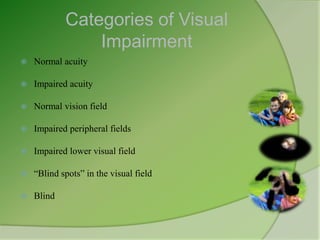
Categories of Visual
                Impairment
   Normal acuity

   Impaired acuity

   Normal vision field

   Impaired peripheral fields

   Impaired lower visual field

   “Blind spots” in the visual field

   Blind
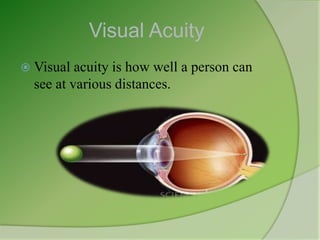
Visual Acuity
 Visual  acuity is how well a person can
  see at various distances.
Activity 1
   Based on the information received, identify
    the different types of visual impairment in
    the pictures below.
Photo Links
 http://heathersanimations.com/children1.
  html
 http://www.kent.gov.uk/adult_social_serv
  ices/your_social_services/services_and
  _support/sensory_disabilities/deafblind_i
  nformation/types_of_visual_impairment.
  aspx

Visual impairment

  • 2.
    Visual Impairment Definition  According to the US Department of Education (2006), Visual Impairment including blindness means an impairment in vision that, even with correction, adversely affects a child’s educational performance. The term includes both partial sight and blindness.(p.1265)
  • 3.
    Blindness Definition  A person, who is blind according to the Centers for Disease Control (2005), has a visual acuity worse than 20/400, with the best possible correction, or visual field of 10 degrees or less. (p.1)
  • 4.
    Low Vision Definition  Corn (1989) stated that low vision is a level of vision, with standard correction hinders an individual in planning and/ or execution of a task, but which permits enhancement of the functional vision through the use of optical or nonoptical devices, environmental modifications and /or techniques. (p.28)
  • 5.
    Legally Blind Definition  The American Foundation for the Blind stated that legally blind is when the central visual acuity of 20/200 or less in the better eye, with best correction, or a diameter of normal field that does not subtend or angle greater than 20 degrees at its widest point. (p.1)
  • 6.
    Visual Efficiency Definition  Visual efficiency- This is how well people can use their sight.  It is influenced by many factors, including the person’s acuity and peripheral vision, environmental conditions and psychological variables.
  • 7.
    Residual Vision  Residual vision – the amount and degree of vision a person has functional use of, despite a visual disability.
  • 8.
    Peripheral Vision  Peripheralvision is the width of a person’s field of vision, or the ability to perceive objects outside of the direct line of vision.  This aspect of vision helps people to move freely through their environment.  It helps them to see large objects and movement.  Severe limitations in peripheral vision is sometimes called tunnel vision or restricted central vision.
  • 9.
    Categories of Visual Impairment  Normal acuity  Impaired acuity  Normal vision field  Impaired peripheral fields  Impaired lower visual field  “Blind spots” in the visual field  Blind
  • 10.
    Visual Acuity  Visual acuity is how well a person can see at various distances.
  • 11.
    Activity 1  Based on the information received, identify the different types of visual impairment in the pictures below.
  • 17.
    Photo Links  http://heathersanimations.com/children1. html  http://www.kent.gov.uk/adult_social_serv ices/your_social_services/services_and _support/sensory_disabilities/deafblind_i nformation/types_of_visual_impairment. aspx