LEARNERS WITH DIFFICULTY
SEEING,HEARING AND
COMMUNICATING
Refers to the ability to distinguish forms
or discriminateamong details.
Legal definitions
associated in
difficulty seeing
Refers to having a visual acuity of 20/200
or less in the better eye with the use of a
correctivelens.
Legal definitions
associated in
difficulty seeing
Those whosevisual acuity in thebetter eye
after correction falls between20/70and
20/200.
Legal definitions
associated in
difficulty seeing
A conditionof having a perceptionof
viewing the world througha narrowtube.
Legal definitions
associated in
difficulty seeing
Visual impairment Havingimpairment in vision that adverselyaffectsa
learner’s educationalperformance.
Total blindness Refersto receivingno useful information throughthe sense
of vision.
Functional blindness Havingso littlevision that one learns primarilythroughthe
tactile and auditory senses.
Learners with difficulty seeing usually perform more
poorly compared to those with normal vision in terms of
cognitive tasks that require comprehension or relating
various kinds of information.
Blindness may also result to delays and deficits in motor
development.
Vision is also important in telling the distance of objects
and direction of movement.
Children with visual impairment may engage in less
play, whichcould affect theirsocial skills development.
Their condition also keeps them from benefitting from
role models due to theirinabilityto observe the.
It is also difficult for them to see and respond to social
signals of others, which reduces opportunities for
reciprocal interaction.
Those with visual impairments are prone to develop
.
These behaviors could place a visually impaired person
at a disadvantage as theymaybe misinterpreted.
Dealing with negative attitudes of sighted people may
pose a challenge to individuals withvisual problems.
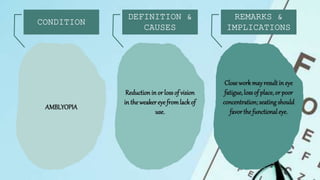
AMBLYOPIA
Reduction in or lossof vision
in theweakereye fromlackof
use.
Close work mayresult in eye
fatigue,lossof place,or poor
concentration;seating should
favorthe functional eye.
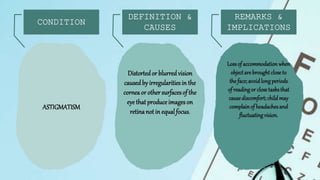
ASTIGMATISM
Distortedor blurredvision
causedby irregularitiesin the
corneaor othersurfacesof the
eye that produce imageson
retinanot in equalfocus.
Lossof accommodationwhen
objectare broughtclose to
theface;avoidlongperiods
of readingor closetasksthat
cause discomfort;childmay
complainof headachesand
fluctuatingvision.
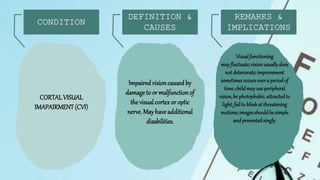
CORTALVISUAL
IMAPAIRMENT(CVI)
Impairedvisioncausedby
damageto or malfunctionof
the visualcortexor optic
nerve.May have additional
disabilities.
Visualfunctioning
may fluctuate;visionusuallydoes
notdeteriorate;improvement
sometimesoccursovera periodof
time;childmay useperipheral
vision,be photophobic,attractedto
light,fail to blinkat threatening
motions;imagesshouldbe simple
andpresentedsingly.
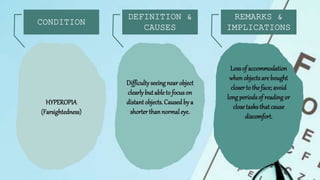
HYPEROPIA
(Farsightedness)
Difficultyseeing near object
clearlybutableto focuson
distant objects.Causedby a
shorterthan normaleye.
Lossof accommodation
whenobjectsare bought
closerto the face; avoid
long periodsof reading or
close tasksthat cause
discomfort.
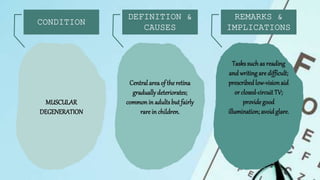
MUSCULAR
DEGENERATION
Central area of the retina
graduallydeteriorates;
common in adultsbutfairly
rare in children.
Taskssuch as reading
and writing are difficult;
prescribedlow-visionaid
or closed-circuit TV;
provide good
illumination; avoidglare.
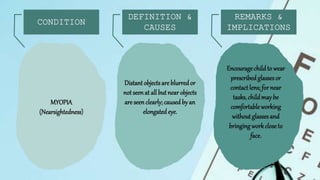
MYOPIA
(Nearsightedness)
Distant objectsare blurredor
not seenat all butnear objects
are seenclearly; causedby an
elongated eye.
Encourage childto wear
prescribedglassesor
contactlens; for near
tasks,childmaybe
comfortable working
without glassesand
bringing workcloseto
face.
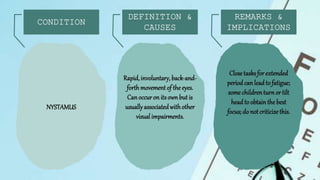
NYSTAMUS
Rapid,involuntary,back-and-
forthmovement of theeyes.
Can occuron itsown butis
usuallyassociatedwithother
visualimpairments.
Close tasksfor extended
periodcan leadto fatigue;
some childrenturnor tilt
head to obtainthe best
focus; do not criticize this.
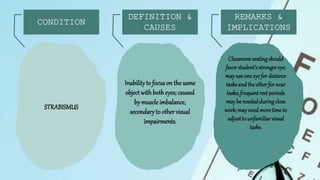
STRABISMUS
Inabilityto focuson the same
object withbotheyes;caused
by muscle imbalance,
secondaryto othervisual
impairments.
Classroomseatingshould
favorstudent’sstrongereye;
may use one eye fordistance
tasksandtheotherfornear
tasks;frequentrestperiods
may be neededduringclose
work;may needmoretimeto
adjustto unfamiliarvisual
tasks.
Thereare numbers of indicators of visual
impairment that parents and teachers
need to be aware of.
• Turning of one’s
eye in or out
• Reddening
eyes/lids
• Excessive
tearing
• Encrusted
eyelids
• Headaches
• Burning or
itching eyes
• Feeling
nauseous/ dizzy
• Blurring vision
Eye appearance
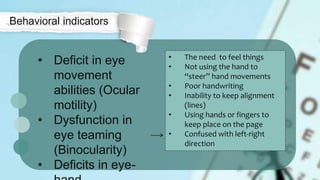
• Deficit in eye
movement
abilities (Ocular
motility)
Behavioral indicators
• Turning of head while
reading across a page
• Losing place during reading
• Short attention span
• Frequent omission of words
• Writing in uphill/downhill
direction
• Unaware rereading or
skipping lines
• Poor page orientation
• Deficit in eye
movement
abilities (Ocular
motility)
• Dysfunction in
eye teaming
(Binocularity)
Behavioral indicators
• Double vision
• Repeating of letter within
words
• Omission of letters/
numbers/phrases
• Misalignment of digits in
columns
• Frequent squinting
• Need to cover/close one eye
• Extreme tilting of head
• Consistent gross postural
deviation
• Deficit in eye
movement
abilities (Ocular
motility)
• Dysfunction in
eye teaming
(Binocularity)
• Deficits in eye-
Behavioral indicators
• The need to feel things
• Not using the hand to
“steer” hand movements
• Poor handwriting
• Inability to keep alignment
(lines)
• Using hands or fingers to
keep place on the page
• Confused with left-right
direction
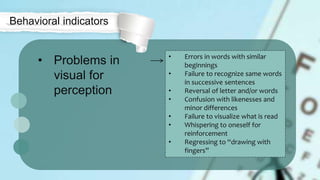
• Problems in
visual for
perception
Behavioral indicators
• Errors in words with similar
beginnings
• Failure to recognize same words
in successive sentences
• Reversal of letter and/or words
• Confusion with likenesses and
minor differences
• Failure to visualize what is read
• Whispering to oneself for
reinforcement
• Regressing to “drawing with
fingers”
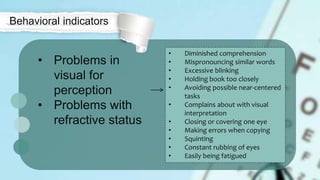
• Problems in
visual for
perception
• Problems with
refractive status
Behavioral indicators
• Diminished comprehension
• Mispronouncing similar words
• Excessive blinking
• Holding book too closely
• Avoiding possible near-centered
tasks
• Complains about with visual
interpretation
• Closing or covering one eye
• Making errors when copying
• Squinting
• Constant rubbing of eyes
• Easily being fatigued
There are also differenttests that
are used to test visual acuity and
visual impairments.
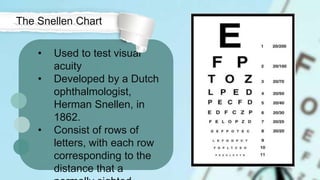
• Used to test visual
acuity
• Developed by a Dutch
ophthalmologist,
Herman Snellen, in
1862.
• Consist of rows of
letters, with each row
corresponding to the
distance that a
The Snellen Chart
• The Vision Services Severity Rating Scale
• Developed by Michigan Department of
Education (2013).
• Assist the Teacher Consultant for Visually
Impaired (TCVI) or Teacher of the Visually
Impaired (TVI) in making recommendations for
services to students who are blind or visually
impaired.
• Intended for use with students in general
education settings
VSSRS
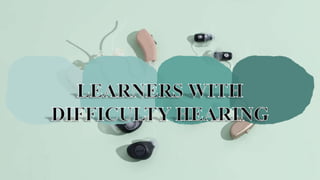
Severe hearing loss in that the learner
is impairedin processing linguistic
informationthrough hearing.
Terms related to
difficulty hearing
Loss in hearing that negativelyaffects
a learner’s educational performance,
otherthanthose that qualify as
deafness.
Terms related to
difficulty hearing
Refers to some sounds perceived by
most deaf people.
However those who are deaf still use
visionas their primary mode of
learning and communication.
Terms related to
difficulty hearing
Those who can use their hearing to
understand speech, generally with the
help of hearing aid.
Terms related to
difficulty hearing
While person-first language is the appropriate
way to refer to individuals with disabilities, people
who identify with the prefer terms
such as Teacher of the Deaf, School for the Deaf,
and Deaf Person.
Decibels(dB) The intensityor loudness of sound.
Zero hearing-thresholdlevel Smallest sound a person withnormal hearing can perceive;
also called .
Hertz(Hz) The frequency, or pitch, of sound.
Most of what we learn in terms of
vocabulary and knowledge of grammar, word
order, idiomatic expressions, and other
aspects of language are acquired through
listening. Thus, learners with difficulty hearing
have smaller vocabularies compared to those
with normal hearing.
They tend to encounter problems in
terms of differentiating questions from
Literacy
• It is common for children who are deaf or
hard of hearing to have atypical speech.
• They also could not hear their own voice.
• There is a tendency for them to speak too
loudly or not loud enough or improper pitch,
stress or inflection.
Speaking
• Students with difficulty hearing usually
perform poorly.
• It is important to note that academic
performance is not equated with
intelligence. Although an individual is deaf,
it does not mean that one has less
cognitive abilities.
Academic Achievement
• Hearing loss may result to feelings of
isolation, having no friends, and
unhappiness in school
• Learners with hearing loss are more likely
to have behavioral difficulties in school and
social situations than those with normal
hearing. Thus, they may experience
feelings of depression, withdrawal, and
Social Functioning
• Students with difficulty hearing usually
perform poorly.
• It is important to note that academic
performance is not equated with
intelligence. Although an individual is deaf,
it does not mean that one has less
cognitive abilities.
Social Functioning

LEARNERS WITH DIFFICULTY SEEING,HEARING AND COMMUNICATING.pptx

  • 1.
  • 4.
    Refers to theability to distinguish forms or discriminateamong details. Legal definitions associated in difficulty seeing
  • 5.
    Refers to havinga visual acuity of 20/200 or less in the better eye with the use of a correctivelens. Legal definitions associated in difficulty seeing
  • 6.
    Those whosevisual acuityin thebetter eye after correction falls between20/70and 20/200. Legal definitions associated in difficulty seeing
  • 7.
    A conditionof havinga perceptionof viewing the world througha narrowtube. Legal definitions associated in difficulty seeing
  • 8.
    Visual impairment Havingimpairmentin vision that adverselyaffectsa learner’s educationalperformance. Total blindness Refersto receivingno useful information throughthe sense of vision. Functional blindness Havingso littlevision that one learns primarilythroughthe tactile and auditory senses.
  • 10.
    Learners with difficultyseeing usually perform more poorly compared to those with normal vision in terms of cognitive tasks that require comprehension or relating various kinds of information.
  • 11.
    Blindness may alsoresult to delays and deficits in motor development. Vision is also important in telling the distance of objects and direction of movement.
  • 12.
    Children with visualimpairment may engage in less play, whichcould affect theirsocial skills development. Their condition also keeps them from benefitting from role models due to theirinabilityto observe the.
  • 13.
    It is alsodifficult for them to see and respond to social signals of others, which reduces opportunities for reciprocal interaction.
  • 14.
    Those with visualimpairments are prone to develop . These behaviors could place a visually impaired person at a disadvantage as theymaybe misinterpreted. Dealing with negative attitudes of sighted people may pose a challenge to individuals withvisual problems.
  • 16.
    AMBLYOPIA Reduction in orlossof vision in theweakereye fromlackof use. Close work mayresult in eye fatigue,lossof place,or poor concentration;seating should favorthe functional eye.
  • 17.
    ASTIGMATISM Distortedor blurredvision causedby irregularitiesinthe corneaor othersurfacesof the eye that produce imageson retinanot in equalfocus. Lossof accommodationwhen objectare broughtclose to theface;avoidlongperiods of readingor closetasksthat cause discomfort;childmay complainof headachesand fluctuatingvision.
  • 18.
    CORTALVISUAL IMAPAIRMENT(CVI) Impairedvisioncausedby damageto or malfunctionof thevisualcortexor optic nerve.May have additional disabilities. Visualfunctioning may fluctuate;visionusuallydoes notdeteriorate;improvement sometimesoccursovera periodof time;childmay useperipheral vision,be photophobic,attractedto light,fail to blinkat threatening motions;imagesshouldbe simple andpresentedsingly.
  • 19.
    HYPEROPIA (Farsightedness) Difficultyseeing near object clearlybutabletofocuson distant objects.Causedby a shorterthan normaleye. Lossof accommodation whenobjectsare bought closerto the face; avoid long periodsof reading or close tasksthat cause discomfort.
  • 20.
    MUSCULAR DEGENERATION Central area ofthe retina graduallydeteriorates; common in adultsbutfairly rare in children. Taskssuch as reading and writing are difficult; prescribedlow-visionaid or closed-circuit TV; provide good illumination; avoidglare.
  • 21.
    MYOPIA (Nearsightedness) Distant objectsare blurredor notseenat all butnear objects are seenclearly; causedby an elongated eye. Encourage childto wear prescribedglassesor contactlens; for near tasks,childmaybe comfortable working without glassesand bringing workcloseto face.
  • 22.
    NYSTAMUS Rapid,involuntary,back-and- forthmovement of theeyes. Canoccuron itsown butis usuallyassociatedwithother visualimpairments. Close tasksfor extended periodcan leadto fatigue; some childrenturnor tilt head to obtainthe best focus; do not criticize this.
  • 23.
    STRABISMUS Inabilityto focuson thesame object withbotheyes;caused by muscle imbalance, secondaryto othervisual impairments. Classroomseatingshould favorstudent’sstrongereye; may use one eye fordistance tasksandtheotherfornear tasks;frequentrestperiods may be neededduringclose work;may needmoretimeto adjustto unfamiliarvisual tasks.
  • 25.
    Thereare numbers ofindicators of visual impairment that parents and teachers need to be aware of.
  • 26.
    • Turning ofone’s eye in or out • Reddening eyes/lids • Excessive tearing • Encrusted eyelids • Headaches • Burning or itching eyes • Feeling nauseous/ dizzy • Blurring vision Eye appearance
  • 27.
    • Deficit ineye movement abilities (Ocular motility) Behavioral indicators • Turning of head while reading across a page • Losing place during reading • Short attention span • Frequent omission of words • Writing in uphill/downhill direction • Unaware rereading or skipping lines • Poor page orientation
  • 28.
    • Deficit ineye movement abilities (Ocular motility) • Dysfunction in eye teaming (Binocularity) Behavioral indicators • Double vision • Repeating of letter within words • Omission of letters/ numbers/phrases • Misalignment of digits in columns • Frequent squinting • Need to cover/close one eye • Extreme tilting of head • Consistent gross postural deviation
  • 29.
    • Deficit ineye movement abilities (Ocular motility) • Dysfunction in eye teaming (Binocularity) • Deficits in eye- Behavioral indicators • The need to feel things • Not using the hand to “steer” hand movements • Poor handwriting • Inability to keep alignment (lines) • Using hands or fingers to keep place on the page • Confused with left-right direction
  • 30.
    • Problems in visualfor perception Behavioral indicators • Errors in words with similar beginnings • Failure to recognize same words in successive sentences • Reversal of letter and/or words • Confusion with likenesses and minor differences • Failure to visualize what is read • Whispering to oneself for reinforcement • Regressing to “drawing with fingers”
  • 31.
    • Problems in visualfor perception • Problems with refractive status Behavioral indicators • Diminished comprehension • Mispronouncing similar words • Excessive blinking • Holding book too closely • Avoiding possible near-centered tasks • Complains about with visual interpretation • Closing or covering one eye • Making errors when copying • Squinting • Constant rubbing of eyes • Easily being fatigued
  • 32.
    There are alsodifferenttests that are used to test visual acuity and visual impairments.
  • 33.
    • Used totest visual acuity • Developed by a Dutch ophthalmologist, Herman Snellen, in 1862. • Consist of rows of letters, with each row corresponding to the distance that a The Snellen Chart
  • 34.
    • The VisionServices Severity Rating Scale • Developed by Michigan Department of Education (2013). • Assist the Teacher Consultant for Visually Impaired (TCVI) or Teacher of the Visually Impaired (TVI) in making recommendations for services to students who are blind or visually impaired. • Intended for use with students in general education settings VSSRS
  • 36.
    Severe hearing lossin that the learner is impairedin processing linguistic informationthrough hearing. Terms related to difficulty hearing
  • 37.
    Loss in hearingthat negativelyaffects a learner’s educational performance, otherthanthose that qualify as deafness. Terms related to difficulty hearing
  • 38.
    Refers to somesounds perceived by most deaf people. However those who are deaf still use visionas their primary mode of learning and communication. Terms related to difficulty hearing
  • 39.
    Those who canuse their hearing to understand speech, generally with the help of hearing aid. Terms related to difficulty hearing
  • 40.
    While person-first languageis the appropriate way to refer to individuals with disabilities, people who identify with the prefer terms such as Teacher of the Deaf, School for the Deaf, and Deaf Person.
  • 41.
    Decibels(dB) The intensityorloudness of sound. Zero hearing-thresholdlevel Smallest sound a person withnormal hearing can perceive; also called . Hertz(Hz) The frequency, or pitch, of sound.
  • 43.
    Most of whatwe learn in terms of vocabulary and knowledge of grammar, word order, idiomatic expressions, and other aspects of language are acquired through listening. Thus, learners with difficulty hearing have smaller vocabularies compared to those with normal hearing. They tend to encounter problems in terms of differentiating questions from Literacy
  • 44.
    • It iscommon for children who are deaf or hard of hearing to have atypical speech. • They also could not hear their own voice. • There is a tendency for them to speak too loudly or not loud enough or improper pitch, stress or inflection. Speaking
  • 45.
    • Students withdifficulty hearing usually perform poorly. • It is important to note that academic performance is not equated with intelligence. Although an individual is deaf, it does not mean that one has less cognitive abilities. Academic Achievement
  • 46.
    • Hearing lossmay result to feelings of isolation, having no friends, and unhappiness in school • Learners with hearing loss are more likely to have behavioral difficulties in school and social situations than those with normal hearing. Thus, they may experience feelings of depression, withdrawal, and Social Functioning
  • 47.
    • Students withdifficulty hearing usually perform poorly. • It is important to note that academic performance is not equated with intelligence. Although an individual is deaf, it does not mean that one has less cognitive abilities. Social Functioning