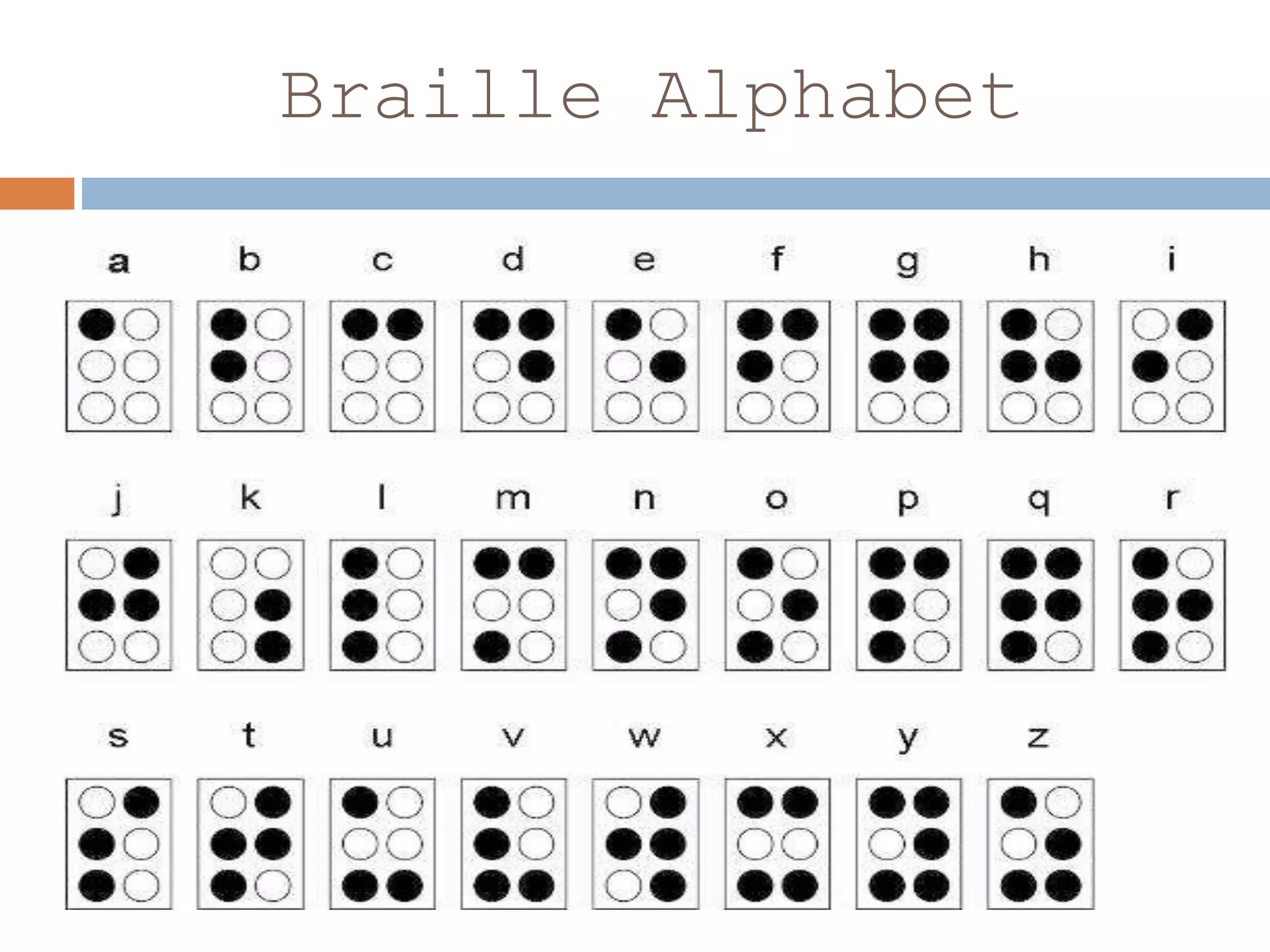
Braille Alphabet
STUDENTS WHO ARE
BLIND OR HAVE LOW
VISION
Ting, Madelaine T.
Yturriaga, Mary Abigail A.
III-10 BS Psychology
Blindness or Low Vision
Blindness can be defined
legally and educationally.
Legal definition based on measurement of:
 Visual acuity, the ability to clearly distinguish forms or
discriminate details at a specific distance.
 Normal vision acuity is measured by reading letters,
numbers, or symbols from a chart 20 feet away.
Example: the Snellen chart
 Legal blindness – condition where visual acuity is
20/200 in the better eye.
 The field of vision refers to the area that normal eyes
cover above, below and on both sides when looking at
the object or when gazing straight ahead.
Normal = approximately a range of 180 degrees.
 Central field of vision – being used when looking
directly at an object.
 Tunnel vision – results from an extremely restricted
field of vision.
Educational definition
 Not all legally blind persons are
totally blind.
 In SpEd, children who are blind are
differentiated from those who have
low vision.
Types and Causes of Problems
of Vision1. Errors of Refraction
 In hyperopia or farsightedness, the lens fails to
focus the light rays from near objects on the retina.
The focus falls behind the retina because the eyes are
too short from front to back. Convex lenses are
prescribed to converge the light rays on the retina to
correct hyperopia.
 In myopia or nearsightedness, the eyes are
abnormally long from front to back and the lens fails to
refract the light rays from distant objects on the retina.
Concave lenses to correct myopia are prescribed to
converge the light rays from far objects on the retina.
 In astigmatism, cornea’s lens is deformed, light
becomes blurred and faulty cylindrical lens is
Hyperopia or Farsightedness
Myopia or Nearsightedness
Astigmatism
2. Imbalance of the eye muscles
 In strabismus, different images are cast on
each retina resulting to cross-eyedness or
squinting.
 Diplopia or double vision results when the
brain cannot fuse the differences in the images
cast on the retina into a single image.
 The condition can be corrected by
prescription lenses, exercises, surgery or a
combination of the three.
 Amblyopia occurs when vision is suppressed
in on eye and it becomes weak or useless.
 Nystagmus is a condition in which there are
rapid involuntary movements of the eyeball
that can result to nausea and vomiting and
dizziness.
3. Diseases of the Eye
 Cataract is caused by the clouding of the lens
which results to progressive blurring of vision
and eventually blindness occur.
Diabetic retinopathy occurs when diabetes
mellitus interfere with the flow of blood to
the retina causing it to degenerate.
 Diseases of the retina, the most sensitive
part of the visual mechanism, can be
congenital or present at birth.
 Retinitis pigmentosa is a hereditary condition
that results in the degeneration of retina.
 Glaucoma is the condition in which there is
excessive pressure in the eye.
4. Traumas or accidents
SPECIAL ADAPTATIONS, AIDS, AND
TECHNOLOGY FOR STUDENTS WHO ARE
BLIND AND WITH LOW VISION
 For Blind Person
Definition Example
1. Braille  is the system of reading
and writing, in which
letters, words, numbers
and others are made
from arrangements
raised by embossed
dots.
 Blind students learn to
read and write in Braille
by using braille like a
typewriter with 6 keys.
Braille
2. Typewriter or
Braille Typewriter
 for
communicatio
n and
handwriting is
taught for them
to sign needed
papers.
Braille Typewriter
3. Manipulative
and Tactile Aids
 are used in
learning
mathematics,
sciences and
social studies.
Cranmer Abacus
4. Technological
Aids (Kurzweil
Personal Reader)
 is a
sophisticated
computer with
an optical
character
recognition
(OPR) system
that scans and
reads via a
synthetic voice
typeset and
other printed
matter.
Kurzweil
Personal Reader
5. Assistive
Technology
 enables blind
person to
access to
 For a person with low vision:
Definition Example
1. Special optical
devices
 to enlarge and
to see regular
prints clearly
Corrective
Eyeglasses
Contact Lenses
2. Large Print  Some books and
other materials are
available in large
print.
3. Classroom
Modification
 providing materials
that would enable
the student to use
vision.
Adjustable Desk
Special Writing Paper
4. Recorded books,
magazines and other
materials
 come with the
synthetic speech
equipment that
plays the tapes at
a faster rate.
Example:
Audio Books
The Education for Students with
Visual Disabilities
 This started during 1960s as a component of
teacher training program for selected public school
teachers. Blind boys and girls with average or better
mental ability were enrolled in regular classes at the
School Division of Pasay City, Manila and the Teacher
Training Department of the then Philippine Normal
College. At present, the Resources for the Blind
Incorporated collaborates with the Department of
Education in training teachers in mainstreaming blind
and low vision students in public schools all over the
country.
 Most children learn visually through the remaining
senses: audition, touch, olfaction, gestation and other
non-visual experience. Blind children receive
With the advent of inclusive education
for children and youth who have disabilities,
more and more students who are blind,
deaf, with mental retardation, or with
orthopedic impairments are enrolled in
regular classes
Rules that can help to make your
student with visual impairment feel
comfortable inside the classroom:
1. Use the words “look” and “see”.
2. Introduce him or her as you would in any of your
students.
3. Include him or her in all class activities.
4. Extend to them the opportunity of being a leader
in class activities.
5. The same disciplinary rules that apply to the rest
of the class should apply as well to the child with
visual impairment.
6. Encourage the blind child to move around the
classroom. (e.g. to get materials or to do certain
activities)
7. Give verbal instructions or oral cues.
8. Provide space to accommodate his or her
special materials.
9. Motivate the seeing classmate to become
interested in topics related to vision and
visual impairment.
10. Your acceptance of the child with visual
impairment will serve as a positive example
to his or her seeing classmates.
11. When approaching the blind student, always
say who you are.
12. The blind student may exhibit certain
mannerisms. Consult the special education
teacher on how to deal with these behaviors.
13. Possible accommodations by area of
disability for students who are blind or have
low vision:

Students Who are Blind or Have Low Vision

  • 1.
  • 2.
    STUDENTS WHO ARE BLINDOR HAVE LOW VISION Ting, Madelaine T. Yturriaga, Mary Abigail A. III-10 BS Psychology
  • 3.
    Blindness or LowVision Blindness can be defined legally and educationally.
  • 4.
    Legal definition basedon measurement of:  Visual acuity, the ability to clearly distinguish forms or discriminate details at a specific distance.  Normal vision acuity is measured by reading letters, numbers, or symbols from a chart 20 feet away. Example: the Snellen chart  Legal blindness – condition where visual acuity is 20/200 in the better eye.  The field of vision refers to the area that normal eyes cover above, below and on both sides when looking at the object or when gazing straight ahead. Normal = approximately a range of 180 degrees.  Central field of vision – being used when looking directly at an object.  Tunnel vision – results from an extremely restricted field of vision.
  • 5.
    Educational definition  Notall legally blind persons are totally blind.  In SpEd, children who are blind are differentiated from those who have low vision.
  • 6.
    Types and Causesof Problems of Vision1. Errors of Refraction  In hyperopia or farsightedness, the lens fails to focus the light rays from near objects on the retina. The focus falls behind the retina because the eyes are too short from front to back. Convex lenses are prescribed to converge the light rays on the retina to correct hyperopia.  In myopia or nearsightedness, the eyes are abnormally long from front to back and the lens fails to refract the light rays from distant objects on the retina. Concave lenses to correct myopia are prescribed to converge the light rays from far objects on the retina.  In astigmatism, cornea’s lens is deformed, light becomes blurred and faulty cylindrical lens is
  • 7.
  • 8.
  • 9.
  • 10.
    2. Imbalance ofthe eye muscles  In strabismus, different images are cast on each retina resulting to cross-eyedness or squinting.
  • 11.
     Diplopia ordouble vision results when the brain cannot fuse the differences in the images cast on the retina into a single image.  The condition can be corrected by prescription lenses, exercises, surgery or a combination of the three.
  • 12.
     Amblyopia occurswhen vision is suppressed in on eye and it becomes weak or useless.  Nystagmus is a condition in which there are rapid involuntary movements of the eyeball that can result to nausea and vomiting and dizziness.
  • 13.
    3. Diseases ofthe Eye  Cataract is caused by the clouding of the lens which results to progressive blurring of vision and eventually blindness occur.
  • 14.
    Diabetic retinopathy occurswhen diabetes mellitus interfere with the flow of blood to the retina causing it to degenerate.
  • 15.
     Diseases ofthe retina, the most sensitive part of the visual mechanism, can be congenital or present at birth.
  • 16.
     Retinitis pigmentosais a hereditary condition that results in the degeneration of retina.
  • 17.
     Glaucoma isthe condition in which there is excessive pressure in the eye. 4. Traumas or accidents
  • 18.
    SPECIAL ADAPTATIONS, AIDS,AND TECHNOLOGY FOR STUDENTS WHO ARE BLIND AND WITH LOW VISION  For Blind Person Definition Example 1. Braille  is the system of reading and writing, in which letters, words, numbers and others are made from arrangements raised by embossed dots.  Blind students learn to read and write in Braille by using braille like a typewriter with 6 keys. Braille
  • 19.
    2. Typewriter or BrailleTypewriter  for communicatio n and handwriting is taught for them to sign needed papers. Braille Typewriter 3. Manipulative and Tactile Aids  are used in learning mathematics, sciences and social studies. Cranmer Abacus
  • 20.
    4. Technological Aids (Kurzweil PersonalReader)  is a sophisticated computer with an optical character recognition (OPR) system that scans and reads via a synthetic voice typeset and other printed matter. Kurzweil Personal Reader 5. Assistive Technology  enables blind person to access to
  • 21.
     For aperson with low vision: Definition Example 1. Special optical devices  to enlarge and to see regular prints clearly Corrective Eyeglasses Contact Lenses
  • 22.
    2. Large Print Some books and other materials are available in large print. 3. Classroom Modification  providing materials that would enable the student to use vision. Adjustable Desk Special Writing Paper
  • 23.
    4. Recorded books, magazinesand other materials  come with the synthetic speech equipment that plays the tapes at a faster rate. Example: Audio Books
  • 24.
    The Education forStudents with Visual Disabilities  This started during 1960s as a component of teacher training program for selected public school teachers. Blind boys and girls with average or better mental ability were enrolled in regular classes at the School Division of Pasay City, Manila and the Teacher Training Department of the then Philippine Normal College. At present, the Resources for the Blind Incorporated collaborates with the Department of Education in training teachers in mainstreaming blind and low vision students in public schools all over the country.  Most children learn visually through the remaining senses: audition, touch, olfaction, gestation and other non-visual experience. Blind children receive
  • 25.
    With the adventof inclusive education for children and youth who have disabilities, more and more students who are blind, deaf, with mental retardation, or with orthopedic impairments are enrolled in regular classes
  • 26.
    Rules that canhelp to make your student with visual impairment feel comfortable inside the classroom: 1. Use the words “look” and “see”. 2. Introduce him or her as you would in any of your students. 3. Include him or her in all class activities. 4. Extend to them the opportunity of being a leader in class activities. 5. The same disciplinary rules that apply to the rest of the class should apply as well to the child with visual impairment. 6. Encourage the blind child to move around the classroom. (e.g. to get materials or to do certain activities) 7. Give verbal instructions or oral cues.
  • 27.
    8. Provide spaceto accommodate his or her special materials. 9. Motivate the seeing classmate to become interested in topics related to vision and visual impairment. 10. Your acceptance of the child with visual impairment will serve as a positive example to his or her seeing classmates. 11. When approaching the blind student, always say who you are. 12. The blind student may exhibit certain mannerisms. Consult the special education teacher on how to deal with these behaviors.
  • 28.
    13. Possible accommodationsby area of disability for students who are blind or have low vision: