Low Vision and Blindness Lois Gumataotao and Gladys Uy ED 443G: Assistive and Adaptive Technology November 5, 2008 Dr. Jacqui Cyrus
Objectives 1.  Be able to divide visual disabilities into two functional subgroups 2.  Discuss ways to accommodate the general education setting for students with visual disabilities 3.  Describe types of assistive technology that benefit people with visual disabilities at school, in the workplace and in independent living.
IDEA Definition ...means an impairment in vision that, even with correction, adversely affects a child’s educational performance.  The term includes both partial sight and blindness.
Two functional Subgroups  Low vision   is also called partial sight. Sight that cannot be satisfactorily corrected with glasses, contacts, or surgery.  2.  Blindness or being legally blind   is
the permanent loss of sight in both eyes, with a corrected visual acuity worse than 20/200 in both eyes or a field of vision less than 20 degrees in both eyes.

Types of Visual Loss  Activity 1: Tunnel Vision Peripheral Vision Temporary Blindness
Peripheral vision: vision from the sides of your eyes Tunnel vision: vision that is directly  In front of you
Prevalence/Incidence Nationally: 1.3 million Americans are legally blind 10 million have low vision About 23,973 students between ages 6-17 receive SPED because of low vision or blindness Locally: GPSS is servicing 10 students that are legally blind or have visual inpairments for SY 08-09
Signs of Visual Problems Appearance of the eyes: Excessively watery Are red or continually inflamed Appear crusty Are swollen Problems with School Work: The student has difficulty: Reading small print Identifying details in pictures Difficulty distinguishing letters
Causes and Prevention Causes: Prenatal factors…heredity…accidents Treatments: Laser treatment, surgery, corneal implants Prevention: Wear protective eye gear Eat vegetables high in Vitamin A
Activity 2 Due to vision loss, our other senses are enhanced. Listen to the following sounds and try to identify them. Identify the items in the bags through your sense of touch and smell
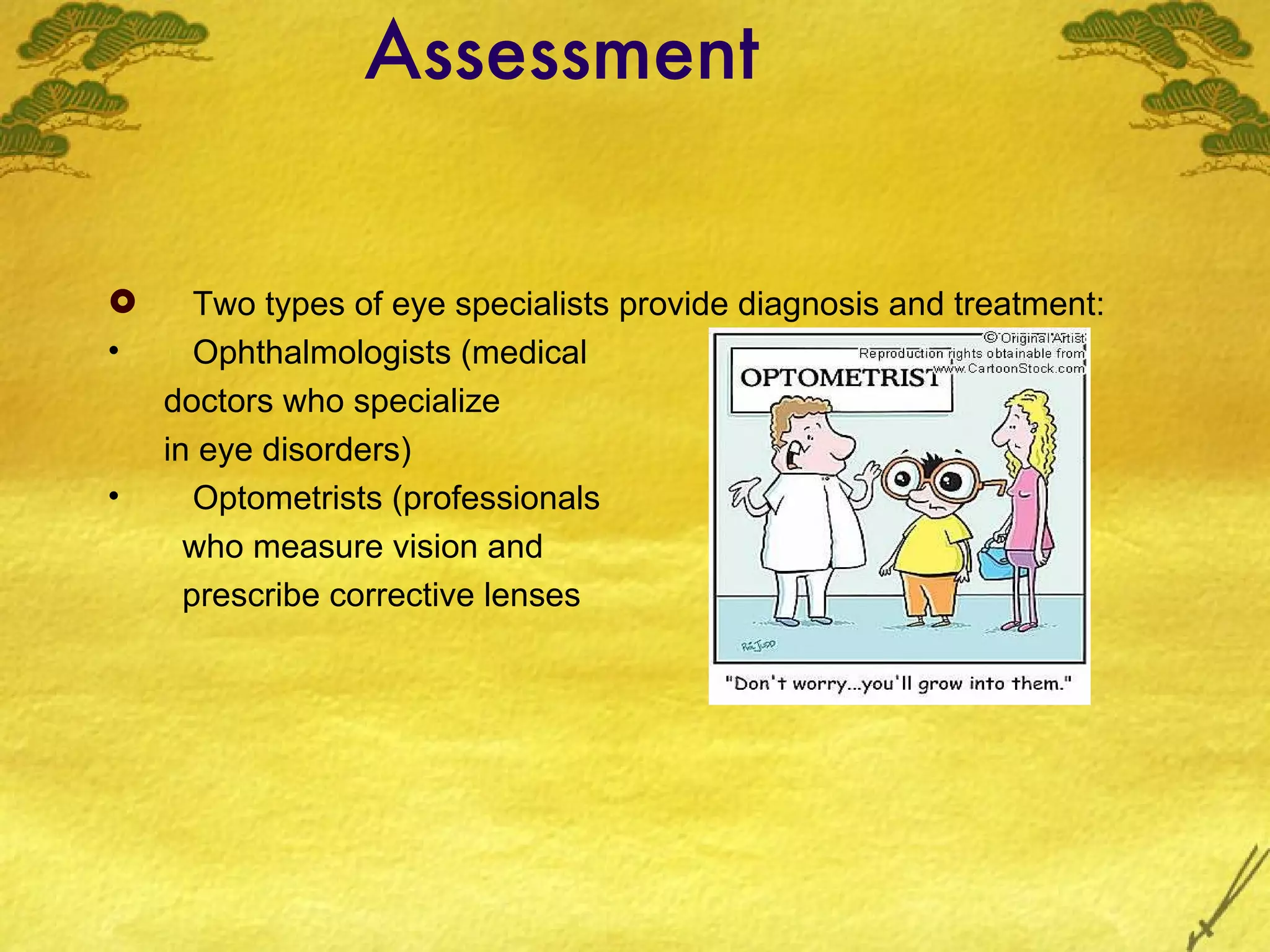
Assessment Two types of eye specialists provide diagnosis and treatment: Ophthalmologists (medical  doctors who specialize  in eye disorders) Optometrists (professionals  who measure vision and  prescribe corrective lenses
Early Intervention Ophthalmologist Occupational therapist Physical therapist Orientation and mobility instructor Social worker
Teaching Tips Understand the child’s visual functioning capabilities Learn the child’s nonverbal cues indicating interest Identify visual features that enhance the child’s visual functions (color, contrast, size)
Accommodating for Inclusive Environments  Making the Classroom safe : Open or close the doors fully Eliminate clutter from the room, especially from the aisles and movement paths Don’t leave the room without telling the student. Supplement Instruction : Prepare enlarge-print or braille handouts, summarizing key points Audio recorded lectures
Jason Cruz’s  bio/ infomercial
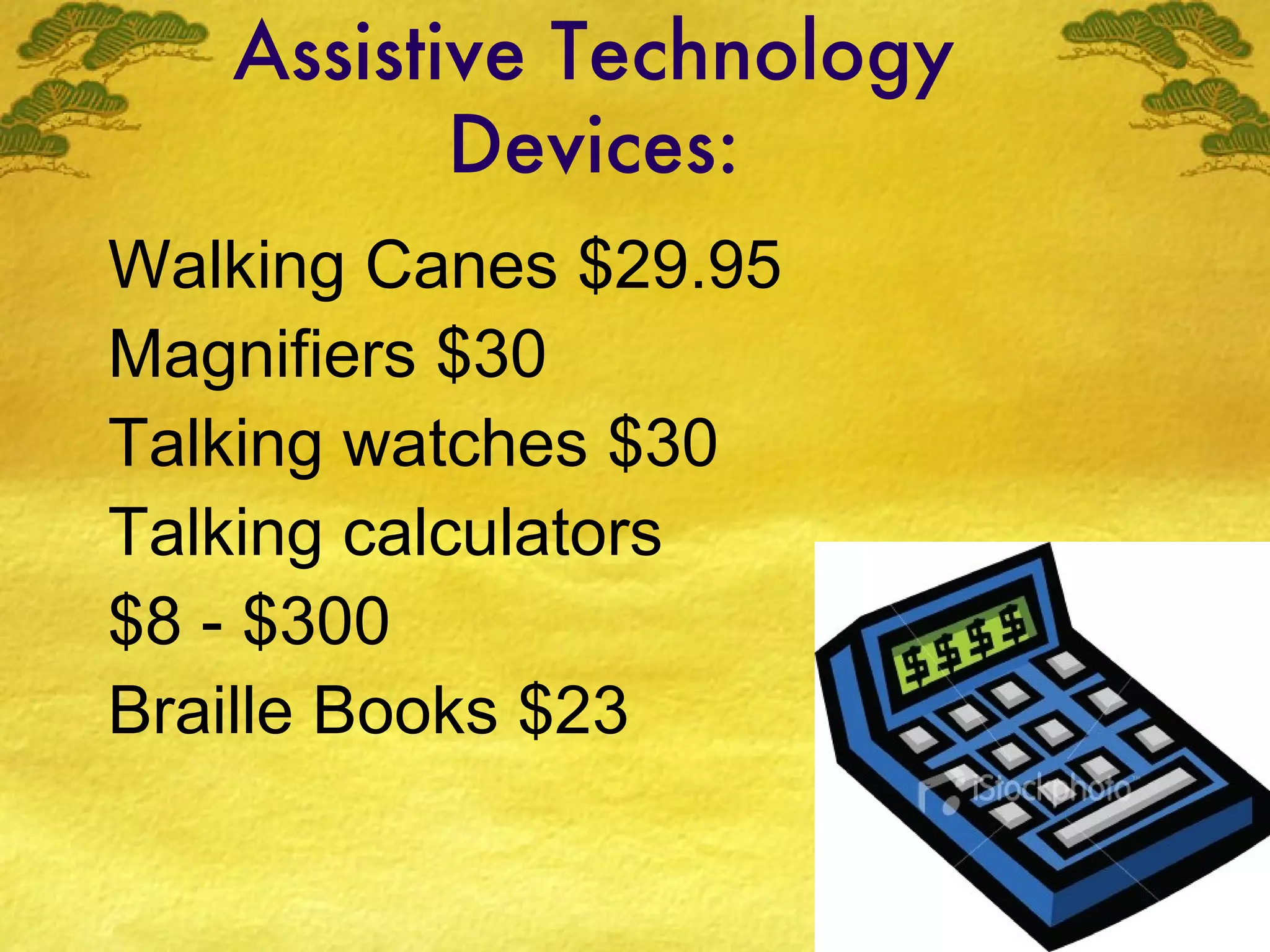
Assistive Technology Devices: Walking Canes $29.95 Magnifiers $30 Talking watches $30 Talking calculators $8 - $300 Braille Books $23
Magnifiers:  The Rainbow Pro allows visually impaired people to view documents, photos, and three- dimensional objects otherwise too small for them to see. The Rainbow Pro displays the items in full color with a zoom lens for magnification control . $3195 Braille Books
Transition Postsecondary Options: Begin the search for the right college program Register for classes as early as possible Contact readers, locate assistive devices and arrange for accommodations Stay in close communication with faculty Transition to work: Community employment during high school Internships in real work settings during high school
Collaboration Teachers should collaborate with the same professionals as in early intervention  processes.  They are experts in their fields and are able to assist for effective instruction.
Youtube 12 year old blind boy plays football http://www.youtube.com/watch?v=7Ycdpxu51OA
References Smith, Deborah (2007), Introduction to Special Education: Making a Difference 6th Edition. Pearson Education, Inc. Youtube http://www.youtube.com/watch?v=7Ycdpxu51OA http://www.elmhurst.edu/~chm/vchembook/532vitaminA.html Mr.Jason Cruz www.order-discount-contact-lens-online.com/discount-contact-lens-glossary.htm www.insurance-journal.ca/tables/04_05mayL1.asp http://www.fashionablecanes.com/blindstick.htm http://www.abledata.com/abledata.cfm?pageid=19327&top=15480&productid=78692&trail=0&discontinued=0
Thought Provoking Questions If a blind student refuses an auditory/oral test and insists on a braille one, yet you have no materials, what would you do? What kind of classroom rules would you implement if you had all visually impaired or blind students?  How would you teach a blind student if the parent refuses special education?

Dr.Cyrus

  • 1.
    Low Vision andBlindness Lois Gumataotao and Gladys Uy ED 443G: Assistive and Adaptive Technology November 5, 2008 Dr. Jacqui Cyrus
  • 2.
    Objectives 1. Be able to divide visual disabilities into two functional subgroups 2. Discuss ways to accommodate the general education setting for students with visual disabilities 3. Describe types of assistive technology that benefit people with visual disabilities at school, in the workplace and in independent living.
  • 3.
    IDEA Definition ...meansan impairment in vision that, even with correction, adversely affects a child’s educational performance. The term includes both partial sight and blindness.
  • 4.
    Two functional Subgroups Low vision is also called partial sight. Sight that cannot be satisfactorily corrected with glasses, contacts, or surgery. 2. Blindness or being legally blind is
the permanent loss of sight in both eyes, with a corrected visual acuity worse than 20/200 in both eyes or a field of vision less than 20 degrees in both eyes.

  • 5.
    Types of VisualLoss Activity 1: Tunnel Vision Peripheral Vision Temporary Blindness
  • 6.
    Peripheral vision: visionfrom the sides of your eyes Tunnel vision: vision that is directly In front of you
  • 7.
    Prevalence/Incidence Nationally: 1.3million Americans are legally blind 10 million have low vision About 23,973 students between ages 6-17 receive SPED because of low vision or blindness Locally: GPSS is servicing 10 students that are legally blind or have visual inpairments for SY 08-09
  • 8.
    Signs of VisualProblems Appearance of the eyes: Excessively watery Are red or continually inflamed Appear crusty Are swollen Problems with School Work: The student has difficulty: Reading small print Identifying details in pictures Difficulty distinguishing letters
  • 9.
    Causes and PreventionCauses: Prenatal factors…heredity…accidents Treatments: Laser treatment, surgery, corneal implants Prevention: Wear protective eye gear Eat vegetables high in Vitamin A
  • 10.
    Activity 2 Dueto vision loss, our other senses are enhanced. Listen to the following sounds and try to identify them. Identify the items in the bags through your sense of touch and smell
  • 11.
    Assessment Two typesof eye specialists provide diagnosis and treatment: Ophthalmologists (medical doctors who specialize in eye disorders) Optometrists (professionals who measure vision and prescribe corrective lenses
  • 12.
    Early Intervention OphthalmologistOccupational therapist Physical therapist Orientation and mobility instructor Social worker
  • 13.
    Teaching Tips Understandthe child’s visual functioning capabilities Learn the child’s nonverbal cues indicating interest Identify visual features that enhance the child’s visual functions (color, contrast, size)
  • 14.
    Accommodating for InclusiveEnvironments Making the Classroom safe : Open or close the doors fully Eliminate clutter from the room, especially from the aisles and movement paths Don’t leave the room without telling the student. Supplement Instruction : Prepare enlarge-print or braille handouts, summarizing key points Audio recorded lectures
  • 15.
    Jason Cruz’s bio/ infomercial
  • 16.
    Assistive Technology Devices:Walking Canes $29.95 Magnifiers $30 Talking watches $30 Talking calculators $8 - $300 Braille Books $23
  • 17.
    Magnifiers: TheRainbow Pro allows visually impaired people to view documents, photos, and three- dimensional objects otherwise too small for them to see. The Rainbow Pro displays the items in full color with a zoom lens for magnification control . $3195 Braille Books
  • 18.
    Transition Postsecondary Options:Begin the search for the right college program Register for classes as early as possible Contact readers, locate assistive devices and arrange for accommodations Stay in close communication with faculty Transition to work: Community employment during high school Internships in real work settings during high school
  • 19.
    Collaboration Teachers shouldcollaborate with the same professionals as in early intervention processes. They are experts in their fields and are able to assist for effective instruction.
  • 20.
    Youtube 12 yearold blind boy plays football http://www.youtube.com/watch?v=7Ycdpxu51OA
  • 21.
    References Smith, Deborah(2007), Introduction to Special Education: Making a Difference 6th Edition. Pearson Education, Inc. Youtube http://www.youtube.com/watch?v=7Ycdpxu51OA http://www.elmhurst.edu/~chm/vchembook/532vitaminA.html Mr.Jason Cruz www.order-discount-contact-lens-online.com/discount-contact-lens-glossary.htm www.insurance-journal.ca/tables/04_05mayL1.asp http://www.fashionablecanes.com/blindstick.htm http://www.abledata.com/abledata.cfm?pageid=19327&top=15480&productid=78692&trail=0&discontinued=0
  • 22.
    Thought Provoking QuestionsIf a blind student refuses an auditory/oral test and insists on a braille one, yet you have no materials, what would you do? What kind of classroom rules would you implement if you had all visually impaired or blind students? How would you teach a blind student if the parent refuses special education?