BY: Matt JonesVisual Dictionary
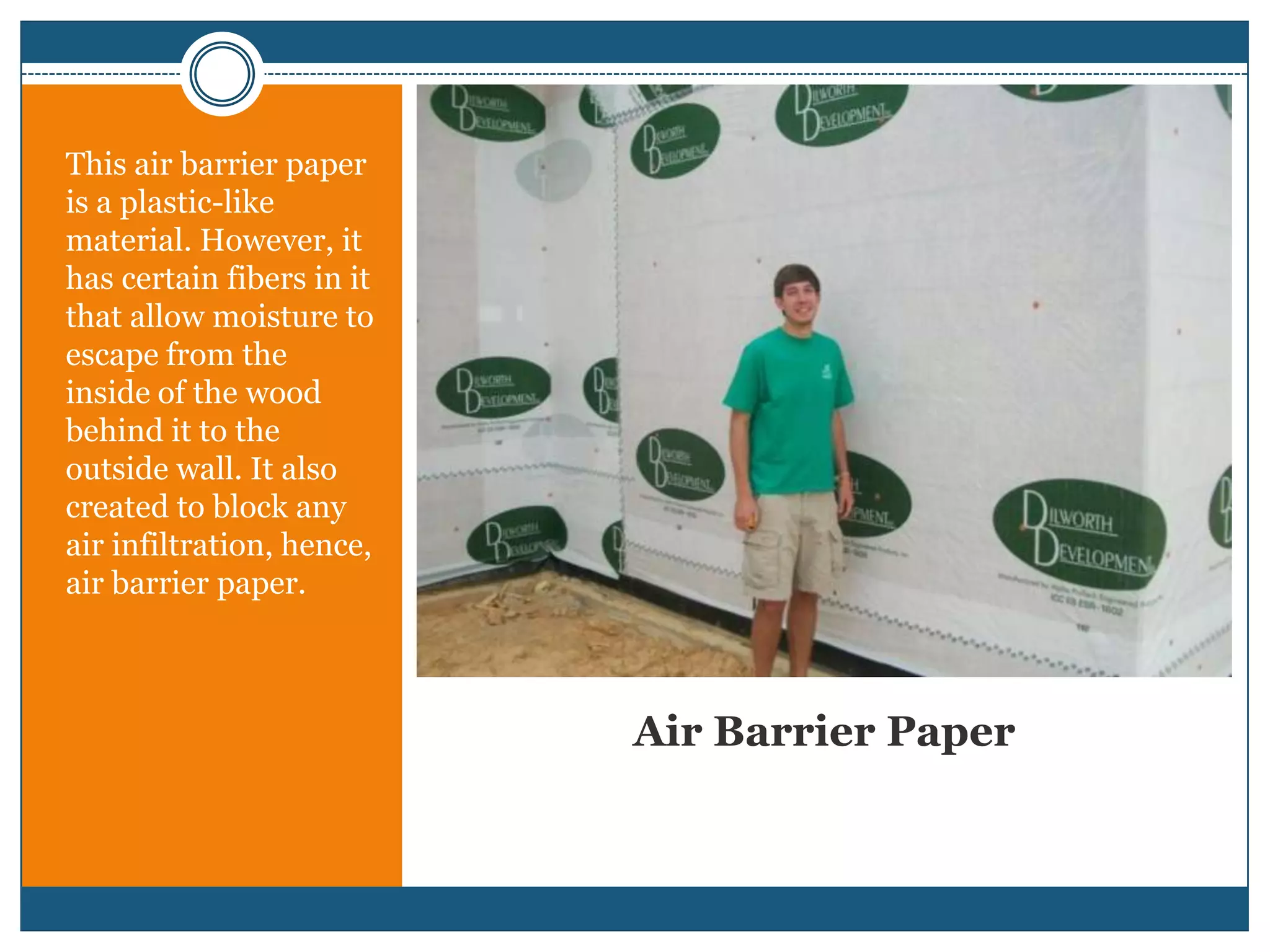
Air Barrier PaperThis air barrier paper is a plastic-like material. However, it has certain fibers in it that allow moisture to escape from the inside of the wood behind it to the outside wall. It also created to block any air infiltration, hence, air barrier paper.
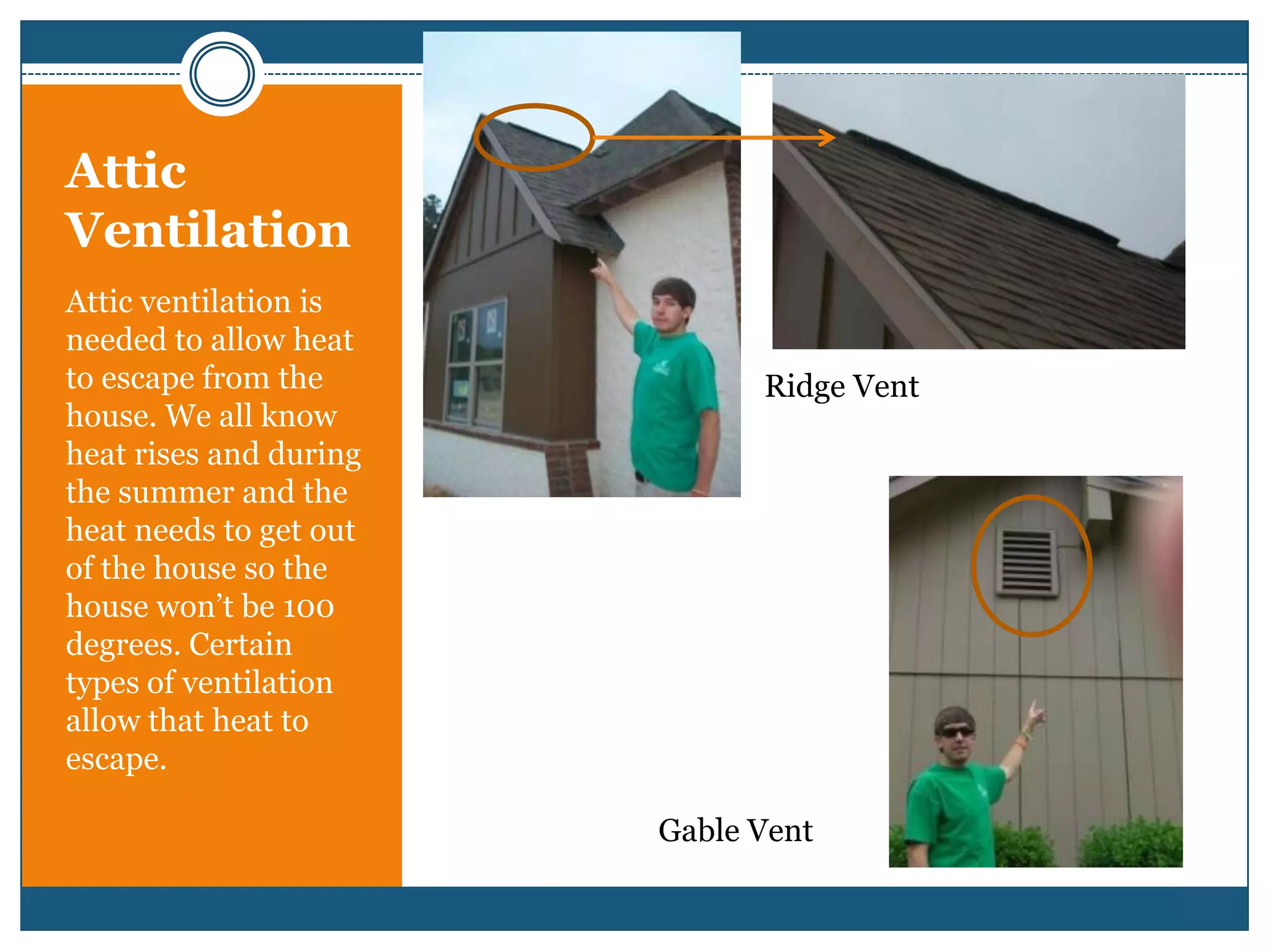
Attic VentilationAttic ventilation is needed to allow heat to escape from the house. We all know heat rises and during the summer and the heat needs to get out of the house so the house won’t be 100 degrees. Certain types of ventilation allow that heat to escape.Ridge VentGable Vent
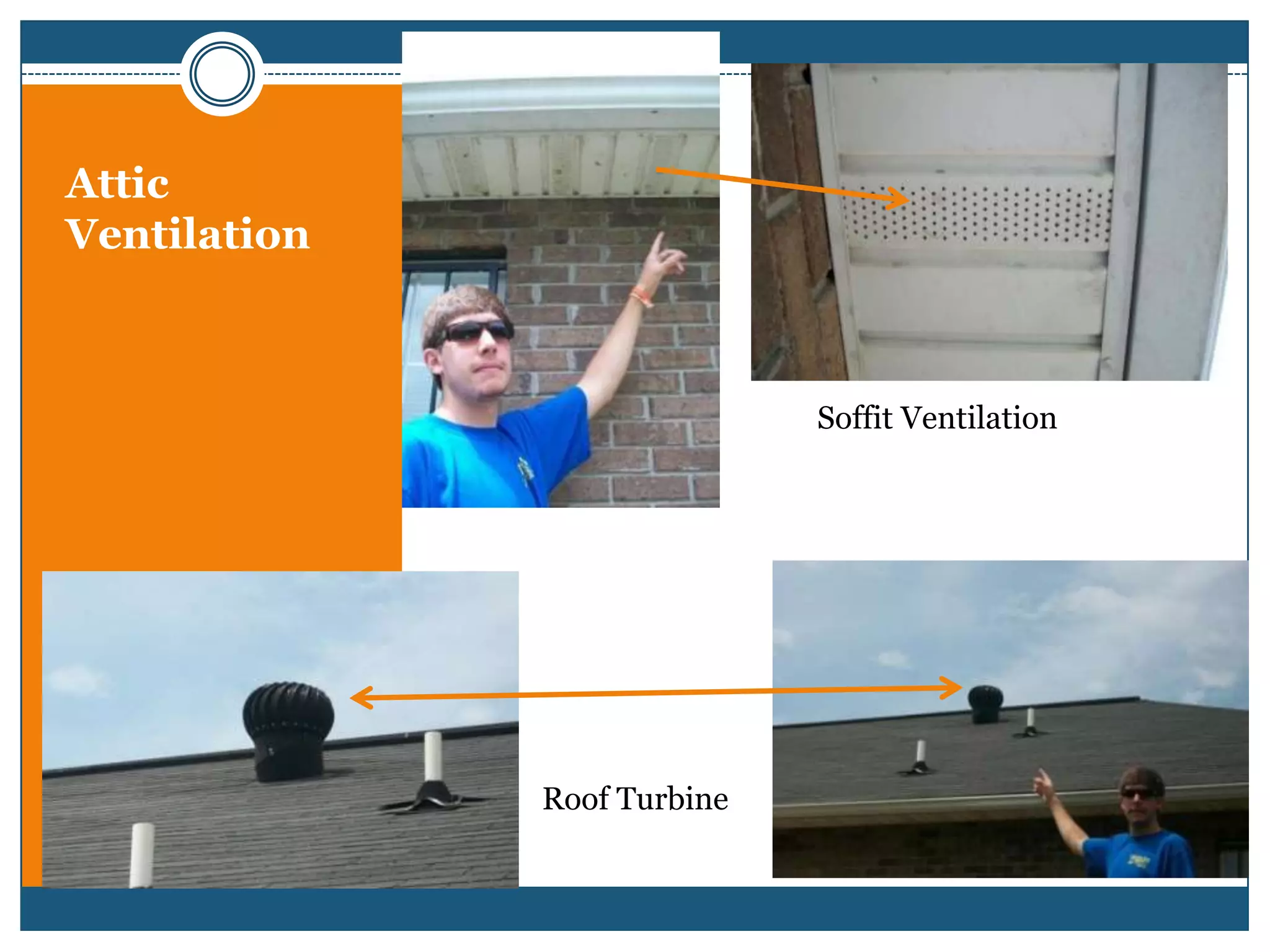
Attic VentilationSoffit VentilationRoof Turbine
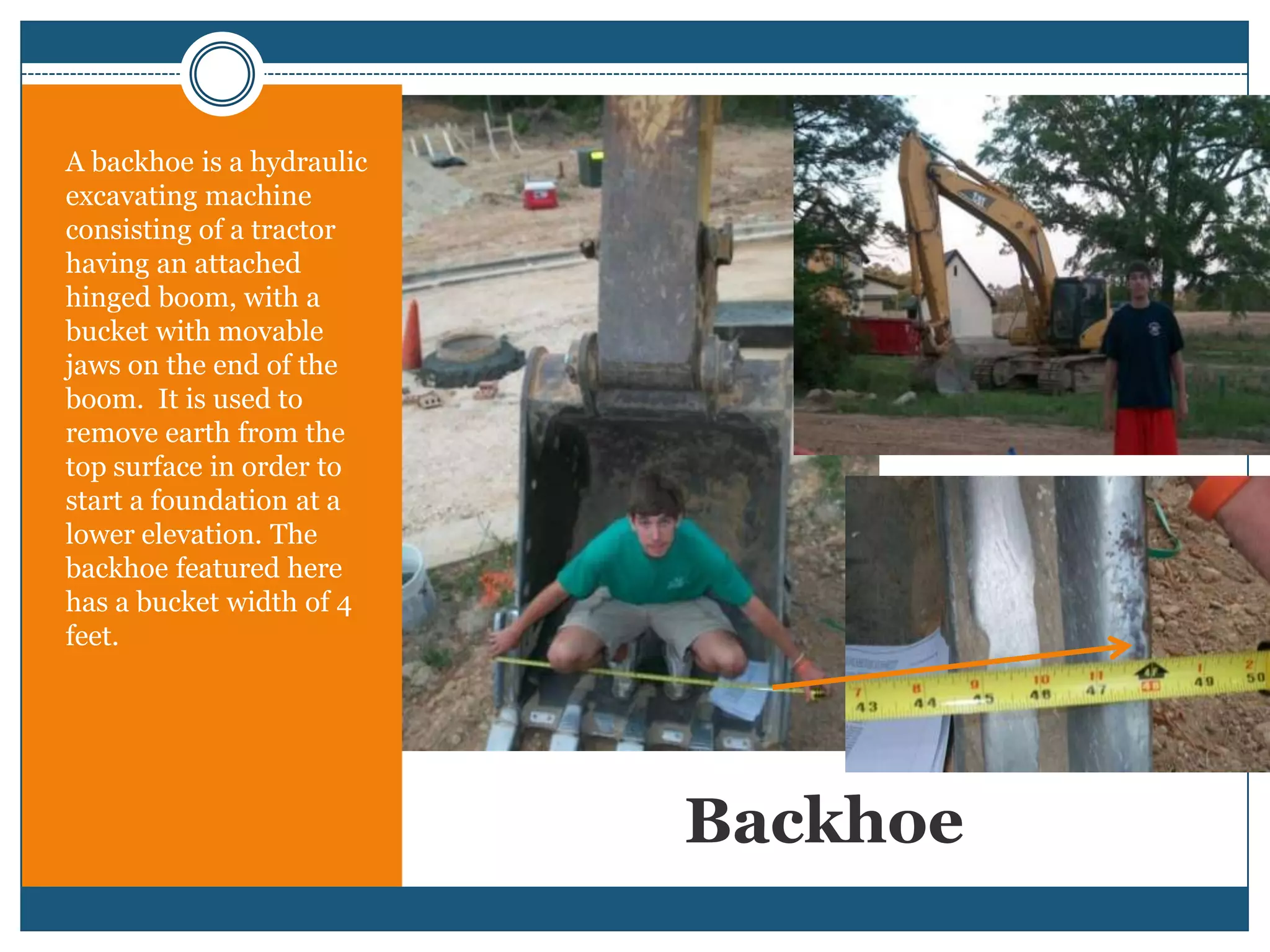
BackhoeA backhoe is a hydraulic excavating machine consisting of a tractor having an attached hinged boom, with a bucket with movable jaws on the end of the boom.  It is used to remove earth from the top surface in order to start a foundation at a lower elevation. The backhoe featured here has a bucket width of 4 feet.
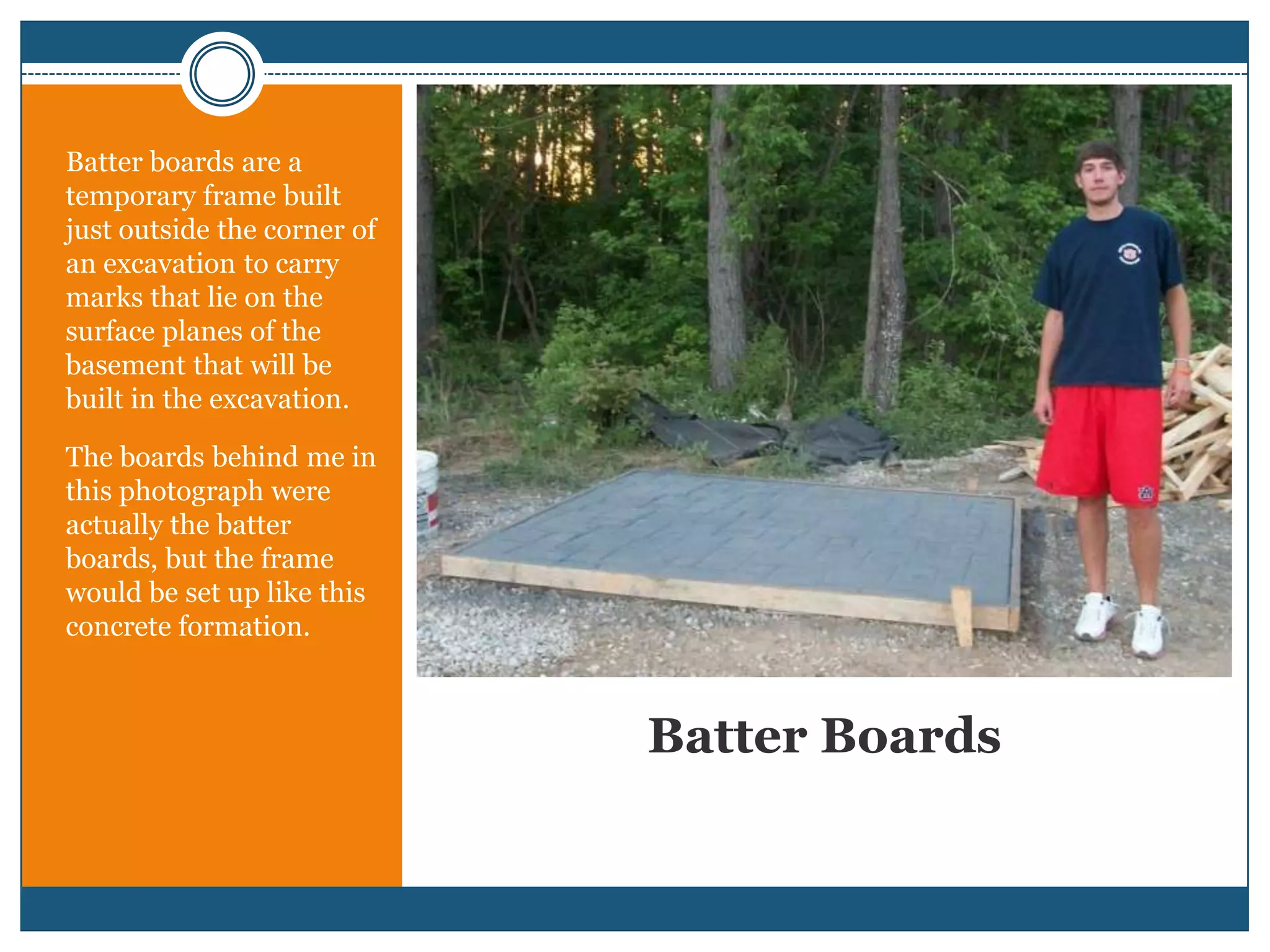
Batter BoardsBatter boards are a temporary frame built just outside the corner of an excavation to carry marks that lie on the surface planes of the basement that will be built in the excavation.The boards behind me in this photograph were actually the batter boards, but the frame would be set up like this concrete formation.
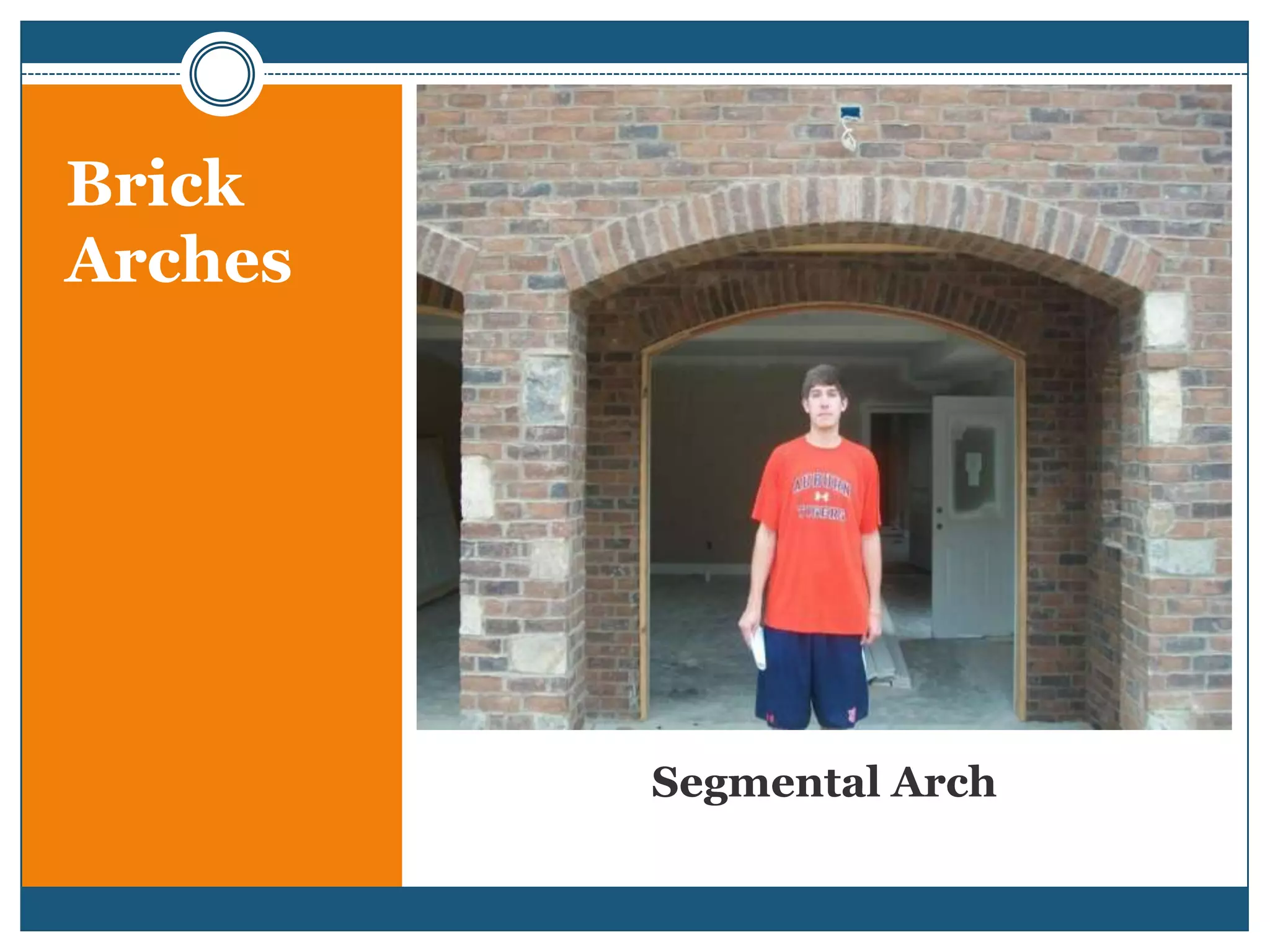
Segmental ArchBrick Arches
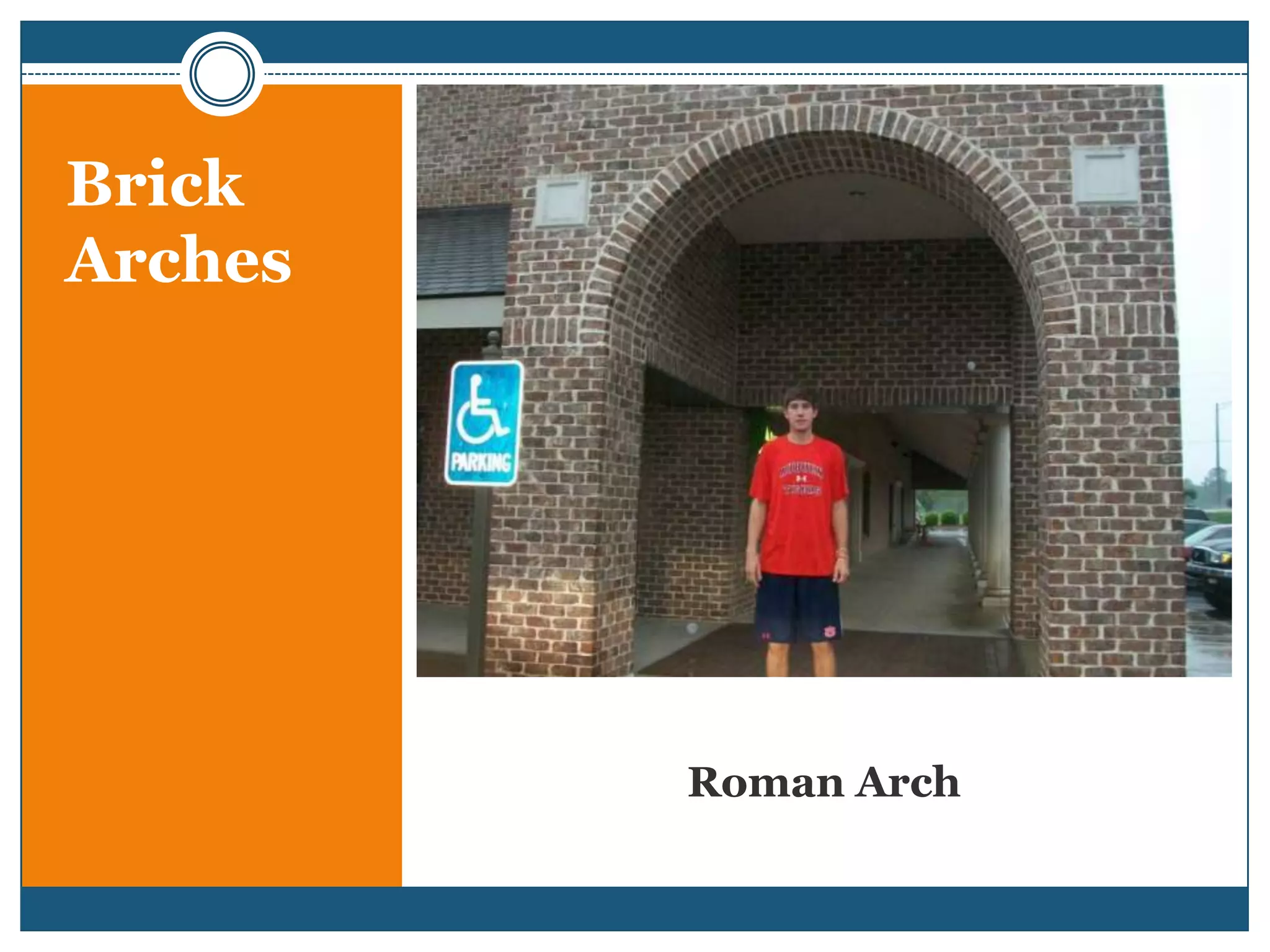
Roman ArchBrick Arches
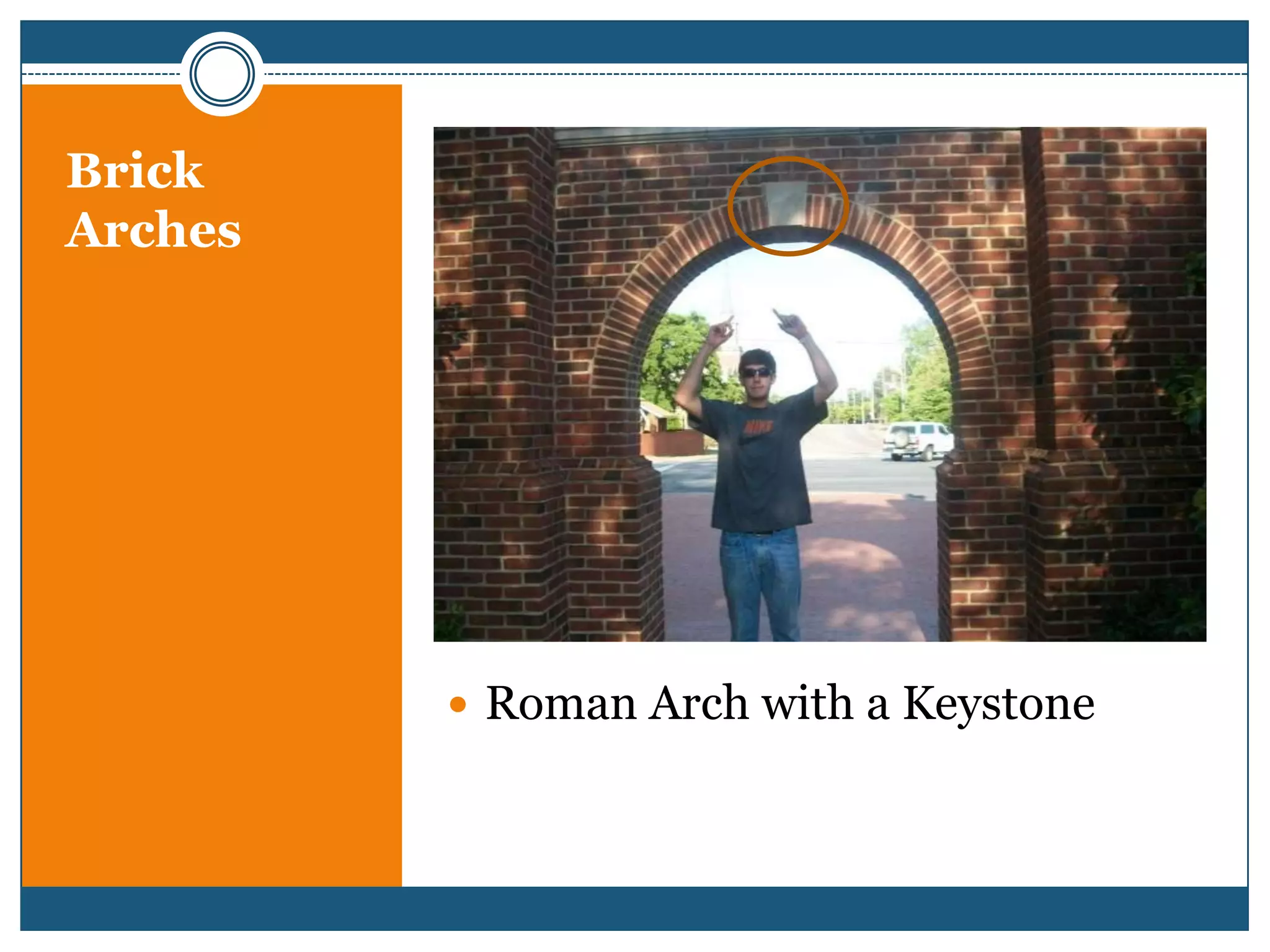
Brick ArchesRoman Arch with a Keystone
Brick BondsFlemish BondThe courses alternate between stretchers and headers
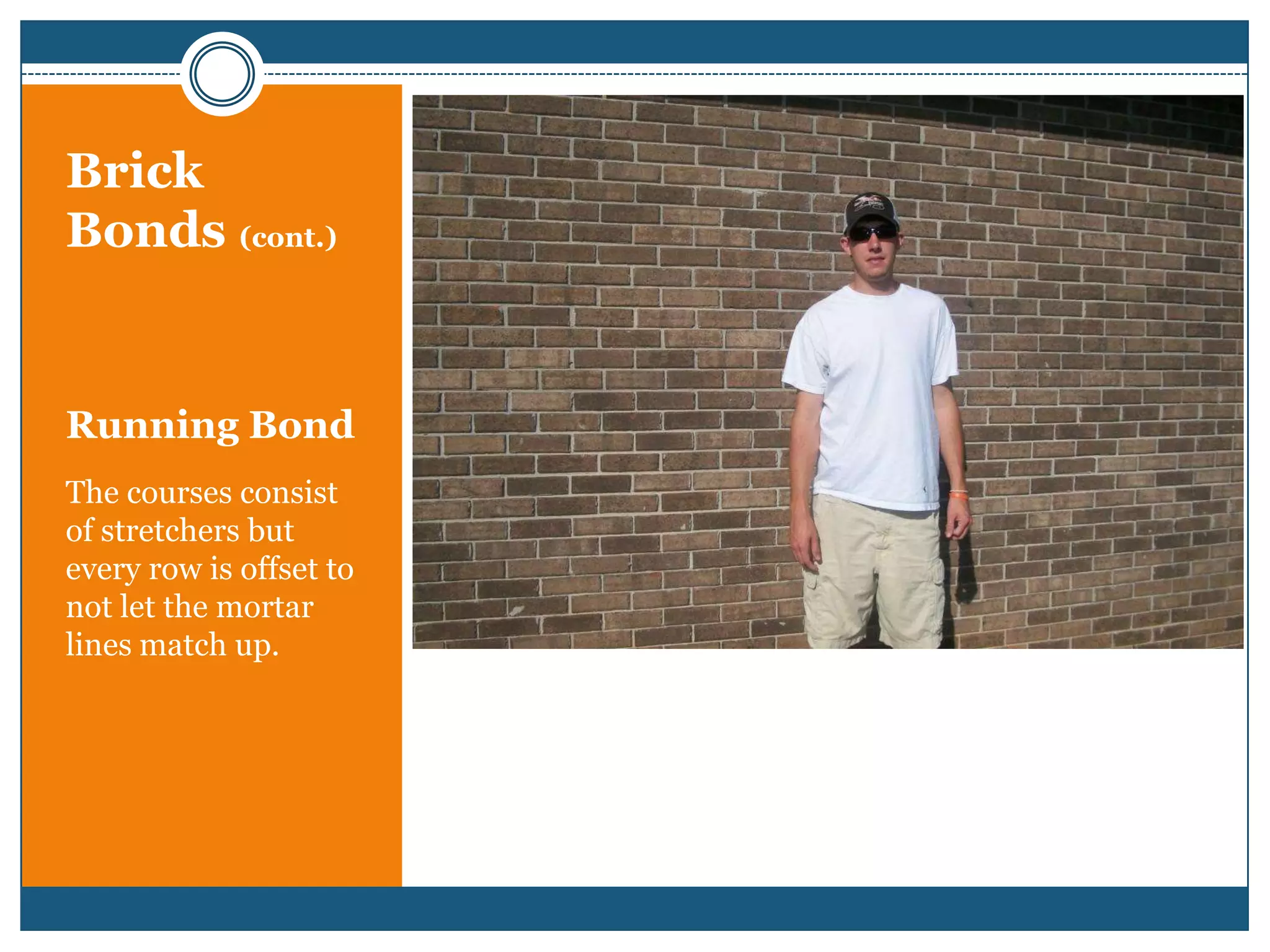
Brick Bonds (cont.)Running BondThe courses consist of stretchers but every row is offset to not let the mortar lines match up.
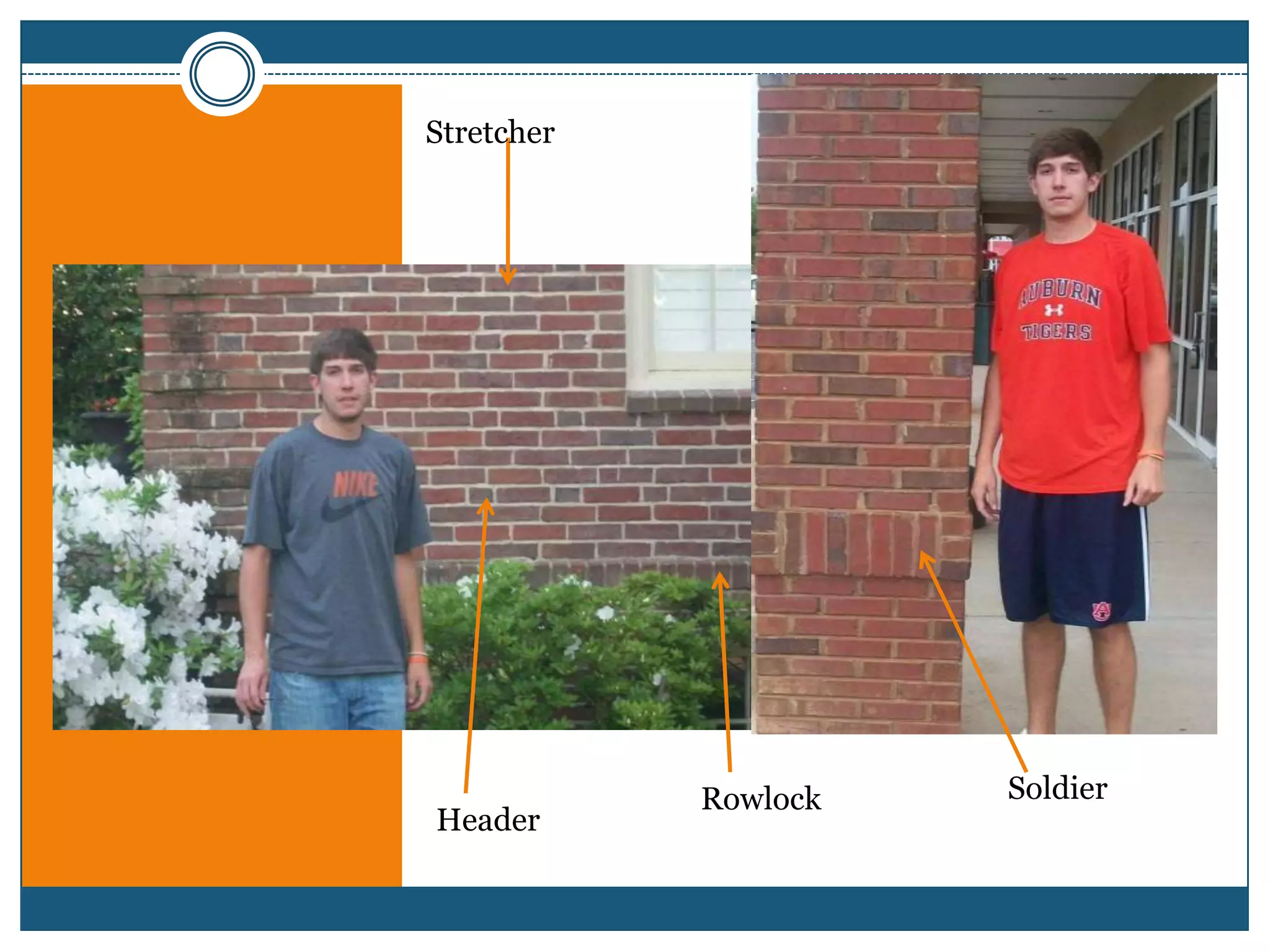
StretcherSoldierRowlockHeader
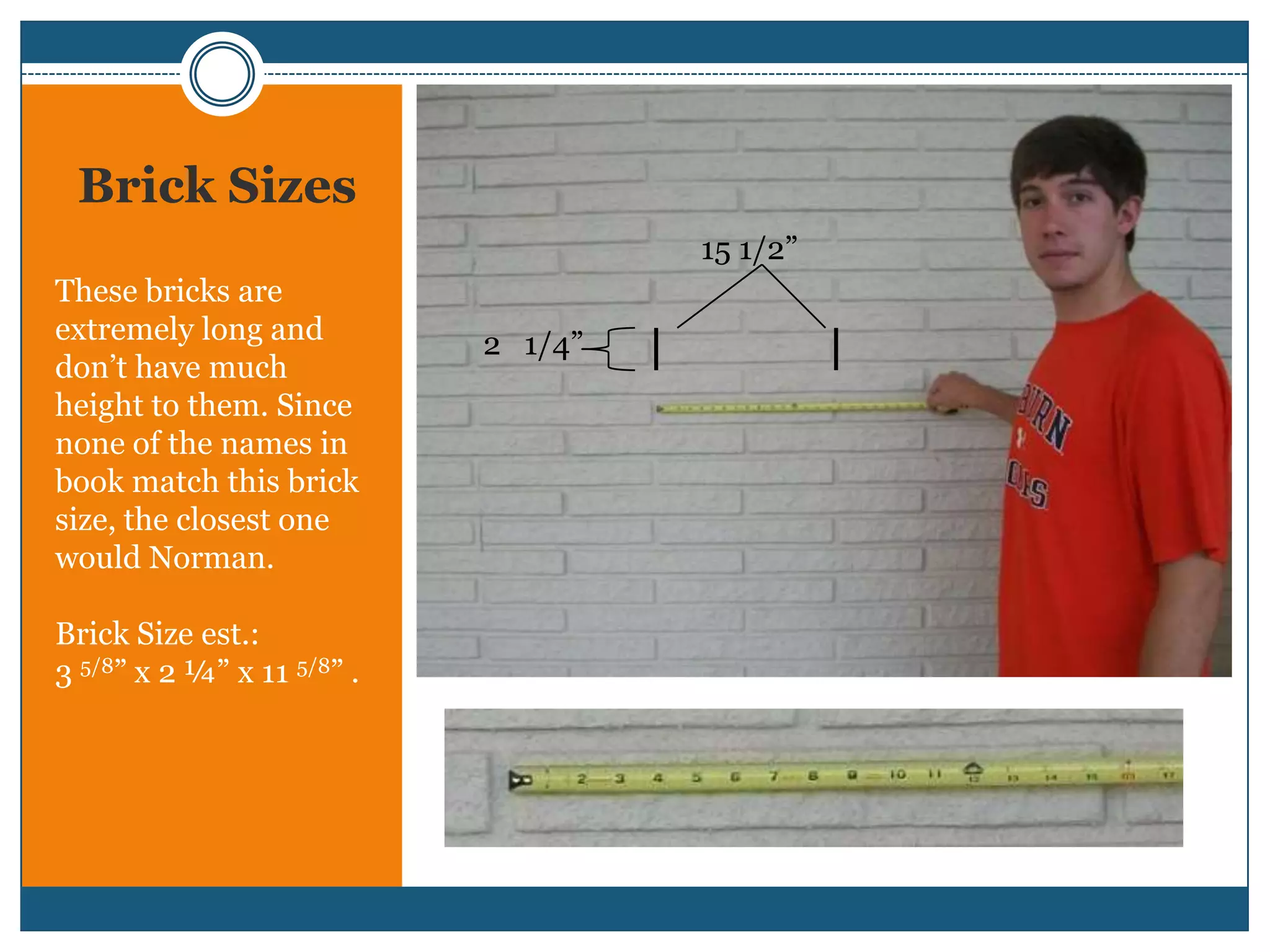
Brick Sizes15 1/2”These bricks are extremely long and don’t have much height to them. Since none of the names in book match this brick size, the closest one would Norman. Brick Size est.:3 5/8” x 2 ¼”x 11 5/8” .   2   1/4”
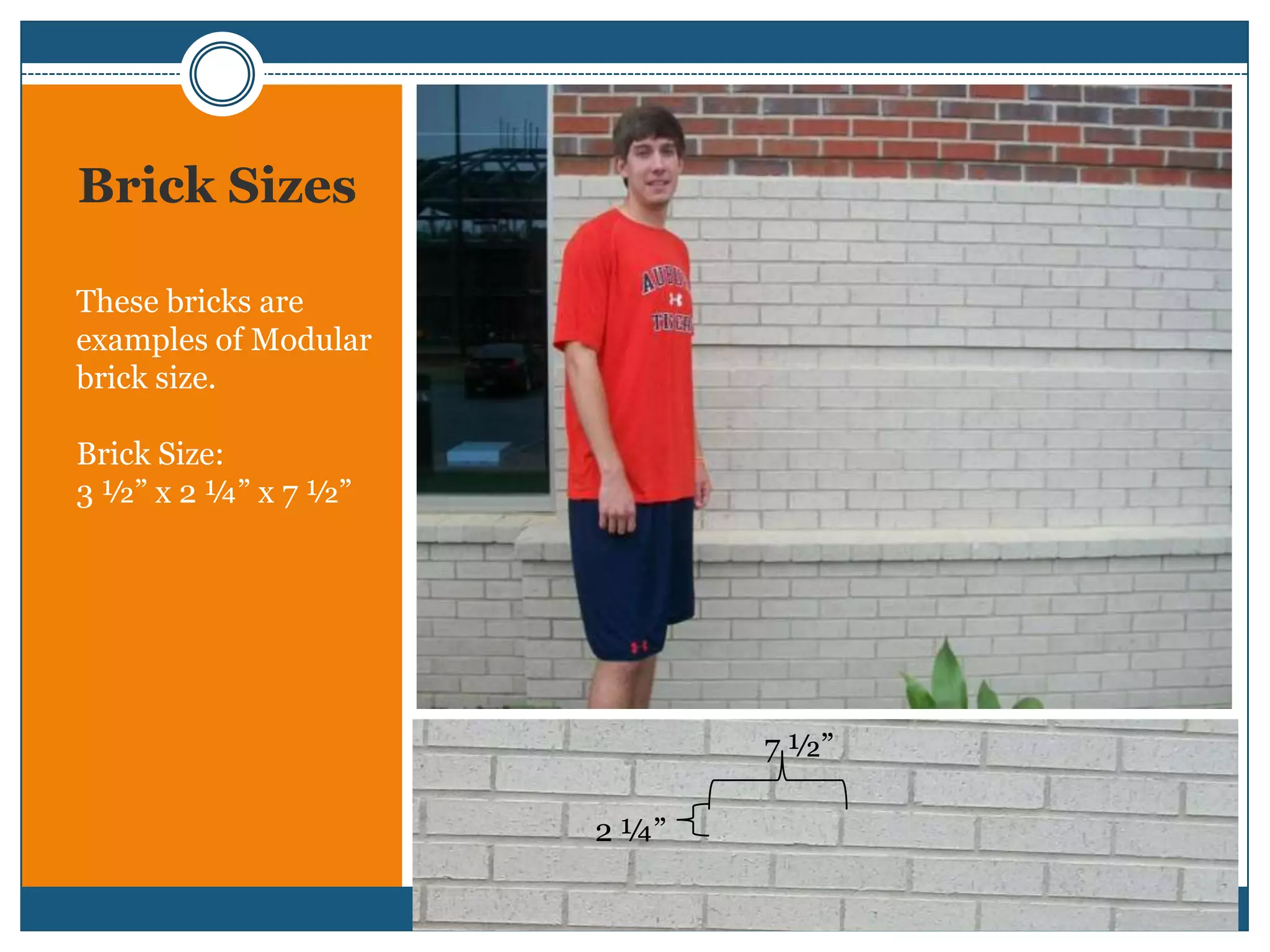
Brick SizesThese bricks are examples of Modular brick size. Brick Size: 3 ½” x 2 ¼” x 7 ½”7 ½” 2 ¼”
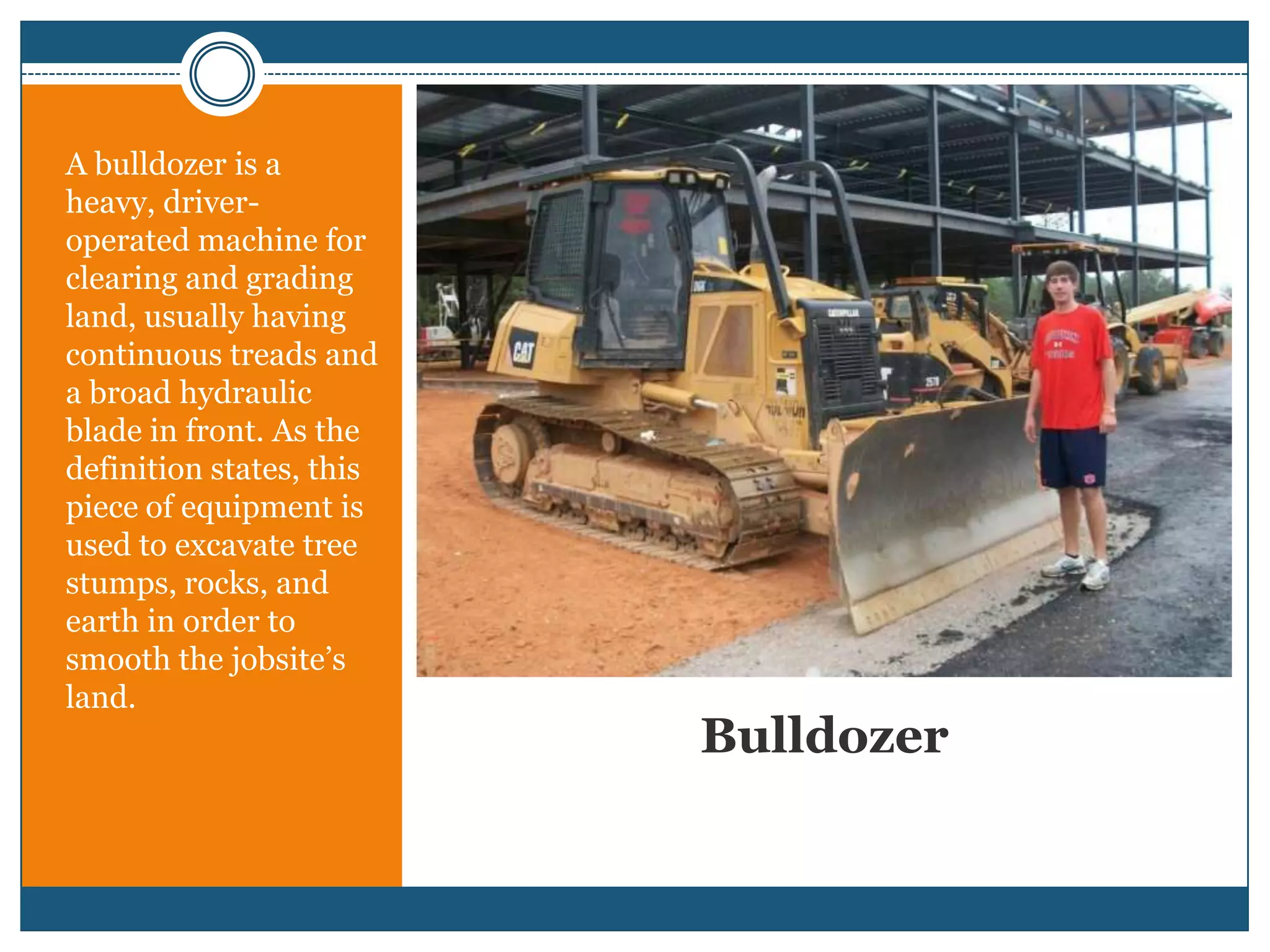
BulldozerA bulldozer is a heavy, driver-operated machine for clearing and grading land, usually having continuous treads and a broad hydraulic blade in front. As the definition states, this piece of equipment is used to excavate tree stumps, rocks, and earth in order to smooth the jobsite’s land.
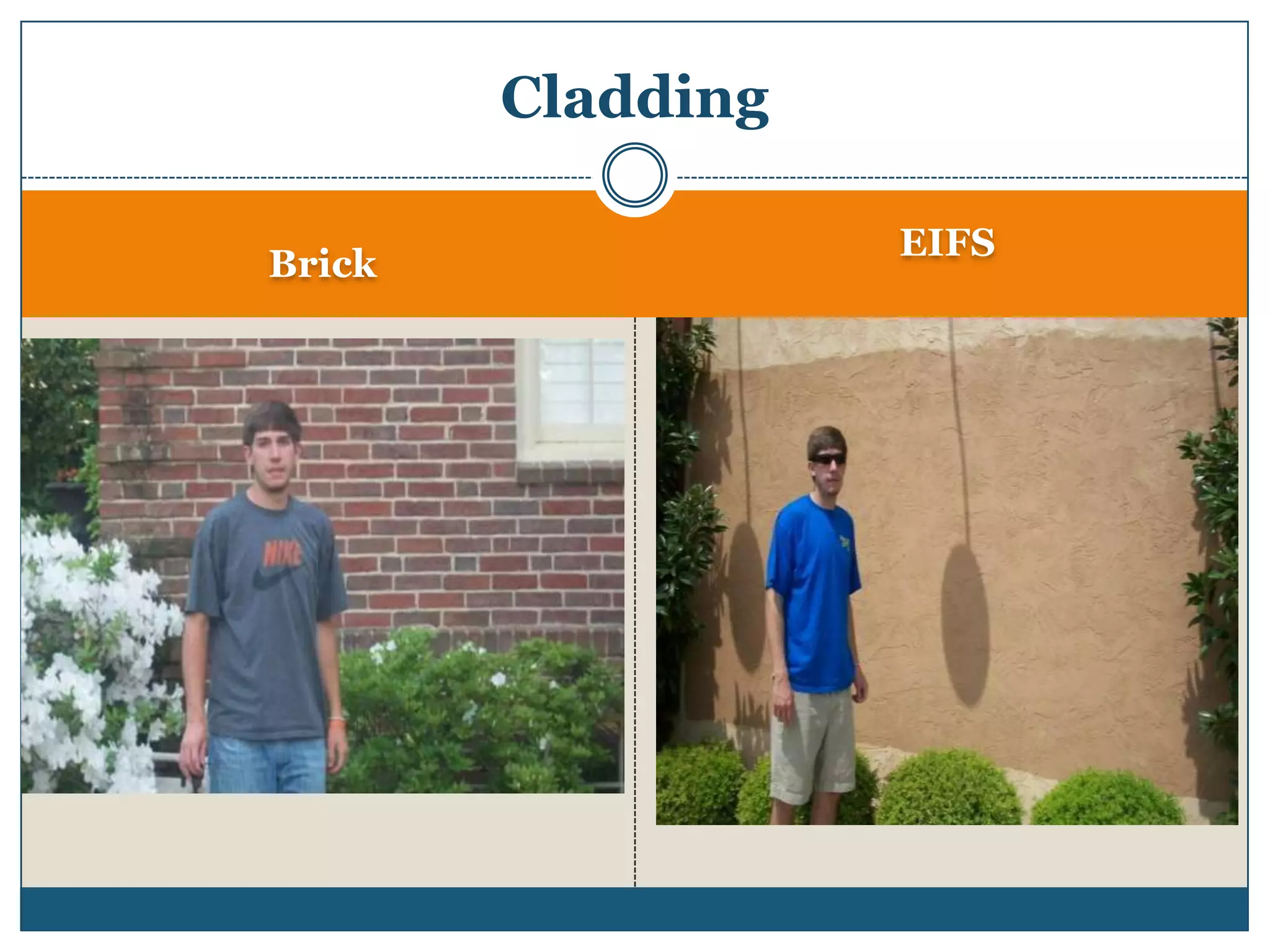
BrickEIFSCladding
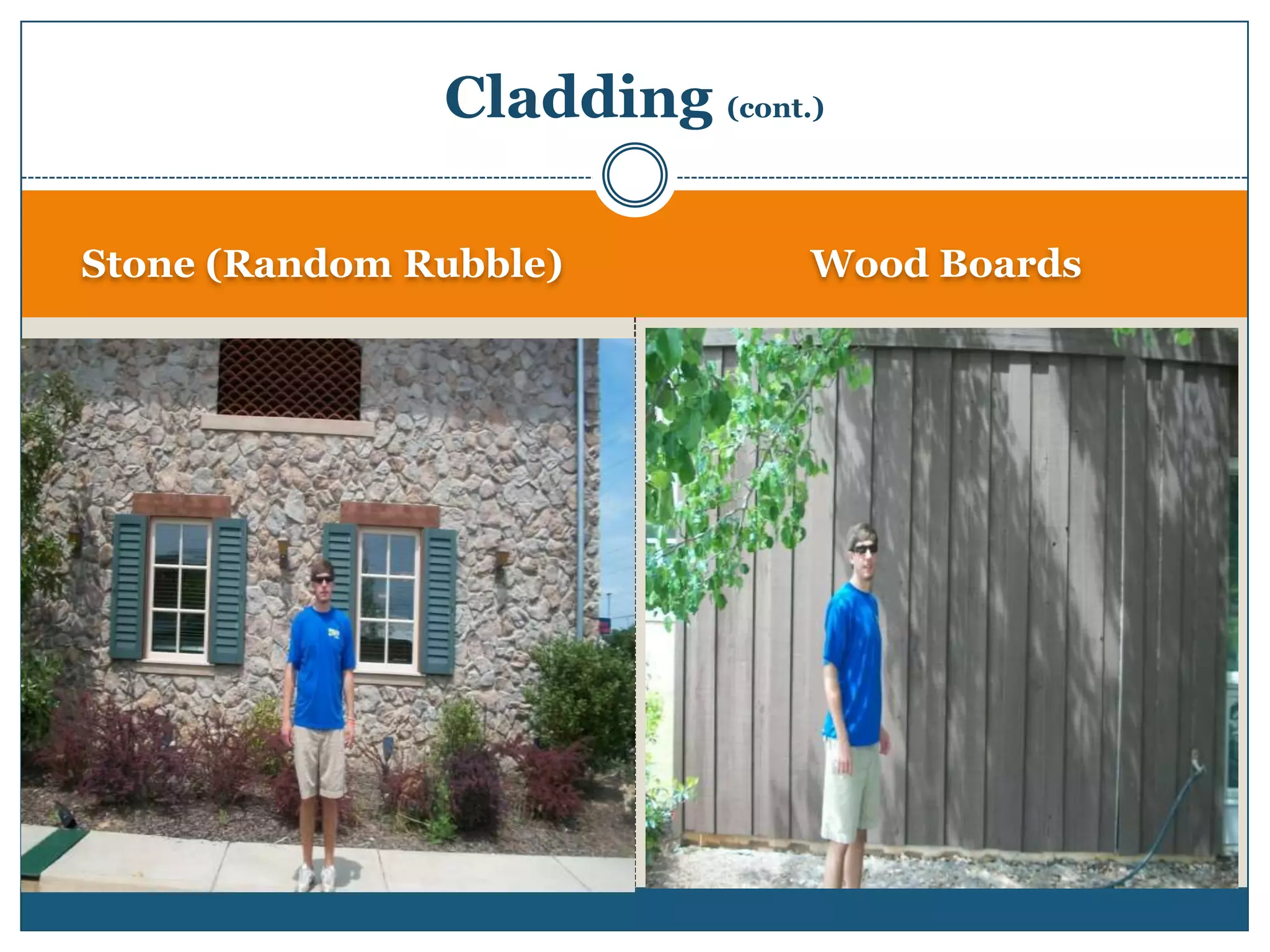
Stone (Random Rubble)Wood BoardsCladding (cont.)
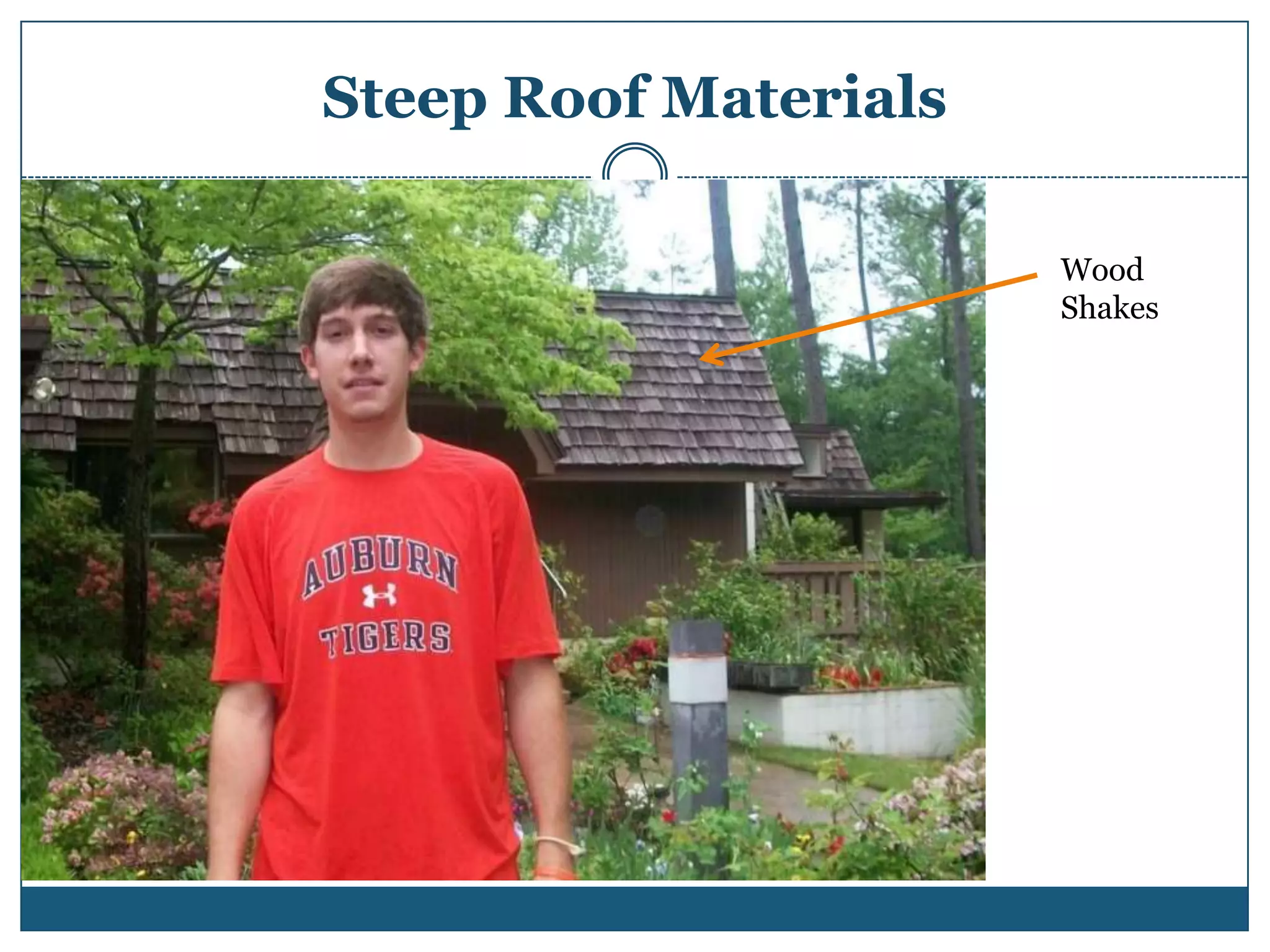
Cladding(cont.)Wood ShakesI’m guessing these are wood shakes because there is no standard size to them and they do not line up perfectly like shingles do.
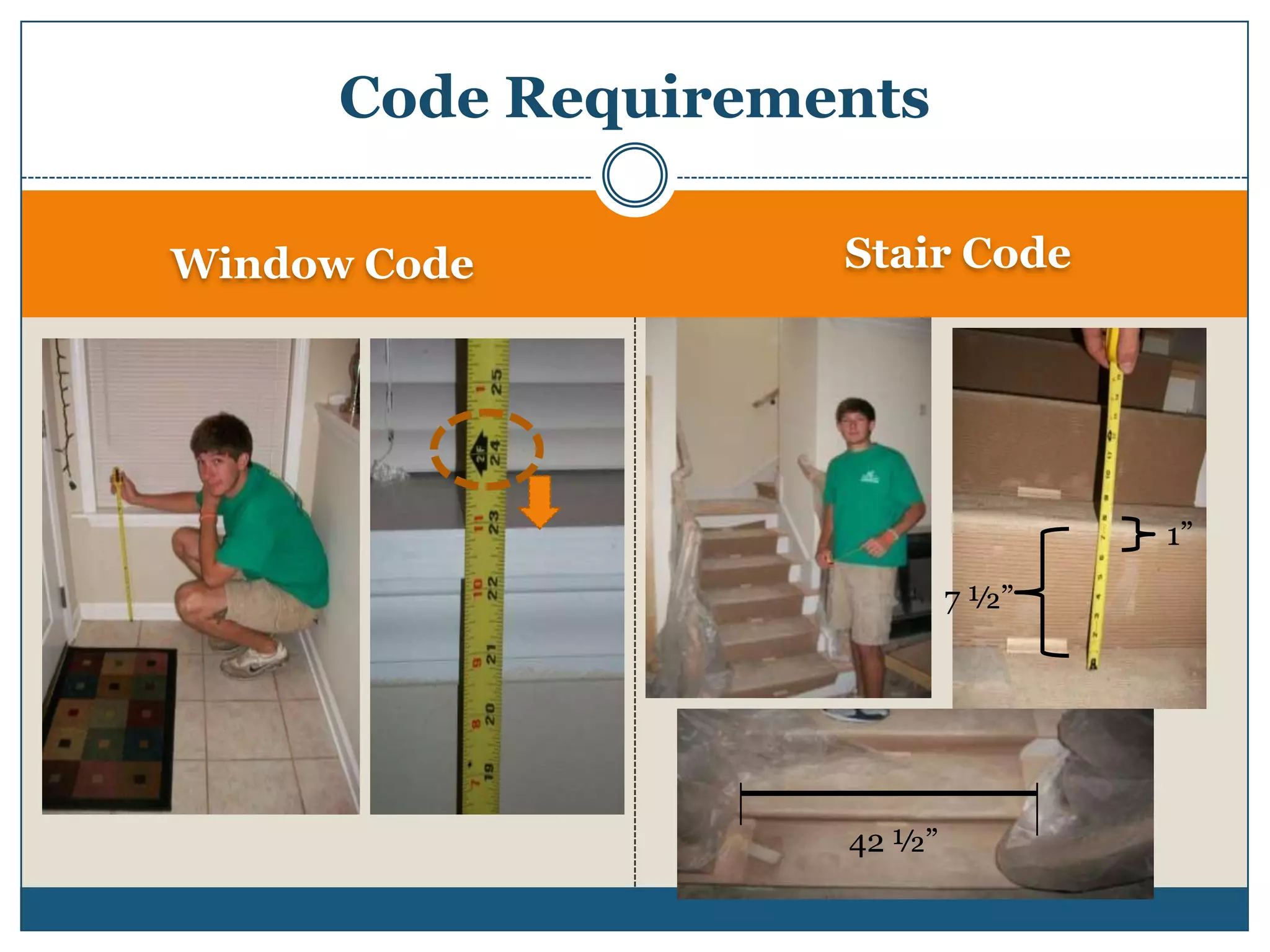
Window CodeStair CodeCode Requirements1”7 ½”42 ½”
Window CodeStair CodeSince my window is below 72 inches in height, the regulation of a 24 inch widow sill is not required. It also raises to 24 ½ inches and the width of it is 35 ¼ inches. Therefore, my window meets the residential code handbook.The stairs meet the code in all aspects. The stair is 42 ½ inches  in length, 11 inches  for each tread, it rises 7 ½ inches, and the nose only overhangs an inch. According to the handbook all of these are acceptable to the code.Code Requirements
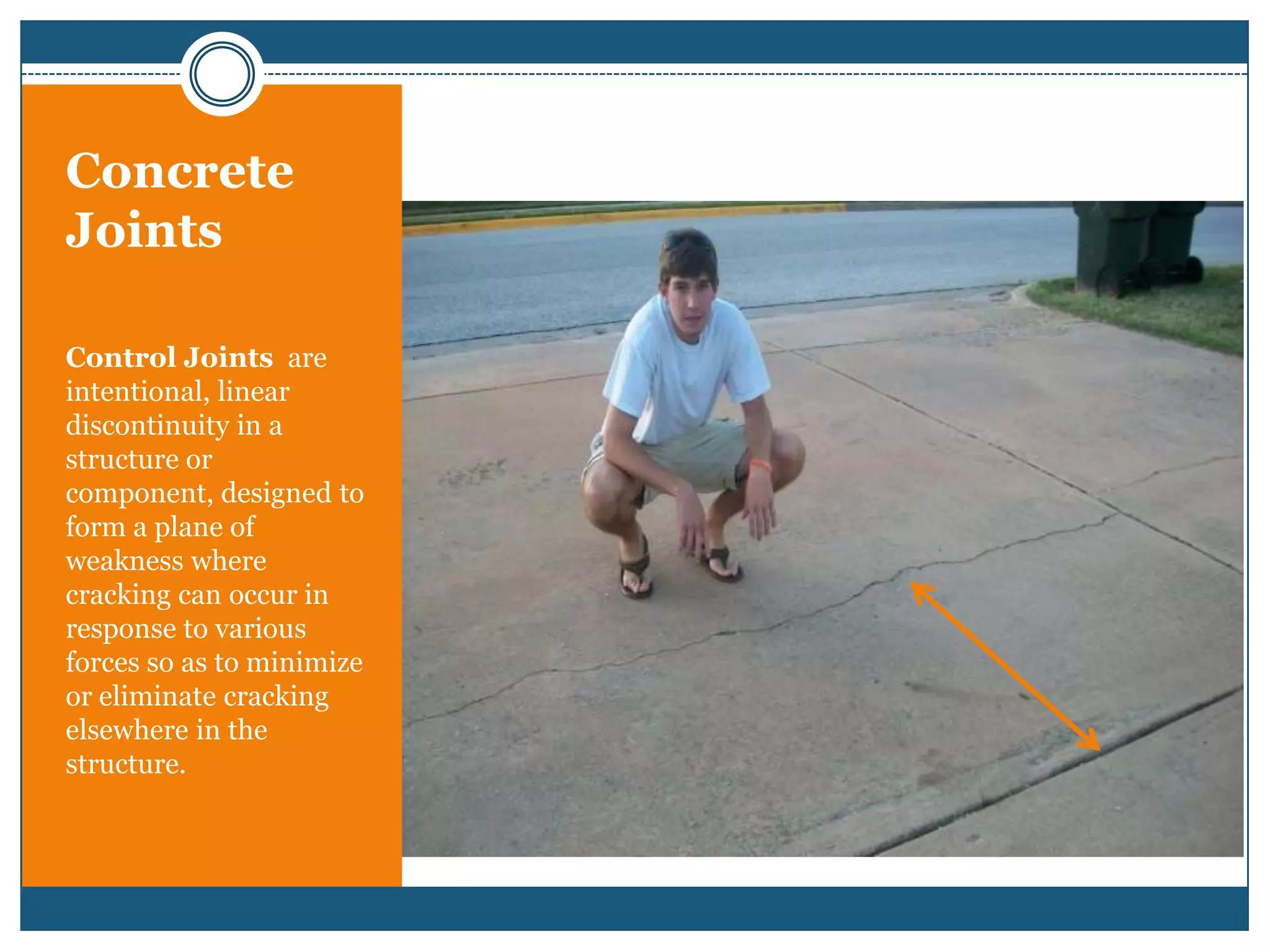
Concrete JointsControl Joints  are intentional, linear discontinuity in a structure or component, designed to form a plane of weakness where cracking can occur in response to various forces so as to minimize or eliminate cracking elsewhere in the structure.
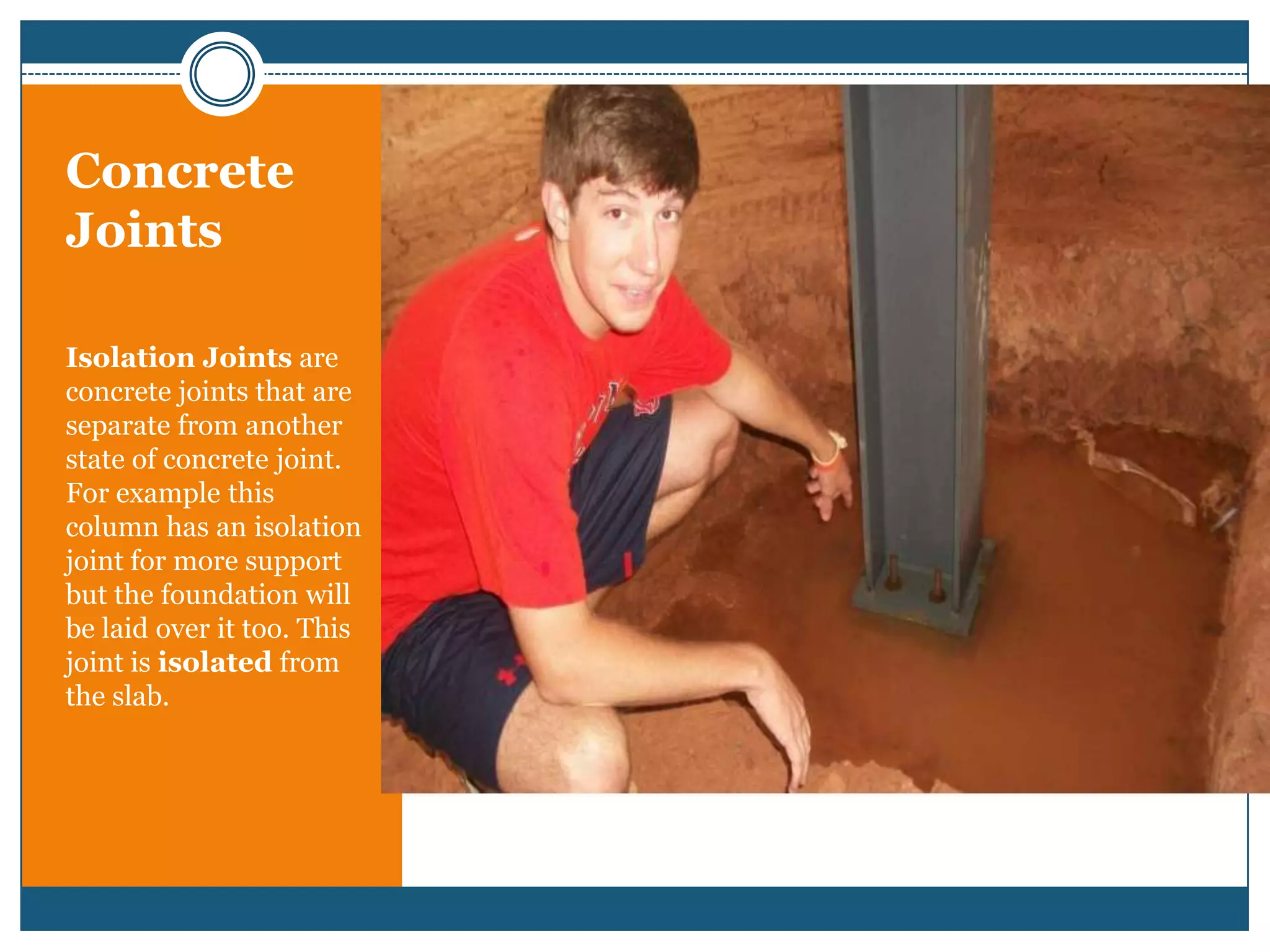
Concrete JointsIsolation Joints are concrete joints that are separate from another state of concrete joint. For example this column has an isolation joint for more support but the foundation will be laid over it too. This joint is isolated from the slab.
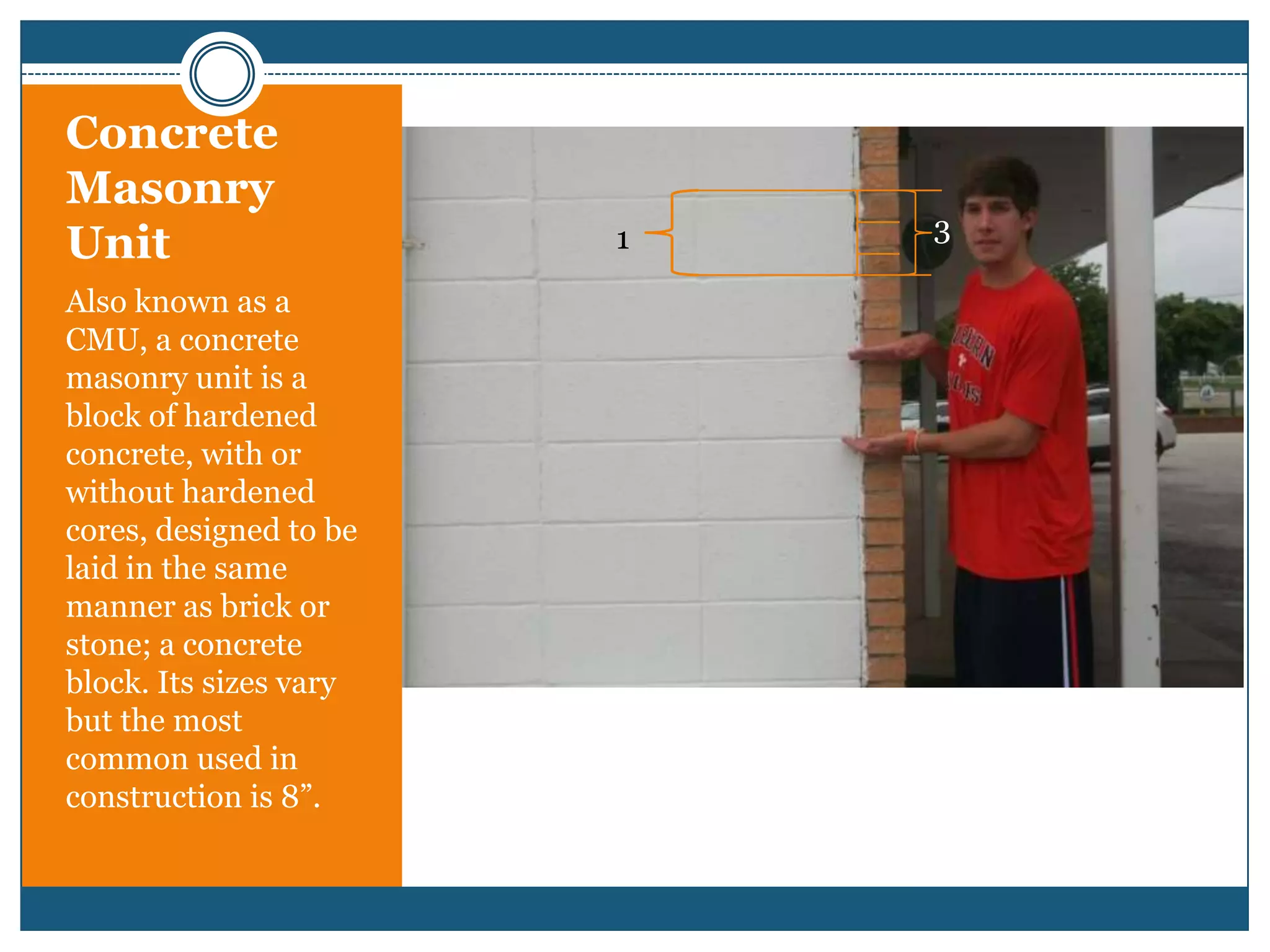
Concrete Masonry Unit31Also known as a CMU, a concrete masonry unit is a block of hardened concrete, with or without hardened cores, designed to be laid in the same manner as brick or stone; a concrete block. Its sizes vary but the most common used in construction is 8”.
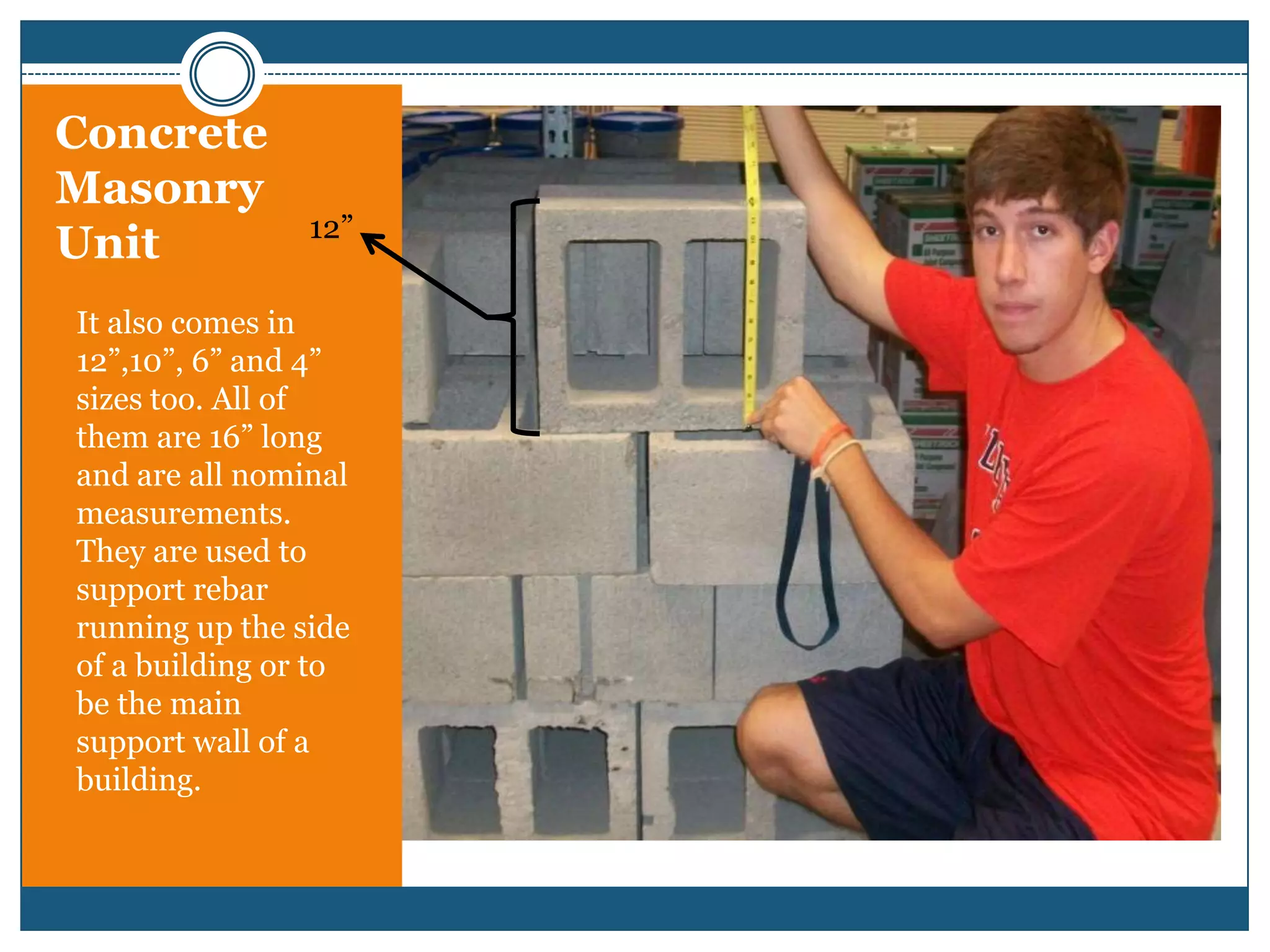
Concrete Masonry Unit12”It also comes in 12”,10”, 6” and 4” sizes too. All of them are 16” long and are all nominal  measurements. They are used to support rebar running up the side of a building or to be the main support wall of a building.
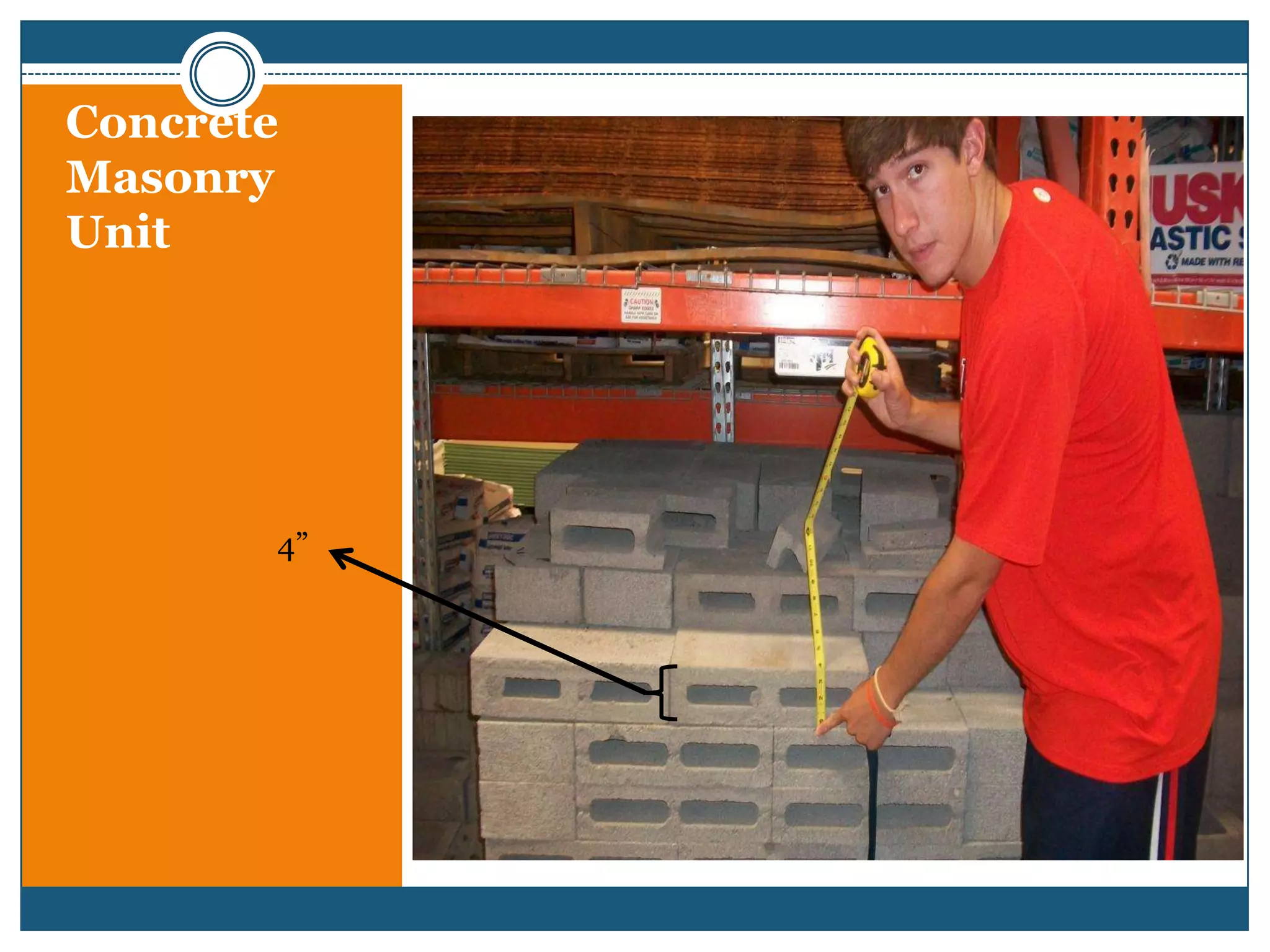
Concrete Masonry Unit4”
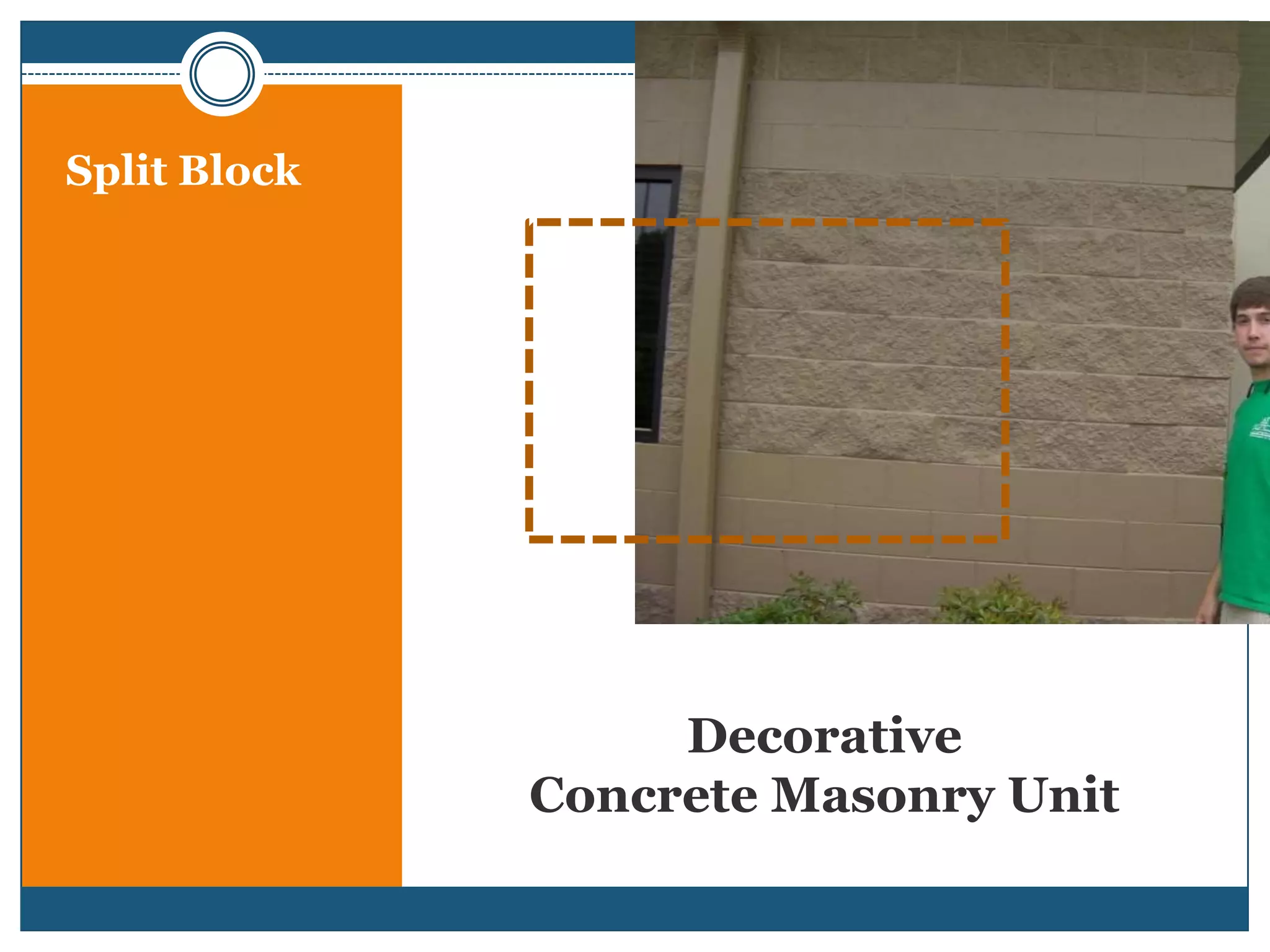
Decorative Concrete Masonry UnitSplit Block
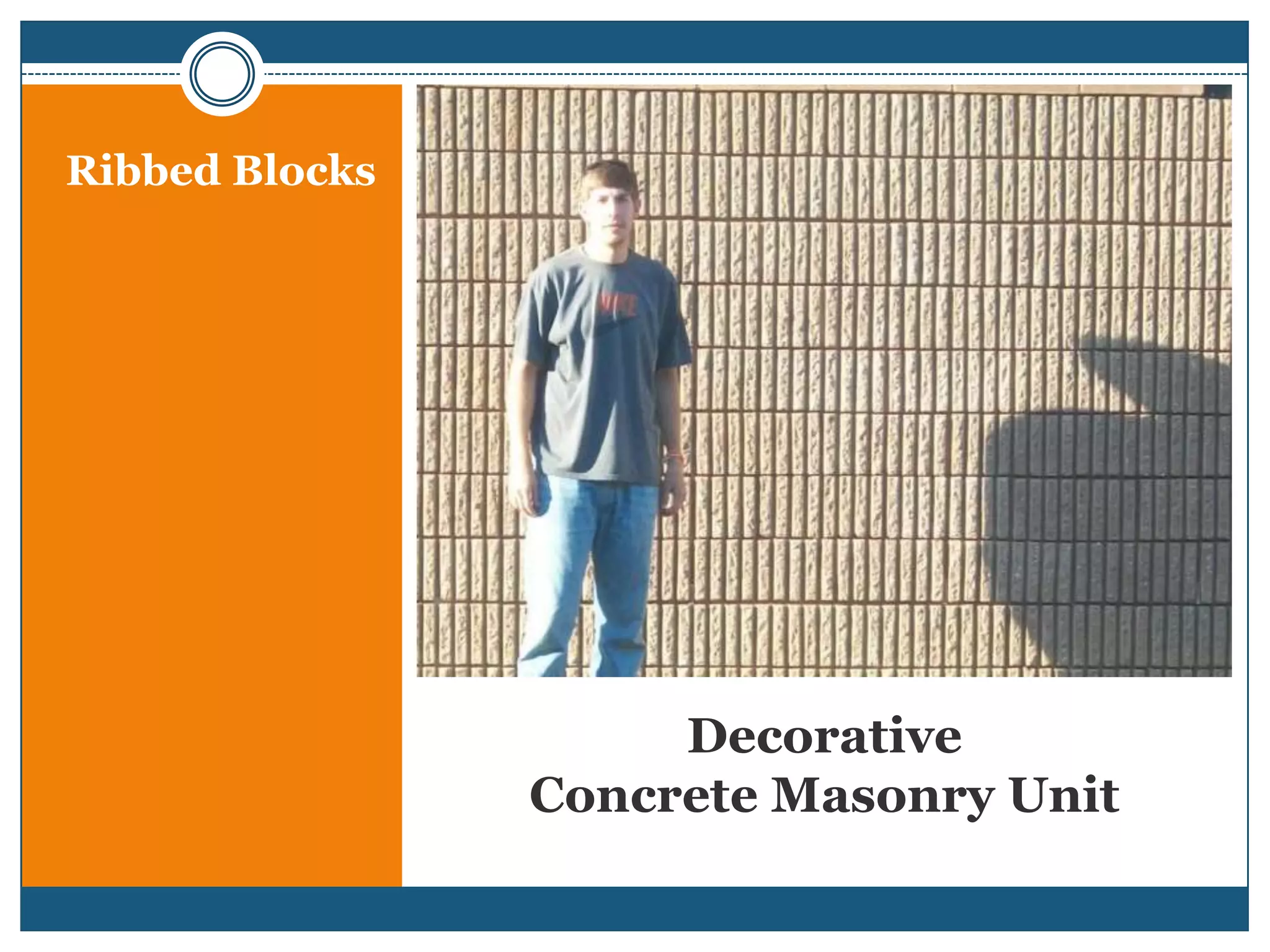
Decorative Concrete Masonry UnitRibbed Blocks
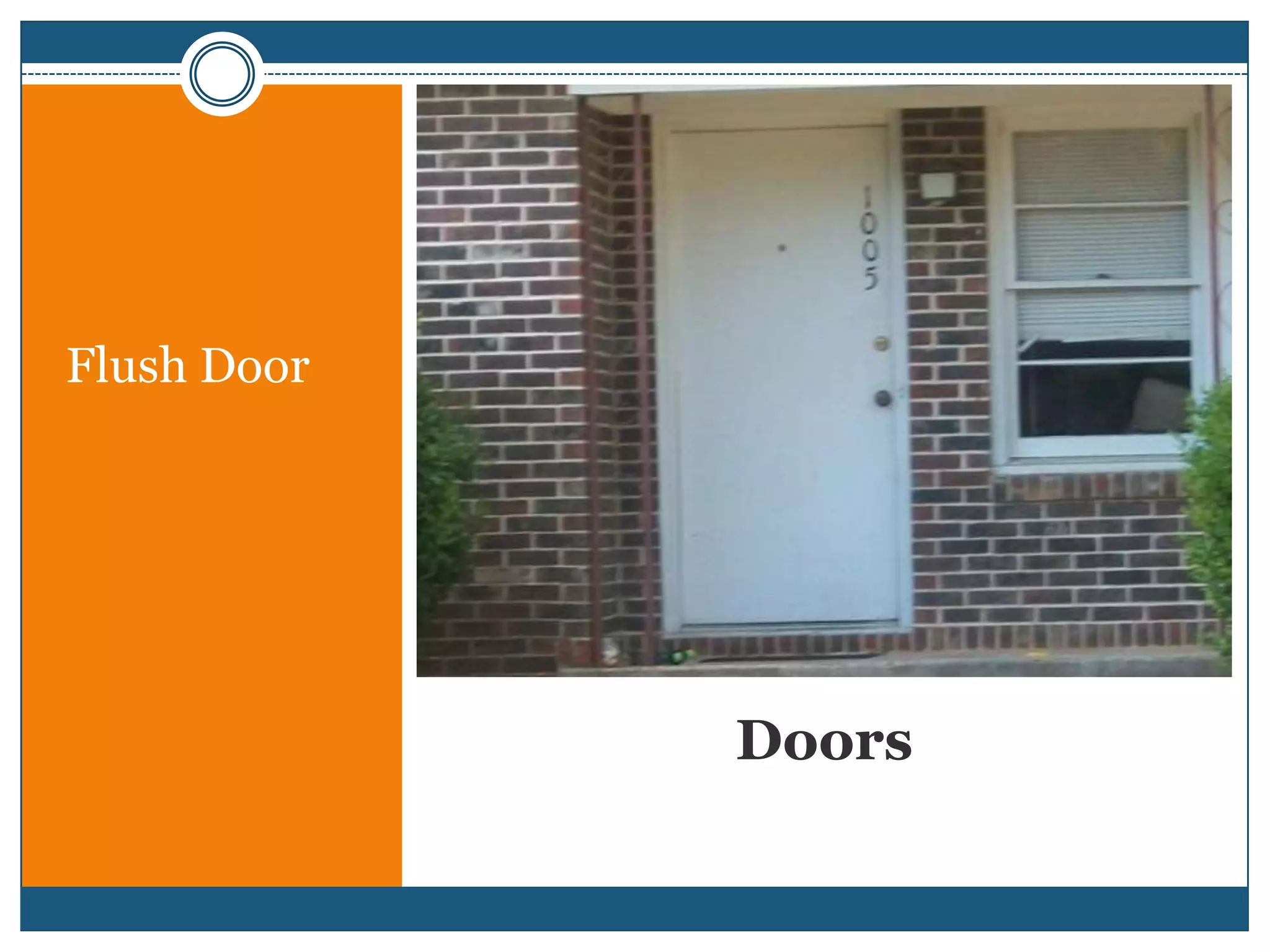
DoorsFlush Door
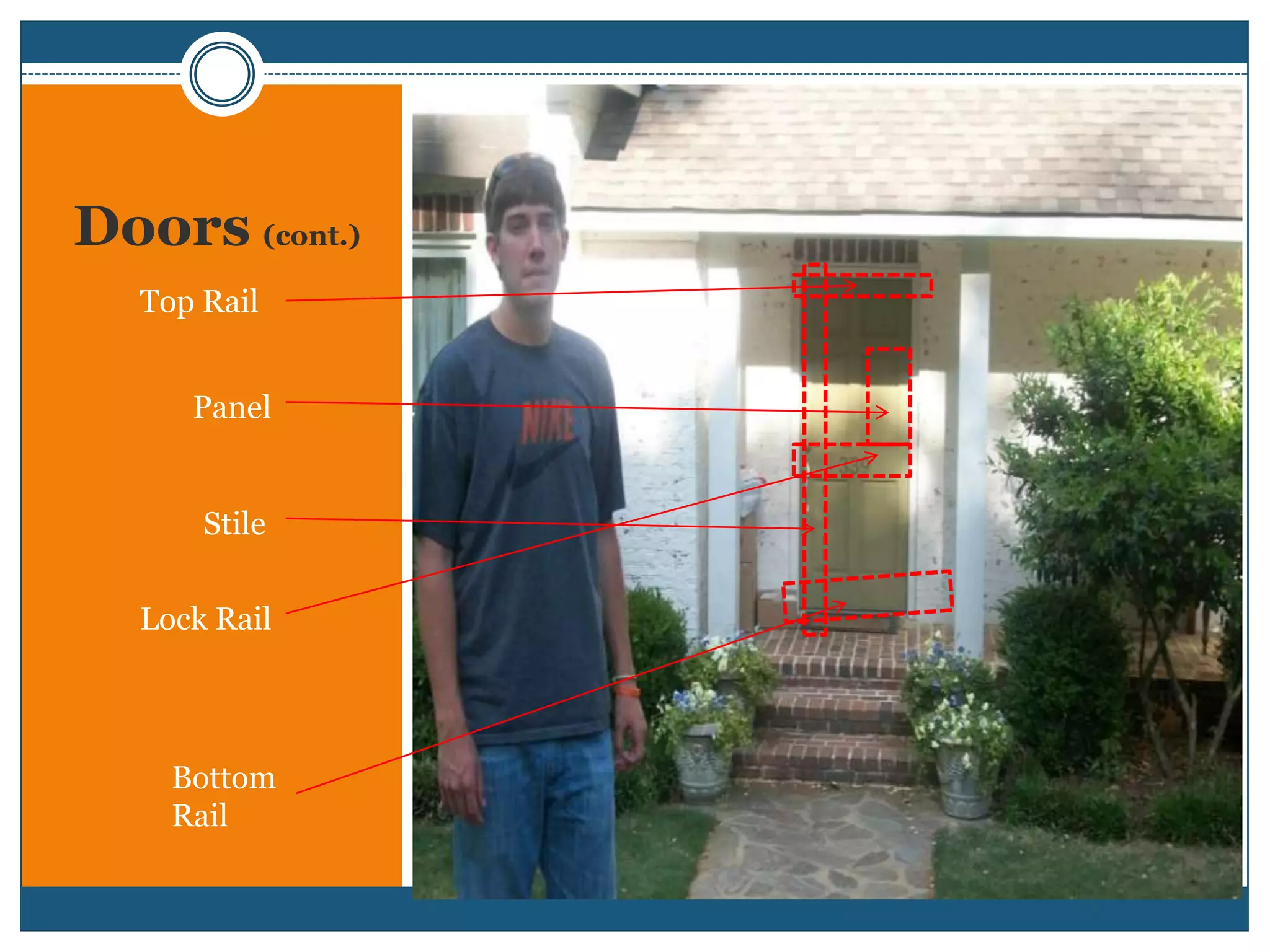
Doors(cont.)Top RailPanelStileLock RailBottom Rail
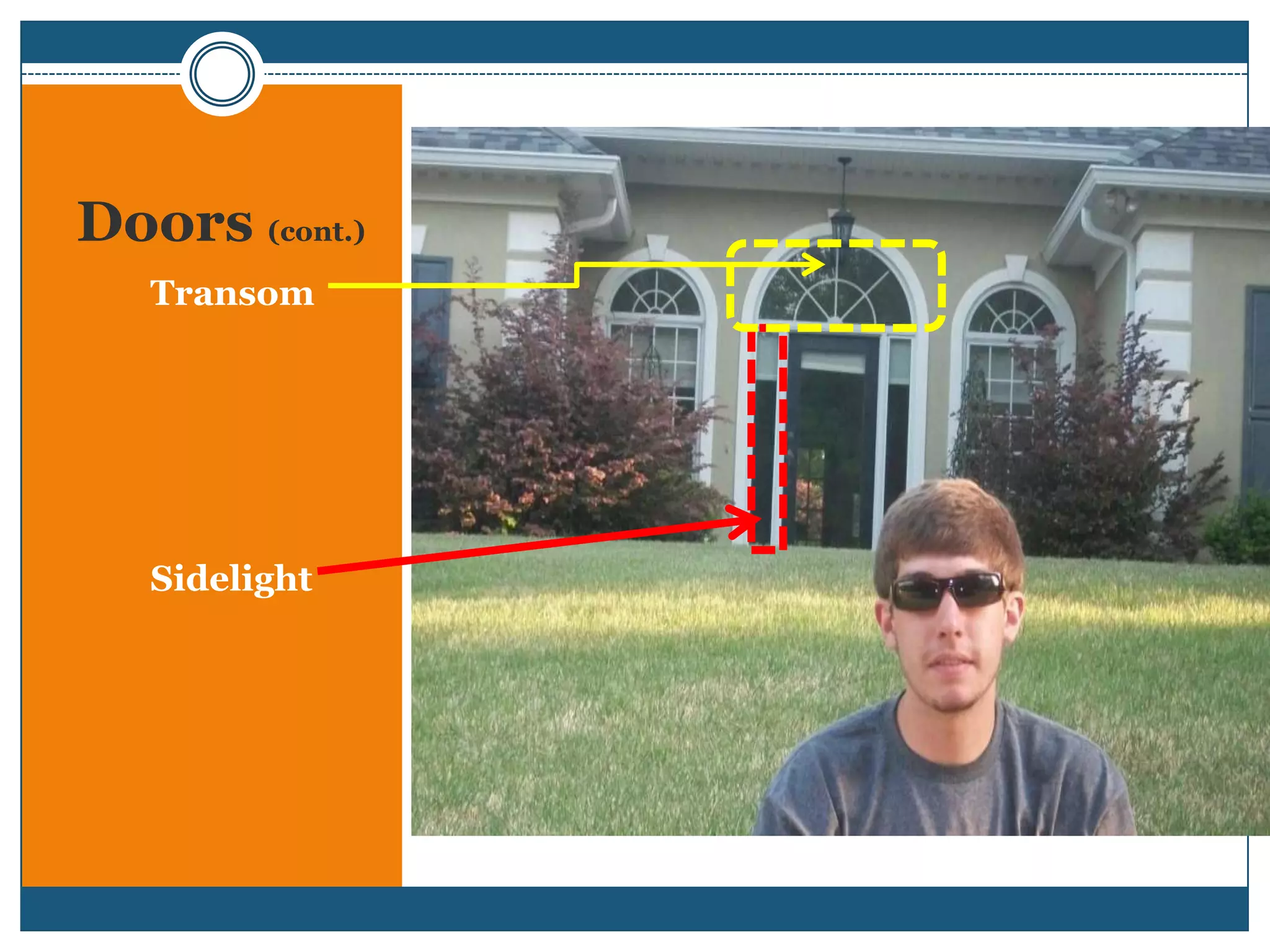
Doors (cont.)TransomSidelight
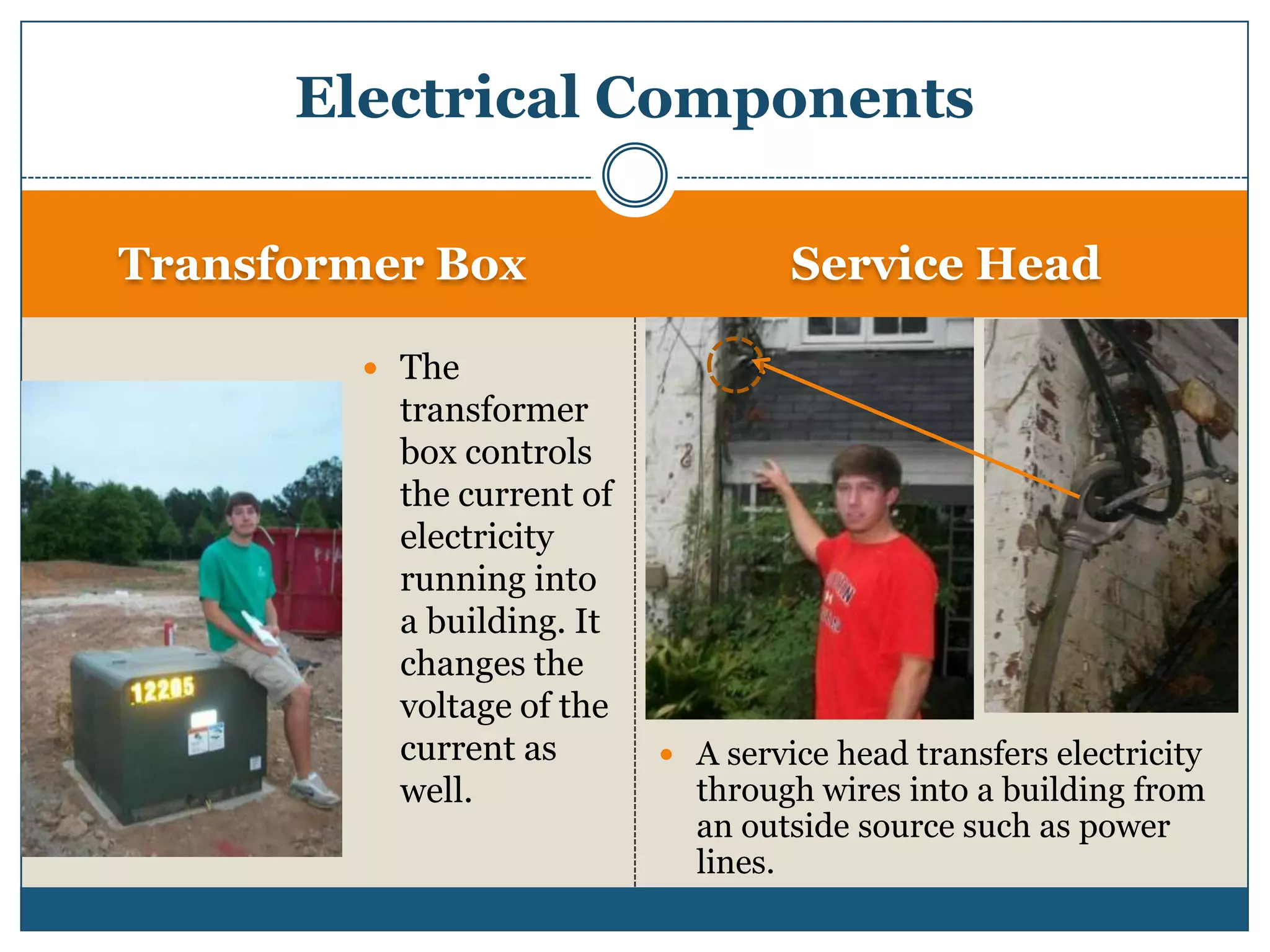
Transformer BoxService HeadThe transformer box controls the current of electricity running into a building. It changes the voltage of the current as well. A service head transfers electricity through wires into a building from an outside source such as power lines.Electrical Components
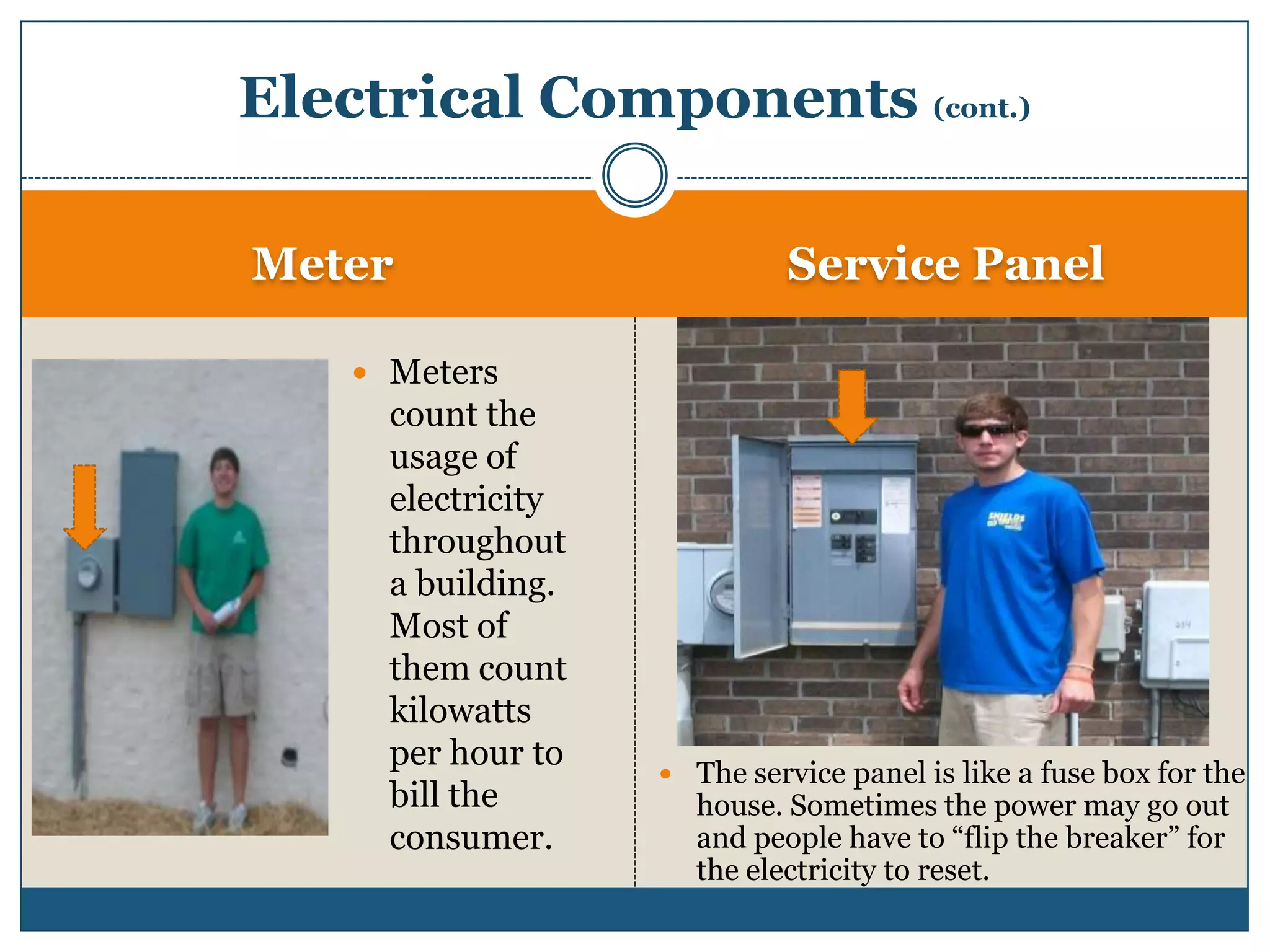
MeterService PanelMeters count the usage of electricity throughout a building. Most of them count kilowatts per hour to bill the consumer.The service panel is like a fuse box for the house. Sometimes the power may go out and people have to “flip the breaker” for the electricity to reset.Electrical Components (cont.)
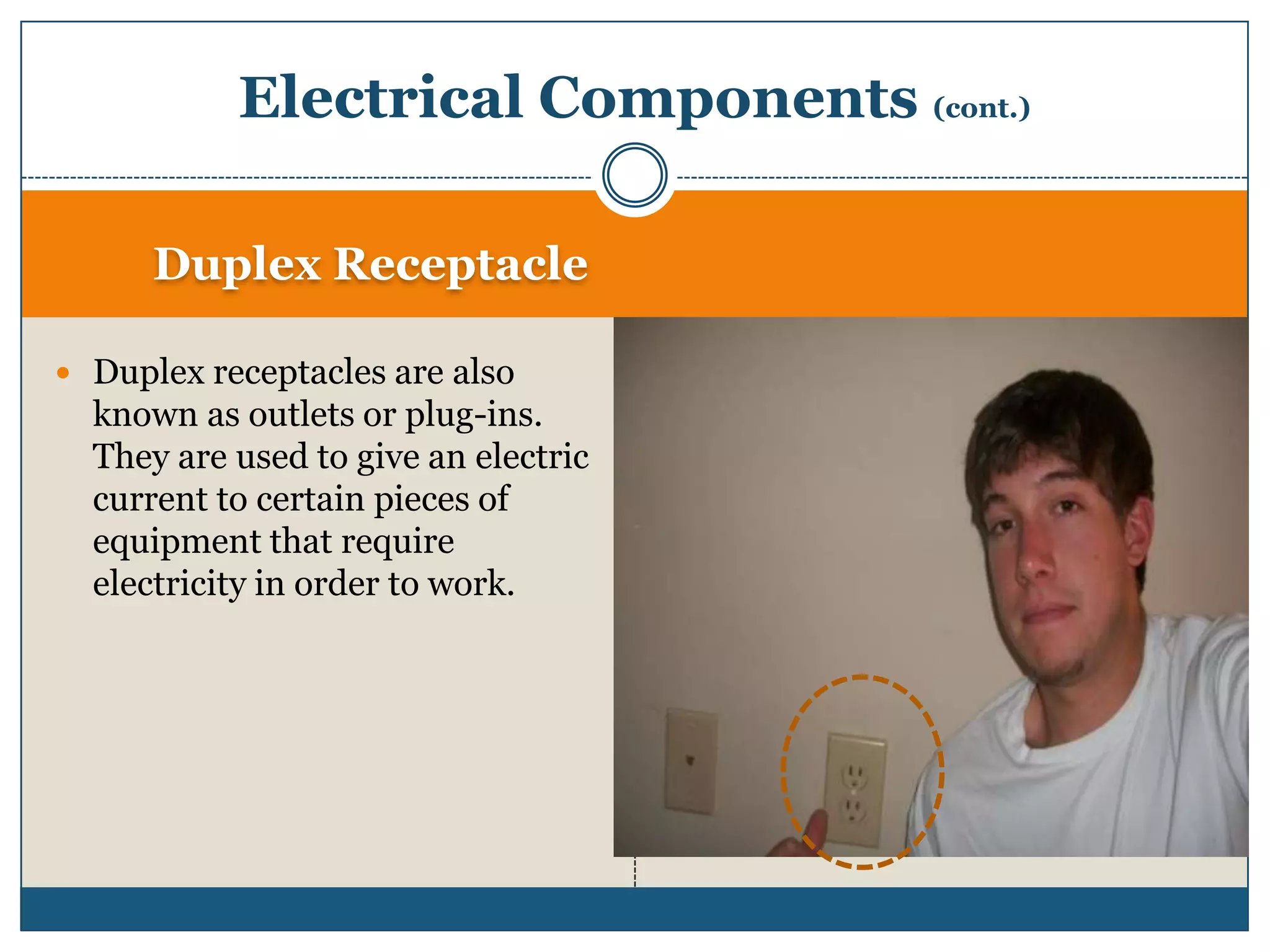
Duplex ReceptacleDuplex receptacles are also known as outlets or plug-ins. They are used to give an electric current to certain pieces of equipment that require electricity in order to work. Electrical Components (cont.)
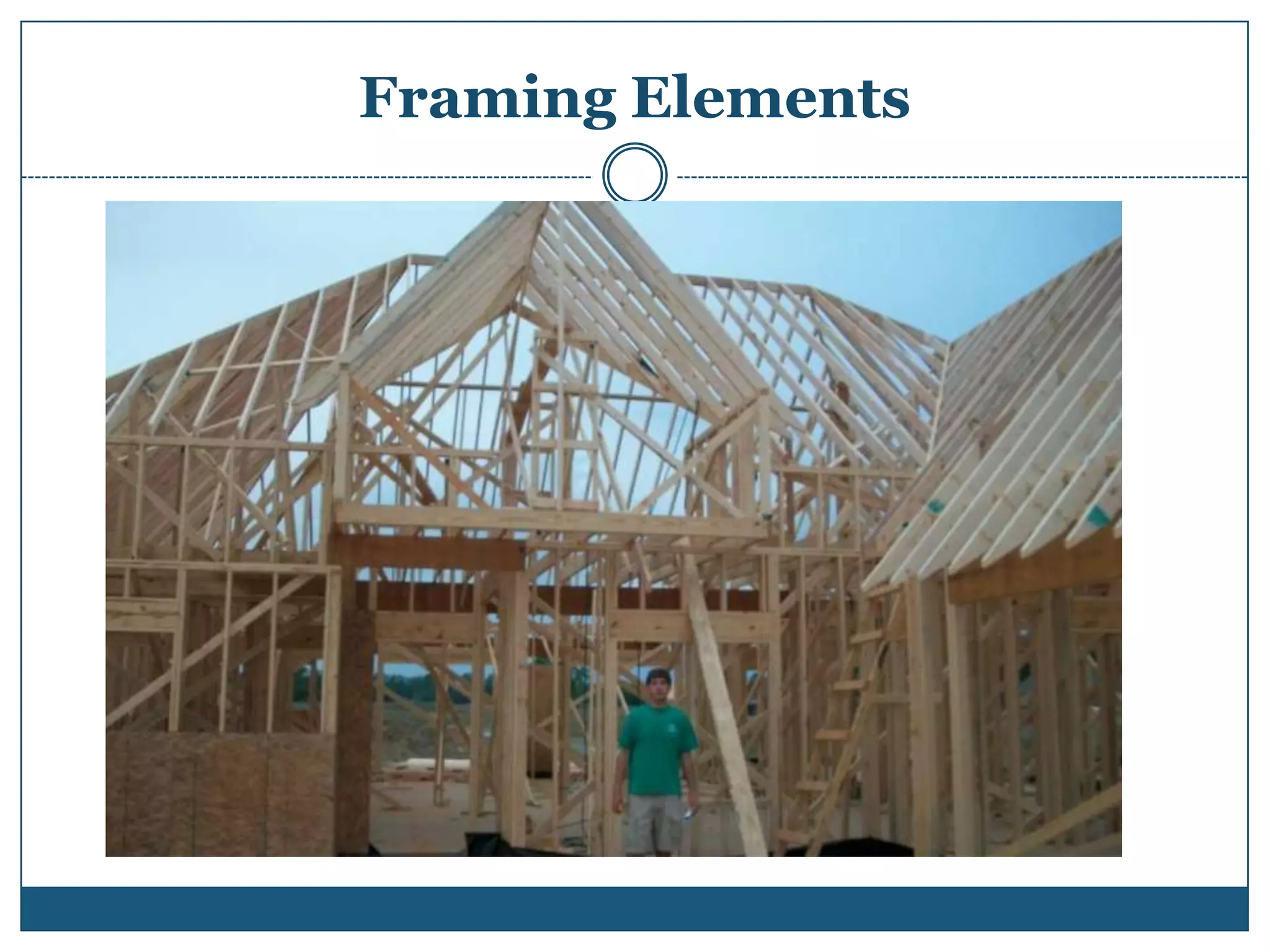
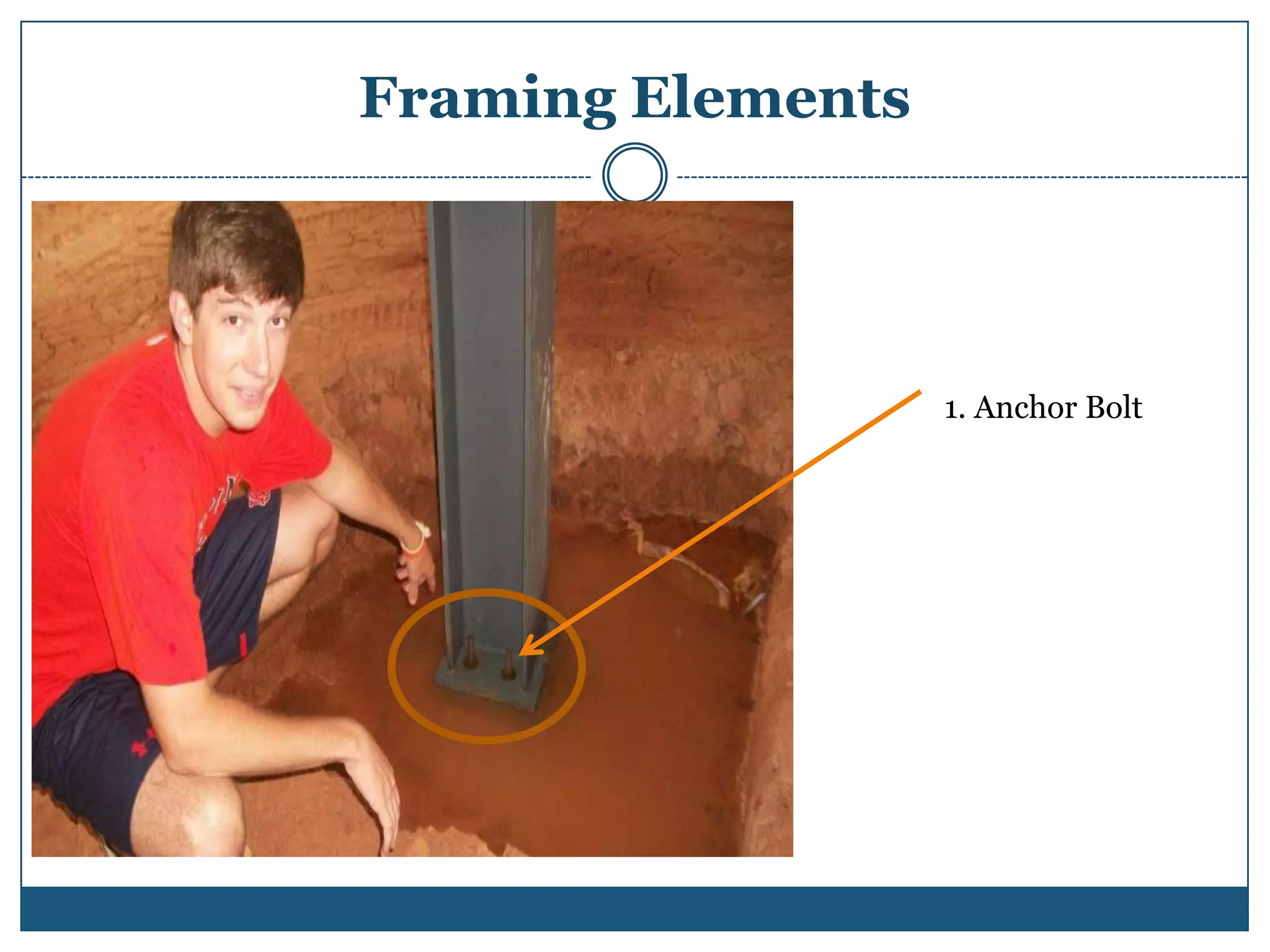
Framing Elements
Framing Elements1. Anchor Bolt
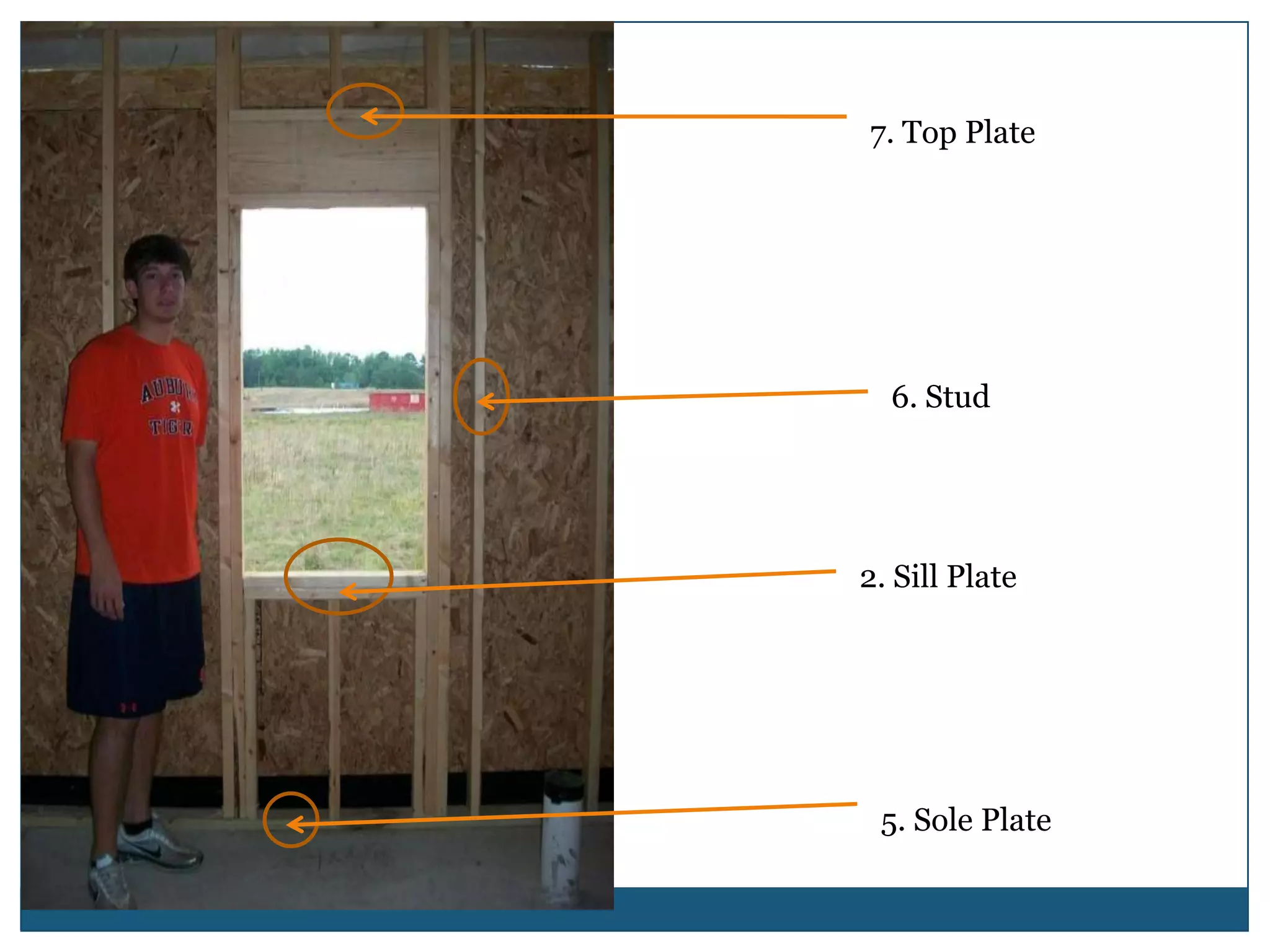
7. Top Plate6. Stud2. Sill Plate5. Sole Plate
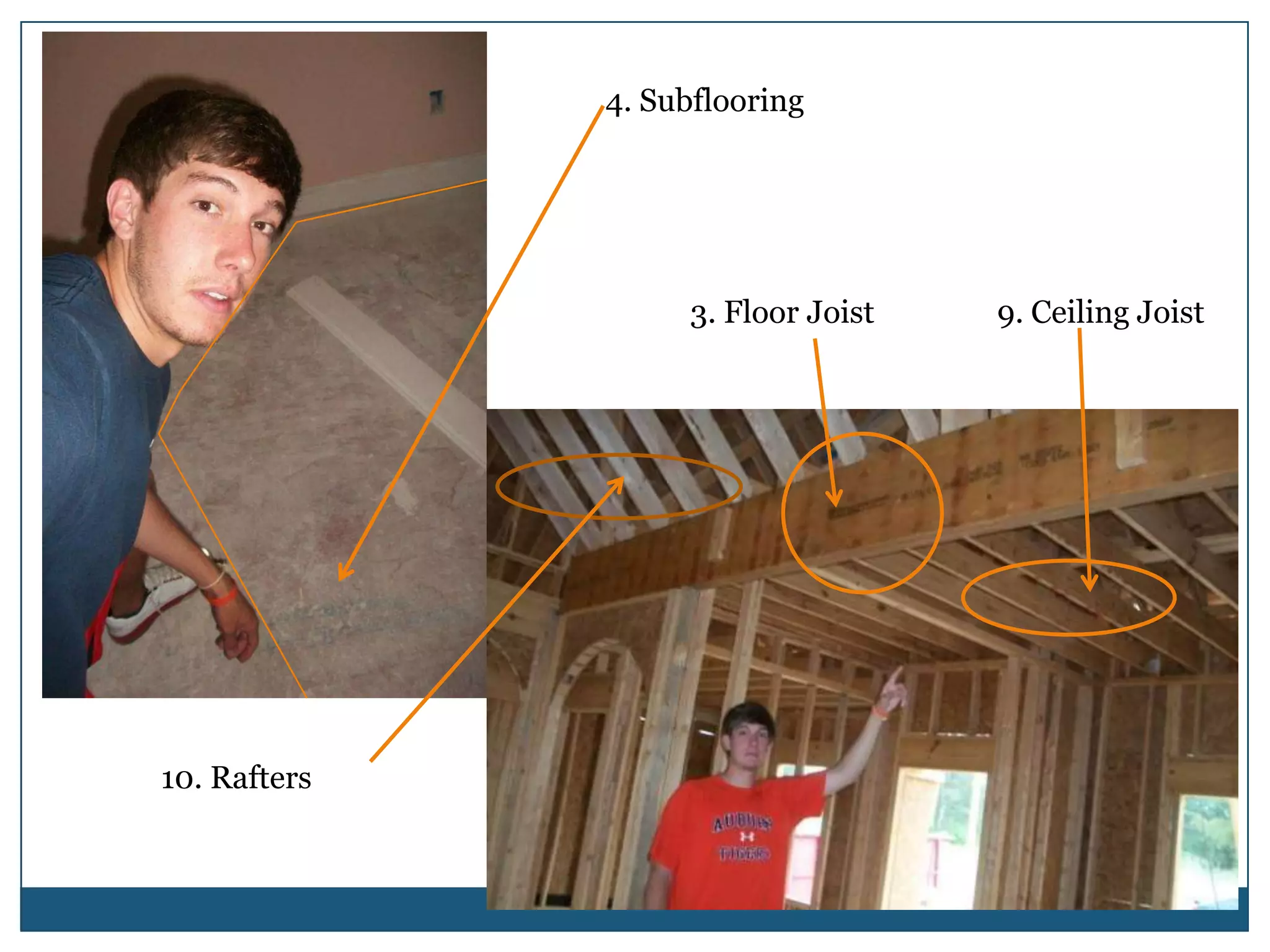
4. Subflooring3. Floor Joist9. Ceiling Joist10. Rafters
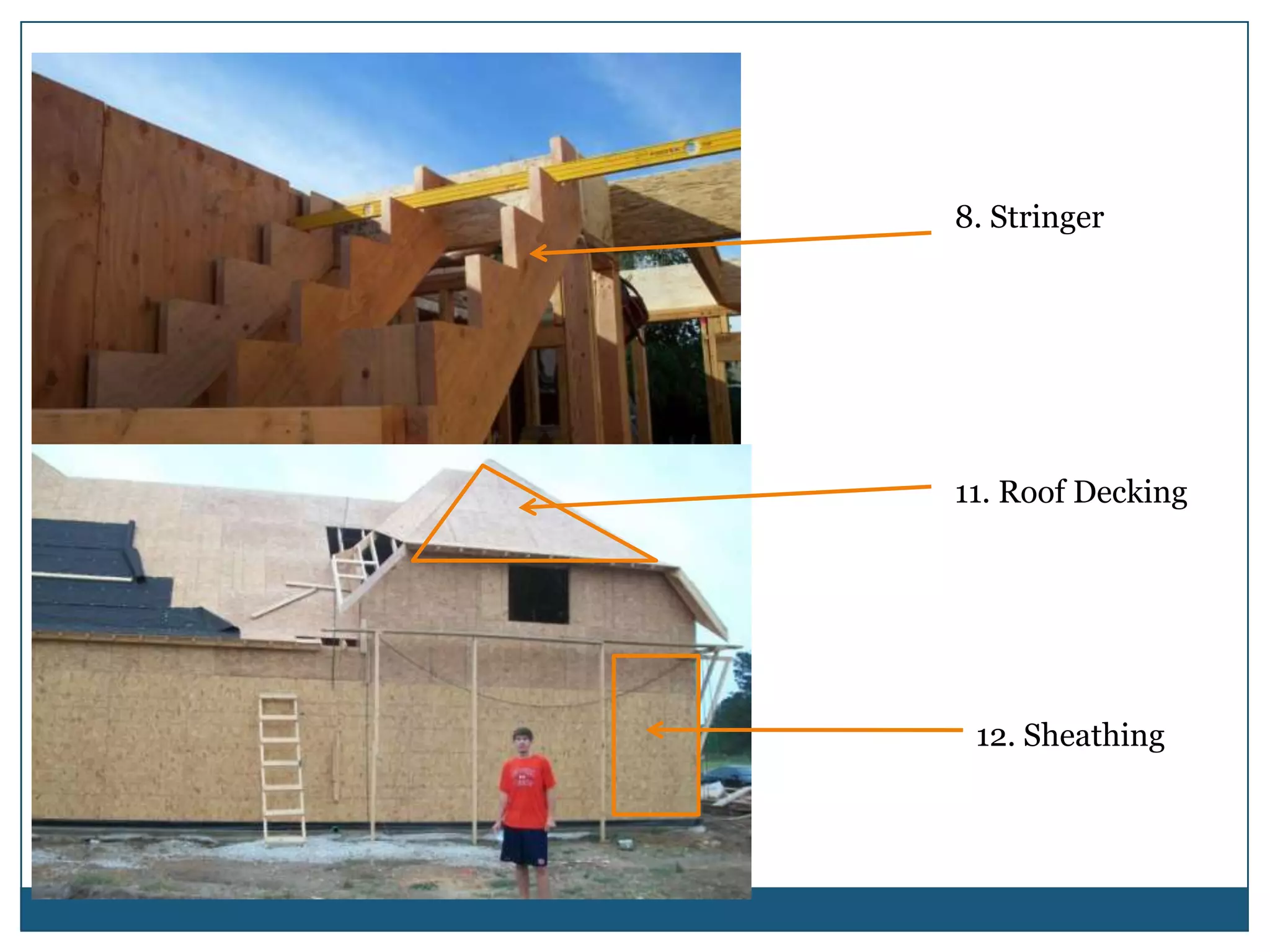
8. Stringer11. Roof Decking12. Sheathing
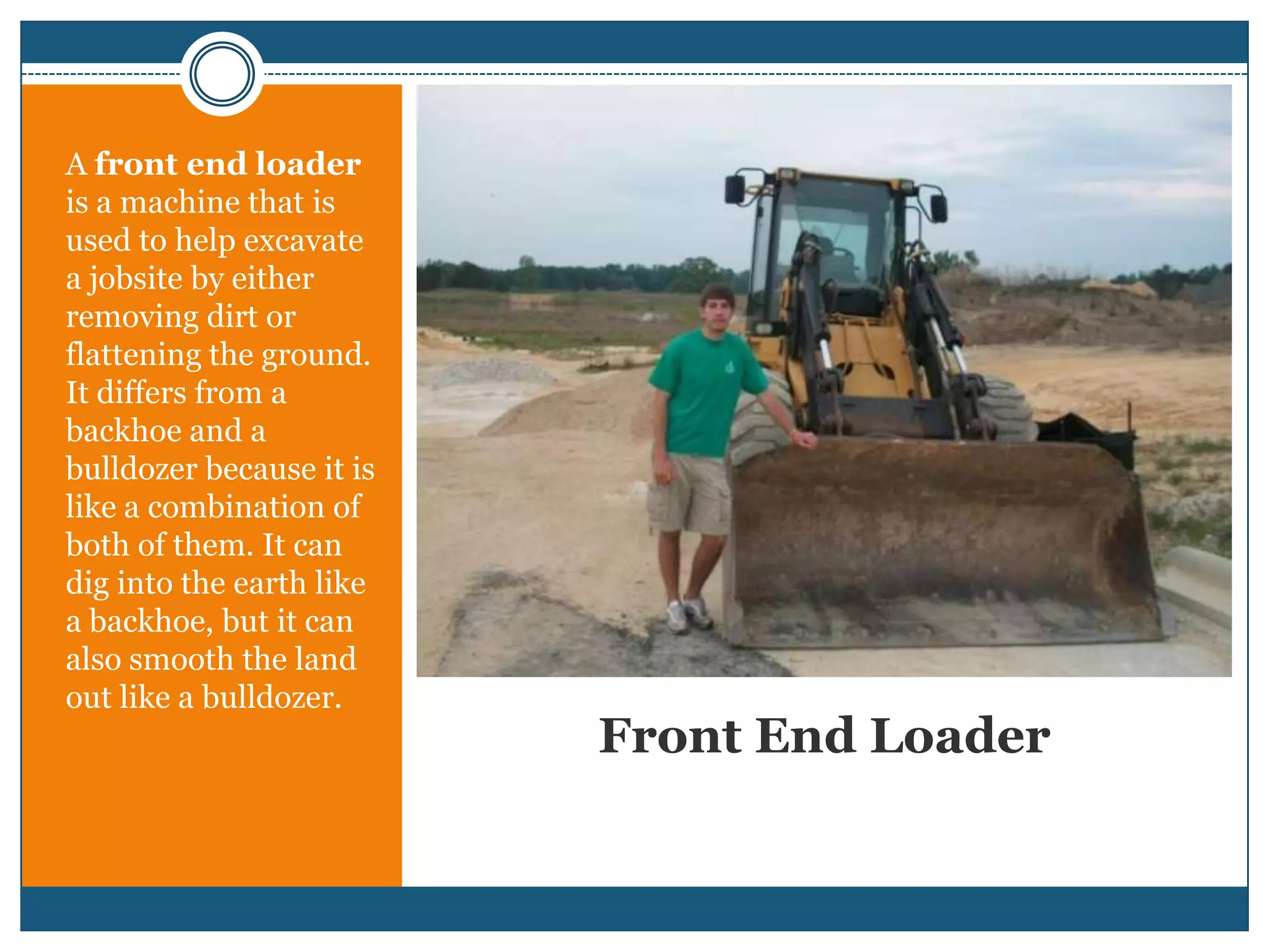
Front End LoaderA front end loader is a machine that is used to help excavate a jobsite by either removing dirt or flattening the ground. It differs from a backhoe and a bulldozer because it is like a combination of both of them. It can dig into the earth like a backhoe, but it can also smooth the land out like a bulldozer.
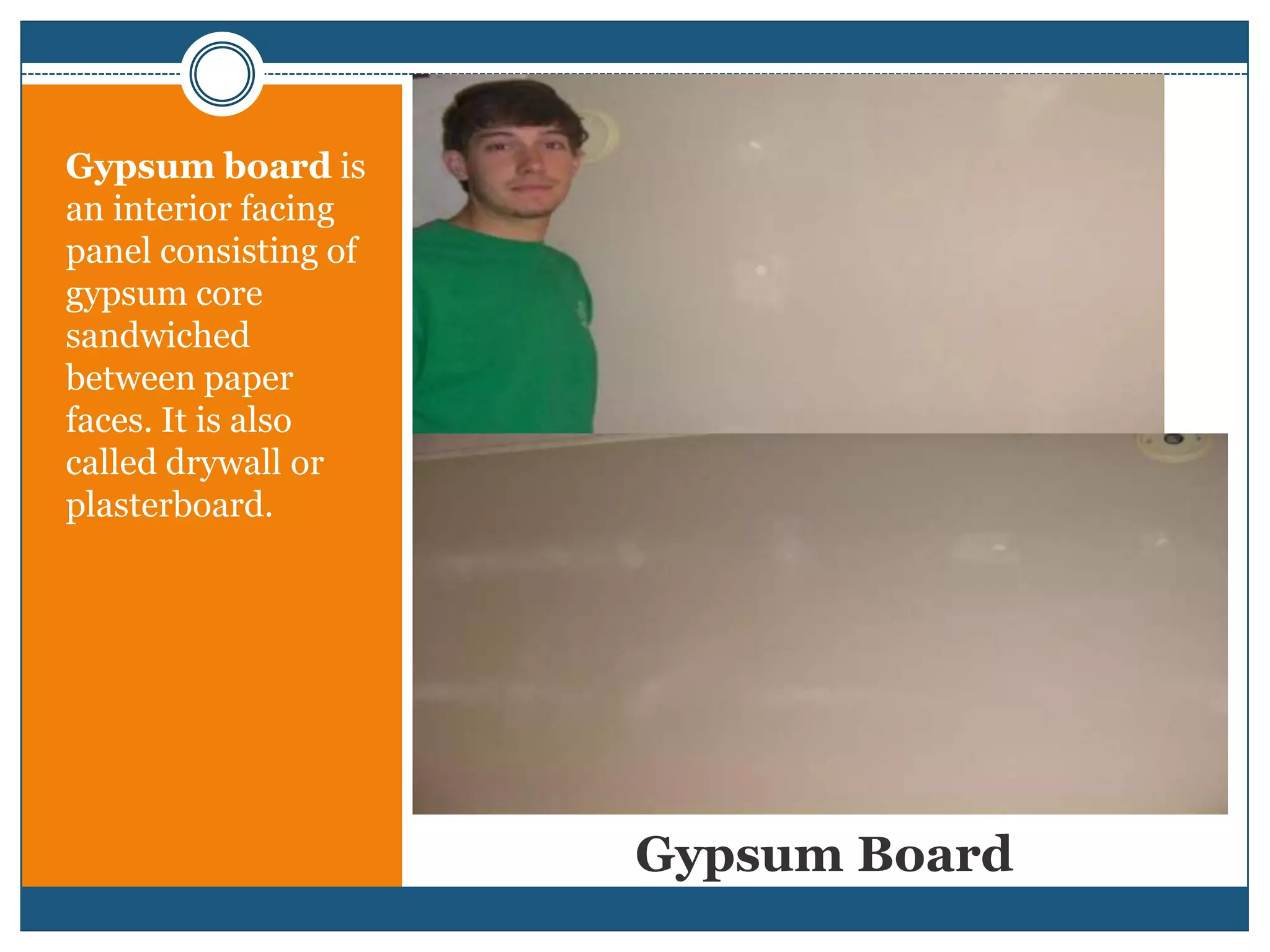
Gypsum BoardGypsum board is an interior facing panel consisting of gypsum core sandwiched between paper faces. It is also called drywall or plasterboard.
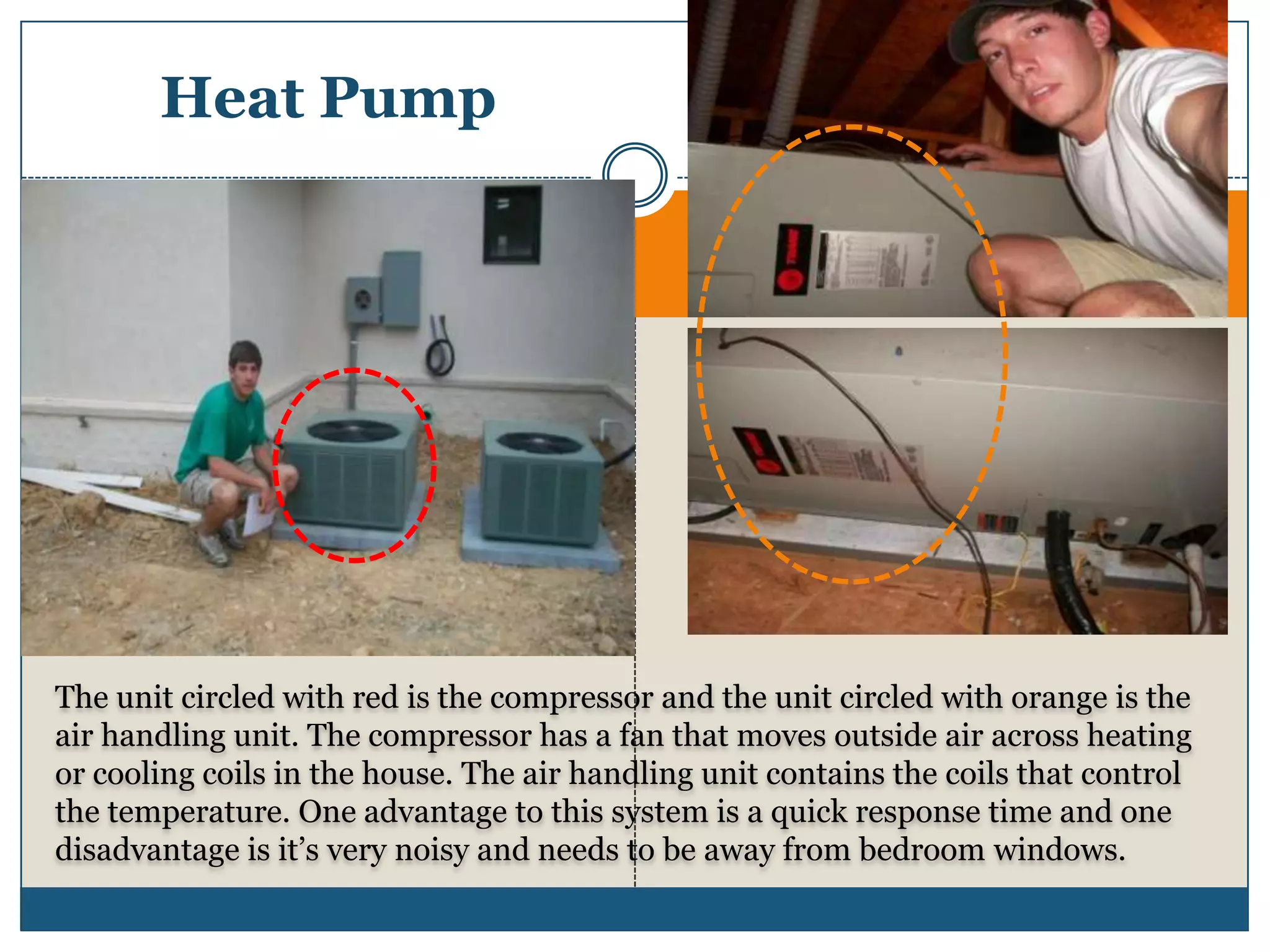
Heat PumpThe unit circled with red is the compressor and the unit circled with orange is the air handling unit. The compressor has a fan that moves outside air across heating or cooling coils in the house. The air handling unit contains the coils that control the temperature. One advantage to this system is a quick response time and one disadvantage is it’s very noisy and needs to be away from bedroom windows.
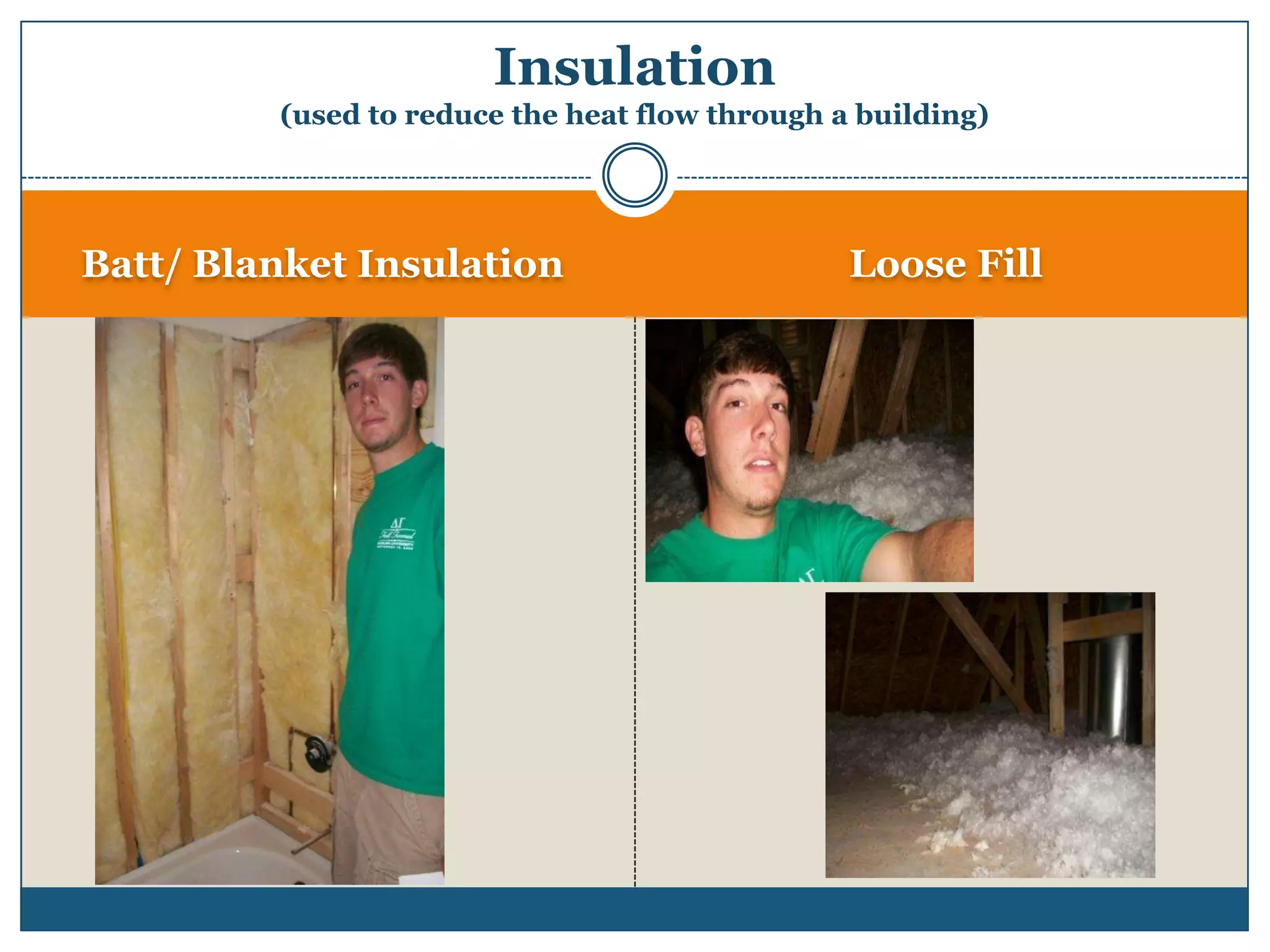
Batt/ Blanket InsulationLoose FillInsulation(used to reduce the heat flow through a building)
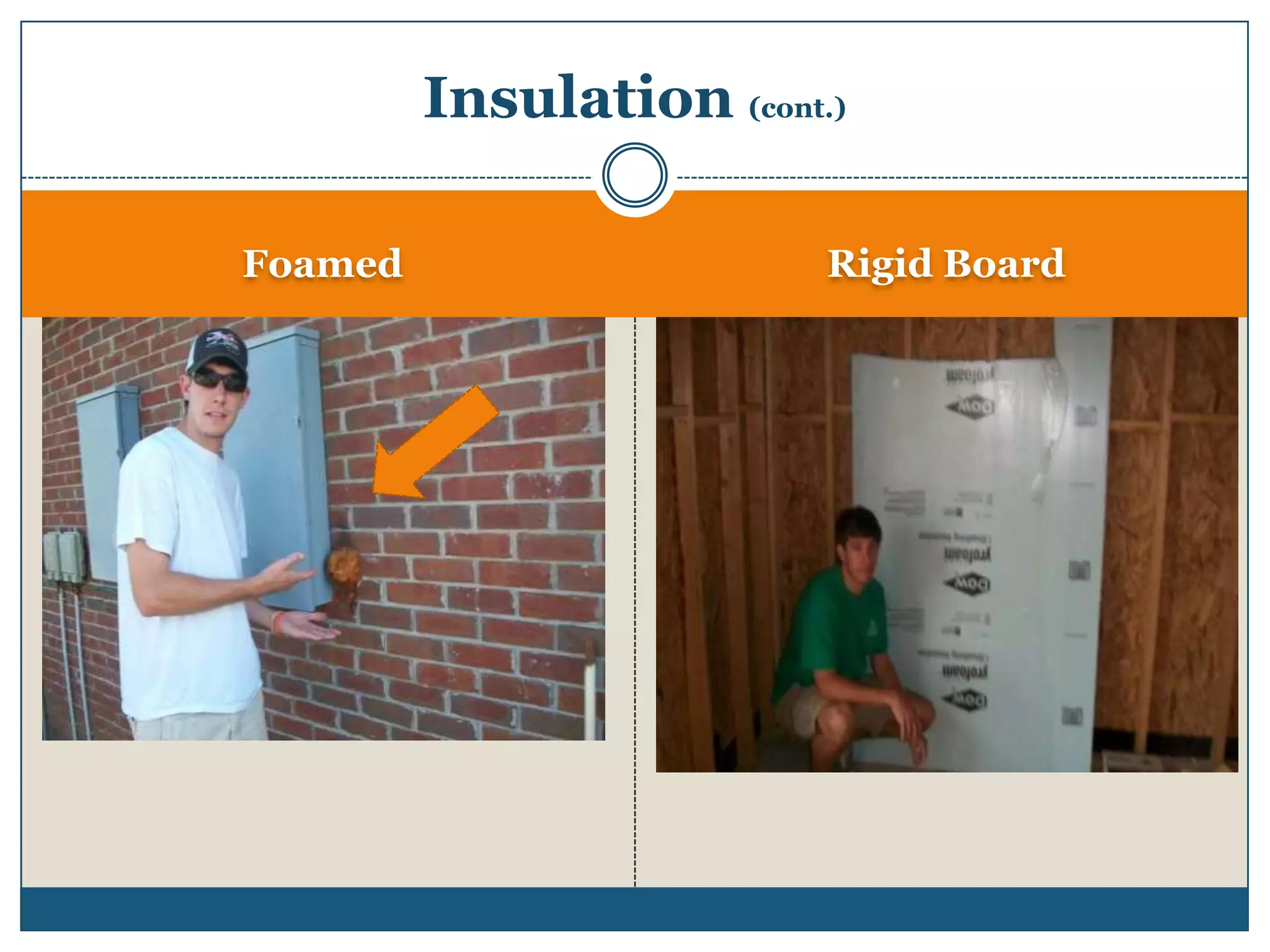
FoamedRigid BoardInsulation (cont.)
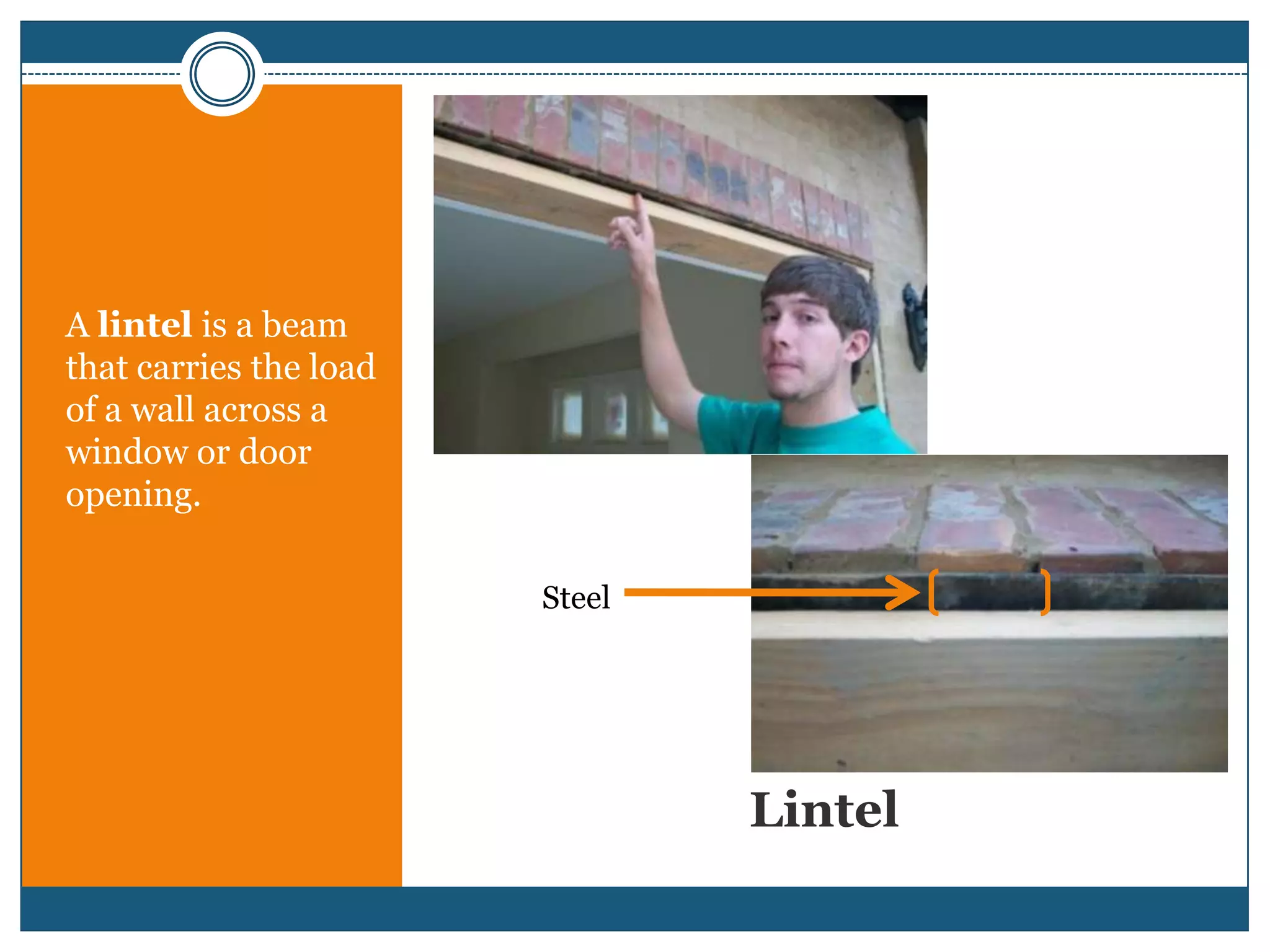
A lintel is a beam that carries the load of a wall across a window or door opening.SteelLintel
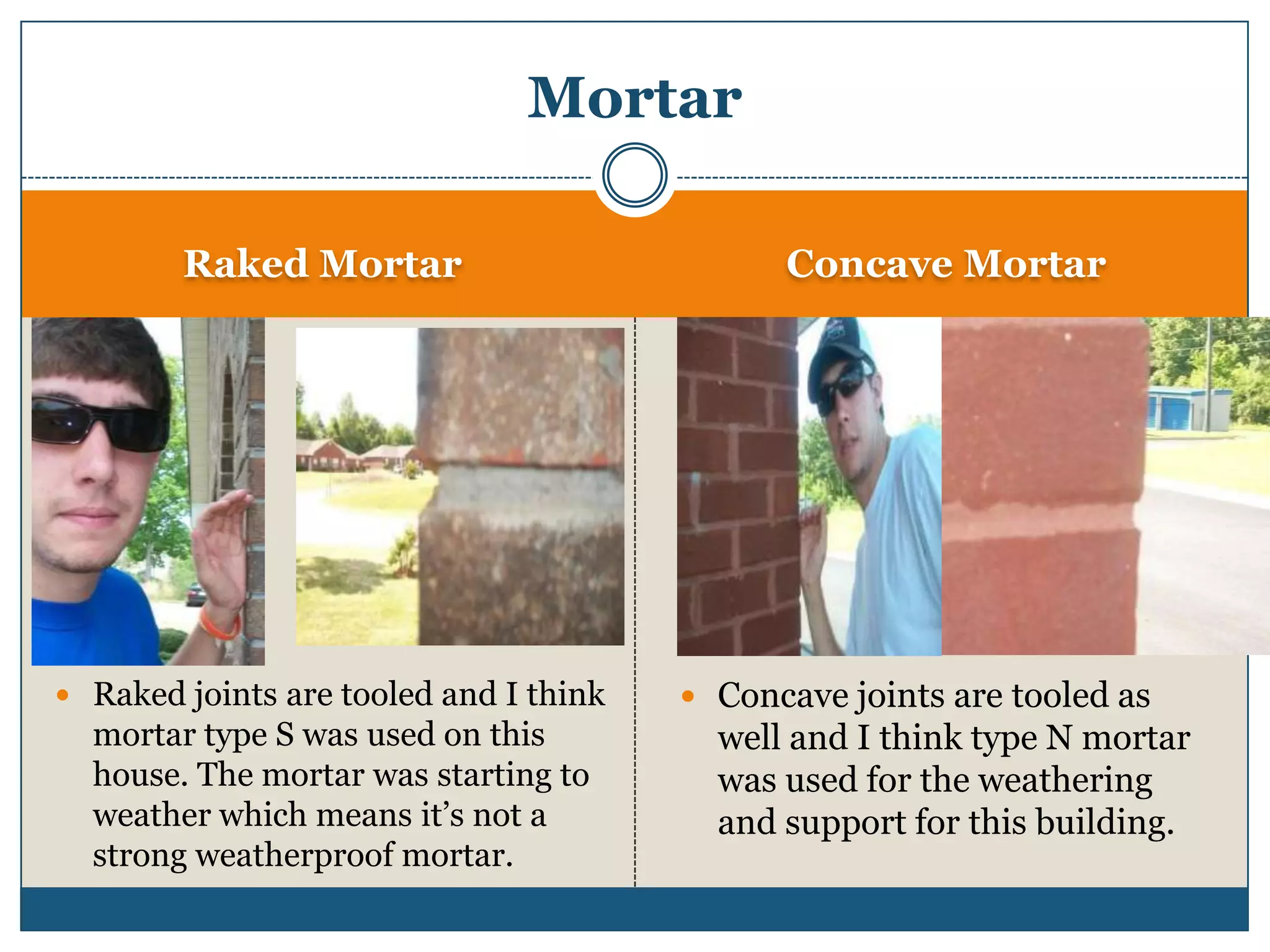
Raked MortarConcave MortarRaked joints are tooled and I think mortar type S was used on this house. The mortar was starting to weather which means it’s not a strong weatherproof mortar. Concave joints are tooled as well and I think type N mortar was used for the weathering and support for this building.Mortar
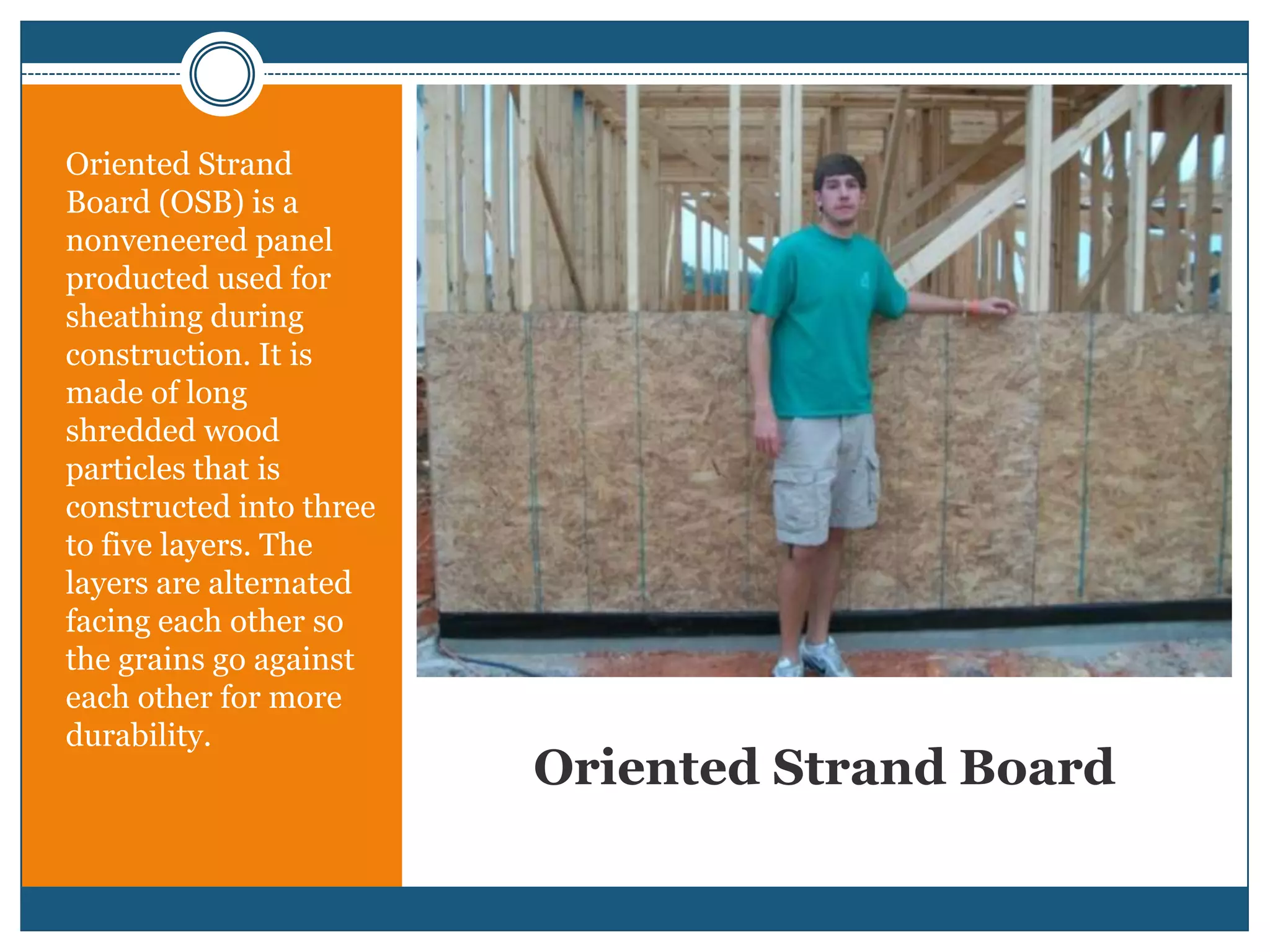
Oriented Strand BoardOriented Strand Board (OSB) is a nonveneered panel producted used for sheathing during construction. It is made of long shredded wood particles that is constructed into three to five layers. The layers are alternated facing each other so the grains go against each other for more durability.
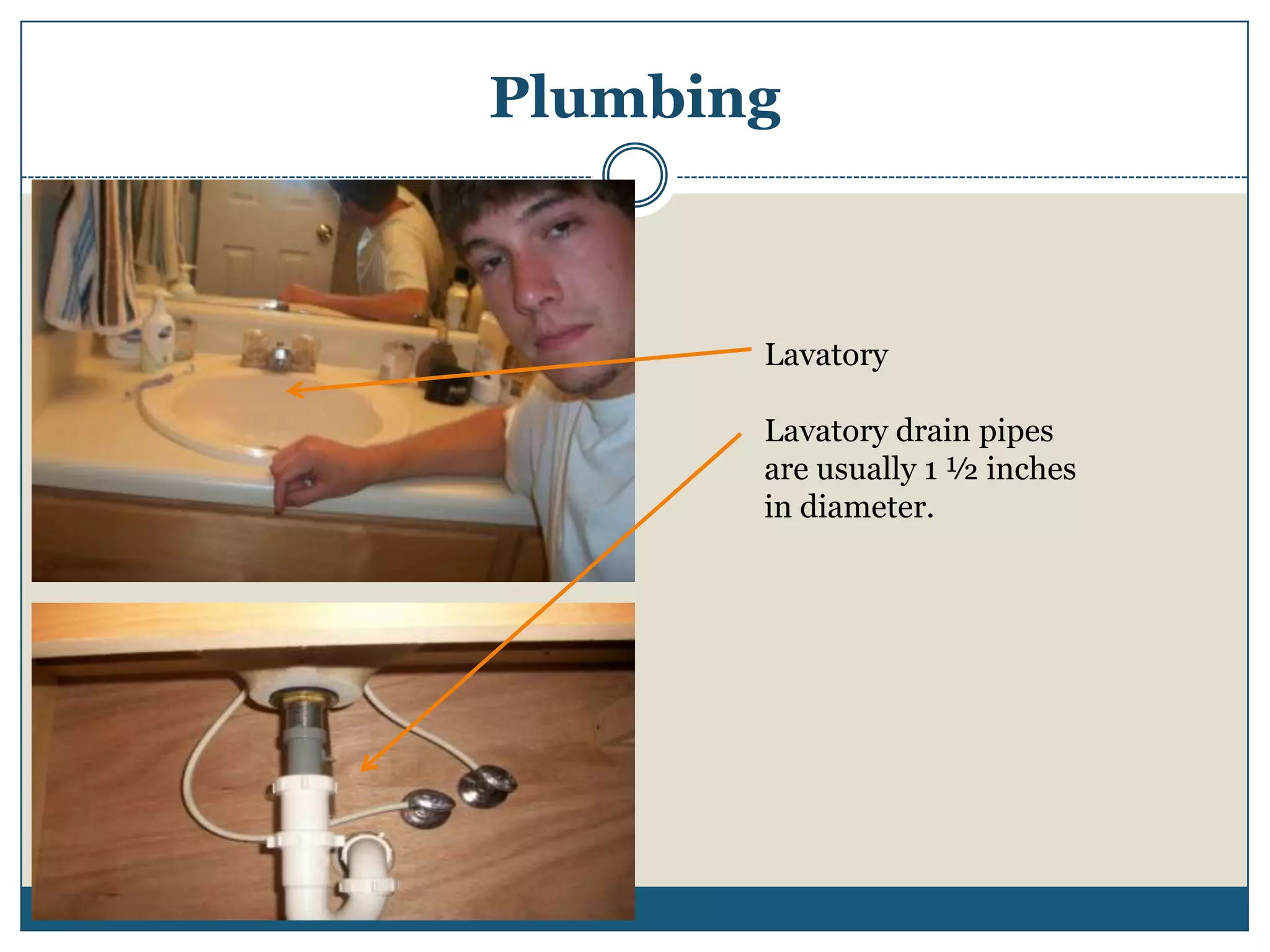
PlumbingLavatoryLavatory drain pipes are usually 1 ½ inches in diameter.
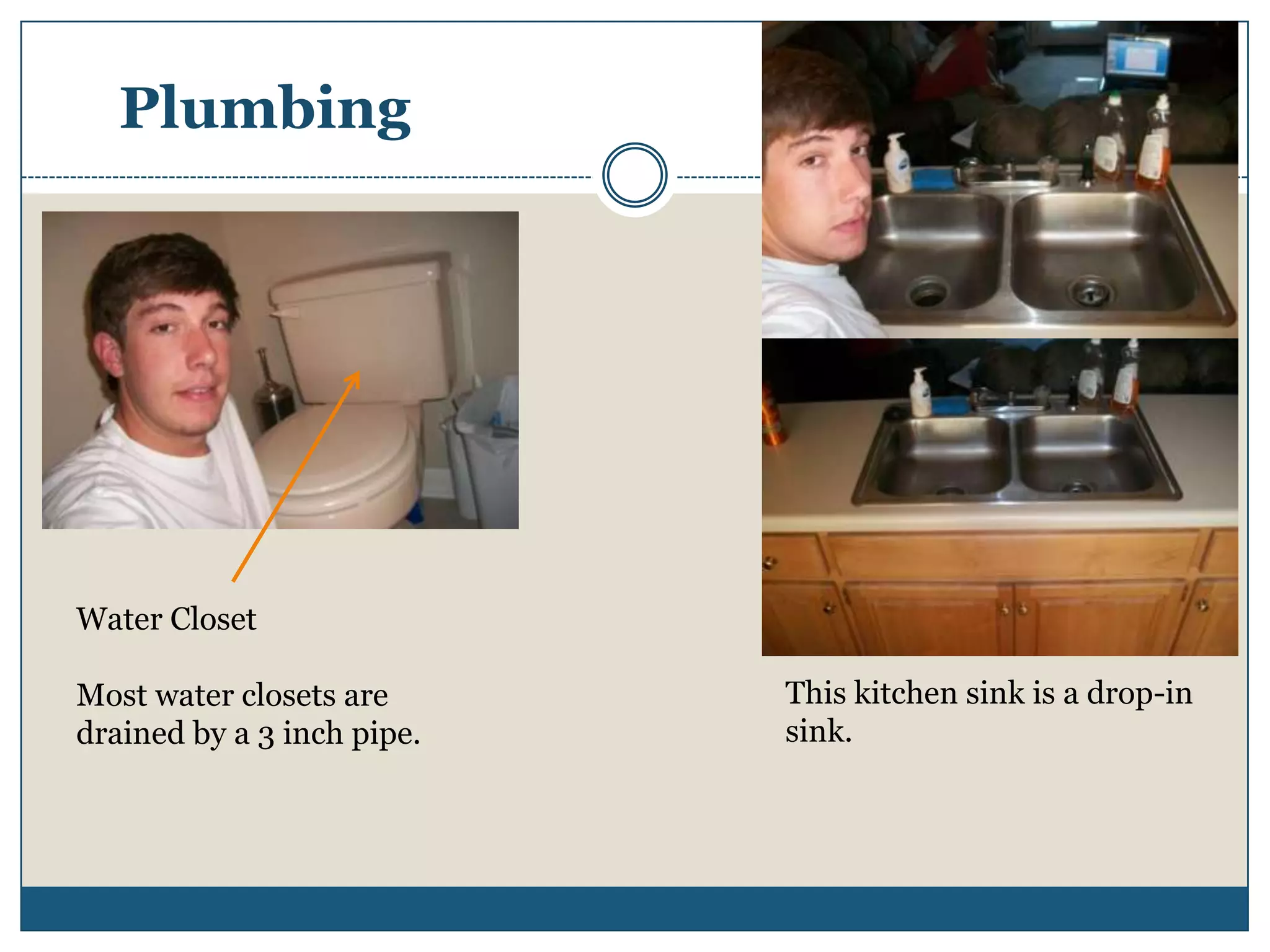
PlumbingWater ClosetMost water closets are drained by a 3 inch pipe.This kitchen sink is a drop-in sink.
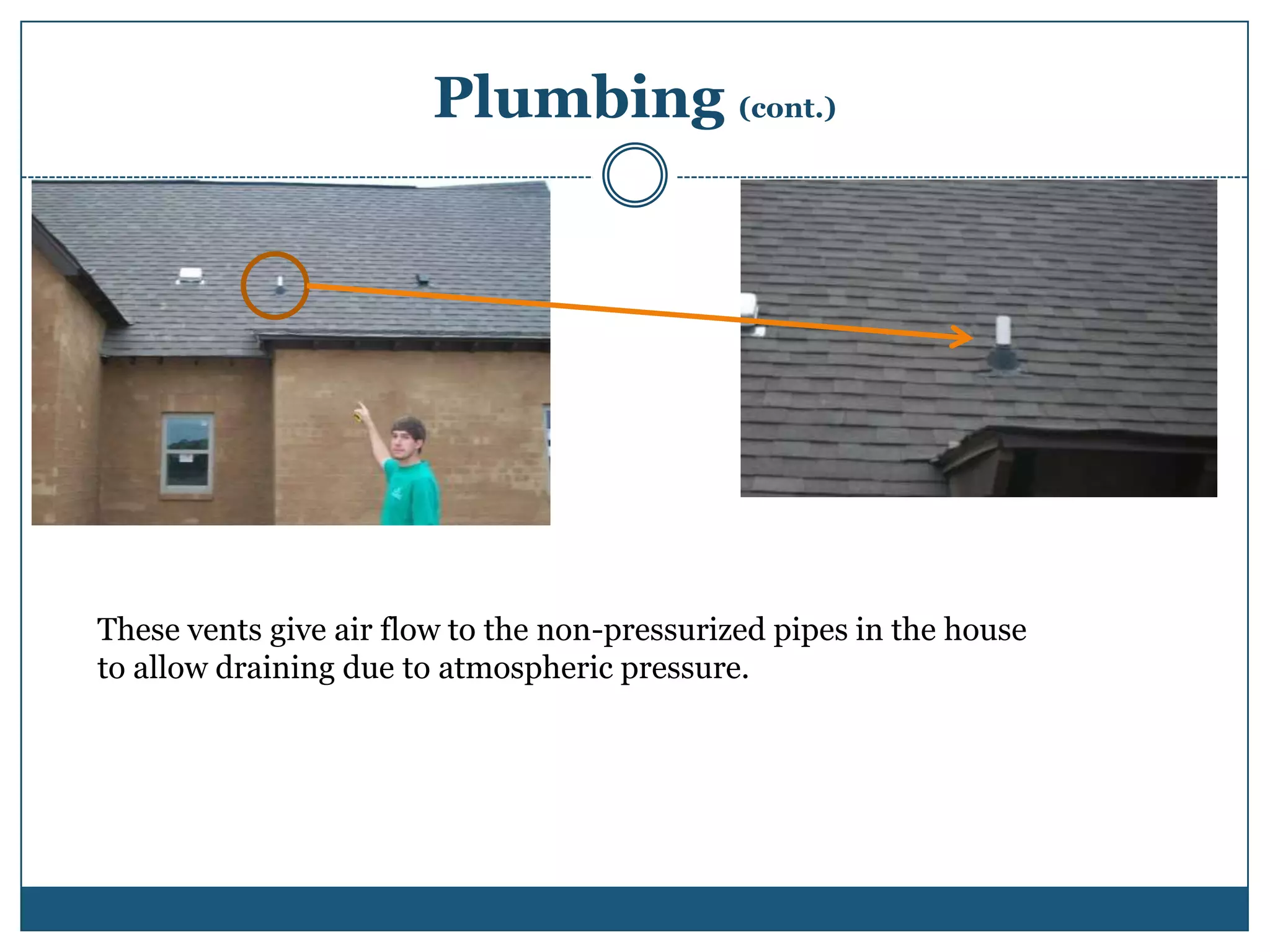
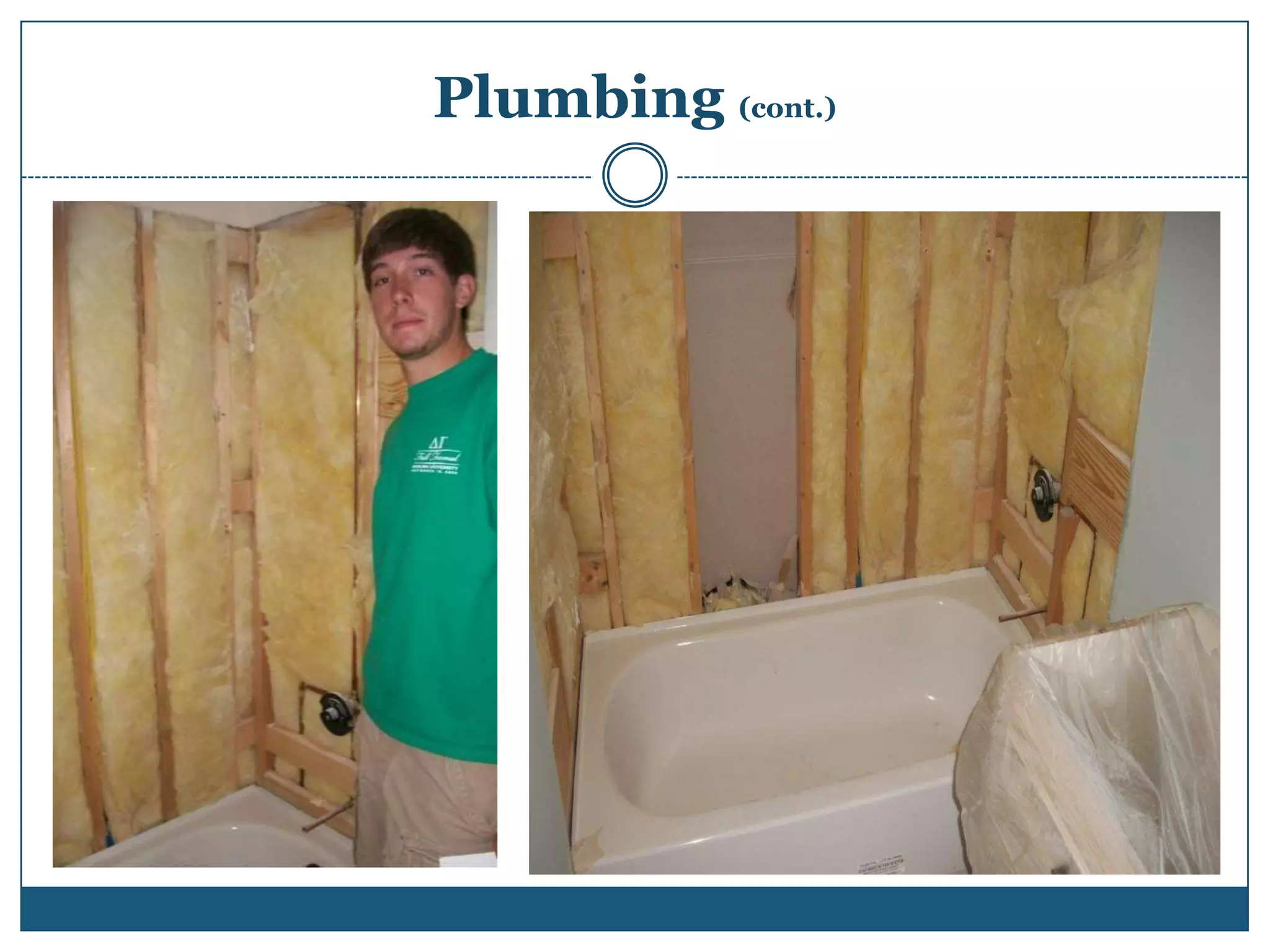
Plumbing (cont.)These vents give air flow to the non-pressurized pipes in the house to allow draining due to atmospheric pressure.
Plumbing (cont.)
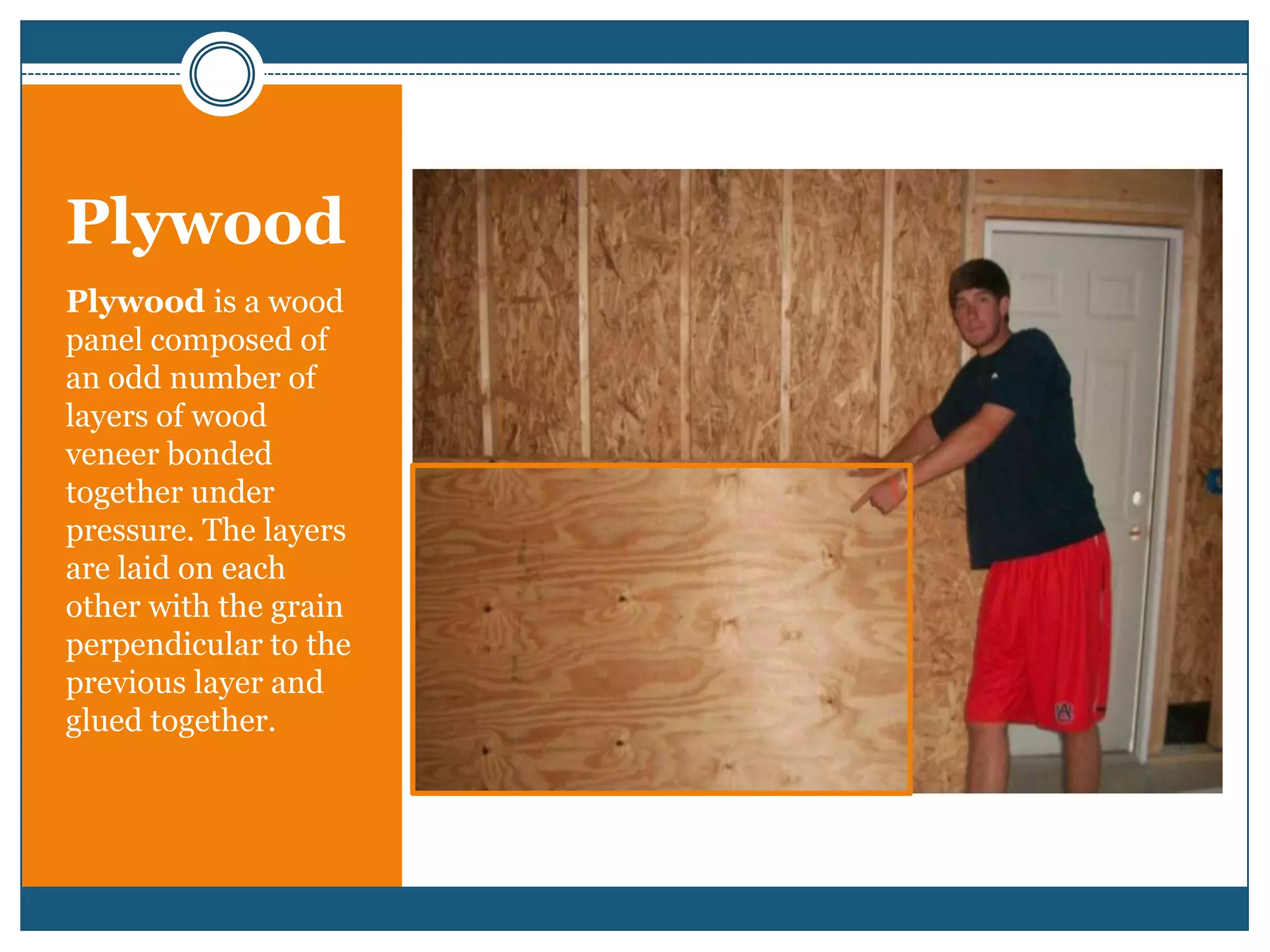
PlywoodPlywood is a wood panel composed of an odd number of layers of wood veneer bonded together under pressure. The layers are laid on each other with the grain perpendicular to the previous layer and glued together.
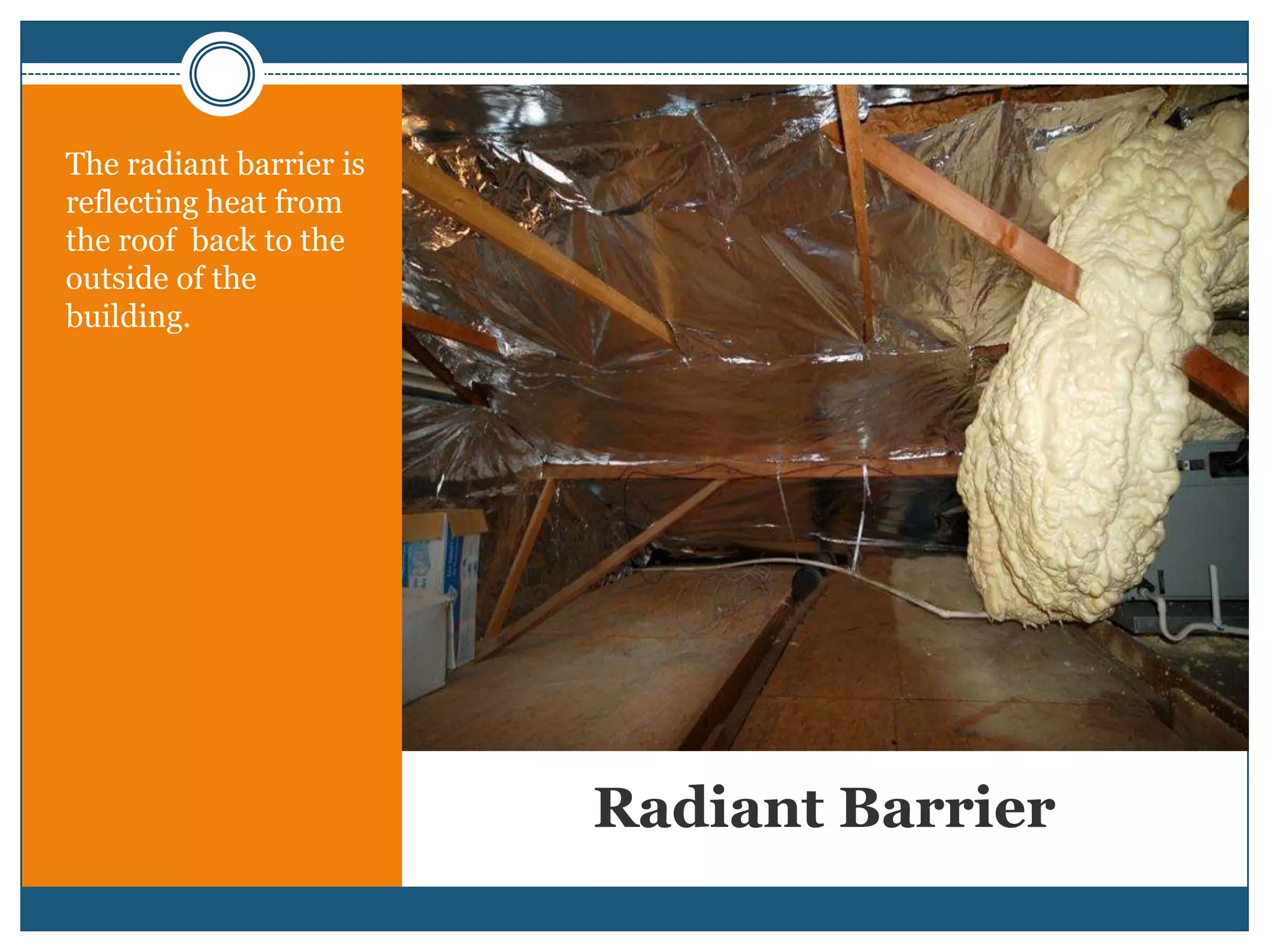
Radiant Barrier The radiant barrier is reflecting heat from the roof  back to the outside of the building.
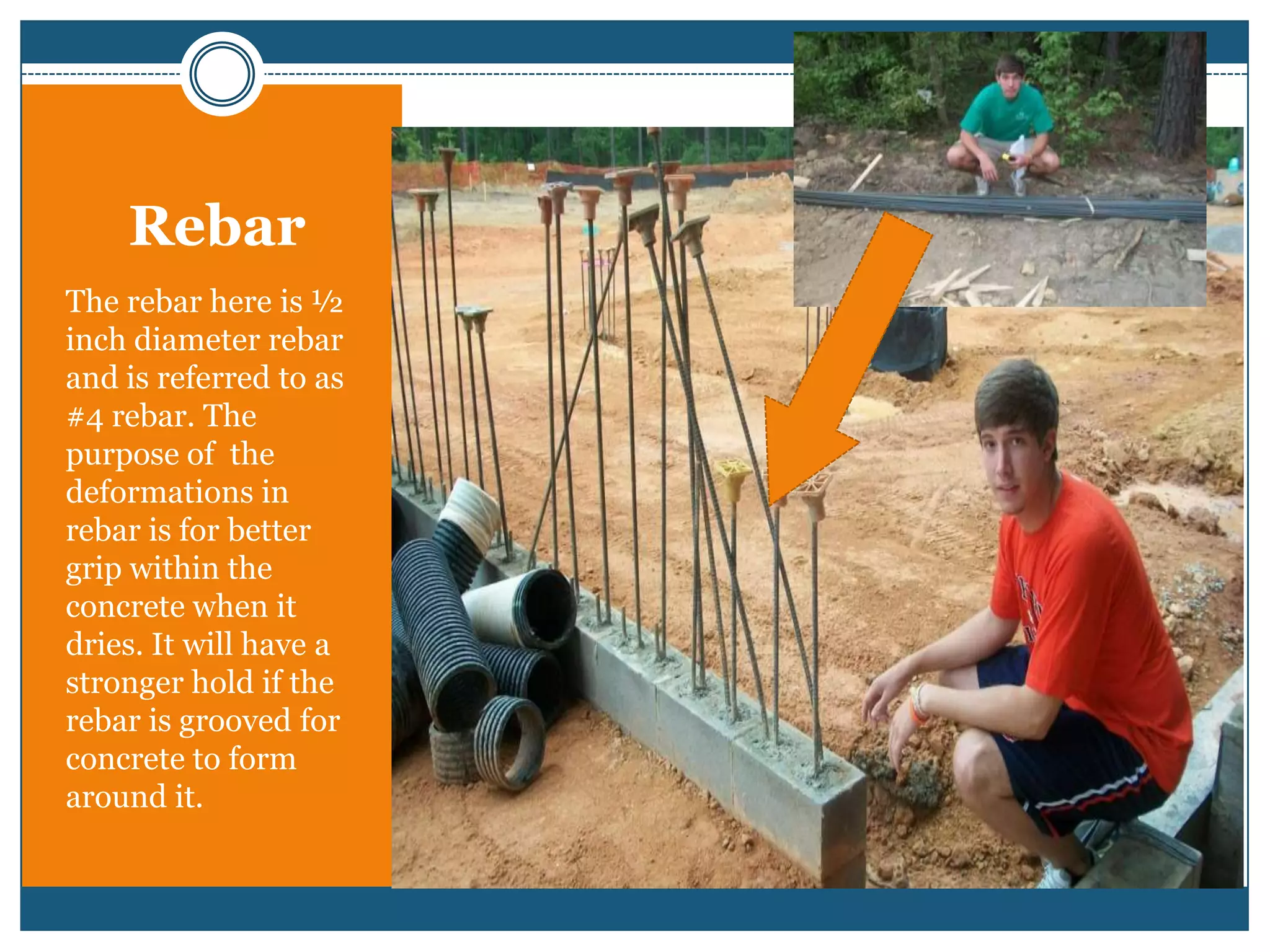
RebarThe rebar here is ½ inch diameter rebar and is referred to as #4 rebar. The purpose of  the deformations in rebar is for better grip within the concrete when it dries. It will have a stronger hold if the rebar is grooved for concrete to form around it.
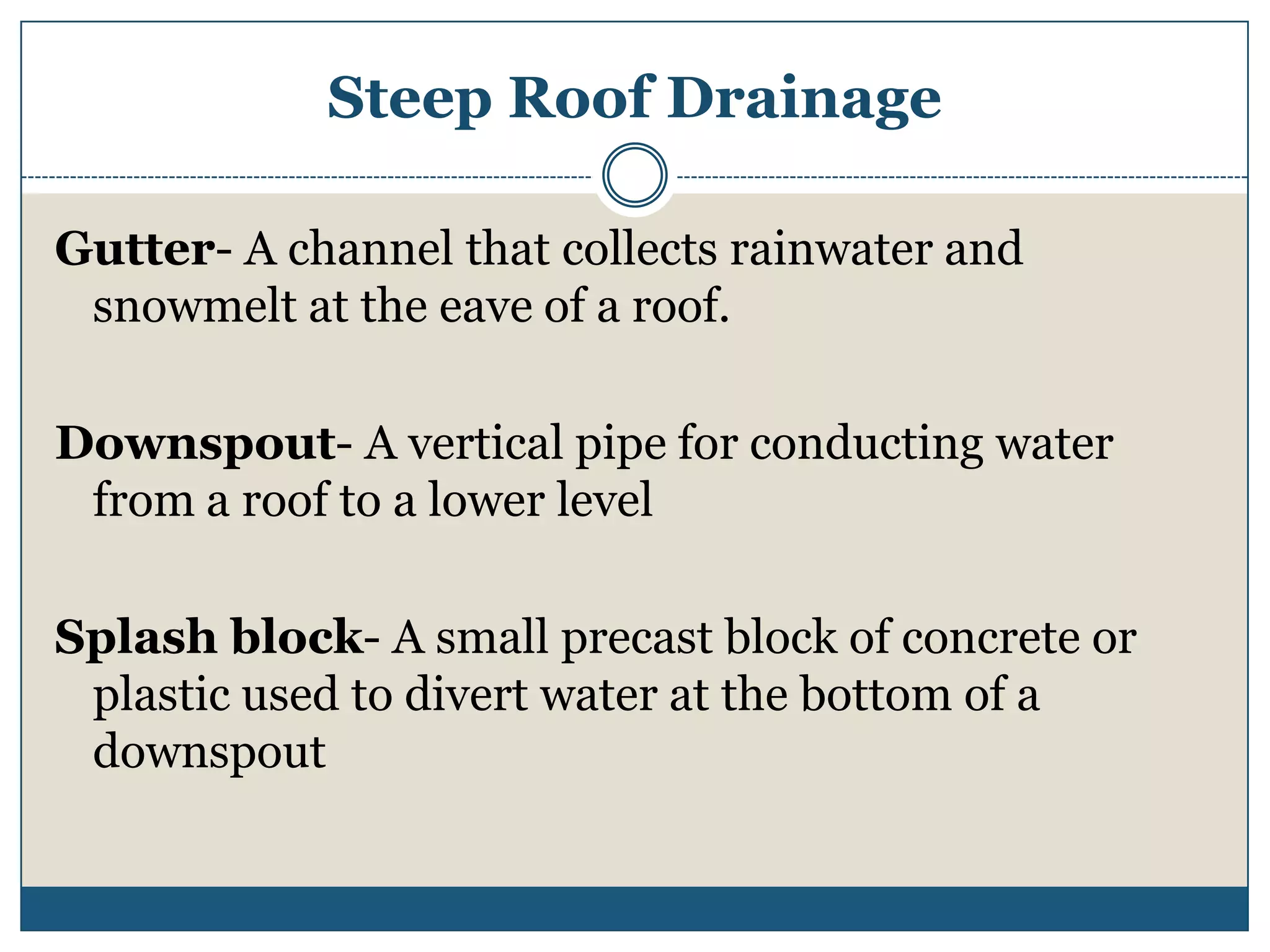
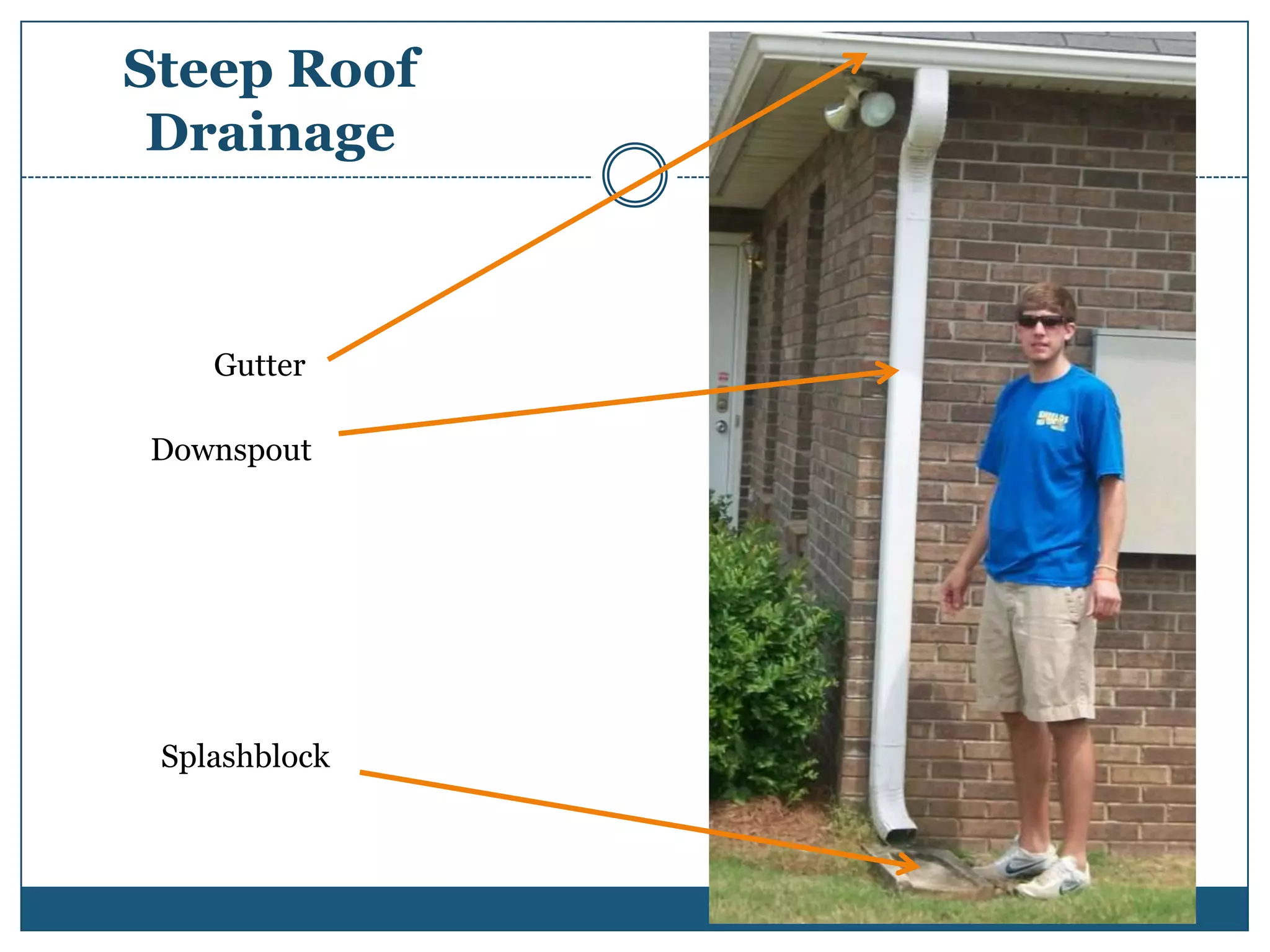
Gutter- A channel that collects rainwater and snowmelt at the eave of a roof.Downspout- A vertical pipe for conducting water from a roof to a lower levelSplash block- A small precast block of concrete or plastic used to divert water at the bottom of a downspoutSteep Roof Drainage
Steep Roof DrainageGutterDownspoutSplashblock
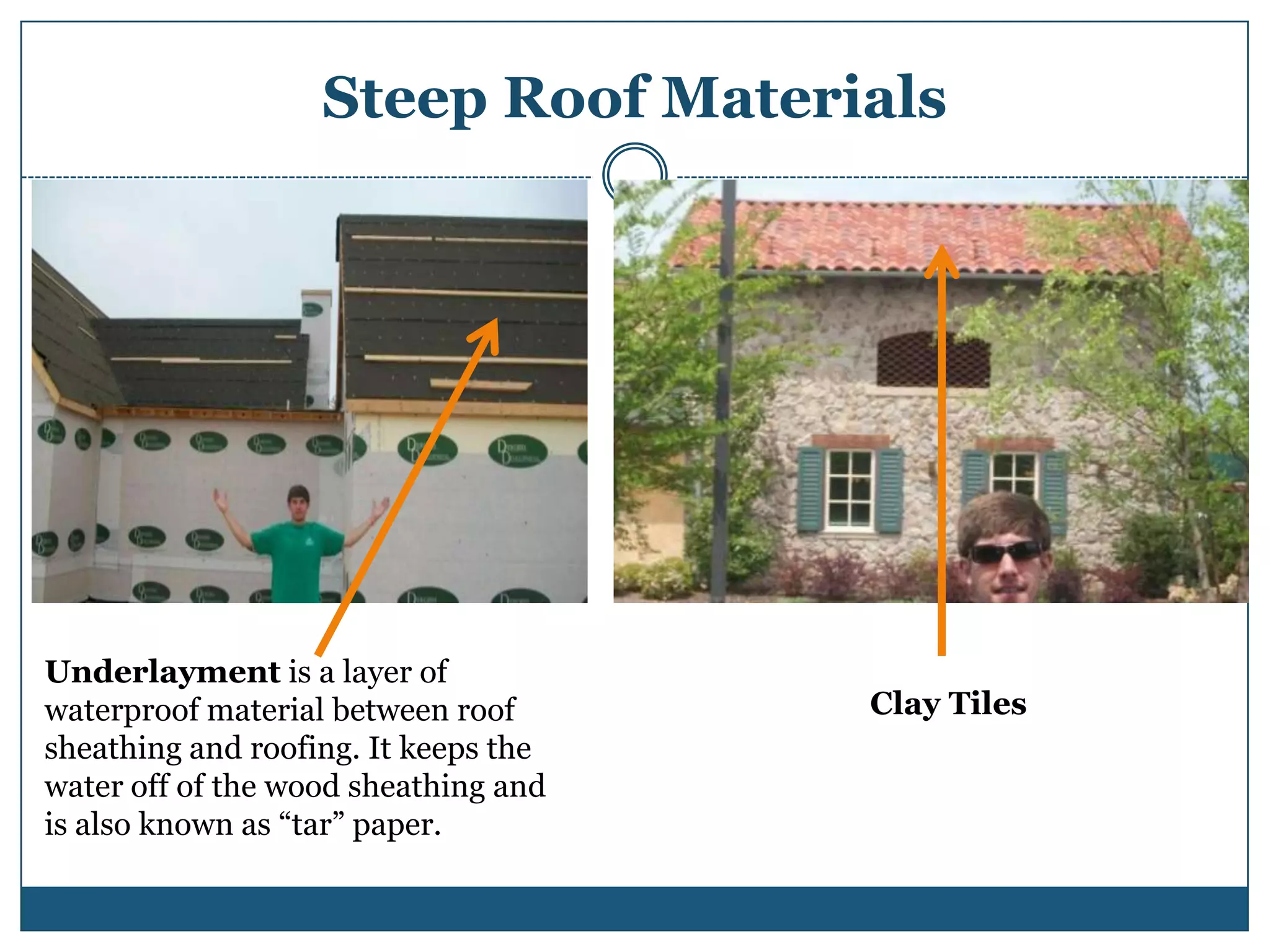
Steep Roof MaterialsUnderlayment is a layer of waterproof material between roof sheathing and roofing. It keeps the water off of the wood sheathing and is also known as “tar” paper.Clay Tiles
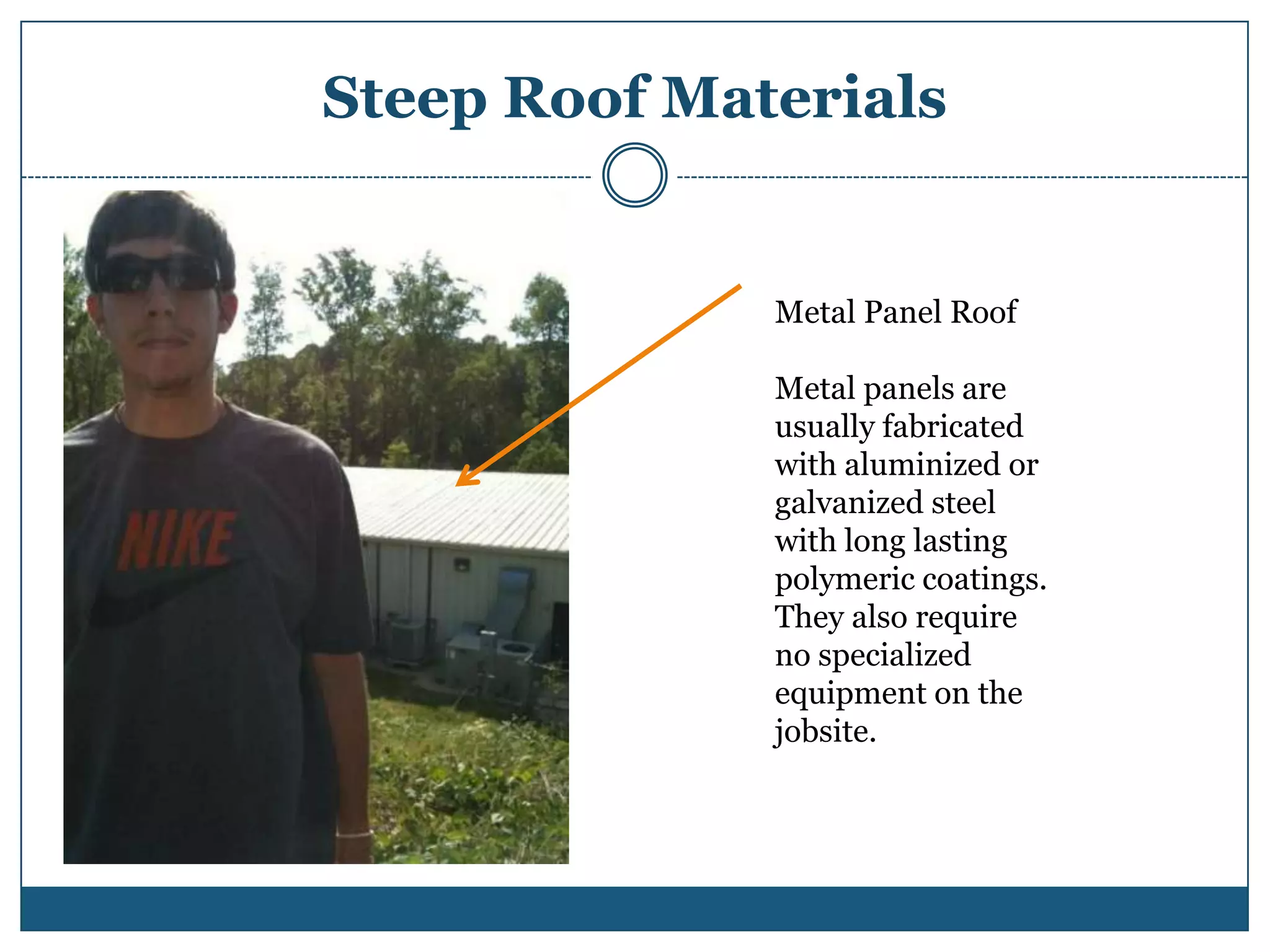
Steep Roof MaterialsMetal Panel RoofMetal panels are usually fabricated with aluminized or galvanized steel with long lasting polymeric coatings. They also require no specialized equipment on the jobsite.
Steep Roof MaterialsWood Shakes
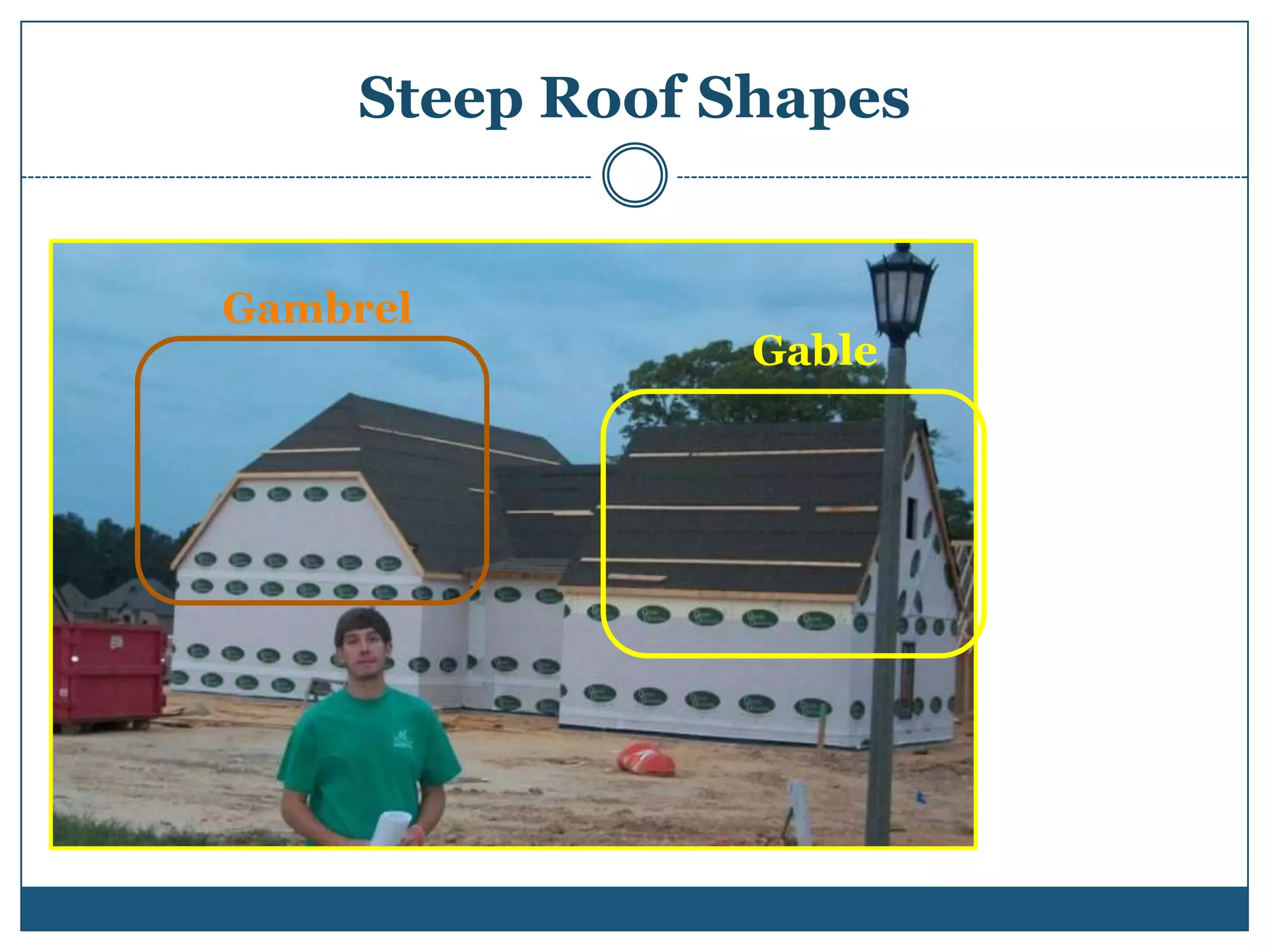
Steep Roof ShapesGambrelGable
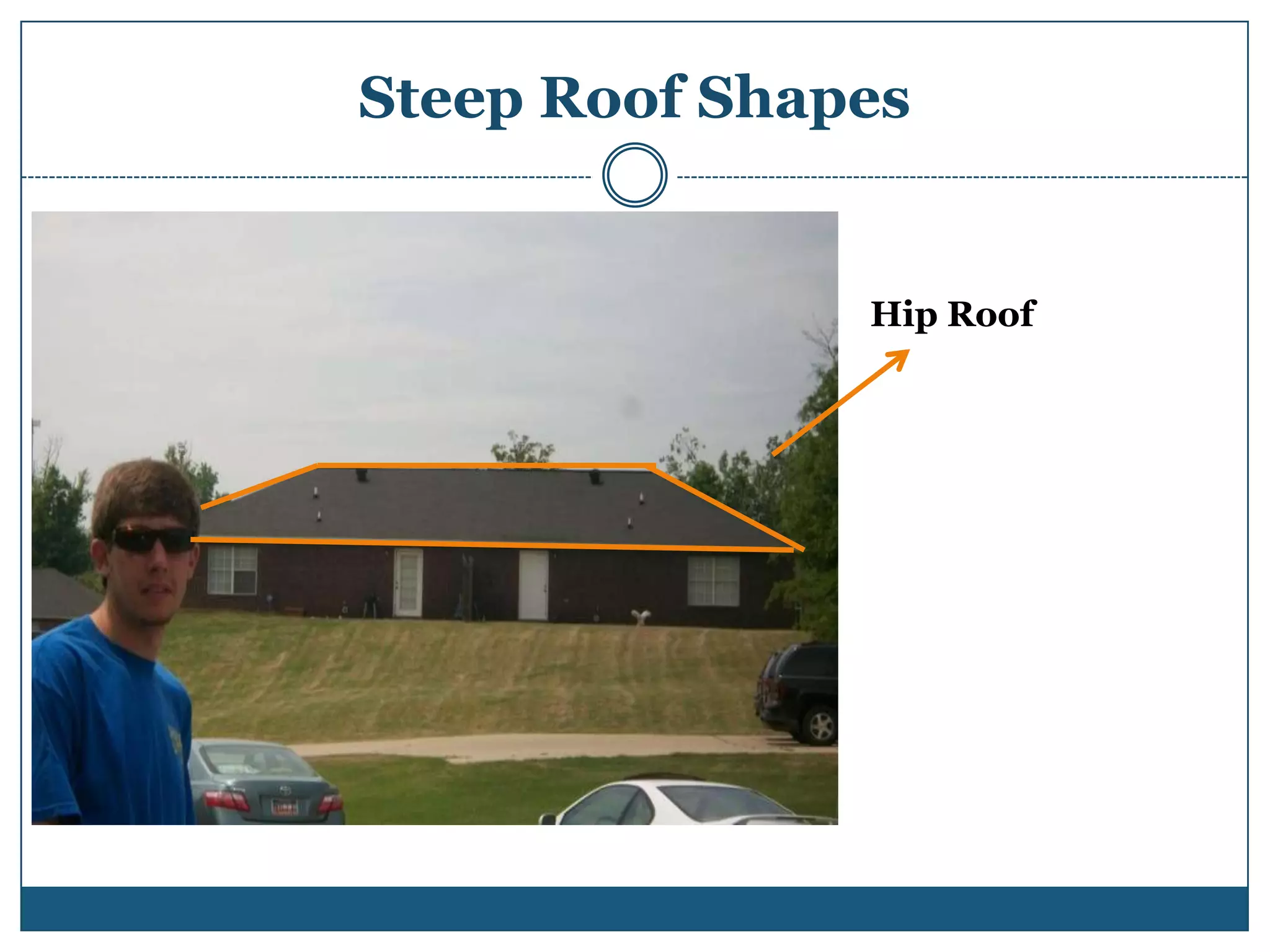
Steep Roof ShapesHip Roof
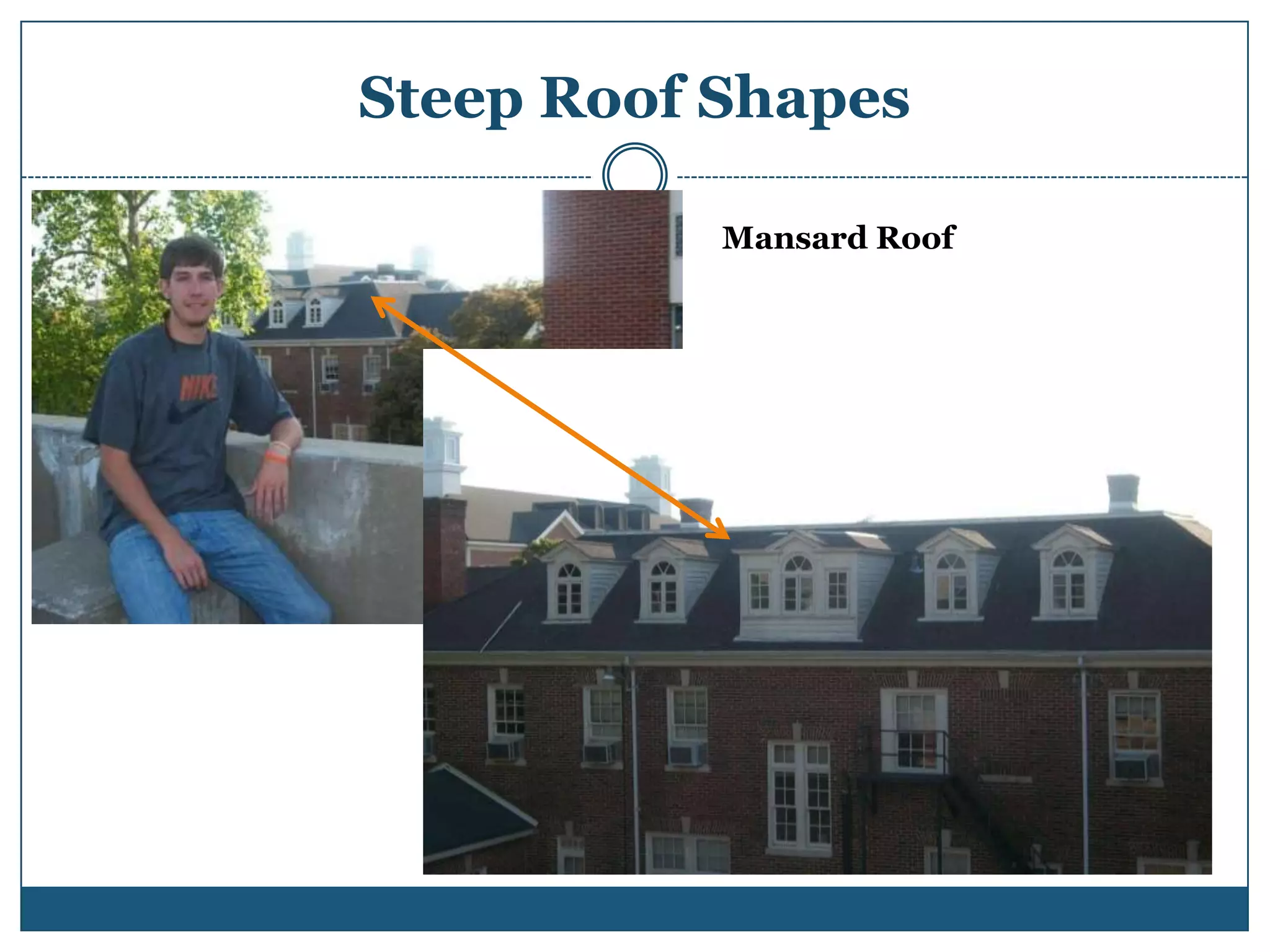
Steep Roof ShapesMansard Roof
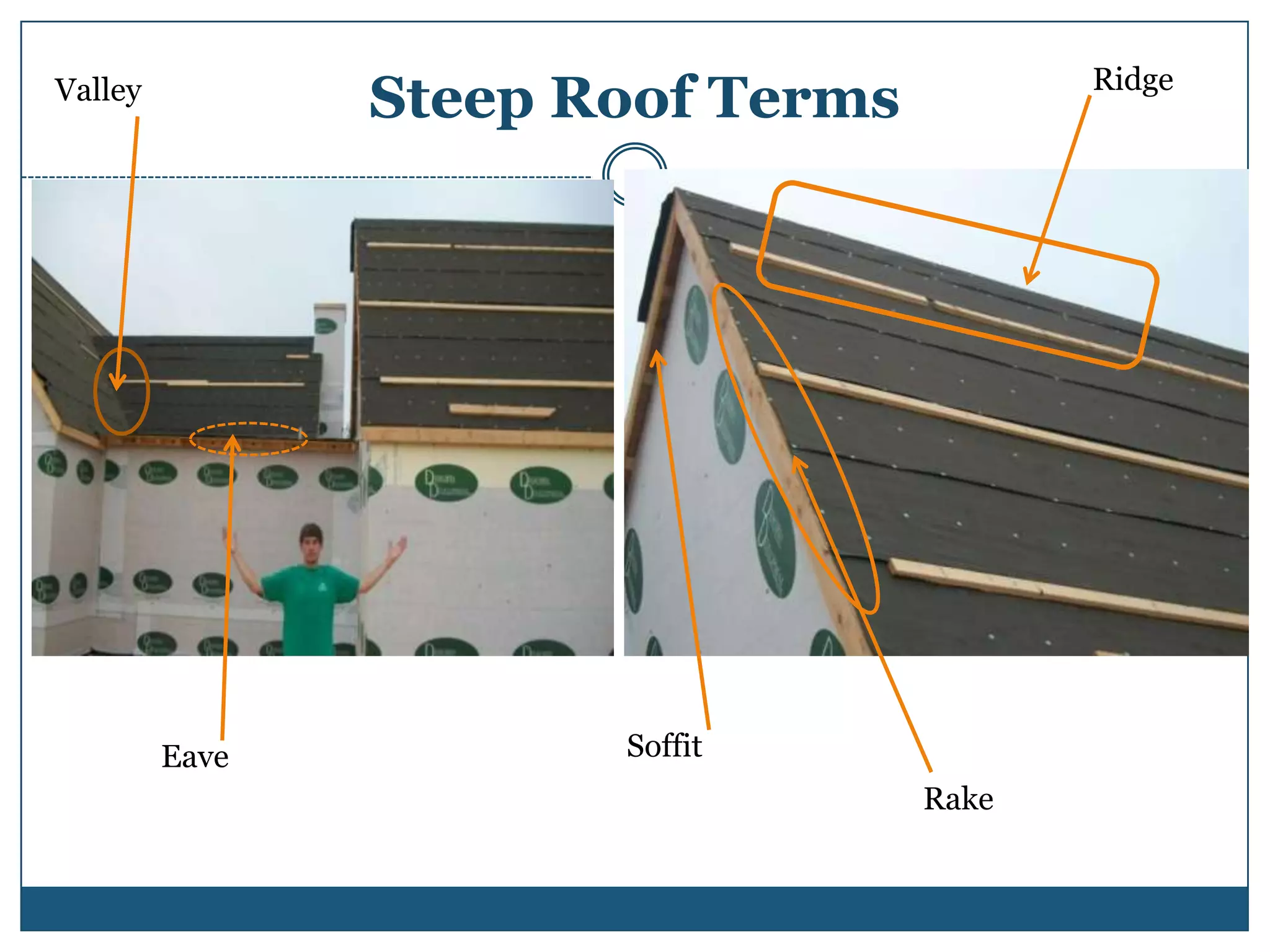
Steep Roof TermsRidgeValleySoffitEaveRake
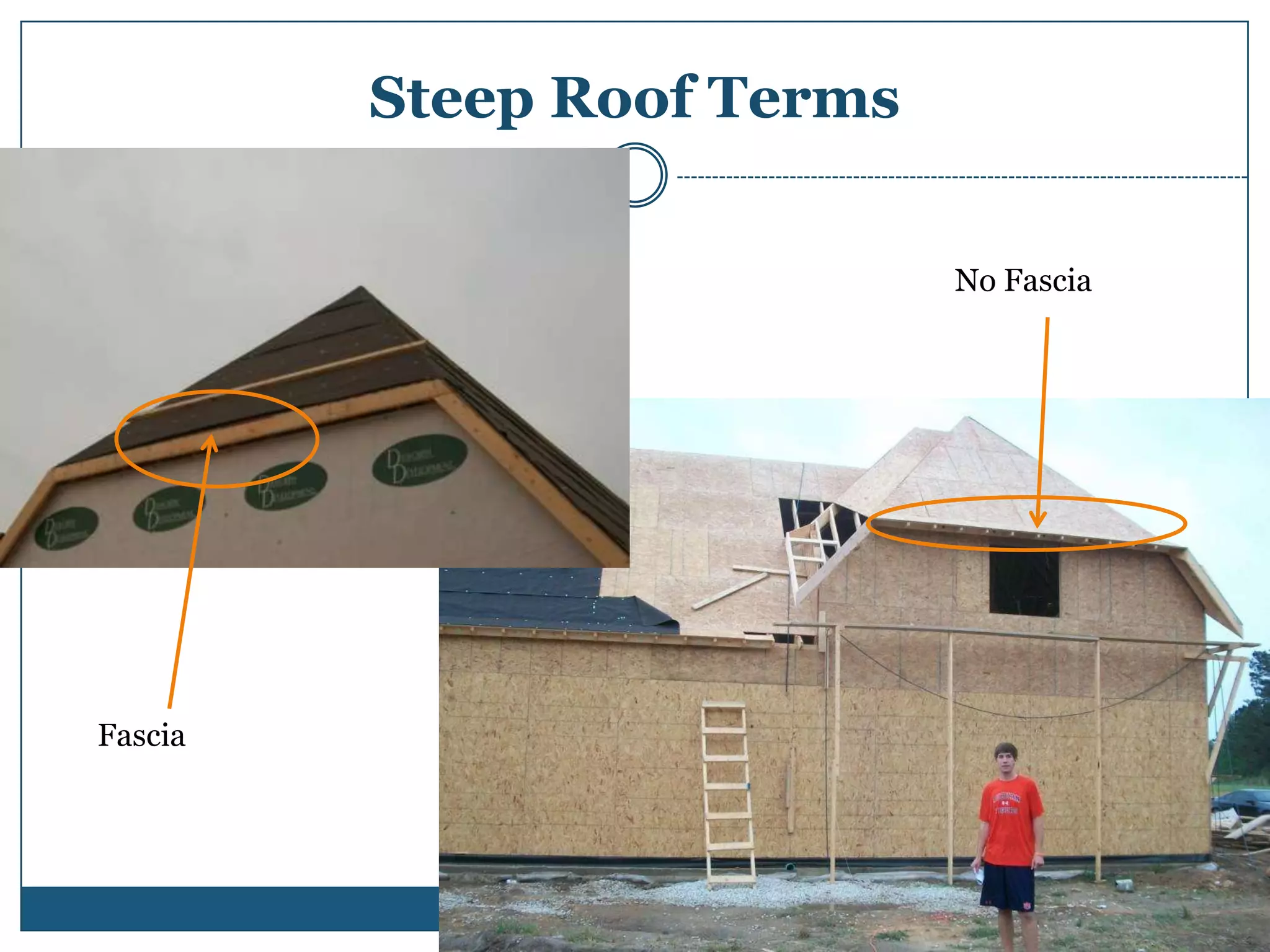
Steep Roof TermsNo FasciaFascia
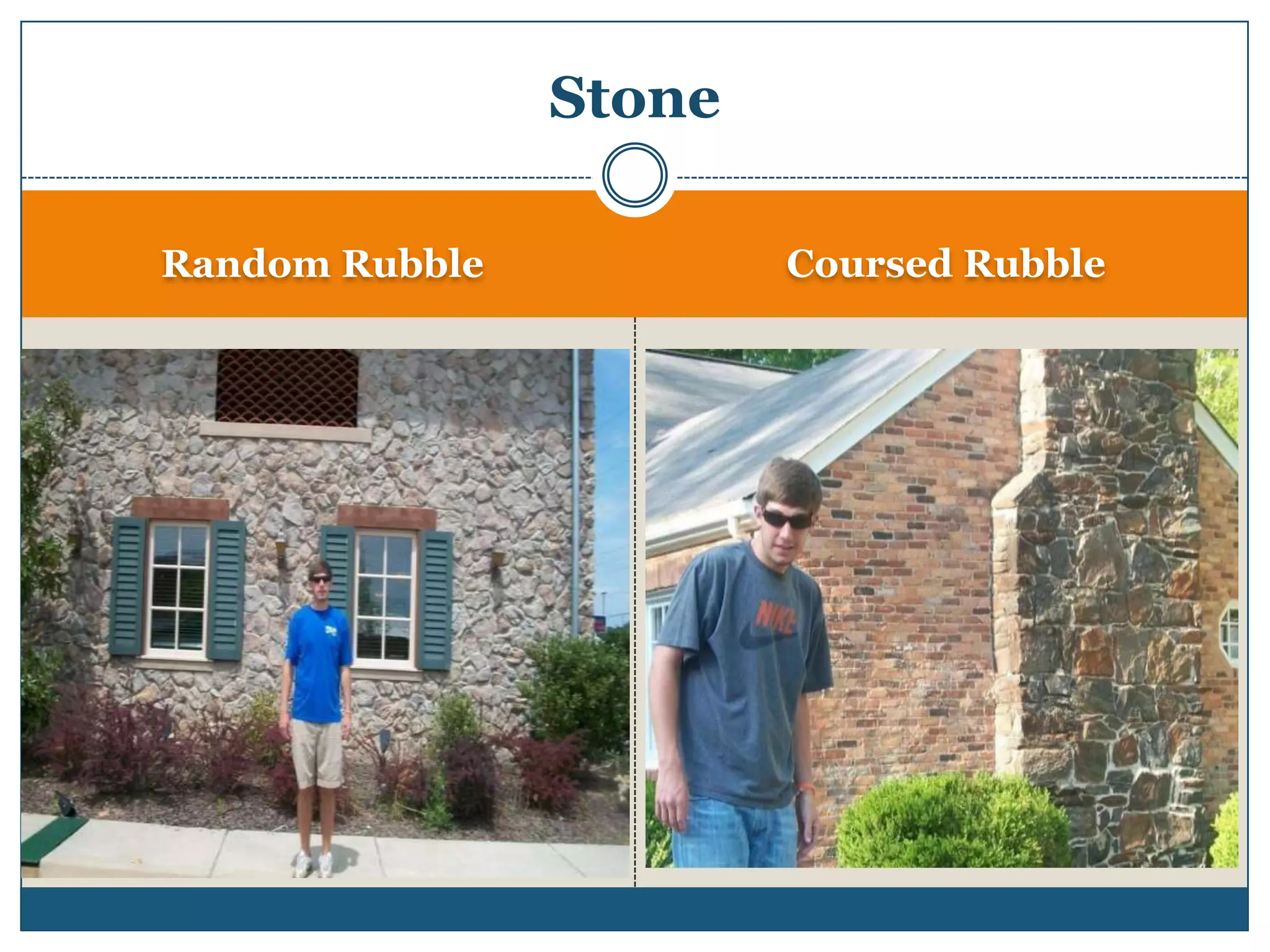
Random RubbleCoursed RubbleStone
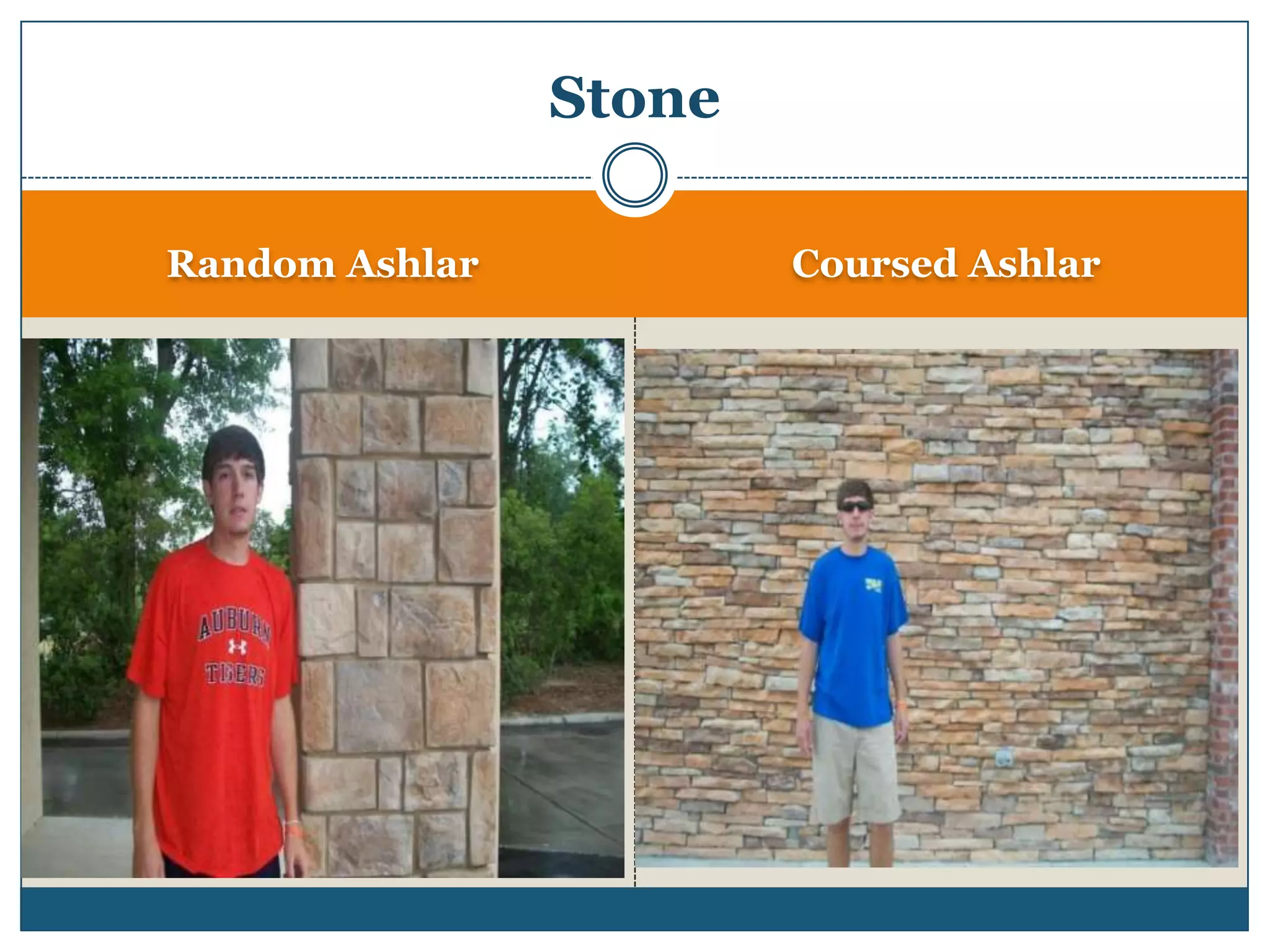
Random AshlarCoursed AshlarStone
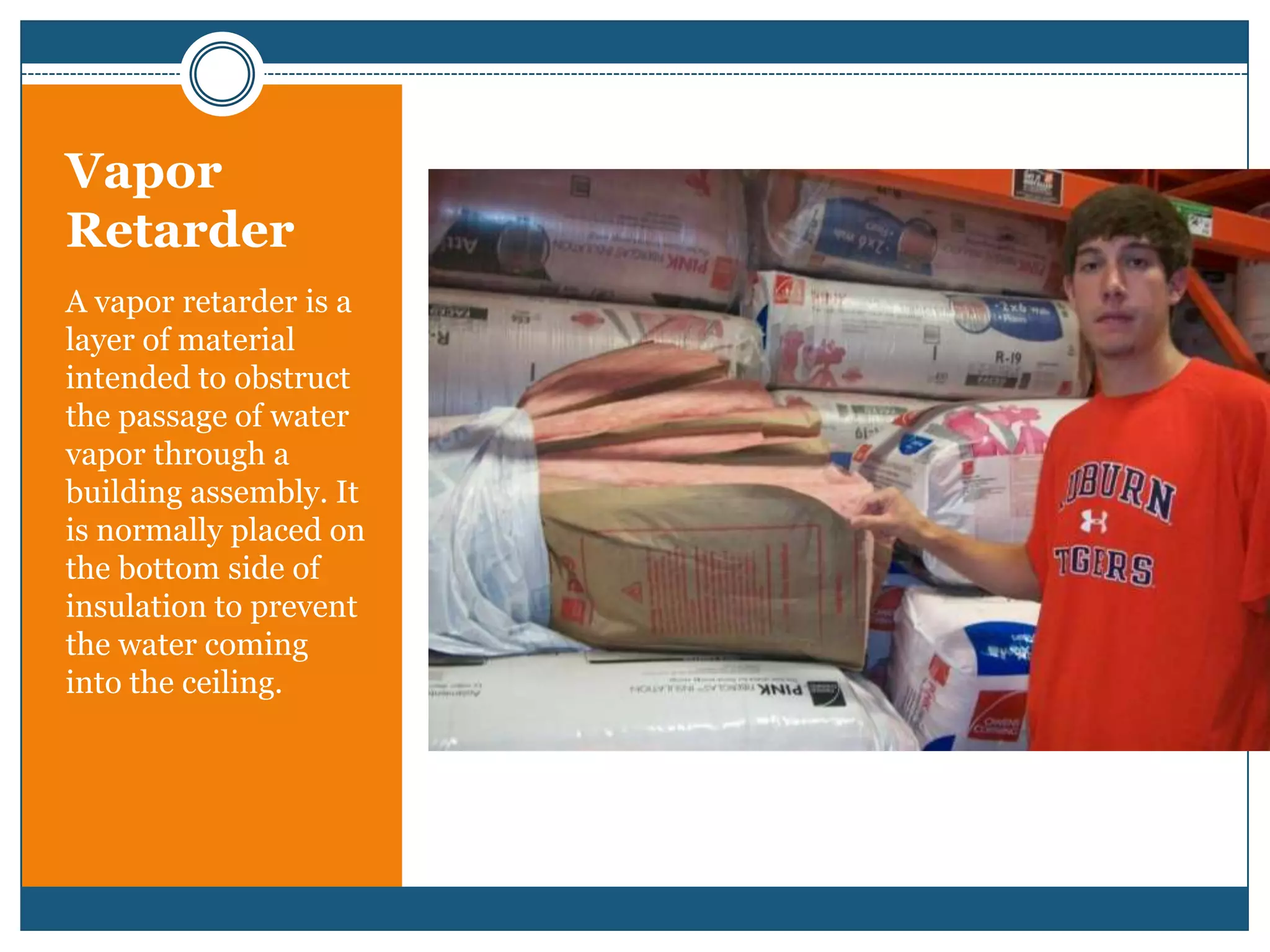
Vapor RetarderA vapor retarder is a layer of material intended to obstruct the passage of water vapor through a building assembly. It is normally placed on the bottom side of insulation to prevent the water coming into the ceiling.
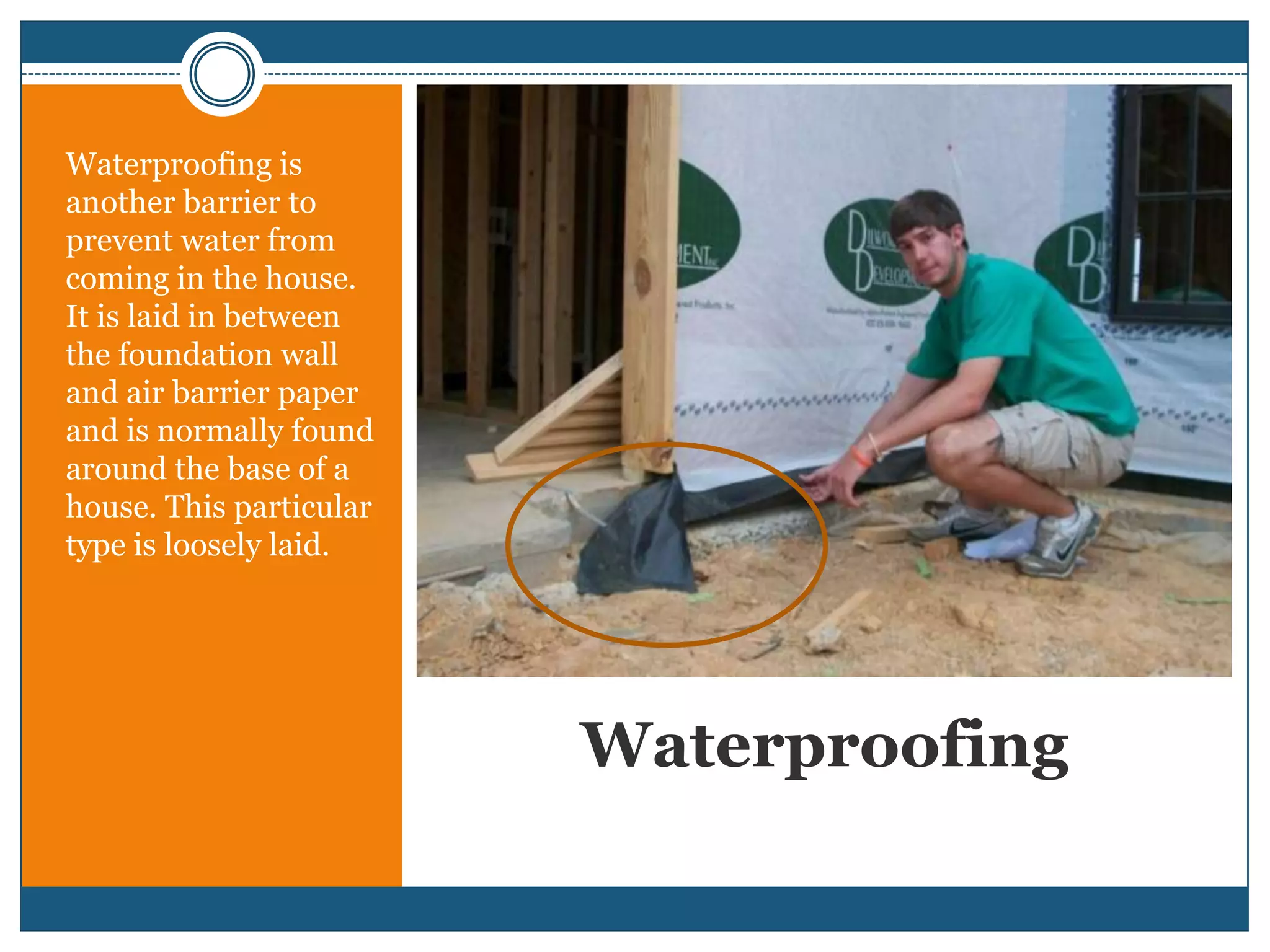
WaterproofingWaterproofing is another barrier to prevent water from coming in the house. It is laid in between the foundation wall and air barrier paper and is normally found around the base of a house. This particular type is loosely laid.
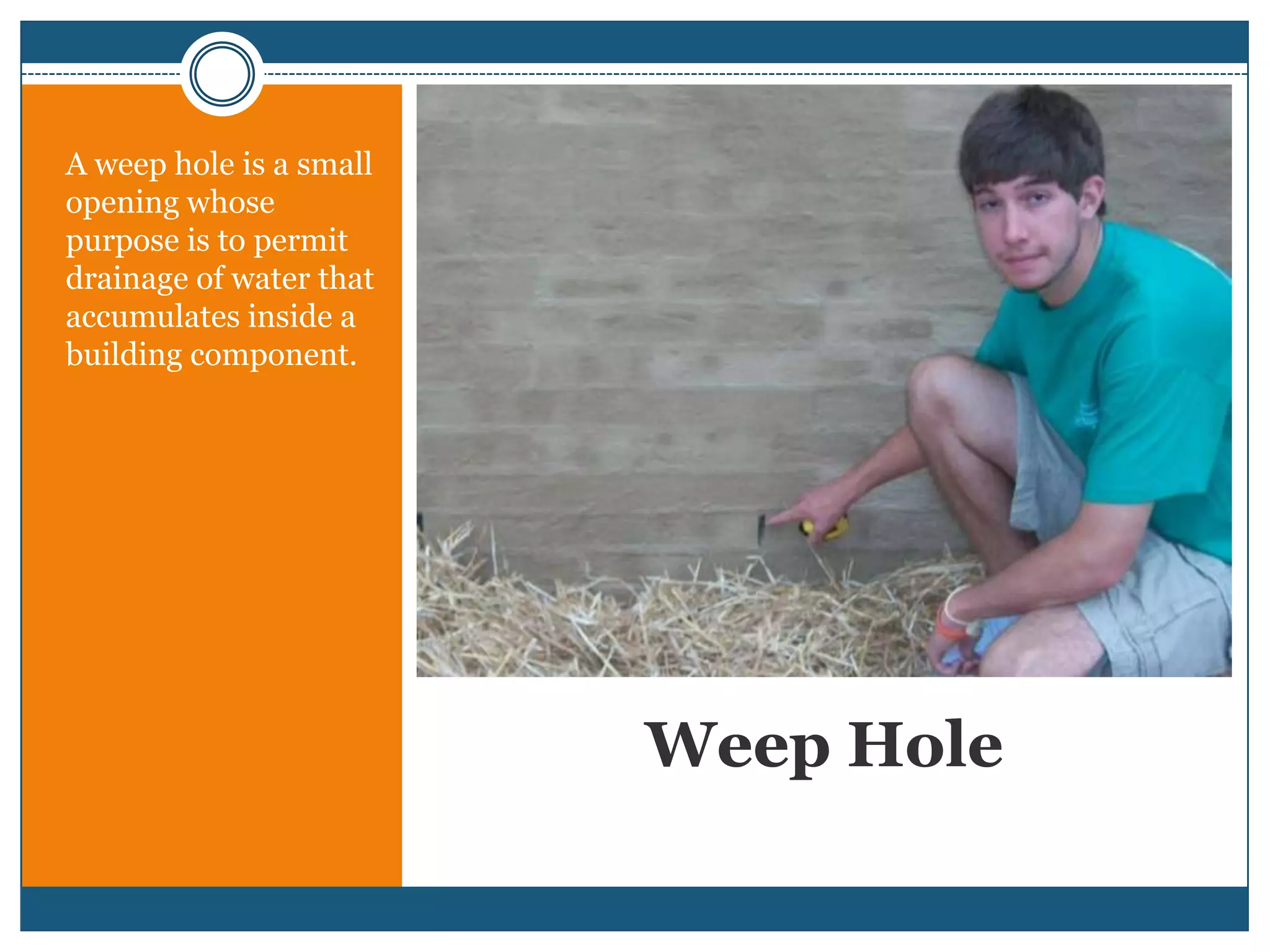
Weep HoleA weep hole is a small opening whose purpose is to permit drainage of water that accumulates inside a building component.
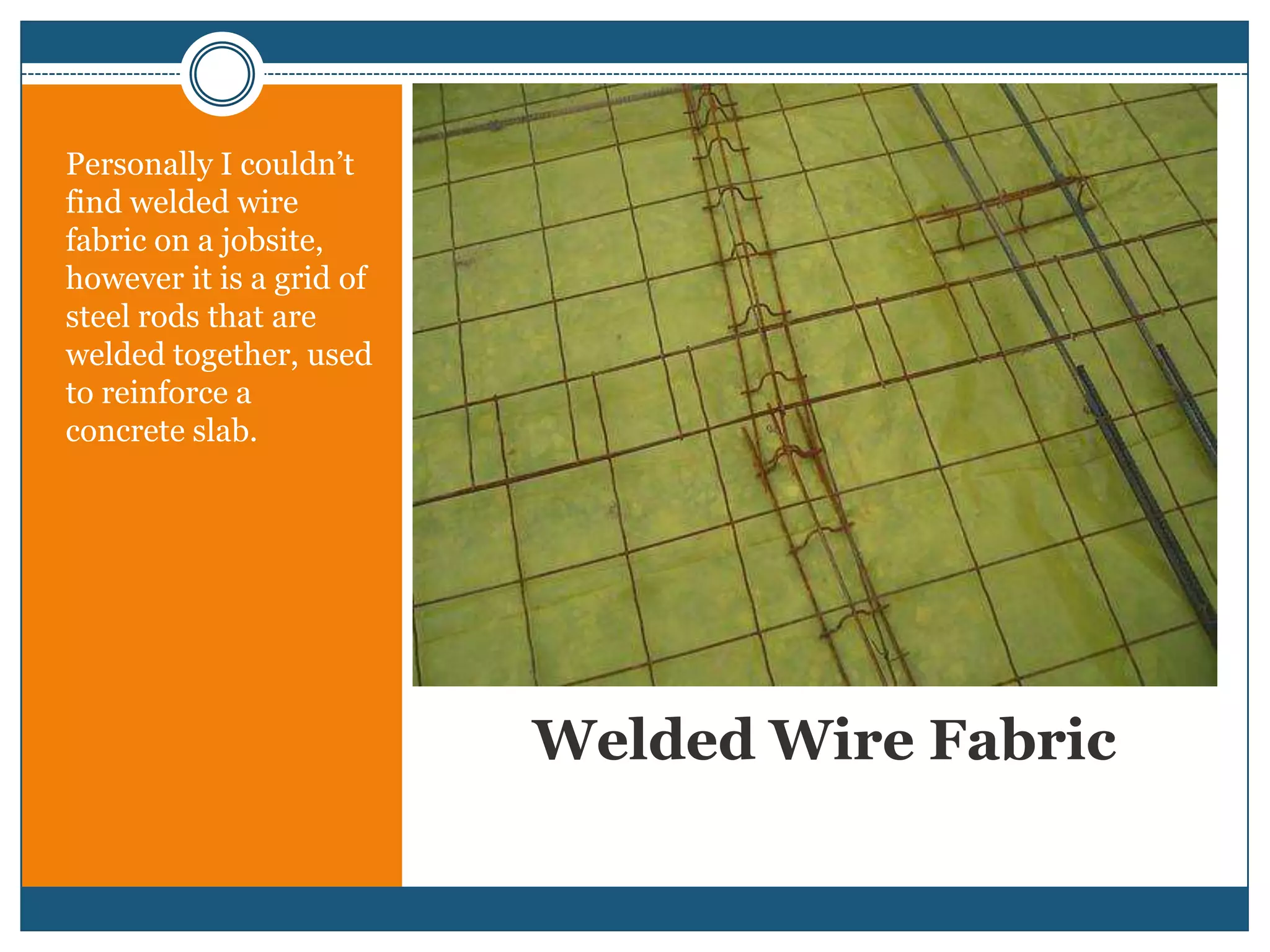
Welded Wire FabricPersonally I couldn’t find welded wire fabric on a jobsite, however it is a grid of steel rods that are welded together, used to reinforce a concrete slab.
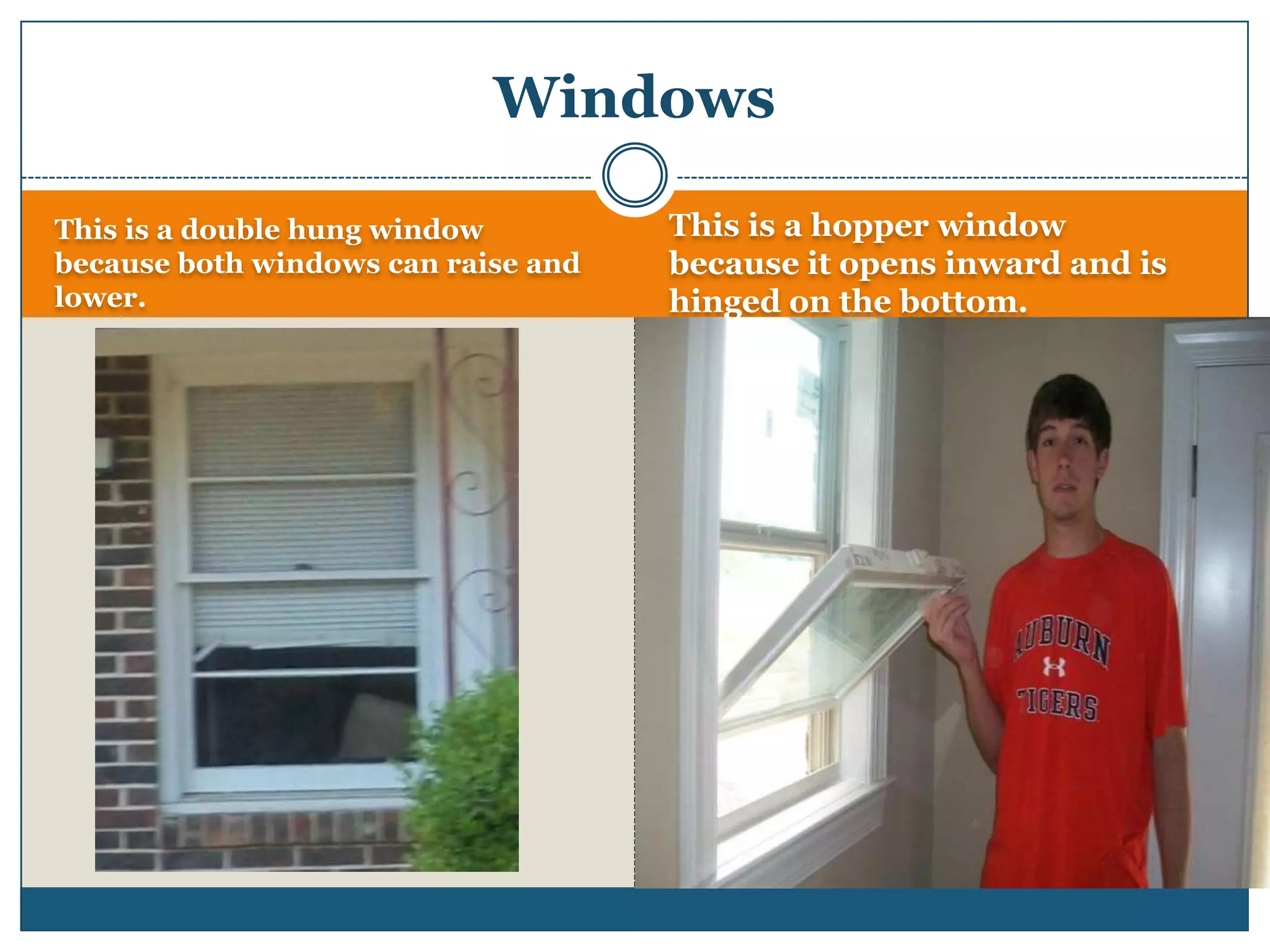
This is a double hung window because both windows can raise and lower.This is a hopper window because it opens inward and is hinged on the bottom.Windows
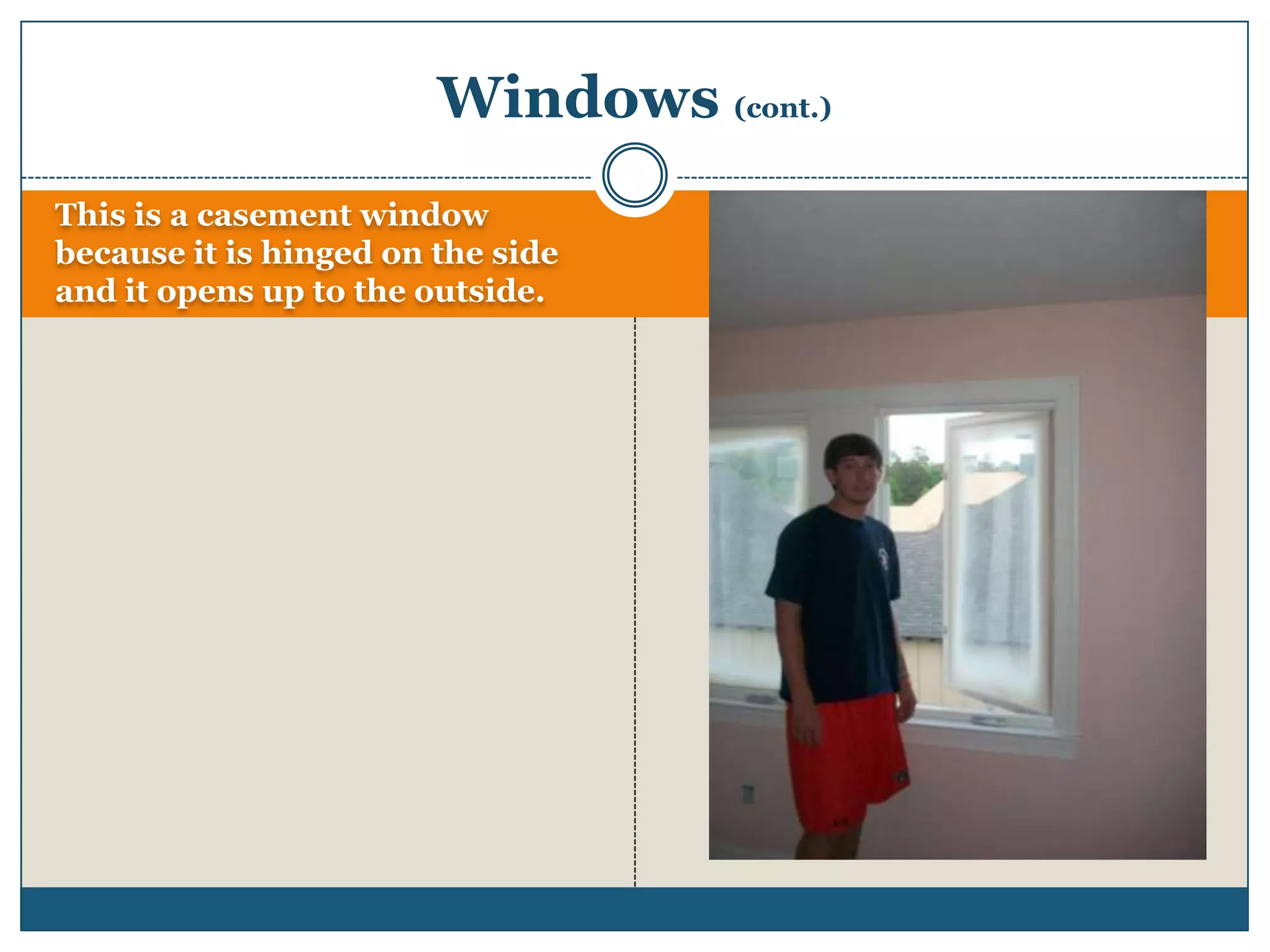
This is a casement window because it is hinged on the side and it opens up to the outside.Windows (cont.)

Visual dictionary - Sp10knothole

  • 1.
  • 2.
    Air Barrier PaperThisair barrier paper is a plastic-like material. However, it has certain fibers in it that allow moisture to escape from the inside of the wood behind it to the outside wall. It also created to block any air infiltration, hence, air barrier paper.
  • 3.
    Attic VentilationAttic ventilationis needed to allow heat to escape from the house. We all know heat rises and during the summer and the heat needs to get out of the house so the house won’t be 100 degrees. Certain types of ventilation allow that heat to escape.Ridge VentGable Vent
  • 4.
  • 5.
    BackhoeA backhoe isa hydraulic excavating machine consisting of a tractor having an attached hinged boom, with a bucket with movable jaws on the end of the boom. It is used to remove earth from the top surface in order to start a foundation at a lower elevation. The backhoe featured here has a bucket width of 4 feet.
  • 6.
    Batter BoardsBatter boardsare a temporary frame built just outside the corner of an excavation to carry marks that lie on the surface planes of the basement that will be built in the excavation.The boards behind me in this photograph were actually the batter boards, but the frame would be set up like this concrete formation.
  • 7.
  • 8.
  • 9.
    Brick ArchesRoman Archwith a Keystone
  • 10.
    Brick BondsFlemish BondThecourses alternate between stretchers and headers
  • 11.
    Brick Bonds (cont.)RunningBondThe courses consist of stretchers but every row is offset to not let the mortar lines match up.
  • 12.
  • 13.
    Brick Sizes15 1/2”Thesebricks are extremely long and don’t have much height to them. Since none of the names in book match this brick size, the closest one would Norman. Brick Size est.:3 5/8” x 2 ¼”x 11 5/8” . 2 1/4”
  • 14.
    Brick SizesThese bricksare examples of Modular brick size. Brick Size: 3 ½” x 2 ¼” x 7 ½”7 ½” 2 ¼”
  • 15.
    BulldozerA bulldozer isa heavy, driver-operated machine for clearing and grading land, usually having continuous treads and a broad hydraulic blade in front. As the definition states, this piece of equipment is used to excavate tree stumps, rocks, and earth in order to smooth the jobsite’s land.
  • 16.
  • 17.
    Stone (Random Rubble)WoodBoardsCladding (cont.)
  • 18.
    Cladding(cont.)Wood ShakesI’m guessingthese are wood shakes because there is no standard size to them and they do not line up perfectly like shingles do.
  • 19.
    Window CodeStair CodeCodeRequirements1”7 ½”42 ½”
  • 20.
    Window CodeStair CodeSincemy window is below 72 inches in height, the regulation of a 24 inch widow sill is not required. It also raises to 24 ½ inches and the width of it is 35 ¼ inches. Therefore, my window meets the residential code handbook.The stairs meet the code in all aspects. The stair is 42 ½ inches in length, 11 inches for each tread, it rises 7 ½ inches, and the nose only overhangs an inch. According to the handbook all of these are acceptable to the code.Code Requirements
  • 21.
    Concrete JointsControl Joints are intentional, linear discontinuity in a structure or component, designed to form a plane of weakness where cracking can occur in response to various forces so as to minimize or eliminate cracking elsewhere in the structure.
  • 22.
    Concrete JointsIsolation Jointsare concrete joints that are separate from another state of concrete joint. For example this column has an isolation joint for more support but the foundation will be laid over it too. This joint is isolated from the slab.
  • 23.
    Concrete Masonry Unit31Alsoknown as a CMU, a concrete masonry unit is a block of hardened concrete, with or without hardened cores, designed to be laid in the same manner as brick or stone; a concrete block. Its sizes vary but the most common used in construction is 8”.
  • 24.
    Concrete Masonry Unit12”Italso comes in 12”,10”, 6” and 4” sizes too. All of them are 16” long and are all nominal measurements. They are used to support rebar running up the side of a building or to be the main support wall of a building.
  • 25.
  • 26.
  • 27.
  • 28.
  • 29.
  • 30.
  • 31.
    Transformer BoxService HeadThetransformer box controls the current of electricity running into a building. It changes the voltage of the current as well. A service head transfers electricity through wires into a building from an outside source such as power lines.Electrical Components
  • 32.
    MeterService PanelMeters countthe usage of electricity throughout a building. Most of them count kilowatts per hour to bill the consumer.The service panel is like a fuse box for the house. Sometimes the power may go out and people have to “flip the breaker” for the electricity to reset.Electrical Components (cont.)
  • 33.
    Duplex ReceptacleDuplex receptaclesare also known as outlets or plug-ins. They are used to give an electric current to certain pieces of equipment that require electricity in order to work. Electrical Components (cont.)
  • 34.
  • 35.
  • 36.
    7. Top Plate6.Stud2. Sill Plate5. Sole Plate
  • 37.
    4. Subflooring3. FloorJoist9. Ceiling Joist10. Rafters
  • 38.
    8. Stringer11. RoofDecking12. Sheathing
  • 39.
    Front End LoaderAfront end loader is a machine that is used to help excavate a jobsite by either removing dirt or flattening the ground. It differs from a backhoe and a bulldozer because it is like a combination of both of them. It can dig into the earth like a backhoe, but it can also smooth the land out like a bulldozer.
  • 40.
    Gypsum BoardGypsum boardis an interior facing panel consisting of gypsum core sandwiched between paper faces. It is also called drywall or plasterboard.
  • 41.
    Heat PumpThe unitcircled with red is the compressor and the unit circled with orange is the air handling unit. The compressor has a fan that moves outside air across heating or cooling coils in the house. The air handling unit contains the coils that control the temperature. One advantage to this system is a quick response time and one disadvantage is it’s very noisy and needs to be away from bedroom windows.
  • 42.
    Batt/ Blanket InsulationLooseFillInsulation(used to reduce the heat flow through a building)
  • 43.
  • 44.
    A lintel isa beam that carries the load of a wall across a window or door opening.SteelLintel
  • 45.
    Raked MortarConcave MortarRakedjoints are tooled and I think mortar type S was used on this house. The mortar was starting to weather which means it’s not a strong weatherproof mortar. Concave joints are tooled as well and I think type N mortar was used for the weathering and support for this building.Mortar
  • 46.
    Oriented Strand BoardOrientedStrand Board (OSB) is a nonveneered panel producted used for sheathing during construction. It is made of long shredded wood particles that is constructed into three to five layers. The layers are alternated facing each other so the grains go against each other for more durability.
  • 47.
    PlumbingLavatoryLavatory drain pipesare usually 1 ½ inches in diameter.
  • 48.
    PlumbingWater ClosetMost waterclosets are drained by a 3 inch pipe.This kitchen sink is a drop-in sink.
  • 49.
    Plumbing (cont.)These ventsgive air flow to the non-pressurized pipes in the house to allow draining due to atmospheric pressure.
  • 50.
  • 51.
    PlywoodPlywood is awood panel composed of an odd number of layers of wood veneer bonded together under pressure. The layers are laid on each other with the grain perpendicular to the previous layer and glued together.
  • 52.
    Radiant Barrier Theradiant barrier is reflecting heat from the roof back to the outside of the building.
  • 53.
    RebarThe rebar hereis ½ inch diameter rebar and is referred to as #4 rebar. The purpose of the deformations in rebar is for better grip within the concrete when it dries. It will have a stronger hold if the rebar is grooved for concrete to form around it.
  • 54.
    Gutter- A channelthat collects rainwater and snowmelt at the eave of a roof.Downspout- A vertical pipe for conducting water from a roof to a lower levelSplash block- A small precast block of concrete or plastic used to divert water at the bottom of a downspoutSteep Roof Drainage
  • 55.
  • 56.
    Steep Roof MaterialsUnderlaymentis a layer of waterproof material between roof sheathing and roofing. It keeps the water off of the wood sheathing and is also known as “tar” paper.Clay Tiles
  • 57.
    Steep Roof MaterialsMetalPanel RoofMetal panels are usually fabricated with aluminized or galvanized steel with long lasting polymeric coatings. They also require no specialized equipment on the jobsite.
  • 58.
  • 59.
  • 60.
  • 61.
  • 62.
  • 63.
    Steep Roof TermsNoFasciaFascia
  • 64.
  • 65.
  • 66.
    Vapor RetarderA vaporretarder is a layer of material intended to obstruct the passage of water vapor through a building assembly. It is normally placed on the bottom side of insulation to prevent the water coming into the ceiling.
  • 67.
    WaterproofingWaterproofing is anotherbarrier to prevent water from coming in the house. It is laid in between the foundation wall and air barrier paper and is normally found around the base of a house. This particular type is loosely laid.
  • 68.
    Weep HoleA weephole is a small opening whose purpose is to permit drainage of water that accumulates inside a building component.
  • 69.
    Welded Wire FabricPersonallyI couldn’t find welded wire fabric on a jobsite, however it is a grid of steel rods that are welded together, used to reinforce a concrete slab.
  • 70.
    This is adouble hung window because both windows can raise and lower.This is a hopper window because it opens inward and is hinged on the bottom.Windows
  • 71.
    This is acasement window because it is hinged on the side and it opens up to the outside.Windows (cont.)