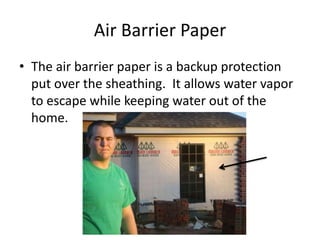
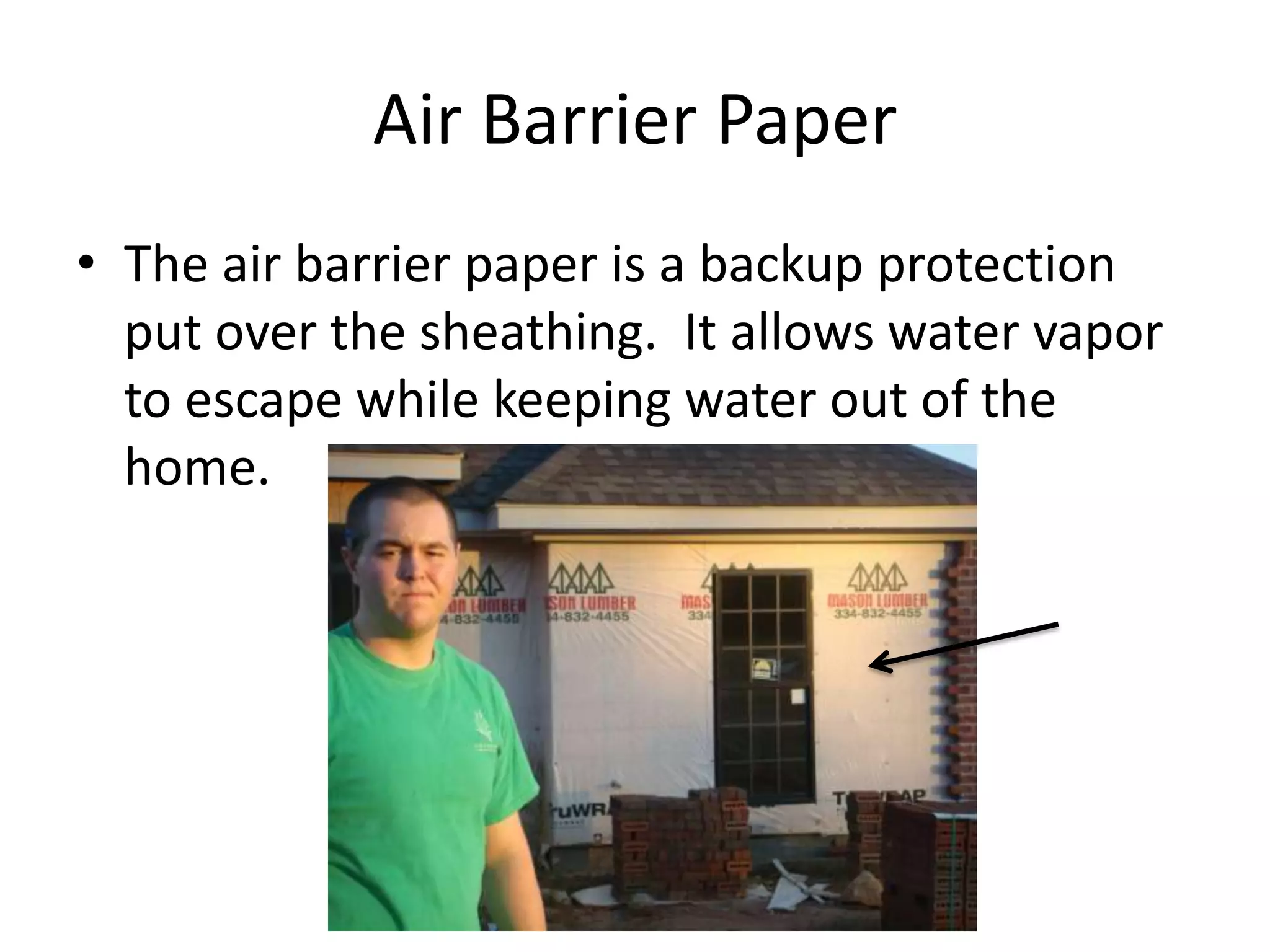
Air Barrier PaperThe air barrier paper is a backup protection put over the sheathing.  It allows water vapor to escape while keeping water out of the home.
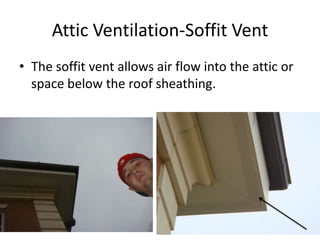
Attic Ventilation-Soffit VentThe soffit vent allows air flow into the attic or space below the roof sheathing.
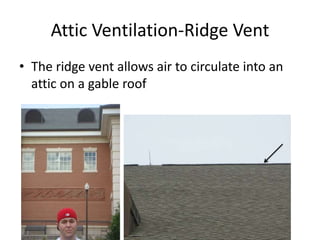
Attic Ventilation-Ridge VentThe ridge vent allows air to circulate into an attic on a gable roof
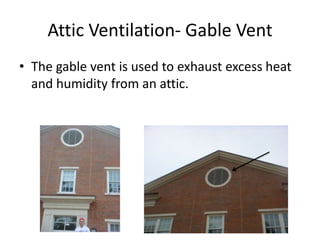
Attic Ventilation- Gable VentThe gable vent is used to exhaust excess heat and humidity from an attic.
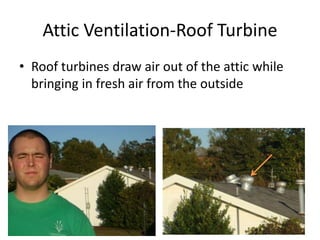
Attic Ventilation-Roof TurbineRoof turbines draw air out of the attic while bringing in fresh air from the outside
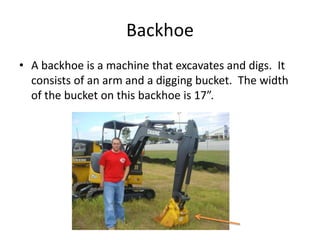
BackhoeA backhoe is a machine that excavates and digs.  It consists of an arm and a digging bucket.  The width of the bucket on this backhoe is 17”.
Batter Boards
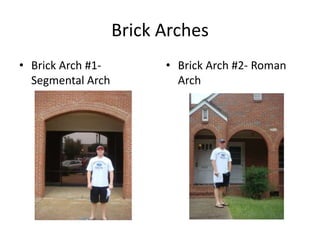
Brick ArchesBrick Arch #1- Segmental ArchBrick Arch #2- Roman Arch
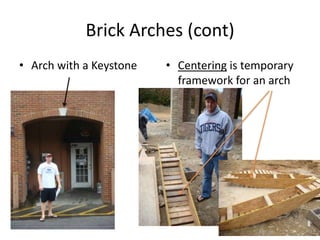
Brick Arches (cont)Arch with a KeystoneCentering is temporary framework for an arch
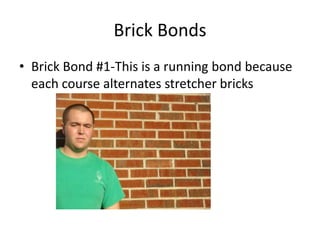
Brick BondsBrick Bond #1-This is a running bond because each course alternates stretcher bricks
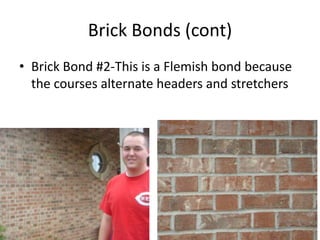
Brick Bonds (cont)Brick Bond #2-This is a Flemish bond because the courses alternate headers and stretchers
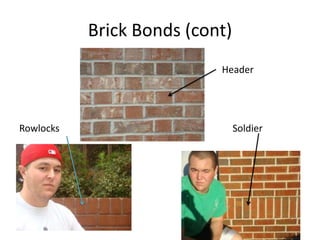
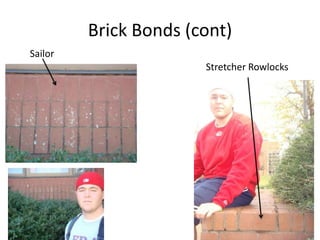
Brick Bonds (cont)HeaderRowlocksSoldier
Brick Bonds (cont)SailorStretcher Rowlocks
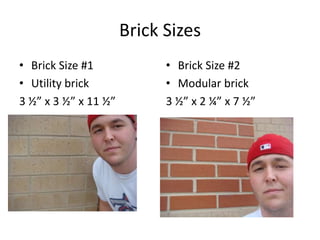
Brick SizesBrick Size #2Modular brick3 ½” x 2 ¼” x 7 ½”Brick Size #1Utility brick3 ½” x 3 ½” x 11 ½”
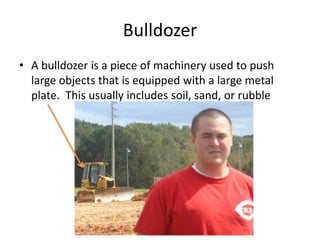
BulldozerA bulldozer is a piece of machinery used to push large objects that is equipped with a large metal plate.  This usually includes soil, sand, or rubble
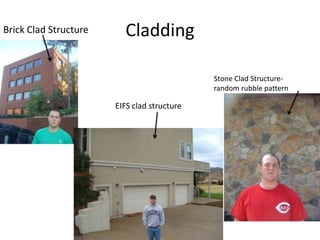
CladdingBrick Clad StructureStone Clad Structure-random rubble patternEIFS clad structure
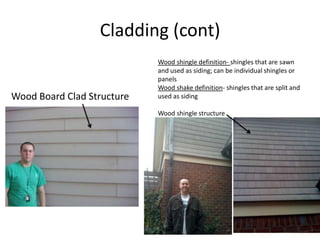
Cladding (cont)Wood shingle definition- shingles that are sawn and used as siding; can be individual shingles or panelsWood shake definition- shingles that are split and used as sidingWood shingle structureWood Board Clad Structure
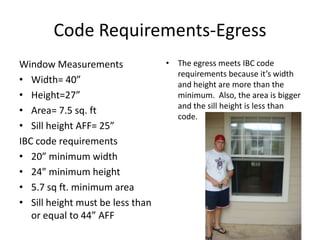
Code Requirements-EgressWindow MeasurementsWidth= 40”Height=27”Area= 7.5 sq. ftSill height AFF= 25”IBC code requirements20” minimum width24” minimum height5.7 sq ft. minimum areaSill height must be less than or equal to 44” AFFThe egress meets IBC code requirements because it’s width and height are more than the minimum.  Also, the area is bigger and the sill height is less than code.
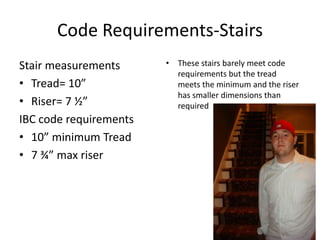
Code Requirements-StairsStair measurementsTread= 10”Riser= 7 ½”IBC code requirements10” minimum Tread7 ¾” max riserThese stairs barely meet code requirements but the tread meets the minimum and the riser has smaller dimensions than required
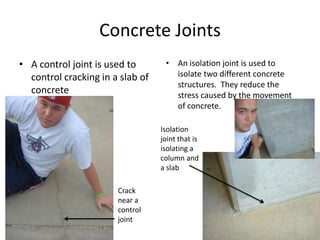
Concrete JointsA control joint is used to prevent cracking in a slab of concreteCrack near a control joint
Concrete Joints (cont)An isolation joint is used to isolate two different concrete structures.  They reduce the stress caused by the movement of concrete.Isolation joint that is isolating a column and a slab
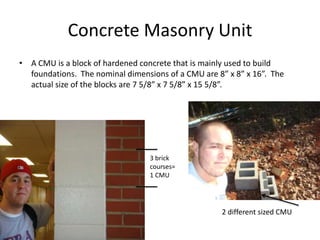
Concrete Masonry UnitA CMU is a block of hardened concrete that is mainly used to build foundations and sometimes walls.  The nominal dimensions of a CMU are 8” x 8” x 16”.  The actual size of the blocks are 7 5/8” x 7 5/8” x 15 5/8” to allow for the mortar joints.3 brick courses= 1 CMU2 different sized CMU
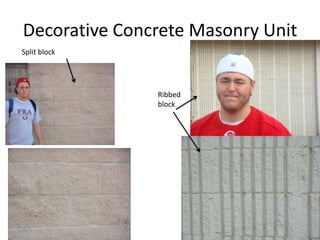
Decorative Concrete Masonry UnitSplit blockRibbed block
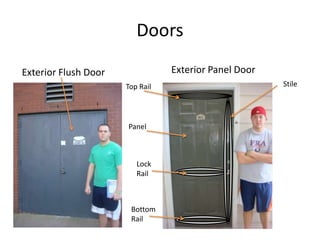
DoorsExterior Panel DoorStileExterior Flush DoorTop RailPanelLock RailBottom Rail
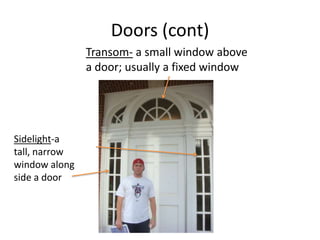
Doors (cont)Transom- a small window above a door; usually a fixed windowSidelight-a tall, narrow window along side a door
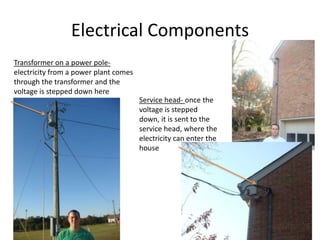
Electrical ComponentsTransformer on a power pole- electricity from a power plant comes through the transformer and the voltage is stepped down hereService head- once the voltage is stepped down, it is sent to the service head, where the electricity can enter the house
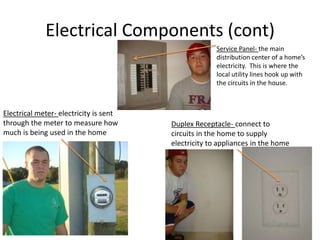
Electrical Components (cont)Service Panel- the main distribution center of a home’s electricity.  This is where the local utility lines hook up with the circuits in the house.Electrical meter- electricity is sent through the meter to measure how much is being used in the homeDuplex Receptacle- connect to circuits in the home to supply electricity to appliances in the home
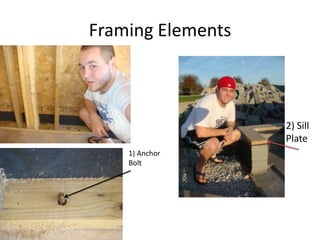
Framing Elements2) Sill Plate1) Anchor Bolt
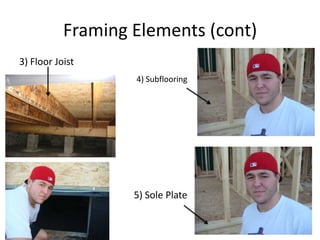
Framing Elements (cont)3) Floor Joist4) Subflooring5) Sole Plate
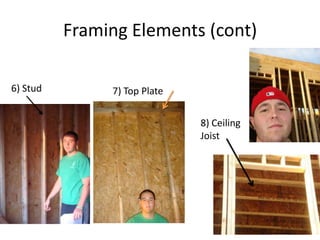
Framing Elements (cont)7) Top Plate6) Stud8) Ceiling Joist
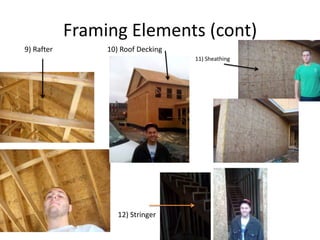
Framing Elements (cont)9) Rafter10) Roof Decking11) Sheathing12) Stringer
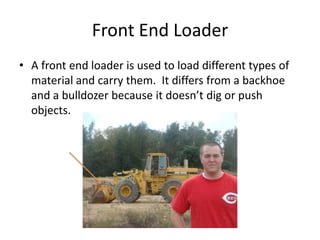
Front End LoaderA front end loader is used to load different types of material and carry them.  It differs from a backhoe and a bulldozer because it doesn’t dig or push objects.
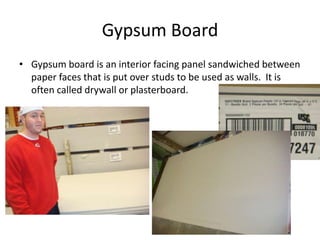
Gypsum BoardGypsum board is an interior facing panel sandwiched between paper faces that is put over studs to be used as walls.  It is often called drywall or plasterboard.
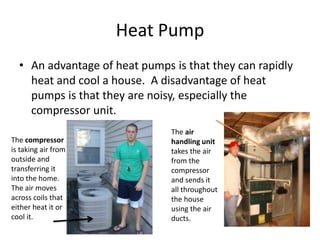
Heat PumpAn advantage of heat pumps is that they can rapidly heat and cool a house.  A disadvantage of heat pumps is that they are noisy, especially the compressor unit.The air handling unit takes the air from the compressor and sends it all throughout the house using the air ducts.The compressor is taking air from outside and transferring it into the home.  The air moves across coils that either heat it or cool it.
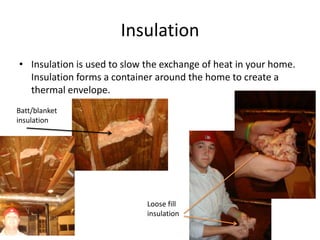
InsulationInsulation is used to slow the exchange of heat in your home.  Insulation forms a container around the home to create a thermal envelope.Batt/blanket insulationLoose fill insulation
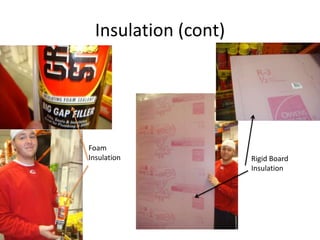
Insulation (cont)Foam InsulationRigid Board Insulation
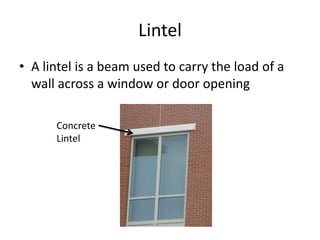
LintelA lintel is a beam used to carry the load of a wall across a window or door openingConcrete Lintel
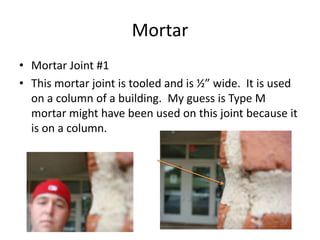
MortarMortar Joint #1This mortar joint is tooled and is ½” wide.  It is used on a column of a building.  My guess is Type M mortar might have been used on this joint because it is on a column.
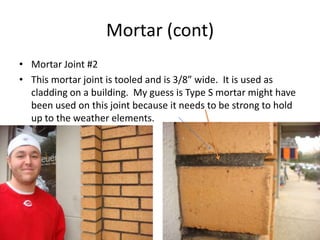
Mortar (cont)Mortar Joint #2This mortar joint is tooled and is 3/8” wide.  It is used as cladding on a building.  My guess is Type S mortar might have been used on this joint because it needs to be strong to hold up to the weather elements.
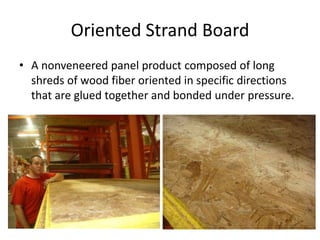
Oriented Strand BoardA nonveneered panel product composed of long shreds of wood fiber oriented in specific directions that are glued together and bonded under pressure.
PlumbingShower set in framing prior to gypsum board insulationLavatory= 1-1 ½” pipes used to drain itWater Closet= 3” pipes used to drain it
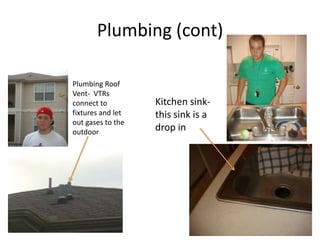
Plumbing (cont)Plumbing Roof Vent-  VTRs connect to bathroom fixtures and let air into the pipes to maintain pressureKitchen sink- this sink is a drop in
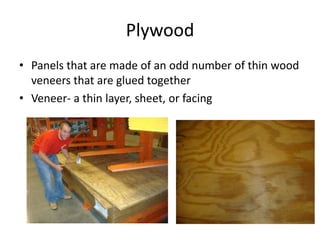
PlywoodWood panels that are made of an odd number of thin wood veneers that are glued togetherVeneer- a thin layer, sheet, or facing
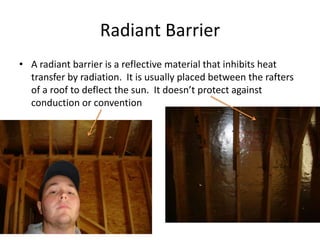
Radiant BarrierA radiant barrier is a reflective material that inhibits heat transfer by radiation.  It is usually placed between the rafters of a roof to deflect the sun’s rays.  However, It doesn’t protect against conduction or convention.
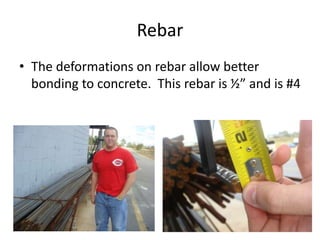
RebarThe deformations on rebar allow better bonding to concrete.  This rebar is ½” and is #4
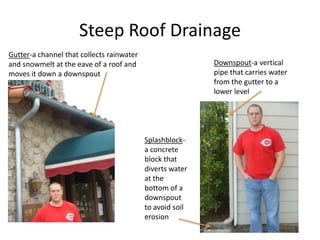
Steep Roof DrainageGutter-a channel that collects rainwater and snowmelt at the eave of a roof and moves it down a downspoutDownspout-a vertical pipe that carries water from the gutter to a lower levelSplashblock-a concrete block that diverts water at the bottom of a downspout to avoid soil erosion
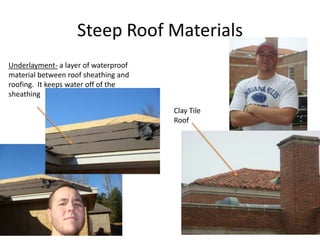
Steep Roof MaterialsUnderlayment- a layer of waterproof material between roof sheathing and roofing.  It keeps water off of the sheathing and prevents it from entering the homeClay Tile Roof
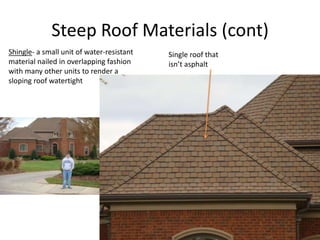
Steep Roof Materials (cont)Shingle- a small unit of water resistant material nailed in overlapping fashion with many other units to render a sloping roof watertightSingle roof that isn’t asphalt
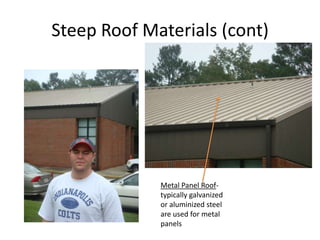
Steep Roof Materials (cont)Metal Panel Roof- typically galvanized or aluminized steel are used for metal panels
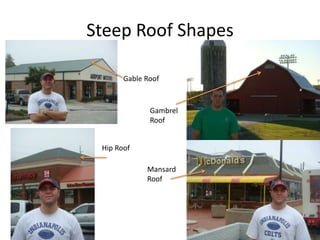
Steep Roof ShapesGable RoofGambrel RoofHip RoofMansard Roof
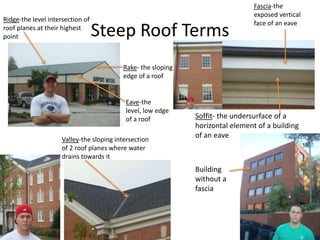
Steep Roof TermsRidge-the level intersection of roof planes at their highest pointValley-the sloping intersection of 2 roof planes where water drains towards it
Steep Roof Terms (cont)Rake- the sloping edge of a roofEave-the level, low edge of a roof
Steep Roof Terms (cont)Fascia-the exposed vertical face of an eaveBuilding without a fasciaSoffit- the undersurface of a horizontal element of a building of an eave
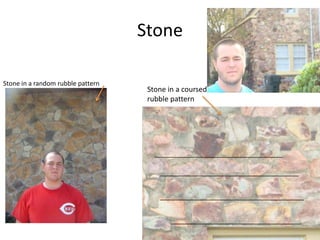
StoneStone in a random rubble patternStone in a coursed rubble pattern
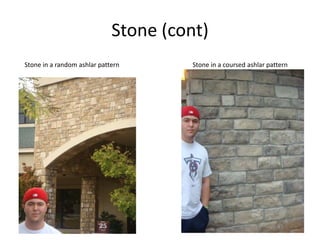
Stone (cont)Stone in a coursed ashlar patternStone in a random ashlar pattern
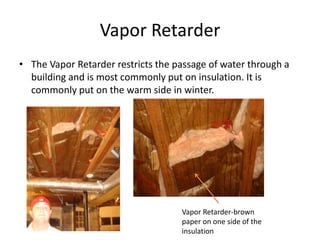
Vapor RetarderThe Vapor Retarder restricts the passage of water vapor through a building and is most commonly put on batt insulation. It is usually put on the warm side in winter.Vapor Retarder-brown paper on one side of the insulation
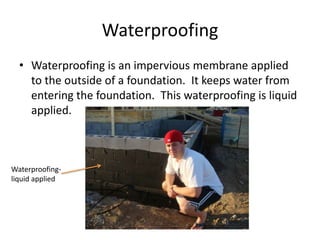
WaterproofingWaterproofing is an impervious membrane applied to the outside of a foundation.  It keeps water from entering the foundation.  This waterproofing is liquid applied.Waterproofing- liquid applied
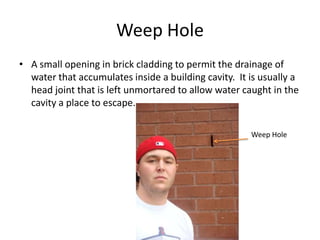
Weep HoleA small opening in brick cladding to permit the drainage of water that accumulates inside a building cavity.  It is usually a head joint that is left unmortared to allow water caught in the cavity a place to escape.Weep Hole
Wielded Wire Fabric
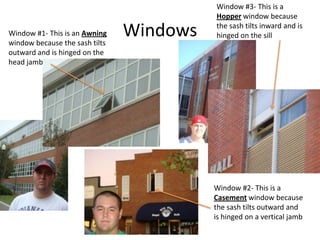
WindowsWindow #1- This is an Awning window because the sash tilts outward and is hinged on the head jamb
Windows (cont)Window #2- This is a Casement window because the sash tilts outward and is hinged on a vertical jamb
Windows (cont)Window #3- This is a Hopper window because the sash tilts inward and is hinged on the sill

Visual Dictionary-Substrate

  • 1.
    Air Barrier PaperTheair barrier paper is a backup protection put over the sheathing. It allows water vapor to escape while keeping water out of the home.
  • 2.
    Attic Ventilation-Soffit VentThesoffit vent allows air flow into the attic or space below the roof sheathing.
  • 3.
    Attic Ventilation-Ridge VentTheridge vent allows air to circulate into an attic on a gable roof
  • 4.
    Attic Ventilation- GableVentThe gable vent is used to exhaust excess heat and humidity from an attic.
  • 5.
    Attic Ventilation-Roof TurbineRoofturbines draw air out of the attic while bringing in fresh air from the outside
  • 6.
    BackhoeA backhoe isa machine that excavates and digs. It consists of an arm and a digging bucket. The width of the bucket on this backhoe is 17”.
  • 7.
  • 8.
    Brick ArchesBrick Arch#1- Segmental ArchBrick Arch #2- Roman Arch
  • 9.
    Brick Arches (cont)Archwith a KeystoneCentering is temporary framework for an arch
  • 10.
    Brick BondsBrick Bond#1-This is a running bond because each course alternates stretcher bricks
  • 11.
    Brick Bonds (cont)BrickBond #2-This is a Flemish bond because the courses alternate headers and stretchers
  • 12.
  • 13.
  • 14.
    Brick SizesBrick Size#2Modular brick3 ½” x 2 ¼” x 7 ½”Brick Size #1Utility brick3 ½” x 3 ½” x 11 ½”
  • 15.
    BulldozerA bulldozer isa piece of machinery used to push large objects that is equipped with a large metal plate. This usually includes soil, sand, or rubble
  • 16.
    CladdingBrick Clad StructureStoneClad Structure-random rubble patternEIFS clad structure
  • 17.
    Cladding (cont)Wood shingledefinition- shingles that are sawn and used as siding; can be individual shingles or panelsWood shake definition- shingles that are split and used as sidingWood shingle structureWood Board Clad Structure
  • 18.
    Code Requirements-EgressWindow MeasurementsWidth=40”Height=27”Area= 7.5 sq. ftSill height AFF= 25”IBC code requirements20” minimum width24” minimum height5.7 sq ft. minimum areaSill height must be less than or equal to 44” AFFThe egress meets IBC code requirements because it’s width and height are more than the minimum. Also, the area is bigger and the sill height is less than code.
  • 19.
    Code Requirements-StairsStair measurementsTread=10”Riser= 7 ½”IBC code requirements10” minimum Tread7 ¾” max riserThese stairs barely meet code requirements but the tread meets the minimum and the riser has smaller dimensions than required
  • 20.
    Concrete JointsA controljoint is used to prevent cracking in a slab of concreteCrack near a control joint
  • 21.
    Concrete Joints (cont)Anisolation joint is used to isolate two different concrete structures. They reduce the stress caused by the movement of concrete.Isolation joint that is isolating a column and a slab
  • 22.
    Concrete Masonry UnitACMU is a block of hardened concrete that is mainly used to build foundations and sometimes walls. The nominal dimensions of a CMU are 8” x 8” x 16”. The actual size of the blocks are 7 5/8” x 7 5/8” x 15 5/8” to allow for the mortar joints.3 brick courses= 1 CMU2 different sized CMU
  • 23.
    Decorative Concrete MasonryUnitSplit blockRibbed block
  • 24.
    DoorsExterior Panel DoorStileExteriorFlush DoorTop RailPanelLock RailBottom Rail
  • 25.
    Doors (cont)Transom- asmall window above a door; usually a fixed windowSidelight-a tall, narrow window along side a door
  • 26.
    Electrical ComponentsTransformer ona power pole- electricity from a power plant comes through the transformer and the voltage is stepped down hereService head- once the voltage is stepped down, it is sent to the service head, where the electricity can enter the house
  • 27.
    Electrical Components (cont)ServicePanel- the main distribution center of a home’s electricity. This is where the local utility lines hook up with the circuits in the house.Electrical meter- electricity is sent through the meter to measure how much is being used in the homeDuplex Receptacle- connect to circuits in the home to supply electricity to appliances in the home
  • 28.
    Framing Elements2) SillPlate1) Anchor Bolt
  • 29.
    Framing Elements (cont)3)Floor Joist4) Subflooring5) Sole Plate
  • 30.
    Framing Elements (cont)7)Top Plate6) Stud8) Ceiling Joist
  • 31.
    Framing Elements (cont)9)Rafter10) Roof Decking11) Sheathing12) Stringer
  • 32.
    Front End LoaderAfront end loader is used to load different types of material and carry them. It differs from a backhoe and a bulldozer because it doesn’t dig or push objects.
  • 33.
    Gypsum BoardGypsum boardis an interior facing panel sandwiched between paper faces that is put over studs to be used as walls. It is often called drywall or plasterboard.
  • 34.
    Heat PumpAn advantageof heat pumps is that they can rapidly heat and cool a house. A disadvantage of heat pumps is that they are noisy, especially the compressor unit.The air handling unit takes the air from the compressor and sends it all throughout the house using the air ducts.The compressor is taking air from outside and transferring it into the home. The air moves across coils that either heat it or cool it.
  • 35.
    InsulationInsulation is usedto slow the exchange of heat in your home. Insulation forms a container around the home to create a thermal envelope.Batt/blanket insulationLoose fill insulation
  • 36.
  • 37.
    LintelA lintel isa beam used to carry the load of a wall across a window or door openingConcrete Lintel
  • 38.
    MortarMortar Joint #1Thismortar joint is tooled and is ½” wide. It is used on a column of a building. My guess is Type M mortar might have been used on this joint because it is on a column.
  • 39.
    Mortar (cont)Mortar Joint#2This mortar joint is tooled and is 3/8” wide. It is used as cladding on a building. My guess is Type S mortar might have been used on this joint because it needs to be strong to hold up to the weather elements.
  • 40.
    Oriented Strand BoardAnonveneered panel product composed of long shreds of wood fiber oriented in specific directions that are glued together and bonded under pressure.
  • 41.
    PlumbingShower set inframing prior to gypsum board insulationLavatory= 1-1 ½” pipes used to drain itWater Closet= 3” pipes used to drain it
  • 42.
    Plumbing (cont)Plumbing RoofVent- VTRs connect to bathroom fixtures and let air into the pipes to maintain pressureKitchen sink- this sink is a drop in
  • 43.
    PlywoodWood panels thatare made of an odd number of thin wood veneers that are glued togetherVeneer- a thin layer, sheet, or facing
  • 44.
    Radiant BarrierA radiantbarrier is a reflective material that inhibits heat transfer by radiation. It is usually placed between the rafters of a roof to deflect the sun’s rays. However, It doesn’t protect against conduction or convention.
  • 45.
    RebarThe deformations onrebar allow better bonding to concrete. This rebar is ½” and is #4
  • 46.
    Steep Roof DrainageGutter-achannel that collects rainwater and snowmelt at the eave of a roof and moves it down a downspoutDownspout-a vertical pipe that carries water from the gutter to a lower levelSplashblock-a concrete block that diverts water at the bottom of a downspout to avoid soil erosion
  • 47.
    Steep Roof MaterialsUnderlayment-a layer of waterproof material between roof sheathing and roofing. It keeps water off of the sheathing and prevents it from entering the homeClay Tile Roof
  • 48.
    Steep Roof Materials(cont)Shingle- a small unit of water resistant material nailed in overlapping fashion with many other units to render a sloping roof watertightSingle roof that isn’t asphalt
  • 49.
    Steep Roof Materials(cont)Metal Panel Roof- typically galvanized or aluminized steel are used for metal panels
  • 50.
    Steep Roof ShapesGableRoofGambrel RoofHip RoofMansard Roof
  • 51.
    Steep Roof TermsRidge-thelevel intersection of roof planes at their highest pointValley-the sloping intersection of 2 roof planes where water drains towards it
  • 52.
    Steep Roof Terms(cont)Rake- the sloping edge of a roofEave-the level, low edge of a roof
  • 53.
    Steep Roof Terms(cont)Fascia-the exposed vertical face of an eaveBuilding without a fasciaSoffit- the undersurface of a horizontal element of a building of an eave
  • 54.
    StoneStone in arandom rubble patternStone in a coursed rubble pattern
  • 55.
    Stone (cont)Stone ina coursed ashlar patternStone in a random ashlar pattern
  • 56.
    Vapor RetarderThe VaporRetarder restricts the passage of water vapor through a building and is most commonly put on batt insulation. It is usually put on the warm side in winter.Vapor Retarder-brown paper on one side of the insulation
  • 57.
    WaterproofingWaterproofing is animpervious membrane applied to the outside of a foundation. It keeps water from entering the foundation. This waterproofing is liquid applied.Waterproofing- liquid applied
  • 58.
    Weep HoleA smallopening in brick cladding to permit the drainage of water that accumulates inside a building cavity. It is usually a head joint that is left unmortared to allow water caught in the cavity a place to escape.Weep Hole
  • 59.
  • 60.
    WindowsWindow #1- Thisis an Awning window because the sash tilts outward and is hinged on the head jamb
  • 61.
    Windows (cont)Window #2-This is a Casement window because the sash tilts outward and is hinged on a vertical jamb
  • 62.
    Windows (cont)Window #3-This is a Hopper window because the sash tilts inward and is hinged on the sill