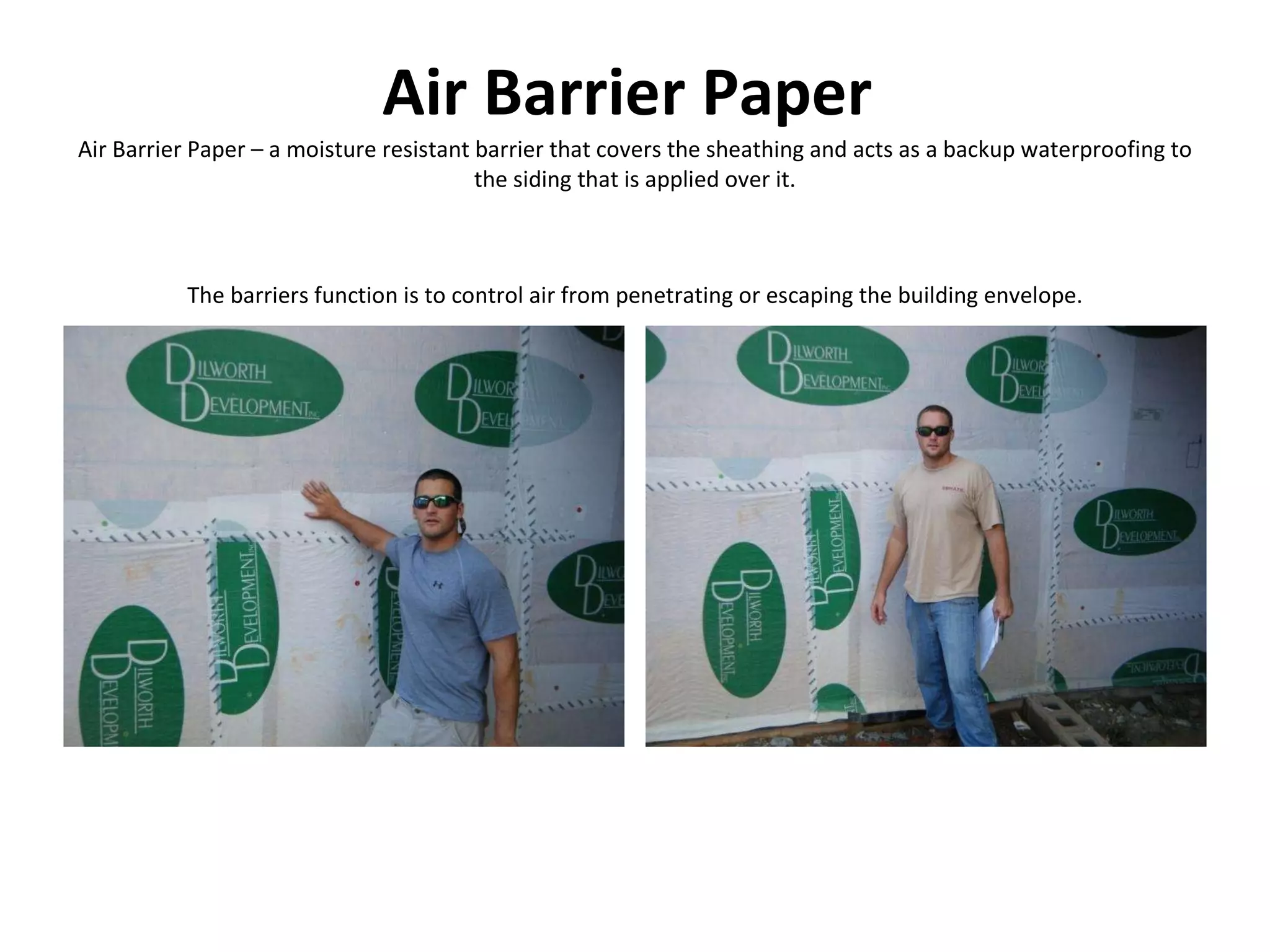
Air Barrier Paper   Air Barrier Paper – a moisture resistant barrier that covers the sheathing and acts as a backup waterproofing to the siding that is applied over it. The barriers function is to control air from penetrating or escaping the building envelope.
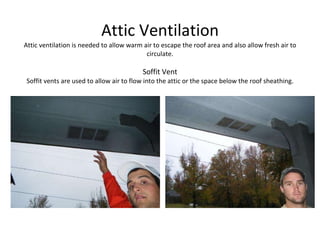
Attic Ventilation Attic ventilation is needed to allow warm air to escape the roof area and also allow fresh air to circulate. Soffit Vent Soffit vents are used to allow air to flow into the attic or the space below the roof sheathing.
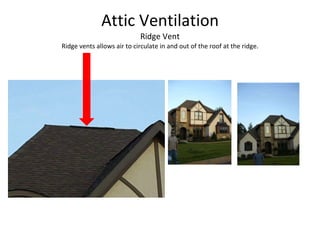
Attic Ventilation Ridge Vent Ridge vents allows air to circulate in and out of the roof at the ridge.
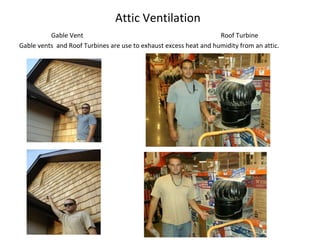
Attic Ventilation Gable Vent   Roof Turbine Gable vents  and Roof Turbines are use to exhaust excess heat and humidity from an attic.
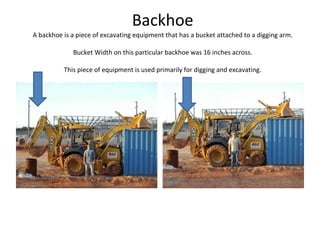
Backhoe A backhoe is a piece of excavating equipment that has a bucket attached to a digging arm. Bucket Width on this particular backhoe was 16 inches across. This piece of equipment is used primarily for digging and excavating.
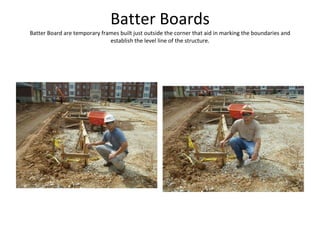
Batter Boards Batter Board are temporary frames built just outside the corner that aid in marking the boundaries and establish the level line of the structure.
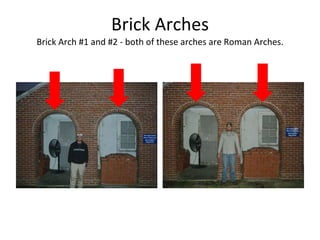
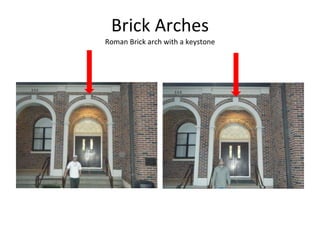
Brick Arches Brick Arch #1 and #2 - both of these arches are Roman Arches.
Brick Arches Roman Brick arch with a keystone
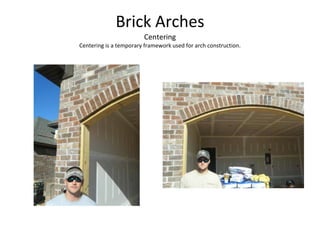
Brick Arches Centering Centering is a temporary framework used for arch construction.
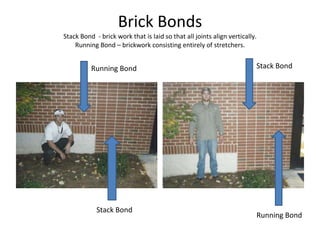
Brick Bonds Stack Bond  - brick work that is laid so that all joints align vertically. Running Bond – brickwork consisting entirely of stretchers. Stack Bond Running Bond Running Bond Stack Bond
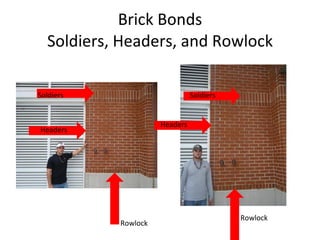
Brick Bonds Soldiers, Headers, and Rowlock Soldiers Headers Rowlock Soldiers Headers Headers Rowlock
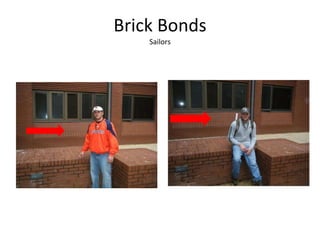
Brick Bonds Sailors
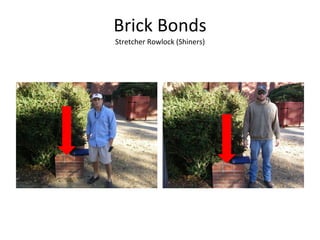
Brick Bonds Stretcher Rowlock (Shiners)
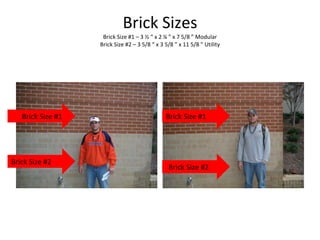
Brick Sizes Brick Size #1 – 3 ½ “ x 2 ¼ ” x 7 5/8 ” Modular Brick Size #2 – 3 5/8 “ x 3 5/8 ” x 11 5/8 ” Utility Brick Size #1 Brick Size #2 Brick Size #2 Brick Size #1
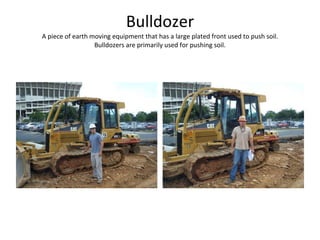
Bulldozer A piece of earth moving equipment that has a large plated front used to push soil. Bulldozers are primarily used for pushing soil.
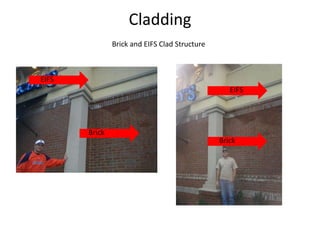
Cladding Brick and EIFS Clad Structure EIFS Brick Brick EIFS
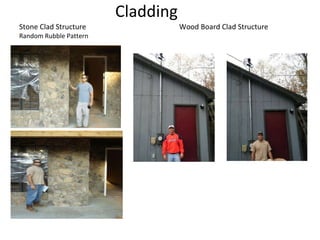
Cladding Stone Clad Structure Wood Board Clad Structure Random Rubble Pattern
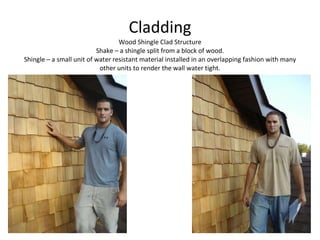
Cladding Wood Shingle Clad Structure Shake – a shingle split from a block of wood. Shingle – a small unit of water resistant material installed in an overlapping fashion with many other units to render the wall water tight.
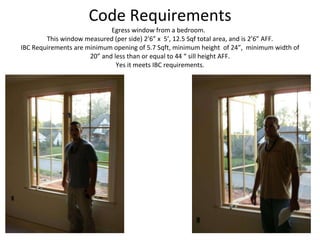
Code Requirements Egress window from a bedroom.  This window measured (per side) 2’6” x  5’, 12.5 Sqf total area, and is 2’6” AFF. IBC Requirements are minimum opening of 5.7 Sqft, minimum height  of 24”,  minimum width of 20” and less than or equal to 44 “ sill height AFF. Yes it meets IBC requirements.
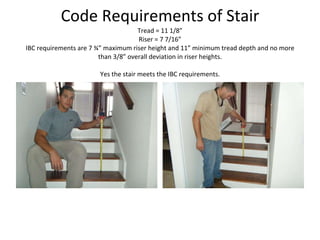
Code Requirements of Stair Tread = 11 1/8” Riser = 7 7/16” IBC requirements are 7 ¾” maximum riser height and 11” minimum tread depth and no more than 3/8” overall deviation in riser heights. Yes the stair meets the IBC requirements.
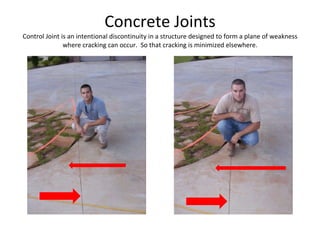
Concrete Joints Control Joint is an intentional discontinuity in a structure designed to form a plane of weakness where cracking can occur.  So that cracking is minimized elsewhere.
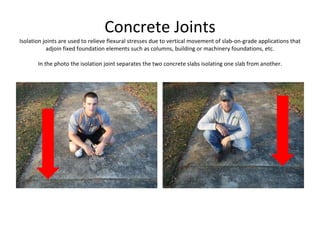
Concrete Joints Isolation joints are used to relieve flexural stresses due to vertical movement of slab-on-grade applications that adjoin fixed foundation elements such as columns, building or machinery foundations, etc. In the photo the isolation joint separates the two concrete slabs isolating one slab from another.
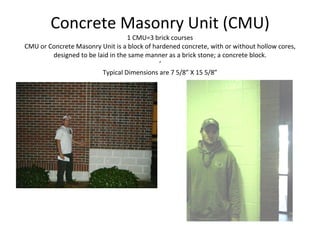
Concrete Masonry Unit (CMU) 1 CMU=3 brick courses CMU or Concrete Masonry Unit is a block of hardened concrete, with or without hollow cores, designed to be laid in the same manner as a brick stone; a concrete block. ‘ Typical Dimensions are 7 5/8” X 15 5/8”
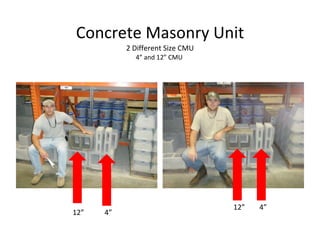
Concrete Masonry Unit 2 Different Size CMU 4” and 12” CMU  12”   4” 12”  4”
Decorative Concrete Masonry Units Split Block
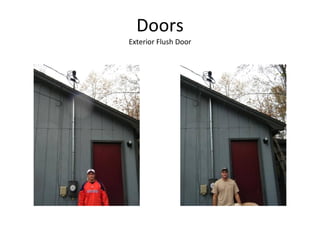
Doors Exterior Flush Door
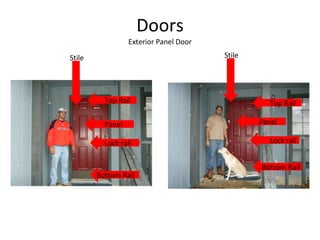
Doors Exterior Panel Door Top Rail Panel Lock rail Bottom Rail Top Rail Panel Lock rail Bottom Rail Stile Stile
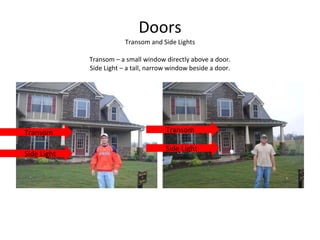
Doors Transom and Side Lights Transom – a small window directly above a door. Side Light – a tall, narrow window beside a door. Transom Side Light Side Light Transom
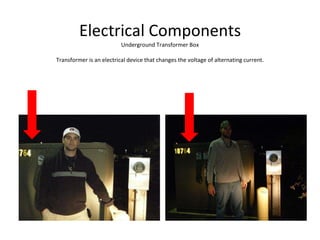
Electrical Components Underground Transformer Box Transformer is an electrical device that changes the voltage of alternating current.
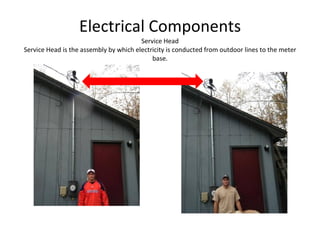
Electrical Components Service Head Service Head is the assembly by which electricity is conducted from outdoor lines to the meter base.
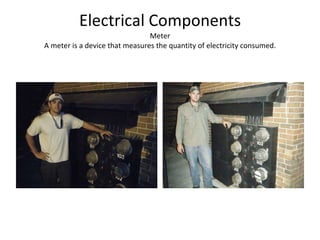
Electrical Components Meter A meter is a device that measures the quantity of electricity consumed.
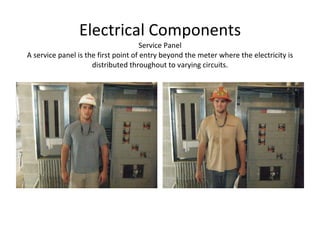
Electrical Components Service Panel A service panel is the first point of entry beyond the meter where the electricity is distributed throughout to varying circuits.
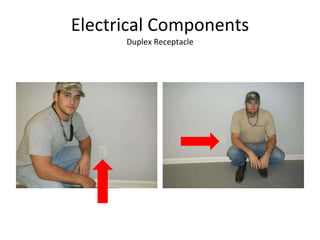
Electrical Components Duplex Receptacle
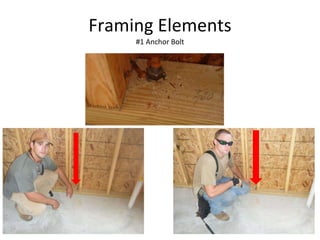
Framing Elements #1 Anchor Bolt
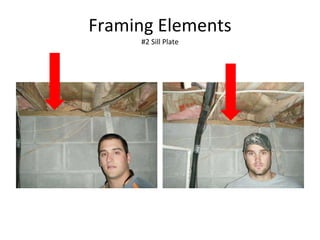
Framing Elements #2 Sill Plate
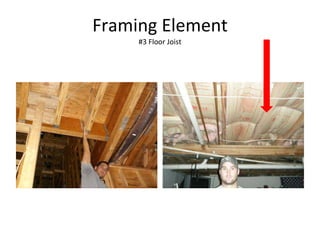
Framing Element #3 Floor Joist
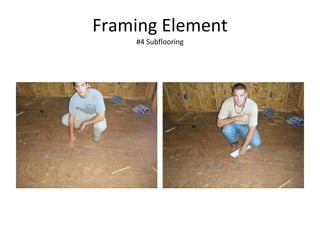
Framing Element #4 Subflooring
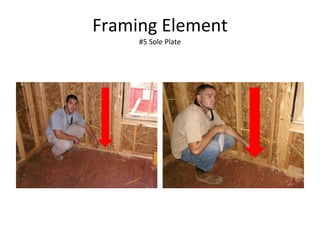
Framing Element #5 Sole Plate
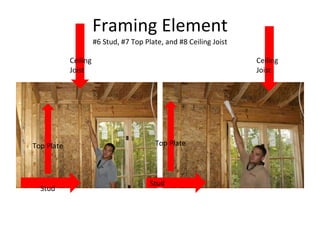
Framing Element #6 Stud, #7 Top Plate, and #8 Ceiling Joist Ceiling Joist Top Plate Stud Ceiling Joist Top Plate Stud
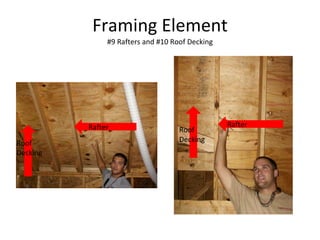
Framing Element #9 Rafters and #10 Roof Decking Rafter Roof Decking Roof Decking Rafter
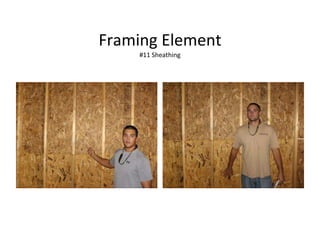
Framing Element #11 Sheathing
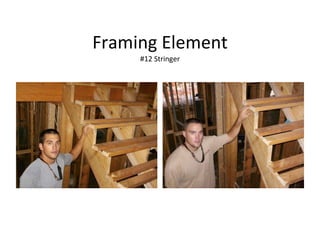
Framing Element #12 Stringer
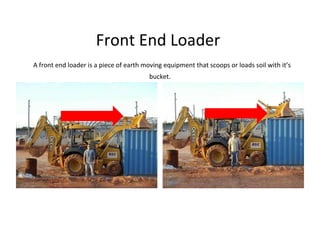
Front End Loader    A front end loader is a piece of earth moving equipment that scoops or loads soil with it’s bucket.
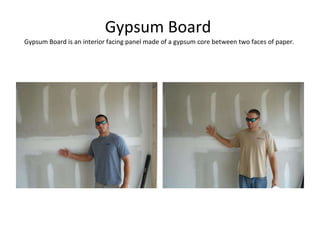
Gypsum Board  Gypsum Board is an interior facing panel made of a gypsum core between two faces of paper.
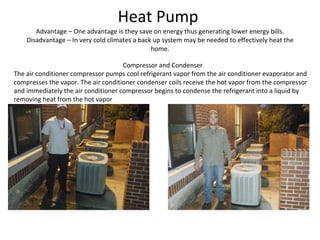
Heat Pump  Advantage – One advantage is they save on energy thus generating lower energy bills. Disadvantage – In very cold climates a back up system may be needed to effectively heat the home. Compressor and Condenser The air conditioner compressor pumps cool refrigerant vapor from the air conditioner evaporator and compresses the vapor. The air conditioner condenser coils receive the hot vapor from the compressor and immediately the air conditioner compressor begins to condense the refrigerant into a liquid by removing heat from the hot vapor
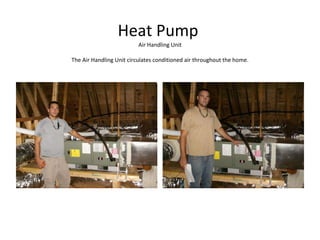
Heat Pump  Air Handling Unit The Air Handling Unit circulates conditioned air throughout the home.
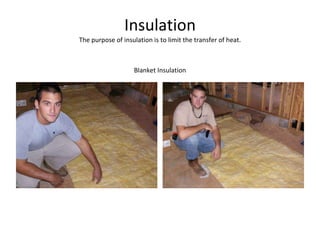
Insulation The purpose of insulation is to limit the transfer of heat. Blanket Insulation
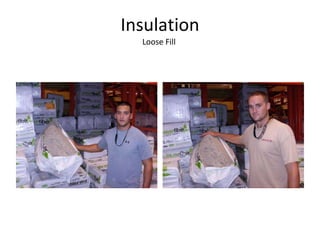
Insulation Loose Fill
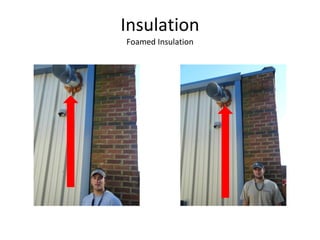
Insulation Foamed Insulation
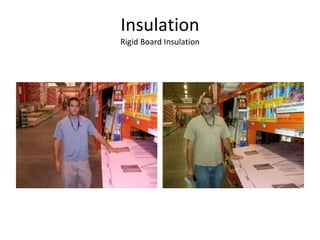
Insulation Rigid Board Insulation
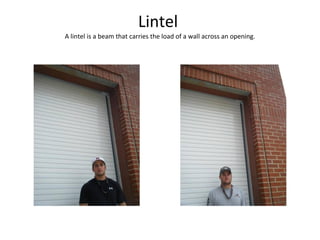
Lintel  A lintel is a beam that carries the load of a wall across an opening.
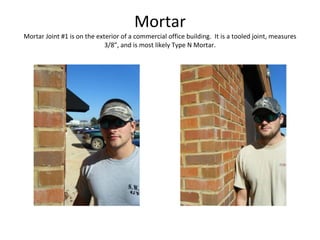
Mortar Mortar Joint #1 is on the exterior of a commercial office building.  It is a tooled joint, measures 3/8”, and is most likely Type N Mortar.
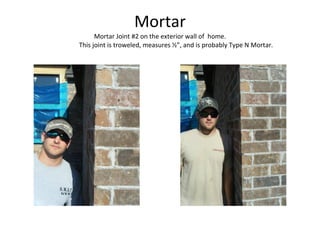
Mortar Mortar Joint #2 on the exterior wall of  home. This joint is troweled, measures ½”, and is probably Type N Mortar.
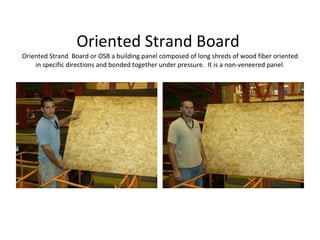
Oriented Strand Board  Oriented Strand  Board or OSB a building panel composed of long shreds of wood fiber oriented in specific directions and bonded together under pressure.  It is a non-veneered panel.
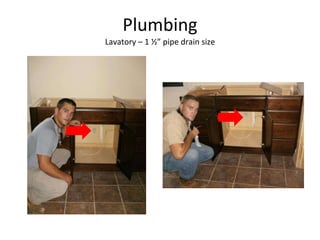
Plumbing Lavatory – 1 ½” pipe drain size
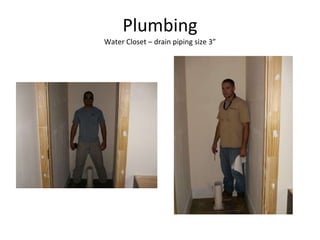
Plumbing Water Closet – drain piping size 3”
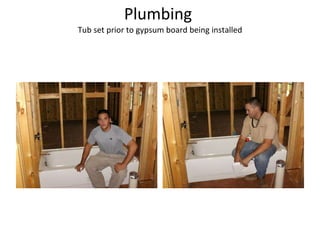
Plumbing  Tub set prior to gypsum board being installed
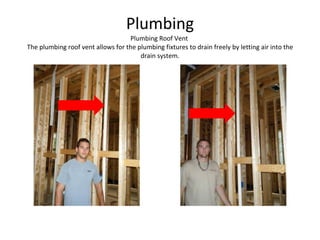
Plumbing Plumbing Roof Vent  The plumbing roof vent allows for the plumbing fixtures to drain freely by letting air into the drain system.
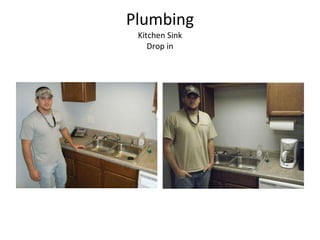
Plumbing Kitchen Sink Drop in
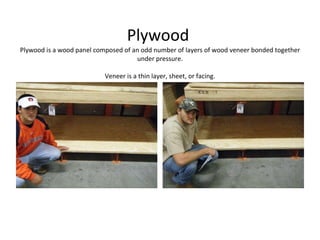
Plywood  Plywood is a wood panel composed of an odd number of layers of wood veneer bonded together under pressure. Veneer is a thin layer, sheet, or facing.
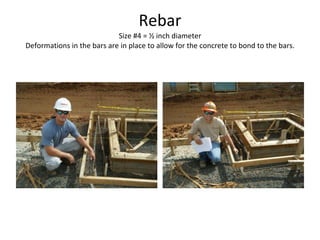
Rebar Size #4 = ½ inch diameter Deformations in the bars are in place to allow for the concrete to bond to the bars.
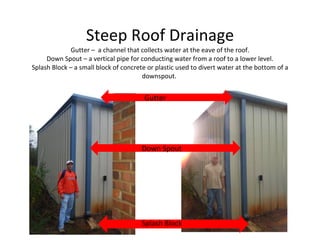
Steep Roof Drainage Gutter –  a channel that collects water at the eave of the roof. Down Spout – a vertical pipe for conducting water from a roof to a lower level. Splash Block – a small block of concrete or plastic used to divert water at the bottom of a downspout.  Gutter Down Spout Splash Block
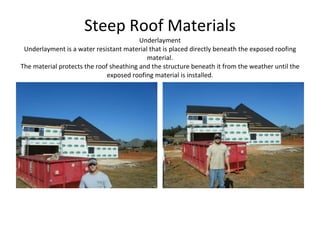
Steep Roof Materials Underlayment Underlayment is a water resistant material that is placed directly beneath the exposed roofing material. The material protects the roof sheathing and the structure beneath it from the weather until the exposed roofing material is installed.
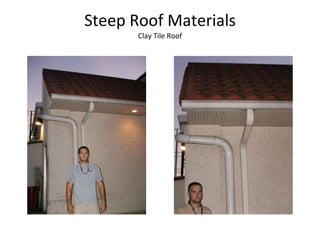
Steep Roof Materials Clay Tile Roof
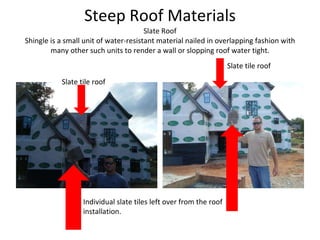
Steep Roof Materials Slate Roof Shingle is a small unit of water-resistant material nailed in overlapping fashion with many other such units to render a wall or slopping roof water tight. Slate tile roof  Slate tile roof  Individual slate tiles left over from the roof installation.
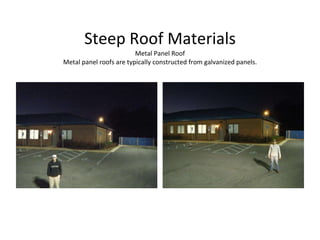
Steep Roof Materials Metal Panel Roof Metal panel roofs are typically constructed from galvanized panels.
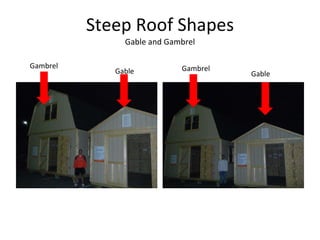
Steep Roof Shapes Gable and Gambrel Gambrel Gambrel Gable Gable
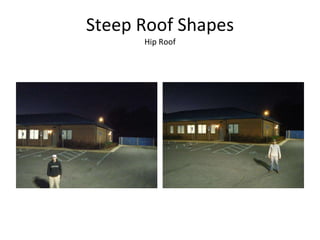
Steep Roof Shapes Hip Roof
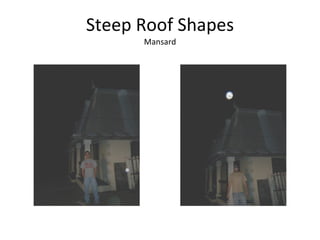
Steep Roof Shapes Mansard
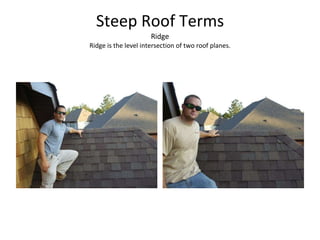
Steep Roof Terms Ridge Ridge is the level intersection of two roof planes.
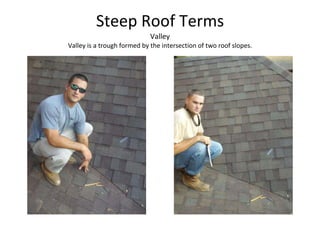
Steep Roof Terms Valley Valley is a trough formed by the intersection of two roof slopes.
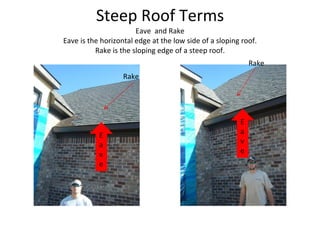
Steep Roof Terms Eave  and Rake Eave is the horizontal edge at the low side of a sloping roof. Rake is the sloping edge of a steep roof. Eave Eave Rake Rake
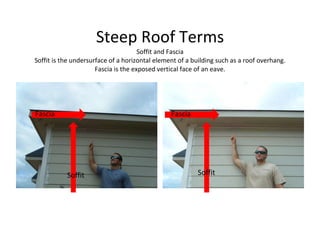
Steep Roof Terms Soffit and Fascia Soffit is the undersurface of a horizontal element of a building such as a roof overhang. Fascia is the exposed vertical face of an eave. Fascia Soffit Soffit Fascia
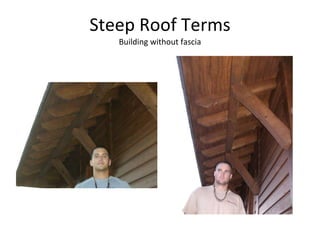
Steep Roof Terms Building without fascia
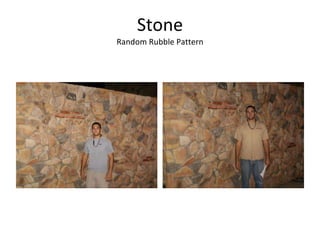
Stone Random Rubble Pattern
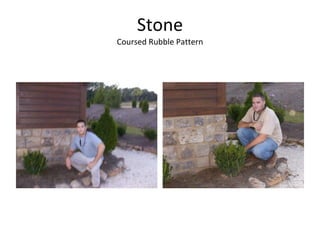
Stone Coursed Rubble Pattern
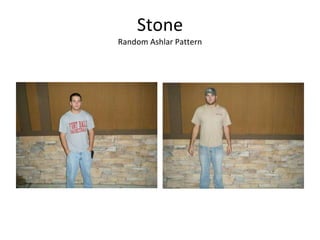
Stone Random Ashlar Pattern
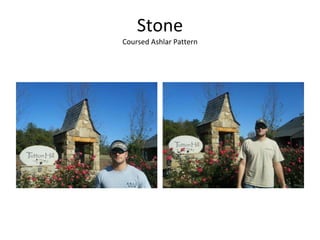
Stone Coursed Ashlar Pattern
Vapor Retarder Vapor retarder placed on the face of a piece bat insulation. The vapor retarder is typically placed on the interior face of the bat insulation.
Water Proofing The waterproofing is applied to prevent water from flowing through the CMU wall. This is a Liquid Applied from of water proofing.
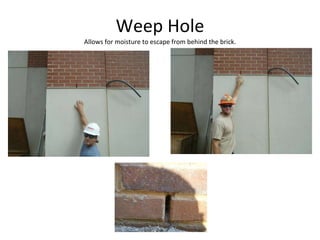
Weep Hole Allows for moisture to escape from behind the brick.
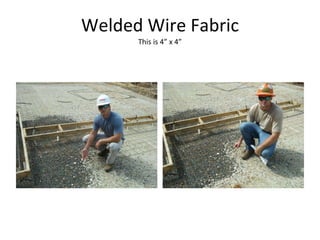
Welded Wire Fabric This is 4” x 4”
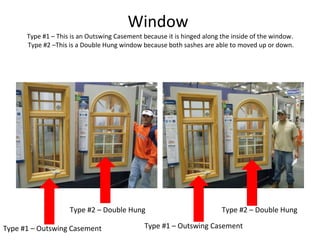
Window  Type #1 – This is an Outswing Casement because it is hinged along the inside of the window.  Type #2 –This is a Double Hung window because both sashes are able to moved up or down. Type #1 – Outswing Casement Type #2 – Double Hung Type #1 – Outswing Casement Type #2 – Double Hung
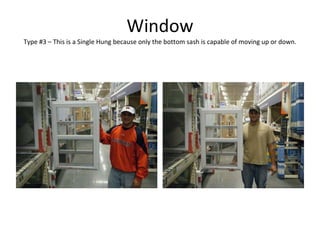
Window Type #3 – This is a Single Hung because only the bottom sash is capable of moving up or down.

Visual Dictionary

  • 1.
    Air Barrier Paper Air Barrier Paper – a moisture resistant barrier that covers the sheathing and acts as a backup waterproofing to the siding that is applied over it. The barriers function is to control air from penetrating or escaping the building envelope.
  • 2.
    Attic Ventilation Atticventilation is needed to allow warm air to escape the roof area and also allow fresh air to circulate. Soffit Vent Soffit vents are used to allow air to flow into the attic or the space below the roof sheathing.
  • 3.
    Attic Ventilation RidgeVent Ridge vents allows air to circulate in and out of the roof at the ridge.
  • 4.
    Attic Ventilation GableVent Roof Turbine Gable vents and Roof Turbines are use to exhaust excess heat and humidity from an attic.
  • 5.
    Backhoe A backhoeis a piece of excavating equipment that has a bucket attached to a digging arm. Bucket Width on this particular backhoe was 16 inches across. This piece of equipment is used primarily for digging and excavating.
  • 6.
    Batter Boards BatterBoard are temporary frames built just outside the corner that aid in marking the boundaries and establish the level line of the structure.
  • 7.
    Brick Arches BrickArch #1 and #2 - both of these arches are Roman Arches.
  • 8.
    Brick Arches RomanBrick arch with a keystone
  • 9.
    Brick Arches CenteringCentering is a temporary framework used for arch construction.
  • 10.
    Brick Bonds StackBond - brick work that is laid so that all joints align vertically. Running Bond – brickwork consisting entirely of stretchers. Stack Bond Running Bond Running Bond Stack Bond
  • 11.
    Brick Bonds Soldiers,Headers, and Rowlock Soldiers Headers Rowlock Soldiers Headers Headers Rowlock
  • 12.
  • 13.
    Brick Bonds StretcherRowlock (Shiners)
  • 14.
    Brick Sizes BrickSize #1 – 3 ½ “ x 2 ¼ ” x 7 5/8 ” Modular Brick Size #2 – 3 5/8 “ x 3 5/8 ” x 11 5/8 ” Utility Brick Size #1 Brick Size #2 Brick Size #2 Brick Size #1
  • 15.
    Bulldozer A pieceof earth moving equipment that has a large plated front used to push soil. Bulldozers are primarily used for pushing soil.
  • 16.
    Cladding Brick andEIFS Clad Structure EIFS Brick Brick EIFS
  • 17.
    Cladding Stone CladStructure Wood Board Clad Structure Random Rubble Pattern
  • 18.
    Cladding Wood ShingleClad Structure Shake – a shingle split from a block of wood. Shingle – a small unit of water resistant material installed in an overlapping fashion with many other units to render the wall water tight.
  • 19.
    Code Requirements Egresswindow from a bedroom. This window measured (per side) 2’6” x 5’, 12.5 Sqf total area, and is 2’6” AFF. IBC Requirements are minimum opening of 5.7 Sqft, minimum height of 24”, minimum width of 20” and less than or equal to 44 “ sill height AFF. Yes it meets IBC requirements.
  • 20.
    Code Requirements ofStair Tread = 11 1/8” Riser = 7 7/16” IBC requirements are 7 ¾” maximum riser height and 11” minimum tread depth and no more than 3/8” overall deviation in riser heights. Yes the stair meets the IBC requirements.
  • 21.
    Concrete Joints ControlJoint is an intentional discontinuity in a structure designed to form a plane of weakness where cracking can occur. So that cracking is minimized elsewhere.
  • 22.
    Concrete Joints Isolationjoints are used to relieve flexural stresses due to vertical movement of slab-on-grade applications that adjoin fixed foundation elements such as columns, building or machinery foundations, etc. In the photo the isolation joint separates the two concrete slabs isolating one slab from another.
  • 23.
    Concrete Masonry Unit(CMU) 1 CMU=3 brick courses CMU or Concrete Masonry Unit is a block of hardened concrete, with or without hollow cores, designed to be laid in the same manner as a brick stone; a concrete block. ‘ Typical Dimensions are 7 5/8” X 15 5/8”
  • 24.
    Concrete Masonry Unit2 Different Size CMU 4” and 12” CMU 12” 4” 12” 4”
  • 25.
    Decorative Concrete MasonryUnits Split Block
  • 26.
  • 27.
    Doors Exterior PanelDoor Top Rail Panel Lock rail Bottom Rail Top Rail Panel Lock rail Bottom Rail Stile Stile
  • 28.
    Doors Transom andSide Lights Transom – a small window directly above a door. Side Light – a tall, narrow window beside a door. Transom Side Light Side Light Transom
  • 29.
    Electrical Components UndergroundTransformer Box Transformer is an electrical device that changes the voltage of alternating current.
  • 30.
    Electrical Components ServiceHead Service Head is the assembly by which electricity is conducted from outdoor lines to the meter base.
  • 31.
    Electrical Components MeterA meter is a device that measures the quantity of electricity consumed.
  • 32.
    Electrical Components ServicePanel A service panel is the first point of entry beyond the meter where the electricity is distributed throughout to varying circuits.
  • 33.
  • 34.
  • 35.
  • 36.
    Framing Element #3Floor Joist
  • 37.
    Framing Element #4Subflooring
  • 38.
  • 39.
    Framing Element #6Stud, #7 Top Plate, and #8 Ceiling Joist Ceiling Joist Top Plate Stud Ceiling Joist Top Plate Stud
  • 40.
    Framing Element #9Rafters and #10 Roof Decking Rafter Roof Decking Roof Decking Rafter
  • 41.
  • 42.
  • 43.
    Front End Loader A front end loader is a piece of earth moving equipment that scoops or loads soil with it’s bucket.
  • 44.
    Gypsum Board Gypsum Board is an interior facing panel made of a gypsum core between two faces of paper.
  • 45.
    Heat Pump Advantage – One advantage is they save on energy thus generating lower energy bills. Disadvantage – In very cold climates a back up system may be needed to effectively heat the home. Compressor and Condenser The air conditioner compressor pumps cool refrigerant vapor from the air conditioner evaporator and compresses the vapor. The air conditioner condenser coils receive the hot vapor from the compressor and immediately the air conditioner compressor begins to condense the refrigerant into a liquid by removing heat from the hot vapor
  • 46.
    Heat Pump Air Handling Unit The Air Handling Unit circulates conditioned air throughout the home.
  • 47.
    Insulation The purposeof insulation is to limit the transfer of heat. Blanket Insulation
  • 48.
  • 49.
  • 50.
  • 51.
    Lintel Alintel is a beam that carries the load of a wall across an opening.
  • 52.
    Mortar Mortar Joint#1 is on the exterior of a commercial office building. It is a tooled joint, measures 3/8”, and is most likely Type N Mortar.
  • 53.
    Mortar Mortar Joint#2 on the exterior wall of home. This joint is troweled, measures ½”, and is probably Type N Mortar.
  • 54.
    Oriented Strand Board Oriented Strand Board or OSB a building panel composed of long shreds of wood fiber oriented in specific directions and bonded together under pressure. It is a non-veneered panel.
  • 55.
    Plumbing Lavatory –1 ½” pipe drain size
  • 56.
    Plumbing Water Closet– drain piping size 3”
  • 57.
    Plumbing Tubset prior to gypsum board being installed
  • 58.
    Plumbing Plumbing RoofVent The plumbing roof vent allows for the plumbing fixtures to drain freely by letting air into the drain system.
  • 59.
  • 60.
    Plywood Plywoodis a wood panel composed of an odd number of layers of wood veneer bonded together under pressure. Veneer is a thin layer, sheet, or facing.
  • 61.
    Rebar Size #4= ½ inch diameter Deformations in the bars are in place to allow for the concrete to bond to the bars.
  • 62.
    Steep Roof DrainageGutter – a channel that collects water at the eave of the roof. Down Spout – a vertical pipe for conducting water from a roof to a lower level. Splash Block – a small block of concrete or plastic used to divert water at the bottom of a downspout. Gutter Down Spout Splash Block
  • 63.
    Steep Roof MaterialsUnderlayment Underlayment is a water resistant material that is placed directly beneath the exposed roofing material. The material protects the roof sheathing and the structure beneath it from the weather until the exposed roofing material is installed.
  • 64.
    Steep Roof MaterialsClay Tile Roof
  • 65.
    Steep Roof MaterialsSlate Roof Shingle is a small unit of water-resistant material nailed in overlapping fashion with many other such units to render a wall or slopping roof water tight. Slate tile roof Slate tile roof Individual slate tiles left over from the roof installation.
  • 66.
    Steep Roof MaterialsMetal Panel Roof Metal panel roofs are typically constructed from galvanized panels.
  • 67.
    Steep Roof ShapesGable and Gambrel Gambrel Gambrel Gable Gable
  • 68.
  • 69.
  • 70.
    Steep Roof TermsRidge Ridge is the level intersection of two roof planes.
  • 71.
    Steep Roof TermsValley Valley is a trough formed by the intersection of two roof slopes.
  • 72.
    Steep Roof TermsEave and Rake Eave is the horizontal edge at the low side of a sloping roof. Rake is the sloping edge of a steep roof. Eave Eave Rake Rake
  • 73.
    Steep Roof TermsSoffit and Fascia Soffit is the undersurface of a horizontal element of a building such as a roof overhang. Fascia is the exposed vertical face of an eave. Fascia Soffit Soffit Fascia
  • 74.
    Steep Roof TermsBuilding without fascia
  • 75.
  • 76.
  • 77.
  • 78.
  • 79.
    Vapor Retarder Vaporretarder placed on the face of a piece bat insulation. The vapor retarder is typically placed on the interior face of the bat insulation.
  • 80.
    Water Proofing Thewaterproofing is applied to prevent water from flowing through the CMU wall. This is a Liquid Applied from of water proofing.
  • 81.
    Weep Hole Allowsfor moisture to escape from behind the brick.
  • 82.
    Welded Wire FabricThis is 4” x 4”
  • 83.
    Window Type#1 – This is an Outswing Casement because it is hinged along the inside of the window. Type #2 –This is a Double Hung window because both sashes are able to moved up or down. Type #1 – Outswing Casement Type #2 – Double Hung Type #1 – Outswing Casement Type #2 – Double Hung
  • 84.
    Window Type #3– This is a Single Hung because only the bottom sash is capable of moving up or down.