Copyright 101 By Kerri Davis
What is copyright? Copyright law gives copyright owners the exclusive right to: reproduce the work adapt the work based on the original distribute copies to the public publicly perform or display the work These rights may be licensed, transferred and/or  assigned by the copyright holder. Library of Congress. (2010).  Taking the mystery out of copyright .  Retrieved April 18, 2010, from  http://www.loc.gov/teachers/copyrightmystery/#/reading/
What does copyright do? Contrary to popular belief, copyright does not protect your ideas, it only protects the expression of your ideas. Library of Congress. (2010).  Taking the mystery out of copyright .  Retrieved April  18, 2010, from http://www.loc.gov/teachers/copyrightmystery/#/reading/
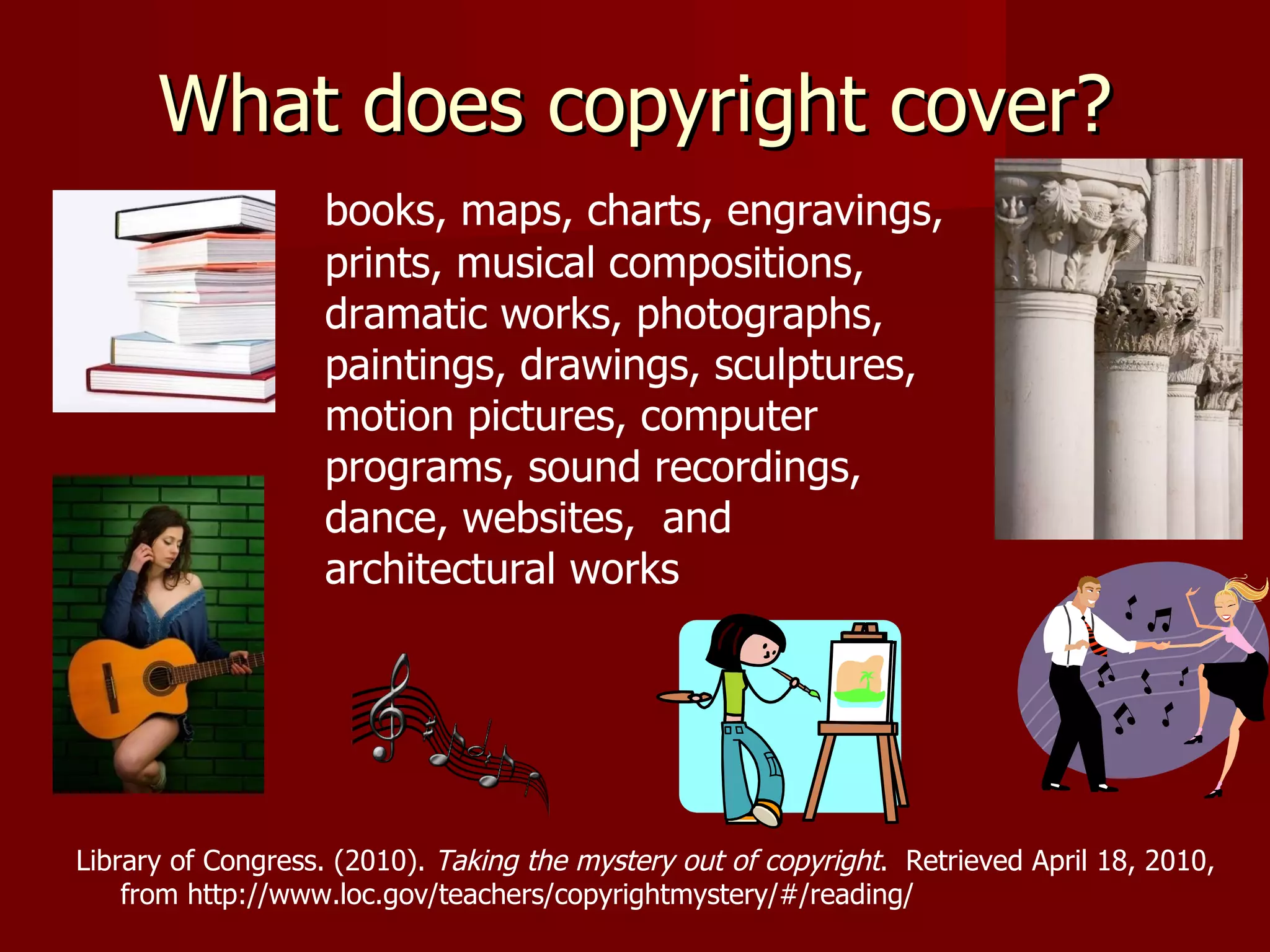
What does copyright cover? books, maps, charts, engravings, prints, musical compositions, dramatic works, photographs, paintings, drawings, sculptures, motion pictures, computer programs, sound recordings, dance, websites,  and architectural works Library of Congress. (2010).  Taking the mystery out of copyright .  Retrieved April 18, 2010,  from http://www.loc.gov/teachers/copyrightmystery/#/reading/
Did You Know? The government cannot copyright any printed material. Any work is copyrighted immediately after it is produced…no paperwork necessary. A copyright’s protection lasts for the life of the author plus an additional seventy years. About 1/4 of the U.S. economy is based on the licensed sale of products protected by intellectual property (IP) law.  Copyrighted movies, TV shows, music, books, and video games, are now the largest export of the U.S. economy. Wilkes University Moodle. (2009).  Intellectual property or imaginary property.  Retrieved April 6,  2010, from http://moodle1.wilkes.edu/mod/resource/view.php?id=54813 University System of Georgia. (2009).  Copyright generally .   Retrieved April 7, 2010, from http:// www.usg.edu/copyright/copyright_generally/
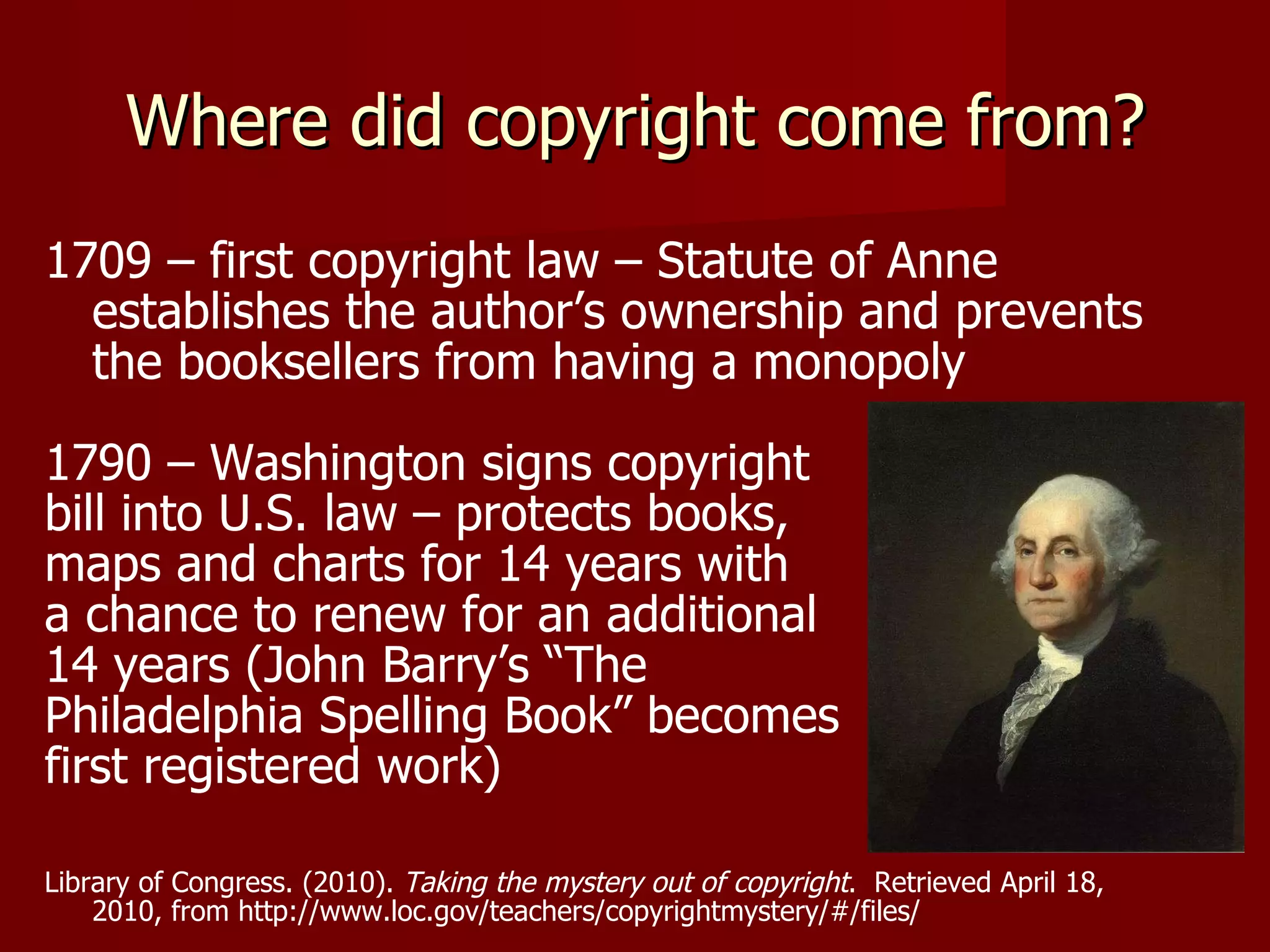
Where did copyright come from? 1709 – first copyright law – Statute of Anne  establishes the author’s ownership and prevents the booksellers from having a monopoly 1790 – Washington signs copyright  bill into U.S. law – protects books,  maps and charts for 14 years with  a chance to renew for an additional  14 years (John Barry’s “The  Philadelphia Spelling Book” becomes  first registered work) Library of Congress. (2010).  Taking the mystery out of copyright .  Retrieved April 18, 2010, from http://www.loc.gov/teachers/copyrightmystery/#/files/
Copyright law and the  U.S. Constitution The power to enact copyright law is granted in Article I,  Section 8, Clause 8 of the U.S. Constitution.  It states,  “ The Congress shall have Power [. . .] To promote the Progress  of Science and useful Arts, by  securing for limited Times to  Authors and Inventors the  exclusive Right to their  respective Writings and  Discoveries.”   Copyright Clause. (2010, March 23).  Wikipedia, The Free Encyclopedia .  Retrieved April 18, 2010, from http://en.wikipedia.org/w/index.php?  title=Copyright_Clause&oldid=351591090
Major events in copyright history 1831 – first major revision to the law, now includes musical compositions and extends copyright to 28 years, plus an additional 14 year renewal – eventually also dramatic works and photographs 1870 – second general revision, includes works of art, copyright activities become responsibility of Library of Congress 1891 –  International Copyright Act  signed into law 1895 – Cleveland signs Printing Act - prohibits copyright of any government publication Library of Congress. (2010).  Taking the mystery out of copyright .  Retrieved April 18, 2010, from http://www.loc.gov/teachers/copyrightmystery/#/files/
Major events in copyright history 1909 – third revision of the law – includes all writings of an author and extends renewal to 28 years 1912 – motion pictures now included 1953 – extended to poetry, novels and textbooks 1955 – U.S. becomes member of  Universal Copyright Convention 1978 – fourth major revision – extends copyright 50 years after author’s death 1998 –  The Sonny Bono Copyright Term Extension Act  – extends to 70 years after author’s death 1998 – Clinton signs  Digital Millennium Copyright Act Library of Congress. (2010).  Taking the mystery out of copyright .  Retrieved April 18, 2010, from http://www.loc.gov/teachers/copyrightmystery/#/files/
Copyright timeline: A history of copyright in the U.S. To get more information regarding copyright legislation and important court cases,  click on the link below Copyright Timeline Adler, P. (2007).  Influencing public policies . Retrieved April 16, 2010 from, http://www.arl.org/pp/ppcopyright/copyresources/copytimeline.shtml
How does copyright affect teachers? The educational system has been provided with the broadest exemption in copyright law.  This exemption is known as fair use.  Fair use means that individuals can use copyrighted material as long as it is used for educational purposes, scholarly criticism, parody, or news reporting. For a more complete look of Fair Use, click on the following link  www.copyright.gov U.S. Copyright Office. (2009). Fair Use. Retrieved April 7, 2010, from http://www.  copyright.gov/fls/fl102.html
Factors in determining fair use There are 4 non-exclusive factors to consider when determining if something falls under Fair Use including:  1) the purpose and character of the use  2) the nature of the copyrighted work 3) the amount and substantiality of the portion used in relation to the copyrighted work as a whole 4) the effect of the use upon the potential market for or value of the copyrighted work University System of Georgia. (2009).  The fair use exception .   Retrieved April 7, 2010,  from http://www.usg.edu/copyright/the_fair_use_exception/
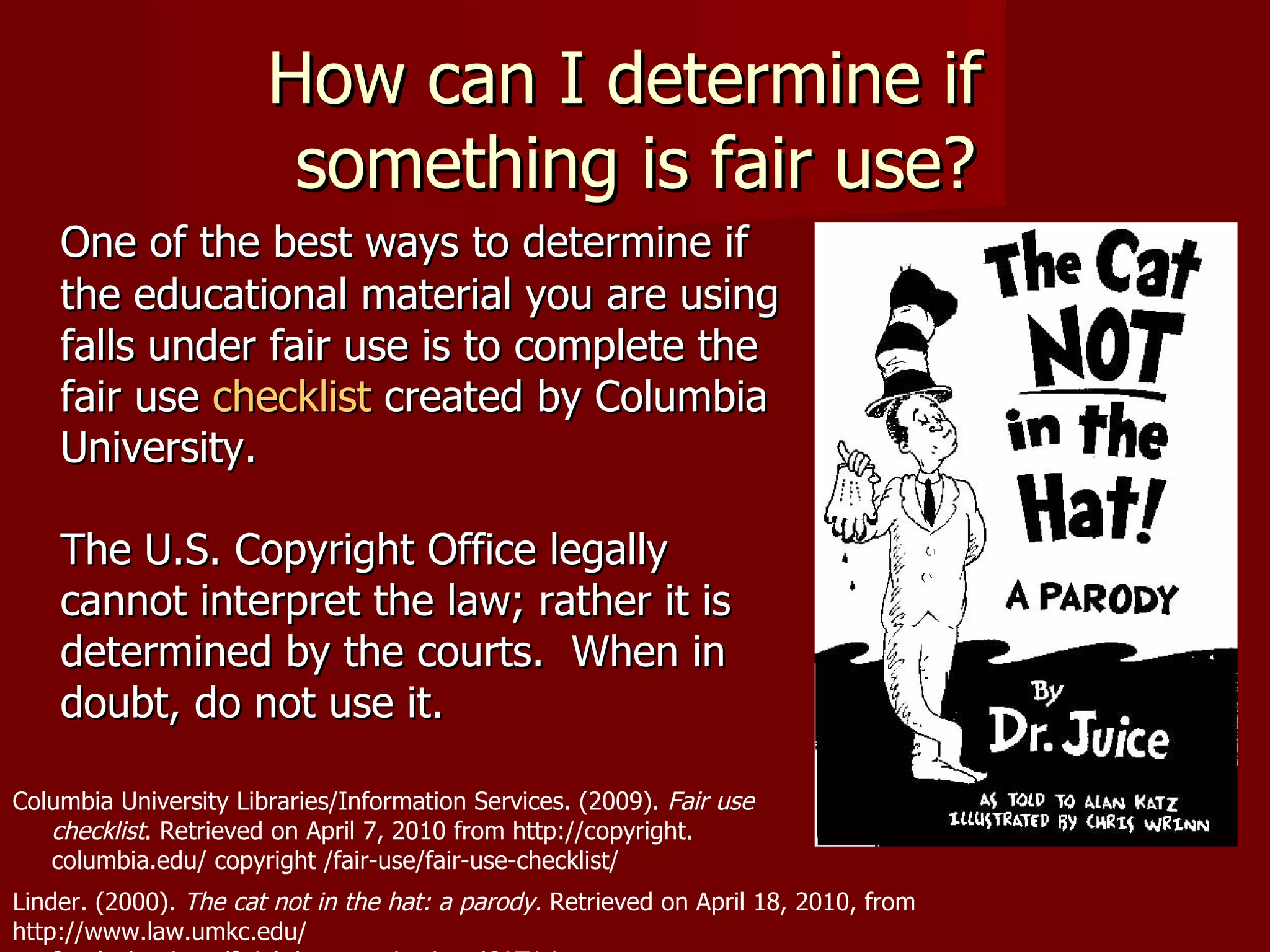
How can I determine if  something is fair use? One of the best ways to determine if the educational material you are using falls under fair use is to complete the fair use  checklist  created by Columbia University.  The U.S. Copyright Office legally cannot interpret the law; rather it is determined by the courts.  When in doubt, do not use it. Linder. (2000).  The cat not in the hat: a parody.  Retrieved on April 18, 2010, from http://www.law.umkc.edu/  faculty/projects/ftrials/communications/CAT1.jpg Columbia University Libraries/Information Services. (2009).  Fair use  checklist . Retrieved on April 7, 2010 from http://copyright.  columbia.edu/ copyright /fair-use/fair-use-checklist/
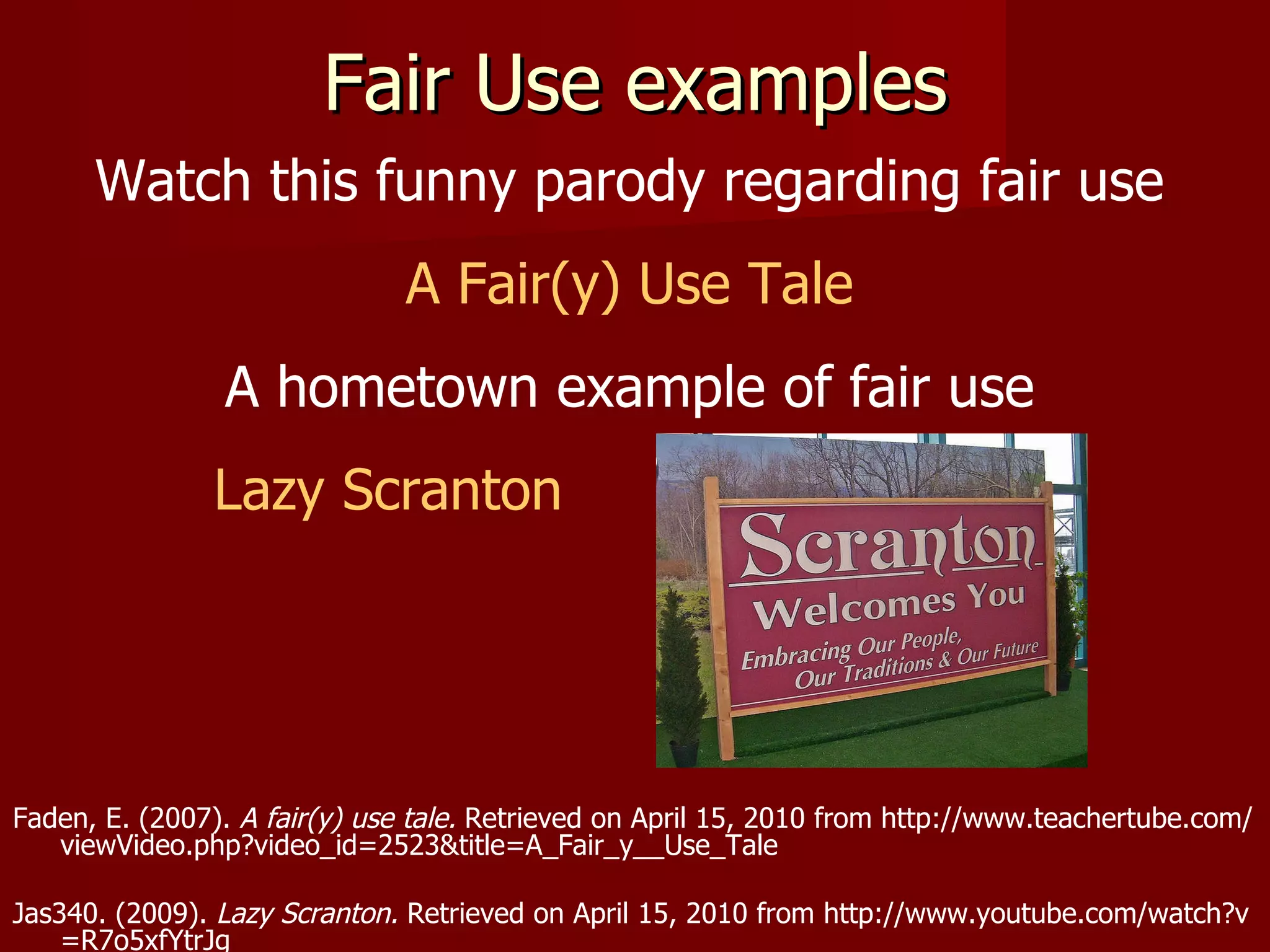
Fair Use examples Faden, E. (2007).  A fair(y) use tale.  Retrieved on April 15, 2010 from http://www.teachertube.com/ viewVideo.php?video_id=2523&title=A_Fair_y__Use_Tale Jas340. (2009).  Lazy Scranton.  Retrieved on April 15, 2010 from http://www.youtube.com/watch?v =R7o5xfYtrJg Watch this funny parody regarding fair use  A  Fair(y ) Use Tale A hometown example of fair use Lazy Scranton
How is copyright changing? Copyright law is constantly being updated as new technology emerges.  The growth of distance learning has caused additional changes to copyright law. In 2002 Bush signed the Technology, Education, and Copyright Harmonization (TEACH) Act which provided for the use of copyrighted work by accredited nonprofit educational institutions in distance education For more specific information click the  TEACH Act Library of Congress. (2010).  Taking the mystery out of copyright .  Retrieved April 18, 2010, from http://www.loc.gov/teachers/copyrightmystery/#/files/ Wilkes University Moodle. (2009).  Copyright in distance education: the TEACH act.  Retrieved April  12, 2010, from http://moodle1.wilkes.edu/mod/resource/view.php?id=54819
Issues with copyright Copyright law is continually changing to meet the demands of today’s technology.  Influential lobbyists are pushing to extend the terms of copyright.  Users of copyrighted material are often fighting for their rights under fair use.  Copyright holders are losing millions of dollars in earnings from their work due to infringement or piracy.  Other copyright holders want to freely share their creations with the world.  How then can teachers expect students to know what is right or wrong?  One solution: Open Content Wilkes University Moodle. (2009).  Intellectual property or imaginary property.  Retrieved April 6,  2010, from http://moodle1.wilkes.edu/mod/resource/view.php?id=54813
What is open content? According to  opencontent.org , open content is content that is licensed in a manner that provides users with the right to make more kinds of uses than those normally permitted under the law - at no cost to the user.  Essentially, the fewer copyright restrictions placed on the user of a piece of content, the more open the content is.  The primary permissions or usage rights open content is concerned with are expressed in the "4Rs Framework:" 1. Reuse 2. Revise  3. Remix  4. Redistribute  Opencontent.org. (2010).  Defining “the open” in open content . Retrieved April  19, 2010, from http://www.opencontent.org/definition/
What types of open content  are available?     Wilkes University Moodle. (2009).  Copyright enhancement, creative commons, and open content.  Retrieved April  12, 2010, from http://moodle1.wilkes.edu/mod/resource/view.php?id=54820 To learn more about any open content source, please click on the icons below.  The buttons will take you directly to the organization’s website.
What does the future hold  for copyright? The simple answer is… we’re not really sure.  Only time will tell.
References Columbia University Libraries/Information Services. (2009).  Fair use checklist . Retrieved on April 7, 2010 from http://copyright.columbia.edu/ copyright /fair-use/fair-use-checklist/  Copyright Clause. (2010, March 23).  Wikipedia, The Free Encyclopedia . Retrieved April 18, 2010, from http://en.wikipedia.org/w/index.php?title=Copyright_Clause&oldid =351591090 Faden, E. (2007).  A fair(y) use tale.  Retrieved on April 15, 2010 from http://www. teachertube.com/viewVideo.php?video_id=2523&title=A_Fair_y__Use_Tale Jas340. (2009).  Lazy Scranton.  Retrieved on April 15, 2010 from http://www.youtube. com/watch?v=R7o5xfYtrJg Library of Congress. (2010).  Taking the mystery out of copyright .  Retrieved April 18, 2010, from http://www.loc.gov/teachers/copyrightmystery/#/files/ Library of Congress. (2010).  Taking the mystery out of copyright .  Retrieved April 18, 2010, from http://www.loc.gov/teachers/copyrightmystery/#/reading/ Linder. (2000).  The cat not in the hat: a parody.  Retrieved on April 18, 2010, from http://www.law.umkc.edu/faculty/projects/ftrials/communications/CAT1.jpg
References Opencontent.org. (2010).  Defining “the open” in open content . Retrieved April 19, 2010, from http://www.opencontent.org/definition/ University System of Georgia. (2009).  Copyright generally .   Retrieved April 7, 2010, from http://www.usg.edu/copyright/copyright_generally/ University System of Georgia. (2009).  The fair use exception .   Retrieved April 7, 2010, from http://www.usg.edu/copyright/the_fair_use_exception/ U.S. Copyright Office. (2009). Fair Use. Retrieved April 7, 2010, from http://www.copyright.gov/fls/fl102.html Wilkes University Moodle. (2009).  Copyright enhancement, creative commons, and open content.  Retrieved April12, 2010, from http://moodle1.wilkes.edu/ mod/resource/view.php?id=54820 Wilkes University Moodle. (2009).  Copyright in distance education: the TEACH act.  Retrieved April 12, 2010, from http://moodle1.wilkes.edu/mod/ resource/view.php?id=54819 Wilkes University Moodle. (2009).  Intellectual property or imaginary property.  Retrieved April 6, 2010, from http://moodle1.wilkes.edu/mod/resource/ view.php?id=54813

Copyright 101 - davisu05a2

  • 1.
    Copyright 101 ByKerri Davis
  • 2.
    What is copyright?Copyright law gives copyright owners the exclusive right to: reproduce the work adapt the work based on the original distribute copies to the public publicly perform or display the work These rights may be licensed, transferred and/or assigned by the copyright holder. Library of Congress. (2010). Taking the mystery out of copyright . Retrieved April 18, 2010, from http://www.loc.gov/teachers/copyrightmystery/#/reading/
  • 3.
    What does copyrightdo? Contrary to popular belief, copyright does not protect your ideas, it only protects the expression of your ideas. Library of Congress. (2010). Taking the mystery out of copyright . Retrieved April 18, 2010, from http://www.loc.gov/teachers/copyrightmystery/#/reading/
  • 4.
    What does copyrightcover? books, maps, charts, engravings, prints, musical compositions, dramatic works, photographs, paintings, drawings, sculptures, motion pictures, computer programs, sound recordings, dance, websites, and architectural works Library of Congress. (2010). Taking the mystery out of copyright . Retrieved April 18, 2010, from http://www.loc.gov/teachers/copyrightmystery/#/reading/
  • 5.
    Did You Know?The government cannot copyright any printed material. Any work is copyrighted immediately after it is produced…no paperwork necessary. A copyright’s protection lasts for the life of the author plus an additional seventy years. About 1/4 of the U.S. economy is based on the licensed sale of products protected by intellectual property (IP) law. Copyrighted movies, TV shows, music, books, and video games, are now the largest export of the U.S. economy. Wilkes University Moodle. (2009). Intellectual property or imaginary property. Retrieved April 6, 2010, from http://moodle1.wilkes.edu/mod/resource/view.php?id=54813 University System of Georgia. (2009). Copyright generally . Retrieved April 7, 2010, from http:// www.usg.edu/copyright/copyright_generally/
  • 6.
    Where did copyrightcome from? 1709 – first copyright law – Statute of Anne establishes the author’s ownership and prevents the booksellers from having a monopoly 1790 – Washington signs copyright bill into U.S. law – protects books, maps and charts for 14 years with a chance to renew for an additional 14 years (John Barry’s “The Philadelphia Spelling Book” becomes first registered work) Library of Congress. (2010). Taking the mystery out of copyright . Retrieved April 18, 2010, from http://www.loc.gov/teachers/copyrightmystery/#/files/
  • 7.
    Copyright law andthe U.S. Constitution The power to enact copyright law is granted in Article I, Section 8, Clause 8 of the U.S. Constitution. It states, “ The Congress shall have Power [. . .] To promote the Progress of Science and useful Arts, by securing for limited Times to Authors and Inventors the exclusive Right to their respective Writings and Discoveries.” Copyright Clause. (2010, March 23). Wikipedia, The Free Encyclopedia . Retrieved April 18, 2010, from http://en.wikipedia.org/w/index.php? title=Copyright_Clause&oldid=351591090
  • 8.
    Major events incopyright history 1831 – first major revision to the law, now includes musical compositions and extends copyright to 28 years, plus an additional 14 year renewal – eventually also dramatic works and photographs 1870 – second general revision, includes works of art, copyright activities become responsibility of Library of Congress 1891 – International Copyright Act signed into law 1895 – Cleveland signs Printing Act - prohibits copyright of any government publication Library of Congress. (2010). Taking the mystery out of copyright . Retrieved April 18, 2010, from http://www.loc.gov/teachers/copyrightmystery/#/files/
  • 9.
    Major events incopyright history 1909 – third revision of the law – includes all writings of an author and extends renewal to 28 years 1912 – motion pictures now included 1953 – extended to poetry, novels and textbooks 1955 – U.S. becomes member of Universal Copyright Convention 1978 – fourth major revision – extends copyright 50 years after author’s death 1998 – The Sonny Bono Copyright Term Extension Act – extends to 70 years after author’s death 1998 – Clinton signs Digital Millennium Copyright Act Library of Congress. (2010). Taking the mystery out of copyright . Retrieved April 18, 2010, from http://www.loc.gov/teachers/copyrightmystery/#/files/
  • 10.
    Copyright timeline: Ahistory of copyright in the U.S. To get more information regarding copyright legislation and important court cases, click on the link below Copyright Timeline Adler, P. (2007). Influencing public policies . Retrieved April 16, 2010 from, http://www.arl.org/pp/ppcopyright/copyresources/copytimeline.shtml
  • 11.
    How does copyrightaffect teachers? The educational system has been provided with the broadest exemption in copyright law. This exemption is known as fair use. Fair use means that individuals can use copyrighted material as long as it is used for educational purposes, scholarly criticism, parody, or news reporting. For a more complete look of Fair Use, click on the following link www.copyright.gov U.S. Copyright Office. (2009). Fair Use. Retrieved April 7, 2010, from http://www. copyright.gov/fls/fl102.html
  • 12.
    Factors in determiningfair use There are 4 non-exclusive factors to consider when determining if something falls under Fair Use including: 1) the purpose and character of the use 2) the nature of the copyrighted work 3) the amount and substantiality of the portion used in relation to the copyrighted work as a whole 4) the effect of the use upon the potential market for or value of the copyrighted work University System of Georgia. (2009). The fair use exception . Retrieved April 7, 2010, from http://www.usg.edu/copyright/the_fair_use_exception/
  • 13.
    How can Idetermine if something is fair use? One of the best ways to determine if the educational material you are using falls under fair use is to complete the fair use checklist created by Columbia University. The U.S. Copyright Office legally cannot interpret the law; rather it is determined by the courts. When in doubt, do not use it. Linder. (2000). The cat not in the hat: a parody. Retrieved on April 18, 2010, from http://www.law.umkc.edu/ faculty/projects/ftrials/communications/CAT1.jpg Columbia University Libraries/Information Services. (2009). Fair use checklist . Retrieved on April 7, 2010 from http://copyright. columbia.edu/ copyright /fair-use/fair-use-checklist/
  • 14.
    Fair Use examplesFaden, E. (2007). A fair(y) use tale. Retrieved on April 15, 2010 from http://www.teachertube.com/ viewVideo.php?video_id=2523&title=A_Fair_y__Use_Tale Jas340. (2009). Lazy Scranton. Retrieved on April 15, 2010 from http://www.youtube.com/watch?v =R7o5xfYtrJg Watch this funny parody regarding fair use A Fair(y ) Use Tale A hometown example of fair use Lazy Scranton
  • 15.
    How is copyrightchanging? Copyright law is constantly being updated as new technology emerges. The growth of distance learning has caused additional changes to copyright law. In 2002 Bush signed the Technology, Education, and Copyright Harmonization (TEACH) Act which provided for the use of copyrighted work by accredited nonprofit educational institutions in distance education For more specific information click the TEACH Act Library of Congress. (2010). Taking the mystery out of copyright . Retrieved April 18, 2010, from http://www.loc.gov/teachers/copyrightmystery/#/files/ Wilkes University Moodle. (2009). Copyright in distance education: the TEACH act. Retrieved April 12, 2010, from http://moodle1.wilkes.edu/mod/resource/view.php?id=54819
  • 16.
    Issues with copyrightCopyright law is continually changing to meet the demands of today’s technology. Influential lobbyists are pushing to extend the terms of copyright. Users of copyrighted material are often fighting for their rights under fair use. Copyright holders are losing millions of dollars in earnings from their work due to infringement or piracy. Other copyright holders want to freely share their creations with the world. How then can teachers expect students to know what is right or wrong? One solution: Open Content Wilkes University Moodle. (2009). Intellectual property or imaginary property. Retrieved April 6, 2010, from http://moodle1.wilkes.edu/mod/resource/view.php?id=54813
  • 17.
    What is opencontent? According to opencontent.org , open content is content that is licensed in a manner that provides users with the right to make more kinds of uses than those normally permitted under the law - at no cost to the user. Essentially, the fewer copyright restrictions placed on the user of a piece of content, the more open the content is. The primary permissions or usage rights open content is concerned with are expressed in the "4Rs Framework:" 1. Reuse 2. Revise 3. Remix 4. Redistribute Opencontent.org. (2010). Defining “the open” in open content . Retrieved April 19, 2010, from http://www.opencontent.org/definition/
  • 18.
    What types ofopen content are available? Wilkes University Moodle. (2009). Copyright enhancement, creative commons, and open content. Retrieved April 12, 2010, from http://moodle1.wilkes.edu/mod/resource/view.php?id=54820 To learn more about any open content source, please click on the icons below. The buttons will take you directly to the organization’s website.
  • 19.
    What does thefuture hold for copyright? The simple answer is… we’re not really sure. Only time will tell.
  • 20.
    References Columbia UniversityLibraries/Information Services. (2009). Fair use checklist . Retrieved on April 7, 2010 from http://copyright.columbia.edu/ copyright /fair-use/fair-use-checklist/ Copyright Clause. (2010, March 23). Wikipedia, The Free Encyclopedia . Retrieved April 18, 2010, from http://en.wikipedia.org/w/index.php?title=Copyright_Clause&oldid =351591090 Faden, E. (2007). A fair(y) use tale. Retrieved on April 15, 2010 from http://www. teachertube.com/viewVideo.php?video_id=2523&title=A_Fair_y__Use_Tale Jas340. (2009). Lazy Scranton. Retrieved on April 15, 2010 from http://www.youtube. com/watch?v=R7o5xfYtrJg Library of Congress. (2010). Taking the mystery out of copyright . Retrieved April 18, 2010, from http://www.loc.gov/teachers/copyrightmystery/#/files/ Library of Congress. (2010). Taking the mystery out of copyright . Retrieved April 18, 2010, from http://www.loc.gov/teachers/copyrightmystery/#/reading/ Linder. (2000). The cat not in the hat: a parody. Retrieved on April 18, 2010, from http://www.law.umkc.edu/faculty/projects/ftrials/communications/CAT1.jpg
  • 21.
    References Opencontent.org. (2010). Defining “the open” in open content . Retrieved April 19, 2010, from http://www.opencontent.org/definition/ University System of Georgia. (2009). Copyright generally . Retrieved April 7, 2010, from http://www.usg.edu/copyright/copyright_generally/ University System of Georgia. (2009). The fair use exception . Retrieved April 7, 2010, from http://www.usg.edu/copyright/the_fair_use_exception/ U.S. Copyright Office. (2009). Fair Use. Retrieved April 7, 2010, from http://www.copyright.gov/fls/fl102.html Wilkes University Moodle. (2009). Copyright enhancement, creative commons, and open content. Retrieved April12, 2010, from http://moodle1.wilkes.edu/ mod/resource/view.php?id=54820 Wilkes University Moodle. (2009). Copyright in distance education: the TEACH act. Retrieved April 12, 2010, from http://moodle1.wilkes.edu/mod/ resource/view.php?id=54819 Wilkes University Moodle. (2009). Intellectual property or imaginary property. Retrieved April 6, 2010, from http://moodle1.wilkes.edu/mod/resource/ view.php?id=54813