Visual DictionaryBSCI 2300 - RuthFall 2009
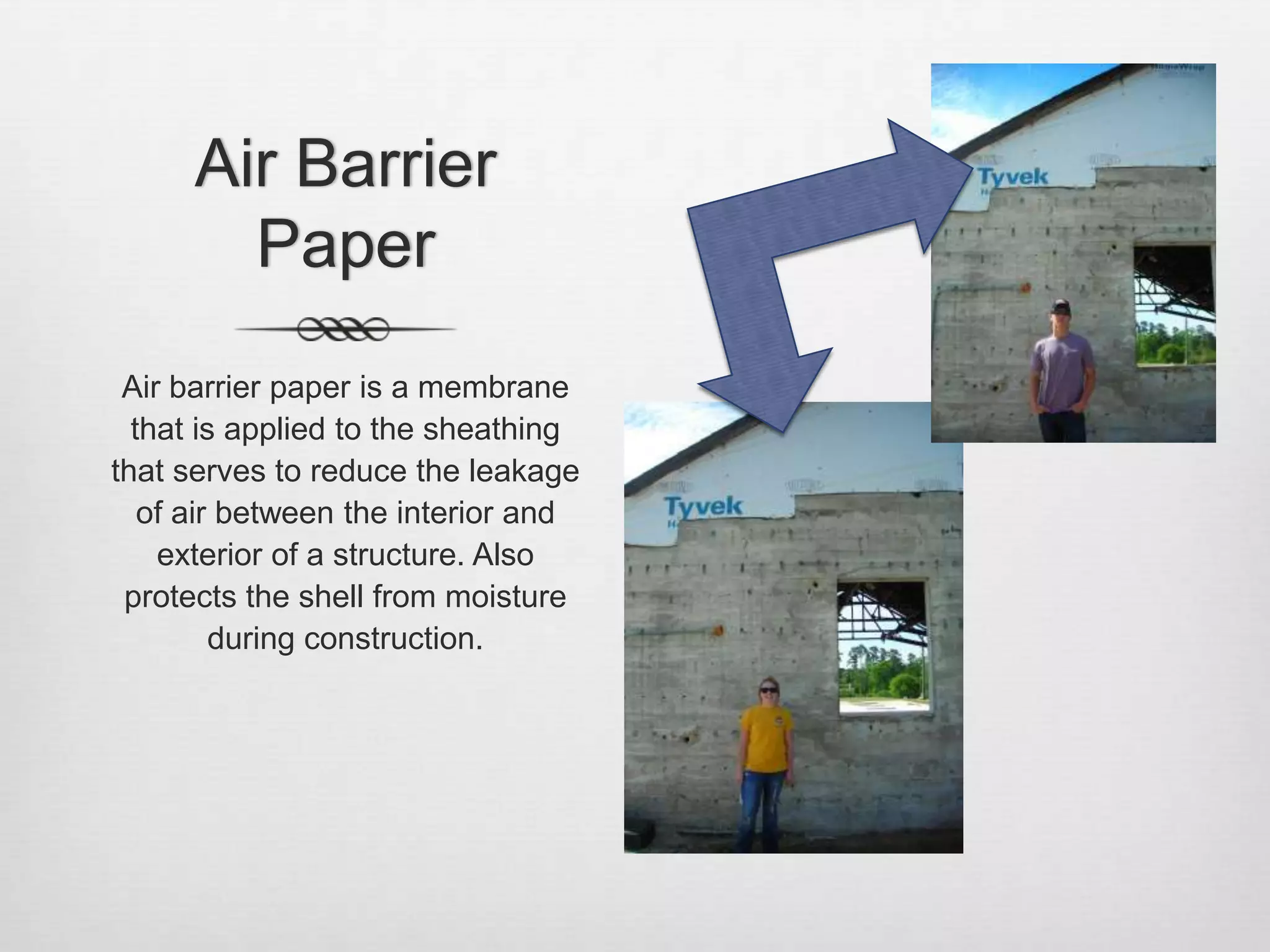
Air Barrier PaperAir barrier paper is a membrane that is applied to the sheathing that serves to reduce the leakage of air between the interior and exterior of a structure. Also protects the shell from moisture during construction.
Attic VentilationAttic ventilation is required to vent heat and moisture from the attic of buildings. It’s essential for proper temperature and moisture control.Four common types of ventilation include soffit vents, ridge vents, gable vents, and roof turbines.
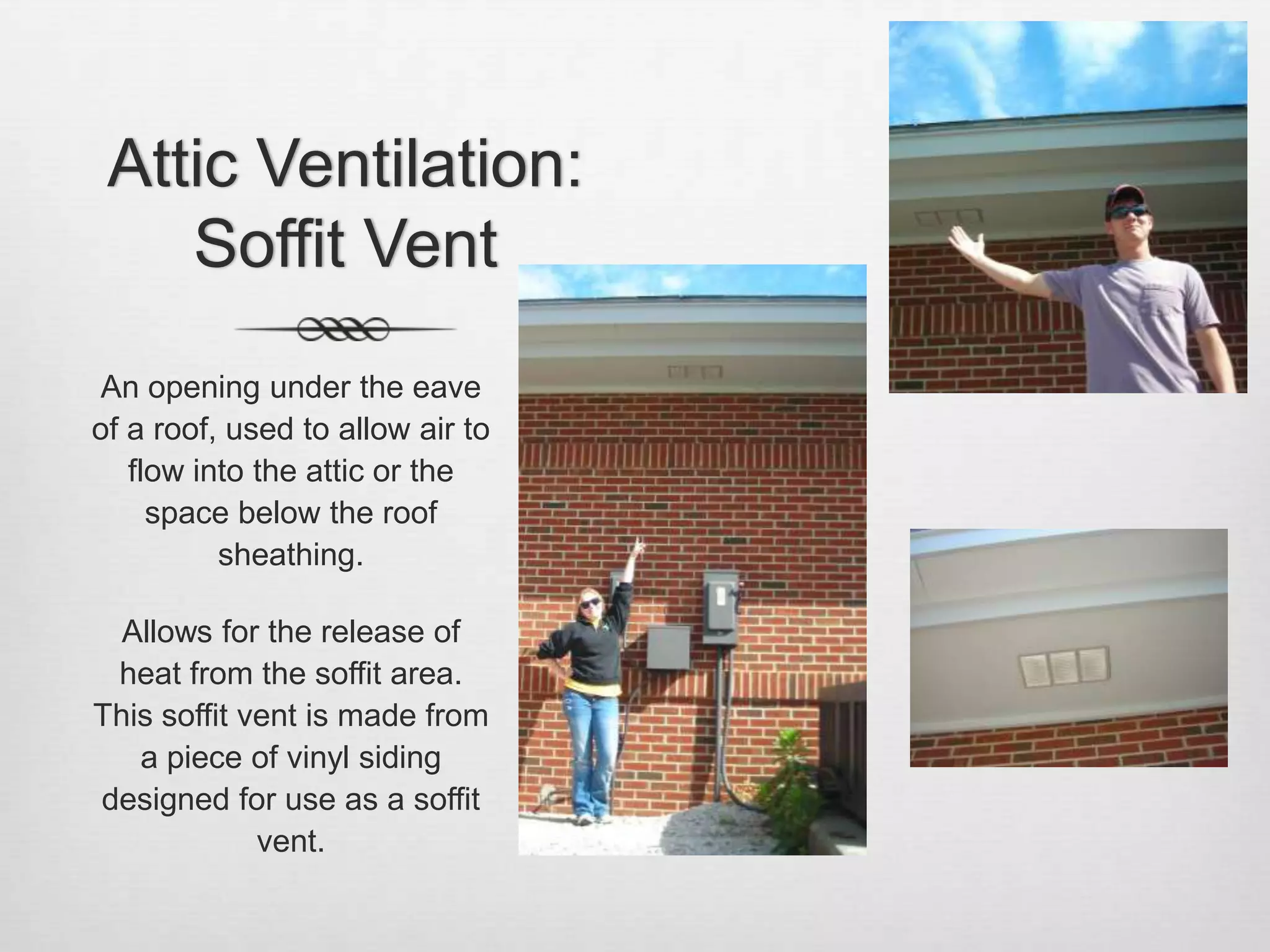
Attic Ventilation: Soffit VentAn opening under the eave of a roof, used to allow air to flow into the attic or the space below the roof sheathing.Allows for the release of heat from the soffit area.  This soffit vent is made from a piece of vinyl siding designed for use as a soffit vent.
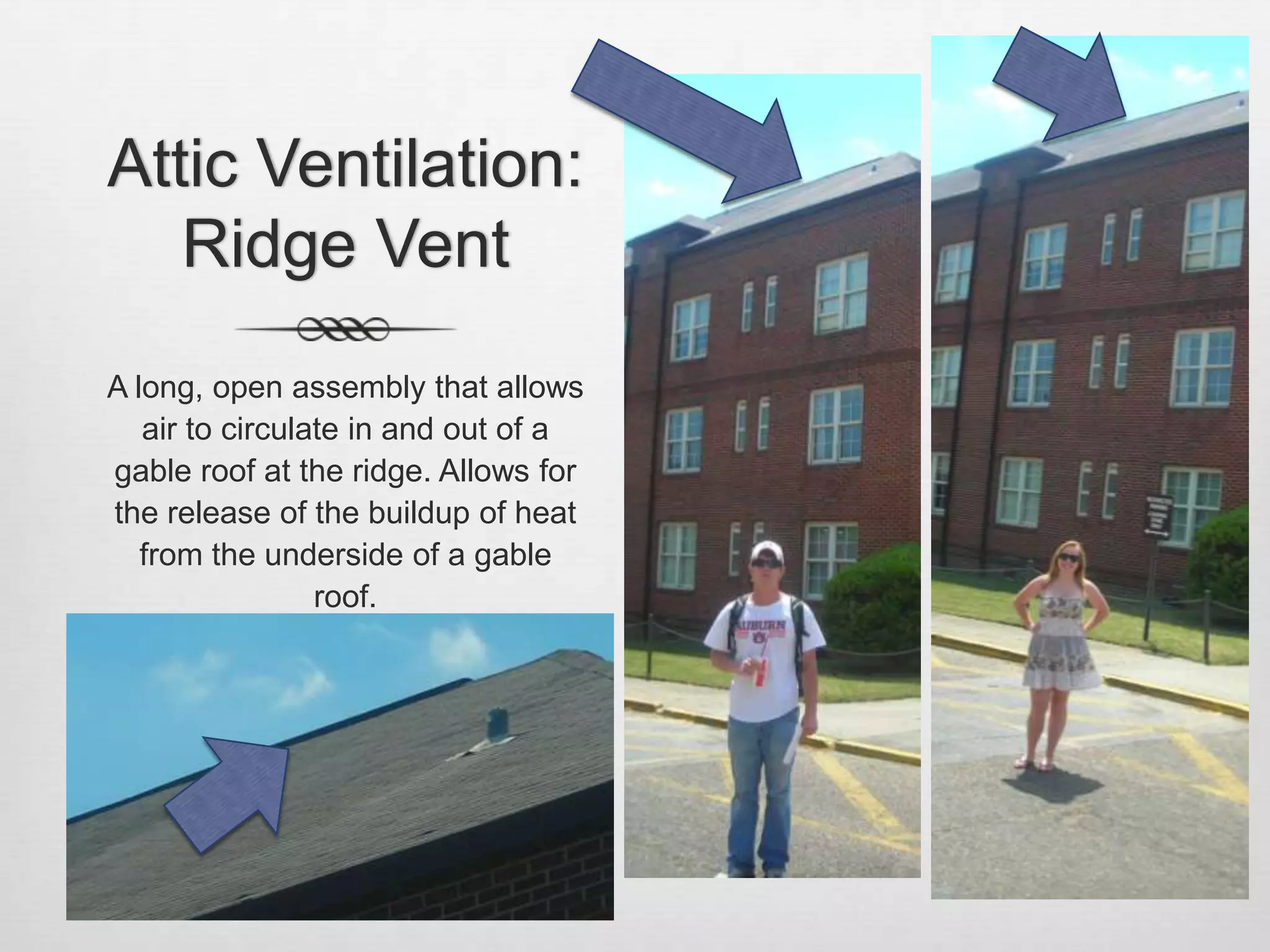
Attic Ventilation: Ridge VentA long, open assembly that allows air to circulate in and out of a gable roof at the ridge. Allows for the release of the buildup of heat from the underside of a gable roof.
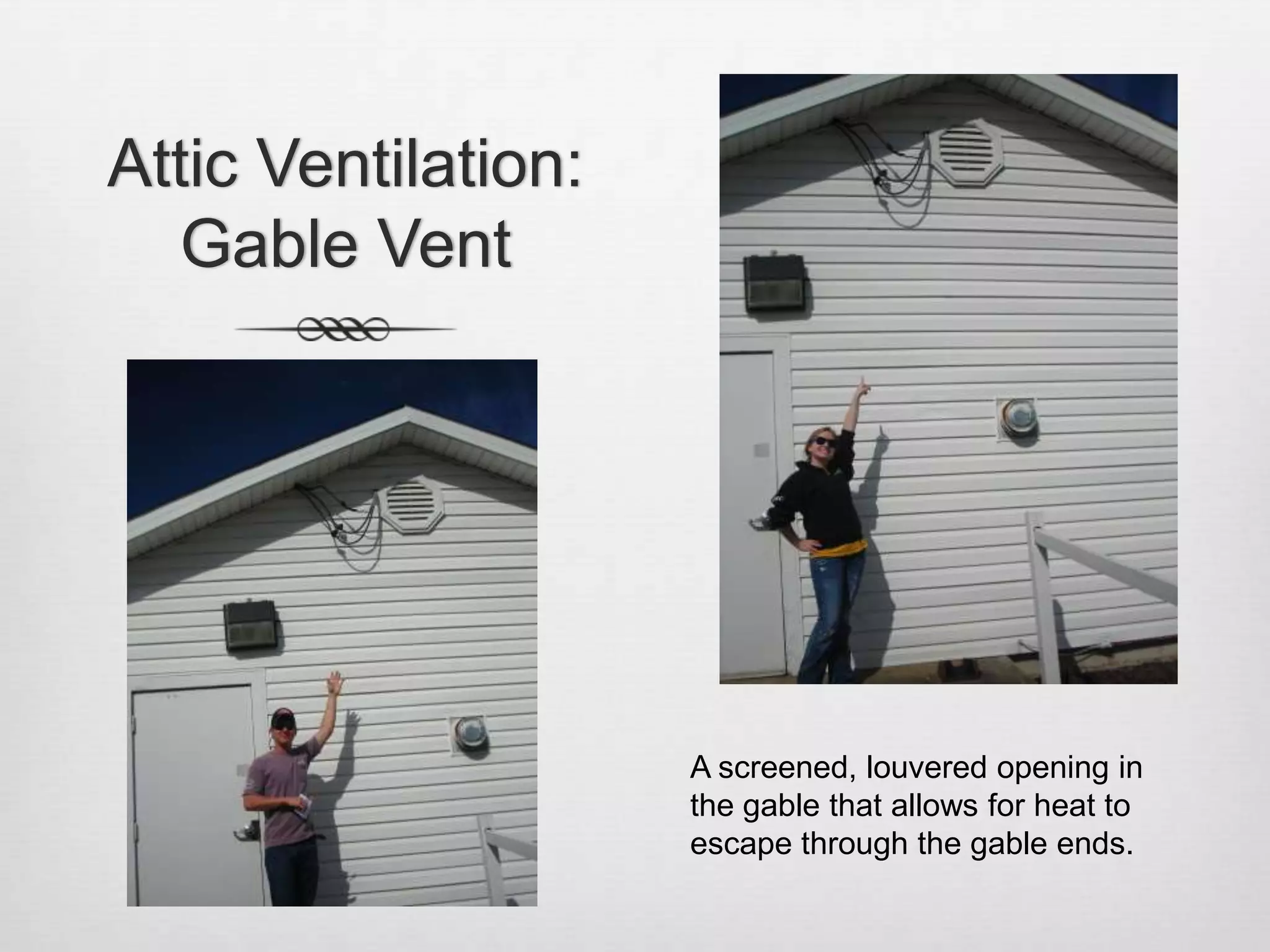
Attic Ventilation: Gable VentA screened, louvered opening in the gable that allows for heat to escape through the gable ends.
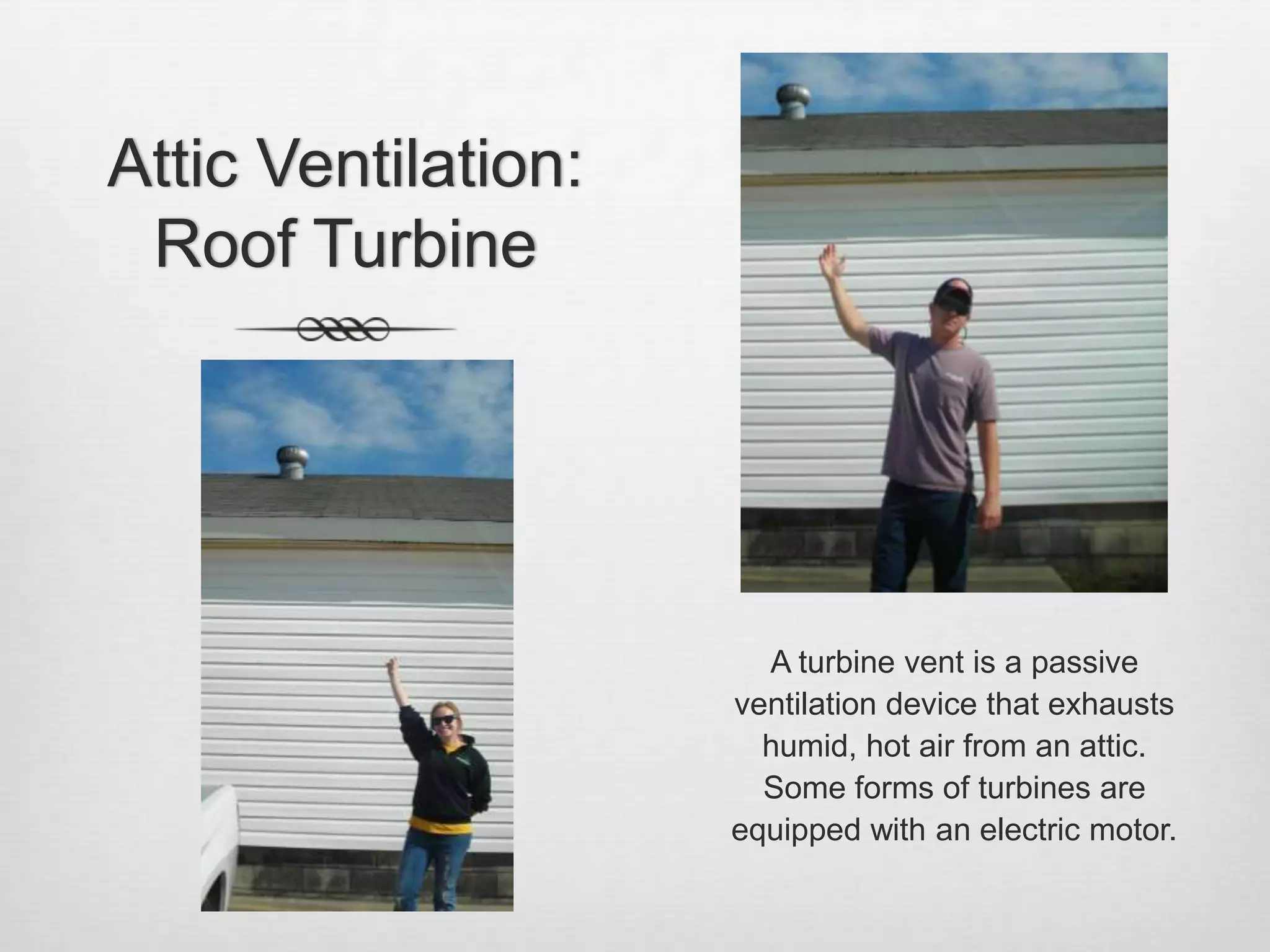
Attic Ventilation: Roof TurbineA turbine vent is a passive ventilation device that exhausts humid, hot air from an attic.  Some forms of turbines are equipped with an electric motor.
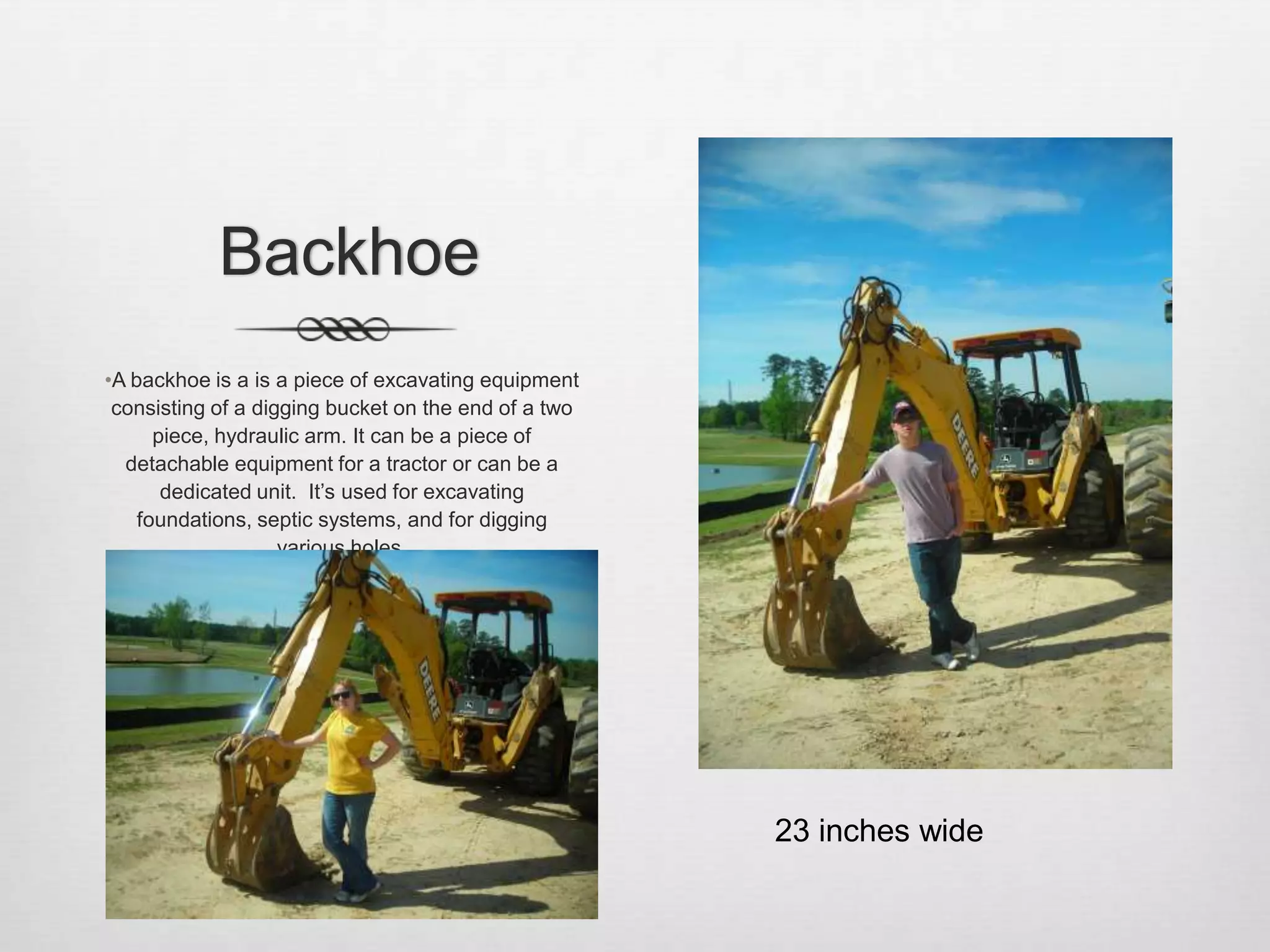
BackhoeA backhoe is a is a piece of excavating equipment consisting of a digging bucket on the end of a two piece, hydraulic arm. It can be a piece of detachable equipment for a tractor or can be a dedicated unit.  It’s used for excavating foundations, septic systems, and for digging various holes. 23 inches wide
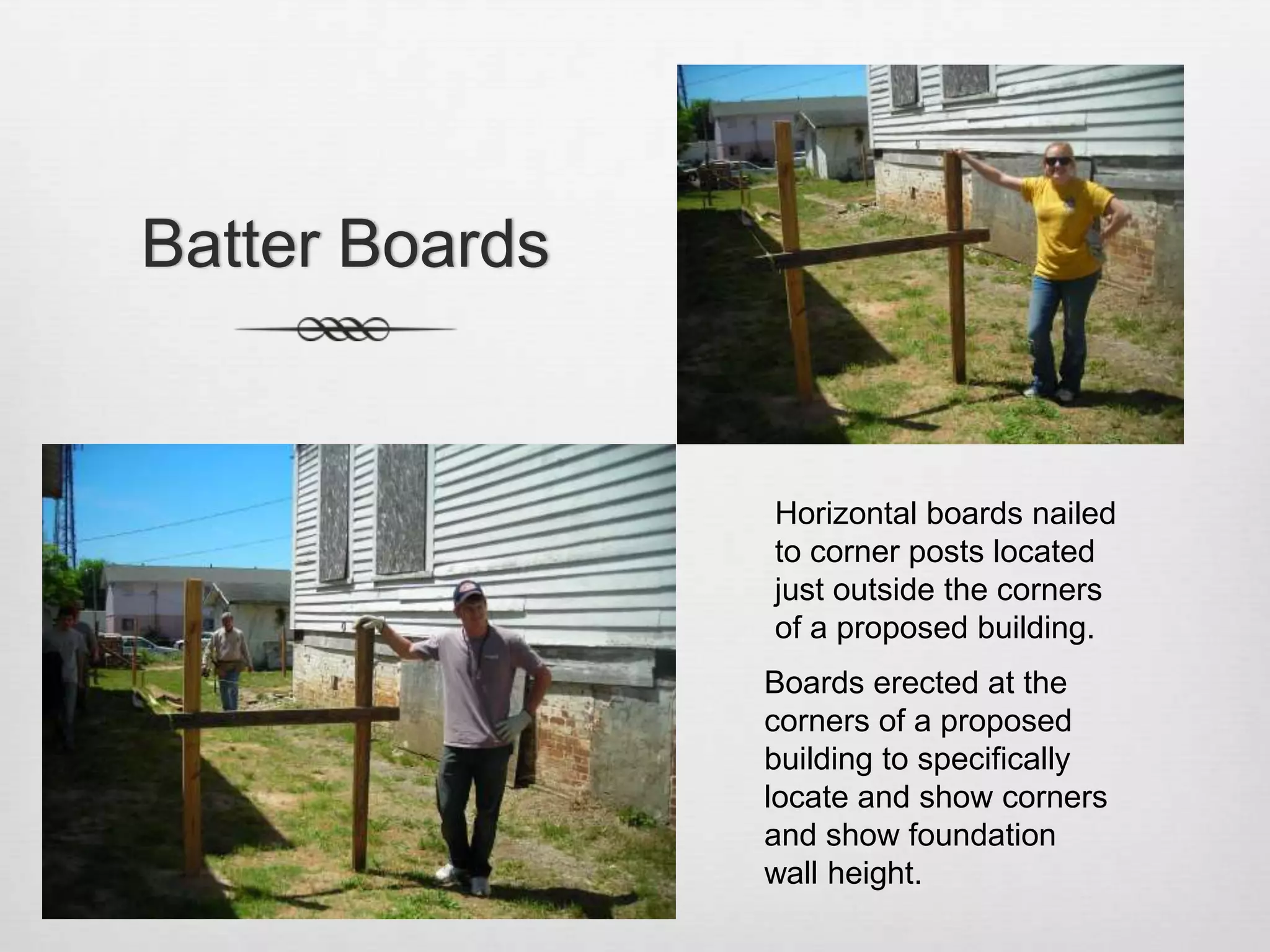
Batter BoardsHorizontal boards nailed to corner posts located just outside the corners of a proposed building.Boards erected at the corners of a proposed building to specifically locate and show corners and show foundation wall height.
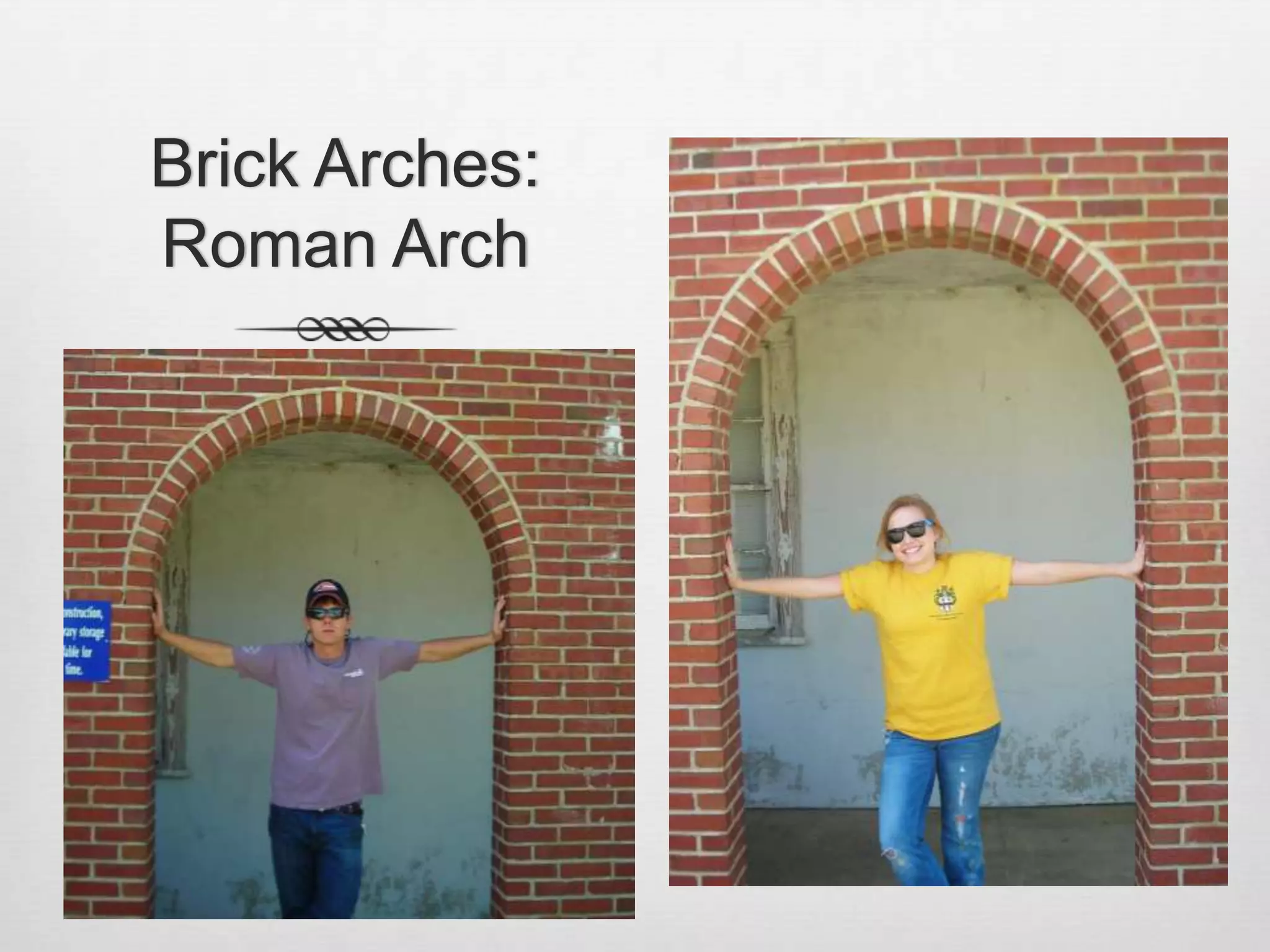
Brick Arches: Roman Arch
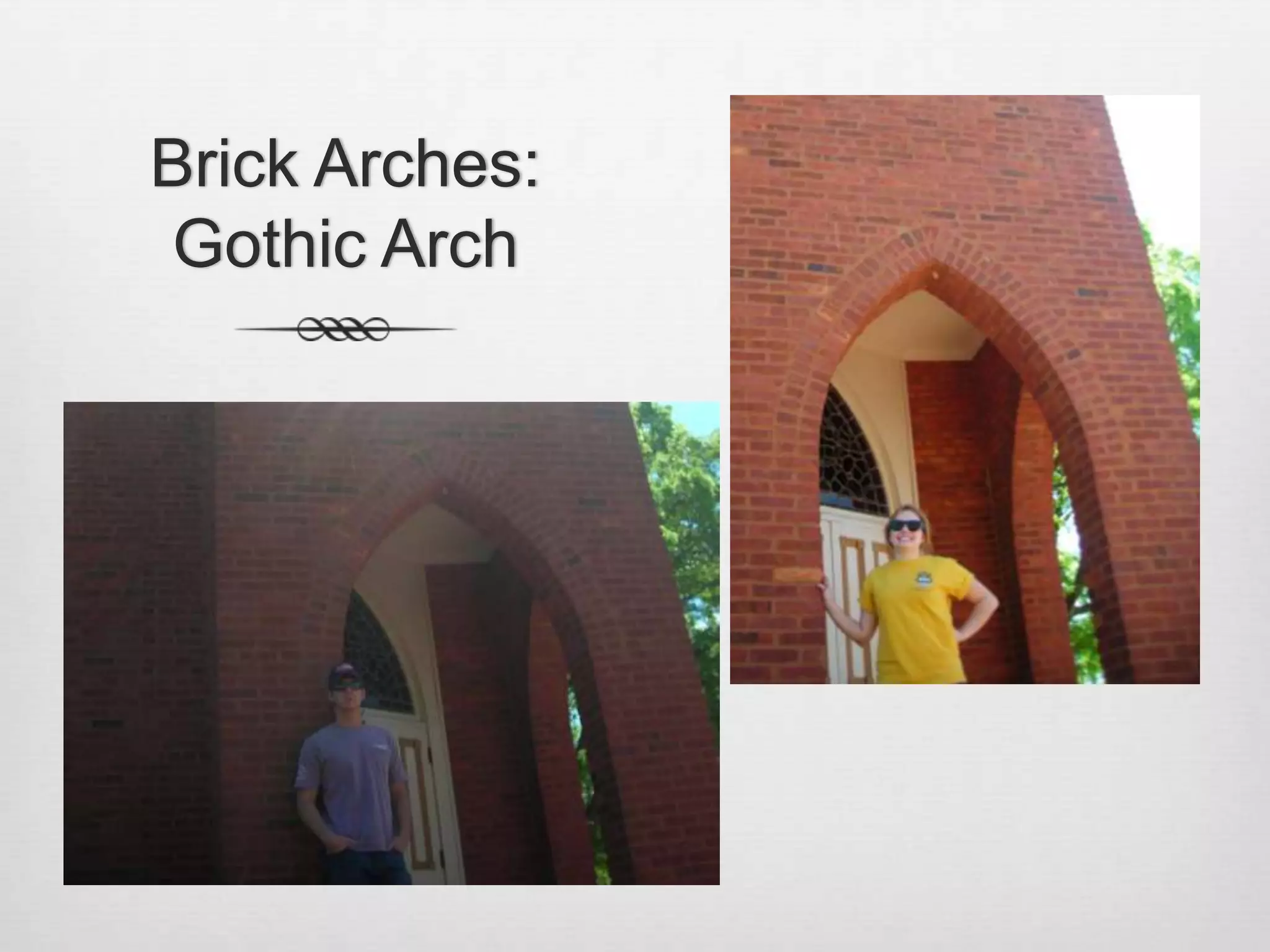
Brick Arches: Gothic Arch
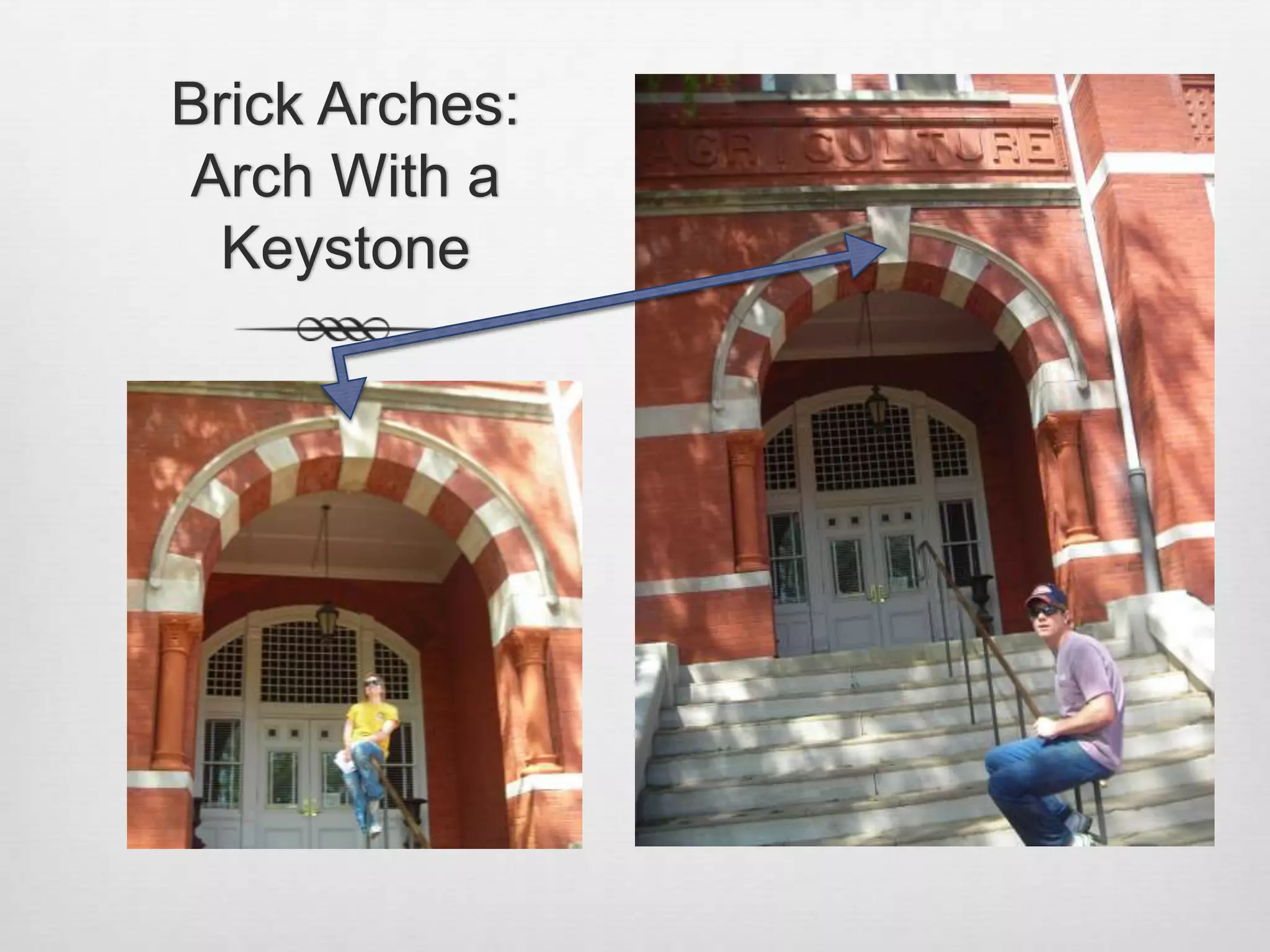
Brick Arches: Arch With a Keystone
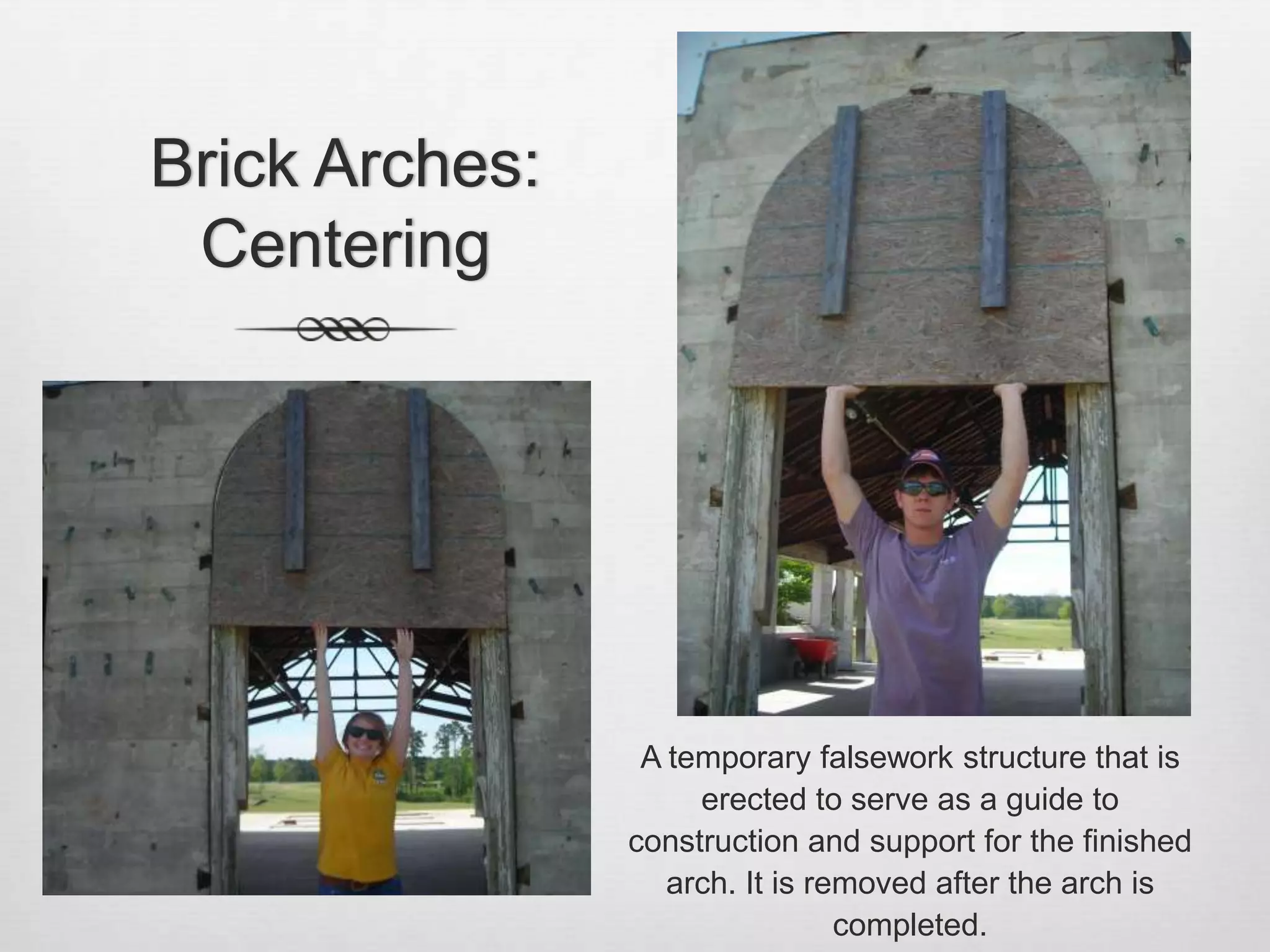
Brick Arches: CenteringA temporary falsework structure that is erected to serve as a guide to construction and support for the finished arch. It is removed after the arch is completed.
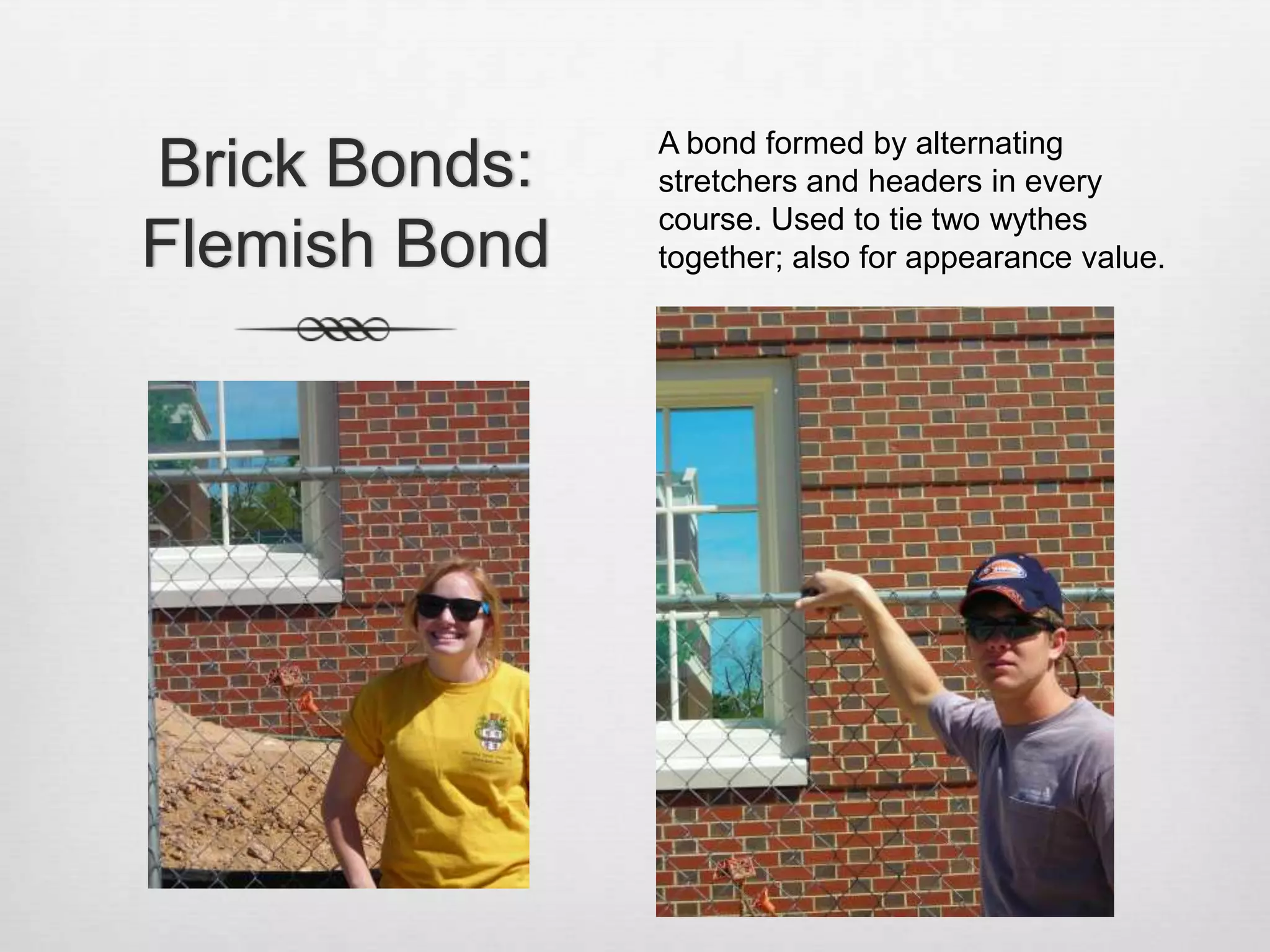
Brick Bonds: Flemish BondA bond formed by alternating stretchers and headers in every course. Used to tie two wythes together; also for appearance value.
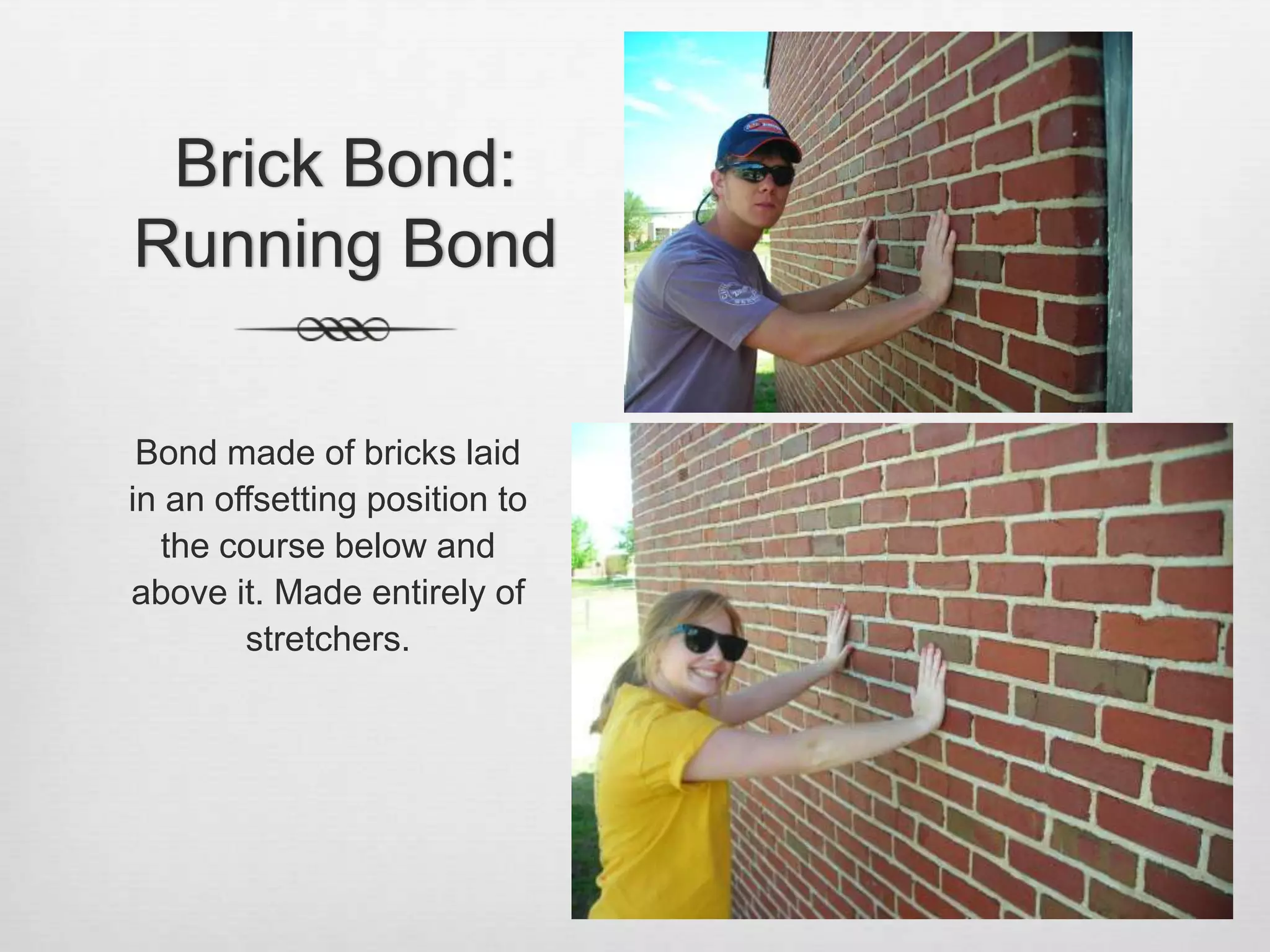
Brick Bond: Running BondBond made of bricks laid in an offsetting position to the course below and above it. Made entirely of stretchers.
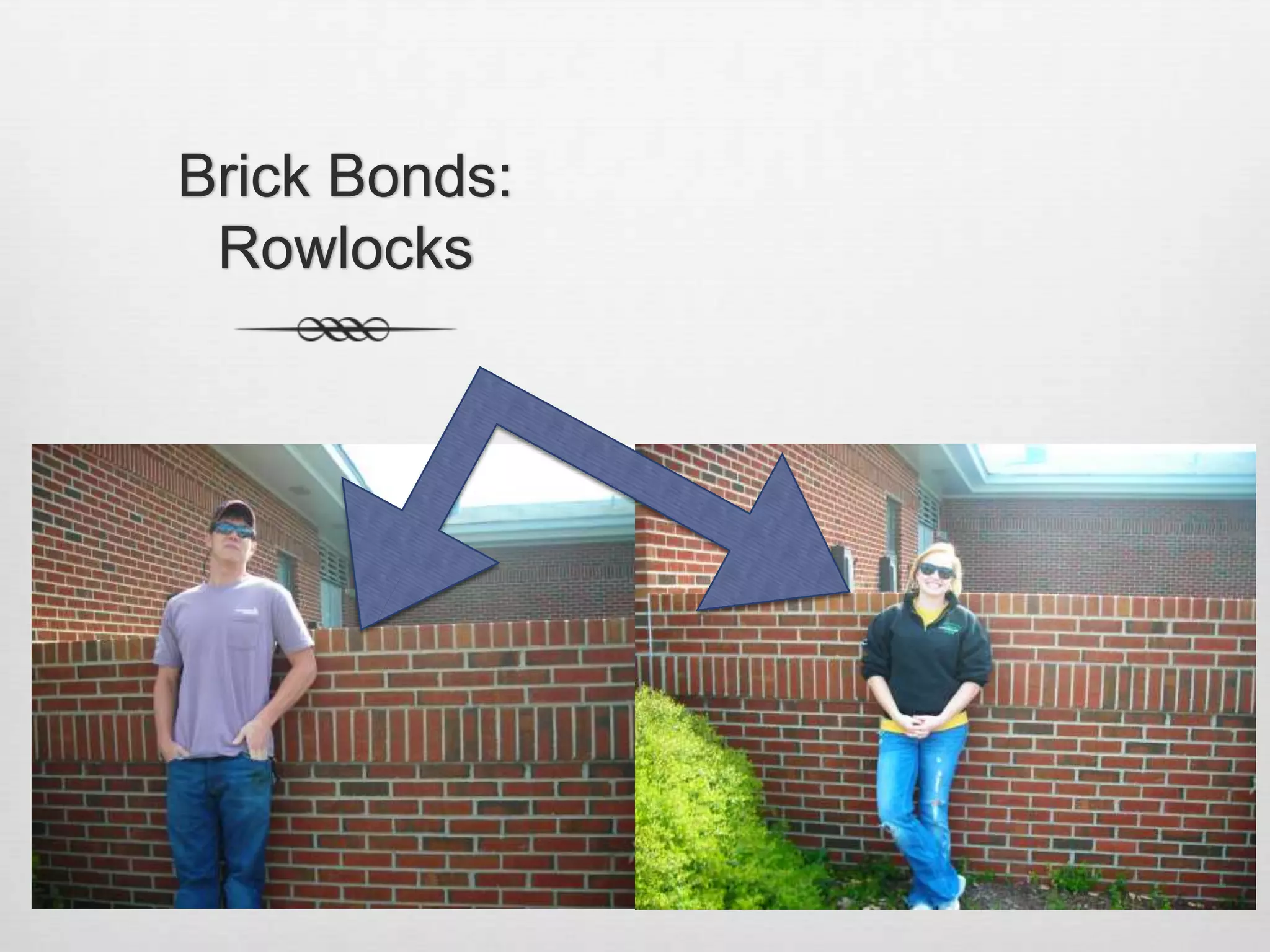
Brick Bonds: Rowlocks
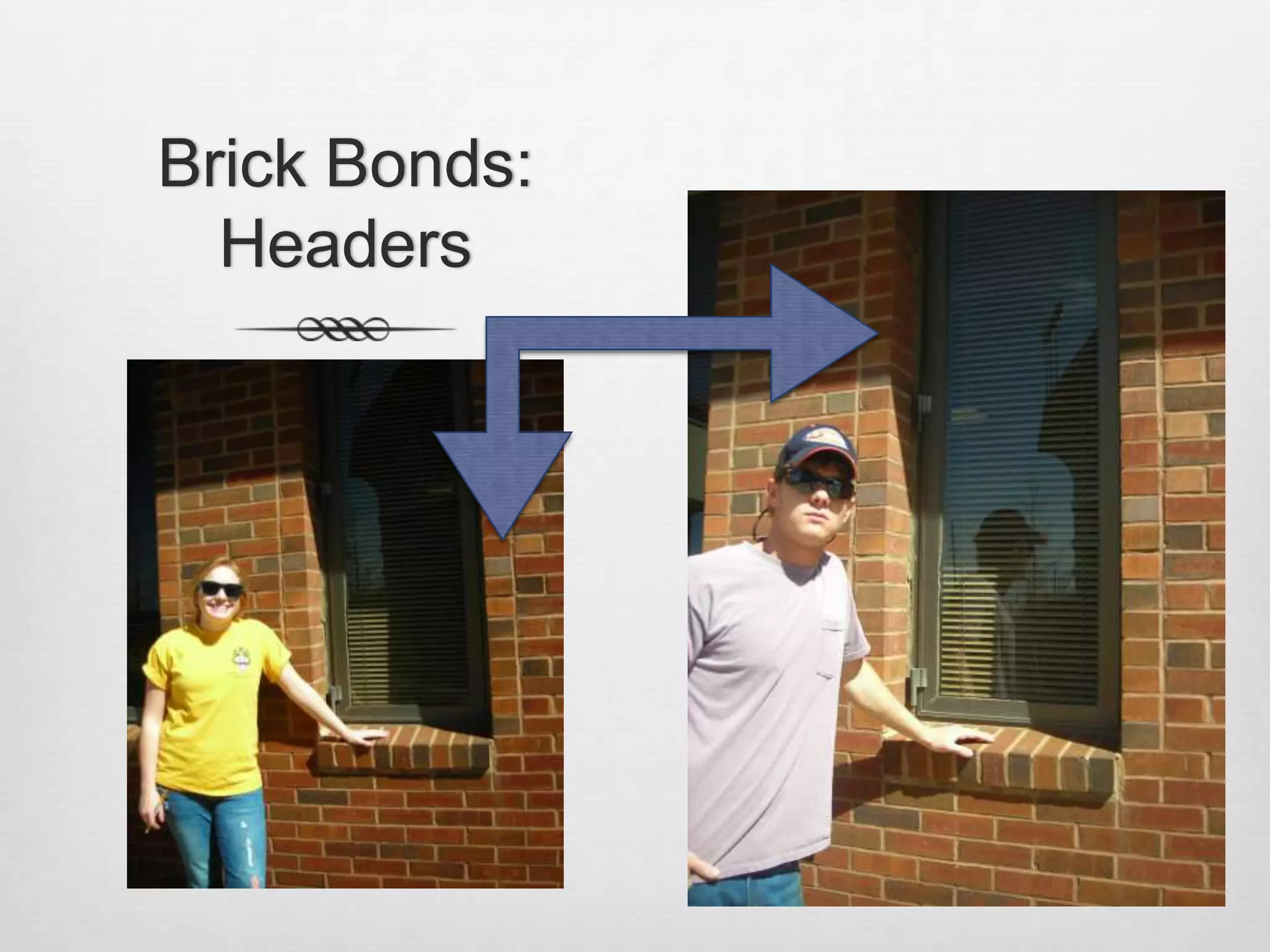
Brick Bonds: Headers
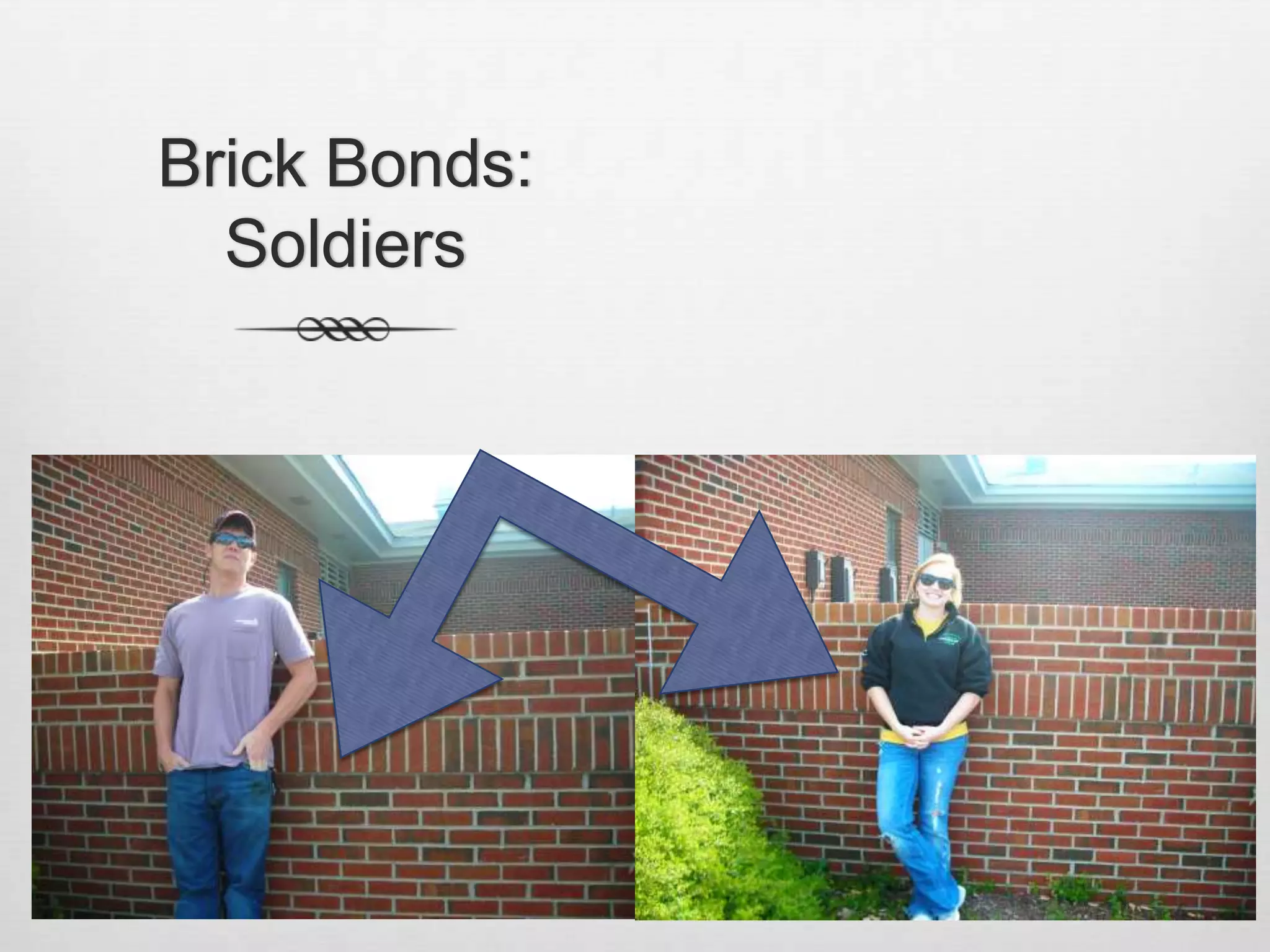
Brick Bonds: Soldiers
Brick Bonds: Sailors
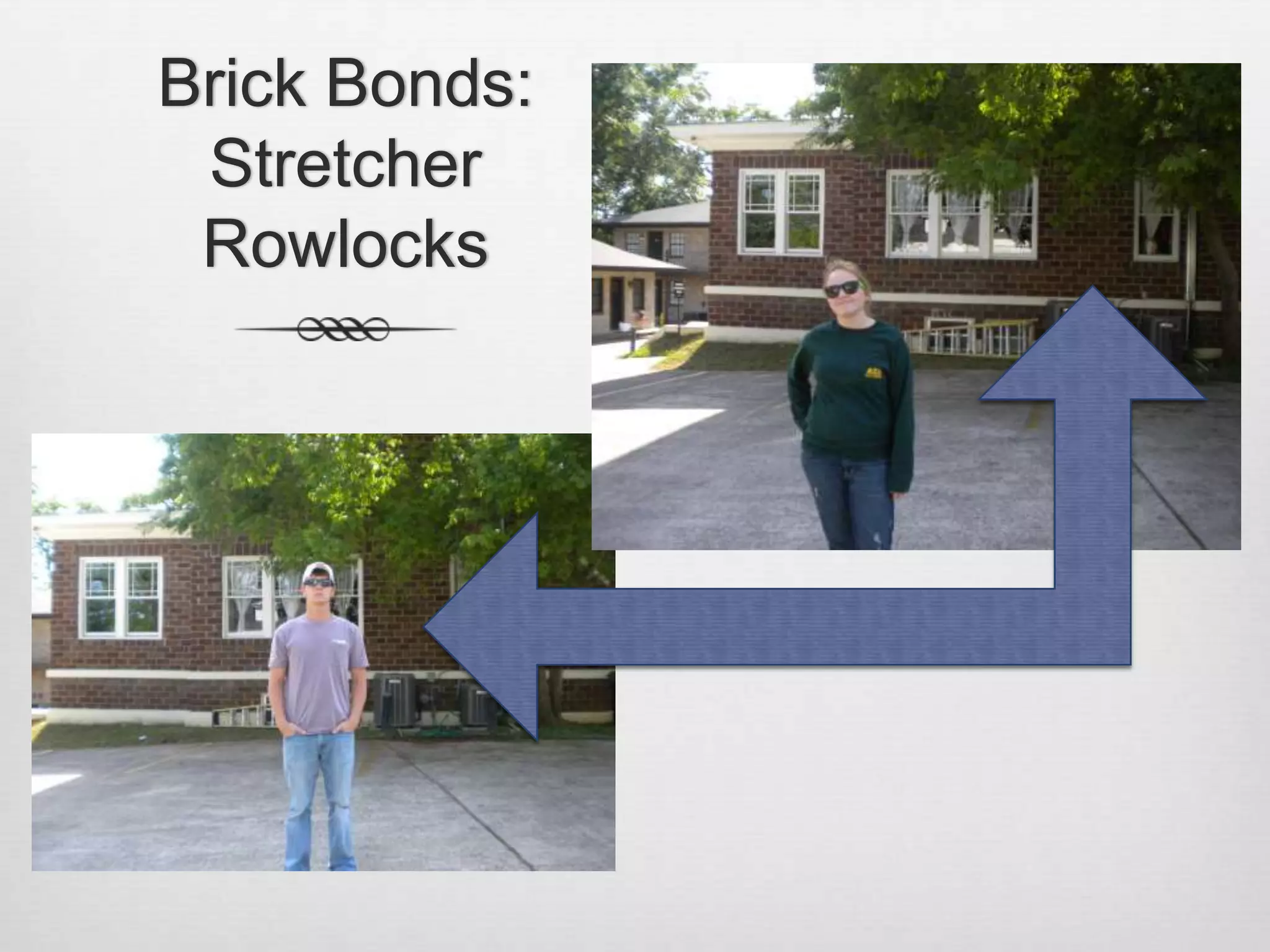
Brick Bonds: Stretcher Rowlocks
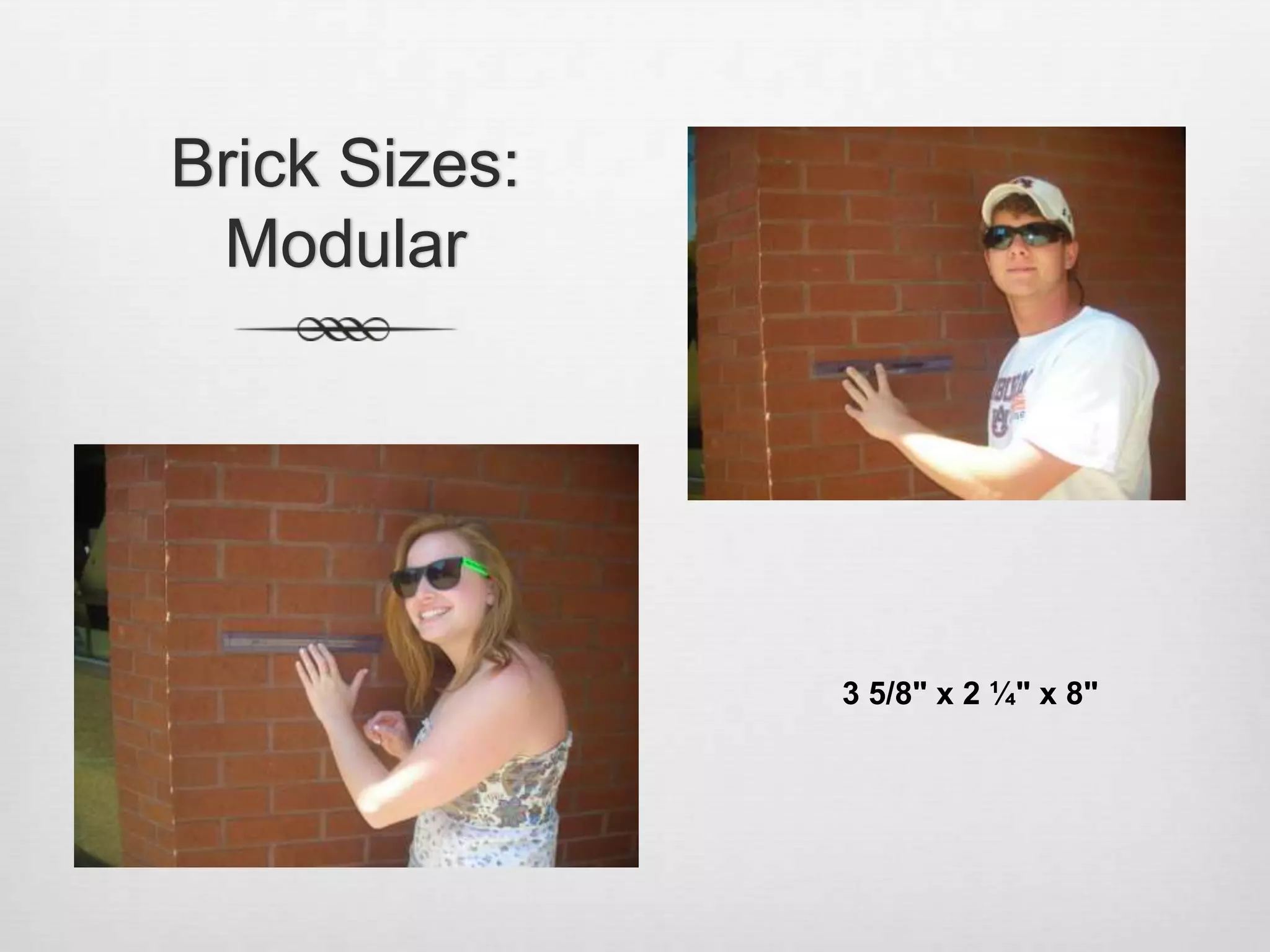
Brick Sizes: Modular3 5/8" x 2 ¼" x 8"
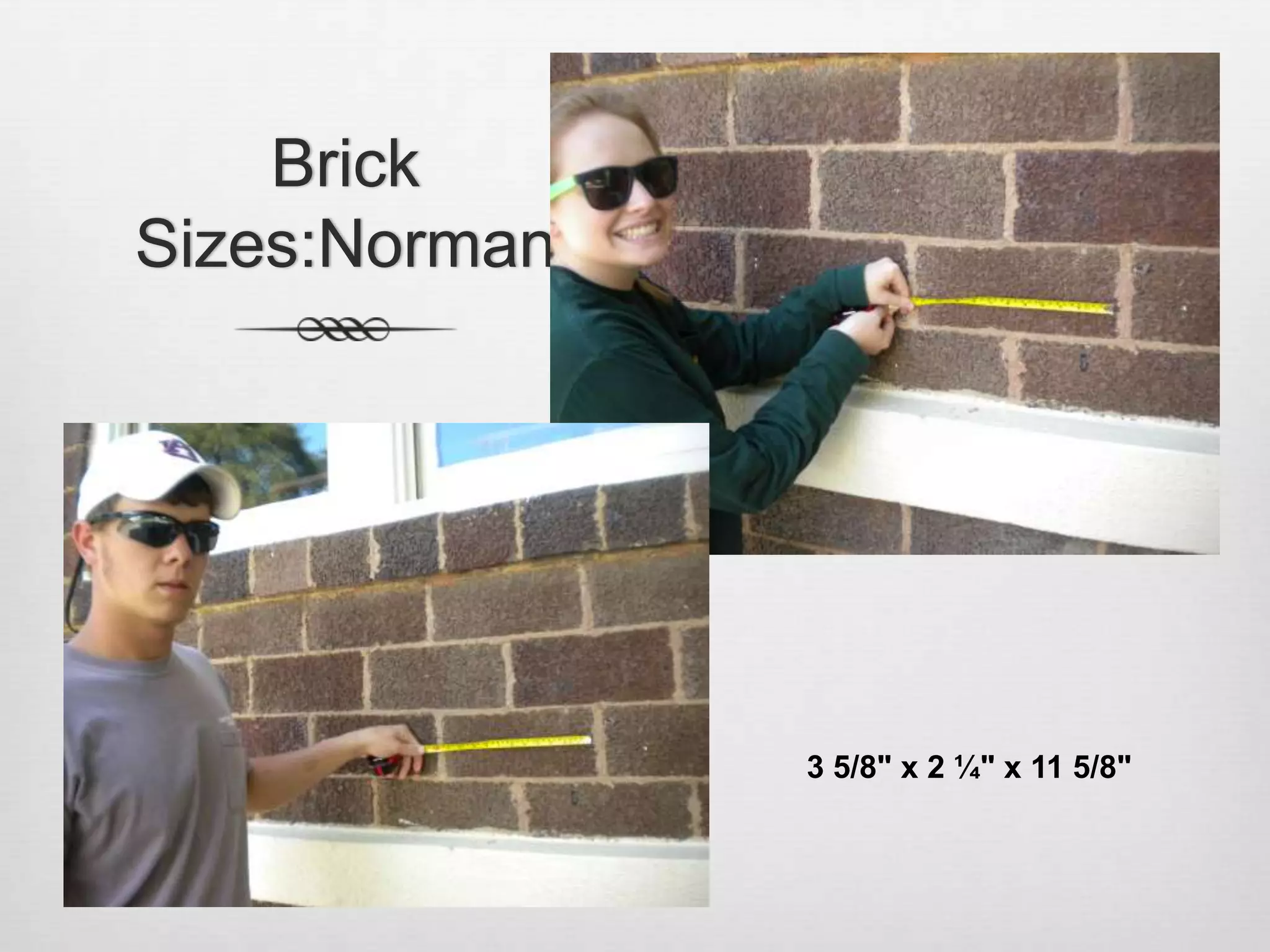
Brick Sizes:Norman3 5/8" x 2 ¼" x 11 5/8"
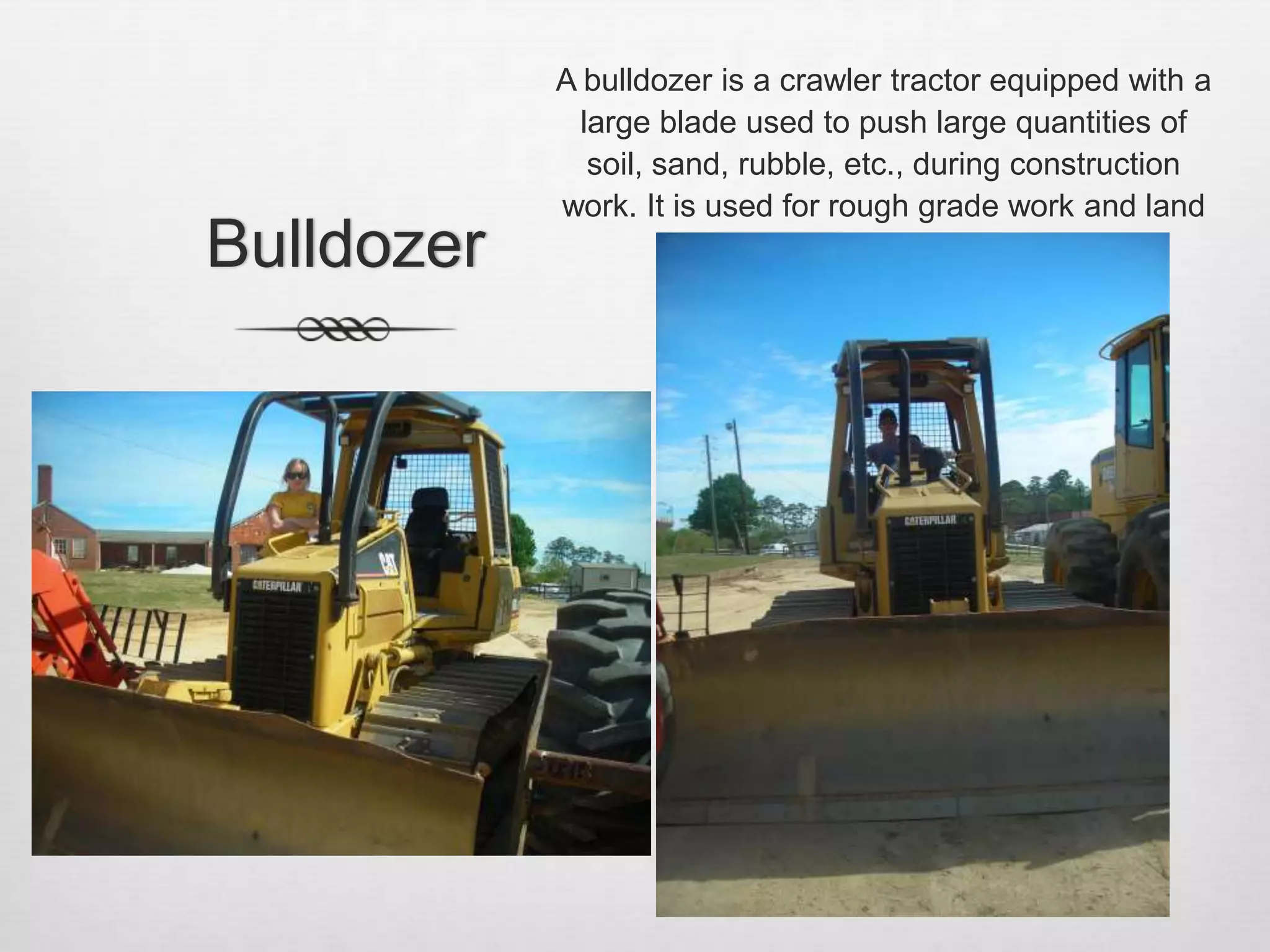
BulldozerA bulldozer is a crawler tractor equipped with a large blade used to push large quantities of soil, sand, rubble, etc., during construction work. It is used for rough grade work and land clearing.
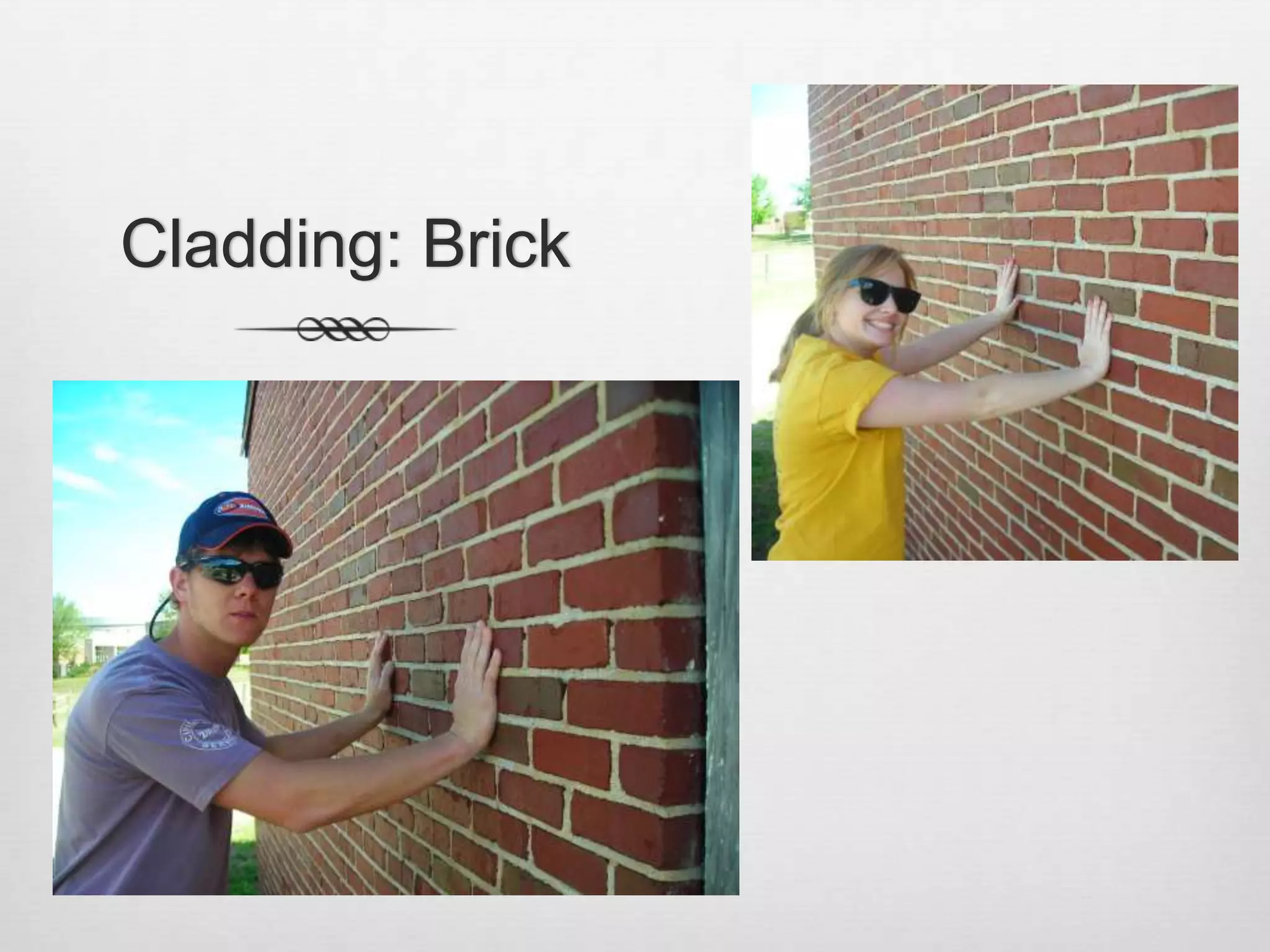
Cladding: Brick
Cladding: EIFS
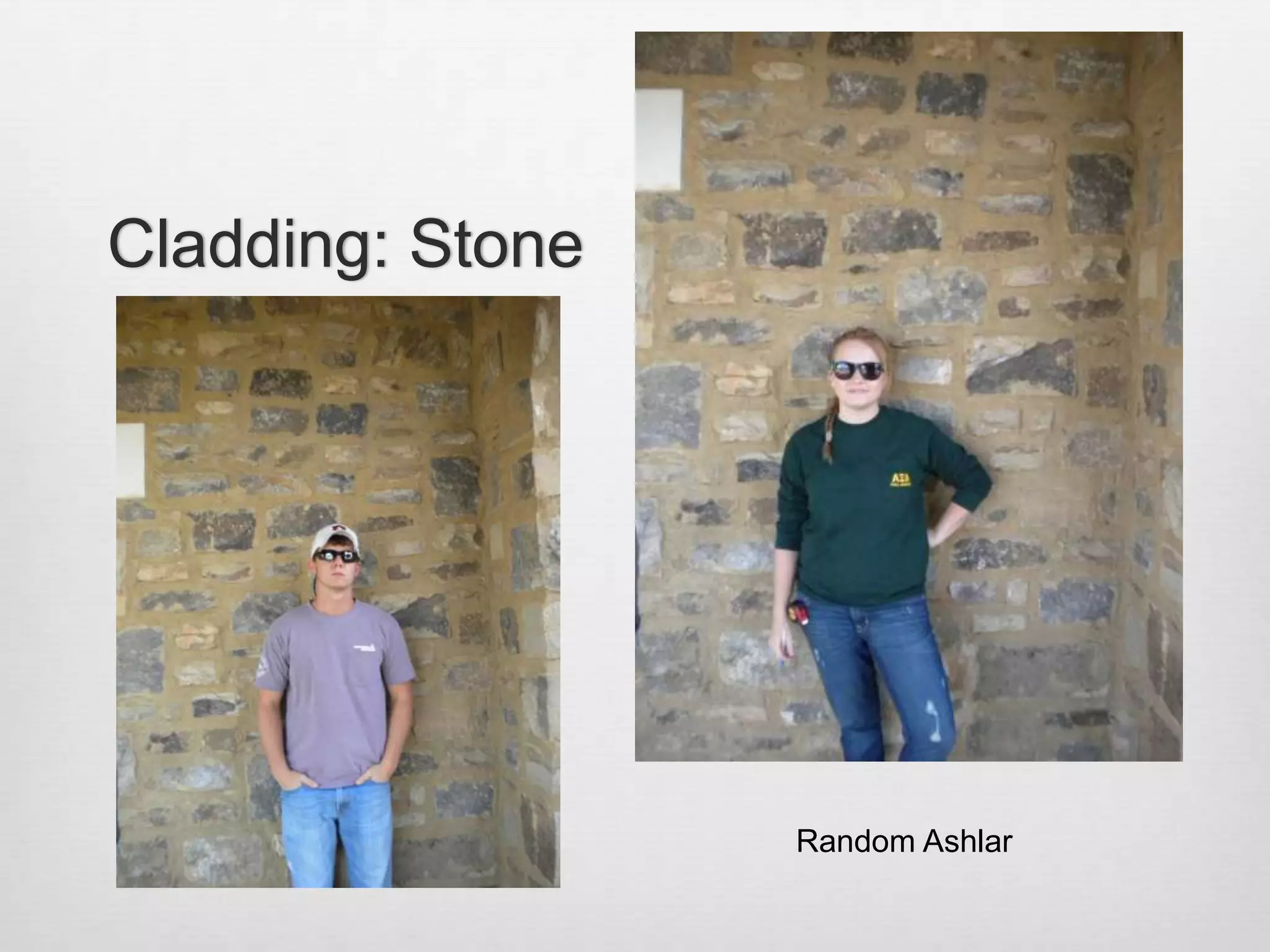
Cladding: StoneRandom Ashlar
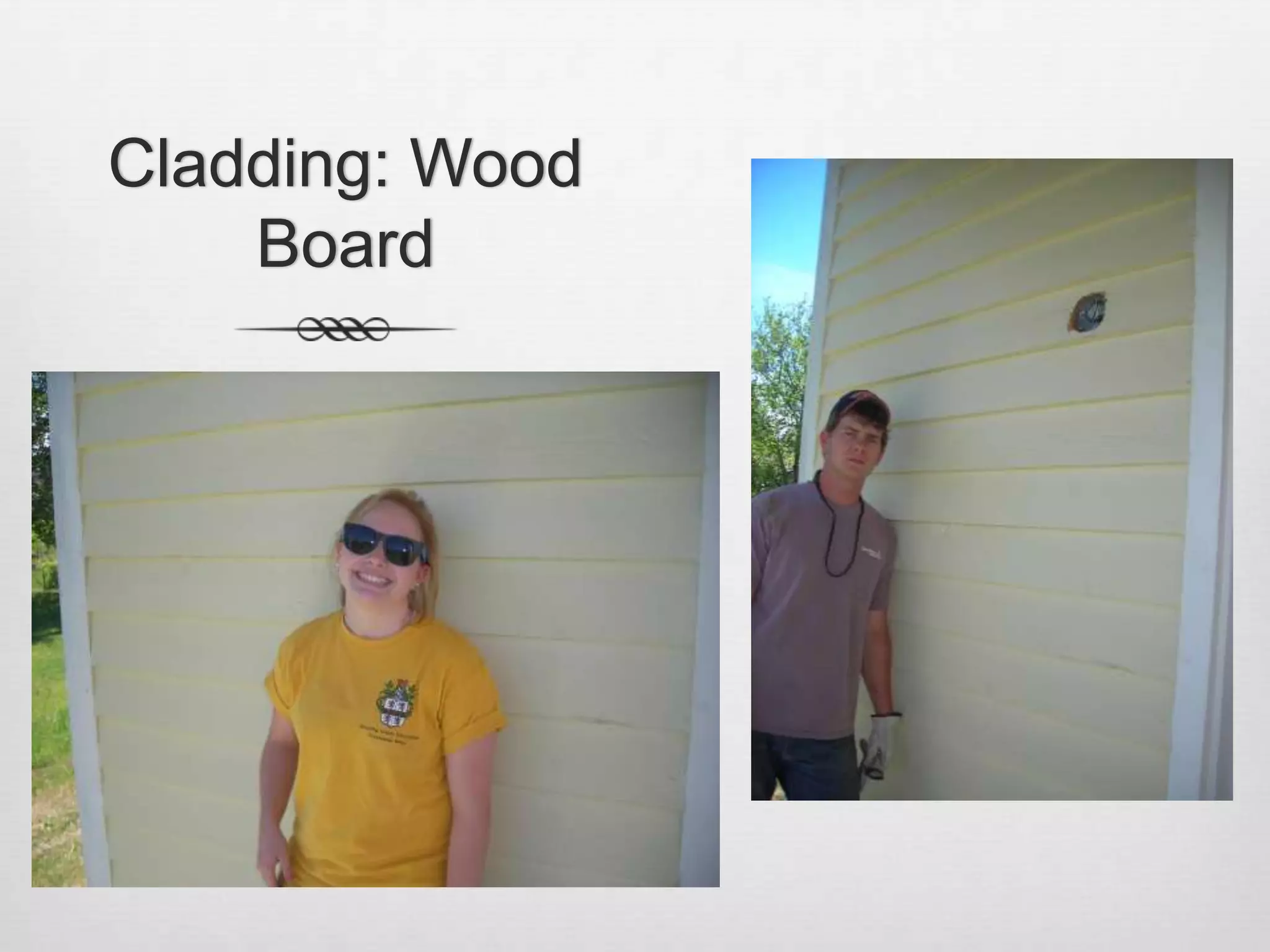
Cladding: Wood Board
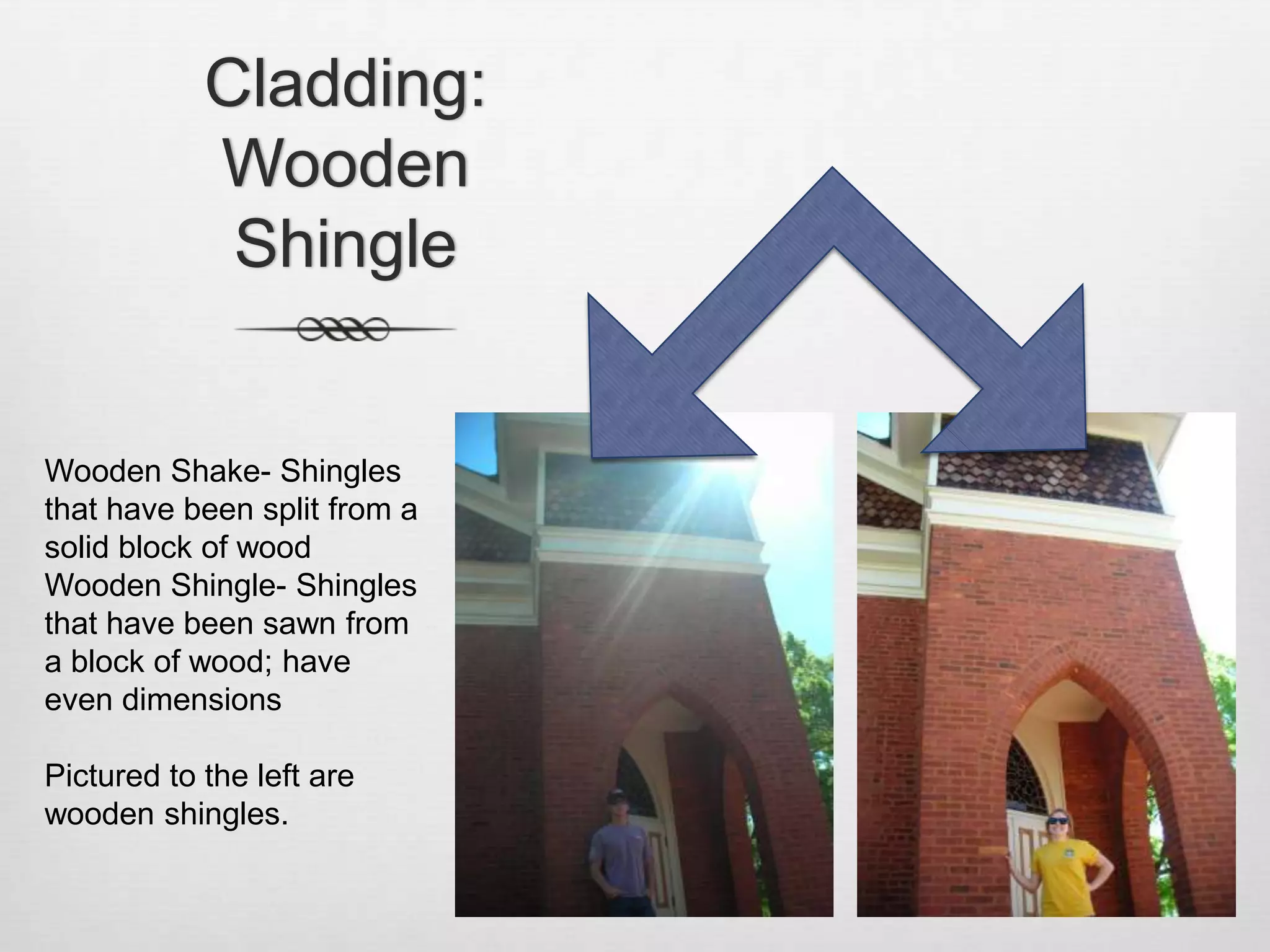
Cladding: Wooden ShingleWooden Shake- Shingles that have been split from a solid block of woodWooden Shingle- Shingles that have been sawn from a block of wood; have even dimensionsPictured to the left are wooden shingles.
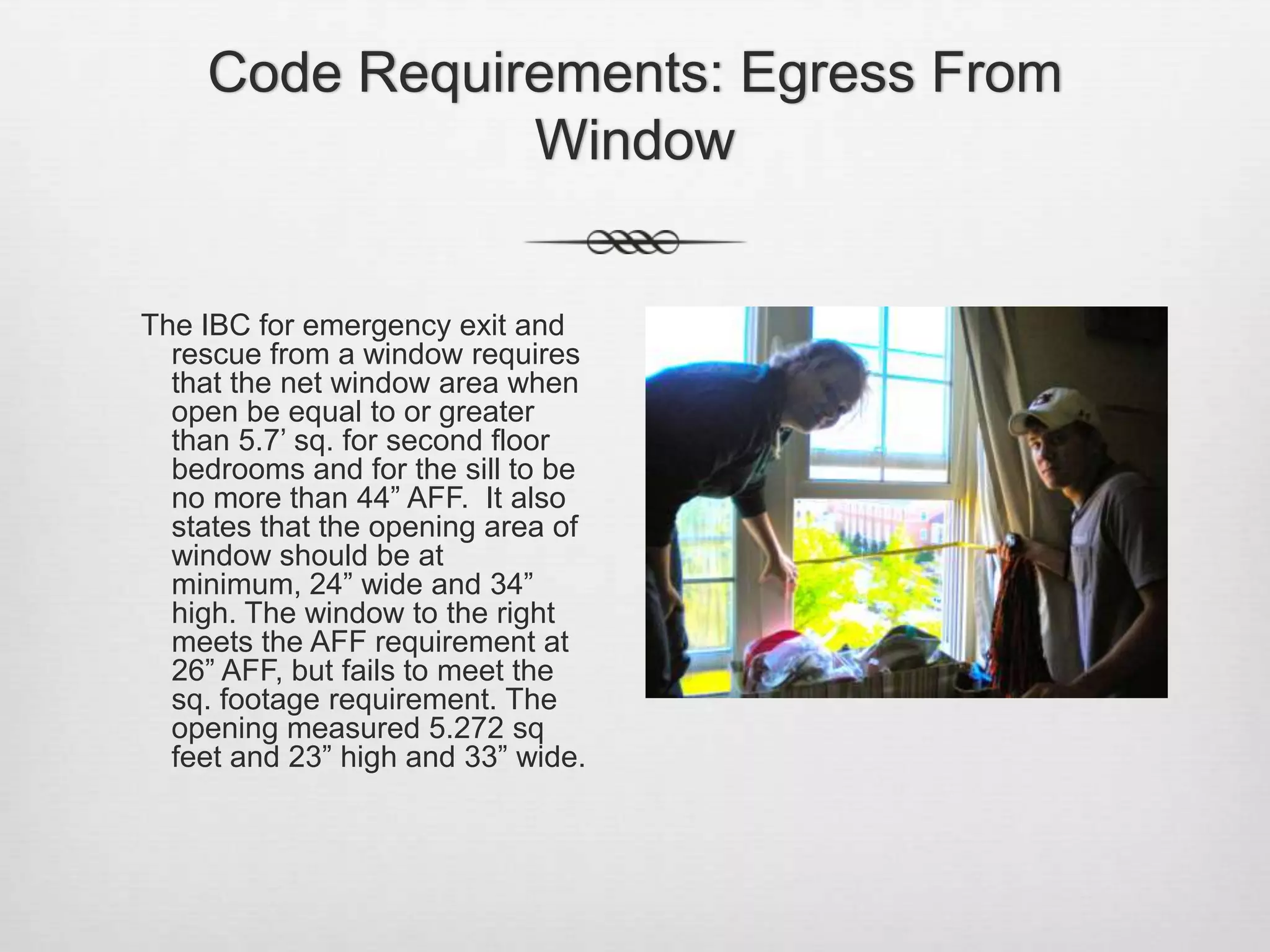
Code Requirements: Egress From Window    The IBC for emergency exit and rescue from a window requires that the net window area when open be equal to or greater than 5.7’ sq. for second floor bedrooms and for the sill to be no more than 44” AFF.  It also states that the opening area of window should be at minimum, 24” wide and 34” high. The window to the right meets the AFF requirement at 26” AFF, but fails to meet the sq. footage requirement. The opening measured 5.272 sq feet and 23” high and 33” wide.
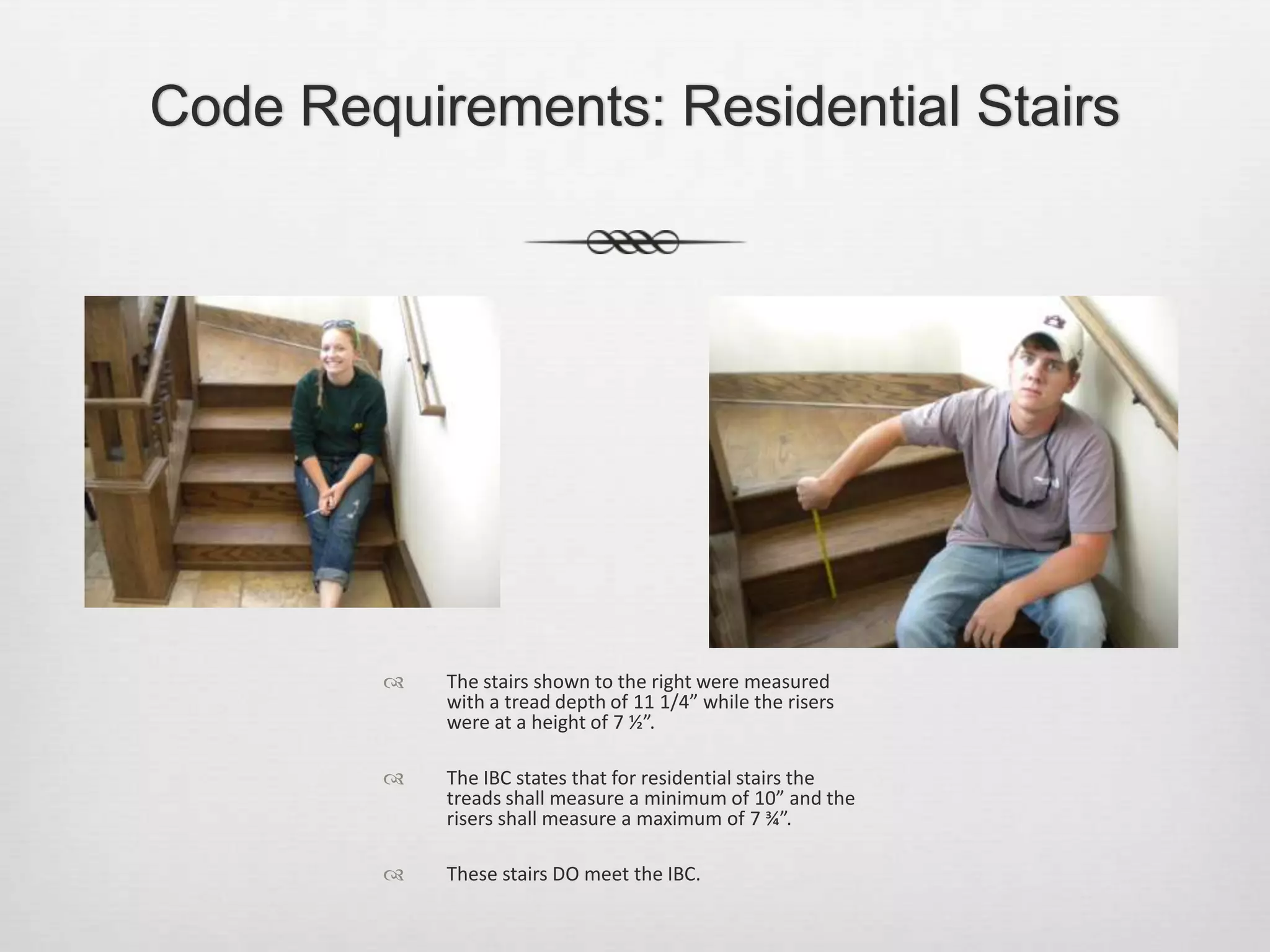
Code Requirements: Residential StairsThe stairs shown to the right were measured with a tread depth of 11 1/4” while the risers were at a height of 7 ½”. The IBC states that for residential stairs the treads shall measure a minimum of 10” and the risers shall measure a maximum of 7 ¾”. These stairs DO meet the IBC.
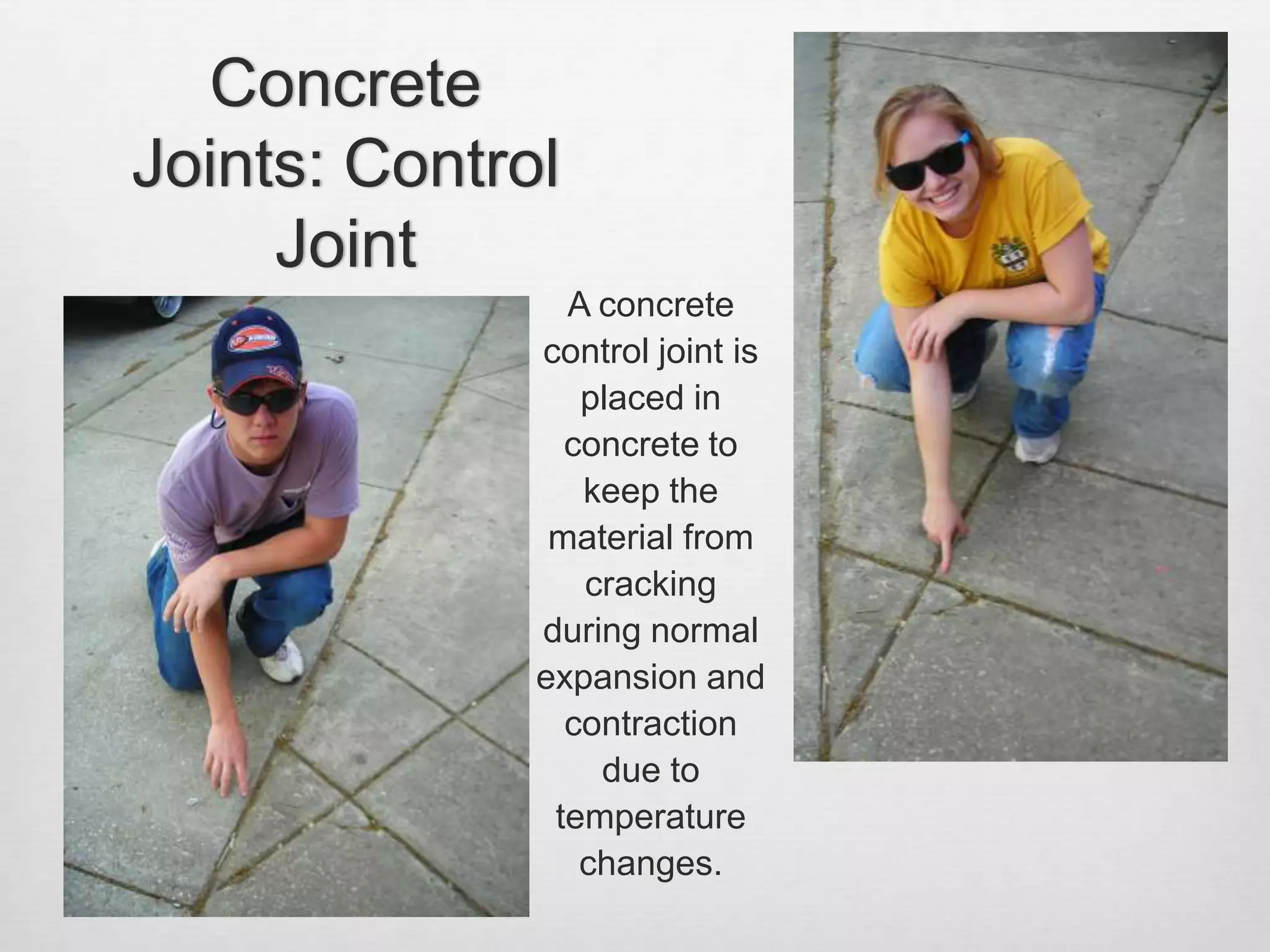
Concrete Joints: Control JointA concrete control joint is placed in concrete to keep the material from cracking during normal expansion and contraction due to temperature changes.
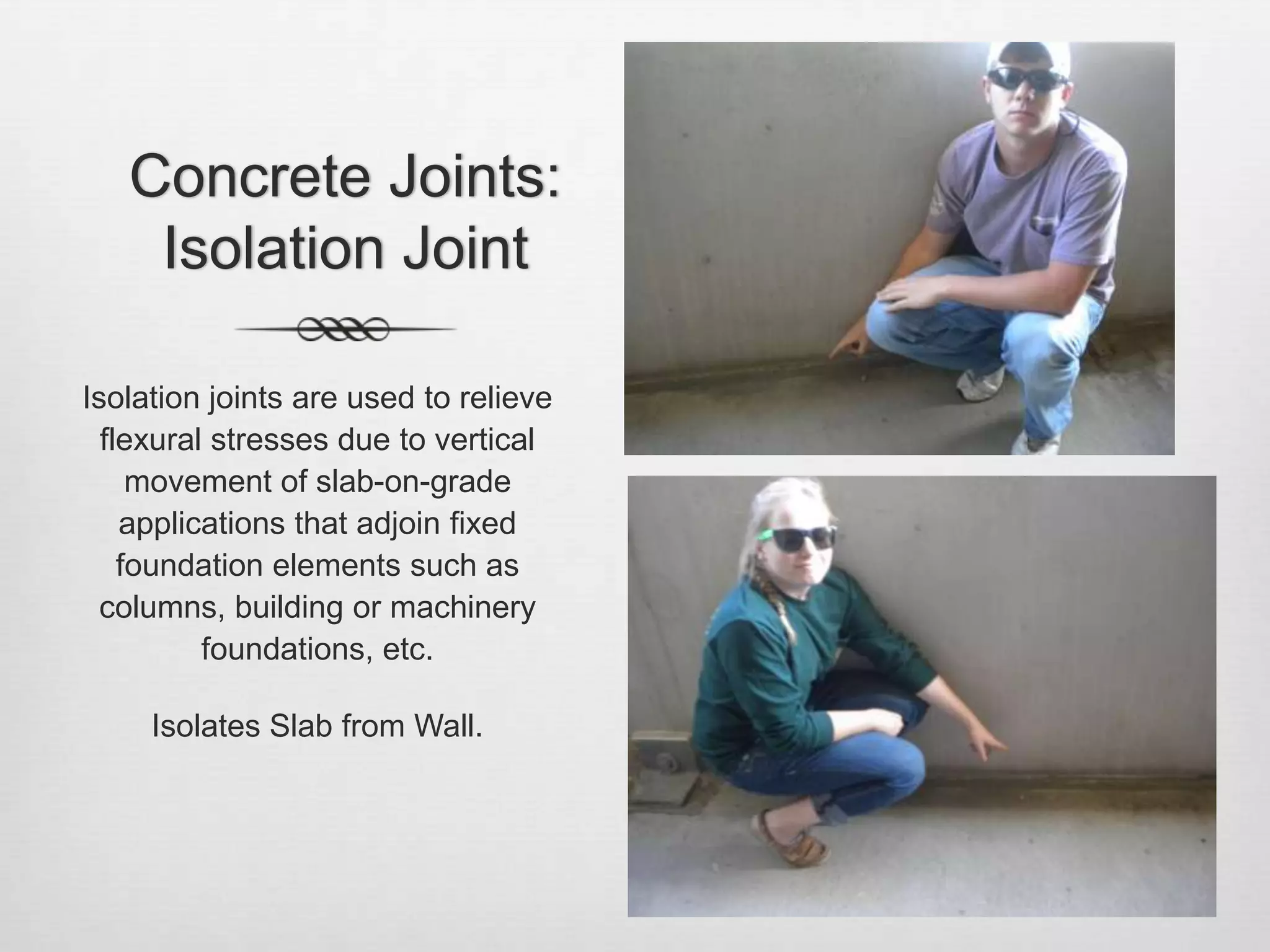
Concrete Joints: Isolation JointIsolation joints are used to relieve flexural stresses due to vertical movement of slab-on-grade applications that adjoin fixed foundation elements such as columns, building or machinery foundations, etc.Isolates Slab from Wall.
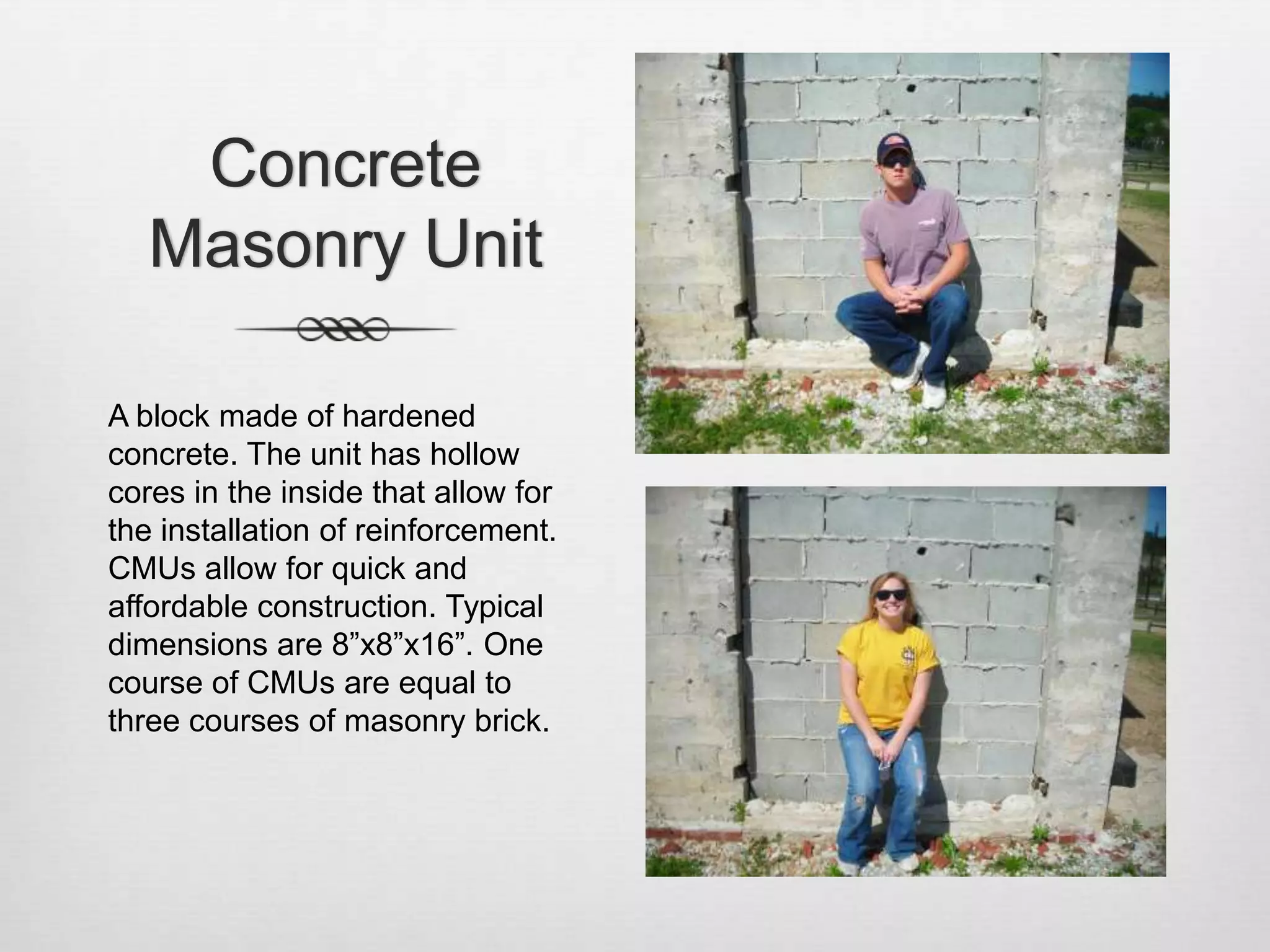
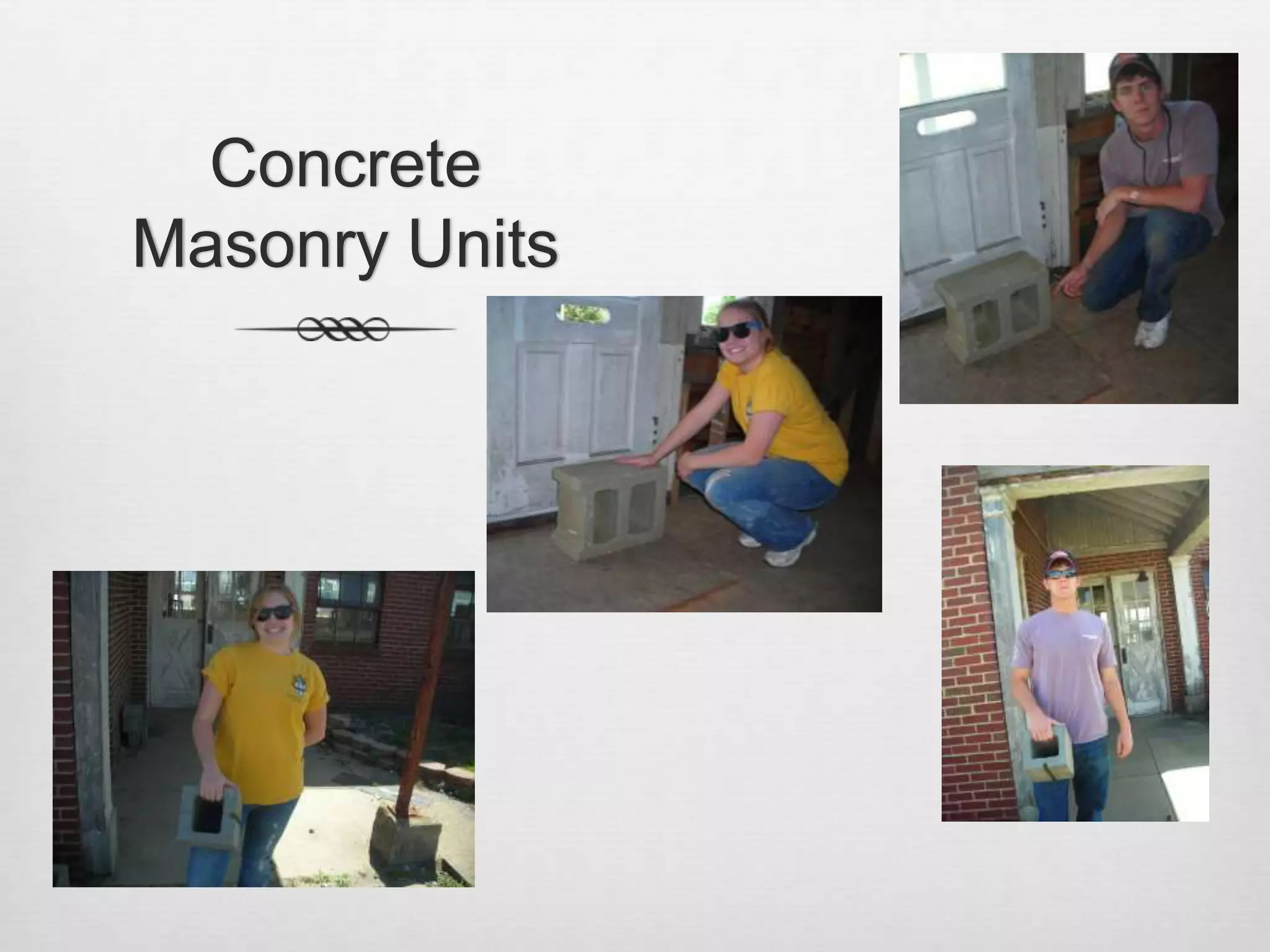
Concrete Masonry Unit  A block made of hardened concrete. The unit has hollow cores in the inside that allow for the installation of reinforcement. CMUs allow for quick and affordable construction. Typical dimensions are 8”x8”x16”. One course of CMUs are equal to three courses of masonry brick.
Concrete Masonry Units
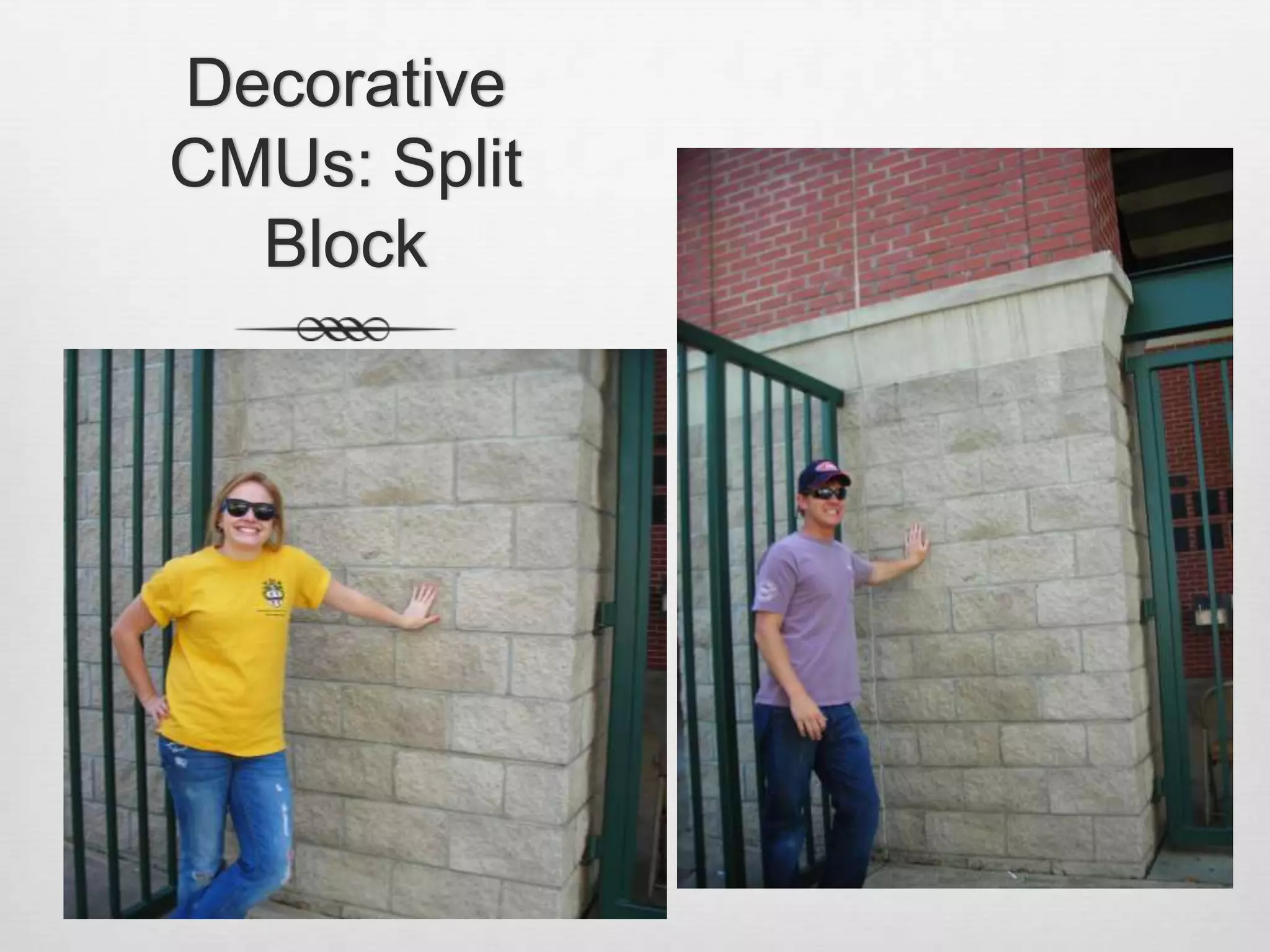
Decorative CMUs: Split Block
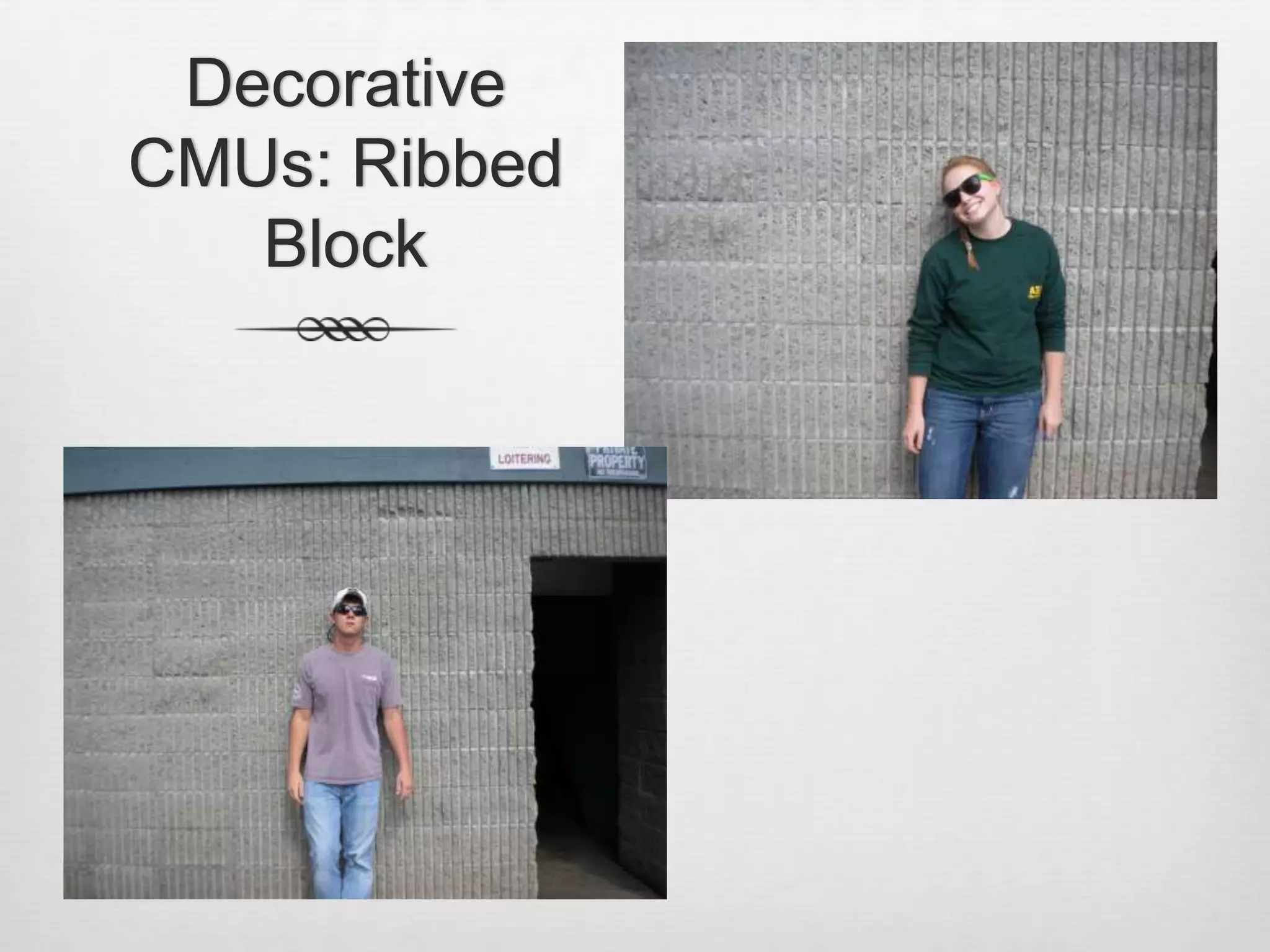
Decorative CMUs: Ribbed Block
Doors: Flush Door
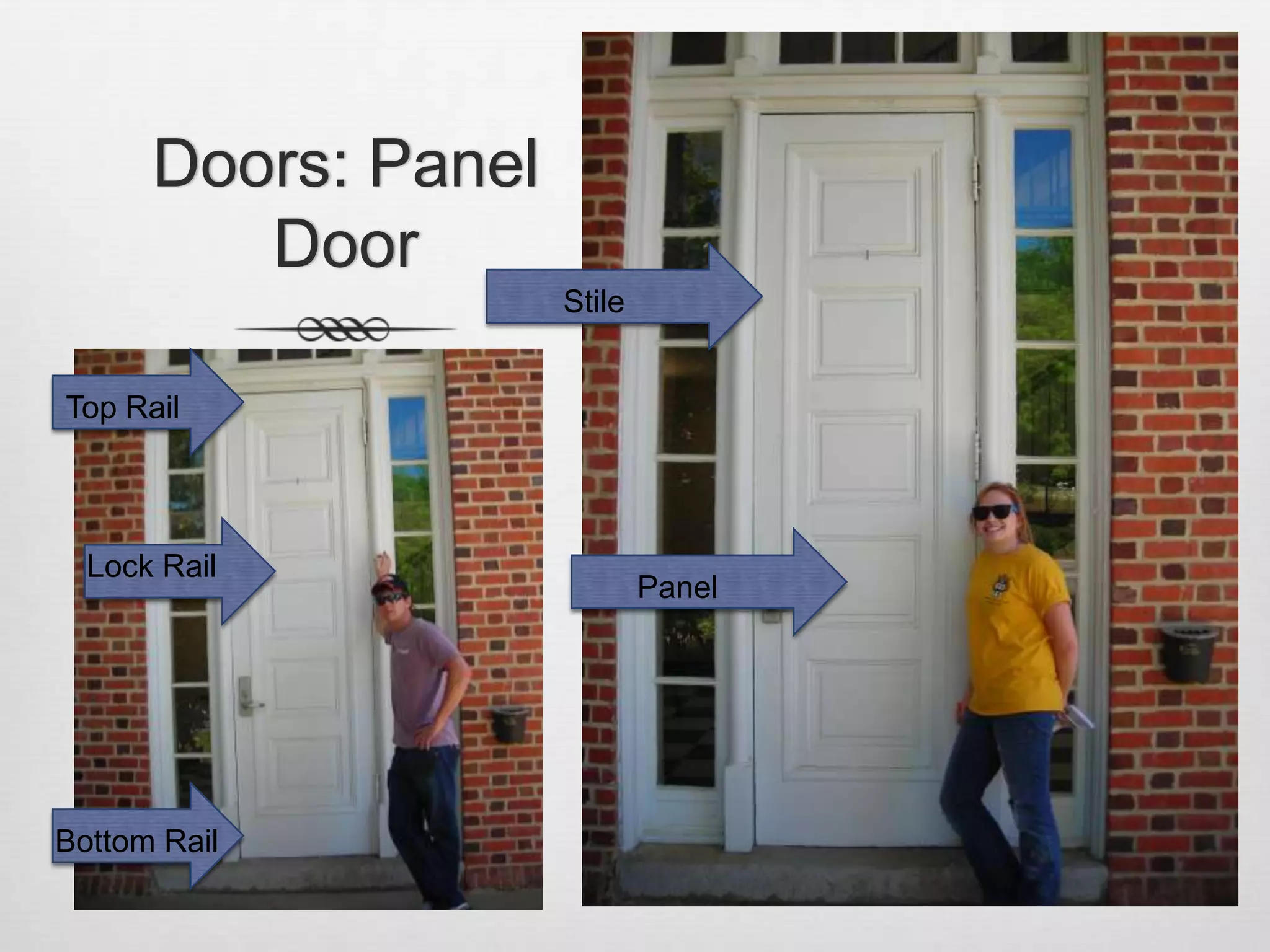
Doors: Panel DoorStileTop RailLock RailPanelBottom Rail
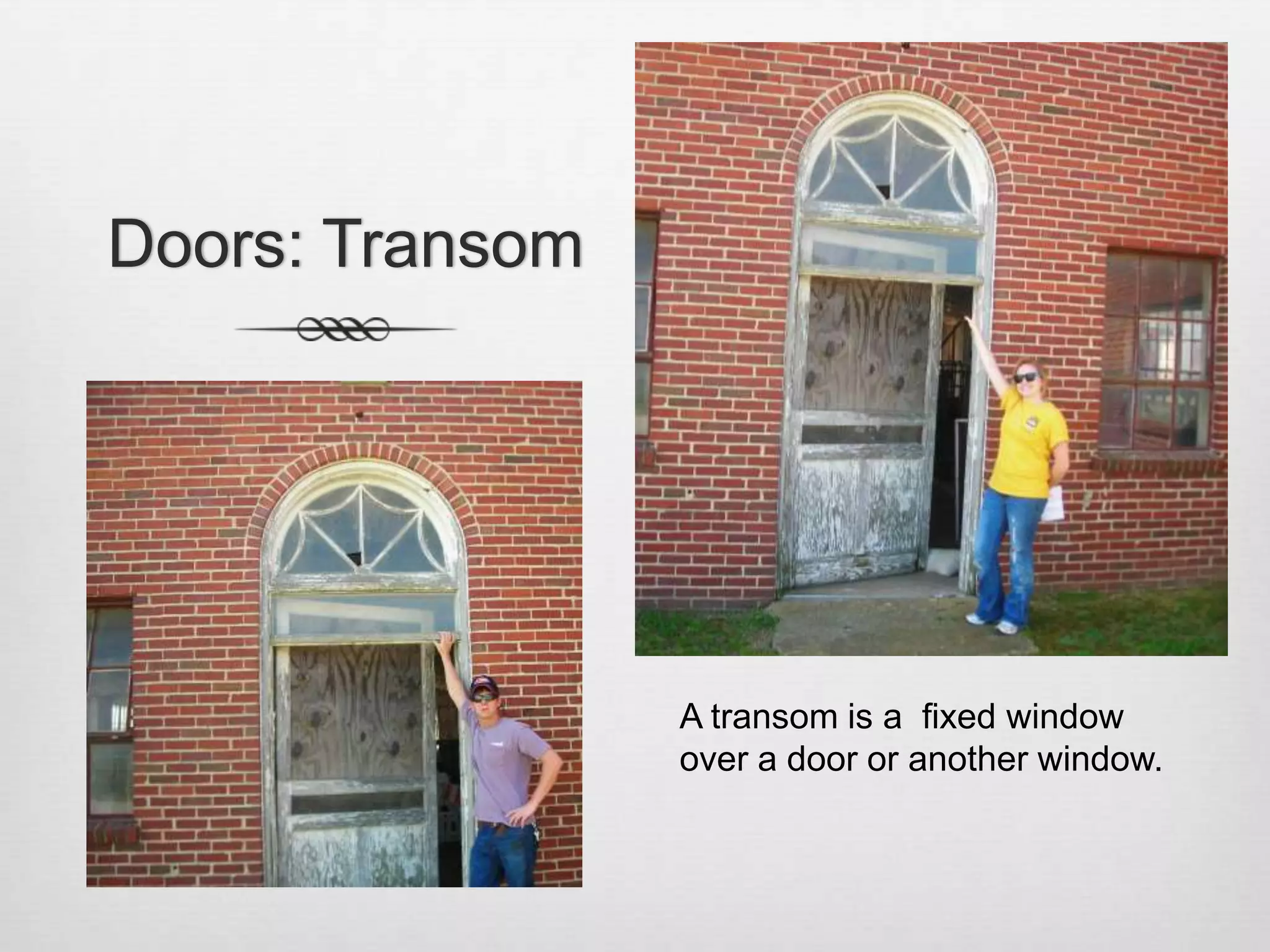
Doors: TransomA transom is a  fixed window over a door or another window.
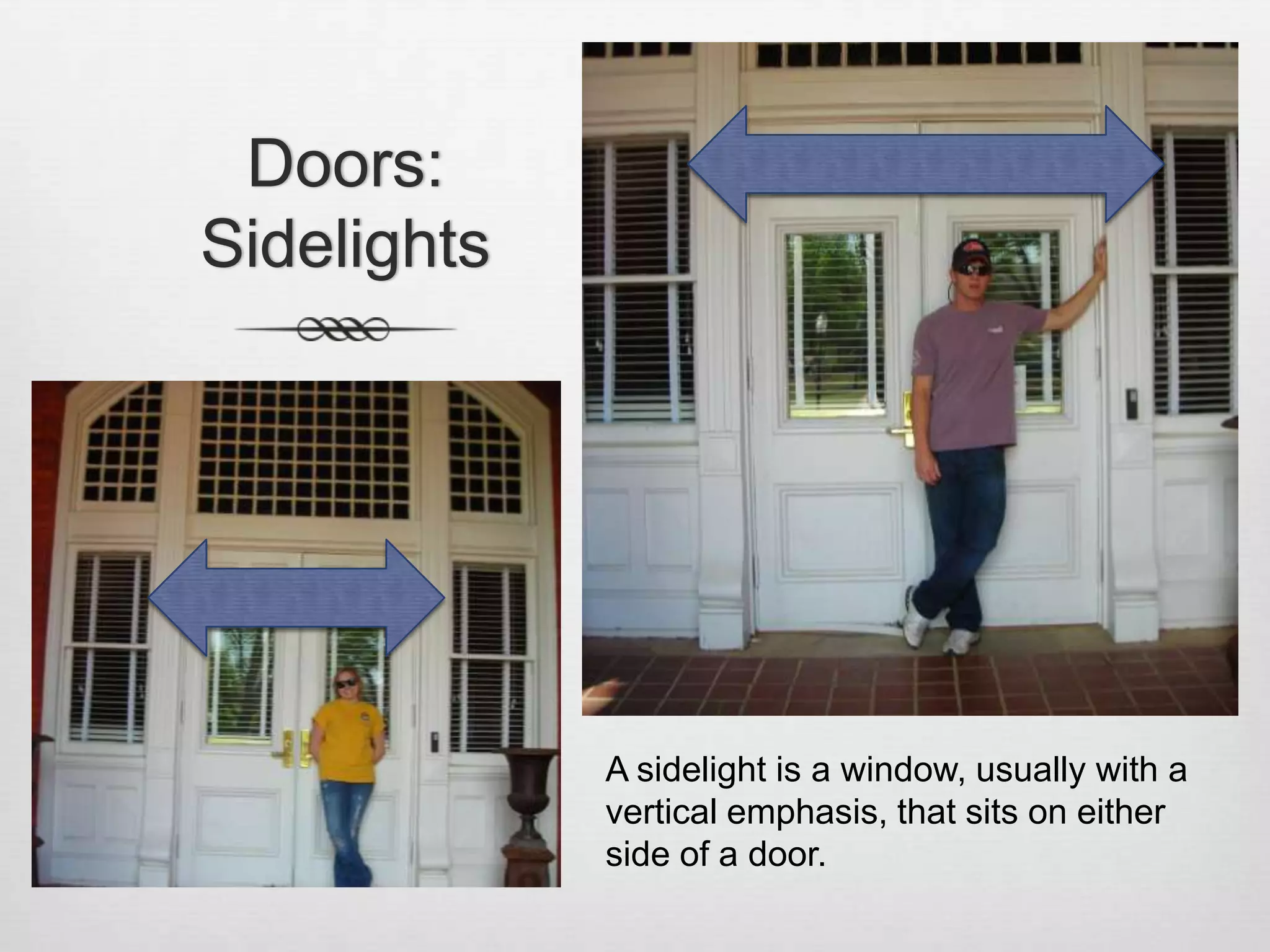
Doors: SidelightsA sidelight is a window, usually with a vertical emphasis, that sits on either side of a door.
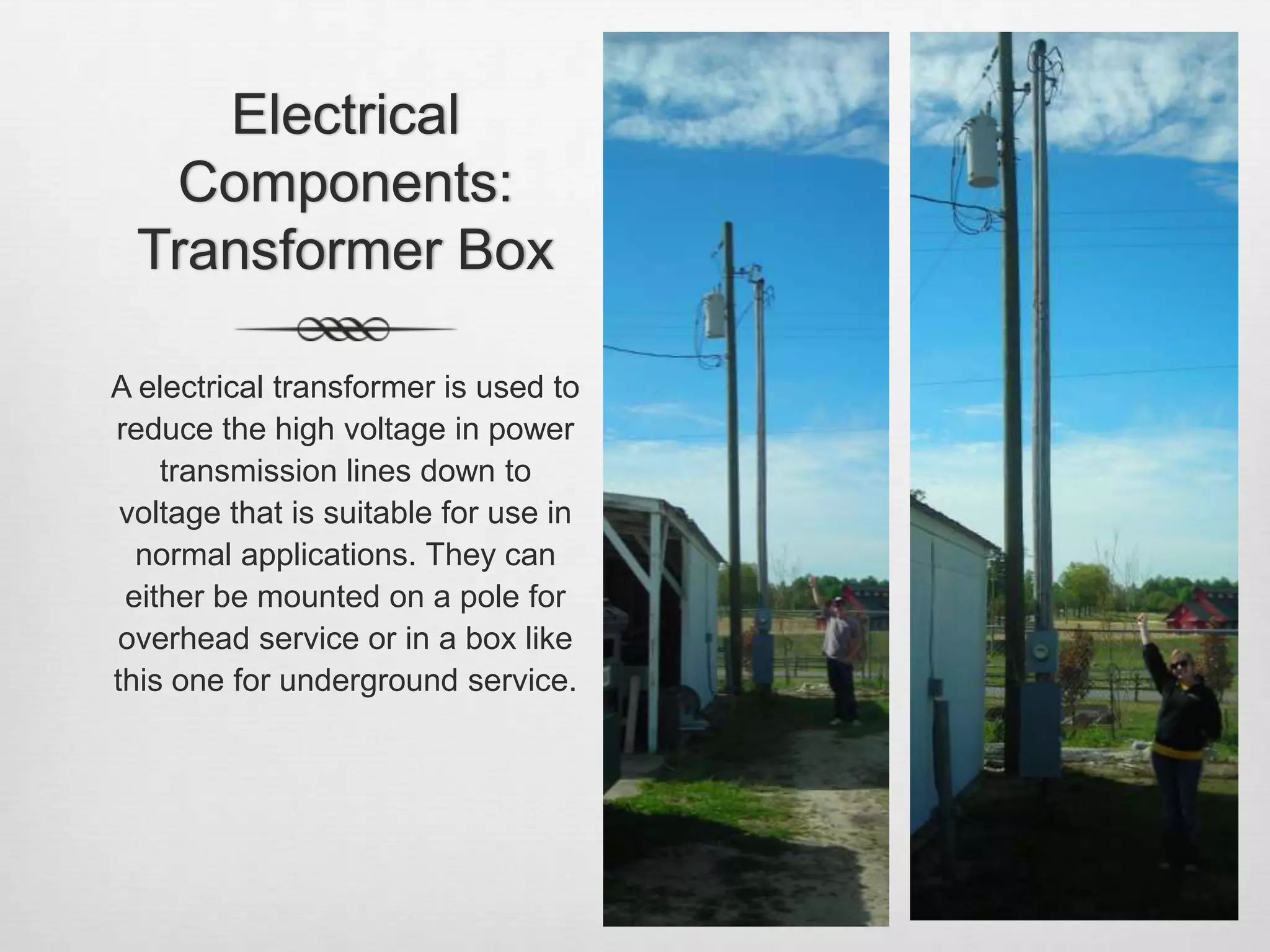
Electrical Components: Transformer BoxA electrical transformer is used to reduce the high voltage in power transmission lines down to voltage that is suitable for use in normal applications. They can either be mounted on a pole for overhead service or in a box like this one for underground service.
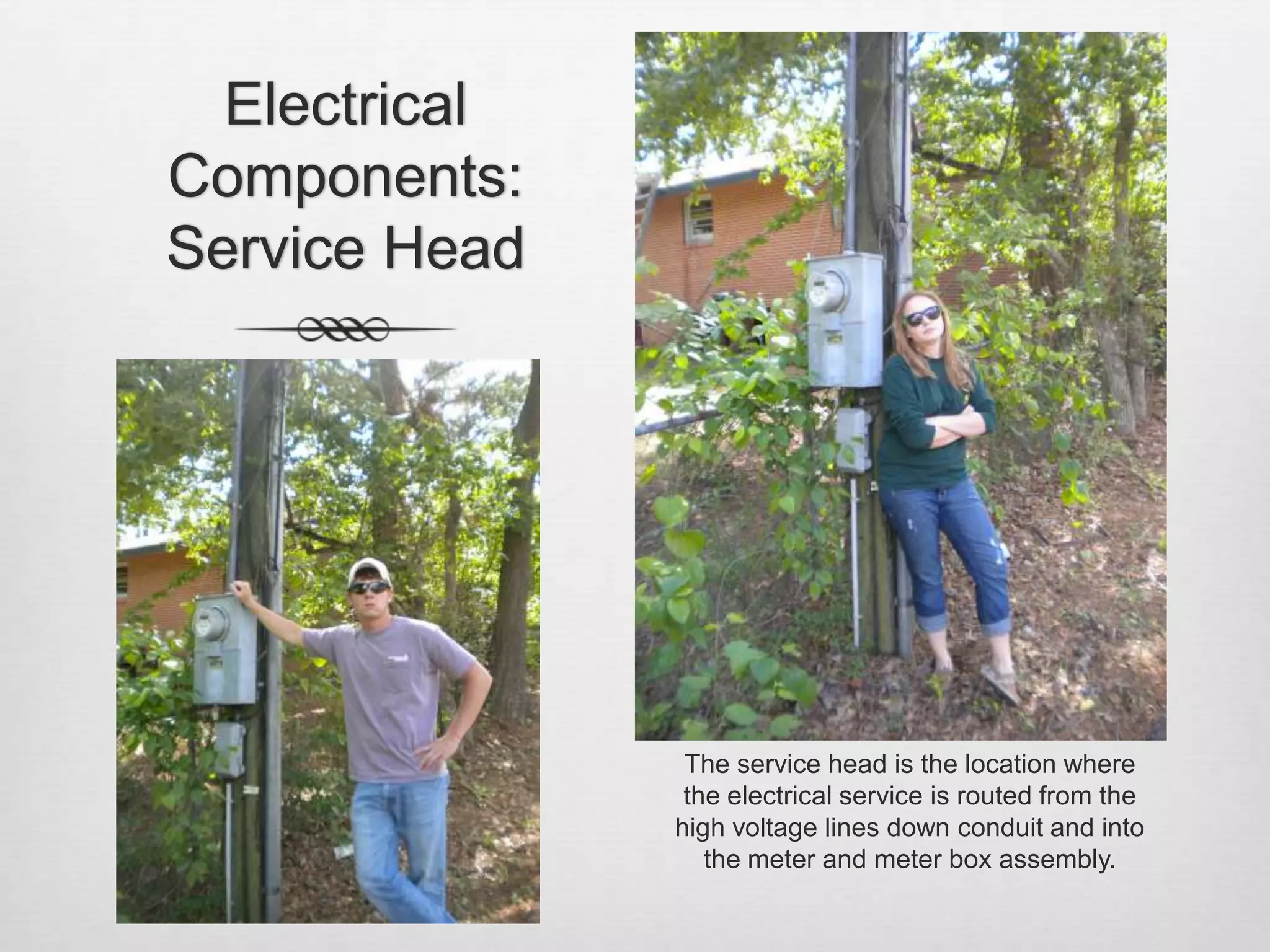
Electrical Components: Service HeadThe service head is the location where the electrical service is routed from the high voltage lines down conduit and into the meter and meter box assembly.
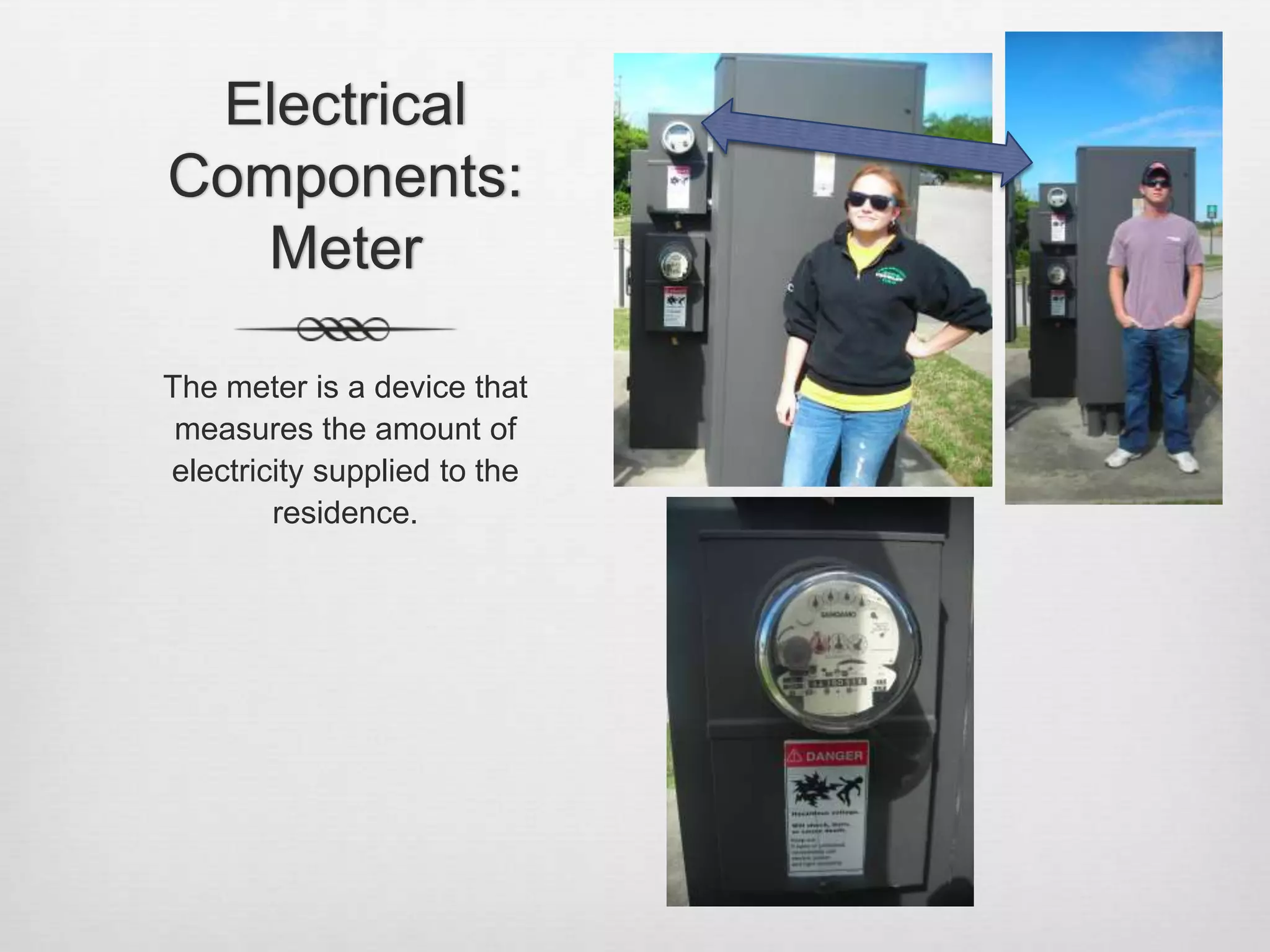
Electrical Components: MeterThe meter is a device that measures the amount of electricity supplied to the residence.
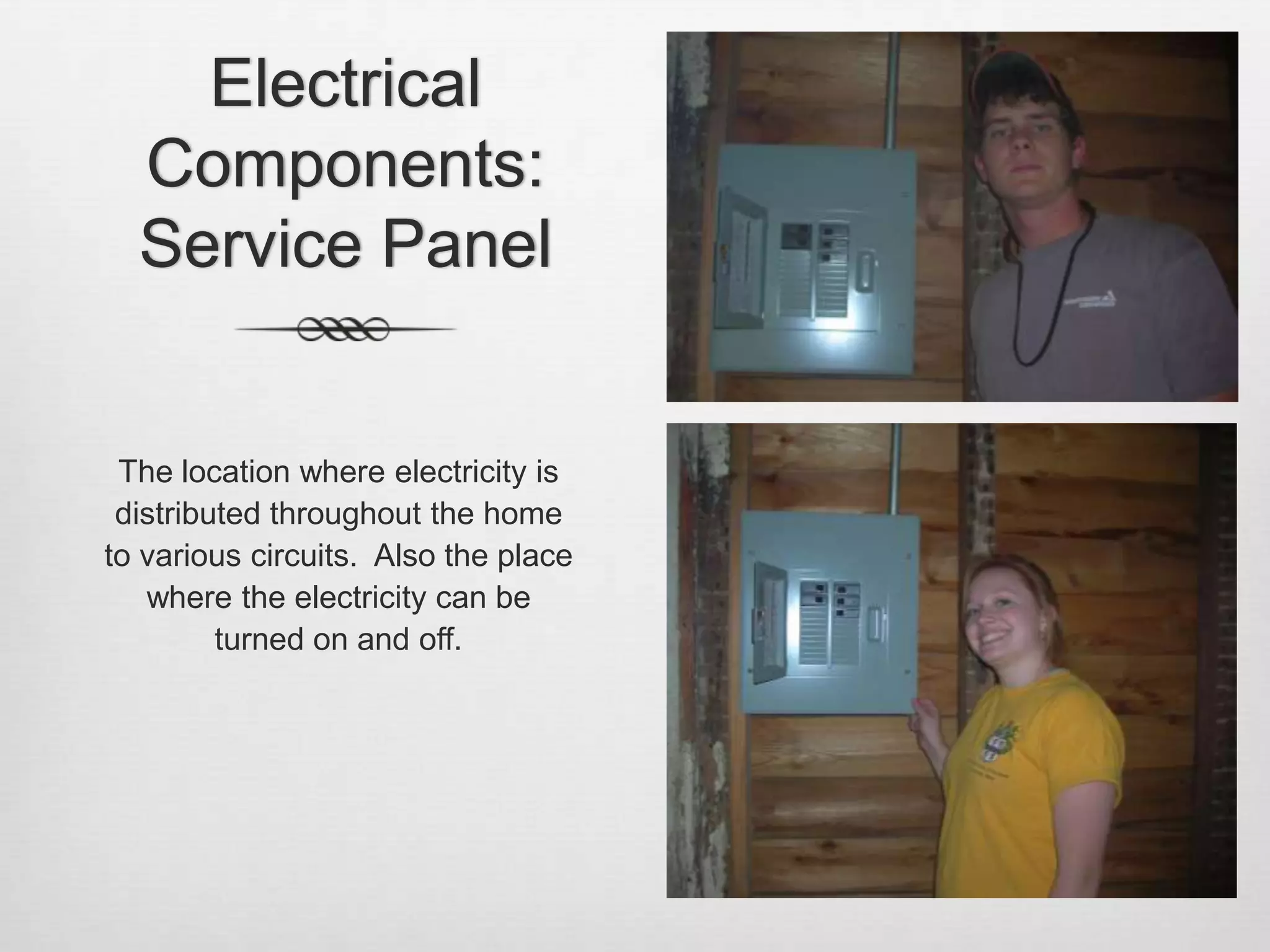
Electrical Components: Service PanelThe location where electricity is distributed throughout the home to various circuits.  Also the place where the electricity can be turned on and off.
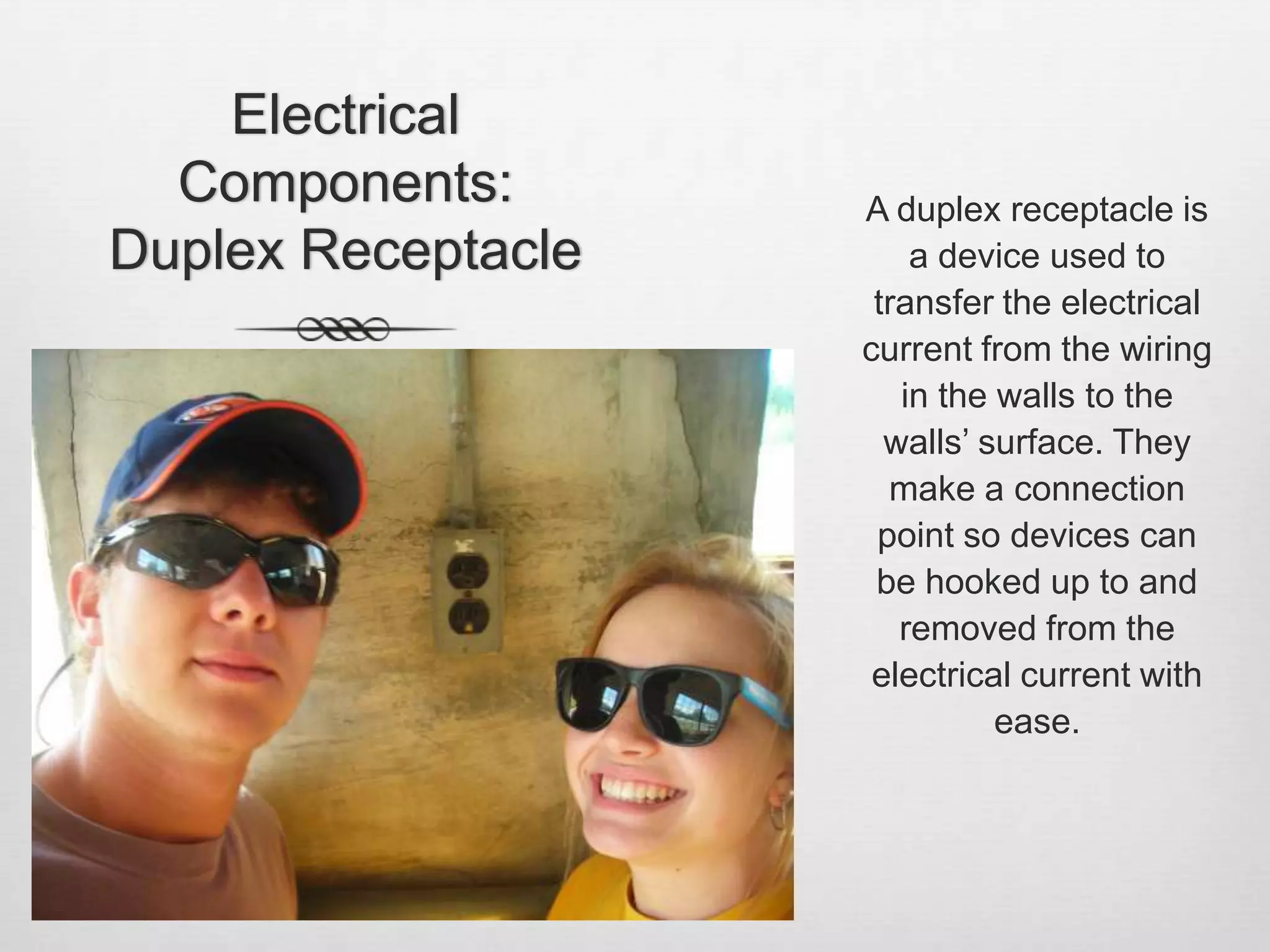
Electrical Components: Duplex ReceptacleA duplex receptacle is a device used to transfer the electrical current from the wiring in the walls to the walls’ surface. They make a connection point so devices can be hooked up to and removed from the electrical current with ease.
Framing Elements
1. Anchor Bolt
2. Sill Plate
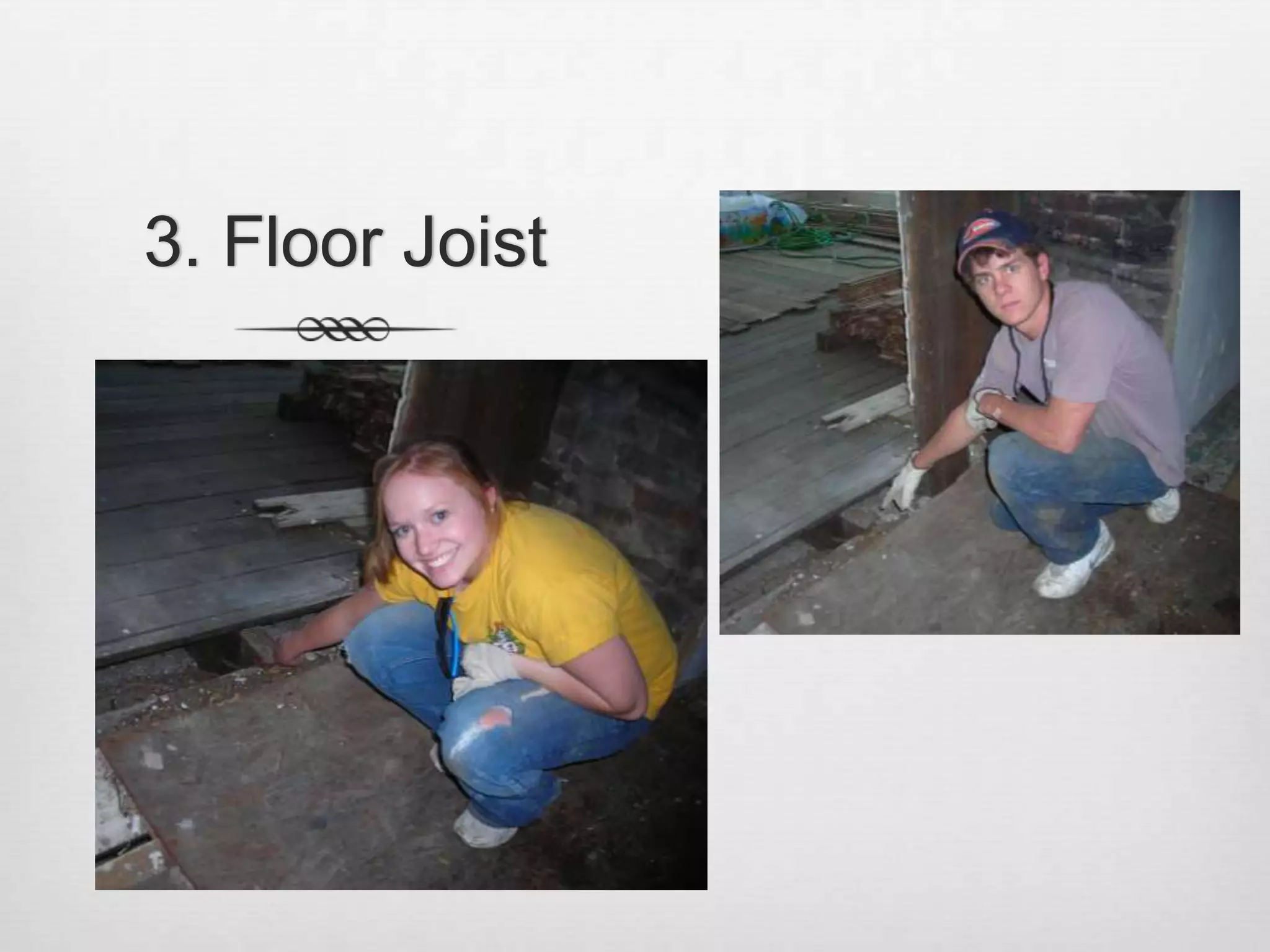
3. Floor Joist
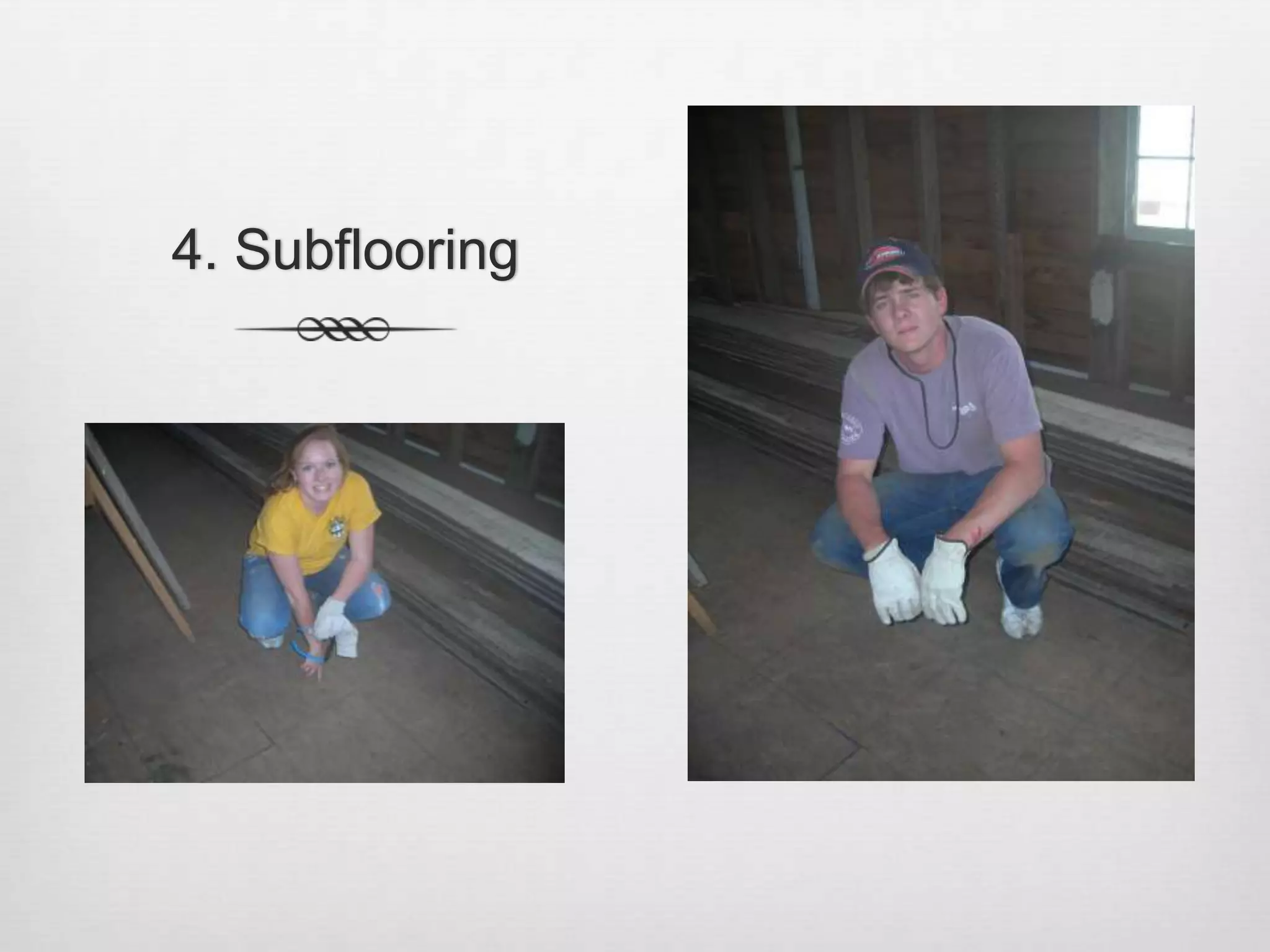
4. Subflooring
5. Sole Plate
6. Stud
7. Top Plate
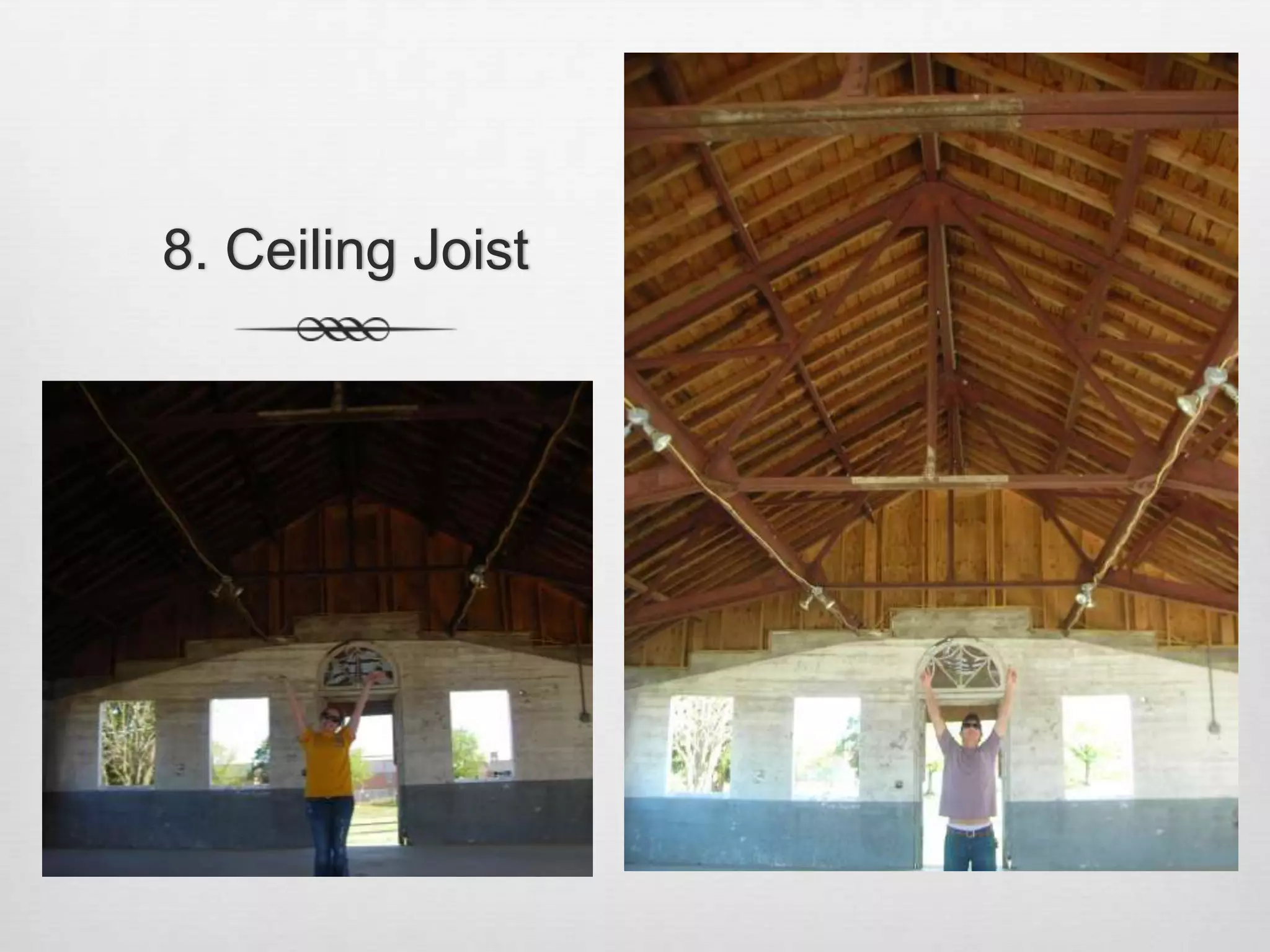
8. Ceiling Joist
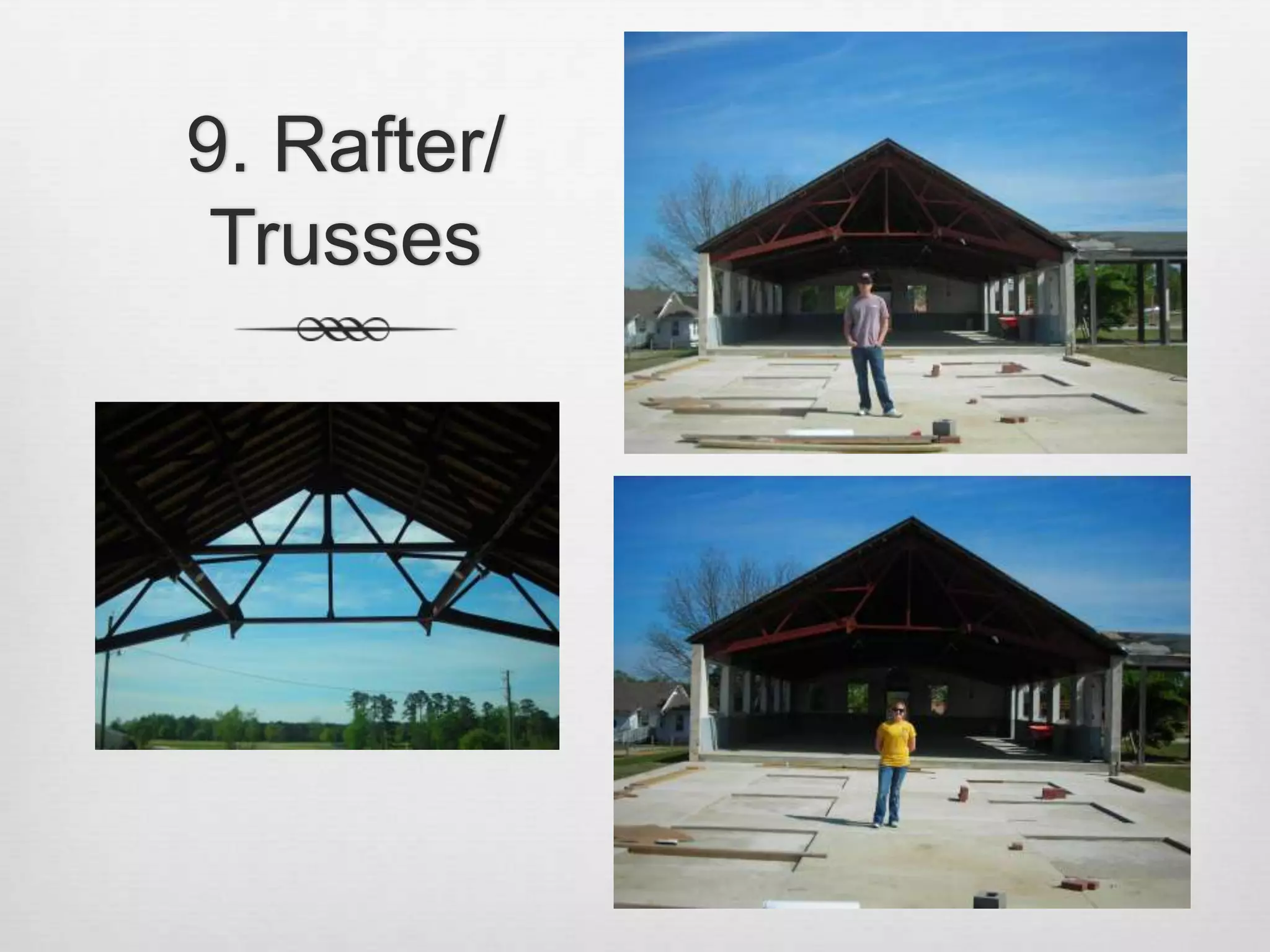
9. Rafter/ Trusses
10. Roof Decking
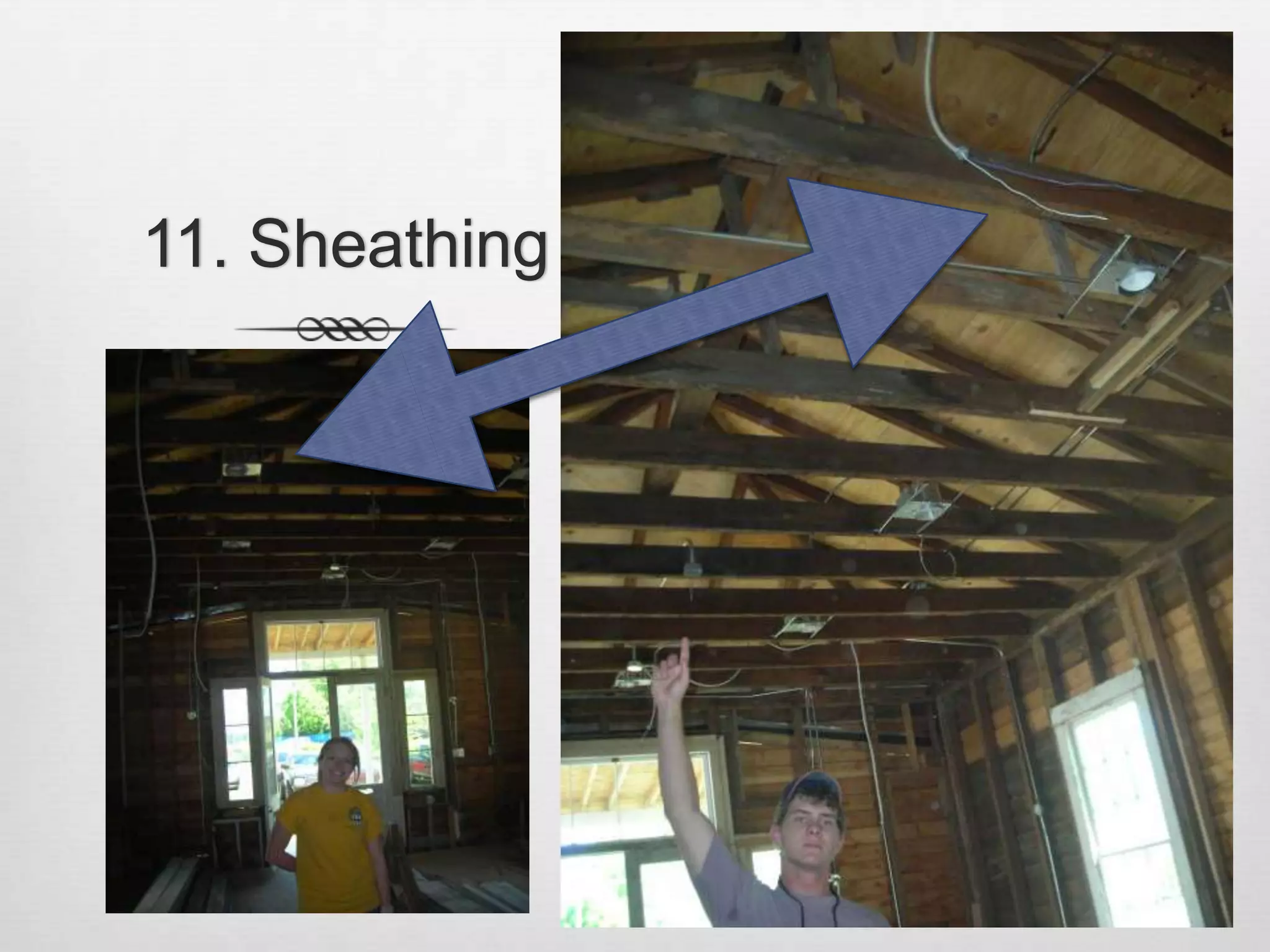
11. Sheathing
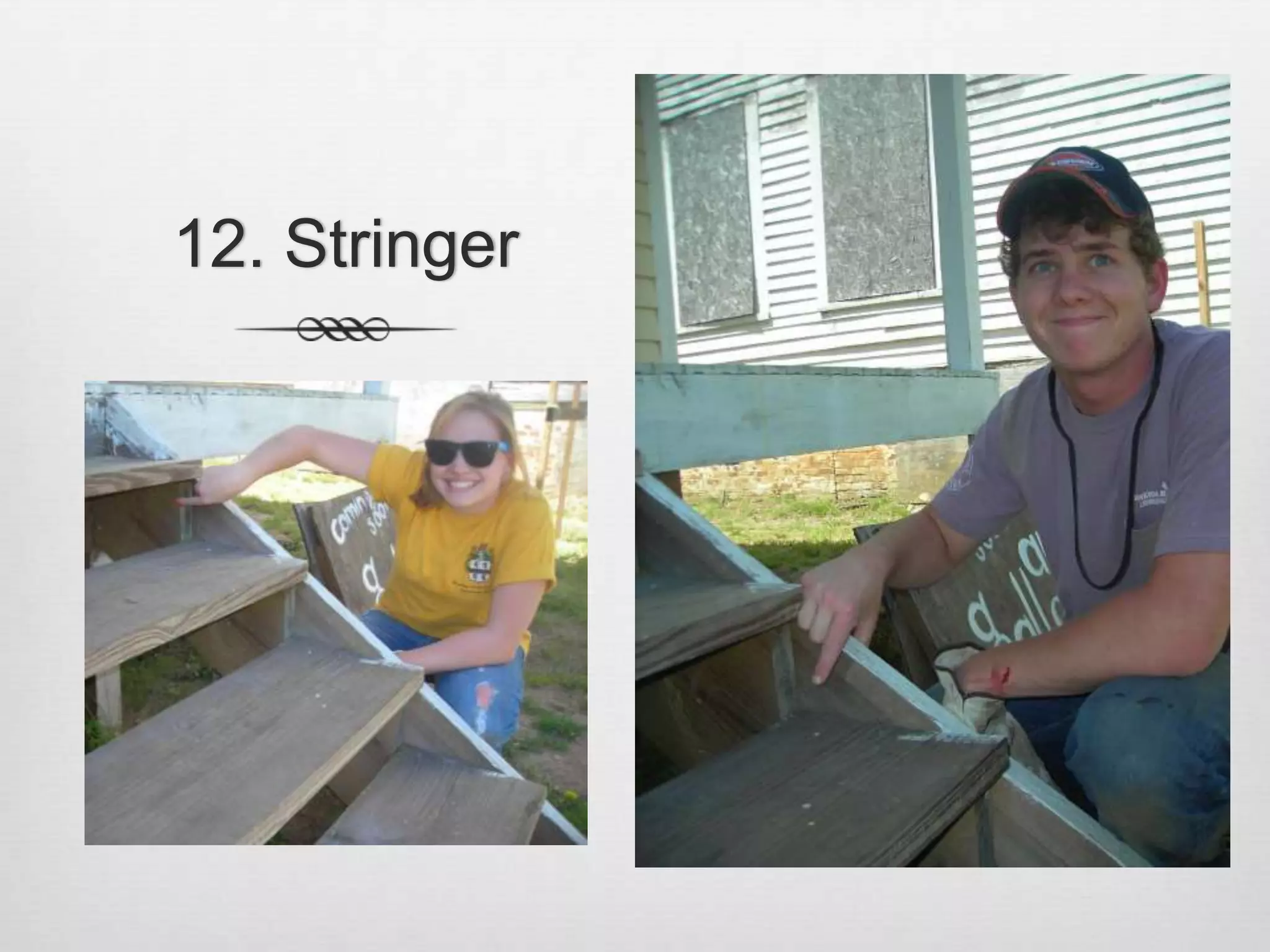
12. Stringer
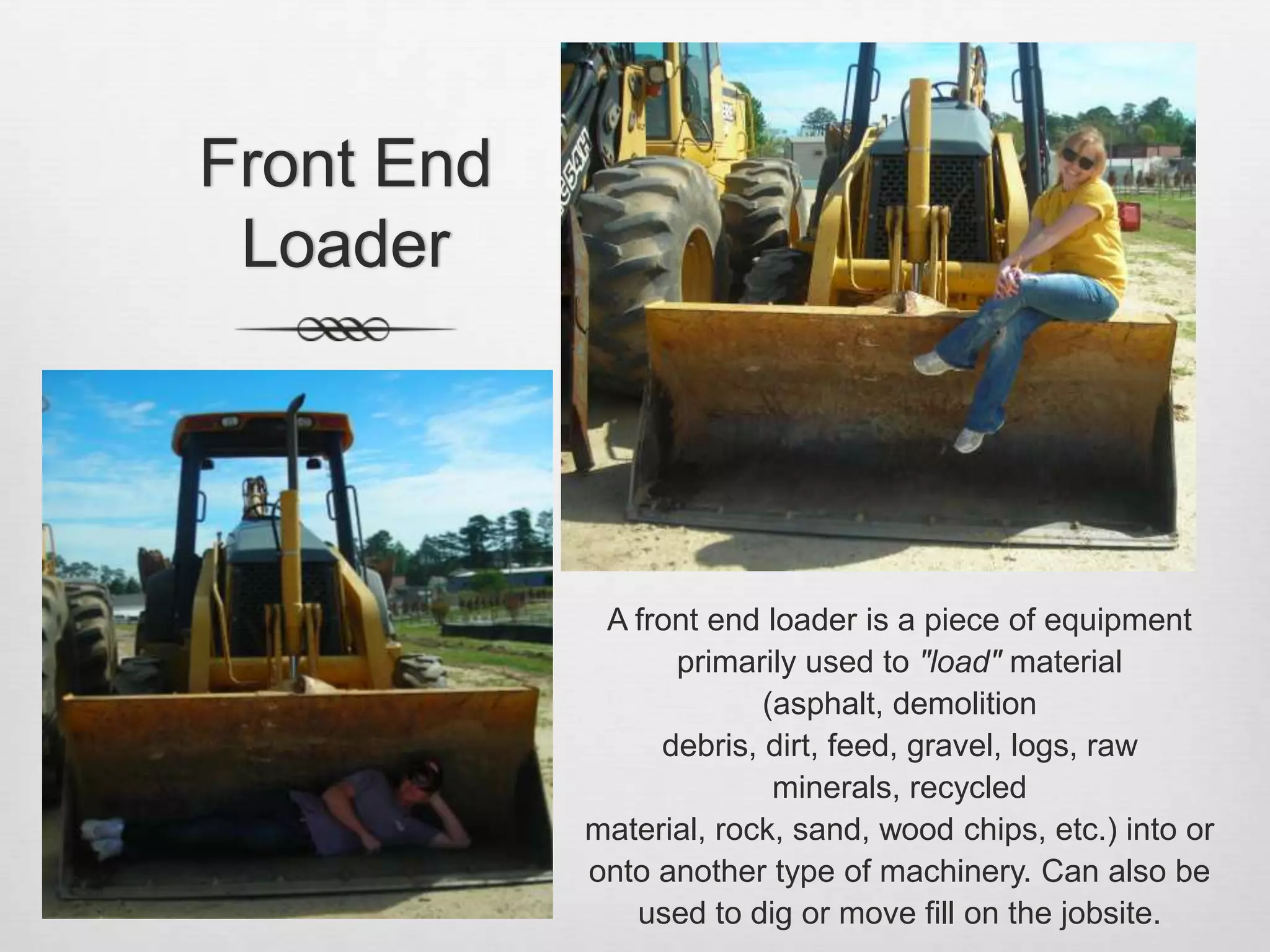
Front End LoaderA front end loader is a piece of equipment primarily used to "load" material (asphalt, demolition debris, dirt, feed, gravel, logs, raw minerals, recycled material, rock, sand, wood chips, etc.) into or onto another type of machinery. Can also be used to dig or move fill on the jobsite.

Gypsum BoardA construction material used for wall and ceiling coverage inside buildings. Gypsum is made using panels made of gypsum plaster pressed between two thick sheets of paper, then kiln dried. Often called sheetrock or drywall.
Heat PumpA heat pump is a device that uses a refrigeration cycle either to heat or cool a building by passing air or water over either the evaporating or condensing coils.The compressor/evaporator moves the coolant around through the unit to facilitate operation. The air handler moves the physical air around through the duct work and across the condenser.One advantage is the affordability of the unit to purchase and operate. The major disadvantage of the heat pump is its inability to operate well at very low temperatures and thus requiring a back-up system.
Heat Pump Components
InsulationInsulation refers broadly to any object in a building used as insulation for any purpose. Whilst the majority of insulation in buildings is for thermal purposes, the term also applies to acoustic insulation.Its primary use is to reduce the effects of the temperature of the outside ambient air and/or the air in adjoining regions.
Insulation: Batt/ Blanket
Insulation: Loose Fill
Insulation: Foamed-in-place
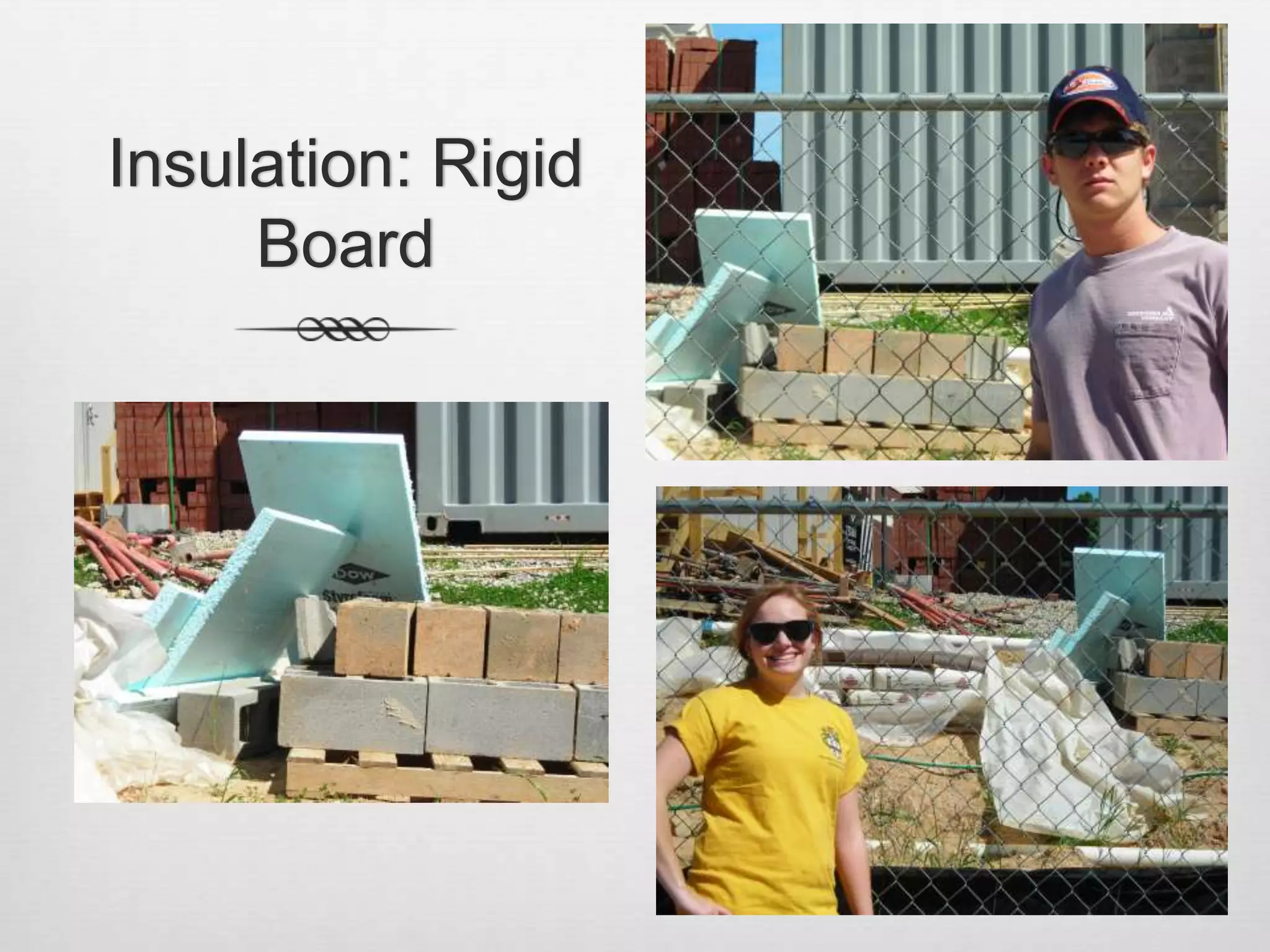
Insulation: Rigid Board
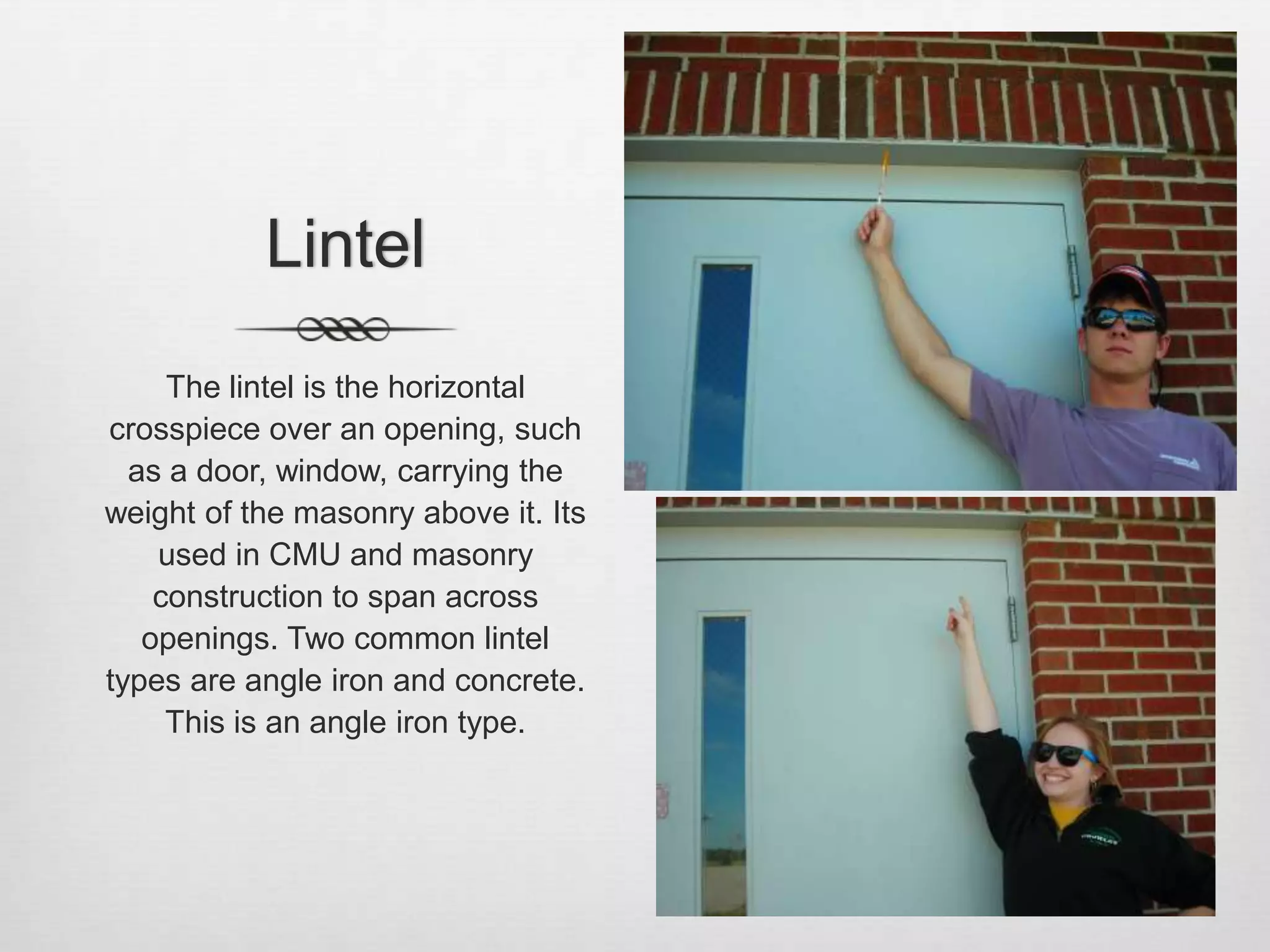
LintelThe lintel is the horizontal crosspiece over an opening, such as a door, window, carrying the weight of the masonry above it. Its used in CMU and masonry construction to span across openings. Two common lintel types are angle iron and concrete. This is an angle iron type.
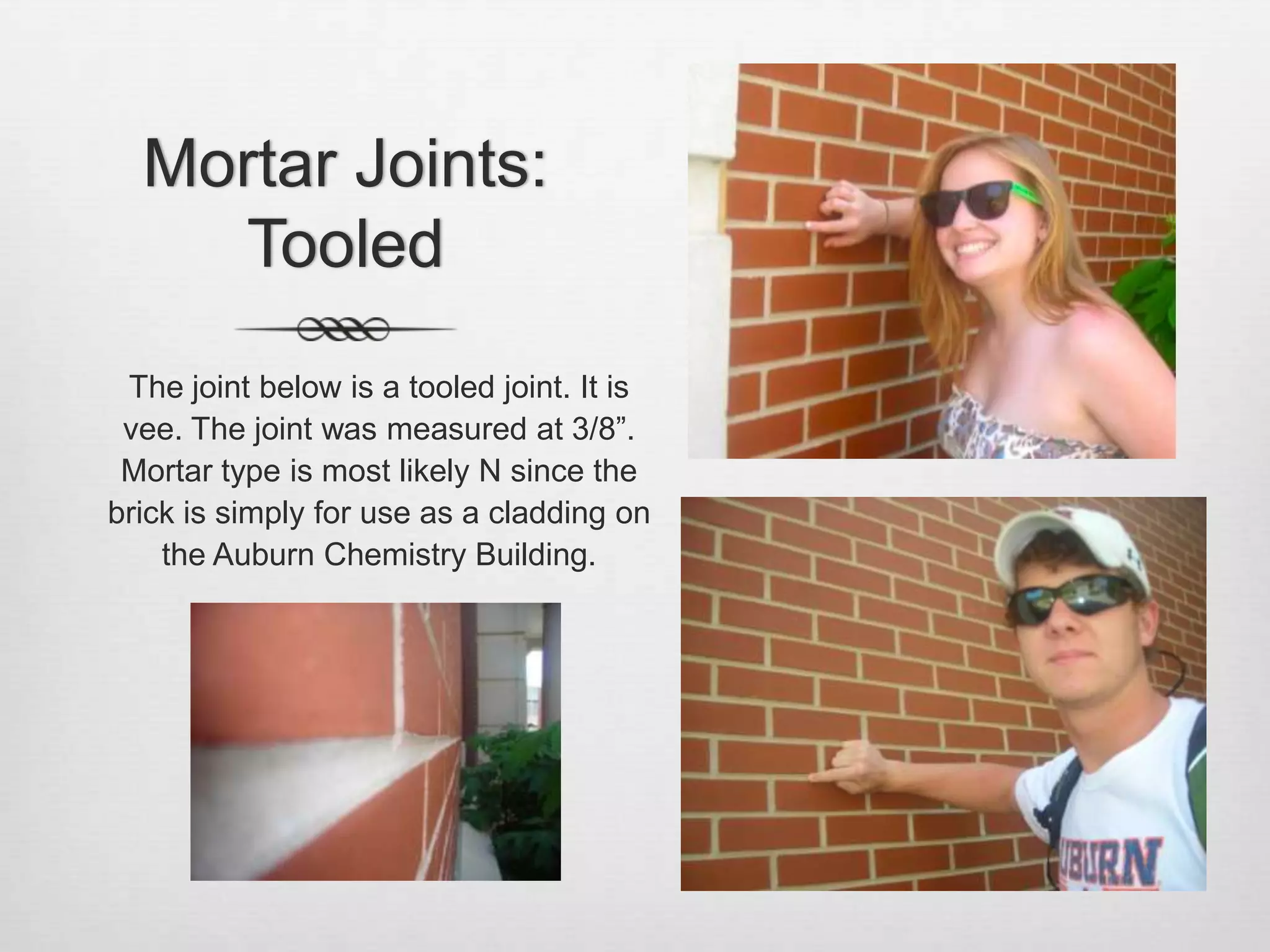
Mortar Joints: TooledThe joint below is a tooled joint. It is vee. The joint was measured at 3/8”.  Mortar type is most likely N since the brick is simply for use as a cladding on the Auburn Chemistry Building.
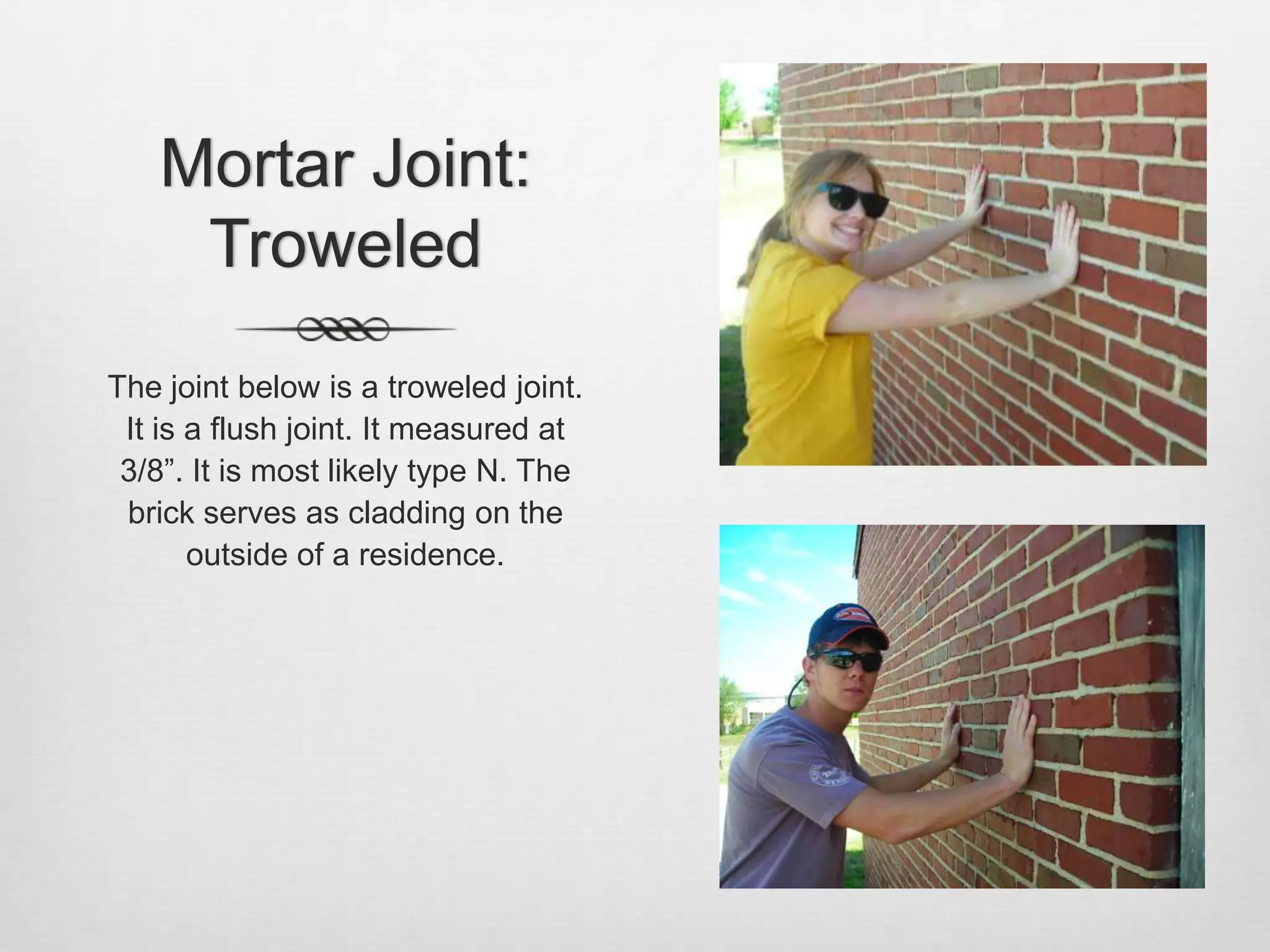
Mortar Joint: TroweledThe joint below is a troweled joint. It is a flush joint. It measured at 3/8”. It is most likely type N. The brick serves as cladding on the outside of a residence.
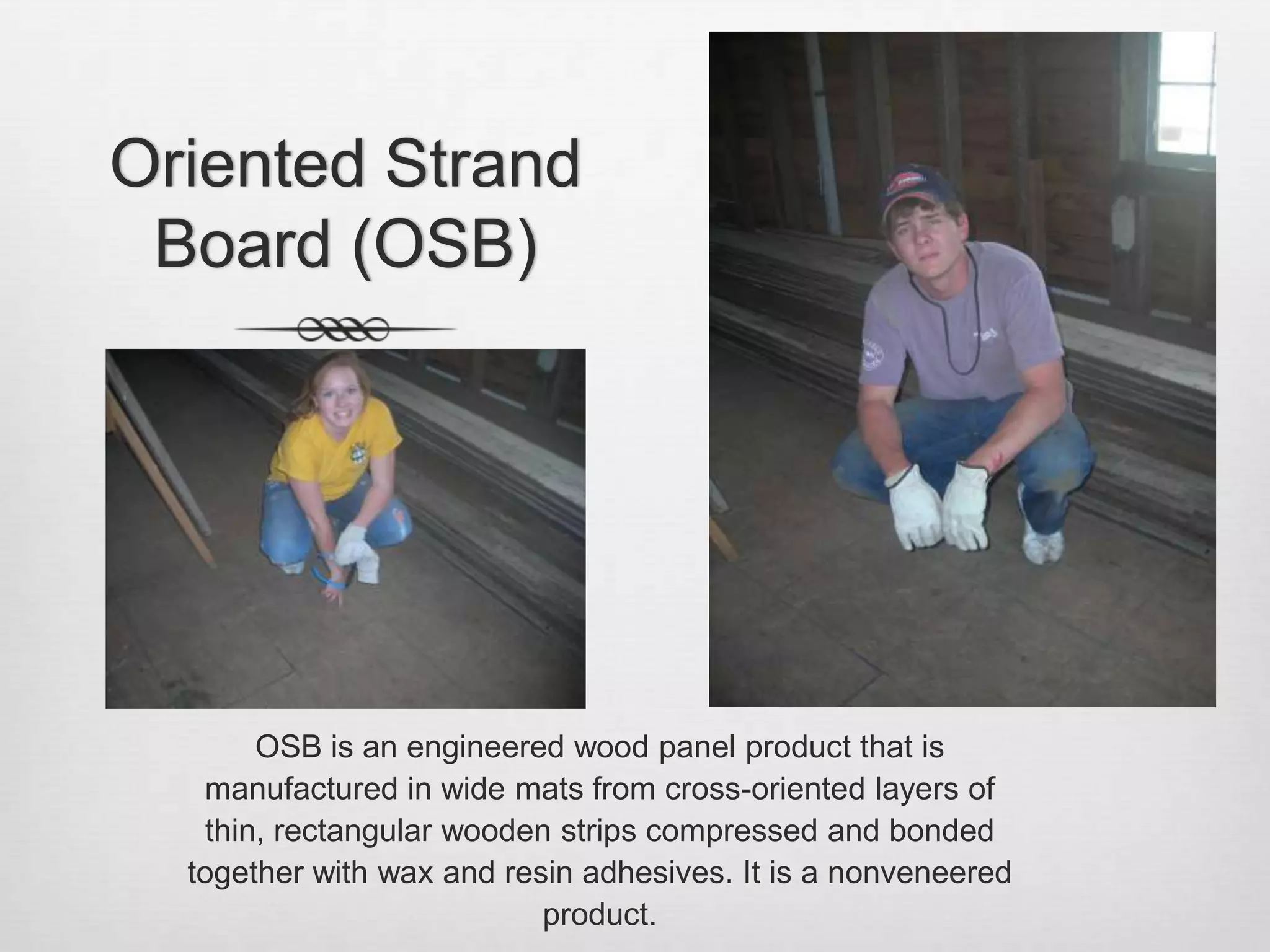
Oriented Strand Board (OSB)OSB is an engineered wood panel product that is manufactured in wide mats from cross-oriented layers of thin, rectangular wooden strips compressed and bonded together with wax and resin adhesives. It is a nonveneered product.
Plumbing: LavatoryA lavatory usually is drained by 1 ½” piping.
Plumbing: Water ClosetA water closet is usually drained with 3” piping.
Plumbing: Manufactured Tub
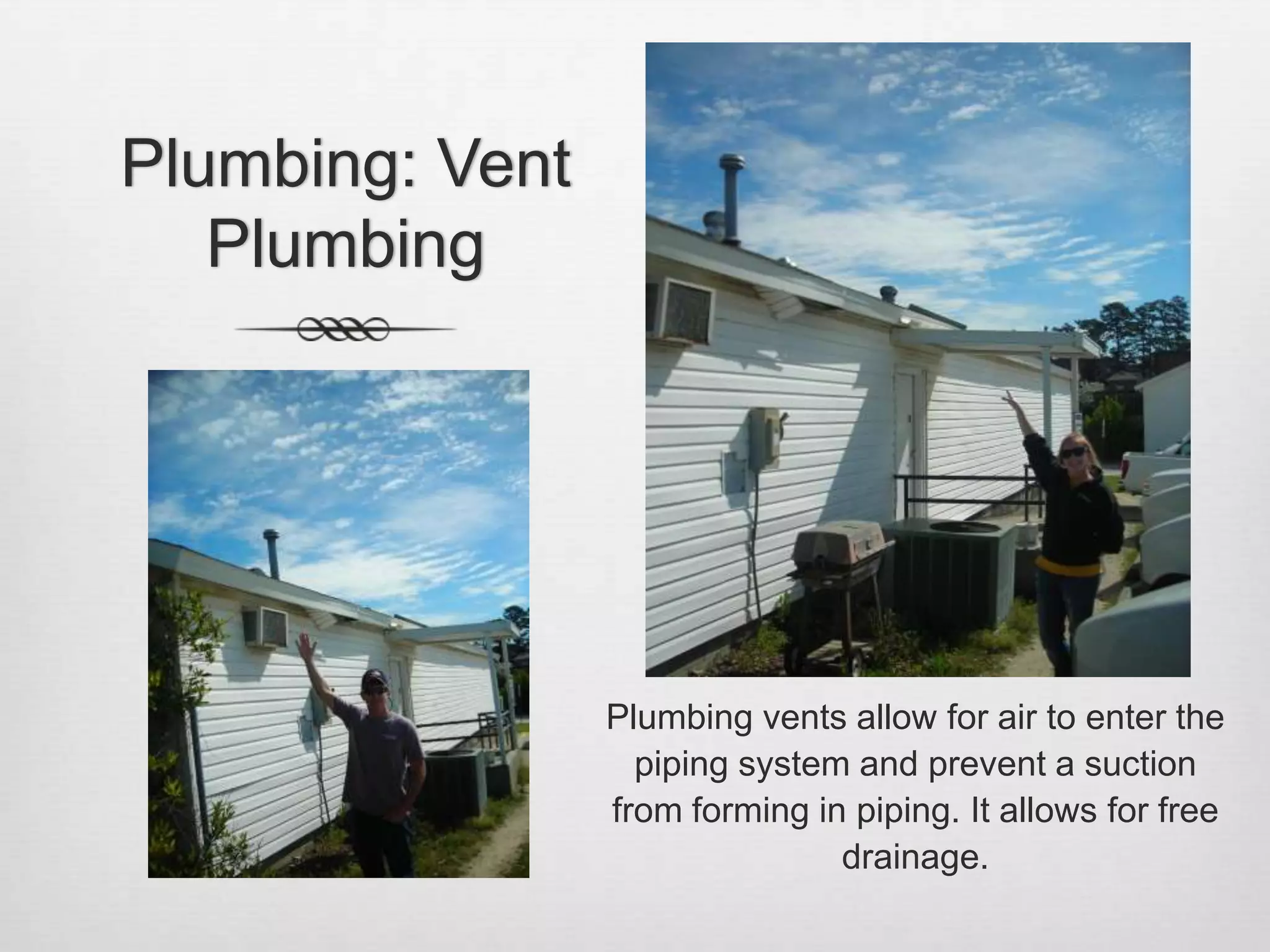
Plumbing: Vent PlumbingPlumbing vents allow for air to enter the piping system and prevent a suction from forming in piping. It allows for free drainage.
Plumbing: SinkThe sink pictured below is a drop in kitchen sink.
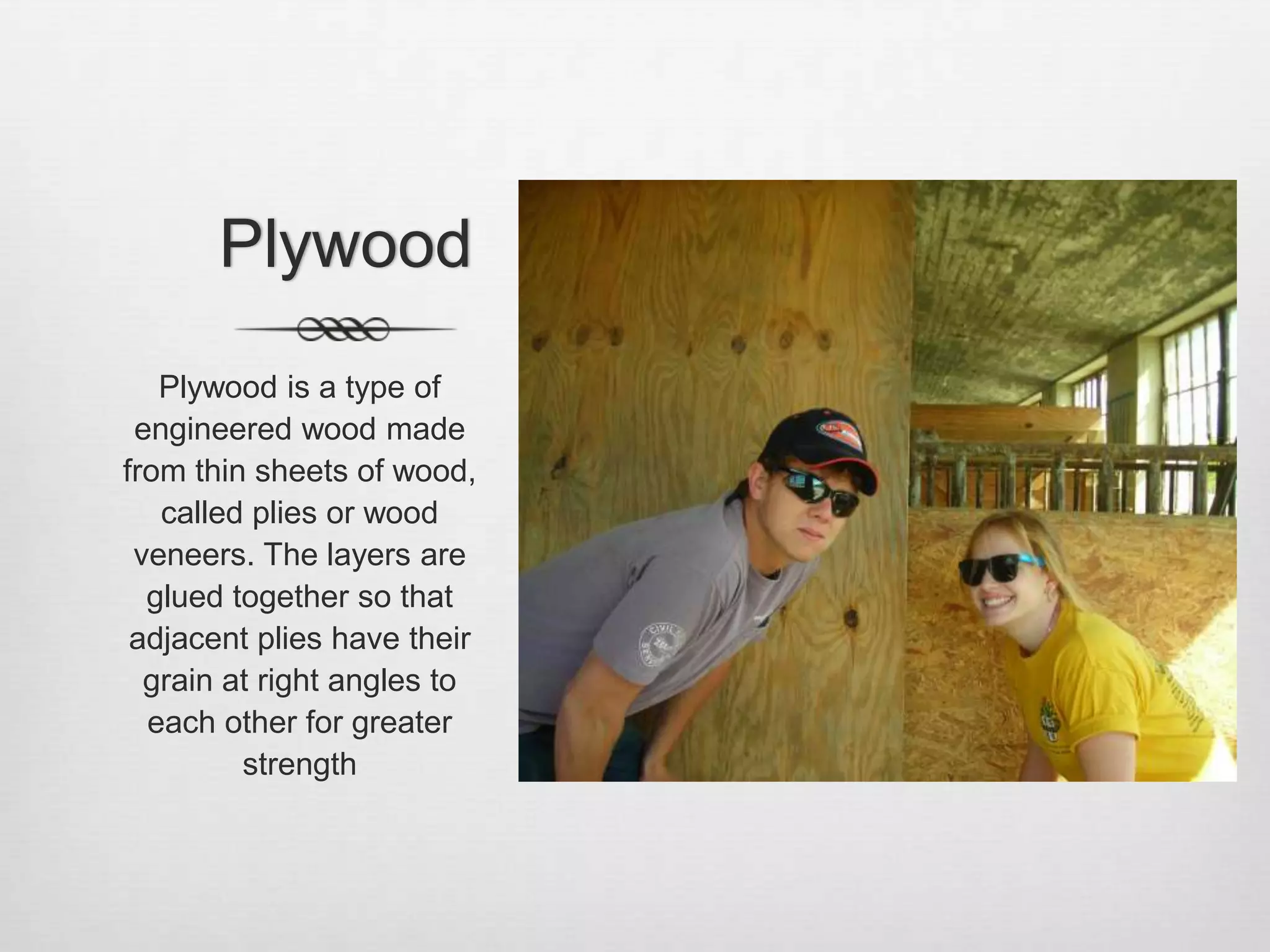
PlywoodPlywood is a type of engineered wood made from thin sheets of wood, called plies or wood veneers. The layers are glued together so that adjacent plies have their grain at right angles to each other for greater strength
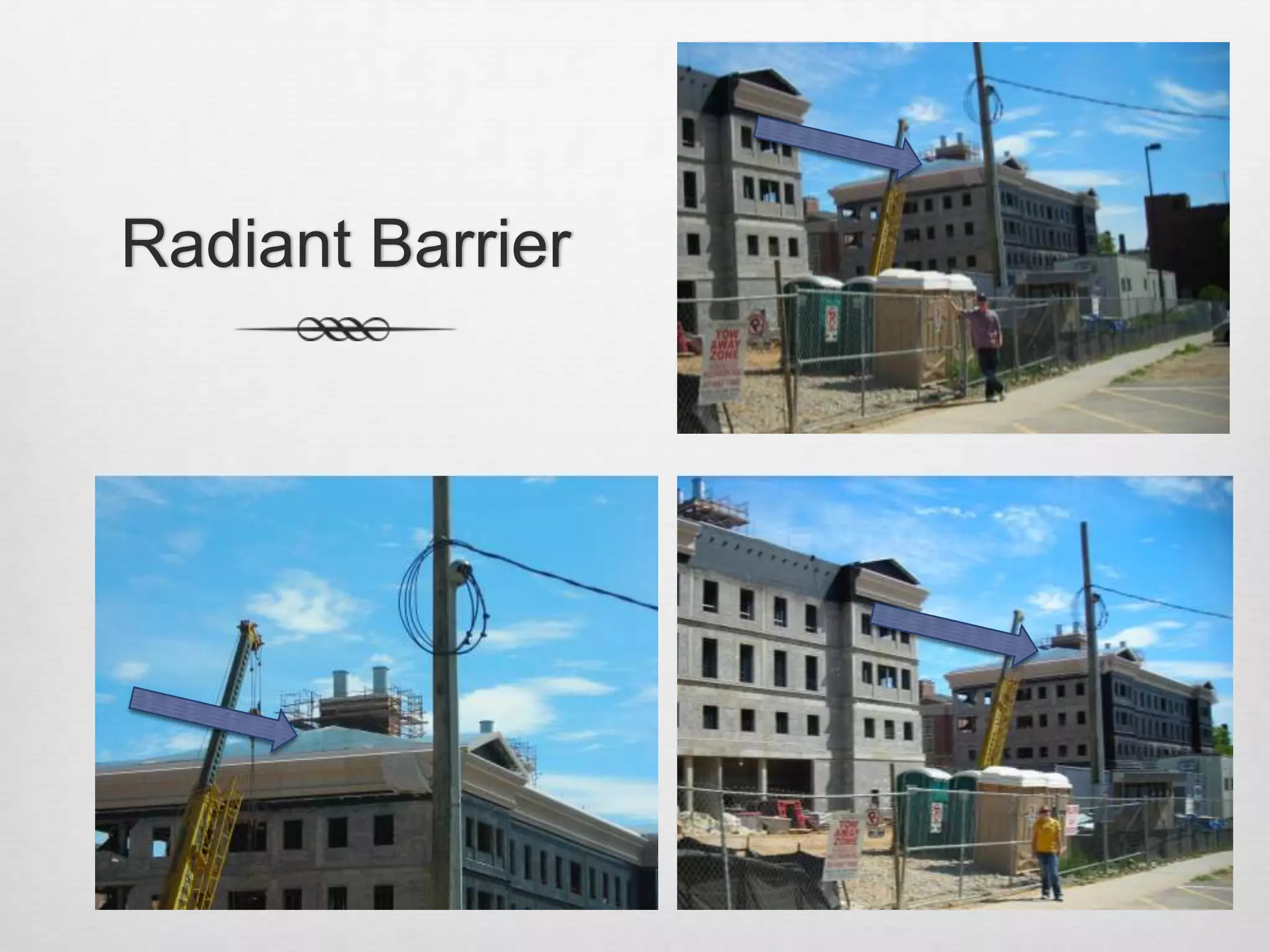
Radiant Barrier
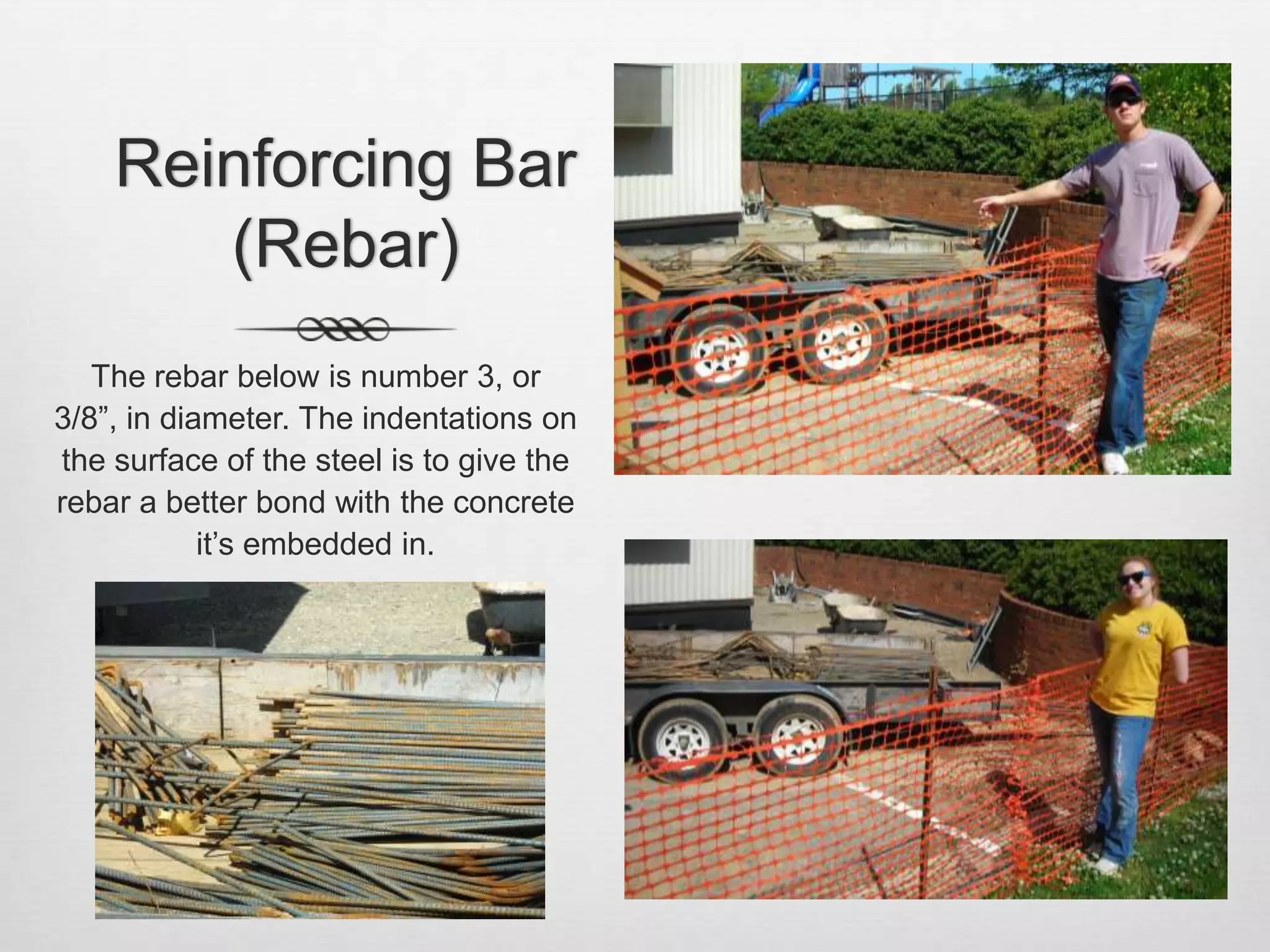
Reinforcing Bar (Rebar)The rebar below is number 3, or 3/8”, in diameter. The indentations on the surface of the steel is to give the rebar a better bond with the concrete it’s embedded in.
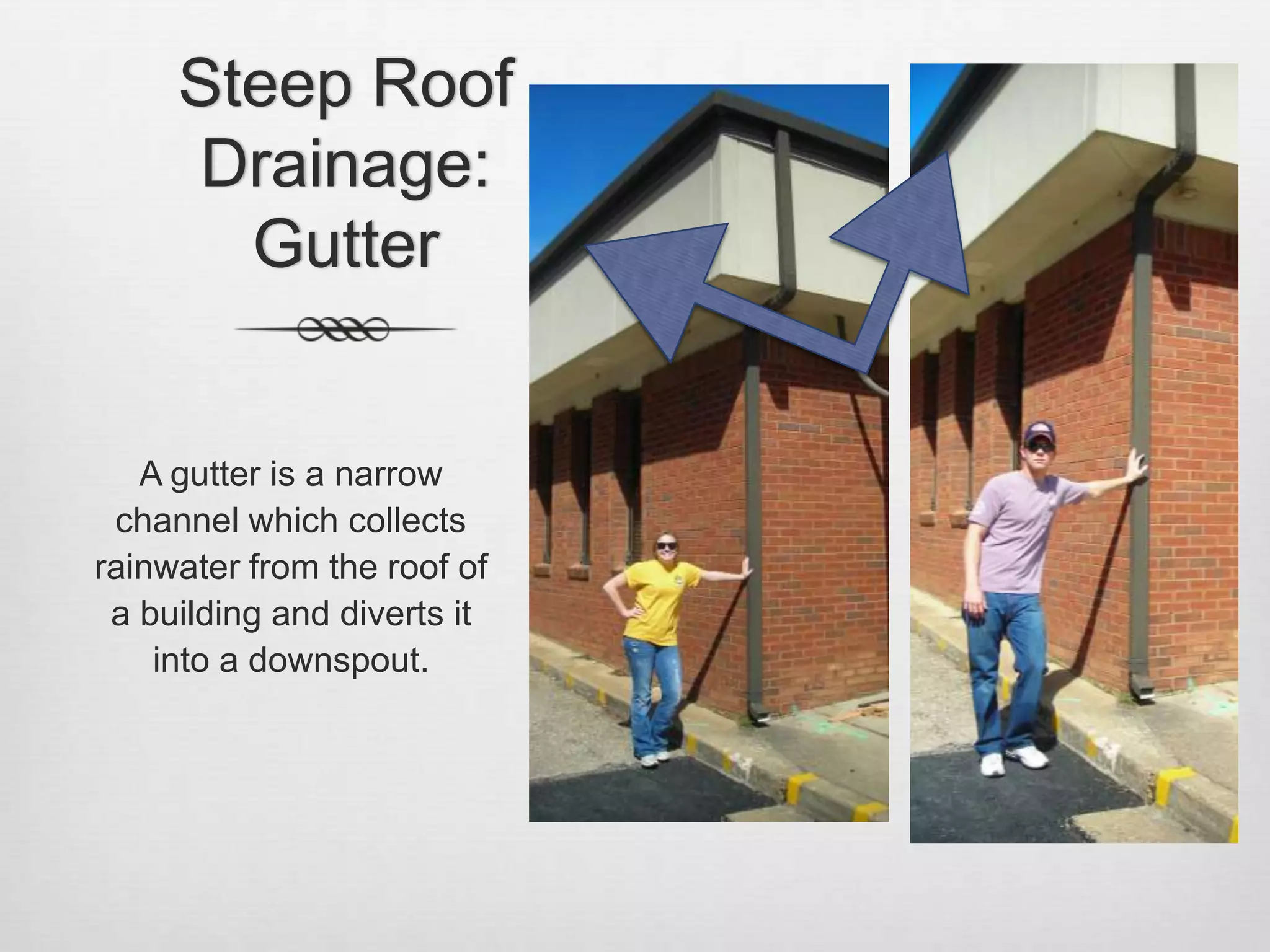
Steep Roof Drainage: GutterA gutter is a narrow channel which collects rainwater from the roof of a building and diverts it into a downspout.
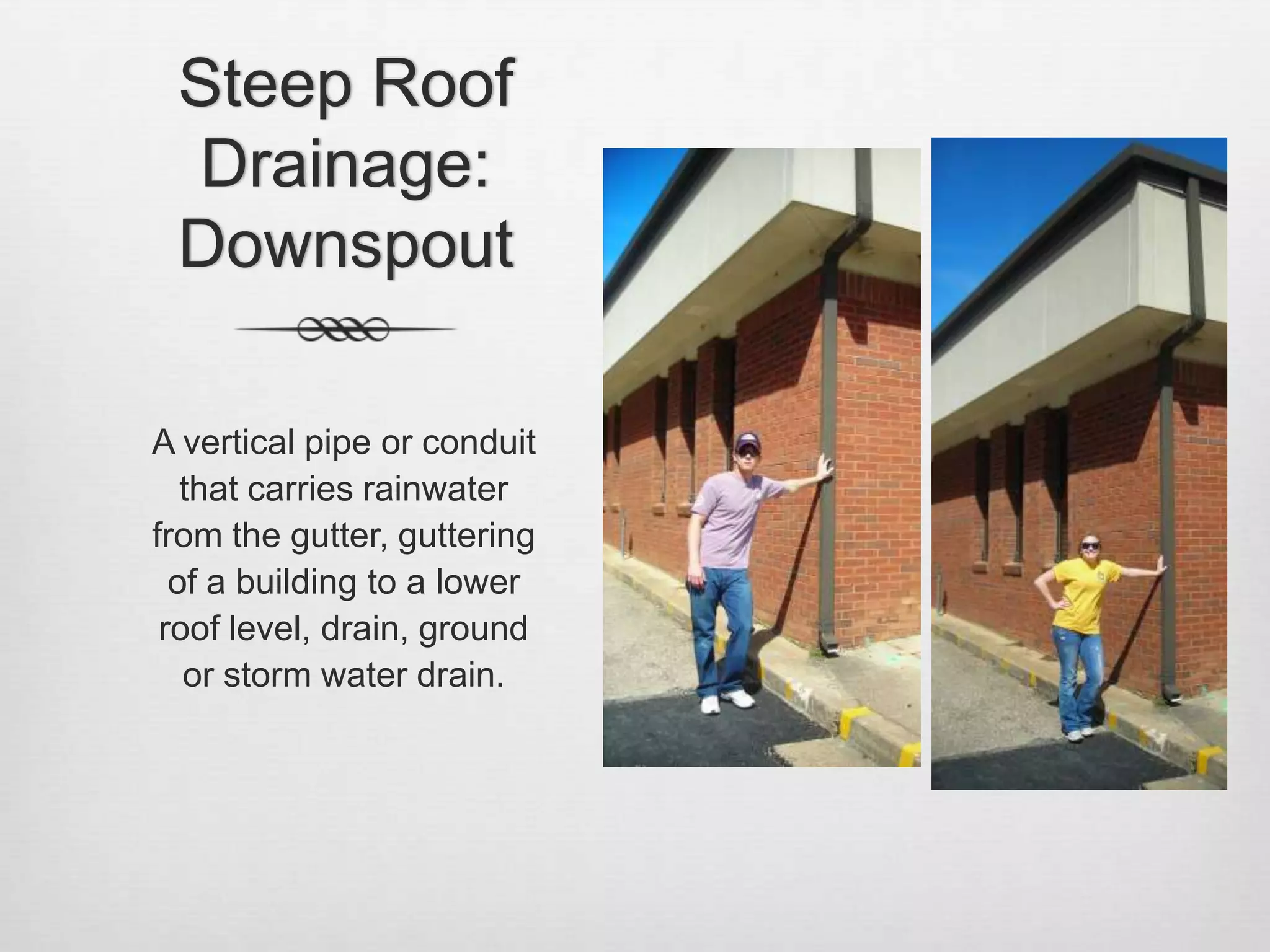
Steep Roof Drainage: DownspoutA vertical pipe or conduit that carries rainwater from the gutter, guttering of a building to a lower roof level, drain, ground or storm water drain.
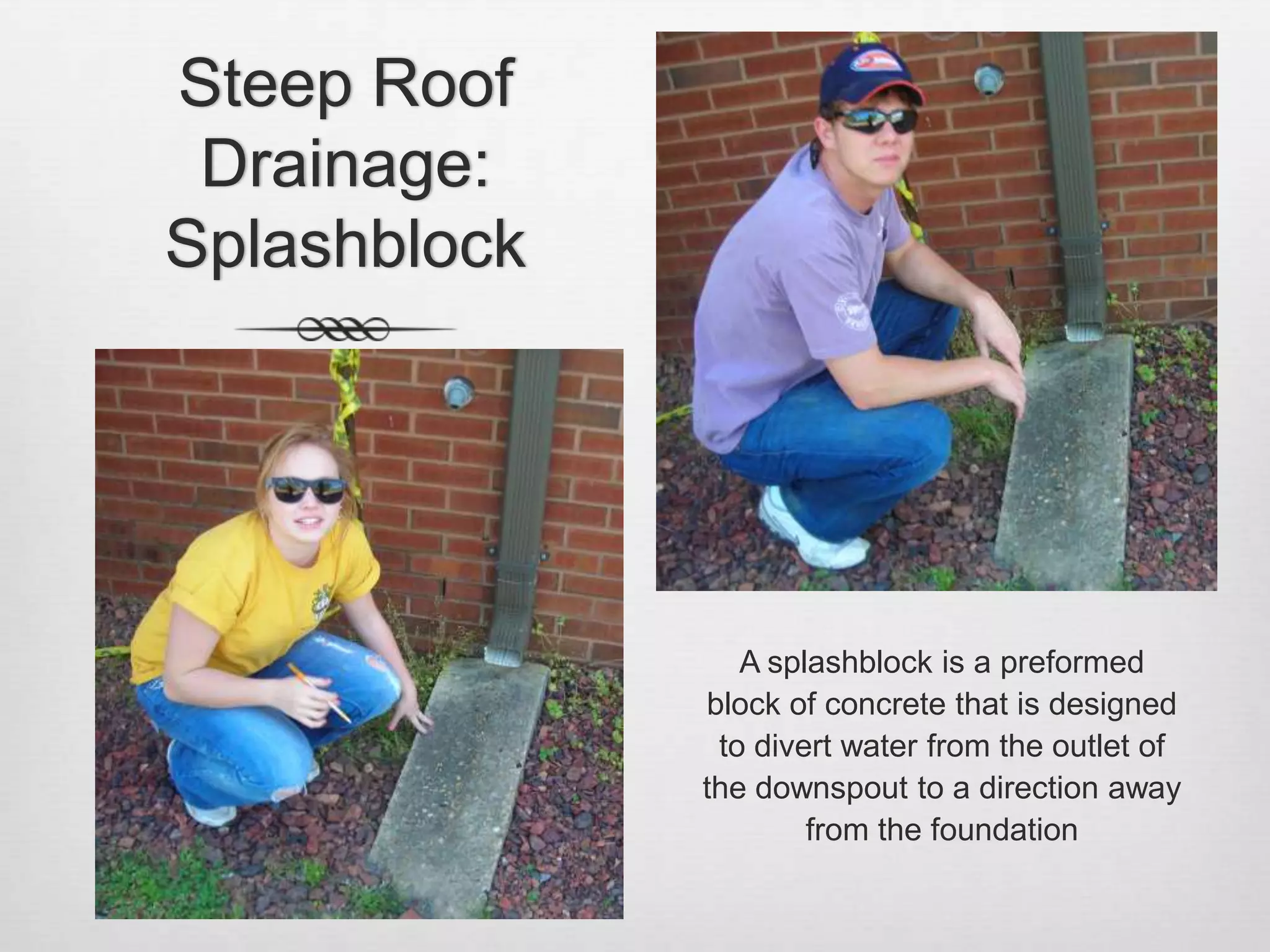
Steep Roof Drainage: SplashblockA splashblock is a preformed block of concrete that is designed to divert water from the outlet of the downspout to a direction away from the foundation
Steep Roof Materials: UnderlaymentUnderlayment is a layer of material that is laid between the roof coverage material and the decking to provide an additional element of moisture protection during and after construction.
Steep Roof Materials: Clay Tile Roof
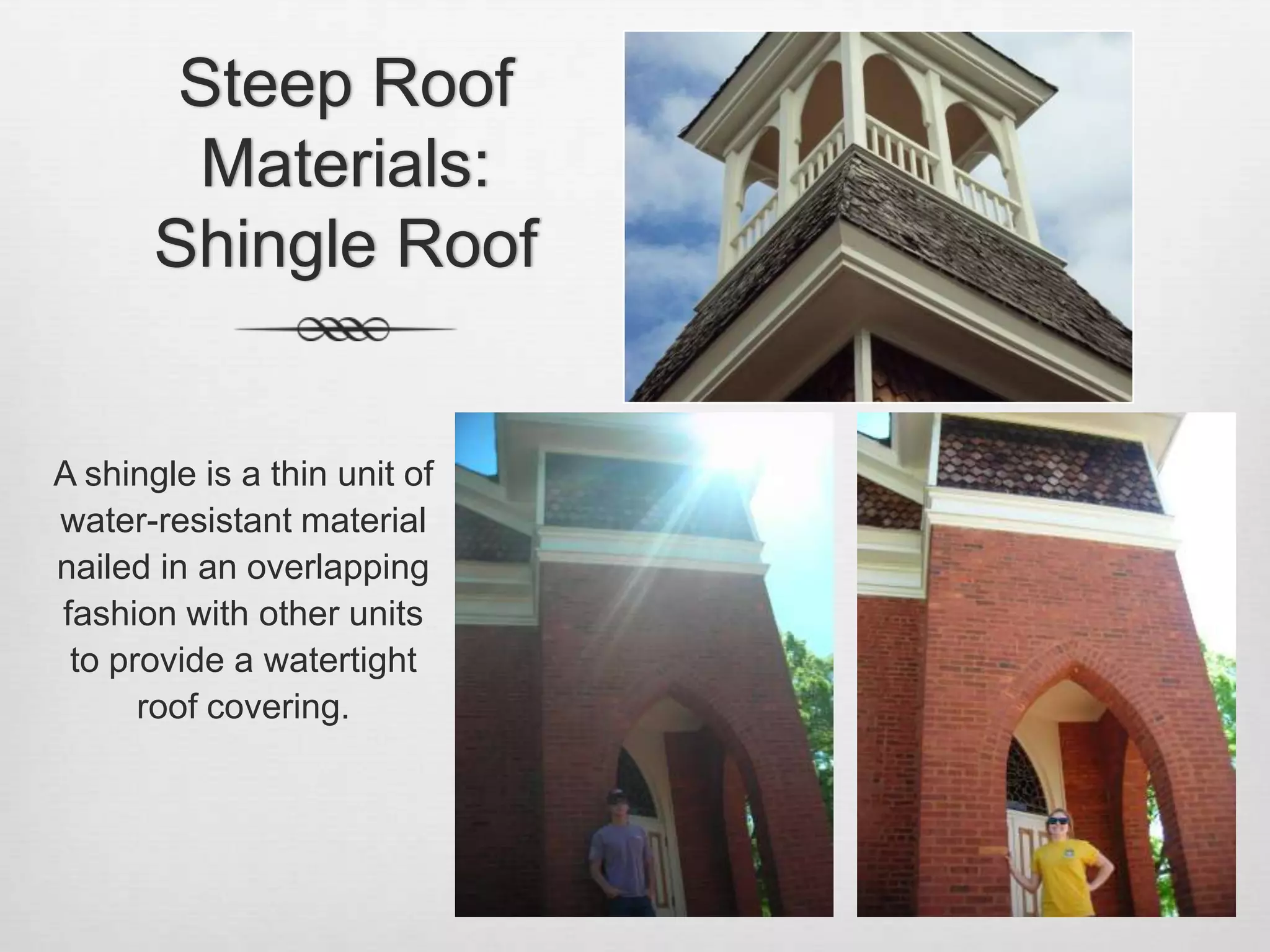
Steep Roof Materials: Shingle RoofA shingle is a thin unit of water-resistant material nailed in an overlapping fashion with other units to provide a watertight roof covering.
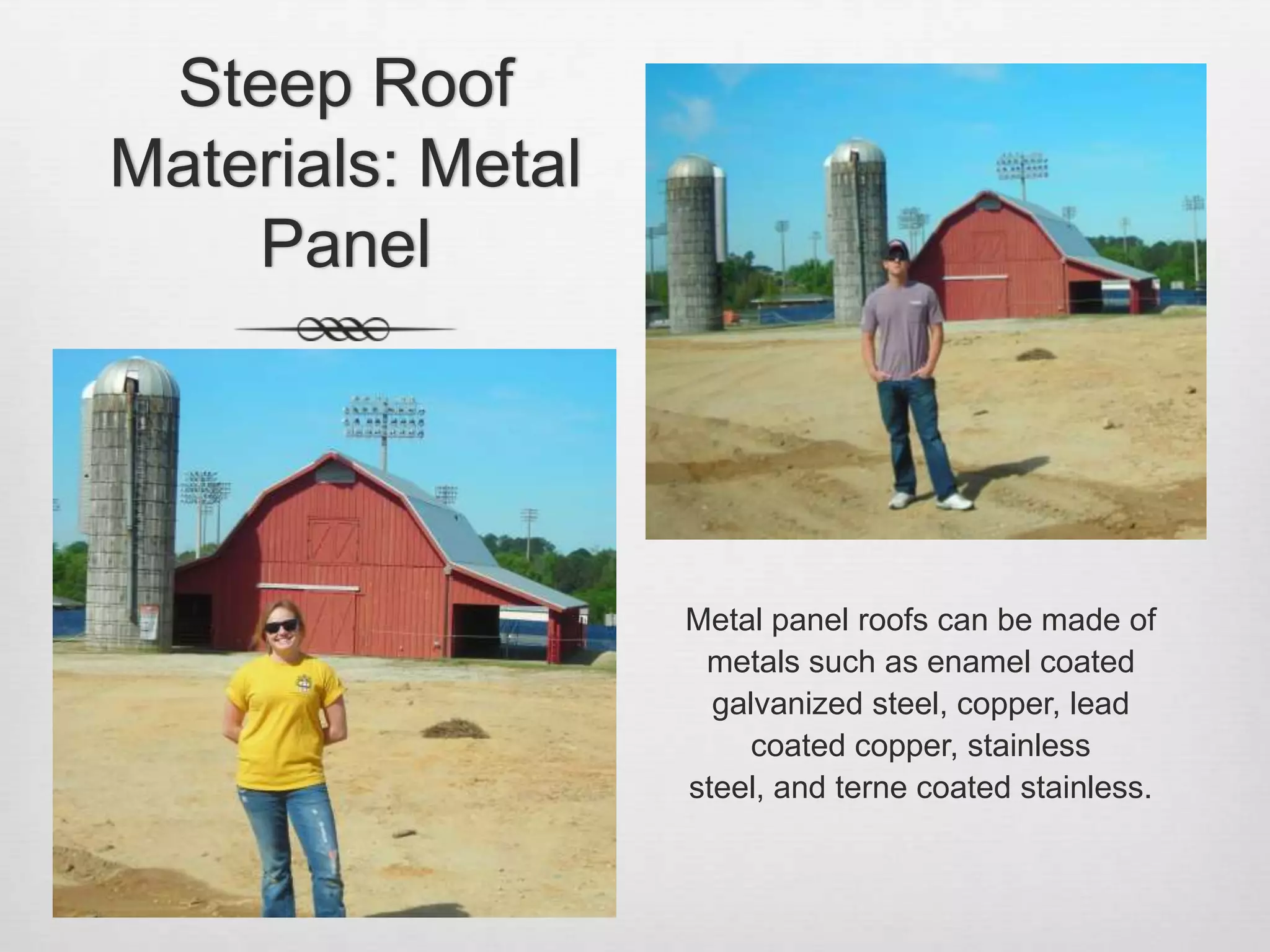
Steep Roof Materials: Metal PanelMetal panel roofs can be made of metals such as enamel coated galvanized steel, copper, lead coated copper, stainless steel, and terne coated stainless.
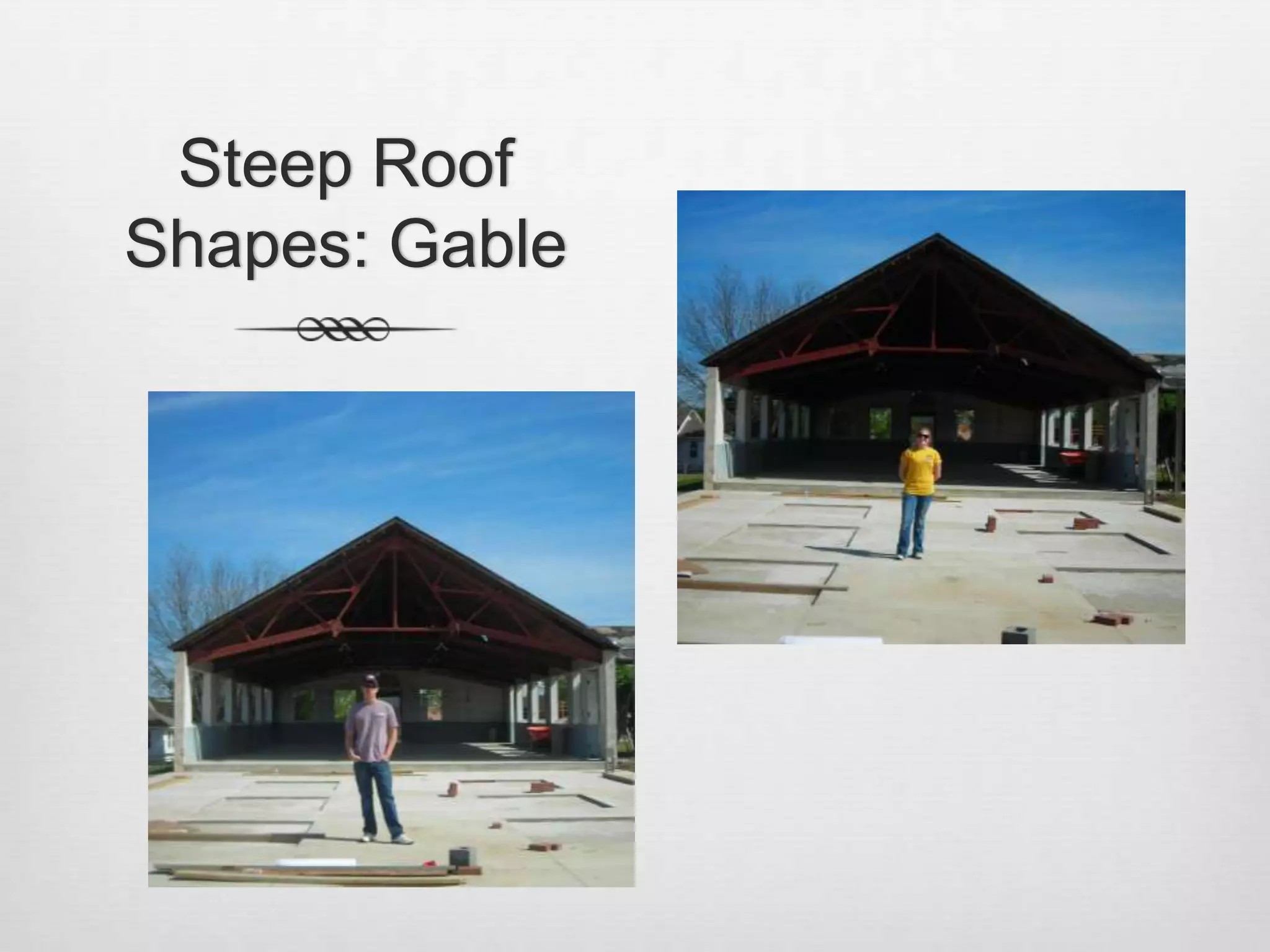
Steep Roof Shapes: Gable
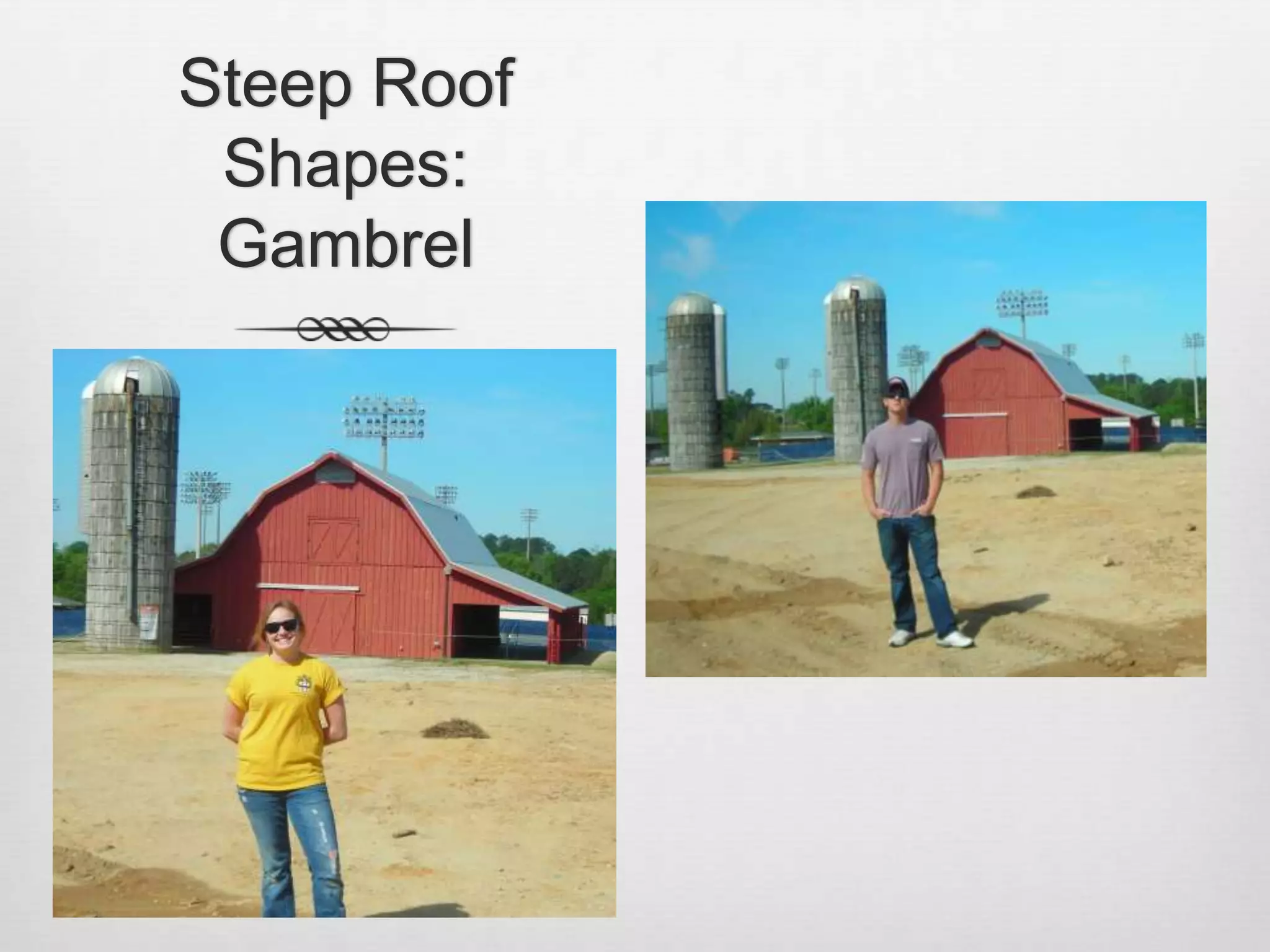
Steep Roof Shapes: Gambrel
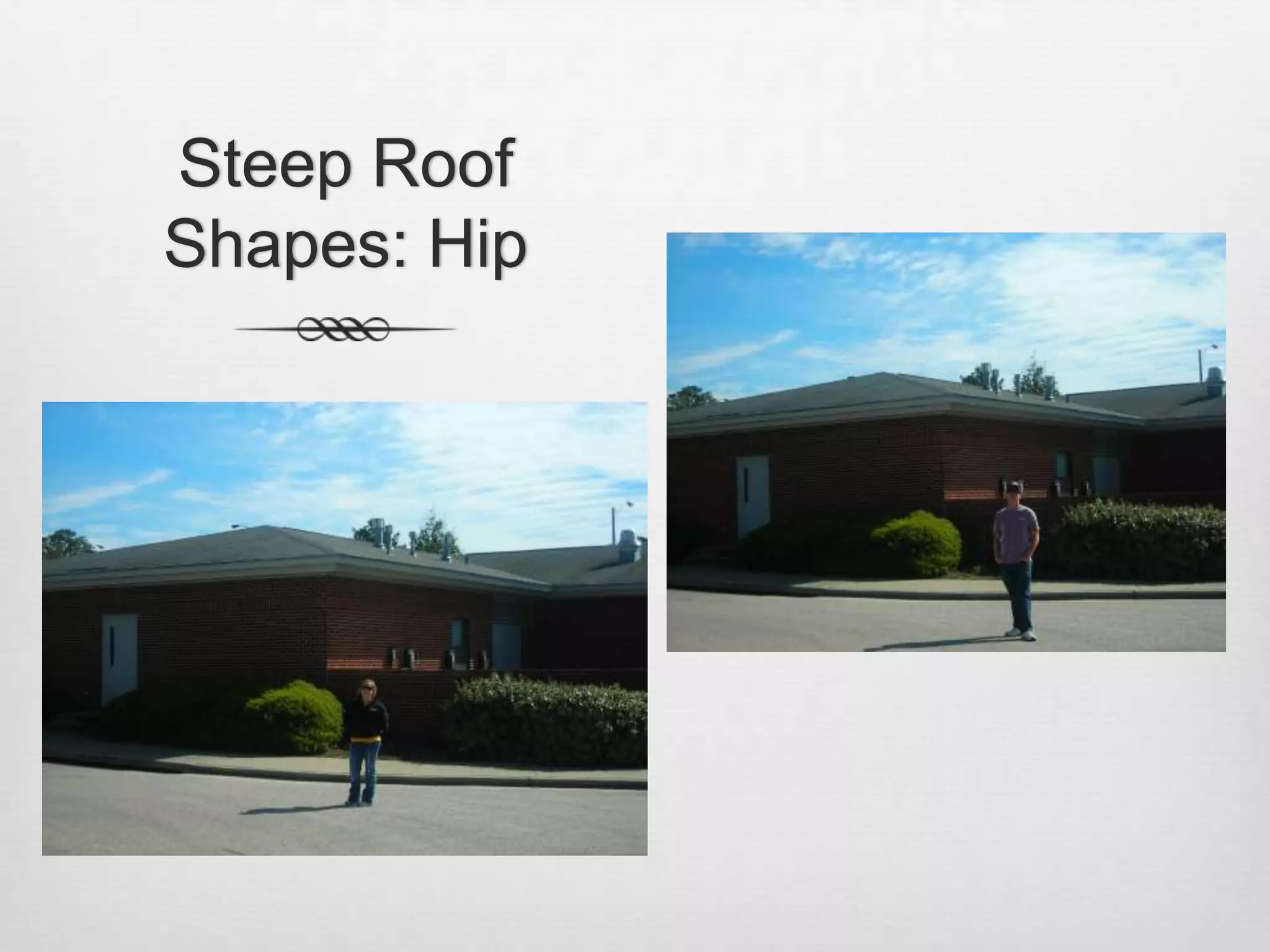
Steep Roof Shapes: Hip
Steep Roof Shapes: Mansard
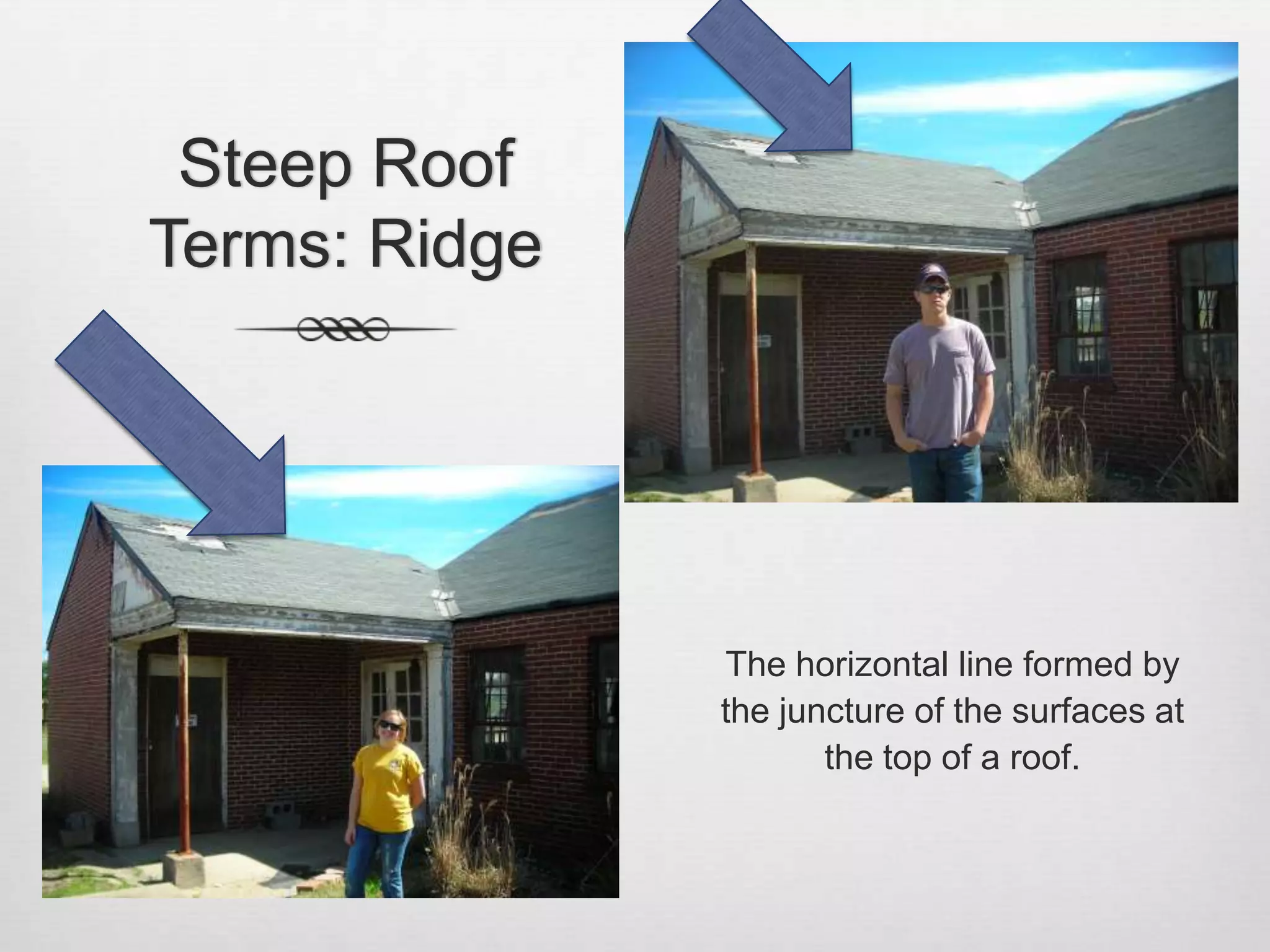
Steep Roof Terms: RidgeThe horizontal line formed by the juncture of the surfaces at the top of a roof.
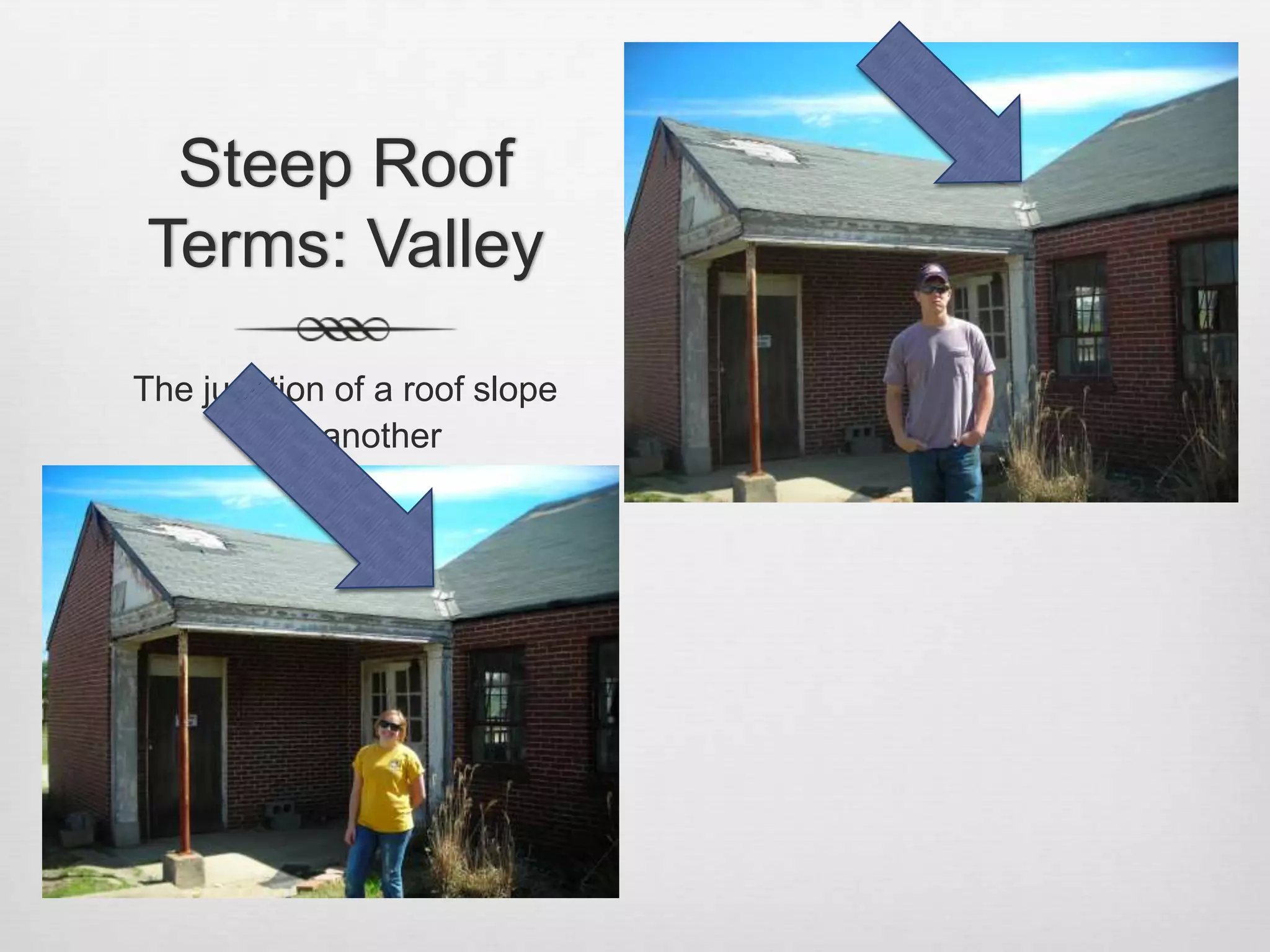
Steep Roof Terms: ValleyThe junction of a roof slope with another
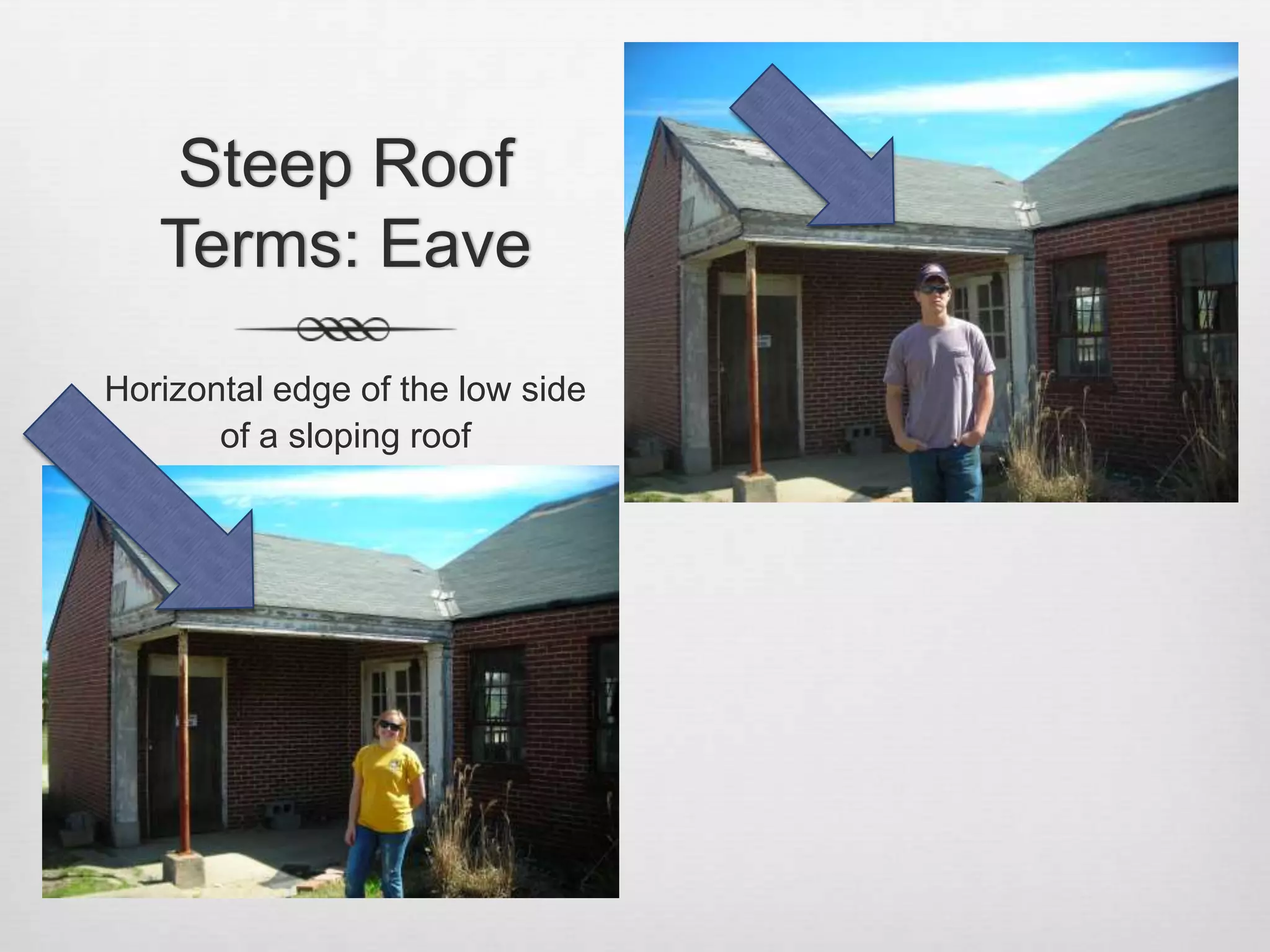
Steep Roof Terms: EaveHorizontal edge of the low side of a sloping roof
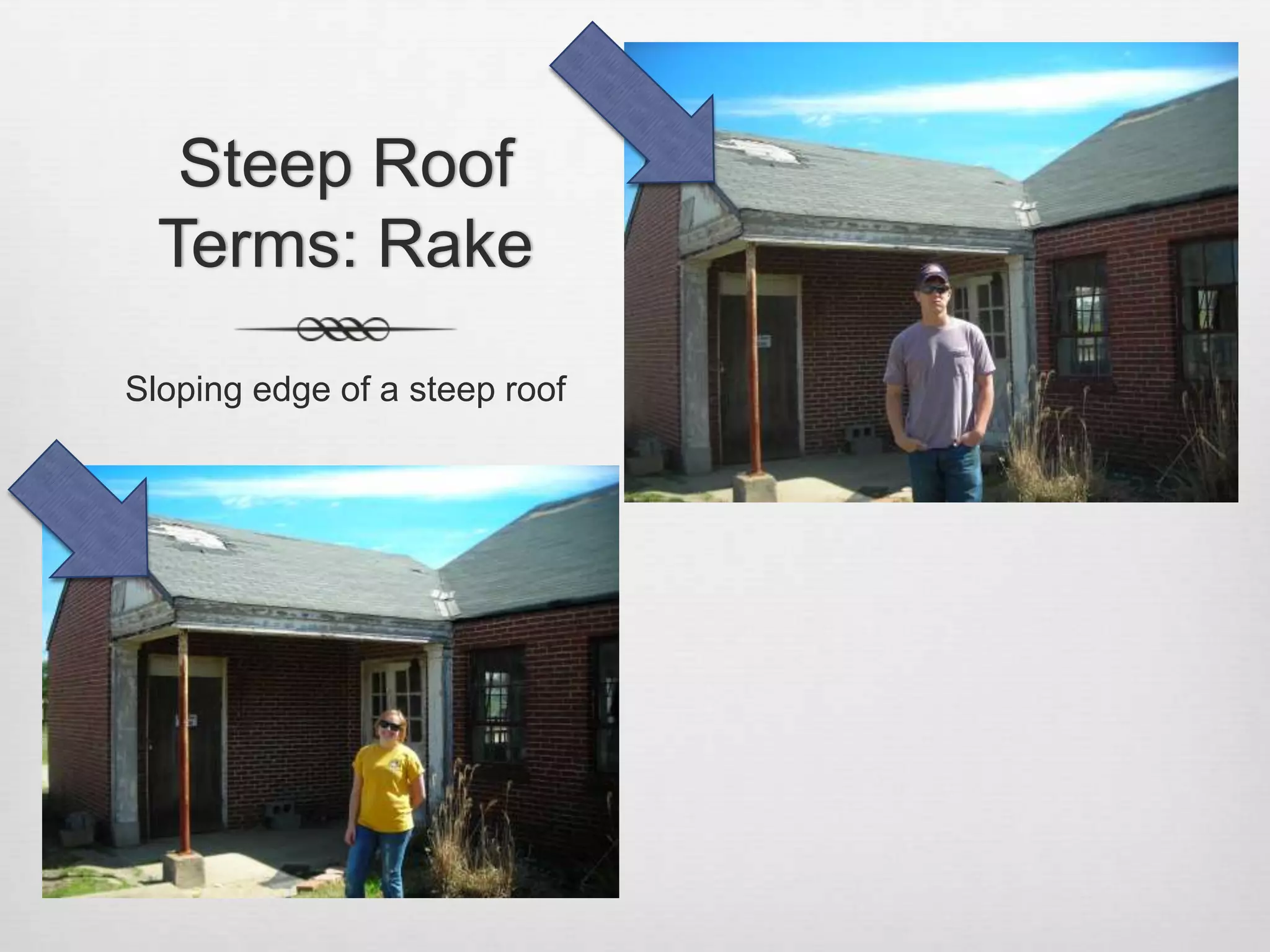
Steep Roof Terms: RakeSloping edge of a steep roof
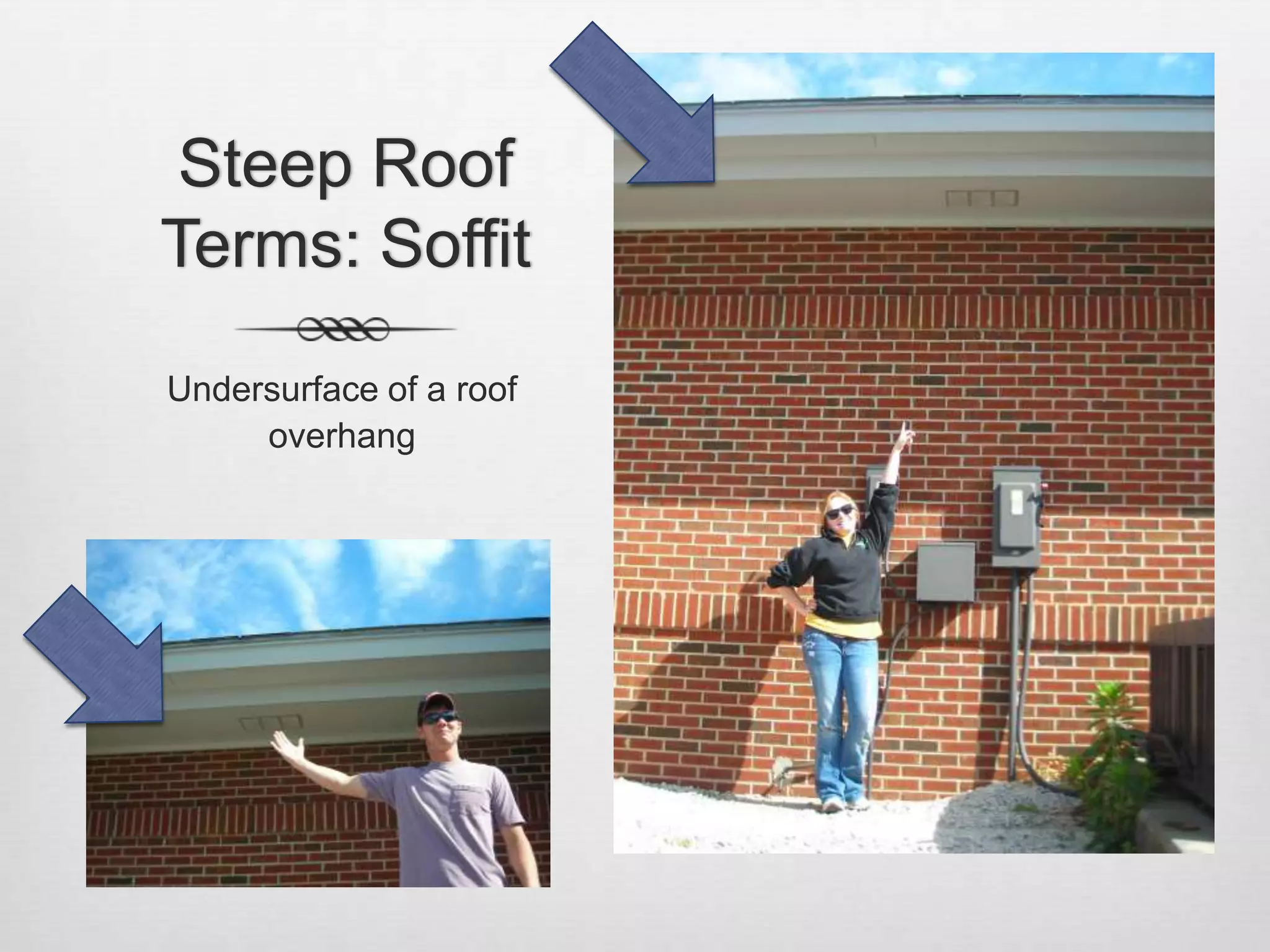
Steep Roof Terms: SoffitUndersurface of a roof overhang
Steep Roof Terms: FasciaExposed vertical edge of an eve
Steep Roof Terms: Without FasciaA Building with out an exposed vertical edge of an eve
Stone: Random Rubble
Stone: Coursed Rubble
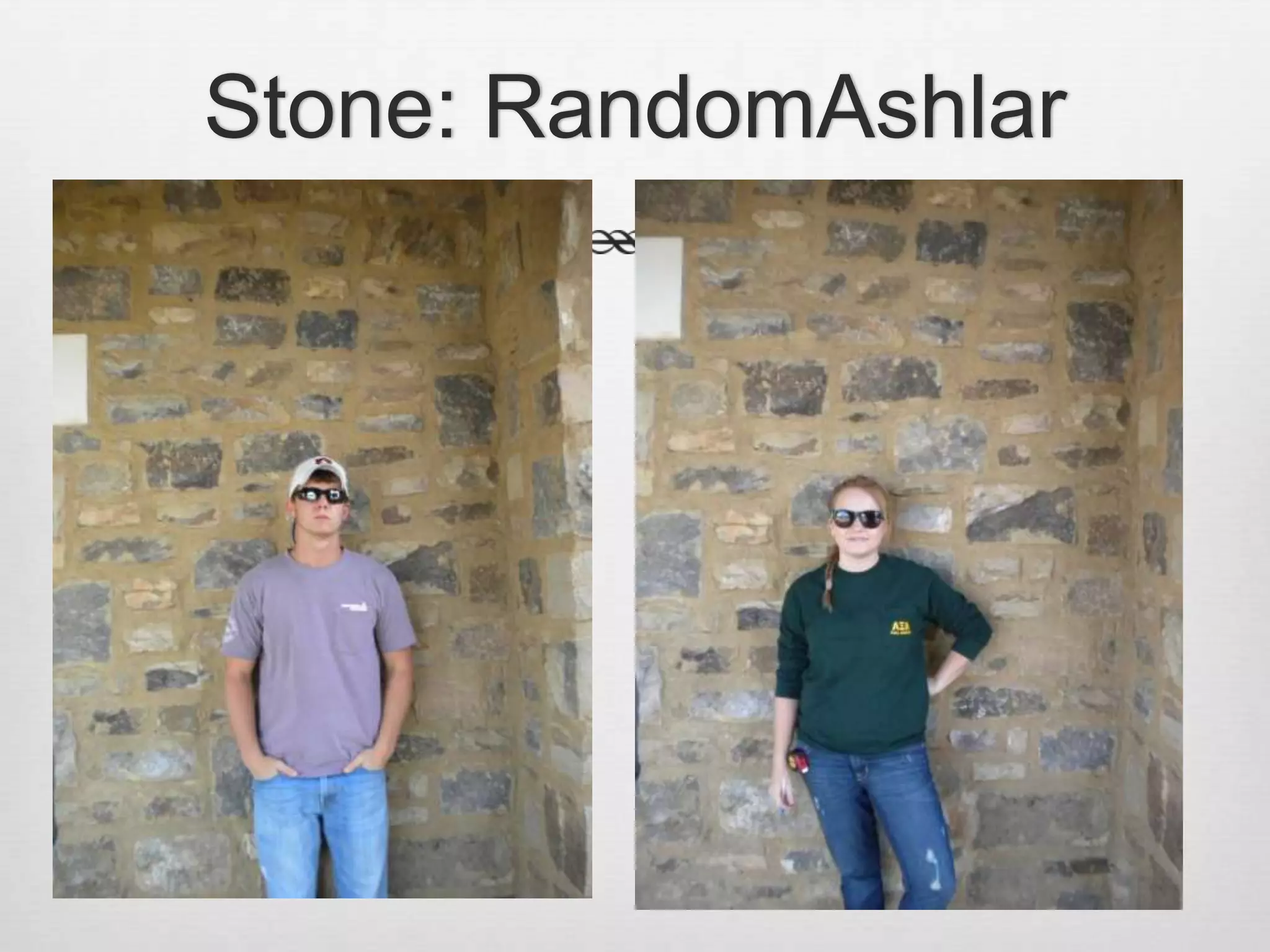
Stone: RandomAshlar
Stone: Coursed Ashlar
Vapor RetarderThe vapor retarder below is of the foil type. It’s placed on the side of the insulation that faces the exterior to slow the penetration of  water vapor through the wall.
WaterproofingThis waterproofing is of the roll on, cementituous type and is used to keep the water from penetrating the brick at the point where the wall intersects the ground.
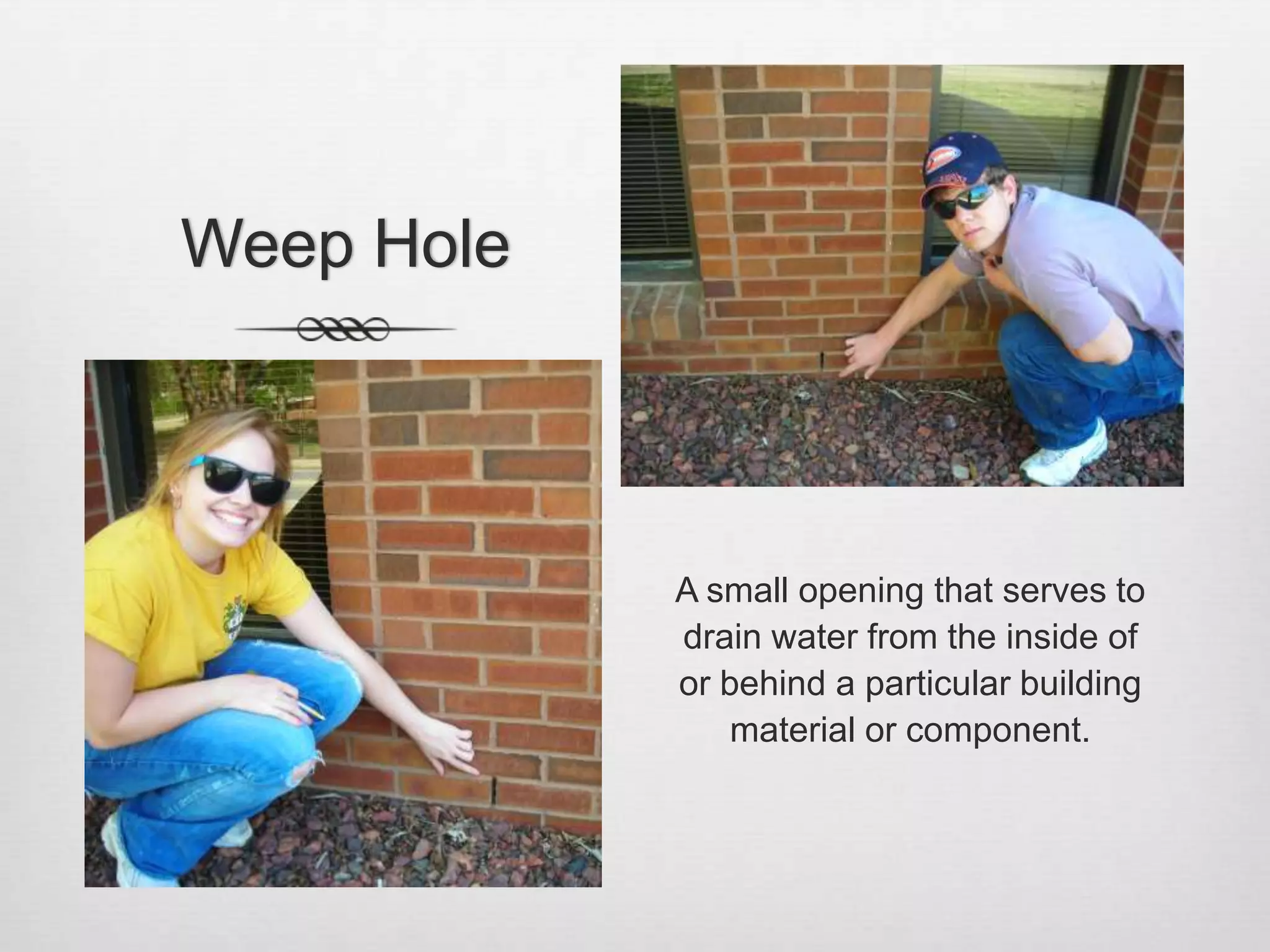
Weep HoleA small opening that serves to drain water from the inside of or behind a particular building material or component.
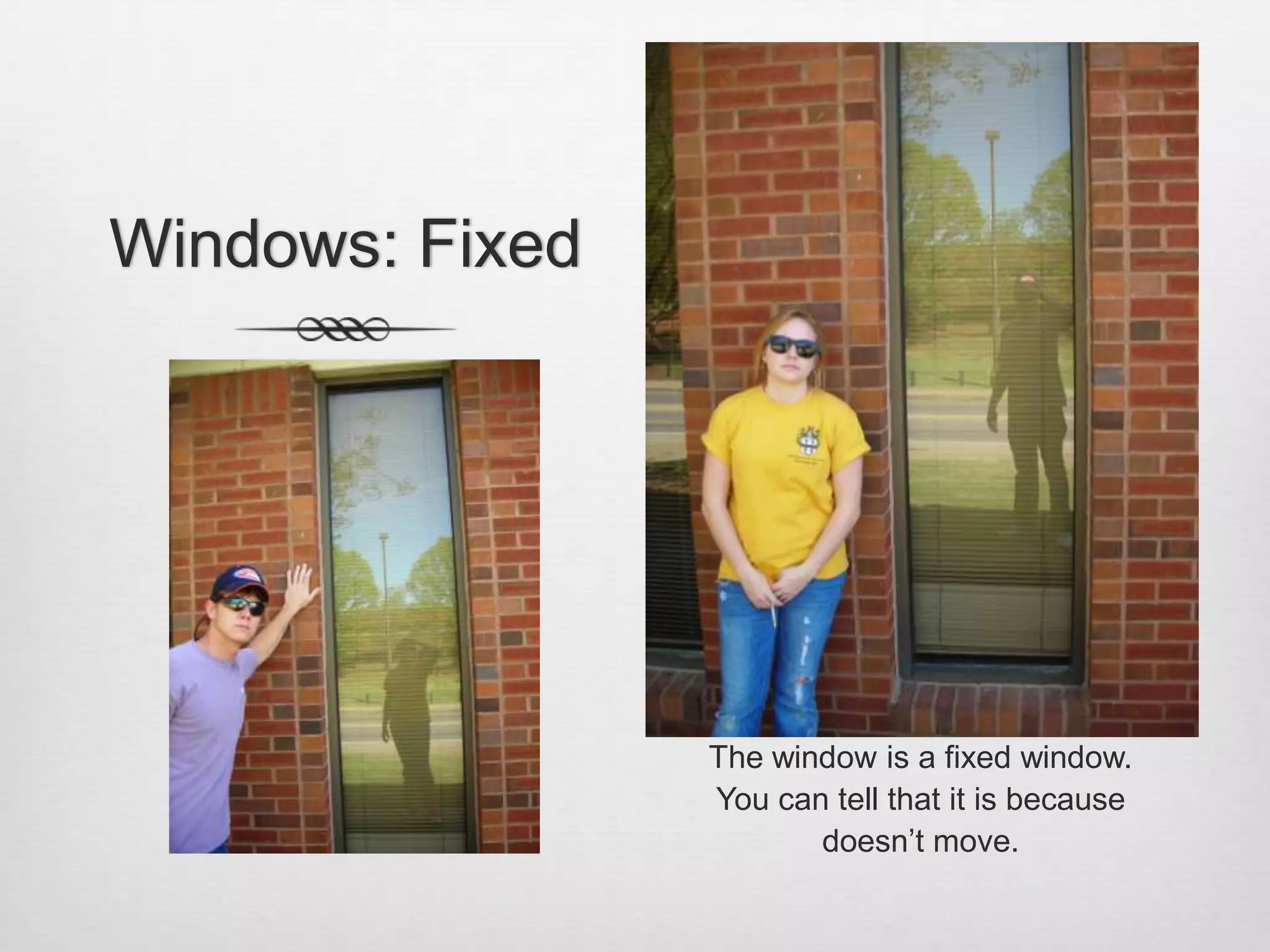
Windows: FixedThe window is a fixed window. You can tell that it is because doesn’t move.
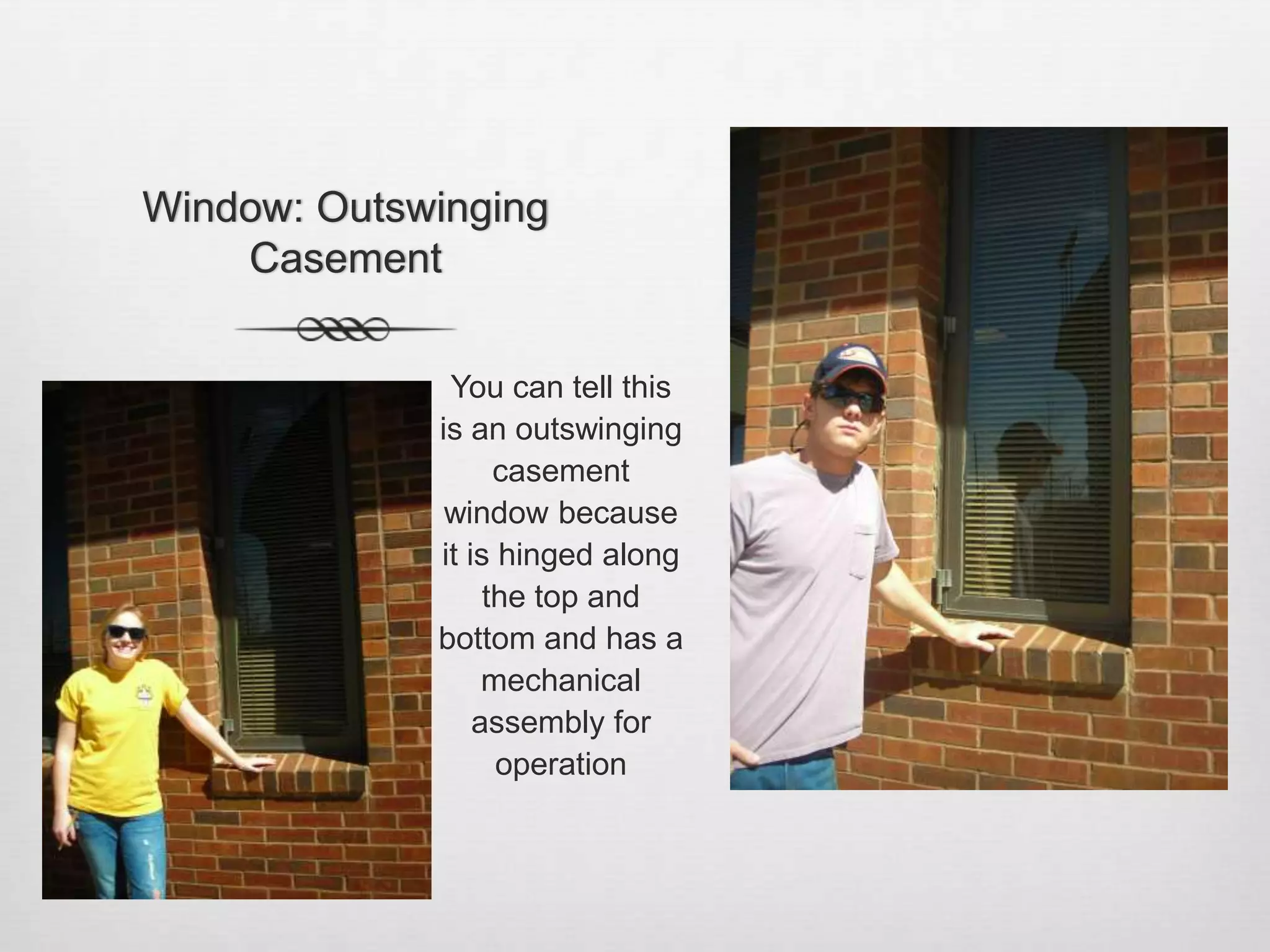
Window: Outswinging CasementYou can tell this is an outswinging casement window because it is hinged along the top and bottom and has a mechanical assembly for operation
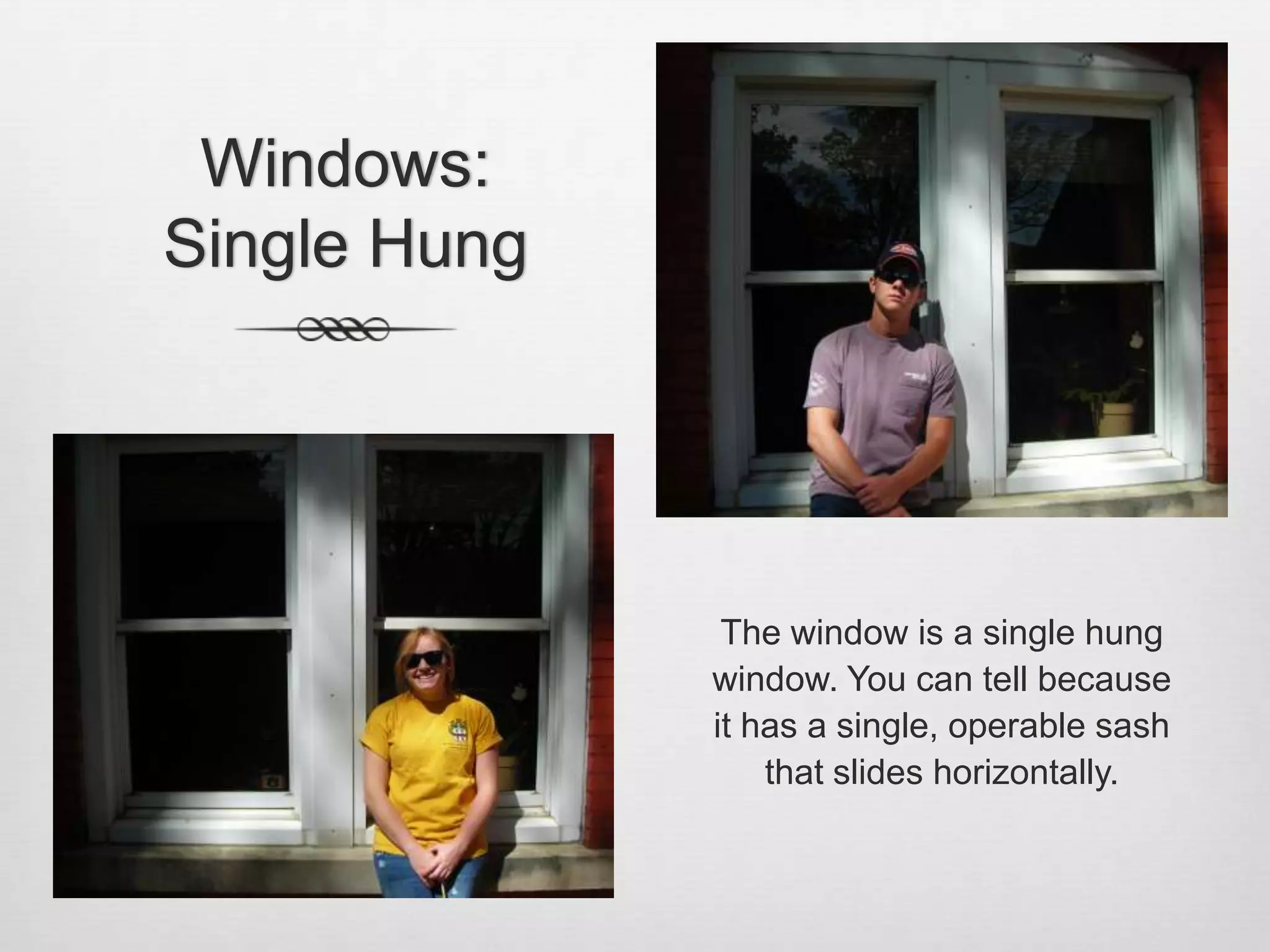
Windows: Single HungThe window is a single hung window. You can tell because it has a single, operable sash that slides horizontally.
(OLD DON'T USE) Visual Dictionary

  • 1.
  • 2.
    Air Barrier PaperAirbarrier paper is a membrane that is applied to the sheathing that serves to reduce the leakage of air between the interior and exterior of a structure. Also protects the shell from moisture during construction.
  • 3.
    Attic VentilationAttic ventilationis required to vent heat and moisture from the attic of buildings. It’s essential for proper temperature and moisture control.Four common types of ventilation include soffit vents, ridge vents, gable vents, and roof turbines.
  • 4.
    Attic Ventilation: SoffitVentAn opening under the eave of a roof, used to allow air to flow into the attic or the space below the roof sheathing.Allows for the release of heat from the soffit area. This soffit vent is made from a piece of vinyl siding designed for use as a soffit vent.
  • 5.
    Attic Ventilation: RidgeVentA long, open assembly that allows air to circulate in and out of a gable roof at the ridge. Allows for the release of the buildup of heat from the underside of a gable roof.
  • 6.
    Attic Ventilation: GableVentA screened, louvered opening in the gable that allows for heat to escape through the gable ends.
  • 7.
    Attic Ventilation: RoofTurbineA turbine vent is a passive ventilation device that exhausts humid, hot air from an attic. Some forms of turbines are equipped with an electric motor.
  • 8.
    BackhoeA backhoe isa is a piece of excavating equipment consisting of a digging bucket on the end of a two piece, hydraulic arm. It can be a piece of detachable equipment for a tractor or can be a dedicated unit. It’s used for excavating foundations, septic systems, and for digging various holes. 23 inches wide
  • 9.
    Batter BoardsHorizontal boardsnailed to corner posts located just outside the corners of a proposed building.Boards erected at the corners of a proposed building to specifically locate and show corners and show foundation wall height.
  • 10.
  • 11.
  • 12.
    Brick Arches: ArchWith a Keystone
  • 13.
    Brick Arches: CenteringAtemporary falsework structure that is erected to serve as a guide to construction and support for the finished arch. It is removed after the arch is completed.
  • 14.
    Brick Bonds: FlemishBondA bond formed by alternating stretchers and headers in every course. Used to tie two wythes together; also for appearance value.
  • 15.
    Brick Bond: RunningBondBond made of bricks laid in an offsetting position to the course below and above it. Made entirely of stretchers.
  • 16.
  • 17.
  • 18.
  • 19.
  • 20.
  • 21.
    Brick Sizes: Modular35/8" x 2 ¼" x 8"
  • 22.
    Brick Sizes:Norman3 5/8"x 2 ¼" x 11 5/8"
  • 23.
    BulldozerA bulldozer isa crawler tractor equipped with a large blade used to push large quantities of soil, sand, rubble, etc., during construction work. It is used for rough grade work and land clearing.
  • 24.
  • 25.
  • 26.
  • 27.
  • 28.
    Cladding: Wooden ShingleWoodenShake- Shingles that have been split from a solid block of woodWooden Shingle- Shingles that have been sawn from a block of wood; have even dimensionsPictured to the left are wooden shingles.
  • 29.
    Code Requirements: EgressFrom Window The IBC for emergency exit and rescue from a window requires that the net window area when open be equal to or greater than 5.7’ sq. for second floor bedrooms and for the sill to be no more than 44” AFF. It also states that the opening area of window should be at minimum, 24” wide and 34” high. The window to the right meets the AFF requirement at 26” AFF, but fails to meet the sq. footage requirement. The opening measured 5.272 sq feet and 23” high and 33” wide.
  • 30.
    Code Requirements: ResidentialStairsThe stairs shown to the right were measured with a tread depth of 11 1/4” while the risers were at a height of 7 ½”. The IBC states that for residential stairs the treads shall measure a minimum of 10” and the risers shall measure a maximum of 7 ¾”. These stairs DO meet the IBC.
  • 31.
    Concrete Joints: ControlJointA concrete control joint is placed in concrete to keep the material from cracking during normal expansion and contraction due to temperature changes.
  • 32.
    Concrete Joints: IsolationJointIsolation joints are used to relieve flexural stresses due to vertical movement of slab-on-grade applications that adjoin fixed foundation elements such as columns, building or machinery foundations, etc.Isolates Slab from Wall.
  • 33.
    Concrete Masonry Unit A block made of hardened concrete. The unit has hollow cores in the inside that allow for the installation of reinforcement. CMUs allow for quick and affordable construction. Typical dimensions are 8”x8”x16”. One course of CMUs are equal to three courses of masonry brick.
  • 34.
  • 35.
  • 36.
  • 37.
  • 38.
    Doors: Panel DoorStileTopRailLock RailPanelBottom Rail
  • 39.
    Doors: TransomA transomis a fixed window over a door or another window.
  • 40.
    Doors: SidelightsA sidelightis a window, usually with a vertical emphasis, that sits on either side of a door.
  • 41.
    Electrical Components: TransformerBoxA electrical transformer is used to reduce the high voltage in power transmission lines down to voltage that is suitable for use in normal applications. They can either be mounted on a pole for overhead service or in a box like this one for underground service.
  • 42.
    Electrical Components: ServiceHeadThe service head is the location where the electrical service is routed from the high voltage lines down conduit and into the meter and meter box assembly.
  • 43.
    Electrical Components: MeterThemeter is a device that measures the amount of electricity supplied to the residence.
  • 44.
    Electrical Components: ServicePanelThe location where electricity is distributed throughout the home to various circuits. Also the place where the electricity can be turned on and off.
  • 45.
    Electrical Components: DuplexReceptacleA duplex receptacle is a device used to transfer the electrical current from the wiring in the walls to the walls’ surface. They make a connection point so devices can be hooked up to and removed from the electrical current with ease.
  • 46.
  • 47.
  • 48.
  • 49.
  • 50.
  • 51.
  • 52.
  • 53.
  • 54.
  • 55.
  • 56.
  • 57.
  • 58.
  • 59.
    Front End LoaderAfront end loader is a piece of equipment primarily used to "load" material (asphalt, demolition debris, dirt, feed, gravel, logs, raw minerals, recycled material, rock, sand, wood chips, etc.) into or onto another type of machinery. Can also be used to dig or move fill on the jobsite.
  • 60.
    Gypsum BoardA constructionmaterial used for wall and ceiling coverage inside buildings. Gypsum is made using panels made of gypsum plaster pressed between two thick sheets of paper, then kiln dried. Often called sheetrock or drywall.
  • 61.
    Heat PumpA heatpump is a device that uses a refrigeration cycle either to heat or cool a building by passing air or water over either the evaporating or condensing coils.The compressor/evaporator moves the coolant around through the unit to facilitate operation. The air handler moves the physical air around through the duct work and across the condenser.One advantage is the affordability of the unit to purchase and operate. The major disadvantage of the heat pump is its inability to operate well at very low temperatures and thus requiring a back-up system.
  • 62.
  • 63.
    InsulationInsulation refers broadlyto any object in a building used as insulation for any purpose. Whilst the majority of insulation in buildings is for thermal purposes, the term also applies to acoustic insulation.Its primary use is to reduce the effects of the temperature of the outside ambient air and/or the air in adjoining regions.
  • 64.
  • 65.
  • 66.
  • 67.
  • 68.
    LintelThe lintel isthe horizontal crosspiece over an opening, such as a door, window, carrying the weight of the masonry above it. Its used in CMU and masonry construction to span across openings. Two common lintel types are angle iron and concrete. This is an angle iron type.
  • 69.
    Mortar Joints: TooledThejoint below is a tooled joint. It is vee. The joint was measured at 3/8”. Mortar type is most likely N since the brick is simply for use as a cladding on the Auburn Chemistry Building.
  • 70.
    Mortar Joint: TroweledThejoint below is a troweled joint. It is a flush joint. It measured at 3/8”. It is most likely type N. The brick serves as cladding on the outside of a residence.
  • 71.
    Oriented Strand Board(OSB)OSB is an engineered wood panel product that is manufactured in wide mats from cross-oriented layers of thin, rectangular wooden strips compressed and bonded together with wax and resin adhesives. It is a nonveneered product.
  • 72.
    Plumbing: LavatoryA lavatoryusually is drained by 1 ½” piping.
  • 73.
    Plumbing: Water ClosetAwater closet is usually drained with 3” piping.
  • 74.
  • 75.
    Plumbing: Vent PlumbingPlumbingvents allow for air to enter the piping system and prevent a suction from forming in piping. It allows for free drainage.
  • 76.
    Plumbing: SinkThe sinkpictured below is a drop in kitchen sink.
  • 77.
    PlywoodPlywood is atype of engineered wood made from thin sheets of wood, called plies or wood veneers. The layers are glued together so that adjacent plies have their grain at right angles to each other for greater strength
  • 78.
  • 79.
    Reinforcing Bar (Rebar)Therebar below is number 3, or 3/8”, in diameter. The indentations on the surface of the steel is to give the rebar a better bond with the concrete it’s embedded in.
  • 80.
    Steep Roof Drainage:GutterA gutter is a narrow channel which collects rainwater from the roof of a building and diverts it into a downspout.
  • 81.
    Steep Roof Drainage:DownspoutA vertical pipe or conduit that carries rainwater from the gutter, guttering of a building to a lower roof level, drain, ground or storm water drain.
  • 82.
    Steep Roof Drainage:SplashblockA splashblock is a preformed block of concrete that is designed to divert water from the outlet of the downspout to a direction away from the foundation
  • 83.
    Steep Roof Materials:UnderlaymentUnderlayment is a layer of material that is laid between the roof coverage material and the decking to provide an additional element of moisture protection during and after construction.
  • 84.
    Steep Roof Materials:Clay Tile Roof
  • 85.
    Steep Roof Materials:Shingle RoofA shingle is a thin unit of water-resistant material nailed in an overlapping fashion with other units to provide a watertight roof covering.
  • 86.
    Steep Roof Materials:Metal PanelMetal panel roofs can be made of metals such as enamel coated galvanized steel, copper, lead coated copper, stainless steel, and terne coated stainless.
  • 87.
  • 88.
  • 89.
  • 90.
  • 91.
    Steep Roof Terms:RidgeThe horizontal line formed by the juncture of the surfaces at the top of a roof.
  • 92.
    Steep Roof Terms:ValleyThe junction of a roof slope with another
  • 93.
    Steep Roof Terms:EaveHorizontal edge of the low side of a sloping roof
  • 94.
    Steep Roof Terms:RakeSloping edge of a steep roof
  • 95.
    Steep Roof Terms:SoffitUndersurface of a roof overhang
  • 96.
    Steep Roof Terms:FasciaExposed vertical edge of an eve
  • 97.
    Steep Roof Terms:Without FasciaA Building with out an exposed vertical edge of an eve
  • 98.
  • 99.
  • 100.
  • 101.
  • 102.
    Vapor RetarderThe vaporretarder below is of the foil type. It’s placed on the side of the insulation that faces the exterior to slow the penetration of water vapor through the wall.
  • 103.
    WaterproofingThis waterproofing isof the roll on, cementituous type and is used to keep the water from penetrating the brick at the point where the wall intersects the ground.
  • 104.
    Weep HoleA smallopening that serves to drain water from the inside of or behind a particular building material or component.
  • 105.
    Windows: FixedThe windowis a fixed window. You can tell that it is because doesn’t move.
  • 106.
    Window: Outswinging CasementYoucan tell this is an outswinging casement window because it is hinged along the top and bottom and has a mechanical assembly for operation
  • 107.
    Windows: Single HungThewindow is a single hung window. You can tell because it has a single, operable sash that slides horizontally.