Visual Dictionary BSCI 2300
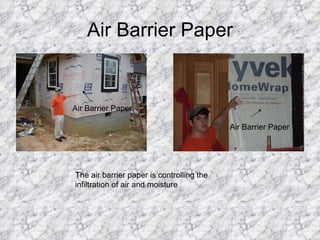
Air Barrier Paper Air Barrier Paper Air Barrier Paper The air barrier paper is controlling the infiltration of air and moisture
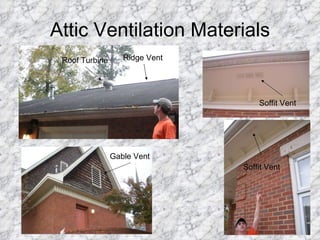
Attic Ventilation Materials Roof Turbine Ridge Vent Soffit Vent Soffit Vent Gable Vent
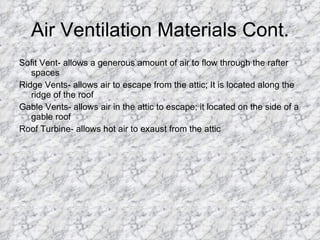
Air Ventilation Materials Cont. Sofit Vent- allows a generous amount of air to flow through the rafter spaces  Ridge Vents- allows air to escape from the attic; It is located along the ridge of the roof Gable Vents- allows air in the attic to escape; it located on the side of a gable roof Roof Turbine- allows hot air to exaust from the attic
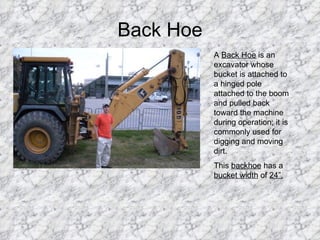
Back Hoe A  Back Hoe  is an excavator whose bucket is attached to a hinged pole attached to the boom and pulled back toward the machine during operation; it is commonly used for digging and moving dirt.  This  backhoe  has a  bucket width  of  24”.
Batter Boards
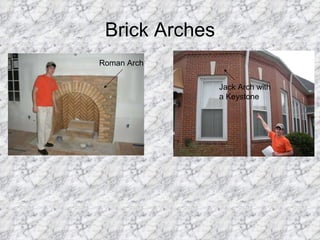
Brick Arches Jack Arch with a Keystone Roman Arch
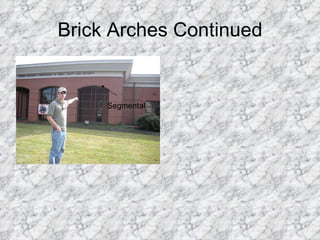
Brick Arches Continued Segmental
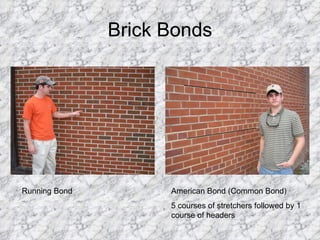
Brick Bonds Running Bond American Bond (Common Bond) 5 courses of stretchers followed by 1 course of headers
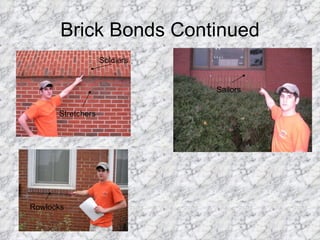
Brick Bonds Continued Soldiers Stretchers Sailors Rowlocks
Brick Bonds Continued Header Shiner
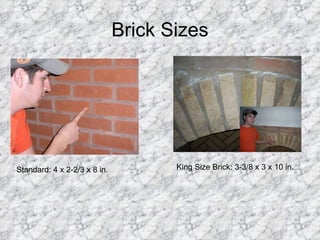
Brick Sizes Standard: 4 x 2-2/3 x 8 in. King Size Brick: 3-3/8 x 3 x 10 in.
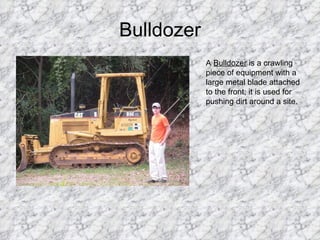
Bulldozer A  Bulldozer  is a crawling piece of equipment with a large metal blade attached to the front; it is used for pushing dirt around a site.
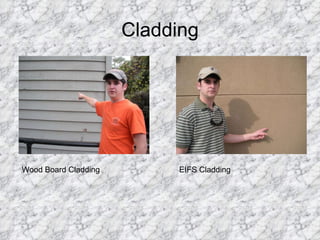
Cladding Wood Board Cladding EIFS Cladding
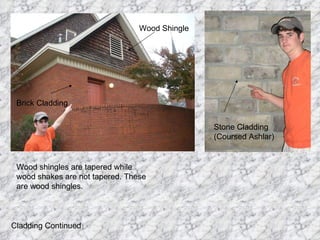
Brick Cladding Wood Shingle Stone Cladding (Coursed Ashlar) Cladding Continued Wood shingles are tapered while wood shakes are not tapered. These are wood shingles.

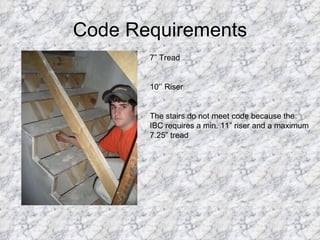
Code Requirements 7” Tread 10’’ Riser The stairs do not meet code because the IBC requires a min. 11” riser and a maximum 7.25” tread
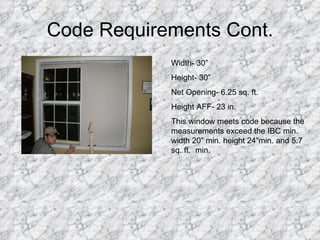
Code Requirements Cont. Width- 30”  Height- 30” Net Opening- 6.25 sq. ft. Height AFF- 23 in. This window meets code because the measurements exceed the IBC min. width 20” min. height 24”min. and 5.7 sq. ft.  min.
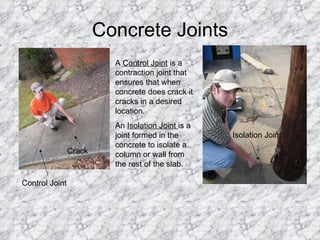
Concrete Joints Crack Control Joint A  Control Joint  is a contraction joint that ensures that when concrete does crack it cracks in a desired location. An  Isolation Joint  is a joint formed in the concrete to isolate a column or wall from the rest of the slab. Isolation Joint
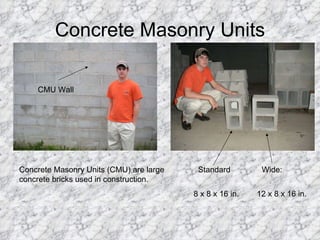
Concrete Masonry Units CMU Wall Concrete Masonry Units (CMU) are large concrete bricks used in construction. Standard  Wide:  8 x 8 x 16 in.  12 x 8 x 16 in.
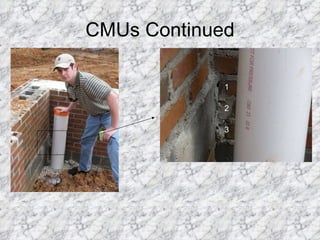
CMUs Continued 1 2 3
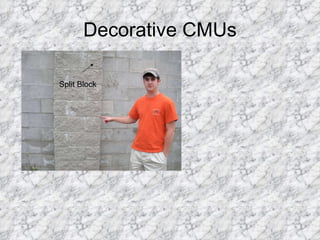
Decorative CMUs Split Block
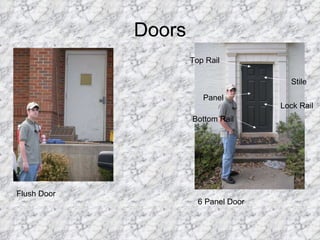
Doors Flush Door 6 Panel Door Top Rail Stile Panel Lock Rail Bottom Rail
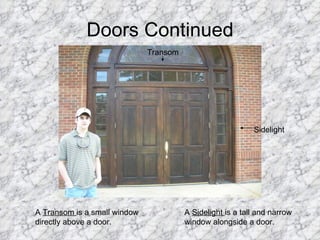
Doors Continued Sidelight Transom A  Transom  is a small window directly above a door. A  Sidelight  is a tall and narrow window alongside a door.
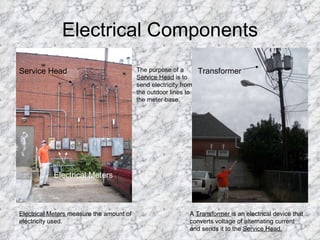
Electrical Components Transformer Electrical Meters Electrical Meters  measure the amount of electricity used. A  Transformer  is an electrical device that converts voltage of alternating current and sends it to the  Service Head. Service Head The purpose of a  Service Head  is to send electricity from the outdoor lines to the meter base.
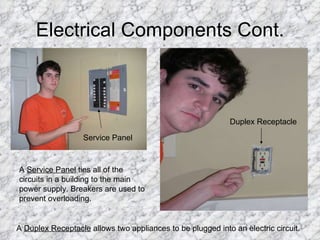
Electrical Components Cont. Service Panel Duplex Receptacle A  Service Panel  ties all of the circuits in a building to the main power supply. Breakers are used to prevent overloading. A  Duplex Receptacle  allows two appliances to be plugged into an electric circuit.
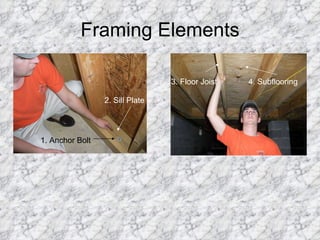
Framing Elements 1. Anchor Bolt 2. Sill Plate 4. Subflooring 3. Floor Joist
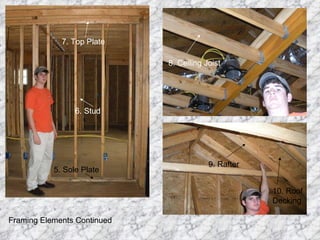
5. Sole Plate 6. Stud 7. Top Plate 8. Ceiling Joist 9. Rafter 10. Roof Decking Framing Elements Continued
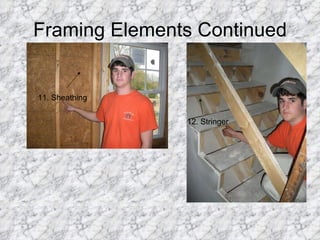
Framing Elements Continued 11. Sheathing 12. Stringer
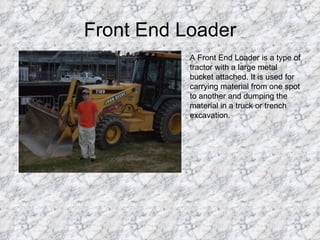
Front End Loader A Front End Loader is a type of tractor with a large metal bucket attached. It is used for carrying material from one spot to another and dumping the material in a truck or trench excavation.
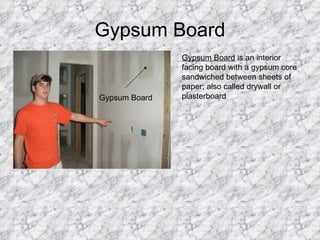
Gypsum Board Gypsum Board Gypsum Board  is an interior facing board with a gypsum core sandwiched between sheets of paper; also called drywall or plasterboard
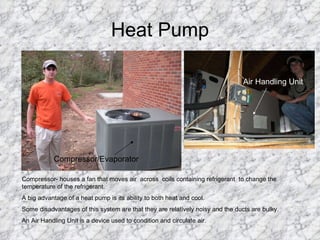
Heat Pump Compressor/Evaporator Air Handling Unit Compressor- houses a fan that moves air  across  coils containing refrigerant  to change the temperature of the refrigerant. A big advantage of a heat pump is its ability to both heat and cool. Some disadvantages of this system are that they are relatively noisy and the ducts are bulky. An Air Handling Unit is a device used to condition and circulate air.
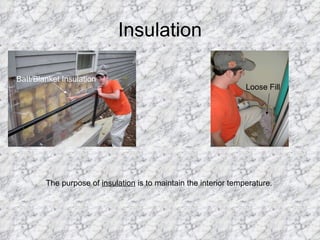
Insulation Batt/Blanket Insulation Loose Fill The purpose of  insulation  is to maintain the interior temperature.
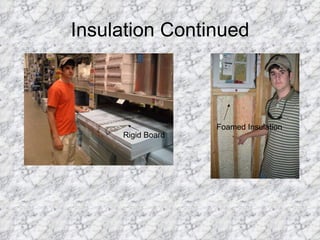
Insulation Continued Rigid Board Foamed Insulation
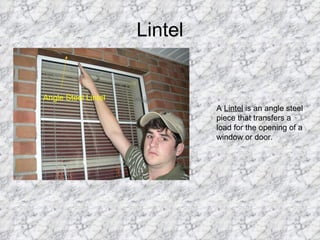
Lintel A  Lintel  is an angle steel piece that transfers a load for the opening of a window or door. Angle Steel Lintel
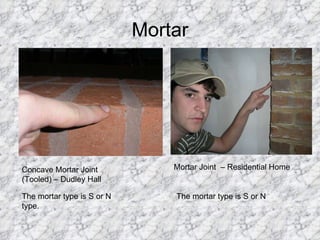
Mortar Concave Mortar Joint (Tooled) – Dudley Hall  The mortar type is S or N type. Mortar Joint  – Residential Home The mortar type is S or N
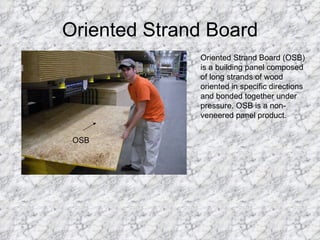
Oriented Strand Board OSB Oriented Strand Board (OSB) is a building panel composed of long strands of wood oriented in specific directions and bonded together under pressure. OSB is a non-veneered panel product.
Plumbing Lavatory Water Closet A water closet uses a 3” drain pipe, and a lavatory uses a 1 ½’’ drain pipe.
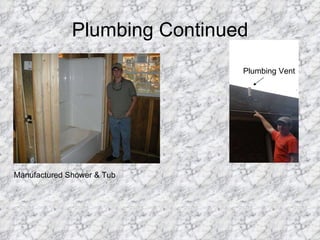
Plumbing Continued Manufactured Shower & Tub Plumbing Vent
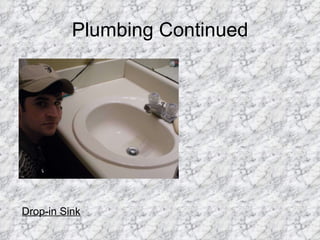
Plumbing Continued Drop-in Sink
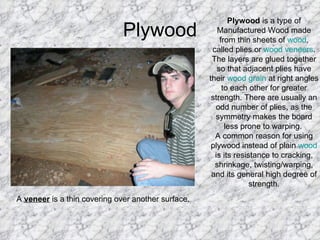
Plywood Plywood  is a type of Manufactured Wood made from thin sheets of  wood , called plies or  wood veneers . The layers are glued together so that adjacent plies have their  wood grain  at right angles to each other for greater strength. There are usually an odd number of plies, as the symmetry makes the board less prone to warping.  A common reason for using plywood instead of plain  wood  is its resistance to cracking, shrinkage, twisting/warping, and its general high degree of strength. A  veneer  is a thin covering over another surface.
Radiant Barrier Picture of one installed and tell what it is doing.
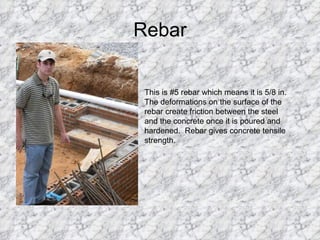
Rebar This is #5 rebar which means it is 5/8 in. The deformations on the surface of the rebar create friction between the steel and the concrete once it is poured and hardened.  Rebar gives concrete tensile strength.
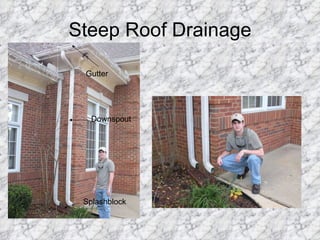
Steep Roof Drainage Gutter Downspout Splashblock
Steep Roof Drainage Cont. Gutter- A narrow channel which collects rainwater from the roof of a building and diverts it away from the structure, typically into a drain.  Downspout- a vertical pipe for carrying rainwater from a rain gutter to ground level. There the water is directed to a sewer, rainwater harvesting or let into the ground through seepage.  Splashblock- a plastic or concrete block placed below the gutter to avoid erosion from fast moving water.
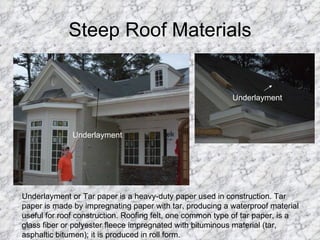
Steep Roof Materials Underlayment Underlayment Underlayment or Tar paper is a heavy-duty paper used in construction. Tar paper is made by impregnating paper with tar, producing a waterproof material useful for roof construction. Roofing felt, one common type of tar paper, is a glass fiber or polyester fleece impregnated with bituminous material (tar, asphaltic bitumen); it is produced in roll form.
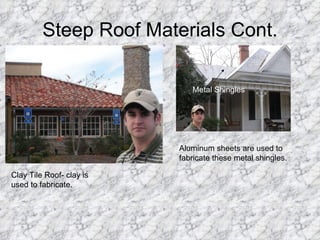
Steep Roof Materials Cont. Clay Tile Roof- clay is used to fabricate.  Aluminum sheets are used to fabricate these metal shingles.  Metal Shingles
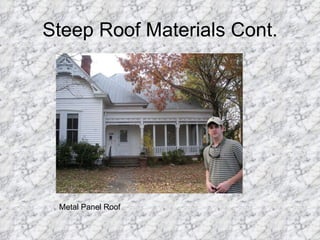
Steep Roof Materials Cont. Metal Panel Roof
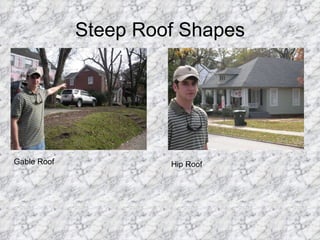
Steep Roof Shapes Gable Roof Hip Roof
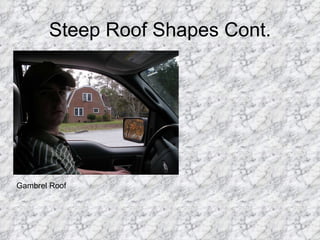
Steep Roof Shapes Cont. Gambrel Roof
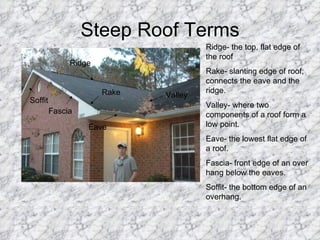
Steep Roof Terms Ridge- the top, flat edge of the roof Rake- slanting edge of roof; connects the eave and the ridge. Valley- where two components of a roof form a low point. Eave- the lowest flat edge of a roof. Fascia- front edge of an over hang below the eaves. Soffit- the bottom edge of an overhang. Ridge Valley Fascia Soffit Rake Eave
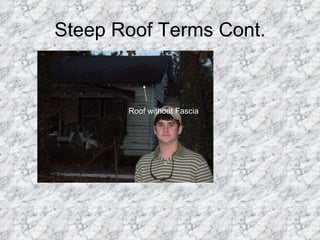
Steep Roof Terms Cont. Roof without Fascia
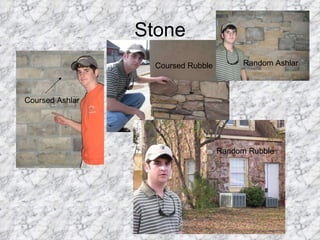
Stone Coursed Ashlar Pics of others. Random Ashlar Coursed Rubble Random Rubble
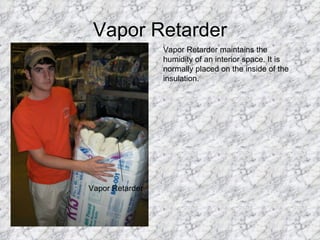
Vapor Retarder Vapor Retarder Vapor Retarder maintains the humidity of an interior space. It is normally placed on the inside of the insulation.
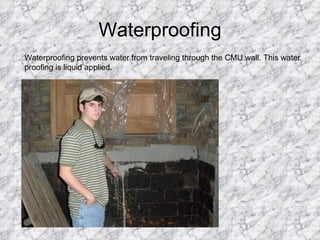
Waterproofing Waterproofing prevents water from traveling through the CMU wall. This water proofing is liquid applied.
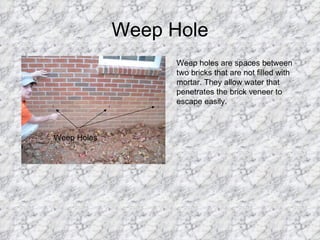
Weep Hole Weep Holes Weep holes are spaces between two bricks that are not filled with mortar. They allow water that penetrates the brick veneer to escape easily.
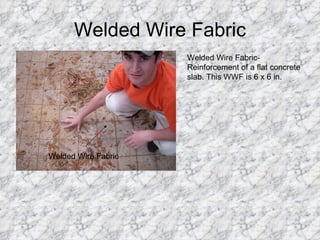
Welded Wire Fabric Welded Wire Fabric Welded Wire Fabric- Reinforcement of a flat concrete slab. This WWF is 6 x 6 in.
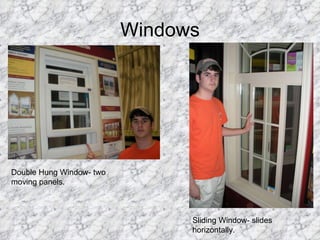
Windows Double Hung Window- two moving panels. Sliding Window- slides horizontally.
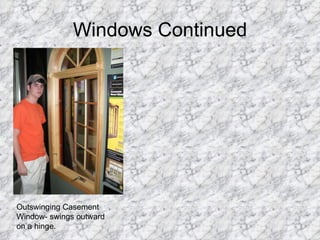
Windows Continued Outswinging Casement Window- swings outward on a hinge.

Visual Dictionary Monday update

  • 1.
  • 2.
    Air Barrier PaperAir Barrier Paper Air Barrier Paper The air barrier paper is controlling the infiltration of air and moisture
  • 3.
    Attic Ventilation MaterialsRoof Turbine Ridge Vent Soffit Vent Soffit Vent Gable Vent
  • 4.
    Air Ventilation MaterialsCont. Sofit Vent- allows a generous amount of air to flow through the rafter spaces Ridge Vents- allows air to escape from the attic; It is located along the ridge of the roof Gable Vents- allows air in the attic to escape; it located on the side of a gable roof Roof Turbine- allows hot air to exaust from the attic
  • 5.
    Back Hoe A Back Hoe is an excavator whose bucket is attached to a hinged pole attached to the boom and pulled back toward the machine during operation; it is commonly used for digging and moving dirt. This backhoe has a bucket width of 24”.
  • 6.
  • 7.
    Brick Arches JackArch with a Keystone Roman Arch
  • 8.
  • 9.
    Brick Bonds RunningBond American Bond (Common Bond) 5 courses of stretchers followed by 1 course of headers
  • 10.
    Brick Bonds ContinuedSoldiers Stretchers Sailors Rowlocks
  • 11.
    Brick Bonds ContinuedHeader Shiner
  • 12.
    Brick Sizes Standard:4 x 2-2/3 x 8 in. King Size Brick: 3-3/8 x 3 x 10 in.
  • 13.
    Bulldozer A Bulldozer is a crawling piece of equipment with a large metal blade attached to the front; it is used for pushing dirt around a site.
  • 14.
    Cladding Wood BoardCladding EIFS Cladding
  • 15.
    Brick Cladding WoodShingle Stone Cladding (Coursed Ashlar) Cladding Continued Wood shingles are tapered while wood shakes are not tapered. These are wood shingles.
  • 16.
    Code Requirements 7”Tread 10’’ Riser The stairs do not meet code because the IBC requires a min. 11” riser and a maximum 7.25” tread
  • 17.
    Code Requirements Cont.Width- 30” Height- 30” Net Opening- 6.25 sq. ft. Height AFF- 23 in. This window meets code because the measurements exceed the IBC min. width 20” min. height 24”min. and 5.7 sq. ft. min.
  • 18.
    Concrete Joints CrackControl Joint A Control Joint is a contraction joint that ensures that when concrete does crack it cracks in a desired location. An Isolation Joint is a joint formed in the concrete to isolate a column or wall from the rest of the slab. Isolation Joint
  • 19.
    Concrete Masonry UnitsCMU Wall Concrete Masonry Units (CMU) are large concrete bricks used in construction. Standard Wide: 8 x 8 x 16 in. 12 x 8 x 16 in.
  • 20.
  • 21.
  • 22.
    Doors Flush Door6 Panel Door Top Rail Stile Panel Lock Rail Bottom Rail
  • 23.
    Doors Continued SidelightTransom A Transom is a small window directly above a door. A Sidelight is a tall and narrow window alongside a door.
  • 24.
    Electrical Components TransformerElectrical Meters Electrical Meters measure the amount of electricity used. A Transformer is an electrical device that converts voltage of alternating current and sends it to the Service Head. Service Head The purpose of a Service Head is to send electricity from the outdoor lines to the meter base.
  • 25.
    Electrical Components Cont.Service Panel Duplex Receptacle A Service Panel ties all of the circuits in a building to the main power supply. Breakers are used to prevent overloading. A Duplex Receptacle allows two appliances to be plugged into an electric circuit.
  • 26.
    Framing Elements 1.Anchor Bolt 2. Sill Plate 4. Subflooring 3. Floor Joist
  • 27.
    5. Sole Plate6. Stud 7. Top Plate 8. Ceiling Joist 9. Rafter 10. Roof Decking Framing Elements Continued
  • 28.
    Framing Elements Continued11. Sheathing 12. Stringer
  • 29.
    Front End LoaderA Front End Loader is a type of tractor with a large metal bucket attached. It is used for carrying material from one spot to another and dumping the material in a truck or trench excavation.
  • 30.
    Gypsum Board GypsumBoard Gypsum Board is an interior facing board with a gypsum core sandwiched between sheets of paper; also called drywall or plasterboard
  • 31.
    Heat Pump Compressor/EvaporatorAir Handling Unit Compressor- houses a fan that moves air across coils containing refrigerant to change the temperature of the refrigerant. A big advantage of a heat pump is its ability to both heat and cool. Some disadvantages of this system are that they are relatively noisy and the ducts are bulky. An Air Handling Unit is a device used to condition and circulate air.
  • 32.
    Insulation Batt/Blanket InsulationLoose Fill The purpose of insulation is to maintain the interior temperature.
  • 33.
    Insulation Continued RigidBoard Foamed Insulation
  • 34.
    Lintel A Lintel is an angle steel piece that transfers a load for the opening of a window or door. Angle Steel Lintel
  • 35.
    Mortar Concave MortarJoint (Tooled) – Dudley Hall The mortar type is S or N type. Mortar Joint – Residential Home The mortar type is S or N
  • 36.
    Oriented Strand BoardOSB Oriented Strand Board (OSB) is a building panel composed of long strands of wood oriented in specific directions and bonded together under pressure. OSB is a non-veneered panel product.
  • 37.
    Plumbing Lavatory WaterCloset A water closet uses a 3” drain pipe, and a lavatory uses a 1 ½’’ drain pipe.
  • 38.
    Plumbing Continued ManufacturedShower & Tub Plumbing Vent
  • 39.
  • 40.
    Plywood Plywood is a type of Manufactured Wood made from thin sheets of wood , called plies or wood veneers . The layers are glued together so that adjacent plies have their wood grain at right angles to each other for greater strength. There are usually an odd number of plies, as the symmetry makes the board less prone to warping. A common reason for using plywood instead of plain wood is its resistance to cracking, shrinkage, twisting/warping, and its general high degree of strength. A veneer is a thin covering over another surface.
  • 41.
    Radiant Barrier Pictureof one installed and tell what it is doing.
  • 42.
    Rebar This is#5 rebar which means it is 5/8 in. The deformations on the surface of the rebar create friction between the steel and the concrete once it is poured and hardened. Rebar gives concrete tensile strength.
  • 43.
    Steep Roof DrainageGutter Downspout Splashblock
  • 44.
    Steep Roof DrainageCont. Gutter- A narrow channel which collects rainwater from the roof of a building and diverts it away from the structure, typically into a drain. Downspout- a vertical pipe for carrying rainwater from a rain gutter to ground level. There the water is directed to a sewer, rainwater harvesting or let into the ground through seepage. Splashblock- a plastic or concrete block placed below the gutter to avoid erosion from fast moving water.
  • 45.
    Steep Roof MaterialsUnderlayment Underlayment Underlayment or Tar paper is a heavy-duty paper used in construction. Tar paper is made by impregnating paper with tar, producing a waterproof material useful for roof construction. Roofing felt, one common type of tar paper, is a glass fiber or polyester fleece impregnated with bituminous material (tar, asphaltic bitumen); it is produced in roll form.
  • 46.
    Steep Roof MaterialsCont. Clay Tile Roof- clay is used to fabricate. Aluminum sheets are used to fabricate these metal shingles. Metal Shingles
  • 47.
    Steep Roof MaterialsCont. Metal Panel Roof
  • 48.
    Steep Roof ShapesGable Roof Hip Roof
  • 49.
    Steep Roof ShapesCont. Gambrel Roof
  • 50.
    Steep Roof TermsRidge- the top, flat edge of the roof Rake- slanting edge of roof; connects the eave and the ridge. Valley- where two components of a roof form a low point. Eave- the lowest flat edge of a roof. Fascia- front edge of an over hang below the eaves. Soffit- the bottom edge of an overhang. Ridge Valley Fascia Soffit Rake Eave
  • 51.
    Steep Roof TermsCont. Roof without Fascia
  • 52.
    Stone Coursed AshlarPics of others. Random Ashlar Coursed Rubble Random Rubble
  • 53.
    Vapor Retarder VaporRetarder Vapor Retarder maintains the humidity of an interior space. It is normally placed on the inside of the insulation.
  • 54.
    Waterproofing Waterproofing preventswater from traveling through the CMU wall. This water proofing is liquid applied.
  • 55.
    Weep Hole WeepHoles Weep holes are spaces between two bricks that are not filled with mortar. They allow water that penetrates the brick veneer to escape easily.
  • 56.
    Welded Wire FabricWelded Wire Fabric Welded Wire Fabric- Reinforcement of a flat concrete slab. This WWF is 6 x 6 in.
  • 57.
    Windows Double HungWindow- two moving panels. Sliding Window- slides horizontally.
  • 58.
    Windows Continued OutswingingCasement Window- swings outward on a hinge.