Visual Dictionary By: Marc Clift
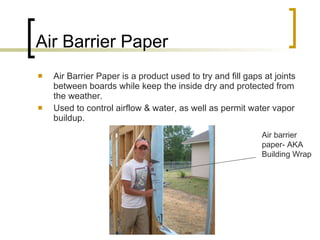
Air Barrier Paper Air Barrier Paper is a product used to try and fill gaps at joints between boards while keep the inside dry and protected from the weather. Used to control airflow & water, as well as permit water vapor buildup. Air barrier paper- AKA Building Wrap
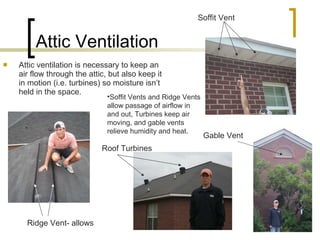
Attic Ventilation Attic ventilation is necessary to keep an air flow through the attic, but also keep it in motion (i.e. turbines) so moisture isn’t held in the space. Ridge Vent- allows Roof Turbines Soffit Vent Gable Vent Soffit Vents and Ridge Vents allow passage of airflow in and out, Turbines keep air moving, and gable vents relieve humidity and heat.
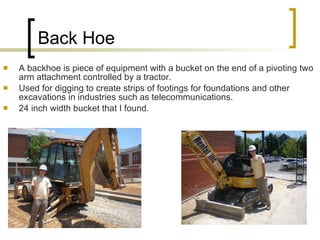
Back Hoe A backhoe is piece of equipment with a bucket on the end of a pivoting two arm attachment controlled by a tractor. Used for digging to create strips of footings for foundations and other excavations in industries such as telecommunications. 24 inch width bucket that I found.
Batter Boards A temporary frame built just outside the corner of an excavation to carry marks that lie on the surface planes of the basement that will be built in the excavation.
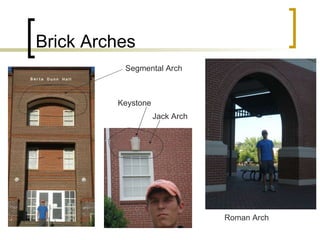
Brick Arches Segmental Arch Keystone Roman Arch Jack Arch
Brick Arches- Centering (Centering) Centering is temporary formwork used to build an arch, dome, or vault.
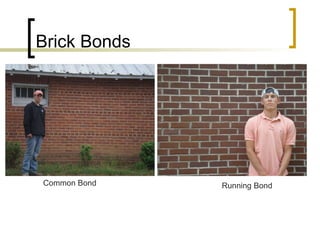
Brick Bonds Common Bond Running Bond
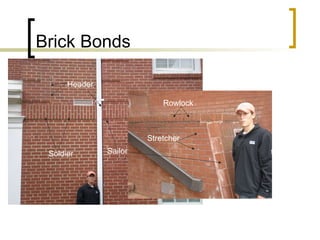
Brick Bonds Header Soldier Sailor Stretcher Rowlock
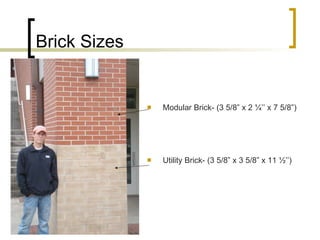
Brick Sizes Modular Brick- (3 5/8” x 2 ¼’’ x 7 5/8”) Utility Brick- (3 5/8” x 3 5/8” x 11 ½’’)
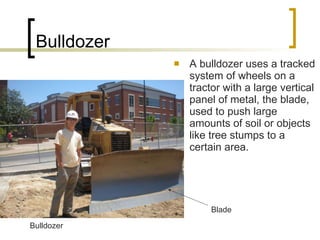
Bulldozer A bulldozer uses a tracked system of wheels on a tractor with a large vertical panel of metal, the blade, used to push large amounts of soil or objects like tree stumps to a certain area. Blade Bulldozer
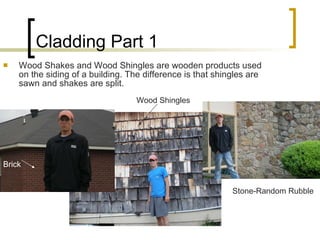
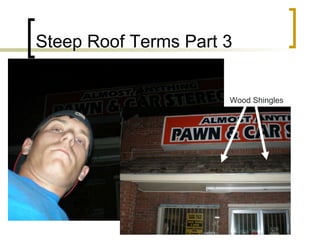
Cladding Part 1 Wood Shakes and Wood Shingles are wooden products used on the siding of a building. The difference is that shingles are sawn and shakes are split. Stone-Random Rubble Brick Wood Shingles
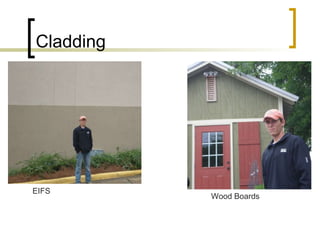
Cladding EIFS Wood Boards
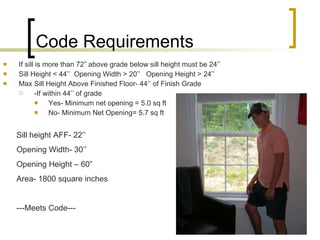
Code Requirements If sill is more than 72” above grade below sill height must be 24’’ Sill Height < 44’’  Opening Width > 20’’  Opening Height > 24’’ Max Sill Height Above Finished Floor- 44’’ of Finish Grade -If within 44’’ of grade Yes- Minimum net opening = 5.0 sq ft No- Minimum Net Opening= 5.7 sq ft Sill height AFF- 22’’ Opening Width- 30’’ Opening Height – 60” Area- 1800 square inches ---Meets Code---
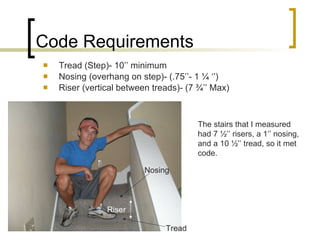
Code Requirements Tread (Step)- 10’’ minimum Nosing (overhang on step)- (.75’’- 1 ¼ ‘’) Riser (vertical between treads)- (7 ¾’’ Max)  The stairs that I measured had 7 ½’’ risers, a 1’’ nosing, and a 10 ½’’ tread, so it met code. Riser Tread Nosing
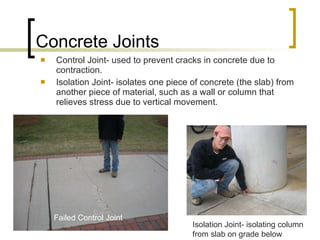
Concrete Joints Control Joint- used to prevent cracks in concrete due to contraction. Isolation Joint- isolates one piece of concrete (the slab) from another piece of material, such as a wall or column that relieves stress due to vertical movement.  Isolation Joint- isolating column from slab on grade below Failed Control Joint
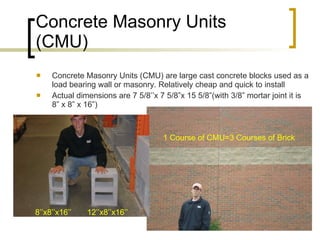
Concrete Masonry Units (CMU) Concrete Masonry Units (CMU) are large cast concrete blocks used as a load bearing wall or masonry. Relatively cheap and quick to install Actual dimensions are 7 5/8’’x 7 5/8”x 15 5/8”(with 3/8” mortar joint it is 8” x 8” x 16”) 1 Course of CMU=3 Courses of Brick 8’’x8’’x16’’  12’’x8’’x16’’
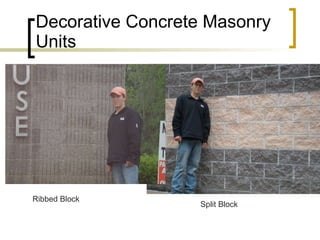
Decorative Concrete Masonry Units Ribbed Block Split Block
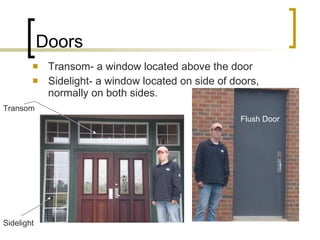
Doors Transom- a window located above the door Sidelight- a window located on side of doors, normally on both sides. Sidelight Transom Flush Door
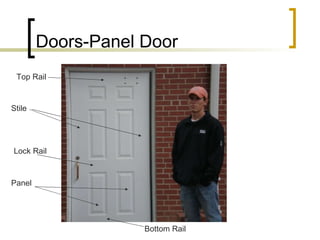
Doors-Panel Door Top Rail Stile Lock Rail Panel Bottom Rail
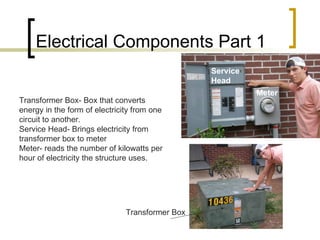
Electrical Components Part 1 Service Head Meter Transformer Box Transformer Box- Box that converts energy in the form of electricity from one circuit to another. Service Head- Brings electricity from transformer box to meter Meter- reads the number of kilowatts per hour of electricity the structure uses.
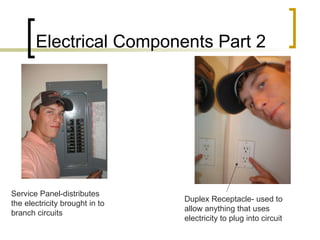
Electrical Components Part 2 Service Panel-distributes the electricity brought in to branch circuits Duplex Receptacle- used to allow anything that uses electricity to plug into circuit
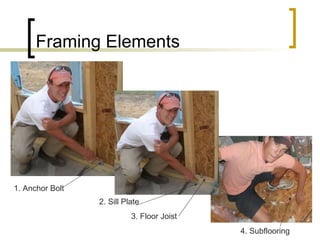
Framing Elements 1. Anchor Bolt 2. Sill Plate 3. Floor Joist 4. Subflooring
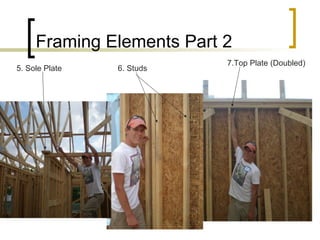
Framing Elements Part 2 5. Sole Plate 6. Studs 7.Top Plate (Doubled)
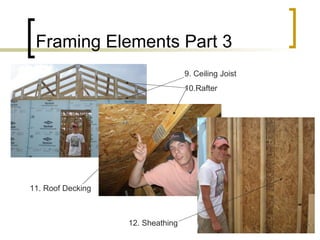
Framing Elements Part 3 9. Ceiling Joist 10.Rafter 11. Roof Decking 12. Sheathing
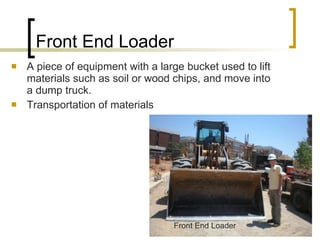
Front End Loader A piece of equipment with a large bucket used to lift materials such as soil or wood chips, and move into a dump truck. Transportation of materials Front End Loader
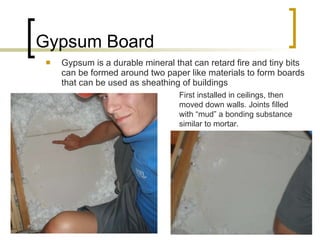
Gypsum Board Gypsum is a durable mineral that can retard fire and tiny bits can be formed around two paper like materials to form boards that can be used as sheathing of buildings First installed in ceilings, then moved down walls. Joints filled with “mud” a bonding substance similar to mortar.
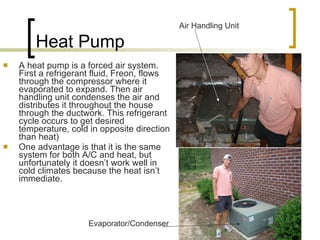
Heat Pump A heat pump is a forced air system. First a refrigerant fluid, Freon, flows through the compressor where it evaporated to expand. Then air handling unit condenses the air and distributes it throughout the house through the ductwork. This refrigerant cycle occurs to get desired temperature, cold in opposite direction than heat) One advantage is that it is the same system for both A/C and heat, but unfortunately it doesn’t work well in cold climates because the heat isn’t immediate. Air Handling Unit Evaporator/Condenser
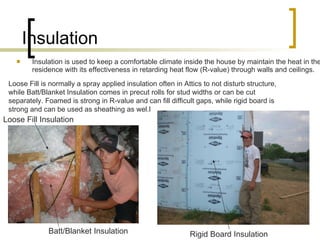
Insulation Insulation is used to keep a comfortable climate inside the house by maintain the heat in the residence with its effectiveness in retarding heat flow (R-value) through walls and ceilings. Loose Fill Insulation Batt/Blanket Insulation Rigid Board Insulation Loose Fill is normally a spray applied insulation often in Attics to not disturb structure,  while Batt/Blanket Insulation comes in precut rolls for stud widths or can be cut separately. Foamed is strong in R-value and can fill difficult gaps, while rigid board is strong and can be used as sheathing as wel.l
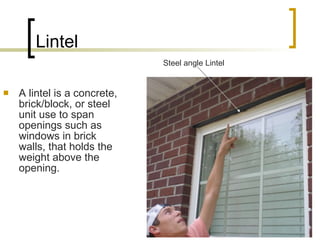
Lintel A lintel is a concrete, brick/block, or steel unit use to span openings such as windows in brick walls, that holds the weight above the opening. Steel angle Lintel
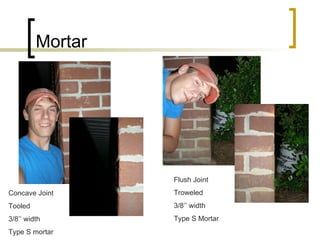
Mortar Concave Joint Tooled 3/8’’ width Type S mortar Flush Joint Troweled 3/8’’ width Type S Mortar
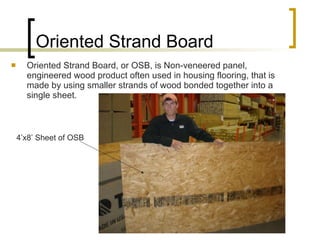
Oriented Strand Board Oriented Strand Board, or OSB, is Non-veneered panel, engineered wood product often used in housing flooring, that is made by using smaller strands of wood bonded together into a single sheet. 4’x8’ Sheet of OSB
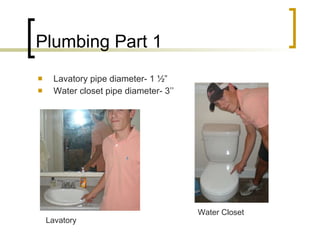
Plumbing Part 1 Lavatory pipe diameter- 1 ½” Water closet pipe diameter- 3’’ Lavatory Water Closet
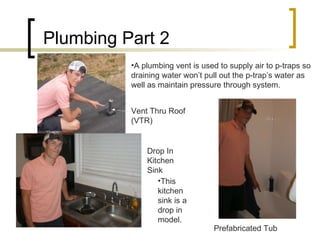
Plumbing Part 2 A plumbing vent is used to supply air to p-traps so draining water won’t pull out the p-trap’s water as well as maintain pressure through system. Vent Thru Roof (VTR) Drop In Kitchen Sink Prefabricated Tub This kitchen sink is a drop in model.
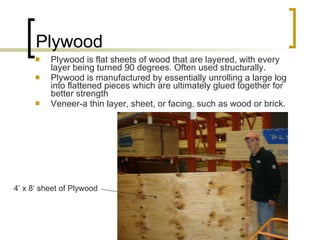
Plywood Plywood is flat sheets of wood that are layered, with every layer being turned 90 degrees. Often used structurally. Plywood is manufactured by essentially unrolling a large log into flattened pieces which are ultimately glued together for better strength Veneer-a thin layer, sheet, or facing, such as wood or brick. 4’ x 8’ sheet of Plywood
Radiant Barrier (Radiant Barrier) Radiant Barrier- Although more common in the South, aluminum sheets or spray-on aluminum particles that reflect sun heat back into atmosphere in order to reduce heat gains in building Can be installed on top side of truss, below bottom chord, or over ceiling insulation.
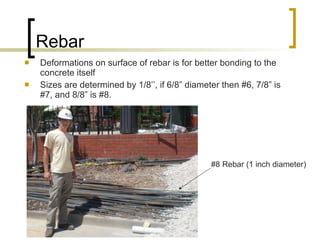
Rebar Deformations on surface of rebar is for better bonding to the concrete itself Sizes are determined by 1/8’’, if 6/8” diameter then #6, 7/8” is #7, and 8/8” is #8. #8 Rebar (1 inch diameter)
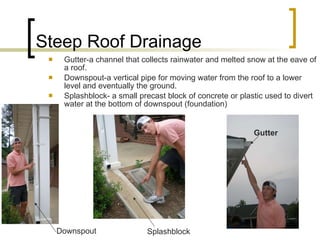
Steep Roof Drainage Gutter-a channel that collects rainwater and melted snow at the eave of a roof. Downspout-a vertical pipe for moving water from the roof to a lower level and eventually the ground. Splashblock- a small precast block of concrete or plastic used to divert water at the bottom of downspout (foundation) Downspout Splashblock Gutter
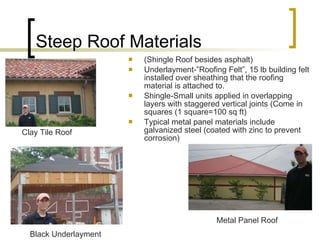
Steep Roof Materials (Shingle Roof besides asphalt) Underlayment-”Roofing Felt”, 15 lb building felt installed over sheathing that the roofing material is attached to. Shingle-Small units applied in overlapping layers with staggered vertical joints (Come in squares (1 square=100 sq ft) Typical metal panel materials include galvanized steel (coated with zinc to prevent corrosion) Clay Tile Roof Black Underlayment Metal Panel Roof
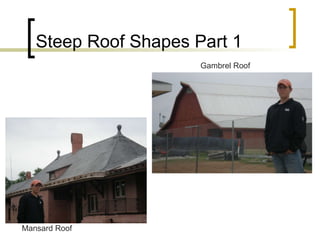
Steep Roof Shapes Part 1 Mansard Roof Gambrel Roof
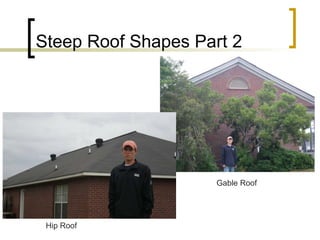
Steep Roof Shapes Part 2 Hip Roof Gable Roof
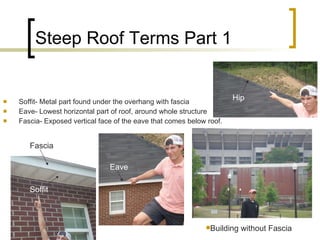
Steep Roof Terms Part 1 Soffit- Metal part found under the overhang with fascia Eave- Lowest horizontal part of roof, around whole structure Fascia- Exposed vertical face of the eave that comes below roof. Eave Hip Fascia Soffit Building without Fascia
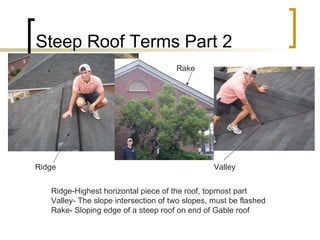
Steep Roof Terms Part 2 Ridge Valley Rake Ridge-Highest horizontal piece of the roof, topmost part Valley- The slope intersection of two slopes, must be flashed Rake- Sloping edge of a steep roof on end of Gable roof
Steep Roof Terms Part 3 Wood Shingles
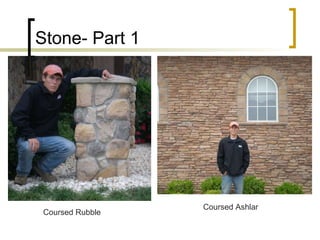
Stone- Part 1 Coursed Ashlar Coursed Rubble
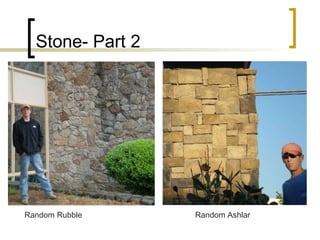
Stone- Part 2 Random Rubble Random Ashlar
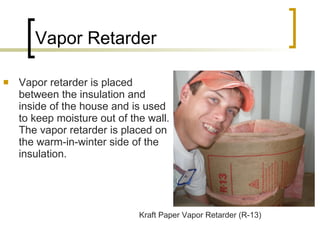
Vapor Retarder Vapor retarder is placed between the insulation and inside of the house and is used to keep moisture out of the wall. The vapor retarder is placed on the warm-in-winter side of the insulation. Kraft Paper Vapor Retarder (R-13)
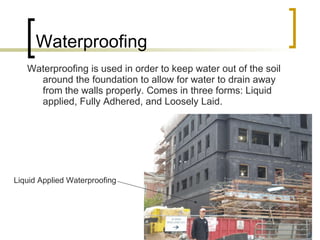
Waterproofing Waterproofing is used in order to keep water out of the soil around the foundation to allow for water to drain away from the walls properly. Comes in three forms: Liquid applied, Fully Adhered, and Loosely Laid. Liquid Applied Waterproofing
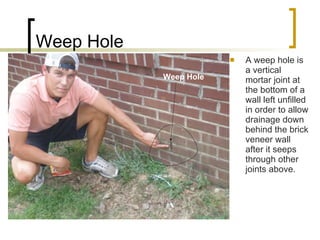
Weep Hole A weep hole is a vertical mortar joint at the bottom of a wall left unfilled in order to allow drainage down behind the brick veneer wall after it seeps through other joints above. Weep Hole
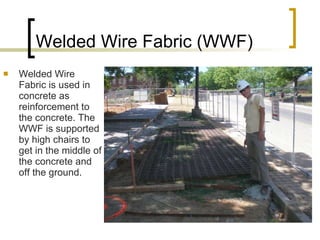
Welded Wire Fabric (WWF) Welded Wire Fabric is used in concrete as reinforcement to the concrete. The WWF is supported by high chairs to get in the middle of the concrete and off the ground.
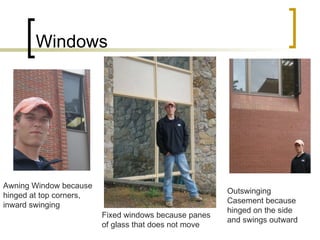
Windows Outswinging Casement because hinged on the side and swings outward Fixed windows because panes of glass that does not move Awning Window because hinged at top corners, inward swinging

Visual dictionary

  • 1.
  • 2.
    Air Barrier PaperAir Barrier Paper is a product used to try and fill gaps at joints between boards while keep the inside dry and protected from the weather. Used to control airflow & water, as well as permit water vapor buildup. Air barrier paper- AKA Building Wrap
  • 3.
    Attic Ventilation Atticventilation is necessary to keep an air flow through the attic, but also keep it in motion (i.e. turbines) so moisture isn’t held in the space. Ridge Vent- allows Roof Turbines Soffit Vent Gable Vent Soffit Vents and Ridge Vents allow passage of airflow in and out, Turbines keep air moving, and gable vents relieve humidity and heat.
  • 4.
    Back Hoe Abackhoe is piece of equipment with a bucket on the end of a pivoting two arm attachment controlled by a tractor. Used for digging to create strips of footings for foundations and other excavations in industries such as telecommunications. 24 inch width bucket that I found.
  • 5.
    Batter Boards Atemporary frame built just outside the corner of an excavation to carry marks that lie on the surface planes of the basement that will be built in the excavation.
  • 6.
    Brick Arches SegmentalArch Keystone Roman Arch Jack Arch
  • 7.
    Brick Arches- Centering(Centering) Centering is temporary formwork used to build an arch, dome, or vault.
  • 8.
    Brick Bonds CommonBond Running Bond
  • 9.
    Brick Bonds HeaderSoldier Sailor Stretcher Rowlock
  • 10.
    Brick Sizes ModularBrick- (3 5/8” x 2 ¼’’ x 7 5/8”) Utility Brick- (3 5/8” x 3 5/8” x 11 ½’’)
  • 11.
    Bulldozer A bulldozeruses a tracked system of wheels on a tractor with a large vertical panel of metal, the blade, used to push large amounts of soil or objects like tree stumps to a certain area. Blade Bulldozer
  • 12.
    Cladding Part 1Wood Shakes and Wood Shingles are wooden products used on the siding of a building. The difference is that shingles are sawn and shakes are split. Stone-Random Rubble Brick Wood Shingles
  • 13.
  • 14.
    Code Requirements Ifsill is more than 72” above grade below sill height must be 24’’ Sill Height < 44’’ Opening Width > 20’’ Opening Height > 24’’ Max Sill Height Above Finished Floor- 44’’ of Finish Grade -If within 44’’ of grade Yes- Minimum net opening = 5.0 sq ft No- Minimum Net Opening= 5.7 sq ft Sill height AFF- 22’’ Opening Width- 30’’ Opening Height – 60” Area- 1800 square inches ---Meets Code---
  • 15.
    Code Requirements Tread(Step)- 10’’ minimum Nosing (overhang on step)- (.75’’- 1 ¼ ‘’) Riser (vertical between treads)- (7 ¾’’ Max) The stairs that I measured had 7 ½’’ risers, a 1’’ nosing, and a 10 ½’’ tread, so it met code. Riser Tread Nosing
  • 16.
    Concrete Joints ControlJoint- used to prevent cracks in concrete due to contraction. Isolation Joint- isolates one piece of concrete (the slab) from another piece of material, such as a wall or column that relieves stress due to vertical movement. Isolation Joint- isolating column from slab on grade below Failed Control Joint
  • 17.
    Concrete Masonry Units(CMU) Concrete Masonry Units (CMU) are large cast concrete blocks used as a load bearing wall or masonry. Relatively cheap and quick to install Actual dimensions are 7 5/8’’x 7 5/8”x 15 5/8”(with 3/8” mortar joint it is 8” x 8” x 16”) 1 Course of CMU=3 Courses of Brick 8’’x8’’x16’’ 12’’x8’’x16’’
  • 18.
    Decorative Concrete MasonryUnits Ribbed Block Split Block
  • 19.
    Doors Transom- awindow located above the door Sidelight- a window located on side of doors, normally on both sides. Sidelight Transom Flush Door
  • 20.
    Doors-Panel Door TopRail Stile Lock Rail Panel Bottom Rail
  • 21.
    Electrical Components Part1 Service Head Meter Transformer Box Transformer Box- Box that converts energy in the form of electricity from one circuit to another. Service Head- Brings electricity from transformer box to meter Meter- reads the number of kilowatts per hour of electricity the structure uses.
  • 22.
    Electrical Components Part2 Service Panel-distributes the electricity brought in to branch circuits Duplex Receptacle- used to allow anything that uses electricity to plug into circuit
  • 23.
    Framing Elements 1.Anchor Bolt 2. Sill Plate 3. Floor Joist 4. Subflooring
  • 24.
    Framing Elements Part2 5. Sole Plate 6. Studs 7.Top Plate (Doubled)
  • 25.
    Framing Elements Part3 9. Ceiling Joist 10.Rafter 11. Roof Decking 12. Sheathing
  • 26.
    Front End LoaderA piece of equipment with a large bucket used to lift materials such as soil or wood chips, and move into a dump truck. Transportation of materials Front End Loader
  • 27.
    Gypsum Board Gypsumis a durable mineral that can retard fire and tiny bits can be formed around two paper like materials to form boards that can be used as sheathing of buildings First installed in ceilings, then moved down walls. Joints filled with “mud” a bonding substance similar to mortar.
  • 28.
    Heat Pump Aheat pump is a forced air system. First a refrigerant fluid, Freon, flows through the compressor where it evaporated to expand. Then air handling unit condenses the air and distributes it throughout the house through the ductwork. This refrigerant cycle occurs to get desired temperature, cold in opposite direction than heat) One advantage is that it is the same system for both A/C and heat, but unfortunately it doesn’t work well in cold climates because the heat isn’t immediate. Air Handling Unit Evaporator/Condenser
  • 29.
    Insulation Insulation isused to keep a comfortable climate inside the house by maintain the heat in the residence with its effectiveness in retarding heat flow (R-value) through walls and ceilings. Loose Fill Insulation Batt/Blanket Insulation Rigid Board Insulation Loose Fill is normally a spray applied insulation often in Attics to not disturb structure, while Batt/Blanket Insulation comes in precut rolls for stud widths or can be cut separately. Foamed is strong in R-value and can fill difficult gaps, while rigid board is strong and can be used as sheathing as wel.l
  • 30.
    Lintel A lintelis a concrete, brick/block, or steel unit use to span openings such as windows in brick walls, that holds the weight above the opening. Steel angle Lintel
  • 31.
    Mortar Concave JointTooled 3/8’’ width Type S mortar Flush Joint Troweled 3/8’’ width Type S Mortar
  • 32.
    Oriented Strand BoardOriented Strand Board, or OSB, is Non-veneered panel, engineered wood product often used in housing flooring, that is made by using smaller strands of wood bonded together into a single sheet. 4’x8’ Sheet of OSB
  • 33.
    Plumbing Part 1Lavatory pipe diameter- 1 ½” Water closet pipe diameter- 3’’ Lavatory Water Closet
  • 34.
    Plumbing Part 2A plumbing vent is used to supply air to p-traps so draining water won’t pull out the p-trap’s water as well as maintain pressure through system. Vent Thru Roof (VTR) Drop In Kitchen Sink Prefabricated Tub This kitchen sink is a drop in model.
  • 35.
    Plywood Plywood isflat sheets of wood that are layered, with every layer being turned 90 degrees. Often used structurally. Plywood is manufactured by essentially unrolling a large log into flattened pieces which are ultimately glued together for better strength Veneer-a thin layer, sheet, or facing, such as wood or brick. 4’ x 8’ sheet of Plywood
  • 36.
    Radiant Barrier (RadiantBarrier) Radiant Barrier- Although more common in the South, aluminum sheets or spray-on aluminum particles that reflect sun heat back into atmosphere in order to reduce heat gains in building Can be installed on top side of truss, below bottom chord, or over ceiling insulation.
  • 37.
    Rebar Deformations onsurface of rebar is for better bonding to the concrete itself Sizes are determined by 1/8’’, if 6/8” diameter then #6, 7/8” is #7, and 8/8” is #8. #8 Rebar (1 inch diameter)
  • 38.
    Steep Roof DrainageGutter-a channel that collects rainwater and melted snow at the eave of a roof. Downspout-a vertical pipe for moving water from the roof to a lower level and eventually the ground. Splashblock- a small precast block of concrete or plastic used to divert water at the bottom of downspout (foundation) Downspout Splashblock Gutter
  • 39.
    Steep Roof Materials(Shingle Roof besides asphalt) Underlayment-”Roofing Felt”, 15 lb building felt installed over sheathing that the roofing material is attached to. Shingle-Small units applied in overlapping layers with staggered vertical joints (Come in squares (1 square=100 sq ft) Typical metal panel materials include galvanized steel (coated with zinc to prevent corrosion) Clay Tile Roof Black Underlayment Metal Panel Roof
  • 40.
    Steep Roof ShapesPart 1 Mansard Roof Gambrel Roof
  • 41.
    Steep Roof ShapesPart 2 Hip Roof Gable Roof
  • 42.
    Steep Roof TermsPart 1 Soffit- Metal part found under the overhang with fascia Eave- Lowest horizontal part of roof, around whole structure Fascia- Exposed vertical face of the eave that comes below roof. Eave Hip Fascia Soffit Building without Fascia
  • 43.
    Steep Roof TermsPart 2 Ridge Valley Rake Ridge-Highest horizontal piece of the roof, topmost part Valley- The slope intersection of two slopes, must be flashed Rake- Sloping edge of a steep roof on end of Gable roof
  • 44.
    Steep Roof TermsPart 3 Wood Shingles
  • 45.
    Stone- Part 1Coursed Ashlar Coursed Rubble
  • 46.
    Stone- Part 2Random Rubble Random Ashlar
  • 47.
    Vapor Retarder Vaporretarder is placed between the insulation and inside of the house and is used to keep moisture out of the wall. The vapor retarder is placed on the warm-in-winter side of the insulation. Kraft Paper Vapor Retarder (R-13)
  • 48.
    Waterproofing Waterproofing isused in order to keep water out of the soil around the foundation to allow for water to drain away from the walls properly. Comes in three forms: Liquid applied, Fully Adhered, and Loosely Laid. Liquid Applied Waterproofing
  • 49.
    Weep Hole Aweep hole is a vertical mortar joint at the bottom of a wall left unfilled in order to allow drainage down behind the brick veneer wall after it seeps through other joints above. Weep Hole
  • 50.
    Welded Wire Fabric(WWF) Welded Wire Fabric is used in concrete as reinforcement to the concrete. The WWF is supported by high chairs to get in the middle of the concrete and off the ground.
  • 51.
    Windows Outswinging Casementbecause hinged on the side and swings outward Fixed windows because panes of glass that does not move Awning Window because hinged at top corners, inward swinging