Visual Dictionary Underlayment
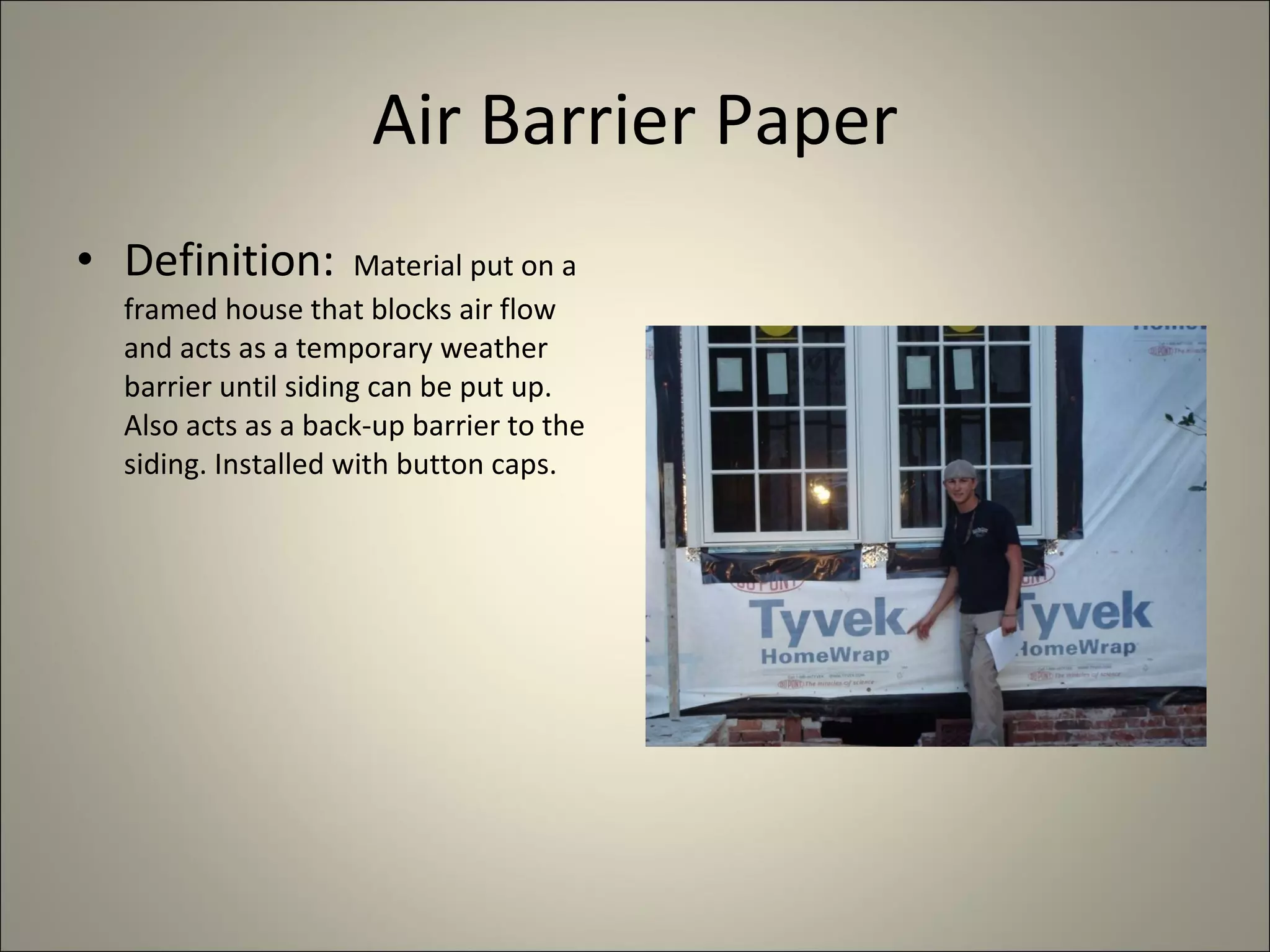
Air Barrier Paper Definition:  Material put on a framed house that blocks air flow and acts as a temporary weather barrier until siding can be put up. Also acts as a back-up barrier to the siding. Installed with button caps.
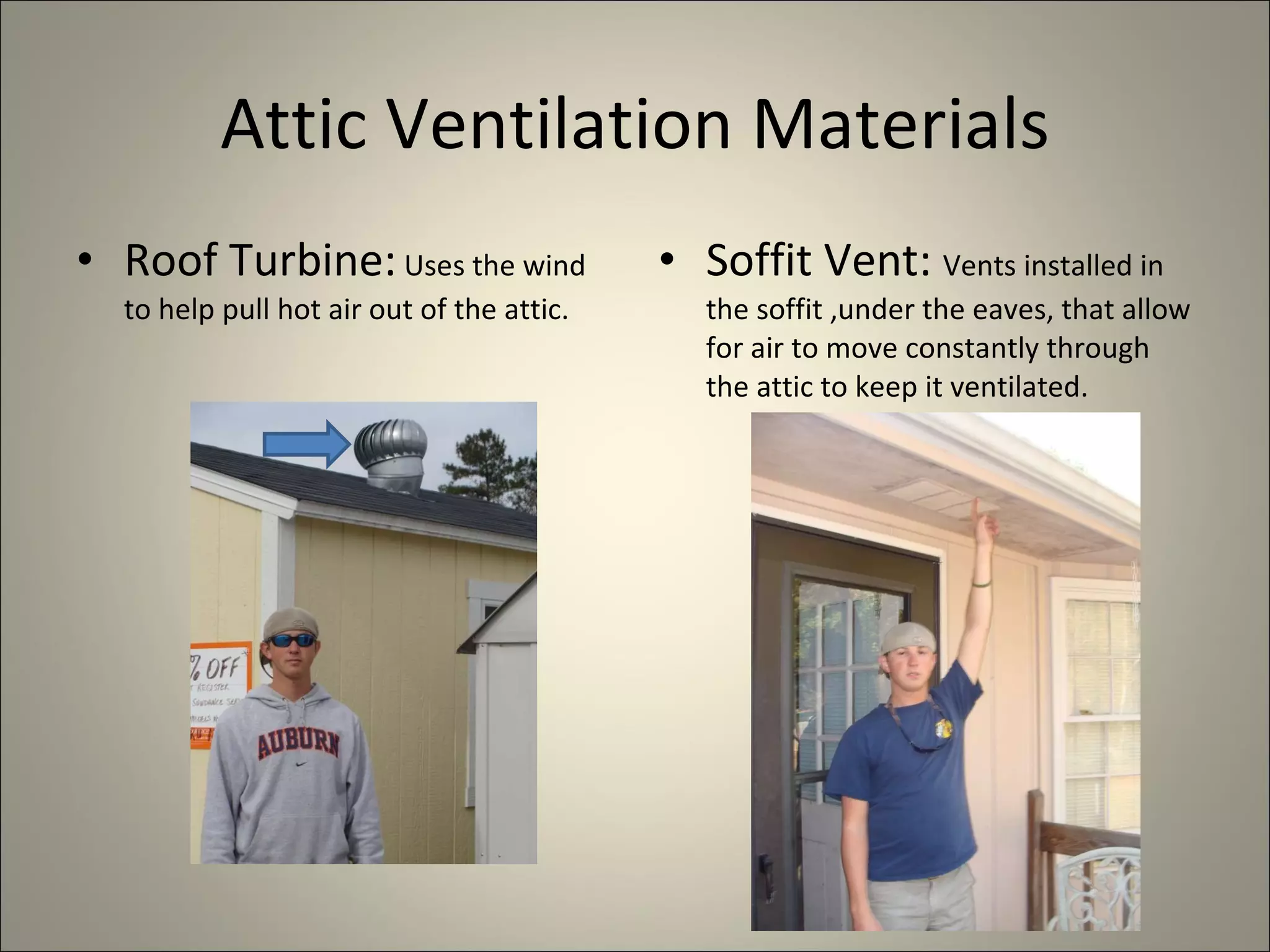
Attic Ventilation Materials Roof Turbine:  Uses the wind to help pull hot air out of the attic. Soffit Vent:  Vents installed in the soffit ,under the eaves, that allow for air to move constantly through the attic to keep it ventilated.
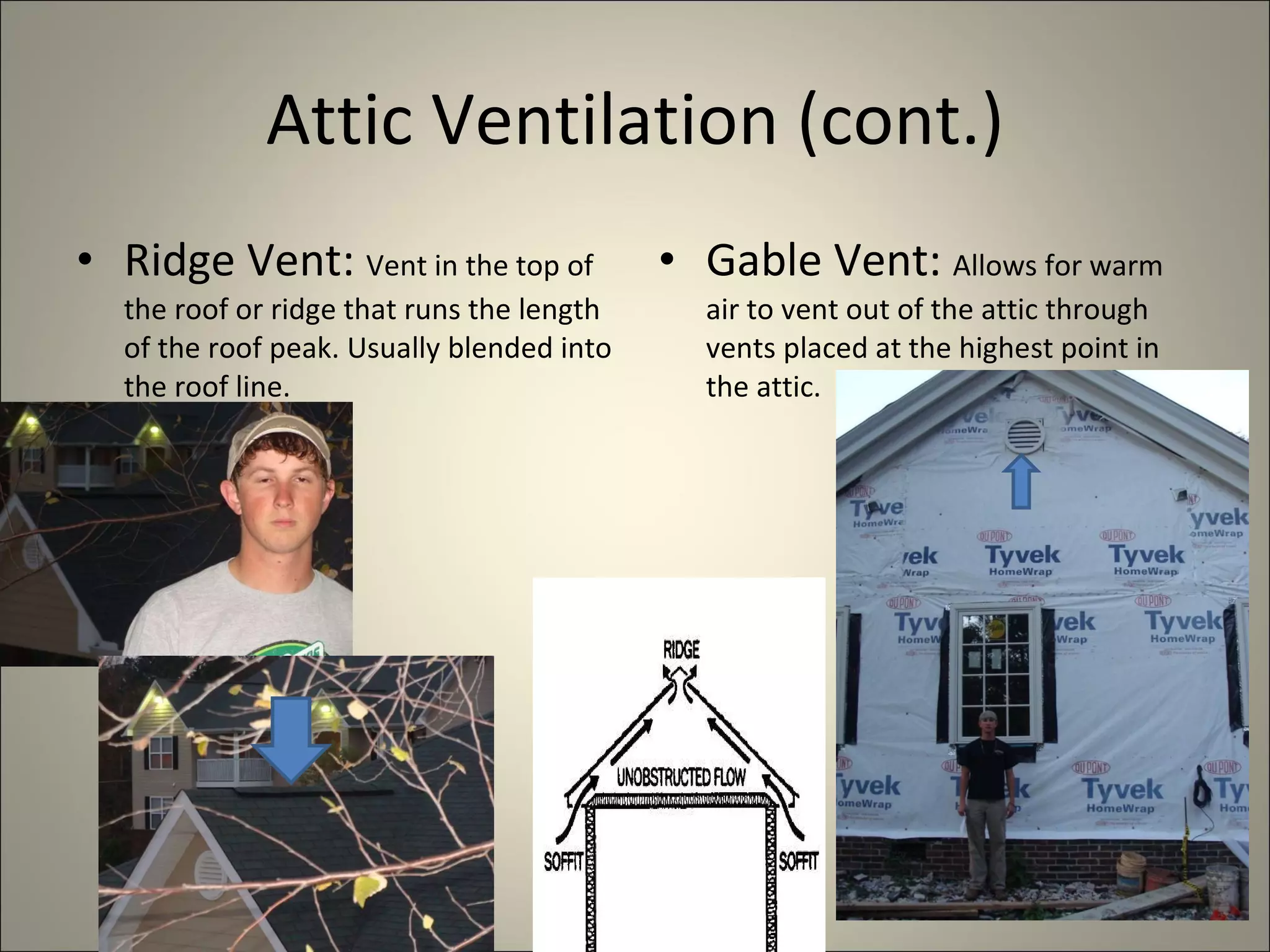
Attic Ventilation (cont.) Ridge Vent:  Vent in the top of the roof or ridge that runs the length of the roof peak. Usually blended into the roof line. Gable Vent:  Allows for warm air to vent out of the attic through vents placed at the highest point in the attic.
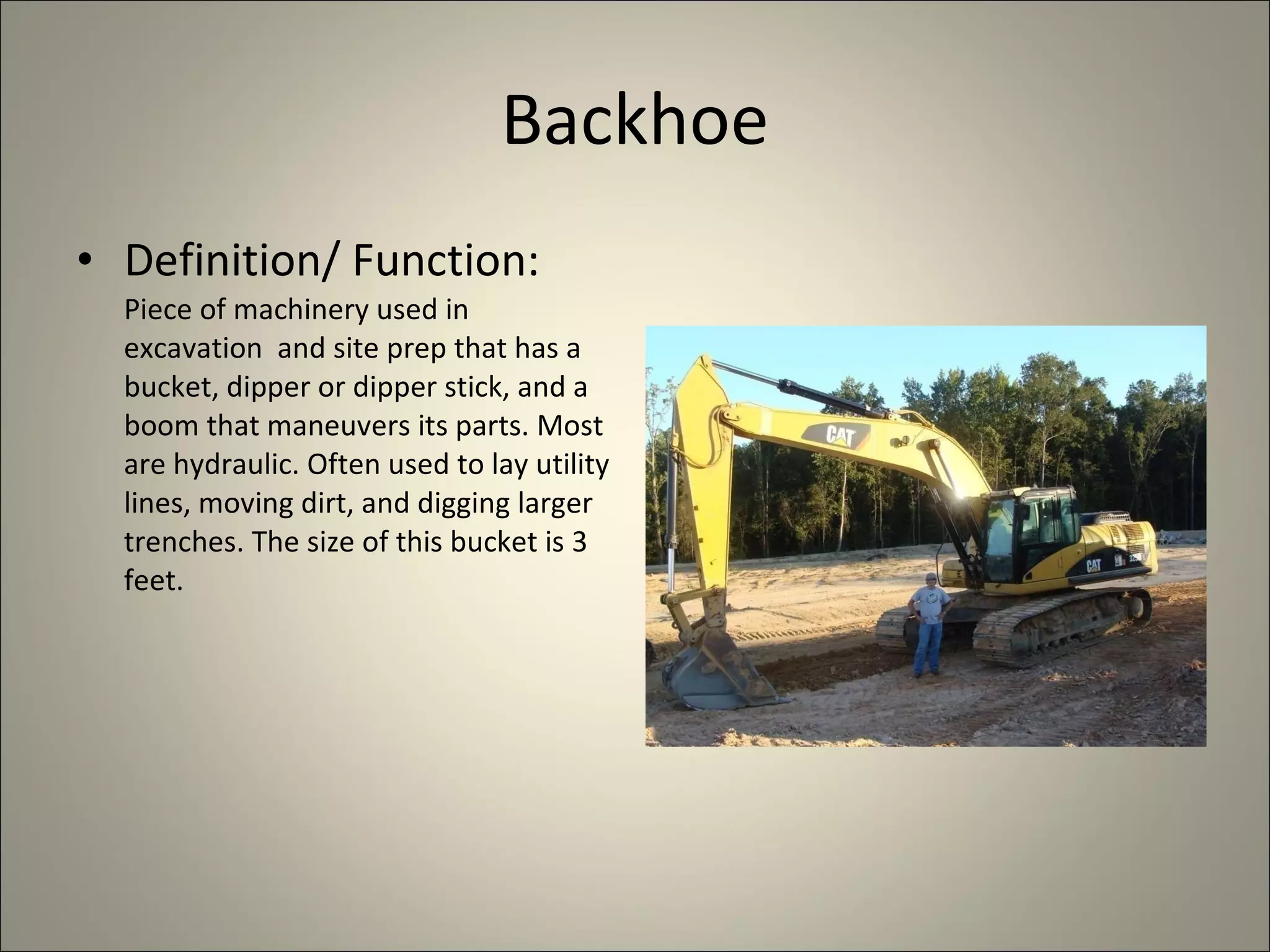
Backhoe Definition/ Function:  Piece of machinery used in excavation  and site prep that has a bucket, dipper or dipper stick, and a boom that maneuvers its parts. Most are hydraulic. Often used to lay utility lines, moving dirt, and digging larger trenches. The size of this bucket is 3 feet.
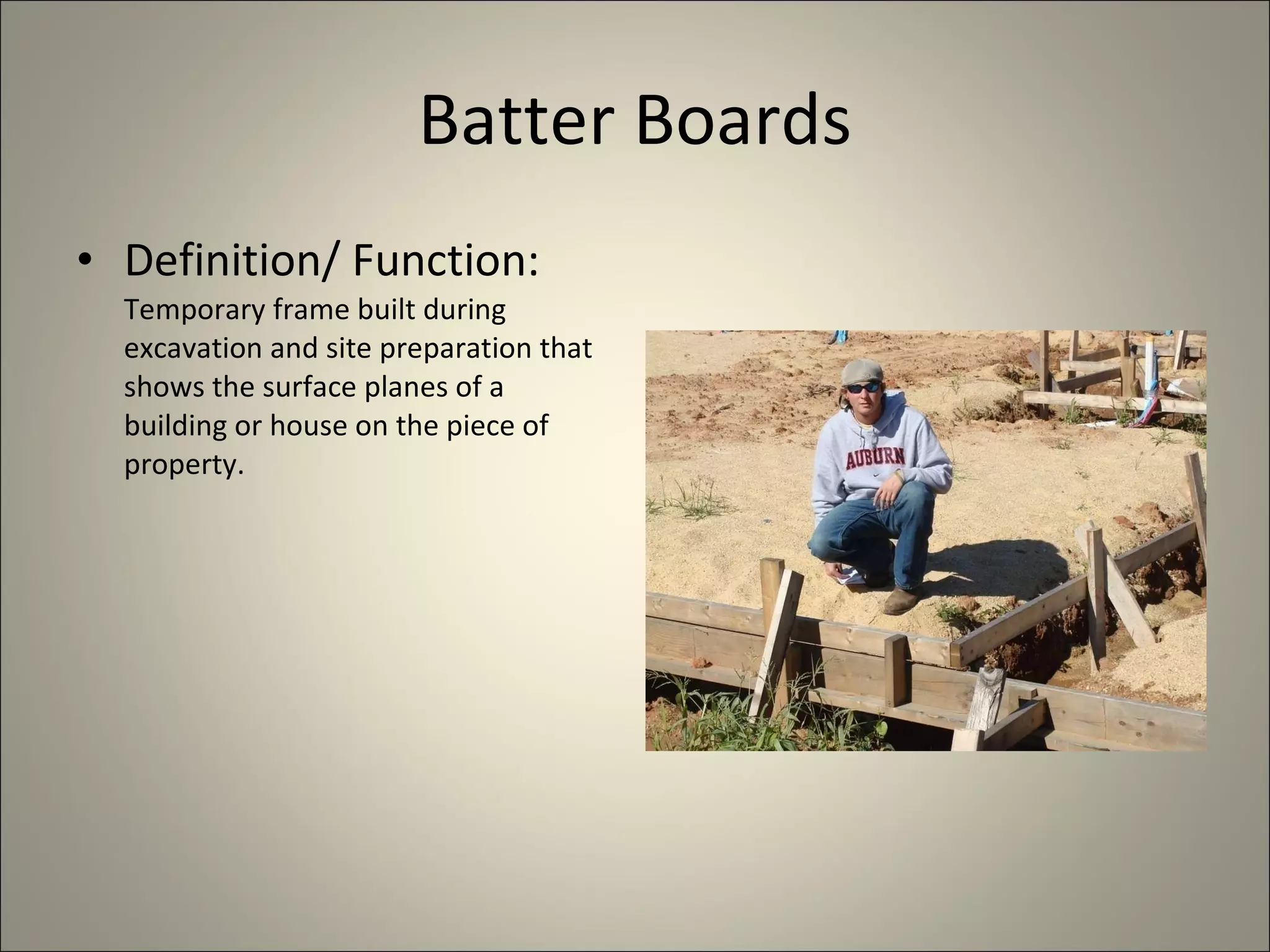
Batter Boards Definition/ Function:  Temporary frame built during excavation and site preparation that shows the surface planes of a building or house on the piece of property.
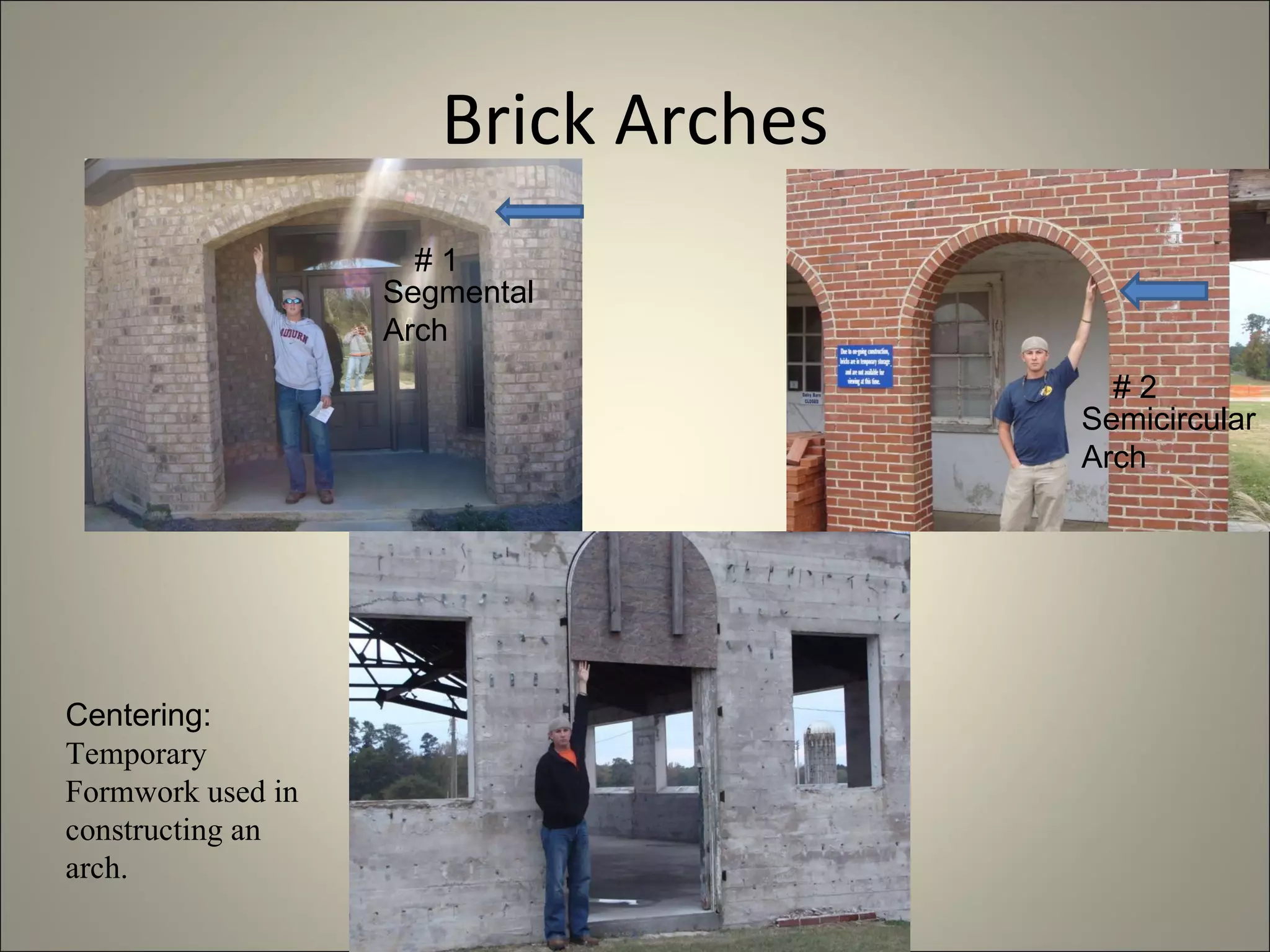
Brick Arches Centering:  Temporary Formwork used in constructing an arch. Semicircular Arch Segmental Arch # 1 # 2
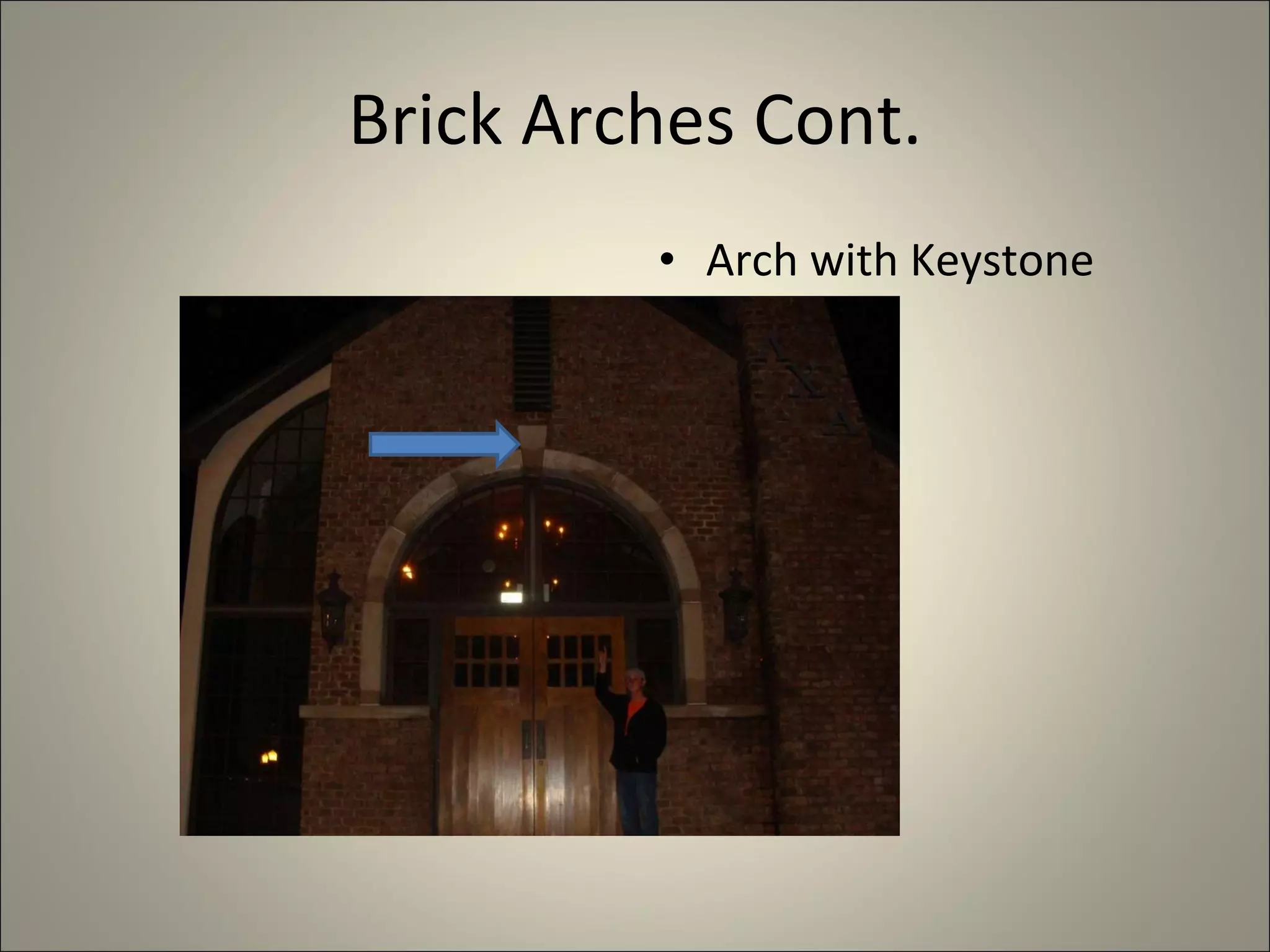
Brick Arches Cont. Arch with Keystone
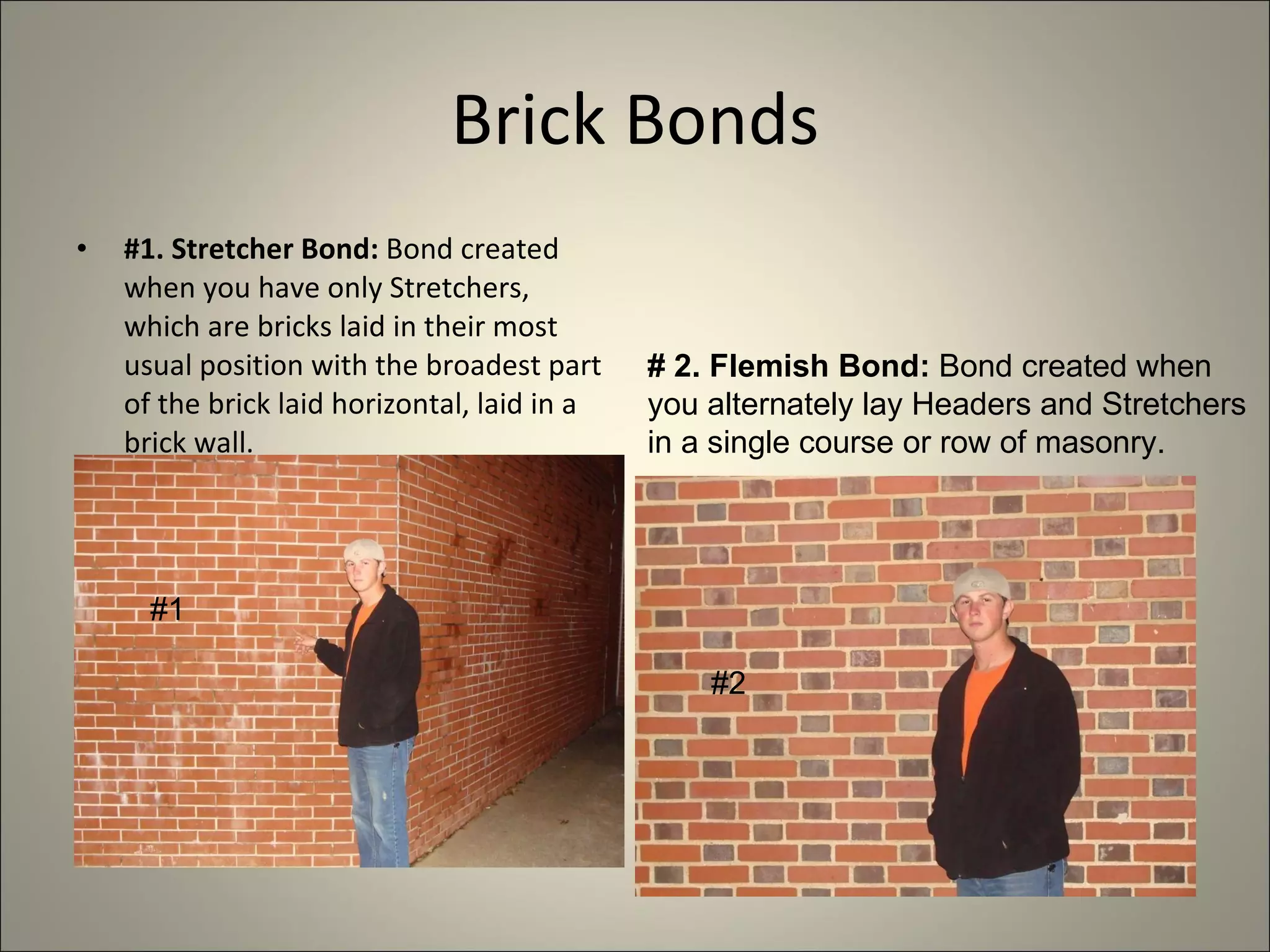
Brick Bonds #1. Stretcher Bond:  Bond created when you have only Stretchers, which are bricks laid in their most usual position with the broadest part of the brick laid horizontal, laid in a brick wall. # 2. Flemish Bond:  Bond created when you alternately lay Headers and Stretchers in a single course or row of masonry. #1  #2
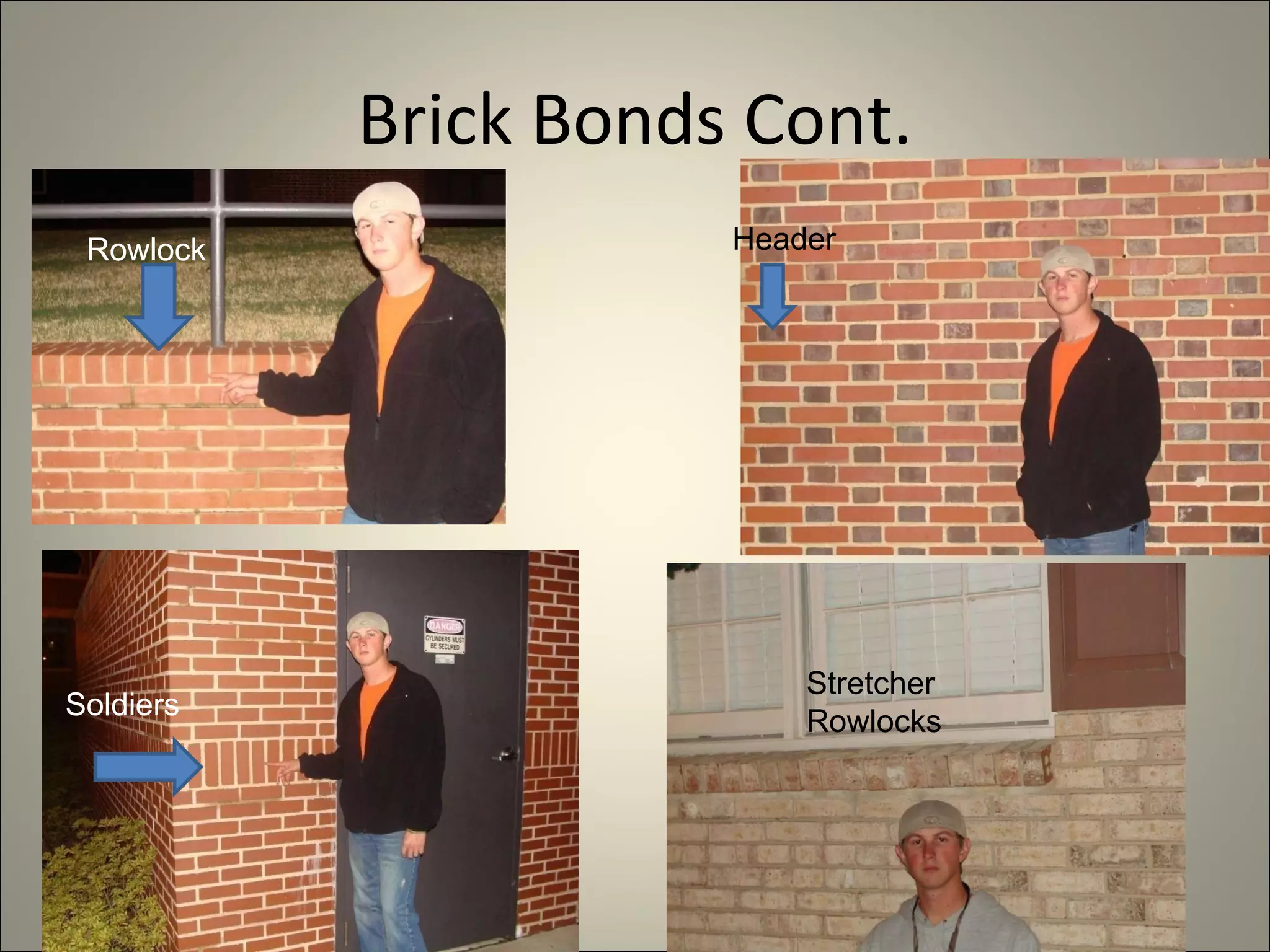
Brick Bonds Cont. Header Rowlock Soldiers Stretcher Rowlocks Stretcher Rowlocks
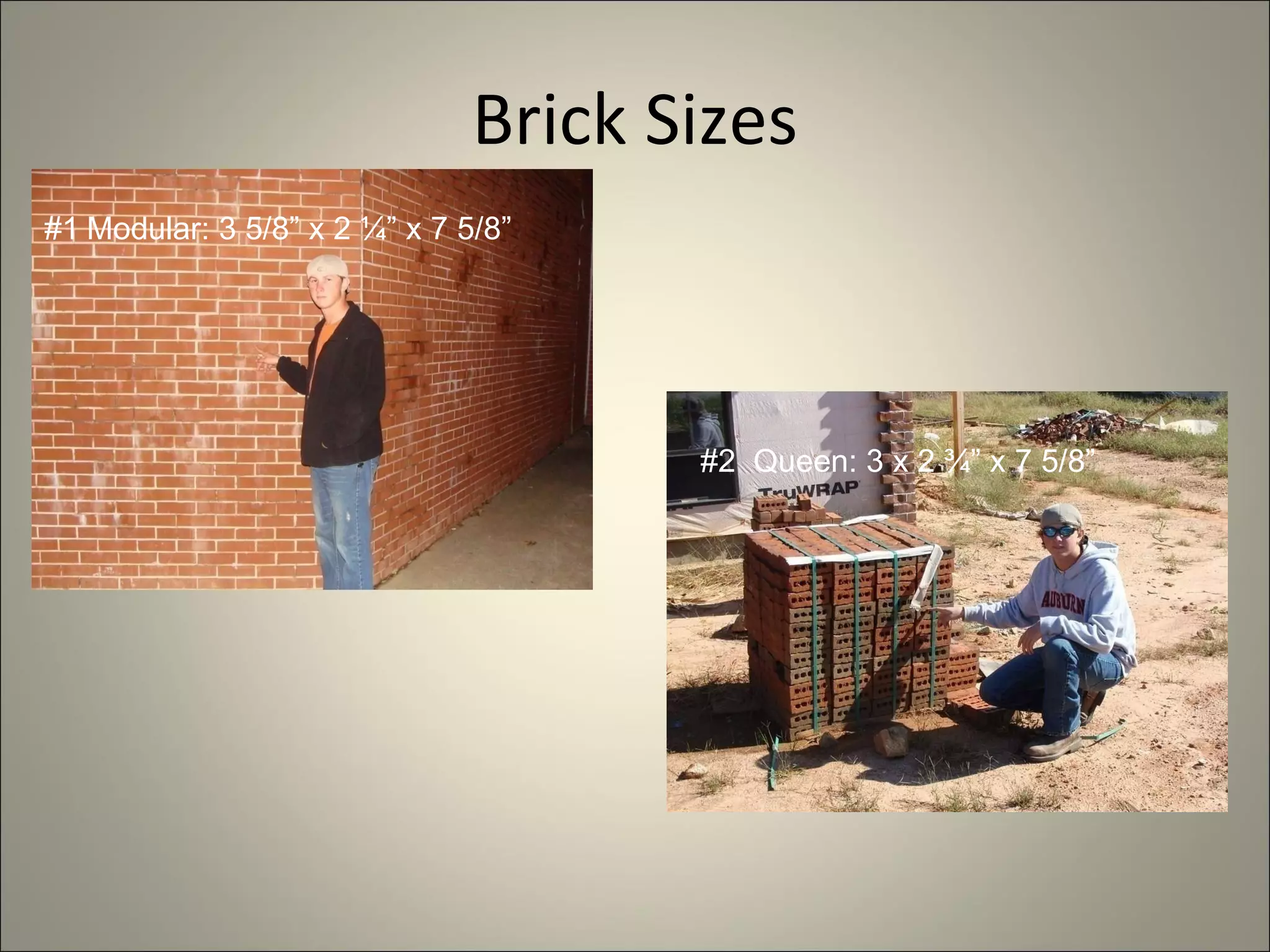
Brick Sizes Modular: 3 5/8” x 2 ¼” x 7 5/8”  Queen: 3 x 2 ¾” x 7 5/8”  #1 #2
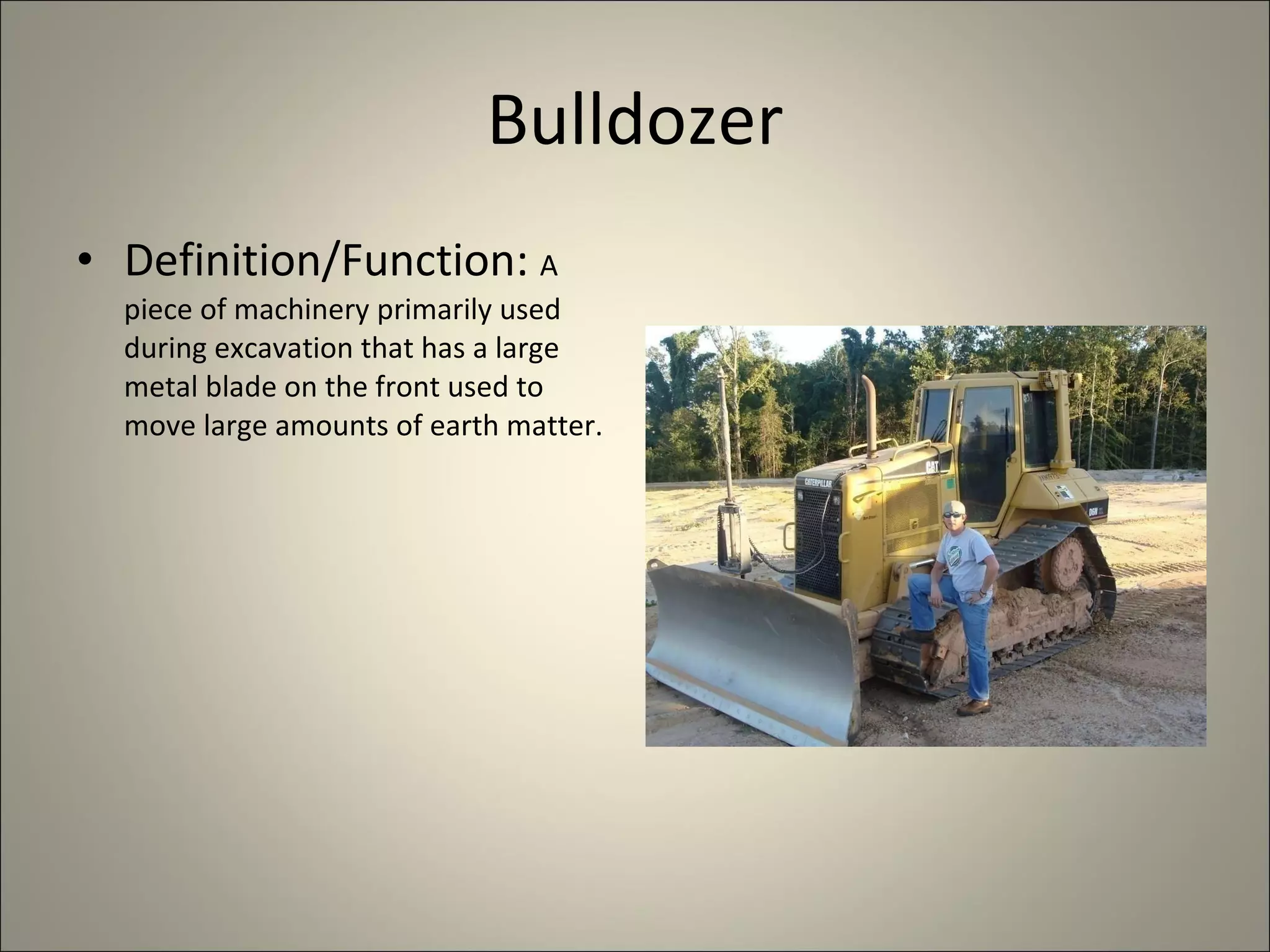
Bulldozer Definition/Function:  A piece of machinery primarily used during excavation that has a large metal blade on the front used to move large amounts of earth matter.
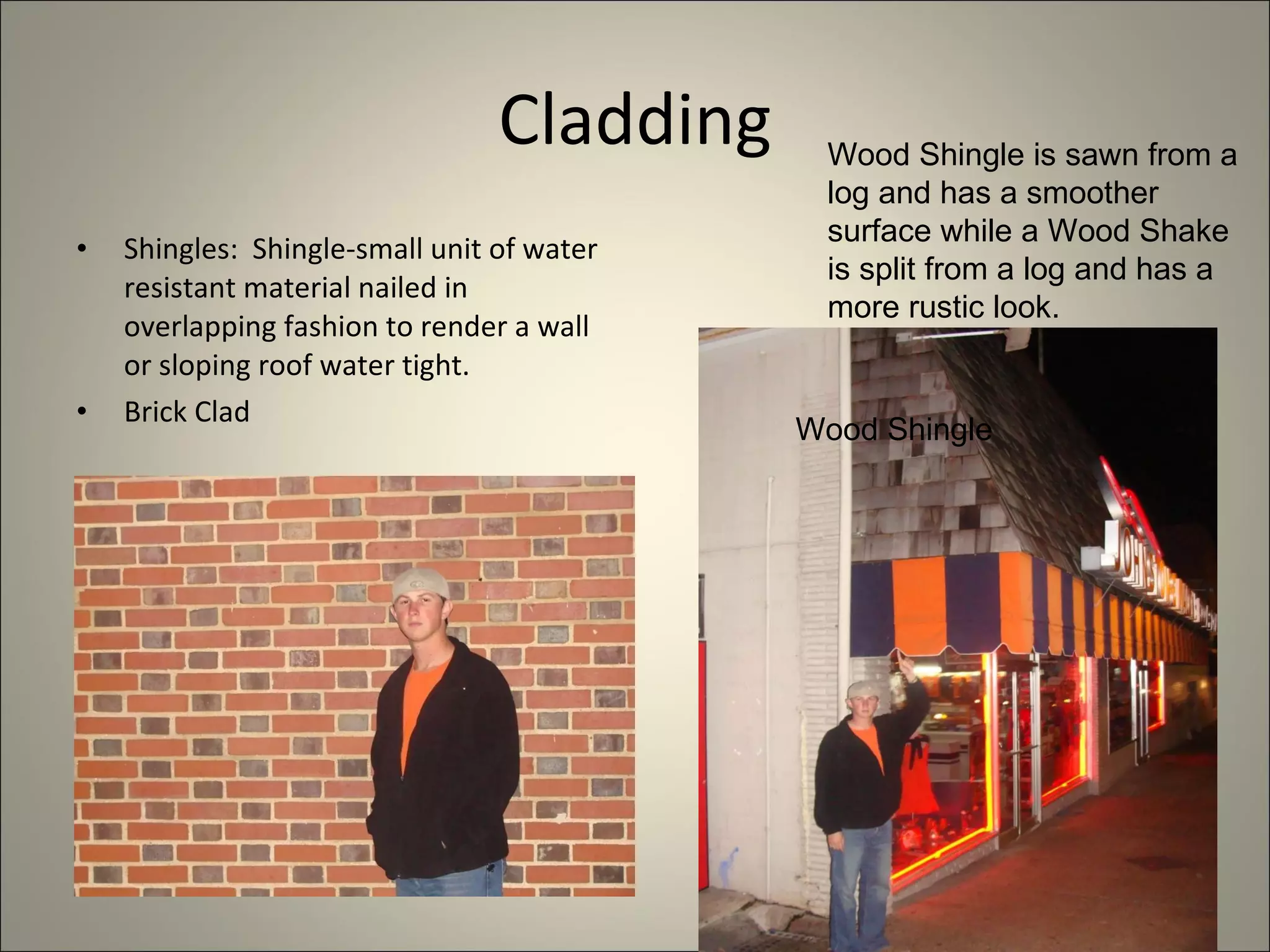
Cladding Shingles:  Shingle-small unit of water resistant material nailed in overlapping fashion to render a wall or sloping roof water tight. Brick Clad Wood Shingle is sawn from a log and has a smoother surface while a Wood Shake is split from a log and has a more rustic look. Wood Shingle
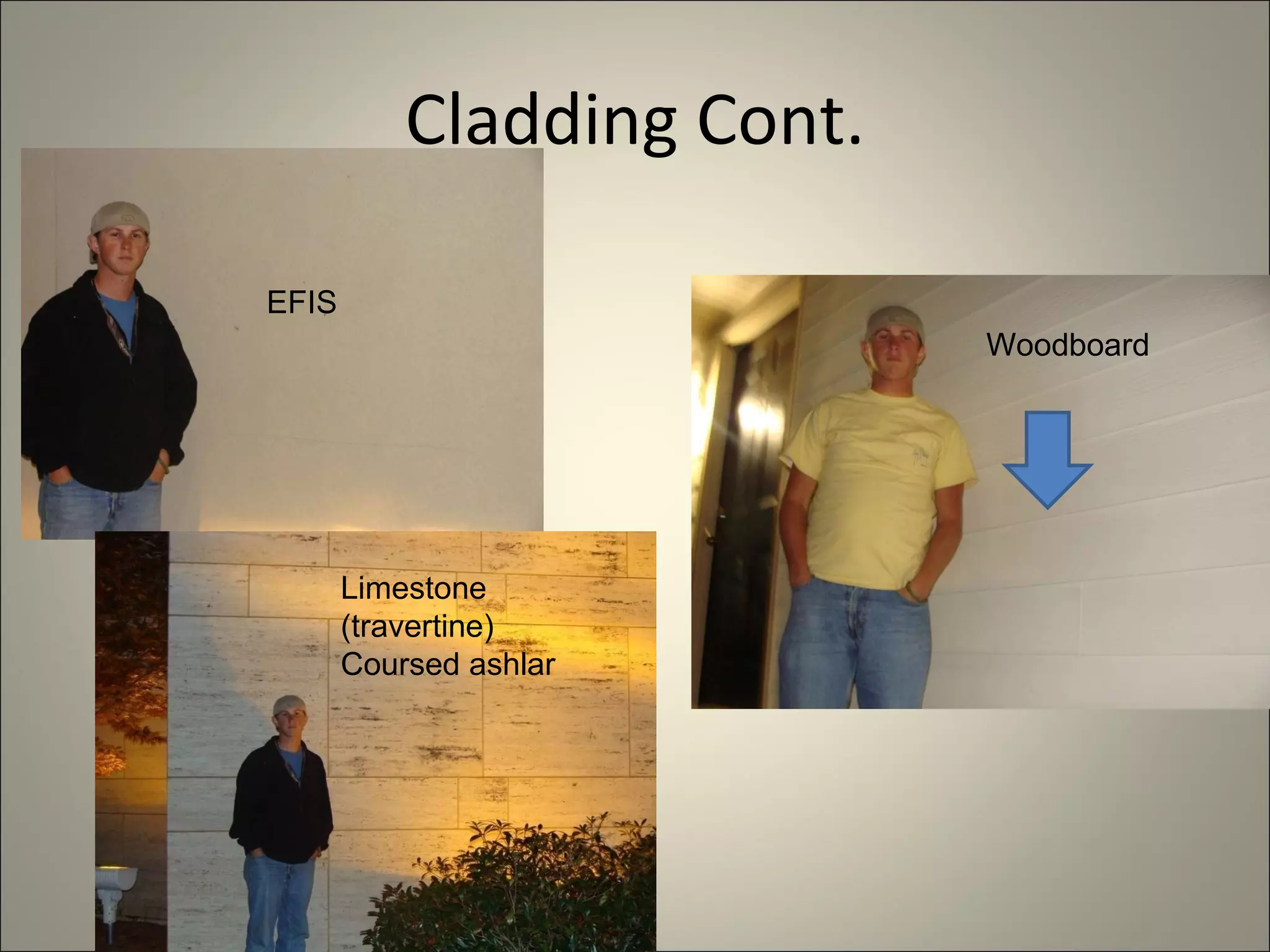
Cladding Cont. EFIS Woodboard Limestone (travertine) Coursed ashlar
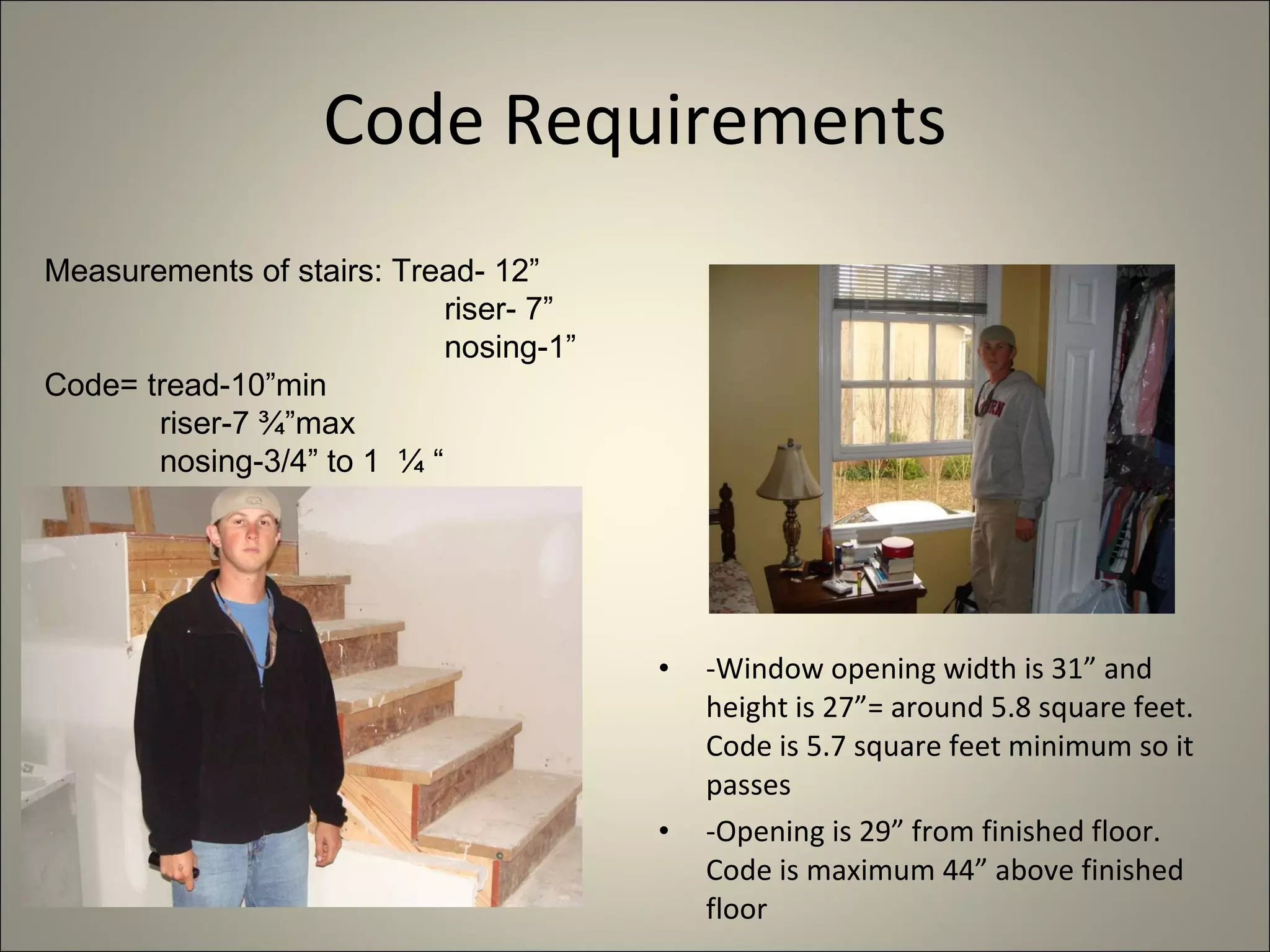
Code Requirements -Window opening width is 31” and height is 27”= around 5.8 square feet. Code is 5.7 square feet minimum so it passes -Opening is 29” from finished floor. Code is maximum 44” above finished floor Measurements of stairs: Tread- 12” riser- 7” nosing-1” Code= tread-10”min riser-7 ¾”max nosing-3/4” to 1  ¼ “
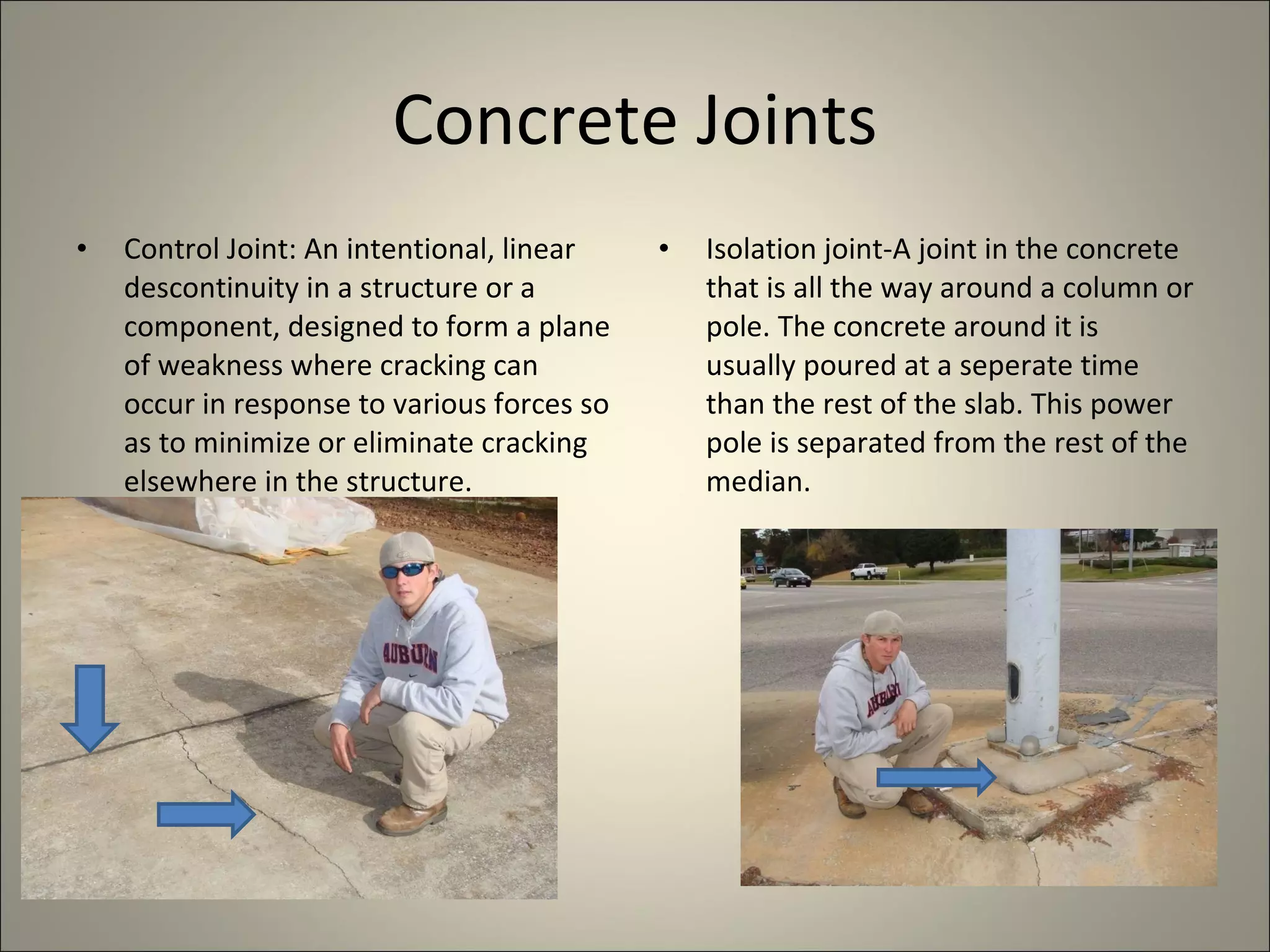
Concrete Joints Control Joint: An intentional, linear descontinuity in a structure or a component, designed to form a plane of weakness where cracking can occur in response to various forces so as to minimize or eliminate cracking elsewhere in the structure. Isolation joint-A joint in the concrete that is all the way around a column or pole. The concrete around it is usually poured at a seperate time than the rest of the slab. This power pole is separated from the rest of the median.
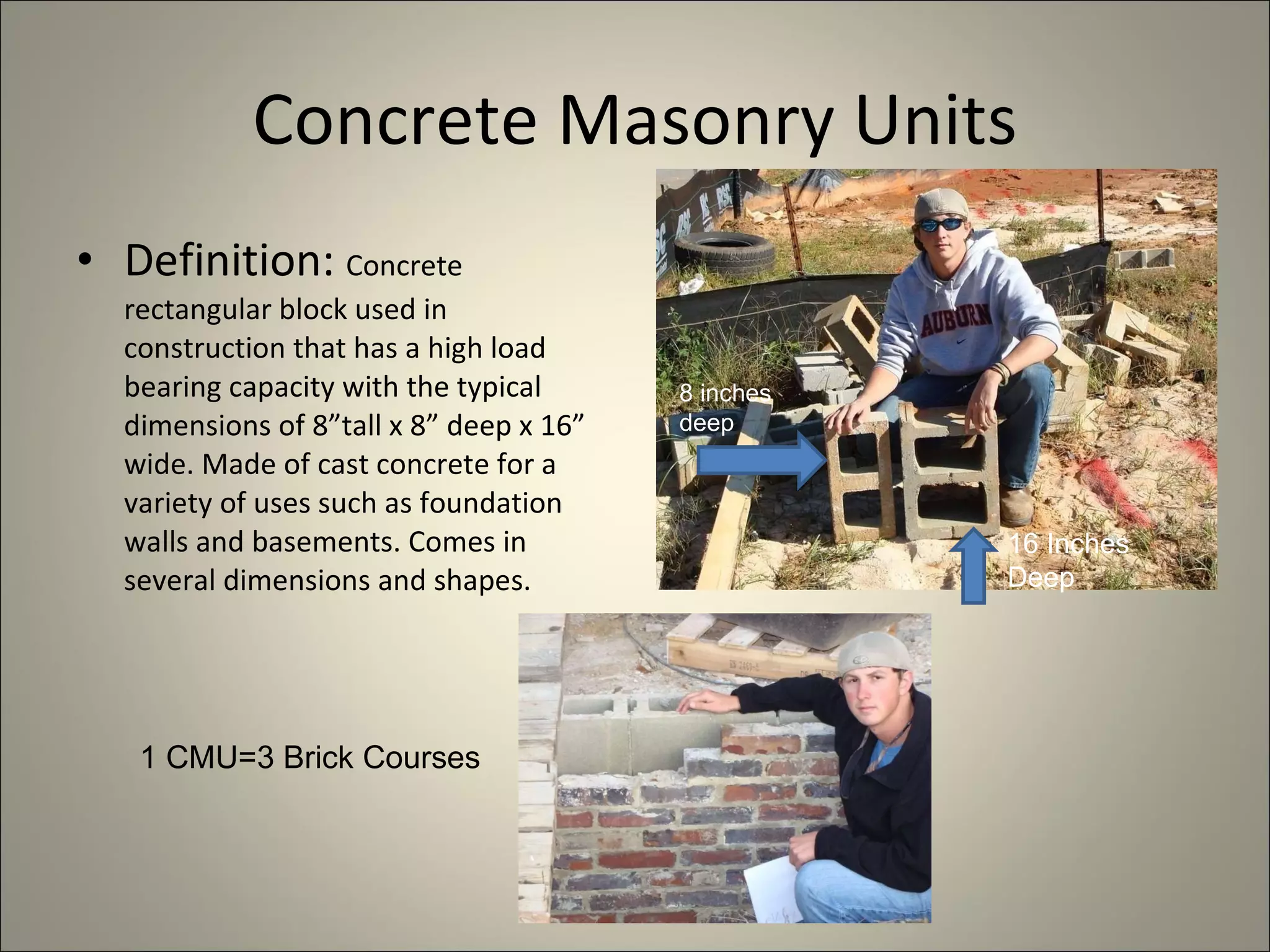
Concrete Masonry Units Definition:  Concrete rectangular block used in construction that has a high load bearing capacity with the typical dimensions of 8”tall x 8” deep x 16” wide. Made of cast concrete for a variety of uses such as foundation walls and basements. Comes in several dimensions and shapes. 8 inches deep 16 Inches  Deep 1 CMU=3 Brick Courses
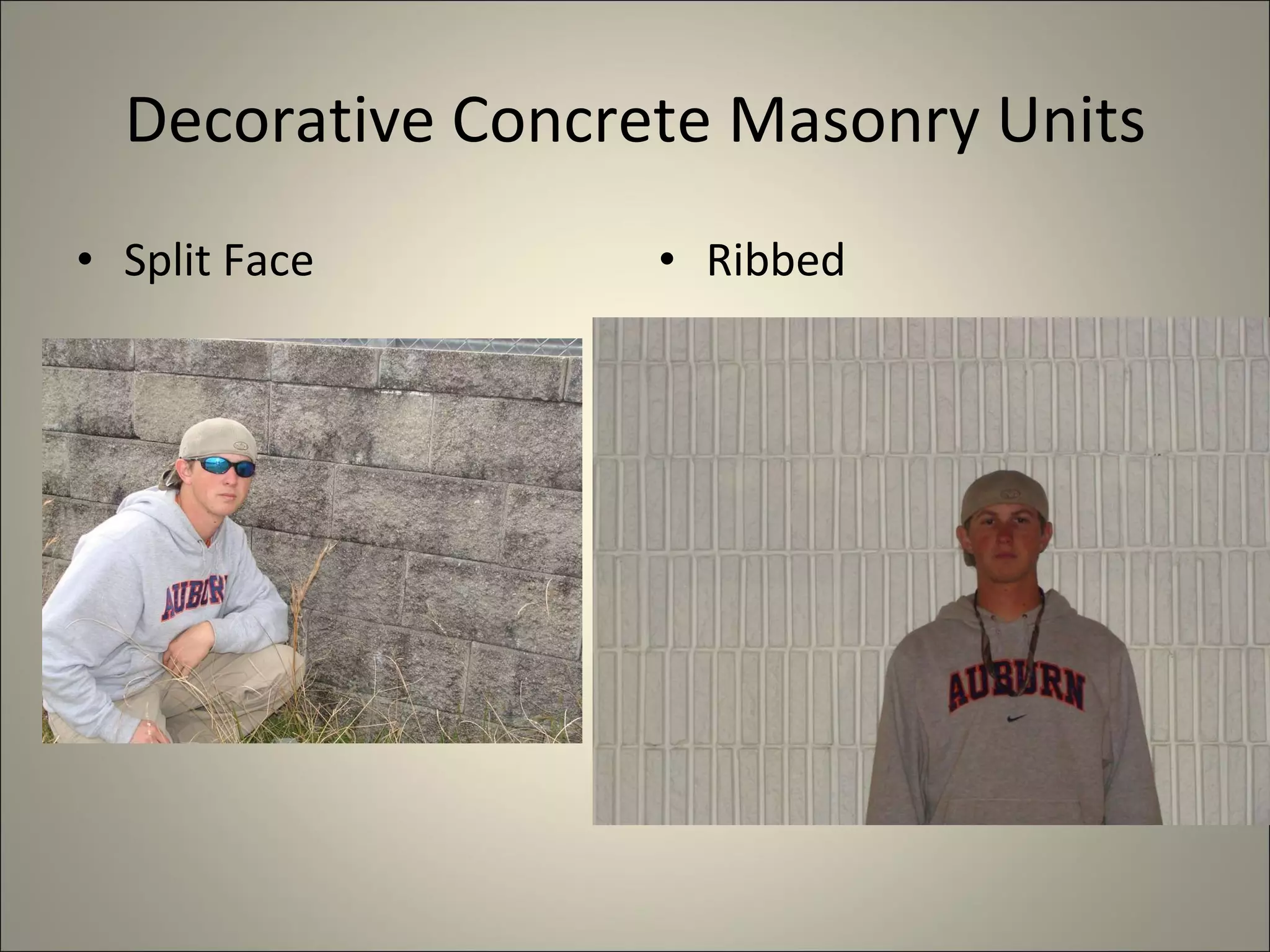
Decorative Concrete Masonry Units Split Face Ribbed
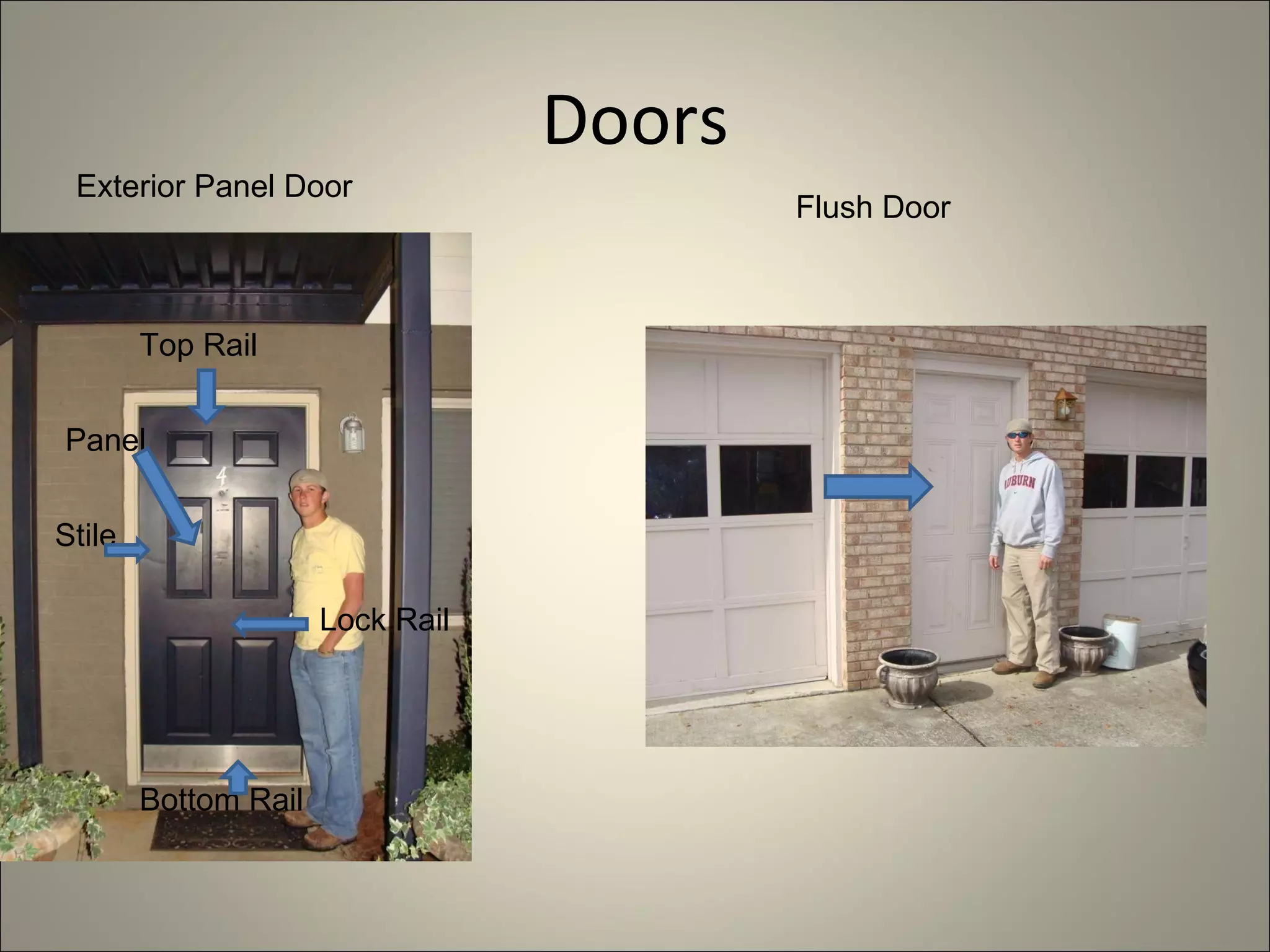
Doors Top Rail Lock Rail Panel Bottom Rail Stile Flush Door Exterior Panel Door
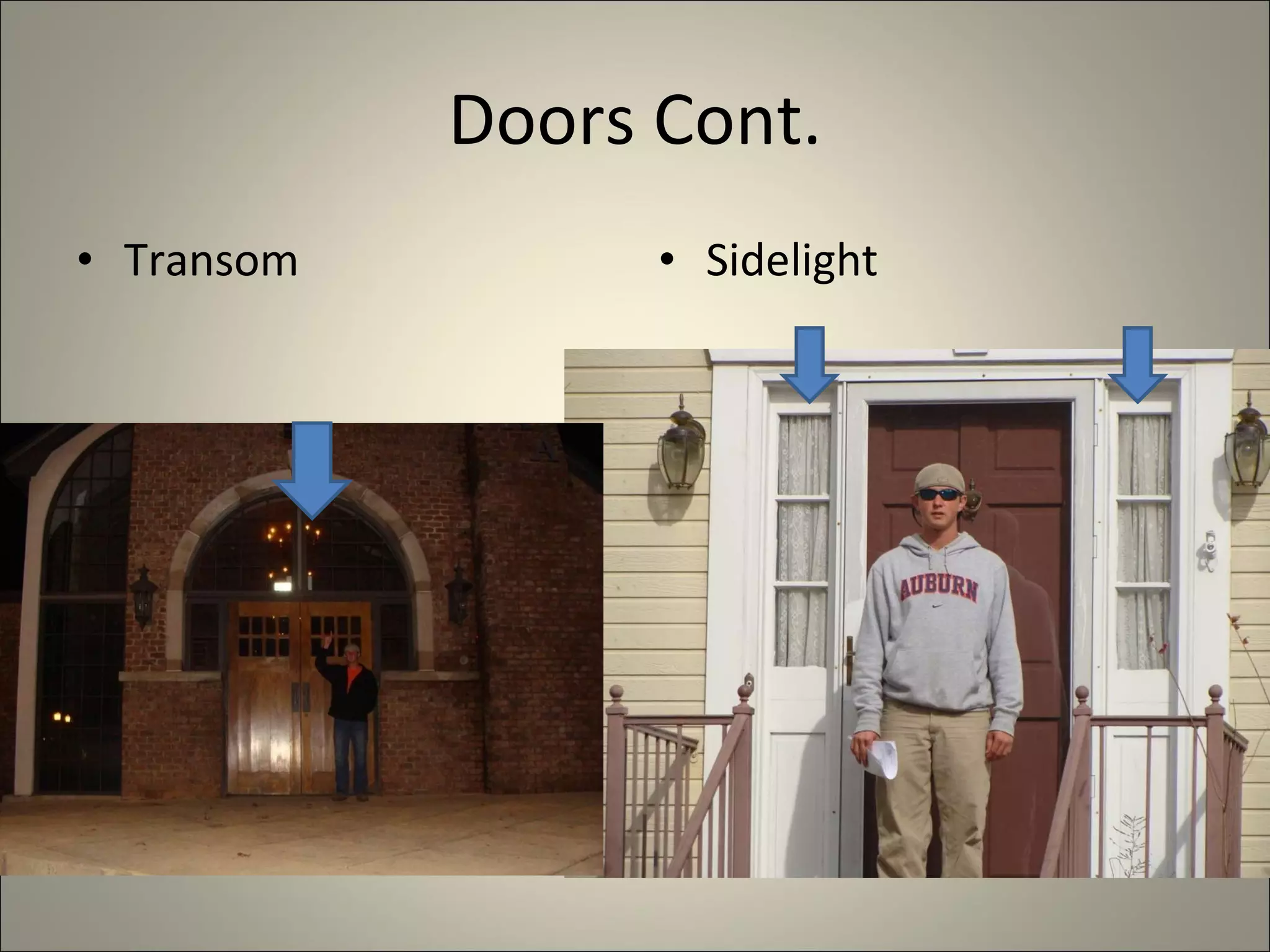
Doors Cont. Transom Sidelight
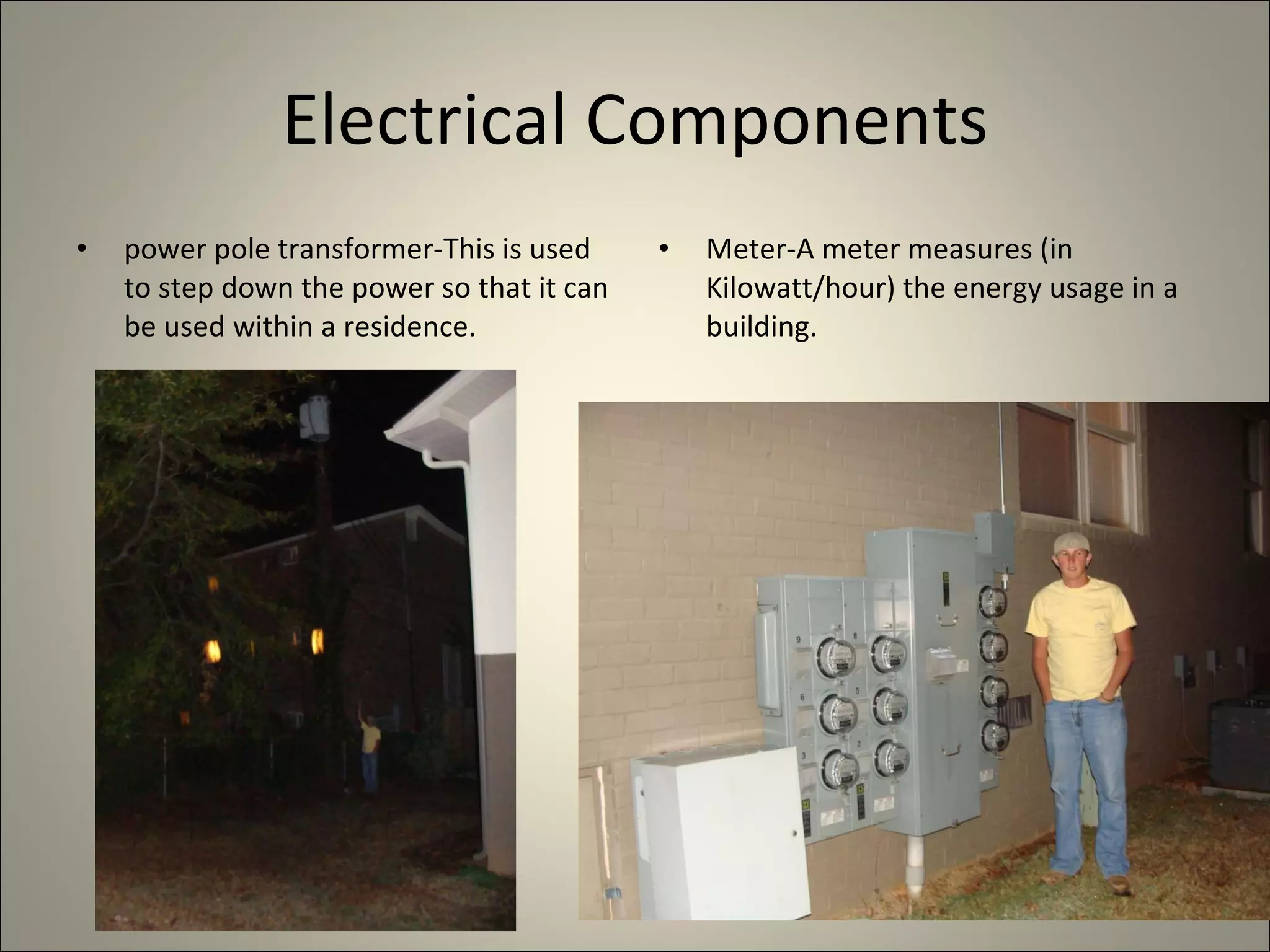
Electrical Components power pole transformer-This is used to step down the power so that it can be used within a residence. Meter-A meter measures (in Kilowatt/hour) the energy usage in a building.
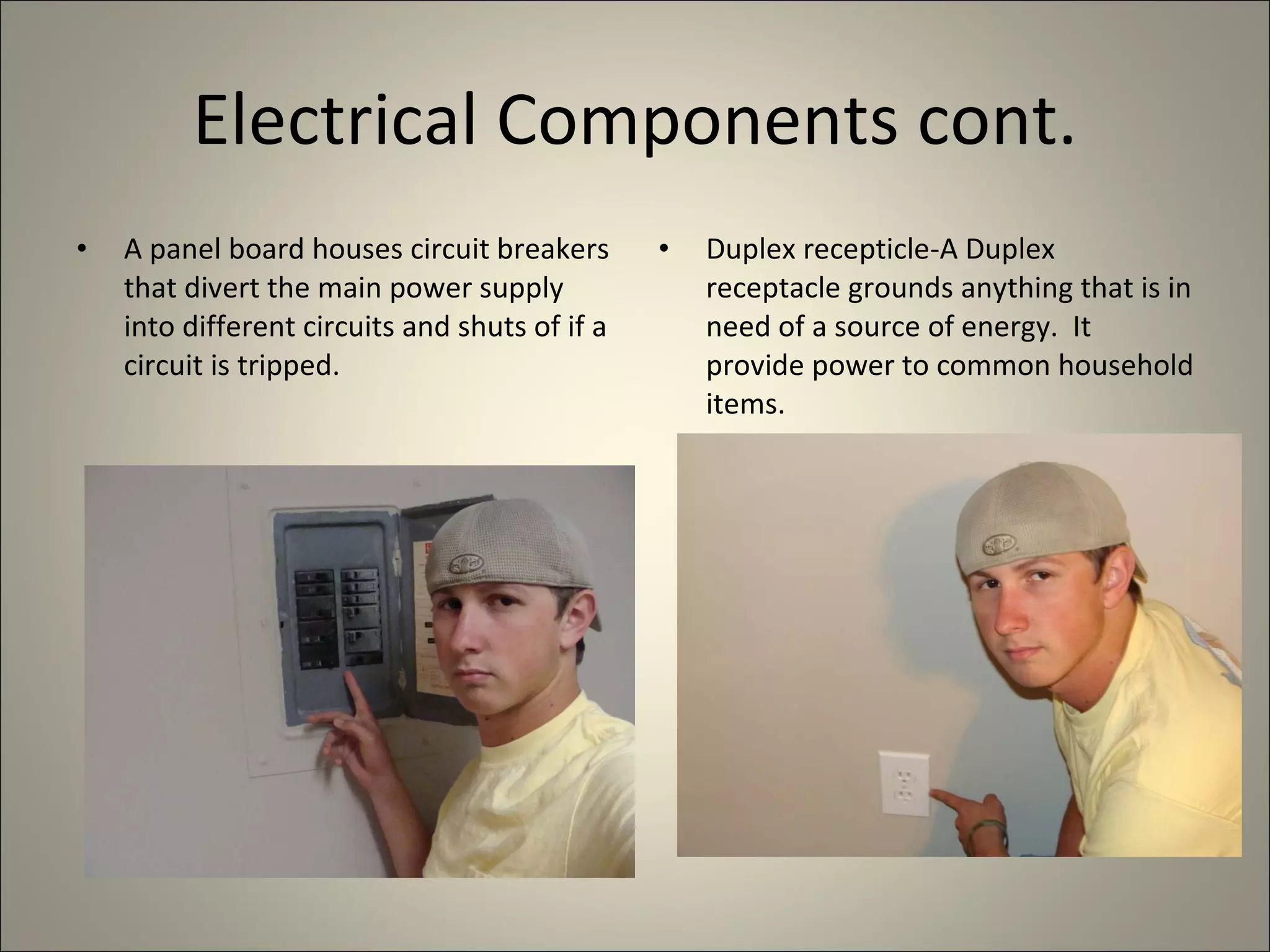
Electrical Components cont. A panel board houses circuit breakers that divert the main power supply into different circuits and shuts of if a circuit is tripped. Duplex recepticle-A Duplex receptacle grounds anything that is in need of a source of energy.  It provide power to common household items.
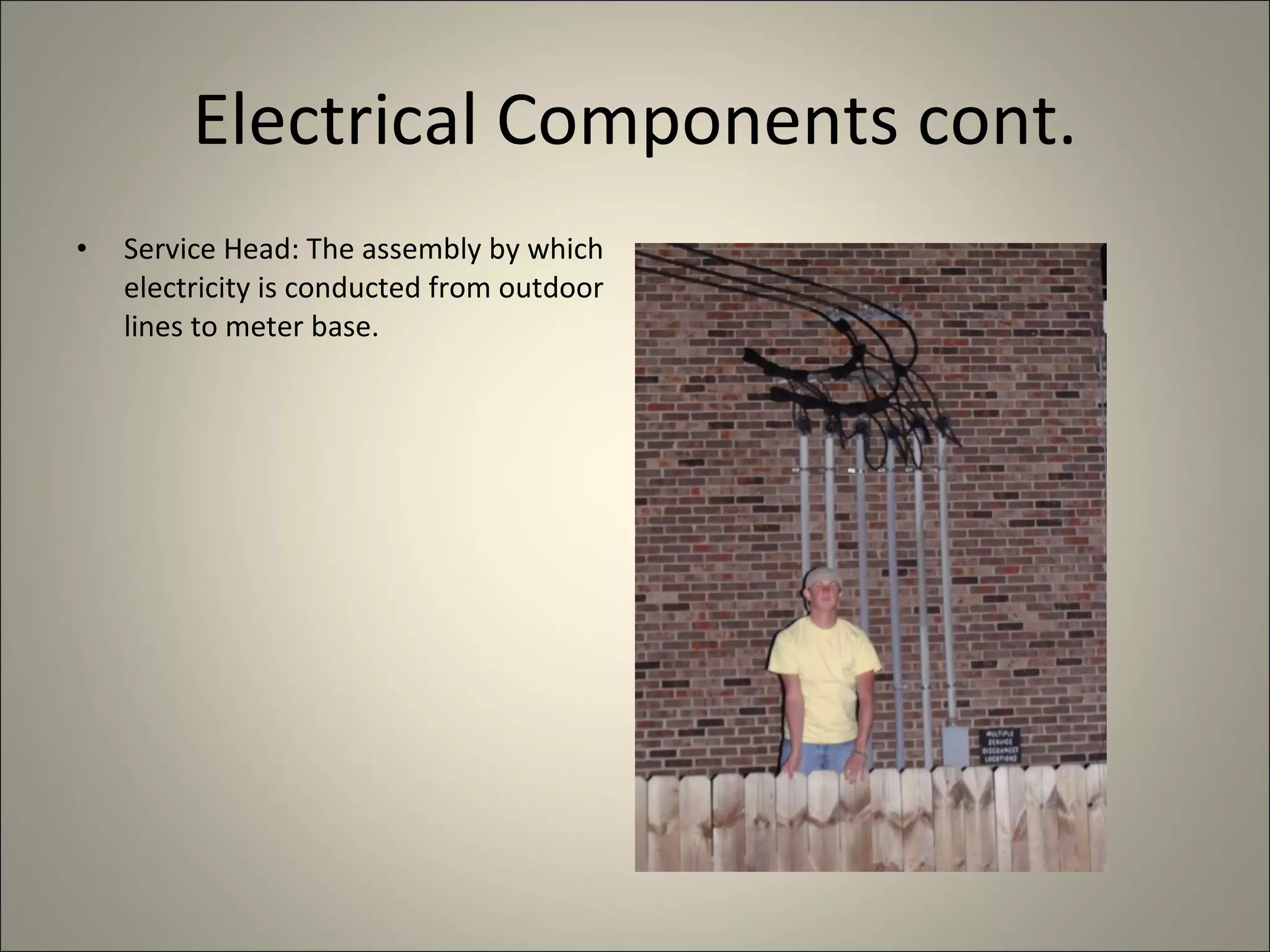
Electrical Components cont. Service Head: The assembly by which electricity is conducted from outdoor lines to meter base.
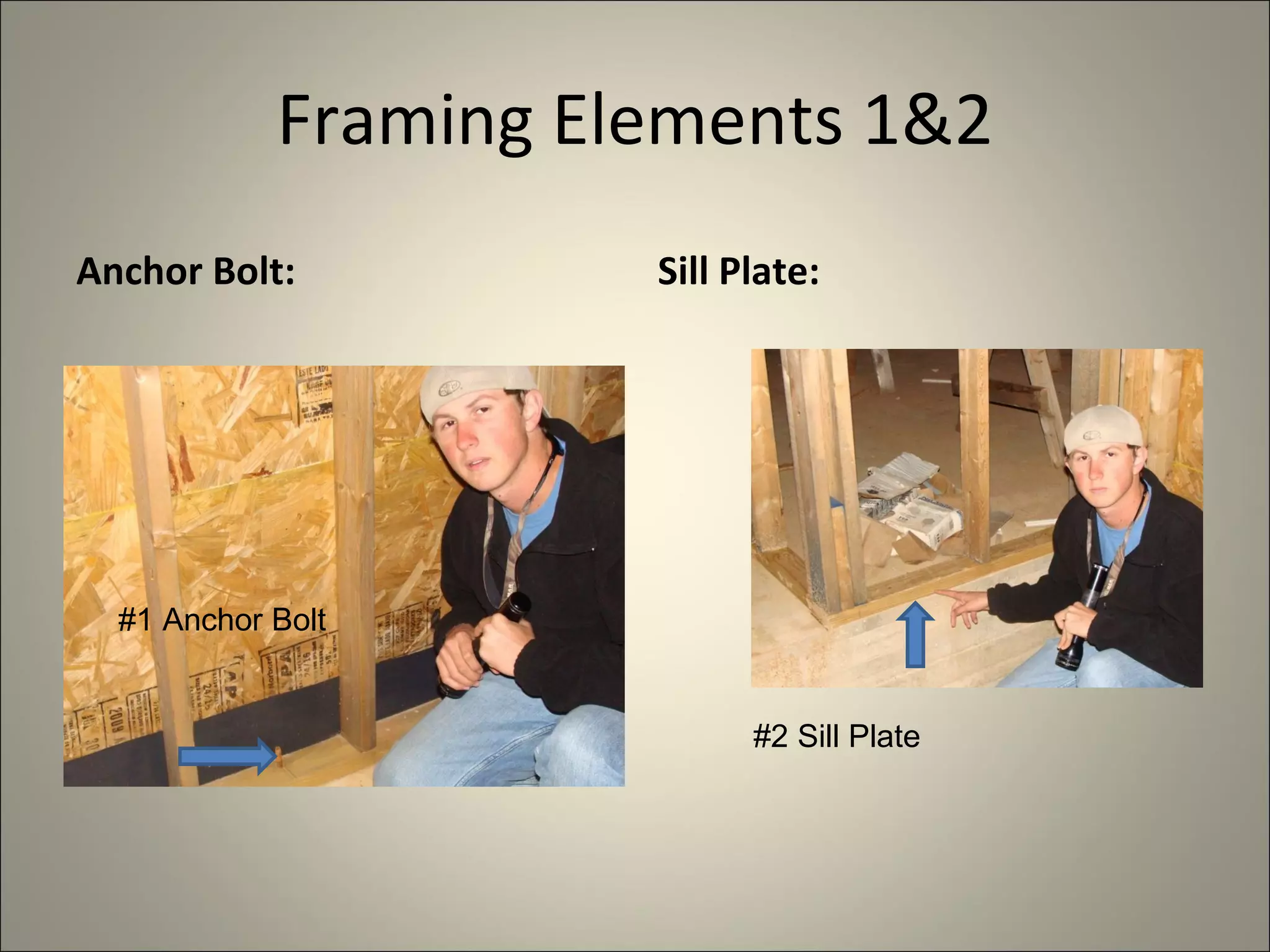
Framing Elements 1&2 Anchor Bolt: Sill Plate: #1 Anchor Bolt #2 Sill Plate
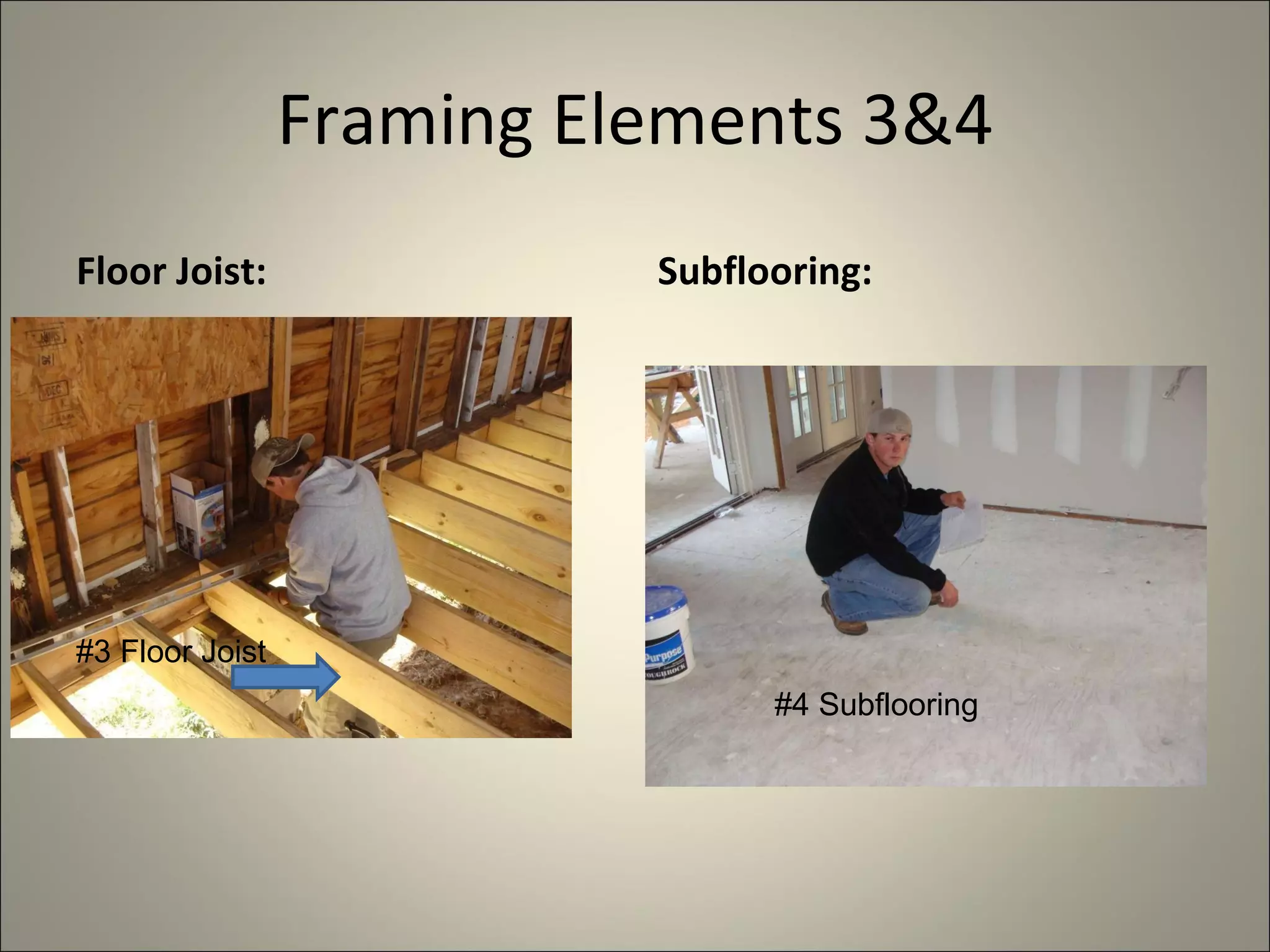
Framing Elements 3&4 Floor Joist: Subflooring: #3 Floor Joist #4 Subflooring
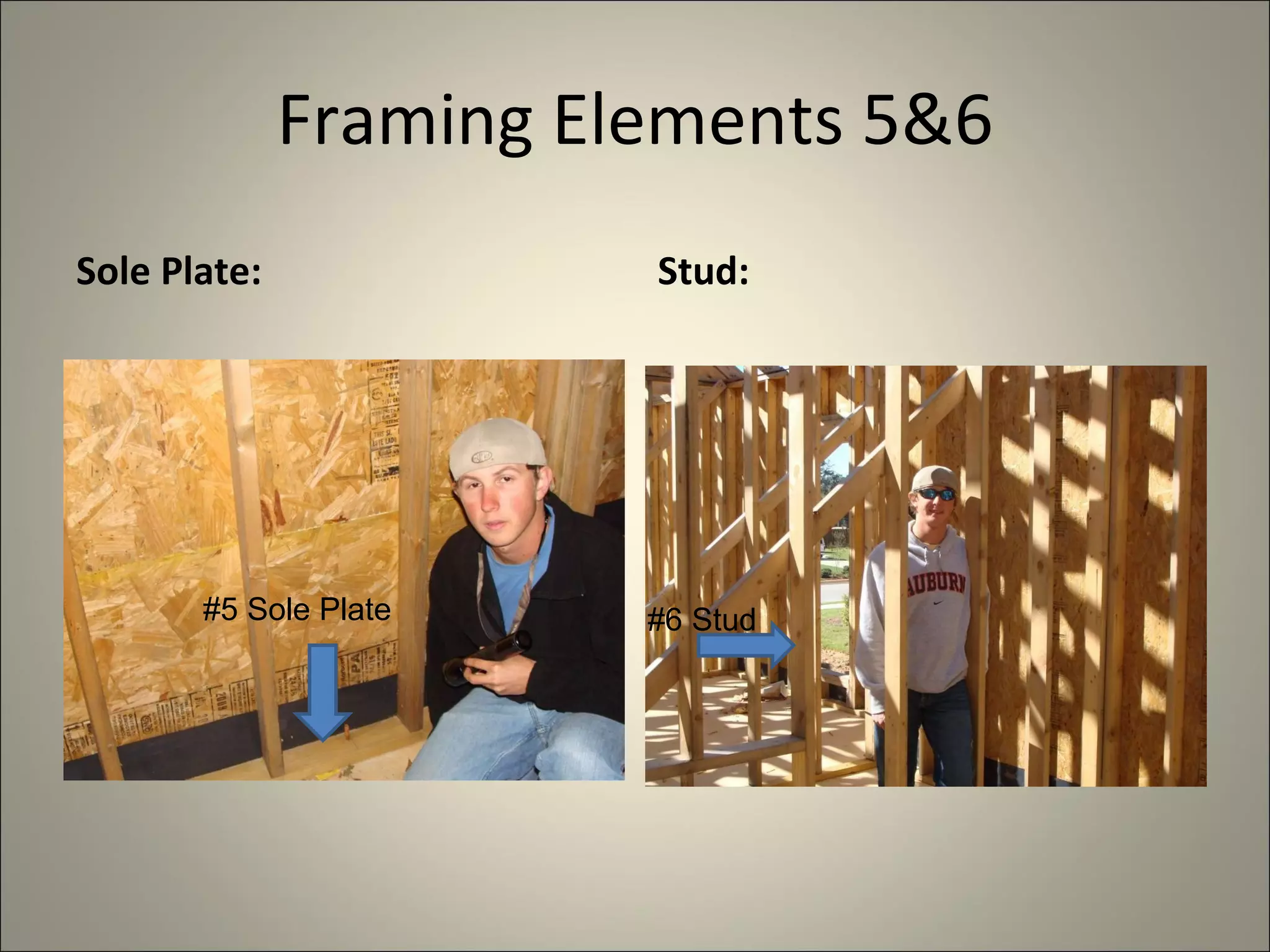
Framing Elements 5&6 Sole Plate: Stud: #5 Sole Plate #6 Stud #5 Sole Plate
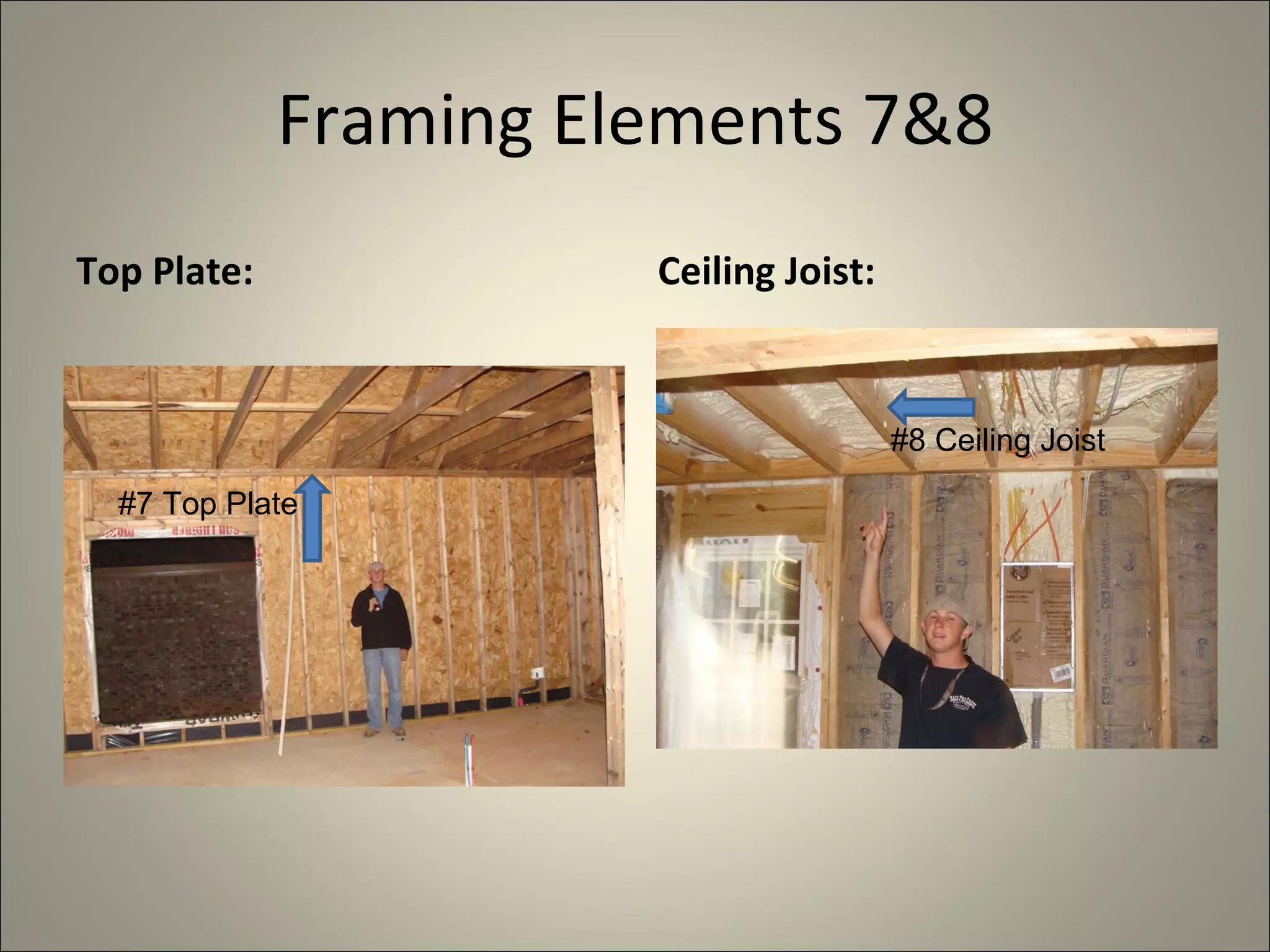
Framing Elements 7&8 Top Plate: Ceiling Joist: #8 Ceiling Joist #7 Top Plate
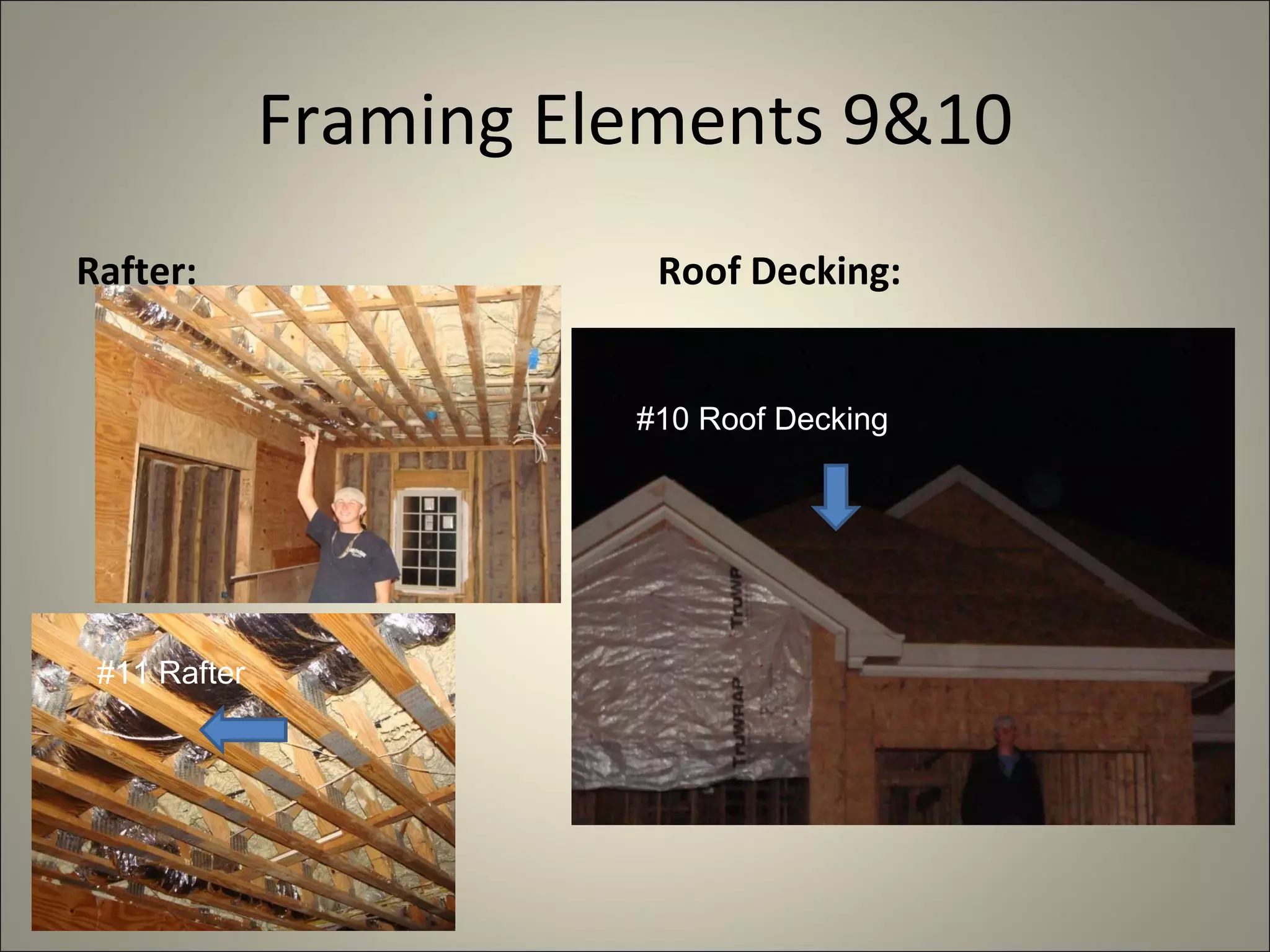
Framing Elements 9&10 Rafter: Roof Decking: #10 Roof Decking #11 Rafter
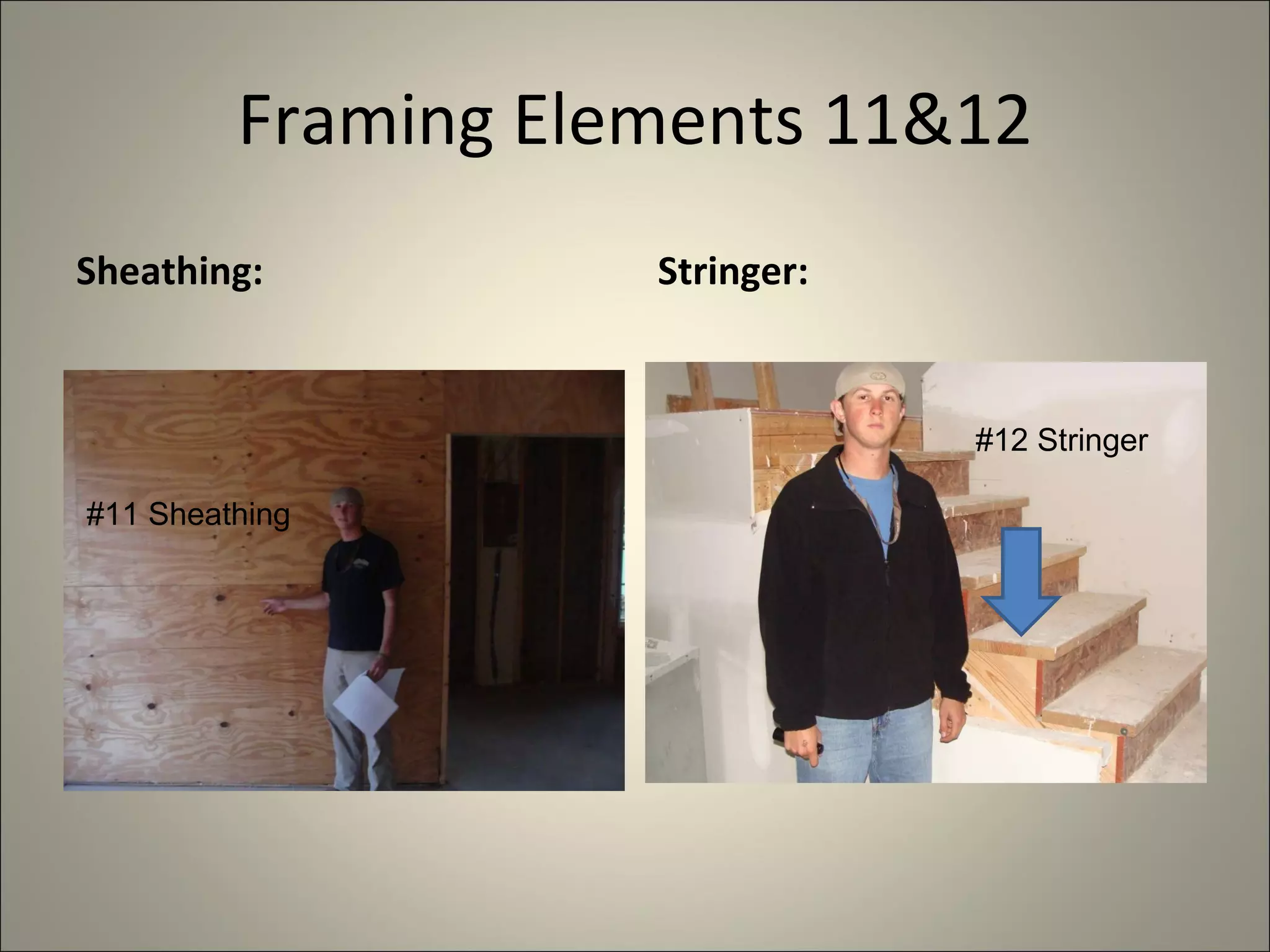
Framing Elements 11&12 Sheathing: Stringer: #11 Sheathing #12 Stringer
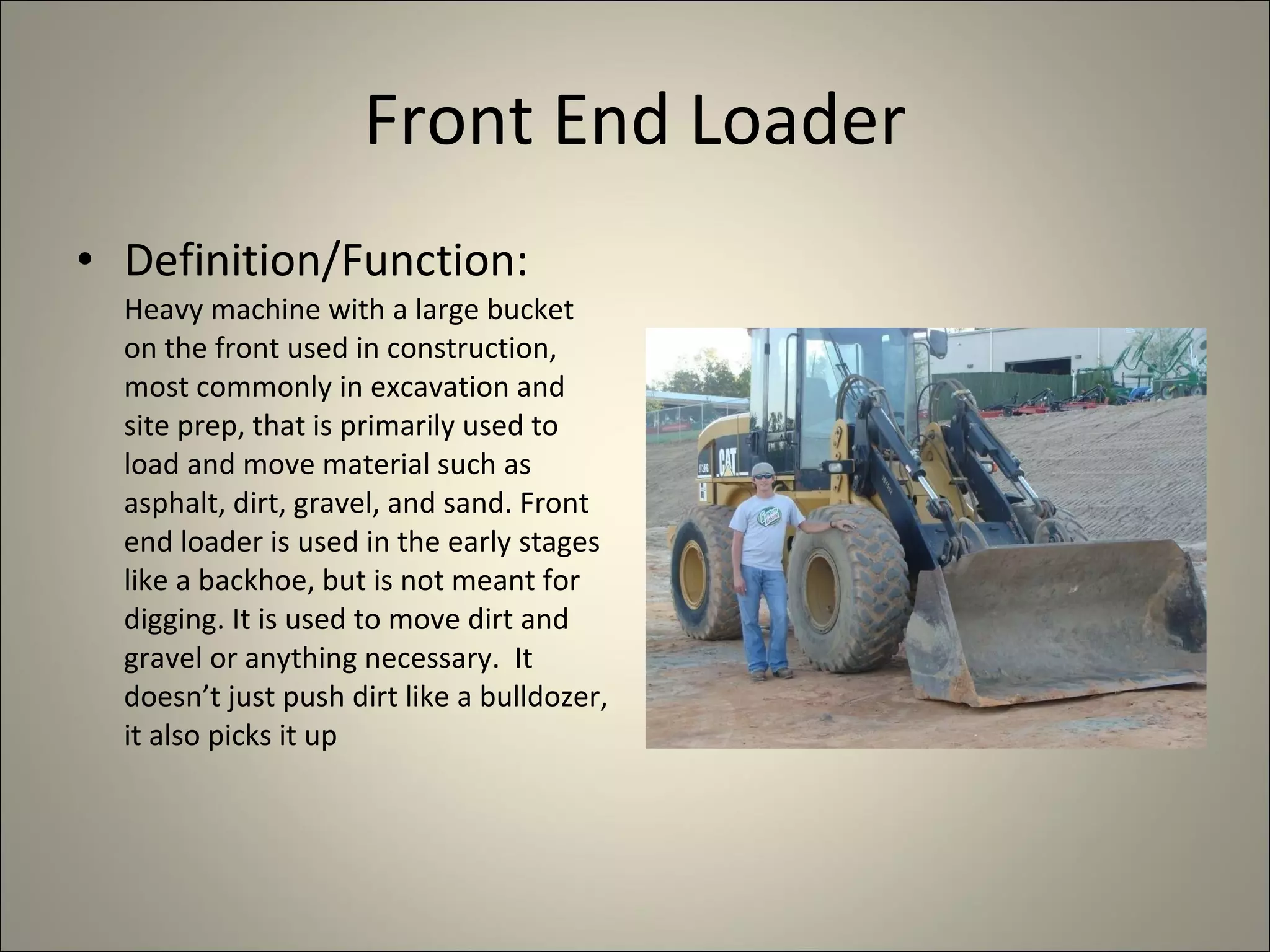
Front End Loader Definition/Function:  Heavy machine with a large bucket on the front used in construction, most commonly in excavation and site prep, that is primarily used to load and move material such as asphalt, dirt, gravel, and sand. Front end loader is used in the early stages like a backhoe, but is not meant for digging. It is used to move dirt and gravel or anything necessary.  It doesn’t just push dirt like a bulldozer, it also picks it up
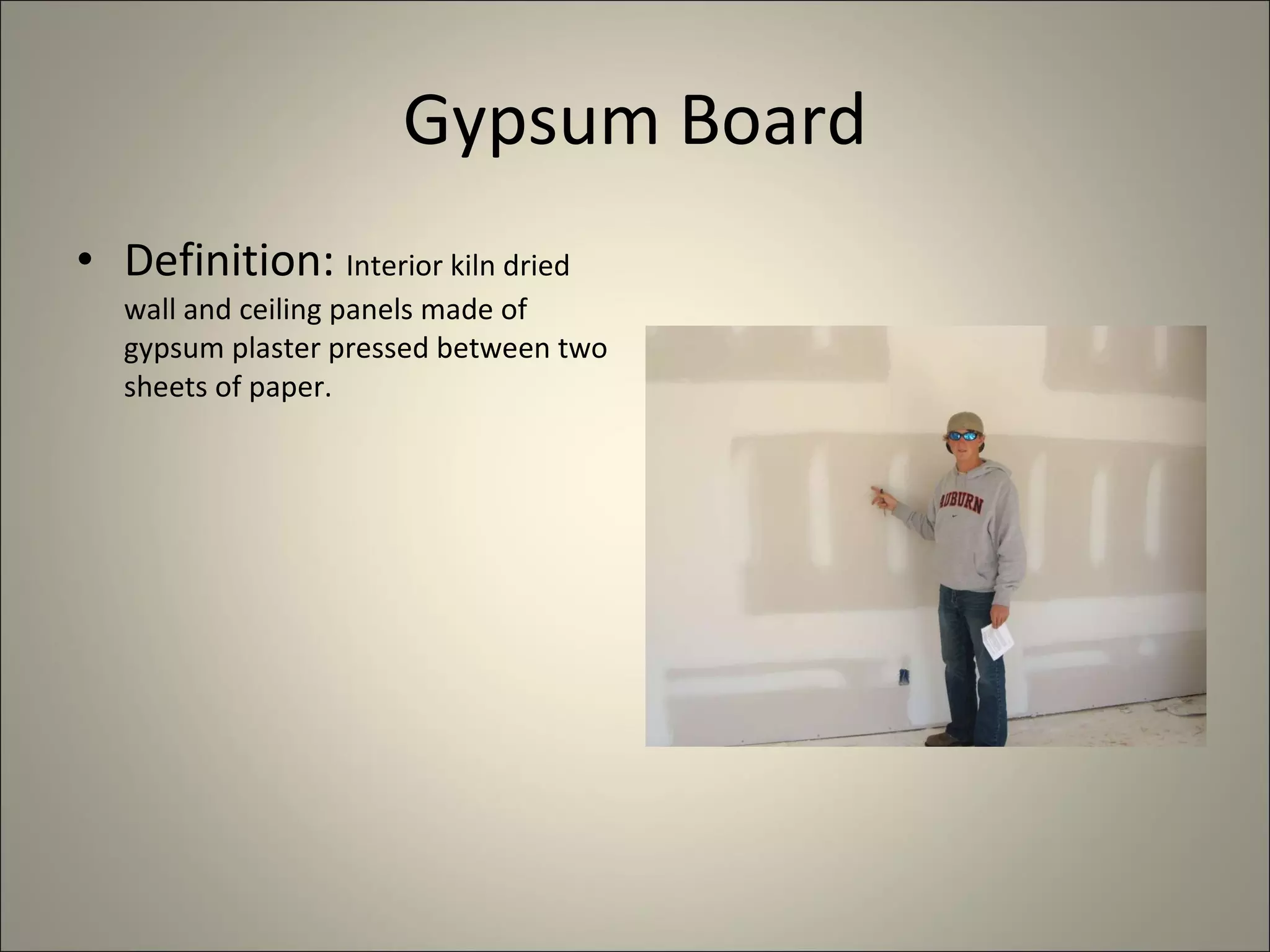
Gypsum Board Definition:  Interior kiln dried wall and ceiling panels made of gypsum plaster pressed between two sheets of paper.
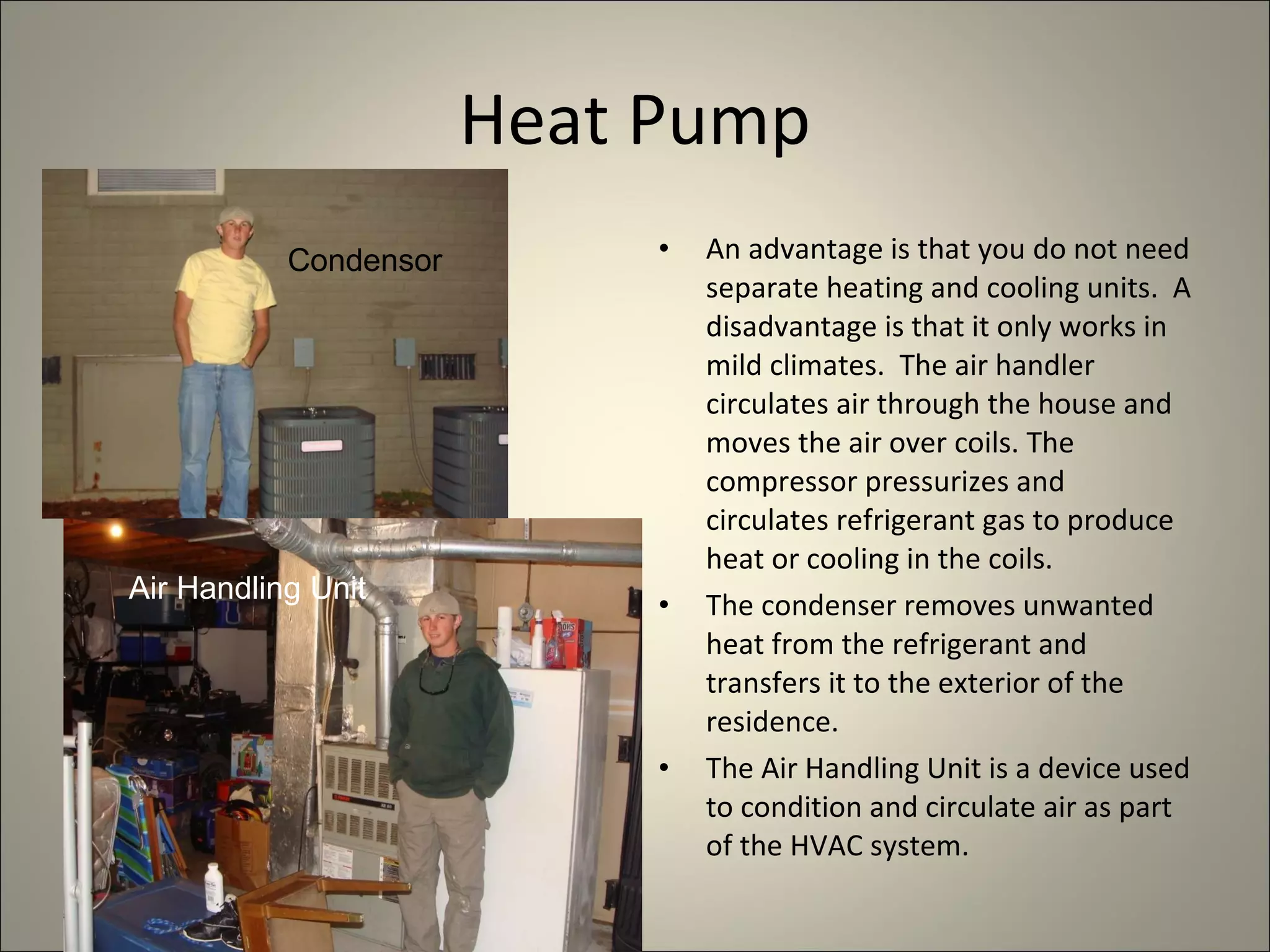
Heat Pump An advantage is that you do not need separate heating and cooling units.  A disadvantage is that it only works in mild climates.  The air handler circulates air through the house and moves the air over coils. The compressor pressurizes and circulates refrigerant gas to produce heat or cooling in the coils. The condenser removes unwanted heat from the refrigerant and transfers it to the exterior of the residence. The Air Handling Unit is a device used to condition and circulate air as part of the HVAC system.  Condensor Air Handling Unit
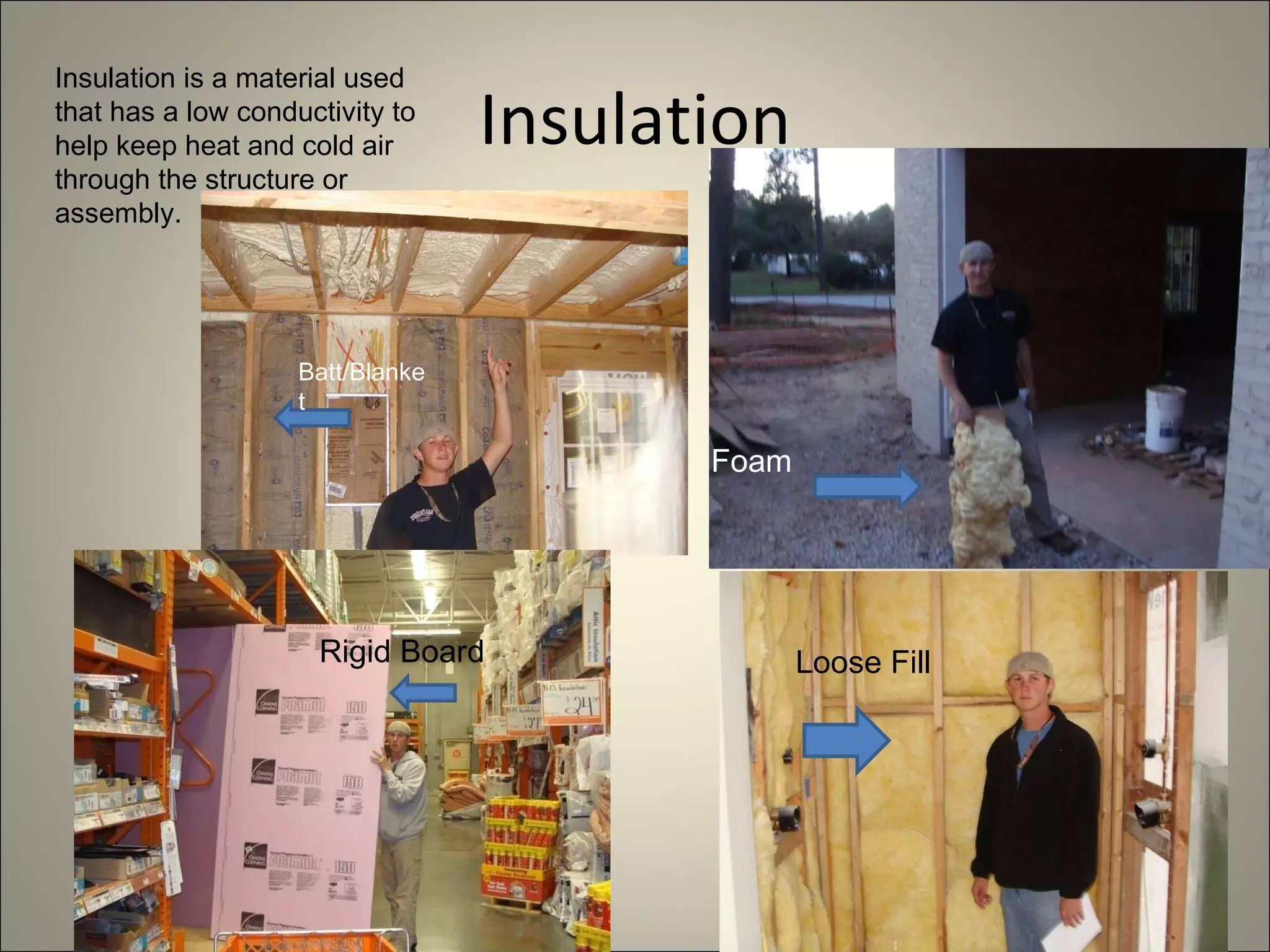
Insulation Foam Batt/Blanket Loose Fill Insulation is a material used that has a low conductivity to help keep heat and cold air through the structure or assembly. Rigid Board
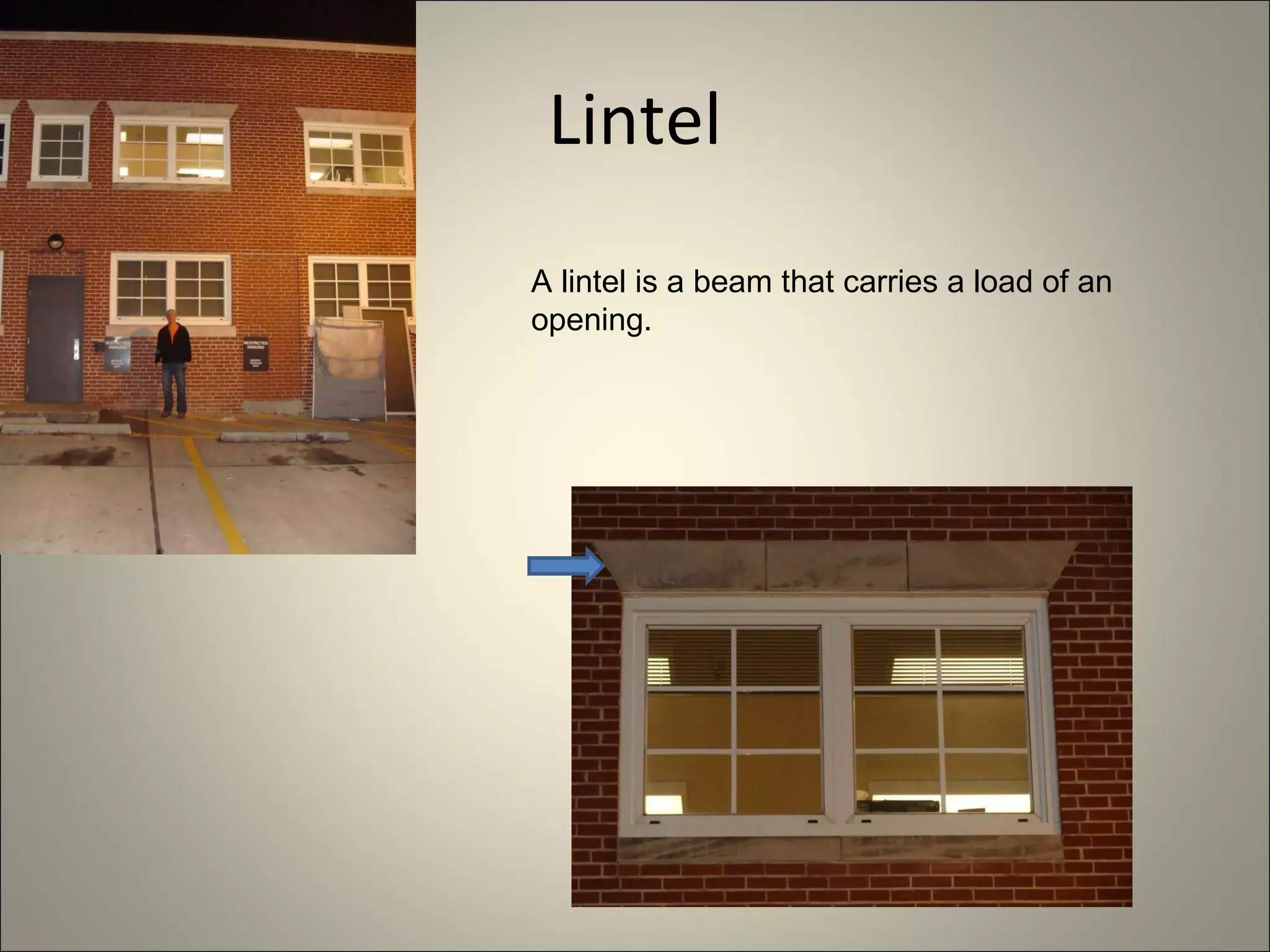
Lintel A lintel is a beam that carries a load of an opening.
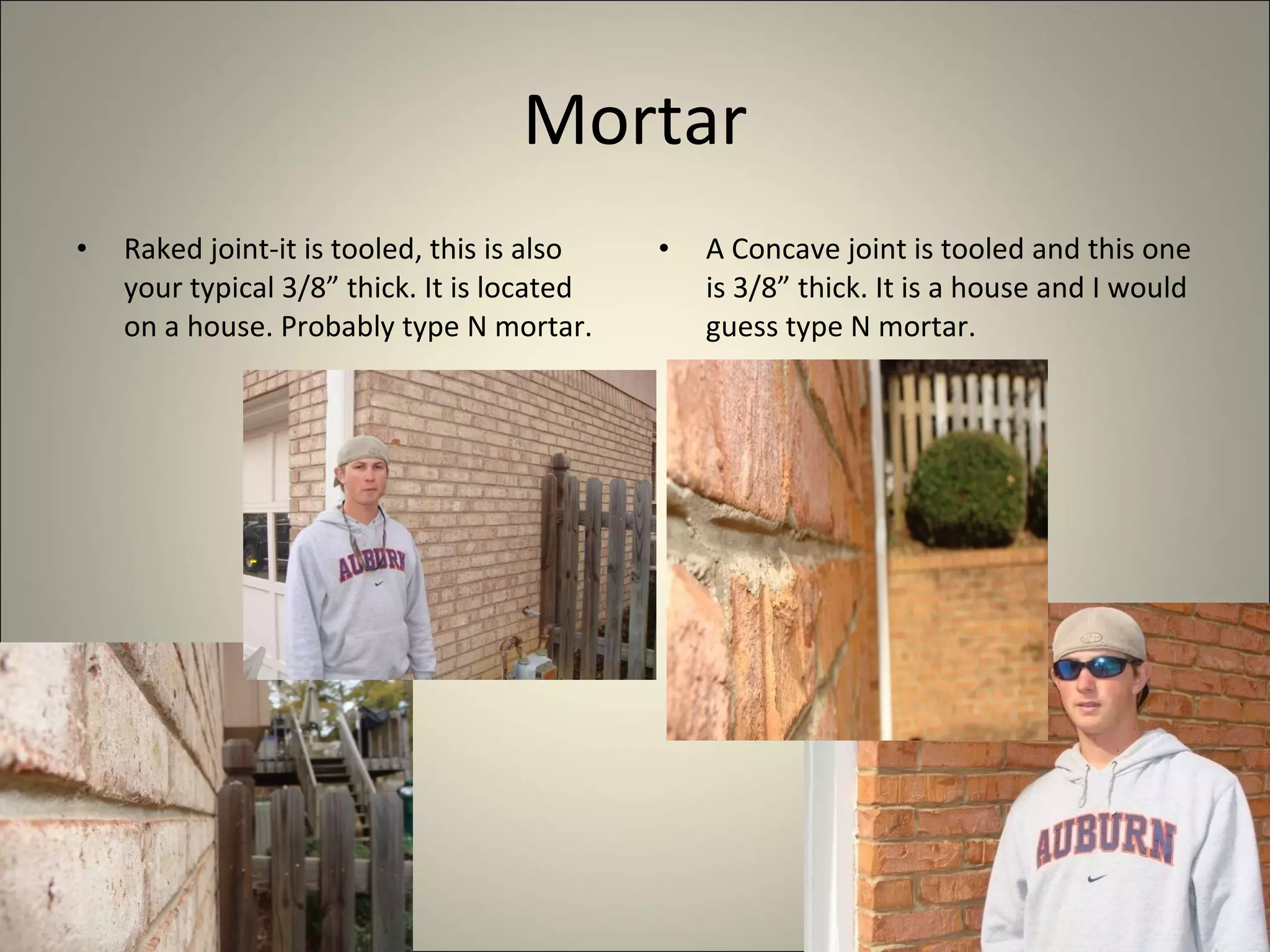
Mortar Raked joint-it is tooled, this is also your typical 3/8” thick. It is located on a house. Probably type N mortar. A Concave joint is tooled and this one is 3/8” thick. It is a house and I would guess type N mortar.
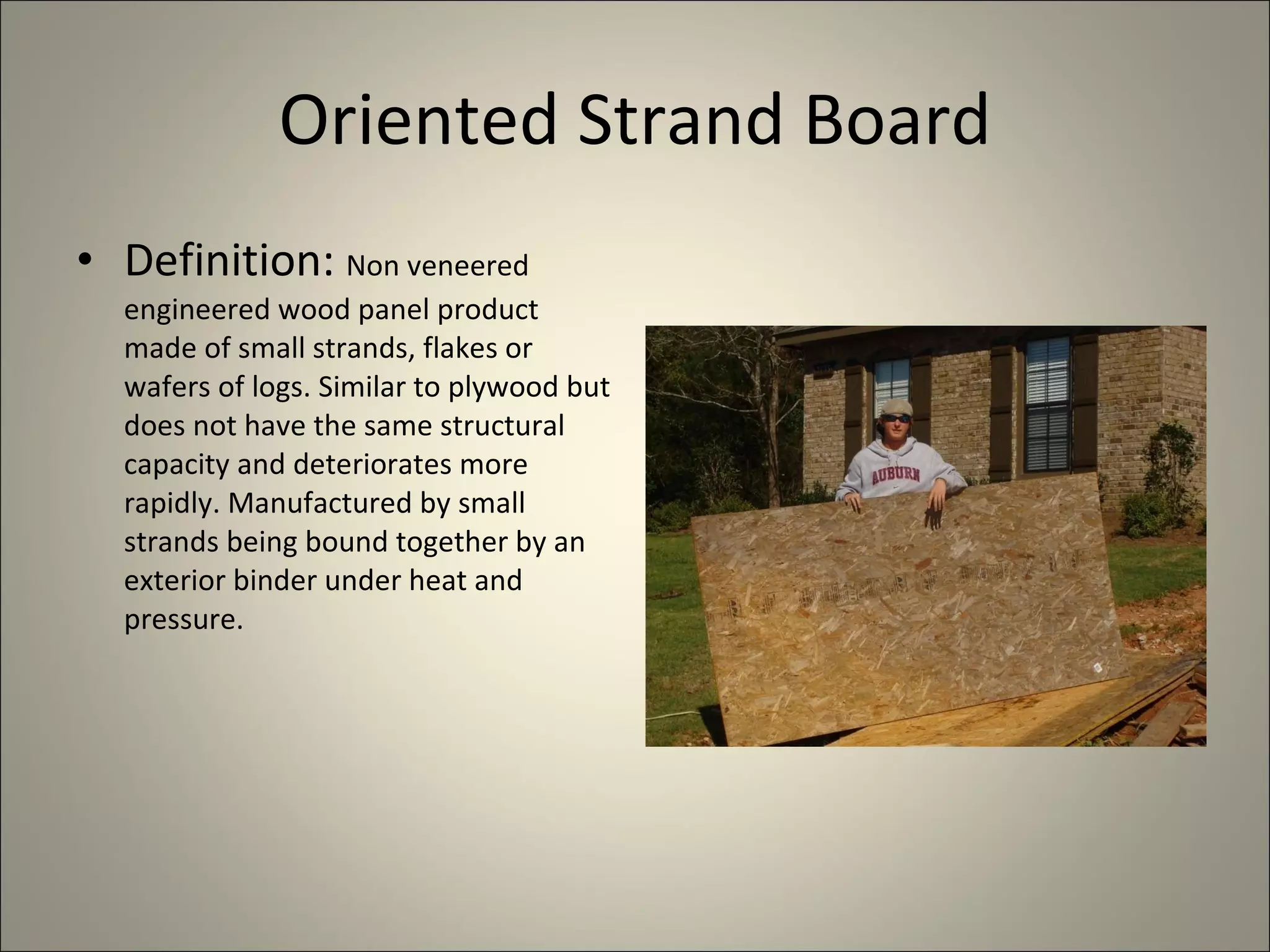
Oriented Strand Board Definition:  Non veneered engineered wood panel product made of small strands, flakes or wafers of logs. Similar to plywood but does not have the same structural capacity and deteriorates more rapidly. Manufactured by small strands being bound together by an exterior binder under heat and pressure.
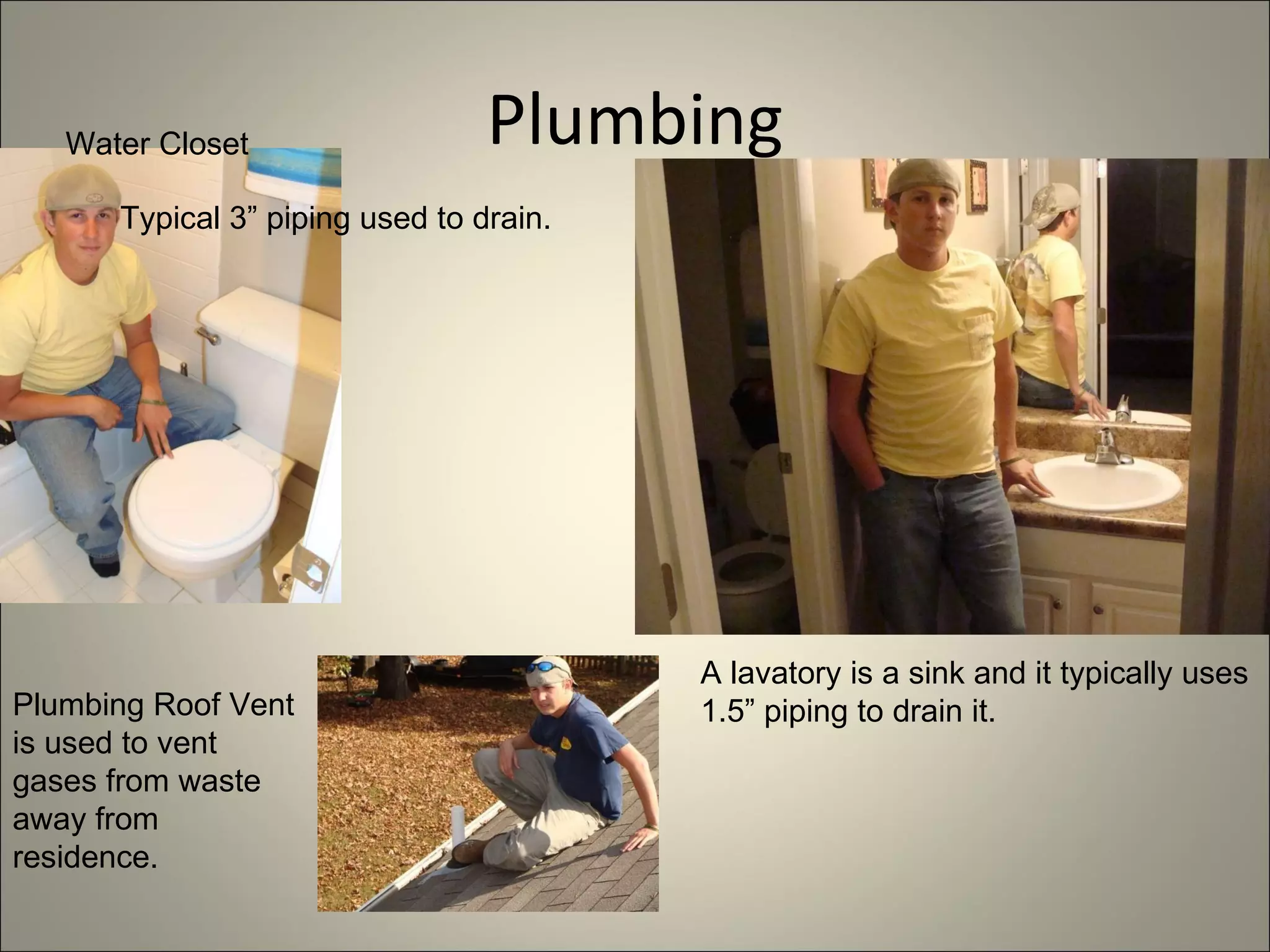
Plumbing Plumbing Roof Vent is used to vent gases from waste away from residence. Water Closet Typical 3” piping used to drain. A lavatory is a sink and it typically uses 1.5” piping to drain it.
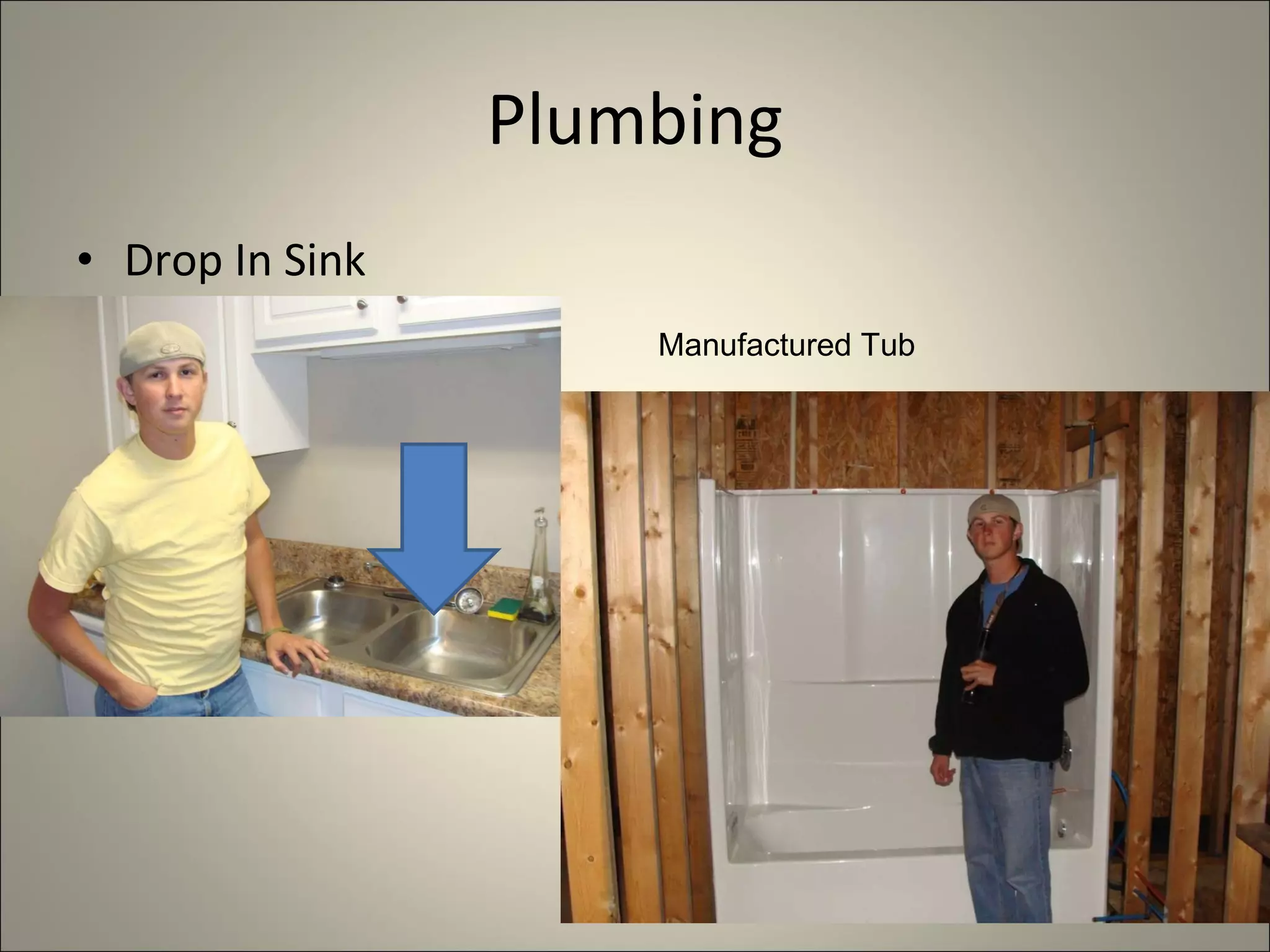
Plumbing Drop In Sink Manufactured Tub
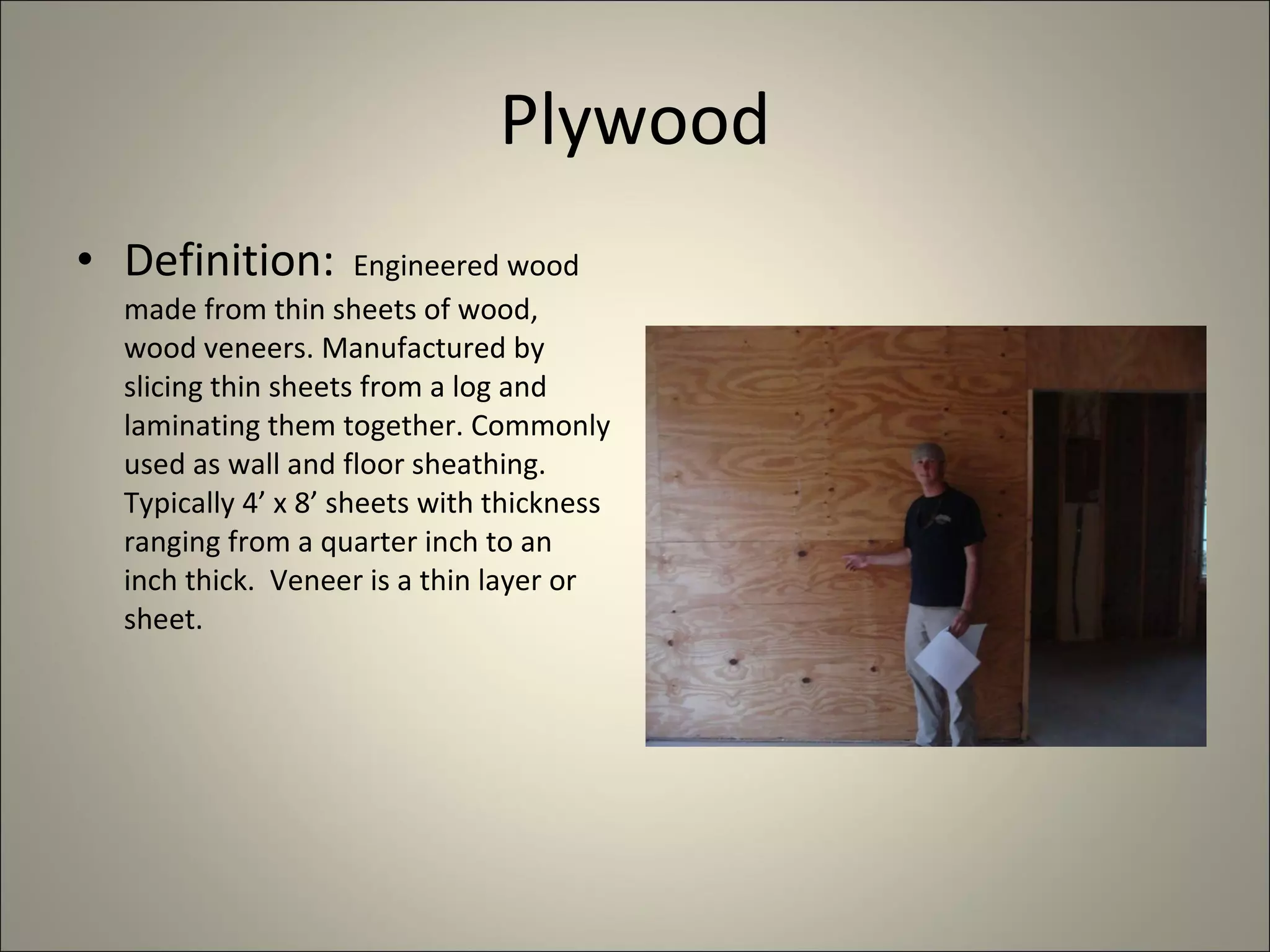
Plywood Definition:  Engineered wood made from thin sheets of wood, wood veneers. Manufactured by slicing thin sheets from a log and laminating them together. Commonly used as wall and floor sheathing. Typically 4’ x 8’ sheets with thickness ranging from a quarter inch to an inch thick.  Veneer is a thin layer or sheet.
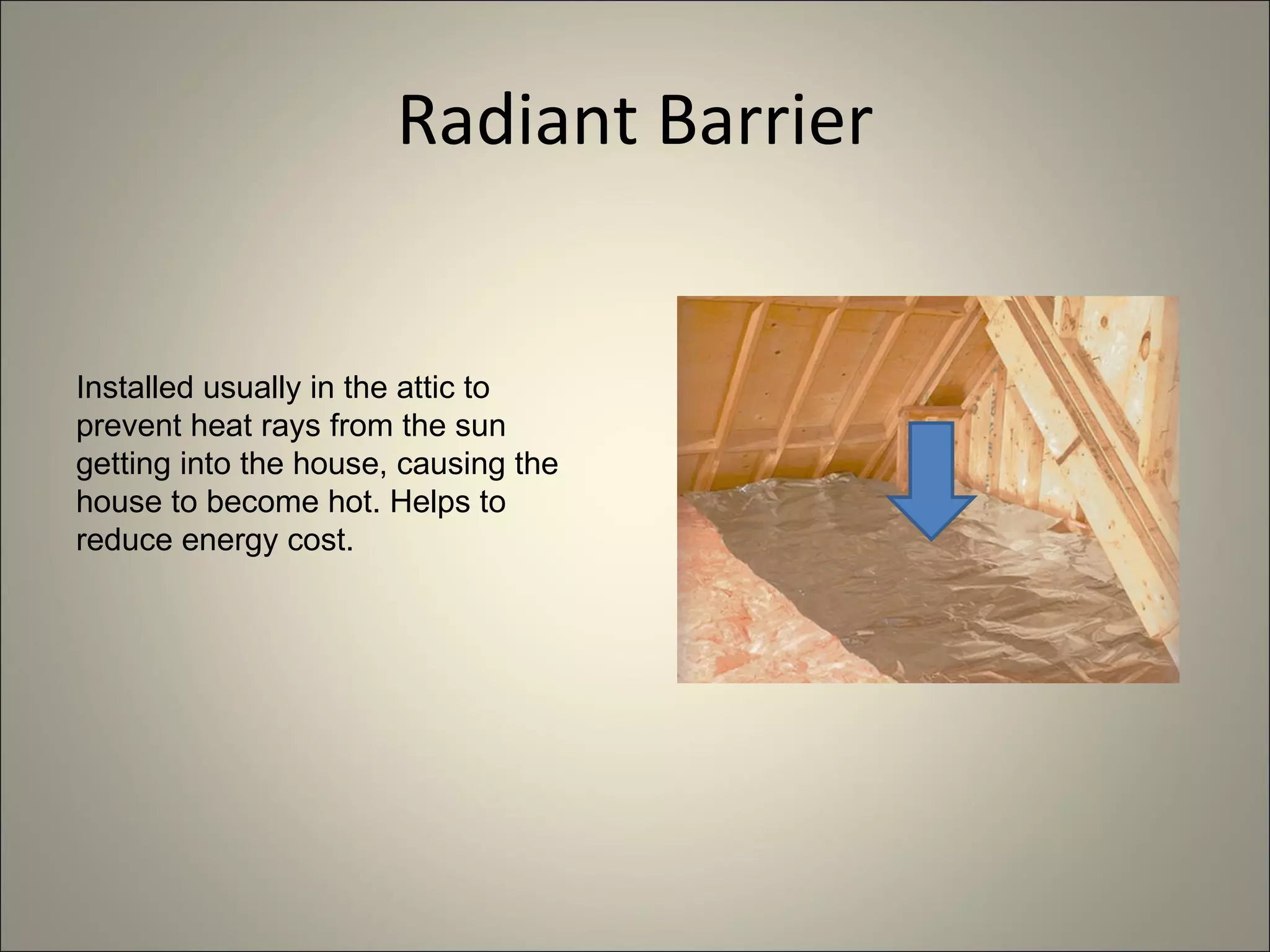
Radiant Barrier Installed usually in the attic to prevent heat rays from the sun getting into the house, causing the house to become hot. Helps to reduce energy cost.
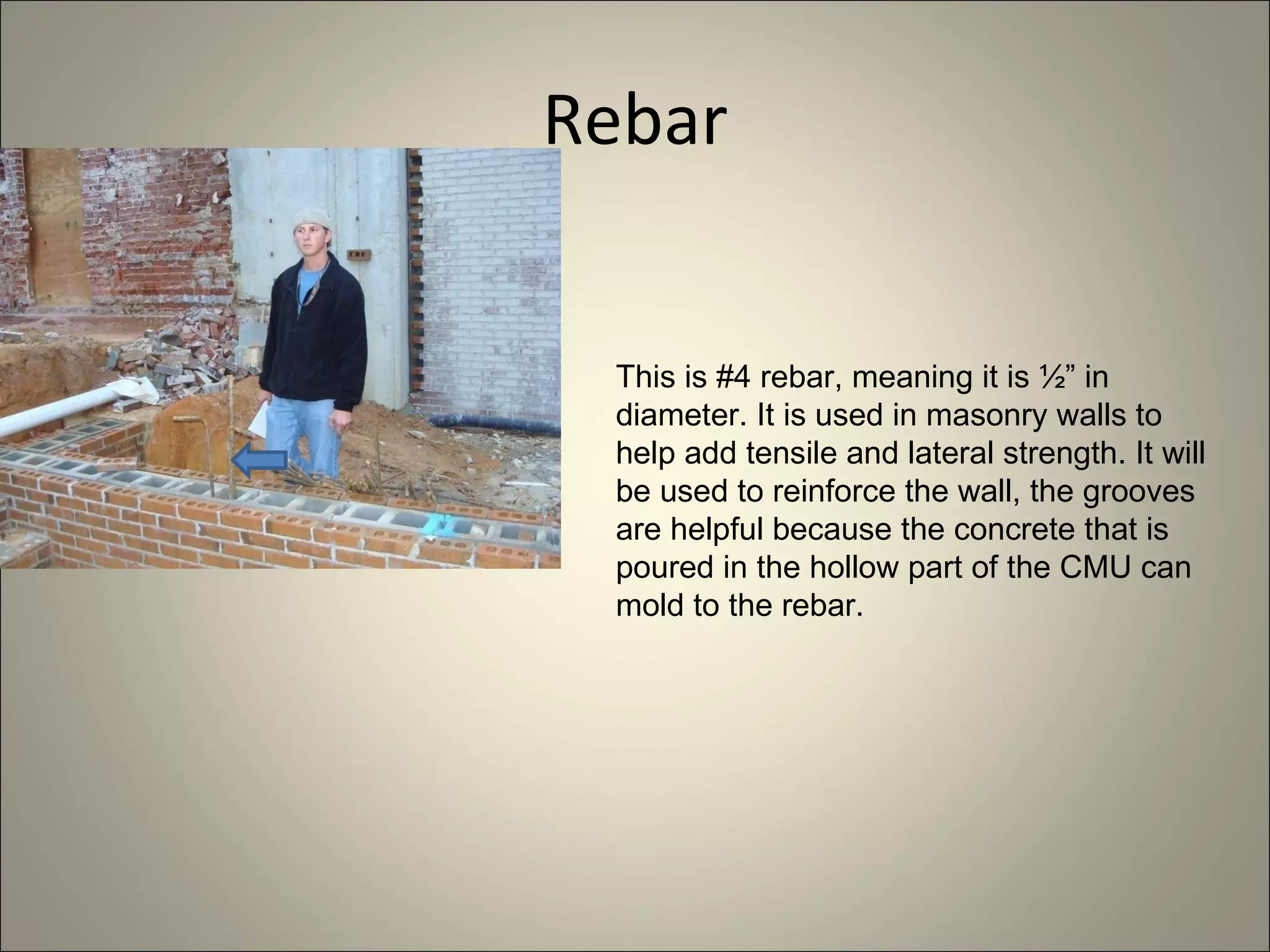
Rebar This is #4 rebar, meaning it is ½” in diameter. It is used in masonry walls to help add tensile and lateral strength. It will be used to reinforce the wall, the grooves are helpful because the concrete that is poured in the hollow part of the CMU can mold to the rebar.
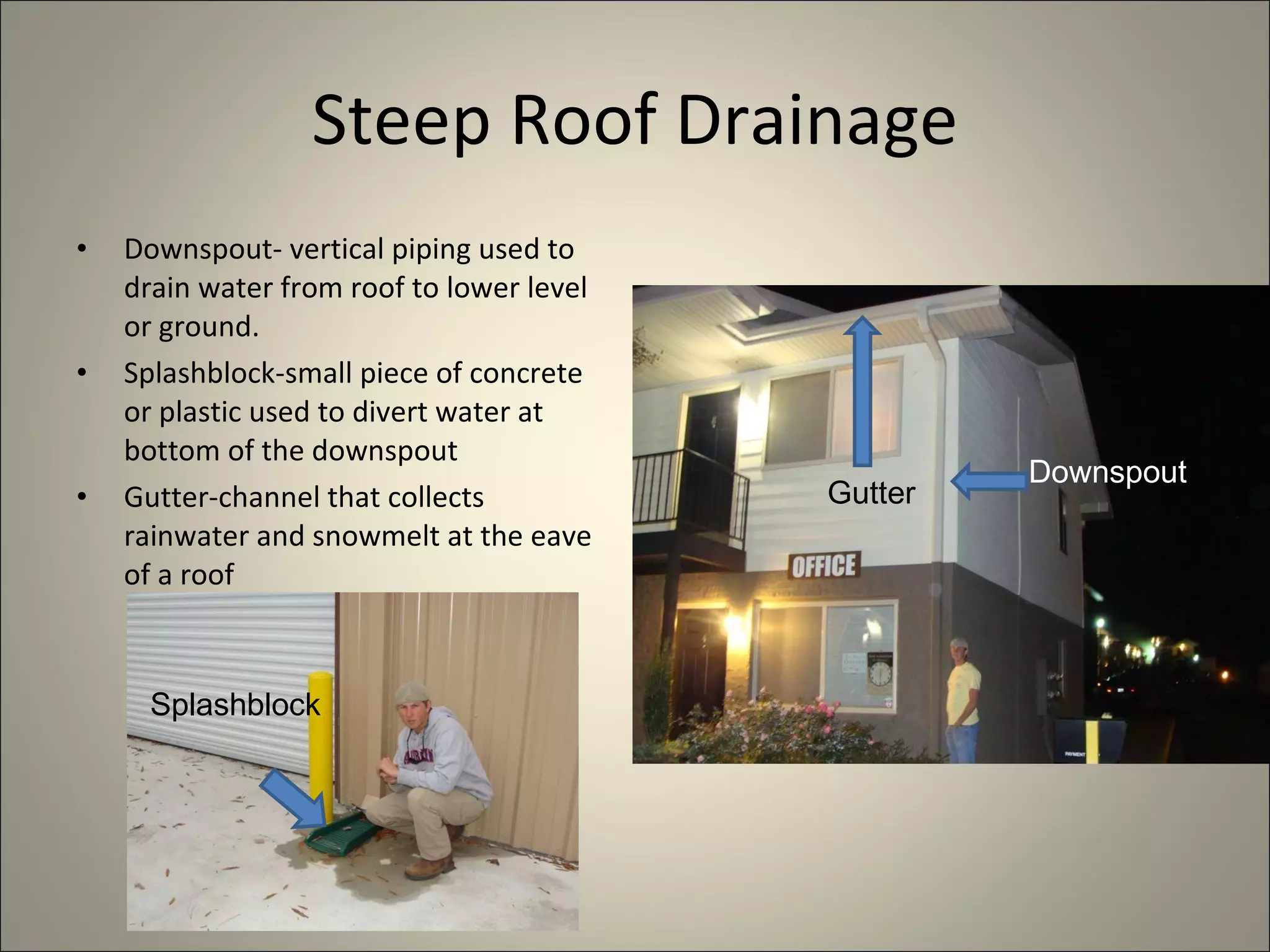
Steep Roof Drainage Downspout- vertical piping used to drain water from roof to lower level or ground. Splashblock-small piece of concrete or plastic used to divert water at bottom of the downspout Gutter-channel that collects rainwater and snowmelt at the eave of a roof Downspout Gutter Splashblock
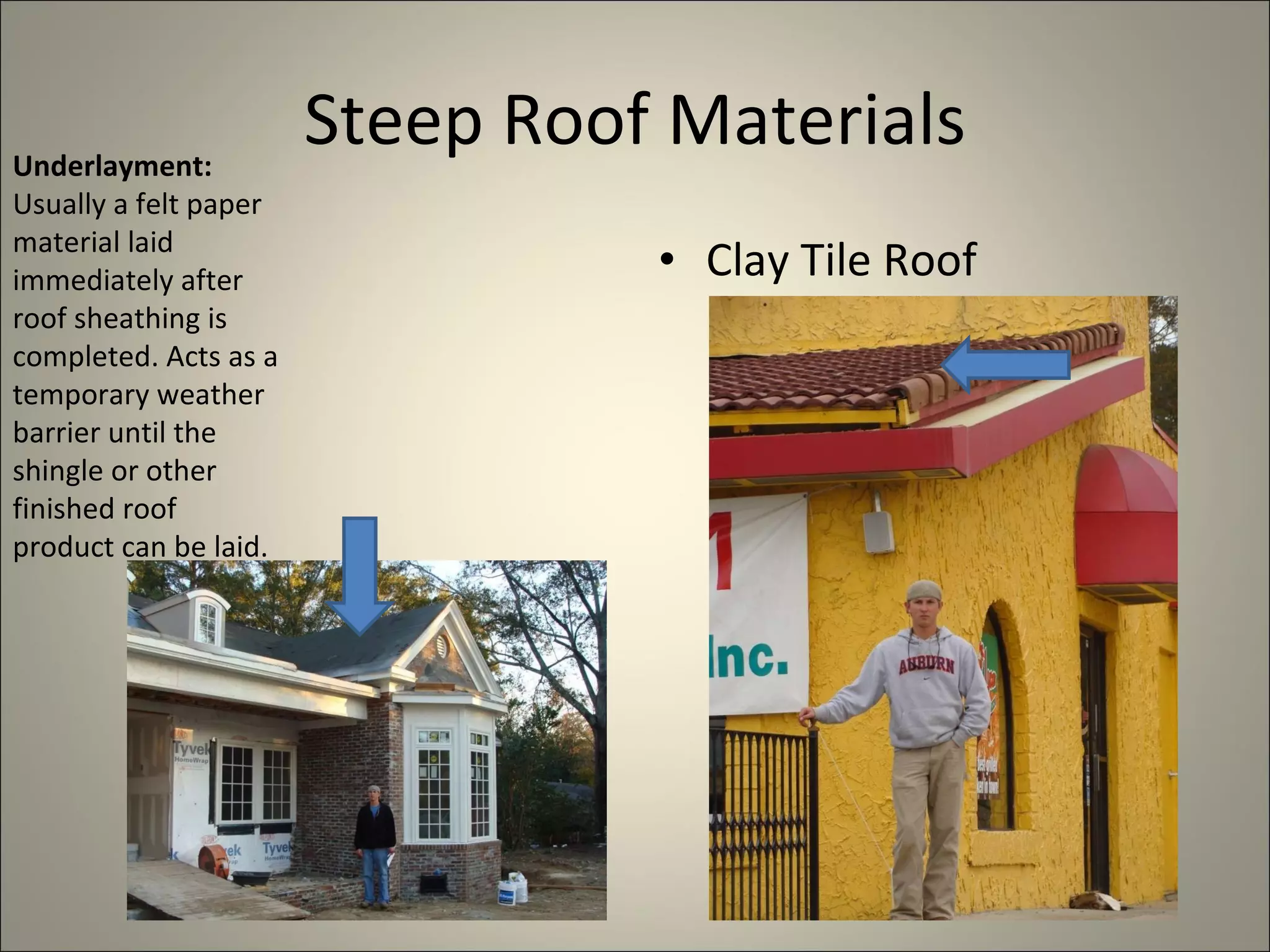
Steep Roof Materials Clay Tile Roof Underlayment:   Usually a felt paper material laid immediately after roof sheathing is completed. Acts as a temporary weather barrier until the shingle or other finished roof product can be laid.
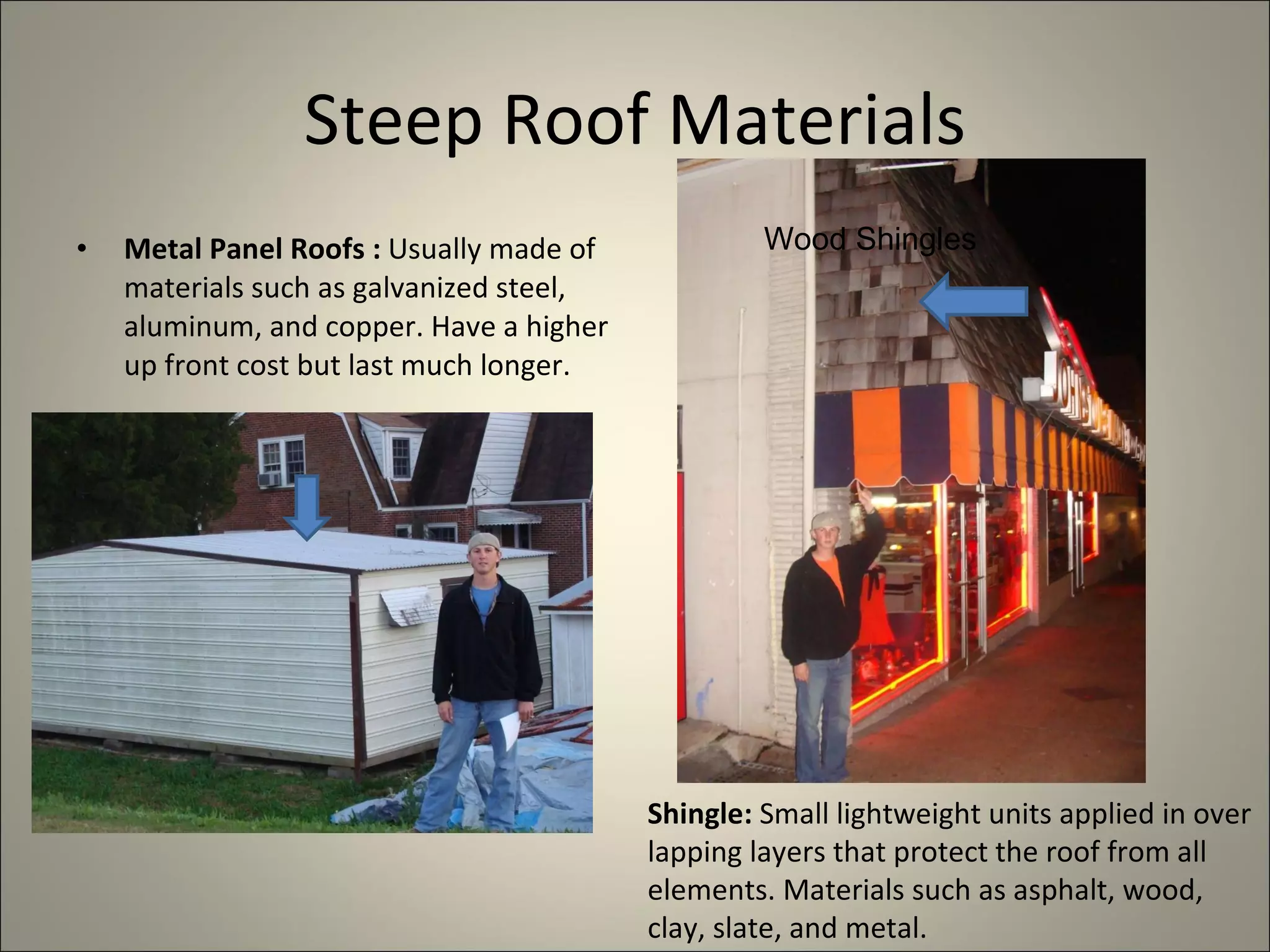
Steep Roof Materials Metal Panel Roofs :  Usually made of materials such as galvanized steel, aluminum, and copper. Have a higher up front cost but last much longer. Shingle:  Small lightweight units applied in over lapping layers that protect the roof from all elements. Materials such as asphalt, wood, clay, slate, and metal. Wood Shingles
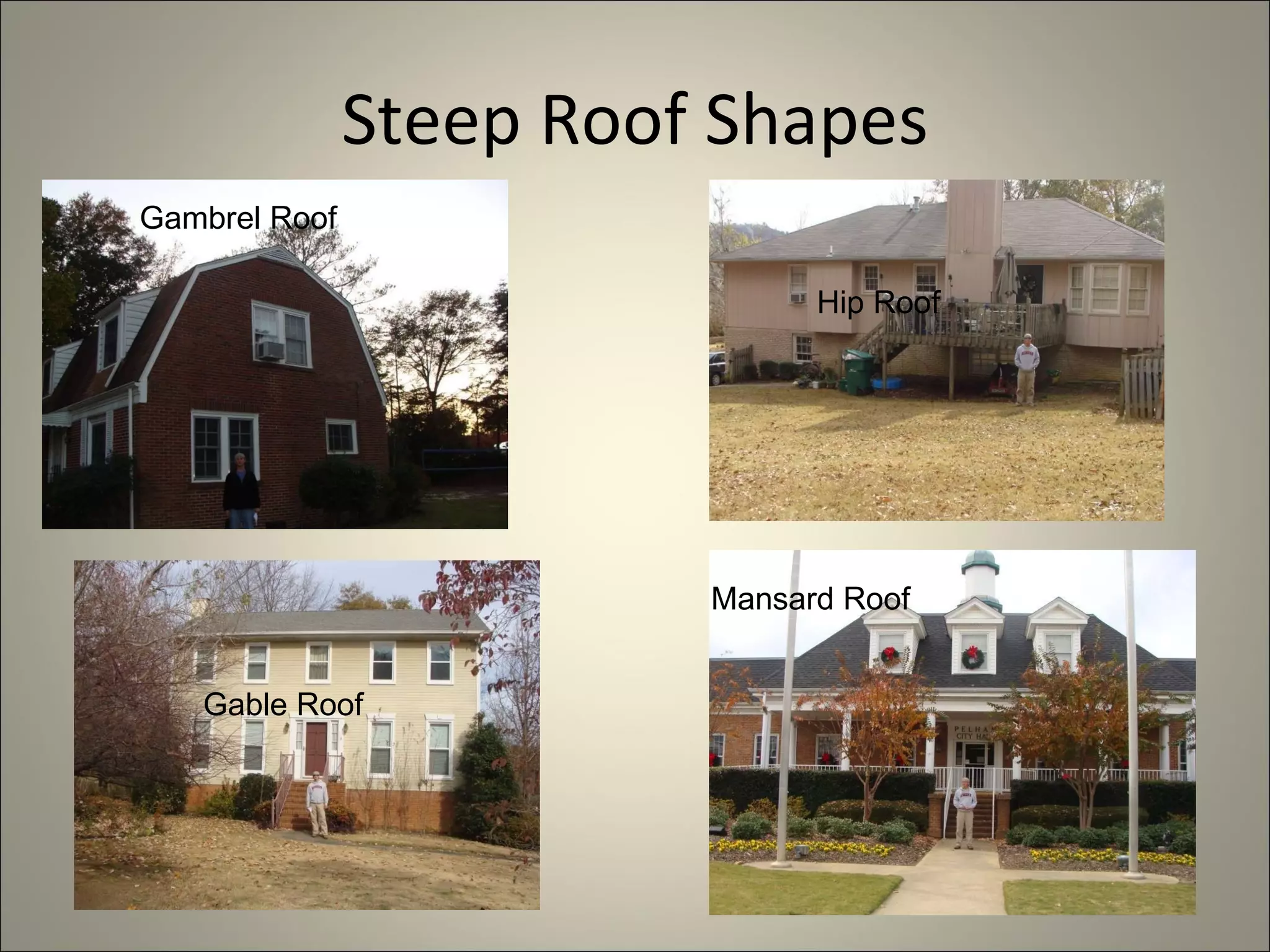
Steep Roof Shapes Gambrel Roof Gable Roof Hip Roof Gable Roof Mansard Roof
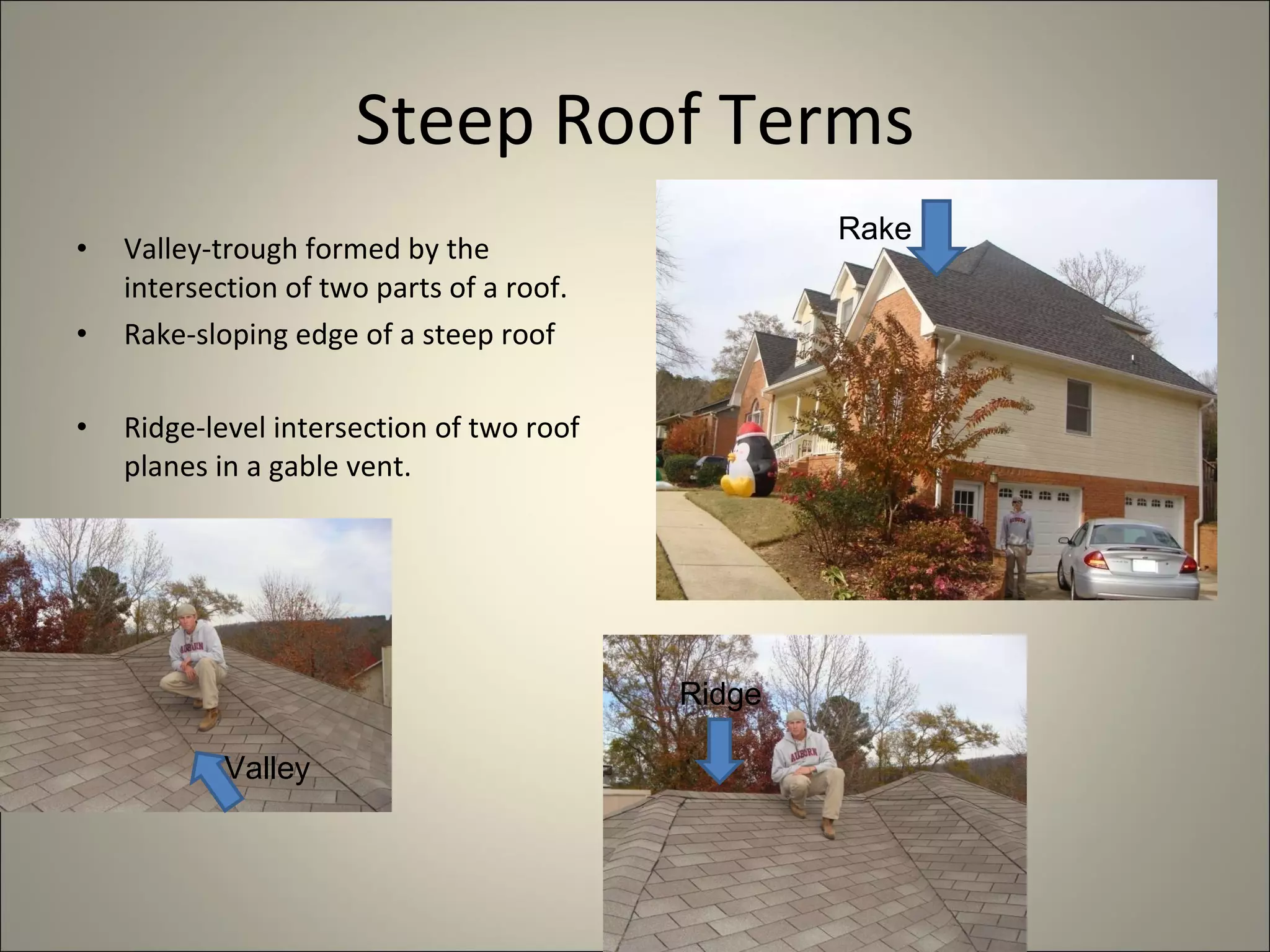
Steep Roof Terms Valley-trough formed by the intersection of two parts of a roof. Rake-sloping edge of a steep roof Ridge-level intersection of two roof planes in a gable vent. Rake Valley Ridge
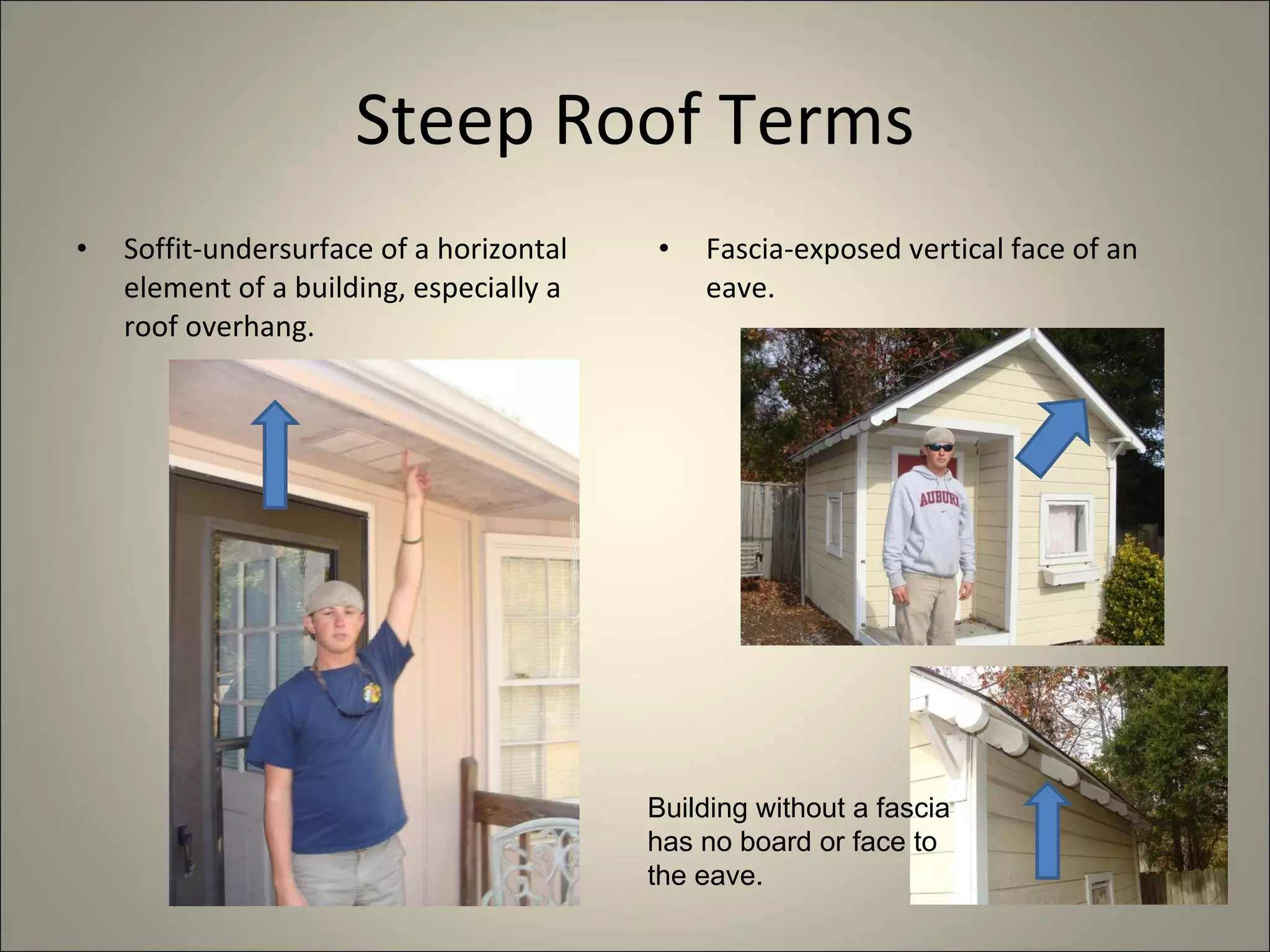
Steep Roof Terms Soffit-undersurface of a horizontal element of a building, especially a roof overhang. Fascia-exposed vertical face of an eave. Building without a fascia has no board or face to the eave.
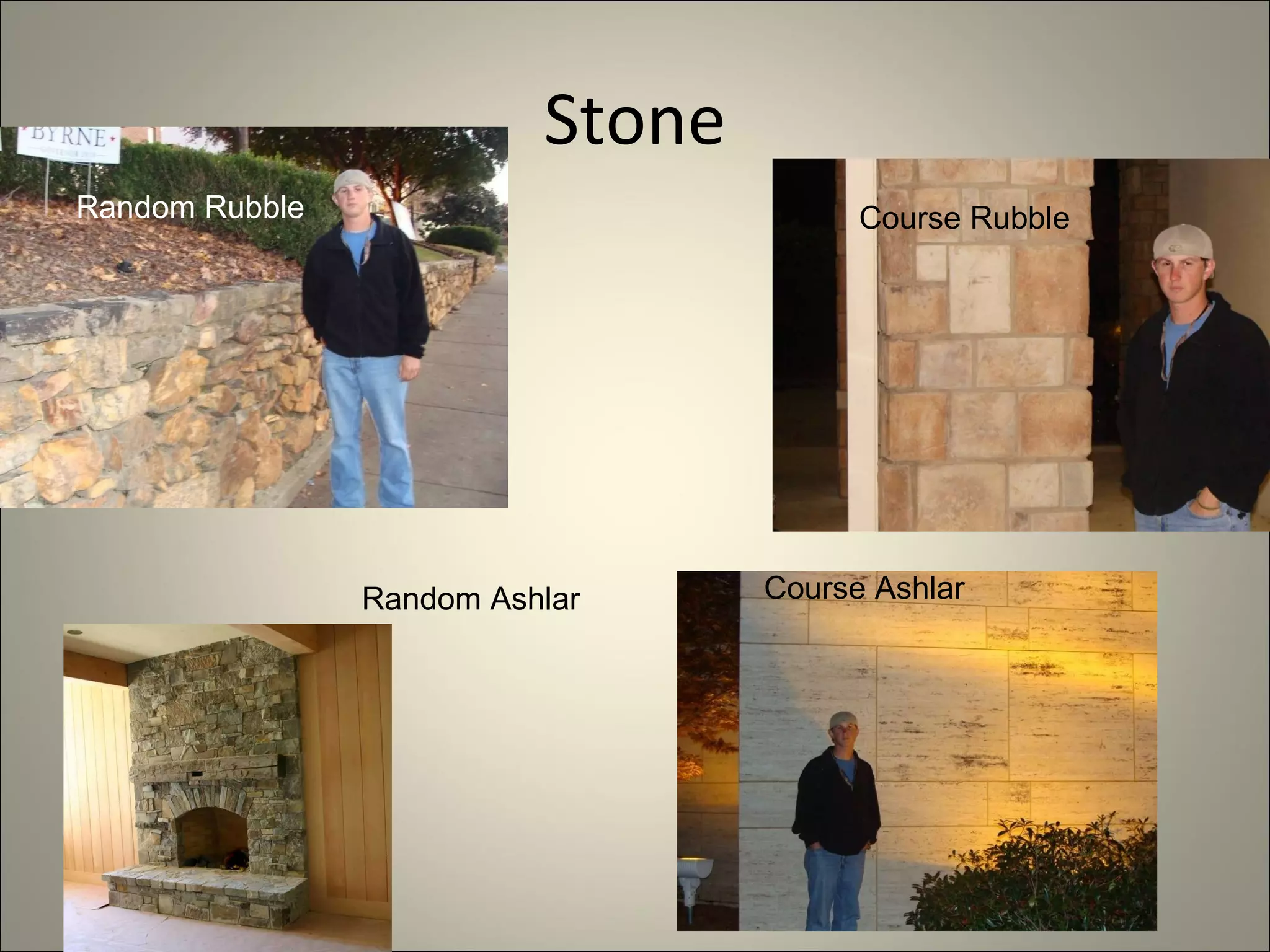
Stone Random Rubble  Course Rubble Random Ashlar Course Ashlar
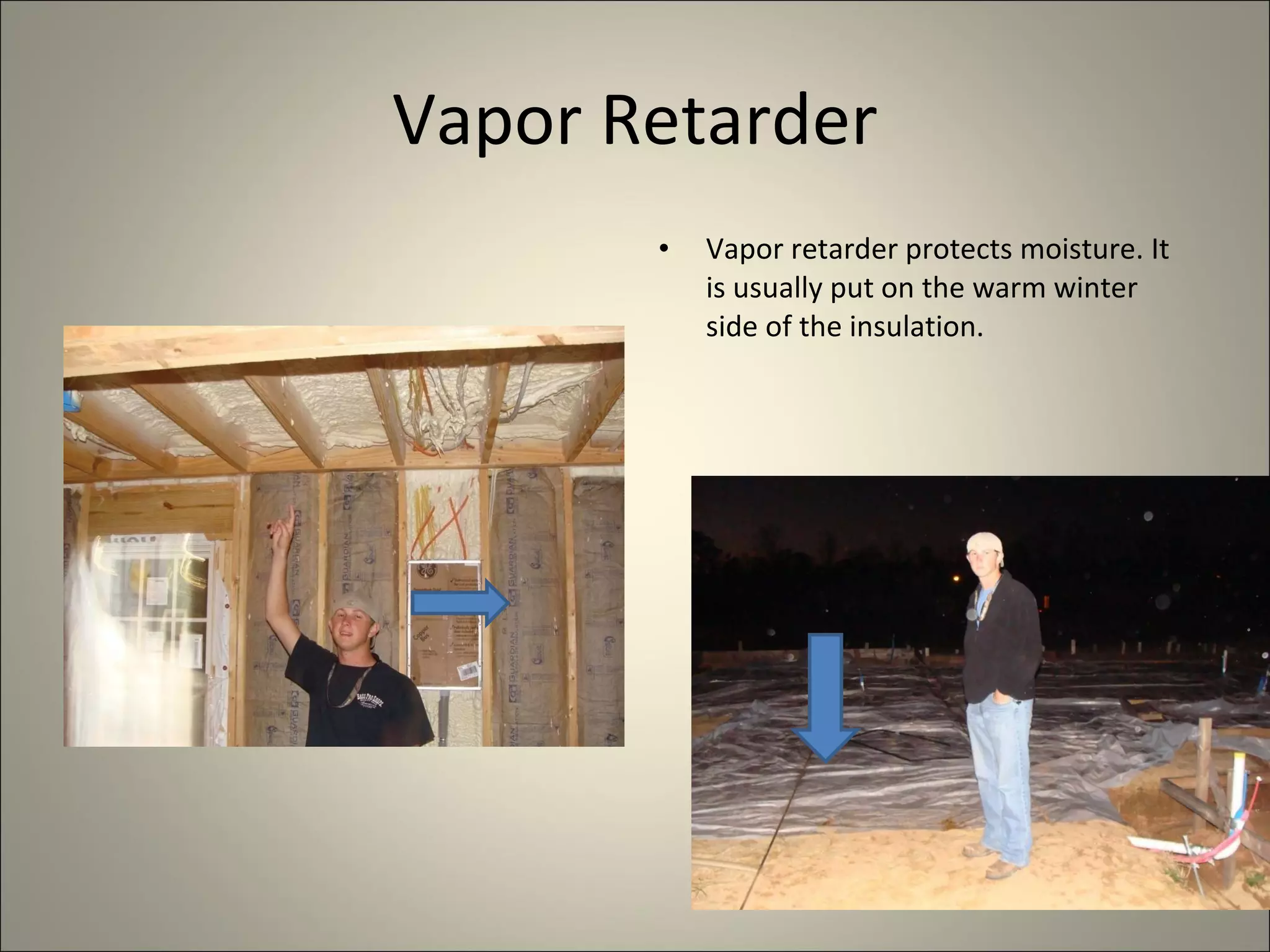
Vapor Retarder Vapor retarder protects moisture. It is usually put on the warm winter side of the insulation.
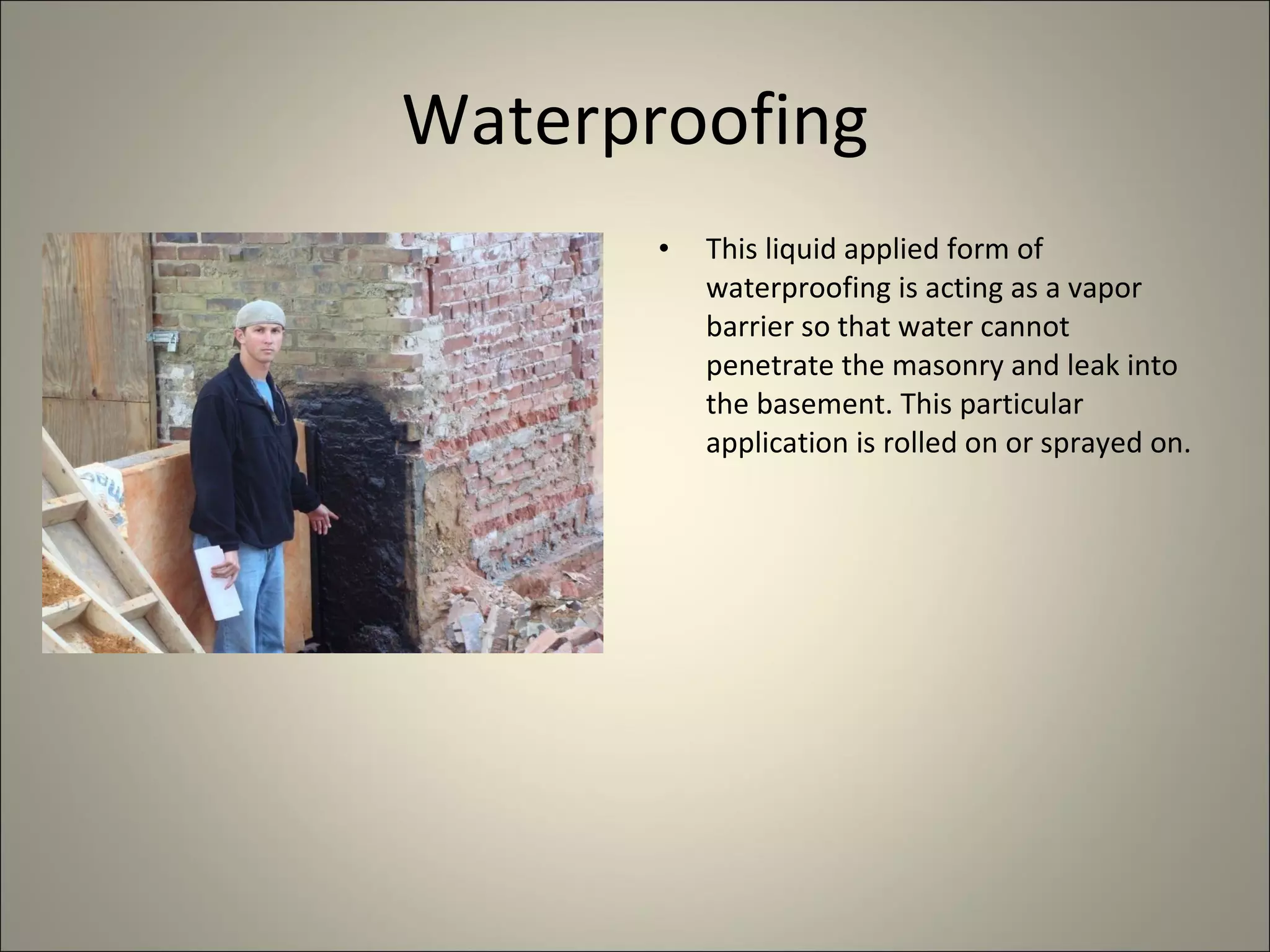
Waterproofing This liquid applied form of waterproofing is acting as a vapor barrier so that water cannot penetrate the masonry and leak into the basement. This particular application is rolled on or sprayed on.
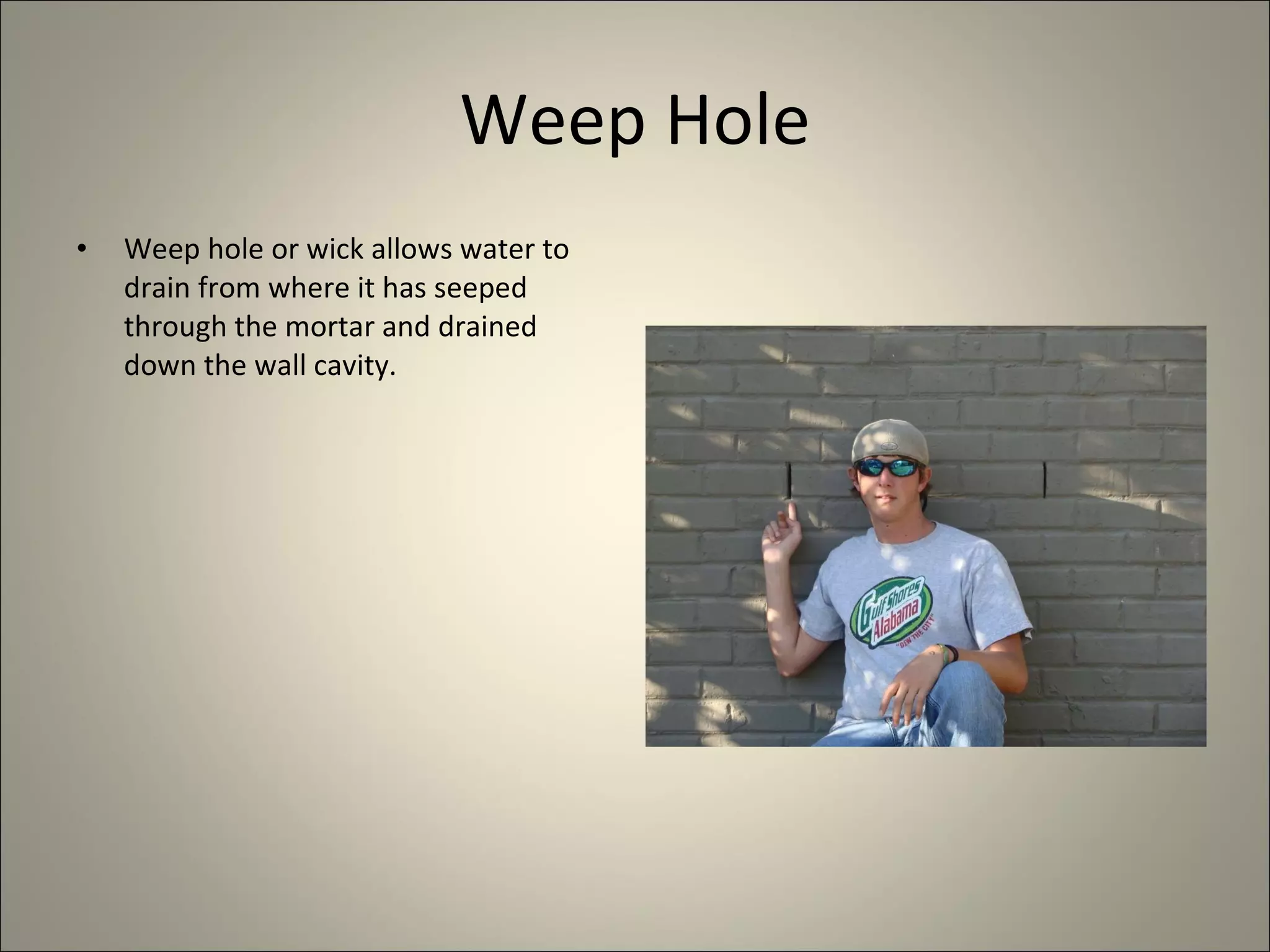
Weep Hole Weep hole or wick allows water to drain from where it has seeped through the mortar and drained down the wall cavity.
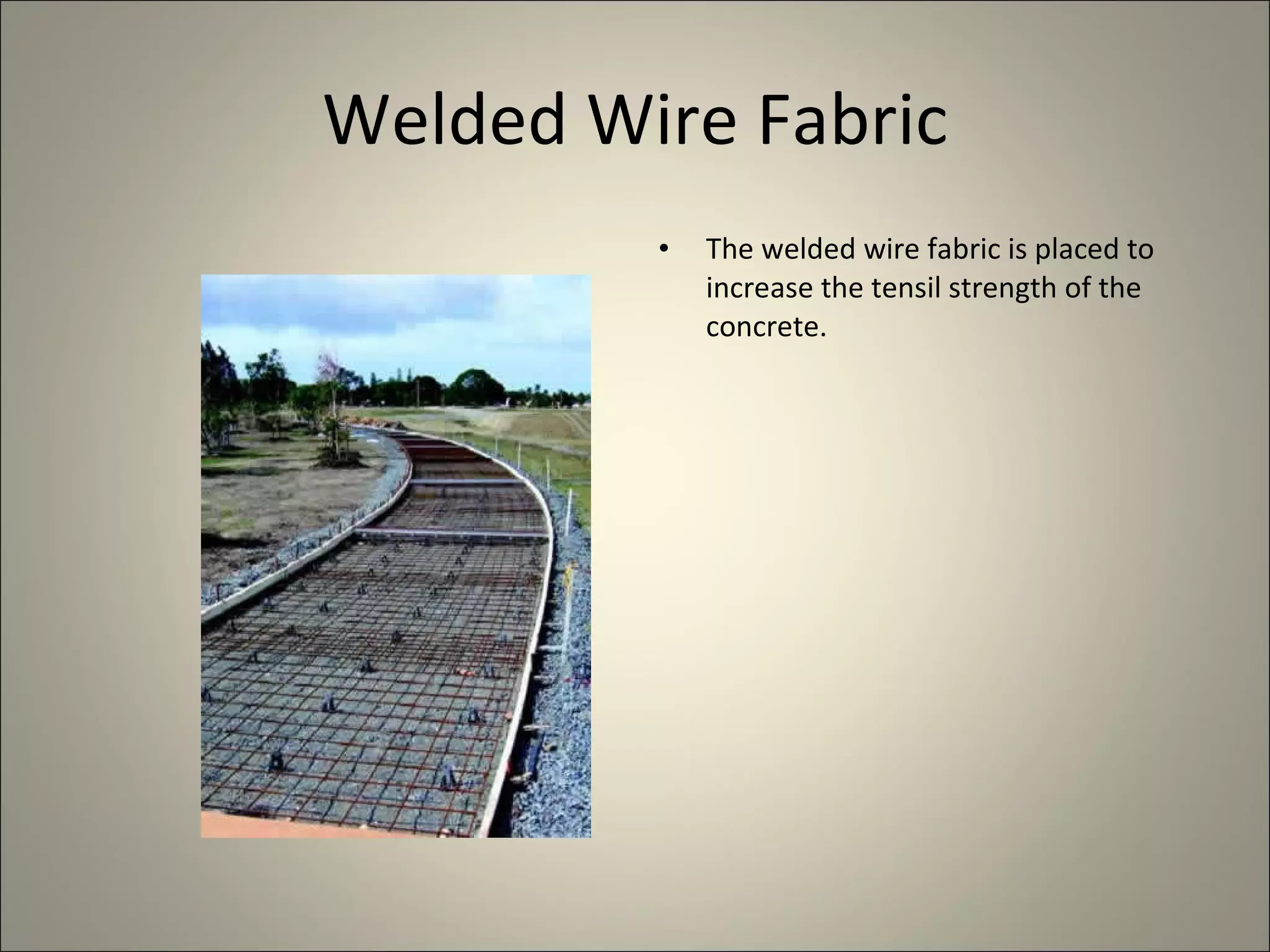
Welded Wire Fabric The welded wire fabric is placed to increase the tensil strength of the concrete.
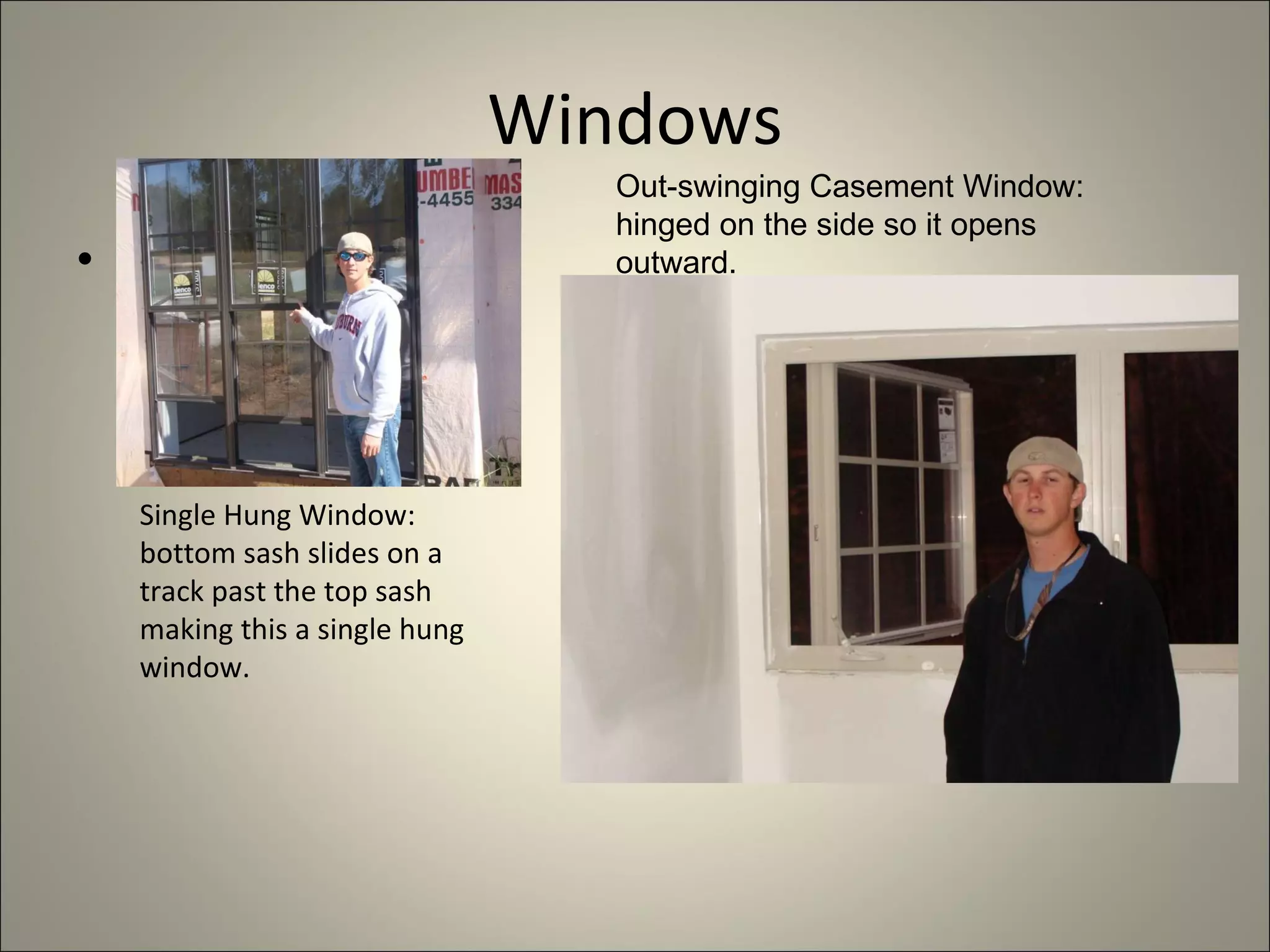
Windows 1.  Single Hung Window: bottom sash slides on a track past the top sash making this a single hung window. Out-swinging Casement Window:  hinged on the side so it opens outward.
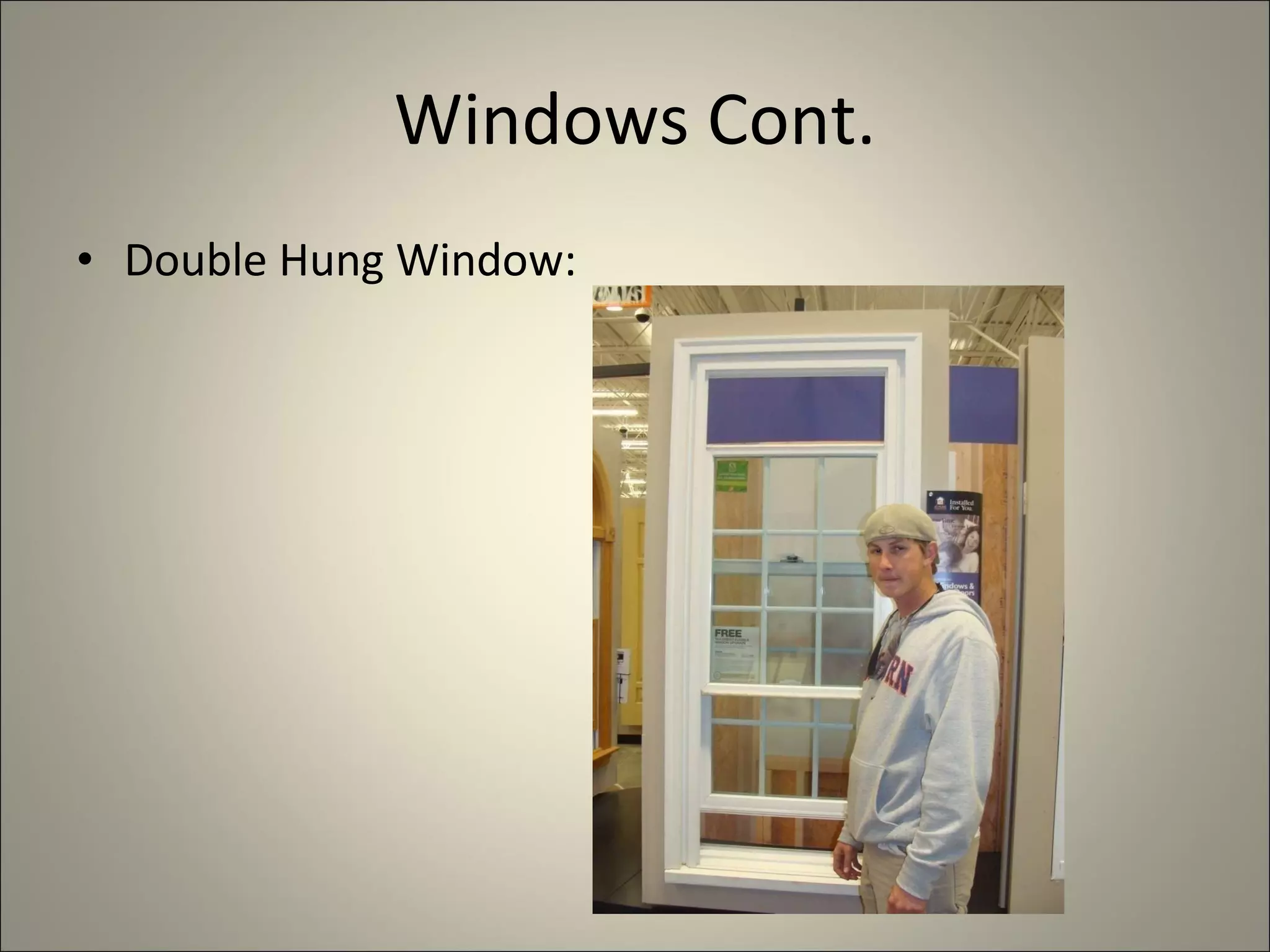
Windows Cont. Double Hung Window:

Visual Dictionary-Underlayment

  • 1.
  • 2.
    Air Barrier PaperDefinition: Material put on a framed house that blocks air flow and acts as a temporary weather barrier until siding can be put up. Also acts as a back-up barrier to the siding. Installed with button caps.
  • 3.
    Attic Ventilation MaterialsRoof Turbine: Uses the wind to help pull hot air out of the attic. Soffit Vent: Vents installed in the soffit ,under the eaves, that allow for air to move constantly through the attic to keep it ventilated.
  • 4.
    Attic Ventilation (cont.)Ridge Vent: Vent in the top of the roof or ridge that runs the length of the roof peak. Usually blended into the roof line. Gable Vent: Allows for warm air to vent out of the attic through vents placed at the highest point in the attic.
  • 5.
    Backhoe Definition/ Function: Piece of machinery used in excavation and site prep that has a bucket, dipper or dipper stick, and a boom that maneuvers its parts. Most are hydraulic. Often used to lay utility lines, moving dirt, and digging larger trenches. The size of this bucket is 3 feet.
  • 6.
    Batter Boards Definition/Function: Temporary frame built during excavation and site preparation that shows the surface planes of a building or house on the piece of property.
  • 7.
    Brick Arches Centering: Temporary Formwork used in constructing an arch. Semicircular Arch Segmental Arch # 1 # 2
  • 8.
    Brick Arches Cont.Arch with Keystone
  • 9.
    Brick Bonds #1.Stretcher Bond: Bond created when you have only Stretchers, which are bricks laid in their most usual position with the broadest part of the brick laid horizontal, laid in a brick wall. # 2. Flemish Bond: Bond created when you alternately lay Headers and Stretchers in a single course or row of masonry. #1 #2
  • 10.
    Brick Bonds Cont.Header Rowlock Soldiers Stretcher Rowlocks Stretcher Rowlocks
  • 11.
    Brick Sizes Modular:3 5/8” x 2 ¼” x 7 5/8” Queen: 3 x 2 ¾” x 7 5/8” #1 #2
  • 12.
    Bulldozer Definition/Function: A piece of machinery primarily used during excavation that has a large metal blade on the front used to move large amounts of earth matter.
  • 13.
    Cladding Shingles: Shingle-small unit of water resistant material nailed in overlapping fashion to render a wall or sloping roof water tight. Brick Clad Wood Shingle is sawn from a log and has a smoother surface while a Wood Shake is split from a log and has a more rustic look. Wood Shingle
  • 14.
    Cladding Cont. EFISWoodboard Limestone (travertine) Coursed ashlar
  • 15.
    Code Requirements -Windowopening width is 31” and height is 27”= around 5.8 square feet. Code is 5.7 square feet minimum so it passes -Opening is 29” from finished floor. Code is maximum 44” above finished floor Measurements of stairs: Tread- 12” riser- 7” nosing-1” Code= tread-10”min riser-7 ¾”max nosing-3/4” to 1 ¼ “
  • 16.
    Concrete Joints ControlJoint: An intentional, linear descontinuity in a structure or a component, designed to form a plane of weakness where cracking can occur in response to various forces so as to minimize or eliminate cracking elsewhere in the structure. Isolation joint-A joint in the concrete that is all the way around a column or pole. The concrete around it is usually poured at a seperate time than the rest of the slab. This power pole is separated from the rest of the median.
  • 17.
    Concrete Masonry UnitsDefinition: Concrete rectangular block used in construction that has a high load bearing capacity with the typical dimensions of 8”tall x 8” deep x 16” wide. Made of cast concrete for a variety of uses such as foundation walls and basements. Comes in several dimensions and shapes. 8 inches deep 16 Inches Deep 1 CMU=3 Brick Courses
  • 18.
    Decorative Concrete MasonryUnits Split Face Ribbed
  • 19.
    Doors Top RailLock Rail Panel Bottom Rail Stile Flush Door Exterior Panel Door
  • 20.
  • 21.
    Electrical Components powerpole transformer-This is used to step down the power so that it can be used within a residence. Meter-A meter measures (in Kilowatt/hour) the energy usage in a building.
  • 22.
    Electrical Components cont.A panel board houses circuit breakers that divert the main power supply into different circuits and shuts of if a circuit is tripped. Duplex recepticle-A Duplex receptacle grounds anything that is in need of a source of energy. It provide power to common household items.
  • 23.
    Electrical Components cont.Service Head: The assembly by which electricity is conducted from outdoor lines to meter base.
  • 24.
    Framing Elements 1&2Anchor Bolt: Sill Plate: #1 Anchor Bolt #2 Sill Plate
  • 25.
    Framing Elements 3&4Floor Joist: Subflooring: #3 Floor Joist #4 Subflooring
  • 26.
    Framing Elements 5&6Sole Plate: Stud: #5 Sole Plate #6 Stud #5 Sole Plate
  • 27.
    Framing Elements 7&8Top Plate: Ceiling Joist: #8 Ceiling Joist #7 Top Plate
  • 28.
    Framing Elements 9&10Rafter: Roof Decking: #10 Roof Decking #11 Rafter
  • 29.
    Framing Elements 11&12Sheathing: Stringer: #11 Sheathing #12 Stringer
  • 30.
    Front End LoaderDefinition/Function: Heavy machine with a large bucket on the front used in construction, most commonly in excavation and site prep, that is primarily used to load and move material such as asphalt, dirt, gravel, and sand. Front end loader is used in the early stages like a backhoe, but is not meant for digging. It is used to move dirt and gravel or anything necessary. It doesn’t just push dirt like a bulldozer, it also picks it up
  • 31.
    Gypsum Board Definition: Interior kiln dried wall and ceiling panels made of gypsum plaster pressed between two sheets of paper.
  • 32.
    Heat Pump Anadvantage is that you do not need separate heating and cooling units. A disadvantage is that it only works in mild climates. The air handler circulates air through the house and moves the air over coils. The compressor pressurizes and circulates refrigerant gas to produce heat or cooling in the coils. The condenser removes unwanted heat from the refrigerant and transfers it to the exterior of the residence. The Air Handling Unit is a device used to condition and circulate air as part of the HVAC system. Condensor Air Handling Unit
  • 33.
    Insulation Foam Batt/BlanketLoose Fill Insulation is a material used that has a low conductivity to help keep heat and cold air through the structure or assembly. Rigid Board
  • 34.
    Lintel A lintelis a beam that carries a load of an opening.
  • 35.
    Mortar Raked joint-itis tooled, this is also your typical 3/8” thick. It is located on a house. Probably type N mortar. A Concave joint is tooled and this one is 3/8” thick. It is a house and I would guess type N mortar.
  • 36.
    Oriented Strand BoardDefinition: Non veneered engineered wood panel product made of small strands, flakes or wafers of logs. Similar to plywood but does not have the same structural capacity and deteriorates more rapidly. Manufactured by small strands being bound together by an exterior binder under heat and pressure.
  • 37.
    Plumbing Plumbing RoofVent is used to vent gases from waste away from residence. Water Closet Typical 3” piping used to drain. A lavatory is a sink and it typically uses 1.5” piping to drain it.
  • 38.
    Plumbing Drop InSink Manufactured Tub
  • 39.
    Plywood Definition: Engineered wood made from thin sheets of wood, wood veneers. Manufactured by slicing thin sheets from a log and laminating them together. Commonly used as wall and floor sheathing. Typically 4’ x 8’ sheets with thickness ranging from a quarter inch to an inch thick. Veneer is a thin layer or sheet.
  • 40.
    Radiant Barrier Installedusually in the attic to prevent heat rays from the sun getting into the house, causing the house to become hot. Helps to reduce energy cost.
  • 41.
    Rebar This is#4 rebar, meaning it is ½” in diameter. It is used in masonry walls to help add tensile and lateral strength. It will be used to reinforce the wall, the grooves are helpful because the concrete that is poured in the hollow part of the CMU can mold to the rebar.
  • 42.
    Steep Roof DrainageDownspout- vertical piping used to drain water from roof to lower level or ground. Splashblock-small piece of concrete or plastic used to divert water at bottom of the downspout Gutter-channel that collects rainwater and snowmelt at the eave of a roof Downspout Gutter Splashblock
  • 43.
    Steep Roof MaterialsClay Tile Roof Underlayment: Usually a felt paper material laid immediately after roof sheathing is completed. Acts as a temporary weather barrier until the shingle or other finished roof product can be laid.
  • 44.
    Steep Roof MaterialsMetal Panel Roofs : Usually made of materials such as galvanized steel, aluminum, and copper. Have a higher up front cost but last much longer. Shingle: Small lightweight units applied in over lapping layers that protect the roof from all elements. Materials such as asphalt, wood, clay, slate, and metal. Wood Shingles
  • 45.
    Steep Roof ShapesGambrel Roof Gable Roof Hip Roof Gable Roof Mansard Roof
  • 46.
    Steep Roof TermsValley-trough formed by the intersection of two parts of a roof. Rake-sloping edge of a steep roof Ridge-level intersection of two roof planes in a gable vent. Rake Valley Ridge
  • 47.
    Steep Roof TermsSoffit-undersurface of a horizontal element of a building, especially a roof overhang. Fascia-exposed vertical face of an eave. Building without a fascia has no board or face to the eave.
  • 48.
    Stone Random Rubble Course Rubble Random Ashlar Course Ashlar
  • 49.
    Vapor Retarder Vaporretarder protects moisture. It is usually put on the warm winter side of the insulation.
  • 50.
    Waterproofing This liquidapplied form of waterproofing is acting as a vapor barrier so that water cannot penetrate the masonry and leak into the basement. This particular application is rolled on or sprayed on.
  • 51.
    Weep Hole Weephole or wick allows water to drain from where it has seeped through the mortar and drained down the wall cavity.
  • 52.
    Welded Wire FabricThe welded wire fabric is placed to increase the tensil strength of the concrete.
  • 53.
    Windows 1. Single Hung Window: bottom sash slides on a track past the top sash making this a single hung window. Out-swinging Casement Window: hinged on the side so it opens outward.
  • 54.