Visual Dictionary Load bearing
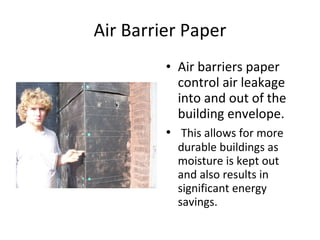
Air Barrier Paper Air barriers paper control air leakage into and out of the building envelope. This allows for more durable buildings as moisture is kept out and also results in significant energy savings.
Attic Ventilation
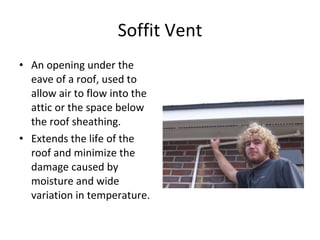
Soffit Vent An opening under the eave of a roof, used to allow air to flow into the attic or the space below the roof sheathing. Extends the life of the roof and minimize the damage caused by moisture and wide variation in temperature.
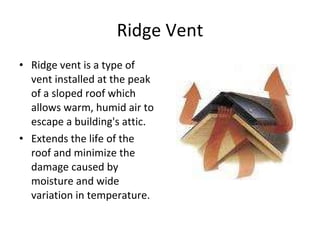
Ridge Vent Ridge vent is a type of vent installed at the peak of a sloped roof which allows warm, humid air to escape a building's attic. Extends the life of the roof and minimize the damage caused by moisture and wide variation in temperature.
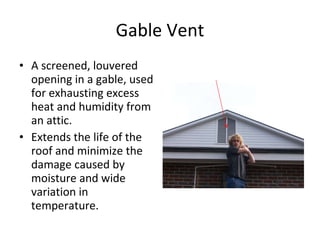
Gable Vent A screened, louvered opening in a gable, used for exhausting excess heat and humidity from an attic.  Extends the life of the roof and minimize the damage caused by moisture and wide variation in temperature.
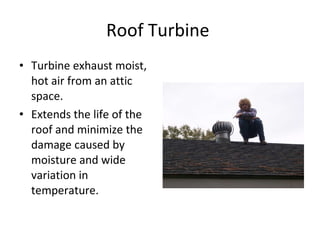
Roof Turbine  Turbine exhaust moist, hot air from an attic space.  Extends the life of the roof and minimize the damage caused by moisture and wide variation in temperature.
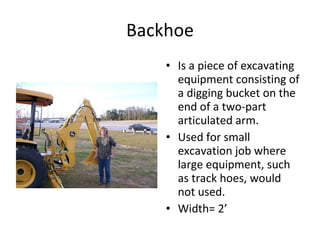
Backhoe Is a piece of excavating equipment consisting of a digging bucket on the end of a two-part articulated arm.  Used for small excavation job where large equipment, such as track hoes, would not used. Width= 2’
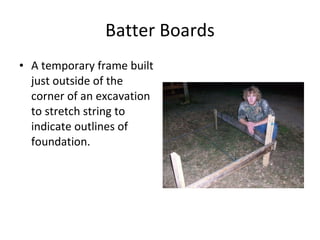
Batter Boards A temporary frame built just outside of the corner of an excavation to stretch string to indicate outlines of foundation.
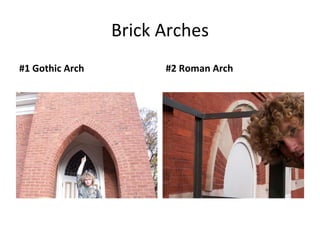
Brick Arches #1 Gothic Arch #2 Roman Arch
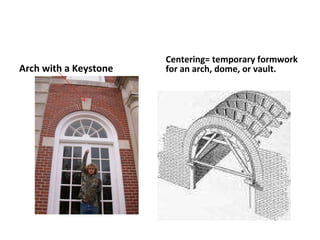
Arch with a Keystone Centering= temporary formwork for an arch, dome, or vault.
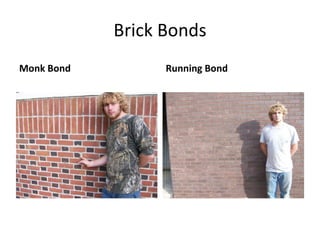
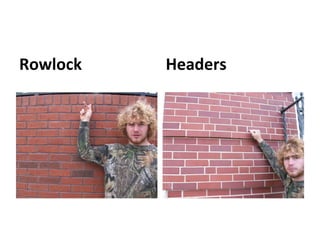
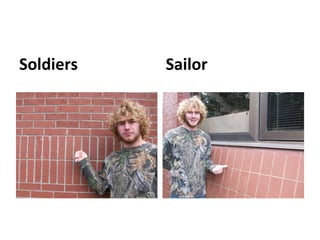
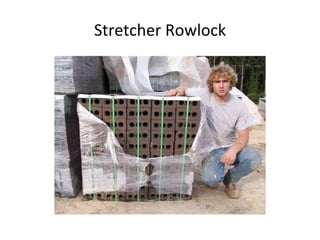
Brick Bonds Flemish Bond= stretcher, header, stretcher, header Running Bond= continuous rows of stretchers
Rowlock Headers
Soldiers  Sailor
Stretcher Rowlock
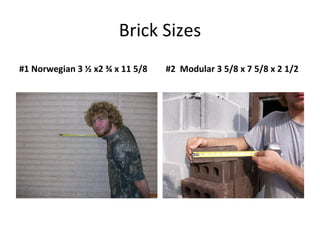
Brick Sizes #1 Norwegian 3 ½ x2 ¾ x 11 5/8 #2  Modular 3 5/8 x 7 5/8 x 2 1/2
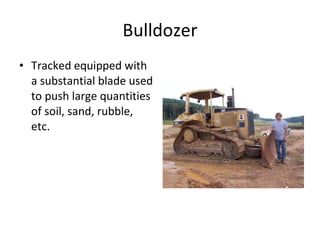
Bulldozer Tracked equipped with a substantial blade used to push large quantities of soil, sand, rubble, etc.
Cladding
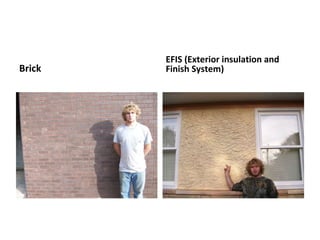
Brick EFIS (Exterior insulation and Finish System)
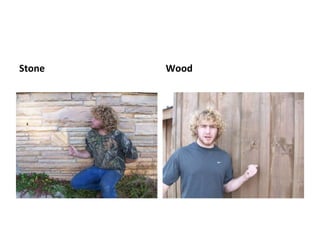
Stone Coursed Rubble Pattern  Wood
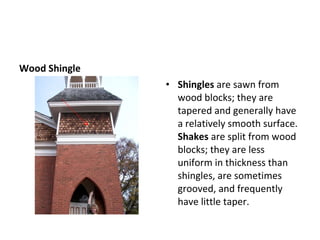
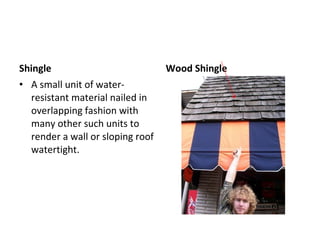
Wood Shingle Shingles  are sawn from wood blocks; they are tapered and generally have a relatively smooth surface.  Shakes  are split from wood blocks; they are less uniform in thickness than shingles, are sometimes grooved, and frequently have little taper.
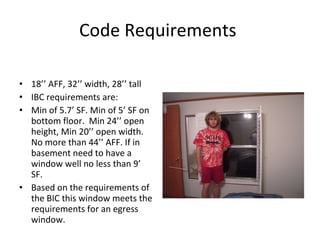
Code Requirements  18’’ AFF, 32’’ width, 28’’ tall IBC requirements are:  Min of 5.7’ SF. Min of 5’ SF on bottom floor.  Min 24’’ open height, Min 20’’ open width.  No more than 44’’ AFF. If in basement need to have a window well no less than 9’ SF. Based on the requirements of the BIC this window meets the requirements for an egress window.
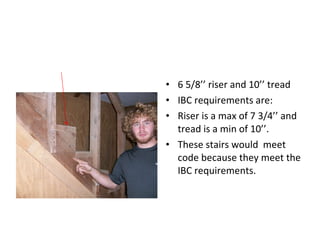
6 5/8’’ riser and 10’’ tread IBC requirements are: Riser is a max of 7 3/4’’ and tread is a min of 10’’. These stairs would  meet code because they meet the IBC requirements.
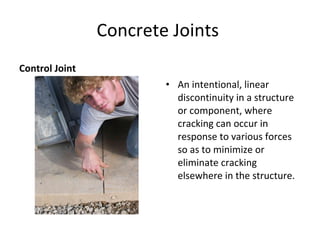
Concrete Joints  Control Joint  An intentional, linear discontinuity in a structure or component, where cracking can occur in response to various forces so as to minimize or eliminate cracking elsewhere in the structure. Crack
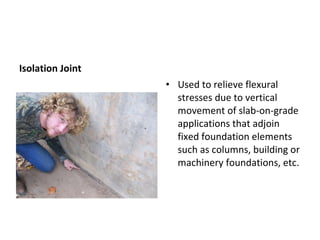
Isolation Joint Used to relieve flexural stresses due to vertical movement of slab-on-grade applications that adjoin fixed foundation elements such as columns, building or machinery foundations, etc. This one is isolating a sidewalk from a retaining wall.
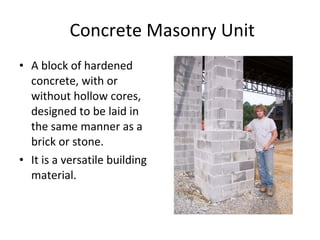
Concrete Masonry Unit A block of hardened concrete, with or without hollow cores, designed to be laid in the same manner as a brick or stone. Typical dimensions are= 8x8x16 It is a versatile building material.
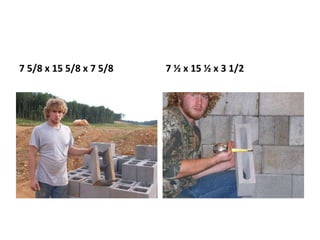
7 5/8 x 15 5/8 x 7 5/8 7 ½ x 15 ½ x 3 1/2
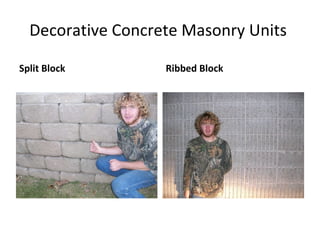
Decorative Concrete Masonry Units  Split Block Ribbed Block
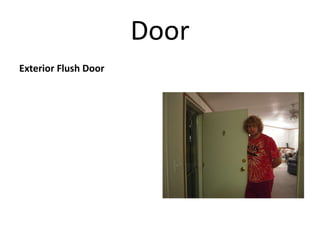
Door Exterior Flush Door
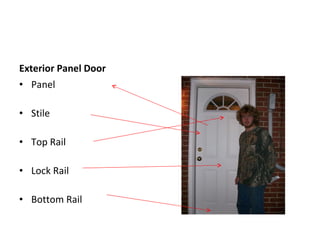
Exterior Panel Door Panel  Stile  Top Rail Lock Rail Bottom Rail
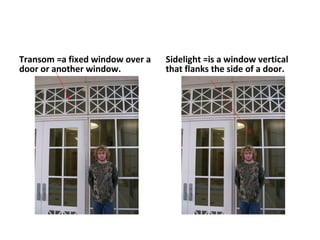
Transom =a fixed window over a door or another window. Sidelight =is a window vertical that flanks the side of a door.
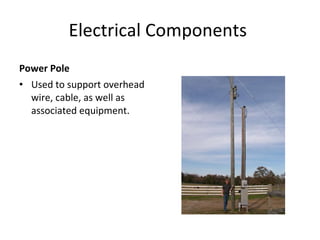
Electrical Components  Power Pole Used to support overhead wire, cable, as well as associated equipment. Transformer
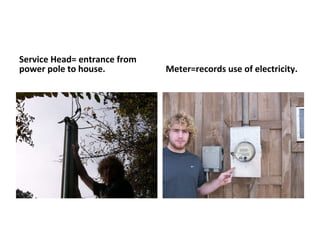
Service Head= entrance from power pole to house. Meter=records use of electricity.
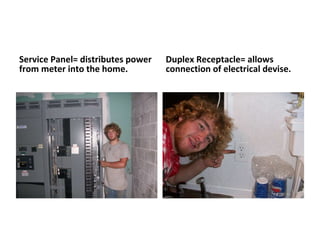
Service Panel= distributes power from meter into the home. Duplex Receptacle= allows connection of electrical devise.
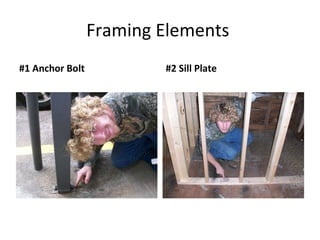
Framing Elements  #1 Anchor Bolt #2 Sill Plate
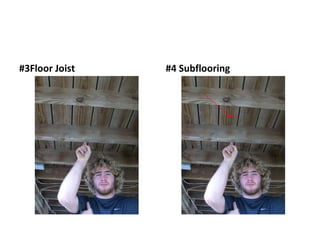
#3Floor Joist #4 Subflooring
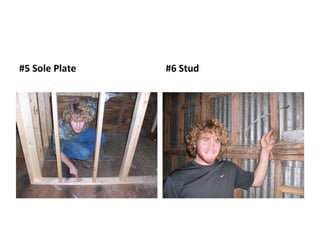
#5 Sole Plate #6 Stud
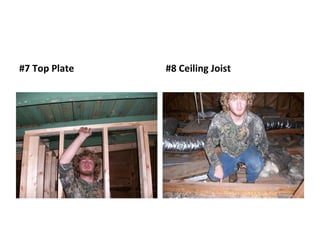
#7 Top Plate #8 Ceiling Joist
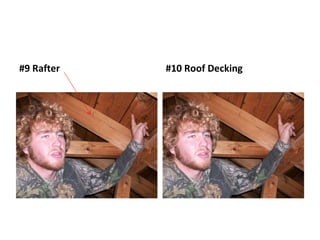
#9 Rafter #10 Roof Decking
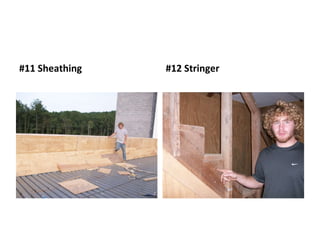
#11 Sheathing  #12 Stringer
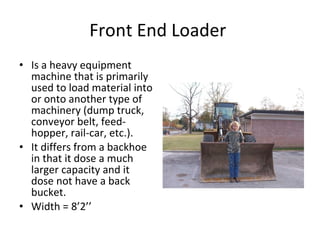
Front End Loader  Is a heavy equipment machine that is primarily used to load material into or onto another type of machinery (dump truck, conveyor belt, feed-hopper, rail-car, etc.). It differs from a backhoe in that it dose a much larger capacity with it and it dose not have a back bucket.  Width = 8’2’’
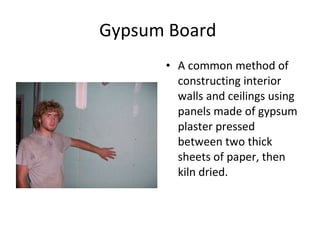
Gypsum Board  A common method of constructing interior walls and ceilings using panels made of gypsum plaster pressed between two thick sheets of paper, then kiln dried.
Heat Pump  One Advantage of a heat pump is a more comfortable humidity level in the winter; not too dry. One disadvantage of a heat pump is its inability to operate well at very low temperatures and thus requiring a back-up system.
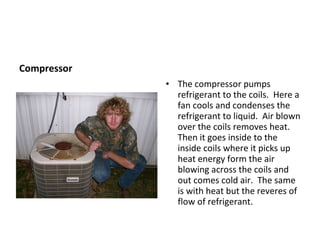
Compressor The compressor pumps refrigerant to the coils.  Here a fan cools and condenses the refrigerant to liquid.  Air blown over the coils removes heat.  Then it goes inside to the inside coils where it picks up heat energy form the air blowing across the coils and out comes cold air.  The same is with heat but the reveres of flow of refrigerant.
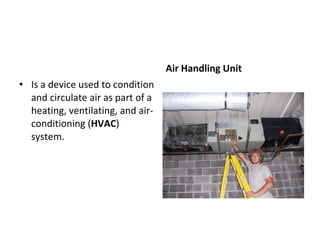
Is a device used to condition and circulate air as part of a heating, ventilating, and air-conditioning ( HVAC ) system. Air Handling Unit
Insulation  A material used to reduce heat transfer or lose by conduction, radiation or convection and are employed in varying combinations to achieve the desired outcome.
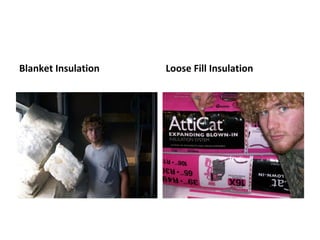
Blanket Insulation Loose Fill Insulation
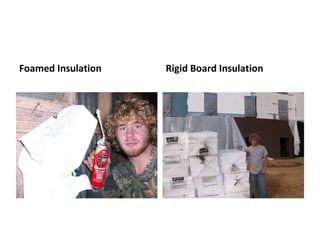
Foamed Insulation Rigid Board Insulation
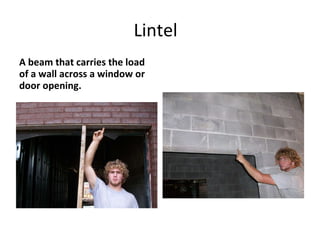
Lintel  A beam that carries the load of a wall across a window or door opening.
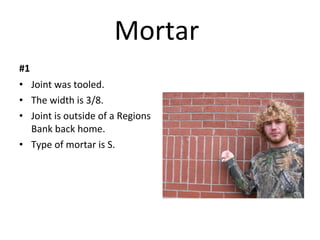
Mortar  #1 Joint was tooled. The width is 3/8. Joint is outside of a Regions Bank back home. Type of mortar is S.
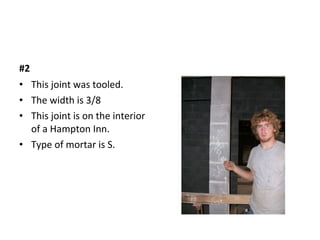
#2 This joint was tooled. The width is 3/8 This joint is on the interior of a Hampton Inn.  Type of mortar is S.
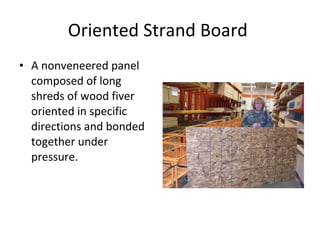
Oriented Strand Board  A nonveneered panel composed of long shreds of wood fiver oriented in specific directions and bonded together under pressure.
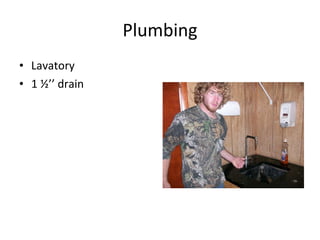
Plumbing Lavatory 1 ½’’ drain
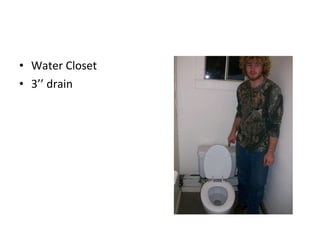
Water Closet 3’’ drain
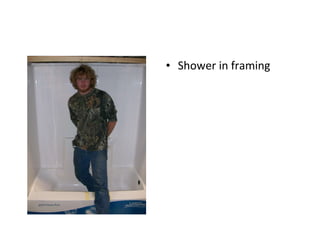
Shower in framing 2’’ drain
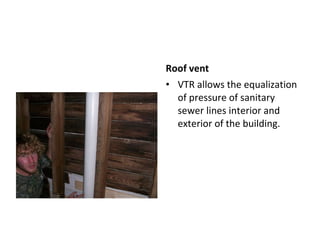
Roof vent VTR allows the equalization of pressure of sanitary sewer lines interior and exterior of the building.
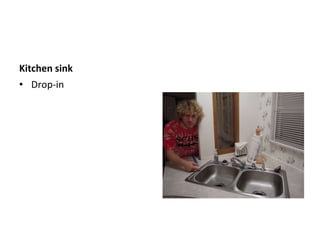
Kitchen sink Drop-in
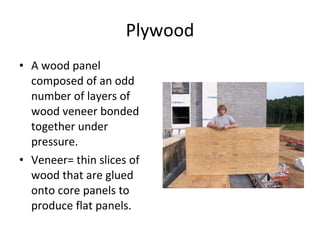
Plywood A wood panel composed of an odd number of layers of wood veneer bonded together under pressure. Veneer= thin slices of wood that are glued onto core panels to produce flat panels.
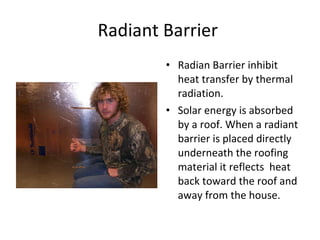
Radiant Barrier  Radian Barrier inhibit heat transfer by thermal radiation. Solar energy is absorbed by a roof. When a radiant barrier is placed directly underneath the roofing material it reflects  heat back toward the roof and away from the house.
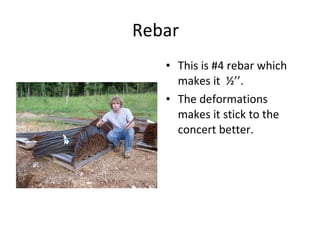
Rebar  This is #4 rebar which makes it  ½’’. The deformations makes it stick to the concert better.
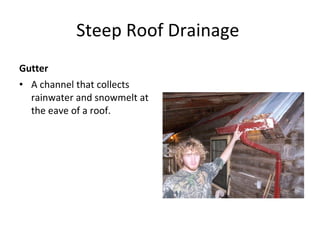
Steep Roof Drainage  Gutter A channel that collects rainwater and snowmelt at the eave of a roof.
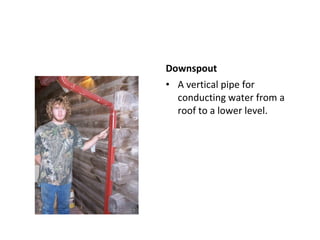
Downspout A vertical pipe for conducting water from a roof to a lower level.
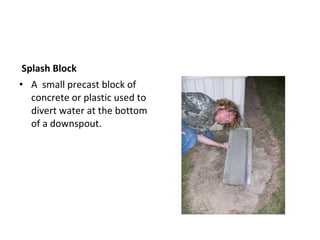
Splash Block A  small precast block of concrete or plastic used to divert water at the bottom of a downspout. Keeps from washing away soil.
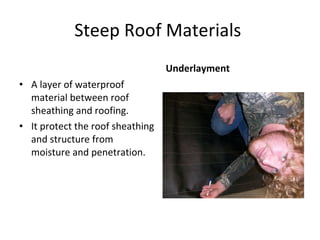
Steep Roof Materials  A layer of waterproof material between roof sheathing and roofing. It protect the roof sheathing and structure from moisture and penetration. Underlayment
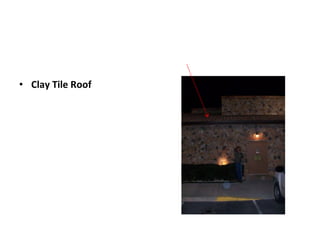
Clay Tile Roof
Shingle A small unit of water-resistant material nailed in overlapping fashion with many other such units to render a wall or sloping roof watertight. Wood Shingle
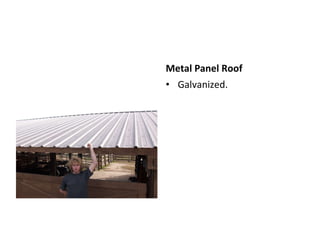
Metal Panel Roof Galvanized.
Steep Roof Shapes
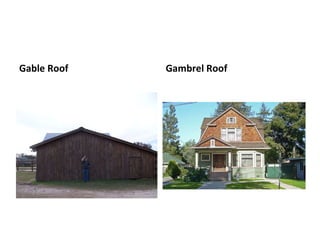
Gable Roof Gambrel Roof
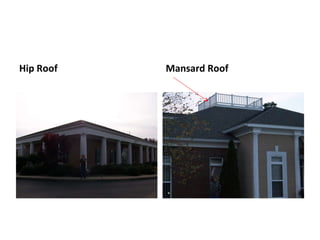
Hip Roof Mansard Roof
Steep Roof Terms
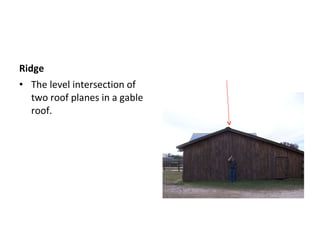
Ridge The level intersection of two roof planes in a gable roof.
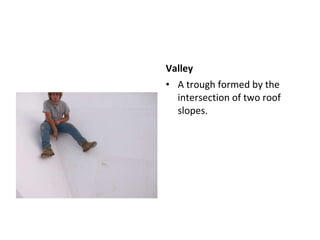
Valley A trough formed by the intersection of two roof slopes.
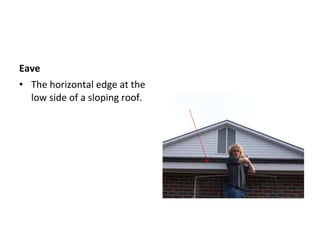
Eave  The horizontal edge at the low side of a sloping roof.
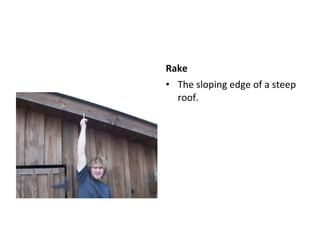
Rake The sloping edge of a steep roof.
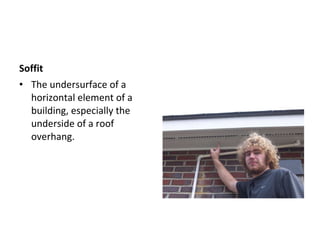
Soffit  The undersurface of a horizontal element of a building, especially the underside of a roof overhang.
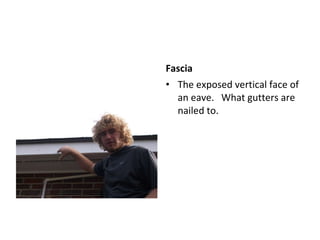
Fascia  The exposed vertical face of an eave.  What gutters are nailed to.
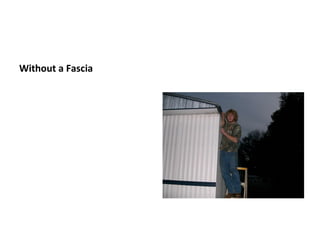
Without a Fascia
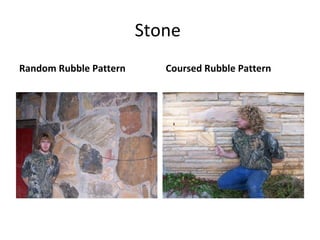
Stone  Random Rubble Pattern Coursed Rubble Pattern
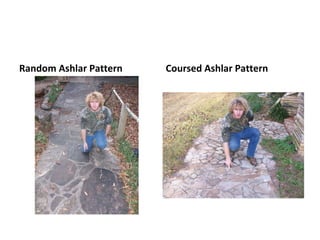
Random Ashlar Pattern Coursed Ashlar Pattern
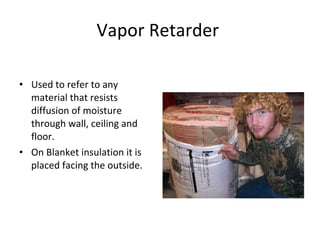
Vapor Retarder  Used to refer to any material that resists diffusion of moisture through wall, ceiling and floor.  On Blanket insulation it is placed facing the outside.
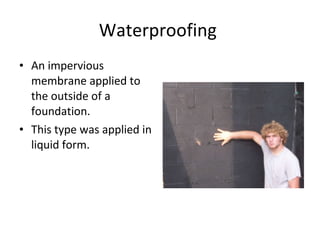
Waterproofing  An impervious membrane applied to the outside of a foundation to help prevent moisture from getting into the building.  This type was applied in liquid form.
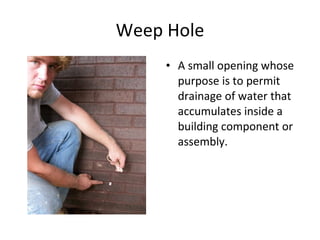
Weep Hole A small opening whose purpose is to permit drainage of water that accumulates inside a building component or assembly.
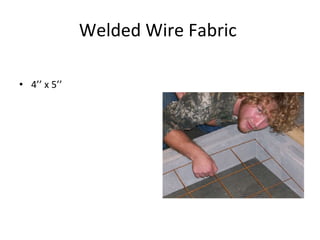
Welded Wire Fabric  4’’ x 5’’
Windows
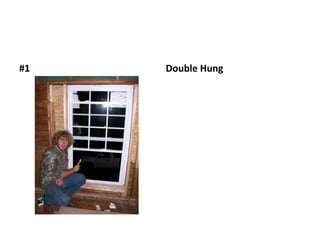
#1 Double Hung It consists of an upper and lower sash that slide vertically in separate grooves in the side jambs or in full-width metal weather stripping.
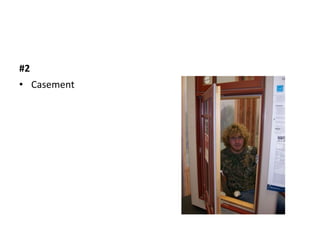
#2 Casement Casement windows open like doors. Like doors, either the left or right side is hinged (or, more accurately, pivoted), and the non-hinged side locks securely into place with latches. Window opens by means of some variation of a crank.  Casement
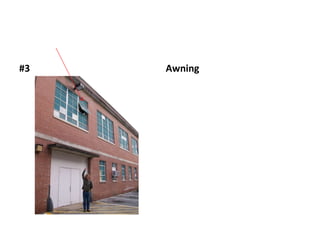
#3 Awning  An awning window is a casement window that is hung horizontally, hinged on top, so that it swings outward.

Visual Dictionary - Loadbearing

  • 1.
  • 2.
    Air Barrier PaperAir barriers paper control air leakage into and out of the building envelope. This allows for more durable buildings as moisture is kept out and also results in significant energy savings.
  • 3.
  • 4.
    Soffit Vent Anopening under the eave of a roof, used to allow air to flow into the attic or the space below the roof sheathing. Extends the life of the roof and minimize the damage caused by moisture and wide variation in temperature.
  • 5.
    Ridge Vent Ridgevent is a type of vent installed at the peak of a sloped roof which allows warm, humid air to escape a building's attic. Extends the life of the roof and minimize the damage caused by moisture and wide variation in temperature.
  • 6.
    Gable Vent Ascreened, louvered opening in a gable, used for exhausting excess heat and humidity from an attic. Extends the life of the roof and minimize the damage caused by moisture and wide variation in temperature.
  • 7.
    Roof Turbine Turbine exhaust moist, hot air from an attic space. Extends the life of the roof and minimize the damage caused by moisture and wide variation in temperature.
  • 8.
    Backhoe Is apiece of excavating equipment consisting of a digging bucket on the end of a two-part articulated arm. Used for small excavation job where large equipment, such as track hoes, would not used. Width= 2’
  • 9.
    Batter Boards Atemporary frame built just outside of the corner of an excavation to stretch string to indicate outlines of foundation.
  • 10.
    Brick Arches #1Gothic Arch #2 Roman Arch
  • 11.
    Arch with aKeystone Centering= temporary formwork for an arch, dome, or vault.
  • 12.
    Brick Bonds FlemishBond= stretcher, header, stretcher, header Running Bond= continuous rows of stretchers
  • 13.
  • 14.
  • 15.
  • 16.
    Brick Sizes #1Norwegian 3 ½ x2 ¾ x 11 5/8 #2 Modular 3 5/8 x 7 5/8 x 2 1/2
  • 17.
    Bulldozer Tracked equippedwith a substantial blade used to push large quantities of soil, sand, rubble, etc.
  • 18.
  • 19.
    Brick EFIS (Exteriorinsulation and Finish System)
  • 20.
  • 21.
    Wood Shingle Shingles are sawn from wood blocks; they are tapered and generally have a relatively smooth surface. Shakes are split from wood blocks; they are less uniform in thickness than shingles, are sometimes grooved, and frequently have little taper.
  • 22.
    Code Requirements 18’’ AFF, 32’’ width, 28’’ tall IBC requirements are: Min of 5.7’ SF. Min of 5’ SF on bottom floor. Min 24’’ open height, Min 20’’ open width. No more than 44’’ AFF. If in basement need to have a window well no less than 9’ SF. Based on the requirements of the BIC this window meets the requirements for an egress window.
  • 23.
    6 5/8’’ riserand 10’’ tread IBC requirements are: Riser is a max of 7 3/4’’ and tread is a min of 10’’. These stairs would meet code because they meet the IBC requirements.
  • 24.
    Concrete Joints Control Joint An intentional, linear discontinuity in a structure or component, where cracking can occur in response to various forces so as to minimize or eliminate cracking elsewhere in the structure. Crack
  • 25.
    Isolation Joint Usedto relieve flexural stresses due to vertical movement of slab-on-grade applications that adjoin fixed foundation elements such as columns, building or machinery foundations, etc. This one is isolating a sidewalk from a retaining wall.
  • 26.
    Concrete Masonry UnitA block of hardened concrete, with or without hollow cores, designed to be laid in the same manner as a brick or stone. Typical dimensions are= 8x8x16 It is a versatile building material.
  • 27.
    7 5/8 x15 5/8 x 7 5/8 7 ½ x 15 ½ x 3 1/2
  • 28.
    Decorative Concrete MasonryUnits Split Block Ribbed Block
  • 29.
  • 30.
    Exterior Panel DoorPanel Stile Top Rail Lock Rail Bottom Rail
  • 31.
    Transom =a fixedwindow over a door or another window. Sidelight =is a window vertical that flanks the side of a door.
  • 32.
    Electrical Components Power Pole Used to support overhead wire, cable, as well as associated equipment. Transformer
  • 33.
    Service Head= entrancefrom power pole to house. Meter=records use of electricity.
  • 34.
    Service Panel= distributespower from meter into the home. Duplex Receptacle= allows connection of electrical devise.
  • 35.
    Framing Elements #1 Anchor Bolt #2 Sill Plate
  • 36.
    #3Floor Joist #4Subflooring
  • 37.
  • 38.
    #7 Top Plate#8 Ceiling Joist
  • 39.
    #9 Rafter #10Roof Decking
  • 40.
    #11 Sheathing #12 Stringer
  • 41.
    Front End Loader Is a heavy equipment machine that is primarily used to load material into or onto another type of machinery (dump truck, conveyor belt, feed-hopper, rail-car, etc.). It differs from a backhoe in that it dose a much larger capacity with it and it dose not have a back bucket. Width = 8’2’’
  • 42.
    Gypsum Board A common method of constructing interior walls and ceilings using panels made of gypsum plaster pressed between two thick sheets of paper, then kiln dried.
  • 43.
    Heat Pump One Advantage of a heat pump is a more comfortable humidity level in the winter; not too dry. One disadvantage of a heat pump is its inability to operate well at very low temperatures and thus requiring a back-up system.
  • 44.
    Compressor The compressorpumps refrigerant to the coils. Here a fan cools and condenses the refrigerant to liquid. Air blown over the coils removes heat. Then it goes inside to the inside coils where it picks up heat energy form the air blowing across the coils and out comes cold air. The same is with heat but the reveres of flow of refrigerant.
  • 45.
    Is a deviceused to condition and circulate air as part of a heating, ventilating, and air-conditioning ( HVAC ) system. Air Handling Unit
  • 46.
    Insulation Amaterial used to reduce heat transfer or lose by conduction, radiation or convection and are employed in varying combinations to achieve the desired outcome.
  • 47.
    Blanket Insulation LooseFill Insulation
  • 48.
    Foamed Insulation RigidBoard Insulation
  • 49.
    Lintel Abeam that carries the load of a wall across a window or door opening.
  • 50.
    Mortar #1Joint was tooled. The width is 3/8. Joint is outside of a Regions Bank back home. Type of mortar is S.
  • 51.
    #2 This jointwas tooled. The width is 3/8 This joint is on the interior of a Hampton Inn. Type of mortar is S.
  • 52.
    Oriented Strand Board A nonveneered panel composed of long shreds of wood fiver oriented in specific directions and bonded together under pressure.
  • 53.
    Plumbing Lavatory 1½’’ drain
  • 54.
  • 55.
    Shower in framing2’’ drain
  • 56.
    Roof vent VTRallows the equalization of pressure of sanitary sewer lines interior and exterior of the building.
  • 57.
  • 58.
    Plywood A woodpanel composed of an odd number of layers of wood veneer bonded together under pressure. Veneer= thin slices of wood that are glued onto core panels to produce flat panels.
  • 59.
    Radiant Barrier Radian Barrier inhibit heat transfer by thermal radiation. Solar energy is absorbed by a roof. When a radiant barrier is placed directly underneath the roofing material it reflects heat back toward the roof and away from the house.
  • 60.
    Rebar Thisis #4 rebar which makes it ½’’. The deformations makes it stick to the concert better.
  • 61.
    Steep Roof Drainage Gutter A channel that collects rainwater and snowmelt at the eave of a roof.
  • 62.
    Downspout A verticalpipe for conducting water from a roof to a lower level.
  • 63.
    Splash Block A small precast block of concrete or plastic used to divert water at the bottom of a downspout. Keeps from washing away soil.
  • 64.
    Steep Roof Materials A layer of waterproof material between roof sheathing and roofing. It protect the roof sheathing and structure from moisture and penetration. Underlayment
  • 65.
  • 66.
    Shingle A smallunit of water-resistant material nailed in overlapping fashion with many other such units to render a wall or sloping roof watertight. Wood Shingle
  • 67.
    Metal Panel RoofGalvanized.
  • 68.
  • 69.
  • 70.
  • 71.
  • 72.
    Ridge The levelintersection of two roof planes in a gable roof.
  • 73.
    Valley A troughformed by the intersection of two roof slopes.
  • 74.
    Eave Thehorizontal edge at the low side of a sloping roof.
  • 75.
    Rake The slopingedge of a steep roof.
  • 76.
    Soffit Theundersurface of a horizontal element of a building, especially the underside of a roof overhang.
  • 77.
    Fascia Theexposed vertical face of an eave. What gutters are nailed to.
  • 78.
  • 79.
    Stone RandomRubble Pattern Coursed Rubble Pattern
  • 80.
    Random Ashlar PatternCoursed Ashlar Pattern
  • 81.
    Vapor Retarder Used to refer to any material that resists diffusion of moisture through wall, ceiling and floor. On Blanket insulation it is placed facing the outside.
  • 82.
    Waterproofing Animpervious membrane applied to the outside of a foundation to help prevent moisture from getting into the building. This type was applied in liquid form.
  • 83.
    Weep Hole Asmall opening whose purpose is to permit drainage of water that accumulates inside a building component or assembly.
  • 84.
    Welded Wire Fabric 4’’ x 5’’
  • 85.
  • 86.
    #1 Double HungIt consists of an upper and lower sash that slide vertically in separate grooves in the side jambs or in full-width metal weather stripping.
  • 87.
    #2 Casement Casementwindows open like doors. Like doors, either the left or right side is hinged (or, more accurately, pivoted), and the non-hinged side locks securely into place with latches. Window opens by means of some variation of a crank. Casement
  • 88.
    #3 Awning An awning window is a casement window that is hung horizontally, hinged on top, so that it swings outward.