Visual DictionaryBen CantrellBCSI 2300
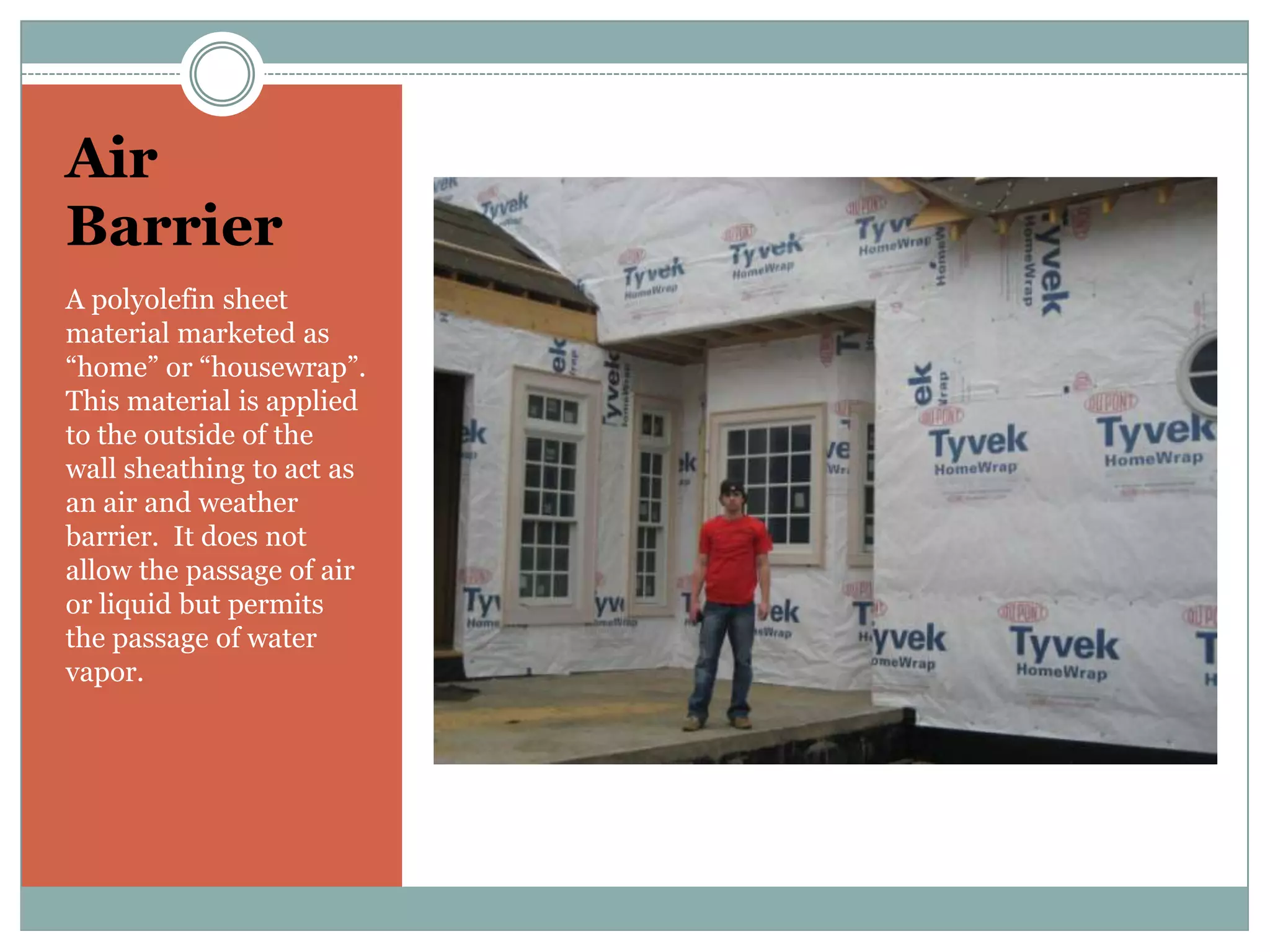
Air BarrierA polyolefin sheet material marketed as “home” or “housewrap”.  This material is applied to the outside of the wall sheathing to act as an air and weather barrier.  It does not allow the passage of air or liquid but permits the passage of water vapor.
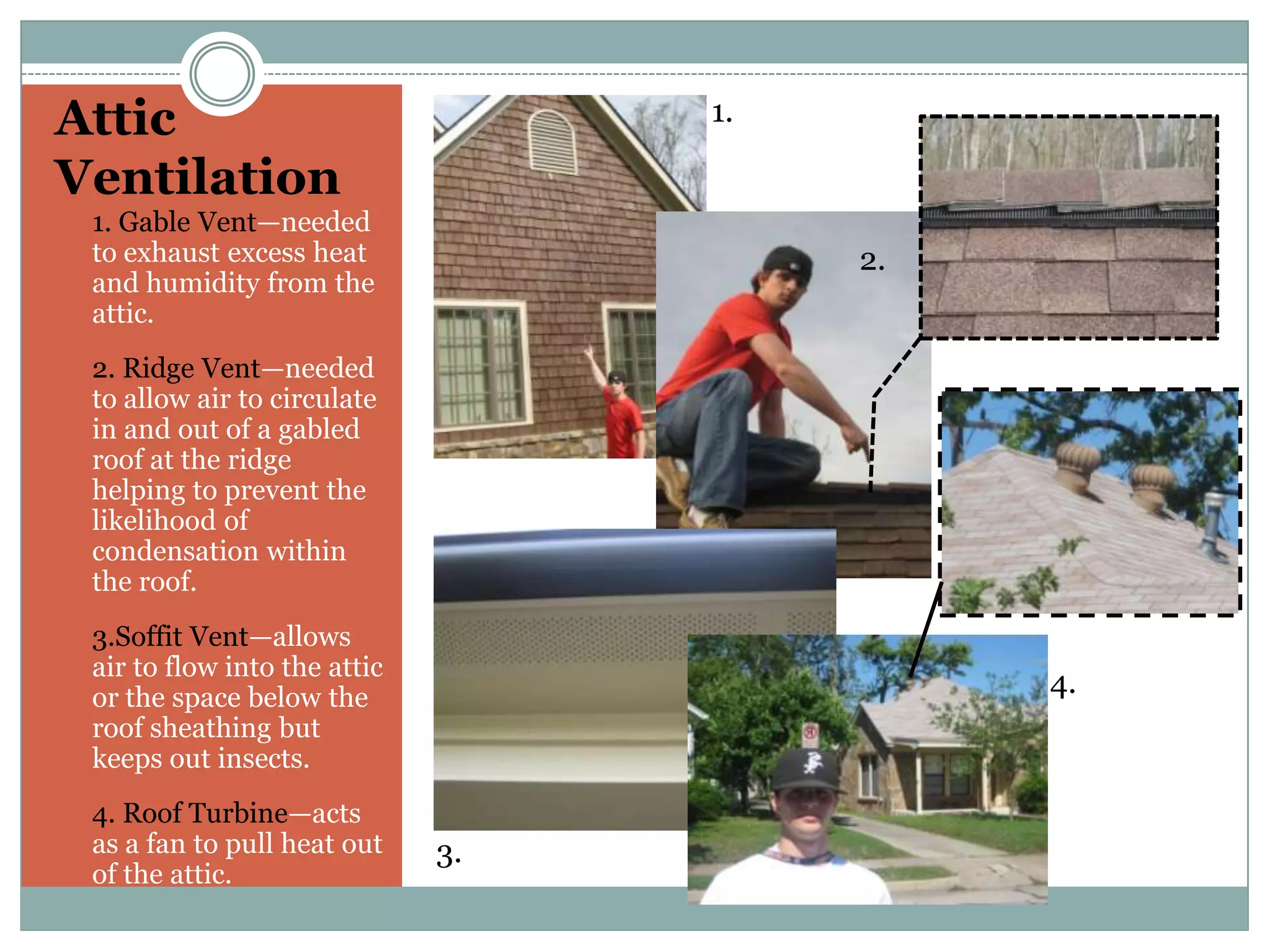
Attic Ventilation1.1. Gable Vent—needed to exhaust excess heat and humidity from the attic.2. Ridge Vent—needed to allow air to circulate in and out of a gabled roof at the ridge helping to prevent the likelihood of condensation within the roof.3.SoffitVent—allows air to flow into the attic or the space below the roof sheathing but keeps out insects.4. Roof Turbine—acts as a fan to pull heat out of the attic.2.4.3.
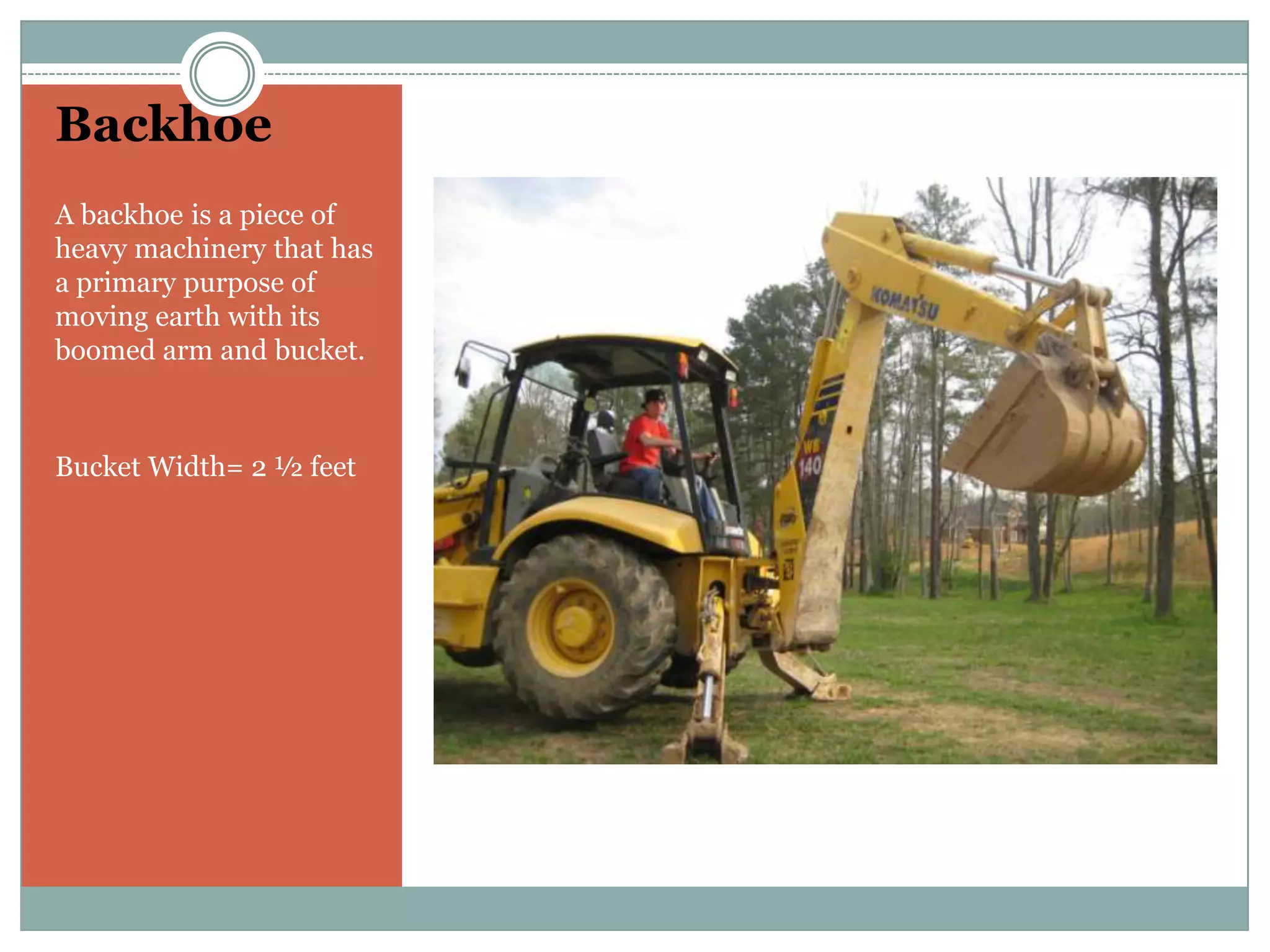
BackhoeA backhoe is a piece of heavy machinery that has a primary purpose of moving earth with its boomed arm and bucket.Bucket Width= 2 ½ feet
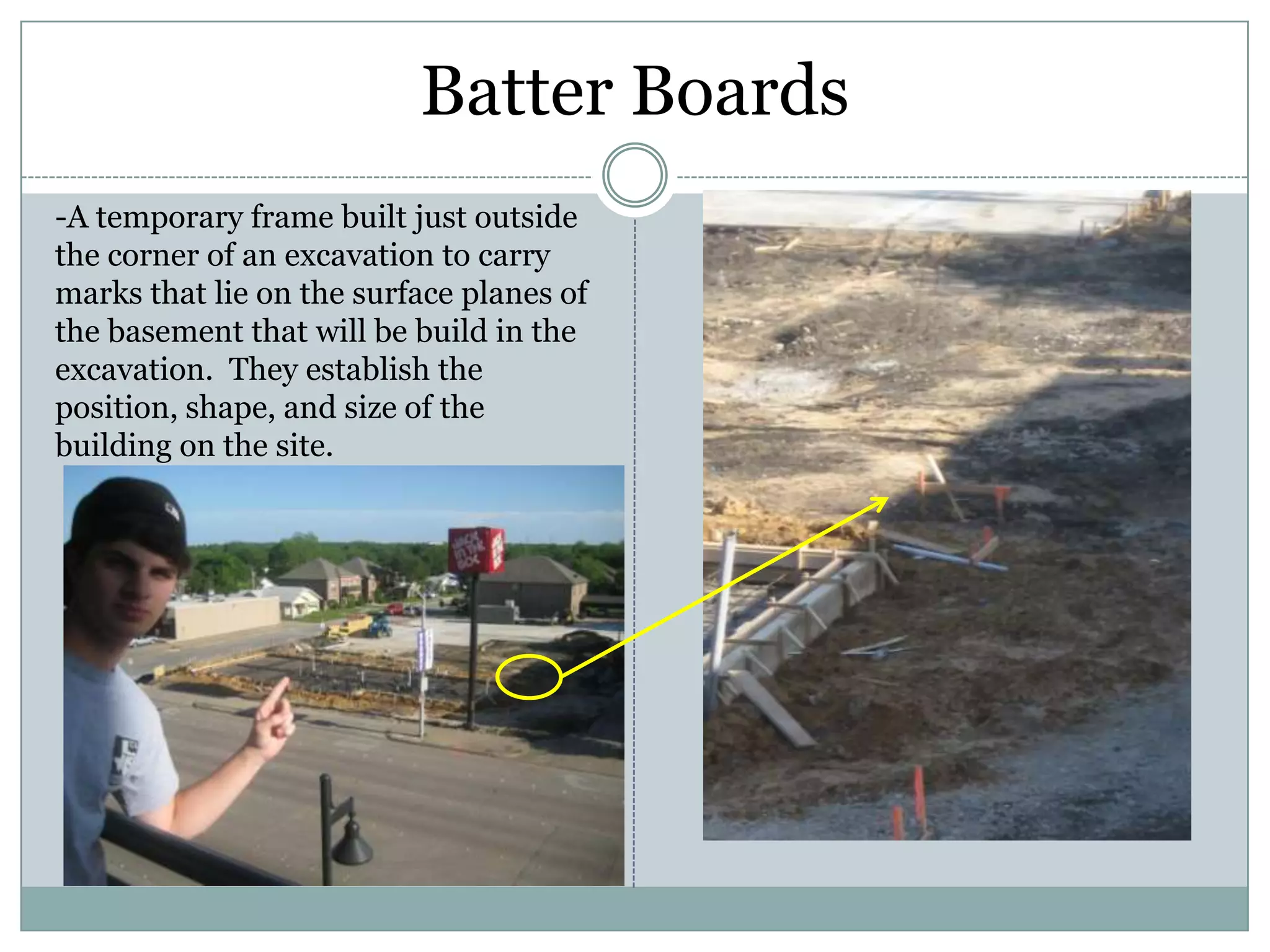
Batter Boards-A temporary frame built just outside the corner of an excavation to carry marks that lie on the surface planes of the basement that will be build in the excavation.  They establish the position, shape, and size of the building on the site.
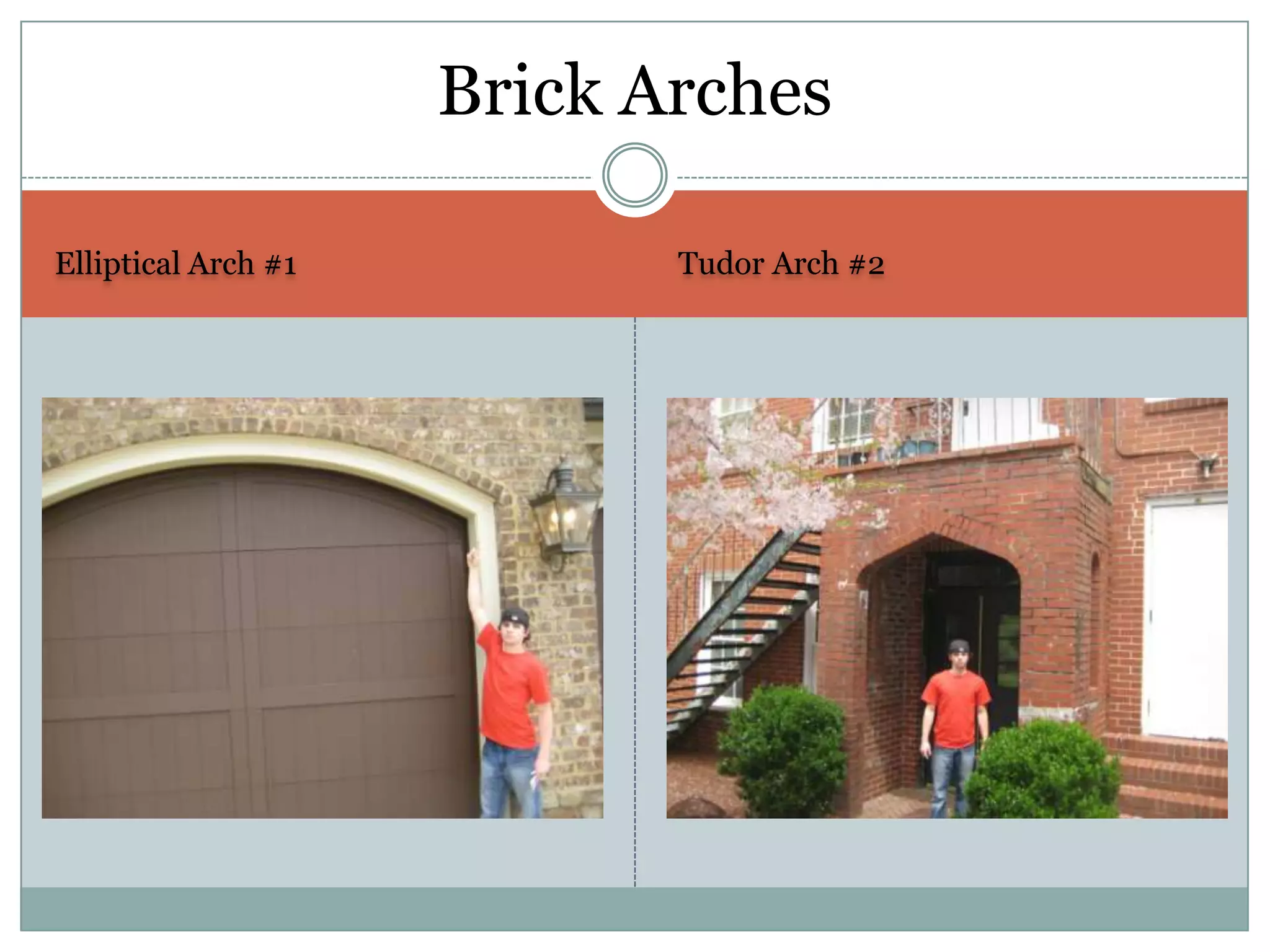
Elliptical Arch #1Tudor Arch #2Brick Arches
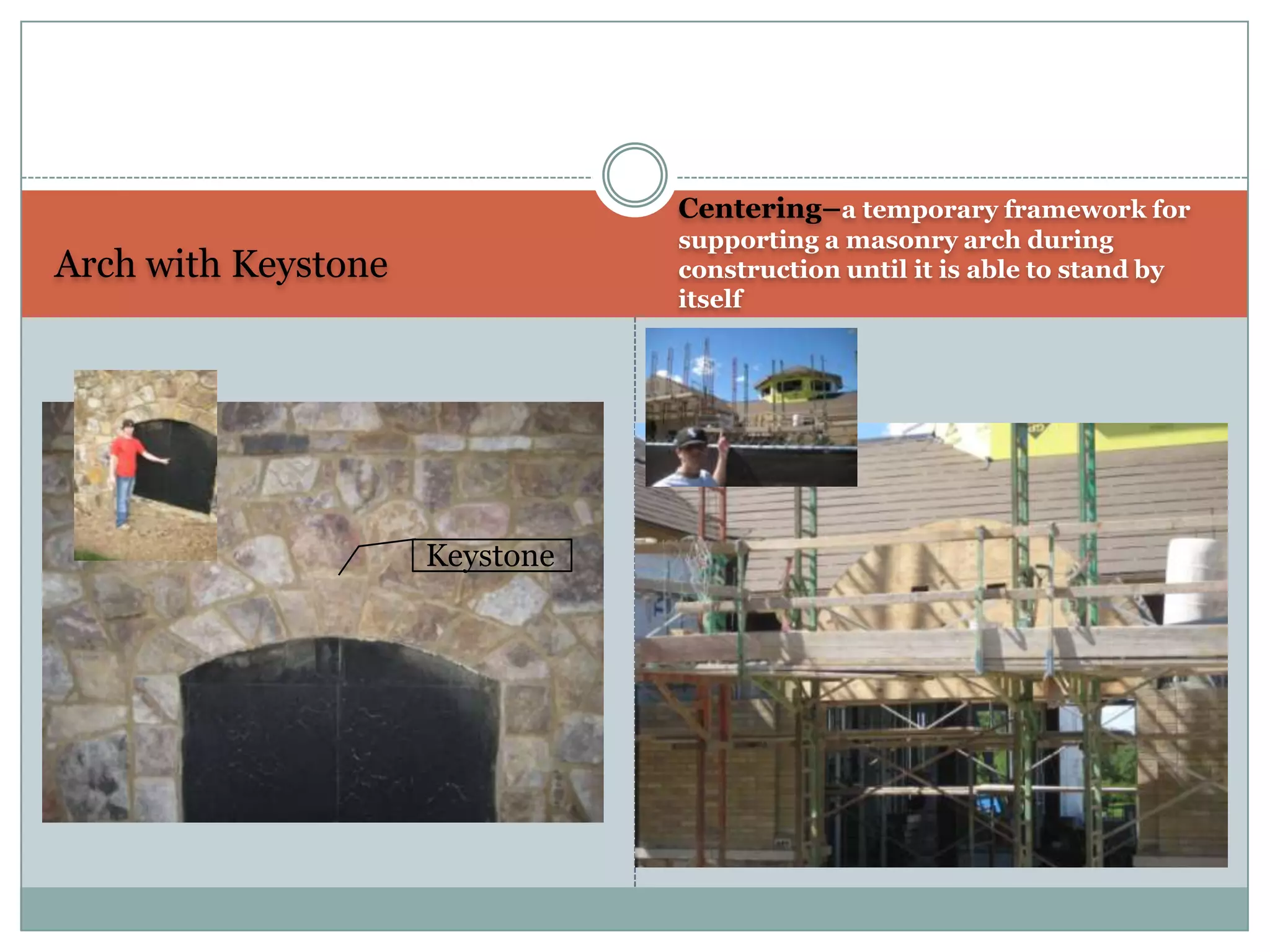
Arch with KeystoneCentering–a temporary framework for supporting a masonry arch during construction until it is able to stand by itselfKeystone
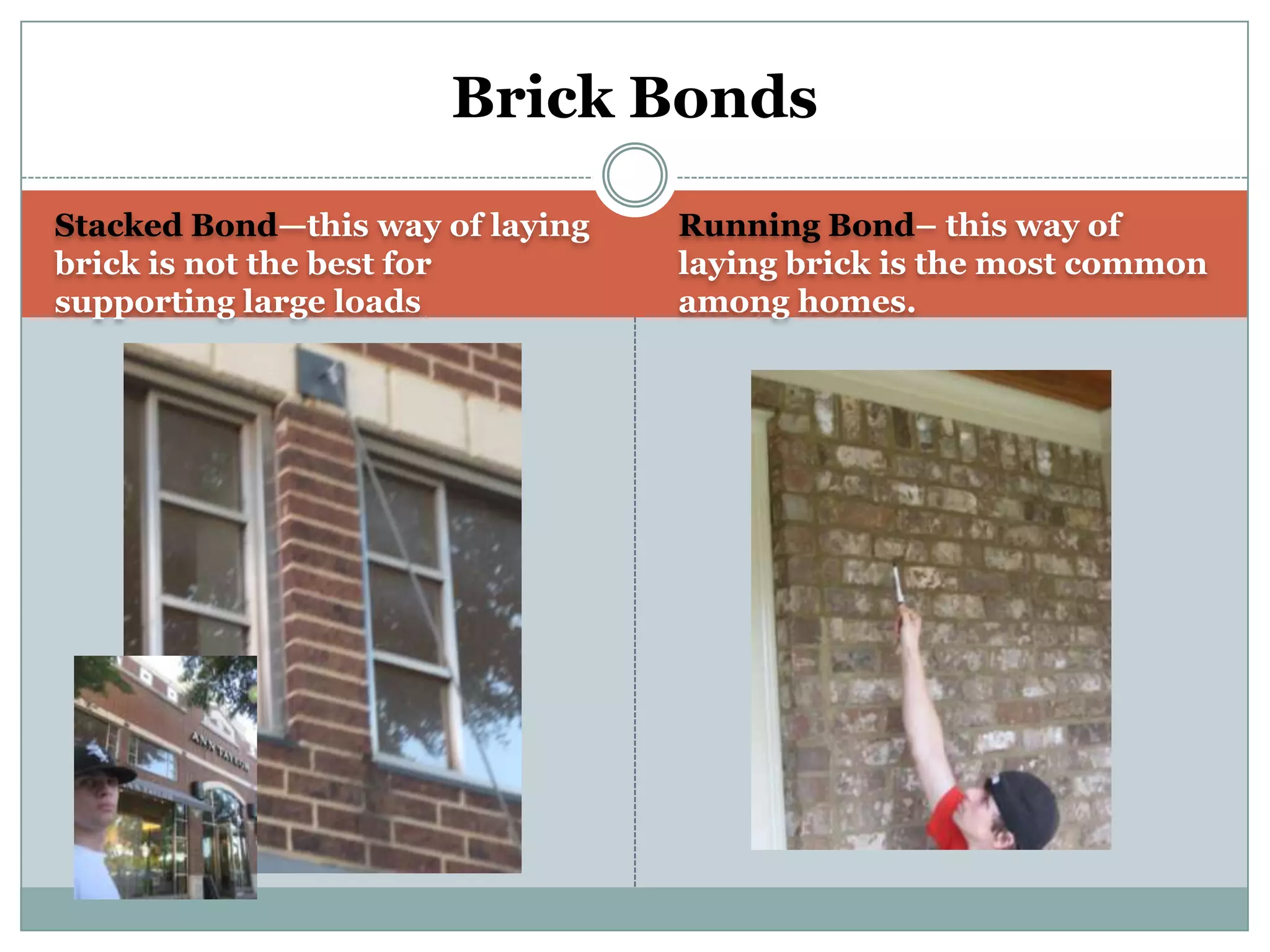
Stacked Bond—this way of laying brick is not the best for supporting large loadsRunning Bond– this way of laying brick is the most common among homes.Brick Bonds
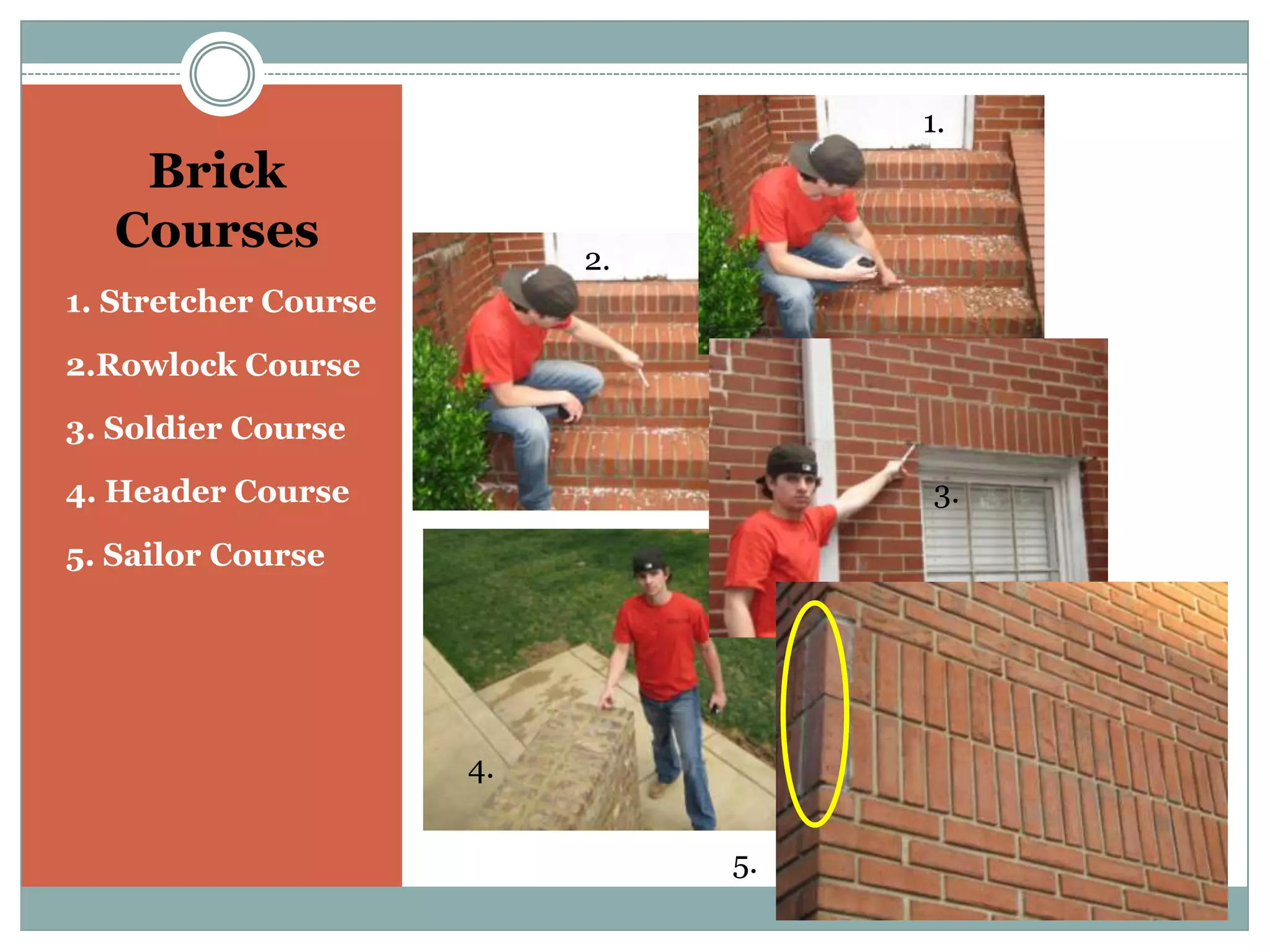
Brick Courses1.2.1. Stretcher Course2.Rowlock Course3. Soldier Course 4. Header Course5. Sailor Course3.4.5.
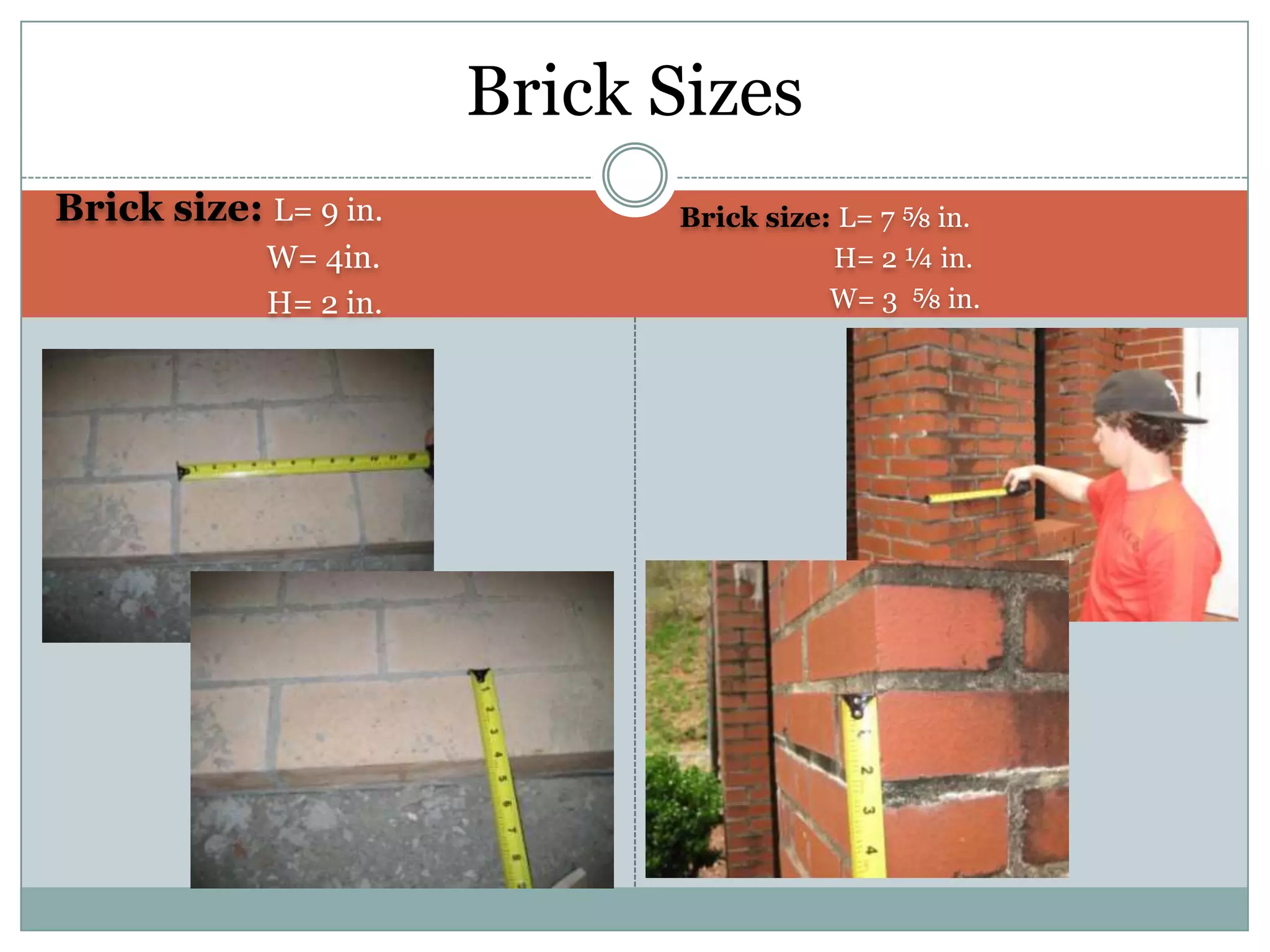
Brick SizesBrick size: L= 9 in.          W= 4in.          H= 2 in.Brick size: L= 7 ⅝ in.	    H= 2 ¼ in.                      W= 3  ⅝ in.
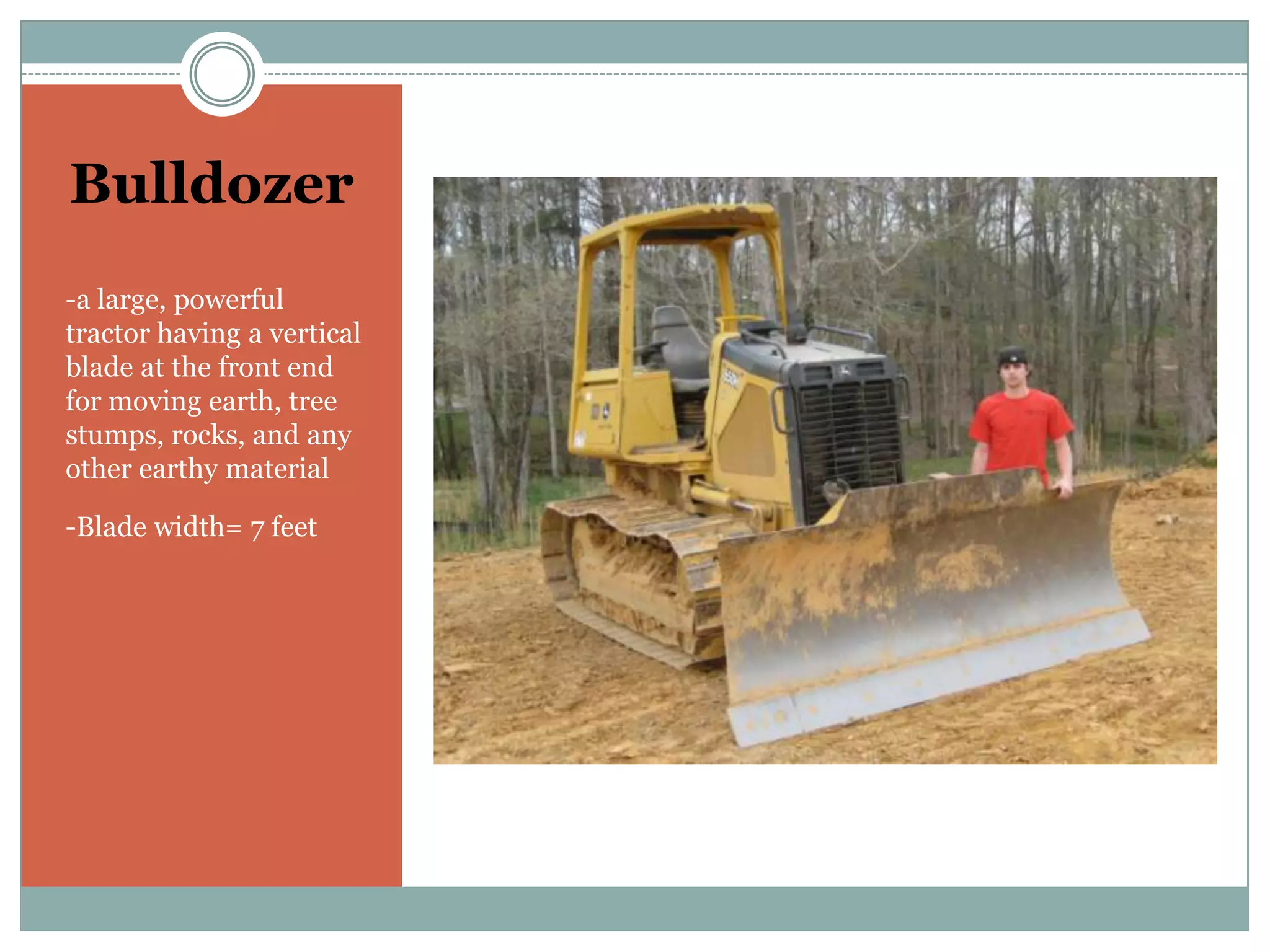
Bulldozer-a large, powerful tractor having a vertical blade at the front end for moving earth, tree stumps, rocks, and any other earthy material-Blade width= 7 feet
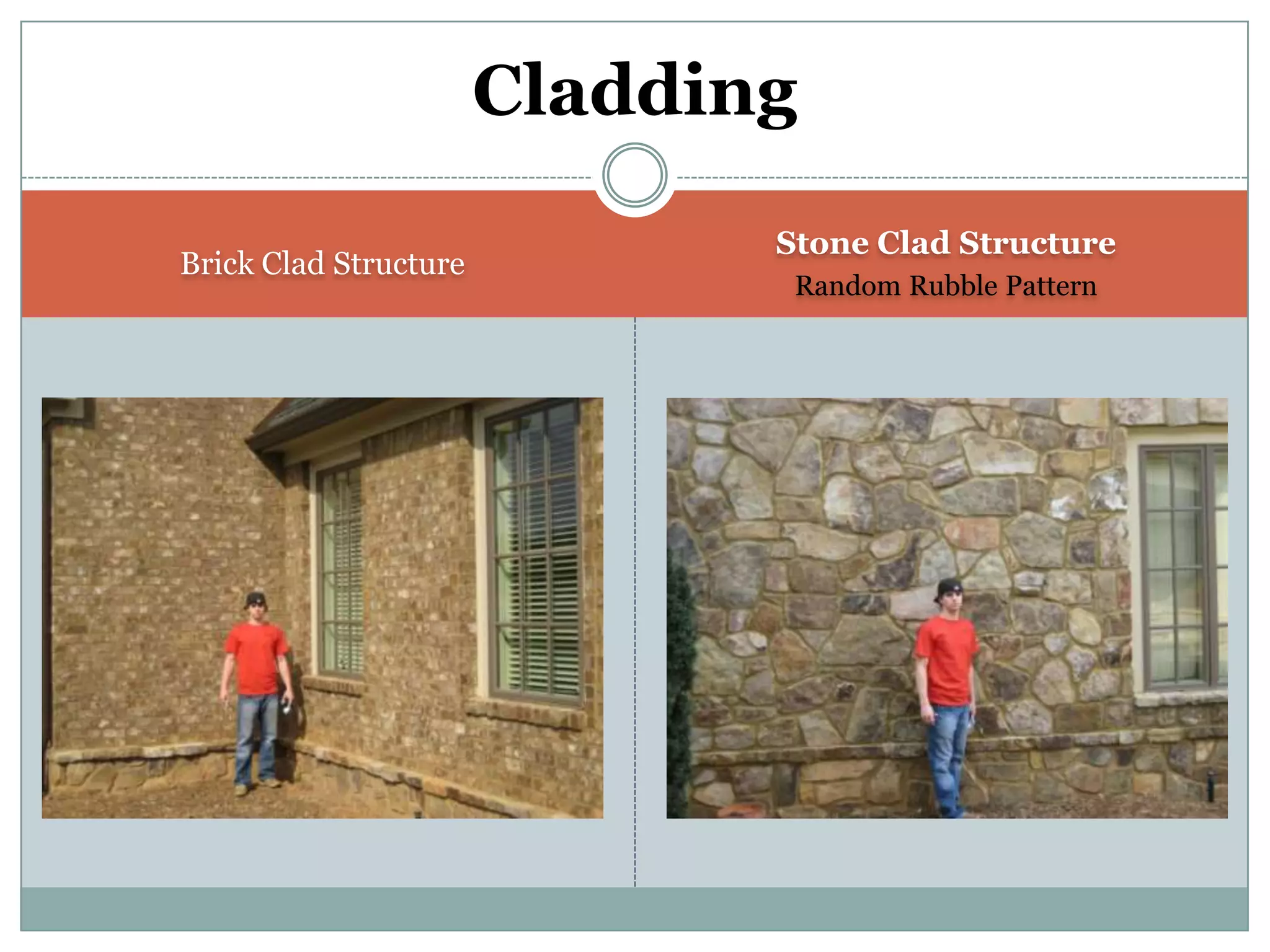
Brick Clad StructureStone Clad StructureRandom Rubble Pattern Cladding
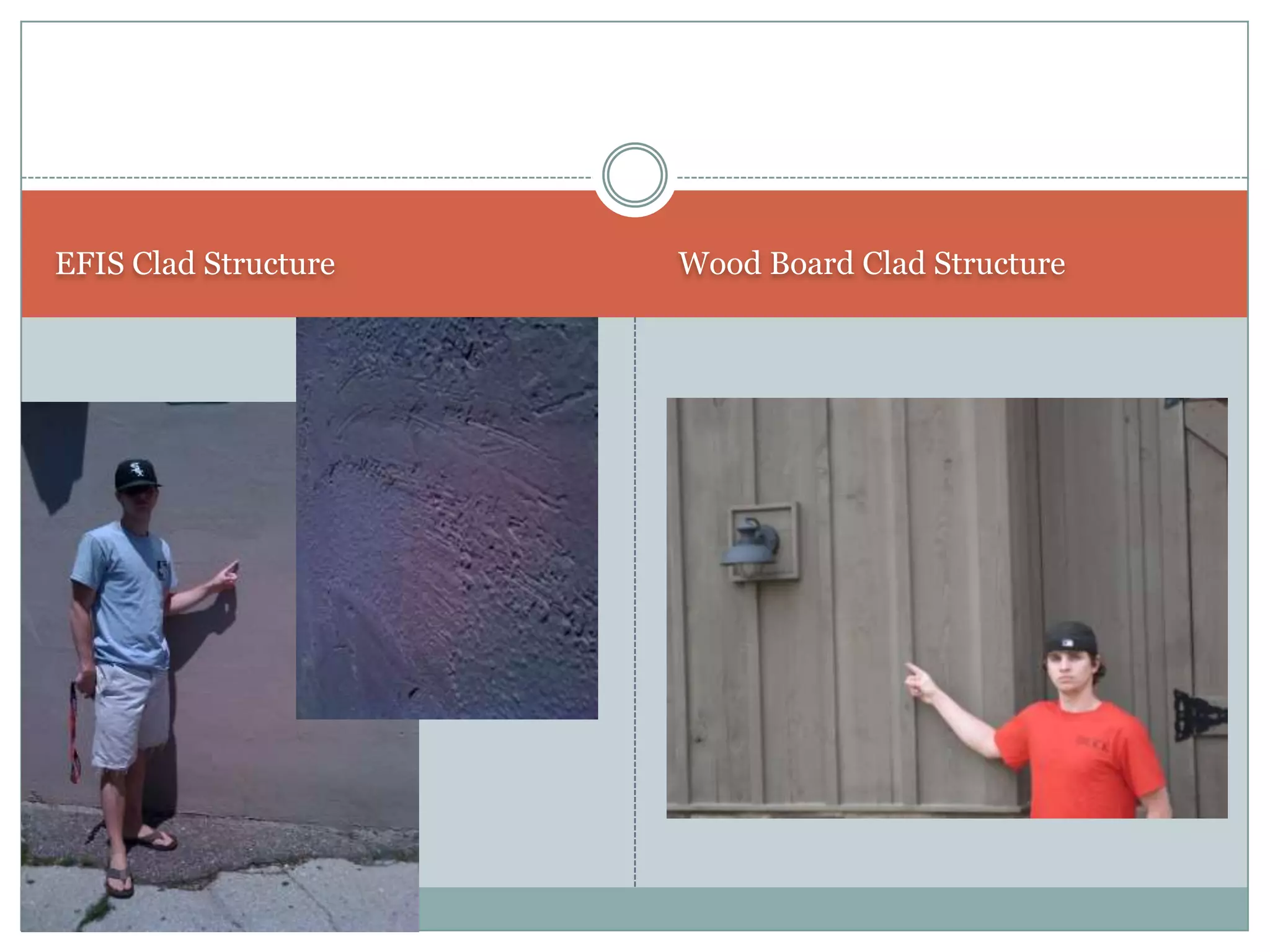
EFIS Clad StructureWood Board Clad Structure
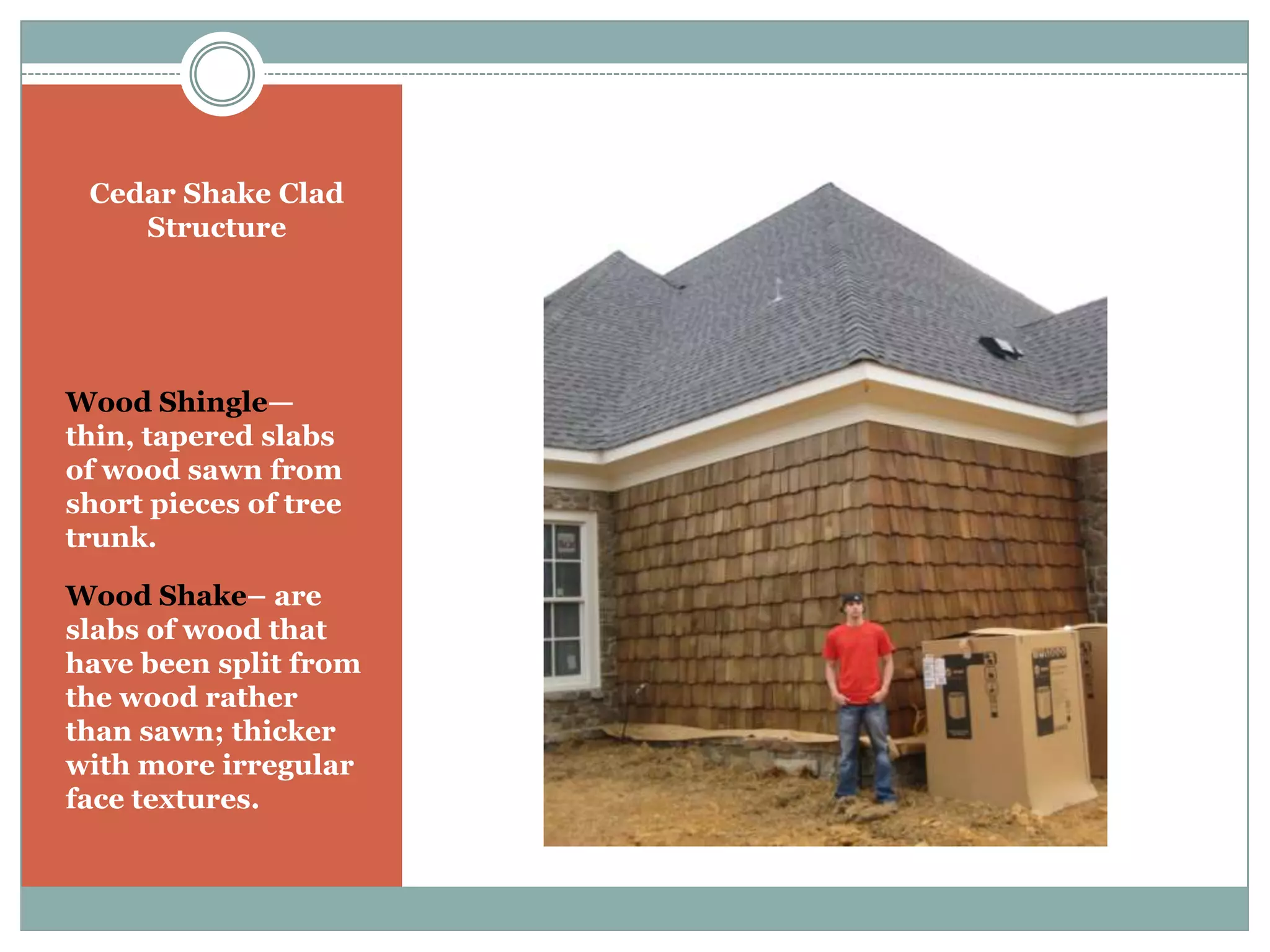
Cedar Shake Clad StructureWood Shingle—thin, tapered slabs of wood sawn from short pieces of tree trunk.Wood Shake– are slabs of wood that have been split from the wood rather than sawn; thicker with more irregular face textures.
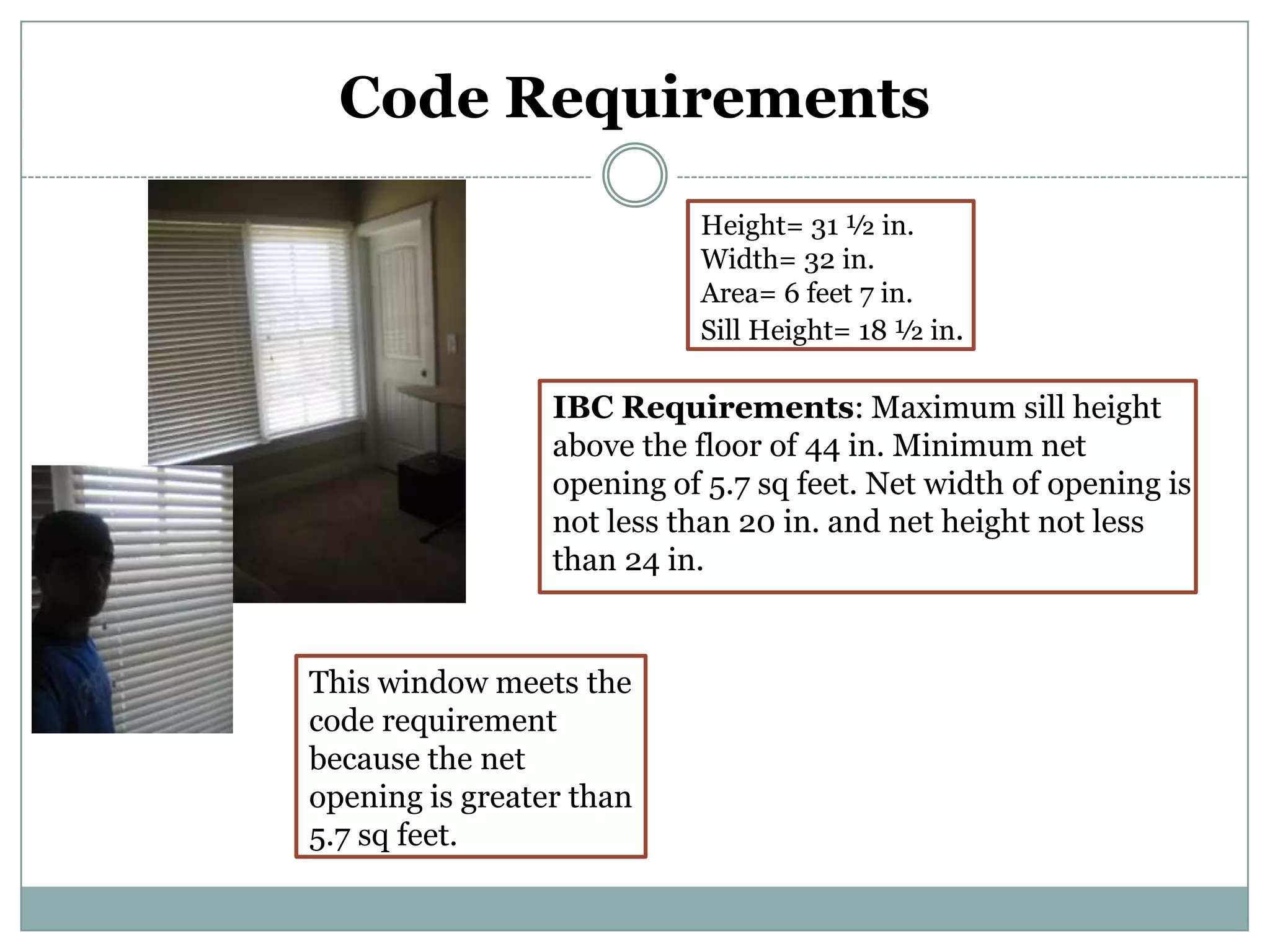
Code Requirements Height= 31 ½ in.Width= 32 in.Area= 6 feet 7 in.Sill Height= 18 ½ in.IBC Requirements: Maximum sill height above the floor of 44 in. Minimum net opening of 5.7 sq feet. Net width of opening is not less than 20 in. and net height not less than 24 in.This window meets the code requirement because the net opening is greater than 5.7 sq feet.
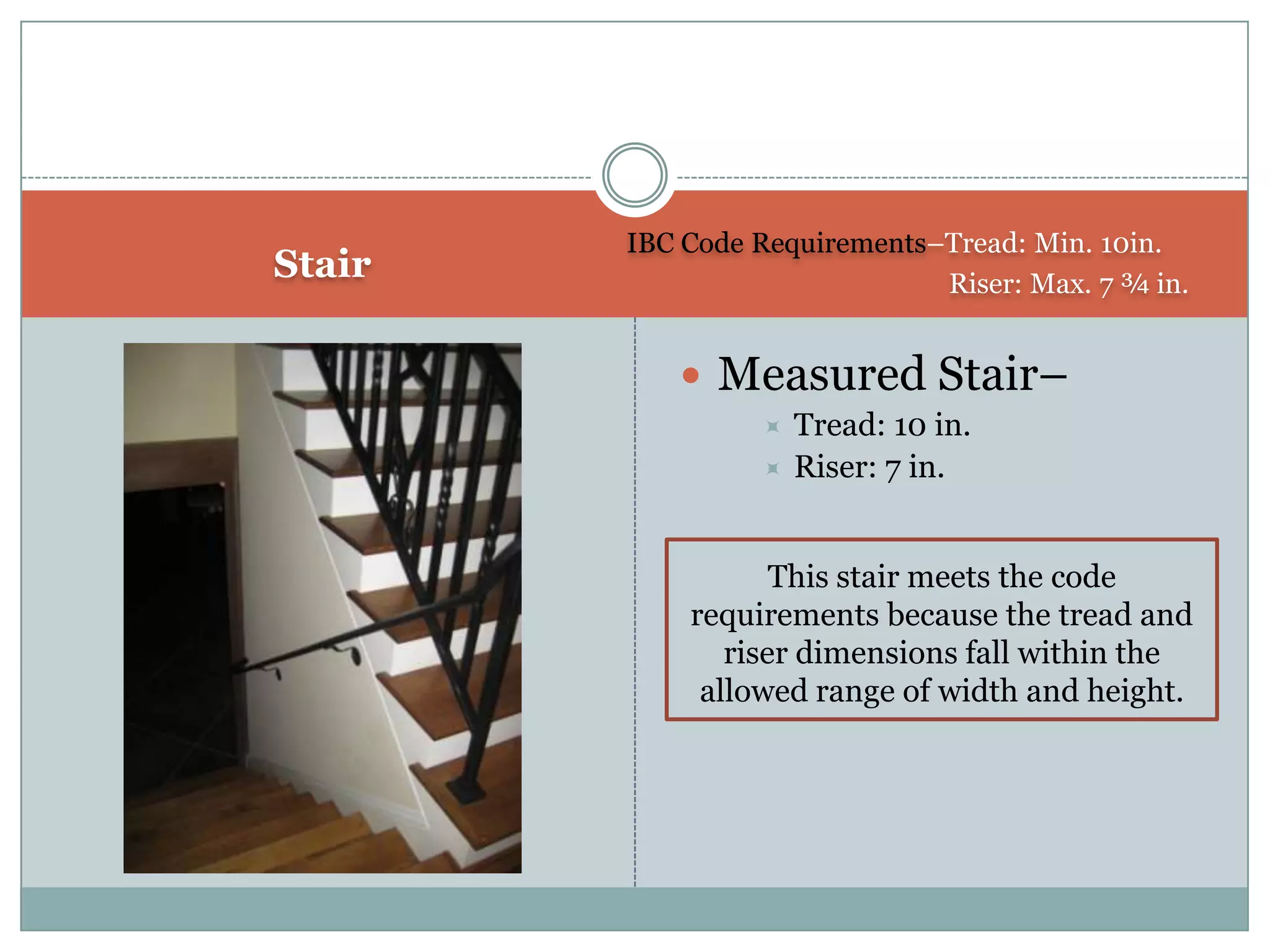
StairIBC Code Requirements–Tread: Min. 10in.		          Riser: Max. 7 ¾ in.Measured Stair– Tread: 10 in.Riser: 7 in.This stair meets the code requirements because the tread and riser dimensions fall within the allowed range of width and height.
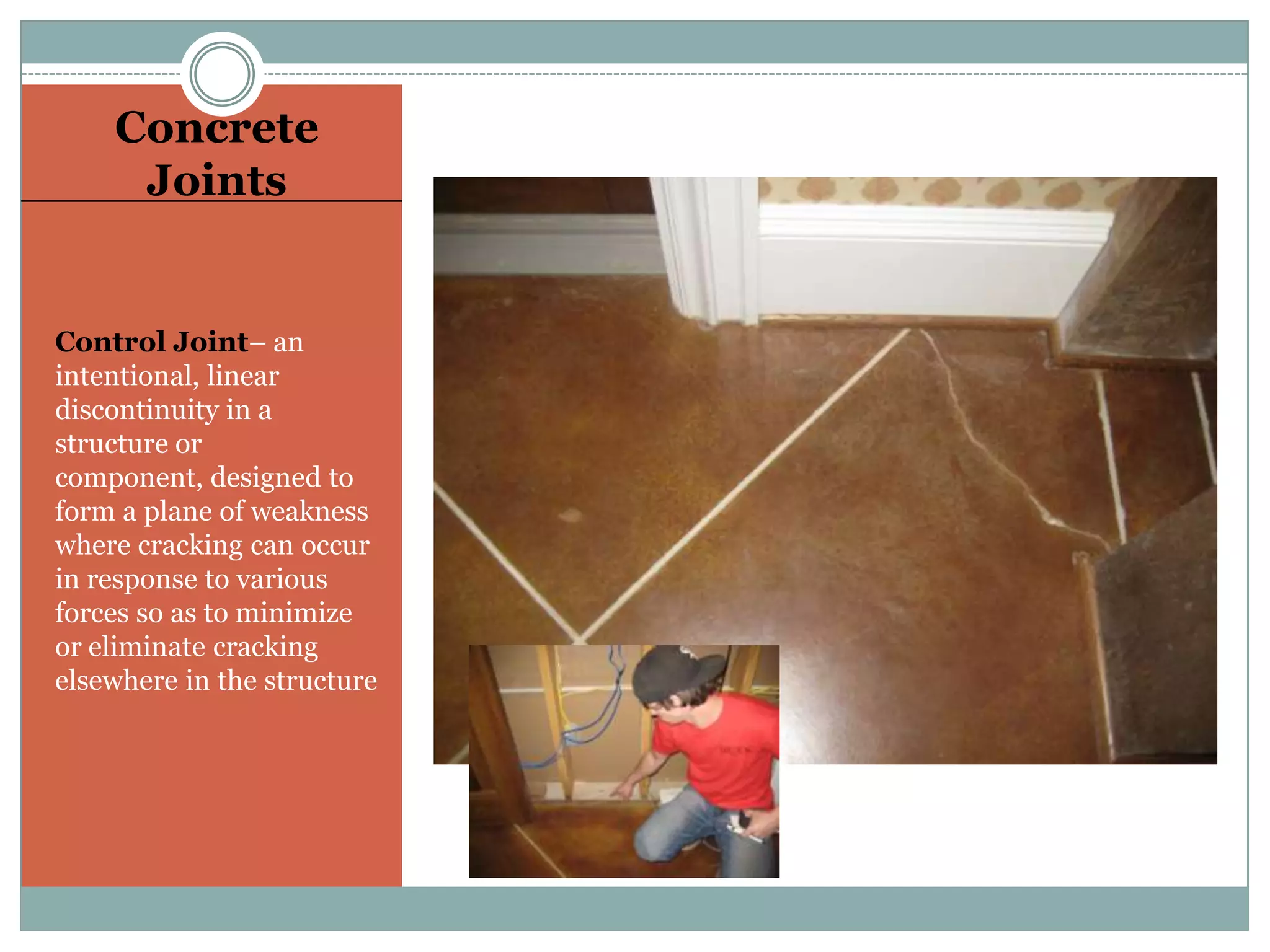
Concrete JointsControl Joint– an intentional, linear discontinuity in a structure or component, designed to form a plane of weakness where cracking can occur in response to various forces so as to minimize or eliminate cracking elsewhere in the structure
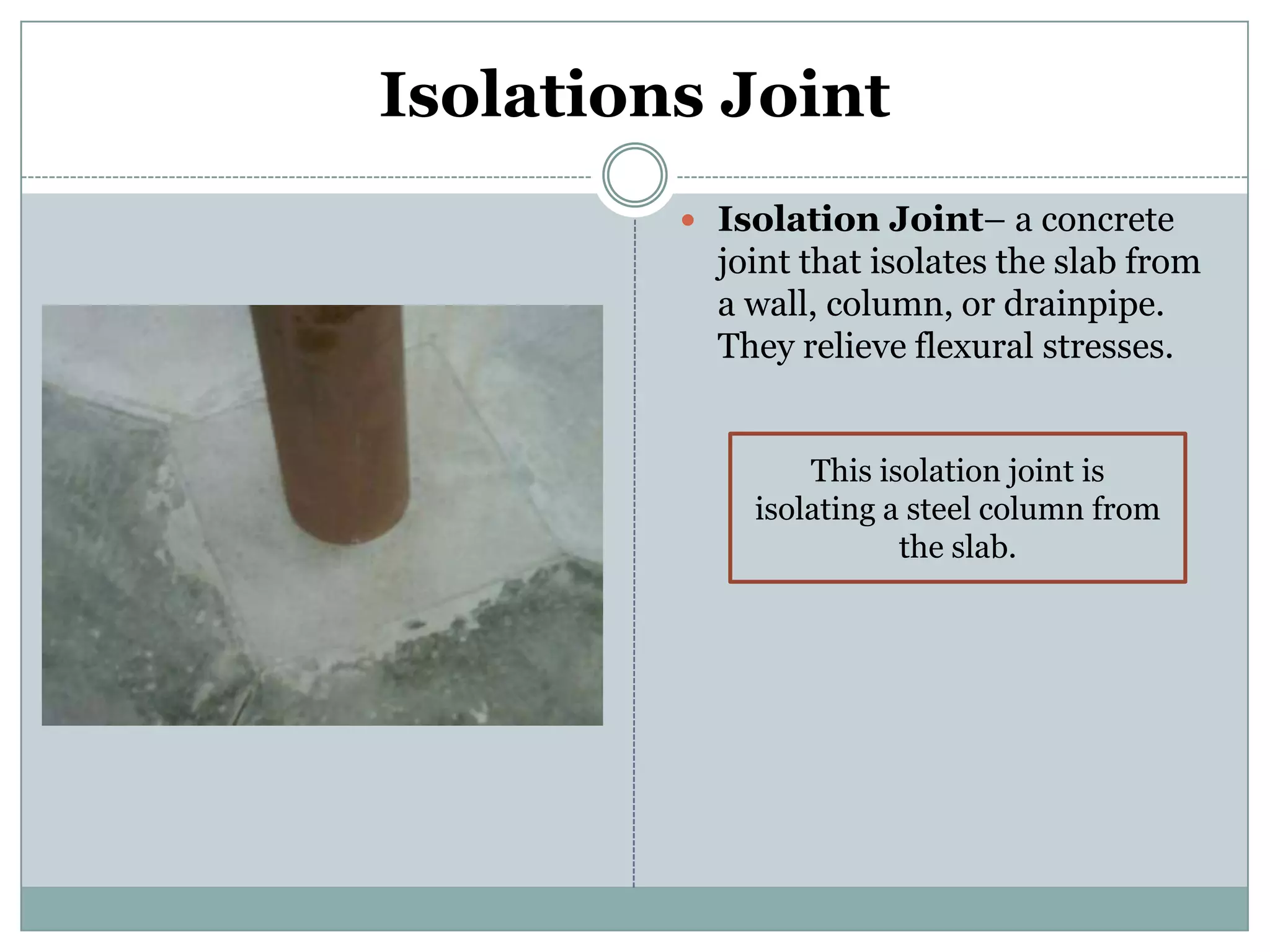
Isolations JointIsolation Joint– a concrete joint that isolates the slab from a wall, column, or drainpipe. They relieve flexural stresses.This isolation joint is isolating a steel column from the slab.
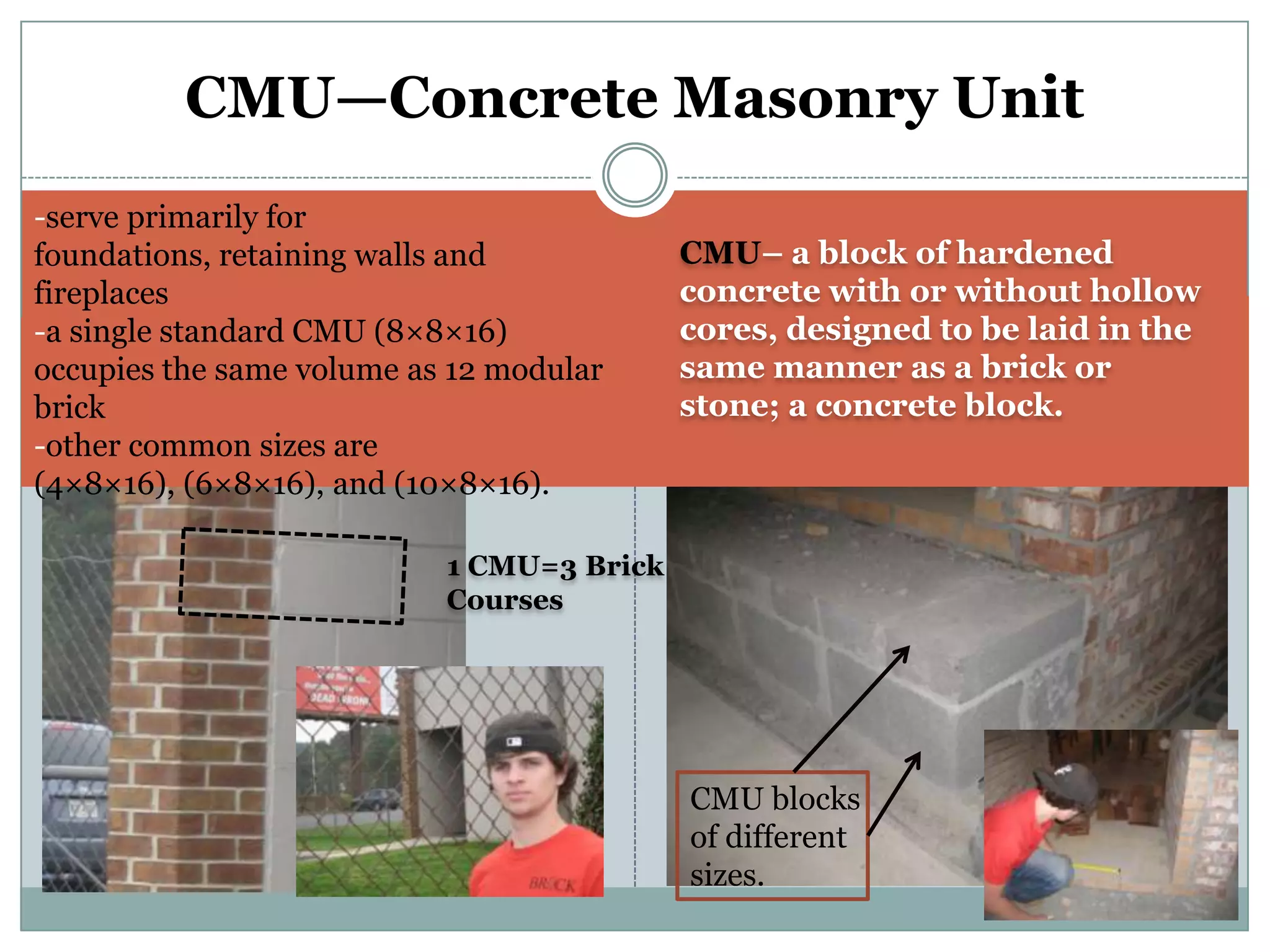
CMU—Concrete Masonry Unit-serve primarily for foundations, retaining walls and fireplaces-a single standard CMU (8×8×16) occupies the same volume as 12 modular brick-other common sizes are (4×8×16), (6×8×16), and (10×8×16).CMU– a block of hardened concrete with or without hollow cores, designed to be laid in the same manner as a brick or stone; a concrete block.1 CMU=3 Brick CoursesCMU blocks of different sizes.
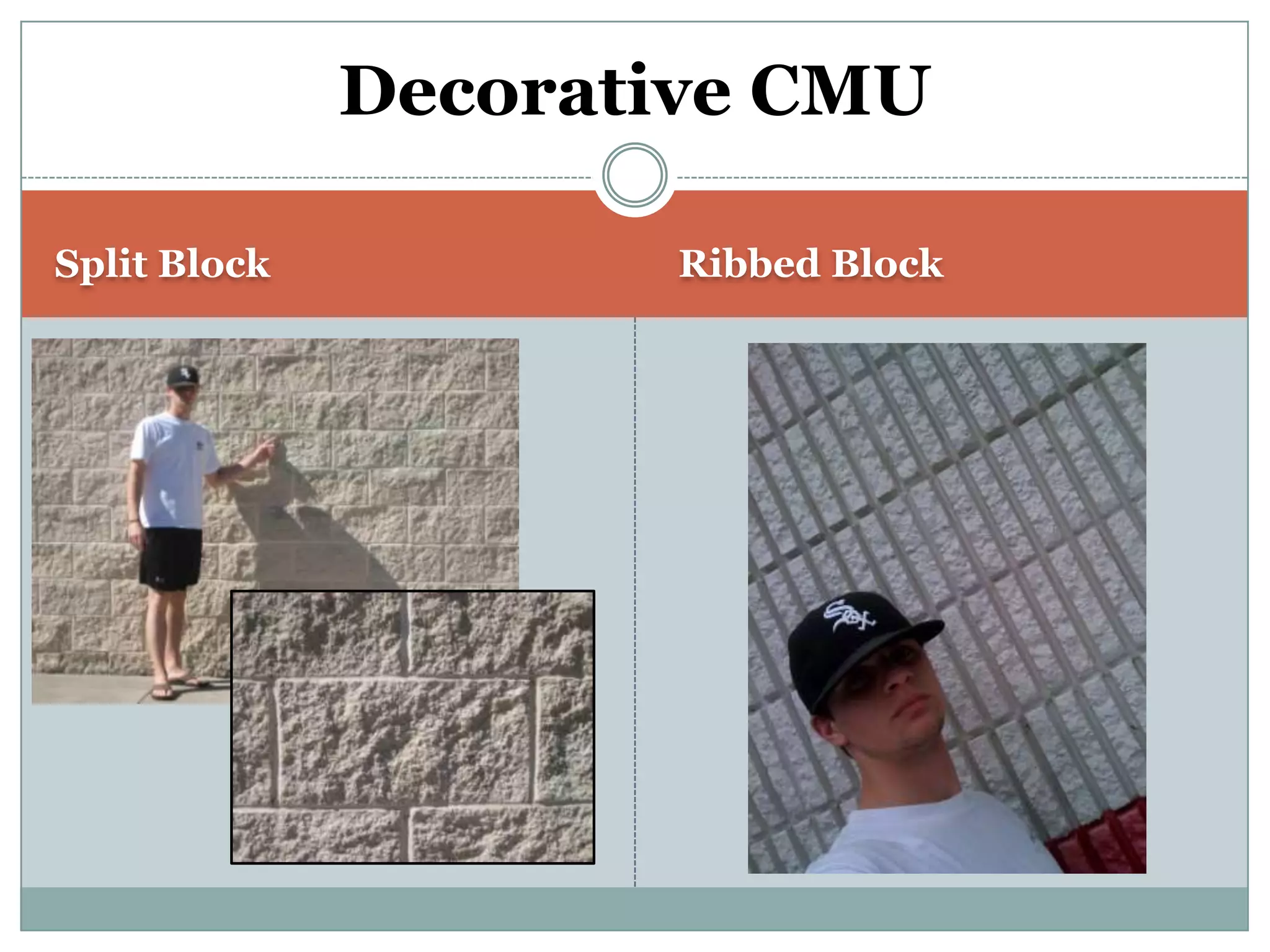
Split BlockRibbed BlockDecorative CMU
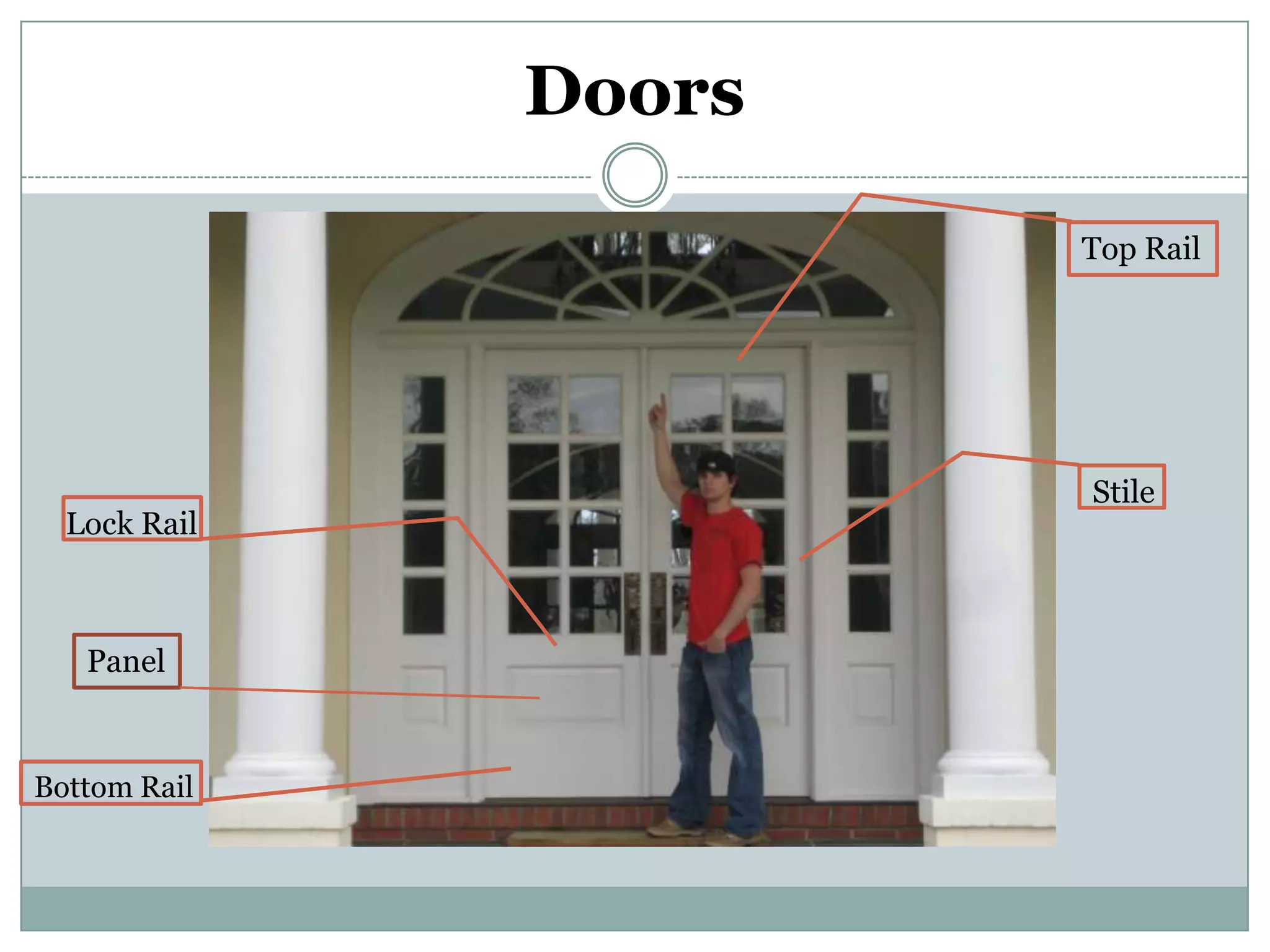
DoorsTop RailStileLockRailPanelBottom Rail
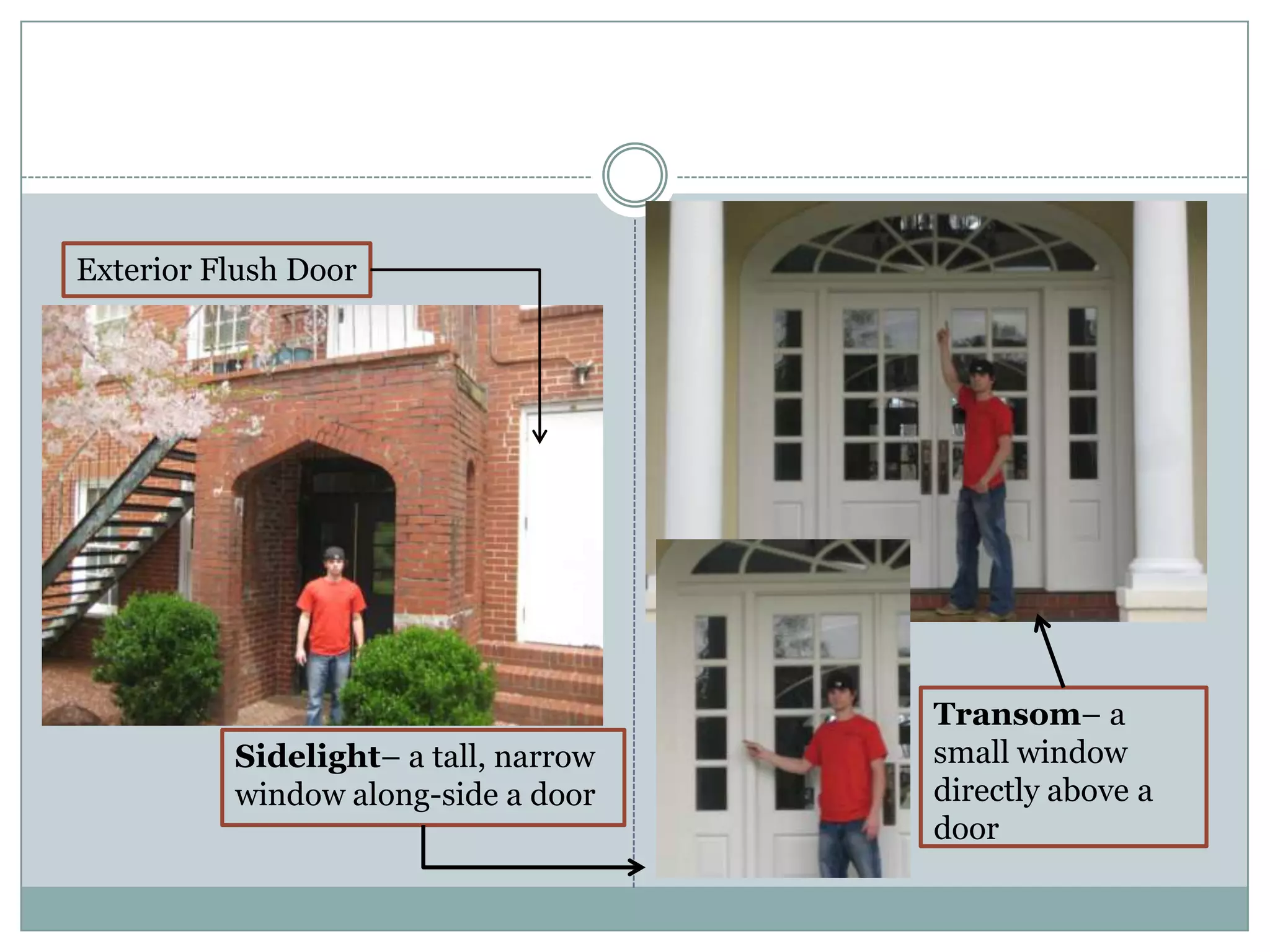
Exterior Flush DoorTransom– a small window directly above a doorSidelight– a tall, narrow window along-side a door
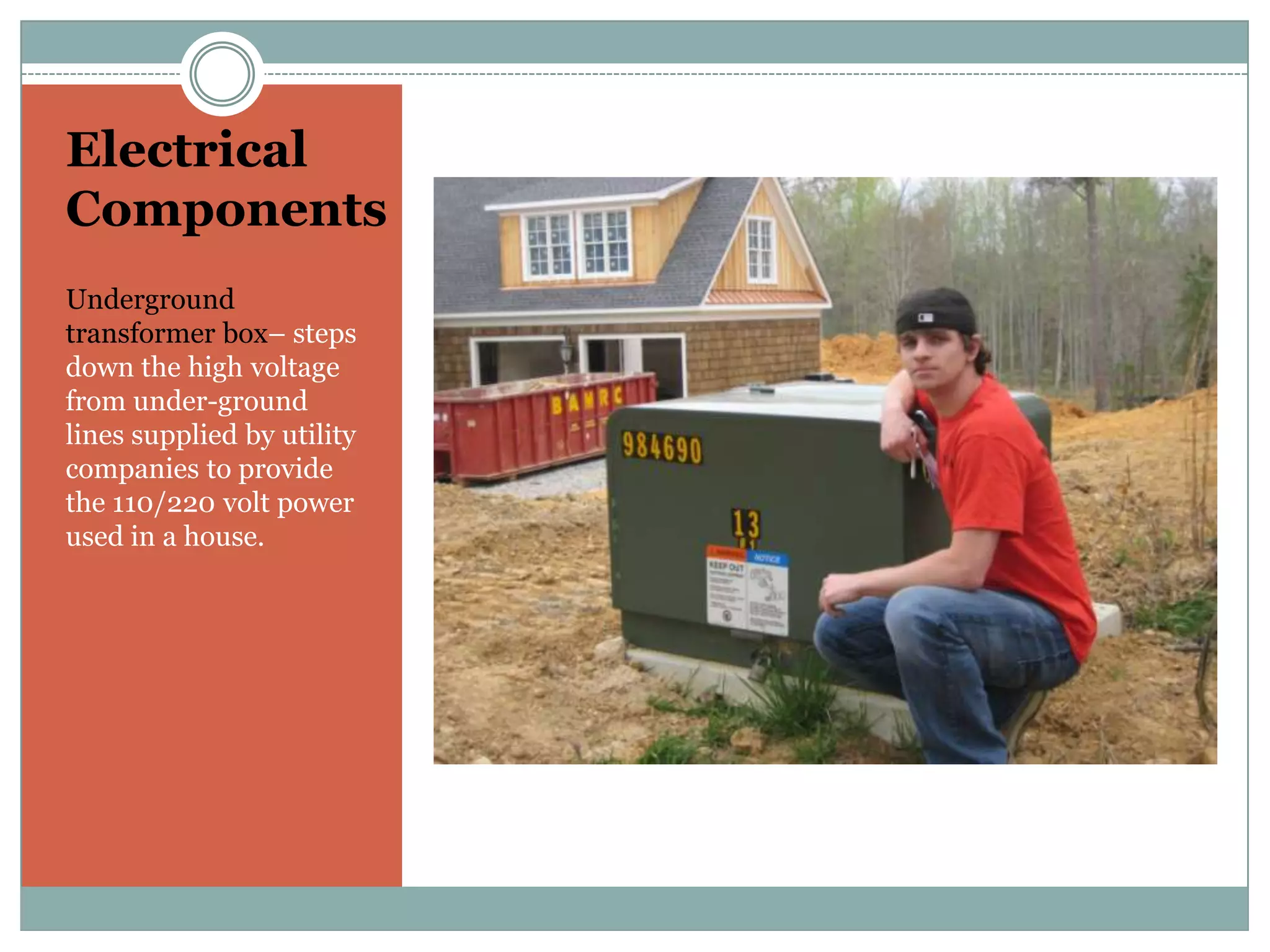
Electrical ComponentsUnderground transformer box– steps down the high voltage from under-ground lines supplied by utility companies to provide the 110/220 volt power used in a house.
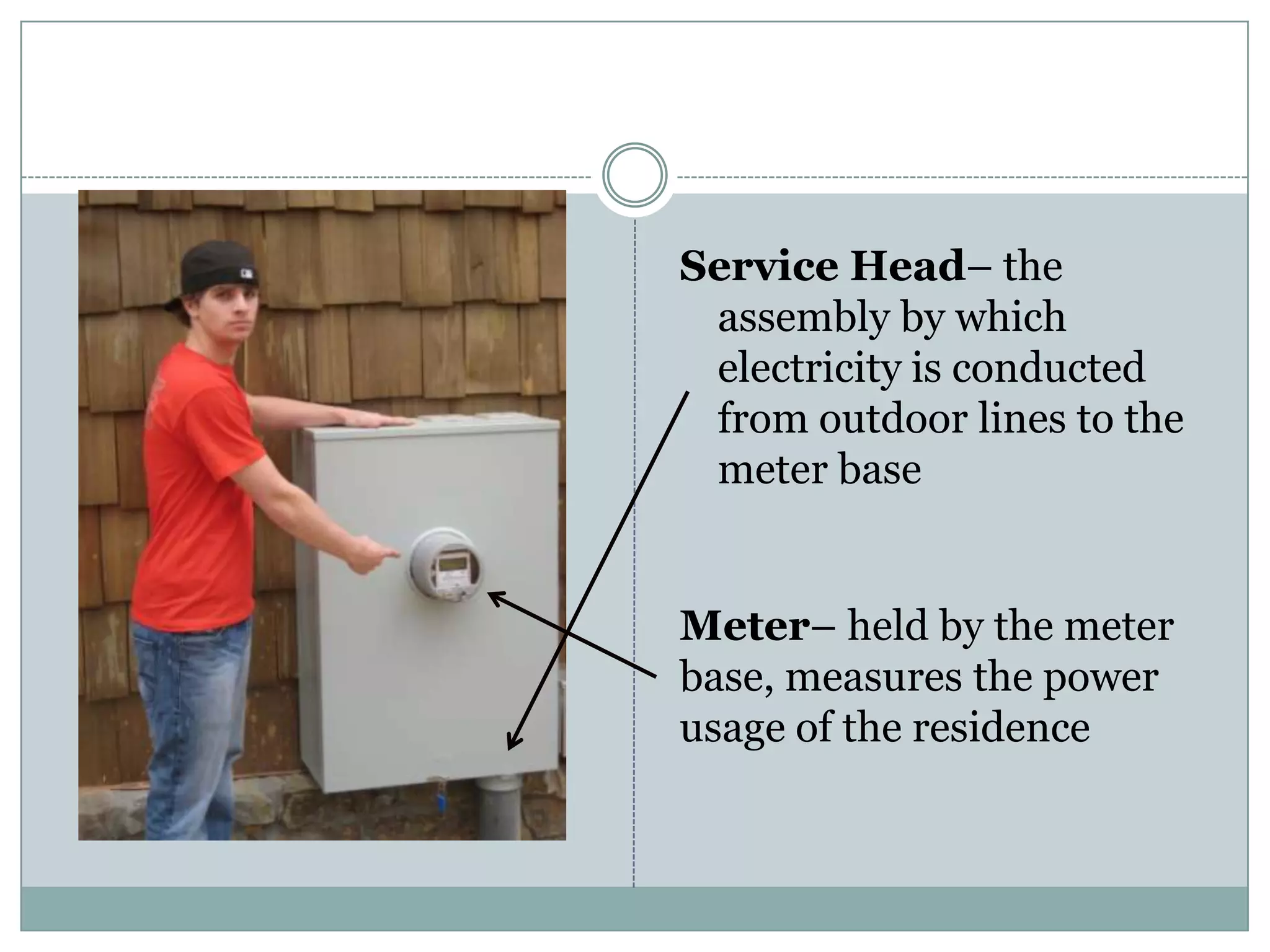
Service Head– the assembly by which electricity is conducted from outdoor lines to the meter baseMeter– held by the meter base, measures the power usage of the residence
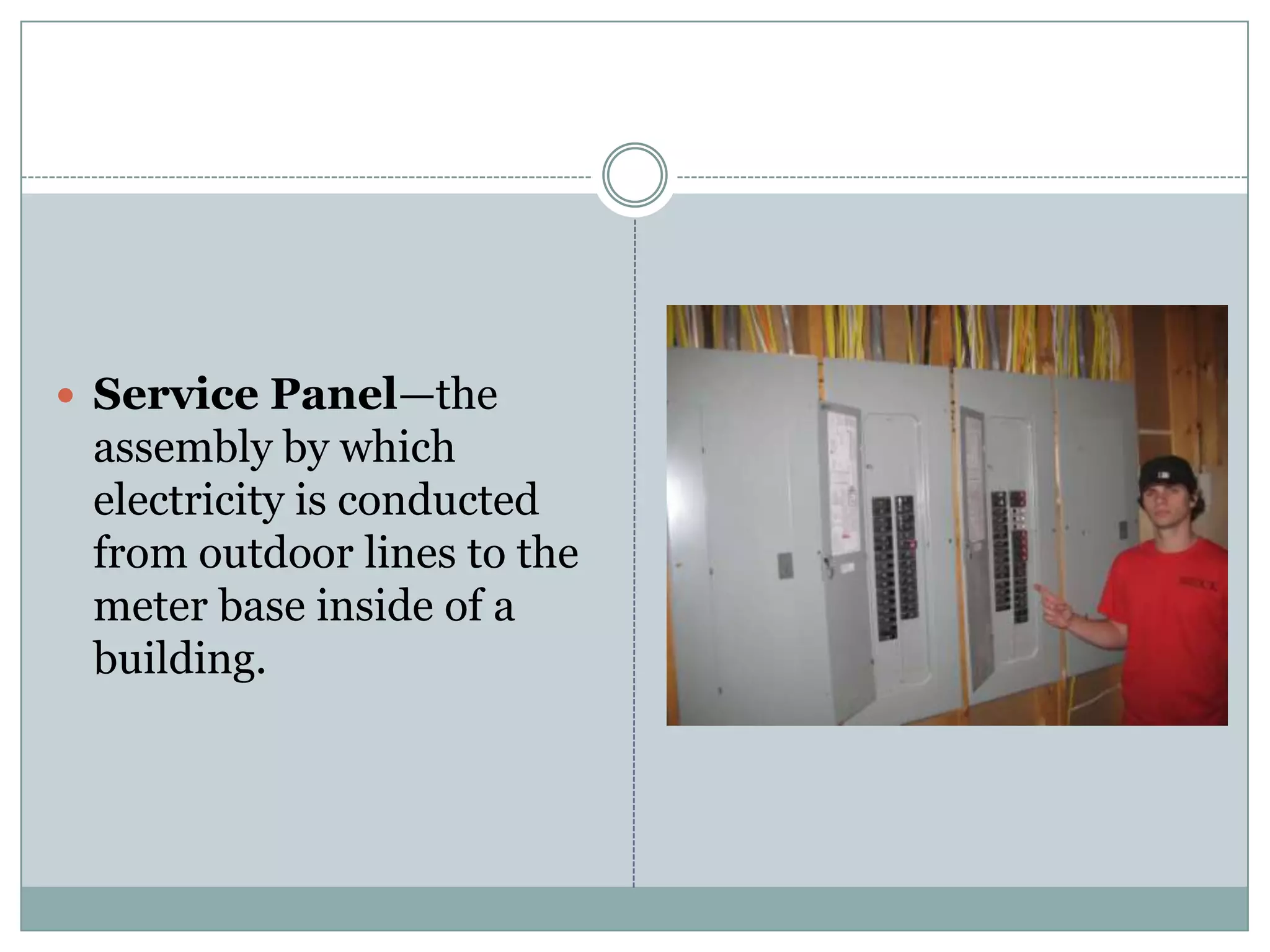
Service Panel—the assembly by which electricity is conducted from outdoor lines to the meter base inside of a building.
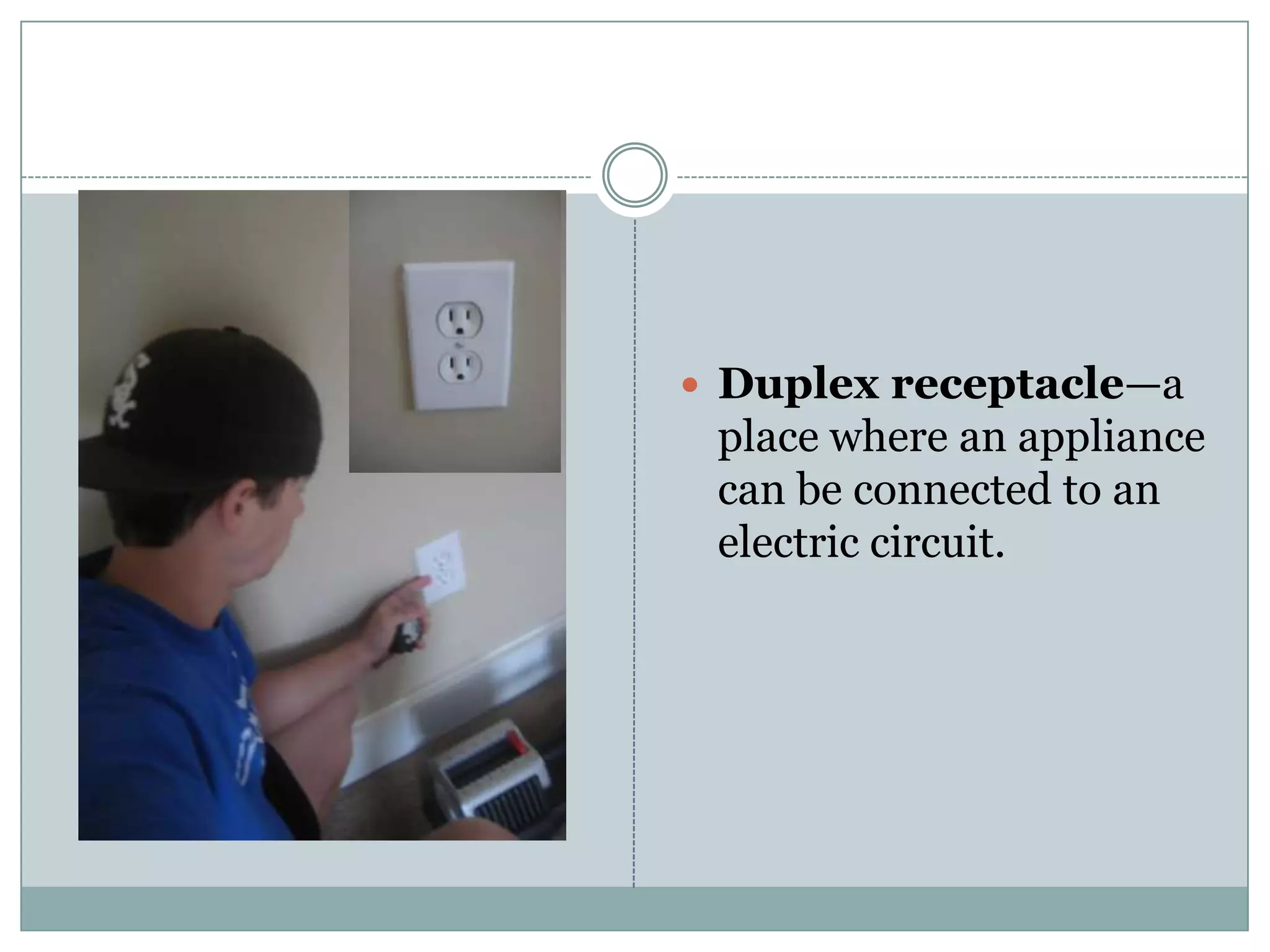
Duplex receptacle—a place where an appliance can be connected to an electric circuit.
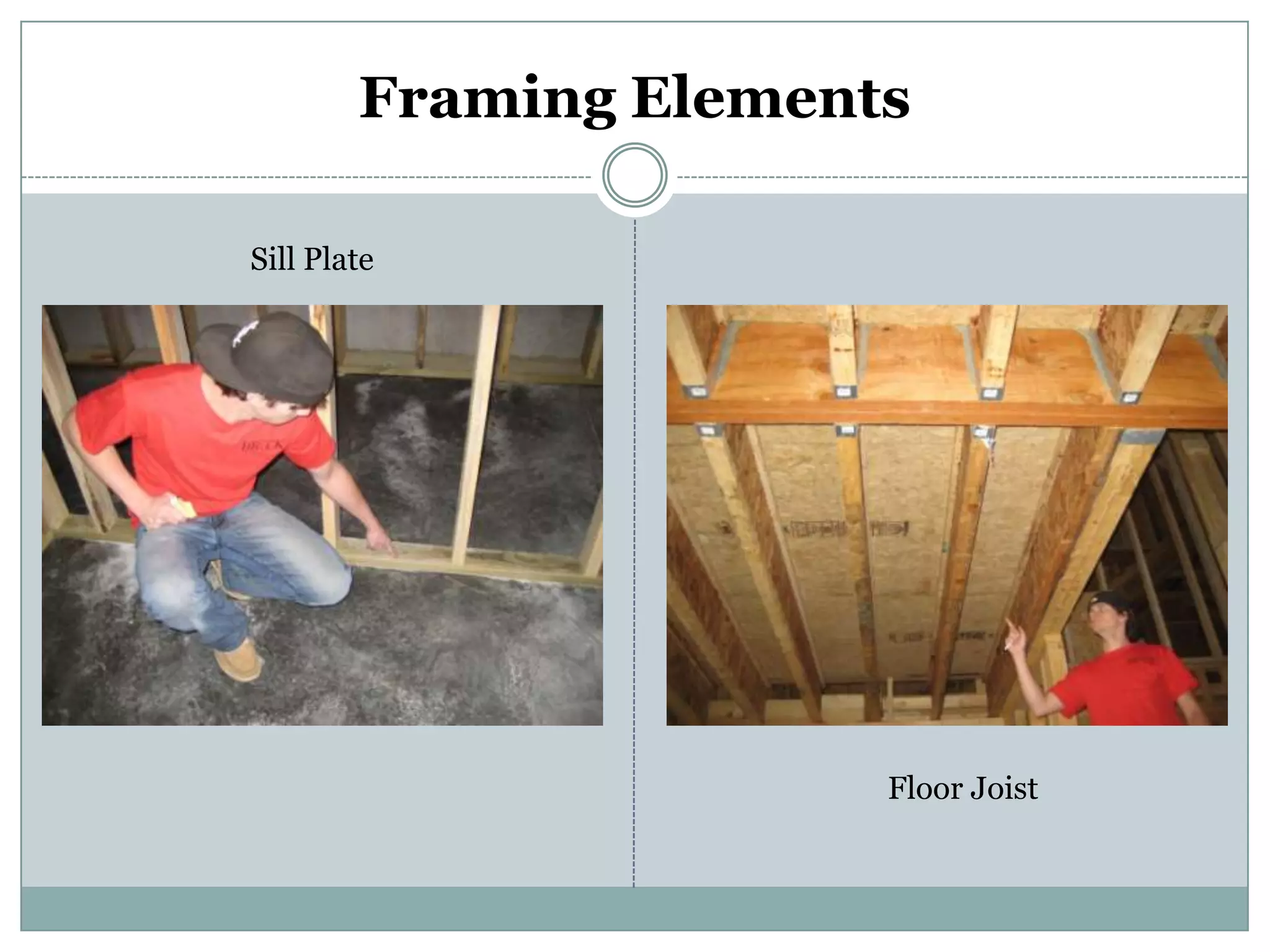
Framing ElementsSill PlateFloor Joist
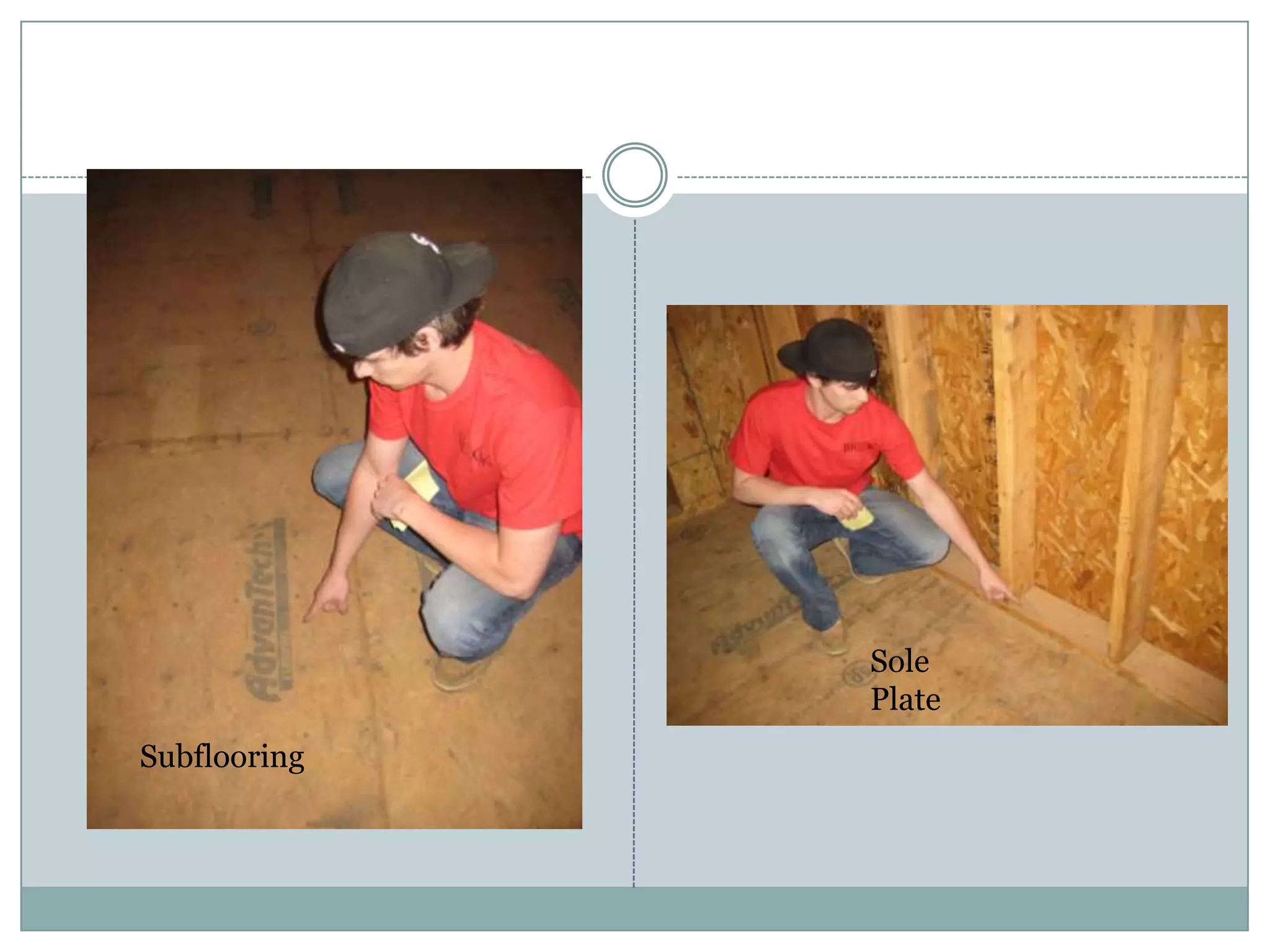
Sole PlateSubflooring
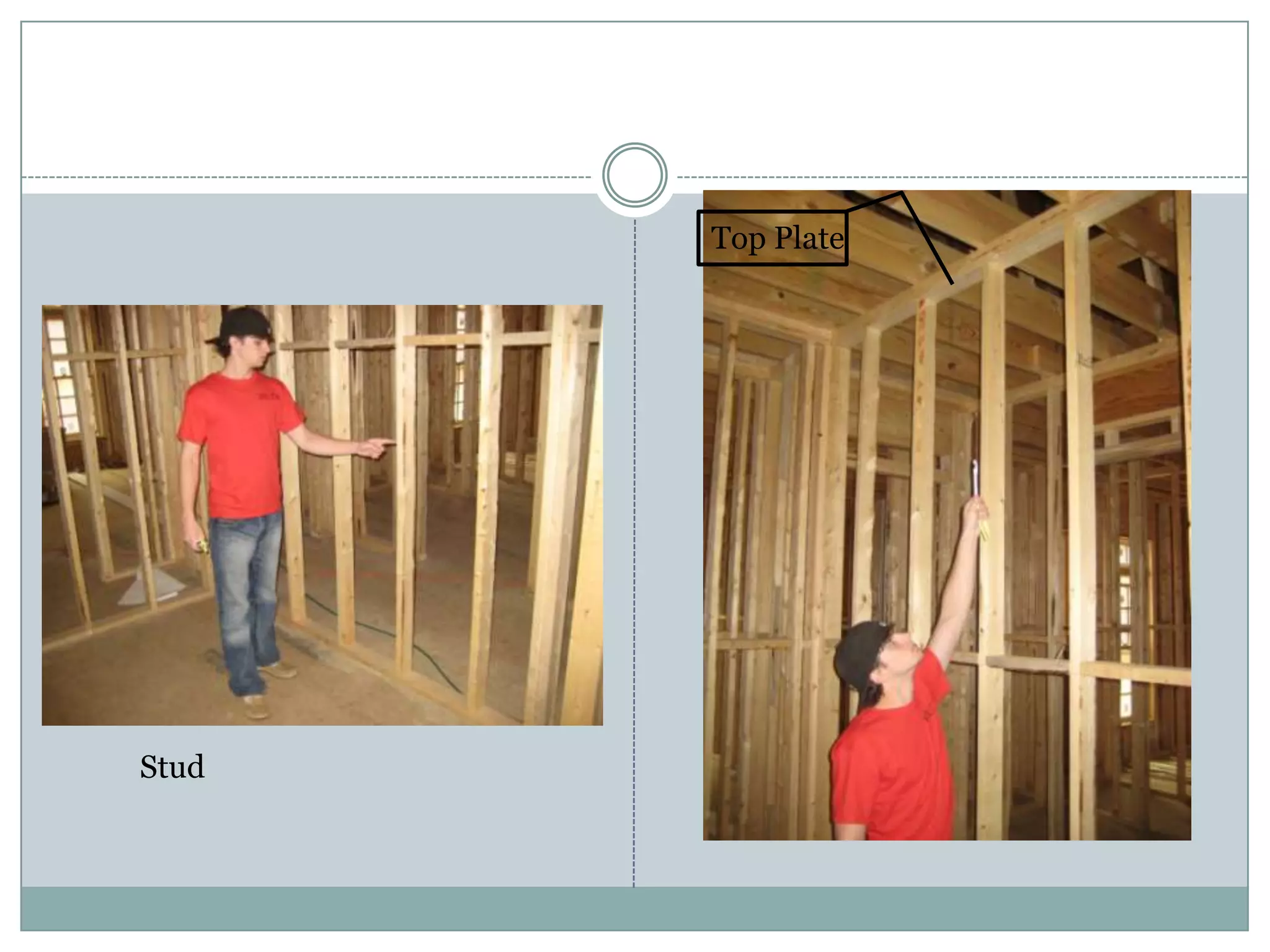
Top PlateStud
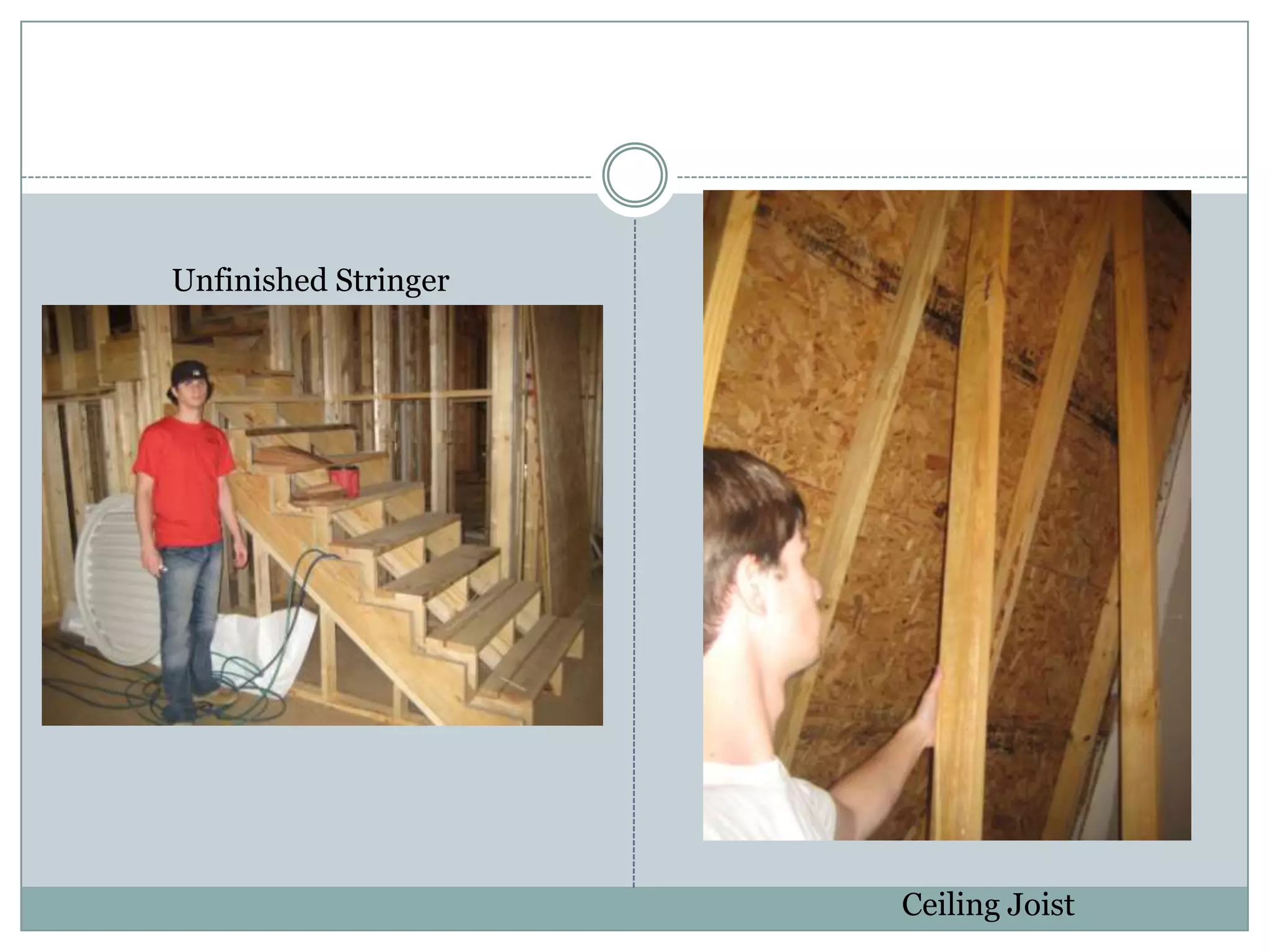
Unfinished StringerCeiling Joist
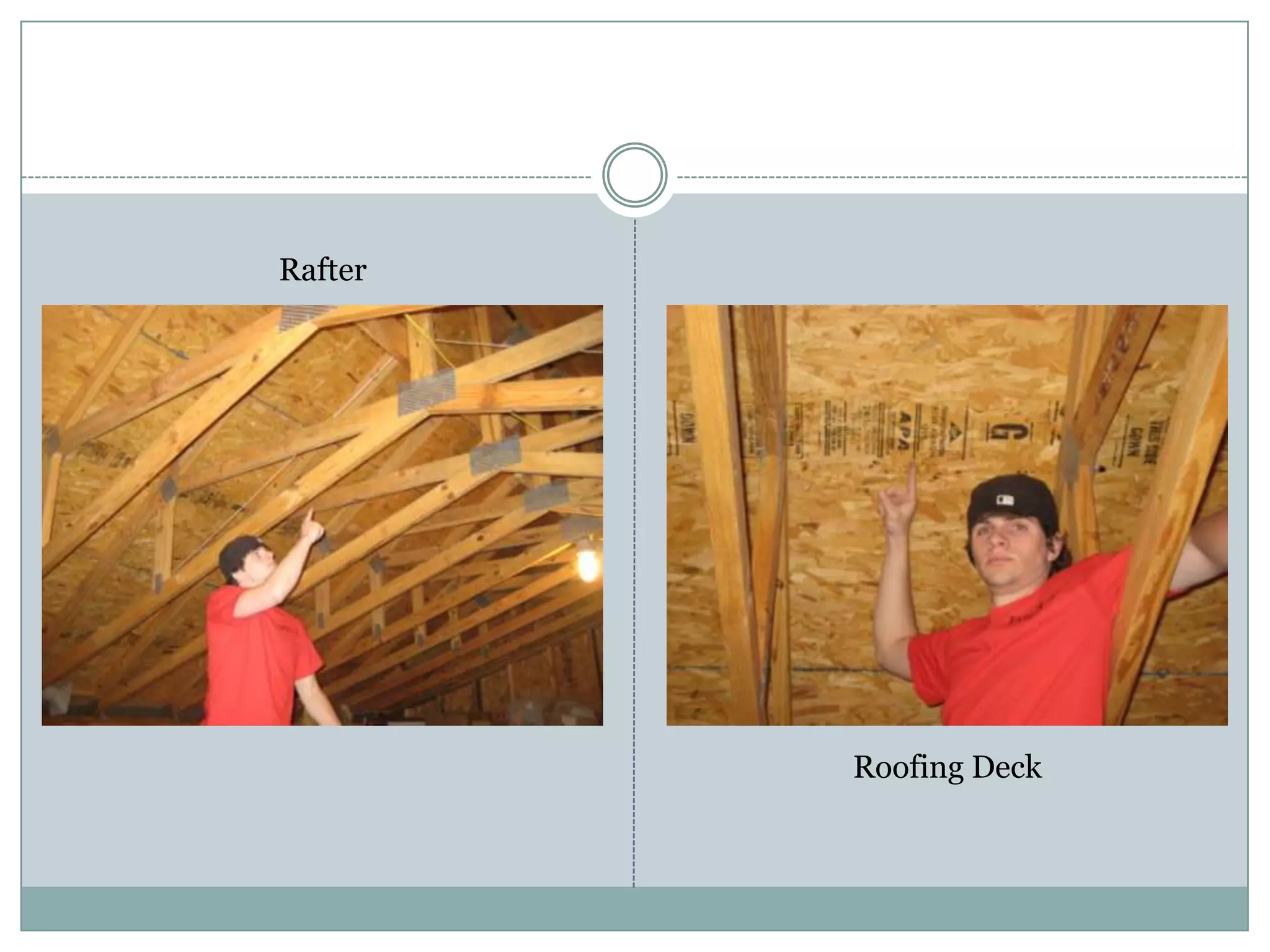
RafterRoofing Deck
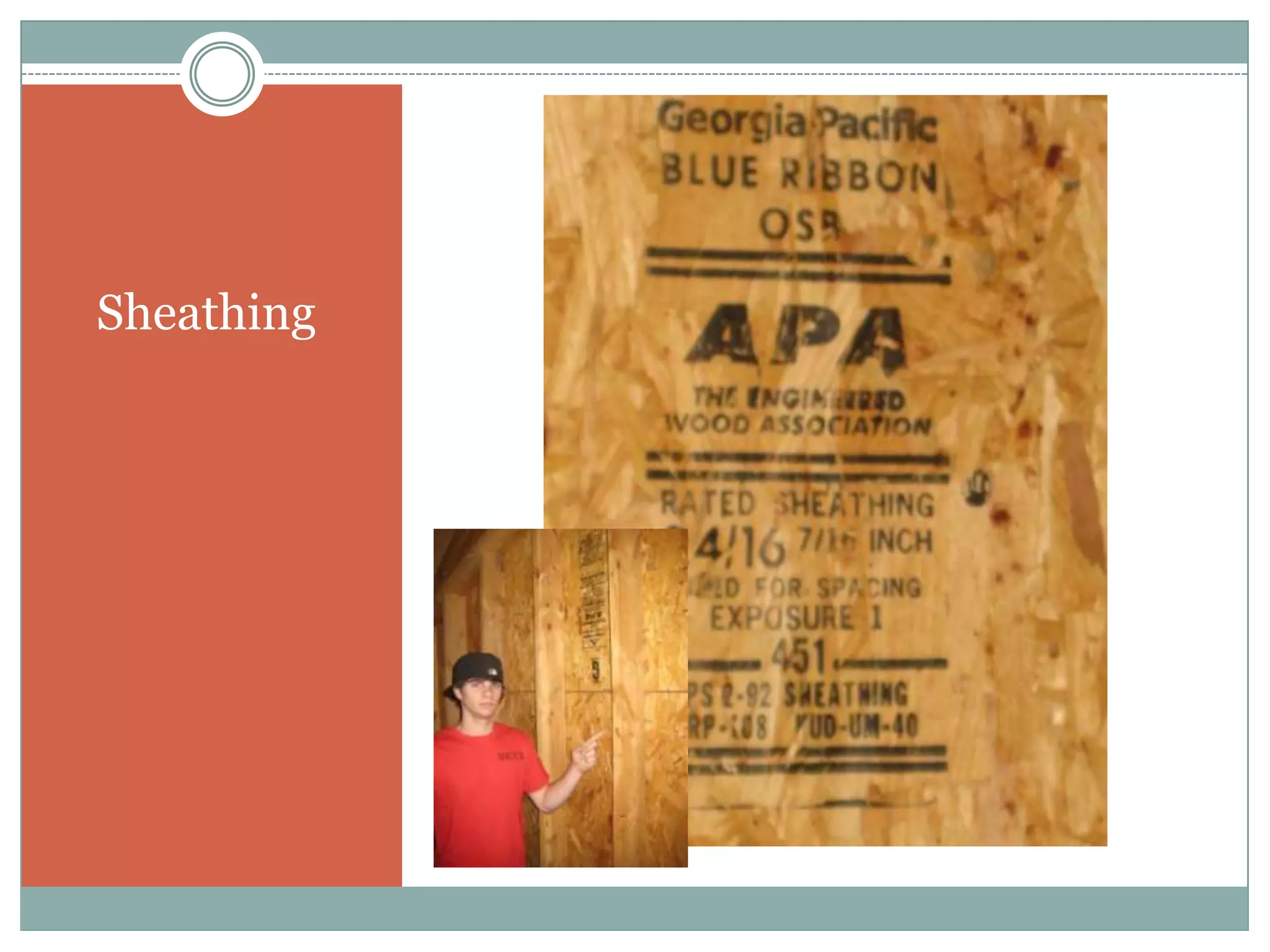
Sheathing
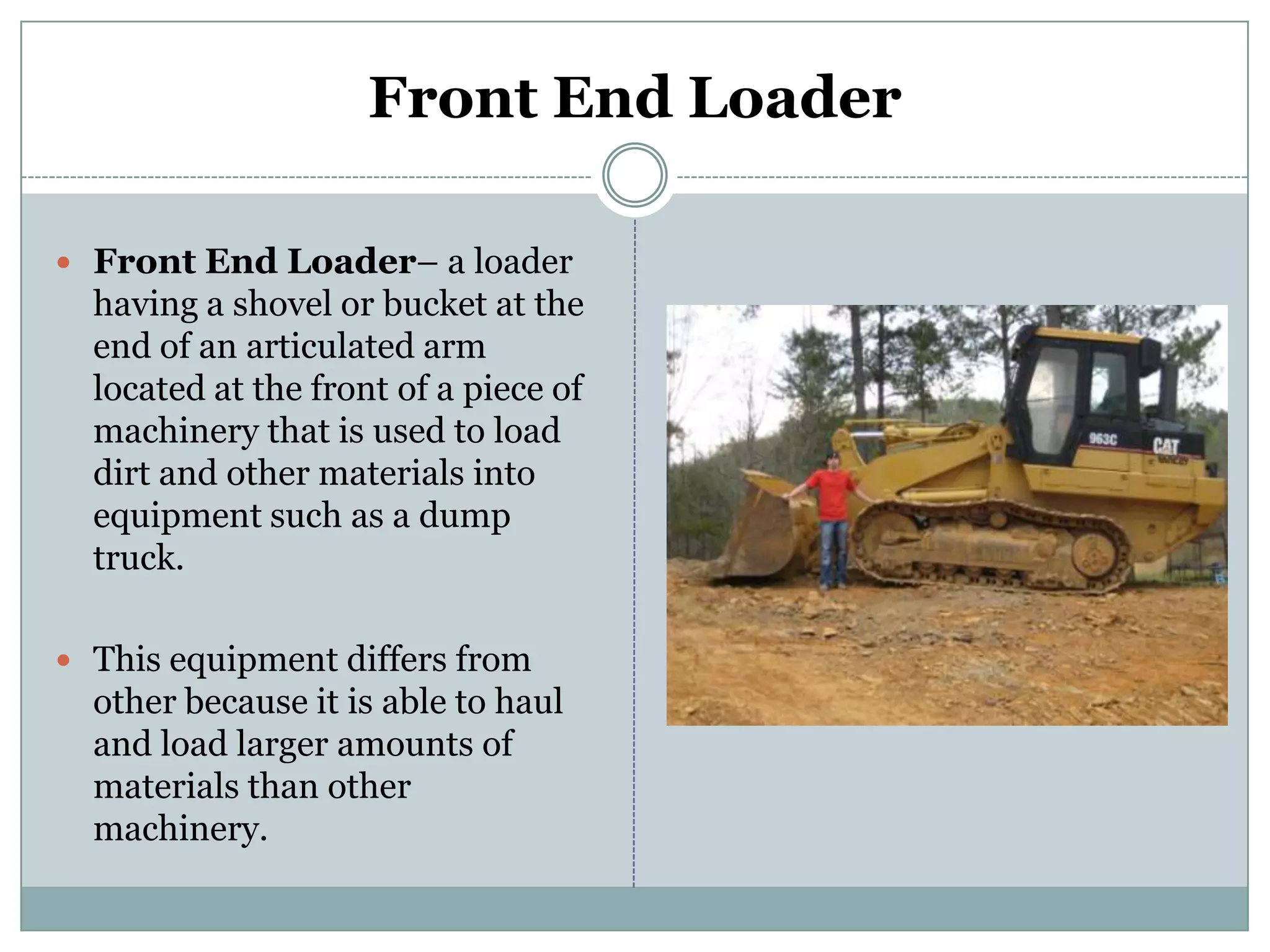
Front End LoaderFront End Loader– a loader having a shovel or bucket at the end of an articulated arm located at the front of a piece of machinery that is used to load dirt and other materials into equipment such as a dump truck.This equipment differs from other because it is able to haul and load larger amounts of materials than other machinery.
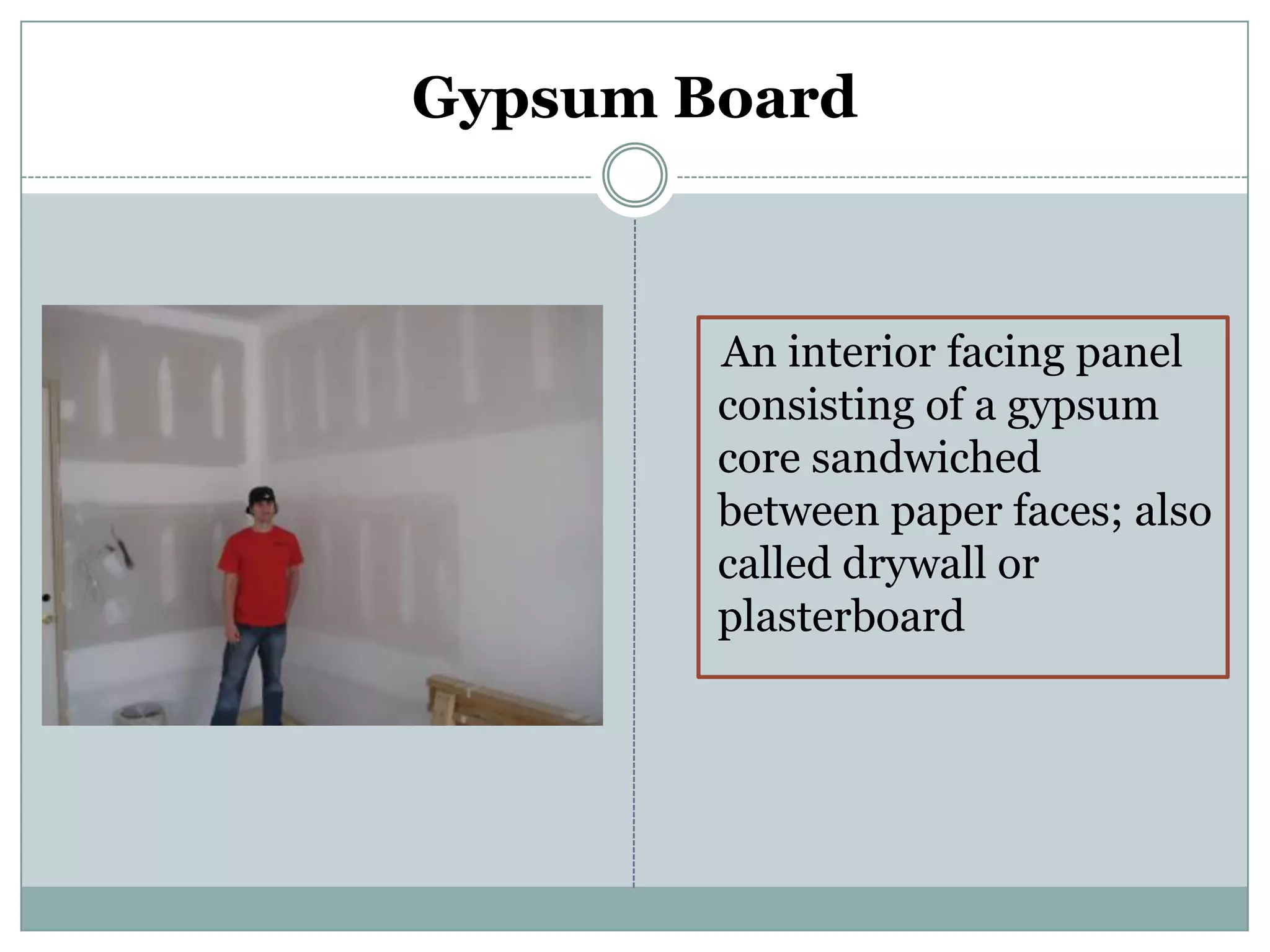
Gypsum Board    An interior facing panel consisting of a gypsum core sandwiched between paper faces; also called drywall or plasterboard
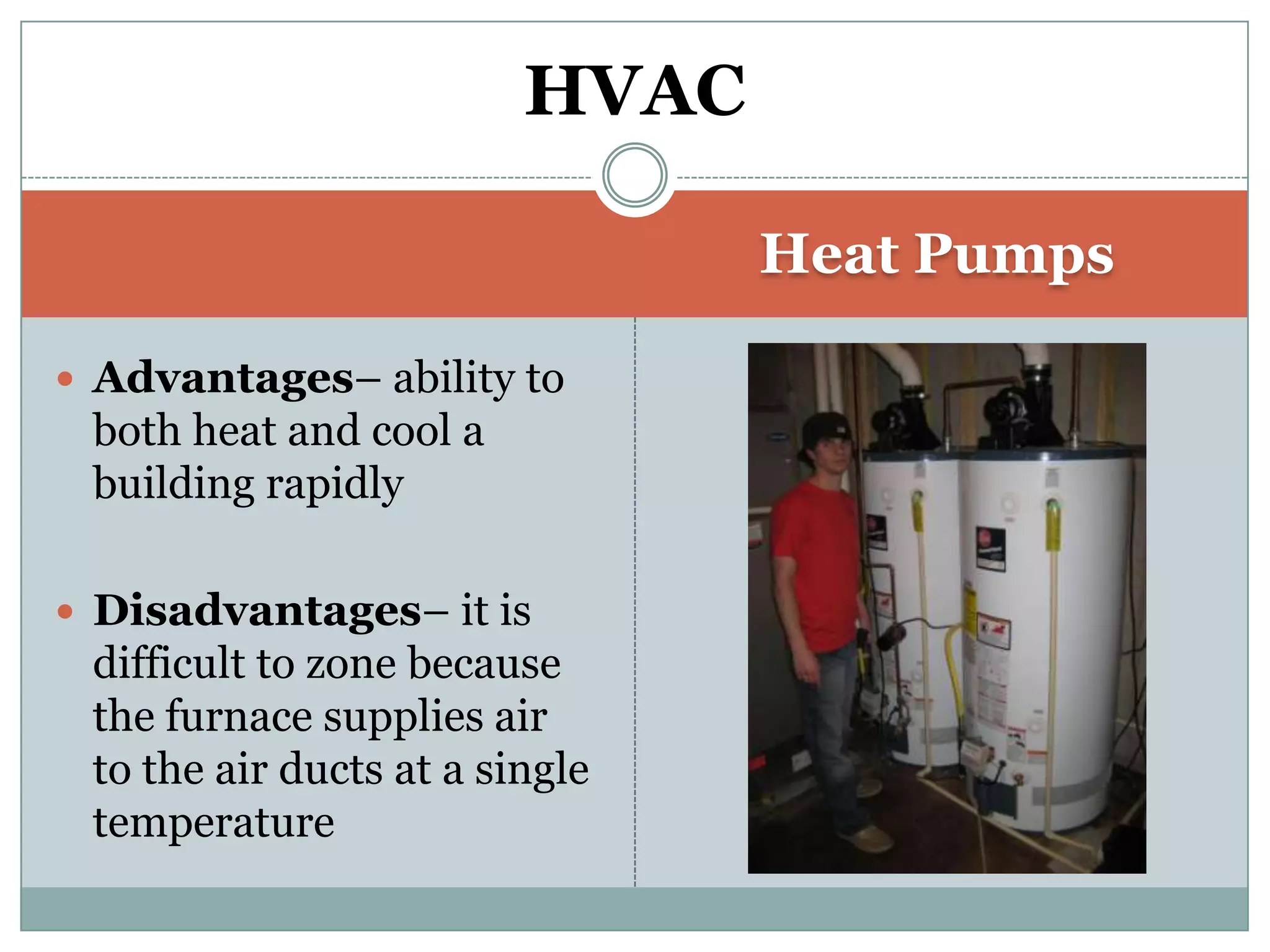
Heat PumpsAdvantages– ability to both heat and cool a building rapidlyDisadvantages– it is difficult to zone because the furnace supplies air to the air ducts at a single temperatureHVAC
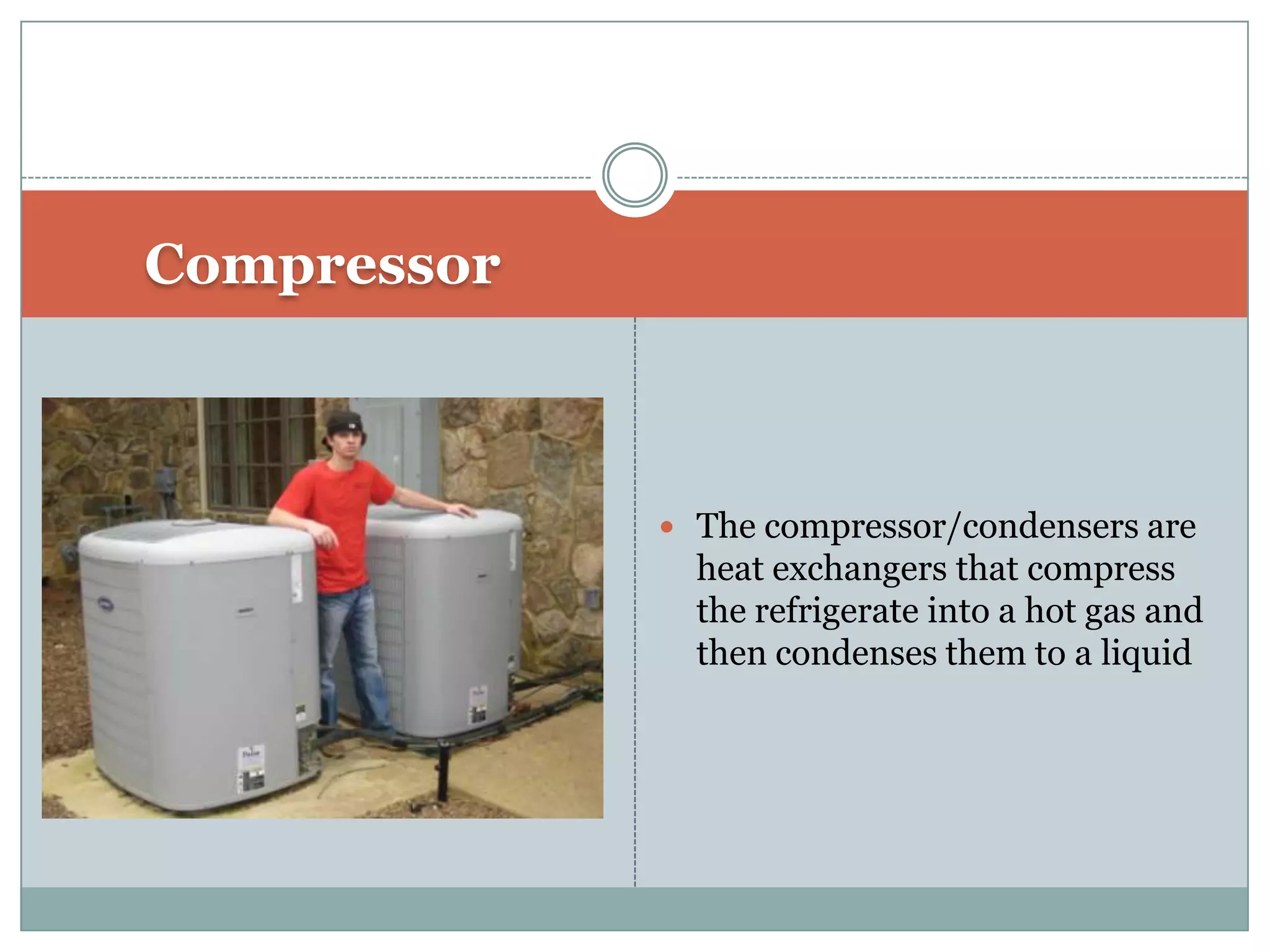
Compressor The compressor/condensers are heat exchangers that compress the refrigerate into a hot gas and then condenses them to a liquid
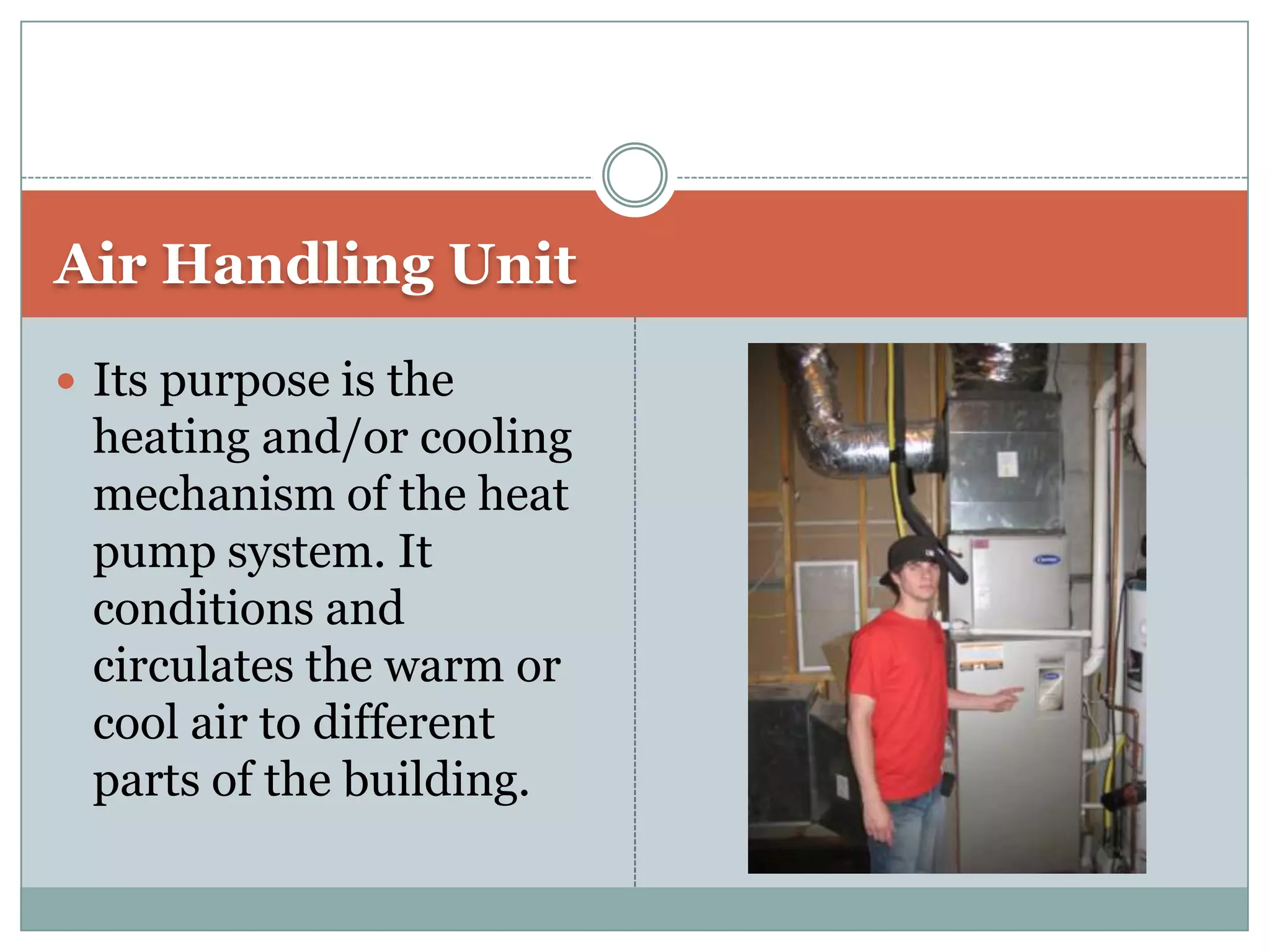
Air Handling UnitIts purpose is the heating and/or cooling mechanism of the heat pump system. It conditions and circulates the warm or cool air to different parts of the building.
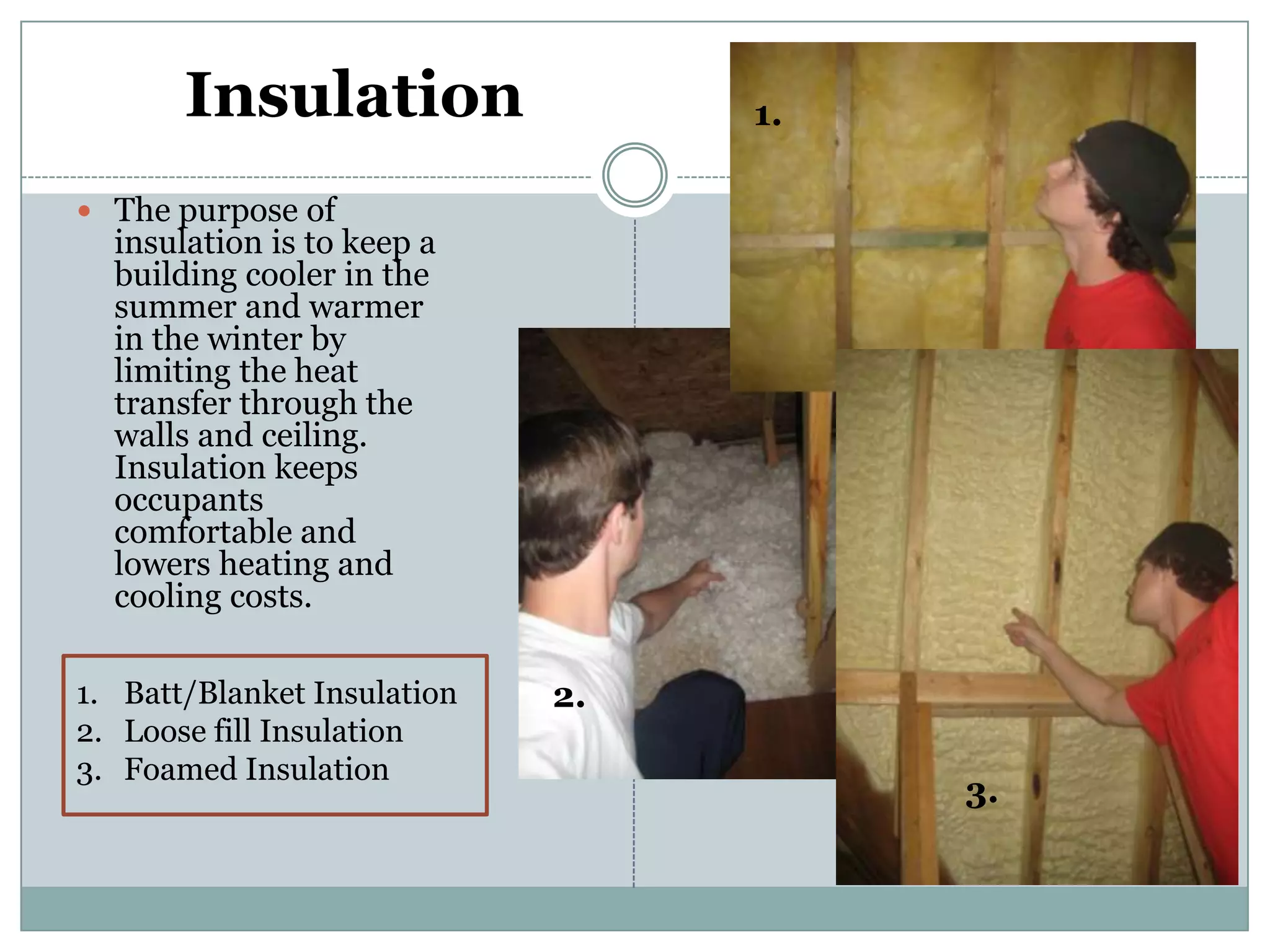
Insulation1.The purpose of insulation is to keep a building cooler in the summer and warmer in the winter by limiting the heat transfer through the walls and ceiling. Insulation keeps occupants comfortable and lowers heating and cooling costs.2.Batt/Blanket InsulationLoose fill InsulationFoamed Insulation3.
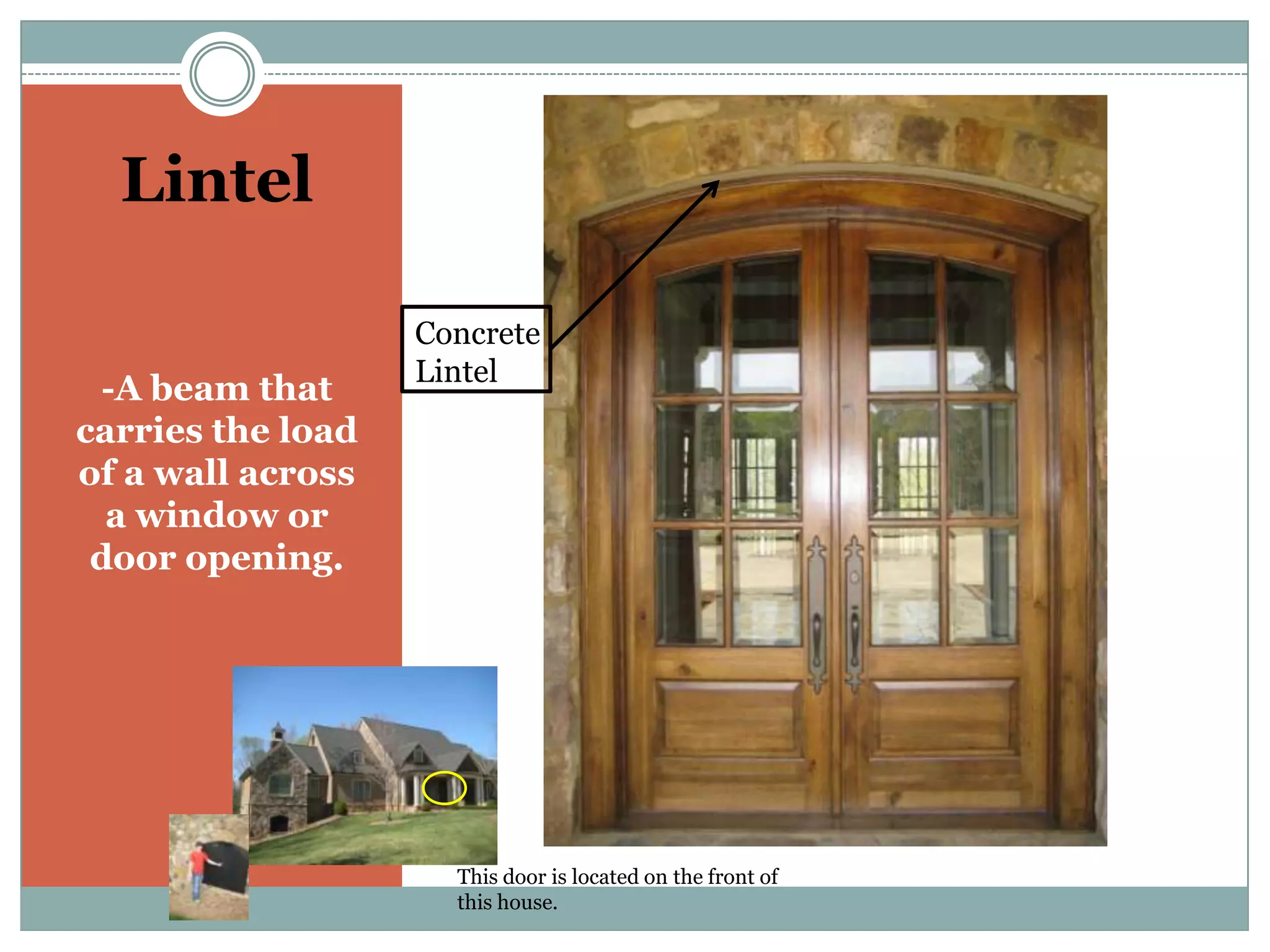
LintelConcrete Lintel-A beam that carries the load of a wall across a window or door opening.This door is located on the front of this house.
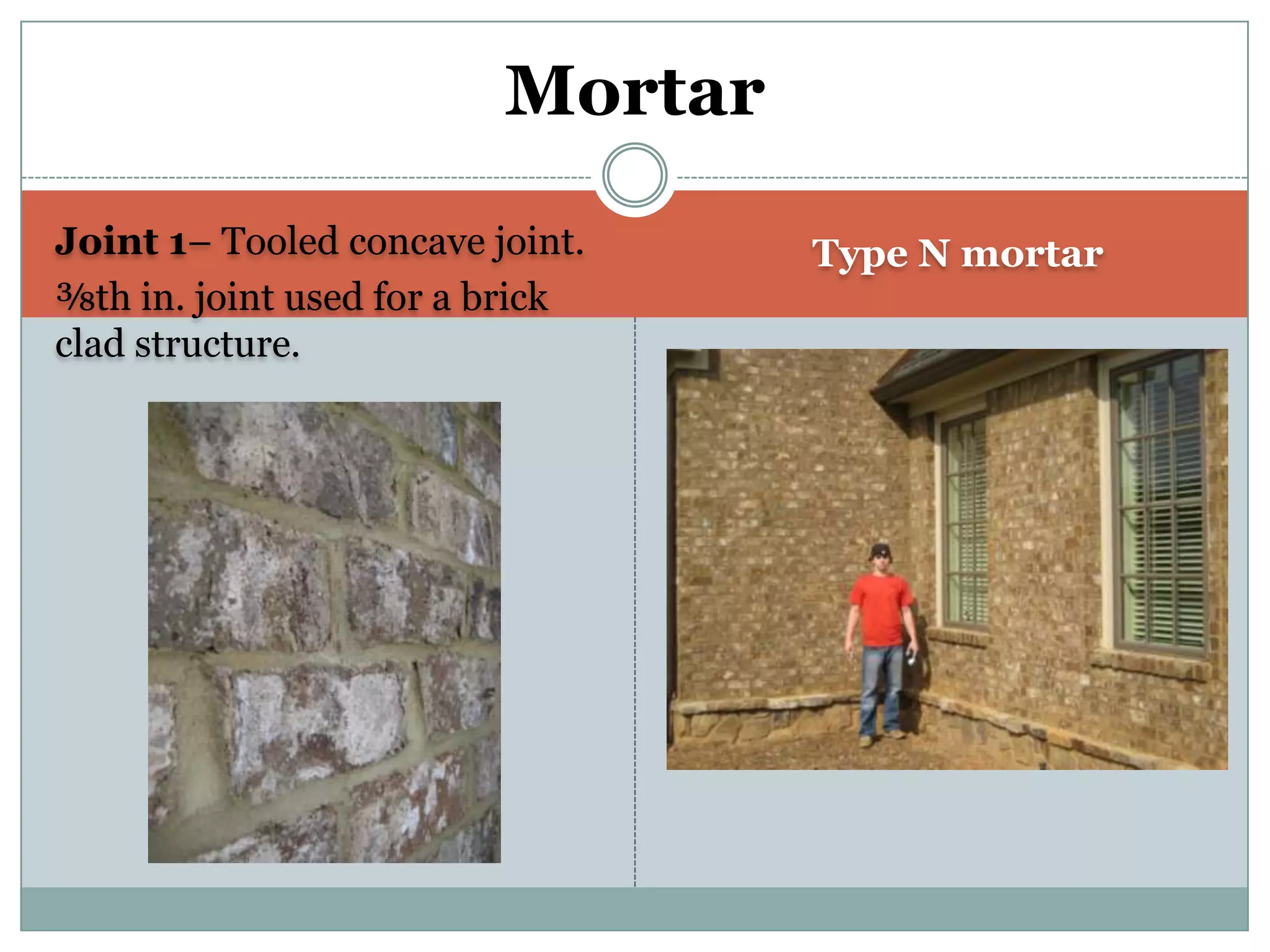
Joint 1– Tooled concave joint. ⅜th in. joint used for a brick clad structure.Type N mortarMortar
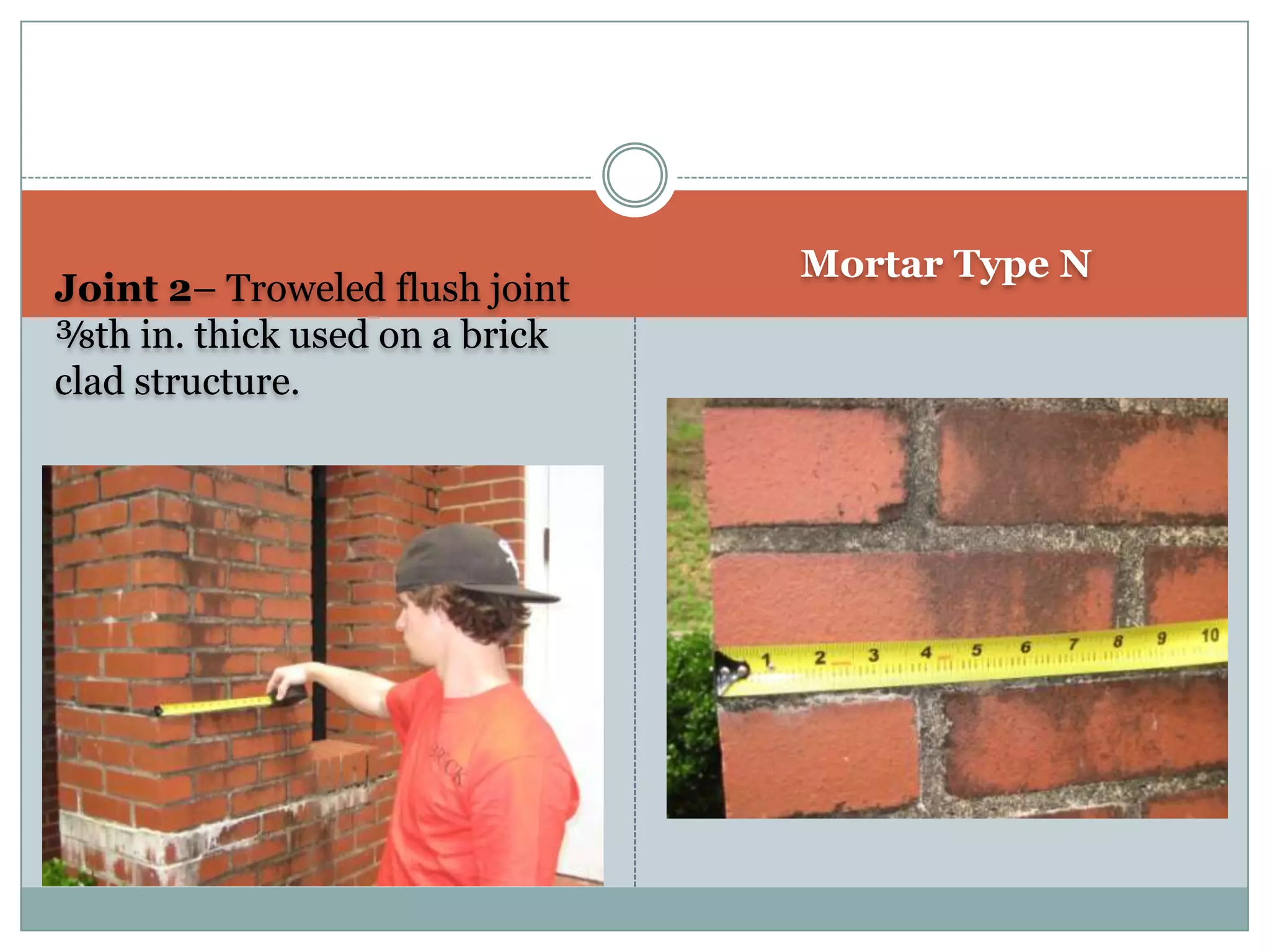
Joint 2– Troweled flush joint ⅜th in. thick used on a brick clad structure.Mortar Type N
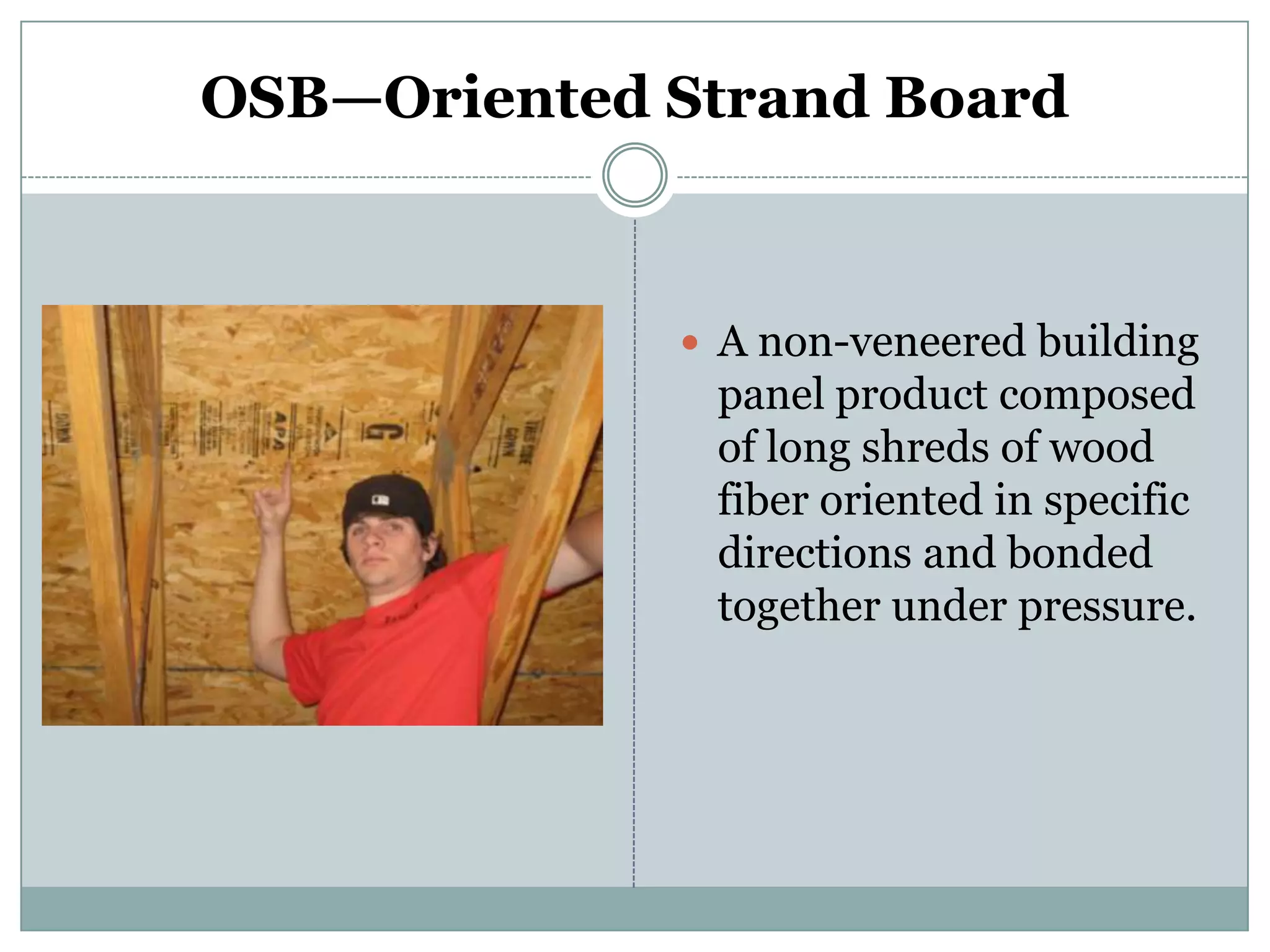
OSB—Oriented Strand BoardA non-veneered building panel product composed of long shreds of wood fiber oriented in specific directions and bonded together under pressure.
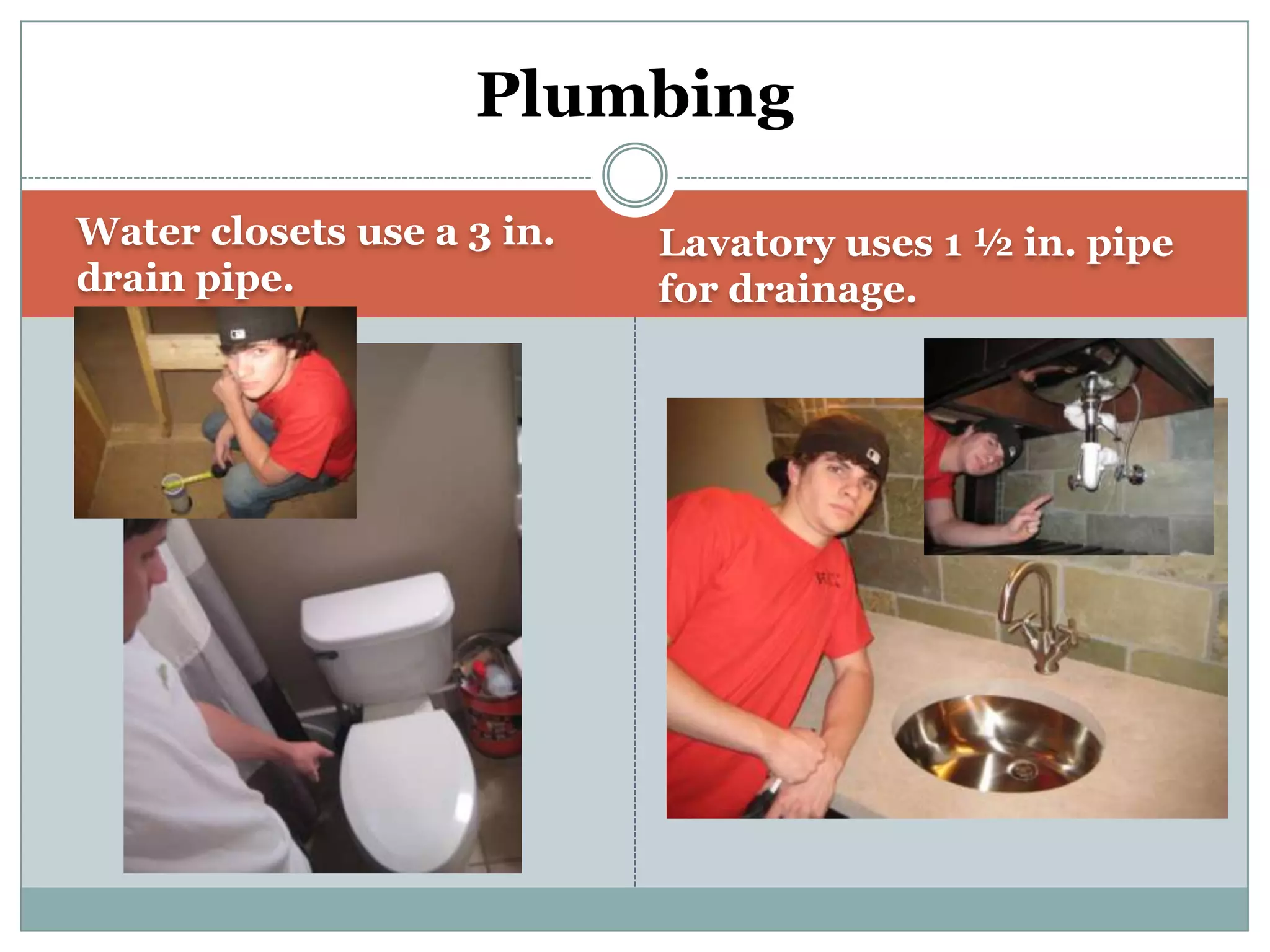
Water closets use a 3 in. drain pipe.Lavatory uses 1 ½ in. pipe for drainage.Plumbing
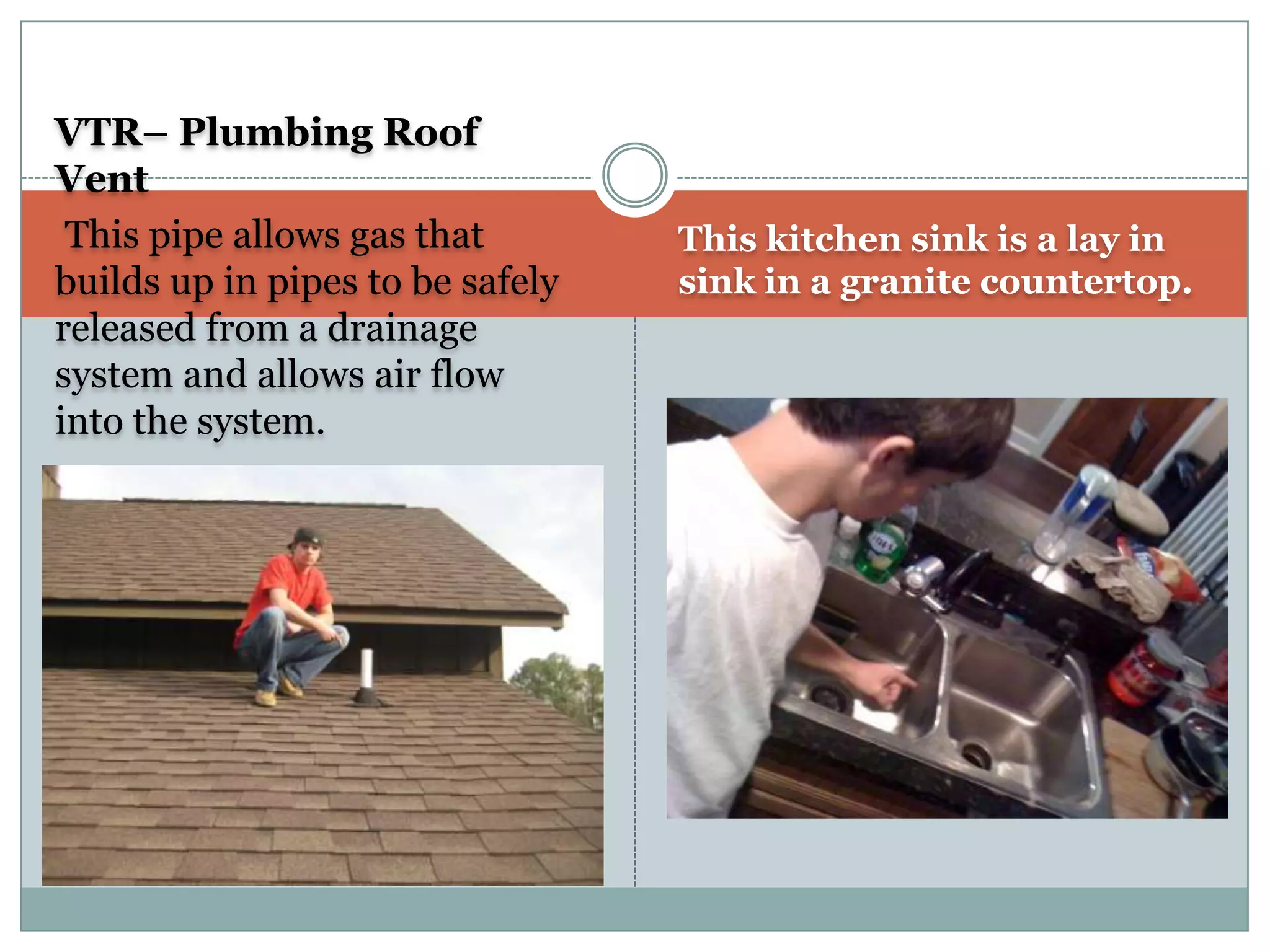
VTR– Plumbing Roof VentThis pipe allows gas that builds up in pipes to be safely released from a drainage system and allows air flow into the system.This kitchen sink is a lay in sink in a granite countertop.
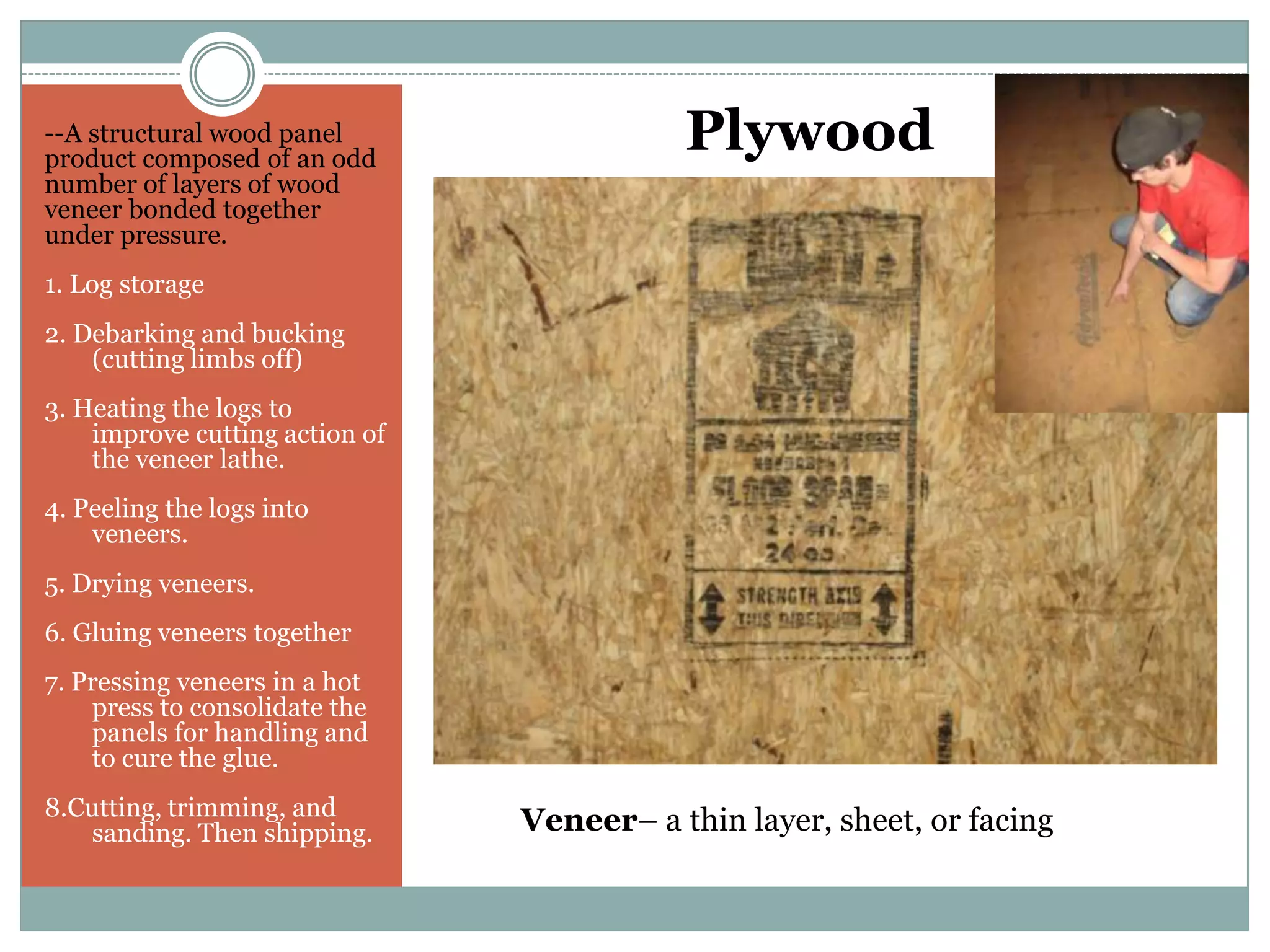
Plywood--A structural wood panel product composed of an odd number of layers of wood veneer bonded together under pressure.1. Log storage2. Debarking and bucking (cutting limbs off)3. Heating the logs to improve cutting action of the veneer lathe.4. Peeling the logs into veneers.5. Drying veneers.6. Gluing veneers together7. Pressing veneers in a hot press to consolidate the panels for handling and to cure the glue.8.Cutting, trimming, and sanding. Then shipping.Veneer– a thin layer, sheet, or facing
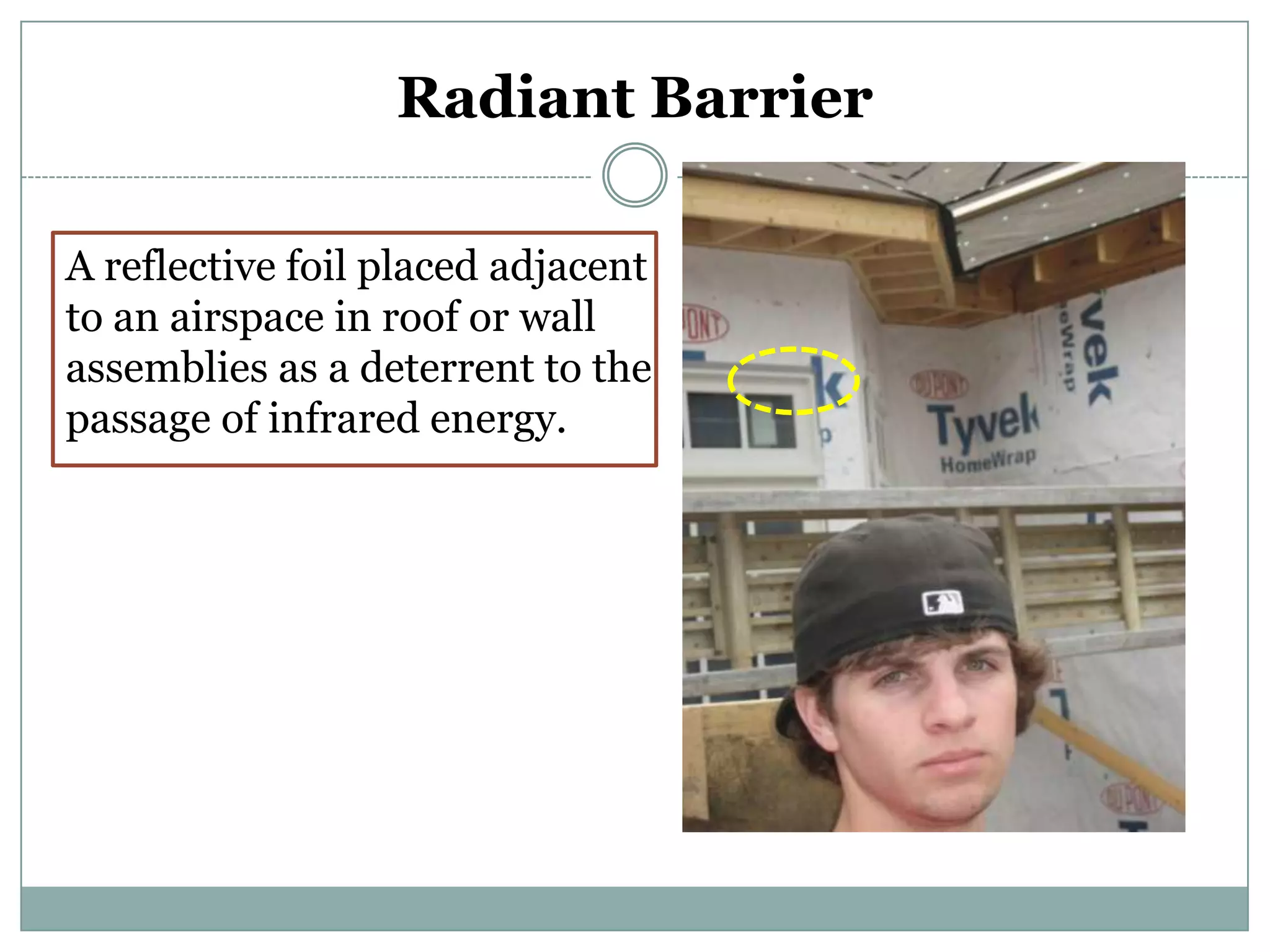
Radiant BarrierA reflective foil placed adjacent to an airspace in roof or wall assemblies as a deterrent to the passage of infrared energy.
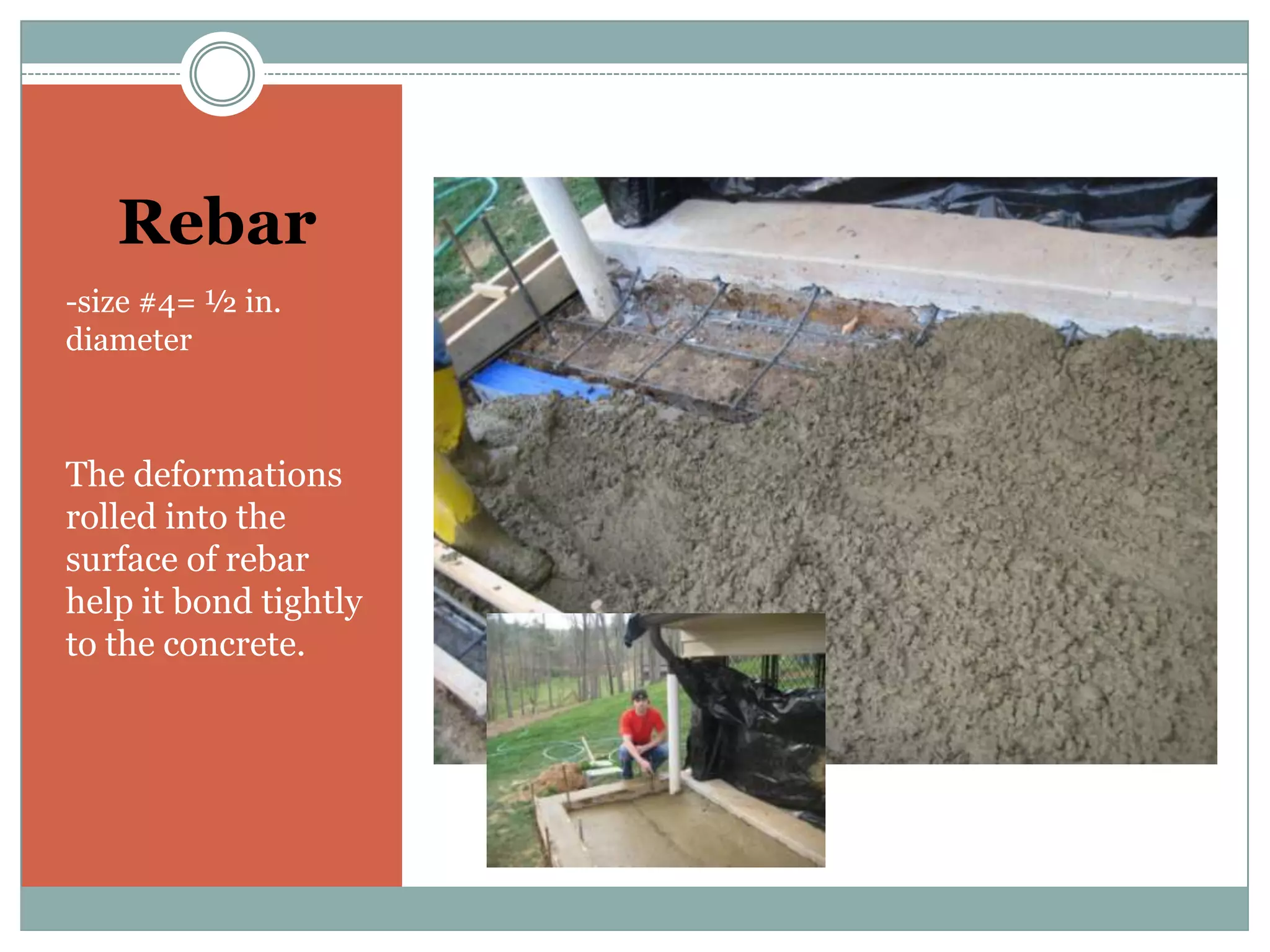
Rebar-size #4= ½ in. diameterThe deformations rolled into the surface of rebar help it bond tightly to the concrete.
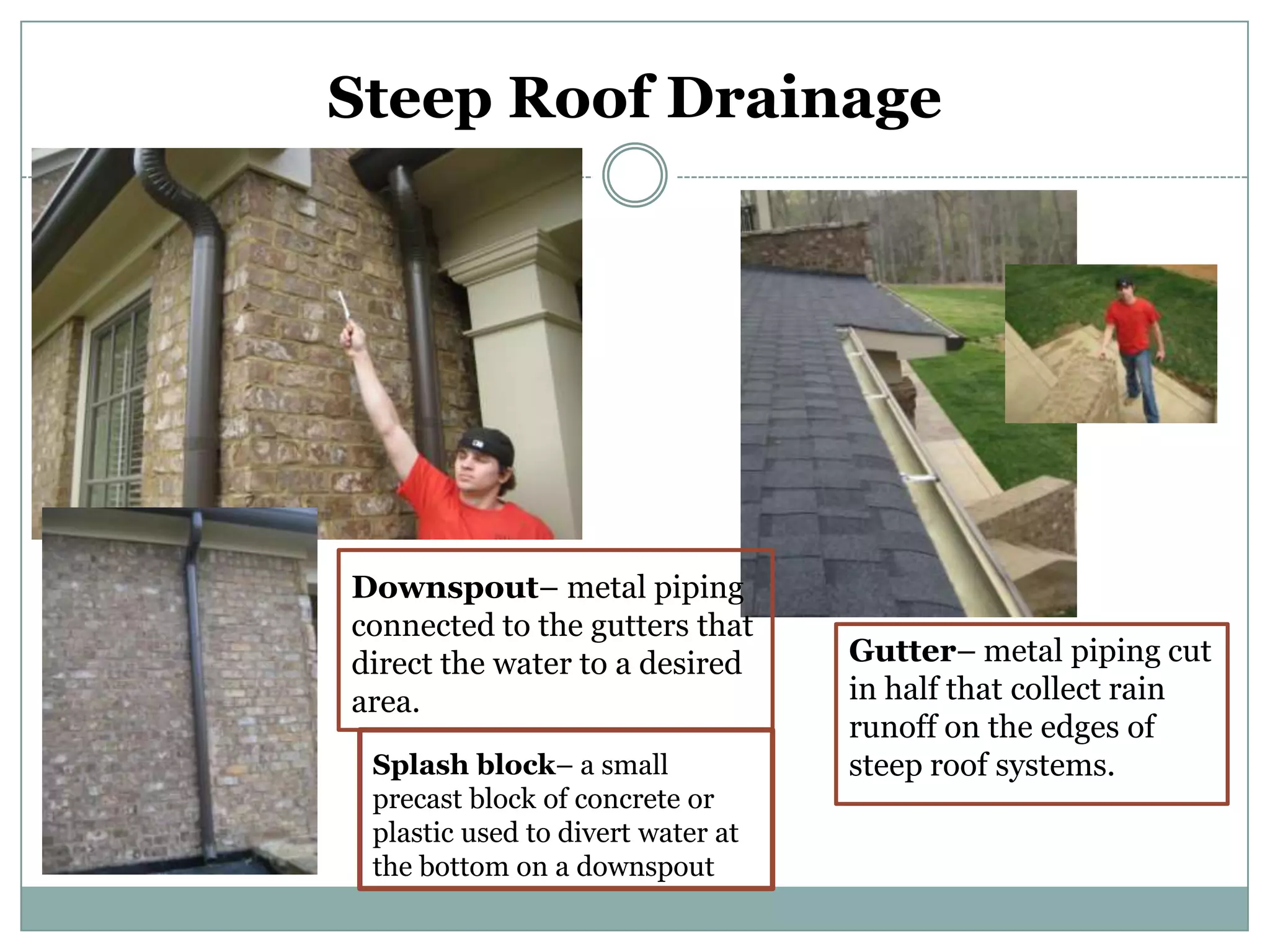
Steep Roof DrainageDownspout– metal piping connected to the gutters that direct the water to a desired area.Gutter– metal piping cut in half that collect rain runoff on the edges of steep roof systems.Splash block– a small precast block of concrete or plastic used to divert water at the bottom on a downspout
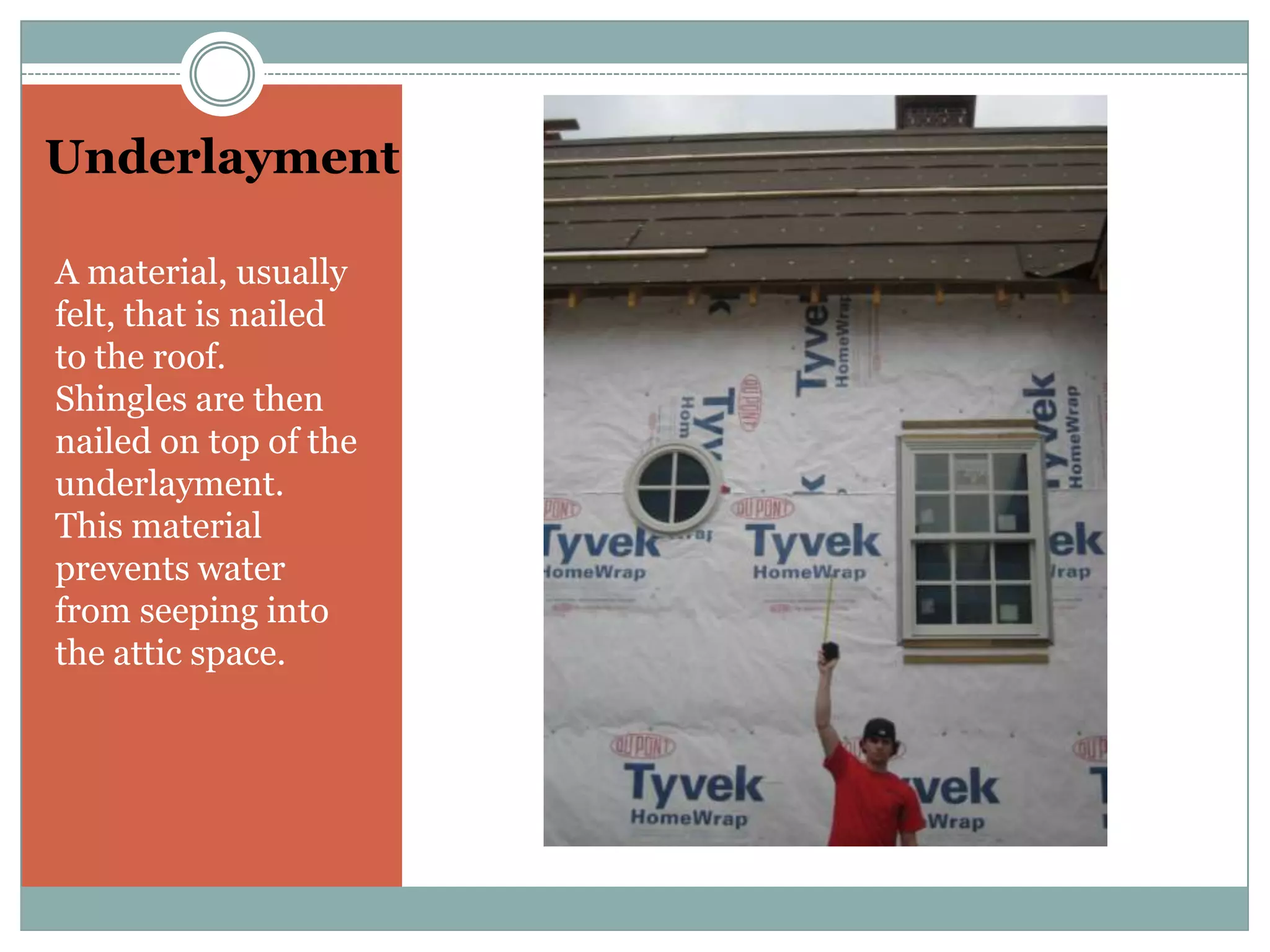
UnderlaymentA material, usually felt, that is nailed to the roof.  Shingles are then nailed on top of the underlayment.  This material prevents water from seeping into the attic space.
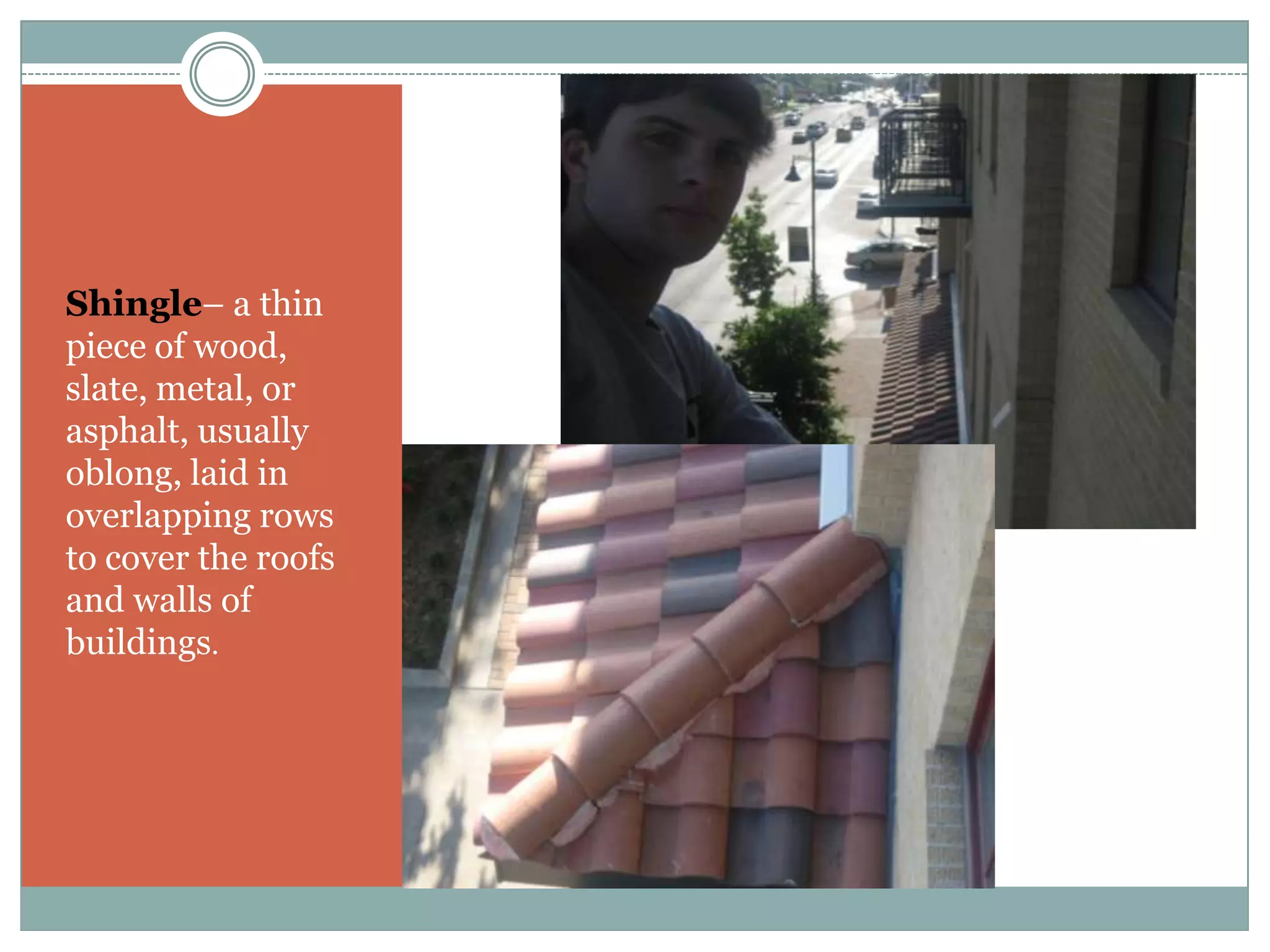
Shingle– a thin piece of wood, slate, metal, or asphalt, usually oblong, laid in overlapping rows to cover the roofs and walls of buildings.
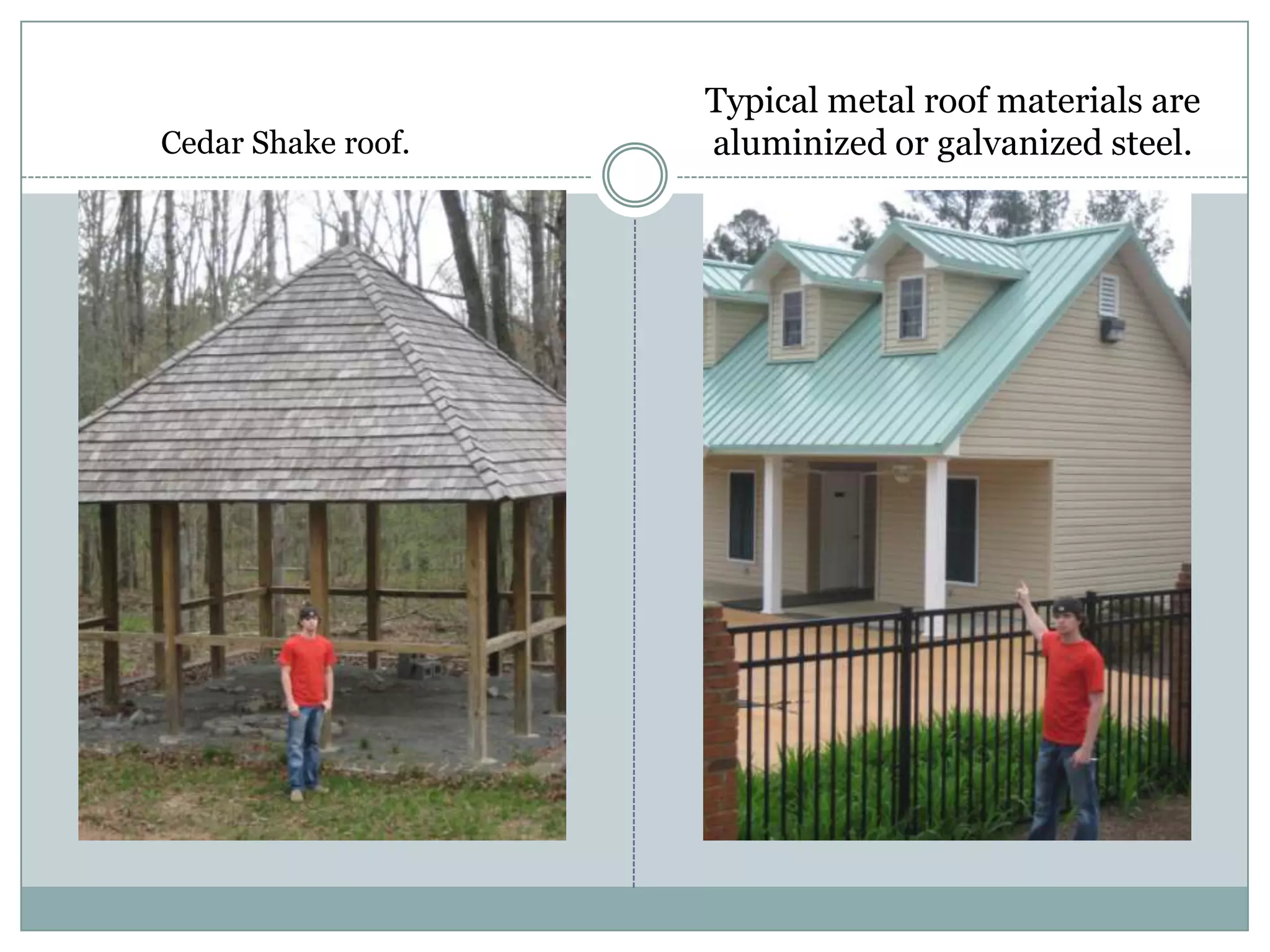
Typical metal roof materials are aluminized or galvanized steel.Cedar Shake roof.
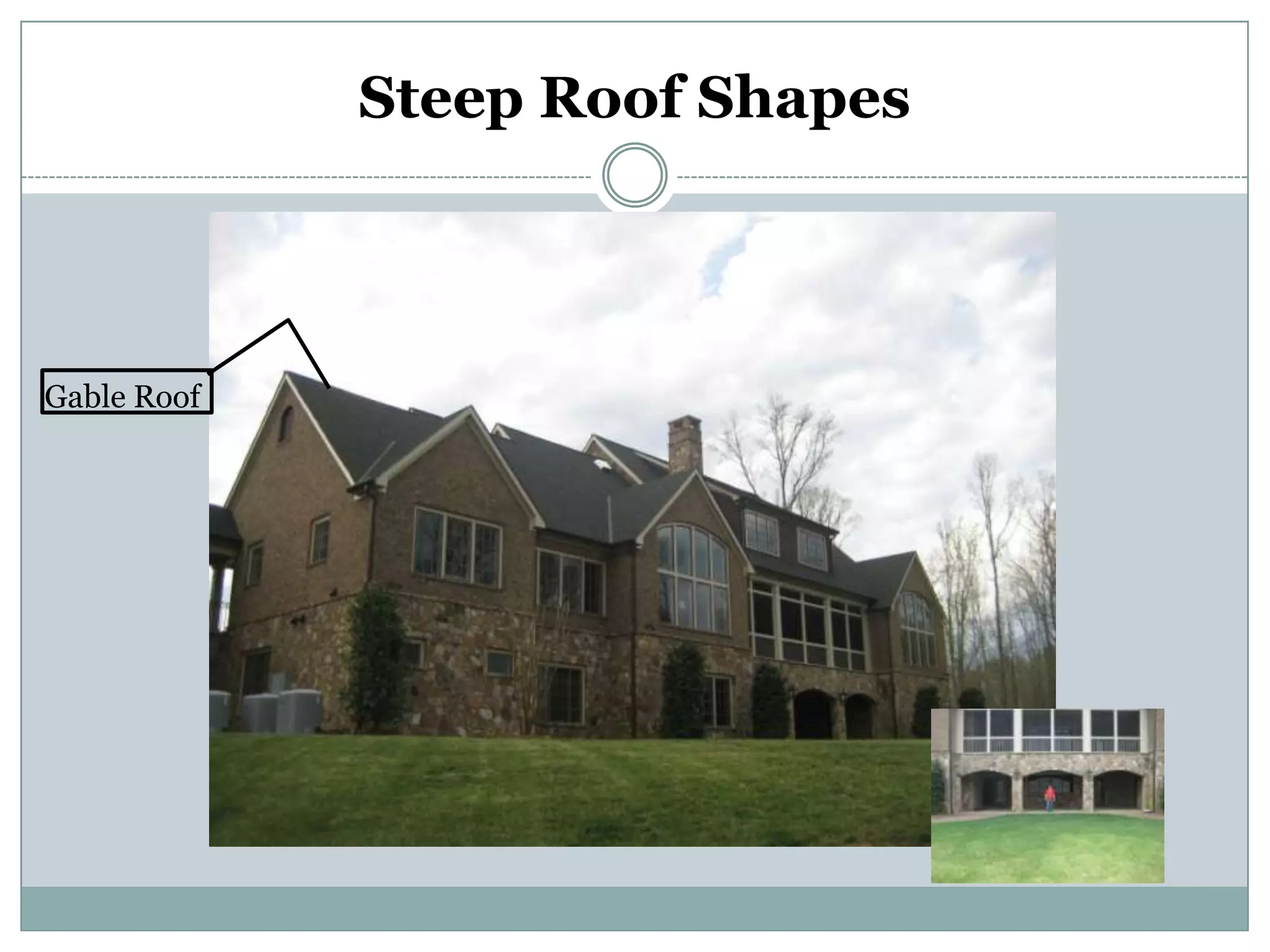
Steep Roof ShapesGable Roof
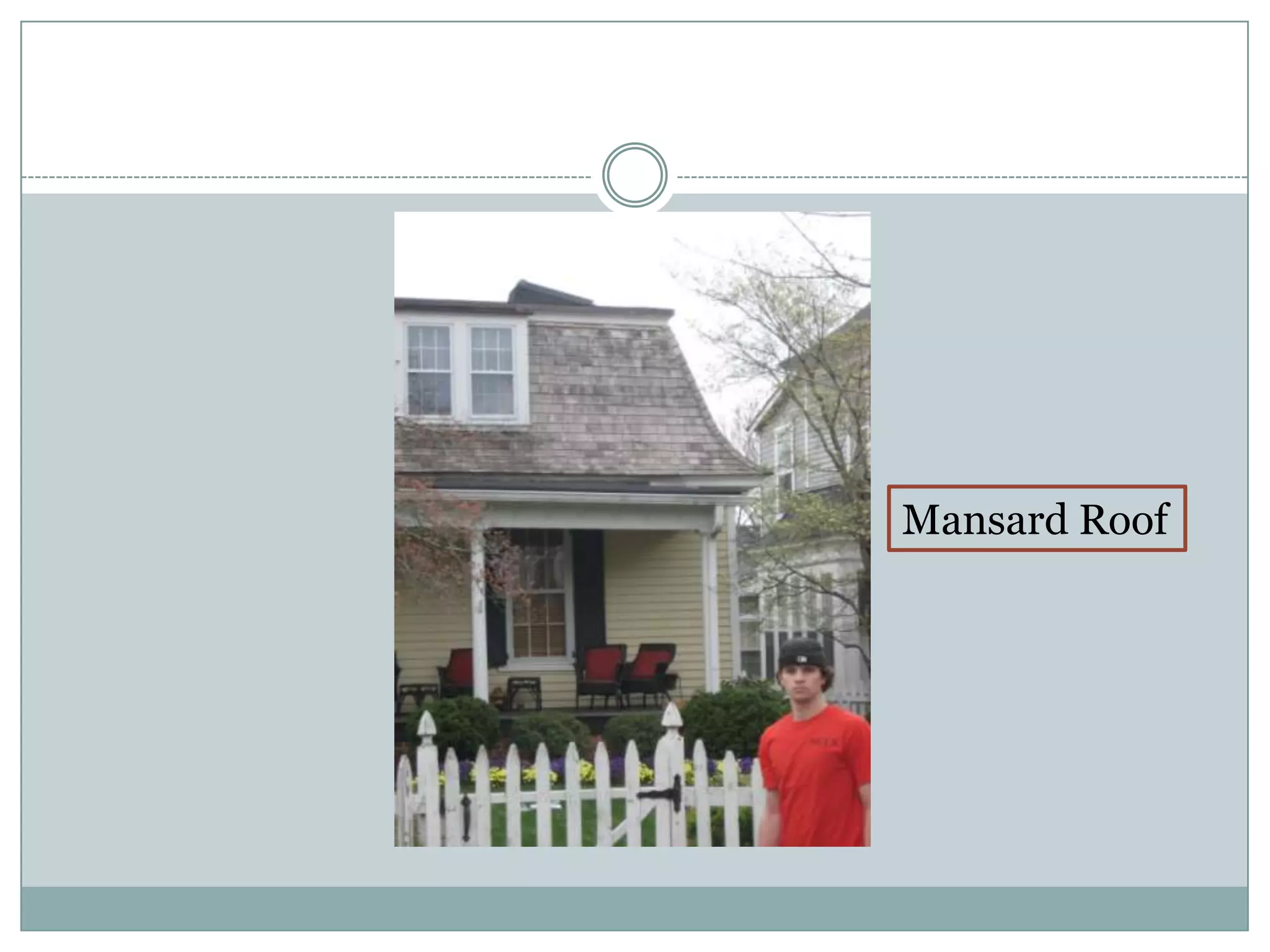
Mansard Roof
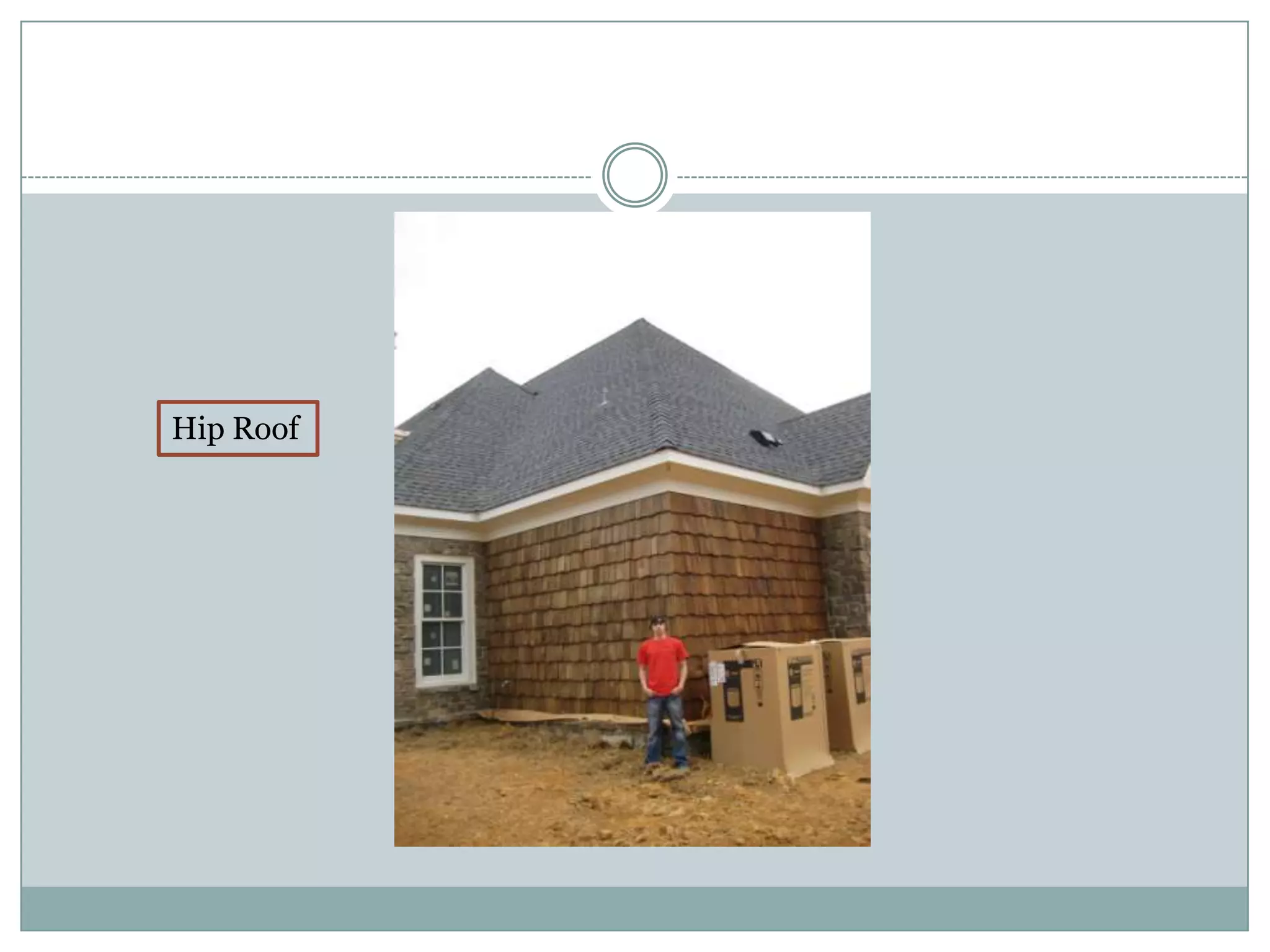
Hip Roof
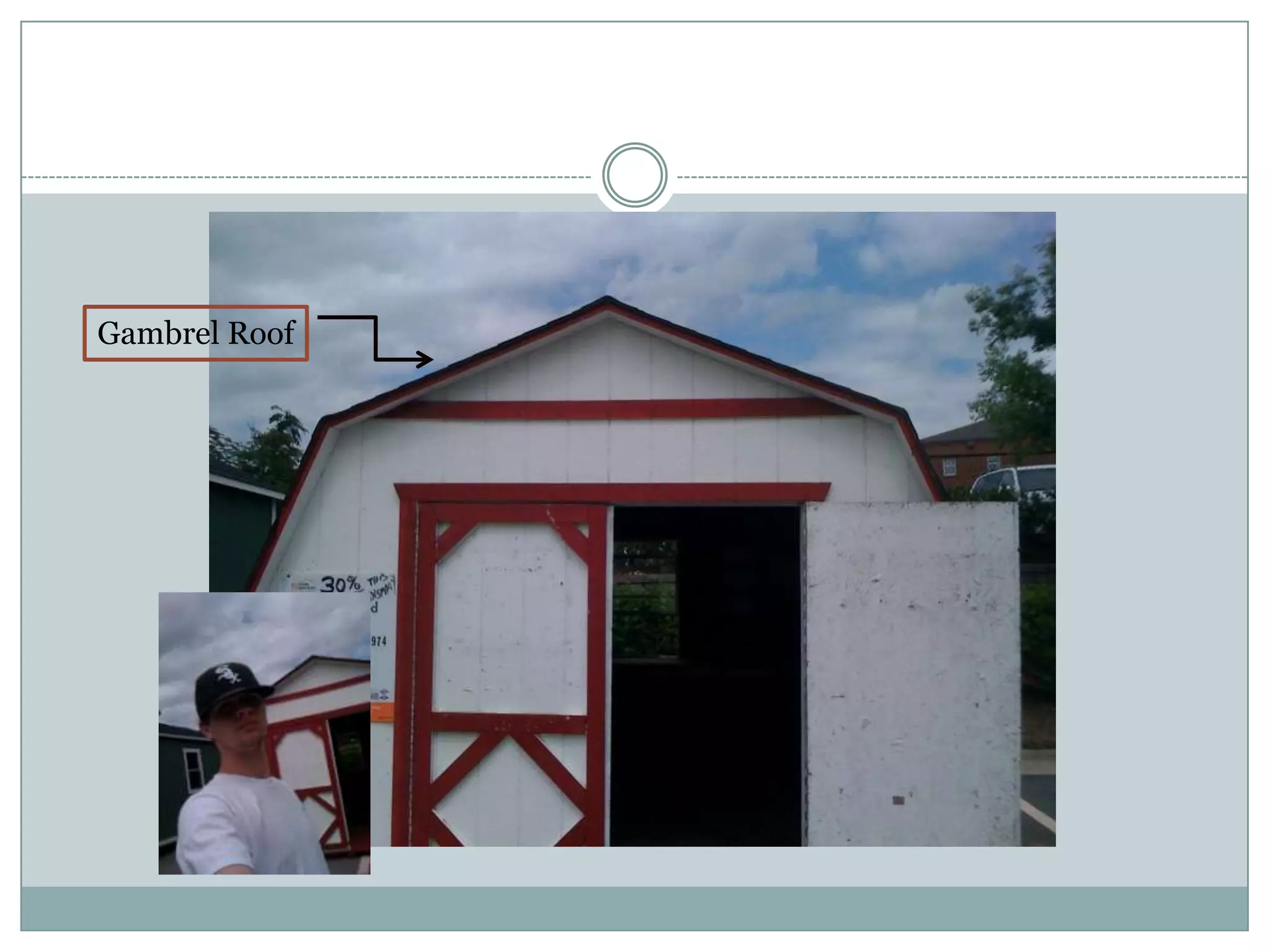
Gambrel Roof
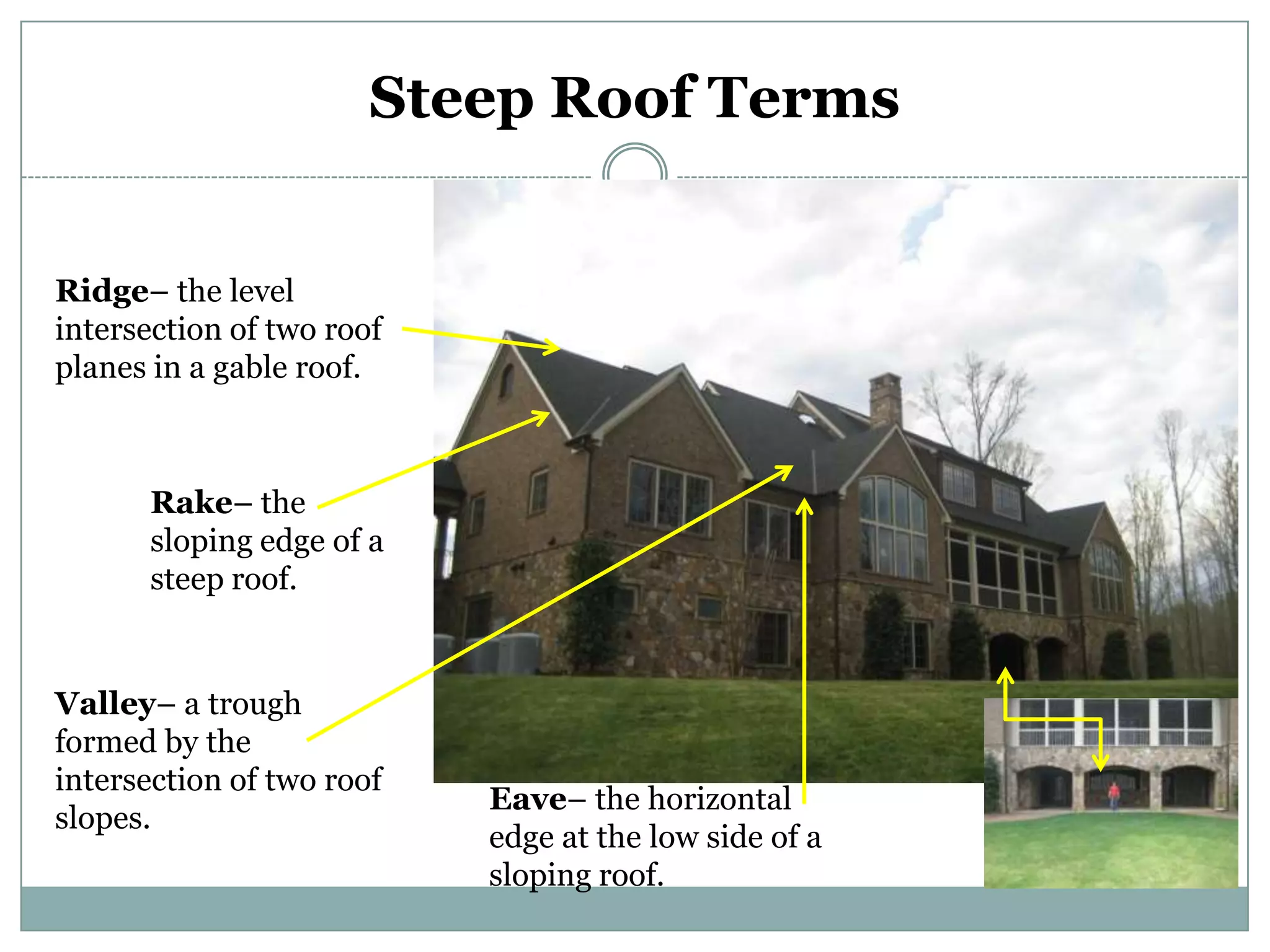
Steep Roof TermsRidge– the level intersection of two roof planes in a gable roof.Rake– the sloping edge of a steep roof. Valley– a trough formed by the intersection of two roof slopes.Eave– the horizontal edge at the low side of a sloping roof.
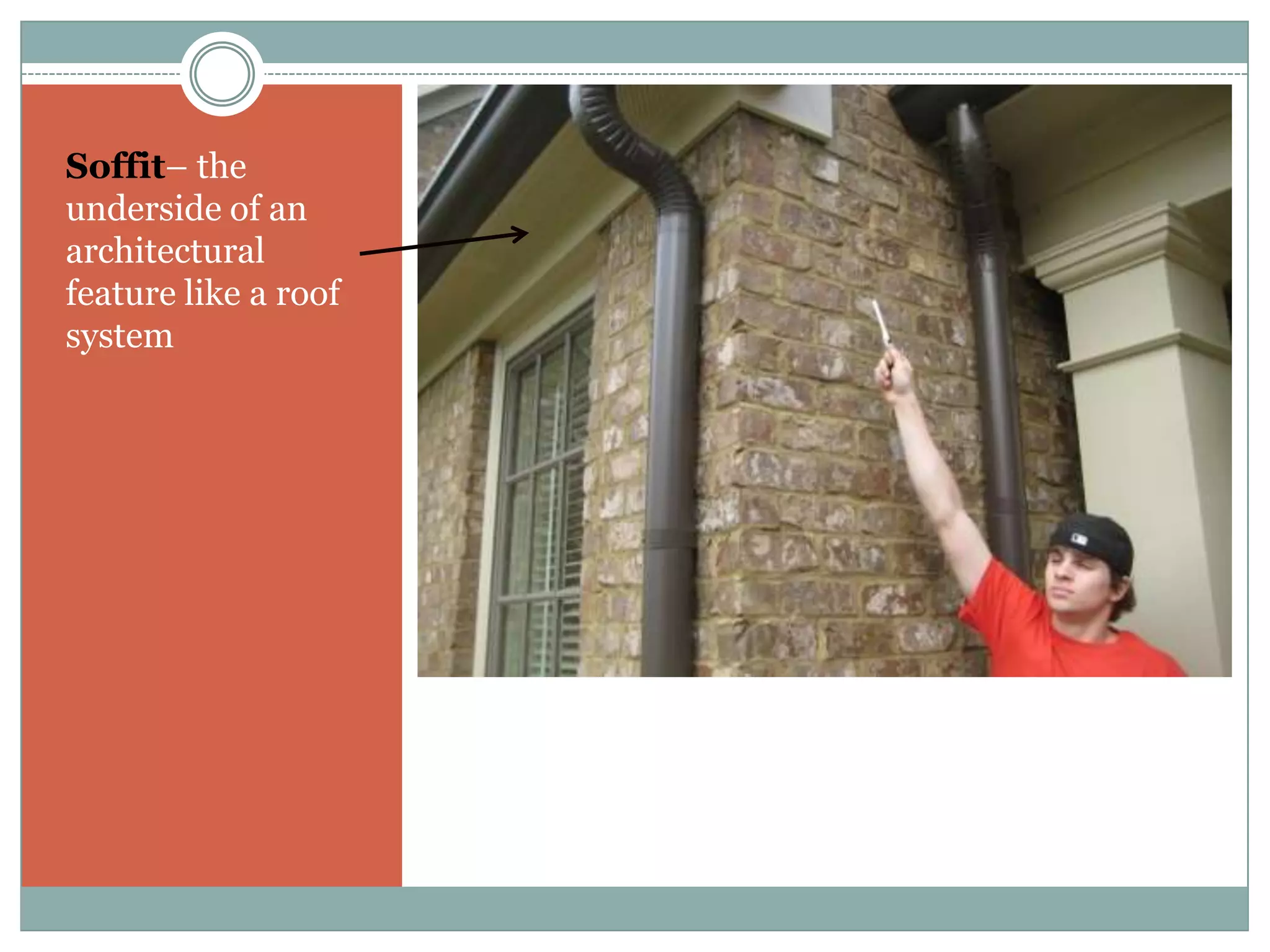
Soffit– the underside of an architectural feature like a roof system
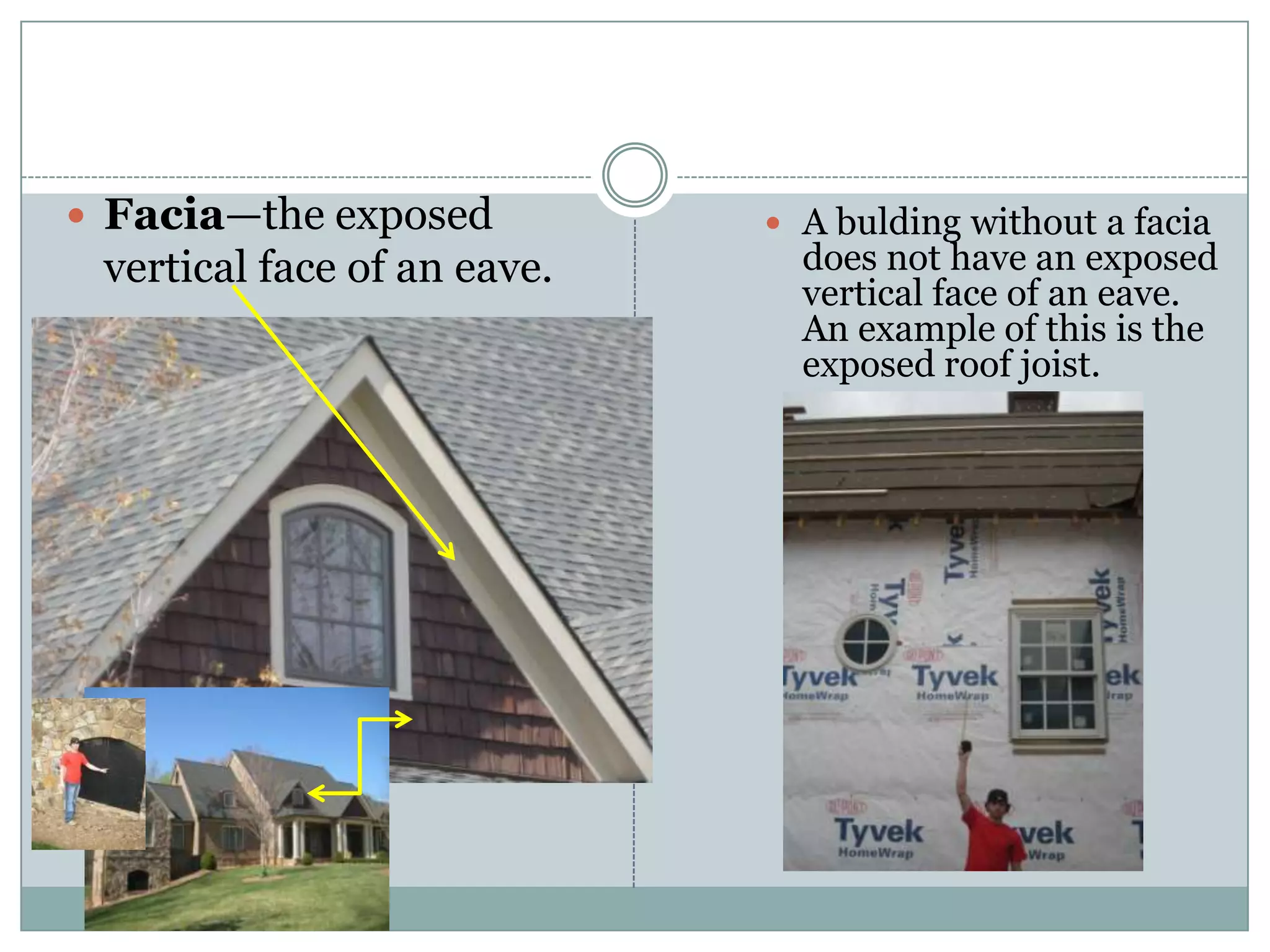
Facia—the exposed vertical face of an eave.	A bulding without a facia does not have an exposed vertical face of an eave. An example of this is the exposed roof joist.
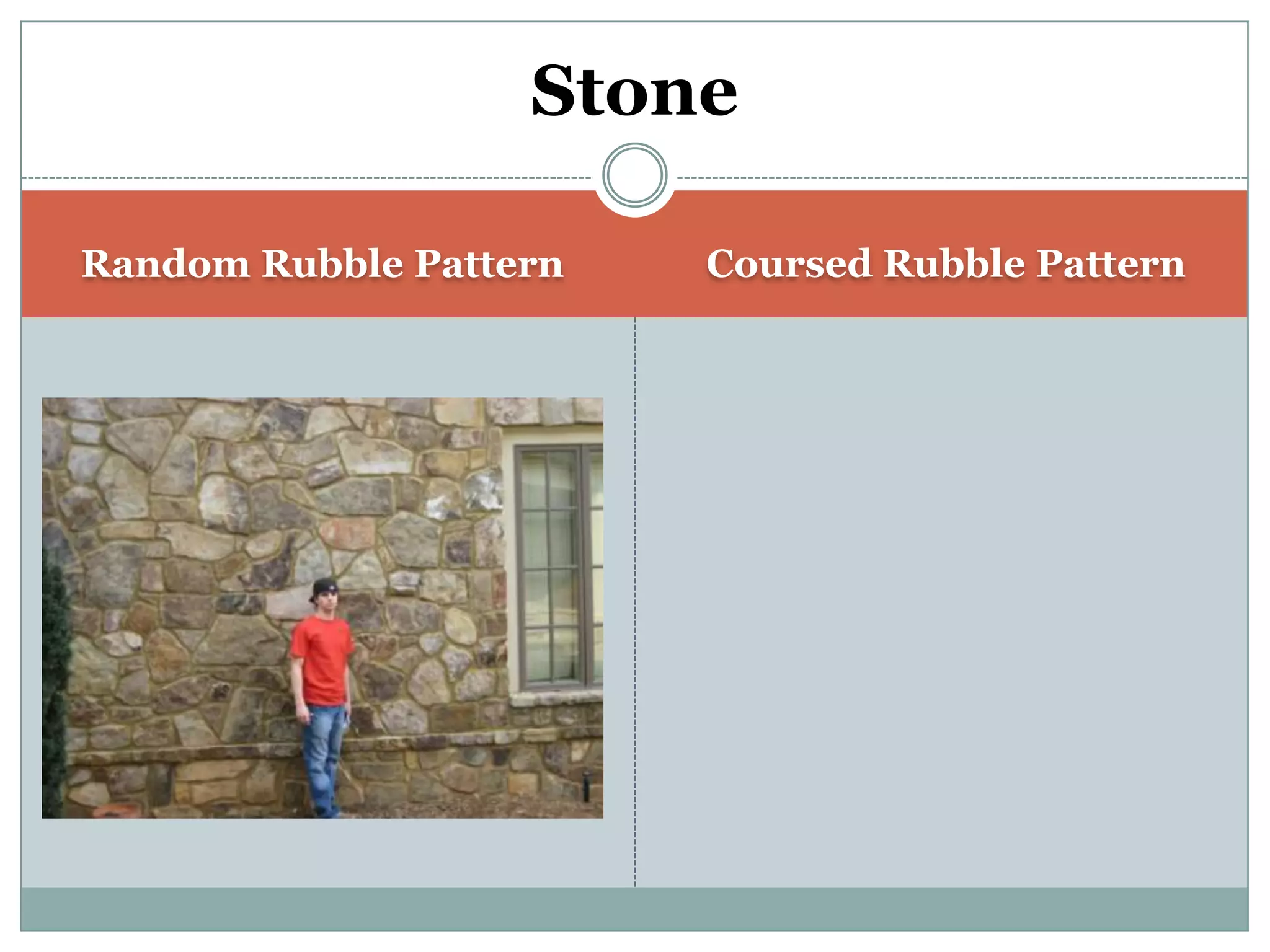
Random Rubble PatternCoursed Rubble PatternStone
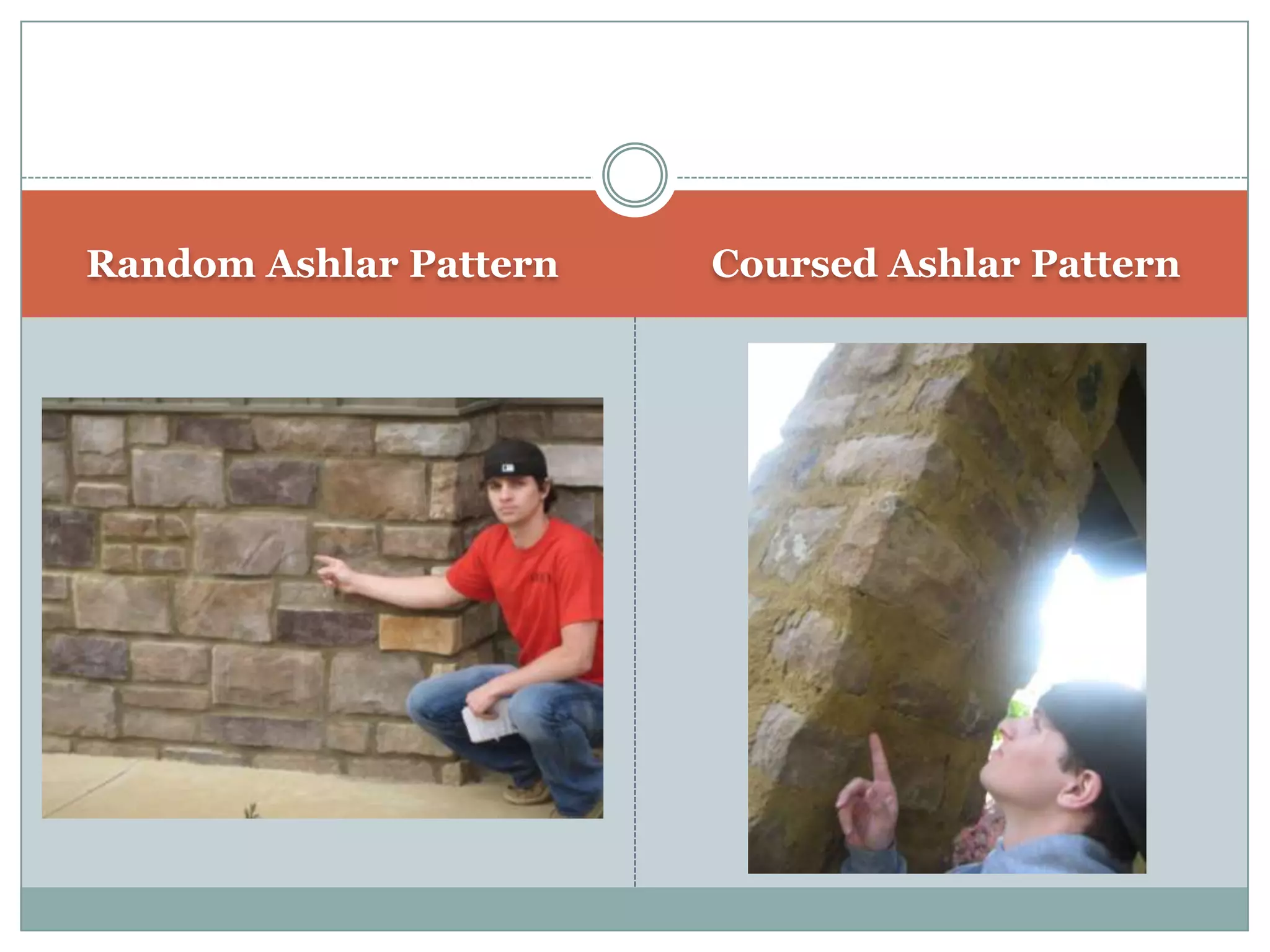
Random Ashlar PatternCoursed Ashlar Pattern
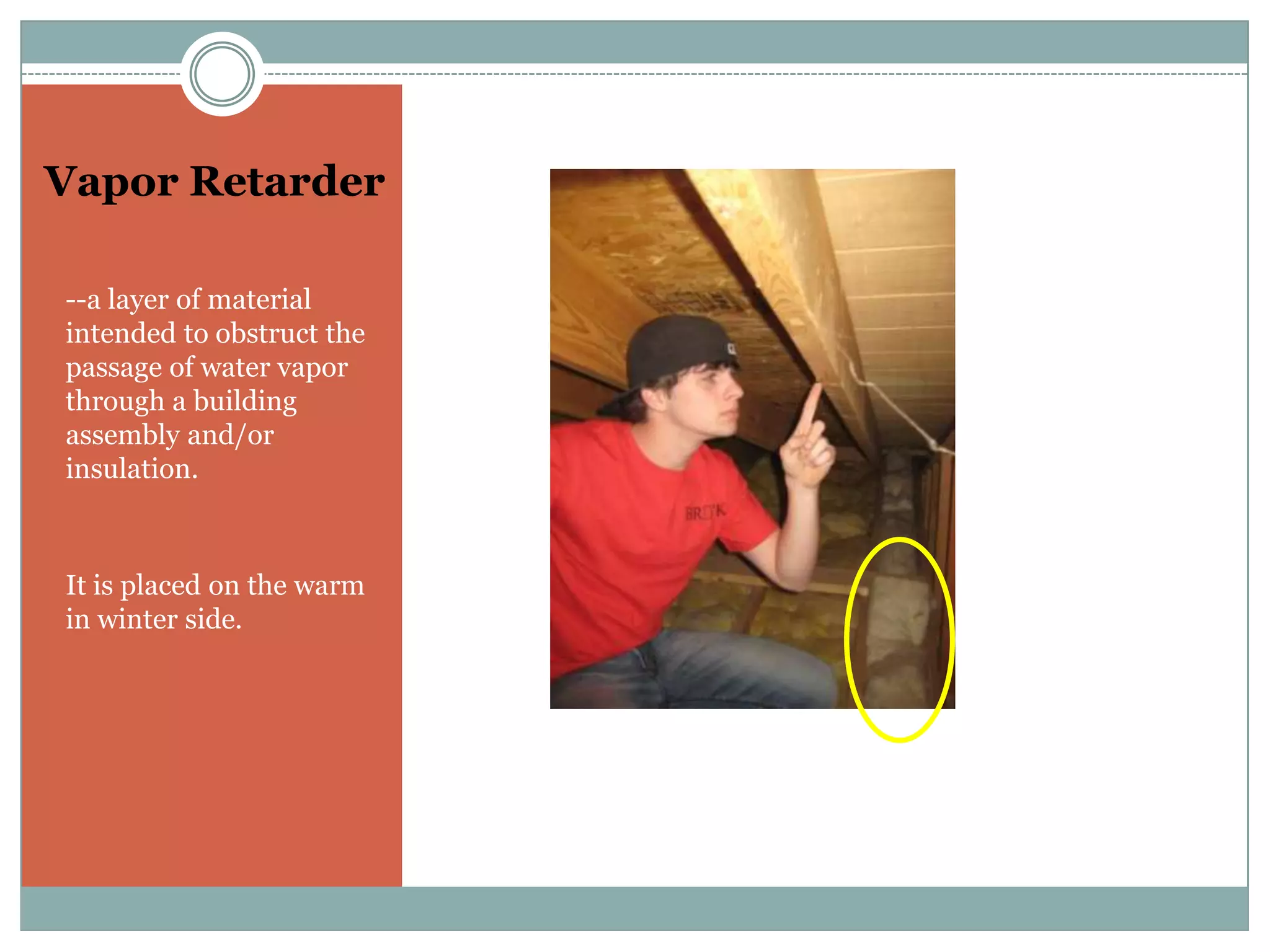
Vapor Retarder--a layer of material intended to obstruct the passage of water vapor through a building assembly and/or insulation.It is placed on the warm in winter side.
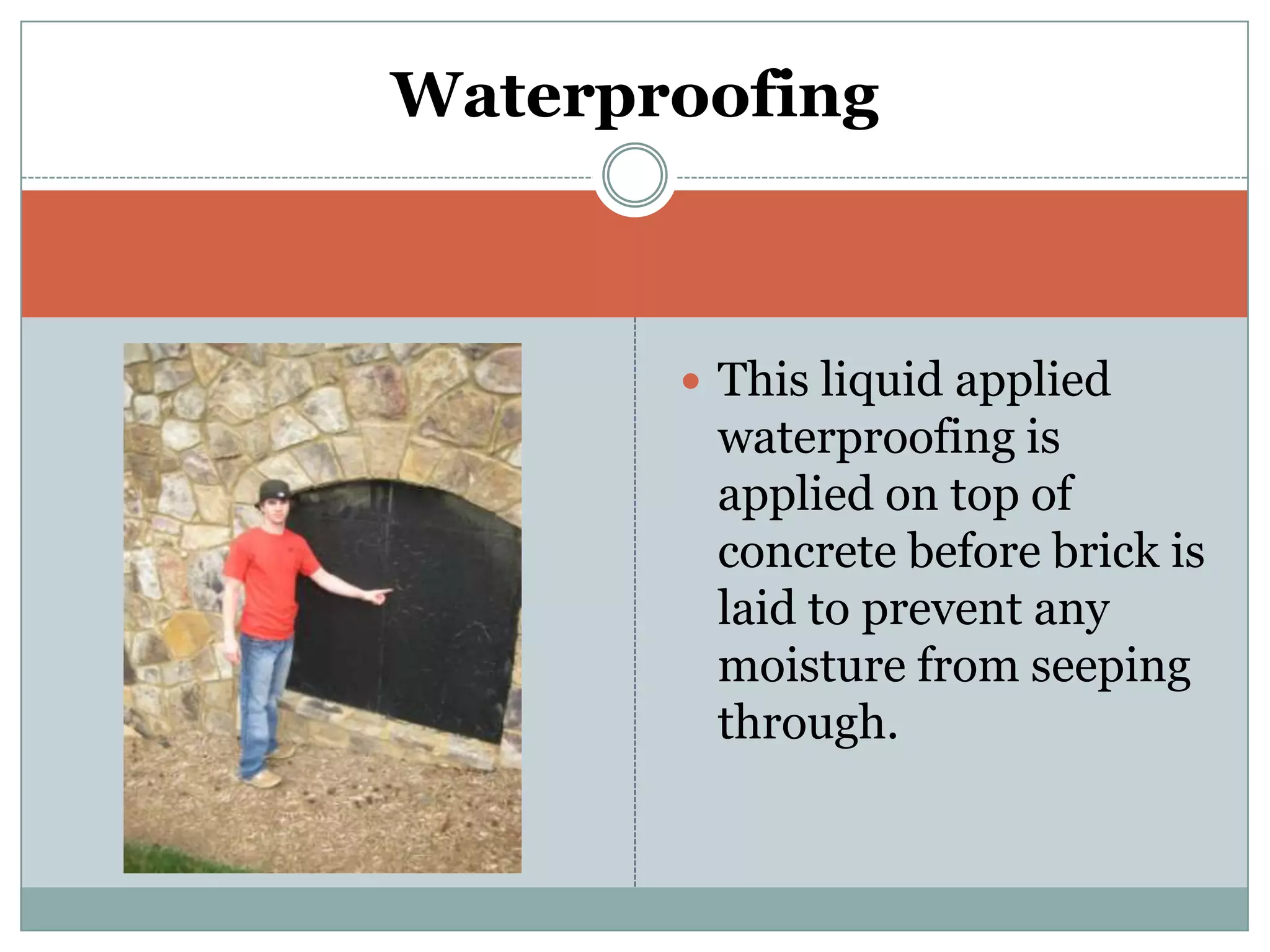
This liquid applied waterproofing is applied on top of concrete before brick is laid to prevent any moisture from seeping through.Waterproofing
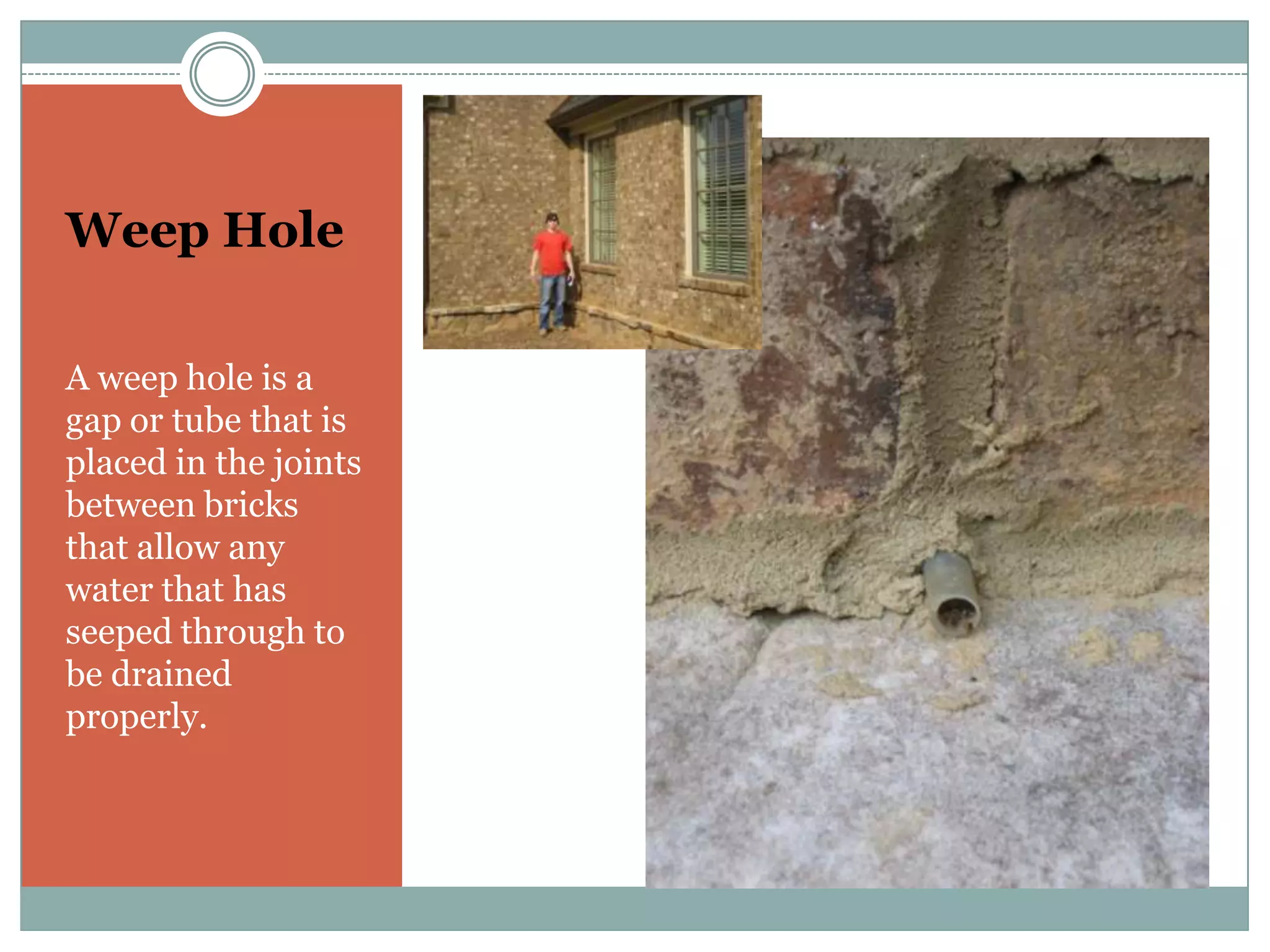
Weep HoleA weep hole is a gap or tube that is placed in the joints between bricks that allow any water that has seeped through to be drained properly.
Welded Wire Fabric
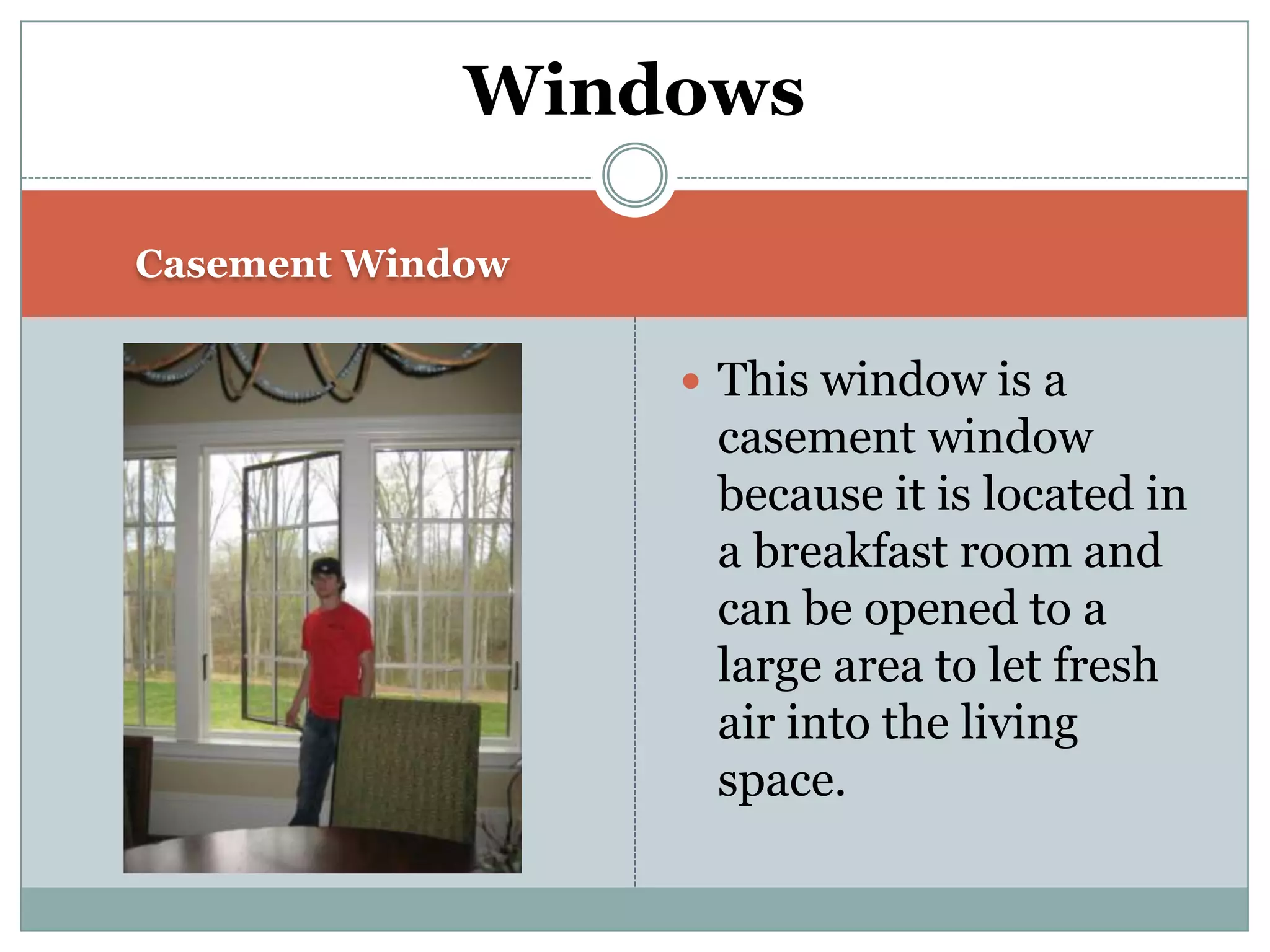
Casement WindowThis window is a casement window because it is located in a breakfast room and can be opened to a large area to let fresh air into the living space.Windows
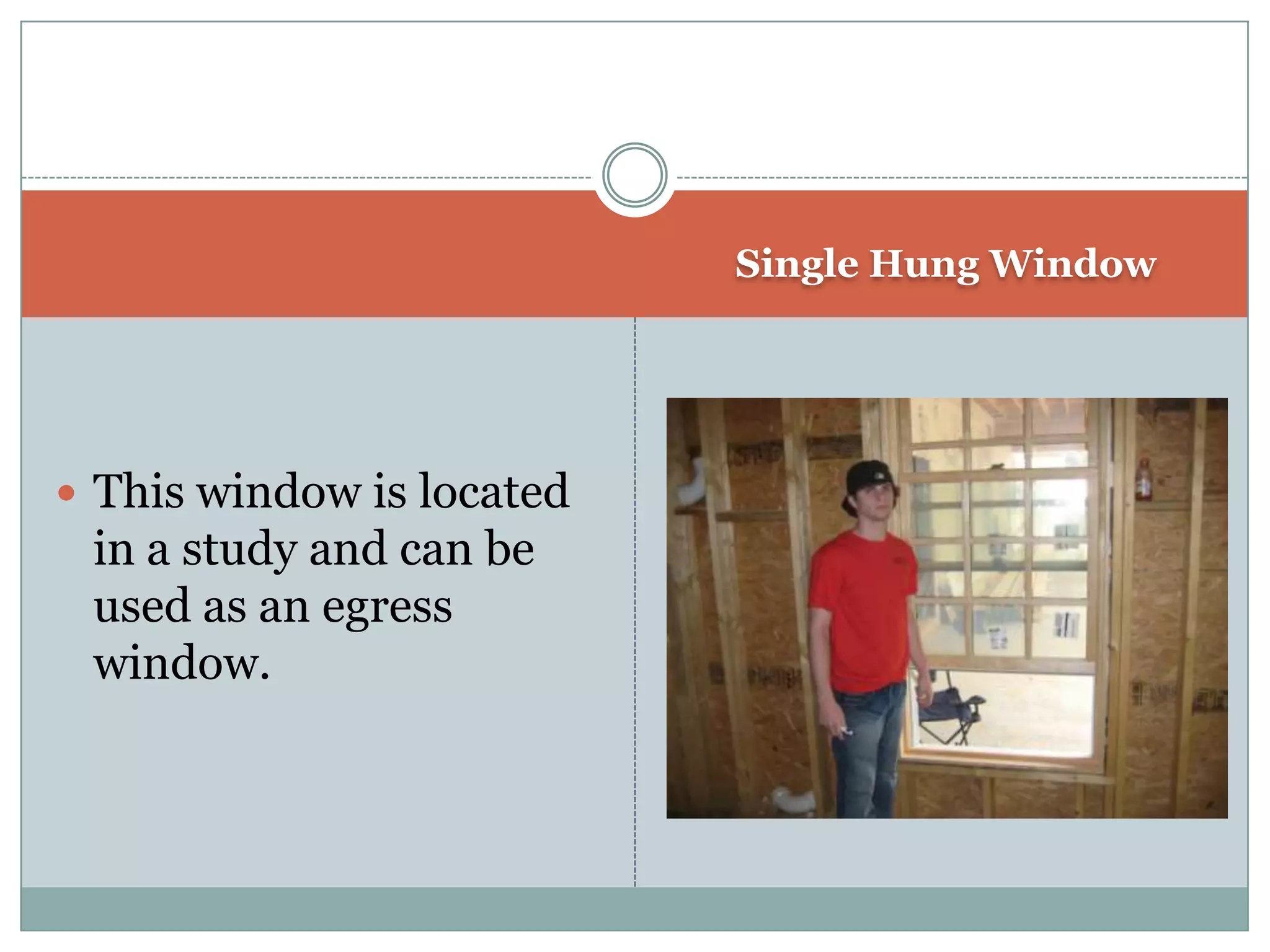
Single Hung WindowThis window is located in a study and can be used as an egress window.
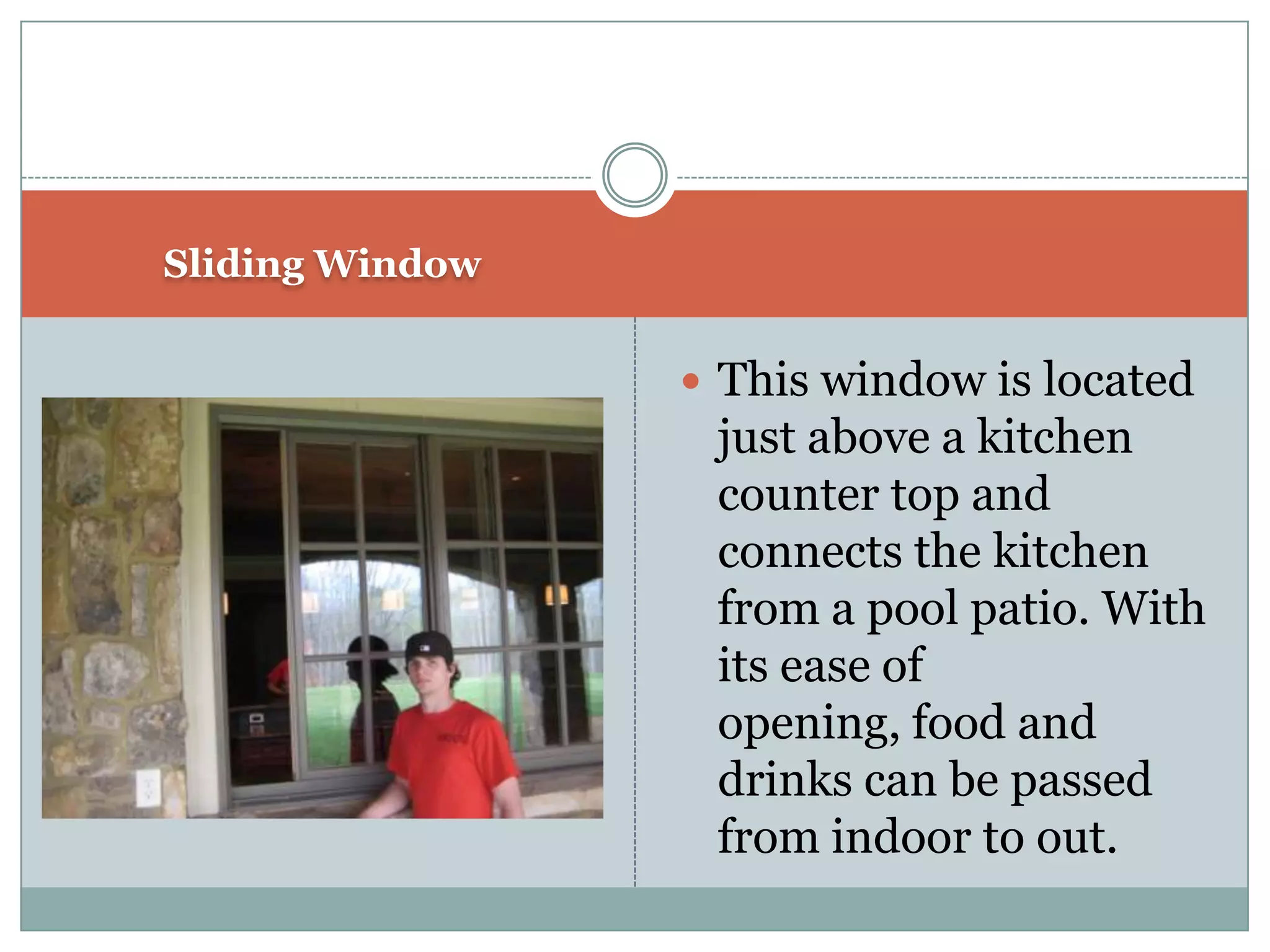
Sliding WindowThis window is located just above a kitchen counter top and connects the kitchen from a pool patio. With its ease of opening, food and drinks can be passed from indoor to out.

Visual dictionary GRADE THIS

  • 1.
  • 2.
    Air BarrierA polyolefinsheet material marketed as “home” or “housewrap”. This material is applied to the outside of the wall sheathing to act as an air and weather barrier. It does not allow the passage of air or liquid but permits the passage of water vapor.
  • 3.
    Attic Ventilation1.1. GableVent—needed to exhaust excess heat and humidity from the attic.2. Ridge Vent—needed to allow air to circulate in and out of a gabled roof at the ridge helping to prevent the likelihood of condensation within the roof.3.SoffitVent—allows air to flow into the attic or the space below the roof sheathing but keeps out insects.4. Roof Turbine—acts as a fan to pull heat out of the attic.2.4.3.
  • 4.
    BackhoeA backhoe isa piece of heavy machinery that has a primary purpose of moving earth with its boomed arm and bucket.Bucket Width= 2 ½ feet
  • 5.
    Batter Boards-A temporaryframe built just outside the corner of an excavation to carry marks that lie on the surface planes of the basement that will be build in the excavation. They establish the position, shape, and size of the building on the site.
  • 6.
    Elliptical Arch #1TudorArch #2Brick Arches
  • 7.
    Arch with KeystoneCentering–atemporary framework for supporting a masonry arch during construction until it is able to stand by itselfKeystone
  • 8.
    Stacked Bond—this wayof laying brick is not the best for supporting large loadsRunning Bond– this way of laying brick is the most common among homes.Brick Bonds
  • 9.
    Brick Courses1.2.1. StretcherCourse2.Rowlock Course3. Soldier Course 4. Header Course5. Sailor Course3.4.5.
  • 10.
    Brick SizesBrick size:L= 9 in. W= 4in. H= 2 in.Brick size: L= 7 ⅝ in. H= 2 ¼ in. W= 3 ⅝ in.
  • 11.
    Bulldozer-a large, powerfultractor having a vertical blade at the front end for moving earth, tree stumps, rocks, and any other earthy material-Blade width= 7 feet
  • 12.
    Brick Clad StructureStoneClad StructureRandom Rubble Pattern Cladding
  • 13.
    EFIS Clad StructureWoodBoard Clad Structure
  • 14.
    Cedar Shake CladStructureWood Shingle—thin, tapered slabs of wood sawn from short pieces of tree trunk.Wood Shake– are slabs of wood that have been split from the wood rather than sawn; thicker with more irregular face textures.
  • 15.
    Code Requirements Height=31 ½ in.Width= 32 in.Area= 6 feet 7 in.Sill Height= 18 ½ in.IBC Requirements: Maximum sill height above the floor of 44 in. Minimum net opening of 5.7 sq feet. Net width of opening is not less than 20 in. and net height not less than 24 in.This window meets the code requirement because the net opening is greater than 5.7 sq feet.
  • 16.
    StairIBC Code Requirements–Tread:Min. 10in. Riser: Max. 7 ¾ in.Measured Stair– Tread: 10 in.Riser: 7 in.This stair meets the code requirements because the tread and riser dimensions fall within the allowed range of width and height.
  • 17.
    Concrete JointsControl Joint–an intentional, linear discontinuity in a structure or component, designed to form a plane of weakness where cracking can occur in response to various forces so as to minimize or eliminate cracking elsewhere in the structure
  • 18.
    Isolations JointIsolation Joint–a concrete joint that isolates the slab from a wall, column, or drainpipe. They relieve flexural stresses.This isolation joint is isolating a steel column from the slab.
  • 19.
    CMU—Concrete Masonry Unit-serveprimarily for foundations, retaining walls and fireplaces-a single standard CMU (8×8×16) occupies the same volume as 12 modular brick-other common sizes are (4×8×16), (6×8×16), and (10×8×16).CMU– a block of hardened concrete with or without hollow cores, designed to be laid in the same manner as a brick or stone; a concrete block.1 CMU=3 Brick CoursesCMU blocks of different sizes.
  • 20.
  • 21.
  • 22.
    Exterior Flush DoorTransom–a small window directly above a doorSidelight– a tall, narrow window along-side a door
  • 23.
    Electrical ComponentsUnderground transformerbox– steps down the high voltage from under-ground lines supplied by utility companies to provide the 110/220 volt power used in a house.
  • 24.
    Service Head– theassembly by which electricity is conducted from outdoor lines to the meter baseMeter– held by the meter base, measures the power usage of the residence
  • 25.
    Service Panel—the assemblyby which electricity is conducted from outdoor lines to the meter base inside of a building.
  • 26.
    Duplex receptacle—a placewhere an appliance can be connected to an electric circuit.
  • 27.
  • 28.
  • 29.
  • 30.
  • 31.
  • 32.
  • 33.
    Front End LoaderFrontEnd Loader– a loader having a shovel or bucket at the end of an articulated arm located at the front of a piece of machinery that is used to load dirt and other materials into equipment such as a dump truck.This equipment differs from other because it is able to haul and load larger amounts of materials than other machinery.
  • 34.
    Gypsum Board An interior facing panel consisting of a gypsum core sandwiched between paper faces; also called drywall or plasterboard
  • 35.
    Heat PumpsAdvantages– abilityto both heat and cool a building rapidlyDisadvantages– it is difficult to zone because the furnace supplies air to the air ducts at a single temperatureHVAC
  • 36.
    Compressor The compressor/condensersare heat exchangers that compress the refrigerate into a hot gas and then condenses them to a liquid
  • 37.
    Air Handling UnitItspurpose is the heating and/or cooling mechanism of the heat pump system. It conditions and circulates the warm or cool air to different parts of the building.
  • 38.
    Insulation1.The purpose ofinsulation is to keep a building cooler in the summer and warmer in the winter by limiting the heat transfer through the walls and ceiling. Insulation keeps occupants comfortable and lowers heating and cooling costs.2.Batt/Blanket InsulationLoose fill InsulationFoamed Insulation3.
  • 39.
    LintelConcrete Lintel-A beamthat carries the load of a wall across a window or door opening.This door is located on the front of this house.
  • 40.
    Joint 1– Tooledconcave joint. ⅜th in. joint used for a brick clad structure.Type N mortarMortar
  • 41.
    Joint 2– Troweledflush joint ⅜th in. thick used on a brick clad structure.Mortar Type N
  • 42.
    OSB—Oriented Strand BoardAnon-veneered building panel product composed of long shreds of wood fiber oriented in specific directions and bonded together under pressure.
  • 43.
    Water closets usea 3 in. drain pipe.Lavatory uses 1 ½ in. pipe for drainage.Plumbing
  • 44.
    VTR– Plumbing RoofVentThis pipe allows gas that builds up in pipes to be safely released from a drainage system and allows air flow into the system.This kitchen sink is a lay in sink in a granite countertop.
  • 45.
    Plywood--A structural woodpanel product composed of an odd number of layers of wood veneer bonded together under pressure.1. Log storage2. Debarking and bucking (cutting limbs off)3. Heating the logs to improve cutting action of the veneer lathe.4. Peeling the logs into veneers.5. Drying veneers.6. Gluing veneers together7. Pressing veneers in a hot press to consolidate the panels for handling and to cure the glue.8.Cutting, trimming, and sanding. Then shipping.Veneer– a thin layer, sheet, or facing
  • 46.
    Radiant BarrierA reflectivefoil placed adjacent to an airspace in roof or wall assemblies as a deterrent to the passage of infrared energy.
  • 47.
    Rebar-size #4= ½in. diameterThe deformations rolled into the surface of rebar help it bond tightly to the concrete.
  • 48.
    Steep Roof DrainageDownspout–metal piping connected to the gutters that direct the water to a desired area.Gutter– metal piping cut in half that collect rain runoff on the edges of steep roof systems.Splash block– a small precast block of concrete or plastic used to divert water at the bottom on a downspout
  • 49.
    UnderlaymentA material, usuallyfelt, that is nailed to the roof. Shingles are then nailed on top of the underlayment. This material prevents water from seeping into the attic space.
  • 50.
    Shingle– a thinpiece of wood, slate, metal, or asphalt, usually oblong, laid in overlapping rows to cover the roofs and walls of buildings.
  • 51.
    Typical metal roofmaterials are aluminized or galvanized steel.Cedar Shake roof.
  • 52.
  • 53.
  • 54.
  • 55.
  • 56.
    Steep Roof TermsRidge–the level intersection of two roof planes in a gable roof.Rake– the sloping edge of a steep roof. Valley– a trough formed by the intersection of two roof slopes.Eave– the horizontal edge at the low side of a sloping roof.
  • 57.
    Soffit– the undersideof an architectural feature like a roof system
  • 58.
    Facia—the exposed verticalface of an eave. A bulding without a facia does not have an exposed vertical face of an eave. An example of this is the exposed roof joist.
  • 59.
    Random Rubble PatternCoursedRubble PatternStone
  • 60.
  • 61.
    Vapor Retarder--a layerof material intended to obstruct the passage of water vapor through a building assembly and/or insulation.It is placed on the warm in winter side.
  • 62.
    This liquid appliedwaterproofing is applied on top of concrete before brick is laid to prevent any moisture from seeping through.Waterproofing
  • 63.
    Weep HoleA weephole is a gap or tube that is placed in the joints between bricks that allow any water that has seeped through to be drained properly.
  • 64.
  • 65.
    Casement WindowThis windowis a casement window because it is located in a breakfast room and can be opened to a large area to let fresh air into the living space.Windows
  • 66.
    Single Hung WindowThiswindow is located in a study and can be used as an egress window.
  • 67.
    Sliding WindowThis windowis located just above a kitchen counter top and connects the kitchen from a pool patio. With its ease of opening, food and drinks can be passed from indoor to out.