Visual Dictionary BSCI 2300 Materials Methods & Equipment I Bark1
Air Barrier Paper What’s it doing?:  Providing a water barrier between the outer cladding of a structure and the frame, insulation, etc. It also serves as windbreak. Air Barrier Paper:  A weather-resistant barrier, preventing rain from getting into the wall assembly while allowing water vapor to pass to the exterior.
Attic Ventilation 1 Soffit Vent : Allows air to flow into the attic or the space below the roof sheathing. Ridge Vent : A long, open assembly that allows air to circulate in and out of a gable roof at the ridge.
Attic Ventilation 2 Gable Vent :   Used for exhausting excess heat and humidity from the attic. Roof Turbine : Exhaust moist, hot air from your attic. Turbine roof vents work with Mother Nature to pull this air outside
Backhoe An excavator whose bucket is rigidly attached to a hinged pole on the boom and is drawn backward to the machine when in operation. The backhoe’s hinged arm makes it capable in extruding large holes and channels.   5’ bucket width
Batter Boards Def Function
Brick Arches Roman arch Jack Arch With Keystone Straight Jack Arch
Brick Bonds 1 Flemish Bond:   It is created by alternately laying headers and stretchers in a single course. The next course is laid so that a header lies in the middle of the stretcher in the course below.   Common Bond:  A variation of running bond with a course of full length headers at regular intervals. These headers provide structural bonding, as well as pattern. Header courses usually appear at every fifth, sixth or seventh course.
Brick Bonds 2 Rowlocks Headers Sailor
Brick Bonds 3 Soldiers Shiners
Brick Sizes Utility Brick:   3 ½” x 3 ½” x 11 ½” Norman Brick:  3 ½” x 2 ¼” x 11 ¼”
Bulldozer Bulldozer: A caterpillar tracked tractor equipped with a substantial metal plate (known as a blade), used to push large quantities of soil, sand, rubble, etc., during construction work.
Cladding 1 Brick Clad Structure -EIFS Clad Structure -Stone Clad Structure (Random/Ashlar)
Cladding 2 Wood board structure Woods Shake Structure Wood that is applied in small sections on exterior walls to convey the run off of water. Wood Shingles : Rectangular pieces  Wood Shakes : Rough and splintered rectangular pieces
Code Requirements 1 Open Area Measurements: Width: 29 ½” Height: 29” Area: 5.99 sp. Ft Sill Height AFF: 21 ½” 21 ½” 29 ½” 29” IBC Requirements: 20in. Min width 24in. Min height 5.7 sq. ft min area Sill height above 44in. My window does not meet code because my window sill height is below the 44in. Requirement.
Code Requirements 2 Tread: 12” Riser: 5 ¼” IBC Code Requirements: Tread: Min depth 10” Riser: Max height 7 ¾” The tread meets code requirements because the tread is above 10” and the riser is below 5 ¼”. 5 ¼” 12”
Concrete Joints Control Joint : An intentional, linear discontinuity in a structure or component, designed to form a plane of weakness where cracking can occur in response to various forces so as to minimize or eliminate cracking elsewhere in the structure Isolation Joint:  They completely isolate the slab from something else. That something else can be a wall or a column or a drain pipe. The Column is being isolated from the slab
Concrete Masonry Unit (CMU) CMU : A block of hardened concrete, with or without hollow cores, designed to be laid in the same manner as a brick or stone American standard concrete block is nominally 8 inches high and 16 inches long.
Concrete Masonry Unit (CMU) 2 Other CMU Sizes: 10” CMU block 6” CMU block
Decorative Concrete Masonry Units Split Block Ribbed Block
Doors 1 Exterior Flush Top Rail Stile Lock Rail Bottom Rail Exterior Panel
Doors 2 Transom : A small window directly above the door. Sidelight : A tall, narrow window alongside a door.
Electrical Components 1 Power pole with transformer:  An electrical device that changes the voltage of alternating current Service Head:  keeps water from entering the electrical mast when the wires run to the home overhead. It also helps protect the wires from mechanical damage.
Electrical Components 2 Meter:  A device that measures the amount of electrical energy supplied to or produced by a residence, business or machine.   Service Panel : Divides an electrical power feed into subsidiary circuits, while providing a protective fuse or circuit breaker for each circuit, in a common enclosure.  Duplex receptacle :  Connectors used for mains electricity that conform to the standards set by the National Electrical Manufacturers Association. Supply electricity to appliances.
Framing Elements 1 #1 Anchor Bolt  #2 Sill Plate #7 Top Plate #6 Stud #5 Sole Plate #4 Subflooring
Framing Elements 2 #3 Floor Joist #8 Ceiling Joist #9 Rafter #10 Roof decking
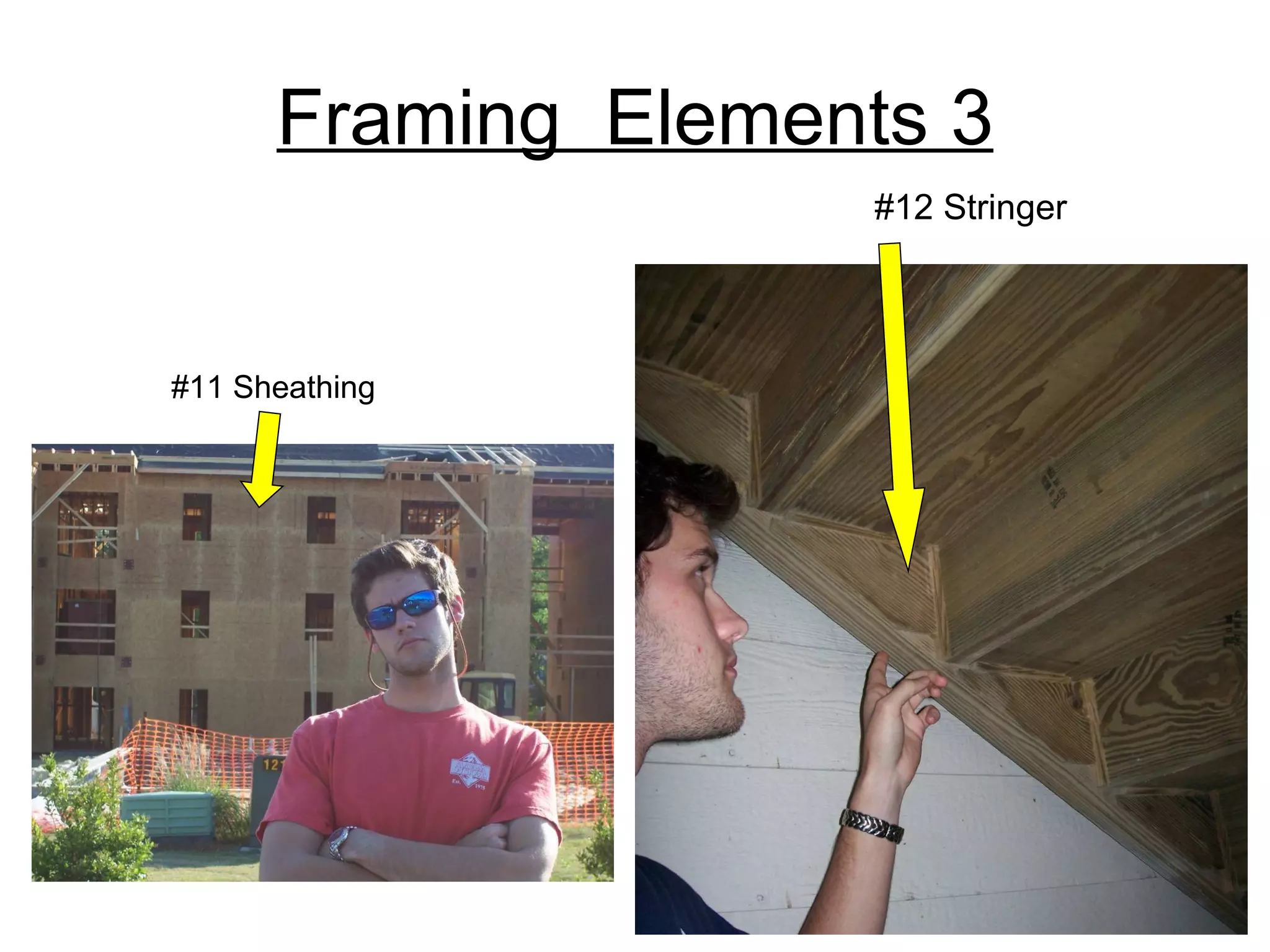
Framing  Elements 3 #12 Stringer #11 Sheathing
Front End Loader An engineering vehicle that is primarily used to  "load"  material (asphalt, demolition debris, dirt, rock, sand, etc.) into or onto another type of machinery (dump truck, conveyor belt, feed-hooper, rail-car, etc.).   Differs from a bulldozer because the front scoop is connected to a nomadic are that is capable of lifting a load instead of just pushing it.
Gypsum Board An interior facing panel consisting of a gypsum core sandwiched between paper faces.
Heat Pump Heap Pump Advantage : capable of producing heating and cooling Heap Pump Disadvantage : Can Be very expensive. Heat Pump Compressor What’s it doing: It’s moving air across coils filled with refrigerant to heat or cool the air Air Handling Unit What’s it doing: It’s conditioning and circulating the air as a part of the HVAC system
Insulation Purpose: To regulate heat and keep it where we want it Foamed Insulation Batt/Blanket Insulation Loose Fill Insulation
Lintel Concrete Lintel A beam that carries the load of a wall across a window or door opening
Mortar 1 Concave Joint Tooled 3/8” width Used on small exterior retaining wall Type S mortar
Mortar 2 Raked Joint Raked, not tooled or troweled 3/8” width Used on small exterior retaining wall Type N mortar
Oriented Strand Board (OSB) A building nonveneered panel product composed of  long shreds of wood fiber. 4 X 8’ It is manufactured by the long shreds of wood fiber being oriented in specific directions and bonded together under pressure
Plumbing 1 Lavatory -Waste piping is usually 1 ½”- 2” in diameter Water closet -Drain piping is at least 3 inches in diameter
Plumbing 2 Manufactured shower/tub Plumbing Roof Vent -Allows noxious waste line gases to vent out of the system and into the outside air.
Plumbing 3 Kitchen Sink Flush mount
Plywood A wood panel composed of an odd number of layers of wood veneer bonded together under pressure. 4 X 8’ Veneer : A thin layer, sheet, or facing
Radiant Barrier A reflective foil placed adjacent to an airspace in roof or wall assemblies as a deterrent to the passage of infrared energy. It is reflecting the exterior heat back out and keeps the interior heat within. ***This is next to impossible to find installed so please cut me some slack. Thank you
Rebar Diameter: ½” # 4 bar The deformations on the exterior of the rebar helps grip and hold the concrete as it sets around the bar
Steep Roof Drainage Gutter A channel that collects rainwater and snowmelt at the eave of a roof. It helps funnel the water to the downspout.   Downspout A vertical pipe for conducting water from a roof to a lower level.  Splashblock A small precast block of concrete or plastic used to divert water at the bottom of a downspout so that it spreads evenly and doesn’t flood the ground
Steep Roof Materials 1 Underlayment: A layer of waterproof material such as building felt between roof sheathing and roofing. It controls air and water and permits water vapor to pass out but not in Clay Tile Roof Shingle : A small unit of water-resistant material nailed in overlapping fashion with many other such units to render a wall or sloping roof watertight.
Steep Roof Materials 2 Slate Shingle Roof Metal Panel Roof Aluminized steel
Steep Roof Shapes 1 Gable Gambrel
Steep Roof Shapes 2 Hip Roof Mansard
Steep Roof Terms 1 Ridge: The level intersection of two roof planes in a gable roof. Valley: A trough formed by the intersection of two roof slopes. Eave: The horizontal edge at the low side of a sloping roof Soffit: The undersurface of a horizontal element of a building, especially the underside of a roof overhang Fascia: The exposed vertical face of an eave.
Steep Roof Terms 2 Building without a fascia Building without a vertical face of an eave
Stone 1 Random Rubble Pattern Coursed Rubble Pattern
Stone 2 Coursed Ashlar Random Ashlar
Vapor Retarder The vapor retarder is obstruct the passage of water vapor through a building assembly. It is installed facing the inside of the home because that is the warm in winter side.
Waterproofing The waterproofing is resisting standing water under pressure by creating a waterproof barrier. Loosely Laid
Weep Hole A small opening whose purpose is to permit drainage of water that accumulates inside a building component or assembly The weep hole is allowing a way for the moisture behind the wall to escape
Welded Wire Fabric The grid is 4” x 4”
Window 1 Awning Window , because it pivots on an axis near the top edge of the sash and projects towards the outdoors
Window 2 Casement Window , because it pivots on an axis at or near a vertical edge of the sash
Window 3 Double-Hung Window , because it has two over lapping sashes that slide vertically in tracks

Visual Dictionary- Bark1

  • 1.
    Visual Dictionary BSCI2300 Materials Methods & Equipment I Bark1
  • 2.
    Air Barrier PaperWhat’s it doing?: Providing a water barrier between the outer cladding of a structure and the frame, insulation, etc. It also serves as windbreak. Air Barrier Paper: A weather-resistant barrier, preventing rain from getting into the wall assembly while allowing water vapor to pass to the exterior.
  • 3.
    Attic Ventilation 1Soffit Vent : Allows air to flow into the attic or the space below the roof sheathing. Ridge Vent : A long, open assembly that allows air to circulate in and out of a gable roof at the ridge.
  • 4.
    Attic Ventilation 2Gable Vent : Used for exhausting excess heat and humidity from the attic. Roof Turbine : Exhaust moist, hot air from your attic. Turbine roof vents work with Mother Nature to pull this air outside
  • 5.
    Backhoe An excavatorwhose bucket is rigidly attached to a hinged pole on the boom and is drawn backward to the machine when in operation. The backhoe’s hinged arm makes it capable in extruding large holes and channels. 5’ bucket width
  • 6.
  • 7.
    Brick Arches Romanarch Jack Arch With Keystone Straight Jack Arch
  • 8.
    Brick Bonds 1Flemish Bond: It is created by alternately laying headers and stretchers in a single course. The next course is laid so that a header lies in the middle of the stretcher in the course below. Common Bond: A variation of running bond with a course of full length headers at regular intervals. These headers provide structural bonding, as well as pattern. Header courses usually appear at every fifth, sixth or seventh course.
  • 9.
    Brick Bonds 2Rowlocks Headers Sailor
  • 10.
    Brick Bonds 3Soldiers Shiners
  • 11.
    Brick Sizes UtilityBrick: 3 ½” x 3 ½” x 11 ½” Norman Brick: 3 ½” x 2 ¼” x 11 ¼”
  • 12.
    Bulldozer Bulldozer: Acaterpillar tracked tractor equipped with a substantial metal plate (known as a blade), used to push large quantities of soil, sand, rubble, etc., during construction work.
  • 13.
    Cladding 1 BrickClad Structure -EIFS Clad Structure -Stone Clad Structure (Random/Ashlar)
  • 14.
    Cladding 2 Woodboard structure Woods Shake Structure Wood that is applied in small sections on exterior walls to convey the run off of water. Wood Shingles : Rectangular pieces Wood Shakes : Rough and splintered rectangular pieces
  • 15.
    Code Requirements 1Open Area Measurements: Width: 29 ½” Height: 29” Area: 5.99 sp. Ft Sill Height AFF: 21 ½” 21 ½” 29 ½” 29” IBC Requirements: 20in. Min width 24in. Min height 5.7 sq. ft min area Sill height above 44in. My window does not meet code because my window sill height is below the 44in. Requirement.
  • 16.
    Code Requirements 2Tread: 12” Riser: 5 ¼” IBC Code Requirements: Tread: Min depth 10” Riser: Max height 7 ¾” The tread meets code requirements because the tread is above 10” and the riser is below 5 ¼”. 5 ¼” 12”
  • 17.
    Concrete Joints ControlJoint : An intentional, linear discontinuity in a structure or component, designed to form a plane of weakness where cracking can occur in response to various forces so as to minimize or eliminate cracking elsewhere in the structure Isolation Joint: They completely isolate the slab from something else. That something else can be a wall or a column or a drain pipe. The Column is being isolated from the slab
  • 18.
    Concrete Masonry Unit(CMU) CMU : A block of hardened concrete, with or without hollow cores, designed to be laid in the same manner as a brick or stone American standard concrete block is nominally 8 inches high and 16 inches long.
  • 19.
    Concrete Masonry Unit(CMU) 2 Other CMU Sizes: 10” CMU block 6” CMU block
  • 20.
    Decorative Concrete MasonryUnits Split Block Ribbed Block
  • 21.
    Doors 1 ExteriorFlush Top Rail Stile Lock Rail Bottom Rail Exterior Panel
  • 22.
    Doors 2 Transom: A small window directly above the door. Sidelight : A tall, narrow window alongside a door.
  • 23.
    Electrical Components 1Power pole with transformer: An electrical device that changes the voltage of alternating current Service Head: keeps water from entering the electrical mast when the wires run to the home overhead. It also helps protect the wires from mechanical damage.
  • 24.
    Electrical Components 2Meter: A device that measures the amount of electrical energy supplied to or produced by a residence, business or machine. Service Panel : Divides an electrical power feed into subsidiary circuits, while providing a protective fuse or circuit breaker for each circuit, in a common enclosure. Duplex receptacle : Connectors used for mains electricity that conform to the standards set by the National Electrical Manufacturers Association. Supply electricity to appliances.
  • 25.
    Framing Elements 1#1 Anchor Bolt #2 Sill Plate #7 Top Plate #6 Stud #5 Sole Plate #4 Subflooring
  • 26.
    Framing Elements 2#3 Floor Joist #8 Ceiling Joist #9 Rafter #10 Roof decking
  • 27.
    Framing Elements3 #12 Stringer #11 Sheathing
  • 28.
    Front End LoaderAn engineering vehicle that is primarily used to "load" material (asphalt, demolition debris, dirt, rock, sand, etc.) into or onto another type of machinery (dump truck, conveyor belt, feed-hooper, rail-car, etc.). Differs from a bulldozer because the front scoop is connected to a nomadic are that is capable of lifting a load instead of just pushing it.
  • 29.
    Gypsum Board Aninterior facing panel consisting of a gypsum core sandwiched between paper faces.
  • 30.
    Heat Pump HeapPump Advantage : capable of producing heating and cooling Heap Pump Disadvantage : Can Be very expensive. Heat Pump Compressor What’s it doing: It’s moving air across coils filled with refrigerant to heat or cool the air Air Handling Unit What’s it doing: It’s conditioning and circulating the air as a part of the HVAC system
  • 31.
    Insulation Purpose: Toregulate heat and keep it where we want it Foamed Insulation Batt/Blanket Insulation Loose Fill Insulation
  • 32.
    Lintel Concrete LintelA beam that carries the load of a wall across a window or door opening
  • 33.
    Mortar 1 ConcaveJoint Tooled 3/8” width Used on small exterior retaining wall Type S mortar
  • 34.
    Mortar 2 RakedJoint Raked, not tooled or troweled 3/8” width Used on small exterior retaining wall Type N mortar
  • 35.
    Oriented Strand Board(OSB) A building nonveneered panel product composed of long shreds of wood fiber. 4 X 8’ It is manufactured by the long shreds of wood fiber being oriented in specific directions and bonded together under pressure
  • 36.
    Plumbing 1 Lavatory-Waste piping is usually 1 ½”- 2” in diameter Water closet -Drain piping is at least 3 inches in diameter
  • 37.
    Plumbing 2 Manufacturedshower/tub Plumbing Roof Vent -Allows noxious waste line gases to vent out of the system and into the outside air.
  • 38.
    Plumbing 3 KitchenSink Flush mount
  • 39.
    Plywood A woodpanel composed of an odd number of layers of wood veneer bonded together under pressure. 4 X 8’ Veneer : A thin layer, sheet, or facing
  • 40.
    Radiant Barrier Areflective foil placed adjacent to an airspace in roof or wall assemblies as a deterrent to the passage of infrared energy. It is reflecting the exterior heat back out and keeps the interior heat within. ***This is next to impossible to find installed so please cut me some slack. Thank you
  • 41.
    Rebar Diameter: ½”# 4 bar The deformations on the exterior of the rebar helps grip and hold the concrete as it sets around the bar
  • 42.
    Steep Roof DrainageGutter A channel that collects rainwater and snowmelt at the eave of a roof. It helps funnel the water to the downspout. Downspout A vertical pipe for conducting water from a roof to a lower level. Splashblock A small precast block of concrete or plastic used to divert water at the bottom of a downspout so that it spreads evenly and doesn’t flood the ground
  • 43.
    Steep Roof Materials1 Underlayment: A layer of waterproof material such as building felt between roof sheathing and roofing. It controls air and water and permits water vapor to pass out but not in Clay Tile Roof Shingle : A small unit of water-resistant material nailed in overlapping fashion with many other such units to render a wall or sloping roof watertight.
  • 44.
    Steep Roof Materials2 Slate Shingle Roof Metal Panel Roof Aluminized steel
  • 45.
    Steep Roof Shapes1 Gable Gambrel
  • 46.
    Steep Roof Shapes2 Hip Roof Mansard
  • 47.
    Steep Roof Terms1 Ridge: The level intersection of two roof planes in a gable roof. Valley: A trough formed by the intersection of two roof slopes. Eave: The horizontal edge at the low side of a sloping roof Soffit: The undersurface of a horizontal element of a building, especially the underside of a roof overhang Fascia: The exposed vertical face of an eave.
  • 48.
    Steep Roof Terms2 Building without a fascia Building without a vertical face of an eave
  • 49.
    Stone 1 RandomRubble Pattern Coursed Rubble Pattern
  • 50.
    Stone 2 CoursedAshlar Random Ashlar
  • 51.
    Vapor Retarder Thevapor retarder is obstruct the passage of water vapor through a building assembly. It is installed facing the inside of the home because that is the warm in winter side.
  • 52.
    Waterproofing The waterproofingis resisting standing water under pressure by creating a waterproof barrier. Loosely Laid
  • 53.
    Weep Hole Asmall opening whose purpose is to permit drainage of water that accumulates inside a building component or assembly The weep hole is allowing a way for the moisture behind the wall to escape
  • 54.
    Welded Wire FabricThe grid is 4” x 4”
  • 55.
    Window 1 AwningWindow , because it pivots on an axis near the top edge of the sash and projects towards the outdoors
  • 56.
    Window 2 CasementWindow , because it pivots on an axis at or near a vertical edge of the sash
  • 57.
    Window 3 Double-HungWindow , because it has two over lapping sashes that slide vertically in tracks