Visual Dictionary Zack Waddell Materials And Methods I MWF 11:00 am
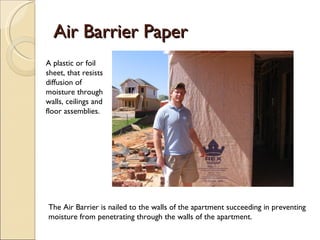
Air Barrier Paper A plastic or foil sheet, that resists diffusion of moisture through walls, ceilings and floor assemblies. The Air Barrier is nailed to the walls of the apartment succeeding in preventing moisture from penetrating through the walls of the apartment.
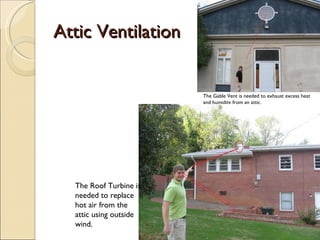
Attic Ventilation The Gable Vent is needed to exhaust excess heat and humidity from an attic. The Roof Turbine is needed to replace hot air from the attic using outside wind.
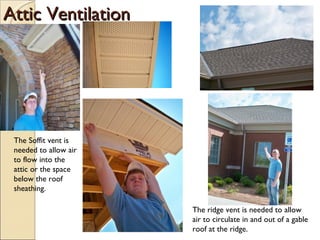
Attic Ventilation The Soffit vent is needed to allow air to flow into the attic or the space below the roof sheathing. The ridge vent is needed to allow air to circulate in and out of a gable roof at the ridge.
Backhoe 16” Bucket The backhoe is used to dig and excavate the earth in order to lay plumbers pipes, conduits, and various kinds of materials. Also used to completely alter elevations and move dirt in massive quantities. The Backhoe is a piece of excavating equipment consisting of a digging bucket on the end of a two-part articulated arm.
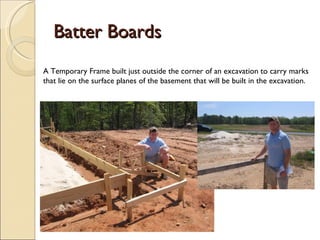
Batter Boards A Temporary Frame built just outside the corner of an excavation to carry marks that lie on the surface planes of the basement that will be built in the excavation.
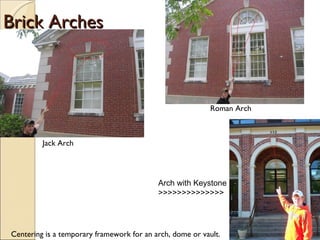
Brick Arches Roman Arch Jack Arch Centering is a temporary framework for an arch, dome or vault. Arch with Keystone >>>>>>>>>>>>>>
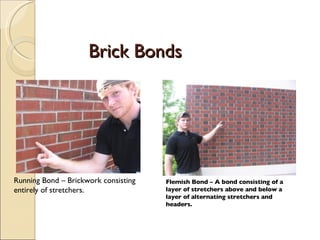
Brick Bonds Running Bond – Brickwork consisting entirely of stretchers. Flemish Bond – A bond consisting of a layer of stretchers above and below a layer of alternating stretchers and headers.
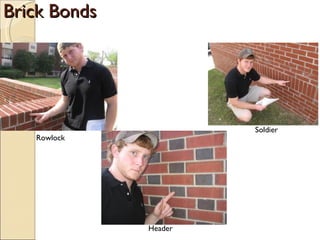
Brick Bonds Rowlock Header Soldier
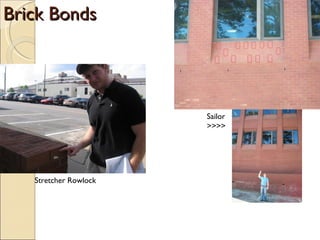
Brick Bonds Sailor >>>> Stretcher Rowlock
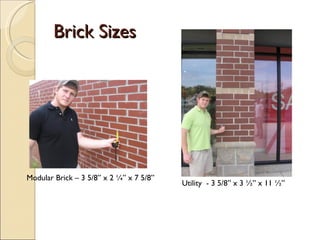
Brick Sizes Modular Brick – 3 5/8” x 2 ¼” x 7 5/8”  Utility  - 3 5/8” x 3 ½” x 11 ½”
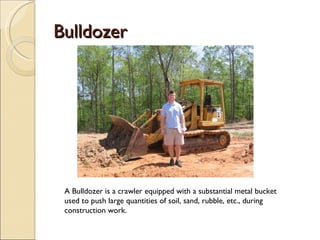
Bulldozer A Bulldozer is a crawler equipped with a substantial metal bucket used to push large quantities of soil, sand, rubble, etc., during construction work.
Cladding Brick Cladding Wood Board Cladding Stone Cladding – Random Ashlar Wood Shingle Cladding ^^^^^ Wood shingle – sawn in squares. Wood Shakes – Split, with a rough corrugated surface. EIFS
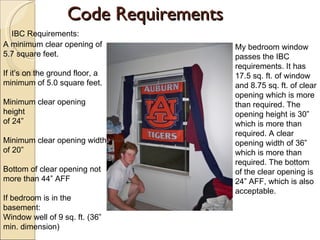
Code Requirements A minimum clear opening of 5.7 square feet. If it’s on the ground floor, a minimum of 5.0 square feet. Minimum clear opening height of 24” Minimum clear opening width of 20” Bottom of clear opening not more than 44” AFF If bedroom is in the basement: Window well of 9 sq. ft. (36” min. dimension) My bedroom window passes the IBC requirements. It has 17.5 sq. ft. of window and 8.75 sq. ft. of clear opening which is more than required. The opening height is 30” which is more than required. A clear opening width of 36” which is more than required. The bottom of the clear opening is 24” AFF, which is also acceptable.  IBC Requirements:
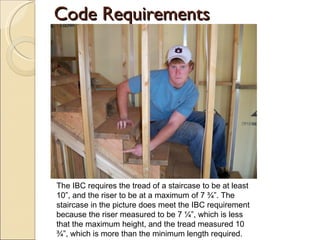
Code Requirements The IBC requires the tread of a staircase to be at least 10”, and the riser to be at a maximum of 7 ¾”. The staircase in the picture does meet the IBC requirement because the riser measured to be 7 ¼”, which is less that the maximum height, and the tread measured 10 ¾”, which is more than the minimum length required.
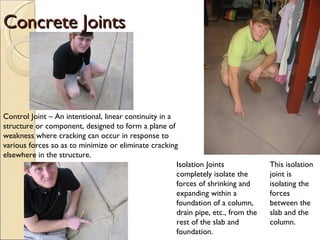
Concrete Joints Control Joint – An intentional, linear continuity in a structure or component, designed to form a plane of weakness where cracking can occur in response to various forces so as to minimize or eliminate cracking elsewhere in the structure. Isolation Joints completely isolate the forces of shrinking and expanding within a foundation of a column, drain pipe, etc., from the rest of the slab and foundation. This isolation joint is isolating the forces between the slab and the column.
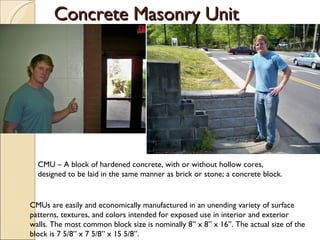
Concrete Masonry Unit CMU – A block of hardened concrete, with or without hollow cores, designed to be laid in the same manner as brick or stone; a concrete block. CMUs are easily and economically manufactured in an unending variety of surface patterns, textures, and colors intended for exposed use in interior and exterior walls. The most common block size is nominally 8” x 8” x 16”. The actual size of the block is 7 5/8” x 7 5/8” x 15 5/8”.
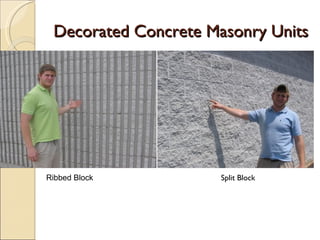
Decorated Concrete Masonry Units Split Block Ribbed Block
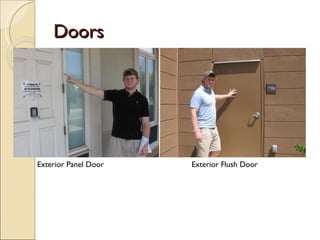
Doors Exterior Panel Door Exterior Flush Door
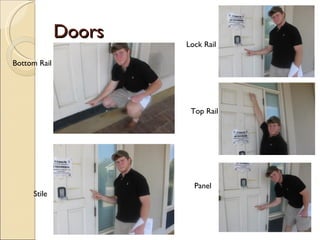
Doors Bottom Rail Stile Panel Top Rail Lock Rail
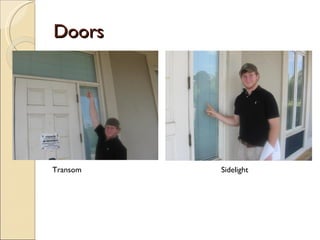
Doors Sidelight Transom Sidelight
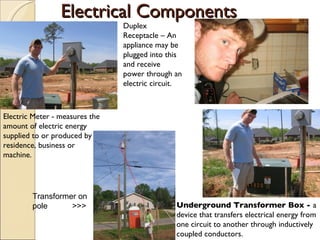
Electrical Components Underground Transformer Box -  a device that transfers electrical energy from one circuit to another through inductively coupled conductors.  Duplex Receptacle – An appliance may be plugged into this and receive power through an electric circuit. Electric Meter - measures the amount of electric energy supplied to or produced by a residence, business or machine. Transformer on pole  >>>
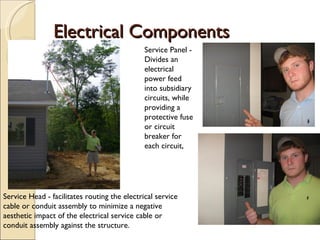
Electrical Components Service Panel - Divides an electrical power feed into subsidiary circuits, while providing a protective fuse or circuit breaker for each circuit,  Service Head - facilitates routing the electrical service cable or conduit assembly to minimize a negative aesthetic impact of the electrical service cable or conduit assembly against the structure.
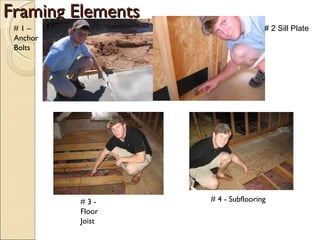
Framing Elements # 1 – Anchor Bolts # 4 - Subflooring # 3 -  Floor Joist # 2 Sill Plate
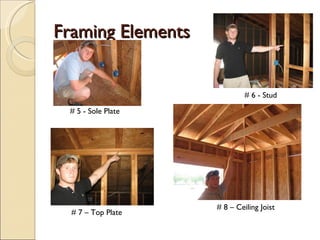
Framing Elements # 5 - Sole Plate # 7 – Top Plate # 6 - Stud # 8 – Ceiling Joist
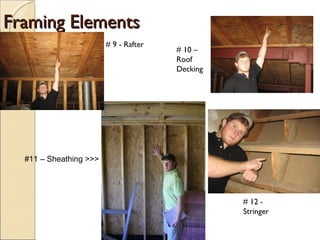
Framing Elements # 9 - Rafter # 10 – Roof Decking # 12 - Stringer #11 – Sheathing >>>
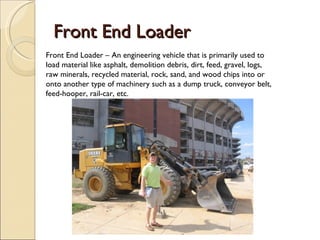
Front End Loader Front End Loader – An engineering vehicle that is primarily used to load   material like asphalt, demolition debris, dirt, feed, gravel, logs, raw minerals, recycled material, rock, sand, and wood chips into or onto another type of machinery such as a dump truck, conveyor belt, feed-hooper, rail-car, etc.
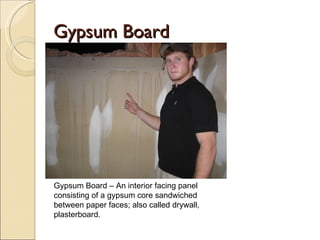
Gypsum Board Gypsum Board – An interior facing panel consisting of a gypsum core sandwiched between paper faces; also called drywall, plasterboard.
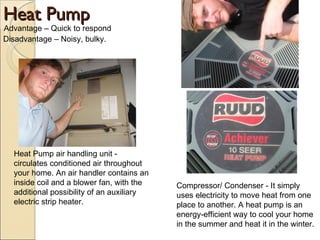
Heat Pump Advantage – Quick to respond Disadvantage – Noisy, bulky. Compressor/ Condenser - It simply uses electricity to move heat from one place to another. A heat pump is an energy-efficient way to cool your home in the summer and heat it in the winter.  Heat Pump air handling unit - circulates conditioned air throughout your home. An air handler contains an inside coil and a blower fan, with the additional possibility of an auxiliary electric strip heater.
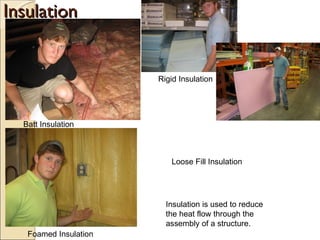
Insulation Batt Insulation Rigid Insulation Insulation is used to reduce the heat flow through the assembly of a structure. Foamed Insulation Loose Fill Insulation
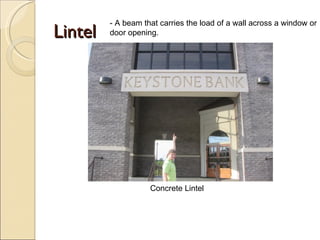
Lintel - A beam that carries the load of a wall across a window or door opening. Concrete Lintel
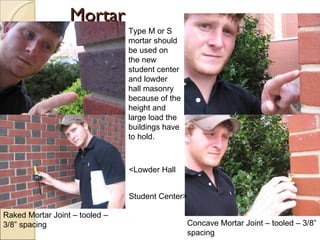
Mortar Raked Mortar Joint – tooled – 3/8” spacing Concave Mortar Joint – tooled – 3/8” spacing Type M or S mortar should be used on the new student center and lowder hall masonry because of the height and large load the buildings have to hold. <Lowder Hall Student Center>
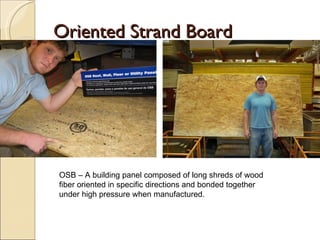
Oriented Strand Board OSB – A building panel composed of long shreds of wood fiber oriented in specific directions and bonded together under high pressure when manufactured.
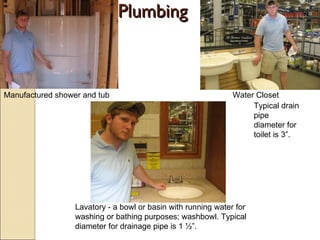
Plumbing Manufactured shower and tub Water Closet Lavatory - a bowl or basin with running water for washing or bathing purposes; washbowl. Typical diameter for drainage pipe is 1 ½”. Typical drain pipe diameter for toilet is 3”.
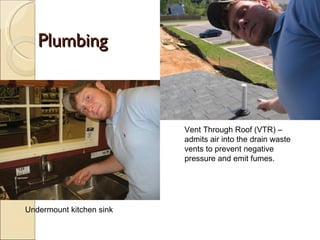
Plumbing Vent Through Roof (VTR) – admits air into the drain waste vents to prevent negative pressure and emit fumes. Undermount kitchen sink
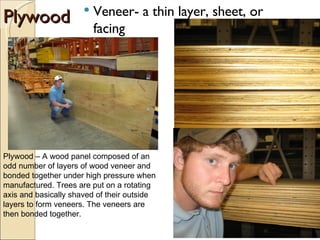
Plywood Veneer- a thin layer, sheet, or facing Plywood – A wood panel composed of an odd number of layers of wood veneer and bonded together under high pressure when manufactured. Trees are put on a rotating axis and basically shaved of their outside layers to form veneers. The veneers are then bonded together.
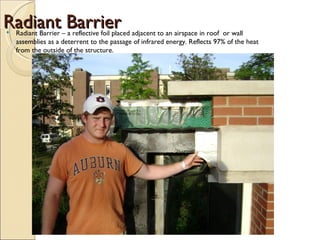
Radiant Barrier Radiant Barrier – a reflective foil placed adjacent to an airspace in roof  or wall assemblies as a deterrent to the passage of infrared energy. Reflects 97% of the heat from the outside of the structure.
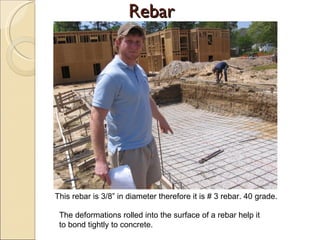
Rebar This rebar is 3/8” in diameter therefore it is # 3 rebar. 40 grade. The deformations rolled into the surface of a rebar help it to bond tightly to concrete.
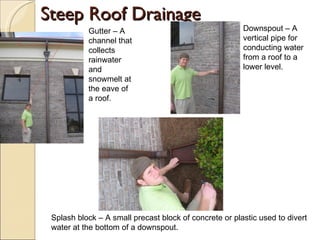
Steep Roof Drainage Gutter – A channel that collects rainwater and snowmelt at the eave of a roof. Downspout – A vertical pipe for conducting water from a roof to a lower level. Splash block – A small precast block of concrete or plastic used to divert water at the bottom of a downspout.
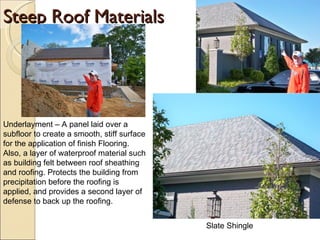
Steep Roof Materials Underlayment – A panel laid over a subfloor to create a smooth, stiff surface for the application of finish Flooring. Also, a layer of waterproof material such as building felt between roof sheathing and roofing. Protects the building from precipitation before the roofing is applied, and provides a second layer of defense to back up the roofing.  Slate Shingle
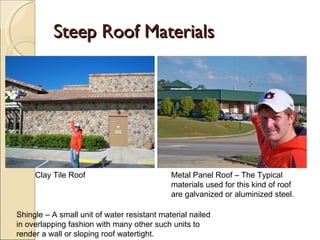
Steep Roof Materials Metal Panel Roof – The Typical materials used for this kind of roof are galvanized or aluminized steel. Clay Tile Roof Shingle – A small unit of water resistant material nailed in overlapping fashion with many other such units to render a wall or sloping roof watertight.
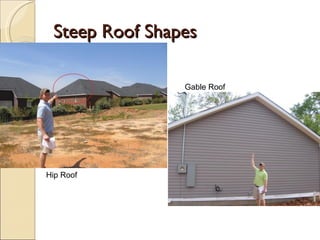
Steep Roof Shapes Hip Roof Gable Roof
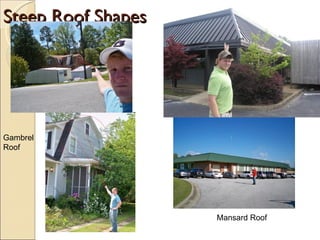
Steep Roof Shapes Gambrel Roof Mansard Roof
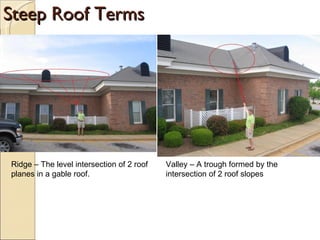
Steep Roof Terms Valley – A trough formed by the intersection of 2 roof slopes Ridge – The level intersection of 2 roof planes in a gable roof.
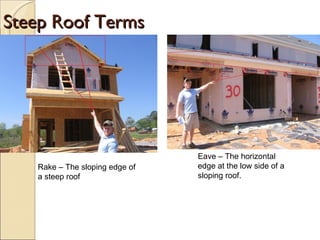
Steep Roof Terms Rake – The sloping edge of a steep roof Eave – The horizontal edge at the low side of a sloping roof.
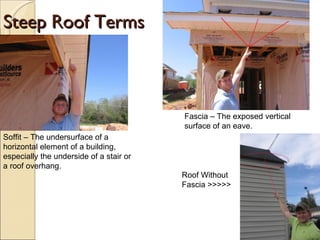
Steep Roof Terms Fascia – The exposed vertical surface of an eave. Soffit – The undersurface of a horizontal element of a building, especially the underside of a stair or a roof overhang. Roof Without Fascia >>>>>
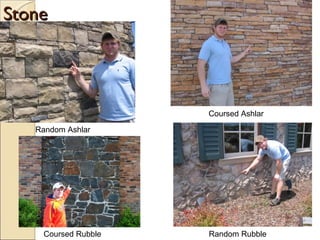
Stone Random Ashlar Coursed Ashlar Random Rubble Coursed Rubble
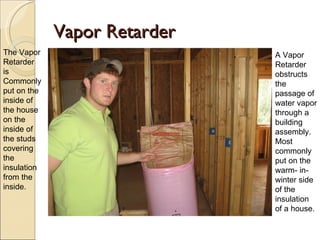
Vapor Retarder The Vapor Retarder is Commonly put on the inside of the house on the inside of the studs covering the insulation from the inside. A Vapor Retarder obstructs the passage of water vapor through a building assembly. Most commonly put on the warm- in-winter side of the insulation of a house.
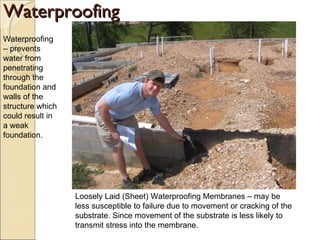
Waterproofing Waterproofing – prevents water from penetrating through the foundation and walls of the structure which could result in a weak foundation.  Loosely Laid (Sheet) Waterproofing Membranes – may be less susceptible to failure due to movement or cracking of the substrate. Since movement of the substrate is less likely to transmit stress into the membrane.
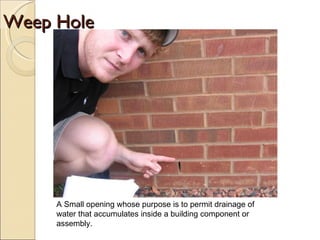
Weep Hole A Small opening whose purpose is to permit drainage of water that accumulates inside a building component or assembly.
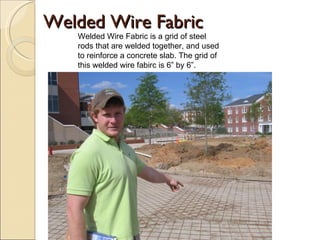
Welded Wire Fabric Welded Wire Fabric is a grid of steel rods that are welded together, and used to reinforce a concrete slab. The grid of this welded wire fabirc is 6” by 6”.
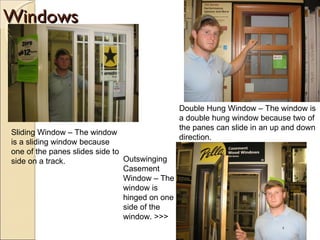
Windows Outswinging Casement Window – The window is hinged on one side of the window. >>> Sliding Window – The window is a sliding window because one of the panes slides side to side on a track. Double Hung Window – The window is a double hung window because two of the panes can slide in an up and down direction.

Visual Dictionary - Damper

  • 1.
    Visual Dictionary ZackWaddell Materials And Methods I MWF 11:00 am
  • 2.
    Air Barrier PaperA plastic or foil sheet, that resists diffusion of moisture through walls, ceilings and floor assemblies. The Air Barrier is nailed to the walls of the apartment succeeding in preventing moisture from penetrating through the walls of the apartment.
  • 3.
    Attic Ventilation TheGable Vent is needed to exhaust excess heat and humidity from an attic. The Roof Turbine is needed to replace hot air from the attic using outside wind.
  • 4.
    Attic Ventilation TheSoffit vent is needed to allow air to flow into the attic or the space below the roof sheathing. The ridge vent is needed to allow air to circulate in and out of a gable roof at the ridge.
  • 5.
    Backhoe 16” BucketThe backhoe is used to dig and excavate the earth in order to lay plumbers pipes, conduits, and various kinds of materials. Also used to completely alter elevations and move dirt in massive quantities. The Backhoe is a piece of excavating equipment consisting of a digging bucket on the end of a two-part articulated arm.
  • 6.
    Batter Boards ATemporary Frame built just outside the corner of an excavation to carry marks that lie on the surface planes of the basement that will be built in the excavation.
  • 7.
    Brick Arches RomanArch Jack Arch Centering is a temporary framework for an arch, dome or vault. Arch with Keystone >>>>>>>>>>>>>>
  • 8.
    Brick Bonds RunningBond – Brickwork consisting entirely of stretchers. Flemish Bond – A bond consisting of a layer of stretchers above and below a layer of alternating stretchers and headers.
  • 9.
    Brick Bonds RowlockHeader Soldier
  • 10.
    Brick Bonds Sailor>>>> Stretcher Rowlock
  • 11.
    Brick Sizes ModularBrick – 3 5/8” x 2 ¼” x 7 5/8” Utility - 3 5/8” x 3 ½” x 11 ½”
  • 12.
    Bulldozer A Bulldozeris a crawler equipped with a substantial metal bucket used to push large quantities of soil, sand, rubble, etc., during construction work.
  • 13.
    Cladding Brick CladdingWood Board Cladding Stone Cladding – Random Ashlar Wood Shingle Cladding ^^^^^ Wood shingle – sawn in squares. Wood Shakes – Split, with a rough corrugated surface. EIFS
  • 14.
    Code Requirements Aminimum clear opening of 5.7 square feet. If it’s on the ground floor, a minimum of 5.0 square feet. Minimum clear opening height of 24” Minimum clear opening width of 20” Bottom of clear opening not more than 44” AFF If bedroom is in the basement: Window well of 9 sq. ft. (36” min. dimension) My bedroom window passes the IBC requirements. It has 17.5 sq. ft. of window and 8.75 sq. ft. of clear opening which is more than required. The opening height is 30” which is more than required. A clear opening width of 36” which is more than required. The bottom of the clear opening is 24” AFF, which is also acceptable. IBC Requirements:
  • 15.
    Code Requirements TheIBC requires the tread of a staircase to be at least 10”, and the riser to be at a maximum of 7 ¾”. The staircase in the picture does meet the IBC requirement because the riser measured to be 7 ¼”, which is less that the maximum height, and the tread measured 10 ¾”, which is more than the minimum length required.
  • 16.
    Concrete Joints ControlJoint – An intentional, linear continuity in a structure or component, designed to form a plane of weakness where cracking can occur in response to various forces so as to minimize or eliminate cracking elsewhere in the structure. Isolation Joints completely isolate the forces of shrinking and expanding within a foundation of a column, drain pipe, etc., from the rest of the slab and foundation. This isolation joint is isolating the forces between the slab and the column.
  • 17.
    Concrete Masonry UnitCMU – A block of hardened concrete, with or without hollow cores, designed to be laid in the same manner as brick or stone; a concrete block. CMUs are easily and economically manufactured in an unending variety of surface patterns, textures, and colors intended for exposed use in interior and exterior walls. The most common block size is nominally 8” x 8” x 16”. The actual size of the block is 7 5/8” x 7 5/8” x 15 5/8”.
  • 18.
    Decorated Concrete MasonryUnits Split Block Ribbed Block
  • 19.
    Doors Exterior PanelDoor Exterior Flush Door
  • 20.
    Doors Bottom RailStile Panel Top Rail Lock Rail
  • 21.
  • 22.
    Electrical Components UndergroundTransformer Box - a device that transfers electrical energy from one circuit to another through inductively coupled conductors. Duplex Receptacle – An appliance may be plugged into this and receive power through an electric circuit. Electric Meter - measures the amount of electric energy supplied to or produced by a residence, business or machine. Transformer on pole >>>
  • 23.
    Electrical Components ServicePanel - Divides an electrical power feed into subsidiary circuits, while providing a protective fuse or circuit breaker for each circuit, Service Head - facilitates routing the electrical service cable or conduit assembly to minimize a negative aesthetic impact of the electrical service cable or conduit assembly against the structure.
  • 24.
    Framing Elements #1 – Anchor Bolts # 4 - Subflooring # 3 - Floor Joist # 2 Sill Plate
  • 25.
    Framing Elements #5 - Sole Plate # 7 – Top Plate # 6 - Stud # 8 – Ceiling Joist
  • 26.
    Framing Elements #9 - Rafter # 10 – Roof Decking # 12 - Stringer #11 – Sheathing >>>
  • 27.
    Front End LoaderFront End Loader – An engineering vehicle that is primarily used to load material like asphalt, demolition debris, dirt, feed, gravel, logs, raw minerals, recycled material, rock, sand, and wood chips into or onto another type of machinery such as a dump truck, conveyor belt, feed-hooper, rail-car, etc.
  • 28.
    Gypsum Board GypsumBoard – An interior facing panel consisting of a gypsum core sandwiched between paper faces; also called drywall, plasterboard.
  • 29.
    Heat Pump Advantage– Quick to respond Disadvantage – Noisy, bulky. Compressor/ Condenser - It simply uses electricity to move heat from one place to another. A heat pump is an energy-efficient way to cool your home in the summer and heat it in the winter. Heat Pump air handling unit - circulates conditioned air throughout your home. An air handler contains an inside coil and a blower fan, with the additional possibility of an auxiliary electric strip heater.
  • 30.
    Insulation Batt InsulationRigid Insulation Insulation is used to reduce the heat flow through the assembly of a structure. Foamed Insulation Loose Fill Insulation
  • 31.
    Lintel - Abeam that carries the load of a wall across a window or door opening. Concrete Lintel
  • 32.
    Mortar Raked MortarJoint – tooled – 3/8” spacing Concave Mortar Joint – tooled – 3/8” spacing Type M or S mortar should be used on the new student center and lowder hall masonry because of the height and large load the buildings have to hold. <Lowder Hall Student Center>
  • 33.
    Oriented Strand BoardOSB – A building panel composed of long shreds of wood fiber oriented in specific directions and bonded together under high pressure when manufactured.
  • 34.
    Plumbing Manufactured showerand tub Water Closet Lavatory - a bowl or basin with running water for washing or bathing purposes; washbowl. Typical diameter for drainage pipe is 1 ½”. Typical drain pipe diameter for toilet is 3”.
  • 35.
    Plumbing Vent ThroughRoof (VTR) – admits air into the drain waste vents to prevent negative pressure and emit fumes. Undermount kitchen sink
  • 36.
    Plywood Veneer- athin layer, sheet, or facing Plywood – A wood panel composed of an odd number of layers of wood veneer and bonded together under high pressure when manufactured. Trees are put on a rotating axis and basically shaved of their outside layers to form veneers. The veneers are then bonded together.
  • 37.
    Radiant Barrier RadiantBarrier – a reflective foil placed adjacent to an airspace in roof or wall assemblies as a deterrent to the passage of infrared energy. Reflects 97% of the heat from the outside of the structure.
  • 38.
    Rebar This rebaris 3/8” in diameter therefore it is # 3 rebar. 40 grade. The deformations rolled into the surface of a rebar help it to bond tightly to concrete.
  • 39.
    Steep Roof DrainageGutter – A channel that collects rainwater and snowmelt at the eave of a roof. Downspout – A vertical pipe for conducting water from a roof to a lower level. Splash block – A small precast block of concrete or plastic used to divert water at the bottom of a downspout.
  • 40.
    Steep Roof MaterialsUnderlayment – A panel laid over a subfloor to create a smooth, stiff surface for the application of finish Flooring. Also, a layer of waterproof material such as building felt between roof sheathing and roofing. Protects the building from precipitation before the roofing is applied, and provides a second layer of defense to back up the roofing. Slate Shingle
  • 41.
    Steep Roof MaterialsMetal Panel Roof – The Typical materials used for this kind of roof are galvanized or aluminized steel. Clay Tile Roof Shingle – A small unit of water resistant material nailed in overlapping fashion with many other such units to render a wall or sloping roof watertight.
  • 42.
    Steep Roof ShapesHip Roof Gable Roof
  • 43.
    Steep Roof ShapesGambrel Roof Mansard Roof
  • 44.
    Steep Roof TermsValley – A trough formed by the intersection of 2 roof slopes Ridge – The level intersection of 2 roof planes in a gable roof.
  • 45.
    Steep Roof TermsRake – The sloping edge of a steep roof Eave – The horizontal edge at the low side of a sloping roof.
  • 46.
    Steep Roof TermsFascia – The exposed vertical surface of an eave. Soffit – The undersurface of a horizontal element of a building, especially the underside of a stair or a roof overhang. Roof Without Fascia >>>>>
  • 47.
    Stone Random AshlarCoursed Ashlar Random Rubble Coursed Rubble
  • 48.
    Vapor Retarder TheVapor Retarder is Commonly put on the inside of the house on the inside of the studs covering the insulation from the inside. A Vapor Retarder obstructs the passage of water vapor through a building assembly. Most commonly put on the warm- in-winter side of the insulation of a house.
  • 49.
    Waterproofing Waterproofing –prevents water from penetrating through the foundation and walls of the structure which could result in a weak foundation. Loosely Laid (Sheet) Waterproofing Membranes – may be less susceptible to failure due to movement or cracking of the substrate. Since movement of the substrate is less likely to transmit stress into the membrane.
  • 50.
    Weep Hole ASmall opening whose purpose is to permit drainage of water that accumulates inside a building component or assembly.
  • 51.
    Welded Wire FabricWelded Wire Fabric is a grid of steel rods that are welded together, and used to reinforce a concrete slab. The grid of this welded wire fabirc is 6” by 6”.
  • 52.
    Windows Outswinging CasementWindow – The window is hinged on one side of the window. >>> Sliding Window – The window is a sliding window because one of the panes slides side to side on a track. Double Hung Window – The window is a double hung window because two of the panes can slide in an up and down direction.