Download as PDF, PPTX


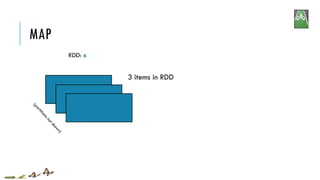
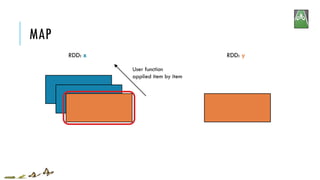
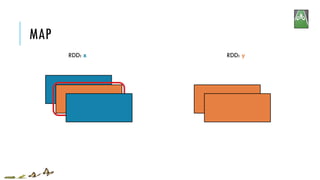
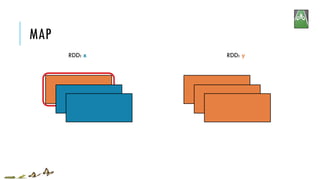
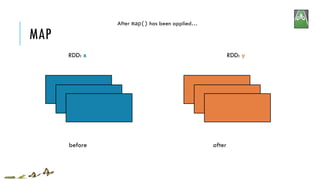
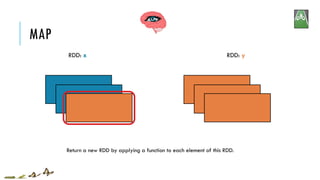
![MAP
x = sc.parallelize(["b", "a", "c"])
y = x.map(lambda z: (z, 1))
print(x.collect())
print(y.collect())
['b', 'a', 'c']
[('b', 1), ('a', 1), ('c', 1)]
RDD: x RDD: y
x:
y:
map(f, preservesPartitioning=False)
Return a new RDD by applying a function to each element of this RDD
val x = sc.parallelize(Array("b", "a", "c"))
val y = x.map(z => (z,1))
println(x.collect().mkString(", "))
println(y.collect().mkString(", "))](https://image.slidesharecdn.com/pv3eq2bkss2fnpowpuhc-signature-c13fa8381260c4198d0a50a5c0cb78109458356025efaebd34e758e3c8d2c4bb-poli-150626181840-lva1-app6891/85/Visual-Api-Training-19-320.jpg)
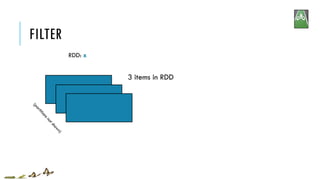
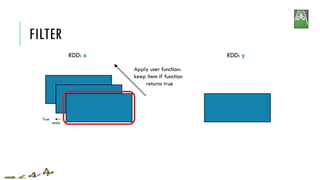
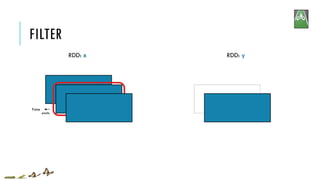
![FILTER
x = sc.parallelize([1,2,3])
y = x.filter(lambda x: x%2 == 1) #keep odd values
print(x.collect())
print(y.collect())
[1, 2, 3]
[1, 3]
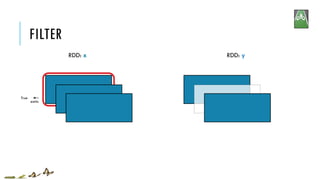
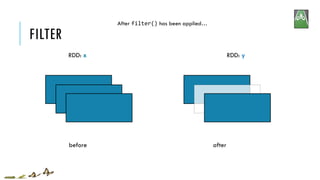
RDD: x RDD: y
x:
y:
filter(f)
Return a new RDD containing only the elements that satisfy a predicate
val x = sc.parallelize(Array(1,2,3))
val y = x.filter(n => n%2 == 1)
println(x.collect().mkString(", "))
println(y.collect().mkString(", "))](https://image.slidesharecdn.com/pv3eq2bkss2fnpowpuhc-signature-c13fa8381260c4198d0a50a5c0cb78109458356025efaebd34e758e3c8d2c4bb-poli-150626181840-lva1-app6891/85/Visual-Api-Training-25-320.jpg)
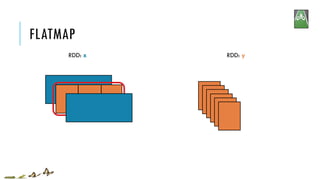
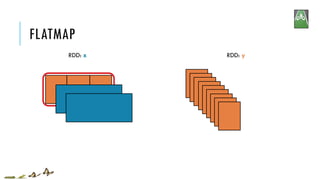
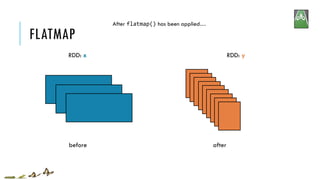
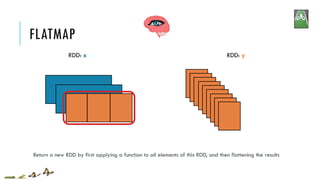
![FLATMAP
x = sc.parallelize([1,2,3])
y = x.flatMap(lambda x: (x, x*100, 42))
print(x.collect())
print(y.collect())
[1, 2, 3]
[1, 100, 42, 2, 200, 42, 3, 300, 42]
x:
y:
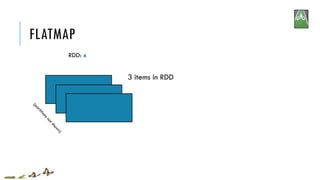
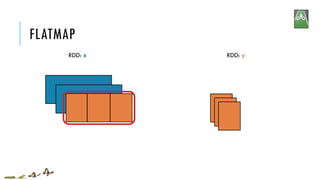
RDD: x RDD: y
flatMap(f, preservesPartitioning=False)
Return a new RDD by first applying a function to all elements of this RDD, and then flattening the results
val x = sc.parallelize(Array(1,2,3))
val y = x.flatMap(n => Array(n, n*100, 42))
println(x.collect().mkString(", "))
println(y.collect().mkString(", "))](https://image.slidesharecdn.com/pv3eq2bkss2fnpowpuhc-signature-c13fa8381260c4198d0a50a5c0cb78109458356025efaebd34e758e3c8d2c4bb-poli-150626181840-lva1-app6891/85/Visual-Api-Training-32-320.jpg)
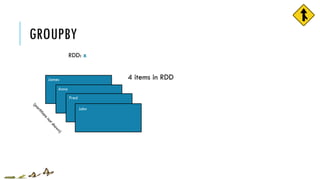
![GROUPBY
RDD: x
James
Anna
Fred
John
emits‘J’
J [ “John” ]
RDD: y](https://image.slidesharecdn.com/pv3eq2bkss2fnpowpuhc-signature-c13fa8381260c4198d0a50a5c0cb78109458356025efaebd34e758e3c8d2c4bb-poli-150626181840-lva1-app6891/85/Visual-Api-Training-34-320.jpg)
![F [ “Fred” ]
GROUPBY
RDD: x
James
Anna
Fred
emits‘F’
J [ “John” ]John
RDD: y](https://image.slidesharecdn.com/pv3eq2bkss2fnpowpuhc-signature-c13fa8381260c4198d0a50a5c0cb78109458356025efaebd34e758e3c8d2c4bb-poli-150626181840-lva1-app6891/85/Visual-Api-Training-35-320.jpg)
![[ “Fred” ]
GROUPBY
RDD: x
James
Anna
emits‘A’
J [ “John” ]
A [ “Anna” ]
Fred
John
F
RDD: y](https://image.slidesharecdn.com/pv3eq2bkss2fnpowpuhc-signature-c13fa8381260c4198d0a50a5c0cb78109458356025efaebd34e758e3c8d2c4bb-poli-150626181840-lva1-app6891/85/Visual-Api-Training-36-320.jpg)
![[ “Fred” ]
GROUPBY
RDD: x
James
Anna
emits‘J’
J [ “John”, “James” ]
[ “Anna” ]
Fred
John
F
A
RDD: y](https://image.slidesharecdn.com/pv3eq2bkss2fnpowpuhc-signature-c13fa8381260c4198d0a50a5c0cb78109458356025efaebd34e758e3c8d2c4bb-poli-150626181840-lva1-app6891/85/Visual-Api-Training-37-320.jpg)
![GROUPBY
x = sc.parallelize(['John', 'Fred', 'Anna', 'James'])
y = x.groupBy(lambda w: w[0])
print [(k, list(v)) for (k, v) in y.collect()]
['John', 'Fred', 'Anna', 'James']
[('A',['Anna']),('J',['John','James']),('F',['Fred'])]
RDD: x RDD: y
x:
y:
groupBy(f, numPartitions=None)
Group the data in the original RDD. Create pairs where the key is the output of
a user function, and the value is all items for which the function yields this key.
val x = sc.parallelize(
Array("John", "Fred", "Anna", "James"))
val y = x.groupBy(w => w.charAt(0))
println(y.collect().mkString(", "))](https://image.slidesharecdn.com/pv3eq2bkss2fnpowpuhc-signature-c13fa8381260c4198d0a50a5c0cb78109458356025efaebd34e758e3c8d2c4bb-poli-150626181840-lva1-app6891/85/Visual-Api-Training-38-320.jpg)
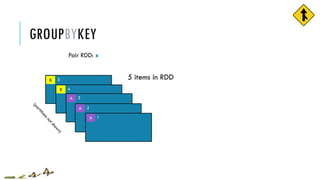
![GROUPBYKEY
Pair RDD: x
5
4
3
2
1
RDD: y
A [ 2 , 3 , 1 ]
B
B
A
A
A](https://image.slidesharecdn.com/pv3eq2bkss2fnpowpuhc-signature-c13fa8381260c4198d0a50a5c0cb78109458356025efaebd34e758e3c8d2c4bb-poli-150626181840-lva1-app6891/85/Visual-Api-Training-40-320.jpg)
![GROUPBYKEY
Pair RDD: x RDD: y
B [ 5 , 4 ]
A [ 2 , 3 , 1 ]
5
4
3
2
1
B
B
A
A
A](https://image.slidesharecdn.com/pv3eq2bkss2fnpowpuhc-signature-c13fa8381260c4198d0a50a5c0cb78109458356025efaebd34e758e3c8d2c4bb-poli-150626181840-lva1-app6891/85/Visual-Api-Training-41-320.jpg)
![GROUPBYKEY
x = sc.parallelize([('B',5),('B',4),('A',3),('A',2),('A',1)])
y = x.groupByKey()
print(x.collect())
print(list((j[0], list(j[1])) for j in y.collect()))
[('B', 5),('B', 4),('A', 3),('A', 2),('A', 1)]
[('A', [2, 3, 1]),('B',[5, 4])]
RDD: x RDD: y
x:
y:
groupByKey(numPartitions=None)
Group the values for each key in the original RDD. Create a new pair where the
original key corresponds to this collected group of values.
val x = sc.parallelize(
Array(('B',5),('B',4),('A',3),('A',2),('A',1)))
val y = x.groupByKey()
println(x.collect().mkString(", "))
println(y.collect().mkString(", "))](https://image.slidesharecdn.com/pv3eq2bkss2fnpowpuhc-signature-c13fa8381260c4198d0a50a5c0cb78109458356025efaebd34e758e3c8d2c4bb-poli-150626181840-lva1-app6891/85/Visual-Api-Training-42-320.jpg)
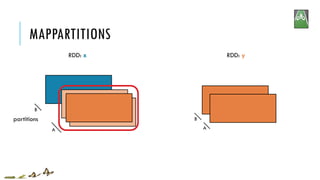
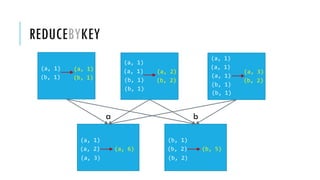
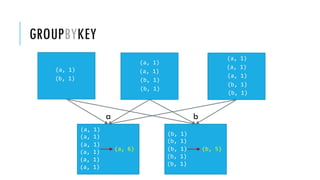
![MAPPARTITIONS
x:
y:
mapPartitions(f, preservesPartitioning=False)
Return a new RDD by applying a function to each partition of this RDD
A
B
A
B
x = sc.parallelize([1,2,3], 2)
def f(iterator): yield sum(iterator); yield 42
y = x.mapPartitions(f)
# glom() flattens elements on the same partition
print(x.glom().collect())
print(y.glom().collect())
[[1], [2, 3]]
[[1, 42], [5, 42]]](https://image.slidesharecdn.com/pv3eq2bkss2fnpowpuhc-signature-c13fa8381260c4198d0a50a5c0cb78109458356025efaebd34e758e3c8d2c4bb-poli-150626181840-lva1-app6891/85/Visual-Api-Training-47-320.jpg)
![MAPPARTITIONS
x:
y:
mapPartitions(f, preservesPartitioning=False)
Return a new RDD by applying a function to each partition of this RDD
A
B
A
B
Array(Array(1), Array(2, 3))
Array(Array(1, 42), Array(5, 42))
val x = sc.parallelize(Array(1,2,3), 2)
def f(i:Iterator[Int])={ (i.sum,42).productIterator }
val y = x.mapPartitions(f)
// glom() flattens elements on the same partition
val xOut = x.glom().collect()
val yOut = y.glom().collect()](https://image.slidesharecdn.com/pv3eq2bkss2fnpowpuhc-signature-c13fa8381260c4198d0a50a5c0cb78109458356025efaebd34e758e3c8d2c4bb-poli-150626181840-lva1-app6891/85/Visual-Api-Training-48-320.jpg)
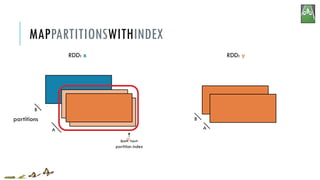
![x:
y:
mapPartitionsWithIndex(f, preservesPartitioning=False)
Return a new RDD by applying a function to each partition of this RDD,
while tracking the index of the original partition
A
B
A
B
x = sc.parallelize([1,2,3], 2)
def f(partitionIndex, iterator): yield (partitionIndex, sum(iterator))
y = x.mapPartitionsWithIndex(f)
# glom() flattens elements on the same partition
print(x.glom().collect())
print(y.glom().collect())
[[1], [2, 3]]
[[0, 1], [1, 5]]
MAPPARTITIONSWITHINDEX
partition index
B A](https://image.slidesharecdn.com/pv3eq2bkss2fnpowpuhc-signature-c13fa8381260c4198d0a50a5c0cb78109458356025efaebd34e758e3c8d2c4bb-poli-150626181840-lva1-app6891/85/Visual-Api-Training-50-320.jpg)
![x:
y:
mapPartitionsWithIndex(f, preservesPartitioning=False)
Return a new RDD by applying a function to each partition of this RDD,
while tracking the index of the original partition.
A
B
A
B
Array(Array(1), Array(2, 3))
Array(Array(0, 1), Array(1, 5))
MAPPARTITIONSWITHINDEX
partition index
B A
val x = sc.parallelize(Array(1,2,3), 2)
def f(partitionIndex:Int, i:Iterator[Int]) = {
(partitionIndex, i.sum).productIterator
}
val y = x.mapPartitionsWithIndex(f)
// glom() flattens elements on the same partition
val xOut = x.glom().collect()
val yOut = y.glom().collect()](https://image.slidesharecdn.com/pv3eq2bkss2fnpowpuhc-signature-c13fa8381260c4198d0a50a5c0cb78109458356025efaebd34e758e3c8d2c4bb-poli-150626181840-lva1-app6891/85/Visual-Api-Training-51-320.jpg)
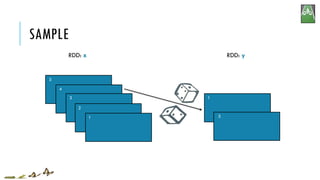
![SAMPLE
x = sc.parallelize([1, 2, 3, 4, 5])
y = x.sample(False, 0.4, 42)
print(x.collect())
print(y.collect())
[1, 2, 3, 4, 5]
[1, 3]
RDD: x RDD: y
x:
y:
sample(withReplacement, fraction, seed=None)
Return a new RDD containing a statistical sample of the original RDD
val x = sc.parallelize(Array(1, 2, 3, 4, 5))
val y = x.sample(false, 0.4)
// omitting seed will yield different output
println(y.collect().mkString(", "))](https://image.slidesharecdn.com/pv3eq2bkss2fnpowpuhc-signature-c13fa8381260c4198d0a50a5c0cb78109458356025efaebd34e758e3c8d2c4bb-poli-150626181840-lva1-app6891/85/Visual-Api-Training-53-320.jpg)
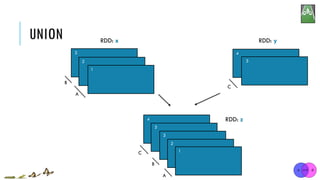
![UNION
x = sc.parallelize([1,2,3], 2)
y = sc.parallelize([3,4], 1)
z = x.union(y)
print(z.glom().collect())
[1, 2, 3]
[3, 4]
[[1], [2, 3], [3, 4]]
x:
y:
union(otherRDD)
Return a new RDD containing all items from two original RDDs. Duplicates are not culled.
val x = sc.parallelize(Array(1,2,3), 2)
val y = sc.parallelize(Array(3,4), 1)
val z = x.union(y)
val zOut = z.glom().collect()
z:](https://image.slidesharecdn.com/pv3eq2bkss2fnpowpuhc-signature-c13fa8381260c4198d0a50a5c0cb78109458356025efaebd34e758e3c8d2c4bb-poli-150626181840-lva1-app6891/85/Visual-Api-Training-55-320.jpg)
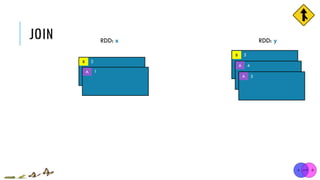
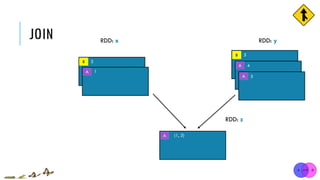
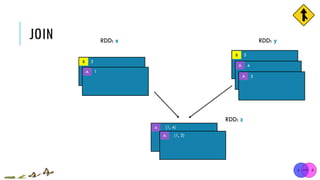
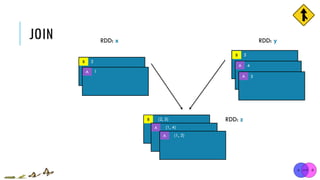
![JOIN
x = sc.parallelize([("a", 1), ("b", 2)])
y = sc.parallelize([("a", 3), ("a", 4), ("b", 5)])
z = x.join(y)
print(z.collect()) [("a", 1), ("b", 2)]
[("a", 3), ("a", 4), ("b", 5)]
[('a', (1, 3)), ('a', (1, 4)), ('b', (2, 5))]
x:
y:
union(otherRDD, numPartitions=None)
Return a new RDD containing all pairs of elements having the same key in the original RDDs
val x = sc.parallelize(Array(("a", 1), ("b", 2)))
val y = sc.parallelize(Array(("a", 3), ("a", 4), ("b", 5)))
val z = x.join(y)
println(z.collect().mkString(", "))
z:](https://image.slidesharecdn.com/pv3eq2bkss2fnpowpuhc-signature-c13fa8381260c4198d0a50a5c0cb78109458356025efaebd34e758e3c8d2c4bb-poli-150626181840-lva1-app6891/85/Visual-Api-Training-60-320.jpg)
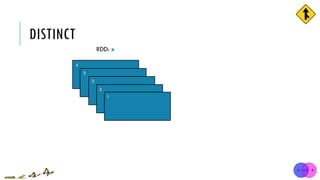
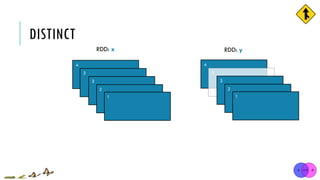
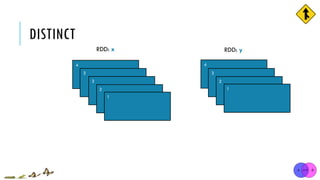
![DISTINCT
x = sc.parallelize([1,2,3,3,4])
y = x.distinct()
print(y.collect())
[1, 2, 3, 3, 4]
[1, 2, 3, 4]
x:
y:
distinct(numPartitions=None)
Return a new RDD containing distinct items from the original RDD (omitting all duplicates)
val x = sc.parallelize(Array(1,2,3,3,4))
val y = x.distinct()
println(y.collect().mkString(", "))
*
*
*¤
¤](https://image.slidesharecdn.com/pv3eq2bkss2fnpowpuhc-signature-c13fa8381260c4198d0a50a5c0cb78109458356025efaebd34e758e3c8d2c4bb-poli-150626181840-lva1-app6891/85/Visual-Api-Training-64-320.jpg)
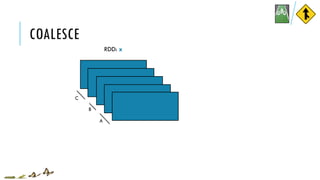
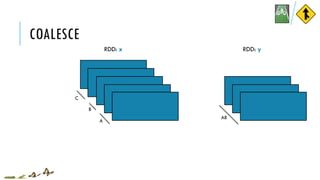
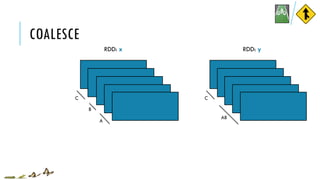
![COALESCE
x = sc.parallelize([1, 2, 3, 4, 5], 3)
y = x.coalesce(2)
print(x.glom().collect())
print(y.glom().collect())
[[1], [2, 3], [4, 5]]
[[1], [2, 3, 4, 5]]
x:
y:
coalesce(numPartitions, shuffle=False)
Return a new RDD which is reduced to a smaller number of partitions
val x = sc.parallelize(Array(1, 2, 3, 4, 5), 3)
val y = x.coalesce(2)
val xOut = x.glom().collect()
val yOut = y.glom().collect()
C
B
C
A
AB](https://image.slidesharecdn.com/pv3eq2bkss2fnpowpuhc-signature-c13fa8381260c4198d0a50a5c0cb78109458356025efaebd34e758e3c8d2c4bb-poli-150626181840-lva1-app6891/85/Visual-Api-Training-68-320.jpg)
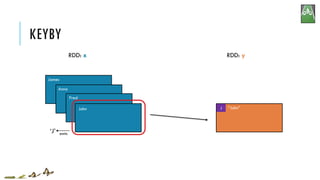
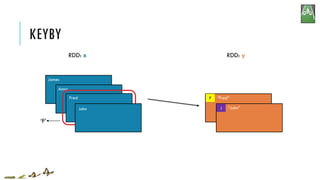
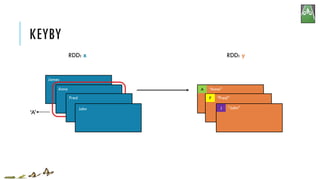
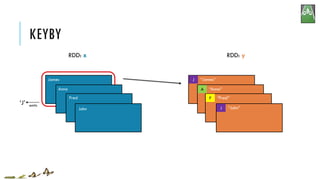
![KEYBY
x = sc.parallelize(['John', 'Fred', 'Anna', 'James'])
y = x.keyBy(lambda w: w[0])
print y.collect()
['John', 'Fred', 'Anna', 'James']
[('J','John'),('F','Fred'),('A','Anna'),('J','James')]
RDD: x RDD: y
x:
y:
keyBy(f)
Create a Pair RDD, forming one pair for each item in the original RDD. The
pair’s key is calculated from the value via a user-supplied function.
val x = sc.parallelize(
Array("John", "Fred", "Anna", "James"))
val y = x.keyBy(w => w.charAt(0))
println(y.collect().mkString(", "))](https://image.slidesharecdn.com/pv3eq2bkss2fnpowpuhc-signature-c13fa8381260c4198d0a50a5c0cb78109458356025efaebd34e758e3c8d2c4bb-poli-150626181840-lva1-app6891/85/Visual-Api-Training-73-320.jpg)
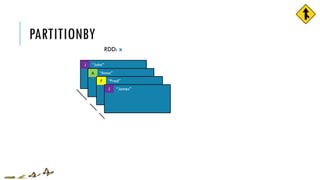
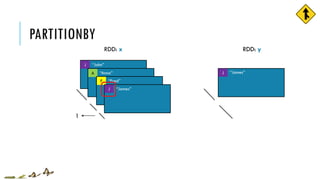
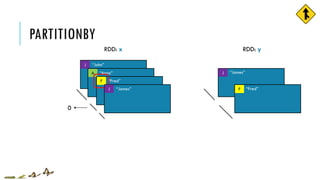
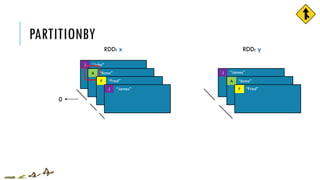
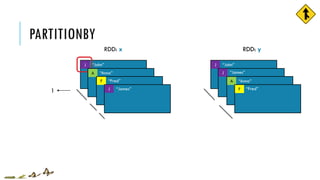
![PARTITIONBY
x = sc.parallelize([('J','James'),('F','Fred'),
('A','Anna'),('J','John')], 3)
y = x.partitionBy(2, lambda w: 0 if w[0] < 'H' else 1)
print x.glom().collect()
print y.glom().collect()
[[('J', 'James')], [('F', 'Fred')],
[('A', 'Anna'), ('J', 'John')]]
[[('A', 'Anna'), ('F', 'Fred')],
[('J', 'James'), ('J', 'John')]]
x:
y:
partitionBy(numPartitions, partitioner=portable_hash)
Return a new RDD with the specified number of partitions, placing original
items into the partition returned by a user supplied function](https://image.slidesharecdn.com/pv3eq2bkss2fnpowpuhc-signature-c13fa8381260c4198d0a50a5c0cb78109458356025efaebd34e758e3c8d2c4bb-poli-150626181840-lva1-app6891/85/Visual-Api-Training-79-320.jpg)
![PARTITIONBY
Array(Array((A,Anna), (F,Fred)),
Array((J,John), (J,James)))
Array(Array((F,Fred), (A,Anna)),
Array((J,John), (J,James)))
x:
y:
partitionBy(numPartitions, partitioner=portable_hash)
Return a new RDD with the specified number of partitions, placing original
items into the partition returned by a user supplied function.
import org.apache.spark.Partitioner
val x = sc.parallelize(Array(('J',"James"),('F',"Fred"),
('A',"Anna"),('J',"John")), 3)
val y = x.partitionBy(new Partitioner() {
val numPartitions = 2
def getPartition(k:Any) = {
if (k.asInstanceOf[Char] < 'H') 0 else 1
}
})
val yOut = y.glom().collect()](https://image.slidesharecdn.com/pv3eq2bkss2fnpowpuhc-signature-c13fa8381260c4198d0a50a5c0cb78109458356025efaebd34e758e3c8d2c4bb-poli-150626181840-lva1-app6891/85/Visual-Api-Training-80-320.jpg)
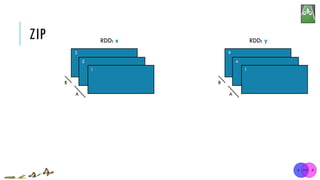
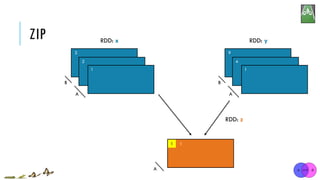
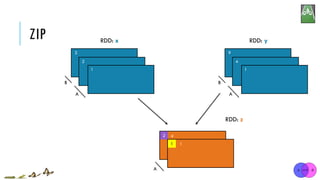
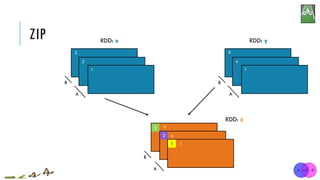
![ZIP
x = sc.parallelize([1, 2, 3])
y = x.map(lambda n:n*n)
z = x.zip(y)
print(z.collect()) [1, 2, 3]
[1, 4, 9]
[(1, 1), (2, 4), (3, 9)]
x:
y:
zip(otherRDD)
Return a new RDD containing pairs whose key is the item in the original RDD, and whose
value is that item’s corresponding element (same partition, same index) in a second RDD
val x = sc.parallelize(Array(1,2,3))
val y = x.map(n=>n*n)
val z = x.zip(y)
println(z.collect().mkString(", "))
z:](https://image.slidesharecdn.com/pv3eq2bkss2fnpowpuhc-signature-c13fa8381260c4198d0a50a5c0cb78109458356025efaebd34e758e3c8d2c4bb-poli-150626181840-lva1-app6891/85/Visual-Api-Training-85-320.jpg)


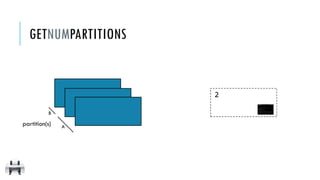
![x:
y:
getNumPartitions()
Return the number of partitions in RDD
[[1], [2, 3]]
2
GETNUMPARTITIONS
A
B
2
x = sc.parallelize([1,2,3], 2)
y = x.getNumPartitions()
print(x.glom().collect())
print(y)
val x = sc.parallelize(Array(1,2,3), 2)
val y = x.partitions.size
val xOut = x.glom().collect()
println(y)](https://image.slidesharecdn.com/pv3eq2bkss2fnpowpuhc-signature-c13fa8381260c4198d0a50a5c0cb78109458356025efaebd34e758e3c8d2c4bb-poli-150626181840-lva1-app6891/85/Visual-Api-Training-89-320.jpg)
![COLLECT
partition(s) A
B
[ ]](https://image.slidesharecdn.com/pv3eq2bkss2fnpowpuhc-signature-c13fa8381260c4198d0a50a5c0cb78109458356025efaebd34e758e3c8d2c4bb-poli-150626181840-lva1-app6891/85/Visual-Api-Training-90-320.jpg)
![x:
y:
collect()
Return all items in the RDD to the driver in a single list
[[1], [2, 3]]
[1, 2, 3]
A
B
x = sc.parallelize([1,2,3], 2)
y = x.collect()
print(x.glom().collect())
print(y)
val x = sc.parallelize(Array(1,2,3), 2)
val y = x.collect()
val xOut = x.glom().collect()
println(y)
COLLECT [ ]](https://image.slidesharecdn.com/pv3eq2bkss2fnpowpuhc-signature-c13fa8381260c4198d0a50a5c0cb78109458356025efaebd34e758e3c8d2c4bb-poli-150626181840-lva1-app6891/85/Visual-Api-Training-91-320.jpg)
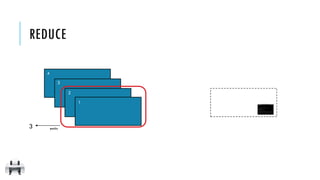
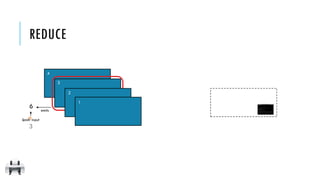
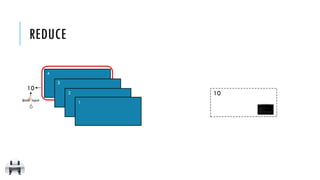
![x:
y:
reduce(f)
Aggregate all the elements of the RDD by applying a user function
pairwise to elements and partial results, and returns a result to the driver
[1, 2, 3, 4]
10
x = sc.parallelize([1,2,3,4])
y = x.reduce(lambda a,b: a+b)
print(x.collect())
print(y)
val x = sc.parallelize(Array(1,2,3,4))
val y = x.reduce((a,b) => a+b)
println(x.collect.mkString(", "))
println(y)
REDUCE
******
*
**
***](https://image.slidesharecdn.com/pv3eq2bkss2fnpowpuhc-signature-c13fa8381260c4198d0a50a5c0cb78109458356025efaebd34e758e3c8d2c4bb-poli-150626181840-lva1-app6891/85/Visual-Api-Training-95-320.jpg)
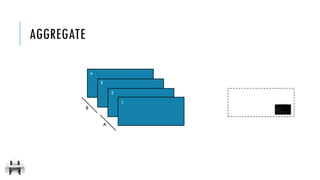
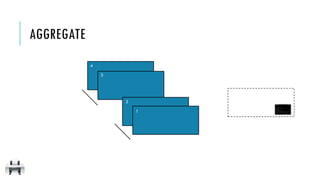
![AGGREGATE
3
2
1
4
emits
([], 0)
([1], 1)](https://image.slidesharecdn.com/pv3eq2bkss2fnpowpuhc-signature-c13fa8381260c4198d0a50a5c0cb78109458356025efaebd34e758e3c8d2c4bb-poli-150626181840-lva1-app6891/85/Visual-Api-Training-98-320.jpg)
![AGGREGATE
3
2
1
4
([], 0)
([2], 2)
([1], 1)](https://image.slidesharecdn.com/pv3eq2bkss2fnpowpuhc-signature-c13fa8381260c4198d0a50a5c0cb78109458356025efaebd34e758e3c8d2c4bb-poli-150626181840-lva1-app6891/85/Visual-Api-Training-99-320.jpg)
![AGGREGATE
3
2
1
4
([2], 2)
([1], 1)([1,2], 3)](https://image.slidesharecdn.com/pv3eq2bkss2fnpowpuhc-signature-c13fa8381260c4198d0a50a5c0cb78109458356025efaebd34e758e3c8d2c4bb-poli-150626181840-lva1-app6891/85/Visual-Api-Training-100-320.jpg)
![AGGREGATE
3
2
1
4
([2], 2)
([1], 1)([1,2], 3)
([3], 3)
([], 0)](https://image.slidesharecdn.com/pv3eq2bkss2fnpowpuhc-signature-c13fa8381260c4198d0a50a5c0cb78109458356025efaebd34e758e3c8d2c4bb-poli-150626181840-lva1-app6891/85/Visual-Api-Training-101-320.jpg)
![AGGREGATE
3
2
1
4
([2], 2)
([1], 1)([1,2], 3)
([3], 3)
([], 0)
([4], 4)](https://image.slidesharecdn.com/pv3eq2bkss2fnpowpuhc-signature-c13fa8381260c4198d0a50a5c0cb78109458356025efaebd34e758e3c8d2c4bb-poli-150626181840-lva1-app6891/85/Visual-Api-Training-102-320.jpg)
![AGGREGATE
3
2
1
4
([2], 2)
([1], 1)([1,2], 3)
([4], 4)
([3], 3)([3,4], 7)](https://image.slidesharecdn.com/pv3eq2bkss2fnpowpuhc-signature-c13fa8381260c4198d0a50a5c0cb78109458356025efaebd34e758e3c8d2c4bb-poli-150626181840-lva1-app6891/85/Visual-Api-Training-103-320.jpg)
![AGGREGATE
3
2
1
4
([2], 2)
([1], 1)([1,2], 3)
([4], 4)
([3], 3)([3,4], 7)](https://image.slidesharecdn.com/pv3eq2bkss2fnpowpuhc-signature-c13fa8381260c4198d0a50a5c0cb78109458356025efaebd34e758e3c8d2c4bb-poli-150626181840-lva1-app6891/85/Visual-Api-Training-104-320.jpg)
![AGGREGATE
3
2
1
4
([1,2], 3)
([3,4], 7)](https://image.slidesharecdn.com/pv3eq2bkss2fnpowpuhc-signature-c13fa8381260c4198d0a50a5c0cb78109458356025efaebd34e758e3c8d2c4bb-poli-150626181840-lva1-app6891/85/Visual-Api-Training-105-320.jpg)
![AGGREGATE
3
2
1
4
([1,2], 3)
([3,4], 7)
([1,2,3,4], 10)
([1,2,3,4], 10)](https://image.slidesharecdn.com/pv3eq2bkss2fnpowpuhc-signature-c13fa8381260c4198d0a50a5c0cb78109458356025efaebd34e758e3c8d2c4bb-poli-150626181840-lva1-app6891/85/Visual-Api-Training-106-320.jpg)
![aggregate(identity, seqOp, combOp)
Aggregate all the elements of the RDD by:
- applying a user function to combine elements with user-supplied objects,
- then combining those user-defined results via a second user function,
- and finally returning a result to the driver.
seqOp = lambda data, item: (data[0] + [item], data[1] + item)
combOp = lambda d1, d2: (d1[0] + d2[0], d1[1] + d2[1])
x = sc.parallelize([1,2,3,4])
y = x.aggregate(([], 0), seqOp, combOp)
print(y)
AGGREGATE
***
****
**
***
[( ),#]
x:
y:
[1, 2, 3, 4]
([1, 2, 3, 4], 10)](https://image.slidesharecdn.com/pv3eq2bkss2fnpowpuhc-signature-c13fa8381260c4198d0a50a5c0cb78109458356025efaebd34e758e3c8d2c4bb-poli-150626181840-lva1-app6891/85/Visual-Api-Training-107-320.jpg)
![def seqOp = (data:(Array[Int], Int), item:Int) =>
(data._1 :+ item, data._2 + item)
def combOp = (d1:(Array[Int], Int), d2:(Array[Int], Int)) =>
(d1._1.union(d2._1), d1._2 + d2._2)
val x = sc.parallelize(Array(1,2,3,4))
val y = x.aggregate((Array[Int](), 0))(seqOp, combOp)
println(y)
x:
y:
aggregate(identity, seqOp, combOp)
Aggregate all the elements of the RDD by:
- applying a user function to combine elements with user-supplied objects,
- then combining those user-defined results via a second user function,
- and finally returning a result to the driver.
[1, 2, 3, 4]
(Array(3, 1, 2, 4),10)
AGGREGATE
***
****
**
***
[( ),#]](https://image.slidesharecdn.com/pv3eq2bkss2fnpowpuhc-signature-c13fa8381260c4198d0a50a5c0cb78109458356025efaebd34e758e3c8d2c4bb-poli-150626181840-lva1-app6891/85/Visual-Api-Training-108-320.jpg)
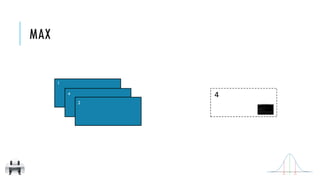
![x:
y:
max()
Return the maximum item in the RDD
[2, 4, 1]
4
MAX
4
x = sc.parallelize([2,4,1])
y = x.max()
print(x.collect())
print(y)
val x = sc.parallelize(Array(2,4,1))
val y = x.max
println(x.collect().mkString(", "))
println(y)
2
1
4
max](https://image.slidesharecdn.com/pv3eq2bkss2fnpowpuhc-signature-c13fa8381260c4198d0a50a5c0cb78109458356025efaebd34e758e3c8d2c4bb-poli-150626181840-lva1-app6891/85/Visual-Api-Training-110-320.jpg)
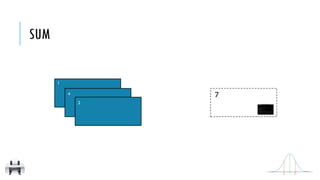
![x:
y:
sum()
Return the sum of the items in the RDD
[2, 4, 1]
7
SUM
7
x = sc.parallelize([2,4,1])
y = x.sum()
print(x.collect())
print(y)
val x = sc.parallelize(Array(2,4,1))
val y = x.sum
println(x.collect().mkString(", "))
println(y)
2
1
4
Σ](https://image.slidesharecdn.com/pv3eq2bkss2fnpowpuhc-signature-c13fa8381260c4198d0a50a5c0cb78109458356025efaebd34e758e3c8d2c4bb-poli-150626181840-lva1-app6891/85/Visual-Api-Training-112-320.jpg)
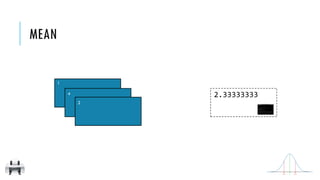
![x:
y:
mean()
Return the mean of the items in the RDD
[2, 4, 1]
2.3333333
MEAN
2.3333333
x = sc.parallelize([2,4,1])
y = x.mean()
print(x.collect())
print(y)
val x = sc.parallelize(Array(2,4,1))
val y = x.mean
println(x.collect().mkString(", "))
println(y)
2
1
4
x](https://image.slidesharecdn.com/pv3eq2bkss2fnpowpuhc-signature-c13fa8381260c4198d0a50a5c0cb78109458356025efaebd34e758e3c8d2c4bb-poli-150626181840-lva1-app6891/85/Visual-Api-Training-114-320.jpg)
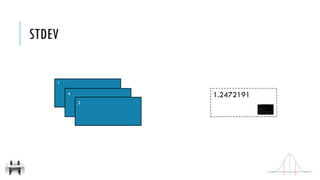
![x:
y:
stdev()
Return the standard deviation of the items in the RDD
[2, 4, 1]
1.2472191
STDEV
1.2472191
x = sc.parallelize([2,4,1])
y = x.stdev()
print(x.collect())
print(y)
val x = sc.parallelize(Array(2,4,1))
val y = x.stdev
println(x.collect().mkString(", "))
println(y)
2
1
4
σ](https://image.slidesharecdn.com/pv3eq2bkss2fnpowpuhc-signature-c13fa8381260c4198d0a50a5c0cb78109458356025efaebd34e758e3c8d2c4bb-poli-150626181840-lva1-app6891/85/Visual-Api-Training-116-320.jpg)
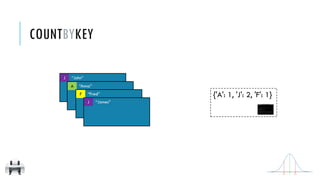
![x:
y:
countByKey()
Return a map of keys and counts of their occurrences in the RDD
[('J', 'James'), ('F','Fred'),
('A','Anna'), ('J','John')]
{'A': 1, 'J': 2, 'F': 1}
COUNTBYKEY
{A: 1, 'J': 2, 'F': 1}
x = sc.parallelize([('J', 'James'), ('F','Fred'),
('A','Anna'), ('J','John')])
y = x.countByKey()
print(y)
val x = sc.parallelize(Array(('J',"James"),('F',"Fred"),
('A',"Anna"),('J',"John")))
val y = x.countByKey()
println(y)](https://image.slidesharecdn.com/pv3eq2bkss2fnpowpuhc-signature-c13fa8381260c4198d0a50a5c0cb78109458356025efaebd34e758e3c8d2c4bb-poli-150626181840-lva1-app6891/85/Visual-Api-Training-118-320.jpg)
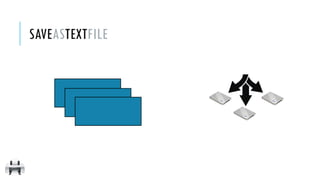
![x:
y:
saveAsTextFile(path, compressionCodecClass=None)
Save the RDD to the filesystem indicated in the path
[2, 4, 1]
[u'2', u'4', u'1']
SAVEASTEXTFILE
dbutils.fs.rm("/temp/demo", True)
x = sc.parallelize([2,4,1])
x.saveAsTextFile("/temp/demo")
y = sc.textFile("/temp/demo")
print(y.collect())
dbutils.fs.rm("/temp/demo", true)
val x = sc.parallelize(Array(2,4,1))
x.saveAsTextFile("/temp/demo")
val y = sc.textFile("/temp/demo")
println(y.collect().mkString(", "))](https://image.slidesharecdn.com/pv3eq2bkss2fnpowpuhc-signature-c13fa8381260c4198d0a50a5c0cb78109458356025efaebd34e758e3c8d2c4bb-poli-150626181840-lva1-app6891/85/Visual-Api-Training-120-320.jpg)


This document summarizes Jeff Thompson's contributions of Spark API visual diagrams to the Spark community under an open source license. It also describes how Databricks further developed the diagrams and commissioned Adam Breindel for this work. The document briefly mentions Databricks' background and products.


![제 23회 보아즈(BOAZ) 빅데이터 컨퍼런스 - [MBOAX] : ABSA를 활용한 소비자 반응 분석 기반 운영 효율화 대시보드 설계](https://cdn.slidesharecdn.com/ss_thumbnails/3-1boaz23rdconferencemboax-260203102709-9d519923-thumbnail.jpg?width=640&height=640&fit=bounds)


