Basics of RDD - More Operations
Basics of RDD
More Transformations
sample(withReplacement, fraction, [seed])
Sample an RDD, with or without replacement.
Basics of RDD
val seq = sc.parallelize(1 to 100, 5)
seq.sample(false, 0.1).collect();
[8, 19, 34, 37, 43, 51, 70, 83]
More Transformations
sample(withReplacement, fraction, [seed])
Sample an RDD, with or without replacement.
Basics of RDD
More Transformations
sample(withReplacement, fraction, [seed])
Sample an RDD, with or without replacement.
val seq = sc.parallelize(1 to 100, 5)
seq.sample(false, 0.1).collect();
[8, 19, 34, 37, 43, 51, 70, 83]
seq.sample(true, 0.1).collect();
[14, 26, 40, 47, 55, 67, 69, 69]
Please note that the result will be different on every run.
Basics of RDD
Common Transformations (continued..)
mapPartitions(f, preservesPartitioning=False)
Return a new RDD by applying a function to each partition of this RDD.
Basics of RDD
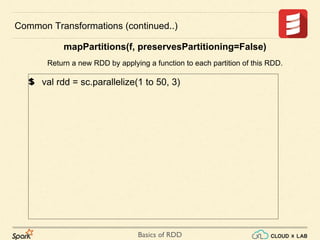
val rdd = sc.parallelize(1 to 50, 3)
Common Transformations (continued..)
mapPartitions(f, preservesPartitioning=False)
Return a new RDD by applying a function to each partition of this RDD.
Basics of RDD
val rdd = sc.parallelize(1 to 50, 3)
def f(l:Iterator[Int]):Iterator[Int] = {
var sum = 0
while(l.hasNext){
sum = sum + l.next
}
return List(sum).iterator
}
Common Transformations (continued..)
mapPartitions(f, preservesPartitioning=False)
Return a new RDD by applying a function to each partition of this RDD.
Basics of RDD
val rdd = sc.parallelize(1 to 50, 3)
def f(l:Iterator[Int]):Iterator[Int] = {
var sum = 0
while(l.hasNext){
sum = sum + l.next
}
return List(sum).iterator
}
rdd.mapPartitions(f).collect()
Array(136, 425, 714)
17, 17, 16
Common Transformations (continued..)
mapPartitions(f, preservesPartitioning=False)
Return a new RDD by applying a function to each partition of this RDD.
Basics of RDD
Common Transformations (continued..)
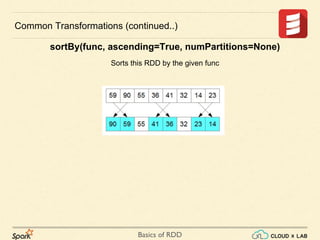
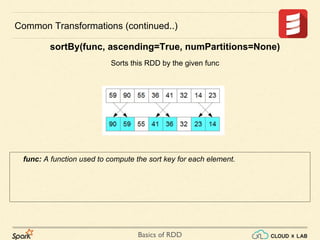
sortBy(func, ascending=True, numPartitions=None)
Sorts this RDD by the given func
Basics of RDD
func: A function used to compute the sort key for each element.
Common Transformations (continued..)
sortBy(func, ascending=True, numPartitions=None)
Sorts this RDD by the given func
Basics of RDD
Common Transformations (continued..)
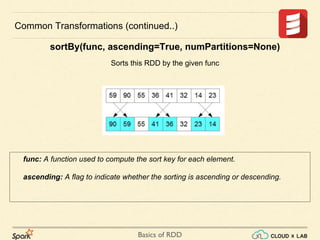
sortBy(func, ascending=True, numPartitions=None)
Sorts this RDD by the given func
func: A function used to compute the sort key for each element.
ascending: A flag to indicate whether the sorting is ascending or descending.
Basics of RDD
Common Transformations (continued..)
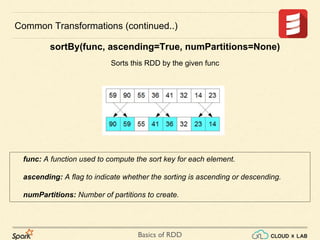
sortBy(func, ascending=True, numPartitions=None)
Sorts this RDD by the given func
func: A function used to compute the sort key for each element.
ascending: A flag to indicate whether the sorting is ascending or descending.
numPartitions: Number of partitions to create.
Basics of RDD
⋙ var tmp = List(('a', 1), ('b', 2), ('1', 3), ('d', 4), ('2', 5))
⋙ var rdd = sc.parallelize(tmp)
Common Transformations (continued..)
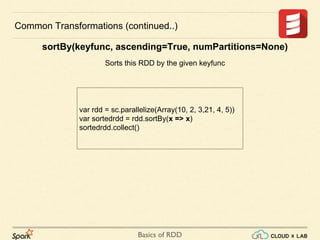
sortBy(keyfunc, ascending=True, numPartitions=None)
Sorts this RDD by the given keyfunc
Basics of RDD
⋙ var tmp = List(('a', 1), ('b', 2), ('1', 3), ('d', 4), ('2', 5))
⋙ var rdd = sc.parallelize(tmp)
⋙ rdd.sortBy(x => x._1).collect()
[('1', 3), ('2', 5), ('a', 1), ('b', 2), ('d', 4)]
Common Transformations (continued..)
sortBy(keyfunc, ascending=True, numPartitions=None)
Sorts this RDD by the given keyfunc
Basics of RDD
⋙ var tmp = List(('a', 1), ('b', 2), ('1', 3), ('d', 4), ('2', 5))
⋙ var rdd = sc.parallelize(tmp)
⋙ rdd.sortBy(x => x._2).collect()
[('a', 1), ('b', 2), ('1', 3), ('d', 4), ('2', 5)]
Common Transformations (continued..)
sortBy(keyfunc, ascending=True, numPartitions=None)
Sorts this RDD by the given keyfunc
Basics of RDD
Common Transformations (continued..)
sortBy(keyfunc, ascending=True, numPartitions=None)
Sorts this RDD by the given keyfunc
var rdd = sc.parallelize(Array(10, 2, 3,21, 4, 5))
var sortedrdd = rdd.sortBy(x => x)
sortedrdd.collect()
Basics of RDD
Common Transformations (continued..)
Pseudo set operations
Though RDD is not really a set but still the set operations try to provide you utility set functions
Basics of RDD
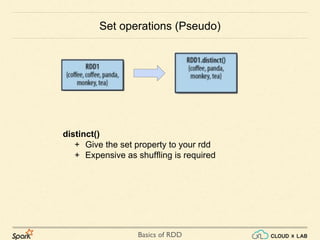
distinct()
+ Give the set property to your rdd
+ Expensive as shuffling is required
Set operations (Pseudo)
Basics of RDD
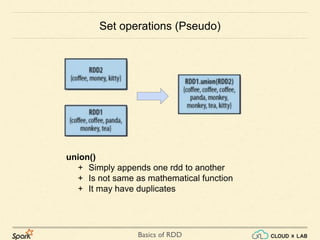
union()
+ Simply appends one rdd to another
+ Is not same as mathematical function
+ It may have duplicates
Set operations (Pseudo)
Basics of RDD
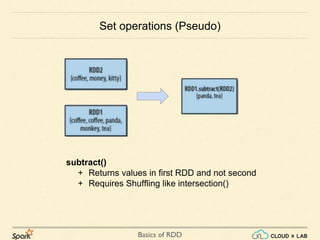
subtract()
+ Returns values in first RDD and not second
+ Requires Shuffling like intersection()
Set operations (Pseudo)
Basics of RDD
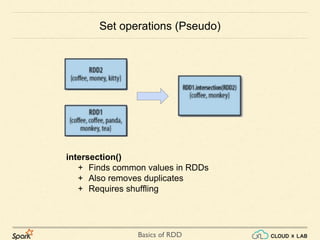
intersection()
+ Finds common values in RDDs
+ Also removes duplicates
+ Requires shuffling
Set operations (Pseudo)
Basics of RDD
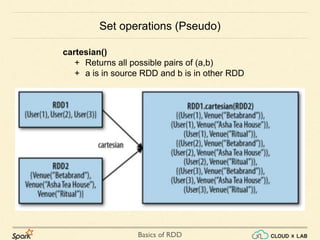
cartesian()
+ Returns all possible pairs of (a,b)
+ a is in source RDD and b is in other RDD
Set operations (Pseudo)
Basics of RDD
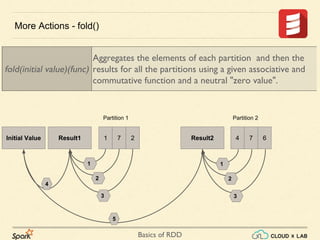
fold(initial value, func)
+ Very similar to reduce
+ Provides a little extra control over the
initialisation
+ Lets us specify an initial value
More Actions - fold()
Basics of RDD
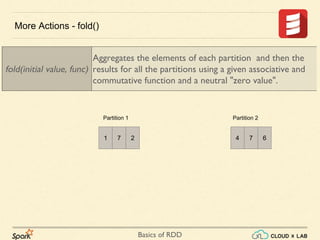
More Actions - fold()
fold(initial value, func)
Aggregates the elements of each partition and then the
results for all the partitions using a given associative and
commutative function and a neutral "zero value".
1 7 2 4 7 6
Partition 1 Partition 2
Basics of RDD
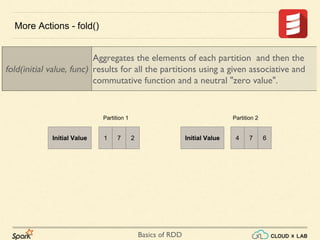
More Actions - fold()
fold(initial value, func)
Aggregates the elements of each partition and then the
results for all the partitions using a given associative and
commutative function and a neutral "zero value".
1 7 2 4 7 6
Partition 1 Partition 2
Initial Value Initial Value
Basics of RDD
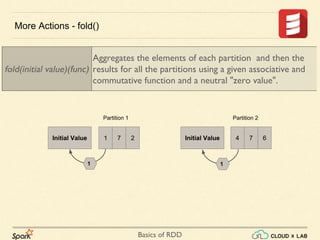
More Actions - fold()
fold(initial value)(func)
Aggregates the elements of each partition and then the
results for all the partitions using a given associative and
commutative function and a neutral "zero value".
Initial Value 1 7 2 4 7 6Initial Value
Partition 1 Partition 2
1 1
Basics of RDD
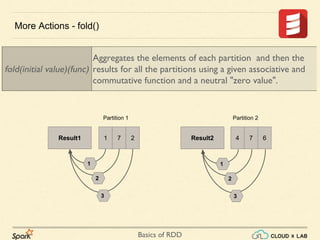
More Actions - fold()
fold(initial value)(func)
Aggregates the elements of each partition and then the
results for all the partitions using a given associative and
commutative function and a neutral "zero value".
Initial Value 1 7 2 4 7 6Initial Value
Partition 1 Partition 2
1
2
3
1
2
3
Result1 Result2
Basics of RDD
More Actions - fold()
fold(initial value)(func)
Aggregates the elements of each partition and then the
results for all the partitions using a given associative and
commutative function and a neutral "zero value".
Result1 Result2Initial Value
4
5
1 7 2 4 7 6
Partition 1 Partition 2
1
2
3
1
2
3
Basics of RDD
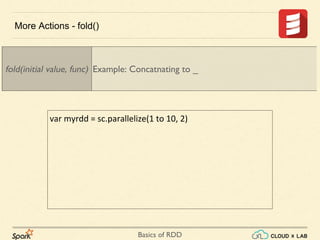
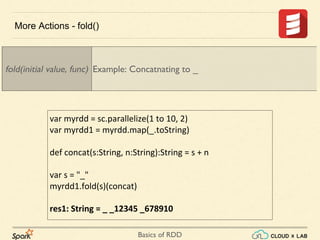
var myrdd = sc.parallelize(1 to 10, 2)
More Actions - fold()
fold(initial value, func) Example: Concatnating to _
Basics of RDD
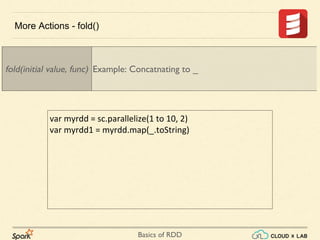
var myrdd = sc.parallelize(1 to 10, 2)
var myrdd1 = myrdd.map(_.toString)
More Actions - fold()
fold(initial value, func) Example: Concatnating to _
Basics of RDD
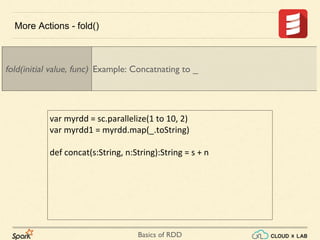
var myrdd = sc.parallelize(1 to 10, 2)
var myrdd1 = myrdd.map(_.toString)
def concat(s:String, n:String):String = s + n
More Actions - fold()
fold(initial value, func) Example: Concatnating to _
Basics of RDD
More Actions - fold()
var myrdd = sc.parallelize(1 to 10, 2)
var myrdd1 = myrdd.map(_.toString)
def concat(s:String, n:String):String = s + n
var s = "_"
myrdd1.fold(s)(concat)
res1: String = _ _12345 _678910
fold(initial value, func) Example: Concatnating to _
Basics of RDD
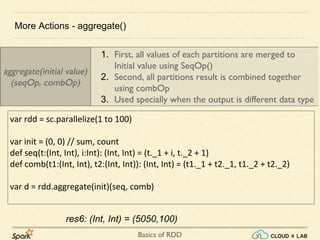
More Actions - aggregate()
aggregate(initial value)
(seqOp, combOp)
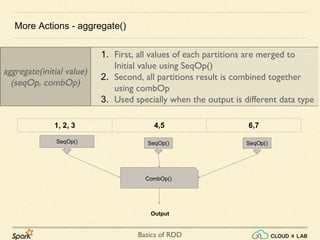
1. First, all values of each partitions are merged to
Initial value using SeqOp()
2. Second, all partitions result is combined together
using combOp
3. Used specially when the output is different data type
1, 2, 3 4,5 6,7
SeqOp() SeqOp() SeqOp()
CombOp()
Output
Basics of RDD
More Actions - aggregate()
aggregate(initial value)
(seqOp, combOp)
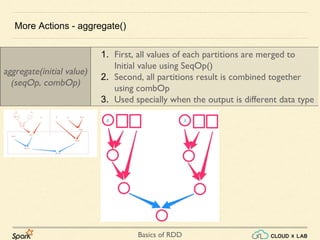
1. First, all values of each partitions are merged to
Initial value using SeqOp()
2. Second, all partitions result is combined together
using combOp
3. Used specially when the output is different data type
Basics of RDD
More Actions - aggregate()
Basics of RDD
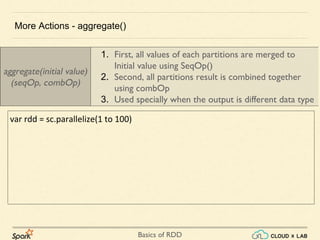
var rdd = sc.parallelize(1 to 100)
More Actions - aggregate()
aggregate(initial value)
(seqOp, combOp)
1. First, all values of each partitions are merged to
Initial value using SeqOp()
2. Second, all partitions result is combined together
using combOp
3. Used specially when the output is different data type
Basics of RDD
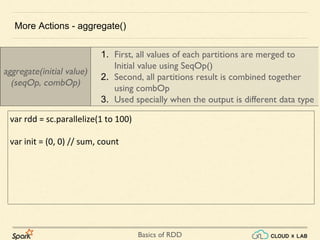
var rdd = sc.parallelize(1 to 100)
var init = (0, 0) // sum, count
More Actions - aggregate()
aggregate(initial value)
(seqOp, combOp)
1. First, all values of each partitions are merged to
Initial value using SeqOp()
2. Second, all partitions result is combined together
using combOp
3. Used specially when the output is different data type
Basics of RDD
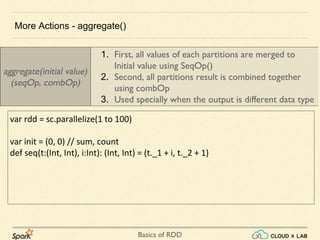
var rdd = sc.parallelize(1 to 100)
var init = (0, 0) // sum, count
def seq(t:(Int, Int), i:Int): (Int, Int) = (t._1 + i, t._2 + 1)
More Actions - aggregate()
aggregate(initial value)
(seqOp, combOp)
1. First, all values of each partitions are merged to
Initial value using SeqOp()
2. Second, all partitions result is combined together
using combOp
3. Used specially when the output is different data type
Basics of RDD
More Actions - aggregate()
aggregate(initial value)
(seqOp, combOp)
1. First, all values of each partitions are merged to
Initial value using SeqOp()
2. Second, all partitions result is combined together
using combOp
3. Used specially when the output is different data type
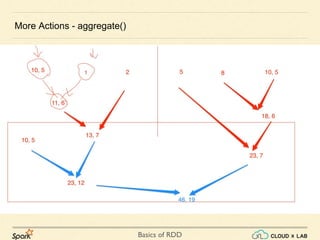
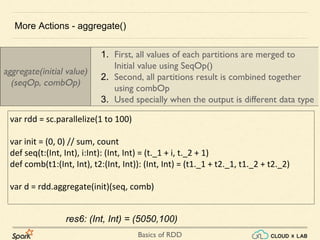
var rdd = sc.parallelize(1 to 100)
var init = (0, 0) // sum, count
def seq(t:(Int, Int), i:Int): (Int, Int) = (t._1 + i, t._2 + 1)
def comb(t1:(Int, Int), t2:(Int, Int)): (Int, Int) = (t1._1 + t2._1, t1._2 + t2._2)
var d = rdd.aggregate(init)(seq, comb)
res6: (Int, Int) = (5050,100)
Basics of RDD
More Actions - aggregate()
var rdd = sc.parallelize(1 to 100)
var init = (0, 0) // sum, count
def seq(t:(Int, Int), i:Int): (Int, Int) = (t._1 + i, t._2 + 1)
def comb(t1:(Int, Int), t2:(Int, Int)): (Int, Int) = (t1._1 + t2._1, t1._2 + t2._2)
var d = rdd.aggregate(init)(seq, comb)
aggregate(initial value)
(seqOp, combOp)
1. First, all values of each partitions are merged to
Initial value using SeqOp()
2. Second, all partitions result is combined together
using combOp
3. Used specially when the output is different data type
res6: (Int, Int) = (5050,100)
Basics of RDD
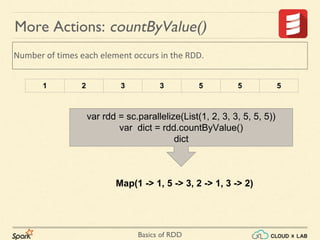
Number of times each element occurs in the RDD.
More Actions: countByValue()
1 2 3 3 5 5 5
var rdd = sc.parallelize(List(1, 2, 3, 3, 5, 5, 5))
var dict = rdd.countByValue()
dict
Map(1 -> 1, 5 -> 3, 2 -> 1, 3 -> 2)
Basics of RDD
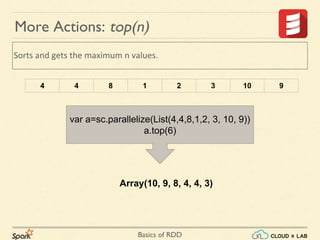
Sorts and gets the maximum n values.
More Actions: top(n)
4 4 8 1 2 3 10 9
var a=sc.parallelize(List(4,4,8,1,2, 3, 10, 9))
a.top(6)
Array(10, 9, 8, 4, 4, 3)
Basics of RDD
sc.parallelize(List(10, 1, 2, 9, 3, 4, 5, 6, 7)).takeOrdered(6)
var l = List((10, "SG"), (1, "AS"), (2, "AB"), (9, "AA"), (3, "SS"), (4, "RG"), (5, "AU"), (6, "DD"), (7, "ZZ"))
var r = sc.parallelize(l)
r.takeOrdered(6)(Ordering[Int].reverse.on(x => x._1))
(10,SG), (9,AA), (7,ZZ), (6,DD), (5,AU), (4,RG)
r.takeOrdered(6)(Ordering[String].reverse.on(x => x._2))
(7,ZZ), (3,SS), (10,SG), (4,RG), (6,DD), (5,AU)
r.takeOrdered(6)(Ordering[String].on(x => x._2))
(9,AA), (2,AB), (1,AS), (5,AU), (6,DD), (4,RG)
Get the N elements from an RDD ordered in ascending order or as specified by
the optional key function.
More Actions: takeOrdered()
Basics of RDD
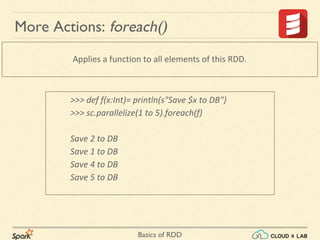
Applies a function to all elements of this RDD.
More Actions: foreach()
>>> def f(x:Int)= println(s"Save $x to DB")
>>> sc.parallelize(1 to 5).foreach(f)
Save 2 to DB
Save 1 to DB
Save 4 to DB
Save 5 to DB
Basics of RDD
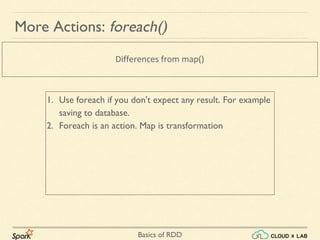
Differences from map()
More Actions: foreach()
1. Use foreach if you don't expect any result. For example
saving to database.
2. Foreach is an action. Map is transformation
Basics of RDD
Applies a function to each partition of this RDD.
More Actions: foreachPartition(f)
Basics of RDD
def partitionSum(itr: Iterator[Int]) =
println("The sum of the parition is " + itr.sum.toString)
Applies a function to each partition of this RDD.
More Actions: foreachPartition(f)
Basics of RDD
Applies a function to each partition of this RDD.
More Actions: foreachPartition(f)
def partitionSum(itr: Iterator[Int]) =
println("The sum of the parition is " + itr.sum.toString)
sc.parallelize(1 to 40, 4).foreachPartition(partitionSum)
The sum of the parition is 155
The sum of the parition is 55
The sum of the parition is 355
The sum of the parition is 255
Thank you!
Basics of RDD

Apache Spark - Basics of RDD & RDD Operations | Big Data Hadoop Spark Tutorial | CloudxLab

  • 1.
    Basics of RDD- More Operations
  • 2.
    Basics of RDD MoreTransformations sample(withReplacement, fraction, [seed]) Sample an RDD, with or without replacement.
  • 3.
    Basics of RDD valseq = sc.parallelize(1 to 100, 5) seq.sample(false, 0.1).collect(); [8, 19, 34, 37, 43, 51, 70, 83] More Transformations sample(withReplacement, fraction, [seed]) Sample an RDD, with or without replacement.
  • 4.
    Basics of RDD MoreTransformations sample(withReplacement, fraction, [seed]) Sample an RDD, with or without replacement. val seq = sc.parallelize(1 to 100, 5) seq.sample(false, 0.1).collect(); [8, 19, 34, 37, 43, 51, 70, 83] seq.sample(true, 0.1).collect(); [14, 26, 40, 47, 55, 67, 69, 69] Please note that the result will be different on every run.
  • 5.
    Basics of RDD CommonTransformations (continued..) mapPartitions(f, preservesPartitioning=False) Return a new RDD by applying a function to each partition of this RDD.
  • 6.
    Basics of RDD valrdd = sc.parallelize(1 to 50, 3) Common Transformations (continued..) mapPartitions(f, preservesPartitioning=False) Return a new RDD by applying a function to each partition of this RDD.
  • 7.
    Basics of RDD valrdd = sc.parallelize(1 to 50, 3) def f(l:Iterator[Int]):Iterator[Int] = { var sum = 0 while(l.hasNext){ sum = sum + l.next } return List(sum).iterator } Common Transformations (continued..) mapPartitions(f, preservesPartitioning=False) Return a new RDD by applying a function to each partition of this RDD.
  • 8.
    Basics of RDD valrdd = sc.parallelize(1 to 50, 3) def f(l:Iterator[Int]):Iterator[Int] = { var sum = 0 while(l.hasNext){ sum = sum + l.next } return List(sum).iterator } rdd.mapPartitions(f).collect() Array(136, 425, 714) 17, 17, 16 Common Transformations (continued..) mapPartitions(f, preservesPartitioning=False) Return a new RDD by applying a function to each partition of this RDD.
  • 9.
    Basics of RDD CommonTransformations (continued..) sortBy(func, ascending=True, numPartitions=None) Sorts this RDD by the given func
  • 10.
    Basics of RDD func:A function used to compute the sort key for each element. Common Transformations (continued..) sortBy(func, ascending=True, numPartitions=None) Sorts this RDD by the given func
  • 11.
    Basics of RDD CommonTransformations (continued..) sortBy(func, ascending=True, numPartitions=None) Sorts this RDD by the given func func: A function used to compute the sort key for each element. ascending: A flag to indicate whether the sorting is ascending or descending.
  • 12.
    Basics of RDD CommonTransformations (continued..) sortBy(func, ascending=True, numPartitions=None) Sorts this RDD by the given func func: A function used to compute the sort key for each element. ascending: A flag to indicate whether the sorting is ascending or descending. numPartitions: Number of partitions to create.
  • 13.
    Basics of RDD ⋙var tmp = List(('a', 1), ('b', 2), ('1', 3), ('d', 4), ('2', 5)) ⋙ var rdd = sc.parallelize(tmp) Common Transformations (continued..) sortBy(keyfunc, ascending=True, numPartitions=None) Sorts this RDD by the given keyfunc
  • 14.
    Basics of RDD ⋙var tmp = List(('a', 1), ('b', 2), ('1', 3), ('d', 4), ('2', 5)) ⋙ var rdd = sc.parallelize(tmp) ⋙ rdd.sortBy(x => x._1).collect() [('1', 3), ('2', 5), ('a', 1), ('b', 2), ('d', 4)] Common Transformations (continued..) sortBy(keyfunc, ascending=True, numPartitions=None) Sorts this RDD by the given keyfunc
  • 15.
    Basics of RDD ⋙var tmp = List(('a', 1), ('b', 2), ('1', 3), ('d', 4), ('2', 5)) ⋙ var rdd = sc.parallelize(tmp) ⋙ rdd.sortBy(x => x._2).collect() [('a', 1), ('b', 2), ('1', 3), ('d', 4), ('2', 5)] Common Transformations (continued..) sortBy(keyfunc, ascending=True, numPartitions=None) Sorts this RDD by the given keyfunc
  • 16.
    Basics of RDD CommonTransformations (continued..) sortBy(keyfunc, ascending=True, numPartitions=None) Sorts this RDD by the given keyfunc var rdd = sc.parallelize(Array(10, 2, 3,21, 4, 5)) var sortedrdd = rdd.sortBy(x => x) sortedrdd.collect()
  • 17.
    Basics of RDD CommonTransformations (continued..) Pseudo set operations Though RDD is not really a set but still the set operations try to provide you utility set functions
  • 18.
    Basics of RDD distinct() +Give the set property to your rdd + Expensive as shuffling is required Set operations (Pseudo)
  • 19.
    Basics of RDD union() +Simply appends one rdd to another + Is not same as mathematical function + It may have duplicates Set operations (Pseudo)
  • 20.
    Basics of RDD subtract() +Returns values in first RDD and not second + Requires Shuffling like intersection() Set operations (Pseudo)
  • 21.
    Basics of RDD intersection() +Finds common values in RDDs + Also removes duplicates + Requires shuffling Set operations (Pseudo)
  • 22.
    Basics of RDD cartesian() +Returns all possible pairs of (a,b) + a is in source RDD and b is in other RDD Set operations (Pseudo)
  • 23.
    Basics of RDD fold(initialvalue, func) + Very similar to reduce + Provides a little extra control over the initialisation + Lets us specify an initial value More Actions - fold()
  • 24.
    Basics of RDD MoreActions - fold() fold(initial value, func) Aggregates the elements of each partition and then the results for all the partitions using a given associative and commutative function and a neutral "zero value". 1 7 2 4 7 6 Partition 1 Partition 2
  • 25.
    Basics of RDD MoreActions - fold() fold(initial value, func) Aggregates the elements of each partition and then the results for all the partitions using a given associative and commutative function and a neutral "zero value". 1 7 2 4 7 6 Partition 1 Partition 2 Initial Value Initial Value
  • 26.
    Basics of RDD MoreActions - fold() fold(initial value)(func) Aggregates the elements of each partition and then the results for all the partitions using a given associative and commutative function and a neutral "zero value". Initial Value 1 7 2 4 7 6Initial Value Partition 1 Partition 2 1 1
  • 27.
    Basics of RDD MoreActions - fold() fold(initial value)(func) Aggregates the elements of each partition and then the results for all the partitions using a given associative and commutative function and a neutral "zero value". Initial Value 1 7 2 4 7 6Initial Value Partition 1 Partition 2 1 2 3 1 2 3 Result1 Result2
  • 28.
    Basics of RDD MoreActions - fold() fold(initial value)(func) Aggregates the elements of each partition and then the results for all the partitions using a given associative and commutative function and a neutral "zero value". Result1 Result2Initial Value 4 5 1 7 2 4 7 6 Partition 1 Partition 2 1 2 3 1 2 3
  • 29.
    Basics of RDD varmyrdd = sc.parallelize(1 to 10, 2) More Actions - fold() fold(initial value, func) Example: Concatnating to _
  • 30.
    Basics of RDD varmyrdd = sc.parallelize(1 to 10, 2) var myrdd1 = myrdd.map(_.toString) More Actions - fold() fold(initial value, func) Example: Concatnating to _
  • 31.
    Basics of RDD varmyrdd = sc.parallelize(1 to 10, 2) var myrdd1 = myrdd.map(_.toString) def concat(s:String, n:String):String = s + n More Actions - fold() fold(initial value, func) Example: Concatnating to _
  • 32.
    Basics of RDD MoreActions - fold() var myrdd = sc.parallelize(1 to 10, 2) var myrdd1 = myrdd.map(_.toString) def concat(s:String, n:String):String = s + n var s = "_" myrdd1.fold(s)(concat) res1: String = _ _12345 _678910 fold(initial value, func) Example: Concatnating to _
  • 33.
    Basics of RDD MoreActions - aggregate() aggregate(initial value) (seqOp, combOp) 1. First, all values of each partitions are merged to Initial value using SeqOp() 2. Second, all partitions result is combined together using combOp 3. Used specially when the output is different data type 1, 2, 3 4,5 6,7 SeqOp() SeqOp() SeqOp() CombOp() Output
  • 34.
    Basics of RDD MoreActions - aggregate() aggregate(initial value) (seqOp, combOp) 1. First, all values of each partitions are merged to Initial value using SeqOp() 2. Second, all partitions result is combined together using combOp 3. Used specially when the output is different data type
  • 35.
    Basics of RDD MoreActions - aggregate()
  • 36.
    Basics of RDD varrdd = sc.parallelize(1 to 100) More Actions - aggregate() aggregate(initial value) (seqOp, combOp) 1. First, all values of each partitions are merged to Initial value using SeqOp() 2. Second, all partitions result is combined together using combOp 3. Used specially when the output is different data type
  • 37.
    Basics of RDD varrdd = sc.parallelize(1 to 100) var init = (0, 0) // sum, count More Actions - aggregate() aggregate(initial value) (seqOp, combOp) 1. First, all values of each partitions are merged to Initial value using SeqOp() 2. Second, all partitions result is combined together using combOp 3. Used specially when the output is different data type
  • 38.
    Basics of RDD varrdd = sc.parallelize(1 to 100) var init = (0, 0) // sum, count def seq(t:(Int, Int), i:Int): (Int, Int) = (t._1 + i, t._2 + 1) More Actions - aggregate() aggregate(initial value) (seqOp, combOp) 1. First, all values of each partitions are merged to Initial value using SeqOp() 2. Second, all partitions result is combined together using combOp 3. Used specially when the output is different data type
  • 39.
    Basics of RDD MoreActions - aggregate() aggregate(initial value) (seqOp, combOp) 1. First, all values of each partitions are merged to Initial value using SeqOp() 2. Second, all partitions result is combined together using combOp 3. Used specially when the output is different data type var rdd = sc.parallelize(1 to 100) var init = (0, 0) // sum, count def seq(t:(Int, Int), i:Int): (Int, Int) = (t._1 + i, t._2 + 1) def comb(t1:(Int, Int), t2:(Int, Int)): (Int, Int) = (t1._1 + t2._1, t1._2 + t2._2) var d = rdd.aggregate(init)(seq, comb) res6: (Int, Int) = (5050,100)
  • 40.
    Basics of RDD MoreActions - aggregate() var rdd = sc.parallelize(1 to 100) var init = (0, 0) // sum, count def seq(t:(Int, Int), i:Int): (Int, Int) = (t._1 + i, t._2 + 1) def comb(t1:(Int, Int), t2:(Int, Int)): (Int, Int) = (t1._1 + t2._1, t1._2 + t2._2) var d = rdd.aggregate(init)(seq, comb) aggregate(initial value) (seqOp, combOp) 1. First, all values of each partitions are merged to Initial value using SeqOp() 2. Second, all partitions result is combined together using combOp 3. Used specially when the output is different data type res6: (Int, Int) = (5050,100)
  • 41.
    Basics of RDD Numberof times each element occurs in the RDD. More Actions: countByValue() 1 2 3 3 5 5 5 var rdd = sc.parallelize(List(1, 2, 3, 3, 5, 5, 5)) var dict = rdd.countByValue() dict Map(1 -> 1, 5 -> 3, 2 -> 1, 3 -> 2)
  • 42.
    Basics of RDD Sortsand gets the maximum n values. More Actions: top(n) 4 4 8 1 2 3 10 9 var a=sc.parallelize(List(4,4,8,1,2, 3, 10, 9)) a.top(6) Array(10, 9, 8, 4, 4, 3)
  • 43.
    Basics of RDD sc.parallelize(List(10,1, 2, 9, 3, 4, 5, 6, 7)).takeOrdered(6) var l = List((10, "SG"), (1, "AS"), (2, "AB"), (9, "AA"), (3, "SS"), (4, "RG"), (5, "AU"), (6, "DD"), (7, "ZZ")) var r = sc.parallelize(l) r.takeOrdered(6)(Ordering[Int].reverse.on(x => x._1)) (10,SG), (9,AA), (7,ZZ), (6,DD), (5,AU), (4,RG) r.takeOrdered(6)(Ordering[String].reverse.on(x => x._2)) (7,ZZ), (3,SS), (10,SG), (4,RG), (6,DD), (5,AU) r.takeOrdered(6)(Ordering[String].on(x => x._2)) (9,AA), (2,AB), (1,AS), (5,AU), (6,DD), (4,RG) Get the N elements from an RDD ordered in ascending order or as specified by the optional key function. More Actions: takeOrdered()
  • 44.
    Basics of RDD Appliesa function to all elements of this RDD. More Actions: foreach() >>> def f(x:Int)= println(s"Save $x to DB") >>> sc.parallelize(1 to 5).foreach(f) Save 2 to DB Save 1 to DB Save 4 to DB Save 5 to DB
  • 45.
    Basics of RDD Differencesfrom map() More Actions: foreach() 1. Use foreach if you don't expect any result. For example saving to database. 2. Foreach is an action. Map is transformation
  • 46.
    Basics of RDD Appliesa function to each partition of this RDD. More Actions: foreachPartition(f)
  • 47.
    Basics of RDD defpartitionSum(itr: Iterator[Int]) = println("The sum of the parition is " + itr.sum.toString) Applies a function to each partition of this RDD. More Actions: foreachPartition(f)
  • 48.
    Basics of RDD Appliesa function to each partition of this RDD. More Actions: foreachPartition(f) def partitionSum(itr: Iterator[Int]) = println("The sum of the parition is " + itr.sum.toString) sc.parallelize(1 to 40, 4).foreachPartition(partitionSum) The sum of the parition is 155 The sum of the parition is 55 The sum of the parition is 355 The sum of the parition is 255
  • 49.