Spark Pair RDD and Persistence
Spark and Scala
Spark Pair RDD and Persistence
 Spark Pair RDDs
 Creating Pair RDDs
 Pair RDD Reduce Transformations
 groupByKey
 reduceByKey
 aggregateByKey
 combineByKey
 Pair RDD Joins Transformations
 Pair RDD Sort by Key
 Pair RDD Actions
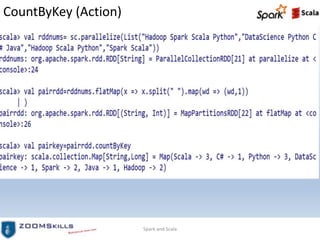
 countByKey
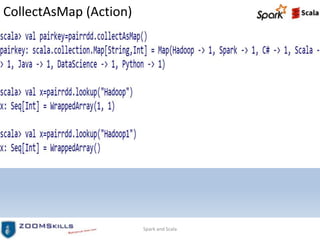
 collectAsMap
 lookUp
 RDD Cache and RDD Persistence
 RDD Storage Levels
 Q & A
Spark and Scala
Spark Pair RDD
 Pair RDDs are rdds of key/value pair
 Key/value RDDs are used to perform aggregations
 Key/value RDDs expose new operations
 Counting reviews for each product, grouping together data with the
same key, and grouping together two different RDDs
Spark and Scala
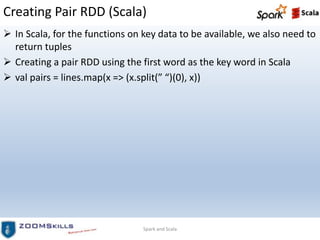
Creating Pair RDD (Scala)
 In Scala, for the functions on key data to be available, we also need to
return tuples
 Creating a pair RDD using the first word as the key word in Scala
 val pairs = lines.map(x => (x.split(” “)(0), x))
Spark and Scala
Creating Pair RDD
 Pair RDDs can be created by running a map() function that returns
key or value pairs
 The procedure to build the key-value RDDs differs by language.
 In Python language, for the functions on key data to work we need to
return an RDD composed of tuples
 Creating a pair RDD using the first word as the key in Python
programming language.
 pairs = lines.map(lambda x: (x.split(” “)[0], x))
Spark and Scala
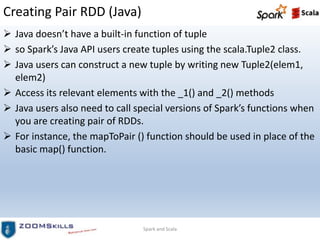
Creating Pair RDD (Java)
 Java doesn’t have a built-in function of tuple
 so Spark’s Java API users create tuples using the scala.Tuple2 class.
 Java users can construct a new tuple by writing new Tuple2(elem1,
elem2)
 Access its relevant elements with the _1() and _2() methods
 Java users also need to call special versions of Spark’s functions when
you are creating pair of RDDs.
 For instance, the mapToPair () function should be used in place of the
basic map() function.
Spark and Scala
Creating Pair RDD (Java)
 Creating a pair RDD using the first word as the key word in Java
program.
 PairFunction<String, String, String> keyData =
new PairFunction<String, String, String>() {
public Tuple2<String, String> call(String x) {
return new Tuple2(x.split(” “)[0], x);
}
};
 JavaPairRDD<String, String> pairs = lines.mapToPair(keyData);
Spark and Scala
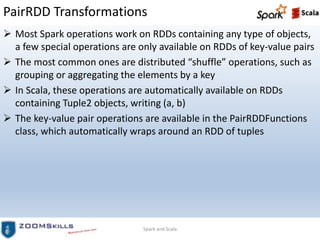
PairRDD Transformations
 Most Spark operations work on RDDs containing any type of objects,
a few special operations are only available on RDDs of key-value pairs
 The most common ones are distributed “shuffle” operations, such as
grouping or aggregating the elements by a key
 In Scala, these operations are automatically available on RDDs
containing Tuple2 objects, writing (a, b)
 The key-value pair operations are available in the PairRDDFunctions
class, which automatically wraps around an RDD of tuples
Spark and Scala
PairRDD Transformations (Aggregation)
 When datasets are described in terms of key/value pairs, it is
common feature that is required to aggregate statistics across all
elements with the same key value
 Spark has a set of operations that combines values that own the
same key
 These operations return RDDs and thus are transformations rather
than actions i.e. reduceByKey(), foldByKey(), combineByKey()
Spark and Scala
PairRDD Transformations (Grouping)
 With key data is a common type of use case in grouping our data sets
is used with respect to predefined key value
 For example, viewing all of a customer’s orders together in one file.
 If our data is already keyed in the way we want to implement,
groupByKey() will group our data using the key value using our RDD.
 On an RDD consisting of keys of type K and values of type V, we get
back an RDD operation of type [K, Iterable[V]]
Spark and Scala
PairRDD Transformations (Joins)
 The most useful and effective operations we get with keyed data
values comes from using it together with other keyed data.
 Joining datasets together is probably one of the most common type
of operations you can find out on a pair RDD
 Supports following type of joins
 Inner Join
 left OuterJoin
 rightOuterJoin
Spark and Scala
PairRDD Transformations (Sort)
 We can sort an RDD with key or value pairs if there is an ordering
defined on the key set.
 Once we have sorted our data elements, any subsequent call on the
sorted data to collect() or save() will result in ordered dataset.
Spark and Scala
PairRDD Transformations
Transformations Description
groupByKey([numTasks]
)
When called on a dataset of (K, V) pairs, returns a dataset of (K,
Iterable<V>) pairs. Note: If you are grouping in order to perform an
aggregation (such as a sum or average) over each key, using
reduceByKey or aggregateByKey will yield much better performance.
Note: By default, the level of parallelism in the output depends on the
number of partitions of the parent RDD.
You can pass an optional numTasks argument to set a different
number of tasks.
reduceByKey(func,
[numTasks])
When called on a dataset of (K, V) pairs, returns a dataset of (K, V)
pairs where the values for each key are aggregated using the given
reduce function func, which must be of type (V,V) => V. Like in
groupByKey, the number of reduce tasks is configurable through an
optional second argument
sortByKey([ascending],
[numTasks])
When called on a dataset of (K, V) pairs where K implements Ordered,
returns a dataset of (K, V) pairs sorted by keys in ascending or
descending order, as specified in the Boolean ascending argument.
Spark and Scala
PairRDD Transformations
Transformations Description
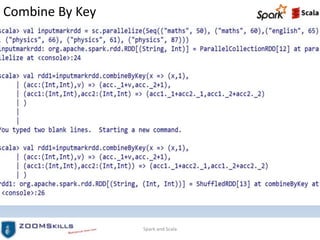
combineByKey[C](
createCombiner: V =>
C,
mergeValue: (C, V) =>
C,
mergeCombiners: (C,
C) => C): RDD[(K, C)]
1st Argument : createCombiner is called when a key(in the RDD
element) is found for the first time in a given Partition. This method
creates an initial value for the accumulator for that key
2nd Argument : mergeValue is called when the key already has an
accumulator
3rd Argument : mergeCombiners is called when more that one
partition has accumulator for the same key
mapvalues When called on a dataset of (K, V) pairs, returns a dataset of (K, V)
pairs where the values for each key are aggregated using the given
reduce function func, which must be of type (V,V) => V. Like in
groupByKey, the number of reduce tasks is configurable through an
optional second argument
Keys/values When called on a dataset of (K, V) pairs where K implements Ordered,
returns a dataset of (K, V) pairs sorted by keys in ascending or
descending order, as specified in the boolean ascending argument.
Spark and Scala
PairRDD Transformations
Transformations Description
aggregateByKey(zeroVal
ue)(seqOp, combOp,
[numTasks])
When called on a dataset of (K, V) pairs, returns a dataset of (K, U)
pairs where the values for each key are aggregated using the given
combine functions and a neutral "zero" value. Allows an aggregated
value type that is different than the input value type, while avoiding
unnecessary allocations. Like in groupByKey, the number of reduce
tasks is configurable through an optional second argument.
join(otherDataset,
[numTasks])
When called on datasets of type (K, V) and (K, W), returns a dataset of
(K, (V, W)) pairs with all pairs of elements for each key. Outer joins are
supported through leftOuterJoin, rightOuterJoin, and fullOuterJoin
cogroup(otherDataset,
[numTasks])
When called on datasets of type (K, V) and (K, W), returns a dataset of
(K, (Iterable<V>, Iterable<W>)) tuples. This operation is also called
groupWith
Spark and Scala
PairRDD Actions
 countByKey() : Count the number of elements for each key pair.
 collectAsMap() : Collect the result outputs as a map to provide easy
lookup.
 lookup(key) : Return all values associated with the provided key pair.
Spark and Scala
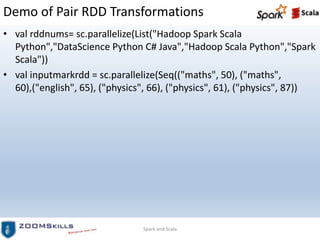
Demo of Pair RDD Transformations
• val rddnums= sc.parallelize(List("Hadoop Spark Scala
Python","DataScience Python C# Java","Hadoop Scala Python","Spark
Scala"))
• val inputmarkrdd = sc.parallelize(Seq(("maths", 50), ("maths",
60),("english", 65), ("physics", 66), ("physics", 61), ("physics", 87))
Spark and Scala
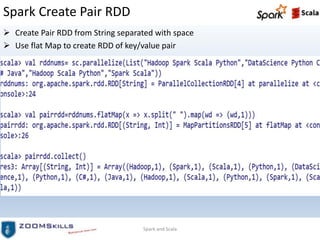
Spark Create Pair RDD
 Create Pair RDD from String separated with space
 Use flat Map to create RDD of key/value pair
Spark and Scala
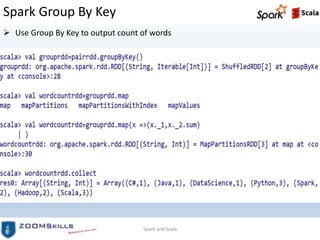
Spark Group By Key
 Use Group By Key to output count of words
Spark and Scala
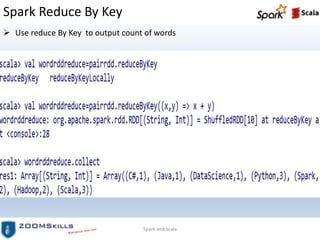
Spark Reduce By Key
 Use reduce By Key to output count of words
Spark and Scala
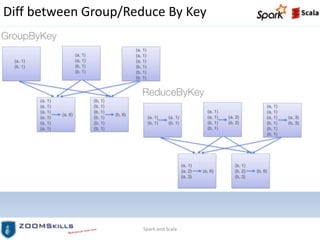
Diff between Group/Reduce By Key
Spark and Scala
Diff between Group/Reduce By Key
 reduce By Key combine output with a common key on each partition
before shuffling the data.
 Reduce function is called again to reduce all the values from each
partition to produce one result.
 On the other hand, when calling groupByKey - all the key-value pairs
are shuffled around. This is a lot of unnecessary data to being
transferred over the network.
 To determine which machine to shuffle a pair to, Spark calls a
partitioning function on the key of the pair. Spark spills data to disk
when there is more data shuffled onto a single executor machine
than can fit in memory.
Spark and Scala
Diff between Group/Reduce By Key
 However, it flushes out the data to disk one key at a time - so if a
single key has more key-value pairs than can fit in memory, an out of
memory exception occurs.
 This will be more gracefully handled in a later release of Spark so the
job can still proceed, but should still be avoided - when Spark needs
to spill to disk, performance is severely impacted.
Spark and Scala
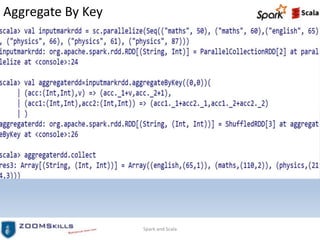
Aggregate By Key
Spark and Scala
Combine By Key
Spark and Scala
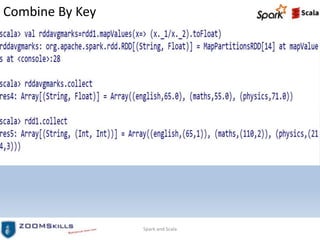
Combine By Key
Spark and Scala
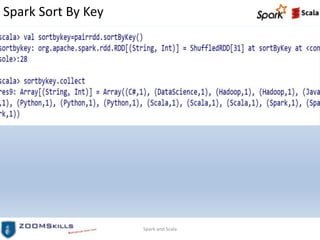
Spark Sort By Key
Spark and Scala
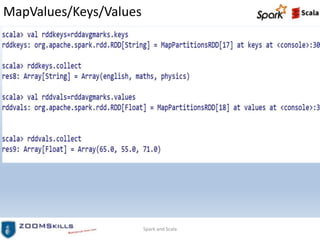
MapValues/Keys/Values
Spark and Scala
CountByKey (Action)
Spark and Scala
CollectAsMap (Action)
Spark and Scala
Spark Persistence
Spark and Scala
 One of the most important capabilities in Spark is persisting (or
caching) a dataset in memory across operations.
 When you persist an RDD, each node stores any partitions of it that it
computes in memory and reuses them in other actions on that
dataset (or datasets derived from it).
 This allows future actions to be much faster (often by more than 10x)
 Caching is a key tool for iterative algorithms and fast interactive use
Spark Persistence
Spark and Scala
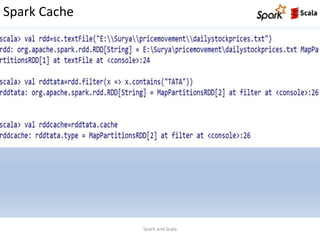
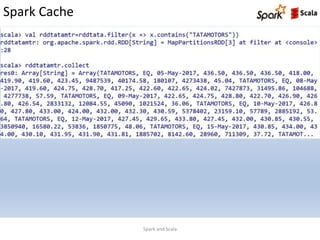
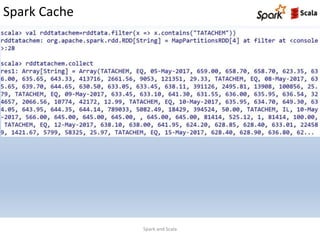
 RDD.cache is also a lazy operation.
 If you run textFile.count the first time, the file will be loaded, cached,
and counted.
 If you call textFile.count a second time, the operation will use the
cache.
Spark Persistence
Spark and Scala
 You can mark an RDD to be persisted using the persist() or cache()
methods on it.
 The first time it is computed in an action, it will be kept in memory on
the nodes.
 Spark’s cache is fault-tolerant – if any partition of an RDD is lost, it will
automatically be recomputed using the transformations that
originally created it.
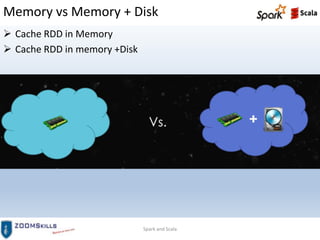
Memory vs Memory + Disk
Spark and Scala
 Cache RDD in Memory
 Cache RDD in memory +Disk
Spark Persistence
Spark and Scala
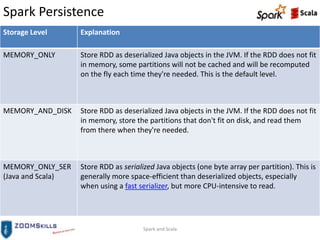
 Each persisted RDD can be stored using a different storage level,
allowing you, for example, to persist the dataset on disk, persist it in
memory but as serialized Java objects (to save space), replicate it
across nodes.
 These levels are set by passing a StorageLevel object (Scala, Java,
Python) to persist().
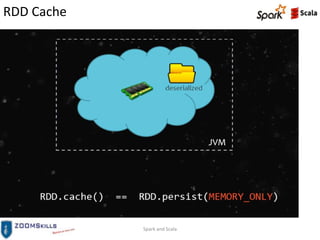
 The cache() method is a shorthand for using the default storage level,
which is StorageLevel.MEMORY_ONLY (store deserialized objects in
memory).
RDD Cache
Spark and Scala
Spark Persistence
Spark and Scala
Storage Level Explanation
MEMORY_ONLY Store RDD as deserialized Java objects in the JVM. If the RDD does not fit
in memory, some partitions will not be cached and will be recomputed
on the fly each time they're needed. This is the default level.
MEMORY_AND_DISK Store RDD as deserialized Java objects in the JVM. If the RDD does not fit
in memory, store the partitions that don't fit on disk, and read them
from there when they're needed.
MEMORY_ONLY_SER
(Java and Scala)
Store RDD as serialized Java objects (one byte array per partition). This is
generally more space-efficient than deserialized objects, especially
when using a fast serializer, but more CPU-intensive to read.
Spark Persistence
Spark and Scala
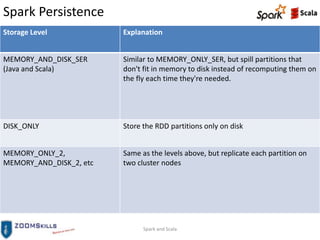
Storage Level Explanation
MEMORY_AND_DISK_SER
(Java and Scala)
Similar to MEMORY_ONLY_SER, but spill partitions that
don't fit in memory to disk instead of recomputing them on
the fly each time they're needed.
DISK_ONLY Store the RDD partitions only on disk
MEMORY_ONLY_2,
MEMORY_AND_DISK_2, etc
Same as the levels above, but replicate each partition on
two cluster nodes
Spark Persistence
Spark and Scala
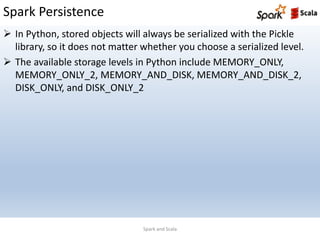
 In Python, stored objects will always be serialized with the Pickle
library, so it does not matter whether you choose a serialized level.
 The available storage levels in Python include MEMORY_ONLY,
MEMORY_ONLY_2, MEMORY_AND_DISK, MEMORY_AND_DISK_2,
DISK_ONLY, and DISK_ONLY_2
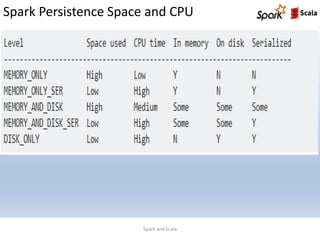
Spark Persistence Space and CPU
Spark and Scala
Spark UnPersist
Spark and Scala
 RDD.unpersist()
Spark Cache
Spark and Scala
Spark Cache
Spark and Scala
Spark Cache
Spark and Scala
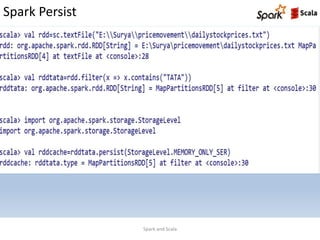
Spark Persist
Spark and Scala

04 spark-pair rdd-rdd-persistence

  • 1.
    Spark Pair RDDand Persistence Spark and Scala
  • 2.
    Spark Pair RDDand Persistence  Spark Pair RDDs  Creating Pair RDDs  Pair RDD Reduce Transformations  groupByKey  reduceByKey  aggregateByKey  combineByKey  Pair RDD Joins Transformations  Pair RDD Sort by Key  Pair RDD Actions  countByKey  collectAsMap  lookUp  RDD Cache and RDD Persistence  RDD Storage Levels  Q & A Spark and Scala
  • 3.
    Spark Pair RDD Pair RDDs are rdds of key/value pair  Key/value RDDs are used to perform aggregations  Key/value RDDs expose new operations  Counting reviews for each product, grouping together data with the same key, and grouping together two different RDDs Spark and Scala
  • 4.
    Creating Pair RDD(Scala)  In Scala, for the functions on key data to be available, we also need to return tuples  Creating a pair RDD using the first word as the key word in Scala  val pairs = lines.map(x => (x.split(” “)(0), x)) Spark and Scala
  • 5.
    Creating Pair RDD Pair RDDs can be created by running a map() function that returns key or value pairs  The procedure to build the key-value RDDs differs by language.  In Python language, for the functions on key data to work we need to return an RDD composed of tuples  Creating a pair RDD using the first word as the key in Python programming language.  pairs = lines.map(lambda x: (x.split(” “)[0], x)) Spark and Scala
  • 6.
    Creating Pair RDD(Java)  Java doesn’t have a built-in function of tuple  so Spark’s Java API users create tuples using the scala.Tuple2 class.  Java users can construct a new tuple by writing new Tuple2(elem1, elem2)  Access its relevant elements with the _1() and _2() methods  Java users also need to call special versions of Spark’s functions when you are creating pair of RDDs.  For instance, the mapToPair () function should be used in place of the basic map() function. Spark and Scala
  • 7.
    Creating Pair RDD(Java)  Creating a pair RDD using the first word as the key word in Java program.  PairFunction<String, String, String> keyData = new PairFunction<String, String, String>() { public Tuple2<String, String> call(String x) { return new Tuple2(x.split(” “)[0], x); } };  JavaPairRDD<String, String> pairs = lines.mapToPair(keyData); Spark and Scala
  • 8.
    PairRDD Transformations  MostSpark operations work on RDDs containing any type of objects, a few special operations are only available on RDDs of key-value pairs  The most common ones are distributed “shuffle” operations, such as grouping or aggregating the elements by a key  In Scala, these operations are automatically available on RDDs containing Tuple2 objects, writing (a, b)  The key-value pair operations are available in the PairRDDFunctions class, which automatically wraps around an RDD of tuples Spark and Scala
  • 9.
    PairRDD Transformations (Aggregation) When datasets are described in terms of key/value pairs, it is common feature that is required to aggregate statistics across all elements with the same key value  Spark has a set of operations that combines values that own the same key  These operations return RDDs and thus are transformations rather than actions i.e. reduceByKey(), foldByKey(), combineByKey() Spark and Scala
  • 10.
    PairRDD Transformations (Grouping) With key data is a common type of use case in grouping our data sets is used with respect to predefined key value  For example, viewing all of a customer’s orders together in one file.  If our data is already keyed in the way we want to implement, groupByKey() will group our data using the key value using our RDD.  On an RDD consisting of keys of type K and values of type V, we get back an RDD operation of type [K, Iterable[V]] Spark and Scala
  • 11.
    PairRDD Transformations (Joins) The most useful and effective operations we get with keyed data values comes from using it together with other keyed data.  Joining datasets together is probably one of the most common type of operations you can find out on a pair RDD  Supports following type of joins  Inner Join  left OuterJoin  rightOuterJoin Spark and Scala
  • 12.
    PairRDD Transformations (Sort) We can sort an RDD with key or value pairs if there is an ordering defined on the key set.  Once we have sorted our data elements, any subsequent call on the sorted data to collect() or save() will result in ordered dataset. Spark and Scala
  • 13.
    PairRDD Transformations Transformations Description groupByKey([numTasks] ) Whencalled on a dataset of (K, V) pairs, returns a dataset of (K, Iterable<V>) pairs. Note: If you are grouping in order to perform an aggregation (such as a sum or average) over each key, using reduceByKey or aggregateByKey will yield much better performance. Note: By default, the level of parallelism in the output depends on the number of partitions of the parent RDD. You can pass an optional numTasks argument to set a different number of tasks. reduceByKey(func, [numTasks]) When called on a dataset of (K, V) pairs, returns a dataset of (K, V) pairs where the values for each key are aggregated using the given reduce function func, which must be of type (V,V) => V. Like in groupByKey, the number of reduce tasks is configurable through an optional second argument sortByKey([ascending], [numTasks]) When called on a dataset of (K, V) pairs where K implements Ordered, returns a dataset of (K, V) pairs sorted by keys in ascending or descending order, as specified in the Boolean ascending argument. Spark and Scala
  • 14.
    PairRDD Transformations Transformations Description combineByKey[C]( createCombiner:V => C, mergeValue: (C, V) => C, mergeCombiners: (C, C) => C): RDD[(K, C)] 1st Argument : createCombiner is called when a key(in the RDD element) is found for the first time in a given Partition. This method creates an initial value for the accumulator for that key 2nd Argument : mergeValue is called when the key already has an accumulator 3rd Argument : mergeCombiners is called when more that one partition has accumulator for the same key mapvalues When called on a dataset of (K, V) pairs, returns a dataset of (K, V) pairs where the values for each key are aggregated using the given reduce function func, which must be of type (V,V) => V. Like in groupByKey, the number of reduce tasks is configurable through an optional second argument Keys/values When called on a dataset of (K, V) pairs where K implements Ordered, returns a dataset of (K, V) pairs sorted by keys in ascending or descending order, as specified in the boolean ascending argument. Spark and Scala
  • 15.
    PairRDD Transformations Transformations Description aggregateByKey(zeroVal ue)(seqOp,combOp, [numTasks]) When called on a dataset of (K, V) pairs, returns a dataset of (K, U) pairs where the values for each key are aggregated using the given combine functions and a neutral "zero" value. Allows an aggregated value type that is different than the input value type, while avoiding unnecessary allocations. Like in groupByKey, the number of reduce tasks is configurable through an optional second argument. join(otherDataset, [numTasks]) When called on datasets of type (K, V) and (K, W), returns a dataset of (K, (V, W)) pairs with all pairs of elements for each key. Outer joins are supported through leftOuterJoin, rightOuterJoin, and fullOuterJoin cogroup(otherDataset, [numTasks]) When called on datasets of type (K, V) and (K, W), returns a dataset of (K, (Iterable<V>, Iterable<W>)) tuples. This operation is also called groupWith Spark and Scala
  • 16.
    PairRDD Actions  countByKey(): Count the number of elements for each key pair.  collectAsMap() : Collect the result outputs as a map to provide easy lookup.  lookup(key) : Return all values associated with the provided key pair. Spark and Scala
  • 17.
    Demo of PairRDD Transformations • val rddnums= sc.parallelize(List("Hadoop Spark Scala Python","DataScience Python C# Java","Hadoop Scala Python","Spark Scala")) • val inputmarkrdd = sc.parallelize(Seq(("maths", 50), ("maths", 60),("english", 65), ("physics", 66), ("physics", 61), ("physics", 87)) Spark and Scala
  • 18.
    Spark Create PairRDD  Create Pair RDD from String separated with space  Use flat Map to create RDD of key/value pair Spark and Scala
  • 19.
    Spark Group ByKey  Use Group By Key to output count of words Spark and Scala
  • 20.
    Spark Reduce ByKey  Use reduce By Key to output count of words Spark and Scala
  • 21.
    Diff between Group/ReduceBy Key Spark and Scala
  • 22.
    Diff between Group/ReduceBy Key  reduce By Key combine output with a common key on each partition before shuffling the data.  Reduce function is called again to reduce all the values from each partition to produce one result.  On the other hand, when calling groupByKey - all the key-value pairs are shuffled around. This is a lot of unnecessary data to being transferred over the network.  To determine which machine to shuffle a pair to, Spark calls a partitioning function on the key of the pair. Spark spills data to disk when there is more data shuffled onto a single executor machine than can fit in memory. Spark and Scala
  • 23.
    Diff between Group/ReduceBy Key  However, it flushes out the data to disk one key at a time - so if a single key has more key-value pairs than can fit in memory, an out of memory exception occurs.  This will be more gracefully handled in a later release of Spark so the job can still proceed, but should still be avoided - when Spark needs to spill to disk, performance is severely impacted. Spark and Scala
  • 24.
  • 25.
  • 26.
  • 27.
    Spark Sort ByKey Spark and Scala
  • 28.
  • 29.
  • 30.
  • 31.
    Spark Persistence Spark andScala  One of the most important capabilities in Spark is persisting (or caching) a dataset in memory across operations.  When you persist an RDD, each node stores any partitions of it that it computes in memory and reuses them in other actions on that dataset (or datasets derived from it).  This allows future actions to be much faster (often by more than 10x)  Caching is a key tool for iterative algorithms and fast interactive use
  • 32.
    Spark Persistence Spark andScala  RDD.cache is also a lazy operation.  If you run textFile.count the first time, the file will be loaded, cached, and counted.  If you call textFile.count a second time, the operation will use the cache.
  • 33.
    Spark Persistence Spark andScala  You can mark an RDD to be persisted using the persist() or cache() methods on it.  The first time it is computed in an action, it will be kept in memory on the nodes.  Spark’s cache is fault-tolerant – if any partition of an RDD is lost, it will automatically be recomputed using the transformations that originally created it.
  • 34.
    Memory vs Memory+ Disk Spark and Scala  Cache RDD in Memory  Cache RDD in memory +Disk
  • 35.
    Spark Persistence Spark andScala  Each persisted RDD can be stored using a different storage level, allowing you, for example, to persist the dataset on disk, persist it in memory but as serialized Java objects (to save space), replicate it across nodes.  These levels are set by passing a StorageLevel object (Scala, Java, Python) to persist().  The cache() method is a shorthand for using the default storage level, which is StorageLevel.MEMORY_ONLY (store deserialized objects in memory).
  • 36.
  • 37.
    Spark Persistence Spark andScala Storage Level Explanation MEMORY_ONLY Store RDD as deserialized Java objects in the JVM. If the RDD does not fit in memory, some partitions will not be cached and will be recomputed on the fly each time they're needed. This is the default level. MEMORY_AND_DISK Store RDD as deserialized Java objects in the JVM. If the RDD does not fit in memory, store the partitions that don't fit on disk, and read them from there when they're needed. MEMORY_ONLY_SER (Java and Scala) Store RDD as serialized Java objects (one byte array per partition). This is generally more space-efficient than deserialized objects, especially when using a fast serializer, but more CPU-intensive to read.
  • 38.
    Spark Persistence Spark andScala Storage Level Explanation MEMORY_AND_DISK_SER (Java and Scala) Similar to MEMORY_ONLY_SER, but spill partitions that don't fit in memory to disk instead of recomputing them on the fly each time they're needed. DISK_ONLY Store the RDD partitions only on disk MEMORY_ONLY_2, MEMORY_AND_DISK_2, etc Same as the levels above, but replicate each partition on two cluster nodes
  • 39.
    Spark Persistence Spark andScala  In Python, stored objects will always be serialized with the Pickle library, so it does not matter whether you choose a serialized level.  The available storage levels in Python include MEMORY_ONLY, MEMORY_ONLY_2, MEMORY_AND_DISK, MEMORY_AND_DISK_2, DISK_ONLY, and DISK_ONLY_2
  • 40.
    Spark Persistence Spaceand CPU Spark and Scala
  • 41.
    Spark UnPersist Spark andScala  RDD.unpersist()
  • 42.
  • 43.
  • 44.
  • 45.