Viscosity
Viscosity
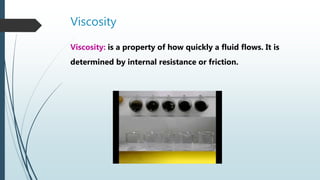
Viscosity: is a property of how quickly a fluid flows. It is
determined by internal resistance or friction.
Viscosity
PMOM (Particle Model of Matter): Recall that
liquid particles slide around and roll over each other and
gas particles move more evenly and easily.
The greater the friction (or rubbing) between particles in
a fluid, the greater the viscosity (slower it will flow).
Viscosity
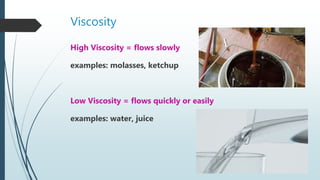
High Viscosity = flows slowly
examples: molasses, ketchup
Low Viscosity = flows quickly or easily
examples: water, juice
Viscosity
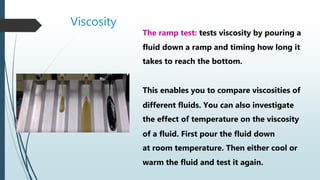
The ramp test: tests viscosity by pouring a
fluid down a ramp and timing how long it
takes to reach the bottom.
This enables you to compare viscosities of
different fluids. You can also investigate
the effect of temperature on the viscosity
of a fluid. First pour the fluid down
at room temperature. Then either cool or
warm the fluid and test it again.
Viscosity & Temperature
As the temperature of a liquid increases, its viscosity decreases.
The reverse is also true.
P.M.O.M and Change of Viscosity:
Liquids have particles that slide and roll. As energy or heat is
added, the particles slide and roll more quickly. Therefore the
fluid flows more readily or has a decreased viscosity. The reverse
is also true.

Viscosity

  • 1.
  • 2.
    Viscosity Viscosity: is aproperty of how quickly a fluid flows. It is determined by internal resistance or friction.
  • 3.
    Viscosity PMOM (Particle Modelof Matter): Recall that liquid particles slide around and roll over each other and gas particles move more evenly and easily. The greater the friction (or rubbing) between particles in a fluid, the greater the viscosity (slower it will flow).
  • 4.
    Viscosity High Viscosity =flows slowly examples: molasses, ketchup Low Viscosity = flows quickly or easily examples: water, juice
  • 5.
    Viscosity The ramp test:tests viscosity by pouring a fluid down a ramp and timing how long it takes to reach the bottom. This enables you to compare viscosities of different fluids. You can also investigate the effect of temperature on the viscosity of a fluid. First pour the fluid down at room temperature. Then either cool or warm the fluid and test it again.
  • 6.
    Viscosity & Temperature Asthe temperature of a liquid increases, its viscosity decreases. The reverse is also true. P.M.O.M and Change of Viscosity: Liquids have particles that slide and roll. As energy or heat is added, the particles slide and roll more quickly. Therefore the fluid flows more readily or has a decreased viscosity. The reverse is also true.