Viscosity
By Tooba Sana Iqra Maheen
Maliha
VISCOSITY
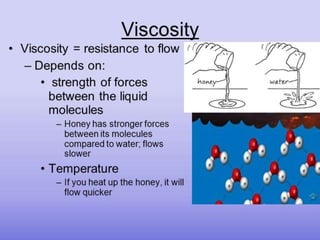
Viscosity means resistance offered
by a liquid or a gas to flow.
OR
The extend to which a fluid resist a
tendency to flow.
Example
 A liquid with high viscosity does not
flow easily i.e honey.
 The molecules of honey experience
friction due to molecular interaction
among them.
FLUIDITY
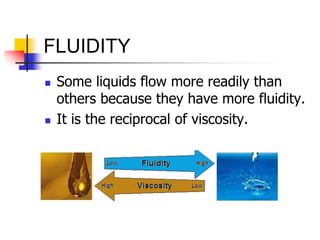
 Some liquids flow more readily than
others because they have more fluidity.
 It is the reciprocal of viscosity.
Relation between rate of flow of
liquid and viscosity
 The rate of flow of liquid is inversely
proportional to its viscosity
 In other words, higher the viscosity,
lesser will be the flow.
Causes of viscosity
 Attraction of molecules
 Internal friction
 Asymmetry in the molecules
Causes of viscosity
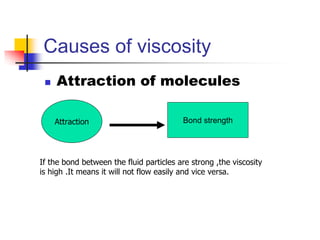
 Attraction of molecules
Attraction Bond strength
If the bond between the fluid particles are strong ,the viscosity
is high .It means it will not flow easily and vice versa.
Causes of viscosity
 Internal friction
Internal friction
Cohesive forces
Cohesive forces are intermolecular forces which cause a
tendency in liquids to resist separation.
Flow of liquid over the glass
plate
 The Liquid has number of molecular
layers arranged one over the other.
 The displacement of different layers
relative to one another is opposed by
internal friction or viscosity of liquid.
Causes of viscosity
 Structure of molecules
Structure of molecules
Symmetrical
Asymmetrical
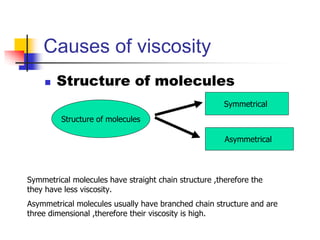
Symmetrical molecules have straight chain structure ,therefore the
they have less viscosity.
Asymmetrical molecules usually have branched chain structure and are
three dimensional ,therefore their viscosity is high.
OSTWALD'S VISCOSIMETER
OR VISCOMETER:-
 The viscosity of a liquid is determined
comparison with water. One method of
determining the viscosity of a liquid is
by the use of ostwald's viscosimeter or
viscometer.
VISCIMETER:-
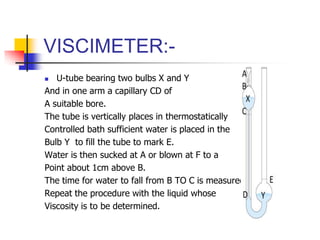
 U-tube bearing two bulbs X and Y
And in one arm a capillary CD of
A suitable bore.
The tube is vertically places in thermostatically
Controlled bath sufficient water is placed in the
Bulb Y to fill the tube to mark E.
Water is then sucked at A or blown at F to a
Point about 1cm above B.
The time for water to fall from B TO C is measured
Repeat the procedure with the liquid whose
Viscosity is to be determined.
EQUATION
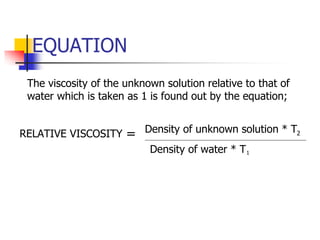
RELATIVE VISCOSITY Density of unknown solution * T2
Density of water * T1
The viscosity of the unknown solution relative to that of
water which is taken as 1 is found out by the equation;
 Here T1 and t2 are seconds taken by
water and other liquid respectively.
 Density of water is 1 and not affect
calculations and may be omitted in this
equation
UNITS OF VISCOSITY
 POISE IS ITS UNIT AFTER THE NAME
OF POISEUILLE ; IT IS EQUIVALENT
TO 10-r.
subscript r indicates that it should be taken at a radius of r.
Factors affecting viscosity
 Temperature
 Chemical composition
 Presence of colloidal particles
 Effect of suspended material
FACTORS AFFECTING
VISCOSITY
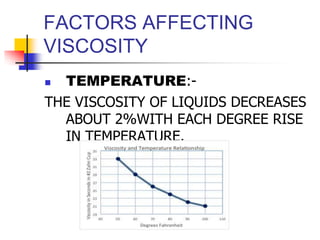
 TEMPERATURE:-
THE VISCOSITY OF LIQUIDS DECREASES
ABOUT 2%WITH EACH DEGREE RISE
IN TEMPERATURE.
Factors affecting viscosity
Chemical composition
size
shape
Chemical nature
Chemical composition
 Viscosity is greater with larger
molecules than with smaller molecules.
 Viscosity is greater in elongated
molecules than with rounded molecules.
Presence of colloidal particles
 In lyophobic colloidal solutions viscosity
is almost similar that of pure dispersion
medium.
 On the other hand viscosity of lyophilic
solution is high than that of pure
dispersion medium.
colloidal particles
Effect of suspended particles
 If the volume of suspended material is
high in total volume of solution than the
viscosity is high.
Example
 Viscosity of blood vary from 3 to 4
times that of water due to lyoplilic
colloidal system present in plasma
(mainly protein).
 Great proportion of suspended
corpuscles also increase the viscosity of
blood. it is important in blood flow and
blood pressure.
Example
 The relative viscosity of plasma and
serum is 1.4 to 1.8 times that of water.
 when it goes up to between 4 and 7
owing to the presence of abnormal
protein the patient develops sign and
symptoms resulting directly from the
increase viscosity (hyperviscosity
syndrome)
Hyperviscosity syndrome
 It is mainly due to high concentration of plasma
protein in the blood.
 Here the serum viscosity may go up as high as 12 to
15 times that of water while normal serum is only 1.8
times viscous as water
 E.g 1gM and 1 gG in macroglobulinemia and 1gG
myeloma respectively.
 Collagen diseases :
 Rhematoid arthritis and systemic lupus erythmatosus
may also produce hypervicosity of the plasma by
increasing the plasma level of certain
immonuglobulins..
Symptoms
 Circulatory impairment
 Recurrent bleeding from mucous
membrane(gums and nose)Gastrointestinal
tract..
 Visual disturbances ( a type of retinopathy)
 Neurological disorders such as
headache,tinnitus,dizziness,vertigo,fits,hemipl
egia and comma..
 Congestive cardiac failure..
Reason for symptoms
 Due to:
 In-vivo RBC agglutination
Treatment
 Plasmapheresis:
 A technique in which an appropriate amount
of blood is removed from the body and its
plasma is separated and the RBC are
retransfused .
 This procedure will decrease the
concentration of plasma protein thus
decrease in plasma viscosity .
 In additon drug therapy is also used.

Viscosity (2)

  • 1.
    Viscosity By Tooba SanaIqra Maheen Maliha
  • 2.
    VISCOSITY Viscosity means resistanceoffered by a liquid or a gas to flow. OR The extend to which a fluid resist a tendency to flow.
  • 3.
    Example  A liquidwith high viscosity does not flow easily i.e honey.  The molecules of honey experience friction due to molecular interaction among them.
  • 4.
    FLUIDITY  Some liquidsflow more readily than others because they have more fluidity.  It is the reciprocal of viscosity.
  • 5.
    Relation between rateof flow of liquid and viscosity  The rate of flow of liquid is inversely proportional to its viscosity  In other words, higher the viscosity, lesser will be the flow.
  • 6.
    Causes of viscosity Attraction of molecules  Internal friction  Asymmetry in the molecules
  • 7.
    Causes of viscosity Attraction of molecules Attraction Bond strength If the bond between the fluid particles are strong ,the viscosity is high .It means it will not flow easily and vice versa.
  • 9.
    Causes of viscosity Internal friction Internal friction Cohesive forces Cohesive forces are intermolecular forces which cause a tendency in liquids to resist separation.
  • 10.
    Flow of liquidover the glass plate  The Liquid has number of molecular layers arranged one over the other.  The displacement of different layers relative to one another is opposed by internal friction or viscosity of liquid.
  • 11.
    Causes of viscosity Structure of molecules Structure of molecules Symmetrical Asymmetrical Symmetrical molecules have straight chain structure ,therefore the they have less viscosity. Asymmetrical molecules usually have branched chain structure and are three dimensional ,therefore their viscosity is high.
  • 12.
    OSTWALD'S VISCOSIMETER OR VISCOMETER:- The viscosity of a liquid is determined comparison with water. One method of determining the viscosity of a liquid is by the use of ostwald's viscosimeter or viscometer.
  • 13.
    VISCIMETER:-  U-tube bearingtwo bulbs X and Y And in one arm a capillary CD of A suitable bore. The tube is vertically places in thermostatically Controlled bath sufficient water is placed in the Bulb Y to fill the tube to mark E. Water is then sucked at A or blown at F to a Point about 1cm above B. The time for water to fall from B TO C is measured Repeat the procedure with the liquid whose Viscosity is to be determined.
  • 14.
    EQUATION RELATIVE VISCOSITY Densityof unknown solution * T2 Density of water * T1 The viscosity of the unknown solution relative to that of water which is taken as 1 is found out by the equation;
  • 15.
     Here T1and t2 are seconds taken by water and other liquid respectively.  Density of water is 1 and not affect calculations and may be omitted in this equation
  • 16.
    UNITS OF VISCOSITY POISE IS ITS UNIT AFTER THE NAME OF POISEUILLE ; IT IS EQUIVALENT TO 10-r. subscript r indicates that it should be taken at a radius of r.
  • 17.
    Factors affecting viscosity Temperature  Chemical composition  Presence of colloidal particles  Effect of suspended material
  • 18.
    FACTORS AFFECTING VISCOSITY  TEMPERATURE:- THEVISCOSITY OF LIQUIDS DECREASES ABOUT 2%WITH EACH DEGREE RISE IN TEMPERATURE.
  • 19.
    Factors affecting viscosity Chemicalcomposition Chemical composition size shape Chemical nature
  • 20.
    Chemical composition  Viscosityis greater with larger molecules than with smaller molecules.  Viscosity is greater in elongated molecules than with rounded molecules.
  • 21.
    Presence of colloidalparticles  In lyophobic colloidal solutions viscosity is almost similar that of pure dispersion medium.  On the other hand viscosity of lyophilic solution is high than that of pure dispersion medium.
  • 22.
  • 23.
    Effect of suspendedparticles  If the volume of suspended material is high in total volume of solution than the viscosity is high.
  • 24.
    Example  Viscosity ofblood vary from 3 to 4 times that of water due to lyoplilic colloidal system present in plasma (mainly protein).  Great proportion of suspended corpuscles also increase the viscosity of blood. it is important in blood flow and blood pressure.
  • 25.
    Example  The relativeviscosity of plasma and serum is 1.4 to 1.8 times that of water.  when it goes up to between 4 and 7 owing to the presence of abnormal protein the patient develops sign and symptoms resulting directly from the increase viscosity (hyperviscosity syndrome)
  • 26.
    Hyperviscosity syndrome  Itis mainly due to high concentration of plasma protein in the blood.  Here the serum viscosity may go up as high as 12 to 15 times that of water while normal serum is only 1.8 times viscous as water  E.g 1gM and 1 gG in macroglobulinemia and 1gG myeloma respectively.  Collagen diseases :  Rhematoid arthritis and systemic lupus erythmatosus may also produce hypervicosity of the plasma by increasing the plasma level of certain immonuglobulins..
  • 27.
    Symptoms  Circulatory impairment Recurrent bleeding from mucous membrane(gums and nose)Gastrointestinal tract..  Visual disturbances ( a type of retinopathy)  Neurological disorders such as headache,tinnitus,dizziness,vertigo,fits,hemipl egia and comma..  Congestive cardiac failure..
  • 28.
    Reason for symptoms Due to:  In-vivo RBC agglutination
  • 29.
    Treatment  Plasmapheresis:  Atechnique in which an appropriate amount of blood is removed from the body and its plasma is separated and the RBC are retransfused .  This procedure will decrease the concentration of plasma protein thus decrease in plasma viscosity .  In additon drug therapy is also used.