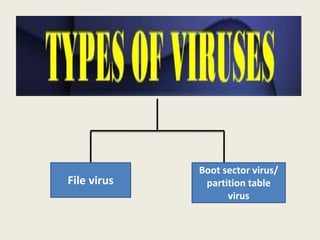
File virus
Boot sector virus/
partition table
virus
1. File virus
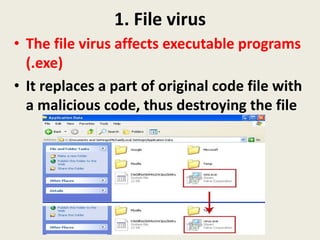
• The file virus affects executable programs
(.exe)
• It replaces a part of original code file with
a malicious code, thus destroying the file
2. Boot sector virus
• The 1st sector of the outermost track in floppy disk
contained a small program known as bootstrap
loader program.
• when computer was switched on, this program
used to load OS from floppy disk to the main
memory of the computer.
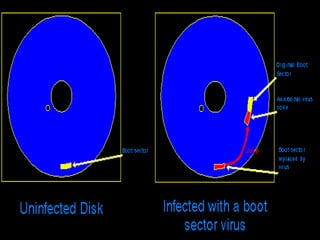
• A boot sector virus substitutes itself for bootstrap
loader. Virus gets automatic loaded into main
memory.
• Once loaded it starts affecting all files on disk.
Examples of viruses
1. Trojan Horse: damages files by merging
unwarranted program code with
authorized programs.
2. Worms: this program duplicates its own
code.
3. Salami techniques: robs small amount of
money from user account and user
remains unaware.
4. Eaves Dropping: allows a person to
observe some message transmitted to
other people.
5. Wire tapping: it has special transmission path
to divert flow of data from original user to
unauthorized user.
6. Stealth virus: these virus avoids self detection
by antivirus.
7. Logic bombs: these cause computer to
malfunction.
8. Data diddling: performs unauthorized
modifications of data and user is not aware of
it.
Antivirus software are computer programs that
attempt to identify, neutralize or eliminate malicious
software.

Virus

  • 1.
    File virus Boot sectorvirus/ partition table virus
  • 2.
    1. File virus •The file virus affects executable programs (.exe) • It replaces a part of original code file with a malicious code, thus destroying the file
  • 3.
    2. Boot sectorvirus • The 1st sector of the outermost track in floppy disk contained a small program known as bootstrap loader program. • when computer was switched on, this program used to load OS from floppy disk to the main memory of the computer. • A boot sector virus substitutes itself for bootstrap loader. Virus gets automatic loaded into main memory. • Once loaded it starts affecting all files on disk.
  • 5.
  • 6.
    1. Trojan Horse:damages files by merging unwarranted program code with authorized programs. 2. Worms: this program duplicates its own code. 3. Salami techniques: robs small amount of money from user account and user remains unaware. 4. Eaves Dropping: allows a person to observe some message transmitted to other people.
  • 7.
    5. Wire tapping:it has special transmission path to divert flow of data from original user to unauthorized user. 6. Stealth virus: these virus avoids self detection by antivirus. 7. Logic bombs: these cause computer to malfunction. 8. Data diddling: performs unauthorized modifications of data and user is not aware of it.
  • 8.
    Antivirus software arecomputer programs that attempt to identify, neutralize or eliminate malicious software.