
Virus
Virus, Worm, Trojan Horse &
Blended Threat
What is a virus?
A virus is a program that replicates itself. It
spreads by making copies of itself on a
computer or by inserting computer code
into program or operating system files.
Viruses don't always damage files or
computers, but they usually affect a
computer's performance and stability. For
a virus to infect a computer or to spread,
you usually have to do something, such as
open an infected e mail attachment.‑
Are all viruses harmful?
Yes, to varying degrees. Virus damage can
range from slowing computer performance
to a loss of information and programs. In
the worst case, viruses delete or modify
information and programs on your
computer. Some e mail viruses send‑
confidential information in messages when
spreading. Even when a virus is not
directly damaging information, the process
of replication can slow your computer and
Internet connection.
What is a worm?
A worm is computer code that spreads without user
interaction. Most worms begin as e mail attachments‑
that infect a computer when they're opened. The worm
scans the infected computer for files, such as address
books, or temporary webpages, that contain e mail‑
addresses. The worm uses the addresses to send
infected e mail, and often mimics (or spoofs) the "From"‑
addresses in subsequent e mail messages so that those‑
infected messages appear to be from someone you
know. Worms then spread automatically through e mail,‑
networks, or operating system vulnerabilities, often
overwhelming those systems before the cause is known.
Worms aren't always destructive to computers, but they
usually cause computer and network performance and
stability problems.
What is a Trojan horse?
A Trojan horse is a malicious software
program that hides inside other programs.
It enters a computer hidden inside a
legitimate program, such as a screen
saver. It then puts code into the operating
system, which enables a hacker to access
the infected computer. Trojan horses do
not usually spread by themselves; they
are spread by viruses, worms, or
downloaded software.
What is a blended threat?
A blended threat is a combination of some
or all of the malicious programs discussed
in the sections above. Blended threats
often begin when someone interacts with
a virus (such as opening an unsafe e mail‑
attachment). The virus automatically
propagates using worm behavior, and
then installs a Trojan horse on the infected
computer.
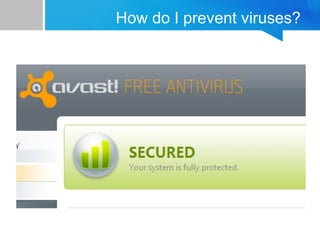
How do I prevent viruses?
Protecting your computer from viruses and other
threats isn't difficult, but you have to be diligent.
Install an antivirus program. Installing an
antivirus program and keeping it up-to-date can
help defend your computer against viruses.
Antivirus programs scan for viruses trying to get
into your e mail, operating system, or files. New‑
viruses appear daily, so check the antivirus
manufacturer's website frequently for updates.
Most antivirus programs are sold with annual
subscriptions, that can be renewed as needed.
To find an antivirus scanner, visit the Windows
Security software providers webpage.
How do I prevent viruses?
 Do not open e - mail attachments. Many viruses are attached to e -
mail messages and will spread as soon as you open the e - mail
attachment. It's best not to open any attachment unless it is something
you are expecting. Microsoft Outlook and Windows Mail help block
potentially dangerous attachments.
 Keep Windows updated. Periodically, Microsoft releases special
security updates that can help protect your computer. These updates
can help prevent viruses and other computer attacks by closing possible
security holes. Make sure that Windows receives these updates by
turning on Windows automatic updating. To learn how, see Turn
automatic updating on or off.
 Use a firewall.‌ Windows Firewall or any other firewall program can help
alert you to suspicious activity if a virus or worm attempts to connect to
your computer. It can also block viruses, worms, and hackers from
attempting to download potentially harmful programs to your computer.
How do I know if your computer has a virus?
If you can answer "yes" to any of the following
questions, your computer might have a virus.
 Is your computer running very slowly? A
common symptom of a virus is much slower
than normal computer performance. However,
there can be other reasons for slow
performance, including a hard disk that needs
defragmenting, a computer that needs more
memory (RAM), or the existence of spyware or
adware. For more information about spyware,
see How to tell if your computer is infected with
spyware.
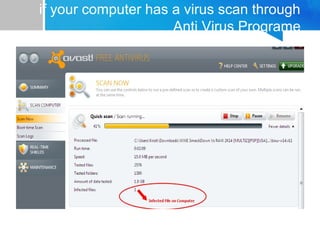
if your computer has a virus scan through
Anti Virus Programe
How do I know if your computer has a
virus?
 Are you getting unexpected messages, or are
programs starting automatically? Some viruses can
cause damage to Windows or some of your programs.
The results of this damage might include messages
appearing unexpectedly, programs starting or closing
automatically, or Windows shutting down suddenly.
 Is your modem or hard disk working overtime? An e
-mail virus works by sending many copies of itself by e -
mail. One indicator of this is that the activity light on your
broadband or external modem is constantly lit; another is
the sound of your computer's hard disk continually
working. These are not always symptoms of a computer
virus, but when combined with other problems, can
indicate a virus infection.
How do I check for and remove
viruses?
• Here are a few things you can try to remove a computer virus:
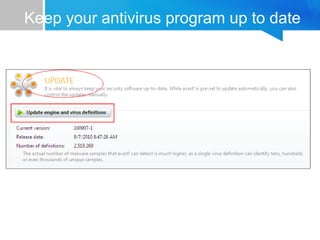
 Keep your antivirus program up to date. If you
have already installed an antivirus program on your computer, it's
important that you keep it up to date. Because new viruses are
being written all the time, most antivirus programs are updated
frequently. Check your antivirus program's documentation or visit
their website to learn how to receive updates. Be aware that some
viruses block common antivirus websites, making it so you cannot
go to the website to download antivirus updates. If this happens,
check with your antivirus vendor to see if they have a disc you can
use to install the latest updates. It might be possible for you to
create this disc on a computer that is not infected (for example, on a
friend's computer).
Keep your antivirus program up to date
 Use an online scanner. If you don't have antivirus software
installed, visit the Windows Security Software website for
more information about security and virus prevention. Some
of the sites offer free online scanners which will search your
computer for the latest viruses. These scanners will not
protect you from getting a virus, but they can help find and
remove viruses your computer already has.
 Use the Malicious Software Removal Tool. Microsoft
offers the Malicious Software Removal Tool, which is
updated once a month. The tool scans your computer for
most new viruses and malicious software. After you run the
tool, you will get a report that describes any malicious
software found on your computer and lists all the viruses it
scanned for.
How do I check for and remove
viruses?
Stop a runaway virus. Viruses are often created
specifically to take control of your computer and send copies of
themselves from your computer to other computers. You can usually
tell this is happening if your computer is performing slowly and
accessing the network more frequently than normal. If this is
happening, you should disconnect from the Internet and network (if
you're on one). If you are connected to the Internet through a
physical connection, disconnect the network or phone cable from
your computer. If you're connected to the Internet through a wireless
connection on a laptop, turn off the wireless adapter on the
computer (either by turning off a switch or removing your wireless
adapter card). Once your computer is disconnected from the
Internet, run your antivirus software (from a disc or software on your
computer) to remove the virus.
How do I check for and remove
viruses?
How do I check for and remove
viruses?
Manually remove viruses. Sometimes a virus
must be removed manually. This is often a technical process and
should only be attempted by computer users who have experience
with the Windows registry and who know how to view and delete
system and program files in Windows.
The first step is to identify the virus. Run your antivirus software to
identify the name of the virus. If you don't have an antivirus program,
or if your program does not detect the virus, you can still identify the
virus by looking for clues about how it behaves. Write down the text
in any messages displayed by the virus or, if you received the virus
in e mail, write down the subject line or name of the file attached to‑
the message. Search the antivirus vendor's website for references
to those specific things you wrote down to try to find the name of the
virus and instructions for how to remove it.
What is Data Execution Prevention?
 Data Execution Prevention (DEP) is a security feature
that can help prevent damage to your computer from
viruses and other security threats. Harmful programs can
try to attack Windows by attempting to run (also known
as execute) code from your computer's memory
reserved for Windows and other authorized programs.
These types of attacks can harm your programs and
files.
 DEP can help protect your computer by monitoring your
programs to make sure that they use computer memory
safely. If DEP notices a program on your computer using
memory incorrectly, it closes the program and notifies
you.
Thank You
Presented by MUKUL
Source : Microsoft Windows

Virus

  • 1.
    Virus Virus, Worm, TrojanHorse & Blended Threat
  • 2.
    What is avirus? A virus is a program that replicates itself. It spreads by making copies of itself on a computer or by inserting computer code into program or operating system files. Viruses don't always damage files or computers, but they usually affect a computer's performance and stability. For a virus to infect a computer or to spread, you usually have to do something, such as open an infected e mail attachment.‑
  • 3.
    Are all virusesharmful? Yes, to varying degrees. Virus damage can range from slowing computer performance to a loss of information and programs. In the worst case, viruses delete or modify information and programs on your computer. Some e mail viruses send‑ confidential information in messages when spreading. Even when a virus is not directly damaging information, the process of replication can slow your computer and Internet connection.
  • 4.
    What is aworm? A worm is computer code that spreads without user interaction. Most worms begin as e mail attachments‑ that infect a computer when they're opened. The worm scans the infected computer for files, such as address books, or temporary webpages, that contain e mail‑ addresses. The worm uses the addresses to send infected e mail, and often mimics (or spoofs) the "From"‑ addresses in subsequent e mail messages so that those‑ infected messages appear to be from someone you know. Worms then spread automatically through e mail,‑ networks, or operating system vulnerabilities, often overwhelming those systems before the cause is known. Worms aren't always destructive to computers, but they usually cause computer and network performance and stability problems.
  • 5.
    What is aTrojan horse? A Trojan horse is a malicious software program that hides inside other programs. It enters a computer hidden inside a legitimate program, such as a screen saver. It then puts code into the operating system, which enables a hacker to access the infected computer. Trojan horses do not usually spread by themselves; they are spread by viruses, worms, or downloaded software.
  • 6.
    What is ablended threat? A blended threat is a combination of some or all of the malicious programs discussed in the sections above. Blended threats often begin when someone interacts with a virus (such as opening an unsafe e mail‑ attachment). The virus automatically propagates using worm behavior, and then installs a Trojan horse on the infected computer.
  • 7.
    How do Iprevent viruses? Protecting your computer from viruses and other threats isn't difficult, but you have to be diligent. Install an antivirus program. Installing an antivirus program and keeping it up-to-date can help defend your computer against viruses. Antivirus programs scan for viruses trying to get into your e mail, operating system, or files. New‑ viruses appear daily, so check the antivirus manufacturer's website frequently for updates. Most antivirus programs are sold with annual subscriptions, that can be renewed as needed. To find an antivirus scanner, visit the Windows Security software providers webpage.
  • 8.
    How do Iprevent viruses?
  • 9.
    How do Iprevent viruses?  Do not open e - mail attachments. Many viruses are attached to e - mail messages and will spread as soon as you open the e - mail attachment. It's best not to open any attachment unless it is something you are expecting. Microsoft Outlook and Windows Mail help block potentially dangerous attachments.  Keep Windows updated. Periodically, Microsoft releases special security updates that can help protect your computer. These updates can help prevent viruses and other computer attacks by closing possible security holes. Make sure that Windows receives these updates by turning on Windows automatic updating. To learn how, see Turn automatic updating on or off.  Use a firewall.‌ Windows Firewall or any other firewall program can help alert you to suspicious activity if a virus or worm attempts to connect to your computer. It can also block viruses, worms, and hackers from attempting to download potentially harmful programs to your computer.
  • 10.
    How do Iknow if your computer has a virus? If you can answer "yes" to any of the following questions, your computer might have a virus.  Is your computer running very slowly? A common symptom of a virus is much slower than normal computer performance. However, there can be other reasons for slow performance, including a hard disk that needs defragmenting, a computer that needs more memory (RAM), or the existence of spyware or adware. For more information about spyware, see How to tell if your computer is infected with spyware.
  • 11.
    if your computerhas a virus scan through Anti Virus Programe
  • 12.
    How do Iknow if your computer has a virus?  Are you getting unexpected messages, or are programs starting automatically? Some viruses can cause damage to Windows or some of your programs. The results of this damage might include messages appearing unexpectedly, programs starting or closing automatically, or Windows shutting down suddenly.  Is your modem or hard disk working overtime? An e -mail virus works by sending many copies of itself by e - mail. One indicator of this is that the activity light on your broadband or external modem is constantly lit; another is the sound of your computer's hard disk continually working. These are not always symptoms of a computer virus, but when combined with other problems, can indicate a virus infection.
  • 13.
    How do Icheck for and remove viruses? • Here are a few things you can try to remove a computer virus:  Keep your antivirus program up to date. If you have already installed an antivirus program on your computer, it's important that you keep it up to date. Because new viruses are being written all the time, most antivirus programs are updated frequently. Check your antivirus program's documentation or visit their website to learn how to receive updates. Be aware that some viruses block common antivirus websites, making it so you cannot go to the website to download antivirus updates. If this happens, check with your antivirus vendor to see if they have a disc you can use to install the latest updates. It might be possible for you to create this disc on a computer that is not infected (for example, on a friend's computer).
  • 14.
    Keep your antivirusprogram up to date
  • 15.
     Use anonline scanner. If you don't have antivirus software installed, visit the Windows Security Software website for more information about security and virus prevention. Some of the sites offer free online scanners which will search your computer for the latest viruses. These scanners will not protect you from getting a virus, but they can help find and remove viruses your computer already has.  Use the Malicious Software Removal Tool. Microsoft offers the Malicious Software Removal Tool, which is updated once a month. The tool scans your computer for most new viruses and malicious software. After you run the tool, you will get a report that describes any malicious software found on your computer and lists all the viruses it scanned for. How do I check for and remove viruses?
  • 16.
    Stop a runawayvirus. Viruses are often created specifically to take control of your computer and send copies of themselves from your computer to other computers. You can usually tell this is happening if your computer is performing slowly and accessing the network more frequently than normal. If this is happening, you should disconnect from the Internet and network (if you're on one). If you are connected to the Internet through a physical connection, disconnect the network or phone cable from your computer. If you're connected to the Internet through a wireless connection on a laptop, turn off the wireless adapter on the computer (either by turning off a switch or removing your wireless adapter card). Once your computer is disconnected from the Internet, run your antivirus software (from a disc or software on your computer) to remove the virus. How do I check for and remove viruses?
  • 17.
    How do Icheck for and remove viruses? Manually remove viruses. Sometimes a virus must be removed manually. This is often a technical process and should only be attempted by computer users who have experience with the Windows registry and who know how to view and delete system and program files in Windows. The first step is to identify the virus. Run your antivirus software to identify the name of the virus. If you don't have an antivirus program, or if your program does not detect the virus, you can still identify the virus by looking for clues about how it behaves. Write down the text in any messages displayed by the virus or, if you received the virus in e mail, write down the subject line or name of the file attached to‑ the message. Search the antivirus vendor's website for references to those specific things you wrote down to try to find the name of the virus and instructions for how to remove it.
  • 18.
    What is DataExecution Prevention?  Data Execution Prevention (DEP) is a security feature that can help prevent damage to your computer from viruses and other security threats. Harmful programs can try to attack Windows by attempting to run (also known as execute) code from your computer's memory reserved for Windows and other authorized programs. These types of attacks can harm your programs and files.  DEP can help protect your computer by monitoring your programs to make sure that they use computer memory safely. If DEP notices a program on your computer using memory incorrectly, it closes the program and notifies you.
  • 19.
    Thank You Presented byMUKUL Source : Microsoft Windows