• Yastee A. Shah
By:
Program/piece of code that is loaded
onto your computer without your
knowledge & runs against your
wishes.
Has ability to make copies by itself,
which attacks itself to other
applications and files.
All viruses are man-made.
There are many types of virus..
 Boot virus: Affects the boot sector of a floppy or hard disk
(crucial part where information on the disk itself is stored together
with a program that makes it possible to boot computer from the
disk.).
The best way of avoiding boot viruses is to ensure that floppy disks
are write-protected and never start your computer with an unknown
floppy disk in the disk drive.
Examples of boot viruses include: Polyboot.B, AntiEXE.

 Program Virus: Infects program files, with
extinction as .COM,.EXE,.DLL,.SYS,.SRC etc.
Program files are attractive targets because they
are widely used and have relatively simple
formats to which virus can attack themselves.
 Macro virus: Infect files that are created using
certain programs that contain macros. These
mini-programs make it possible to automate
series of operations so that they are performed as
a single action.
Examples of macro viruses: Relax, Melissa. A,
Babbles, O97M/Y2K.
 Directory virus
 Polymorphic virus
 Encrypted virus
 Stealth virus
 Worm
 Trojans
 Cookies etc.
Virus tries to take control of system it
has infected at the first opportunity
available.
It is linked to the host object in such a
way that it activates when host object is
used.
Then , virus looks for other suitable
carrier objects and attacks itself to them.
With this dependency, virus slows down
system.
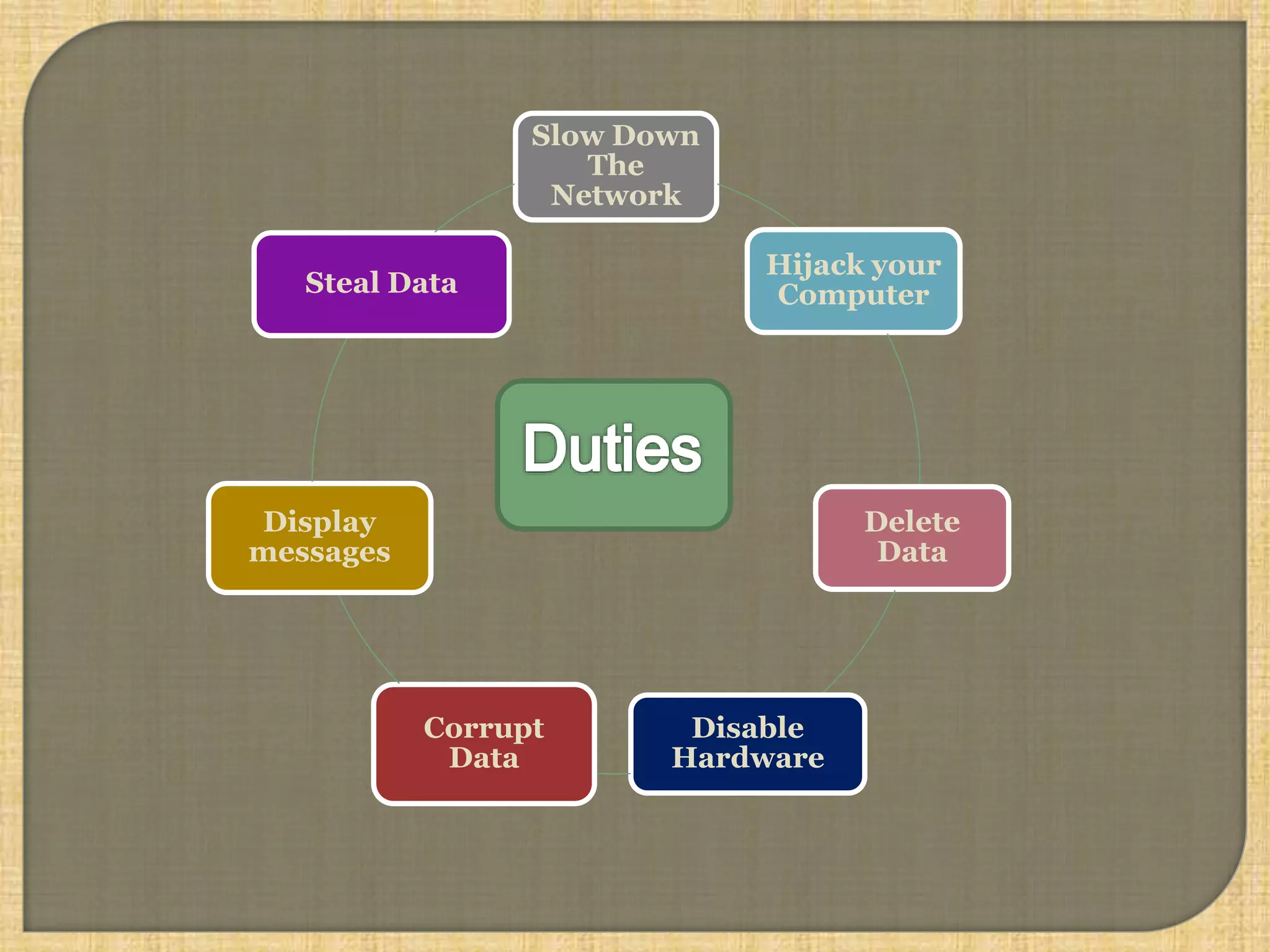
Slow Down
The
Network
Hijack your
Computer
Delete
Data
Disable
Hardware
Corrupt
Data
Display
messages
Steal Data
Downloaded Programs
Cracked Software
Email Attachments
Internet
Booting from CD
~Whether you saw a message saying a virus
was detected, or your computer just seems
slow and unreliable, you’ll want to scan for
malware on your PC and remove any you
find.
Computer program intended to identify
& eliminate computer virus.
Antivirus program runs in RAM of the
system.
There are mainly 2 types of anti-virus:
Specific.
Generic.
Antivirus application maintains
database of known virus & compare
scanned files that match
characteristics of known virus.
If scanned files matches those
characteristics of virus, it is moved to
separate place so that it cannot affect
other files on your system and can be
used if ever needed.
HOW DOES ANTIVIRUS
WORKS..
 Providing regular updates for virus
dictionary. Antivirus program should
provide free virus updates on periodic
basis.
https://www.microsoft.com/aspx
https://www.privacyrights.org/
http://www.webopedia.com/virus.html
http://www.avast.com/c-computer-virus
http:/google.com/
Types of virus and saviour

Types of virus and saviour

  • 1.
    • Yastee A.Shah By:
  • 4.
    Program/piece of codethat is loaded onto your computer without your knowledge & runs against your wishes. Has ability to make copies by itself, which attacks itself to other applications and files. All viruses are man-made.
  • 5.
    There are manytypes of virus..  Boot virus: Affects the boot sector of a floppy or hard disk (crucial part where information on the disk itself is stored together with a program that makes it possible to boot computer from the disk.). The best way of avoiding boot viruses is to ensure that floppy disks are write-protected and never start your computer with an unknown floppy disk in the disk drive. Examples of boot viruses include: Polyboot.B, AntiEXE. 
  • 6.
     Program Virus:Infects program files, with extinction as .COM,.EXE,.DLL,.SYS,.SRC etc. Program files are attractive targets because they are widely used and have relatively simple formats to which virus can attack themselves.  Macro virus: Infect files that are created using certain programs that contain macros. These mini-programs make it possible to automate series of operations so that they are performed as a single action. Examples of macro viruses: Relax, Melissa. A, Babbles, O97M/Y2K.
  • 7.
     Directory virus Polymorphic virus  Encrypted virus  Stealth virus  Worm  Trojans  Cookies etc.
  • 8.
    Virus tries totake control of system it has infected at the first opportunity available. It is linked to the host object in such a way that it activates when host object is used. Then , virus looks for other suitable carrier objects and attacks itself to them. With this dependency, virus slows down system.
  • 9.
  • 10.
    Downloaded Programs Cracked Software EmailAttachments Internet Booting from CD
  • 11.
    ~Whether you sawa message saying a virus was detected, or your computer just seems slow and unreliable, you’ll want to scan for malware on your PC and remove any you find.
  • 14.
    Computer program intendedto identify & eliminate computer virus. Antivirus program runs in RAM of the system. There are mainly 2 types of anti-virus: Specific. Generic.
  • 15.
    Antivirus application maintains databaseof known virus & compare scanned files that match characteristics of known virus. If scanned files matches those characteristics of virus, it is moved to separate place so that it cannot affect other files on your system and can be used if ever needed.
  • 16.
  • 17.
     Providing regularupdates for virus dictionary. Antivirus program should provide free virus updates on periodic basis.
  • 20.