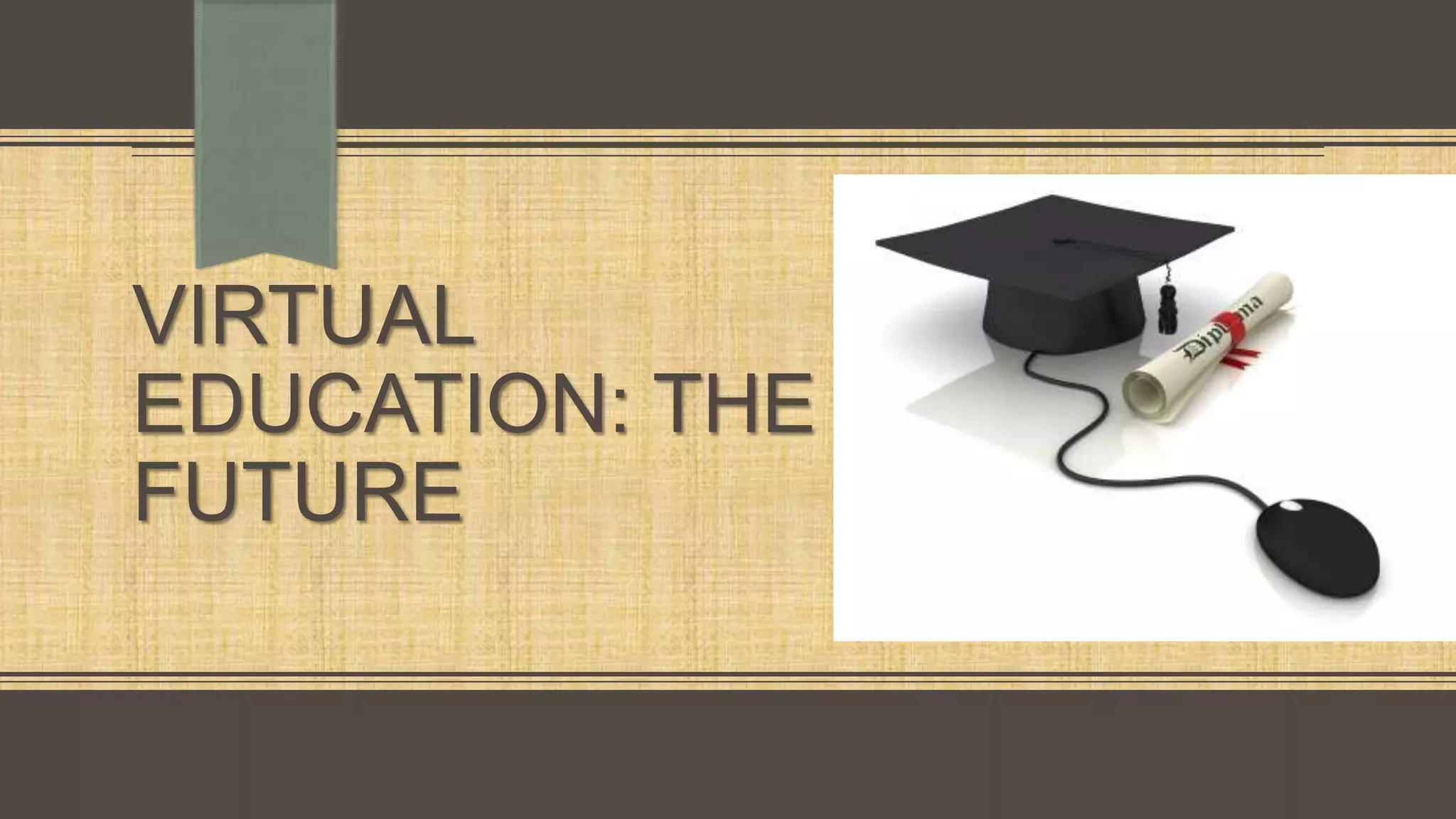
VIRTUAL
EDUCATION: THE
FUTURE
History of Virtual Education

Virtual Education in Today’s World

Virtual Education & The Future
Virtual Education:
 Virtual





having the essence or effect but not the appearance or form of: a virtual revolution
physics being, relating to, or involving a virtual image: a virtual focus
computing of or relating to virtual storage: virtual memory
of or relating to a computer technique by which a person, wearing a headset or mask, has
the experience of being in an environment created by the computer, and of interacting
with and causing changes in it
 rare capable of producing an effect through inherent power or virtue
 Physics designating or relating to a particle exchanged between other particles that are
interacting by a field of force: a virtual photon
Virtual Education – Definitions
 Virtual Education
 distance learning that takes place via the Internet (INACOL)
 a form of distance education whose central defining characteristic is the separation of
teacher and learner (Keegan, 1996)
 teacher-led education that takes place over the Internet, with the teacher and student
separated geographically (Keeping the Pace)

 Online learning is instruction via a web-based educational delivery system
 enhances educational opportunities
 synchronous or asynchronous
 accessed from multiple settings

 Blended learning combines online learning with other modes of instructional
delivery.
Modes of Learning:
 Traditional Classroom learning
 Not needed to explain as the term describes itself

 Online learning is instruction via a web-based educational delivery system
 enhances educational opportunities
 synchronous or asynchronous
 accessed from multiple settings

 Blended learning combines online learning with other modes of instructional
delivery.
iNACOL
 I want to introduce you to iNACOL, the international council on online learning.
 It is the leading organization on research and expanding online education in the K-12
arena for all grades.
History of Online learning
 As technology improved and advanced, distance learning was able to occur through print
materials, CD-ROMs, and video and video conferencing. Now it has expanded to online
learning via the internet.
 In 1960, the University of Illinois initiated a classroom system based in
linked computer terminals where students could access informational resources on
a particular course while listening to the lectures that were recorded via some form
of remotely-linked device like television or audio device.
 In the early 1960s, Stanford University psychology professors Patrick
Suppes and Richard C. Atkinson experimented with using computers to teach
math and reading to young children inelementary schools in East Palo Alto,
California.
 Educational institutions began to take advantage of the new medium by offering
distance learning courses using computer networking for information.
PRESENT ERA & VIRTUAL
EDUCATION
Present Era & Virtual Education
 Early forms of online courses included Advanced Placement courses and college prep
courses that weren’t available for students in rural areas of USA.
 The growth of online education in post-secondary and professional development
contributed to the legitimacy and growth of online learning in K-12.
 Online learning has become common place in higher education, but is growing in the K-12
arena as well. In the K-12 arena we see online learning in the form of blended or hybrid,
and fully online programs.
Top 4 E-learning Sites
Now I will tell you briefly about top 4 e-learning sites today.
 Coursera (www.coursera.org)
 Codecademy (http://www.codecademy.com/)
 Edx (www.edx.org)
 Udacity (www.udacity.com)
Coursera
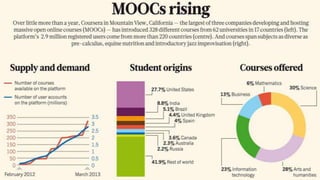
 The top of the list is Coursera.
 It was launched in April 2012, and it has now 5.2 Million active users.
 I have personally used Coursera. It is the best out there. Coursera provides online courses
of university and college level by partnering with the top Universities of the world.
 Each course includes lecture videos, quizzes, assignments and projects on weekly basis. At
the end of the course if you pass the final exam you get a statement of achievement or a
verified certificate.
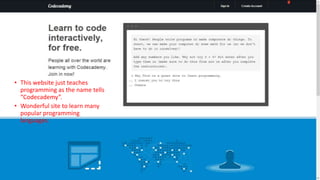
• This website just teaches
programming as the name tells
“Codecademy”.
• Wonderful site to learn many
popular programming
languages.
Codecademy
 Next on the list is Codecademy.
 It was launched in 2011, and it has now 5 Million active users.
 Codecademy is an online interactive platform that offers free coding classes
in programming languages like Python, PHP, JavaScript, and Ruby, as well as markup
languages including HTML and CSS.
edX





Next on the list is edX.
It was launched in May 2012, and it has now 1.2 Million active users.
edX provides university level online courses.
You get a certificate of successful completion at the end of the course if you pass.
Udacity
 Udacity was launched in June 2011, and it has now 7 lac active users.
 Udacity provides university level computer science courses.
 Each course includes lecture videos, quizzes, assignments and projects, unlike coursera
you can do the coursework whenever you want to, there are no deadlines or time slots.
 At the end of the course if you pass the final exam you get a certificate of completion
indicating your achievement.
Pakistan & Virtual Education
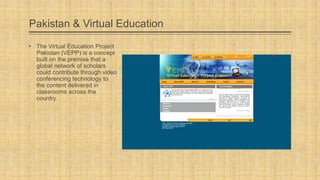
• The Virtual Education Project
Pakistan (VEPP) is a concept
built on the premise that a
global network of scholars
could contribute through video
conferencing technology to
the content delivered in
classrooms across the
country.
Pakistan & Virtual Education
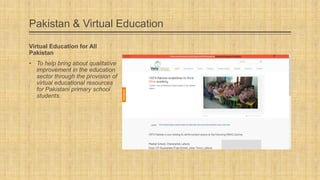
Virtual Education for All
Pakistan

• To help bring about qualitative
improvement in the education
sector through the provision of
virtual educational resources
for Pakistani primary school
students.
A small advice
 If you want your country to
prosper, educate
yourselves about Virtual
Education, and teach online
so that children or adults
who have special needs
and can not learn in a
traditional class room can
learn online. Almost all the
developed countries are
taking Virtual Education
very seriously and if we
don’t want to be left behind
we have to do the same.
Now Usman will tell you
about the Future of Virtual
Education.
VIRTUAL EDUCATION: THE FUTURE
Advantages of Virtual Education
• Automatic retention- You do not have to take notes
• Fosters more interaction among students and instructors
• The knowledge you want first
• Learn at your own pace

• Anytime, anywhere, accessibility
Disadvantages of Virtual Education
• Learners with low motivation or bad habits can easily fall behind
• Lack of routine structure
• Students feel isolated from classmates or instructor
• Instructor may not always be available

• Slow internet connections and slow computers are a problem
Future of Virtual Education

 Future Research
 A better understanding of online student characteristics
 Predictive instruments, diagnosis, and prescription of services and
supports
 Research that will inform instructors about the most effective
interaction types, tools, and frequency for learners and tasks in a
course
 More research on gaming and social software.
 Research on at-risk and struggling student performance and
improvement by involvement in virtual learning
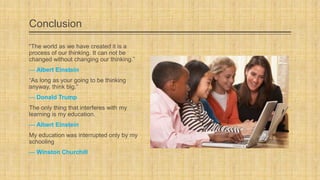
Conclusion
“The world as we have created it is a
process of our thinking. It can not be
changed without changing our thinking.”
— Albert Einstein
“As long as your going to be thinking
anyway, think big.”
— Donald Trump

The only thing that interferes with my
learning is my education.
— Albert Einstein
My education was interrupted only by my
schooling
— Winston Churchill
Credits
• Syed Farjad Zia Zaidi

Virtual education, and Future of Virtual education in Pakistan.

  • 1.
  • 2.
    History of VirtualEducation Virtual Education in Today’s World Virtual Education & The Future
  • 3.
    Virtual Education:  Virtual     havingthe essence or effect but not the appearance or form of: a virtual revolution physics being, relating to, or involving a virtual image: a virtual focus computing of or relating to virtual storage: virtual memory of or relating to a computer technique by which a person, wearing a headset or mask, has the experience of being in an environment created by the computer, and of interacting with and causing changes in it  rare capable of producing an effect through inherent power or virtue  Physics designating or relating to a particle exchanged between other particles that are interacting by a field of force: a virtual photon
  • 4.
    Virtual Education –Definitions  Virtual Education  distance learning that takes place via the Internet (INACOL)  a form of distance education whose central defining characteristic is the separation of teacher and learner (Keegan, 1996)  teacher-led education that takes place over the Internet, with the teacher and student separated geographically (Keeping the Pace)  Online learning is instruction via a web-based educational delivery system  enhances educational opportunities  synchronous or asynchronous  accessed from multiple settings  Blended learning combines online learning with other modes of instructional delivery.
  • 5.
    Modes of Learning: Traditional Classroom learning  Not needed to explain as the term describes itself  Online learning is instruction via a web-based educational delivery system  enhances educational opportunities  synchronous or asynchronous  accessed from multiple settings  Blended learning combines online learning with other modes of instructional delivery.
  • 6.
    iNACOL  I wantto introduce you to iNACOL, the international council on online learning.  It is the leading organization on research and expanding online education in the K-12 arena for all grades.
  • 7.
    History of Onlinelearning  As technology improved and advanced, distance learning was able to occur through print materials, CD-ROMs, and video and video conferencing. Now it has expanded to online learning via the internet.  In 1960, the University of Illinois initiated a classroom system based in linked computer terminals where students could access informational resources on a particular course while listening to the lectures that were recorded via some form of remotely-linked device like television or audio device.  In the early 1960s, Stanford University psychology professors Patrick Suppes and Richard C. Atkinson experimented with using computers to teach math and reading to young children inelementary schools in East Palo Alto, California.  Educational institutions began to take advantage of the new medium by offering distance learning courses using computer networking for information.
  • 8.
    PRESENT ERA &VIRTUAL EDUCATION
  • 9.
    Present Era &Virtual Education  Early forms of online courses included Advanced Placement courses and college prep courses that weren’t available for students in rural areas of USA.  The growth of online education in post-secondary and professional development contributed to the legitimacy and growth of online learning in K-12.  Online learning has become common place in higher education, but is growing in the K-12 arena as well. In the K-12 arena we see online learning in the form of blended or hybrid, and fully online programs.
  • 10.
    Top 4 E-learningSites Now I will tell you briefly about top 4 e-learning sites today.  Coursera (www.coursera.org)  Codecademy (http://www.codecademy.com/)  Edx (www.edx.org)  Udacity (www.udacity.com)
  • 12.
    Coursera  The topof the list is Coursera.  It was launched in April 2012, and it has now 5.2 Million active users.  I have personally used Coursera. It is the best out there. Coursera provides online courses of university and college level by partnering with the top Universities of the world.  Each course includes lecture videos, quizzes, assignments and projects on weekly basis. At the end of the course if you pass the final exam you get a statement of achievement or a verified certificate.
  • 14.
    • This websitejust teaches programming as the name tells “Codecademy”. • Wonderful site to learn many popular programming languages.
  • 15.
    Codecademy  Next onthe list is Codecademy.  It was launched in 2011, and it has now 5 Million active users.  Codecademy is an online interactive platform that offers free coding classes in programming languages like Python, PHP, JavaScript, and Ruby, as well as markup languages including HTML and CSS.
  • 17.
    edX     Next on thelist is edX. It was launched in May 2012, and it has now 1.2 Million active users. edX provides university level online courses. You get a certificate of successful completion at the end of the course if you pass.
  • 19.
    Udacity  Udacity waslaunched in June 2011, and it has now 7 lac active users.  Udacity provides university level computer science courses.  Each course includes lecture videos, quizzes, assignments and projects, unlike coursera you can do the coursework whenever you want to, there are no deadlines or time slots.  At the end of the course if you pass the final exam you get a certificate of completion indicating your achievement.
  • 20.
    Pakistan & VirtualEducation • The Virtual Education Project Pakistan (VEPP) is a concept built on the premise that a global network of scholars could contribute through video conferencing technology to the content delivered in classrooms across the country.
  • 21.
    Pakistan & VirtualEducation Virtual Education for All Pakistan • To help bring about qualitative improvement in the education sector through the provision of virtual educational resources for Pakistani primary school students.
  • 22.
    A small advice If you want your country to prosper, educate yourselves about Virtual Education, and teach online so that children or adults who have special needs and can not learn in a traditional class room can learn online. Almost all the developed countries are taking Virtual Education very seriously and if we don’t want to be left behind we have to do the same. Now Usman will tell you about the Future of Virtual Education.
  • 23.
  • 24.
    Advantages of VirtualEducation • Automatic retention- You do not have to take notes • Fosters more interaction among students and instructors • The knowledge you want first • Learn at your own pace • Anytime, anywhere, accessibility
  • 25.
    Disadvantages of VirtualEducation • Learners with low motivation or bad habits can easily fall behind • Lack of routine structure • Students feel isolated from classmates or instructor • Instructor may not always be available • Slow internet connections and slow computers are a problem
  • 26.
    Future of VirtualEducation  Future Research  A better understanding of online student characteristics  Predictive instruments, diagnosis, and prescription of services and supports  Research that will inform instructors about the most effective interaction types, tools, and frequency for learners and tasks in a course  More research on gaming and social software.  Research on at-risk and struggling student performance and improvement by involvement in virtual learning
  • 28.
    Conclusion “The world aswe have created it is a process of our thinking. It can not be changed without changing our thinking.” — Albert Einstein “As long as your going to be thinking anyway, think big.” — Donald Trump The only thing that interferes with my learning is my education. — Albert Einstein My education was interrupted only by my schooling — Winston Churchill
  • 29.