Education Online
THE LATEST STATE OF RESEARCH AND
NETIQUETTE
1
Halina Ostankowicz- Bazan MMVC14
1-3 August 2014
Connecting Learners and Educators 2
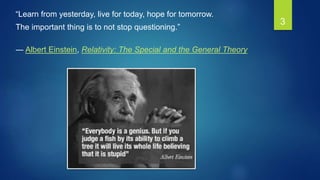
“Learn from yesterday, live for today, hope for tomorrow.
The important thing is to not stop questioning.”
― Albert Einstein, Relativity: The Special and the General Theory
3
What? Education
 1. the act or process of imparting or acquiring general knowledge, developing the
powers of reasoning and judgment, and generally of preparing oneself or others
intellectually for mature life.
 2. the act or process of imparting or acquiring particular knowledge or skills, as
for a profession.
 3. a degree, level, or kind of schooling: a university education.
 4. the result produced by instruction, training, or study: to show one's education.
 5. the science or art of teaching; pedagogics.
http://dictionary.reference.com/browse/education
4
How?
Online or not online?
Online Education:
 The nonexistence of a physical classroom, flexible
schedules, and reduced personal interactions
 Online education is a type of distance learning---taking courses
without attending a brick-and-mortar school or university. Instead,
online students and teachers interact over the Internet.
5
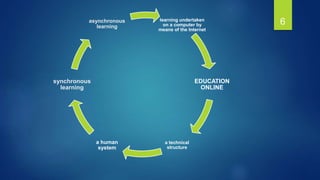
6learning undertaken
on a computer by
means of the Internet
EDUCATION
ONLINE
a technical
structure
a human
system
synchronous
learning
asynchronous
learning
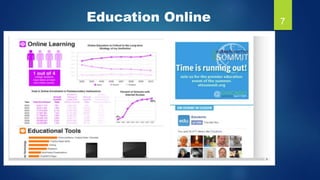
7Education Online
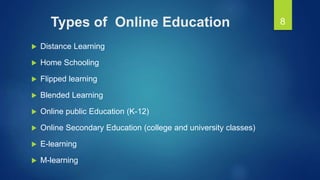
Types of Online Education
 Distance Learning
 Home Schooling
 Flipped learning
 Blended Learning
 Online public Education (K-12)
 Online Secondary Education (college and university classes)
 E-learning
 M-learning
8
 The phenomenal growth of online education is presenting uncharted
challenges for academic institutions.
 A virtual learning environment can also include students and teachers “meeting”
online through a synchronous web-based application. The teacher is able to
present lessons through video, PowerPoint, or chatting. The students are able to
talk with other students and the teacher, as well as collaborate with each other,
answer questions, or pose questions. They can use the tools available through the
application to virtually raise their hand, send messages, or answer questions on
the screen given by the teacher or student presenter.

9
This is a look inside The Education of Tomorrow.
http://www.huffingtonpost.com/2014/07/25/education-of-the-future_n_5549193.html
Online ?
10
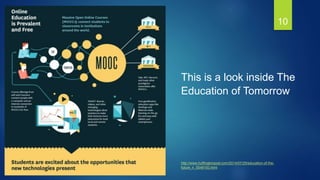
This is a look inside The
Education of Tomorrow.
http://www.huffingtonpost.com/2014/07/25/education-of-the-
future_n_5549193.html
11
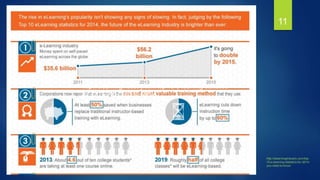
http://elearningindustry.com/top-10-e-learning-statistics-
for-2014-you-need-to-know
http://elearningindustry.com/top-10-e-learning-statistics-
for-2014-you-need-to-know
http://elearningindustry.com/top-
10-e-learning-statistics-for-2014-
you-need-to-know
12
What Is the Meaning of Online
Education?
 Online learning – Education in which instruction and content are delivered
primarily over the Internet. (Watson & Kalmon, 2005)
 Used interchangeably with Virtual learning, Cyber learning, e-learning.
 Virtual learning can take place synchronously or asynchronously.
 In synchronous systems, participants meet in “real time”, and teachers
conduct live classes in virtual classrooms. Students can communicate
through a microphone, chat rights, or by writing on the board. In
asynchronous learning, which is sometimes called “self-paced” learning,
students are expected to complete lessons and assignments independently
through the system.
 Asynchronous courses have deadlines just as synchronous courses do, but
each student is learning at his own pace.
13
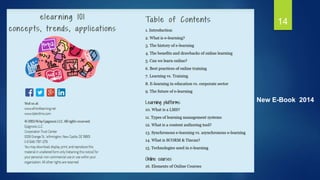
14
New E-Book 2014
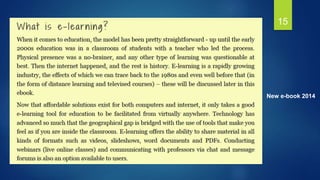
15
New e-book 2014
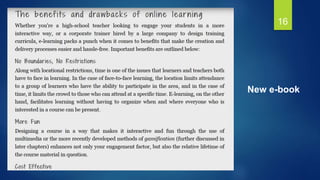
16
New e-book
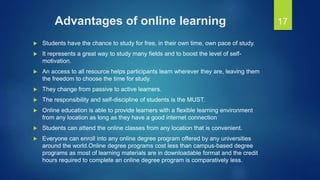
Advantages of online learning
 Students have the chance to study for free, in their own time, own pace of study.
 It represents a great way to study many fields and to boost the level of self-
motivation.
 An access to all resource helps participants learn wherever they are, leaving them
the freedom to choose the time for study.
 They change from passive to active learners.
 The responsibility and self-discipline of students is the MUST.
 Online education is able to provide learners with a flexible learning environment
from any location as long as they have a good internet connection
 Students can attend the online classes from any location that is convenient.
 Everyone can enroll into any online degree program offered by any universities
around the world.Online degree programs cost less than campus-based degree
programs as most of learning materials are in downloadable format and the credit
hours required to complete an online degree program is comparatively less.
17
Where?
 Course Management System (CMS) – The technology platform through which
online courses are offered.
 Virtual Learning Environment and Learning Management System (LMS)
 Educational Platform;
 In the higher education market as of fall 2013, Blackboard was the leading provider with
41% market share, with Moodle (23%), Desire2Learn (11%) and Vclassrooming being the
next three largest providers. In the corporate market, the six largest LMS providers
constitute approximately 50% of the market, with SuccessFactors Learning, Saba Software,
Voniz Inc and Sumtotal Systems being the four largest providers.
 New challenges and aspirations such as MOOCs (massively online open
courseware) and the immersive 3D Web are the basis for the next generation of
learning environments.
 WizIQ
 Social Networks

18
19
► A virtual learning environment can also include students and
teachers “meeting” online through a synchronous web-based
application. The teacher is able to present lessons through
video, PowerPoint, or chatting.
► The students are able to talk with other students and the
teacher, as well as collaborate with each other, answer
questions, or pose questions. They can use the tools
available through the application to virtually raise their hand,
send messages, or answer questions on the screen given by
the teacher or student presenter.
HOW?
Social Networks
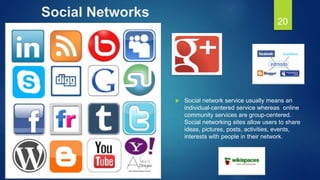
 Social network service usually means an
individual-centered service whereas online
community services are group-centered.
Social networking sites allow users to share
ideas, pictures, posts, activities, events,
interests with people in their network.
20
21
22
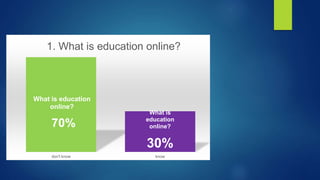
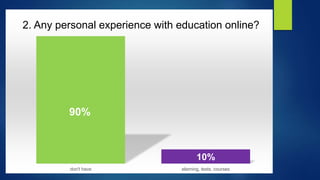
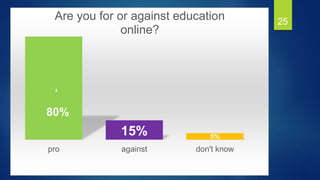
This is the result of my short statistical research with
360 students from Wroclaw Technical University
(May 2014).
There were three questions in my questionnaire:
1. What is education online?
2. Do you have any personal experience with education online?
3. Are you pro or against online education?
What is education
online?
70%
What is
education
online?
30%
don't know know
1. What is education online?
90%
,
10%
don't have elarning, tests, courses
2. Any personal experience with education online?
25
,
80%
15% 5%
pro against don't know
Are you for or against education
online?
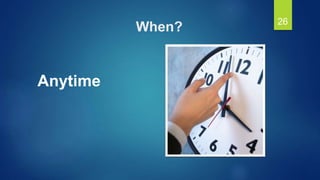
When? 26
Anytime
Why?
 We are in the 21st century where everything is possible and
acceptable. For example, students are studying at
home/work place utilizing computer which is called online
schooling/learning.
 Online learning is a great alternative to traditional
universities, especially for people who can’t afford the time
and money to take real courses.
 Online method of education can be a highly effective
alternative method of education for the students who are
matured, self-disciplined and motivated, well organized and
having high degree of time management skills.
27
Who? 28
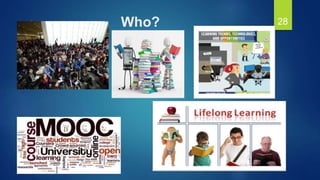
Educators
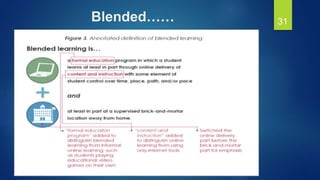
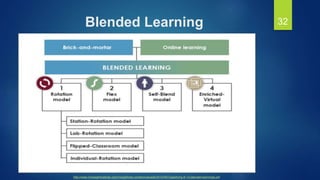
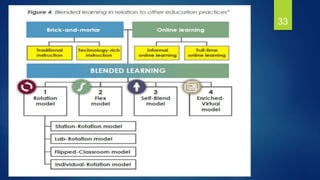
How? Blended….
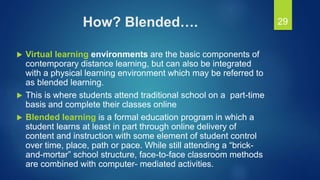
 Virtual learning environments are the basic components of
contemporary distance learning, but can also be integrated
with a physical learning environment which may be referred to
as blended learning.
 This is where students attend traditional school on a part-time
basis and complete their classes online
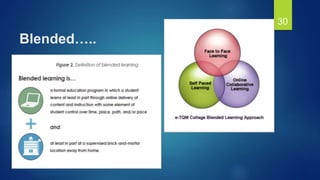
 Blended learning is a formal education program in which a
student learns at least in part through online delivery of
content and instruction with some element of student control
over time, place, path or pace. While still attending a “brick-
and-mortar” school structure, face-to-face classroom methods
are combined with computer- mediated activities.
29
Blended…..
30
Blended…… 31
Blended Learning 32
http://www.innosightinstitute.org/innosight/wp-content/uploads/2012/05/Classifying-K-12-blended-learning2.pdf
33
34
35
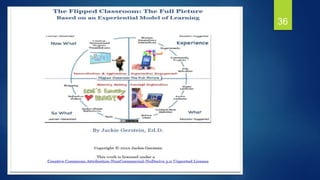
► As interest in flipped learning continues to grow, so does its adoption
among the educational rank and file. By moving entry-level information
outside the classroom -- typically (but not exclusively) through self-paced,
scored videos -- teachers can reframe learning so that students spend
more instructional time engaged in deeper discussions, hands-on
applications and project-based learning. With a focus on more direct
contact between teachers and students, greater application of basic
concepts, and increased collaboration between learners, flipped learning
provides yet another outlet for 21st century teaching.
► The payoff from flipped learning is significant. Teachers will recapture
instructional time that can be used to deepen learning. Student
engagement will likely rise due to more personalized contact with
information. And a richer culture of collaboration will emerge among
students who learn to work together. Flipped learning means that teachers
do less talking and more listening. Their students will flip for that.
Joe Hirsch , 4 Tips for Flipped Learning JULY 22, 2014
36
Future Learning
 In a recent survey of 1,021 experts, 60% agreed that by 2020 “there
will be mass adoption of teleconferencing and distance learning…”
 “On average, students in online learning conditions performed better
than those receiving face-to-face instruction” – Steve Lohr, New York
Times, 2009
37
M - Learning
 M-Learning is the way to learn the tools of communication involving
mobile wireless, which creates the premises of an area spreading
messages on a global scale.
 Mobile telephoning has evolved so much that now allows connections
to computers and making consistent data transfers.
 M-Learning is a new educational paradigm that creates an
environment in which pupils access to course materials, instructions
and applications anytime and anywhere.
38
Disadvantages M - Learning
 Lack of personal community and connection (bad for blended learning)
 Focuses on memorization over learning core competencies
 Underutilized talents and facilities
 Too long downloading
 Mobile may create problems in itself
39
M-Learning Advantages:
 Students can study anywhere as long as there is access to an
internet connection
 Can work at own pace
 Can accommodate different learning styles through different
activities
 Flexibility in class time
 M-Learning is relatively cost effective
40
Advantages of Online Education 1
 Students have the chance to study for free, in their own time, own pace of study.
 It represents a great way to study many fields and to boost the level of self-motivation.
 An access to all resource helps participants learn wherever they are, leaving them the freedom to
choose the time for study.
 They change from passive to active learners.
 The responsibility and self-discipline of students is the MUST.
 Online education is able to provide learners with a flexible learning environment from any
location as long as they have a good internet connection
 Students can attend the online classes from any location that is convenient.
 Everyone can enroll into any online degree program offered by any universities around the world.
 Online degree programs cost less than campus-based degree programs as most of learning
materials are in downloadable format and the credit hours required to complete an online degree
program is comparatively less.
41
Advantages of Online Education 2
 It’s more efficient.
 Students can direct their own pace.
 Provides the flexibility for students to move at their own pace, unlike a classroom setting where
everyone must keep up with, or slow down to, the instructor’s pace. So students who need
additional time to review materials can do so at a slower rate, while faster students can breeze
through course materials more quickly.
 Students can direct their own learning paths.
 Provides the modularity for students to choose their order of coursework in a manner that best
suits their respective learning styles. This has been especially desired among adult learners.
42
Advantages of Online Education 3
 Cost Effective
 Promotes online and computer skills
 Reduces travel time
 Can work around work, family and other activities
 Helps to build self-knowledge and self-confidence and encourages
student responsibility
 Ability to test out if interested
43
Disadvantages of Online Education
 Learners with low motivation and bad study habits can easily fall behind
 Students may feel isolated from classmates or instructor
 Instructor may not always be available
 Slow Internet connections or older computers make accessing course difficult
 Hands-on or lab work is difficult to simulate in a virtual classroom
 Lack of student customization
 Lack of personal community and connection
 Digital divide may short circuit improvement
44
Disadvantages of Online Education
 Online learning cannot offer human interaction, which gives a person
opportunity to develop properly.
 Online courses cannot cope with thousands of students who try to join
discussions.
 Online learning can be difficult technically , if it is meant for disciplines that
involve practice.
 If you are not comfortable with text format and prefer to listen to the lecture
instead of reading it.
45
Disadvantages of Online Education
 Cost is still equivalent if not more than brick and mortar school
 Course availability
 Employment
 Working Alone
 Missing out on non-verbal communication
 Potential for less networking opportunities
 No facilities to use or access
 Exclusion of fun campus activities
 Commitment
46
Conclusion
 There are both pros and cons of online education.
 Online learning should be seen as a complement and extension of classical
forms of learning. Not even the best online course can fully replace the
personal contact with a teacher, or the human relationships that develop in a
group.
 All in all, traditional classes should not be replaced with online learning.
47
http://www.innosightinstitute.org/innosight/wp-content/uploads/2012/05/Classifying-K-12-blended-learning2.pdf
Conclusion
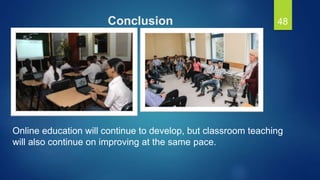
Online education will continue to develop, but classroom teaching
will also continue on improving at the same pace.
48
Making the difference
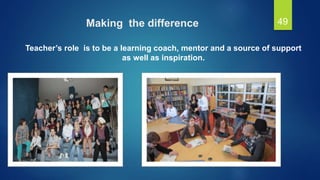
Teacher’s role is to be a learning coach, mentor and a source of support
as well as inspiration.
49
What do you think…? 50
http://www.innosightinstitute.org/innosight/wp-content/uploads/2012/05/Classifying-K-12-blended-learning2.pdf
References
 Goff, Brian. Collaborative Learning: Benefits of Online Learning. Rochester Institute of
technology: 2012. web. 5 October 2012. http://online.rit.edu/faculty/teaching
strategies/collaborative learning/benefits.cfm
 McLaughlin, Mark. Online Grade Schools Becoming a Popular Alternative.
CNBC.com: 19 September 2011. web. 5 October 2012.
http://www.cnbc.com/id/44255406/Online_Grade_Schools_Becoming_a_Popular_Alt
ernative
 Borden, Jeff. The Future of Online Learning. Elearn Magazine: August 2011. web. 5
October 2012. http://elearnmag.acm.org/archive.cfm?aid=2024704
 Baker, Jason and Woods, Robert. Social Dynamics of Online learning: Pedagogical
Imperatives and Practical Applications. 18th Annual Conference on Distance Learning:
2005. web. 5 October 2012. www.uwex.edu/disted/comference/
51
References
 Banciu, Viorica and Gordan, Mircea. The Social Benefits of E-Learning in the
Study of Foreign Languages in Romanian Education.International Conference
on Management and Education Innovation: Lansit Press, Singapore. 2012.
web. 5 October 2012.
 Schwartzman, Eric. 4 Advantages of Online Socila Media Training Over
Classroom Learning. 12 September 2012. web. 5 October 2012.
http://socialmediatoday.com/ericschwartzman/803011/4-advantages-online-
social-media-training-overclassroom-learning
 Whitaker, Kari. 7 Benefits of online Education. Online Education benefits: 2
April 2007. web. 5 October 2012.
http://www.classesandcareers.com/education/2007/04/02/7-benefits-of-online-
education/
 Na. Advantages and Disadvantages of eLearning. eLearner: n.d.web.5
October.
2012.http://www.dso.iastate.edu/asc/academic/elearner/advantage.html
52
References
 James, Gary. Advantages and Disadvantages of Online Learning. N.p.n.d.web.5
October 2012. www.allencomm.com/events
 na. Challenges and Disadvantages of E-learning and Distance Learning. Compassion
in politics: 26 September 2009. web. 2 October 2012.
http://compassioninpolitics.wordpress.com/2009/09/26/challenges-disadvantages-e-
learning-and-distance-learning
 Na. The Disadvantages of Online Learning. Elearning-Companion: Supporting the
Implementation of Elearning. 2011.web. 2 October 2012. http://www.elearning-
companion.com/disadvantages-of-online-learning.html
 Georevich, Don. 5 Disadvantages of E-Learning. N.p.n.d. web. 2 October 2012.
http://www.jobinterviewtools.com/blog/5-disadvantages-of-e-learning/
 Na. 5 Disadvantages of Online Learning. Online Learning Marketplace. N.d. web. 2
October 2012.
http://www.onlinelearningmarketplace.com/5disadvantagesofonlinelearning.html
53
Thank you very much
HALINA OSTANKOWICZ- BAZAN
54

Education Online_2014

  • 1.
    Education Online THE LATESTSTATE OF RESEARCH AND NETIQUETTE 1 Halina Ostankowicz- Bazan MMVC14 1-3 August 2014
  • 2.
  • 3.
    “Learn from yesterday,live for today, hope for tomorrow. The important thing is to not stop questioning.” ― Albert Einstein, Relativity: The Special and the General Theory 3
  • 4.
    What? Education  1.the act or process of imparting or acquiring general knowledge, developing the powers of reasoning and judgment, and generally of preparing oneself or others intellectually for mature life.  2. the act or process of imparting or acquiring particular knowledge or skills, as for a profession.  3. a degree, level, or kind of schooling: a university education.  4. the result produced by instruction, training, or study: to show one's education.  5. the science or art of teaching; pedagogics. http://dictionary.reference.com/browse/education 4
  • 5.
    How? Online or notonline? Online Education:  The nonexistence of a physical classroom, flexible schedules, and reduced personal interactions  Online education is a type of distance learning---taking courses without attending a brick-and-mortar school or university. Instead, online students and teachers interact over the Internet. 5
  • 6.
    6learning undertaken on acomputer by means of the Internet EDUCATION ONLINE a technical structure a human system synchronous learning asynchronous learning
  • 7.
  • 8.
    Types of OnlineEducation  Distance Learning  Home Schooling  Flipped learning  Blended Learning  Online public Education (K-12)  Online Secondary Education (college and university classes)  E-learning  M-learning 8
  • 9.
     The phenomenalgrowth of online education is presenting uncharted challenges for academic institutions.  A virtual learning environment can also include students and teachers “meeting” online through a synchronous web-based application. The teacher is able to present lessons through video, PowerPoint, or chatting. The students are able to talk with other students and the teacher, as well as collaborate with each other, answer questions, or pose questions. They can use the tools available through the application to virtually raise their hand, send messages, or answer questions on the screen given by the teacher or student presenter.  9 This is a look inside The Education of Tomorrow. http://www.huffingtonpost.com/2014/07/25/education-of-the-future_n_5549193.html Online ?
  • 10.
    10 This is alook inside The Education of Tomorrow. http://www.huffingtonpost.com/2014/07/25/education-of-the- future_n_5549193.html
  • 11.
  • 12.
  • 13.
    What Is theMeaning of Online Education?  Online learning – Education in which instruction and content are delivered primarily over the Internet. (Watson & Kalmon, 2005)  Used interchangeably with Virtual learning, Cyber learning, e-learning.  Virtual learning can take place synchronously or asynchronously.  In synchronous systems, participants meet in “real time”, and teachers conduct live classes in virtual classrooms. Students can communicate through a microphone, chat rights, or by writing on the board. In asynchronous learning, which is sometimes called “self-paced” learning, students are expected to complete lessons and assignments independently through the system.  Asynchronous courses have deadlines just as synchronous courses do, but each student is learning at his own pace. 13
  • 14.
  • 15.
  • 16.
  • 17.
    Advantages of onlinelearning  Students have the chance to study for free, in their own time, own pace of study.  It represents a great way to study many fields and to boost the level of self- motivation.  An access to all resource helps participants learn wherever they are, leaving them the freedom to choose the time for study.  They change from passive to active learners.  The responsibility and self-discipline of students is the MUST.  Online education is able to provide learners with a flexible learning environment from any location as long as they have a good internet connection  Students can attend the online classes from any location that is convenient.  Everyone can enroll into any online degree program offered by any universities around the world.Online degree programs cost less than campus-based degree programs as most of learning materials are in downloadable format and the credit hours required to complete an online degree program is comparatively less. 17
  • 18.
    Where?  Course ManagementSystem (CMS) – The technology platform through which online courses are offered.  Virtual Learning Environment and Learning Management System (LMS)  Educational Platform;  In the higher education market as of fall 2013, Blackboard was the leading provider with 41% market share, with Moodle (23%), Desire2Learn (11%) and Vclassrooming being the next three largest providers. In the corporate market, the six largest LMS providers constitute approximately 50% of the market, with SuccessFactors Learning, Saba Software, Voniz Inc and Sumtotal Systems being the four largest providers.  New challenges and aspirations such as MOOCs (massively online open courseware) and the immersive 3D Web are the basis for the next generation of learning environments.  WizIQ  Social Networks  18
  • 19.
    19 ► A virtuallearning environment can also include students and teachers “meeting” online through a synchronous web-based application. The teacher is able to present lessons through video, PowerPoint, or chatting. ► The students are able to talk with other students and the teacher, as well as collaborate with each other, answer questions, or pose questions. They can use the tools available through the application to virtually raise their hand, send messages, or answer questions on the screen given by the teacher or student presenter. HOW?
  • 20.
    Social Networks  Socialnetwork service usually means an individual-centered service whereas online community services are group-centered. Social networking sites allow users to share ideas, pictures, posts, activities, events, interests with people in their network. 20
  • 21.
  • 22.
    22 This is theresult of my short statistical research with 360 students from Wroclaw Technical University (May 2014). There were three questions in my questionnaire: 1. What is education online? 2. Do you have any personal experience with education online? 3. Are you pro or against online education?
  • 23.
    What is education online? 70% Whatis education online? 30% don't know know 1. What is education online?
  • 24.
    90% , 10% don't have elarning,tests, courses 2. Any personal experience with education online?
  • 25.
    25 , 80% 15% 5% pro againstdon't know Are you for or against education online?
  • 26.
  • 27.
    Why?  We arein the 21st century where everything is possible and acceptable. For example, students are studying at home/work place utilizing computer which is called online schooling/learning.  Online learning is a great alternative to traditional universities, especially for people who can’t afford the time and money to take real courses.  Online method of education can be a highly effective alternative method of education for the students who are matured, self-disciplined and motivated, well organized and having high degree of time management skills. 27
  • 28.
  • 29.
    How? Blended….  Virtuallearning environments are the basic components of contemporary distance learning, but can also be integrated with a physical learning environment which may be referred to as blended learning.  This is where students attend traditional school on a part-time basis and complete their classes online  Blended learning is a formal education program in which a student learns at least in part through online delivery of content and instruction with some element of student control over time, place, path or pace. While still attending a “brick- and-mortar” school structure, face-to-face classroom methods are combined with computer- mediated activities. 29
  • 30.
  • 31.
  • 32.
  • 33.
  • 34.
  • 35.
    35 ► As interestin flipped learning continues to grow, so does its adoption among the educational rank and file. By moving entry-level information outside the classroom -- typically (but not exclusively) through self-paced, scored videos -- teachers can reframe learning so that students spend more instructional time engaged in deeper discussions, hands-on applications and project-based learning. With a focus on more direct contact between teachers and students, greater application of basic concepts, and increased collaboration between learners, flipped learning provides yet another outlet for 21st century teaching. ► The payoff from flipped learning is significant. Teachers will recapture instructional time that can be used to deepen learning. Student engagement will likely rise due to more personalized contact with information. And a richer culture of collaboration will emerge among students who learn to work together. Flipped learning means that teachers do less talking and more listening. Their students will flip for that. Joe Hirsch , 4 Tips for Flipped Learning JULY 22, 2014
  • 36.
  • 37.
    Future Learning  Ina recent survey of 1,021 experts, 60% agreed that by 2020 “there will be mass adoption of teleconferencing and distance learning…”  “On average, students in online learning conditions performed better than those receiving face-to-face instruction” – Steve Lohr, New York Times, 2009 37
  • 38.
    M - Learning M-Learning is the way to learn the tools of communication involving mobile wireless, which creates the premises of an area spreading messages on a global scale.  Mobile telephoning has evolved so much that now allows connections to computers and making consistent data transfers.  M-Learning is a new educational paradigm that creates an environment in which pupils access to course materials, instructions and applications anytime and anywhere. 38
  • 39.
    Disadvantages M -Learning  Lack of personal community and connection (bad for blended learning)  Focuses on memorization over learning core competencies  Underutilized talents and facilities  Too long downloading  Mobile may create problems in itself 39
  • 40.
    M-Learning Advantages:  Studentscan study anywhere as long as there is access to an internet connection  Can work at own pace  Can accommodate different learning styles through different activities  Flexibility in class time  M-Learning is relatively cost effective 40
  • 41.
    Advantages of OnlineEducation 1  Students have the chance to study for free, in their own time, own pace of study.  It represents a great way to study many fields and to boost the level of self-motivation.  An access to all resource helps participants learn wherever they are, leaving them the freedom to choose the time for study.  They change from passive to active learners.  The responsibility and self-discipline of students is the MUST.  Online education is able to provide learners with a flexible learning environment from any location as long as they have a good internet connection  Students can attend the online classes from any location that is convenient.  Everyone can enroll into any online degree program offered by any universities around the world.  Online degree programs cost less than campus-based degree programs as most of learning materials are in downloadable format and the credit hours required to complete an online degree program is comparatively less. 41
  • 42.
    Advantages of OnlineEducation 2  It’s more efficient.  Students can direct their own pace.  Provides the flexibility for students to move at their own pace, unlike a classroom setting where everyone must keep up with, or slow down to, the instructor’s pace. So students who need additional time to review materials can do so at a slower rate, while faster students can breeze through course materials more quickly.  Students can direct their own learning paths.  Provides the modularity for students to choose their order of coursework in a manner that best suits their respective learning styles. This has been especially desired among adult learners. 42
  • 43.
    Advantages of OnlineEducation 3  Cost Effective  Promotes online and computer skills  Reduces travel time  Can work around work, family and other activities  Helps to build self-knowledge and self-confidence and encourages student responsibility  Ability to test out if interested 43
  • 44.
    Disadvantages of OnlineEducation  Learners with low motivation and bad study habits can easily fall behind  Students may feel isolated from classmates or instructor  Instructor may not always be available  Slow Internet connections or older computers make accessing course difficult  Hands-on or lab work is difficult to simulate in a virtual classroom  Lack of student customization  Lack of personal community and connection  Digital divide may short circuit improvement 44
  • 45.
    Disadvantages of OnlineEducation  Online learning cannot offer human interaction, which gives a person opportunity to develop properly.  Online courses cannot cope with thousands of students who try to join discussions.  Online learning can be difficult technically , if it is meant for disciplines that involve practice.  If you are not comfortable with text format and prefer to listen to the lecture instead of reading it. 45
  • 46.
    Disadvantages of OnlineEducation  Cost is still equivalent if not more than brick and mortar school  Course availability  Employment  Working Alone  Missing out on non-verbal communication  Potential for less networking opportunities  No facilities to use or access  Exclusion of fun campus activities  Commitment 46
  • 47.
    Conclusion  There areboth pros and cons of online education.  Online learning should be seen as a complement and extension of classical forms of learning. Not even the best online course can fully replace the personal contact with a teacher, or the human relationships that develop in a group.  All in all, traditional classes should not be replaced with online learning. 47 http://www.innosightinstitute.org/innosight/wp-content/uploads/2012/05/Classifying-K-12-blended-learning2.pdf
  • 48.
    Conclusion Online education willcontinue to develop, but classroom teaching will also continue on improving at the same pace. 48
  • 49.
    Making the difference Teacher’srole is to be a learning coach, mentor and a source of support as well as inspiration. 49
  • 50.
    What do youthink…? 50 http://www.innosightinstitute.org/innosight/wp-content/uploads/2012/05/Classifying-K-12-blended-learning2.pdf
  • 51.
    References  Goff, Brian.Collaborative Learning: Benefits of Online Learning. Rochester Institute of technology: 2012. web. 5 October 2012. http://online.rit.edu/faculty/teaching strategies/collaborative learning/benefits.cfm  McLaughlin, Mark. Online Grade Schools Becoming a Popular Alternative. CNBC.com: 19 September 2011. web. 5 October 2012. http://www.cnbc.com/id/44255406/Online_Grade_Schools_Becoming_a_Popular_Alt ernative  Borden, Jeff. The Future of Online Learning. Elearn Magazine: August 2011. web. 5 October 2012. http://elearnmag.acm.org/archive.cfm?aid=2024704  Baker, Jason and Woods, Robert. Social Dynamics of Online learning: Pedagogical Imperatives and Practical Applications. 18th Annual Conference on Distance Learning: 2005. web. 5 October 2012. www.uwex.edu/disted/comference/ 51
  • 52.
    References  Banciu, Vioricaand Gordan, Mircea. The Social Benefits of E-Learning in the Study of Foreign Languages in Romanian Education.International Conference on Management and Education Innovation: Lansit Press, Singapore. 2012. web. 5 October 2012.  Schwartzman, Eric. 4 Advantages of Online Socila Media Training Over Classroom Learning. 12 September 2012. web. 5 October 2012. http://socialmediatoday.com/ericschwartzman/803011/4-advantages-online- social-media-training-overclassroom-learning  Whitaker, Kari. 7 Benefits of online Education. Online Education benefits: 2 April 2007. web. 5 October 2012. http://www.classesandcareers.com/education/2007/04/02/7-benefits-of-online- education/  Na. Advantages and Disadvantages of eLearning. eLearner: n.d.web.5 October. 2012.http://www.dso.iastate.edu/asc/academic/elearner/advantage.html 52
  • 53.
    References  James, Gary.Advantages and Disadvantages of Online Learning. N.p.n.d.web.5 October 2012. www.allencomm.com/events  na. Challenges and Disadvantages of E-learning and Distance Learning. Compassion in politics: 26 September 2009. web. 2 October 2012. http://compassioninpolitics.wordpress.com/2009/09/26/challenges-disadvantages-e- learning-and-distance-learning  Na. The Disadvantages of Online Learning. Elearning-Companion: Supporting the Implementation of Elearning. 2011.web. 2 October 2012. http://www.elearning- companion.com/disadvantages-of-online-learning.html  Georevich, Don. 5 Disadvantages of E-Learning. N.p.n.d. web. 2 October 2012. http://www.jobinterviewtools.com/blog/5-disadvantages-of-e-learning/  Na. 5 Disadvantages of Online Learning. Online Learning Marketplace. N.d. web. 2 October 2012. http://www.onlinelearningmarketplace.com/5disadvantagesofonlinelearning.html 53
  • 54.
    Thank you verymuch HALINA OSTANKOWICZ- BAZAN 54