




Next Generation Learning &
 Competency Education: A Vision
       Toward the Future

Susan Patrick
President & CEO
International Association for K-12 Online Learning
December 2012


www.inacol.org
International Association for K-12 Online Learning
                        (iNACOL)
•   iNACOL is the premier K-12 nonprofit in online learning
•   Provides leadership, advocacy, research, training, and networking with experts in K-12 online
    learning.
      – 4400+ members in K-12 virtual schools and online learning representing over 50 countries
      – Annual conference – iNACOL Symposium: Orlando, FL in October 28-30, 2013
•   “Ensure every student has access to the best education available regardless of geography,
    income or background.”
•   Next Generation Learning Challenges – Gates Foundation
•   Our strategic areas of focus in online and blended learning:
      1. Policy
      2. Quality
      3. New Learning Models
Blended
                                   Schools                        Philanthropy/
                                                                  Foundations
         3,361                                                                                    Parents
       Teachers &
       Educators                                                 Think                              Policy
                                                                 Tanks      International           Makers
                                                                            Programs
          State
          Virtual
                                                         Non-profit/
         Schools                  Public                 Associate                                  OER
                                  School
                                  Districts
  Full-time
  Online                                                     Next                Online Content
  Schools                                                    Generation            Providers
                                                             Learning
                   Colleges &           Regional             Partners
                   Universities         Education                                           Tech Tools
                                        Agencies                                            Providers
                                                                          EMOs
              Part-time                                                                           Tutoring/S
              Online                                                                              ervices
              Programs                                        State
                                                          Departments             Private &
                                          Researchers     of Education            Independent
                                          & Evaluators                            Schools

 www.inacol.org
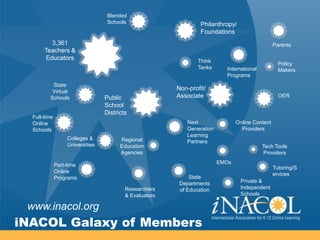
iNACOL Galaxy of Members
International Perspective


www.inacol.org
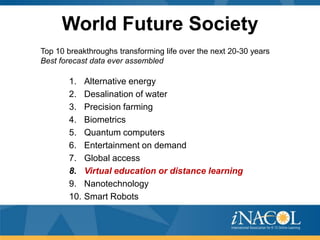
World Future Society
Top 10 breakthroughs transforming life over the next 20-30 years
Best forecast data ever assembled

       1.    Alternative energy
       2.    Desalination of water
       3.    Precision farming
       4.    Biometrics
       5.    Quantum computers
       6.    Entertainment on demand
       7.    Global access
       8.    Virtual education or distance learning
       9.    Nanotechnology
       10.   Smart Robots
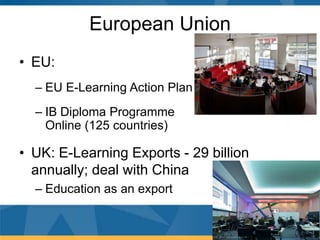
European Union
• EU:
  – EU E-Learning Action Plan
  – IB Diploma Programme
    Online (125 countries)

• UK: E-Learning Exports - 29 billion
  annually; deal with China
  – Education as an export
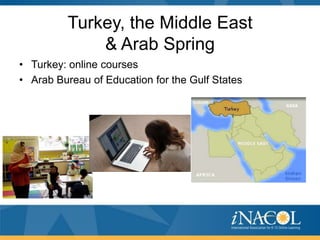
Turkey, the Middle East
             & Arab Spring
• Turkey: online courses
• Arab Bureau of Education for the Gulf States
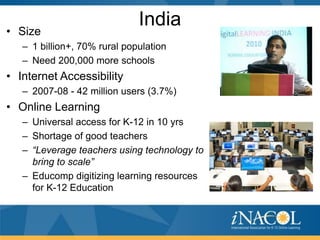
• Size
                              India
   – 1 billion+, 70% rural population
   – Need 200,000 more schools
• Internet Accessibility
   – 2007-08 - 42 million users (3.7%)
• Online Learning
   – Universal access for K-12 in 10 yrs
   – Shortage of good teachers
   – “Leverage teachers using technology to
     bring to scale”
   – Educomp digitizing learning resources
     for K-12 Education
India announces $35 tablet
computer for rural poor
“Oct. 5, 2011 -
The $35 basic touch screen tablet
aimed at students can be used for
functions like word processing, web
browsing and video conferencing.
Aakash, manufactured by DataWind,
has a 7" Android 2.2 touch screen
and a HD video coprocessor.
The Indian government intends to
deliver 10 million tablets to students
across India.” (AP Photo - Gurinder
Osan) (Source: Associated Press)

“Datawind says it can make about 100,000 units a
month at the moment, not nearly enough to meet India's
hope of getting its 220 million children online.”
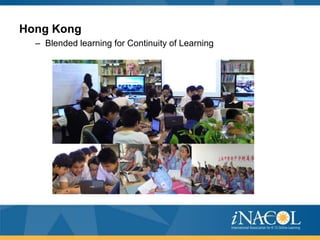
Hong Kong
  – Blended learning for Continuity of Learning
South Korea
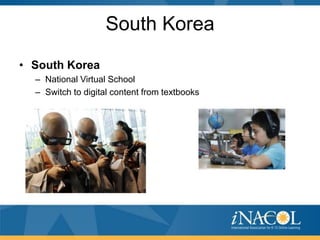
• South Korea
  – National Virtual School
  – Switch to digital content from textbooks
China
• China: 1.3 billion people
     • Digitized K-12 curriculum
     • Training Master Teachers to teach online
     • With online learning: increase
       educational opportunities to 100 million
       new students
The Futurist: Education 2011
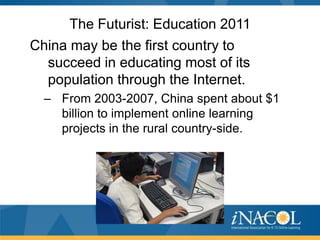
China may be the first country to
  succeed in educating most of its
  population through the Internet.
  – From 2003-2007, China spent about $1
    billion to implement online learning
    projects in the rural country-side.
“Web opens world for young Chinese . . .”
              -Christian Science Monitor, May 14, 2007


• Bejing -- “Excited and emboldened by the wealth of information they
  find on the Internet, Chinese teens are breaking centuries of
  tradition to challenge their teachers and express their opinions in
  class. . . .”
• “Students at Tianjin’s No. 1 Middle School are encouraged to
  challenge their history texts.”
• “The Internet has given Chinese children wings,” says Sun Yun
  Xiao, vice president of the China Youth and Children’s Research
  Center.
• 137 million online in China at the end of 2006 (in 1999 there were
  just 4 million connections in China)
• 87% of urban youth in China use the Internet
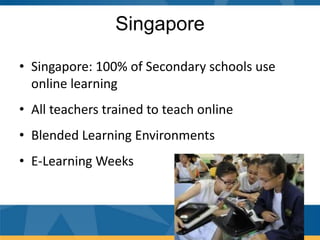
Singapore

• Singapore: 100% of Secondary schools use
  online learning
• All teachers trained to teach online
• Blended Learning Environments
• E-Learning Weeks
National Perspective


www.inacol.org
Nat’l Center Education Stats
            (NCES) 2011 Data
• Fifty-five percent of U.S. public school districts
  reported having students enrolled in distance
  education courses in 2009–10
• Districts reported 1,816,400 enrollments
• 74% in HS, 9% MS, 4% ES
• Providers:
   – 50% university/higher ed
   – 47% vendor
   – 33% state virtual school
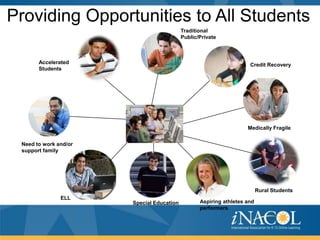
Providing Opportunities to All Students
                                           Traditional
                                           Public/Private


       Accelerated                                                   Credit Recovery
       Students


                                                                    Medically Fragile


 Need to work and/or
 support family


                                                                          Rural Students
               ELL
                       Special Education          Aspiring athletes and
                                                  performers
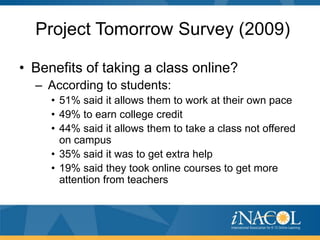
Project Tomorrow Survey (2009)

• Benefits of taking a class online?
  – According to students:
     • 51% said it allows them to work at their own pace
     • 49% to earn college credit
     • 44% said it allows them to take a class not offered
       on campus
     • 35% said it was to get extra help
     • 19% said they took online courses to get more
       attention from teachers
www.inacol.org
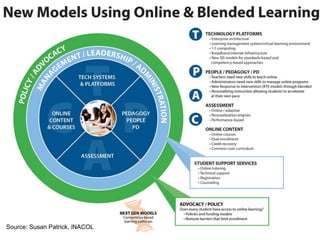
Source: Susan Patrick, iNACOL
Defining blended learning?
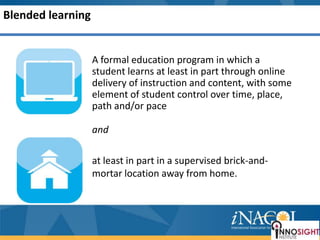
Blended learning


                   A formal education program in which a
                   student learns at least in part through online
                   delivery of instruction and content, with some
                   element of student control over time, place,
                   path and/or pace

                   and

                   at least in part in a supervised brick-and-
                   mortar location away from home.
Blended Learning: The Convergence of Online and
    Face-to-Face…the “Best of Both Worlds”
• “Blended learning should be approached as not only a
  temporal construct, but rather as a fundamental redesign of
  the instructional model with the following characteristics:
   • -A shift from lecture- to student-centered instruction
     where students become interactive learners (this shift
     should apply to entire course, including face-to-face
     sessions);
   • -Increases in interaction between student-instructor,
     student-student, student-content, and student-outside
     resources; and
   • -Integrated formative and summative assessment
     mechanisms for student and instructor.” - Educause,
     Blended Learning (2004)
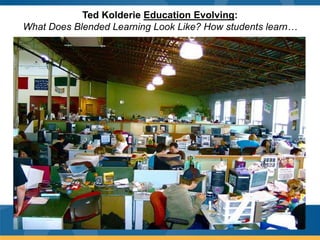
Ted Kolderie Education Evolving:
What Does Blended Learning Look Like? How students learn…
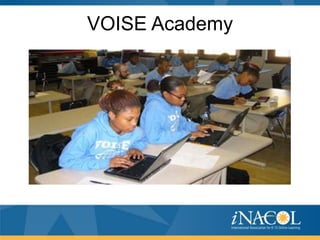
VOISE Academy
Creating an Effective System for Online
             Learning and Teaching
• “Online education can fundamentally change the relationship that
  students, teachers, parents and the community have with their
  educational institutions and with one another. For policymakers,
  those transformations pose some difficult choices. If they ignore
  online education, they turn their back on their responsibility to
  extend learning opportunities.” –National Education Association
  (NEA) Guide to Teaching Online Courses
Online Learning Growing
• Pent up demand from students & kids
  needing help
• Different schools, different services,
  different people can do different things to
  help kids; differentiation
• Don’t think about “school” – about kids
  looking for what they need for learning . . .
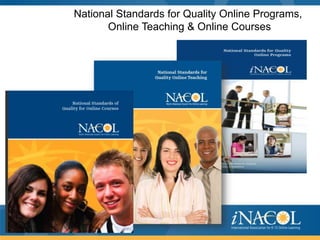
National Standards for Quality Online Programs,
       Online Teaching & Online Courses
Exploring the Future of
        Learning


www.inacol.org
Future Trends
• Online & Blended Learning
   – Competency-based approaches
   – Mobile learning
   – Open Resources
• National:
   – CCSSO Partnership for Next Gen Learning
      • Innovation Lab Network
   – Gates Foundation’s Next Generation Learning
   – Shared Learning Infrastructure
      • Openly architected IT systems - draw in vast online content,
        learning analytics, personalized learning maps for each student’s
        own learning trajectory
Competency-based Learning


www.inacol.org
Next Generation Learning
Shifting the Focus to the Student

CCSSO – Six Critical Attributes for Next Generation
Learning – Design Principles for New Systems for
Learning
  1. World Class Knowledge and Skills
  2. Planning for Personalized Learning
  3. Authentic Student Voice
  4. Comprehensive Systems of Support
  5. Performance-based Learning
  6. Anytime, everywhere learning
A 5-Part Working Definition:
          Competency-based Learning
1.   Students advance upon mastery.
2.   Competencies include explicit, measurable, transferable
     learning objectives that empower students.
3.   Assessment is meaningful and a positive learning
     experience for students.
4.   Students receive timely, differentiated support based on their
     individual learning needs.
5.   Learning outcomes emphasize competencies that include
     application and creation of knowledge, along with the
     development of important skills and dispositions.
In a proficiency system, failure or poor
performance may be part of student’s learning
curve, but it is not an outcome.
----- Proficiency Based Instruction and Assessment, Oregon Education
Roundtable
What It Looks Like
• Every student with a personalized learning plan: “map”
    – Competencies for each level - academic+
• Data systems to support teachers and students clearly
  indicating level of progress on each academic standard and
  efficacy standards (to monitor student progress)
• Rubrics to help teachers understand what proficiency looks
  like
• Students know their targets; collaborate w/each other
• Adults shifting roles
    – Personalization, grouping, teacher specialization
• Classroom, online, expanded learning opportunities
    – After school, museum, NASA, formal & informal learning
• Individual growth models for accountability
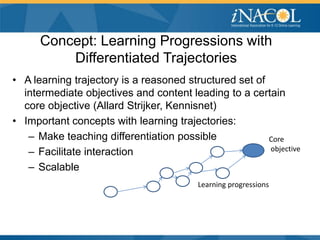
Concept: Learning Progressions with
          Differentiated Trajectories
• A learning trajectory is a reasoned structured set of
  intermediate objectives and content leading to a certain
  core objective (Allard Strijker, Kennisnet)
• Important concepts with learning trajectories:
   – Make teaching differentiation possible             Core
   – Facilitate interaction                             objective

   – Scalable
                                         Learning progressions
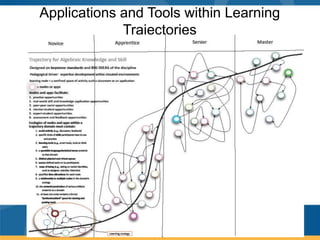
Applications and Tools within Learning
             Trajectories
Fundamentals of Learning

•   Using platform of the common core:
    – Approaches should anticipate the future of
      learning
    – Active, situated and experiential learning
      improves engagement, problem solving and
      achievement
    – Learning best measured by mastery rather
      than seat-time
Designing Competency-based Pathways
for Next Generation Learning
•Move away from content packed into traditional course
sequences
•Leave grade and age level grouping behind
•Focus on each student’s progress through the continuum of
learning
•Use embedded assessment as part of the learning process
•Design learning trajectories of BIG IDEAS and key concepts
•Student learning plan is based on attainment of
mastery/competency through these progressions (and not all
students in the same sequences!)
•Evidence of learning can be varied
•Failure is no longer an option
Competency-based learning
       Performance or competency
    based learning is fundamental to
      personalizing learning at scale
                    and
      It challenges almost all of our
     assumptions about the present
                  system
Importance for Students?
• Time is a resource not a constraint
   • Over-age and under-credited students accelerate
     credits
   • Ability to build skills through expanded learning
     opportunities (work, online, volunteering)
   • Advanced students accelerate
• Environment and instructional model dedicated to
  students success
   • Explicit, transparent, and rapid interventions
   • High engagement and motivation through multiple
     ways to demonstrate proficiency
• Educational continuity for highly mobile students


                                                         42
43
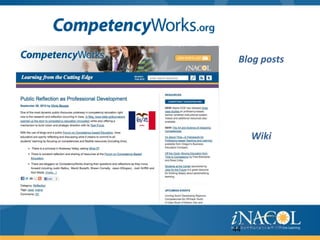
Blog posts


    Wiki


44Resources
45

Partners
46

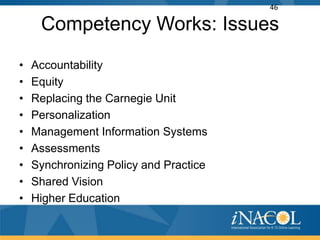
     Competency Works: Issues
•   Accountability
•   Equity
•   Replacing the Carnegie Unit
•   Personalization
•   Management Information Systems
•   Assessments
•   Synchronizing Policy and Practice
•   Shared Vision
•   Higher Education
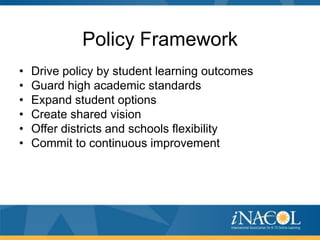
Policy Framework
•   Drive policy by student learning outcomes
•   Guard high academic standards
•   Expand student options
•   Create shared vision
•   Offer districts and schools flexibility
•   Commit to continuous improvement
Funding & Policy:
  Policy Changes to Allow Innovation
• “Seat-time” (ADA/instructional minutes) vs.
  “competency-based learning” policies;
  performance-based funding; rewards quality
• Equity; does every student have access?
• Systems of Assessments
  – Performance-based assessment; modular; real-
    time; multiple assessments at multiple times
• Accountability model
• Information systems
Requires New Models of Accountability
 • Federal & State Accountability MUST be
   using an individual student growth model
   • Value-add models are considered best
 • Performance-based: Moving away from seat-
   time to competency-based learning models of
   policy and funding
 • Performance-based funding: Provide
   incentives for schools that do the most with
   the most challenged students to incentivize
   success
States Leading the Way
• New Hampshire and Maine
  – Expectation of competency-based diploma

• Oregon
  – Enabling policy and investment in building effective
    practice

• Ohio
  – Districts must offer credit flexibilty

• CCSSO Innovation Lab Network
National Initiatives
• Smarter Balanced Assessment Consortium Task Force
• Achieve American Diploma Project Work Group
• CCSSO Innovation Lab Network
• Federal Race to the Top – District Competition
• National Science Fdn – 8th Grade Algebra Evaluation
• Growing as a Policy Agenda for Stakeholders - iNACOL


• Emerging
   – Competency Education in Higher Education
   – Expanded Learning Opportunities
   – Badges
Cracking the Code: Synchronizing Policy and
 Practice for Performance-based Learning
Resources
• CompetencyWorks Issue Briefs
   – Art and Science of Designing Competencies
   – Student Supports: On the Learning Edge

• Initial Scan and Analysis of Competency Education
   – When Success is the Only Option
   – Cracking the Code
   – It’s Not a Matter of Time

• School Models
   – Making Mastery Work Nellie Mae Education Foundation
   – Developing Rigorous Competencies for Off-track Youth, JFF

• District Reform
   – Maine Department of Education Case Studies and Videos

• Policy: State Strategies for Awarding Credit to Support Student
  Learning, NGA
Stephen Heppel (U.K.) notschool.net Quotes
          from iScoil in Ireland

• “Students should advance on stage not
  age”
• “Age and time are for adult convenience”.
• “There’s no limit on how fast and how far
  students can go.”
Discussion: Q&A
Susan Patrick
spatrick@inacol.org
  www.inacol.org

Next Generation Learning & Competency Education: A Vision Toward the Future

  • 1.
    Next Generation Learning& Competency Education: A Vision Toward the Future Susan Patrick President & CEO International Association for K-12 Online Learning December 2012 www.inacol.org
  • 2.
    International Association forK-12 Online Learning (iNACOL) • iNACOL is the premier K-12 nonprofit in online learning • Provides leadership, advocacy, research, training, and networking with experts in K-12 online learning. – 4400+ members in K-12 virtual schools and online learning representing over 50 countries – Annual conference – iNACOL Symposium: Orlando, FL in October 28-30, 2013 • “Ensure every student has access to the best education available regardless of geography, income or background.” • Next Generation Learning Challenges – Gates Foundation • Our strategic areas of focus in online and blended learning: 1. Policy 2. Quality 3. New Learning Models
  • 3.
    Blended Schools Philanthropy/ Foundations 3,361 Parents Teachers & Educators Think Policy Tanks International Makers Programs State Virtual Non-profit/ Schools Public Associate OER School Districts Full-time Online Next Online Content Schools Generation Providers Learning Colleges & Regional Partners Universities Education Tech Tools Agencies Providers EMOs Part-time Tutoring/S Online ervices Programs State Departments Private & Researchers of Education Independent & Evaluators Schools www.inacol.org iNACOL Galaxy of Members
  • 4.
  • 5.
    World Future Society Top10 breakthroughs transforming life over the next 20-30 years Best forecast data ever assembled 1. Alternative energy 2. Desalination of water 3. Precision farming 4. Biometrics 5. Quantum computers 6. Entertainment on demand 7. Global access 8. Virtual education or distance learning 9. Nanotechnology 10. Smart Robots
  • 6.
    European Union • EU: – EU E-Learning Action Plan – IB Diploma Programme Online (125 countries) • UK: E-Learning Exports - 29 billion annually; deal with China – Education as an export
  • 7.
    Turkey, the MiddleEast & Arab Spring • Turkey: online courses • Arab Bureau of Education for the Gulf States
  • 8.
    • Size India – 1 billion+, 70% rural population – Need 200,000 more schools • Internet Accessibility – 2007-08 - 42 million users (3.7%) • Online Learning – Universal access for K-12 in 10 yrs – Shortage of good teachers – “Leverage teachers using technology to bring to scale” – Educomp digitizing learning resources for K-12 Education
  • 9.
    India announces $35tablet computer for rural poor “Oct. 5, 2011 - The $35 basic touch screen tablet aimed at students can be used for functions like word processing, web browsing and video conferencing. Aakash, manufactured by DataWind, has a 7" Android 2.2 touch screen and a HD video coprocessor. The Indian government intends to deliver 10 million tablets to students across India.” (AP Photo - Gurinder Osan) (Source: Associated Press) “Datawind says it can make about 100,000 units a month at the moment, not nearly enough to meet India's hope of getting its 220 million children online.”
  • 10.
    Hong Kong – Blended learning for Continuity of Learning
  • 11.
    South Korea • SouthKorea – National Virtual School – Switch to digital content from textbooks
  • 12.
    China • China: 1.3billion people • Digitized K-12 curriculum • Training Master Teachers to teach online • With online learning: increase educational opportunities to 100 million new students
  • 13.
    The Futurist: Education2011 China may be the first country to succeed in educating most of its population through the Internet. – From 2003-2007, China spent about $1 billion to implement online learning projects in the rural country-side.
  • 14.
    “Web opens worldfor young Chinese . . .” -Christian Science Monitor, May 14, 2007 • Bejing -- “Excited and emboldened by the wealth of information they find on the Internet, Chinese teens are breaking centuries of tradition to challenge their teachers and express their opinions in class. . . .” • “Students at Tianjin’s No. 1 Middle School are encouraged to challenge their history texts.” • “The Internet has given Chinese children wings,” says Sun Yun Xiao, vice president of the China Youth and Children’s Research Center. • 137 million online in China at the end of 2006 (in 1999 there were just 4 million connections in China) • 87% of urban youth in China use the Internet
  • 15.
    Singapore • Singapore: 100%of Secondary schools use online learning • All teachers trained to teach online • Blended Learning Environments • E-Learning Weeks
  • 16.
  • 18.
    Nat’l Center EducationStats (NCES) 2011 Data • Fifty-five percent of U.S. public school districts reported having students enrolled in distance education courses in 2009–10 • Districts reported 1,816,400 enrollments • 74% in HS, 9% MS, 4% ES • Providers: – 50% university/higher ed – 47% vendor – 33% state virtual school
  • 19.
    Providing Opportunities toAll Students Traditional Public/Private Accelerated Credit Recovery Students Medically Fragile Need to work and/or support family Rural Students ELL Special Education Aspiring athletes and performers
  • 20.
    Project Tomorrow Survey(2009) • Benefits of taking a class online? – According to students: • 51% said it allows them to work at their own pace • 49% to earn college credit • 44% said it allows them to take a class not offered on campus • 35% said it was to get extra help • 19% said they took online courses to get more attention from teachers
  • 21.
  • 22.
  • 23.
    Blended learning A formal education program in which a student learns at least in part through online delivery of instruction and content, with some element of student control over time, place, path and/or pace and at least in part in a supervised brick-and- mortar location away from home.
  • 24.
    Blended Learning: TheConvergence of Online and Face-to-Face…the “Best of Both Worlds” • “Blended learning should be approached as not only a temporal construct, but rather as a fundamental redesign of the instructional model with the following characteristics: • -A shift from lecture- to student-centered instruction where students become interactive learners (this shift should apply to entire course, including face-to-face sessions); • -Increases in interaction between student-instructor, student-student, student-content, and student-outside resources; and • -Integrated formative and summative assessment mechanisms for student and instructor.” - Educause, Blended Learning (2004)
  • 25.
    Ted Kolderie EducationEvolving: What Does Blended Learning Look Like? How students learn…
  • 26.
  • 27.
    Creating an EffectiveSystem for Online Learning and Teaching • “Online education can fundamentally change the relationship that students, teachers, parents and the community have with their educational institutions and with one another. For policymakers, those transformations pose some difficult choices. If they ignore online education, they turn their back on their responsibility to extend learning opportunities.” –National Education Association (NEA) Guide to Teaching Online Courses
  • 28.
    Online Learning Growing •Pent up demand from students & kids needing help • Different schools, different services, different people can do different things to help kids; differentiation • Don’t think about “school” – about kids looking for what they need for learning . . .
  • 29.
    National Standards forQuality Online Programs, Online Teaching & Online Courses
  • 30.
    Exploring the Futureof Learning www.inacol.org
  • 31.
    Future Trends • Online& Blended Learning – Competency-based approaches – Mobile learning – Open Resources • National: – CCSSO Partnership for Next Gen Learning • Innovation Lab Network – Gates Foundation’s Next Generation Learning – Shared Learning Infrastructure • Openly architected IT systems - draw in vast online content, learning analytics, personalized learning maps for each student’s own learning trajectory
  • 32.
  • 33.
    Next Generation Learning Shiftingthe Focus to the Student CCSSO – Six Critical Attributes for Next Generation Learning – Design Principles for New Systems for Learning 1. World Class Knowledge and Skills 2. Planning for Personalized Learning 3. Authentic Student Voice 4. Comprehensive Systems of Support 5. Performance-based Learning 6. Anytime, everywhere learning
  • 34.
    A 5-Part WorkingDefinition: Competency-based Learning 1. Students advance upon mastery. 2. Competencies include explicit, measurable, transferable learning objectives that empower students. 3. Assessment is meaningful and a positive learning experience for students. 4. Students receive timely, differentiated support based on their individual learning needs. 5. Learning outcomes emphasize competencies that include application and creation of knowledge, along with the development of important skills and dispositions.
  • 35.
    In a proficiencysystem, failure or poor performance may be part of student’s learning curve, but it is not an outcome. ----- Proficiency Based Instruction and Assessment, Oregon Education Roundtable
  • 36.
    What It LooksLike • Every student with a personalized learning plan: “map” – Competencies for each level - academic+ • Data systems to support teachers and students clearly indicating level of progress on each academic standard and efficacy standards (to monitor student progress) • Rubrics to help teachers understand what proficiency looks like • Students know their targets; collaborate w/each other • Adults shifting roles – Personalization, grouping, teacher specialization • Classroom, online, expanded learning opportunities – After school, museum, NASA, formal & informal learning • Individual growth models for accountability
  • 37.
    Concept: Learning Progressionswith Differentiated Trajectories • A learning trajectory is a reasoned structured set of intermediate objectives and content leading to a certain core objective (Allard Strijker, Kennisnet) • Important concepts with learning trajectories: – Make teaching differentiation possible Core – Facilitate interaction objective – Scalable Learning progressions
  • 38.
    Applications and Toolswithin Learning Trajectories
  • 39.
    Fundamentals of Learning • Using platform of the common core: – Approaches should anticipate the future of learning – Active, situated and experiential learning improves engagement, problem solving and achievement – Learning best measured by mastery rather than seat-time
  • 40.
    Designing Competency-based Pathways forNext Generation Learning •Move away from content packed into traditional course sequences •Leave grade and age level grouping behind •Focus on each student’s progress through the continuum of learning •Use embedded assessment as part of the learning process •Design learning trajectories of BIG IDEAS and key concepts •Student learning plan is based on attainment of mastery/competency through these progressions (and not all students in the same sequences!) •Evidence of learning can be varied •Failure is no longer an option
  • 41.
    Competency-based learning Performance or competency based learning is fundamental to personalizing learning at scale and It challenges almost all of our assumptions about the present system
  • 42.
    Importance for Students? •Time is a resource not a constraint • Over-age and under-credited students accelerate credits • Ability to build skills through expanded learning opportunities (work, online, volunteering) • Advanced students accelerate • Environment and instructional model dedicated to students success • Explicit, transparent, and rapid interventions • High engagement and motivation through multiple ways to demonstrate proficiency • Educational continuity for highly mobile students 42
  • 43.
  • 44.
    Blog posts Wiki 44Resources
  • 45.
  • 46.
    46 Competency Works: Issues • Accountability • Equity • Replacing the Carnegie Unit • Personalization • Management Information Systems • Assessments • Synchronizing Policy and Practice • Shared Vision • Higher Education
  • 47.
    Policy Framework • Drive policy by student learning outcomes • Guard high academic standards • Expand student options • Create shared vision • Offer districts and schools flexibility • Commit to continuous improvement
  • 48.
    Funding & Policy: Policy Changes to Allow Innovation • “Seat-time” (ADA/instructional minutes) vs. “competency-based learning” policies; performance-based funding; rewards quality • Equity; does every student have access? • Systems of Assessments – Performance-based assessment; modular; real- time; multiple assessments at multiple times • Accountability model • Information systems
  • 49.
    Requires New Modelsof Accountability • Federal & State Accountability MUST be using an individual student growth model • Value-add models are considered best • Performance-based: Moving away from seat- time to competency-based learning models of policy and funding • Performance-based funding: Provide incentives for schools that do the most with the most challenged students to incentivize success
  • 50.
    States Leading theWay • New Hampshire and Maine – Expectation of competency-based diploma • Oregon – Enabling policy and investment in building effective practice • Ohio – Districts must offer credit flexibilty • CCSSO Innovation Lab Network
  • 51.
    National Initiatives • SmarterBalanced Assessment Consortium Task Force • Achieve American Diploma Project Work Group • CCSSO Innovation Lab Network • Federal Race to the Top – District Competition • National Science Fdn – 8th Grade Algebra Evaluation • Growing as a Policy Agenda for Stakeholders - iNACOL • Emerging – Competency Education in Higher Education – Expanded Learning Opportunities – Badges
  • 52.
    Cracking the Code:Synchronizing Policy and Practice for Performance-based Learning
  • 53.
    Resources • CompetencyWorks IssueBriefs – Art and Science of Designing Competencies – Student Supports: On the Learning Edge • Initial Scan and Analysis of Competency Education – When Success is the Only Option – Cracking the Code – It’s Not a Matter of Time • School Models – Making Mastery Work Nellie Mae Education Foundation – Developing Rigorous Competencies for Off-track Youth, JFF • District Reform – Maine Department of Education Case Studies and Videos • Policy: State Strategies for Awarding Credit to Support Student Learning, NGA
  • 54.
    Stephen Heppel (U.K.)notschool.net Quotes from iScoil in Ireland • “Students should advance on stage not age” • “Age and time are for adult convenience”. • “There’s no limit on how fast and how far students can go.”
  • 55.
  • 56.

Editor's Notes

  • #7 In the EU this fall, the International Baccalaureate program started an IB diploma programme online. The IB developed gold-standard online courses, trained master teachers to teach online and will offer the IB program to students in 125 countries.
  • #13 China is centering their education strategy using online learning to expand access as a new delivery model. Three years ago, CHINA digitized their entire K-12 academic curriculum. They are training master teachers to teach online. China is working to move all exams online and provide test prep online. In the next 10 years, the Chinese Ministry of Education plans to reach 100 million more students through online learning.
  • #18 JW
  • #30 This is an area where SREB and iNACOL, working with many member states, have been very active.SREB developed the Standards for Quality Online Teaching, (2006) which defines the qualifications, standards and indicators of a quality online teacher…Online Teaching Evaluation Guidelines developed standards checklist.ADVANCE: iNACOL National Standards for Quality Online Teaching as a comprehensive set of criteria combining SREB Standards with 21st Century Skills criteria…Speak Up Survey: Teachers see professional development as one of the primary barriers…Good news: 1/3 of teachers have taken online PD course (57% increase from 2007) But much, much more is needed!Working with member states, SREB developed the nation’s first (ADVANCE) Guidelines for Professional Development of Online Teachers, which define the qualifications of a quality online teacher and the standards needed for academic preparation, content knowledge, online skills and delivery. The guidelines give state virtual schools a valuable tool to:develop and provide professional development programs and support for their online teachers; andassess the quality of professional development programs, products and services available from third-party providers.
  • #39 Jason Zimba’s chart
  • #46 The partners will be introduced in the following order: Charlie, Betsy, Stephanie, and Rebecca Wolfe. Each one has opportunity to say why this issue is important and any info about upcoming work. Keep it short – no more than 2 minutes. Susan: Before I turn you over to Chris, let me introduce you to the partner organizations. Each of us come to this issue from a slightly different perspective and we want to make sure you have a chance to understand the partnership that is making CompetencyWork happen. So I’m Susan Patrick and iNACOL comes to the topic because we simply cannot take advantage the full benefit of online learning when it is operating in the constraints of a time-based system.Nellie Mae Education Foundation has been an outstanding partner – their early funding allowed us to do the research in Success is the Only Option, organize the Competency Education Summit in March 2011, and kick of CompetencyWorks. I’d like to introduce Charlie Toulmin, Director of Policy for Nellie Mae Education Foundation. Charlie would you like to say a few words about why competency is important to your organization. Charlie – 1 -2 minutesSusan, let’s hear from Betsy Brand, Executive Director of the American Youth Policy Forum. Betsy, why is competency education important to your organization? Mentions Betsy – importance to improving education for all students, but especially critical for students at risk of aging out of K-12 education. interplay between academics and lifelong learning skills. We published Assessment for the 21st CenturySusan – Stephanie Shipton is here with us from the NGA. Can you tell us about efforts on competency education that the NGA is leading?Stephanie: Paper and upcoming RFP and policy frameworkSusan: Thank Stephanie. Next I’d like to introduce Dr. Rebecca Wolfe, Senior Program Manager at Jobs for the Future. Can you tell us about some of the work JFF has been involved in with competency education. Claire: BMGF three sites; As you know competency education is an important element of many of the different aspects of next generation learning. With support from Nellie Mae we have been involved in exploring student centered learning. Susan: Thanks Claire. All the resources mentioned in this webinar will be listed on the last page. You can get the webinar from iNACOL starting Wednesday. I think many of you have heard of Chris Sturgis of MetisNet. We’ve been working together for two years to raise awareness and support knowledge sharing in competency education. Chris was instrumental in helping the US Department of Education introduce competency education into policy. She has been advocating for competency education for overage, undercredited students on the Youth Transition Funders Group blog Connected by 25. She comes to this work because of her commitment that the education system must be re-designed to ensure that all young people get a high school diploma that is meaningful to their future.
  • #47 These tough issues were raised at the summit a year ago. There are different ways to approach these – Nuts and Bolts: How schools, districts and states are handling specific operational or policy issues. Making Sense: Exploration of issues such as designing and defining competencies, assessing mastery and other issues identified by the field. Breaking Through: Highlighting progress and accomplishments. Resource Alerts: Information about upcoming meetings and resources. Providehighlights of your meetings as well!