M -LEARNING
By
Ub@le Amol
OBJECTIVES (उद्देश )
• To teach students the meaning of Mobile Learning.
• To know the advantages of using Mobile Learning.
• To know the challenges involved in using Mobile Learning.
• To know about other Apps used in Mobile Learning.
• To understand the concepts of Mobile Learning.
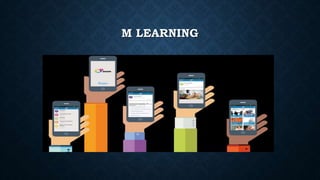
M LEARNING
Mobile learning is the ability to obtain or provide
educational content on personal pocket devices such
as PDAs, smartphones and mobile phones.
WHAT IS M Learning ?
Quinn (2000) defined it earlier,
as simply learning that takes place with the help of
mobile devices, or the intersection of mobile computing
(the application of small, portable, and wireless
computing and communication devices) and e- learning
(learning facilitated and supported through the use of
information and communications technology).
MOBILE LEARNING DEVICES
• CELL PHONES
The simplest of them all but still fairly
powerful. They can be used for group
discussions via text messaging, and since so
many cell phones have cameras, they are
useful for photography-based projects as
well. Students can also record themselves
reading stories aloud for writers’ workshops
or practicing speeches.
E-BOOK READERS
• Their fundamental function, of course,
is for reading books and storing entire
libraries.
• They also provide easy access to
dictionaries. Many students also use
their e-book readers as a replacement
for the daily paper, since they can read
various editions and magazines on it.
Well-known brands
• include Amazon’s Kindle and Barnes &
Noble’s Nook.
TABLETS
• Apple’siPad,the KindleFire, andthe
Galaxyare justafew modelsof tablets,
andthey candoanything e-book readers
candoandthen some.
• Downloadable apps,many educational,
makethese machinesnearly comparable
to computers;youcansurf the Web, play
games,watch (and evenmake) movies,
as well astakephotographs.
SMARTPHONES
• Theolderthestudents,the morelikelythey
aretobe wieldingoneofthese.Like
tablets,smartphoneshave many
computer-likefunctions. (They’realso
phones,of course.)Theycanrunappsand
software,recordaudioand video,send
andreceiveemail andtexts—
functionalitiesthat caneasilybechanneled
into classroominquiry.
SOMEMOBILE LEARNINGAPPS
EVERNOTE
Students cankeep notes
andgather sourcesfor their
projects, all of which canbe
shared with their teachers
andclassmates.
TWITTER
Allow usersshare their
thoughts, questions,
links, photos, and
videos. Students can
tweet in journalism
classes,posting reports
online in real time, for
instance, or on field
trips, sharingwhat
they’re discoveringon
their trips.
SOCRATIVE
hisWeb-based student-response
system enables you to assessin
real time — via multiple-choice,
short-answer,andtrue-false
questions — how muchof the
material your studentsunderstand.
Students enter their answerson
their own devices,allowing them
the privacy to answer candidly,and
results are tabulated immediately.
Instant feedback!
THECHEMICAL TOUCH
Theperiodic table comesalive
with anapp that provides
detailed info on the elements,
standard amino acids,and
nucleobases.
SATPREPAPPS
Students canget quizzed on
the SAT’sdifferent sections
via subject-organized
practice questions;they can
take tests (timed and
untimed), which are scored
immediately to provide
them with feedback on
potential problem areasand
how to correctthem.
CONCEPTS OF MOBILE LEARNING
MOBILITY OF TECHNOLOGY
• The mobile technology referred to in this article is mainly more advanced cellular
telephones. But there are other forms of technology such as “smart” phones, digital
cameras, flash-discs, iPods and personal digital assistance devices (PDAs).
• Mobile devices used to deliver higher education content and instruction can also
function as audio- players, media-players and digital cameras.
MOBILITY OF TECHNOLOGY
• Advanced mobile devices are furnished with Wireless Application Protocol (WAP)
and Wireless Fidelity (Wi- Fi) capacities so that a user can connect to the Internet
by means of his or her PDA (Trinder, 2005).
• The mobile cellular devices mentioned above have the capacity to link to the
Internet and deliver content and instruction that can enable learners to learn at
anytime and anywhere in a format that is culturally prestigious among people in
the same age group.
MOBILITY OF TECHNOLOGY
• Most of the more advanced models can support a portable, digital and wireless
lifestyle and mode of teaching and learning.
• It is precisely the mobility of these devices that makes them highly prestigious and
therefore desirable as instruments of learning among learners in the same age
group.
MOBILITY OF TECHNOLOGY
• Most of the more advanced models can support a portable, digital and wireless
lifestyle and mode of teaching and learning.
• It is precisely the mobility of these devices that makes them highly prestigious and
therefore desirable as instruments of learning among learners in the same age
group.
MOBILITY OF TECHNOLOGY
• Walker (2007) points out that the advantages of mobile learning are not dependent
solely upon the ability to use a portable and wireless communication device
successfully.
• He argues that the kind of learning experienced by mobile owners is unique because
it is received and processed within the context in which the learner is situated. The
context is utterly individual – completely different from the rigid outlay of the
traditional classroom or lecture room, and the computer laboratory.
MOBILITY OF LEARNERS
• with mobile learning, learning can occur at any place and at any time.
• The ordinary (non-mobile) personal computer with landline connections to the
Internet is constrained by the places in which they are located and their
availability. Non- portable personal computers are too heavy to move easily and so
learners are compelled to work in the same place and during the time slots
allocated to them by university authorities.
MOBILITY OF LEARNERS
• Ting (2005) makes the following remarks about the advantages of mobile learning:
“The overall advantages provided by the mobile learning are [that it is
characterised by] more flexible, accessible and personalised learning activities.
• Such advantages ; keep the learners engaged in the ongoing learning activities and
enhance their productivity and effectiveness”.
ADVANTAGES OF MOBILE LEARNING
• Flexibility to learners
Flexibility is not limited to any one place or time anymore! Flexibility in mLearning also
involves learning using videos, podcasts and other popular multimedia assets on smartphones.
• Collaborative learning.
Engaging learners towards the establishment of online learning communities is more
effective using mobile devices.
• Higher engagement.
Extant research and statistics reveal a higher engagement rate when courses are
delivered using the mobile format.
ADVANTAGES OF MOBILE LEARNING
• Multi-device support.
The same course is available on variable devices ranging from PCs, laptops, tablets and
smartphones
• Blending the Learning Styles
A mobile learning environment will always represent a much better path to the whole
concept of blended learning. –physical movement, personal communication, Learning styles and
digital interaction.
• Easy access
Mobile learning provides easy access to the learning at any time, which is more convenient to
the learners. Learners have an advantage of spending their free time during travelling, in between
meetings or during weekends to focus on subject they want learn.
CHALLENGES
• Cultural norms and attitudes
• No mobile theory of learning
• Differentiated access and technology
• Inconvenience of size
• Short battery life
M  learning

M learning

  • 1.
  • 2.
    OBJECTIVES (उद्देश ) •To teach students the meaning of Mobile Learning. • To know the advantages of using Mobile Learning. • To know the challenges involved in using Mobile Learning. • To know about other Apps used in Mobile Learning. • To understand the concepts of Mobile Learning.
  • 3.
  • 4.
    Mobile learning isthe ability to obtain or provide educational content on personal pocket devices such as PDAs, smartphones and mobile phones. WHAT IS M Learning ?
  • 5.
    Quinn (2000) definedit earlier, as simply learning that takes place with the help of mobile devices, or the intersection of mobile computing (the application of small, portable, and wireless computing and communication devices) and e- learning (learning facilitated and supported through the use of information and communications technology).
  • 6.
    MOBILE LEARNING DEVICES •CELL PHONES The simplest of them all but still fairly powerful. They can be used for group discussions via text messaging, and since so many cell phones have cameras, they are useful for photography-based projects as well. Students can also record themselves reading stories aloud for writers’ workshops or practicing speeches.
  • 7.
    E-BOOK READERS • Theirfundamental function, of course, is for reading books and storing entire libraries. • They also provide easy access to dictionaries. Many students also use their e-book readers as a replacement for the daily paper, since they can read various editions and magazines on it. Well-known brands • include Amazon’s Kindle and Barnes & Noble’s Nook.
  • 8.
    TABLETS • Apple’siPad,the KindleFire,andthe Galaxyare justafew modelsof tablets, andthey candoanything e-book readers candoandthen some. • Downloadable apps,many educational, makethese machinesnearly comparable to computers;youcansurf the Web, play games,watch (and evenmake) movies, as well astakephotographs.
  • 9.
    SMARTPHONES • Theolderthestudents,the morelikelythey aretobewieldingoneofthese.Like tablets,smartphoneshave many computer-likefunctions. (They’realso phones,of course.)Theycanrunappsand software,recordaudioand video,send andreceiveemail andtexts— functionalitiesthat caneasilybechanneled into classroominquiry.
  • 10.
    SOMEMOBILE LEARNINGAPPS EVERNOTE Students cankeepnotes andgather sourcesfor their projects, all of which canbe shared with their teachers andclassmates.
  • 11.
    TWITTER Allow usersshare their thoughts,questions, links, photos, and videos. Students can tweet in journalism classes,posting reports online in real time, for instance, or on field trips, sharingwhat they’re discoveringon their trips.
  • 12.
    SOCRATIVE hisWeb-based student-response system enablesyou to assessin real time — via multiple-choice, short-answer,andtrue-false questions — how muchof the material your studentsunderstand. Students enter their answerson their own devices,allowing them the privacy to answer candidly,and results are tabulated immediately. Instant feedback!
  • 13.
    THECHEMICAL TOUCH Theperiodic tablecomesalive with anapp that provides detailed info on the elements, standard amino acids,and nucleobases.
  • 14.
    SATPREPAPPS Students canget quizzedon the SAT’sdifferent sections via subject-organized practice questions;they can take tests (timed and untimed), which are scored immediately to provide them with feedback on potential problem areasand how to correctthem.
  • 15.
  • 16.
    MOBILITY OF TECHNOLOGY •The mobile technology referred to in this article is mainly more advanced cellular telephones. But there are other forms of technology such as “smart” phones, digital cameras, flash-discs, iPods and personal digital assistance devices (PDAs). • Mobile devices used to deliver higher education content and instruction can also function as audio- players, media-players and digital cameras.
  • 17.
    MOBILITY OF TECHNOLOGY •Advanced mobile devices are furnished with Wireless Application Protocol (WAP) and Wireless Fidelity (Wi- Fi) capacities so that a user can connect to the Internet by means of his or her PDA (Trinder, 2005). • The mobile cellular devices mentioned above have the capacity to link to the Internet and deliver content and instruction that can enable learners to learn at anytime and anywhere in a format that is culturally prestigious among people in the same age group.
  • 18.
    MOBILITY OF TECHNOLOGY •Most of the more advanced models can support a portable, digital and wireless lifestyle and mode of teaching and learning. • It is precisely the mobility of these devices that makes them highly prestigious and therefore desirable as instruments of learning among learners in the same age group.
  • 19.
    MOBILITY OF TECHNOLOGY •Most of the more advanced models can support a portable, digital and wireless lifestyle and mode of teaching and learning. • It is precisely the mobility of these devices that makes them highly prestigious and therefore desirable as instruments of learning among learners in the same age group.
  • 20.
    MOBILITY OF TECHNOLOGY •Walker (2007) points out that the advantages of mobile learning are not dependent solely upon the ability to use a portable and wireless communication device successfully. • He argues that the kind of learning experienced by mobile owners is unique because it is received and processed within the context in which the learner is situated. The context is utterly individual – completely different from the rigid outlay of the traditional classroom or lecture room, and the computer laboratory.
  • 21.
    MOBILITY OF LEARNERS •with mobile learning, learning can occur at any place and at any time. • The ordinary (non-mobile) personal computer with landline connections to the Internet is constrained by the places in which they are located and their availability. Non- portable personal computers are too heavy to move easily and so learners are compelled to work in the same place and during the time slots allocated to them by university authorities.
  • 22.
    MOBILITY OF LEARNERS •Ting (2005) makes the following remarks about the advantages of mobile learning: “The overall advantages provided by the mobile learning are [that it is characterised by] more flexible, accessible and personalised learning activities. • Such advantages ; keep the learners engaged in the ongoing learning activities and enhance their productivity and effectiveness”.
  • 23.
    ADVANTAGES OF MOBILELEARNING • Flexibility to learners Flexibility is not limited to any one place or time anymore! Flexibility in mLearning also involves learning using videos, podcasts and other popular multimedia assets on smartphones. • Collaborative learning. Engaging learners towards the establishment of online learning communities is more effective using mobile devices. • Higher engagement. Extant research and statistics reveal a higher engagement rate when courses are delivered using the mobile format.
  • 24.
    ADVANTAGES OF MOBILELEARNING • Multi-device support. The same course is available on variable devices ranging from PCs, laptops, tablets and smartphones • Blending the Learning Styles A mobile learning environment will always represent a much better path to the whole concept of blended learning. –physical movement, personal communication, Learning styles and digital interaction. • Easy access Mobile learning provides easy access to the learning at any time, which is more convenient to the learners. Learners have an advantage of spending their free time during travelling, in between meetings or during weekends to focus on subject they want learn.
  • 25.
    CHALLENGES • Cultural normsand attitudes • No mobile theory of learning • Differentiated access and technology • Inconvenience of size • Short battery life