Viruses structure and
classification
And Plant Viruses
Dr. Harinatha Reddy M.sc, Ph.D.
biohari14@gmail.com
Department of Microbiology
Sri Krishnadevaraya University
Anantapur, A.p. India
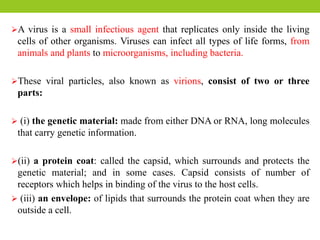
A virus is a small infectious agent that replicates only inside the living
cells of other organisms. Viruses can infect all types of life forms, from
animals and plants to microorganisms, including bacteria.
These viral particles, also known as virions, consist of two or three
parts:
 (i) the genetic material: made from either DNA or RNA, long molecules
that carry genetic information.
(ii) a protein coat: called the capsid, which surrounds and protects the
genetic material; and in some cases. Capsid consists of number of
receptors which helps in binding of the virus to the host cells.
 (iii) an envelope: of lipids that surrounds the protein coat when they are
outside a cell.
General Properties of Viruses
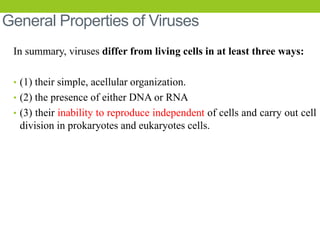
In summary, viruses differ from living cells in at least three ways:
• (1) their simple, acellular organization.
• (2) the presence of either DNA or RNA
• (3) their inability to reproduce independent of cells and carry out cell
division in prokaryotes and eukaryotes cells.
Virus Size:
• Virus range in size from about 10 to 300 or 400 nm in diameter.
• The smallest viruses are a little larger than ribosomes.
• Whereas the poxviruses (300 nm) is the largest virus, around the
size of the smallest bacteria.
• Most viruses, however, are too small to be visible in the light
microscope and must be viewed with the scanning and
transmission electron microscopes.
• F2 Bacteriophage smallest Bacteriophage 2nm.
• Smallest plant virus is Satellite tobacco mosaic virus.
• Foot-and-mouth disease or hoof-and-mouth disease is smallest
animal virus.
• The biggest animal virus is Pox virus (300 nm).
Morphology of Viruses:
• Based on shape viruses divided into 3 types:
• 1.Helical viruses
• 2.Icosahedral viruses
• 3.Complex viruses
Helical viruses :
• Best example for Helical viruses is TMV, mumps virus, Measles
and Rabies virus.
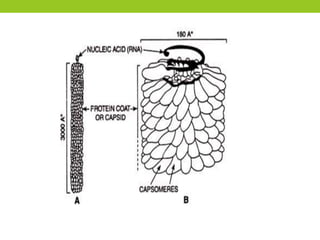
• Some viruses resembles long rods and show helical symmetry.
• In these viruses the capsomers are arranged in a helix around a
single rotational axis.
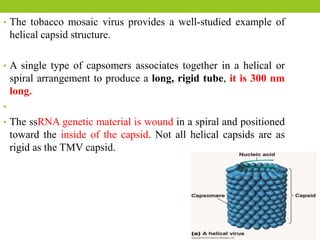
• The tobacco mosaic virus provides a well-studied example of
helical capsid structure.
• A single type of capsomers associates together in a helical or
spiral arrangement to produce a long, rigid tube, it is 300 nm
long.
•
• The ssRNA genetic material is wound in a spiral and positioned
toward the inside of the capsid. Not all helical capsids are as
rigid as the TMV capsid.
Icosahedral viruses:
• Many of the viruses like Herpes virus, Polio virus, Adenovirus
have icosahedral symmetry.
• They resembles small crystals and appear approximately
spherical shape in electron microscope.
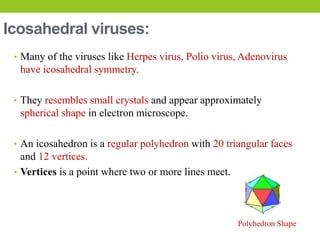
• An icosahedron is a regular polyhedron with 20 triangular faces
and 12 vertices.
• Vertices is a point where two or more lines meet.
Polyhedron Shape
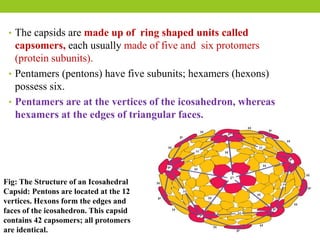
• The capsids are made up of ring shaped units called
capsomers, each usually made of five and six protomers
(protein subunits).
• Pentamers (pentons) have five subunits; hexamers (hexons)
possess six.
• Pentamers are at the vertices of the icosahedron, whereas
hexamers at the edges of triangular faces.
Fig: The Structure of an Icosahedral
Capsid: Pentons are located at the 12
vertices. Hexons form the edges and
faces of the icosahedron. This capsid
contains 42 capsomers; all protomers
are identical.
Complex Viruses:
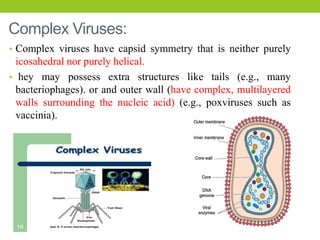
• Complex viruses have capsid symmetry that is neither purely
icosahedral nor purely helical.
• hey may possess extra structures like tails (e.g., many
bacteriophages). or and outer wall (have complex, multilayered
walls surrounding the nucleic acid) (e.g., poxviruses such as
vaccinia).
Viral Envelope:
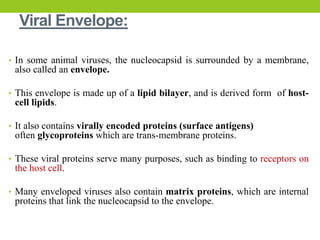
• In some animal viruses, the nucleocapsid is surrounded by a membrane,
also called an envelope.
• This envelope is made up of a lipid bilayer, and is derived form of host-
cell lipids.
• It also contains virally encoded proteins (surface antigens)
often glycoproteins which are trans-membrane proteins.
• These viral proteins serve many purposes, such as binding to receptors on
the host cell.
• Many enveloped viruses also contain matrix proteins, which are internal
proteins that link the nucleocapsid to the envelope.
Nucleic Acids:
• There are four possible nucleic acid types:
1. ssDNA
2. dsDNA
3. ssRNA
4. Ds RNA
• All four types are found in animal viruses.
• But majority of animal viruses are dsDNA viruses.
• Plant viruses most often have single-stranded RNA genomes.
• Bacterial viruses usually contain double-stranded DNA.
• DNA Single-Stranded Viruses:
• Linear single strand: Parvoviruses.
• Circular single strand: φX174, M13 phages.
• Double-Stranded DNA viruses:
• Linear double strand: Herpes simplex viruses,
Adenoviruses, T coliphages, Lambda phage, Vaccinia and
Smallpox.
• Closed circular double strand: Polyomaviruses,
Papillomaviruses, Cauliflower mosaic Viruses.
• Single-Stranded RNA viruses:
• Linear, single stranded, positive strand: Polio, rhinoviruses,
Togaviruses, TMV, Retroviruses (HIV) and most plant viruses.
• Linear, single stranded, negative strand: Rhabdoviruses (rabies),
Paramyxoviruses (mumps, measles), orthomyxoviruses
(influenza).
• Double-Stranded RNA viruses:
• Linear, double stranded: Reoviruses, wound-tumor virus of plants,
and many mycoviruses.
Positive RNA strand:
• The viral RNA base sequence identical with that of viral
mRNA, in which case the RNA strand is called the plus strand or
positive strand (+ strand, sense strand and 5’ to 3’).
Negative RNA strand:
• The viral RNA genome may be complementary to viral
mRNA, and then it is called a minus or negative strand. (- strand,
sense strand and 3’ to 5’).
• Many of these RNA genomes are segmented that is, they are
divided into separate parts.
• It is believed that each fragment or segment codes for one protein.
• Some virus genomes may be composed of as many as 10 to 12
segments, such as the reoviruses, have 10 to 12 segments.
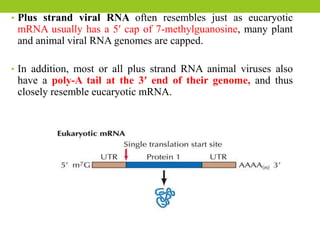
• Plus strand viral RNA often resembles just as eucaryotic
mRNA usually has a 5′ cap of 7-methylguanosine, many plant
and animal viral RNA genomes are capped.
• In addition, most or all plus strand RNA animal viruses also
have a poly-A tail at the 3′ end of their genome, and thus
closely resemble eucaryotic mRNA.
Viroids:
• Viroids are the smallest infectious pathogens.
• They composed of a short strand of circular, single-stranded RNA
(246-375 Nucleotides) without protein coat.
• All known viroids are infect higher plants, in which most cause
diseases.
• The first recognized viroid, the pathogenic agent of the potato
spindle tuber disease, was discovered by T.O.Diener.
• The other important plant disease caused by Viroids are
Chrysanthemum stunt disease, Cocount cadang-cadang disease,
AND Tomato apical stunt disease etc.
Plant Viruses:
• Cauliflower mosaic virus (CaMV)
• Tobacco mosaic virus (TMV).
Plant Viruses: Cauliflower mosaic virus (CaMV):
• Cauliflower mosaic virus (CaMV) is a member of the genus
Caulimovirus.
• Caulimoviruses contain circular ds DNA and are spherical in
shape
• CaMV infects mostly plants of the Brassicaceae family (such as
cauliflower and turnip) but some CaMV strains are also able to
infect Solanaceae species (Datura).
• Symptoms: CaMV induces a variety of systemic symptoms such as
mosaic, necrotic lesions on leaf surfaces, stunted growth, and
deformation of the overall plant structure.
• The CaMV particle is an icosahedron with a diameter of 52 nm
built from 420 capsid protein (CP) subunits.
• CaMV contains a closed circular double-stranded DNA molecule of
about 8.0 kilobase pairs.
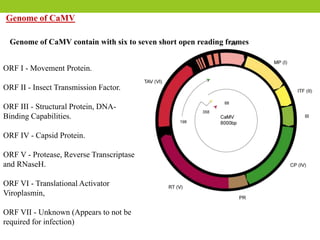
ORF I - Movement Protein.
ORF II - Insect Transmission Factor.
ORF III - Structural Protein, DNA-
Binding Capabilities.
ORF IV - Capsid Protein.
ORF V - Protease, Reverse Transcriptase
and RNaseH.
ORF VI - Translational Activator
Viroplasmin,
ORF VII - Unknown (Appears to not be
required for infection)
Genome of CaMV
Genome of CaMV contain with six to seven short open reading frames
• The CaMV promoter was named CaMV 35S & 19S promoter
("35S promoter") because the coefficient of sedimentation of the
viral transcript.
• The 35S DNA is particularly complex, containing a highly
structured 600 nucleotide long leader sequence.
• The Cauliflower mosaic virus promoter (CaMV 35S) is used in
most transgenic crops to activate foreign genes which have been
artificially inserted into the host plant.
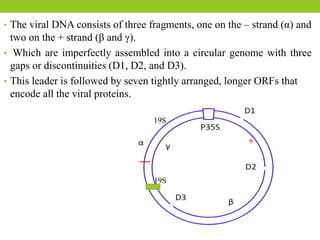
• The viral DNA consists of three fragments, one on the – strand (α) and
two on the + strand (β and γ).
• Which are imperfectly assembled into a circular genome with three
gaps or discontinuities (D1, D2, and D3).
• This leader is followed by seven tightly arranged, longer ORFs that
encode all the viral proteins.
–
+
19S
19S
• CaMV replicates by reverse transcription.
• Viral particles enter a plant cell and are unencapsidated.
• The viral DNA enters the nucleus where the discontinuities gaps are
filled, are sealed and the molecule associates with histones forming a
minichromosome
• This is the template for transcription by the host DNA-dependent
RNA polymerase, giving the 35S and 19S RNAs, which pass to the
cytoplasm.
• The 19S RNA is translated to yield the inclusion body protein.
• The 35S RNA has two functions, being the mRNA for at least the products of
ORFs I and II and the template for the reverse transcription phase of replication.
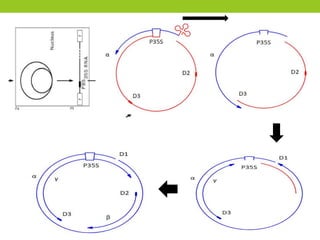
• The replication begins with the binding of 3′ end of tRNA (met-init) to 5′ end of
the 35S RNA.
• This acts as a primer for the synthesis of α -strand DNA toward the 5′ end of the
template.
•
• RNaseH activity removes the RNA moiety of the DNA-RNA duplex thus formed
and leaves DNA.
• The digestion of the RNA by RNaseH leaves purine-rich regions at the positions
of discontinuities 2 and 3 (D2 and D3), which act as primers for the synthesis of
the β and γ strands.
Aphid transmission of cauliflower mosaic virus:
• Most plant viruses are transmitted by insects, using two different
strategies: “circulant transmission” where the virus, once taken up
by the vector during feeding on an infected plant, passes from the
intestine via the body lumen to the salivary glands and is finally
inoculated with the saliva into a new host plant.
• The second strategy is “non-circulant transmission” where
transmissible virus particles attach only to the exterior mouthpieces
of the insect from which they are released into a new host.
Control strategies:
• It involves:
• (1) Elimination of sources of virus.
• (2) Elimination of the virus from infected plants.
• (3) Control of vectors.
• (4) Breeding for resistance and the use of cross-protection
methods.
Tobacco mosaic virus:
• Tobacco mosaic virus(TMV) is a positive-sense single stranded RNA
virus that infects a wide range of plants, especially tobacco and other
members of the family Solanaceae.
• Tobacco mosaic virus has a rod-like appearance.
• Its capsid is made from 2130 molecules of capsomers and one
molecule of genomic single strand RNA, 6400 bases long.
• Each capsomers is a grape like structure consists of 158 amino acids
which are assembled into four main alpha-helices.
• Virions are ~300 nm in length and ~18 nm in diameter.
TMV genome:
• The TMV genome consists of a 6.3-6.5 kb single-stranded (ss) RNA.
• The 5’ terminus has a methylated nucleotide cap (7 methylguanosine) and
the 3’-terminus has a tRNA-like structure.
• The genome contain 4 open reading frames.
• The 2 genes encode a replicase (with methyltransferase [MT] and RNA
helicase [Hel]), an RNA-dependent RNA polymerase, also-called
movement protein (MP) and a capsid protein (CP).
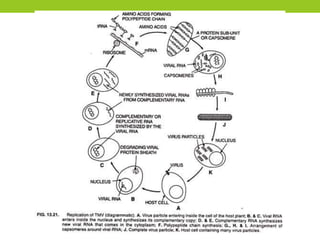
Replication:
• Following entry into its host via mechanical inoculation, TMV uncoats
itself to release its viral [+]RNA strand.
• Then the viral genome transcribes and produce multiple mRNAs.
• The resulting mRNAs encode several proteins, including the coat protein
and an RNA-dependent RNA polymerase (RdRp).
• Thus TMV can replicate its own genome by RNA-dependent RNA
polymerase.
• After the coat protein and RNA genome of TMV have been synthesized,
they spontaneously assemble into complete TMV virions in a highly
organized process.
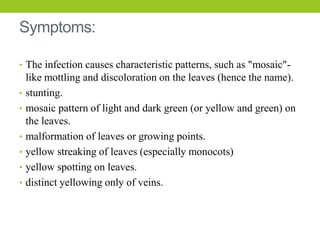
Symptoms:
• The infection causes characteristic patterns, such as "mosaic"-
like mottling and discoloration on the leaves (hence the name).
• stunting.
• mosaic pattern of light and dark green (or yellow and green) on
the leaves.
• malformation of leaves or growing points.
• yellow streaking of leaves (especially monocots)
• yellow spotting on leaves.
• distinct yellowing only of veins.
Transmission:
• It can also spread through phloem for longer distance movement within
the plant.
• Moreover, TMV can be transmitted from one plant to another by direct
contact.
• Although TMV does not have defined transmission vectors, the virus can
be easily transmitted from the infected hosts to the healthy plants, by
human handling.
• Rather, it will over-winter in infected tobacco stalks and leaves in the soil,
on the surface of contaminated seed (TMV can even survive in
contaminated tobacco products for many years).
• With the direct contact with host plants through its vectors (normally
insects such as aphids and leafhoppers).
Control of Tobacco Mosaic Virus: Following are some of the
suggested control measures:
• (i) Seed beds should be located at a great distance from the tobacco
warehouses.
• (ii) Seed beds should be free from any tobacco refuse. (iii) Seed bed soil
should be sterilized by steam.
• (iv) Care should be taken to avoid contamination through hands and
cultivation implements.
• (v) Since pipe tobacco, cigarettes and chewing tobacco are all sources of
primary inoculum, smoking or chewing of any kind of tobacco should be
avoided.
• (vi) Susceptible hosts, weed or otherwise in which virus may harbour,
should be destroyed.
• (vii) Previous year’s plant debris should be destroyed by burning.
• (viii) Diseased plants should be removed and burnt to stop further spread
of the disease.
• (ix) Growing resistant varieties produces good results.
THANK U

Virus structure and classification

  • 1.
    Viruses structure and classification AndPlant Viruses Dr. Harinatha Reddy M.sc, Ph.D. biohari14@gmail.com Department of Microbiology Sri Krishnadevaraya University Anantapur, A.p. India
  • 2.
    A virus isa small infectious agent that replicates only inside the living cells of other organisms. Viruses can infect all types of life forms, from animals and plants to microorganisms, including bacteria. These viral particles, also known as virions, consist of two or three parts:  (i) the genetic material: made from either DNA or RNA, long molecules that carry genetic information. (ii) a protein coat: called the capsid, which surrounds and protects the genetic material; and in some cases. Capsid consists of number of receptors which helps in binding of the virus to the host cells.  (iii) an envelope: of lipids that surrounds the protein coat when they are outside a cell.
  • 3.
    General Properties ofViruses In summary, viruses differ from living cells in at least three ways: • (1) their simple, acellular organization. • (2) the presence of either DNA or RNA • (3) their inability to reproduce independent of cells and carry out cell division in prokaryotes and eukaryotes cells.
  • 4.
    Virus Size: • Virusrange in size from about 10 to 300 or 400 nm in diameter. • The smallest viruses are a little larger than ribosomes. • Whereas the poxviruses (300 nm) is the largest virus, around the size of the smallest bacteria. • Most viruses, however, are too small to be visible in the light microscope and must be viewed with the scanning and transmission electron microscopes.
  • 5.
    • F2 Bacteriophagesmallest Bacteriophage 2nm. • Smallest plant virus is Satellite tobacco mosaic virus. • Foot-and-mouth disease or hoof-and-mouth disease is smallest animal virus. • The biggest animal virus is Pox virus (300 nm).
  • 6.
    Morphology of Viruses: •Based on shape viruses divided into 3 types: • 1.Helical viruses • 2.Icosahedral viruses • 3.Complex viruses
  • 7.
    Helical viruses : •Best example for Helical viruses is TMV, mumps virus, Measles and Rabies virus. • Some viruses resembles long rods and show helical symmetry. • In these viruses the capsomers are arranged in a helix around a single rotational axis.
  • 8.
    • The tobaccomosaic virus provides a well-studied example of helical capsid structure. • A single type of capsomers associates together in a helical or spiral arrangement to produce a long, rigid tube, it is 300 nm long. • • The ssRNA genetic material is wound in a spiral and positioned toward the inside of the capsid. Not all helical capsids are as rigid as the TMV capsid.
  • 9.
    Icosahedral viruses: • Manyof the viruses like Herpes virus, Polio virus, Adenovirus have icosahedral symmetry. • They resembles small crystals and appear approximately spherical shape in electron microscope. • An icosahedron is a regular polyhedron with 20 triangular faces and 12 vertices. • Vertices is a point where two or more lines meet. Polyhedron Shape
  • 10.
    • The capsidsare made up of ring shaped units called capsomers, each usually made of five and six protomers (protein subunits). • Pentamers (pentons) have five subunits; hexamers (hexons) possess six. • Pentamers are at the vertices of the icosahedron, whereas hexamers at the edges of triangular faces. Fig: The Structure of an Icosahedral Capsid: Pentons are located at the 12 vertices. Hexons form the edges and faces of the icosahedron. This capsid contains 42 capsomers; all protomers are identical.
  • 11.
    Complex Viruses: • Complexviruses have capsid symmetry that is neither purely icosahedral nor purely helical. • hey may possess extra structures like tails (e.g., many bacteriophages). or and outer wall (have complex, multilayered walls surrounding the nucleic acid) (e.g., poxviruses such as vaccinia).
  • 12.
    Viral Envelope: • Insome animal viruses, the nucleocapsid is surrounded by a membrane, also called an envelope. • This envelope is made up of a lipid bilayer, and is derived form of host- cell lipids. • It also contains virally encoded proteins (surface antigens) often glycoproteins which are trans-membrane proteins. • These viral proteins serve many purposes, such as binding to receptors on the host cell. • Many enveloped viruses also contain matrix proteins, which are internal proteins that link the nucleocapsid to the envelope.
  • 13.
    Nucleic Acids: • Thereare four possible nucleic acid types: 1. ssDNA 2. dsDNA 3. ssRNA 4. Ds RNA • All four types are found in animal viruses. • But majority of animal viruses are dsDNA viruses. • Plant viruses most often have single-stranded RNA genomes. • Bacterial viruses usually contain double-stranded DNA.
  • 14.
    • DNA Single-StrandedViruses: • Linear single strand: Parvoviruses. • Circular single strand: φX174, M13 phages. • Double-Stranded DNA viruses: • Linear double strand: Herpes simplex viruses, Adenoviruses, T coliphages, Lambda phage, Vaccinia and Smallpox. • Closed circular double strand: Polyomaviruses, Papillomaviruses, Cauliflower mosaic Viruses.
  • 15.
    • Single-Stranded RNAviruses: • Linear, single stranded, positive strand: Polio, rhinoviruses, Togaviruses, TMV, Retroviruses (HIV) and most plant viruses. • Linear, single stranded, negative strand: Rhabdoviruses (rabies), Paramyxoviruses (mumps, measles), orthomyxoviruses (influenza). • Double-Stranded RNA viruses: • Linear, double stranded: Reoviruses, wound-tumor virus of plants, and many mycoviruses.
  • 16.
    Positive RNA strand: •The viral RNA base sequence identical with that of viral mRNA, in which case the RNA strand is called the plus strand or positive strand (+ strand, sense strand and 5’ to 3’). Negative RNA strand: • The viral RNA genome may be complementary to viral mRNA, and then it is called a minus or negative strand. (- strand, sense strand and 3’ to 5’).
  • 17.
    • Many ofthese RNA genomes are segmented that is, they are divided into separate parts. • It is believed that each fragment or segment codes for one protein. • Some virus genomes may be composed of as many as 10 to 12 segments, such as the reoviruses, have 10 to 12 segments.
  • 18.
    • Plus strandviral RNA often resembles just as eucaryotic mRNA usually has a 5′ cap of 7-methylguanosine, many plant and animal viral RNA genomes are capped. • In addition, most or all plus strand RNA animal viruses also have a poly-A tail at the 3′ end of their genome, and thus closely resemble eucaryotic mRNA.
  • 19.
    Viroids: • Viroids arethe smallest infectious pathogens. • They composed of a short strand of circular, single-stranded RNA (246-375 Nucleotides) without protein coat. • All known viroids are infect higher plants, in which most cause diseases. • The first recognized viroid, the pathogenic agent of the potato spindle tuber disease, was discovered by T.O.Diener. • The other important plant disease caused by Viroids are Chrysanthemum stunt disease, Cocount cadang-cadang disease, AND Tomato apical stunt disease etc.
  • 20.
    Plant Viruses: • Cauliflowermosaic virus (CaMV) • Tobacco mosaic virus (TMV).
  • 21.
    Plant Viruses: Cauliflowermosaic virus (CaMV): • Cauliflower mosaic virus (CaMV) is a member of the genus Caulimovirus. • Caulimoviruses contain circular ds DNA and are spherical in shape • CaMV infects mostly plants of the Brassicaceae family (such as cauliflower and turnip) but some CaMV strains are also able to infect Solanaceae species (Datura). • Symptoms: CaMV induces a variety of systemic symptoms such as mosaic, necrotic lesions on leaf surfaces, stunted growth, and deformation of the overall plant structure.
  • 22.
    • The CaMVparticle is an icosahedron with a diameter of 52 nm built from 420 capsid protein (CP) subunits. • CaMV contains a closed circular double-stranded DNA molecule of about 8.0 kilobase pairs.
  • 23.
    ORF I -Movement Protein. ORF II - Insect Transmission Factor. ORF III - Structural Protein, DNA- Binding Capabilities. ORF IV - Capsid Protein. ORF V - Protease, Reverse Transcriptase and RNaseH. ORF VI - Translational Activator Viroplasmin, ORF VII - Unknown (Appears to not be required for infection) Genome of CaMV Genome of CaMV contain with six to seven short open reading frames
  • 24.
    • The CaMVpromoter was named CaMV 35S & 19S promoter ("35S promoter") because the coefficient of sedimentation of the viral transcript. • The 35S DNA is particularly complex, containing a highly structured 600 nucleotide long leader sequence. • The Cauliflower mosaic virus promoter (CaMV 35S) is used in most transgenic crops to activate foreign genes which have been artificially inserted into the host plant.
  • 25.
    • The viralDNA consists of three fragments, one on the – strand (α) and two on the + strand (β and γ). • Which are imperfectly assembled into a circular genome with three gaps or discontinuities (D1, D2, and D3). • This leader is followed by seven tightly arranged, longer ORFs that encode all the viral proteins. – + 19S 19S
  • 26.
    • CaMV replicatesby reverse transcription. • Viral particles enter a plant cell and are unencapsidated. • The viral DNA enters the nucleus where the discontinuities gaps are filled, are sealed and the molecule associates with histones forming a minichromosome • This is the template for transcription by the host DNA-dependent RNA polymerase, giving the 35S and 19S RNAs, which pass to the cytoplasm.
  • 27.
    • The 19SRNA is translated to yield the inclusion body protein. • The 35S RNA has two functions, being the mRNA for at least the products of ORFs I and II and the template for the reverse transcription phase of replication. • The replication begins with the binding of 3′ end of tRNA (met-init) to 5′ end of the 35S RNA. • This acts as a primer for the synthesis of α -strand DNA toward the 5′ end of the template. • • RNaseH activity removes the RNA moiety of the DNA-RNA duplex thus formed and leaves DNA. • The digestion of the RNA by RNaseH leaves purine-rich regions at the positions of discontinuities 2 and 3 (D2 and D3), which act as primers for the synthesis of the β and γ strands.
  • 29.
    Aphid transmission ofcauliflower mosaic virus: • Most plant viruses are transmitted by insects, using two different strategies: “circulant transmission” where the virus, once taken up by the vector during feeding on an infected plant, passes from the intestine via the body lumen to the salivary glands and is finally inoculated with the saliva into a new host plant. • The second strategy is “non-circulant transmission” where transmissible virus particles attach only to the exterior mouthpieces of the insect from which they are released into a new host.
  • 30.
    Control strategies: • Itinvolves: • (1) Elimination of sources of virus. • (2) Elimination of the virus from infected plants. • (3) Control of vectors. • (4) Breeding for resistance and the use of cross-protection methods.
  • 31.
    Tobacco mosaic virus: •Tobacco mosaic virus(TMV) is a positive-sense single stranded RNA virus that infects a wide range of plants, especially tobacco and other members of the family Solanaceae. • Tobacco mosaic virus has a rod-like appearance. • Its capsid is made from 2130 molecules of capsomers and one molecule of genomic single strand RNA, 6400 bases long. • Each capsomers is a grape like structure consists of 158 amino acids which are assembled into four main alpha-helices. • Virions are ~300 nm in length and ~18 nm in diameter.
  • 33.
    TMV genome: • TheTMV genome consists of a 6.3-6.5 kb single-stranded (ss) RNA. • The 5’ terminus has a methylated nucleotide cap (7 methylguanosine) and the 3’-terminus has a tRNA-like structure. • The genome contain 4 open reading frames. • The 2 genes encode a replicase (with methyltransferase [MT] and RNA helicase [Hel]), an RNA-dependent RNA polymerase, also-called movement protein (MP) and a capsid protein (CP).
  • 34.
    Replication: • Following entryinto its host via mechanical inoculation, TMV uncoats itself to release its viral [+]RNA strand. • Then the viral genome transcribes and produce multiple mRNAs. • The resulting mRNAs encode several proteins, including the coat protein and an RNA-dependent RNA polymerase (RdRp). • Thus TMV can replicate its own genome by RNA-dependent RNA polymerase. • After the coat protein and RNA genome of TMV have been synthesized, they spontaneously assemble into complete TMV virions in a highly organized process.
  • 36.
    Symptoms: • The infectioncauses characteristic patterns, such as "mosaic"- like mottling and discoloration on the leaves (hence the name). • stunting. • mosaic pattern of light and dark green (or yellow and green) on the leaves. • malformation of leaves or growing points. • yellow streaking of leaves (especially monocots) • yellow spotting on leaves. • distinct yellowing only of veins.
  • 37.
    Transmission: • It canalso spread through phloem for longer distance movement within the plant. • Moreover, TMV can be transmitted from one plant to another by direct contact. • Although TMV does not have defined transmission vectors, the virus can be easily transmitted from the infected hosts to the healthy plants, by human handling. • Rather, it will over-winter in infected tobacco stalks and leaves in the soil, on the surface of contaminated seed (TMV can even survive in contaminated tobacco products for many years). • With the direct contact with host plants through its vectors (normally insects such as aphids and leafhoppers).
  • 38.
    Control of TobaccoMosaic Virus: Following are some of the suggested control measures: • (i) Seed beds should be located at a great distance from the tobacco warehouses. • (ii) Seed beds should be free from any tobacco refuse. (iii) Seed bed soil should be sterilized by steam. • (iv) Care should be taken to avoid contamination through hands and cultivation implements. • (v) Since pipe tobacco, cigarettes and chewing tobacco are all sources of primary inoculum, smoking or chewing of any kind of tobacco should be avoided. • (vi) Susceptible hosts, weed or otherwise in which virus may harbour, should be destroyed. • (vii) Previous year’s plant debris should be destroyed by burning. • (viii) Diseased plants should be removed and burnt to stop further spread of the disease. • (ix) Growing resistant varieties produces good results.
  • 39.