Video Editing
Basics
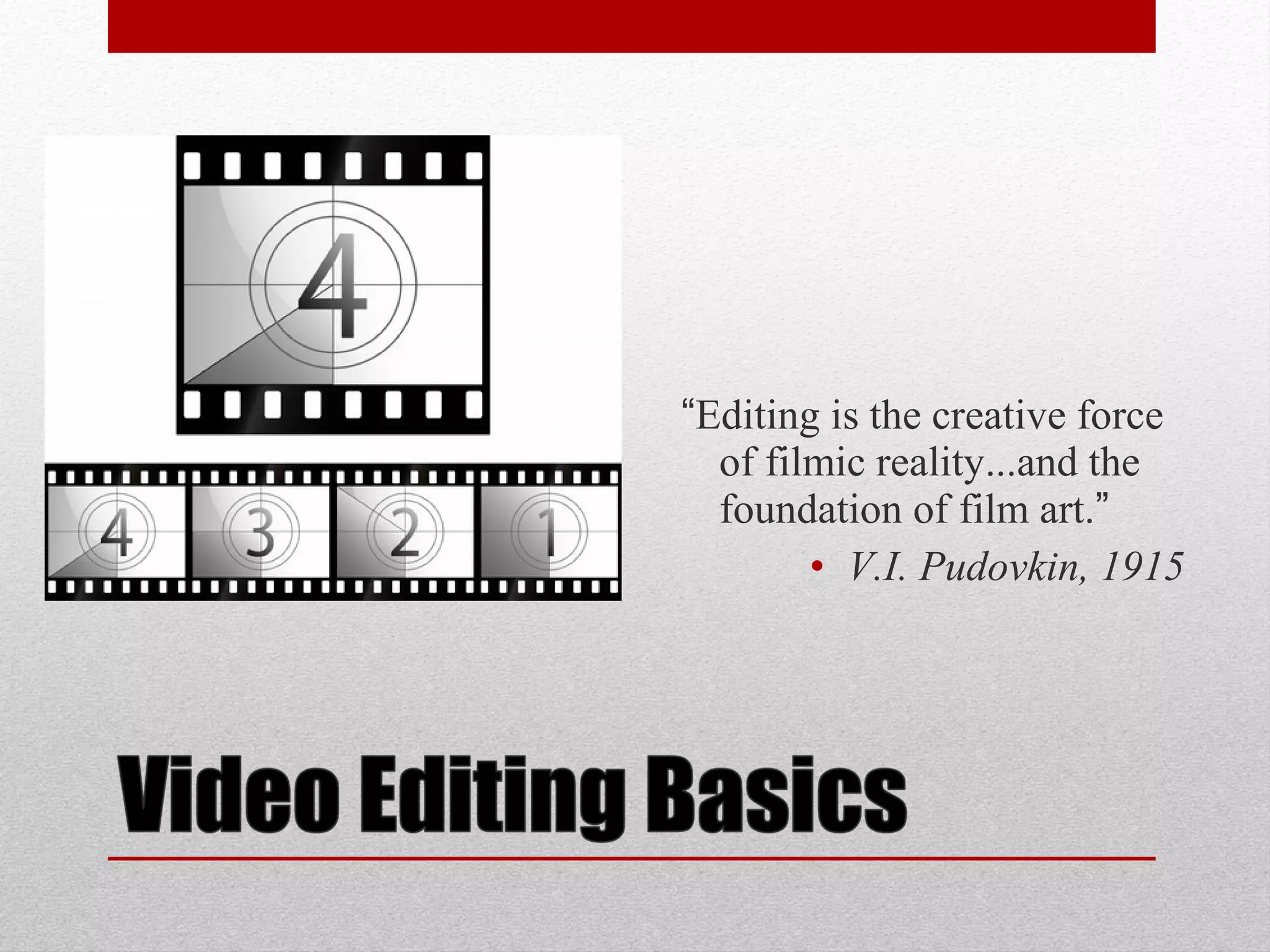
“Editing is the creative force
of filmic reality...and the
foundation of film art.”
• V.I. Pudovkin, 1915
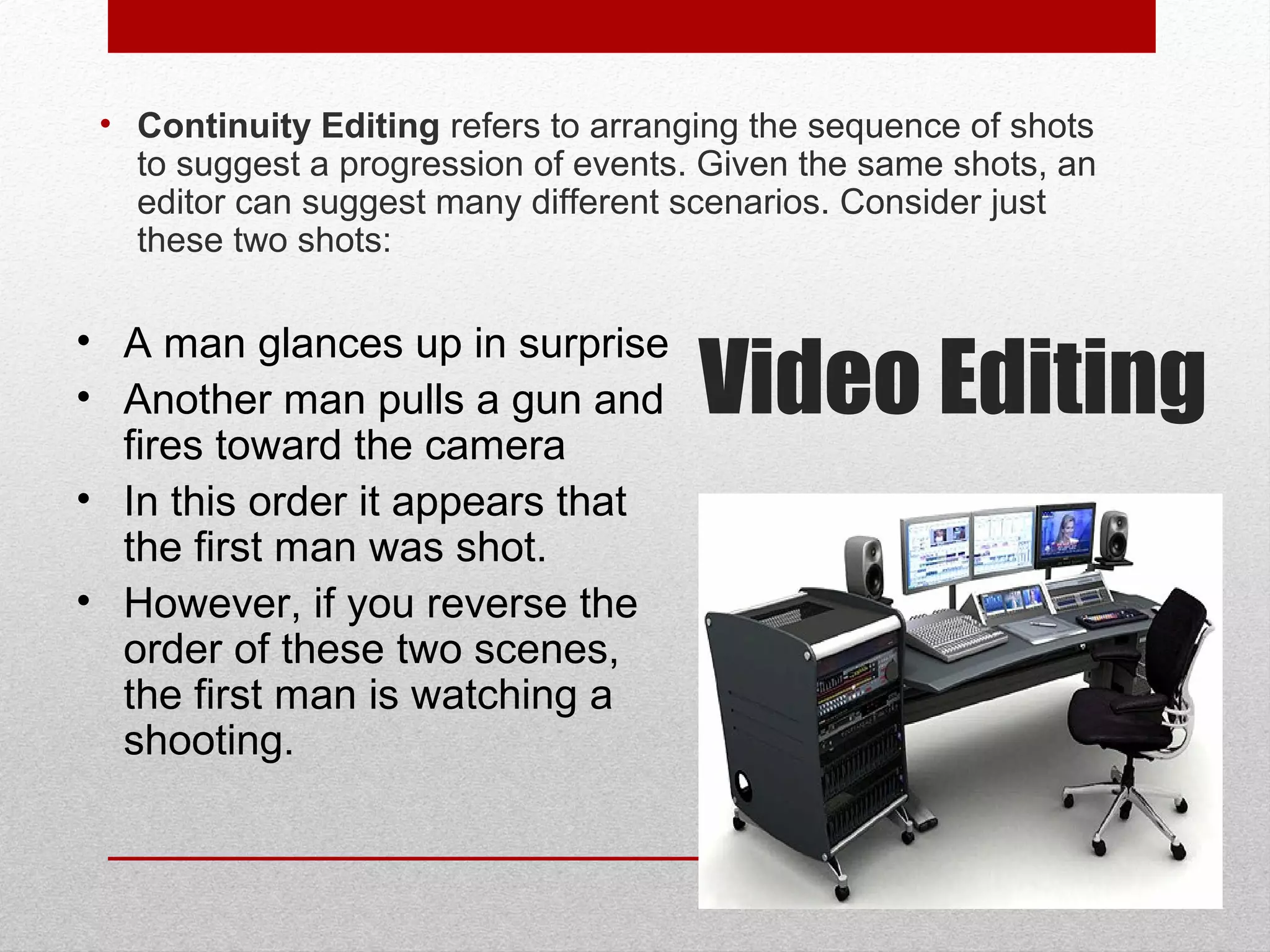
• Continuity Editing refers to arranging the sequence of shots
to suggest a progression of events. Given the same shots, an
editor can suggest many different scenarios. Consider just
these two shots:
• A man glances up in surprise
• Another man pulls a gun and
fires toward the camera
• In this order it appears that
the first man was shot.
• However, if you reverse the
order of these two scenes,
the first man is watching a
shooting.
Video Editing
Video Editing
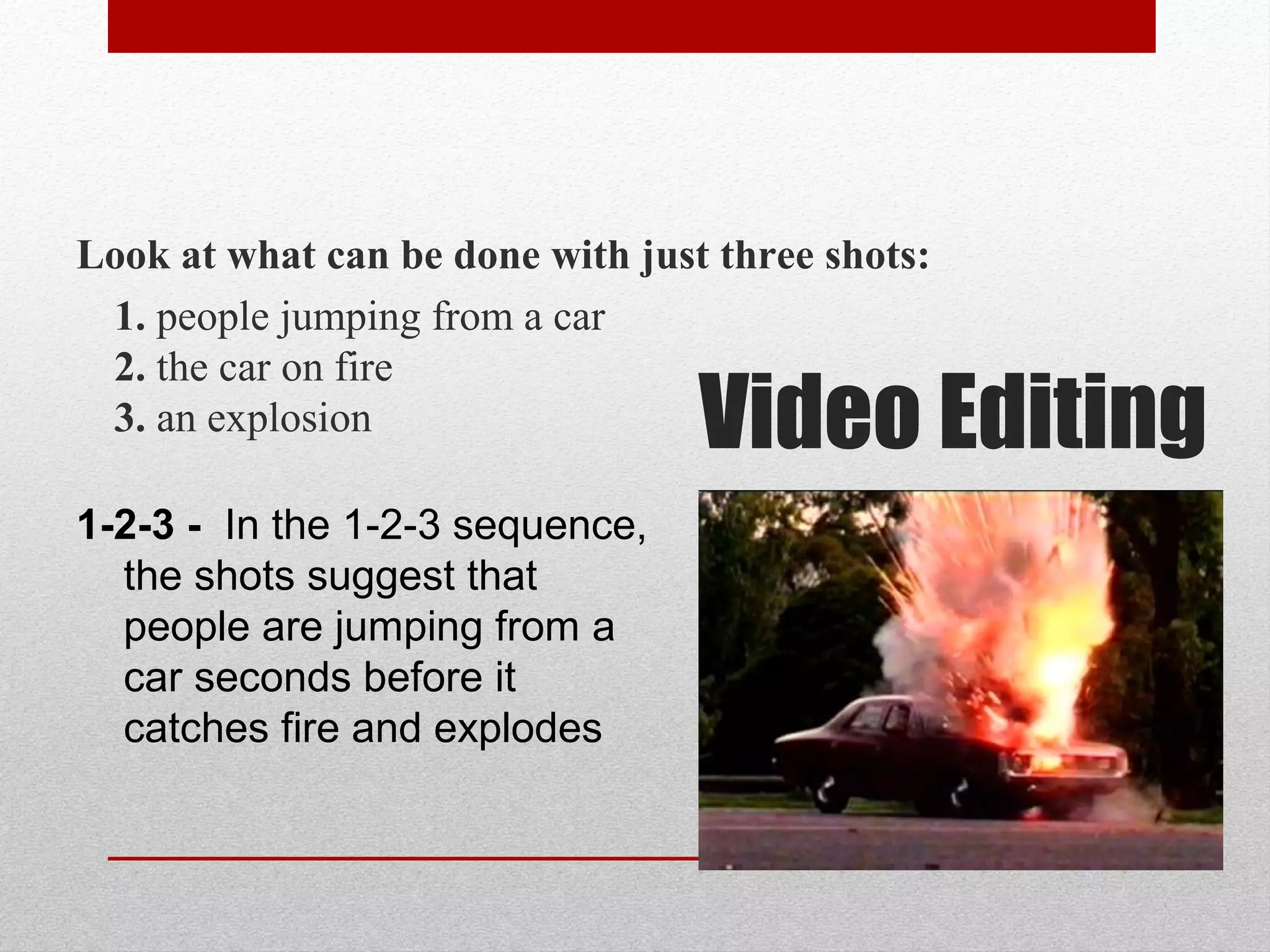
Look at what can be done with just three shots:
1. people jumping from a car
2. the car on fire
3. an explosion
1-2-3 - In the 1-2-3 sequence,
the shots suggest that
people are jumping from a
car seconds before it
catches fire and explodes
Look at what can be done with just three shots:
1. people jumping from a car
2. the car on fire
3. an explosion
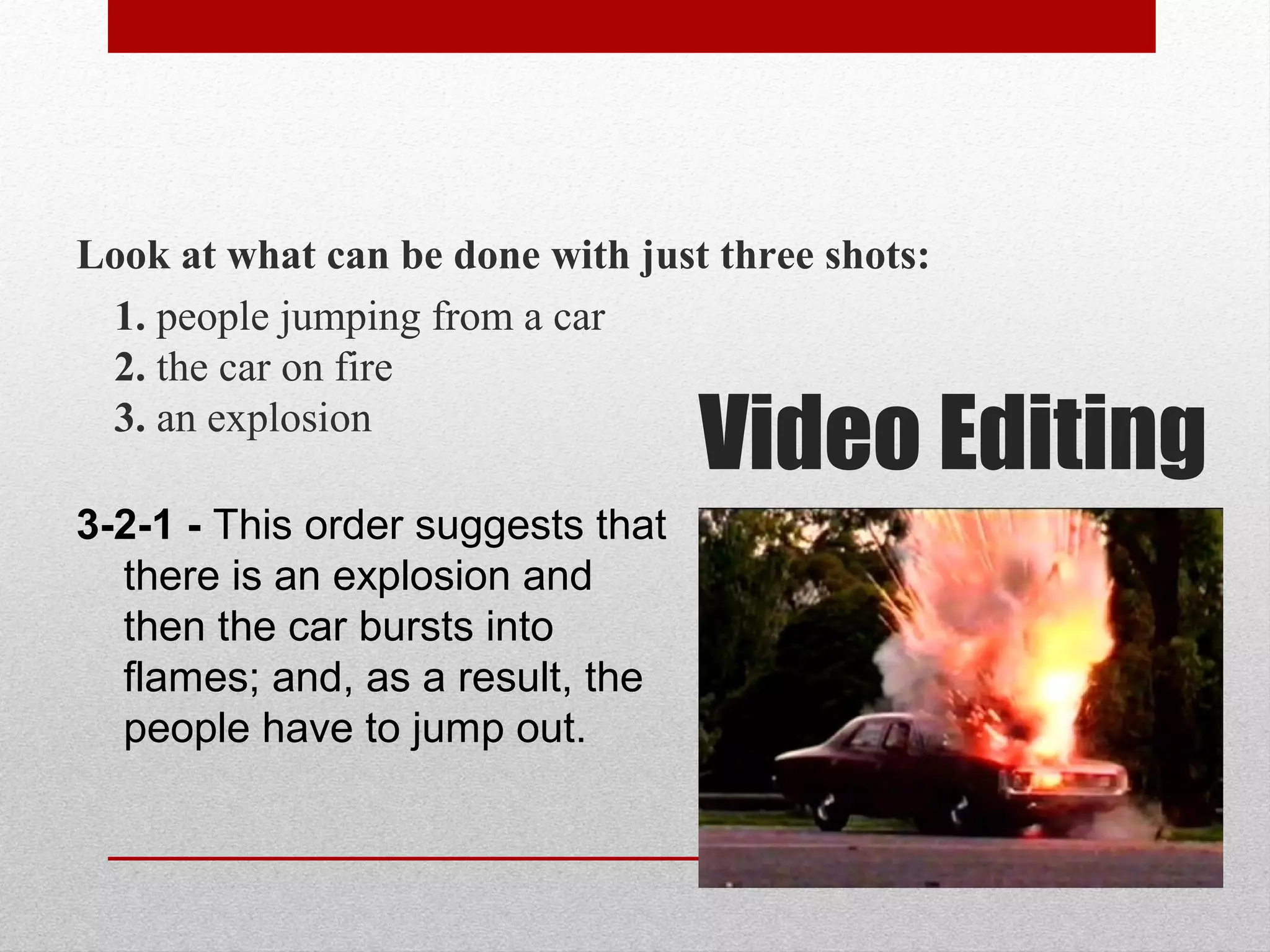
3-2-1 - This order suggests that
there is an explosion and
then the car bursts into
flames; and, as a result, the
people have to jump out.
Video Editing
Look at what can be done with just three shots:
1. people jumping from a car
2. the car on fire
3. an explosion
2-1-3 - If the sequence is
changed to 2-1-3, it appears
that as a result of a fire
passengers jump out of the
car just in time to escape a
devastating explosion.
Video Editing
Look at what can be done with just three shots:
1. people jumping from a car
2. the car on fire
3. an explosion
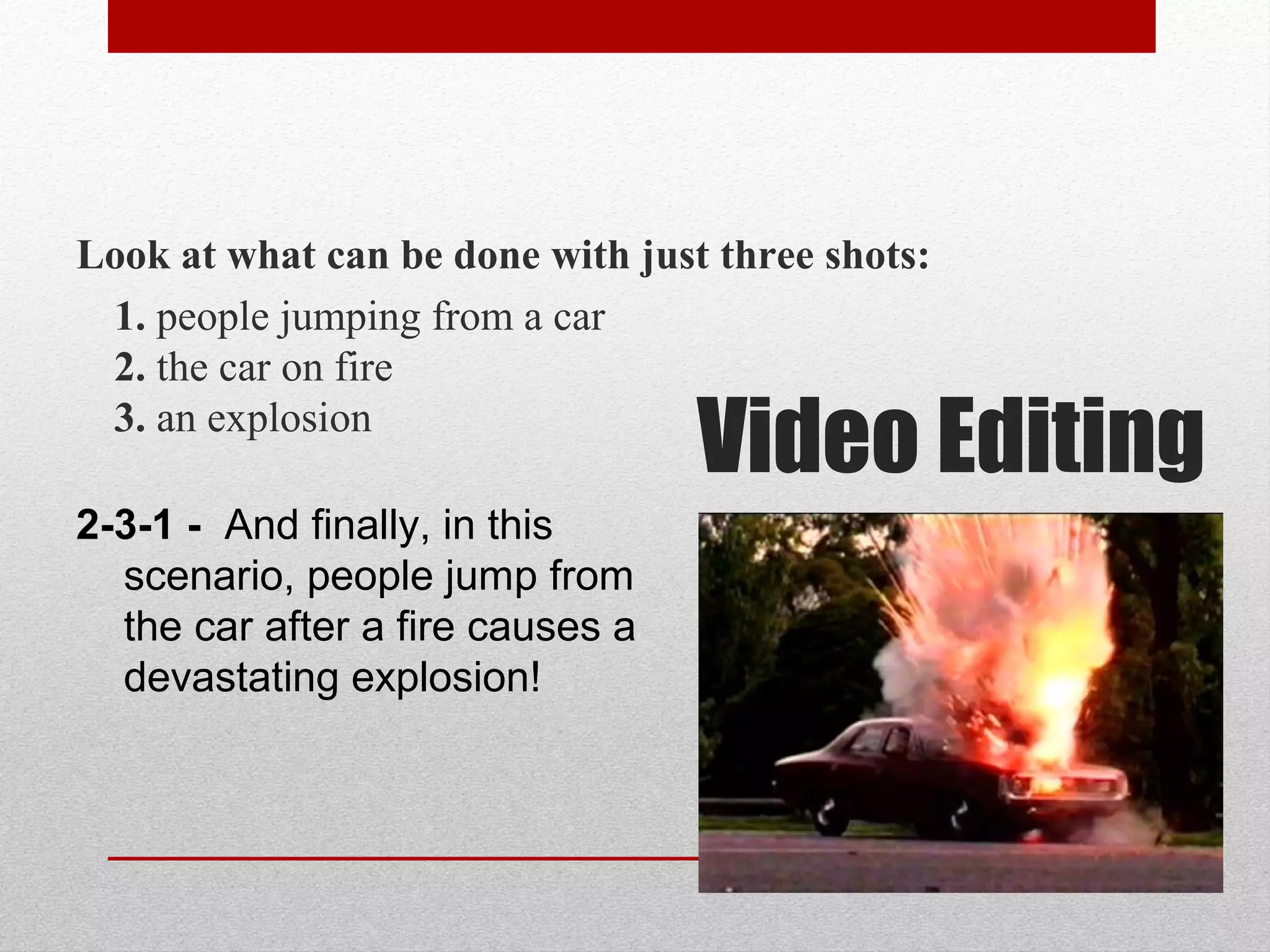
2-3-1 - And finally, in this
scenario, people jump from
the car after a fire causes a
devastating explosion!
Video Editing
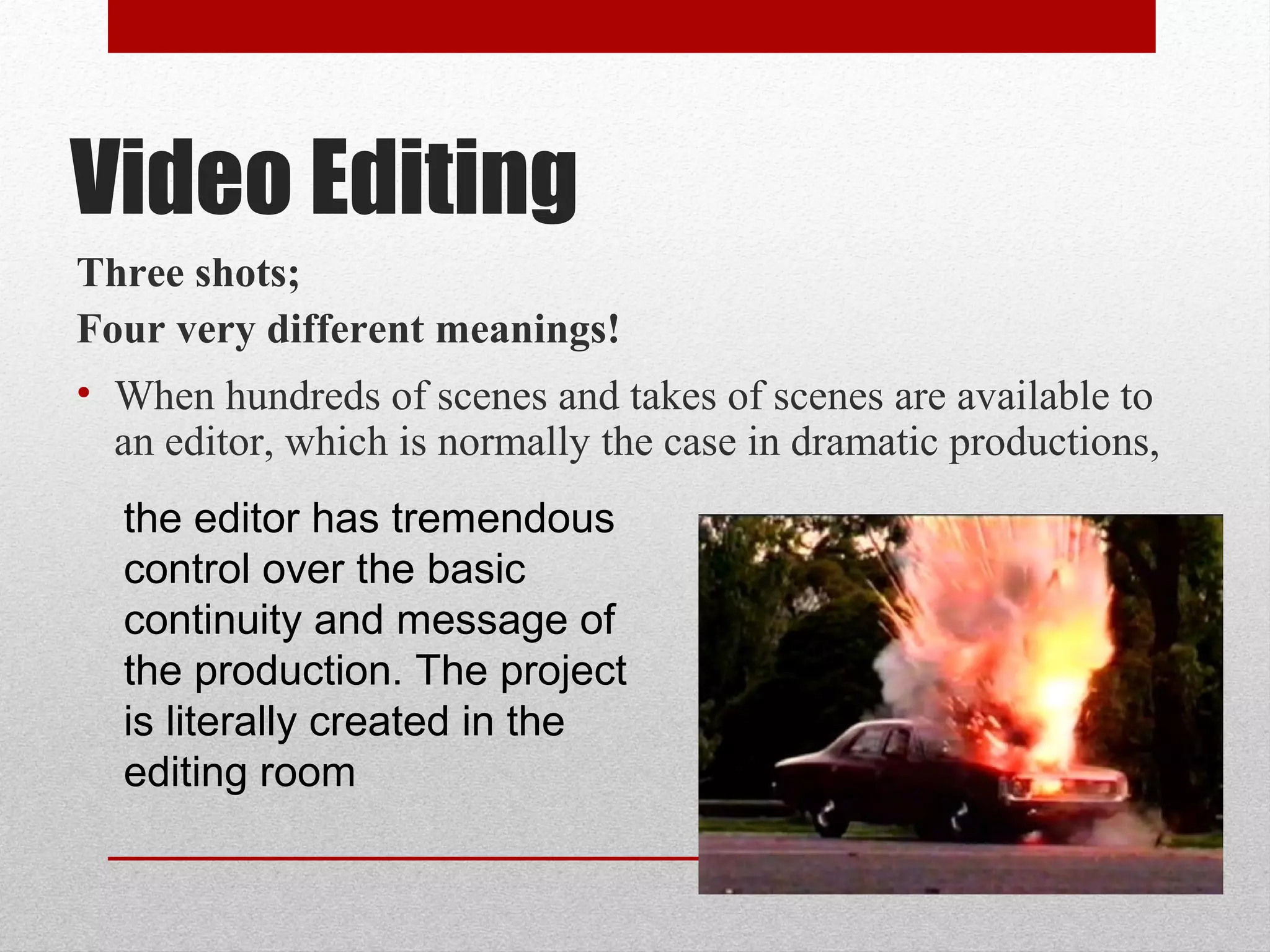
Three shots;
Four very different meanings!
• When hundreds of scenes and takes of scenes are available to
an editor, which is normally the case in dramatic productions,
the editor has tremendous
control over the basic
continuity and message of
the production. The project
is literally created in the
editing room
Video Editing
• Continuity Editing primarily
suggests guiding an audience
through a sequence of events,
and, in the process, showing
them what they want to see
when they want to see it.
In dramatic storytelling, good editors sometimes break
from the expected to achieve a dramatic effect.
Unfulfilled expectations can be used to create tension.
Video Editing
• Here's an example of the latter. In a story about the changes in
the U.S. $100 bill a treasury spokesperson spends considerable
time giving specific details on the changes that were necessary
to foil counterfeiting.
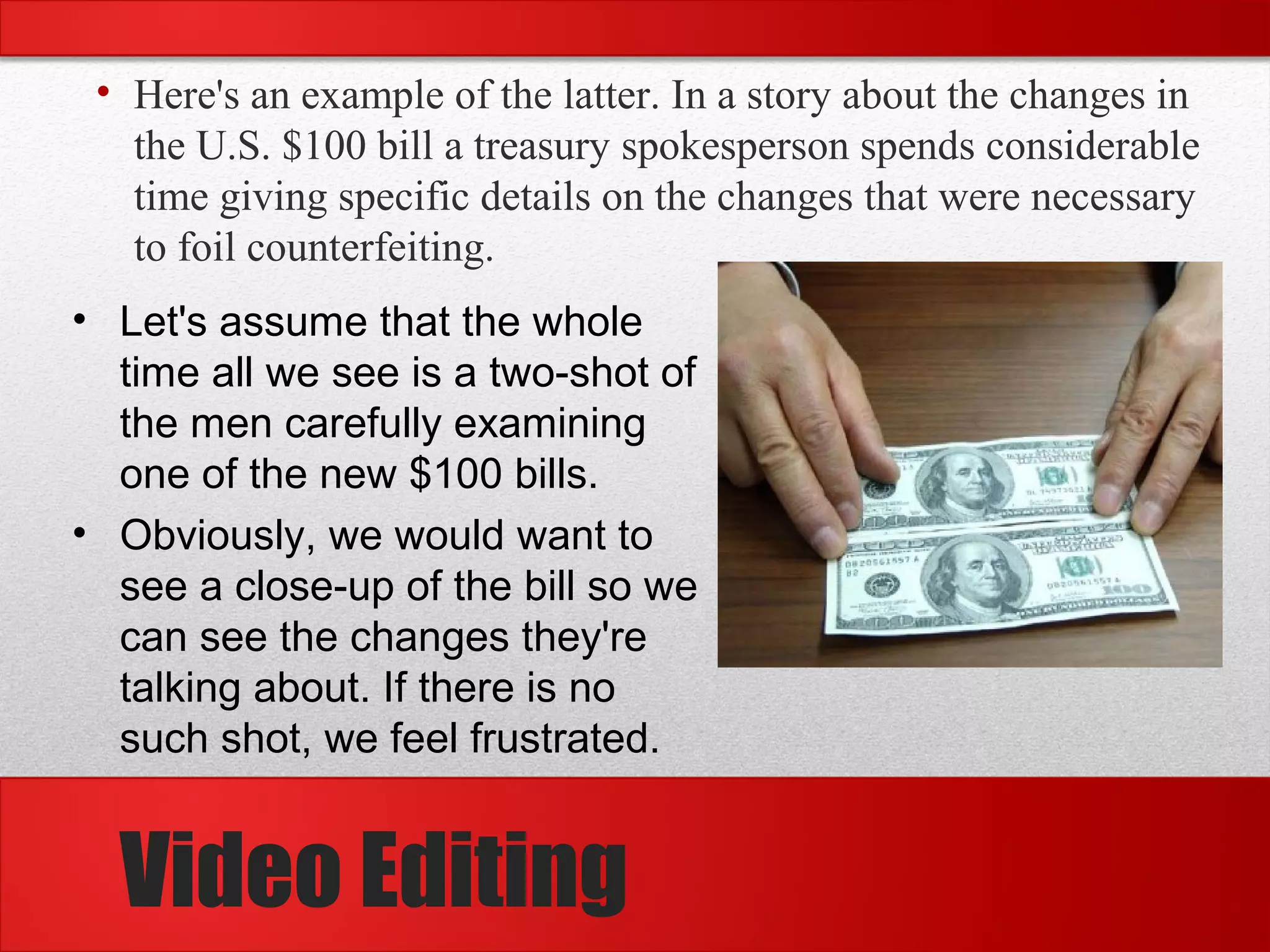
• Let's assume that the whole
time all we see is a two-shot of
the men carefully examining
one of the new $100 bills.
• Obviously, we would want to
see a close-up of the bill so we
can see the changes they're
talking about. If there is no
such shot, we feel frustrated.
Video Editing
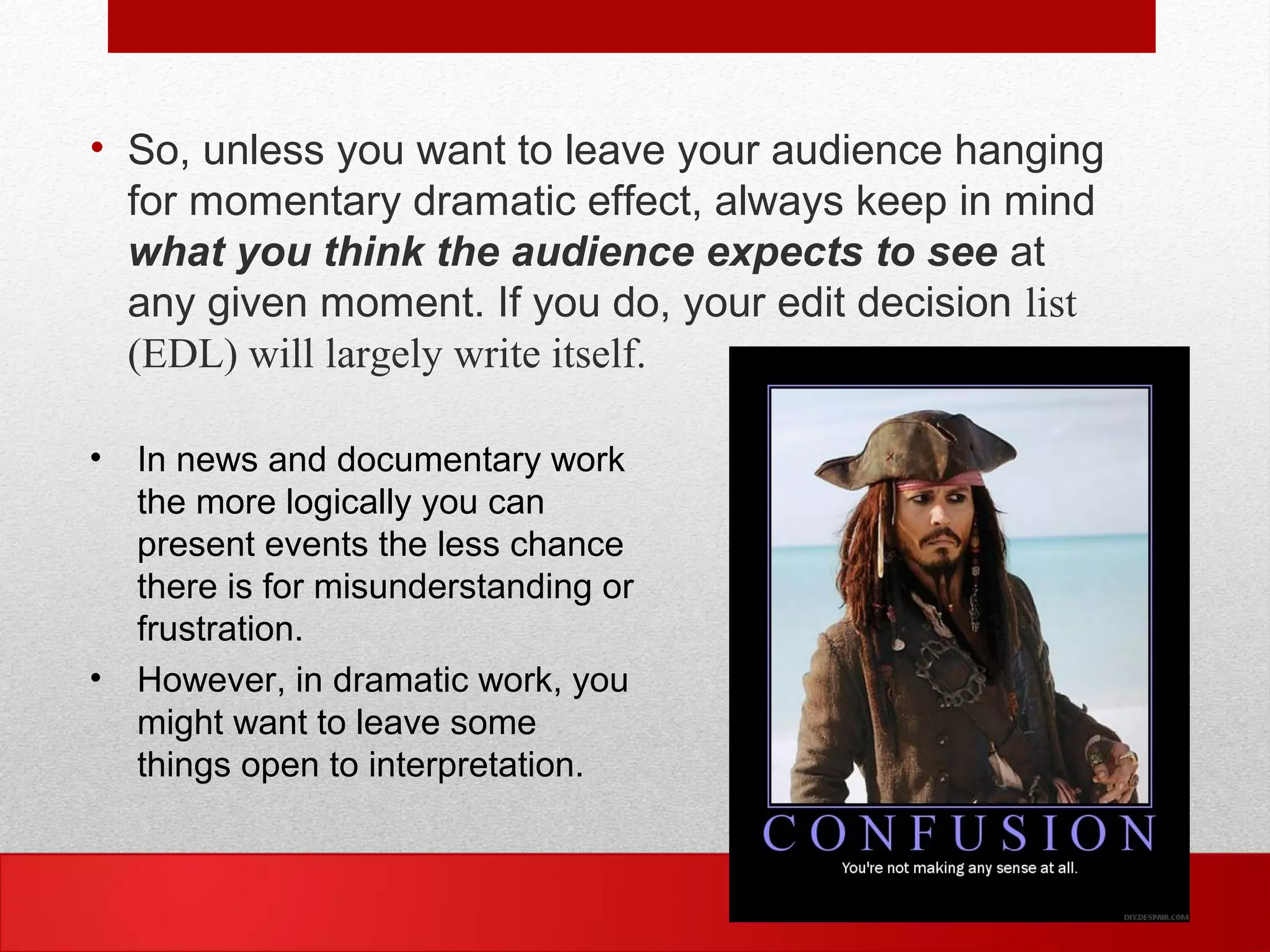
• So, unless you want to leave your audience hanging
for momentary dramatic effect, always keep in mind
what you think the audience expects to see at
any given moment. If you do, your edit decision list
(EDL) will largely write itself.
• In news and documentary work
the more logically you can
present events the less chance
there is for misunderstanding or
frustration.
• However, in dramatic work, you
might want to leave some
things open to interpretation.
ACCELERATING TIME
• In film and video production time is routinely
condensed and expanded. For example, let's say
you want to tell the story of a young woman going
out on an important date.
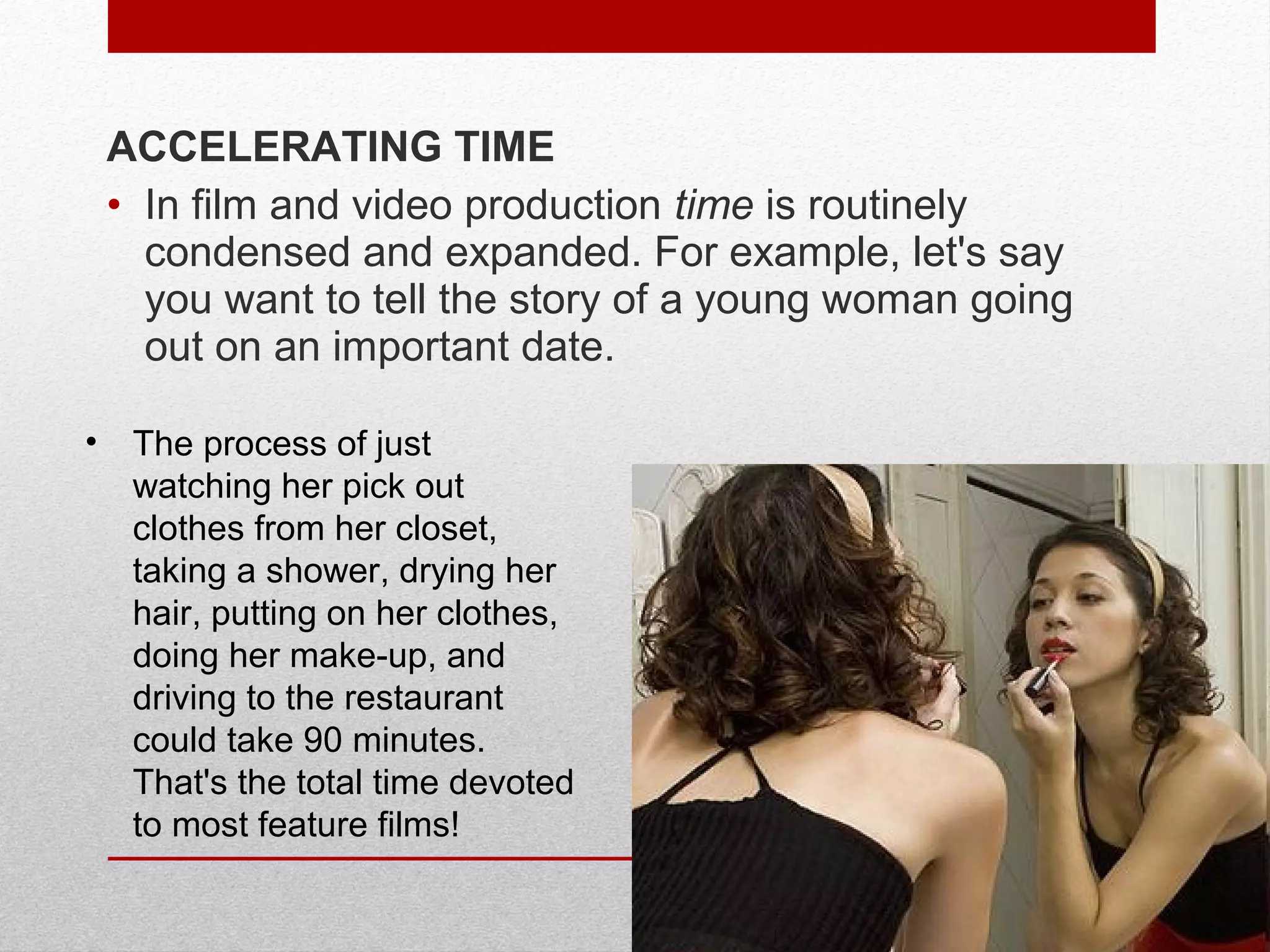
• The process of just
watching her pick out
clothes from her closet,
taking a shower, drying her
hair, putting on her clothes,
doing her make-up, and
driving to the restaurant
could take 90 minutes.
That's the total time devoted
to most feature films!
ACCELERATING TIME
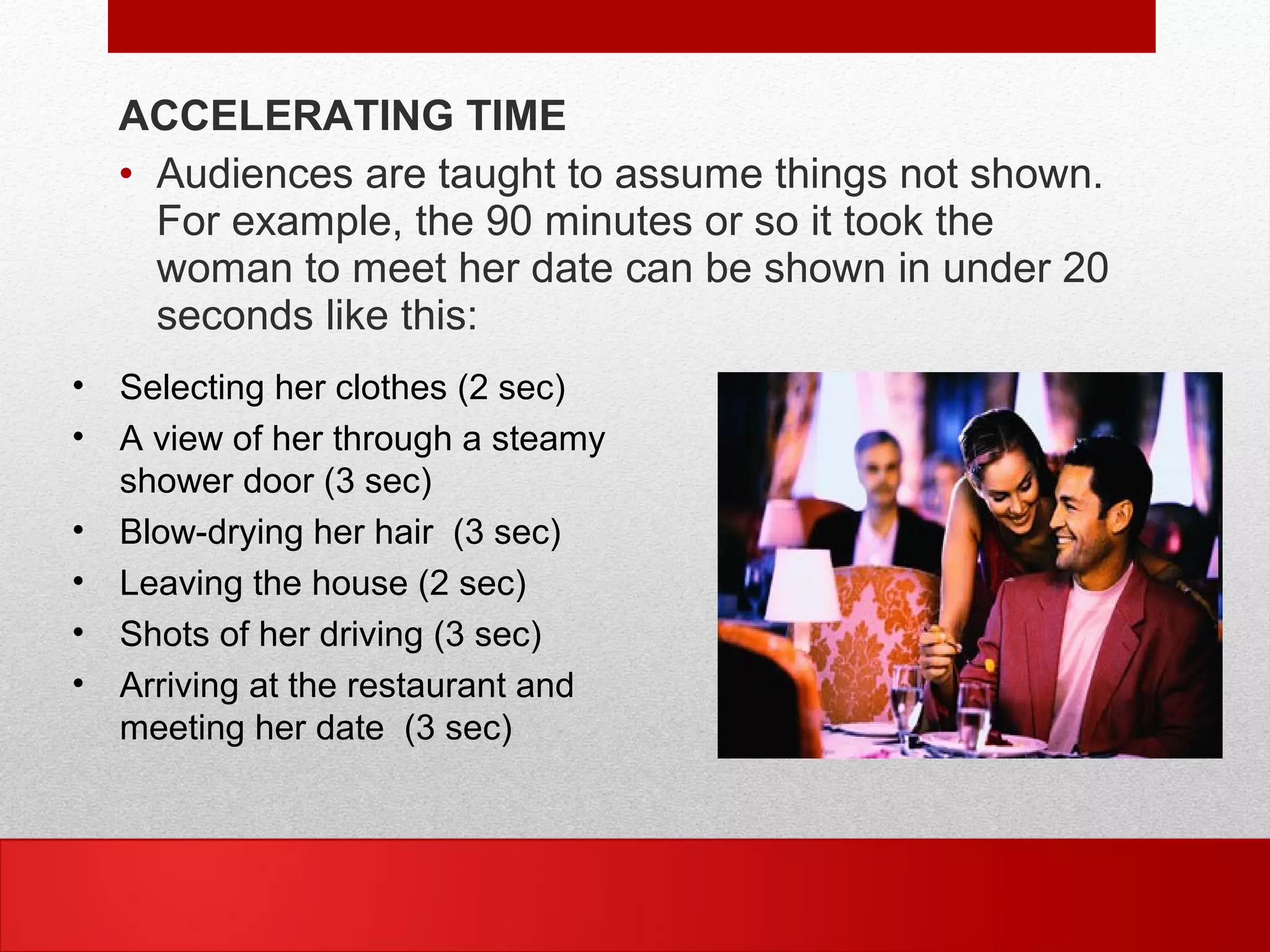
• Audiences are taught to assume things not shown.
For example, the 90 minutes or so it took the
woman to meet her date can be shown in under 20
seconds like this:
• Selecting her clothes (2 sec)
• A view of her through a steamy
shower door (3 sec)
• Blow-drying her hair (3 sec)
• Leaving the house (2 sec)
• Shots of her driving (3 sec)
• Arriving at the restaurant and
meeting her date (3 sec)
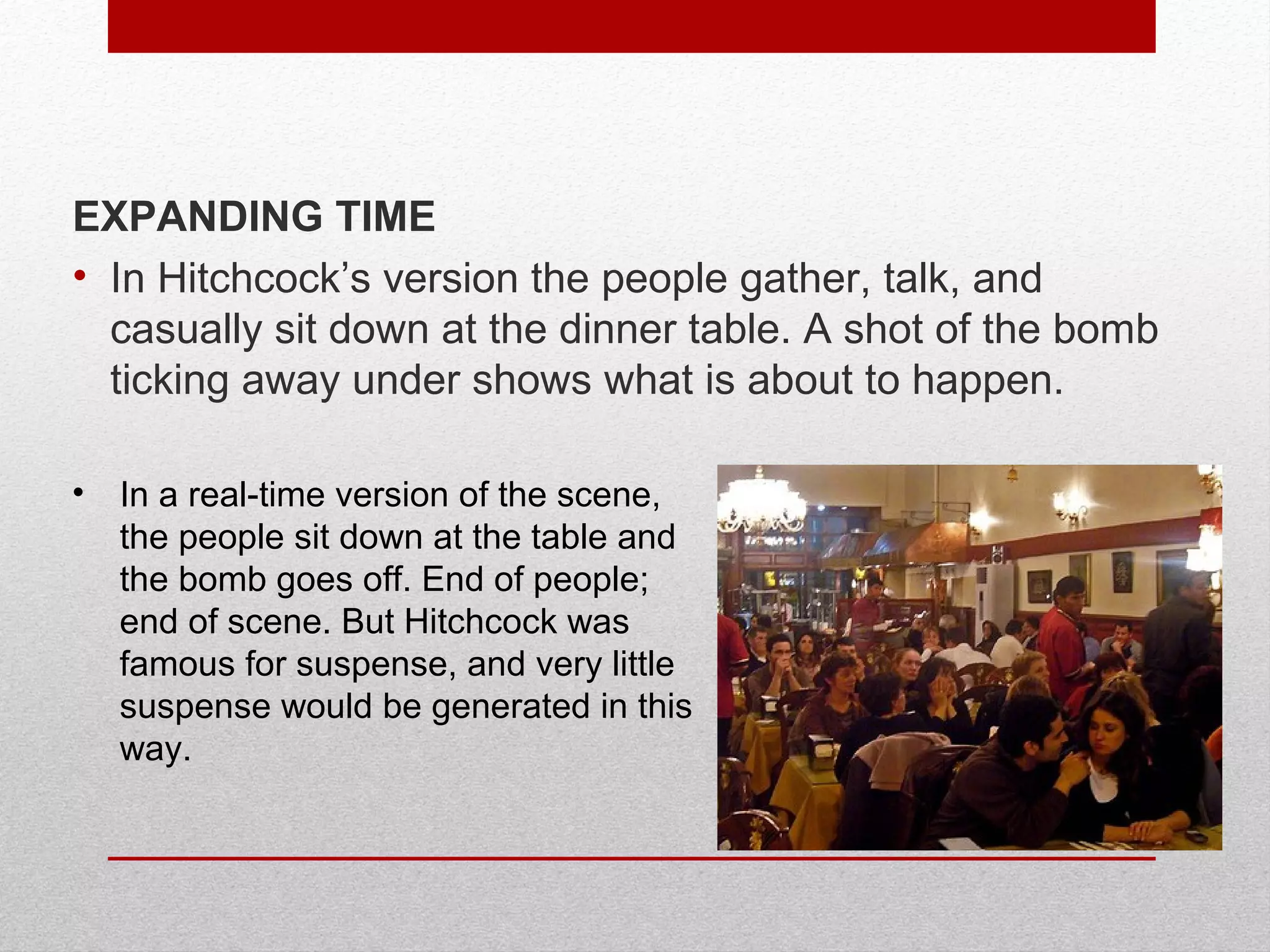
• In a real-time version of the scene,
the people sit down at the table and
the bomb goes off. End of people;
end of scene. But Hitchcock was
famous for suspense, and very little
suspense would be generated in this
way.
EXPANDING TIME
• In Hitchcock’s version the people gather, talk, and
casually sit down at the dinner table. A shot of the bomb
ticking away under shows what is about to happen.
EXPANDING TIME
• In Hitchcock’s version the people gather, talk, and
casually sit down at the dinner table. A shot of the bomb
ticking away under shows what is about to happen.
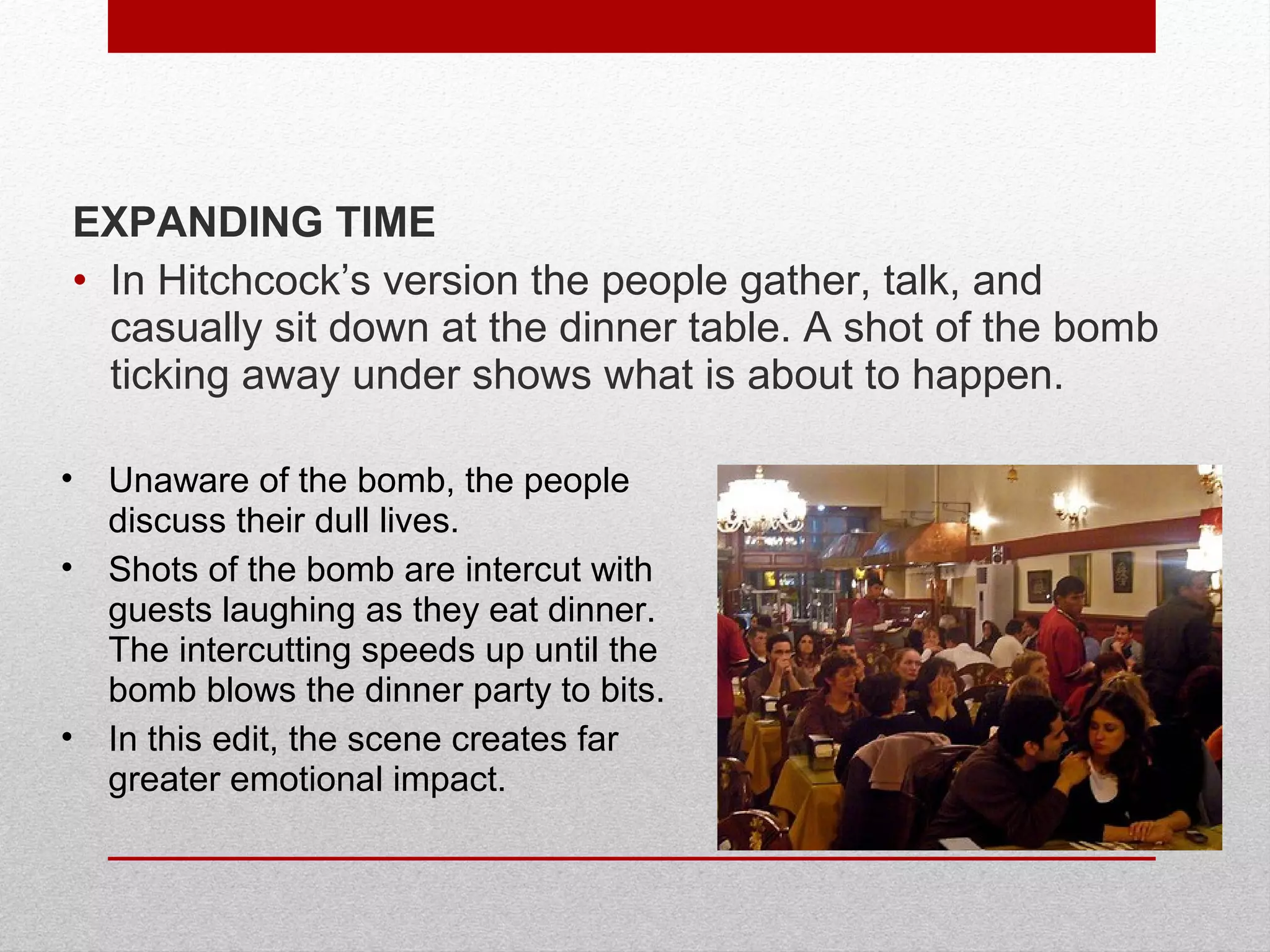
• Unaware of the bomb, the people
discuss their dull lives.
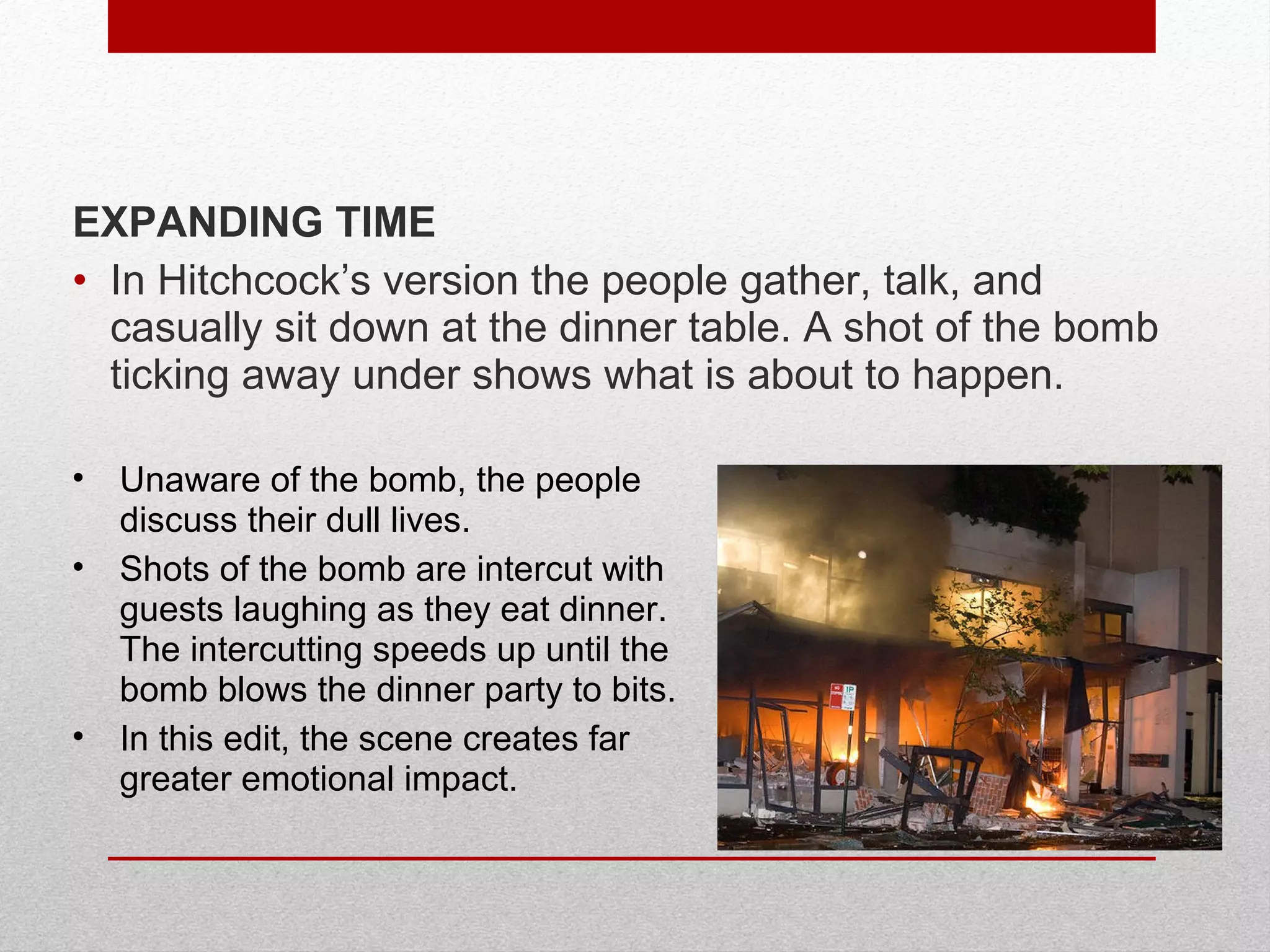
• Shots of the bomb are intercut with
guests laughing as they eat dinner.
The intercutting speeds up until the
bomb blows the dinner party to bits.
• In this edit, the scene creates far
greater emotional impact.
• Unaware of the bomb, the people
discuss their dull lives.
• Shots of the bomb are intercut with
guests laughing as they eat dinner.
The intercutting speeds up until the
bomb blows the dinner party to bits.
• In this edit, the scene creates far
greater emotional impact.
EXPANDING TIME
• In Hitchcock’s version the people gather, talk, and
casually sit down at the dinner table. A shot of the bomb
ticking away under shows what is about to happen.
SHOWING CAUSALITY
• Often, a part of continuity editing is to suggest or explain
cause. A good script (enhanced by good editing)
suggests or explains why things happen.
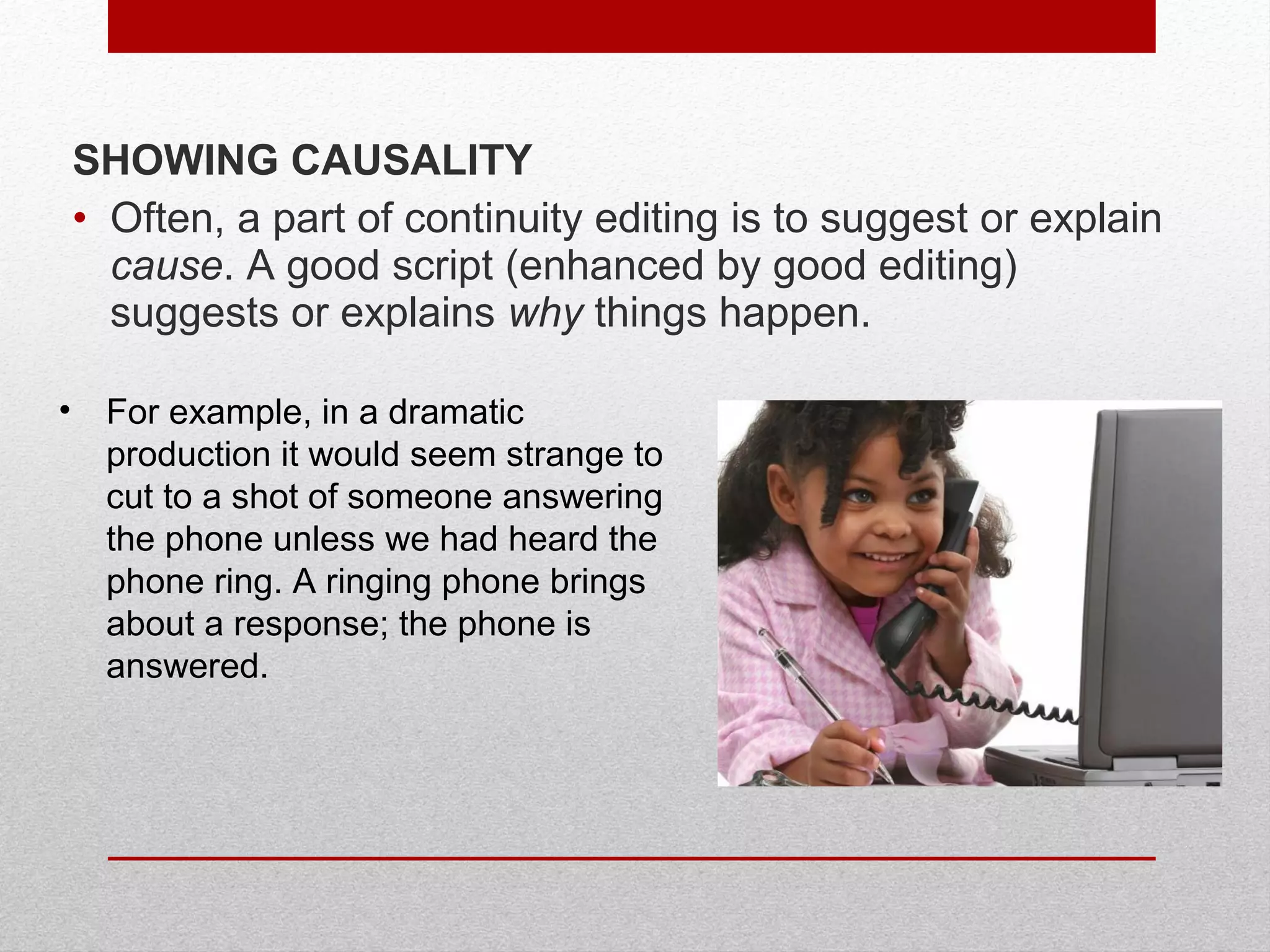
• For example, in a dramatic
production it would seem strange to
cut to a shot of someone answering
the phone unless we had heard the
phone ring. A ringing phone brings
about a response; the phone is
answered.
SHOWING CAUSALITY
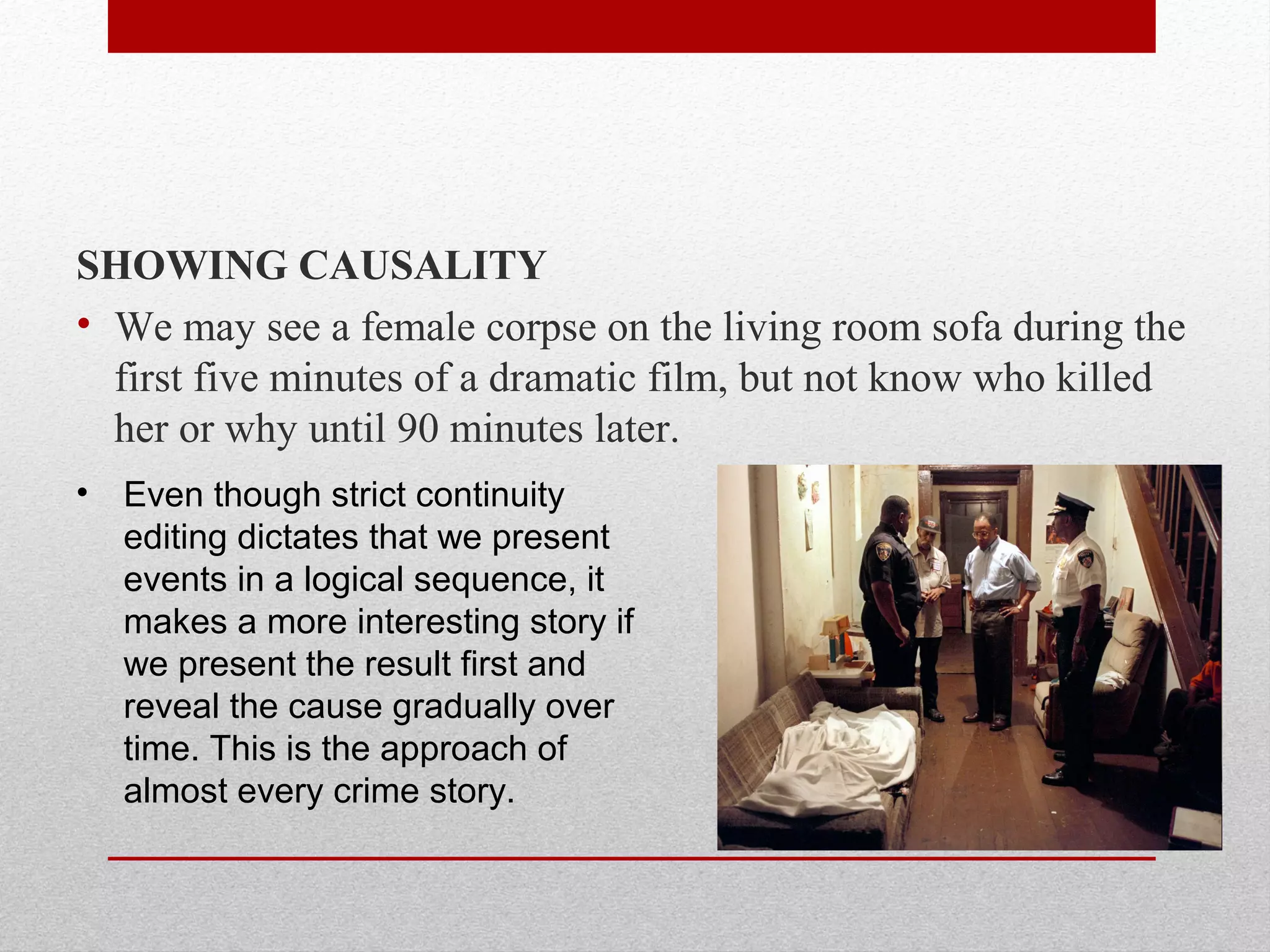
• We may see a female corpse on the living room sofa during the
first five minutes of a dramatic film, but not know who killed
her or why until 90 minutes later.
• Even though strict continuity
editing dictates that we present
events in a logical sequence, it
makes a more interesting story if
we present the result first and
reveal the cause gradually over
time. This is the approach of
almost every crime story.
SHOWING CAUSALITY
• Sometimes we assume the cause. If we see a shot of someone
with all the symptoms of being drunk, we can safely assume
they have been drinking (cause).
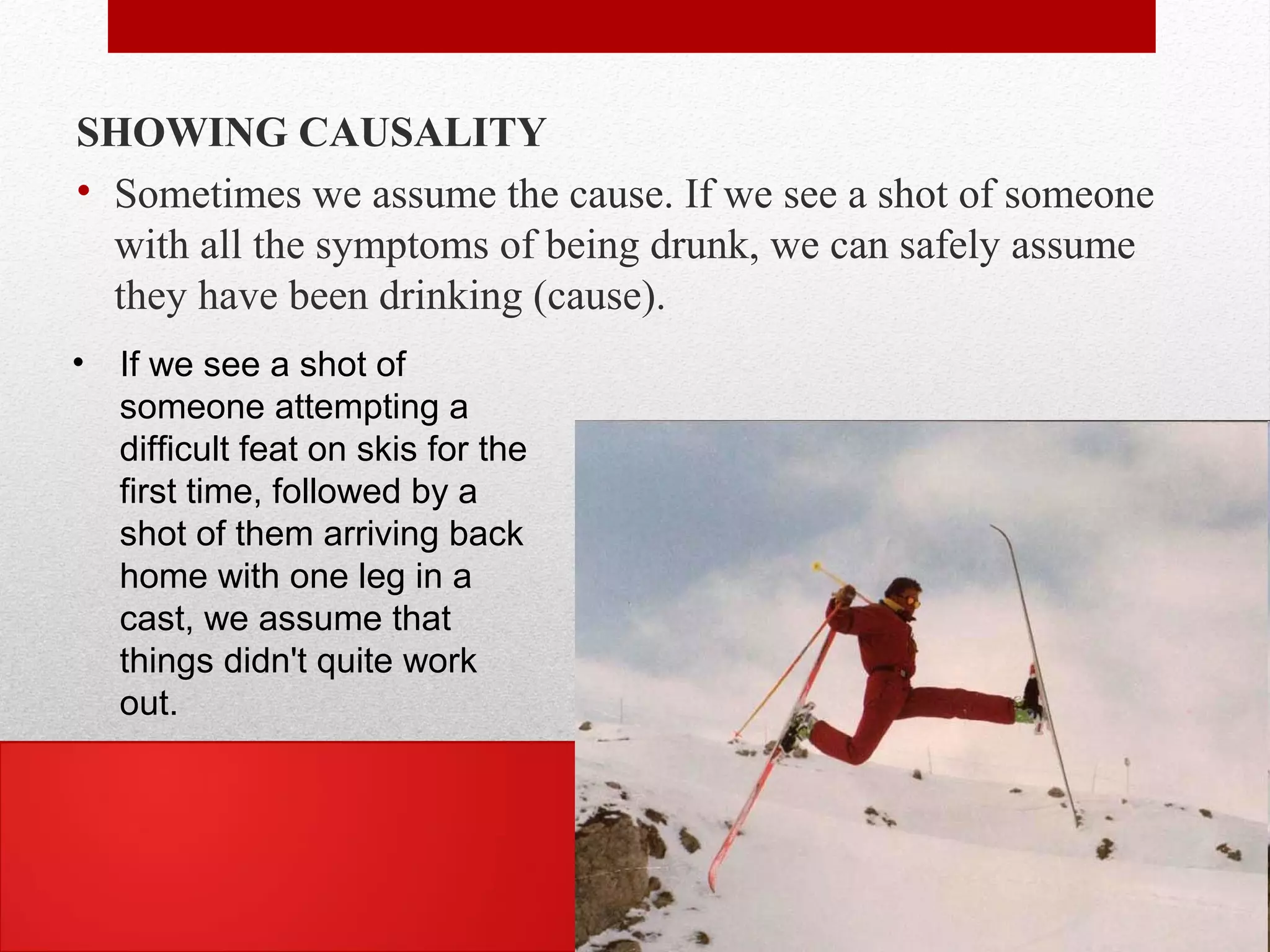
• If we see a shot of
someone attempting a
difficult feat on skis for the
first time, followed by a
shot of them arriving back
home with one leg in a
cast, we assume that
things didn't quite work
out.
SHOWING CAUSALITY
• Sometimes we assume the cause. If we see a shot of
someone with all the symptoms of being drunk, we can
safely assume they have been drinking (cause).
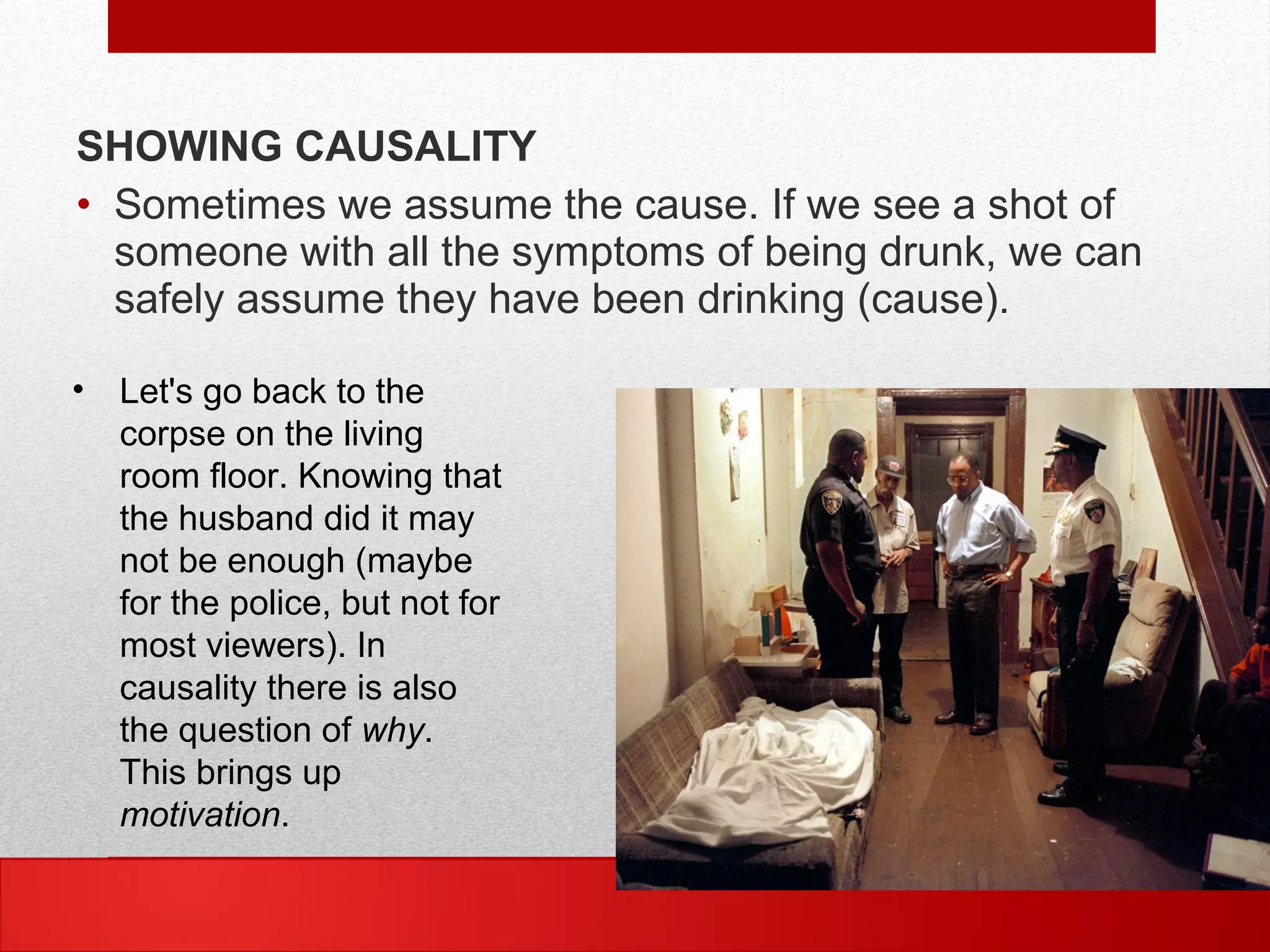
• Let's go back to the
corpse on the living
room floor. Knowing that
the husband did it may
not be enough (maybe
for the police, but not for
most viewers). In
causality there is also
the question of why.
This brings up
motivation.
SHOWING MOTIVATION
• Motivation includes any one of the age-old motives, including
money, jealousy and revenge. Even if the motivation is
revenge, revenge must have a cause.
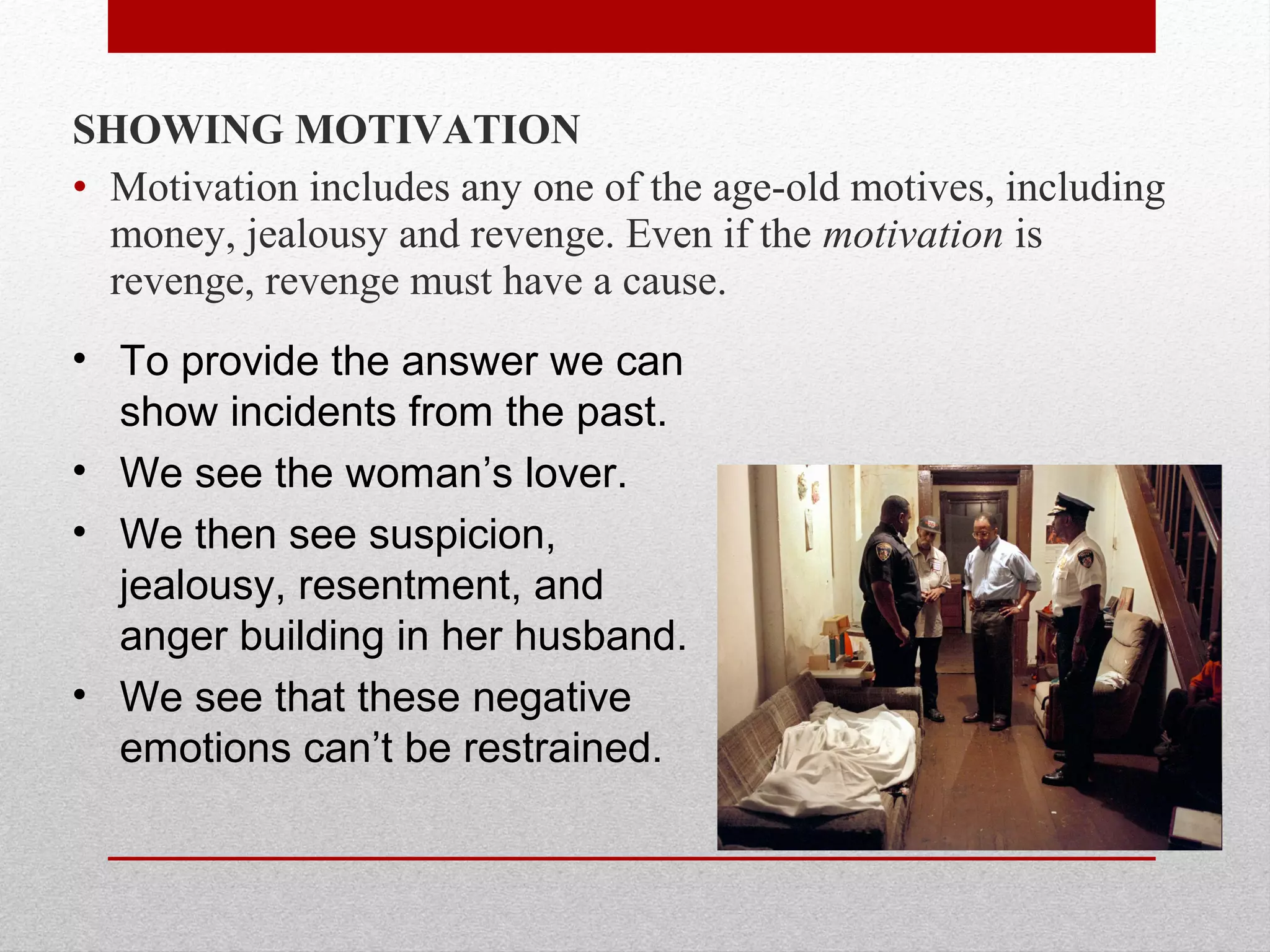
• To provide the answer we can
show incidents from the past.
• We see the woman’s lover.
• We then see suspicion,
jealousy, resentment, and
anger building in her husband.
• We see that these negative
emotions can’t be restrained.
Video Editing Basics
CAUSE, EFFECT and MOTIVATION
• Editors must perceive the dynamics of these cause-and-
effect relationships to skillfully handle them. They must
also have an understanding of human psychology so that
they can portray feelings and events realistically.
• How many serious dramatic productions have you seen
where actions and reactions just don't seem to be
realistic? Doesn’t it take away from the believability of
the production?
• Writers and directors also know they shouldn't reveal
answers (motivations) too quickly.
• In a good mystery we will probably try to hold our
audience by leading them through critical developments
in a step-by-step fashion
PAPER EDITING EXERCISE
• Given the following four shots, explain four possible scenarios
by composing them in a different order:
1) A man enters a house
2) There is the sound of a gunshot
3) An ambulance arrives
4) A body is rolled out on a gurney
• Provide a possible scenario for:
1-2-3-4 3-1-2-4 3-4-1-2 3-4-2-1
CONTINUITY TECHNIQUES
• While holding to the basic continuity of a story, an editor
can enhance the look of a production by adding insert
shots and cutaways.
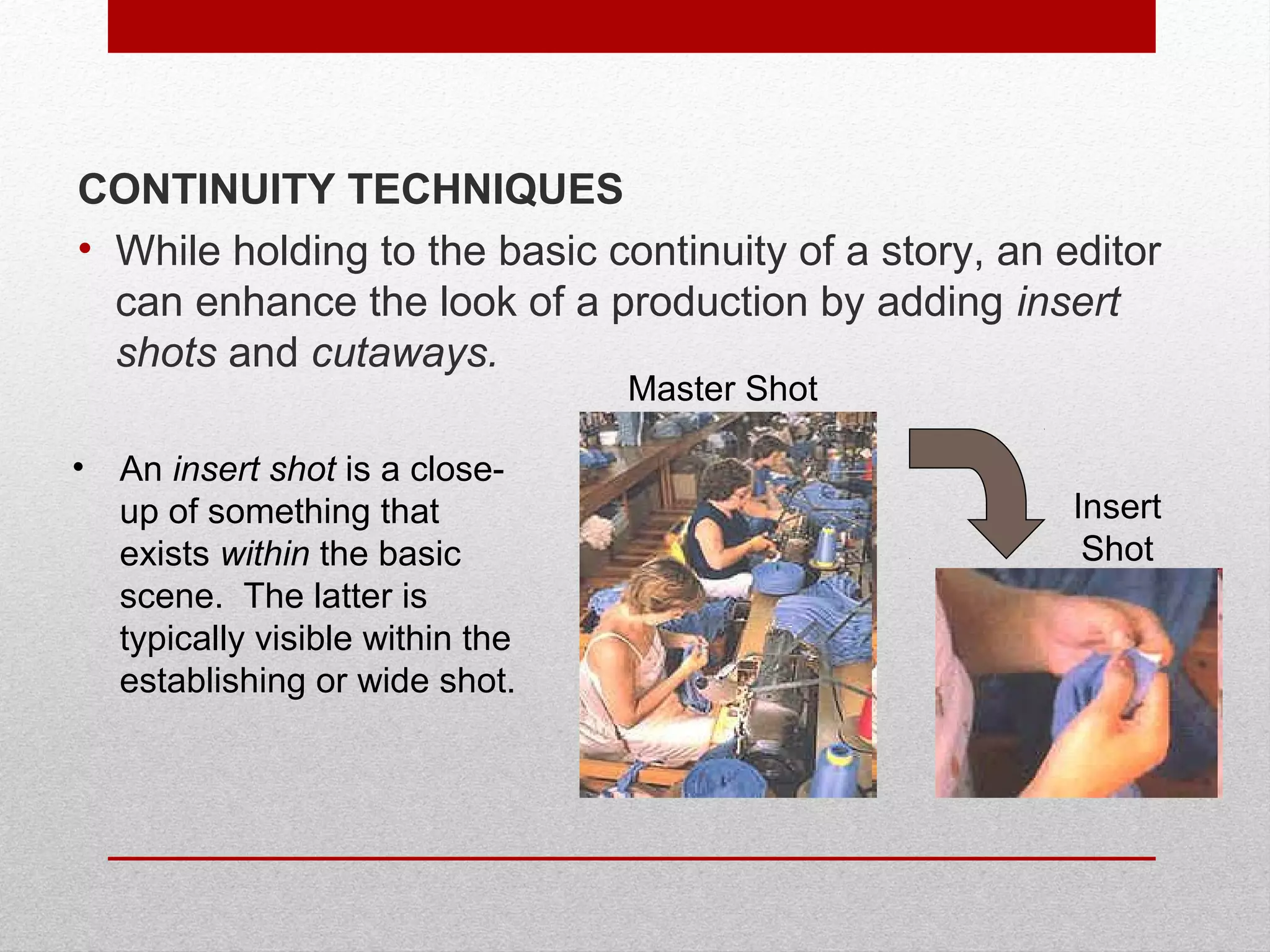
• An insert shot is a close-
up of something that
exists within the basic
scene. The latter is
typically visible within the
establishing or wide shot.
Master Shot
Insert
Shot
CONTINUITY TECHNIQUES
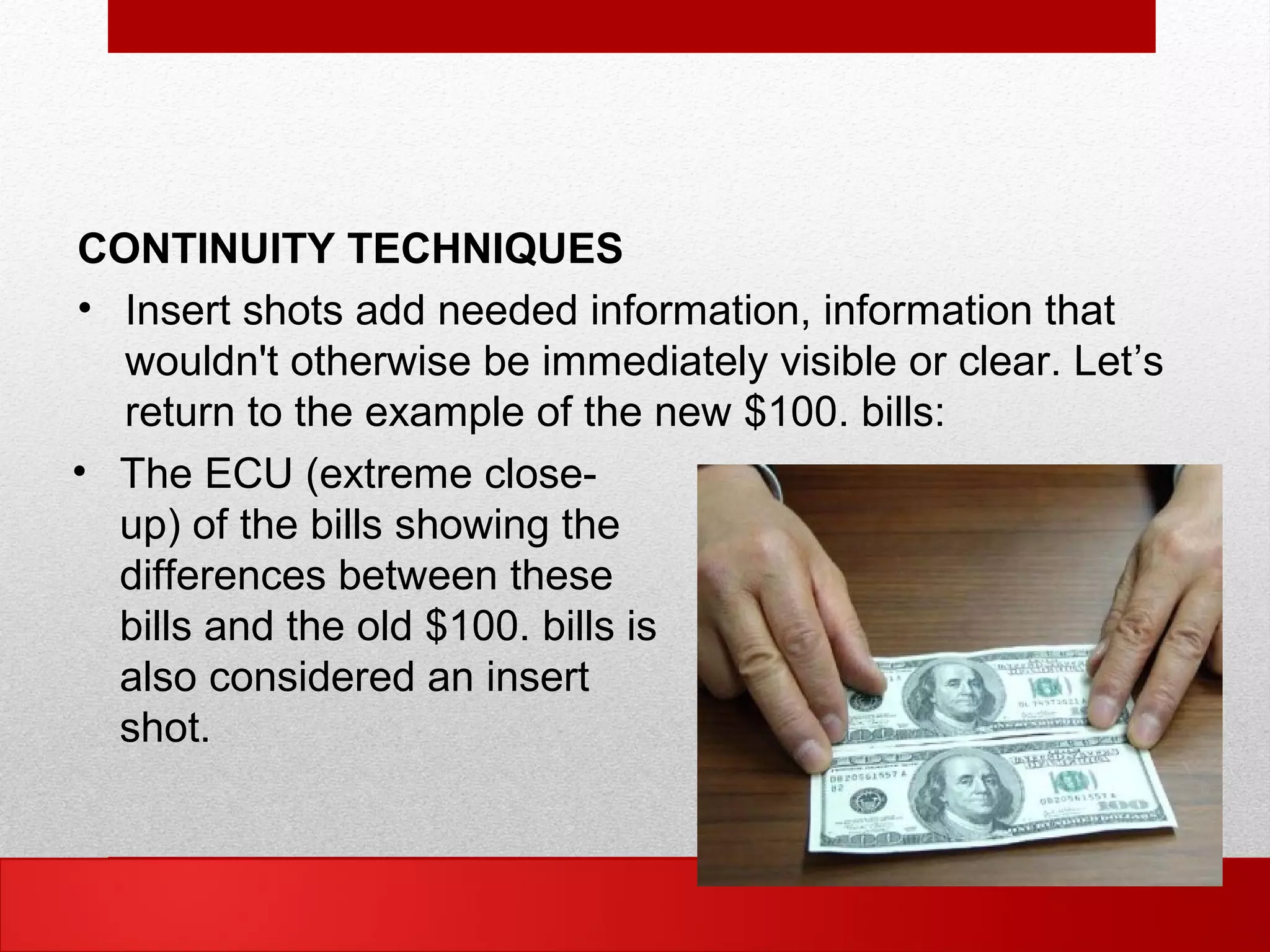
• Insert shots add needed information, information that
wouldn't otherwise be immediately visible or clear. Let’s
return to the example of the new $100. bills:
• The ECU (extreme close-
up) of the bills showing the
differences between these
bills and the old $100. bills is
also considered an insert
shot.
CONTINUITY TECHNIQUES
• Unlike insert shots that show significant
aspects of the overall scene in close-up,
cutaways cut away from the main scene
or action to add additional information.
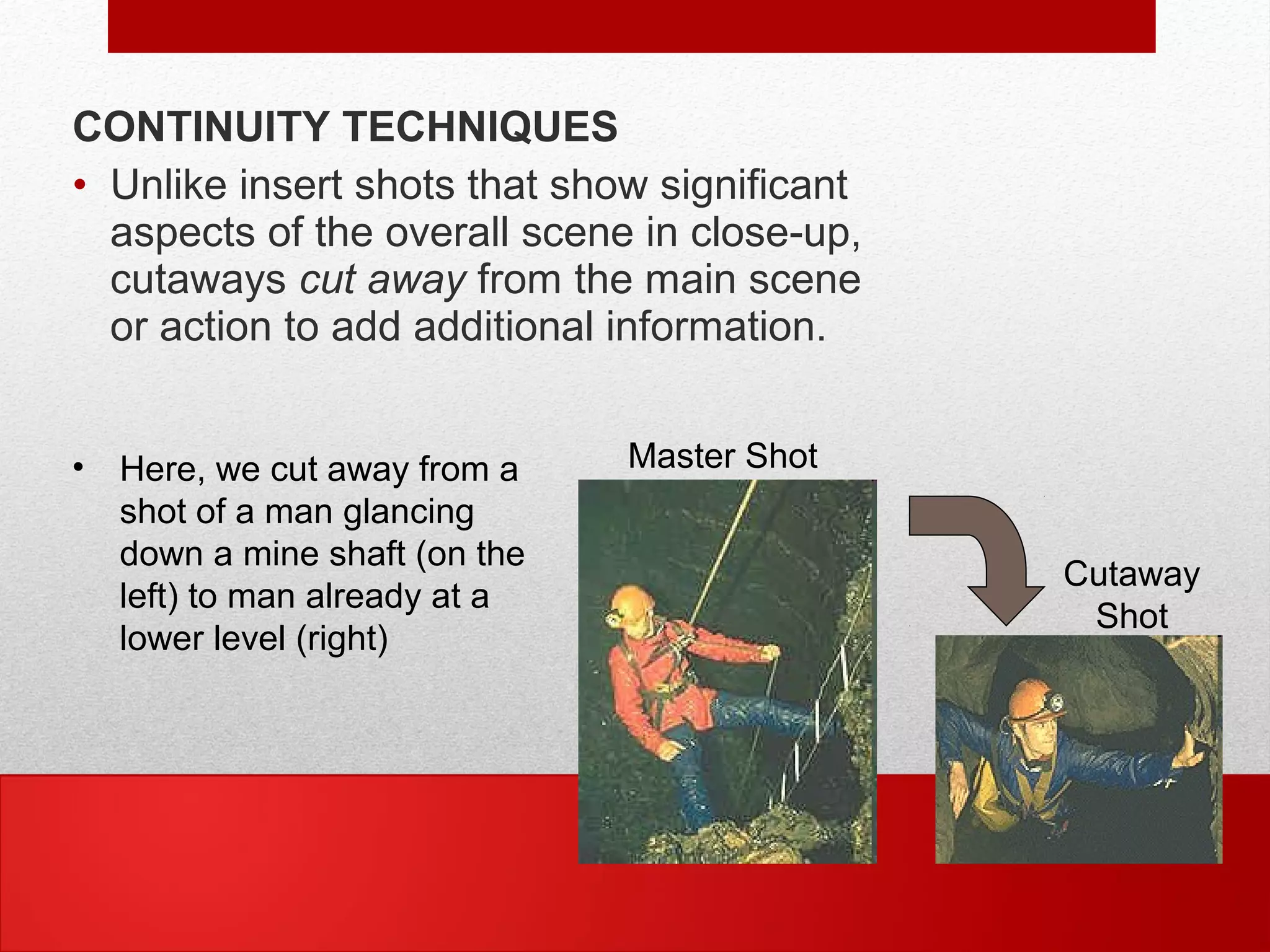
• Here, we cut away from a
shot of a man glancing
down a mine shaft (on the
left) to man already at a
lower level (right)
Master Shot
Cutaway
Shot
CONTINUITY TECHNIQUES
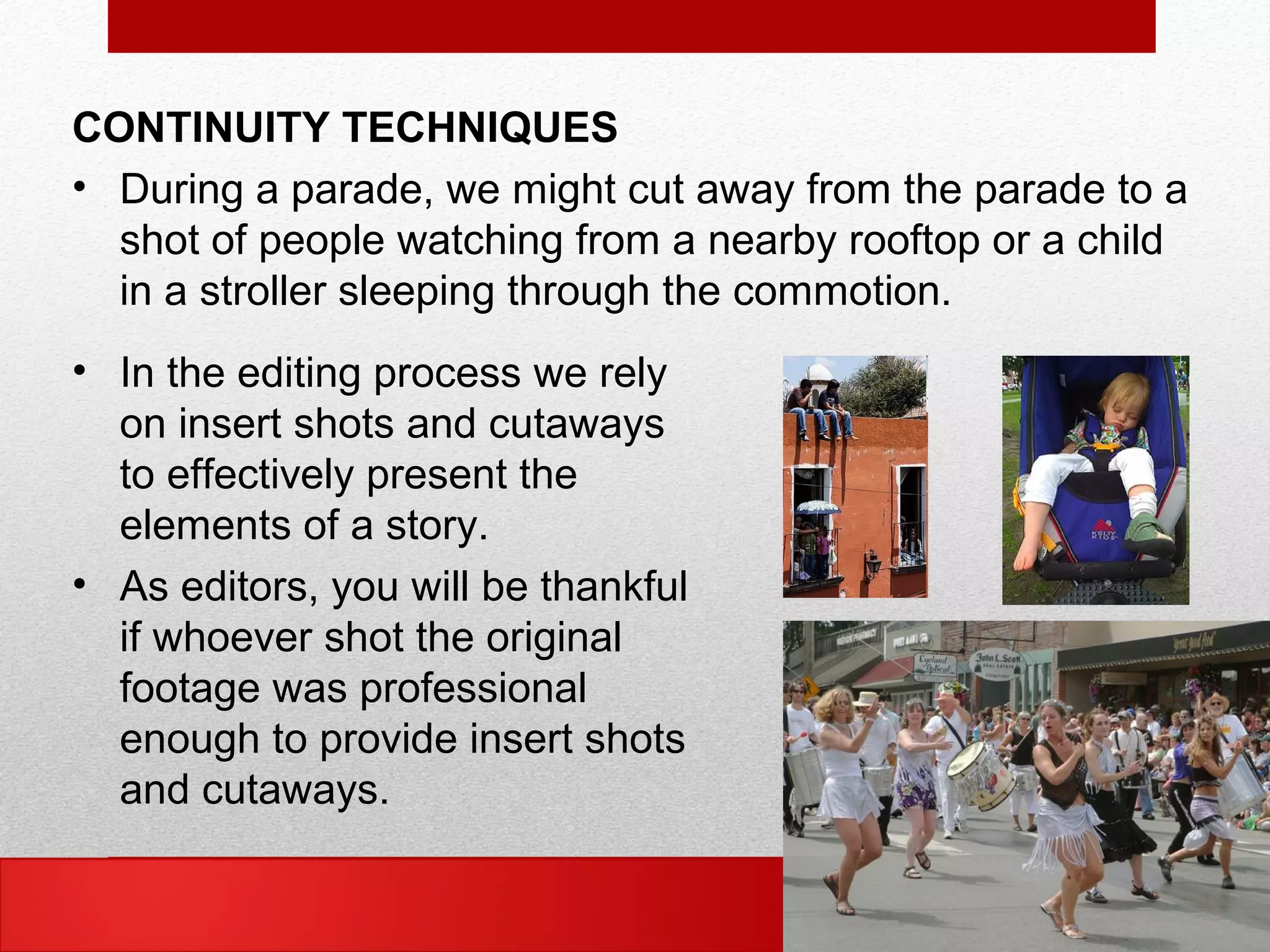
• During a parade, we might cut away from the parade to a
shot of people watching from a nearby rooftop or a child
in a stroller sleeping through the commotion.
• In the editing process we rely
on insert shots and cutaways
to effectively present the
elements of a story.
• As editors, you will be thankful
if whoever shot the original
footage was professional
enough to provide insert shots
and cutaways.
RELATIONAL EDITING
• Relational editing refers to the human tendency to try to
establish a relationship between scenes. A series of
shots can take on a cause and effect significance when
edited together in a sequence.
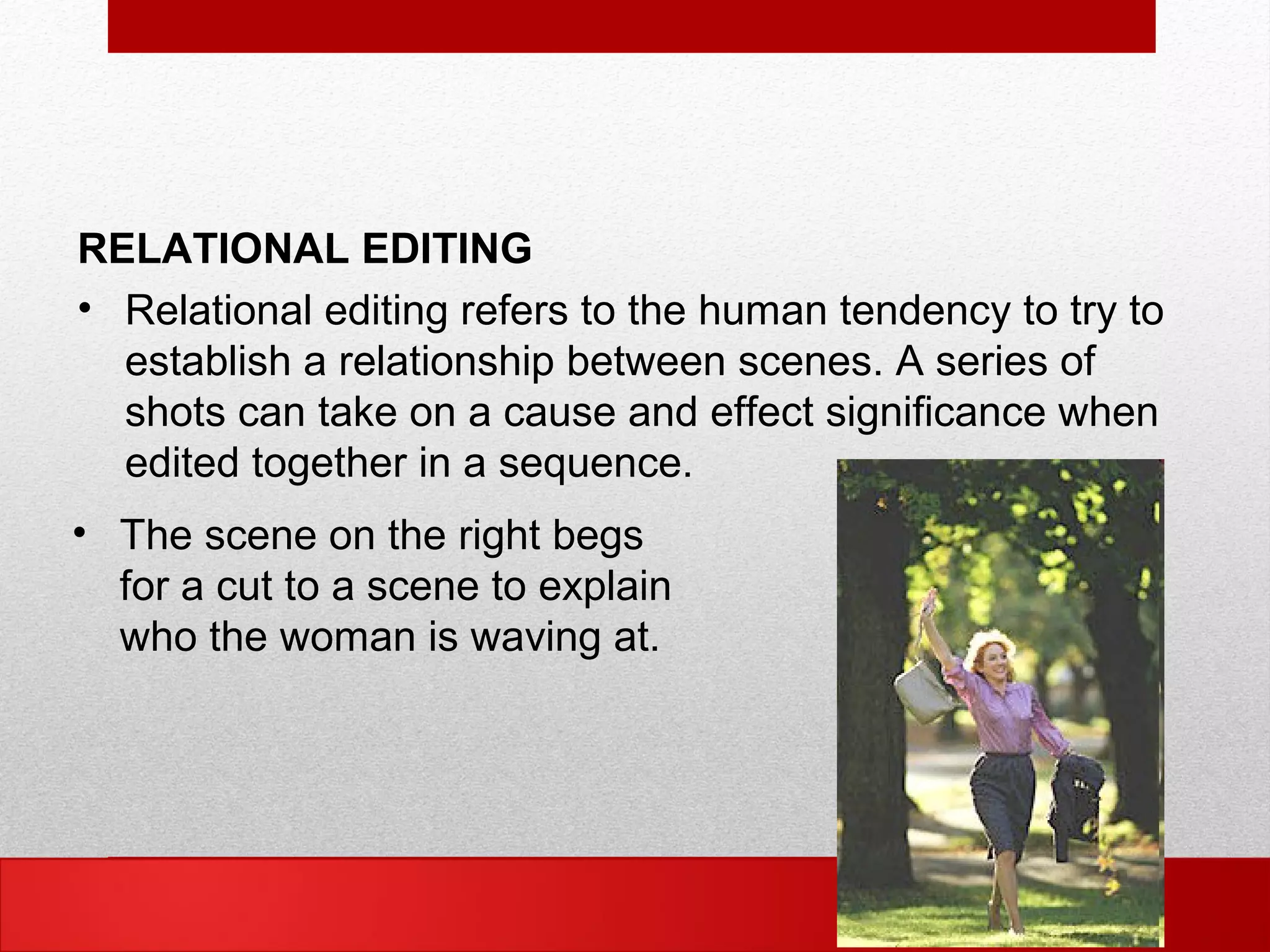
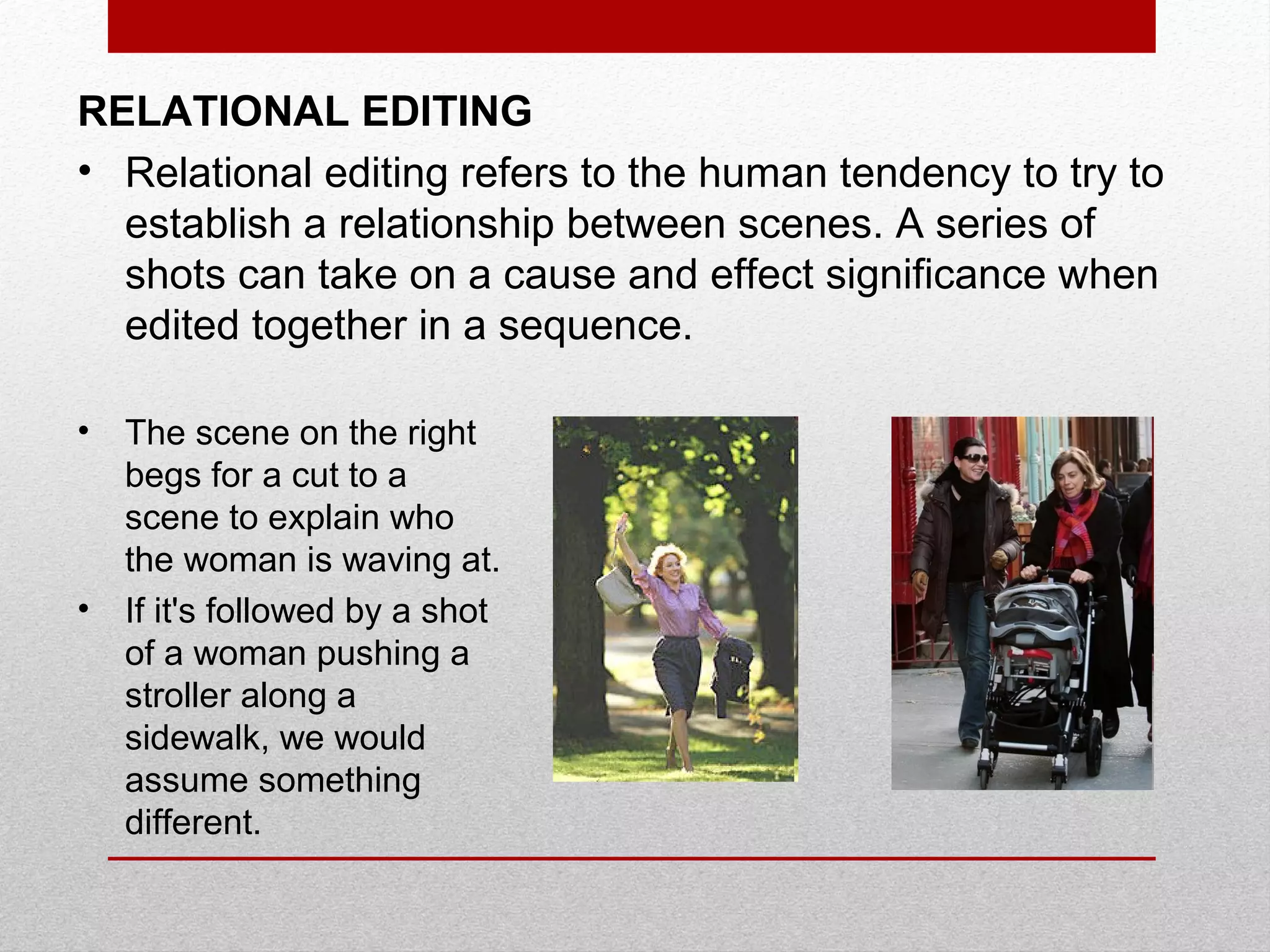
• The scene on the right begs
for a cut to a scene to explain
who the woman is waving at.
RELATIONAL EDITING
• Relational editing refers to the human tendency to try to
establish a relationship between scenes. A series of
shots can take on a cause and effect significance when
edited together in a sequence.
• The scene on the right begs
for a cut to a scene to
explain who the woman is
waving at.
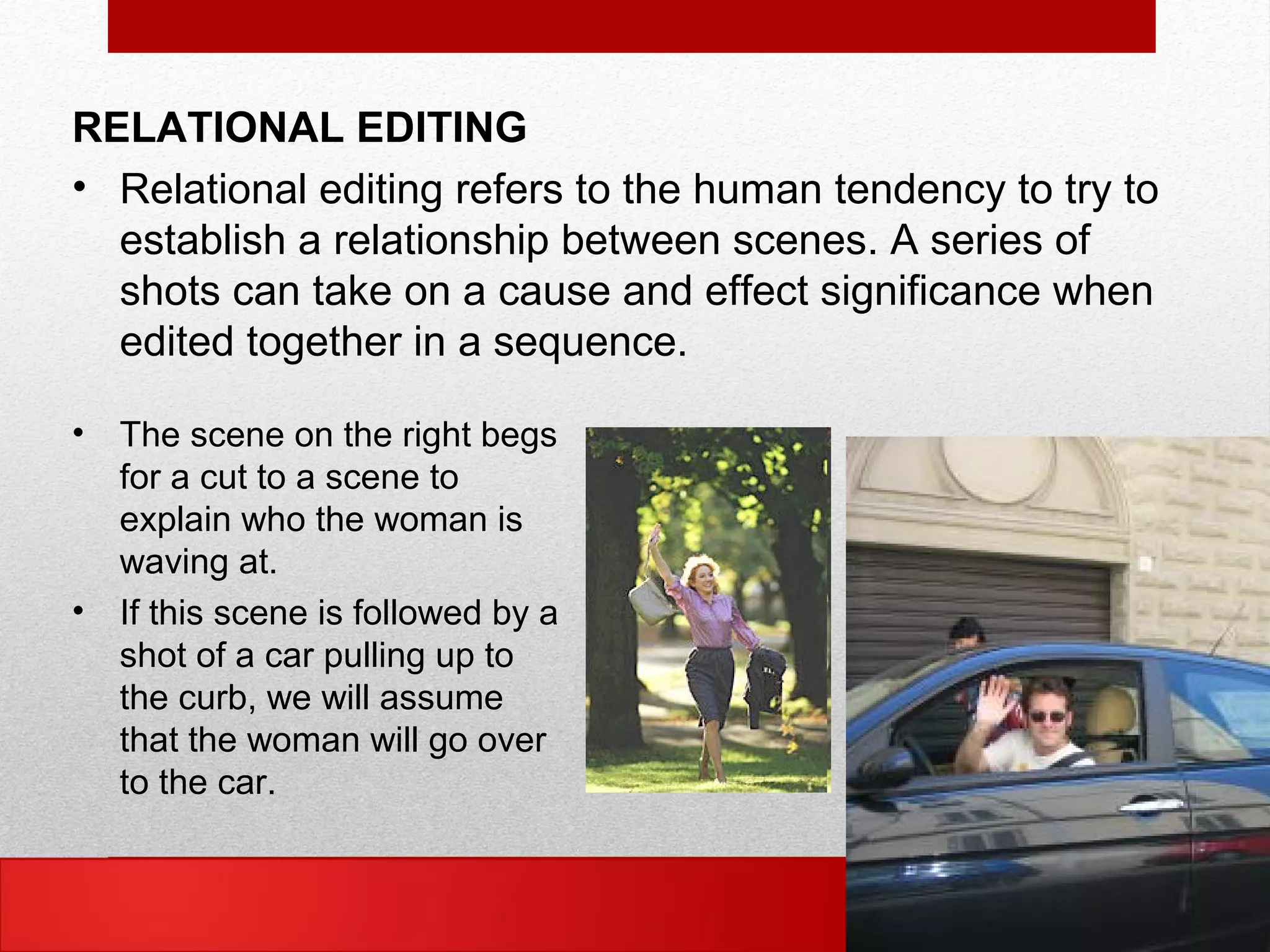
• If this scene is followed by a
shot of a car pulling up to
the curb, we will assume
that the woman will go over
to the car.
RELATIONAL EDITING
• Relational editing refers to the human tendency to try to
establish a relationship between scenes. A series of
shots can take on a cause and effect significance when
edited together in a sequence.
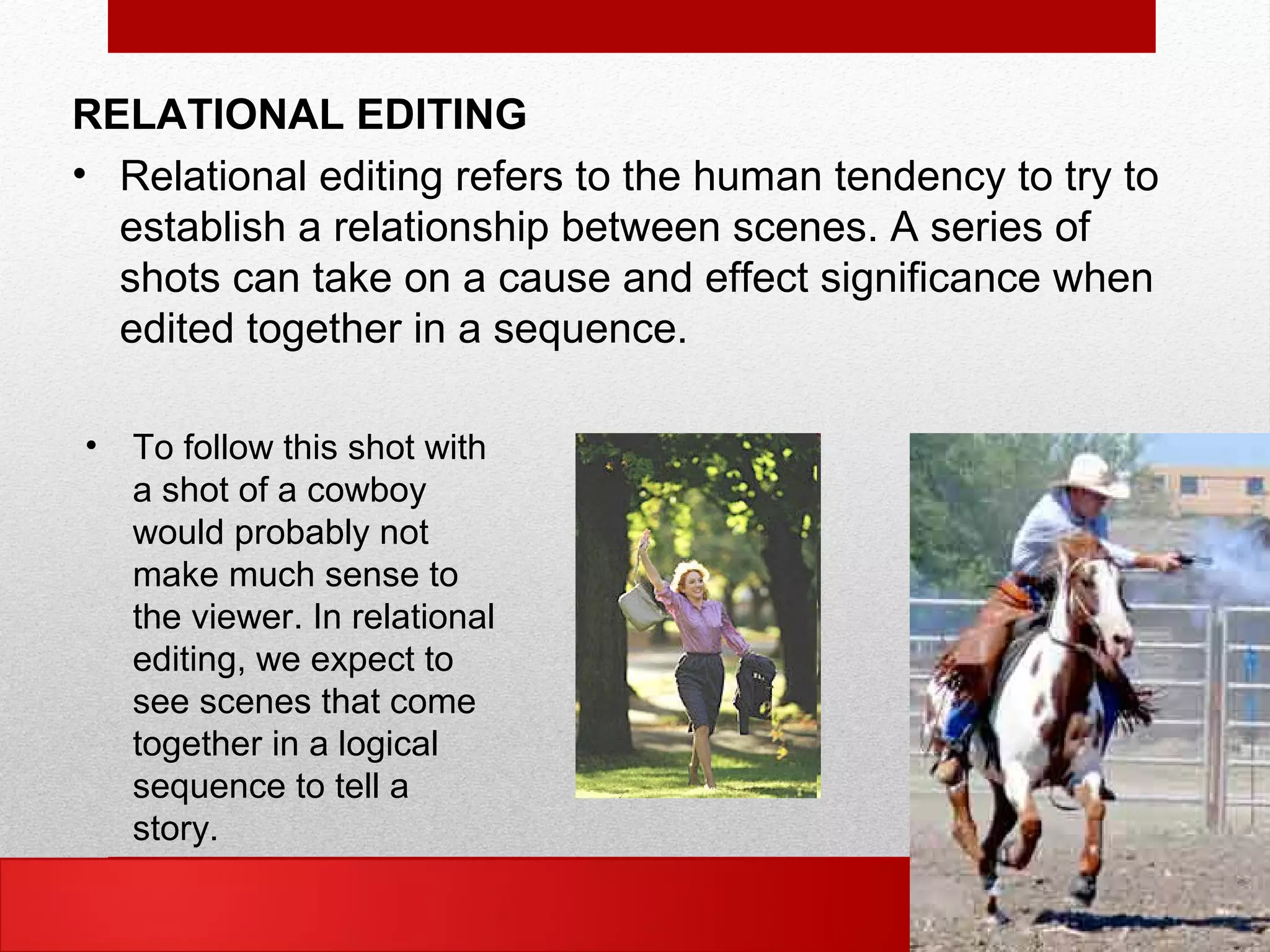
• The scene on the right
begs for a cut to a
scene to explain who
the woman is waving at.
• If it's followed by a shot
of a woman pushing a
stroller along a
sidewalk, we would
assume something
different.
RELATIONAL EDITING
• Relational editing refers to the human tendency to try to
establish a relationship between scenes. A series of
shots can take on a cause and effect significance when
edited together in a sequence.
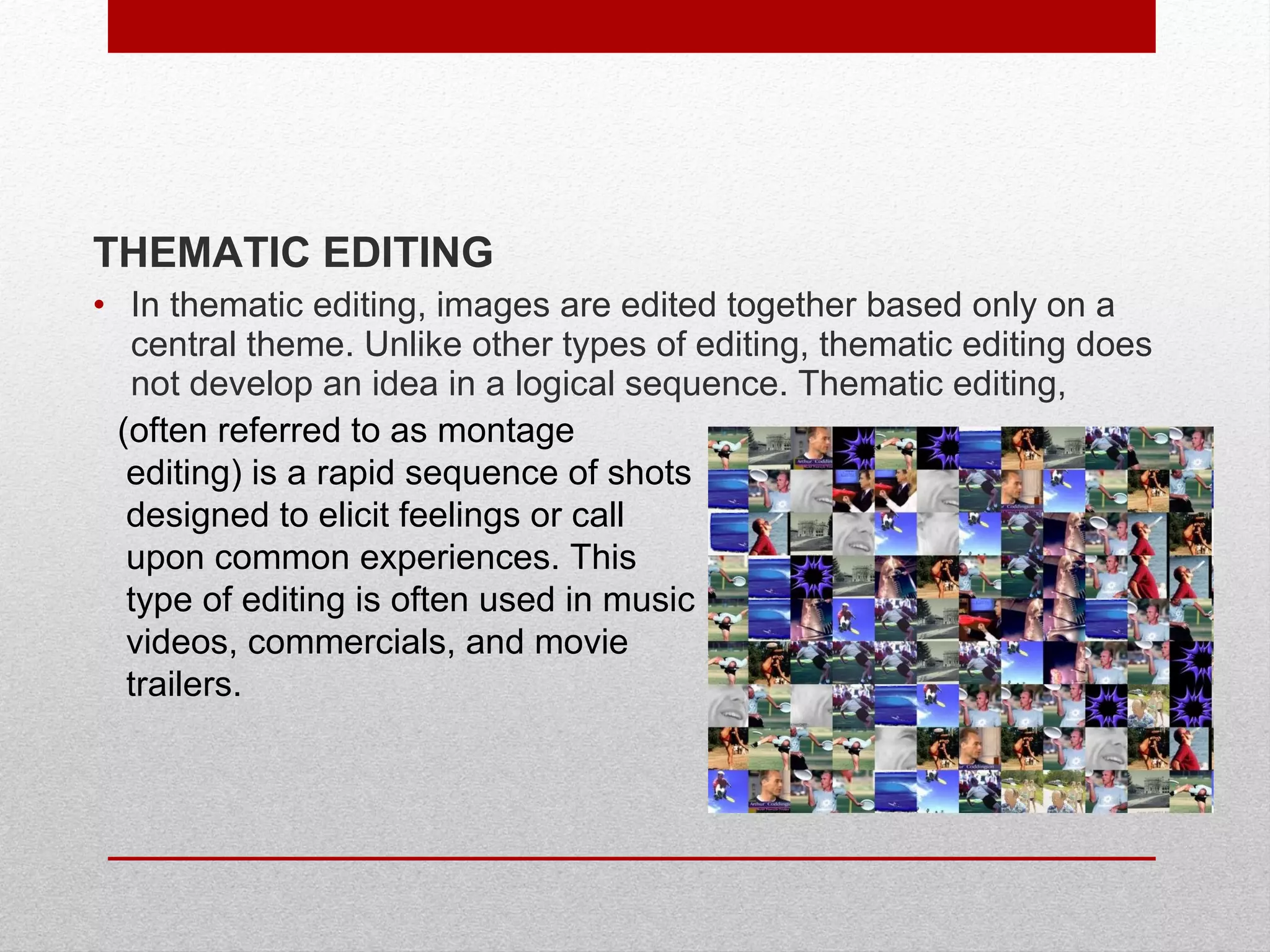
• To follow this shot with
a shot of a cowboy
would probably not
make much sense to
the viewer. In relational
editing, we expect to
see scenes that come
together in a logical
sequence to tell a
story.
THEMATIC EDITING
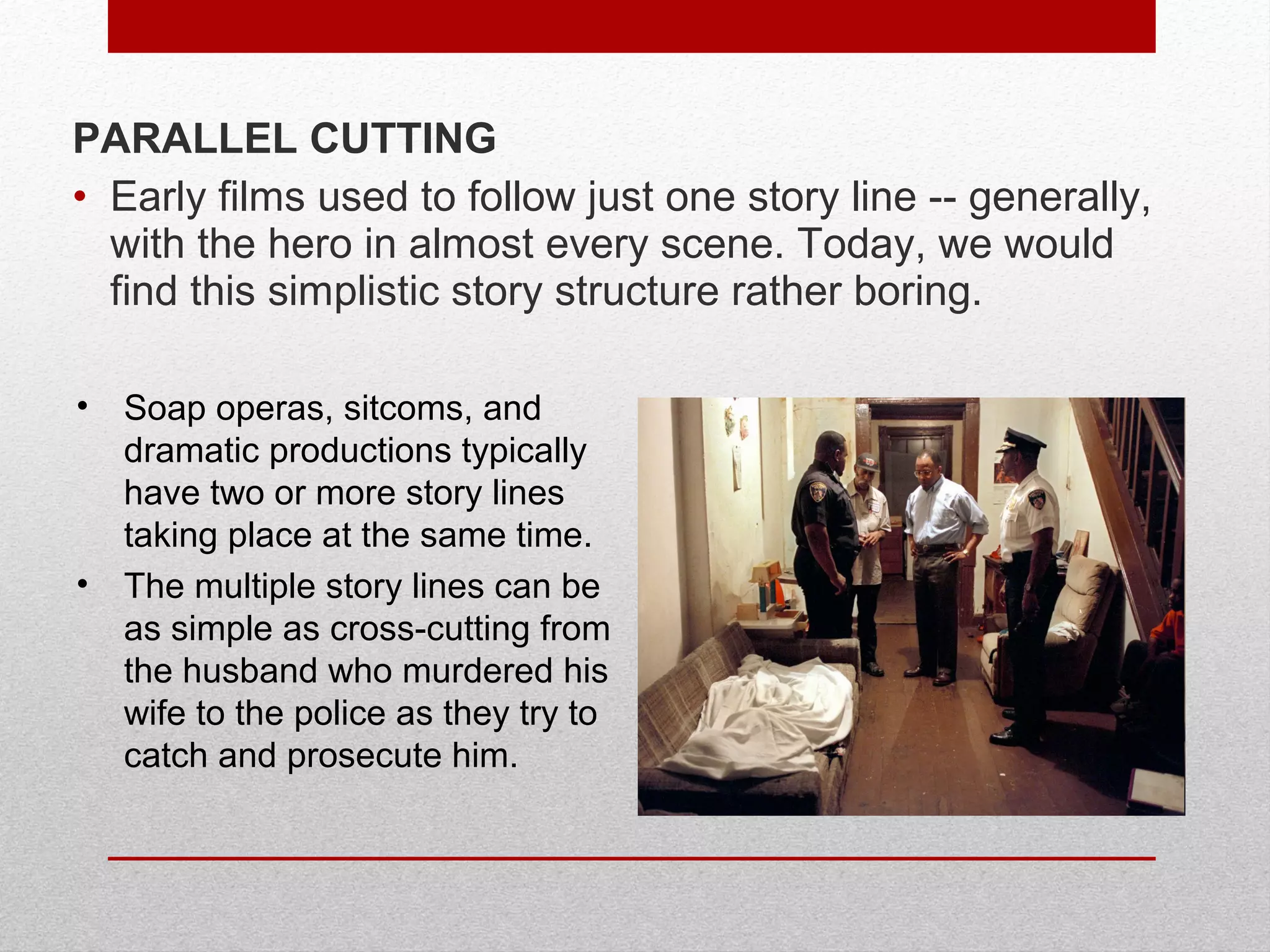
• In thematic editing, images are edited together based only on a
central theme. Unlike other types of editing, thematic editing does
not develop an idea in a logical sequence. Thematic editing,
(often referred to as montage
editing) is a rapid sequence of shots
designed to elicit feelings or call
upon common experiences. This
type of editing is often used in music
videos, commercials, and movie
trailers.
PARALLEL CUTTING
• Early films used to follow just one story line -- generally,
with the hero in almost every scene. Today, we would
find this simplistic story structure rather boring.
• Soap operas, sitcoms, and
dramatic productions typically
have two or more story lines
taking place at the same time.
• The multiple story lines can be
as simple as cross-cutting from
the husband who murdered his
wife to the police as they try to
catch and prosecute him.
PARALLEL CUTTING
• When the segments are cut together to follow multiple (different)
story lines, it's referred to as parallel cutting. By cutting back and
forth between two or more mini-
stories within the overall story, pace
is varied and the viewer interest is
heightened.
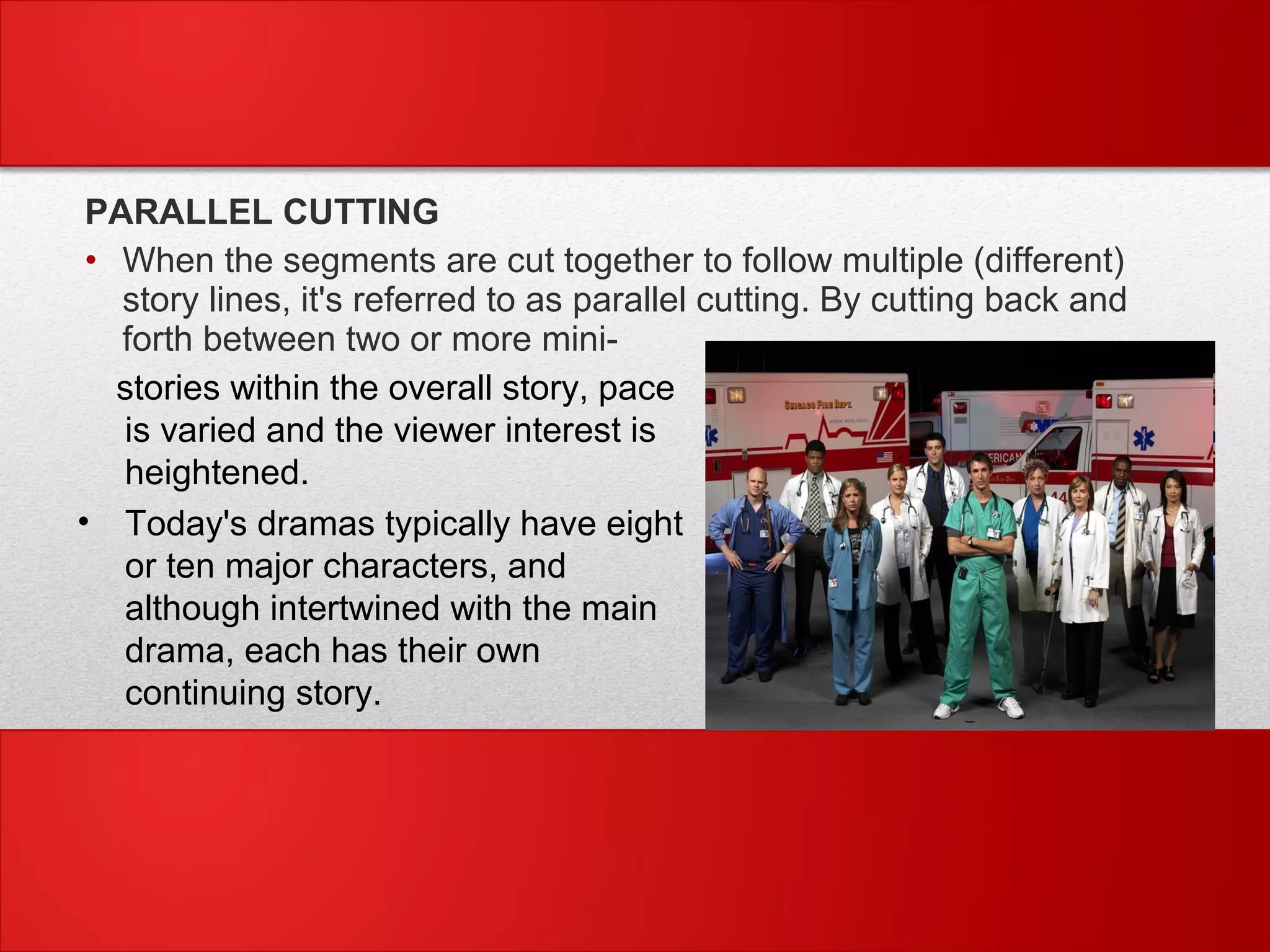
• Today's dramas typically have eight
or ten major characters, and
although intertwined with the main
drama, each has their own
continuing story.

Video Editing Basics

  • 1.
  • 2.
    “Editing is thecreative force of filmic reality...and the foundation of film art.” • V.I. Pudovkin, 1915
  • 3.
    • Continuity Editingrefers to arranging the sequence of shots to suggest a progression of events. Given the same shots, an editor can suggest many different scenarios. Consider just these two shots: • A man glances up in surprise • Another man pulls a gun and fires toward the camera • In this order it appears that the first man was shot. • However, if you reverse the order of these two scenes, the first man is watching a shooting. Video Editing
  • 4.
    Video Editing Look atwhat can be done with just three shots: 1. people jumping from a car 2. the car on fire 3. an explosion 1-2-3 - In the 1-2-3 sequence, the shots suggest that people are jumping from a car seconds before it catches fire and explodes
  • 5.
    Look at whatcan be done with just three shots: 1. people jumping from a car 2. the car on fire 3. an explosion 3-2-1 - This order suggests that there is an explosion and then the car bursts into flames; and, as a result, the people have to jump out. Video Editing
  • 6.
    Look at whatcan be done with just three shots: 1. people jumping from a car 2. the car on fire 3. an explosion 2-1-3 - If the sequence is changed to 2-1-3, it appears that as a result of a fire passengers jump out of the car just in time to escape a devastating explosion. Video Editing
  • 7.
    Look at whatcan be done with just three shots: 1. people jumping from a car 2. the car on fire 3. an explosion 2-3-1 - And finally, in this scenario, people jump from the car after a fire causes a devastating explosion! Video Editing
  • 8.
    Three shots; Four verydifferent meanings! • When hundreds of scenes and takes of scenes are available to an editor, which is normally the case in dramatic productions, the editor has tremendous control over the basic continuity and message of the production. The project is literally created in the editing room Video Editing
  • 9.
    • Continuity Editingprimarily suggests guiding an audience through a sequence of events, and, in the process, showing them what they want to see when they want to see it. In dramatic storytelling, good editors sometimes break from the expected to achieve a dramatic effect. Unfulfilled expectations can be used to create tension. Video Editing
  • 10.
    • Here's anexample of the latter. In a story about the changes in the U.S. $100 bill a treasury spokesperson spends considerable time giving specific details on the changes that were necessary to foil counterfeiting. • Let's assume that the whole time all we see is a two-shot of the men carefully examining one of the new $100 bills. • Obviously, we would want to see a close-up of the bill so we can see the changes they're talking about. If there is no such shot, we feel frustrated. Video Editing
  • 11.
    • So, unlessyou want to leave your audience hanging for momentary dramatic effect, always keep in mind what you think the audience expects to see at any given moment. If you do, your edit decision list (EDL) will largely write itself. • In news and documentary work the more logically you can present events the less chance there is for misunderstanding or frustration. • However, in dramatic work, you might want to leave some things open to interpretation.
  • 12.
    ACCELERATING TIME • Infilm and video production time is routinely condensed and expanded. For example, let's say you want to tell the story of a young woman going out on an important date. • The process of just watching her pick out clothes from her closet, taking a shower, drying her hair, putting on her clothes, doing her make-up, and driving to the restaurant could take 90 minutes. That's the total time devoted to most feature films!
  • 13.
    ACCELERATING TIME • Audiencesare taught to assume things not shown. For example, the 90 minutes or so it took the woman to meet her date can be shown in under 20 seconds like this: • Selecting her clothes (2 sec) • A view of her through a steamy shower door (3 sec) • Blow-drying her hair (3 sec) • Leaving the house (2 sec) • Shots of her driving (3 sec) • Arriving at the restaurant and meeting her date (3 sec)
  • 14.
    • In areal-time version of the scene, the people sit down at the table and the bomb goes off. End of people; end of scene. But Hitchcock was famous for suspense, and very little suspense would be generated in this way. EXPANDING TIME • In Hitchcock’s version the people gather, talk, and casually sit down at the dinner table. A shot of the bomb ticking away under shows what is about to happen.
  • 15.
    EXPANDING TIME • InHitchcock’s version the people gather, talk, and casually sit down at the dinner table. A shot of the bomb ticking away under shows what is about to happen. • Unaware of the bomb, the people discuss their dull lives. • Shots of the bomb are intercut with guests laughing as they eat dinner. The intercutting speeds up until the bomb blows the dinner party to bits. • In this edit, the scene creates far greater emotional impact.
  • 16.
    • Unaware ofthe bomb, the people discuss their dull lives. • Shots of the bomb are intercut with guests laughing as they eat dinner. The intercutting speeds up until the bomb blows the dinner party to bits. • In this edit, the scene creates far greater emotional impact. EXPANDING TIME • In Hitchcock’s version the people gather, talk, and casually sit down at the dinner table. A shot of the bomb ticking away under shows what is about to happen.
  • 17.
    SHOWING CAUSALITY • Often,a part of continuity editing is to suggest or explain cause. A good script (enhanced by good editing) suggests or explains why things happen. • For example, in a dramatic production it would seem strange to cut to a shot of someone answering the phone unless we had heard the phone ring. A ringing phone brings about a response; the phone is answered.
  • 18.
    SHOWING CAUSALITY • Wemay see a female corpse on the living room sofa during the first five minutes of a dramatic film, but not know who killed her or why until 90 minutes later. • Even though strict continuity editing dictates that we present events in a logical sequence, it makes a more interesting story if we present the result first and reveal the cause gradually over time. This is the approach of almost every crime story.
  • 19.
    SHOWING CAUSALITY • Sometimeswe assume the cause. If we see a shot of someone with all the symptoms of being drunk, we can safely assume they have been drinking (cause). • If we see a shot of someone attempting a difficult feat on skis for the first time, followed by a shot of them arriving back home with one leg in a cast, we assume that things didn't quite work out.
  • 20.
    SHOWING CAUSALITY • Sometimeswe assume the cause. If we see a shot of someone with all the symptoms of being drunk, we can safely assume they have been drinking (cause). • Let's go back to the corpse on the living room floor. Knowing that the husband did it may not be enough (maybe for the police, but not for most viewers). In causality there is also the question of why. This brings up motivation.
  • 21.
    SHOWING MOTIVATION • Motivationincludes any one of the age-old motives, including money, jealousy and revenge. Even if the motivation is revenge, revenge must have a cause. • To provide the answer we can show incidents from the past. • We see the woman’s lover. • We then see suspicion, jealousy, resentment, and anger building in her husband. • We see that these negative emotions can’t be restrained.
  • 22.
    Video Editing Basics CAUSE,EFFECT and MOTIVATION • Editors must perceive the dynamics of these cause-and- effect relationships to skillfully handle them. They must also have an understanding of human psychology so that they can portray feelings and events realistically. • How many serious dramatic productions have you seen where actions and reactions just don't seem to be realistic? Doesn’t it take away from the believability of the production? • Writers and directors also know they shouldn't reveal answers (motivations) too quickly. • In a good mystery we will probably try to hold our audience by leading them through critical developments in a step-by-step fashion
  • 23.
    PAPER EDITING EXERCISE •Given the following four shots, explain four possible scenarios by composing them in a different order: 1) A man enters a house 2) There is the sound of a gunshot 3) An ambulance arrives 4) A body is rolled out on a gurney • Provide a possible scenario for: 1-2-3-4 3-1-2-4 3-4-1-2 3-4-2-1
  • 24.
    CONTINUITY TECHNIQUES • Whileholding to the basic continuity of a story, an editor can enhance the look of a production by adding insert shots and cutaways. • An insert shot is a close- up of something that exists within the basic scene. The latter is typically visible within the establishing or wide shot. Master Shot Insert Shot
  • 25.
    CONTINUITY TECHNIQUES • Insertshots add needed information, information that wouldn't otherwise be immediately visible or clear. Let’s return to the example of the new $100. bills: • The ECU (extreme close- up) of the bills showing the differences between these bills and the old $100. bills is also considered an insert shot.
  • 26.
    CONTINUITY TECHNIQUES • Unlikeinsert shots that show significant aspects of the overall scene in close-up, cutaways cut away from the main scene or action to add additional information. • Here, we cut away from a shot of a man glancing down a mine shaft (on the left) to man already at a lower level (right) Master Shot Cutaway Shot
  • 27.
    CONTINUITY TECHNIQUES • Duringa parade, we might cut away from the parade to a shot of people watching from a nearby rooftop or a child in a stroller sleeping through the commotion. • In the editing process we rely on insert shots and cutaways to effectively present the elements of a story. • As editors, you will be thankful if whoever shot the original footage was professional enough to provide insert shots and cutaways.
  • 28.
    RELATIONAL EDITING • Relationalediting refers to the human tendency to try to establish a relationship between scenes. A series of shots can take on a cause and effect significance when edited together in a sequence. • The scene on the right begs for a cut to a scene to explain who the woman is waving at.
  • 29.
    RELATIONAL EDITING • Relationalediting refers to the human tendency to try to establish a relationship between scenes. A series of shots can take on a cause and effect significance when edited together in a sequence. • The scene on the right begs for a cut to a scene to explain who the woman is waving at. • If this scene is followed by a shot of a car pulling up to the curb, we will assume that the woman will go over to the car.
  • 30.
    RELATIONAL EDITING • Relationalediting refers to the human tendency to try to establish a relationship between scenes. A series of shots can take on a cause and effect significance when edited together in a sequence. • The scene on the right begs for a cut to a scene to explain who the woman is waving at. • If it's followed by a shot of a woman pushing a stroller along a sidewalk, we would assume something different.
  • 31.
    RELATIONAL EDITING • Relationalediting refers to the human tendency to try to establish a relationship between scenes. A series of shots can take on a cause and effect significance when edited together in a sequence. • To follow this shot with a shot of a cowboy would probably not make much sense to the viewer. In relational editing, we expect to see scenes that come together in a logical sequence to tell a story.
  • 32.
    THEMATIC EDITING • Inthematic editing, images are edited together based only on a central theme. Unlike other types of editing, thematic editing does not develop an idea in a logical sequence. Thematic editing, (often referred to as montage editing) is a rapid sequence of shots designed to elicit feelings or call upon common experiences. This type of editing is often used in music videos, commercials, and movie trailers.
  • 33.
    PARALLEL CUTTING • Earlyfilms used to follow just one story line -- generally, with the hero in almost every scene. Today, we would find this simplistic story structure rather boring. • Soap operas, sitcoms, and dramatic productions typically have two or more story lines taking place at the same time. • The multiple story lines can be as simple as cross-cutting from the husband who murdered his wife to the police as they try to catch and prosecute him.
  • 34.
    PARALLEL CUTTING • Whenthe segments are cut together to follow multiple (different) story lines, it's referred to as parallel cutting. By cutting back and forth between two or more mini- stories within the overall story, pace is varied and the viewer interest is heightened. • Today's dramas typically have eight or ten major characters, and although intertwined with the main drama, each has their own continuing story.