camera
movements
why camera
movement is
important:
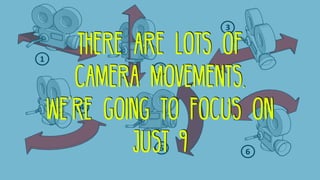
there are lots of
camera movements.
we’re going to focus on
just 9
how and why do we
analyse camera
movement?
1. a camera moves to show, tell
or reveal information to an
audience. Sometimes though, this
isn’t in straight lines.
2. if you can clearly see a camera movement:
A. describe what the movement is,
B. then where it moves from then to.
C. finally, describe what it tells, shows or teaches us.
There are lots of different camera movements and
many different ways of describing them. for
clarity, we’re going to focus on nine different
ones and use the following terms for them:
pan
tilt
ped
dolly
track
zoom
crane
steadicam
POV
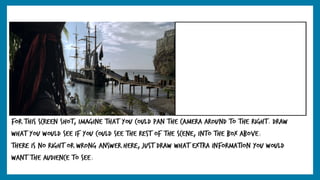
pan
tilt
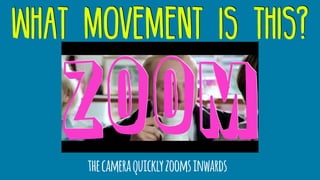
zoom
Thecameramovesfromlefttoright(orrighttoleft)from
afixedposition.
(Imagineshakingyourheadasyousayno)
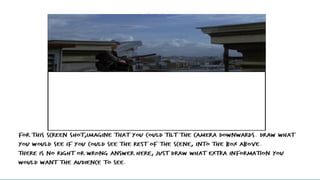
The camera moves from down to up (or up to down)
from a fixed position.
(Imagine nodding your head as you say yes)
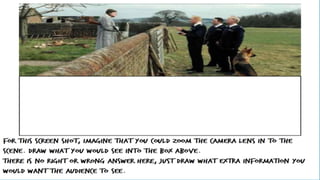
The camera does not move, the camera lens does.
As the lens moves closer (or further away) so
the image increases in size (or decreases).
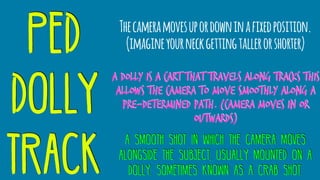
ped
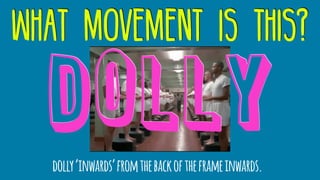
dolly
track
Thecameramovesupordowninafixedposition.
(imagineyourneckgettingtallerorshorter)
A DOLLY IS A CART THAT TRAVELS ALONG TRACKS THIS
ALLOWS THE CAMERA TO MOVE SMOOTHLY ALONG A
PRE-DETERMINED PATH. (CAMERA MOVES IN OR
OUTWARDS)
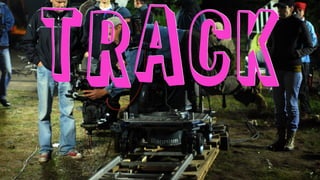
a smooth shot in which the camera moves
alongside the subject, usually mounted on a
dolly. sometimes known as a crab shot.
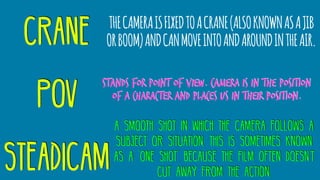
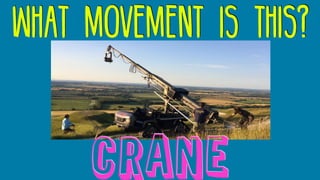
CRANE
POV
steadicam
THECAMERAISFIXEDTOACRANE(ALSOKNOWNASAJIB
ORBOOM)ANDCANMOVEINTOANDAROUNDINTHEAIR.
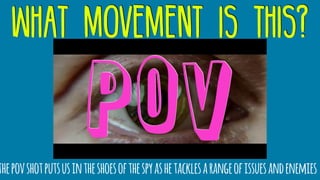
STANDS FOR POINT OF VIEW. CAMERA IS IN THE POSITION
OF A CHARACTER AND PLACES US IN THEIR POSITION.
a smooth shot in which the camera follows a
subject or situation. This is sometimes known
as a ‘one shot’ because the film often doesn’t
cut away from the action.
watch the video closely,
looking at the examples of
camera movements.
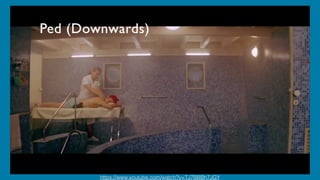
https://www.youtube.com/watch?v=TJ7BBBh7JGY
watch the videos closely,
looking at the individual
examples of camera
movements.
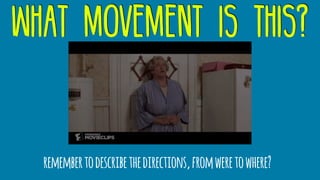
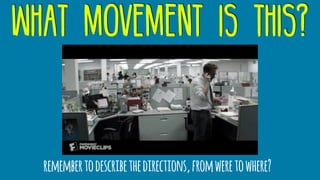
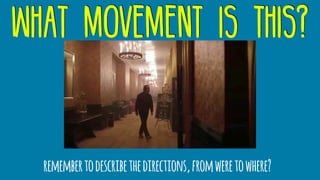
what movement is this?
remembertodescribethedirections,fromweretowhere?
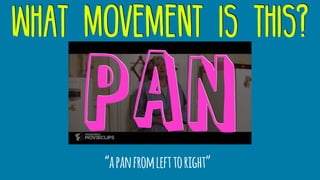
what movement is this?
“apanfromlefttoright”
pan
what movement is this?
remembertodescribethedirections,fromweretowhere?
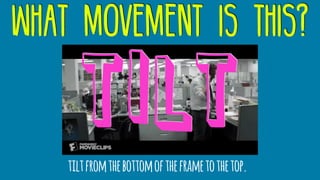
what movement is this?
tiltfromthebottomoftheframetothetop.
tilt
what movement is this?
remembertodescribethedirections,fromweretowhere?
what movement is this?
thecameraquicklyzoomsinwards
zoom
what movement is this?
remembertodescribethedirections,fromweretowhere?
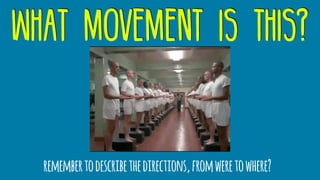
what movement is this?
dolly‘inwards’fromthebackoftheframeinwards.
dolly
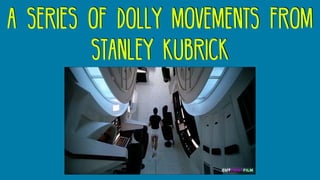
a series of dolly movements from
stanley kubrick
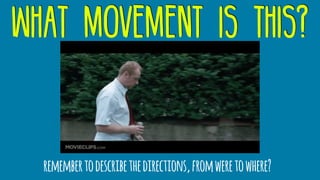
what movement is this?
remembertodescribethedirections,fromweretowhere?
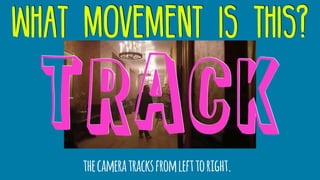
what movement is this?
thecameratracksfromlefttoright
track
what movement is this?
remembertodescribethedirections,fromweretowhere?
what movement is this?
thecameratracksfromlefttoright.
track
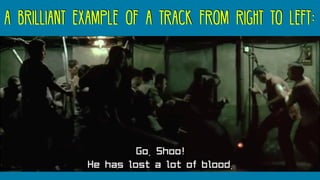
a brilliant example of a track from right to left:
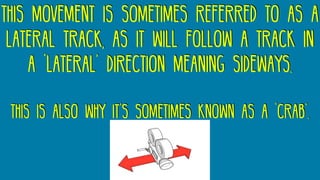
this movement is sometimes referred to as a
lateral track, as it will follow a track in
a ‘lateral’ direction meaning sideways.
This is also why it’s sometimes known as a ‘crab’.
https://www.youtube.com/watch?v=pdSKot0psNg
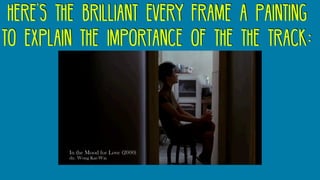
here’s the brilliant every frame a painting
to explain the importance of the the track:
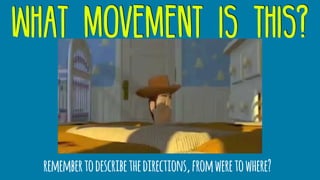
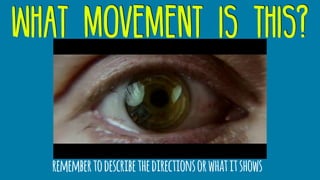
what movement is this?
remembertodescribethedirections,fromweretowhere?
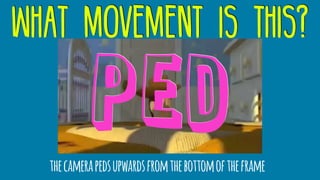
what movement is this?
thecamerapedsupwardsfromthebottomoftheframe
ped
what movement is this?
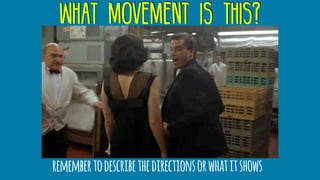
remembertodescribethedirectionsorwhatitshows
what movement is this?
thepovshotputsusintheshoesofthespyashetacklesarangeofissuesandenemies
pov
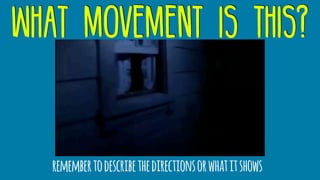
what movement is this?
remembertodescribethedirectionsorwhatitshows
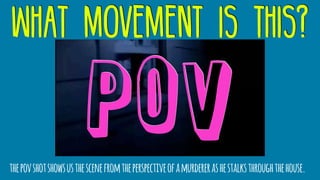
what movement is this?
pov
thepovshotshowsusthescenefromtheperspectiveofamurdererashestalksthroughthehouse.
what movement is this?
remembertodescribethedirectionsorwhatitshows
what movement is this?
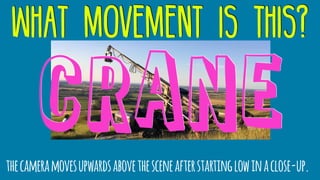
crane
what movement is this?
remembertodescribethedirectionsorwhatitshows
what movement is this?
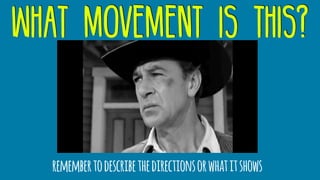
thecameramovesupwardsabovethesceneafterstartinglowinaclose-up.
crane
what movement is this?
remembertodescribethedirectionsorwhatitshows
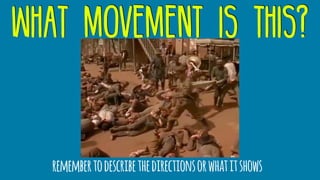
what movement is this?
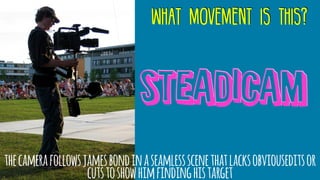
steadicam
thecamerafollowsjamesbondinaseamlessscenethatlacksobviouseditsor
cutstoshowhimfindinghistarget
what movement is this?
remembertodescribethedirectionsorwhatitshows
what movement is this?
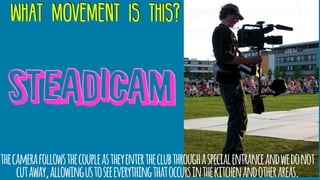
steadicam
thecamerafollowsthecoupleastheyentertheclubthroughaspecialentranceandwedonot
cutaway,allowingustoseeeverythingthatoccursinthekitchenandotherareas.
please note:
whatwewillbecallingasteadicamshotisalsoknownasa
one-shotoratrackingshot.
itisusedtodescribeaone-takesceneorshotthatfollowsa
characterorsituationdeveloping.Thisisbecausethecamera
‘tracks’theaction.
steadicam / one-shot / tracking shot
we’regoingtoavoiddescribingaone-shotasatrackingshot,
asitmaycontainmorethanonetypeofcameramovement.
thiscanalsobeknownasasequenceshot,asteadicamshot,a
one-take,a‘oner’ andmanyothers!
steadicam / one-shot / tracking shot
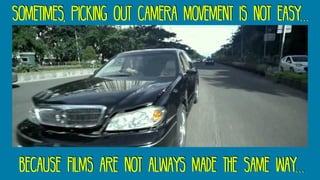
sometimes, picking out camera movement is not easy…
because films are not always made the same way…
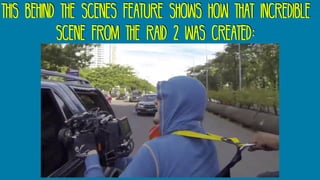
This behind the scenes feature shows how that incredible
scene from the raid 2 was created:
describing camera movements can be
difficult, especially in modern films where
the camera doesn’t need to be on a tripod.
if a camera moves and it seems important,
just try to describe where the camera
moves.
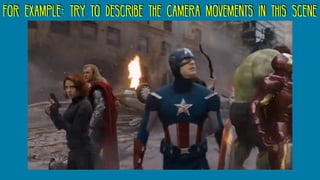
for example: try to describe the camera movements in this scene
Modern filmmaking differs considerably from ‘classic’
filmmaking. Hitchcock was, at times, a traditional and
formal filmmaker who often used camera movements in a
traditional manner.. This means that often it’s easier to
analyse clips from film such as his classic rear window.
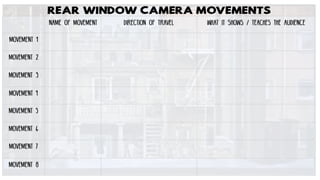
Watch the following clip and then use it to complete the
table on the next slide.
rear window:
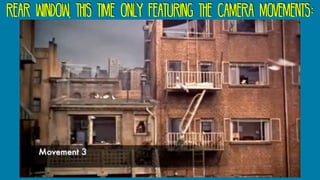
rear window, this time only featuring the camera movements:
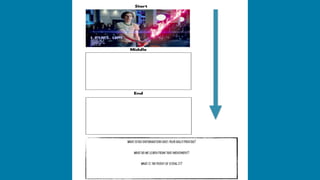
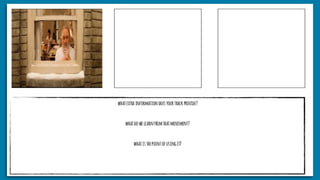
For the last column, describe what each
movement is telling the audience.
why has the director made the camera move
in the way that he does?
what is the point?
we hear no dialogue but we learn about the
area, some of the people who live there and
some key detail about our main character.
what do we learn? how does the
camera movement help to tell us?
Finally, to create a formal analysis, try to
write a 4 sentence explanation of how these
movements communicate something about this
scene:
(what do we learn about the view and the
neighbours? How do these movements help in
revealing these things?)
(Point) “In this clip we learn that or we
react to the clip…
(Evidence) “We see this with the camera
movements…
(Explanation) “these movements help the
audience to feel/understand … because…”
analysis time!
watch this clip and analyse the use of
camera movements.
Identify the movements, explain what they
show and then analyse what they aim to
inform us about or how they aim to make
us react.
analysis time part 2: slightly harder!
watch this clip and analyse the use of
camera movements.
Identify the movements, explain what they
show and then analyse what they aim to
inform us about or how they aim to make
us react.
analysis time part 3: hardest yet!
watch this clip and analyse the use of
camera movements.
Identify the movements, explain what they
show and then analyse what they aim to
inform us about or how they aim to make
us react.
video credits:
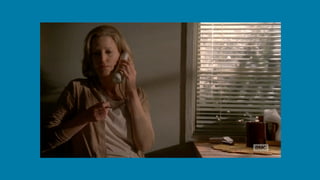
BREAKING BAD - Motivated Camera Movement is on slide 3
https://www.youtube.com/watch?v=TJ7BBBh7JGY is on slide 14
https://www.youtube.com/watch?v=7m8_QLnRBFo is on slide 16
Neighbors (8/10) Movie CLIP - Air Bag Prank (2014) HD is on slide 19
Shaun of the Dead - The Plan is on slide 22
https://www.youtube.com/watch?v=ur3121e_Cgg is on slide 25
https://www.youtube.com/watch?v=Y3uOitRaX9s is on slide 27
Shaun of the Dead (2/8) Movie CLIP - Oblivious to the Zombies (2004) HD is on slide 29
The Shining Ballscene 1080p is on slide 31
Oldboy The Corridor Fight Scene is on slide 33
Wolf Children (2012) - The Lateral Tracking Shot is on slide 35
https://www.youtube.com/watch?v=XmMi1j2Zrkk is on slide 37
https://www.youtube.com/watch?v=42GwGBfGo3E is on slide 40
https://www.youtube.com/watch?v=UBpugQt-uTg is on slide 42
Gone With The Wind (1939) Battle of Atlanta Injuries is on slide 44
High Noon Crane Shot is on slide 46
Spectre- Opening Tracking Shot in 1080p is on slide 49
https://www.youtube.com/watch?v=3Sr-vxVaY_M is on slide 51
The Raid 2 Car Chase (2014) HD is on slide 55
https://www.youtube.com/watch?v=ErrRhXItBWc is on slide 56
https://www.youtube.com/watch?v=QlQ_thbFtDA is on slide 58
Camera Movement in Rear Window - an analysis task for Film Students is
on slide 61
Use of camera movement in Rear Window - simplified is on slide 62
Iron Man to the Rescue - Iron Man (8/9) Movie CLIP (2008) HD is on slide
67
Moonrise Kingdom - Sam and Suzy's first encounter is on slide 69
Godzilla- The Arrival (Beach Scene) is on slide 71