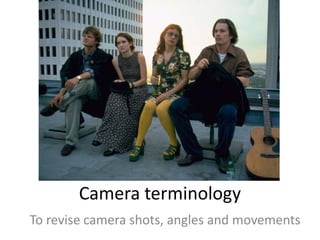
Camera terminology
To revise camera shots, angles and movements
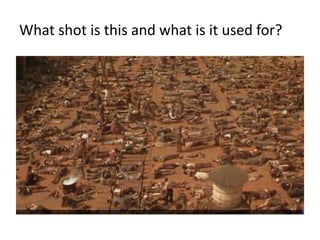
What shot is this and what is it used for?
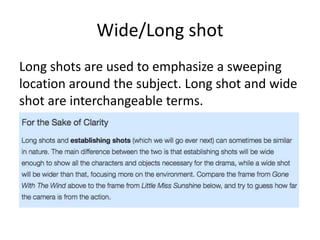
Wide/Long shot
Long shots are used to emphasize a sweeping
location around the subject. Long shot and wide
shot are interchangeable terms.
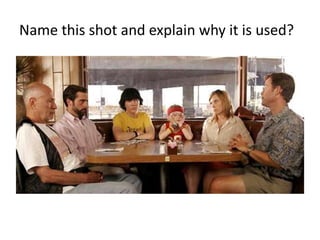
Name this shot and explain why it is used?
Establishing Shot and Master Shot
An establishing shot and a master shot are not the same
but they usually use the same framing and composition.
An establishing shot introduces a new location – a church,
a city street, a rooftop, a hospital room – from a vantage
point that allows the audience to see all the relevant
characters in the filmic space.
A master shot would probably be recorded from the same
position, with the same lens, also showing all the
characters. The difference is the duration. A master shot
records the entire action, a complete run-through from
that same camera position to provide a back up stock of
rushes so the director knows they have enough material
to show the whole scene.
Clarifying the establishing shot
Establishing shots refer more to the editing
phase of the film, where the editor selects one
quick angle to reveal the location. Also note that
an establishing shot doesn’t necessarily mean
that we see the character’s full body. Bascially,
the establishing shot displays the elements
needed for the scene to function in terms of
explaining the narrative to the audience.
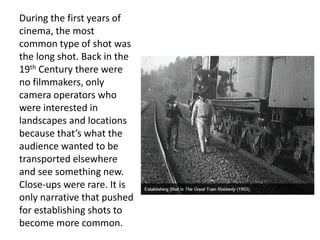
During the first years of
cinema, the most
common type of shot was
the long shot. Back in the
19th Century there were
no filmmakers, only
camera operators who
were interested in
landscapes and locations
because that’s what the
audience wanted to be
transported elsewhere
and see something new.
Close-ups were rare. It is
only narrative that pushed
for establishing shots to
become more common.
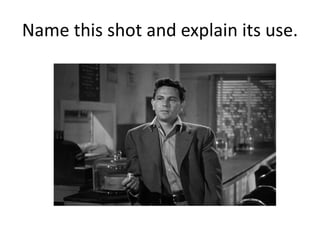
Name this shot and explain its use.
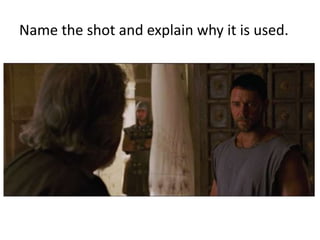
Medium Shot (MS)
Medium shots are the most common types of
shots in film narratives. Showing most of the
subject’s body, medium shots are halfway
between long shots and close-ups. They are all
about the character’s action and their
involvement with the narrative development.
Name the shot and explain why it is used.
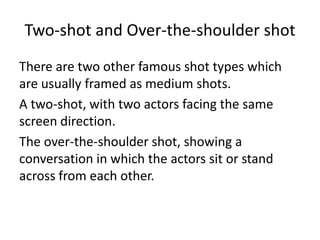
Two-shot and Over-the-shoulder shot
There are two other famous shot types which
are usually framed as medium shots.
A two-shot, with two actors facing the same
screen direction.
The over-the-shoulder shot, showing a
conversation in which the actors sit or stand
across from each other.
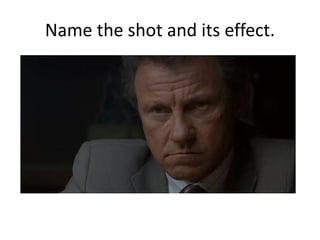
Name the shot and its effect.
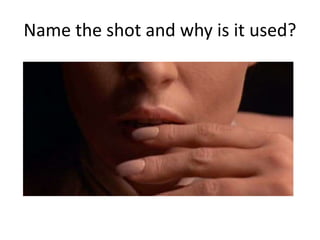
Close-up (CU)
In close-up shots, the subject occupies most of
the frame, allowing very little observation on
the environment. Close-ups are much more
dramatic than long or medium shots. They are
perfect for emphasizing someone’s emotion.
Name the shot and why is it used?
Extreme Close-up (ECU)
Sometimes, called a detail shot, extreme close-
ups do exactly that: show small detail that
would otherwise be missed.
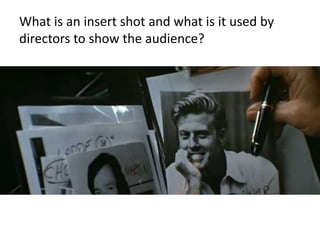
What is an insert shot and what is it used by
directors to show the audience?
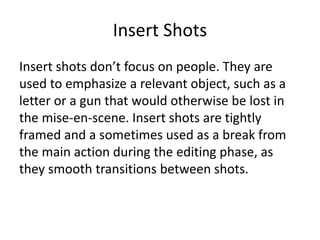
Insert Shots
Insert shots don’t focus on people. They are
used to emphasize a relevant object, such as a
letter or a gun that would otherwise be lost in
the mise-en-scene. Insert shots are tightly
framed and a sometimes used as a break from
the main action during the editing phase, as
they smooth transitions between shots.
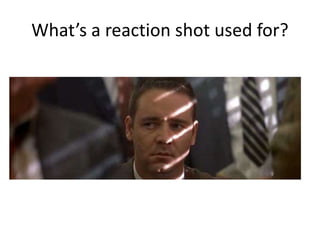
What’s a reaction shot used for?
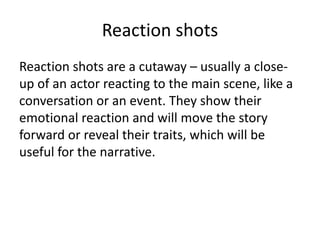
Reaction shots
Reaction shots are a cutaway – usually a close-
up of an actor reacting to the main scene, like a
conversation or an event. They show their
emotional reaction and will move the story
forward or reveal their traits, which will be
useful for the narrative.
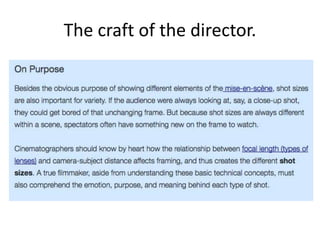
The craft of the director.
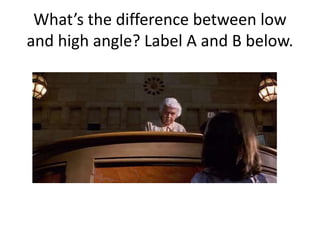
What’s the difference between low
and high angle? Label A and B below.
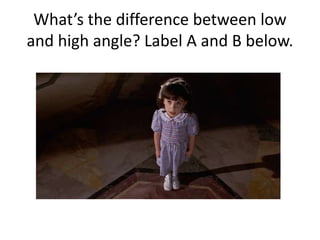
What’s the difference between low
and high angle? Label A and B below.
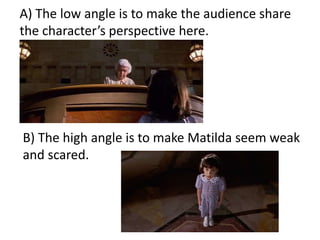
A) The low angle is to make the audience share
the character’s perspective here.
B) The high angle is to make Matilda seem weak
and scared.
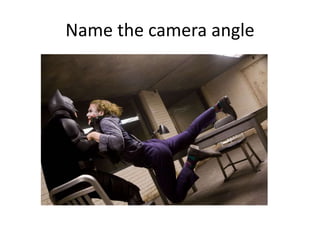
Name the camera angle
Dutch Tilt
Also called a canted angle, a Dutch tilt has the
camera leaning sideways, transforming the
horizon into a slope. A Dutch tilt changes
horizontal and vertical lines into diagonals and
creates a disorientation to disturb the viewer.
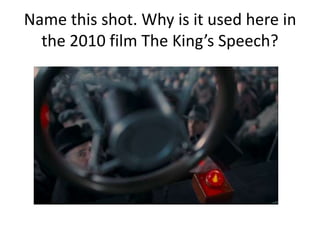
Name this shot. Why is it used here in
the 2010 film The King’s Speech?
Point-of-view (POV)
This is the perfect shot for positioning the
audience with the character. They are usually
preceded by a close-up of the character’s eyes.

Camera shots revise

  • 1.
    Camera terminology To revisecamera shots, angles and movements
  • 2.
    What shot isthis and what is it used for?
  • 3.
    Wide/Long shot Long shotsare used to emphasize a sweeping location around the subject. Long shot and wide shot are interchangeable terms.
  • 4.
    Name this shotand explain why it is used?
  • 5.
    Establishing Shot andMaster Shot An establishing shot and a master shot are not the same but they usually use the same framing and composition. An establishing shot introduces a new location – a church, a city street, a rooftop, a hospital room – from a vantage point that allows the audience to see all the relevant characters in the filmic space. A master shot would probably be recorded from the same position, with the same lens, also showing all the characters. The difference is the duration. A master shot records the entire action, a complete run-through from that same camera position to provide a back up stock of rushes so the director knows they have enough material to show the whole scene.
  • 6.
    Clarifying the establishingshot Establishing shots refer more to the editing phase of the film, where the editor selects one quick angle to reveal the location. Also note that an establishing shot doesn’t necessarily mean that we see the character’s full body. Bascially, the establishing shot displays the elements needed for the scene to function in terms of explaining the narrative to the audience.
  • 7.
    During the firstyears of cinema, the most common type of shot was the long shot. Back in the 19th Century there were no filmmakers, only camera operators who were interested in landscapes and locations because that’s what the audience wanted to be transported elsewhere and see something new. Close-ups were rare. It is only narrative that pushed for establishing shots to become more common.
  • 8.
    Name this shotand explain its use.
  • 9.
    Medium Shot (MS) Mediumshots are the most common types of shots in film narratives. Showing most of the subject’s body, medium shots are halfway between long shots and close-ups. They are all about the character’s action and their involvement with the narrative development.
  • 10.
    Name the shotand explain why it is used.
  • 11.
    Two-shot and Over-the-shouldershot There are two other famous shot types which are usually framed as medium shots. A two-shot, with two actors facing the same screen direction. The over-the-shoulder shot, showing a conversation in which the actors sit or stand across from each other.
  • 12.
    Name the shotand its effect.
  • 13.
    Close-up (CU) In close-upshots, the subject occupies most of the frame, allowing very little observation on the environment. Close-ups are much more dramatic than long or medium shots. They are perfect for emphasizing someone’s emotion.
  • 14.
    Name the shotand why is it used?
  • 15.
    Extreme Close-up (ECU) Sometimes,called a detail shot, extreme close- ups do exactly that: show small detail that would otherwise be missed.
  • 16.
    What is aninsert shot and what is it used by directors to show the audience?
  • 17.
    Insert Shots Insert shotsdon’t focus on people. They are used to emphasize a relevant object, such as a letter or a gun that would otherwise be lost in the mise-en-scene. Insert shots are tightly framed and a sometimes used as a break from the main action during the editing phase, as they smooth transitions between shots.
  • 18.
    What’s a reactionshot used for?
  • 19.
    Reaction shots Reaction shotsare a cutaway – usually a close- up of an actor reacting to the main scene, like a conversation or an event. They show their emotional reaction and will move the story forward or reveal their traits, which will be useful for the narrative.
  • 20.
    The craft ofthe director.
  • 21.
    What’s the differencebetween low and high angle? Label A and B below.
  • 22.
    What’s the differencebetween low and high angle? Label A and B below.
  • 23.
    A) The lowangle is to make the audience share the character’s perspective here. B) The high angle is to make Matilda seem weak and scared.
  • 24.
  • 25.
    Dutch Tilt Also calleda canted angle, a Dutch tilt has the camera leaning sideways, transforming the horizon into a slope. A Dutch tilt changes horizontal and vertical lines into diagonals and creates a disorientation to disturb the viewer.
  • 26.
    Name this shot.Why is it used here in the 2010 film The King’s Speech?
  • 27.
    Point-of-view (POV) This isthe perfect shot for positioning the audience with the character. They are usually preceded by a close-up of the character’s eyes.