

(VISUAL EFFECTS – VFX)
:Presented By:
Sidra Khan
Fariha Razi
Ambreen Ajaib
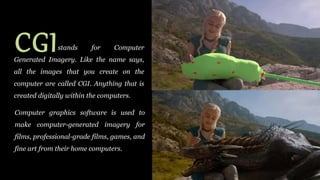
CGIstands for Computer
Generated Imagery. Like the name says,
all the images that you create on the
computer are called CGI. Anything that is
created digitally within the computers.
Computer graphics software is used to
make computer-generated imagery for
films, professional-grade films, games, and
fine art from their home computers.
ANIMATION
Animation is the process of by which images are used to
bring the illusion of motion by the rapid movement of those
images in a sequence. Animations can be recorded or stored
in various equipment and formats. Some recording would
be flip books, stop motion picture movies etc.
FLIP BOOK
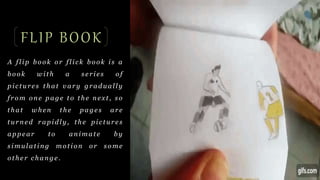
A fl i p book o r fl i ck book i s a
bo o k wi th a s eries o f
p i c ture s t ha t va ry g ra dua l l y
fro m o ne p a g e t o t h e nex t, so
tha t when t h e p a g es a re
turne d rap i dl y, t h e p i ctures
a p p e a r t o a n i ma te by
si mul a ti ng moti on o r some
o the r cha n g e .
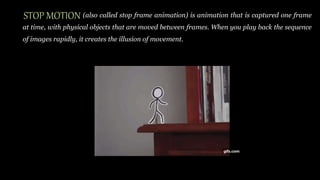
(also called stop frame animation) is animation that is captured one frame
at time, with physical objects that are moved between frames. When you play back the sequence
of images rapidly, it creates the illusion of movement.
STOP MOTION
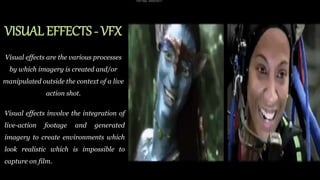
VISUAL EFFECTS - VFX
Visual effects involve the integration of
live-action footage and generated
imagery to create environments which
look realistic which is impossible to
capture on film.
Visual effects are the various processes
by which imagery is created and/or
manipulated outside the context of a live
action shot.
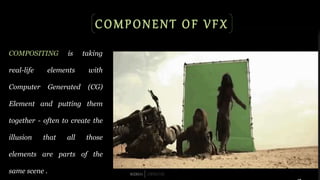
COMPOSITING is taking
real-life elements with
Computer Generated (CG)
Element and putting them
together - often to create the
illusion that all those
elements are parts of the
same scene .
COMPONENT OF VFX
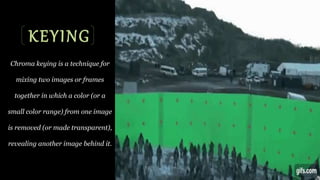
Chroma keying is a technique for
mixing two images or frames
together in which a color (or a
small color range) from one image
is removed (or made transparent),
revealing another image behind it.
KEYING
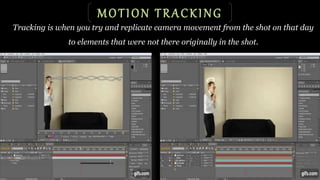
MOTION TRACKING
Tracking is when you try and replicate camera movement from the shot on that day
to elements that were not there originally in the shot.
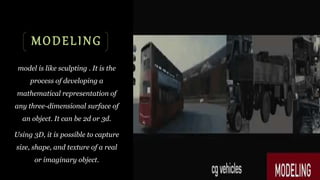
model is like sculpting . It is the
process of developing a
mathematical representation of
any three-dimensional surface of
an object. It can be 2d or 3d.
Using 3D, it is possible to capture
size, shape, and texture of a real
or imaginary object.
MODELING
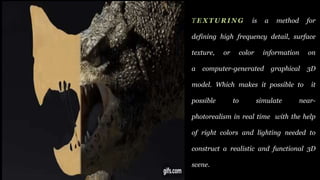
texturing
TEXTURIN G is a method for
defining high frequency detail, surface
texture, or color information on
a computer-generated graphical 3D
model. Which makes it possible to it
possible to simulate near-
photorealism in real time with the help
of right colors and lighting needed to
construct a realistic and functional 3D
scene.
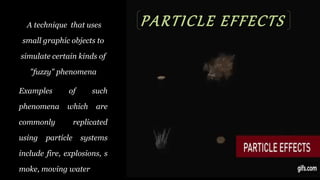
PARTICLE EFFECTSA technique that uses
small graphic objects to
simulate certain kinds of
"fuzzy" phenomena
Examples of such
phenomena which are
commonly replicated
using particle systems
include fire, explosions, s
moke, moving water
TYPES OF VFX
1. Matte paintings
2. Digital animation
3. Live action
4. imagery
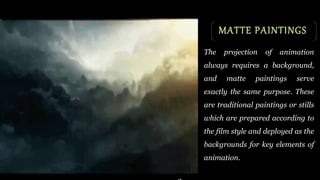
The projection of animation
always requires a background,
and matte paintings serve
exactly the same purpose. These
are traditional paintings or stills
which are prepared according to
the film style and deployed as the
backgrounds for key elements of
animation.
MATTE PAINTINGS
As the name suggests, digital animation uses the digital methods of
creation. It involves everything from modeling and texturing to
lighting and rendering computer generated 3D techniques. To
make animation look more realistic and powerful, digital
animation fosters all the dimensional based actions and imagery.
D I G I T A L A N I M A T I O N
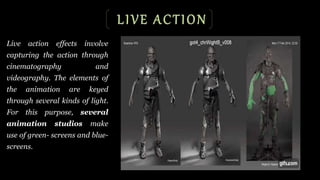
LIVE ACTION
Live action effects involve
capturing the action through
cinematography and
videography. The elements of
the animation are keyed
through several kinds of light.
For this purpose, several
animation studios make
use of green- screens and blue-
screens.
T O O LS US E D WI TH V F X
• Studio Adobe Premiere pro
• Adobe After Effects
• Mocha
• Maya ed
• Nuke
THANK YOU !!!

Visual Effects - VFX

  • 1.
  • 2.
  • 3.
    CGIstands for Computer GeneratedImagery. Like the name says, all the images that you create on the computer are called CGI. Anything that is created digitally within the computers. Computer graphics software is used to make computer-generated imagery for films, professional-grade films, games, and fine art from their home computers.
  • 4.
    ANIMATION Animation is theprocess of by which images are used to bring the illusion of motion by the rapid movement of those images in a sequence. Animations can be recorded or stored in various equipment and formats. Some recording would be flip books, stop motion picture movies etc.
  • 5.
    FLIP BOOK A fli p book o r fl i ck book i s a bo o k wi th a s eries o f p i c ture s t ha t va ry g ra dua l l y fro m o ne p a g e t o t h e nex t, so tha t when t h e p a g es a re turne d rap i dl y, t h e p i ctures a p p e a r t o a n i ma te by si mul a ti ng moti on o r some o the r cha n g e .
  • 6.
    (also called stopframe animation) is animation that is captured one frame at time, with physical objects that are moved between frames. When you play back the sequence of images rapidly, it creates the illusion of movement. STOP MOTION
  • 7.
    VISUAL EFFECTS -VFX Visual effects involve the integration of live-action footage and generated imagery to create environments which look realistic which is impossible to capture on film. Visual effects are the various processes by which imagery is created and/or manipulated outside the context of a live action shot.
  • 8.
    COMPOSITING is taking real-lifeelements with Computer Generated (CG) Element and putting them together - often to create the illusion that all those elements are parts of the same scene . COMPONENT OF VFX
  • 9.
    Chroma keying isa technique for mixing two images or frames together in which a color (or a small color range) from one image is removed (or made transparent), revealing another image behind it. KEYING
  • 10.
    MOTION TRACKING Tracking iswhen you try and replicate camera movement from the shot on that day to elements that were not there originally in the shot.
  • 11.
    model is likesculpting . It is the process of developing a mathematical representation of any three-dimensional surface of an object. It can be 2d or 3d. Using 3D, it is possible to capture size, shape, and texture of a real or imaginary object. MODELING
  • 12.
    texturing TEXTURIN G isa method for defining high frequency detail, surface texture, or color information on a computer-generated graphical 3D model. Which makes it possible to it possible to simulate near- photorealism in real time with the help of right colors and lighting needed to construct a realistic and functional 3D scene.
  • 13.
    PARTICLE EFFECTSA techniquethat uses small graphic objects to simulate certain kinds of "fuzzy" phenomena Examples of such phenomena which are commonly replicated using particle systems include fire, explosions, s moke, moving water
  • 14.
    TYPES OF VFX 1.Matte paintings 2. Digital animation 3. Live action 4. imagery
  • 15.
    The projection ofanimation always requires a background, and matte paintings serve exactly the same purpose. These are traditional paintings or stills which are prepared according to the film style and deployed as the backgrounds for key elements of animation. MATTE PAINTINGS
  • 16.
    As the namesuggests, digital animation uses the digital methods of creation. It involves everything from modeling and texturing to lighting and rendering computer generated 3D techniques. To make animation look more realistic and powerful, digital animation fosters all the dimensional based actions and imagery. D I G I T A L A N I M A T I O N
  • 17.
    LIVE ACTION Live actioneffects involve capturing the action through cinematography and videography. The elements of the animation are keyed through several kinds of light. For this purpose, several animation studios make use of green- screens and blue- screens.
  • 18.
    T O OLS US E D WI TH V F X • Studio Adobe Premiere pro • Adobe After Effects • Mocha • Maya ed • Nuke
  • 20.