"If it is correct that logic is the basis of a creator's
slightest reasoning, I believe that it must not be allowed
to interfere with one's dreams of "charm", that delicate
superfluous entity which often adds to harsh necessity'"

VICTOR HORTA
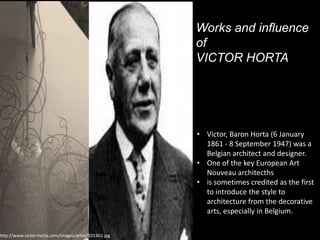
http://www.victor-horta.com/images/artist/501362.jpg

Works and influence
of
VICTOR HORTA

• Victor, Baron Horta (6 January
1861 - 8 September 1947) was a
Belgian architect and designer.
• One of the key European Art
Nouveau architecths
• is sometimes credited as the first
to introduce the style to
architecture from the decorative
arts, especially in Belgium.
Early life
BIRTH
6 JANUARY
1861

• Born and raised in Ghent ; Born in the family of a shoemaker

• In 1873, went to study musical theory at the Ghent
1873
Conservatory
STUDY MUSICAL • Expelled for misbehaviour. Joined Department of Architecture
THEORY
at the Royal Academy of Fine Arts in Ghent
1878
LEFT FOR PARIS

1880, he
• Found work with architect and designer Jules Debuysson
returned to
in Montmartre
Belgium and
moved
to Brussels

1880
• Went to study architecture at Academie Royale Des Beaux-Arts
DEATH OF
FATHER; RETURN
TO BRUSSELS
1881
ASSISTANT;
FIRST GLASS &
IRON WORK

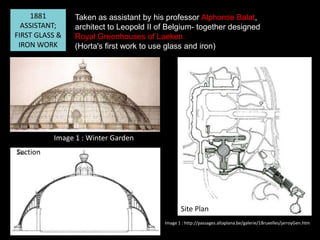
Taken as assistant by his professor Alphonse Balat,
architect to Leopold II of Belgium- together designed
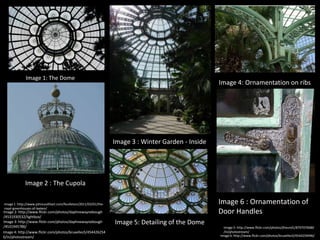
Royal Greenhouses of Laeken
(Horta's first work to use glass and iron)

Image 1 : Winter Garden
Section

Site Plan
Image 1 : http://passages.altaplana.be/galerie/1Bruxelles/jarroyGen.htm
Image 1: The Dome

Image 4: Ornamentation on ribs

Image 3 : Winter Garden - Inside

Image 2 : The Cupola

Image 6 : Ornamentation of
Door Handles

Image 1 :http://www.johncoulthart.com/feuilleton/2011/03/01/theroyal-greenhouses-of-laeken/

Image 2: http://www.flickr.com/photos/daphnewaynebough
/4531930532/lightbox/
Image 3: http://www.flickr.com/photos/daphnewaynebough
/4531945786/
Image 4: http://www.flickr.com/photos/bruxelles5/454426254
6/in/photostream/

Image 5: Detailing of the Dome

Image 5: http://www.flickr.com/photos/jfreund1/8707076680
/in/photostream/
Image 6: http://www.flickr.com/photos/bruxelles5/4544259496/
1884
WON THE FIRST
PRIX
GODECHARLE

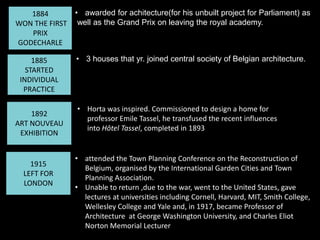
• awarded for achitecture(for his unbuilt project for Parliament) as
well as the Grand Prix on leaving the royal academy.

1885
STARTED
INDIVIDUAL
PRACTICE

• 3 houses that yr. joined central society of Belgian architecture.

1892
ART NOUVEAU
EXHIBITION

1915
LEFT FOR
LONDON

• Horta was inspired. Commissioned to design a home for
professor Emile Tassel, he transfused the recent influences
into Hôtel Tassel, completed in 1893

• attended the Town Planning Conference on the Reconstruction of
Belgium, organised by the International Garden Cities and Town
Planning Association.
• Unable to return ,due to the war, went to the United States, gave
lectures at universities including Cornell, Harvard, MIT, Smith College,
Wellesley College and Yale and, in 1917, became Professor of
Architecture at George Washington University, and Charles Eliot
Norton Memorial Lecturer
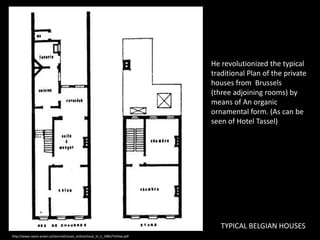
He revolutionized the typical
traditional Plan of the private
houses from Brussels
(three adjoining rooms) by
means of An organic
ornamental form. (As can be
seen of Hotel Tassel)

TYPICAL BELGIAN HOUSES
http://www.caans-acaen.ca/Journal/issues_online/Issue_VI_ii_1985/Tsihlias.pdf
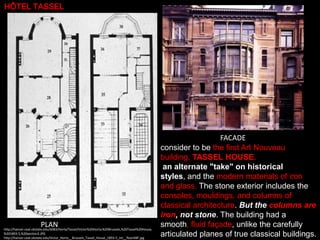
HÔTEL TASSEL

PLAN

http://hanser.ceat.okstate.edu/6083/Horta/Tassel/Victor%20Horta;%20Brussels,%20Tassel%20House,
%201893-5,%20section2.JPG
http://hanser.ceat.okstate.edu/Victor_Horta__Brussels_Tassel_House_1893-5_int__floorABF.jpg

FACADE
consider to be the first Art Nouveau
building, TASSEL HOUSE.
an alternate "take" on historical
styles, and the modern materials of iron
and glass. The stone exterior includes the
consoles, mouldings, and columns of
classical architecture. But the columns are
iron, not stone. The building had a
smooth, fluid façade, unlike the carefully
articulated planes of true classical buildings.
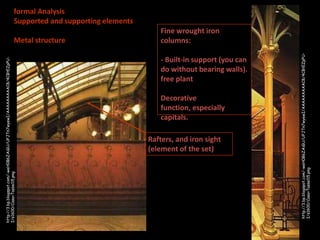
formal Analysis
Supported and supporting elements

- Built-in support (you can
do without bearing walls).
free plant
Decorative
function, especially
capitals.
Rafters, and iron sight
(element of the set)

http://3.bp.blogspot.com/-weH0B6ZAiGU/UFJTn7wyewI/AAAAAAAAAC8/4CBtEZpPUI/s1600/Casa+Tassel15.png

http://3.bp.blogspot.com/-weH0B6ZAiGU/UFJTn7wyewI/AAAAAAAAAC8/4CBtEZpPUI/s1600/Casa+Tassel15.png

Metal structure

Fine wrought iron
columns:
http://www.arqfdr.rialverde.com/8-S_xix/images/tassel_fach.jpg

http://historiayviajes.files.wordpress.com/2011/05/casatassel2.jpg?w=150

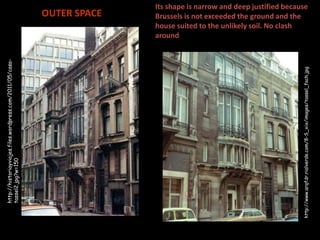
OUTER SPACE

Its shape is narrow and deep justified because
Brussels is not exceeded the ground and the
house suited to the unlikely soil. No clash
around
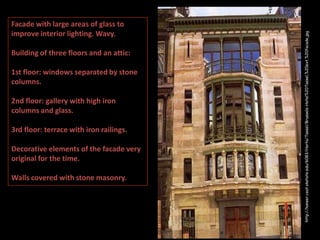
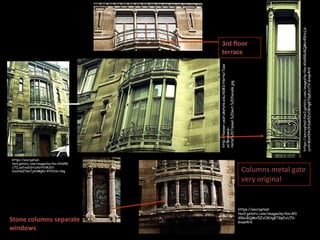
Building of three floors and an attic:
1st floor: windows separated by stone
columns.
2nd floor: gallery with high iron
columns and glass.
3rd floor: terrace with iron railings.
Decorative elements of the facade very
original for the time.
Walls covered with stone masonry.

http://hanser.ceat.okstate.edu/6083/Horta/Tassel/Brussels-Hotel%20Tassel,%20ext.%20facade.jpg

Facade with large areas of glass to
improve interior lighting. Wavy.
https://encryptedhttps://encryptedtbn1.gstatic.com/images?q=tbn:ANd9G
tbn1.gstatic.com/images?q=tbn:ANd9G
cTCLzefxeXSrvzXsYVr8UDtcTCLzefxeXSrvzXsYVr8UDt2uuXdaZYaaTjmVMgKv-KY0OSv-bkg
2uuXdaZYaaTjmVMgKv-KY0OSv-bkg

Stone columns separate
windows

https://encrypted-tbn3.gstatic.com/images?q=tbn:ANd9GcRQMvi45HcLduvVrWsX54UXSdn5ZvOKHgBTGpExU7V-Gvae4H1

http://hanser.ceat.okstate.edu/6083/Horta/Tass
el/BrusselsHotel%20Tassel,%20ext.%20facade.jpg

3rd floor
terrace

Columns metal gate
very original

https://encryptedtbn3.gstatic.com/images?q=tbn:AN
d9GcRQMvi5ZvOKHgBTGpExU7VGvae4H1
https://encrypted-tbn1.gstatic.com/images?q=tbn:ANd9GcTCLzefxeXSrvzXsYVr8UDt-2uuXdaZYaaTjmVMgKvKY0OSv-bkg

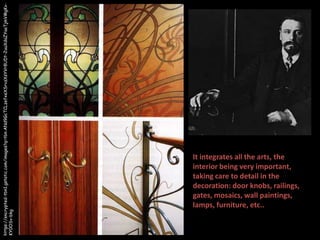
It integrates all the arts, the
interior being very important,
taking care to detail in the
decoration: door knobs, railings,
gates, mosaics, wall paintings,
lamps, furniture, etc..
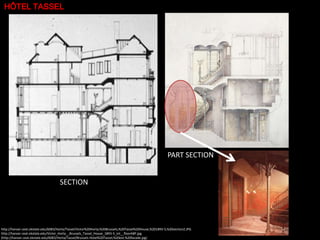
HÔTEL TASSEL

PART SECTION
SECTION

http://hanser.ceat.okstate.edu/6083/Horta/Tassel/Victor%20Horta;%20Brussels,%20Tassel%20House,%201893-5,%20section2.JPG
http://hanser.ceat.okstate.edu/Victor_Horta__Brussels_Tassel_House_1893-5_int__floorABF.jpg
(http://hanser.ceat.okstate.edu/6083/Horta/Tassel/Brussels-Hotel%20Tassel,%20ext.%20facade.jpg)
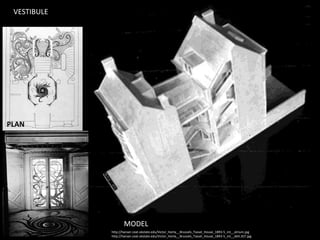
VESTIBULE

PLAN

MODEL
http://hanser.ceat.okstate.edu/Victor_Horta__Brussels_Tassel_House_1893-5_int__atrium.jpg
http://hanser.ceat.okstate.edu/Victor_Horta__Brussels_Tassel_House_1893-5_int__detl.3CF.jpg
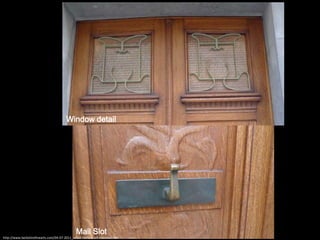
Window detail

Mail Slot
http://www.berkshirefinearts.com/04-07-2011_victor-horta-s-art-nouveau.htm
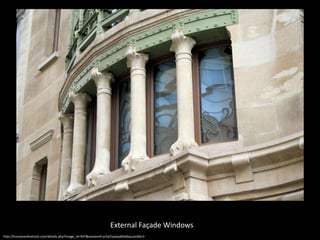
External Façade Windows
http://humanandnatural.com/details.php?image_id=947&sessionid=jc5a21pvqvj60ai6quuic0dsr3
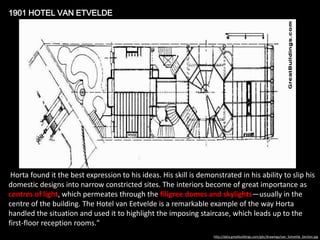
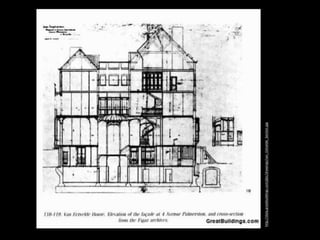
1901 HOTEL VAN ETVELDE

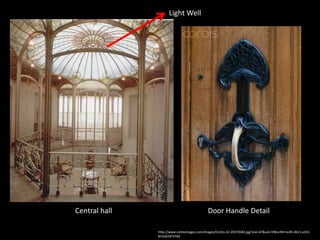
Horta found it the best expression to his ideas. His skill is demonstrated in his ability to slip his
domestic designs into narrow constricted sites. The interiors become of great importance as
centres of light, which permeates through the filigree domes and skylights—usually in the
centre of the building. The Hotel van Eetvelde is a remarkable example of the way Horta
handled the situation and used it to highlight the imposing staircase, which leads up to the
first-floor reception rooms."
http://data.greatbuildings.com/gbc/drawings/van_Eetvelde_Section.jpg
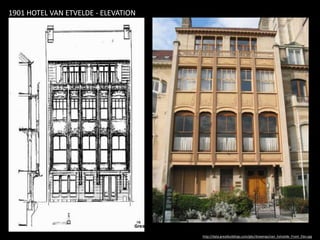
1901 HOTEL VAN ETVELDE - ELEVATION

http://data.greatbuildings.com/gbc/drawings/van_Eetvelde_Front_Elev.jpg
http://data.greatbuildings.com/gbc/drawings/van_Eetvelde_Section.jpg
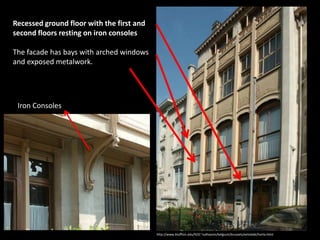
Recessed ground floor with the first and
second floors resting on iron consoles
The facade has bays with arched windows
and exposed metalwork.

Iron Consoles

http://www.bluffton.edu/%5C~sullivanm/belgium/brussels/eetvelde/horta.html
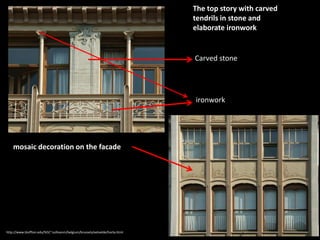
The top story with carved
tendrils in stone and
elaborate ironwork

Carved stone

ironwork

mosaic decoration on the facade

http://www.bluffton.edu/%5C~sullivanm/belgium/brussels/eetvelde/horta.html
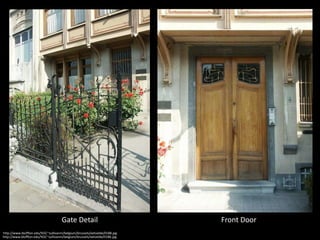
Gate Detail
http://www.bluffton.edu/%5C~sullivanm/belgium/brussels/eetvelde/0188.jpg
http://www.bluffton.edu/%5C~sullivanm/belgium/brussels/eetvelde/0186.jpg

Front Door
Light Well

Central hall

Door Handle Detail
http://www.corbisimages.com/images/Corbis-42-20374582.jpg?size=67&uid=5f8ce394-bc05-4611-a253831bb18737dd
1919
RETURNED
BRUSSELS

1928
PALAIS DES
BEAUX-ARTS

1932
BARON

1947
DEATH

1952

• Sold his workshop workshop on the rue Américaine(American Street),
and became full member of Belgian royal family

• Change of style , Art Deco and Cubist styles seen

• In recognition of his work, Horta was awarded the title of Baron by
Albert I of Belgium in 1932

• Died while working on his last project. Brussels Central Railway Station
Another shift- to Modernism.
• His colleagues led by Maxime Brunfaut completed his plans.
• The Brussels Central Railway station was finally opened
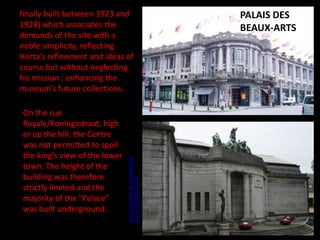
On the rue
Royale/Koningsstraat, high
er up the hill, the Centre
was not permitted to spoil
the king’s view of the lower
town. The height of the
building was therefore
strictly limited and the
majority of the "Palace"
was built underground.

http://en.wikipedia.org/wiki/Palais_
des_Beaux-Arts_de_Lille

finally built between 1923 and
1928) which associates the
demands of the site with a
noble simplicity, reflecting
Horta’s refinement and ideas of
course but without neglecting
his mission : enhancing the
museum’s future collections.

Museum in Tournai

PALAIS DES
BEAUX-ARTS
http://mfresnillo.blogspot.in/2008_03_01_archive.html

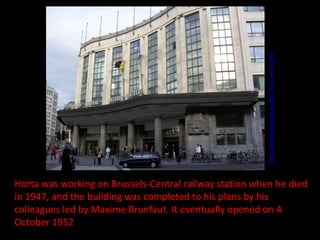
Horta was working on Brussels-Central railway station when he died
in 1947, and the building was completed to his plans by his
colleagues led by Maxime Brunfaut. It eventually opened on 4
October 1952
ART NOUVEAU

SHIFTING
TO
MODERNIST CLASSICAL

ART DECO

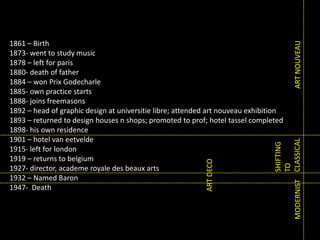
1861 – Birth
1873- went to study music
1878 – left for paris
1880- death of father
1884 – won Prix Godecharle
1885- own practice starts
1888- joins freemasons
1892 – head of graphic design at universitie libre; attended art nouveau exhibition
1893 – returned to design houses n shops; promoted to prof; hotel tassel completed
1898- his own residence
1901 – hotel van eetvelde
1915- left for london
1919 – returns to belgium
1927- director, academe royale des beaux arts
1932 – Named Baron
1947- Death
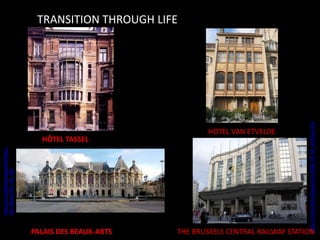
HÔTEL TASSEL

PALAIS DES BEAUX-ARTS
HOTEL VAN ETVELDE

THE BRUSSELS CENTRAL RAILWAY STATION

http://mfresnillo.blogspot.in/2008_03_01_archive.html

http://en.wikipedia.org/wiki/Palais_
des_Beaux-Arts_de_Lille

TRANSITION THROUGH LIFE
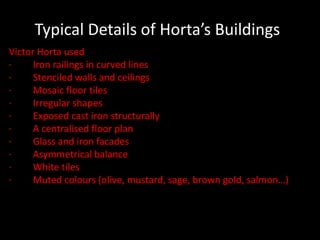
Typical Details of Horta’s Buildings
Victor Horta used
·
Iron railings in curved lines
·
Stenciled walls and ceilings
·
Mosaic floor tiles
·
Irregular shapes
·
Exposed cast iron structurally
·
A centralised floor plan
·
Glass and iron facades
·
Asymmetrical balance
·
White tiles
·
Muted colours (olive, mustard, sage, brown gold, salmon…)
Influences on Horta
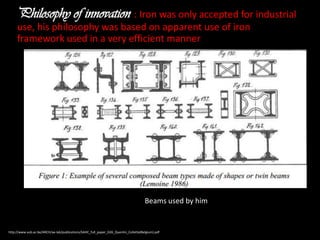
Philosophy of innovation : Iron was only accepted for industrial
use, his philosophy was based on apparent use of iron
framework used in a very efficient manner

Beams used by him

http://www.vub.ac.be/ARCH/ae-lab/publications/SAHC_full_paper_D26_Quentin_Collette(Belgium).pdf
"My stay in Paris, walking the city streets, visiting
the monuments and museums threw wide open the
windows of my artistic soul. No school could have
done more to tire me with an enthusiasm for
architecture than viewing and deciphering those
monuments - an enthusiasm that has never left me."
(Mémoires, p.8)
Victor Horta
Influence of Paris
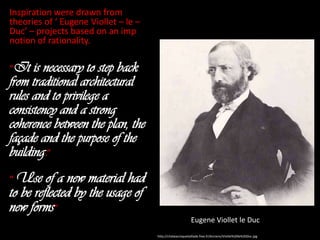
Inspiration were drawn from
theories of ‘ Eugene Viollet – le –
Duc’ – projects based on an imp
notion of rationality.
“It

is necessary to step back
from traditional architectural
rules and to privilege a
consistency and a strong
coherence between the plan, the
façade and the purpose of the
building.”
“ Use

of a new material had
to be reflected by the usage of
new forms”
Eugene Viollet le Duc
http://chateauroquetaillade.free.fr/Anciens/Viollet%20le%20Duc.jpg
The Art Nouveau Movement
Art Nouveau Movement considered that each
material should be presented by its own formal
expression.
As a student of Alphonse Balat, Horta was highly
influenced by the Art Nouveau theories.
Biblography
• http://www.vub.ac.be/ARCH/aelab/publications/SAHC_full_paper_D26_Quentin_Collette(Belgium).
pdf
• http://www.caansacaen.ca/Journal/issues_online/Issue_VI_ii_1985/Tsihlias.pdf
• http://visitbrussels.be/bitc/BE_en/content/2791/victor-horta-andbrussels.do
• http://www.hortamuseum.be/en/horta-en/biography
• George Kohlmeir, House of Glass
• http://www.monarchie.be/palace-and-heritage/greenhouseslaeken
• http://www.johncoulthart.com/feuilleton/2011/03/01/the-royalgreenhouses-of-laeken/
Hemant kandpal
Prashansha sachdeva

Victor horta work and influences