SUBMITTEDBY:
G RISHITHA
318106101006
2/5 B ARCH
ART
NOUVEAU
MOMENT
INTODUCTION
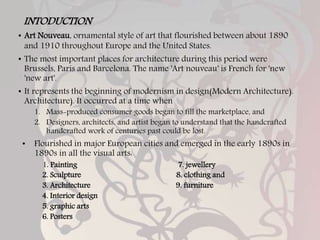
• Art Nouveau, ornamental style of art that flourished between about 1890
and 1910 throughout Europe and the United States.
• The most important places for architecture during this period were
Brussels, Paris and Barcelona. The name 'Art nouveau' is French for 'new
'new art'.
• It represents the beginning of modernism in design(Modern Architecture).
Architecture). It occurred at a time when
1. Mass-produced consumer goods began to fill the marketplace, and
2. Designers, architects, and artist began to understand that the handcrafted
handcrafted work of centuries past could be lost.
• Flourished in major European cities and emerged in the early 1890s in
1890s in all the visual arts:
1. Painting 7. jewellery
2. Sculpture 8. clothing and
3. Architecture 9. furniture
4. Interior design
5. graphic arts
6. Posters
• ART NOUVEAU MOMENT OF PAINTINGS
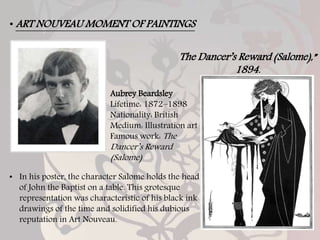
Aubrey Beardsley
Lifetime: 1872–1898
Nationality: British
Medium: Illustration art
Famous work: The
Dancer’s Reward
(Salome)
• In his poster, the character Salome holds the head
of John the Baptist on a table. This grotesque
representation was characteristic of his black ink
drawings of the time and solidified his dubious
reputation in Art Nouveau.
The Dancer’s Reward (Salome),”
1894.
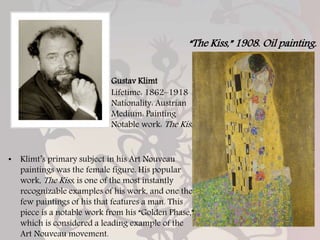
Gustav Klimt
Lifetime: 1862–1918
Nationality: Austrian
Medium: Painting
Notable work: The Kiss
• Klimt’s primary subject in his Art Nouveau
paintings was the female figure. His popular
work, The Kiss, is one of the most instantly
recognizable examples of his work, and one the
few paintings of his that features a man. This
piece is a notable work from his “Golden Phase,”
which is considered a leading example of the
Art Nouveau movement.
“The Kiss,” 1908. Oil painting.
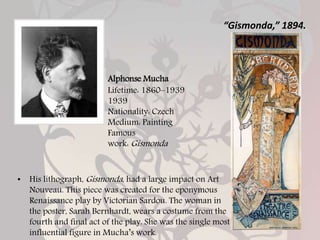
Alphonse Mucha
Lifetime: 1860–1939
1939
Nationality: Czech
Medium: Painting
Famous
work: Gismonda
• His lithograph, Gismonda, had a large impact on Art
Nouveau. This piece was created for the eponymous
Renaissance play by Victorian Sardou. The woman in
the poster, Sarah Bernhardt, wears a costume from the
fourth and final act of the play. She was the single most
influential figure in Mucha’s work.
“Gismonda,” 1894.
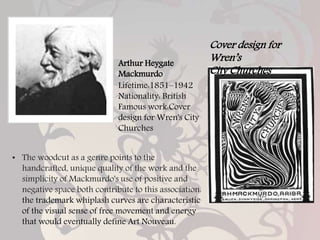
Arthur Heygate
Mackmurdo
Lifetime:1851–1942
Nationality: British
Famous work:Cover
design for Wren's City
Churches
Cover design for
Wren’s
City Churches
• The woodcut as a genre points to the
handcrafted, unique quality of the work and the
simplicity of Mackmurdo's use of positive and
negative space both contribute to this association.
the trademark whiplash curves are characteristic
of the visual sense of free movement and energy
that would eventually define Art Nouveau.
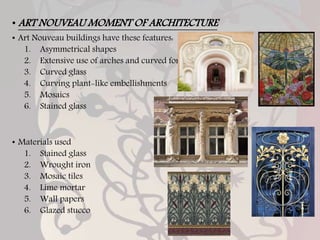
• ART NOUVEAU MOMENT OF ARCHITECTURE
• Art Nouveau buildings have these features:
1. Asymmetrical shapes
2. Extensive use of arches and curved forms
3. Curved glass
4. Curving plant-like embellishments
5. Mosaics
6. Stained glass
• Materials used
1. Stained glass
2. Wrought iron
3. Mosaic tiles
4. Lime mortar
5. Wall papers
6. Glazed stucco
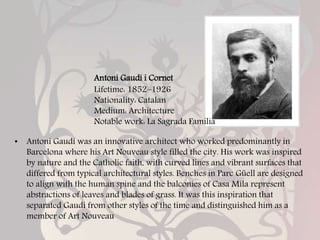
Antoni Gaudí i Cornet
Lifetime: 1852–1926
Nationality: Catalan
Medium: Architecture
Notable work: La Sagrada Familia
• Antoni Gaudí was an innovative architect who worked predominantly in
Barcelona where his Art Nouveau style filled the city. His work was inspired
by nature and the Catholic faith, with curved lines and vibrant surfaces that
differed from typical architectural styles. Benches in Parc Güell are designed
to align with the human spine and the balconies of Casa Mila represent
abstractions of leaves and blades of grass. It was this inspiration that
separated Gaudí from other styles of the time and distinguished him as a
member of Art Nouveau
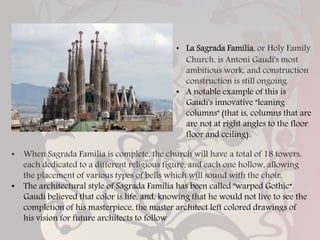
• La Sagrada Familia, or Holy Family
Church, is Antoni Gaudi's most
ambitious work, and construction
construction is still ongoing.
• A notable example of this is
Gaudi's innovative "leaning
columns" (that is, columns that are
are not at right angles to the floor
floor and ceiling).
• When Sagrada Familia is complete, the church will have a total of 18 towers,
each dedicated to a different religious figure, and each one hollow, allowing
the placement of various types of bells which will sound with the choir.
• The architectural style of Sagrada Familia has been called "warped Gothic“.
Gaudi believed that color is life, and, knowing that he would not live to see the
completion of his masterpiece, the master architect left colored drawings of
his vision for future architects to follow
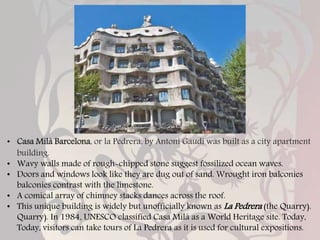
• Casa Milà Barcelona, or la Pedrera, by Antoni Gaudi was built as a city apartment
building.
• Wavy walls made of rough-chipped stone suggest fossilized ocean waves.
• Doors and windows look like they are dug out of sand. Wrought iron balconies
balconies contrast with the limestone.
• A comical array of chimney stacks dances across the roof.
• This unique building is widely but unofficially known as La Pedrera (the Quarry).
Quarry). In 1984, UNESCO classified Casa Milà as a World Heritage site. Today,
Today, visitors can take tours of La Pedrera as it is used for cultural expositions.
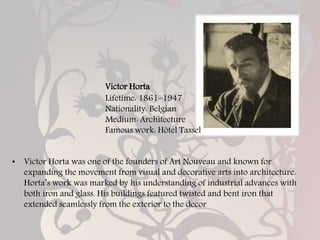
Victor Horta
Lifetime: 1861–1947
Nationality: Belgian
Medium: Architecture
Famous work: Hôtel Tassel
• Victor Horta was one of the founders of Art Nouveau and known for
expanding the movement from visual and decorative arts into architecture.
Horta’s work was marked by his understanding of industrial advances with
both iron and glass. His buildings featured twisted and bent iron that
extended seamlessly from the exterior to the decor
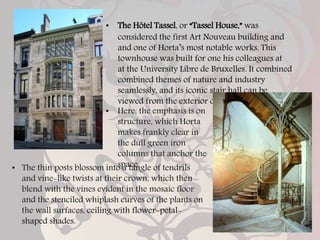
• The Hôtel Tassel, or “Tassel House,” was
considered the first Art Nouveau building and
and one of Horta’s most notable works. This
townhouse was built for one his colleagues at
at the University Libre de Bruxelles. It combined
combined themes of nature and industry
seamlessly, and its iconic stair hall can be
viewed from the exterior of the building.
• Here, the emphasis is on
structure, which Horta
makes frankly clear in
the dull green iron
columns that anchor the
space.
• The thin posts blossom into a tangle of tendrils
and vine-like twists at their crown, which then
blend with the vines evident in the mosaic floor
and the stenciled whiplash curves of the plants on
the wall surfaces, ceiling with flower-petal-
shaped shades.
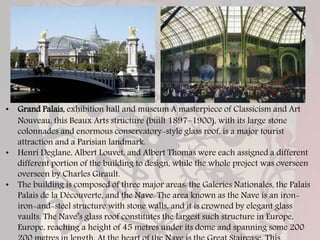
• Grand Palais, exhibition hall and museum A masterpiece of Classicism and Art
Nouveau, this Beaux Arts structure (built 1897–1900), with its large stone
colonnades and enormous conservatory-style glass roof, is a major tourist
attraction and a Parisian landmark.
• Henri Deglane, Albert Louvet, and Albert Thomas were each assigned a different
different portion of the building to design, while the whole project was overseen
overseen by Charles Girault.
• The building is composed of three major areas: the Galeries Nationales, the Palais
Palais de la Découverte, and the Nave. The area known as the Nave is an iron-
iron-and-steel structure with stone walls, and it is crowned by elegant glass
vaults. The Nave’s glass roof constitutes the largest such structure in Europe,
Europe, reaching a height of 45 metres under its dome and spanning some 200
Louis Comfort Tiffany
Lifetime: 1848–1933
Nationality: American
Medium: Painting, decorative art, glass
making
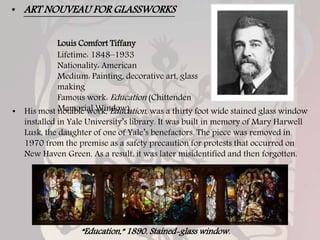
Famous work: Education (Chittenden
Memorial Window)
• His most notable work, Education, was a thirty foot wide stained glass window
installed in Yale University’s library. It was built in memory of Mary Harwell
Lusk, the daughter of one of Yale’s benefactors. The piece was removed in
1970 from the premise as a safety precaution for protests that occurred on
New Haven Green. As a result, it was later misidentified and then forgotten.
“Education,” 1890. Stained-glass window.
• ART NOUVEAU FOR GLASSWORKS
Émile Gallé
Lifetime: 1846–1904
Nationality: French
Medium: Glass maker
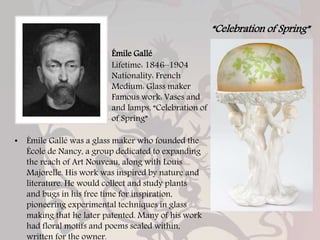
Famous work: Vases and
and lamps, “Celebration of
of Spring”
• Émile Gallé was a glass maker who founded the
École de Nancy, a group dedicated to expanding
the reach of Art Nouveau, along with Louis
Majorelle. His work was inspired by nature and
literature. He would collect and study plants
and bugs in his free time for inspiration,
pioneering experimental techniques in glass
making that he later patented. Many of his work
had floral motifs and poems sealed within,
written for the owner.
“Celebration of Spring”
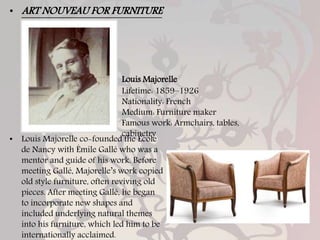
Louis Majorelle
Lifetime: 1859–1926
Nationality: French
Medium: Furniture maker
Famous work: Armchairs, tables,
cabinetry
• Louis Majorelle co-founded the École
de Nancy with Émile Gallé who was a
mentor and guide of his work. Before
meeting Gallé, Majorelle’s work copied
old style furniture, often reviving old
pieces. After meeting Gallé, he began
to incorporate new shapes and
included underlying natural themes
into his furniture, which led him to be
internationally acclaimed.
• ART NOUVEAU FOR FURNITURE
THANK YOU

Art Nouveau Moment

  • 1.
  • 2.
    INTODUCTION • Art Nouveau,ornamental style of art that flourished between about 1890 and 1910 throughout Europe and the United States. • The most important places for architecture during this period were Brussels, Paris and Barcelona. The name 'Art nouveau' is French for 'new 'new art'. • It represents the beginning of modernism in design(Modern Architecture). Architecture). It occurred at a time when 1. Mass-produced consumer goods began to fill the marketplace, and 2. Designers, architects, and artist began to understand that the handcrafted handcrafted work of centuries past could be lost. • Flourished in major European cities and emerged in the early 1890s in 1890s in all the visual arts: 1. Painting 7. jewellery 2. Sculpture 8. clothing and 3. Architecture 9. furniture 4. Interior design 5. graphic arts 6. Posters
  • 3.
    • ART NOUVEAUMOMENT OF PAINTINGS Aubrey Beardsley Lifetime: 1872–1898 Nationality: British Medium: Illustration art Famous work: The Dancer’s Reward (Salome) • In his poster, the character Salome holds the head of John the Baptist on a table. This grotesque representation was characteristic of his black ink drawings of the time and solidified his dubious reputation in Art Nouveau. The Dancer’s Reward (Salome),” 1894.
  • 4.
    Gustav Klimt Lifetime: 1862–1918 Nationality:Austrian Medium: Painting Notable work: The Kiss • Klimt’s primary subject in his Art Nouveau paintings was the female figure. His popular work, The Kiss, is one of the most instantly recognizable examples of his work, and one the few paintings of his that features a man. This piece is a notable work from his “Golden Phase,” which is considered a leading example of the Art Nouveau movement. “The Kiss,” 1908. Oil painting.
  • 5.
    Alphonse Mucha Lifetime: 1860–1939 1939 Nationality:Czech Medium: Painting Famous work: Gismonda • His lithograph, Gismonda, had a large impact on Art Nouveau. This piece was created for the eponymous Renaissance play by Victorian Sardou. The woman in the poster, Sarah Bernhardt, wears a costume from the fourth and final act of the play. She was the single most influential figure in Mucha’s work. “Gismonda,” 1894.
  • 6.
    Arthur Heygate Mackmurdo Lifetime:1851–1942 Nationality: British Famouswork:Cover design for Wren's City Churches Cover design for Wren’s City Churches • The woodcut as a genre points to the handcrafted, unique quality of the work and the simplicity of Mackmurdo's use of positive and negative space both contribute to this association. the trademark whiplash curves are characteristic of the visual sense of free movement and energy that would eventually define Art Nouveau.
  • 7.
    • ART NOUVEAUMOMENT OF ARCHITECTURE • Art Nouveau buildings have these features: 1. Asymmetrical shapes 2. Extensive use of arches and curved forms 3. Curved glass 4. Curving plant-like embellishments 5. Mosaics 6. Stained glass • Materials used 1. Stained glass 2. Wrought iron 3. Mosaic tiles 4. Lime mortar 5. Wall papers 6. Glazed stucco
  • 8.
    Antoni Gaudí iCornet Lifetime: 1852–1926 Nationality: Catalan Medium: Architecture Notable work: La Sagrada Familia • Antoni Gaudí was an innovative architect who worked predominantly in Barcelona where his Art Nouveau style filled the city. His work was inspired by nature and the Catholic faith, with curved lines and vibrant surfaces that differed from typical architectural styles. Benches in Parc Güell are designed to align with the human spine and the balconies of Casa Mila represent abstractions of leaves and blades of grass. It was this inspiration that separated Gaudí from other styles of the time and distinguished him as a member of Art Nouveau
  • 9.
    • La SagradaFamilia, or Holy Family Church, is Antoni Gaudi's most ambitious work, and construction construction is still ongoing. • A notable example of this is Gaudi's innovative "leaning columns" (that is, columns that are are not at right angles to the floor floor and ceiling). • When Sagrada Familia is complete, the church will have a total of 18 towers, each dedicated to a different religious figure, and each one hollow, allowing the placement of various types of bells which will sound with the choir. • The architectural style of Sagrada Familia has been called "warped Gothic“. Gaudi believed that color is life, and, knowing that he would not live to see the completion of his masterpiece, the master architect left colored drawings of his vision for future architects to follow
  • 10.
    • Casa MilàBarcelona, or la Pedrera, by Antoni Gaudi was built as a city apartment building. • Wavy walls made of rough-chipped stone suggest fossilized ocean waves. • Doors and windows look like they are dug out of sand. Wrought iron balconies balconies contrast with the limestone. • A comical array of chimney stacks dances across the roof. • This unique building is widely but unofficially known as La Pedrera (the Quarry). Quarry). In 1984, UNESCO classified Casa Milà as a World Heritage site. Today, Today, visitors can take tours of La Pedrera as it is used for cultural expositions.
  • 11.
    Victor Horta Lifetime: 1861–1947 Nationality:Belgian Medium: Architecture Famous work: Hôtel Tassel • Victor Horta was one of the founders of Art Nouveau and known for expanding the movement from visual and decorative arts into architecture. Horta’s work was marked by his understanding of industrial advances with both iron and glass. His buildings featured twisted and bent iron that extended seamlessly from the exterior to the decor
  • 12.
    • The HôtelTassel, or “Tassel House,” was considered the first Art Nouveau building and and one of Horta’s most notable works. This townhouse was built for one his colleagues at at the University Libre de Bruxelles. It combined combined themes of nature and industry seamlessly, and its iconic stair hall can be viewed from the exterior of the building. • Here, the emphasis is on structure, which Horta makes frankly clear in the dull green iron columns that anchor the space. • The thin posts blossom into a tangle of tendrils and vine-like twists at their crown, which then blend with the vines evident in the mosaic floor and the stenciled whiplash curves of the plants on the wall surfaces, ceiling with flower-petal- shaped shades.
  • 13.
    • Grand Palais,exhibition hall and museum A masterpiece of Classicism and Art Nouveau, this Beaux Arts structure (built 1897–1900), with its large stone colonnades and enormous conservatory-style glass roof, is a major tourist attraction and a Parisian landmark. • Henri Deglane, Albert Louvet, and Albert Thomas were each assigned a different different portion of the building to design, while the whole project was overseen overseen by Charles Girault. • The building is composed of three major areas: the Galeries Nationales, the Palais Palais de la Découverte, and the Nave. The area known as the Nave is an iron- iron-and-steel structure with stone walls, and it is crowned by elegant glass vaults. The Nave’s glass roof constitutes the largest such structure in Europe, Europe, reaching a height of 45 metres under its dome and spanning some 200
  • 14.
    Louis Comfort Tiffany Lifetime:1848–1933 Nationality: American Medium: Painting, decorative art, glass making Famous work: Education (Chittenden Memorial Window) • His most notable work, Education, was a thirty foot wide stained glass window installed in Yale University’s library. It was built in memory of Mary Harwell Lusk, the daughter of one of Yale’s benefactors. The piece was removed in 1970 from the premise as a safety precaution for protests that occurred on New Haven Green. As a result, it was later misidentified and then forgotten. “Education,” 1890. Stained-glass window. • ART NOUVEAU FOR GLASSWORKS
  • 15.
    Émile Gallé Lifetime: 1846–1904 Nationality:French Medium: Glass maker Famous work: Vases and and lamps, “Celebration of of Spring” • Émile Gallé was a glass maker who founded the École de Nancy, a group dedicated to expanding the reach of Art Nouveau, along with Louis Majorelle. His work was inspired by nature and literature. He would collect and study plants and bugs in his free time for inspiration, pioneering experimental techniques in glass making that he later patented. Many of his work had floral motifs and poems sealed within, written for the owner. “Celebration of Spring”
  • 16.
    Louis Majorelle Lifetime: 1859–1926 Nationality:French Medium: Furniture maker Famous work: Armchairs, tables, cabinetry • Louis Majorelle co-founded the École de Nancy with Émile Gallé who was a mentor and guide of his work. Before meeting Gallé, Majorelle’s work copied old style furniture, often reviving old pieces. After meeting Gallé, he began to incorporate new shapes and included underlying natural themes into his furniture, which led him to be internationally acclaimed. • ART NOUVEAU FOR FURNITURE
  • 17.