

Art Nouveau
Hriday Das
13110014
B. Arch 2nd yr
IIT Roorkee
Art Nouveau
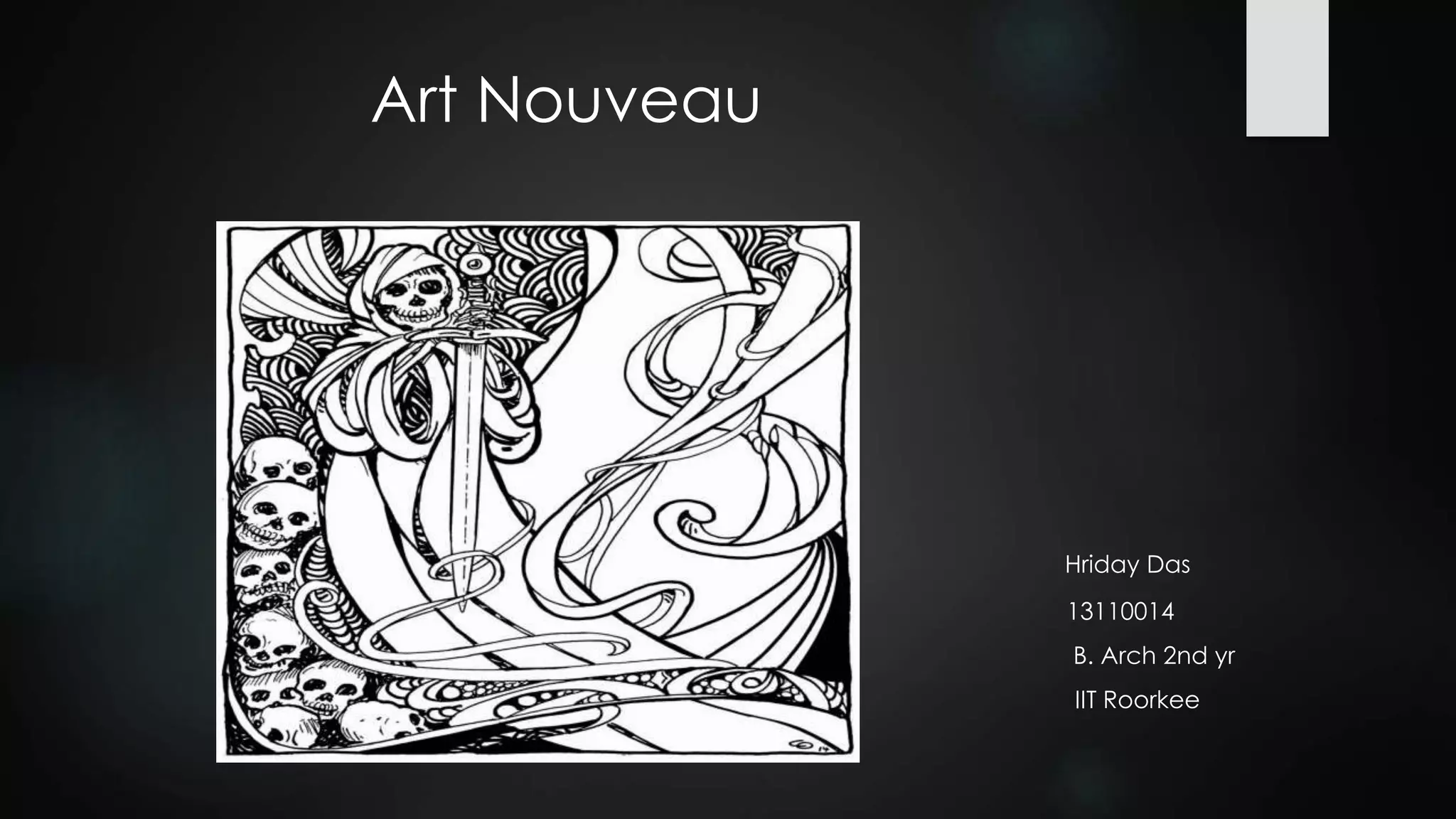
Art Nouveau, 1890-1914, explores a new style in the visual arts and architecture
that developed in Europe and North America at the end of the nineteenth century.
The exhibition is divided into three sections: the first focuses on the 1900 World's
Fair in Paris, where Art Nouveau was established as the first new decorative style
of the twentieth century; the second examines the sources that influenced the
style; and the third looks at its development and fruition in major cities in Europe
and North America.
At its height exactly one hundred years ago, Art Nouveau was a concerted
attempt to create an international style based on decoration. It was developed by
a brilliant and energetic generation of artists and designers, who sought to
fashion an art form appropriate to the modern age. During this extraordinary time,
urban life as we now understand it was established. Old customs, habits, and
artistic styles sat alongside new, combining a wide range of contradictory images
and ideas. Many artists, designers, and architects were excited by new
technologies and lifestyles, while others retreated into the past, embracing the
spirit world, fantasy, and myth.
Art Nouveau
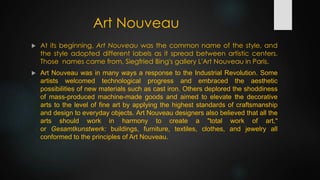
 At its beginning, Art Nouveau was the common name of the style, and
the style adopted different labels as it spread between artistic centers.
Those names came from, Siegfried Bing's gallery L'Art Nouveau in Paris.
 Art Nouveau was in many ways a response to the Industrial Revolution. Some
artists welcomed technological progress and embraced the aesthetic
possibilities of new materials such as cast iron. Others deplored the shoddiness
of mass-produced machine-made goods and aimed to elevate the decorative
arts to the level of fine art by applying the highest standards of craftsmanship
and design to everyday objects. Art Nouveau designers also believed that all the
arts should work in harmony to create a "total work of art,"
or Gesamtkunstwerk: buildings, furniture, textiles, clothes, and jewelry all
conformed to the principles of Art Nouveau.
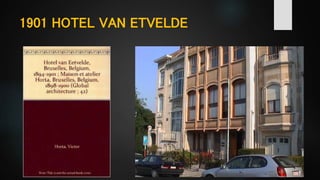
1901 HOTEL VAN ETVELDE
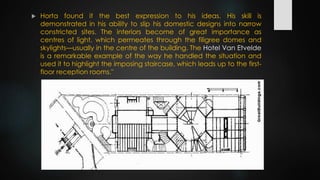
 Horta found it the best expression to his ideas. His skill is
demonstrated in his ability to slip his domestic designs into narrow
constricted sites. The interiors become of great importance as
centres of light, which permeates through the filigree domes and
skylights—usually in the centre of the building. The Hotel Van Etvelde
is a remarkable example of the way he handled the situation and
used it to highlight the imposing staircase, which leads up to the first-
floor reception rooms."
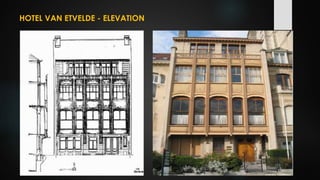
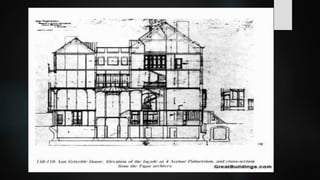
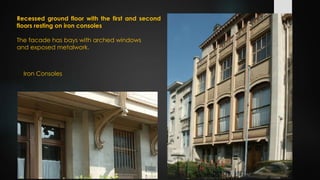
HOTEL VAN ETVELDE - ELEVATION
Recessed ground floor with the first and second
floors resting on iron consoles
The facade has bays with arched windows
and exposed metalwork.
Iron Consoles
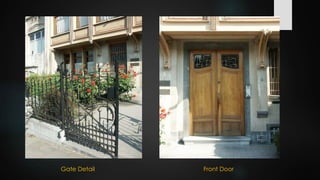
Gate Detail Front Door
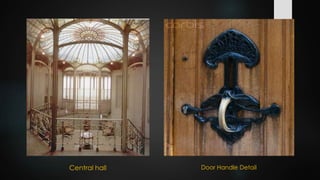
Central hall Door Handle Detail
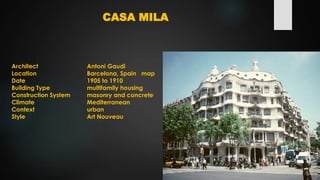
CASA MILA
Architect Antoni Gaudi
Location Barcelona, Spain map
Date 1905 to 1910
Building Type multifamily housing
Construction System masonry and concrete
Climate Mediterranean
Context urban
Style Art Nouveau
The wavy facade, with its large pores, reminds one also of an undulating beach of fine
sand, formed, for example, by a receding dune.
The honeycombs made by industrious bees might also spring to the mind of the observer
viewing the snake-like ups-and-downs that run through the whole building.
CASA MILA
The building does not have any straight lines.
The most astonishing part is the roof with an almost lunar appearance and dream like
landscape.
The building can be considered more of a sculpture than a regular building. Critics remark
on its detachment from usefulness, but others consider it to be art. The Barcelonese of the
time considered it ugly, hence the "quarry" nickname, but today it is a landmark of
Barcelona.
Most people consider it magnificent and overwhelming -- some say it is like waves of
lava or a sand-dune. This building seems to break our understanding of conventional
architecture
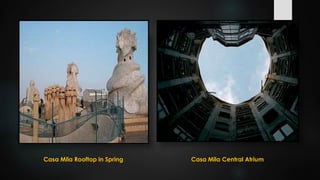
Casa Mila Rooftop in Spring Casa Mila Central Atrium
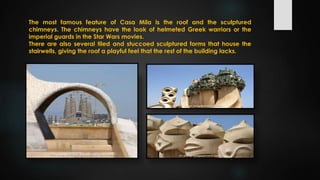
The most famous feature of Casa Mila is the roof and the sculptured
chimneys. The chimneys have the look of helmeted Greek warriors or the
imperial guards in the Star Wars movies.
There are also several tiled and stuccoed sculptured forms that house the
stairwells, giving the roof a playful feel that the rest of the building lacks.
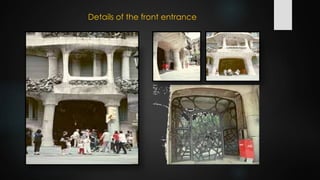
Details of the front entrance
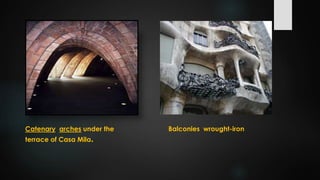
Catenary arches under the
terrace of Casa Mila.
Balconies wrought-iron
Biblography
http://www.vub.ac.be/ARCH/ae-lab/publications/SAHC_full_paper_D26_Quentin_Collette(Belgium).pdf
http://www.caans-acaen.ca/Journal/issues_online/Issue_VI_ii_1985/Tsihlias.pdf
http://visitbrussels.be/bitc/BE_en/content/2791/victor-horta-and-brussels.do
http://www.hortamuseum.be/en/horta-en/biography
George Kohlmeir, House of Glass
http://www.monarchie.be/palace-and-heritage/greenhouses-laeken
http://www.johncoulthart.com/feuilleton/2011/03/01/the-royal-greenhouses-of-laeken/
Art nouveau

Art nouveau

  • 1.
    Art Nouveau Hriday Das 13110014 B.Arch 2nd yr IIT Roorkee
  • 2.
    Art Nouveau Art Nouveau,1890-1914, explores a new style in the visual arts and architecture that developed in Europe and North America at the end of the nineteenth century. The exhibition is divided into three sections: the first focuses on the 1900 World's Fair in Paris, where Art Nouveau was established as the first new decorative style of the twentieth century; the second examines the sources that influenced the style; and the third looks at its development and fruition in major cities in Europe and North America. At its height exactly one hundred years ago, Art Nouveau was a concerted attempt to create an international style based on decoration. It was developed by a brilliant and energetic generation of artists and designers, who sought to fashion an art form appropriate to the modern age. During this extraordinary time, urban life as we now understand it was established. Old customs, habits, and artistic styles sat alongside new, combining a wide range of contradictory images and ideas. Many artists, designers, and architects were excited by new technologies and lifestyles, while others retreated into the past, embracing the spirit world, fantasy, and myth.
  • 3.
    Art Nouveau  Atits beginning, Art Nouveau was the common name of the style, and the style adopted different labels as it spread between artistic centers. Those names came from, Siegfried Bing's gallery L'Art Nouveau in Paris.  Art Nouveau was in many ways a response to the Industrial Revolution. Some artists welcomed technological progress and embraced the aesthetic possibilities of new materials such as cast iron. Others deplored the shoddiness of mass-produced machine-made goods and aimed to elevate the decorative arts to the level of fine art by applying the highest standards of craftsmanship and design to everyday objects. Art Nouveau designers also believed that all the arts should work in harmony to create a "total work of art," or Gesamtkunstwerk: buildings, furniture, textiles, clothes, and jewelry all conformed to the principles of Art Nouveau.
  • 4.
  • 5.
     Horta foundit the best expression to his ideas. His skill is demonstrated in his ability to slip his domestic designs into narrow constricted sites. The interiors become of great importance as centres of light, which permeates through the filigree domes and skylights—usually in the centre of the building. The Hotel Van Etvelde is a remarkable example of the way he handled the situation and used it to highlight the imposing staircase, which leads up to the first- floor reception rooms."
  • 6.
    HOTEL VAN ETVELDE- ELEVATION
  • 8.
    Recessed ground floorwith the first and second floors resting on iron consoles The facade has bays with arched windows and exposed metalwork. Iron Consoles
  • 9.
  • 10.
    Central hall DoorHandle Detail
  • 11.
    CASA MILA Architect AntoniGaudi Location Barcelona, Spain map Date 1905 to 1910 Building Type multifamily housing Construction System masonry and concrete Climate Mediterranean Context urban Style Art Nouveau
  • 12.
    The wavy facade,with its large pores, reminds one also of an undulating beach of fine sand, formed, for example, by a receding dune. The honeycombs made by industrious bees might also spring to the mind of the observer viewing the snake-like ups-and-downs that run through the whole building. CASA MILA The building does not have any straight lines. The most astonishing part is the roof with an almost lunar appearance and dream like landscape. The building can be considered more of a sculpture than a regular building. Critics remark on its detachment from usefulness, but others consider it to be art. The Barcelonese of the time considered it ugly, hence the "quarry" nickname, but today it is a landmark of Barcelona. Most people consider it magnificent and overwhelming -- some say it is like waves of lava or a sand-dune. This building seems to break our understanding of conventional architecture
  • 13.
    Casa Mila Rooftopin Spring Casa Mila Central Atrium
  • 14.
    The most famousfeature of Casa Mila is the roof and the sculptured chimneys. The chimneys have the look of helmeted Greek warriors or the imperial guards in the Star Wars movies. There are also several tiled and stuccoed sculptured forms that house the stairwells, giving the roof a playful feel that the rest of the building lacks.
  • 15.
    Details of thefront entrance
  • 16.
    Catenary arches underthe terrace of Casa Mila. Balconies wrought-iron
  • 17.