Art Deco 1920
Overview
 First appeared in France after WW1, at an art exhibition set up by the society of
decorative artists in 1925
 Successor to the Art Nouveau style, popular between 1890s-1910, and focused
more on natural forms, plants and flowers
 Influenced the design of buildings, furniture, clothing, graphics and jewellery
 Characterised by bold geometric shapes, rare and expensive materials and
bright colours
 Came about during the Post War Era, which represented a loss of innocence and
rapid advancement in technology, as technology developed from the war, was
being used for commercial use instead
 The trend spread quickly over Europe, and was popular in the US amongst the
wealthy and middle class
 Merging Ancient and Futuristic styles: Advanced for the time, but has many
characteristics of Ancient art and Architecture (hieroglyphs, runes etc.)
Overview
 The use of Triangles and rectangles is extremely popular
 Use of layered Motifs
 Machine like metallic
 Ascending and descending rectangles
 Embellishments similar to Ancient Egyptian headdress and lots of patterns
similar to what's on Greek Pottery
 Colour scheme: Ancient Greek Art/Pottery
 Tiny details are important
 Grandeur and sophisticated but futuristic
 Fully developed in late 1920s, survived the Great Depression and was at its peak
in the 1930s
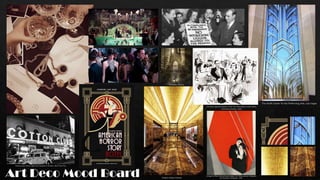
Art Deco Mood Board
The Smith Center for the Performing Arts, Las Vegas
Empire State Interior
Famous jazz music night club located in Harlem, New York City
Art Deco type illustration. From The Illustrated London News,
Christmas Number, 1933.
Vintage Art Deco red and black design of a 1920s woman clinging to
her boyfriend; lithograph, 1928.
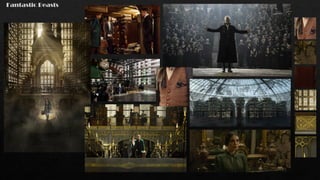
Fantastic Beasts
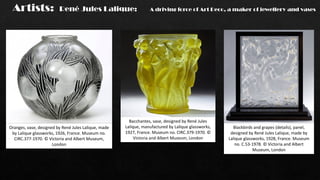
Artists: René Jules Lalique: A driving force of Art Deco, a maker of jewellery and vases
Oranges, vase, designed by René Jules Lalique, made
by Lalique glassworks, 1926, France. Museum no.
CIRC.377-1970. © Victoria and Albert Museum,
London
Bacchantes, vase, designed by René Jules
Lalique, manufactured by Lalique glassworks,
1927, France. Museum no. CIRC.379-1970. ©
Victoria and Albert Museum, London
Blackbirds and grapes (details), panel,
designed by René Jules Lalique, made by
Lalique glassworks, 1928, France. Museum
no. C.53-1978. © Victoria and Albert
Museum, London
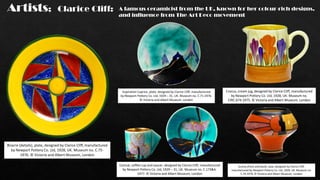
Bizarre (details), plate, designed by Clarice Cliff, manufactured
by Newport Pottery Co. Ltd, 1928, UK. Museum no. C.75-
1976. © Victoria and Albert Museum, London
Crocus, cream jug, designed by Clarice Cliff, manufactured
by Newport Pottery Co. Ltd, 1928, UK. Museum no.
CIRC.674-1975. © Victoria and Albert Museum, London
Inspiration Caprice, plate, designed by Clarice Cliff, manufactured
by Newport Pottery Co. Ltd, 1929 – 31, UK. Museum no. C.71-1976.
© Victoria and Albert Museum, London
Sunray (front and back), vase, designed by Clarice Cliff,
manufactured by Newport Pottery Co. Ltd, 1929, UK. Museum no.
C.74-1976. © Victoria and Albert Museum, London
Conical, coffee cup and saucer, designed by Clarice Cliff, manufactured
by Newport Pottery Co. Ltd, 1929 – 31, UK. Museum no. C.173&A-
1977. © Victoria and Albert Museum, London
Artists; Clarice Cliff: A famous ceramicist from the UK, known for her colour-rich designs,
and influence from The Art Deco movement
Media
Great Gatsby Metropolis 1927 Bioshock
Fantastic Beasts
Fantastic Beasts
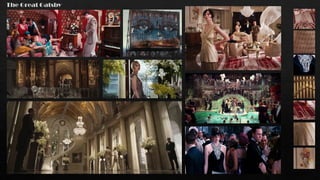
The Great Gatsby
Architecture
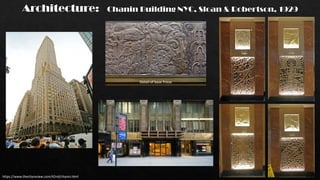
Architecture: Chanin Building NYC, Sloan & Robertson, 1929
Detail of base frieze
https://www.thecityreview.com/42nd/chanin.html
Architecture: Chrysler Building NYC, William Van Alen, 1928
https://www.thecityreview.com/42nd/chanin.html
Art Deco Style noticeable at the top of the building and its interior
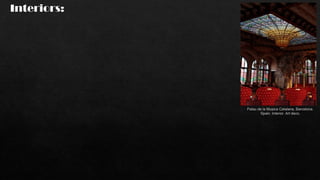
Interiors:
Palau de la Musica Catalana, Barcelona.
Spain. Interior. Art deco,
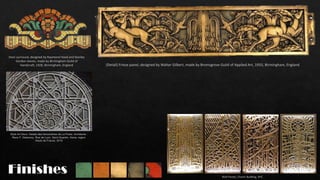
Finishes
Door surround, designed by Raymond Hood and Stanley
Gordon Jeeves, made by Birmingham Guild of
Handicraft, 1928, Birmingham, England (Detail) Frieze panel, designed by Walter Gilbert, made by Bromsgrove Guild of Applied Art, 1933, Birmingham, England
Wall Panels, Chanin Building, NYC
Style Art Deco. Details des ferronneries de La Poste. Architecte :
Rene F. Delannoy. Rue de Lyon. Saint Quentin, Aisne, region
Hauts de France, 2019
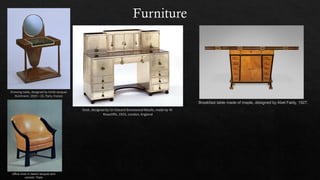
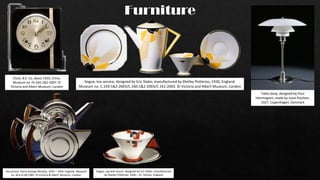
Furniture
Dressing table, designed by Emile Jacques
Ruhlmann, 1919 – 23, Paris, France
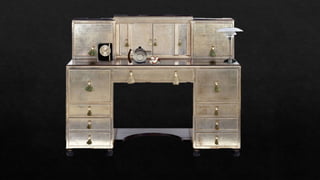
Desk, designed by Sir Edward Brantwood Maufe, made by W.
Rowcliffe, 1925, London, England
Breakfast table made of maple, designed by Abel Faidy, 1927.
office chair in beech lacquer and
varnish; Paris
Furniture
Clock, B.E. Co, about 1935, China.
Museum no. FE.565:1&2-2007. ©
Victoria and Albert Museum, London
Table lamp, designed by Poul
Henningsen, made by Louis Poulsen,
1927, Copenhagen, Denmark
Vogue, cup and saucer, designed by Eric Slater, manufactured
by Shelley Potteries, 1930 – 31, Fenton, England
Tea service, Harry George Murphy, 1933 – 1934, England. Museum
no. M.6 to 6b 1985. © Victoria & Albert Museum, London
Vogue, tea service, designed by Eric Slater, manufactured by Shelley Potteries, 1930, England.
Museum no. C.159:1&2-2003/C.160:1&2-2003/C.161-2003. © Victoria and Albert Museum, London
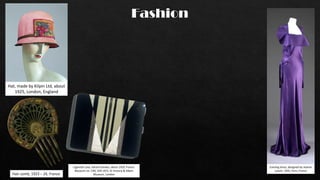
Fashion
Hat, made by Kilpin Ltd, about
1925, London, England
Evening dress, designed by Jeanne
Lanvin, 1935, Paris, France
Hair comb, 1923 – 24, France
Cigarette case, Gérard Sandoz, about 1929, France.
Museum no. CIRC.329-1972. © Victoria & Albert
Museum, London

Art deco-research-boards-first-draft

  • 1.
  • 2.
    Overview  First appearedin France after WW1, at an art exhibition set up by the society of decorative artists in 1925  Successor to the Art Nouveau style, popular between 1890s-1910, and focused more on natural forms, plants and flowers  Influenced the design of buildings, furniture, clothing, graphics and jewellery  Characterised by bold geometric shapes, rare and expensive materials and bright colours  Came about during the Post War Era, which represented a loss of innocence and rapid advancement in technology, as technology developed from the war, was being used for commercial use instead  The trend spread quickly over Europe, and was popular in the US amongst the wealthy and middle class  Merging Ancient and Futuristic styles: Advanced for the time, but has many characteristics of Ancient art and Architecture (hieroglyphs, runes etc.)
  • 3.
    Overview  The useof Triangles and rectangles is extremely popular  Use of layered Motifs  Machine like metallic  Ascending and descending rectangles  Embellishments similar to Ancient Egyptian headdress and lots of patterns similar to what's on Greek Pottery  Colour scheme: Ancient Greek Art/Pottery  Tiny details are important  Grandeur and sophisticated but futuristic  Fully developed in late 1920s, survived the Great Depression and was at its peak in the 1930s
  • 4.
    Art Deco MoodBoard The Smith Center for the Performing Arts, Las Vegas Empire State Interior Famous jazz music night club located in Harlem, New York City Art Deco type illustration. From The Illustrated London News, Christmas Number, 1933. Vintage Art Deco red and black design of a 1920s woman clinging to her boyfriend; lithograph, 1928. Fantastic Beasts
  • 5.
    Artists: René JulesLalique: A driving force of Art Deco, a maker of jewellery and vases Oranges, vase, designed by René Jules Lalique, made by Lalique glassworks, 1926, France. Museum no. CIRC.377-1970. © Victoria and Albert Museum, London Bacchantes, vase, designed by René Jules Lalique, manufactured by Lalique glassworks, 1927, France. Museum no. CIRC.379-1970. © Victoria and Albert Museum, London Blackbirds and grapes (details), panel, designed by René Jules Lalique, made by Lalique glassworks, 1928, France. Museum no. C.53-1978. © Victoria and Albert Museum, London
  • 6.
    Bizarre (details), plate,designed by Clarice Cliff, manufactured by Newport Pottery Co. Ltd, 1928, UK. Museum no. C.75- 1976. © Victoria and Albert Museum, London Crocus, cream jug, designed by Clarice Cliff, manufactured by Newport Pottery Co. Ltd, 1928, UK. Museum no. CIRC.674-1975. © Victoria and Albert Museum, London Inspiration Caprice, plate, designed by Clarice Cliff, manufactured by Newport Pottery Co. Ltd, 1929 – 31, UK. Museum no. C.71-1976. © Victoria and Albert Museum, London Sunray (front and back), vase, designed by Clarice Cliff, manufactured by Newport Pottery Co. Ltd, 1929, UK. Museum no. C.74-1976. © Victoria and Albert Museum, London Conical, coffee cup and saucer, designed by Clarice Cliff, manufactured by Newport Pottery Co. Ltd, 1929 – 31, UK. Museum no. C.173&A- 1977. © Victoria and Albert Museum, London Artists; Clarice Cliff: A famous ceramicist from the UK, known for her colour-rich designs, and influence from The Art Deco movement
  • 7.
    Media Great Gatsby Metropolis1927 Bioshock Fantastic Beasts
  • 8.
  • 9.
  • 10.
  • 11.
    Architecture: Chanin BuildingNYC, Sloan & Robertson, 1929 Detail of base frieze https://www.thecityreview.com/42nd/chanin.html
  • 12.
    Architecture: Chrysler BuildingNYC, William Van Alen, 1928 https://www.thecityreview.com/42nd/chanin.html Art Deco Style noticeable at the top of the building and its interior
  • 13.
    Interiors: Palau de laMusica Catalana, Barcelona. Spain. Interior. Art deco,
  • 14.
    Finishes Door surround, designedby Raymond Hood and Stanley Gordon Jeeves, made by Birmingham Guild of Handicraft, 1928, Birmingham, England (Detail) Frieze panel, designed by Walter Gilbert, made by Bromsgrove Guild of Applied Art, 1933, Birmingham, England Wall Panels, Chanin Building, NYC Style Art Deco. Details des ferronneries de La Poste. Architecte : Rene F. Delannoy. Rue de Lyon. Saint Quentin, Aisne, region Hauts de France, 2019
  • 15.
    Furniture Dressing table, designedby Emile Jacques Ruhlmann, 1919 – 23, Paris, France Desk, designed by Sir Edward Brantwood Maufe, made by W. Rowcliffe, 1925, London, England Breakfast table made of maple, designed by Abel Faidy, 1927. office chair in beech lacquer and varnish; Paris
  • 17.
    Furniture Clock, B.E. Co,about 1935, China. Museum no. FE.565:1&2-2007. © Victoria and Albert Museum, London Table lamp, designed by Poul Henningsen, made by Louis Poulsen, 1927, Copenhagen, Denmark Vogue, cup and saucer, designed by Eric Slater, manufactured by Shelley Potteries, 1930 – 31, Fenton, England Tea service, Harry George Murphy, 1933 – 1934, England. Museum no. M.6 to 6b 1985. © Victoria & Albert Museum, London Vogue, tea service, designed by Eric Slater, manufactured by Shelley Potteries, 1930, England. Museum no. C.159:1&2-2003/C.160:1&2-2003/C.161-2003. © Victoria and Albert Museum, London
  • 18.
    Fashion Hat, made byKilpin Ltd, about 1925, London, England Evening dress, designed by Jeanne Lanvin, 1935, Paris, France Hair comb, 1923 – 24, France Cigarette case, Gérard Sandoz, about 1929, France. Museum no. CIRC.329-1972. © Victoria & Albert Museum, London