• Antoni Gaudí i Cornet (Riudoms or Reus, 25
June 1852 – Barcelona, 10 June 1926) was a
Spanish Catalan architect
• the best-known representative of Catalan
Modernism
• His works are marked by a highly individual
style
• the vast majority of them are situated in the
Catalan capital of Barcelona,
• Much of Gaudí's work was marked by the four
passions of his life: architecture, nature,
religion and his love for Catalonia
• he himself was skilled, such as ceramics,
stained glass, wrought ironwork forging and
carpentry
• introduced new techniques in the treatment
of the materials
• trencadis, made of waste ceramic pieces.
• Rarely did Gaudí draw detailed plans of his
works
• instead preferred to create them as three-
dimensional scale
• Gaudí’s work has widespread international
appeal
• admired by both professionals and the general
public
• Between 1984 and 2005 seven of his works
were declared World Heritage Sites by
UNESCO.
• Antoni Gaudí was born in 1852, to the
industrial Francesc Gaudí i Serra (1813–1906)
and Antònia Cornet i Bertran (1819–1876).
• family origins go back to the Auvergne region
in southern France
• Gaudí’s exact birthplace is unknown because
no documents stating it were kept
• it was Reus or Riudoms
• he was baptized in the church of Sant Pere
Apòstol in Reus the day after his birth
• name that appears on his baptismal certificate
is "Antoni Plàcid Guillem Gaudí i Cornet
• felt a deep appreciation for his native land
• ”We own the image. Fantasy comes from the
ghosts. Fantasy is what people in the North
own. We are concrete. The image comes from
the Mediterranean. Orestes knows his way,
where Hamlet is torn apart by his doubts”.
• time spent in his native land helped Gaudí to
get to know and study nature profoundly
• he later on became a member of the Centre
Excursionista de Catalunya (1879)
• Sometimes, he used to horse-ride, or walked
around ten kilometres a day.
• Young Gaudí was of a sickly nature;
• he suffered from rheumatism from childhood,
• led to his rather reticent and reserved
character
• This may also have been the reason for his
becoming a vegetarian along with Dr. Kneipp’s
hygienist theories.
• Gaudí’s first studies were at the nursery
school run by Francesc Berenguer, whose son,
also called Francesc, would later become one
of Gaudí’s main assistants
• he attended the Piarists school in Reus
• his talent for drawing stood out during his
• participation in the seminar El Arlequin (the
Harlequin)
• He also worked as an apprentice in the “Vapor
Nou” textile mill in Reus for some time.
• In 1868 he moved to Barcelona to study
teaching in the Convent del Carme.
• During his adolescence he was interested in
utopian socialism
• with his fellow students Eduard Toda i Güell
and Josep Ribera i Sans he planned a
restoration of the Poblet monastery that
would have transformed it into a Utopian
phalanstère.
• Between 1875 and 1878, Gaudí completed his
compulsory military service in the Infantry
regiment in Barcelona as a Military
Administrator.
• In 1876 his mother died at the age of 57, and
so did his brother Francesc, 25
• Gaudí studied architecture at the Llotja School
• the Barcelona Higher School of Architecture,
from which he graduated in 1878.
• He also attended French lectures and studied
history, economics, philosophy and aesthetics.
• His grades were average, some of them were
fails
• Gaudí cared more about his own interests
than those of the official courses
• When handing him his degree, Elies Rogent,
director of Barcelona Architecture School, said:
”We have given this academic title either to a fool
or a genius. Time will show.”
• To finance his studies, Gaudí worked as a
draughtsman for various architects and
constructors such as Leandre Serrallach, Joan
Martorell, Emili Sala Cortés, Francisco de Paula
del Villar y Lozano and Josep Fontserè.
• that was why Gaudí, when receiving his
degree, said to his friend the sculptor Llorenç
Matamala, with his ironical sense of humour:
”Llorenç, they’re saying I’m an architect now”
:P
• Gaudí’s first projects were the lampposts he
designed for the Plaça Reial in Barcelona, the
unfinished Girossi news stands and the
Cooperativa Obrera Mataronense (Workers'
Cooperative of Mataró).
• He became well known through his first
important commission, the Casa Vicens, and
subsequently received increasingly more
significant requests.
• At the Paris World Fair in 1878 Gaudí
displayed a showcase he had produced for the
glove manufacturer Comella.
• Its modernista design, which was at the same
time functional and aesthetic, impressed the
Catalan industrialist Eusebi Güell
• who later on contacted the architect to
request him to carry out various projects he
had in mind.
• In 1883 Gaudí accepted responsibility for the
recently-initiated works of the Basílica i
Temple Expiatori de la Sagrada Família
(Basilica and Expiatory Church of the Holy
Family, more commonly referred to in English
as the Sagrada Família).
• Given the number of commissions he began
receiving, he had to rely on a professional team
to be able to work on various projects
simultaneously.
• His team consisted of professionals from all fields
of construction.
• As a result of Gaudi’s increasing fame, in 1902 the
painter Joan Llimona chose Gaudí’s features to
represent Saint Philip Neri in the paintings in the
aisle of the Sant Felip Neri church in Barcelona
• Gaudí frequently changed his address
• Finally, in 1906, he settled in a house in the
Güell Park that he owned and which had been
constructed by his assistant Francesc
Berenguer as a showcase property for the
estate.
• Gaudí lived his life devoted entirely to his
profession, remaining single all his life.
• It seems that it was only on one occasion that
he felt attracted to a woman, Josefa Moreu,
teacher at the Mataró Cooperative, in 1884,
but this was not reciprocated.
• From then on, Gaudí took refuge in his deep
religiousness, which gave him profound
spiritual peace.
• From then on, Gaudí took refuge in his deep
religiousness, which gave him profound
spiritual peace.
• From then on, Gaudí took refuge in his deep
religiousness, which gave him profound
spiritual peace.
• Gaudí left hardly any written documents,
apart from technical reports of his works
required by official authorities, some letters
sent to friends (above all to Joan Maragall)
and a few journal articles.
Movements or styles in architectural history
• Ancient Egypt 3,050 BC to 900 BC
• Classical 850 BC to 476 AD
• Byzantine 527 to 565 AD.
• Romanesque 800 to 1200 AD
• Gothic Architecture 1100 to 1450 AD
• Renaissance Architecture 1400 to 1600 AD
• Baroque Architecture 1600 to 1830 AD
• Rococo Architecture 1650 to 1790 AD
• Neoclassicism in Architecture 1730 to 1925 AD
• Art Nouveau Architecture 1890 to 1914 AD
• Beaux Arts Architecture 1895 to 1925 AD
• Neo-Gothic Architecture 1905 to 1930 AD
• Art Deco Architecture 1925 to 1937 AD
• Sezession The Vienna Secession was founded on 3 April 1897 by
artists Gustav Klimt, Koloman Moser, Josef Hoffmann, Joseph Maria
Olbrich, Max Kurzweil, and others.
• Liberty It is simply a man’s name: Arthur Lasenby Liberty (1843-
1917), a London merchant whose shop specialized in ornaments,
fabrics and miscellaneous art objects associated with the then (the
late 1800s) emerging aesthetic movement known in French (and in
English) as Art Nouveau and in German as Jugendstil.
• Jugendstil art nouveau in Germany
• Art nouveau international philosophy and style of decorative
art
• Modernisme : it was the expression of a desire for the
modernisation and cultural resurgence of Catalonia, fed by the
dynamism of its capital, Barcelona
• three of whom are particularly well known for
their outstanding buildings: Antoni
Gaudí, Lluís Domènech i Montaner andJosep
Puig i Cadafalch.
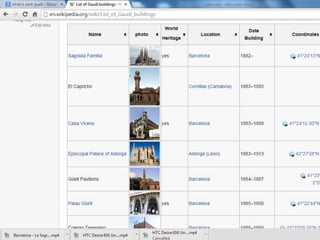
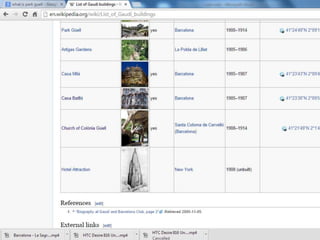
• Parque Güell
• Palacio Güell
• Casa Mila
• Casa Vicens
• Casa Batlló
• Crypt at the Colònia Güell
• Sagrada Familia
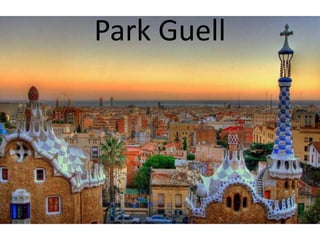
Parque guell
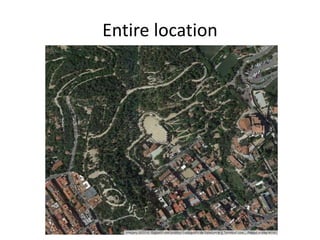
• Park Güell is a garden complex
with architectural elements situated on the hill
of El Carmel in the Gràcia district
of Barcelona Catalonia Spain. It was designed by
the Catalan architect Antoni Gaudíand built in the
years 1900 to 1914. It has an extension of 17.18
ha (0.1718 km²), which makes it one of the
largest architectural works in south Europe. It is
part of the UNESCO World Heritage Site "Works
of Antoni Gaudí".
Park Guell
• Eusebi Güell gave Gaudí the assignment of drawing up
plans for developing an estate for well-off families on a
large property he had acquired in the zone known
popularly as the Muntanya Pelada (bare mountain).
• Its location was unbeatable, in a healthy setting and
with splendid views over the sea and the Plain of
Barcelona.
• Allowance was made for some 60 triangular-shaped
plots on the estate, with a complex network of paths,
viaducts and steps to cope with the lie of the land.
• The building conditions were highly restrictive, as only
one-sixth of the plot could be built upon and the height
and placement of the houses was ordained so that
they could not block the view of the sea nor deprive
neighbours of sunlight.
Entire location
• Güell wanted to recreate the British residential parks, which is
why he named it Park Güell, in English.
•
Gaudí respected the vegetation that was already growing on
the property, such as the carob and olive trees, and when new
species were introduced, he opted for Mediterranean plants
that did not require much water.
• He also designed various systems for collecting and storing
water, based on the irrigation systems he had learned about
in the rural setting of his childhood.
• Both the vegetation and the management of the water
resources thus helped to prevent the erosion of the land
caused by the heavy Mediterranean downpours, while at the
same time helping to provide the water needed by the
estate’s inhabitants.
• October 1900 saw the start of work on dividing the site
into levels, with building work proceeding at a good
pace.
• On 4 January 1903, a description published in the
Anuari de l’Associació d’Arquitectes (Association of
Architects Year Book) noted that the two entrance
pavilions had been constructed, as well as the main
flight of steps, the shelter for horse-drawn carriages,
the outer enclosure, the viaducts and part of the great
esplanade, together with the water evacuation system.
• By 1907 events were already being held in the great
square, from which we know that the hypostyle room
was entirely covered by then, while the tiled bench
running around it was completed in 1914.
• The first person to buy a plot in the Park, in 1902, was a
friend of Güell, lawyer Martí Trias i Domènech, who
commissioned architect Juli Batllevell with building his
villa.
• At the same time, the works contractor, Josep Pardo i
Casanovas, built a show house, designed by Gaudí’s
assistant Francesc Berenguer, to encourage sales.
• Gaudí himself moved there in 1906 to live with his
father and niece.
• Shortly afterwards, in 1907, Eusebi Güell converted the
old mansion (Casa Larrard), that was already there when
he bought the site for development, into his usual
residence. Over those years, a large number of civic
events were held in the great square, with the owner’s
approval.
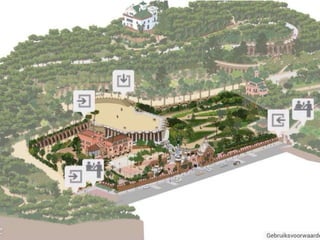
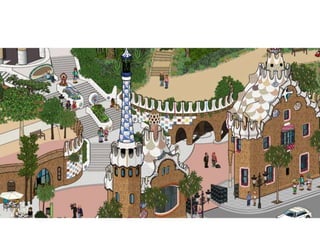
• The entrance and the porter's lodge pavilions
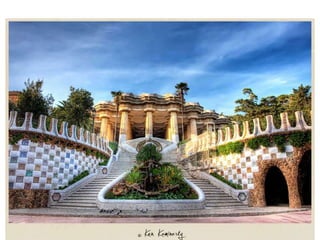
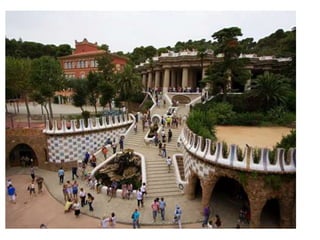
• The main entrance to Park Güell is on the south side, on
Carrer d’Olot, from which visitors can enjoy the spectacular
view of the stairway with the hypostyle room.
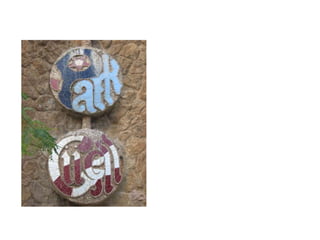
• The wall of the park is made of rustic stone topped with
ceramic tiling and medallions bearing the name of Park Güell.
The iron gates, designed in the shape of palm leaves, do not
form part of the original plan, but came from Casa Vicens
• To either side are the two pavilions that form the porter’s
lodge. The one to the left was the one actually used as a
porter’s lodge, with a waiting room and telephone booth,
while the one to the right was the porter’s residence, whence
the name Casa del Guarda, though it is today part of
the Barcelona History Museum. Both have very beautiful
roofs, built with the traditional Catalan clay tiles covered with
“trencadís”, a mosaic made of tile shards.
• The Dragon Stairway
• From the entrance esplanade a twin flight of steps
soars up, flanked by two walls with merlons that form
terraces under which there are two grottos.
• The one to the right was used for keeping the horses
and is supported by a magnificent conical central
column.
• The stairway is divided into three sections, along
which the water from a fountain runs, once supplied
from the tank under the hypostyle room.
• On the first landing are some capricious shapes like
goblins, while halfway up the steps is the emblem of
Catalonia and further up the dragon, or salamander,
covered with decorative tile-shard mosaic which has
become the most popular image of the park.
• On the last flight of steps, sheltered under the
hypostyle room, is a Greek-theatre shaped bench.
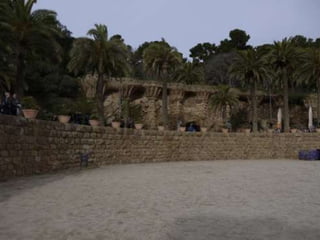
• The Hypostyle Room
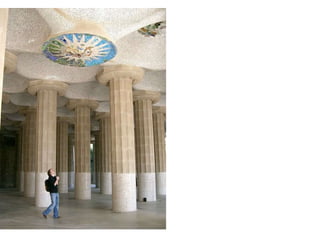
• The great entrance stairway leads to the Hypostyle Room, which
was designed to be the market for the estate.
• It is made up of 84 striated columns inspired in the Doric order.
• The outermost ones slope in an undulating movement clearly
contrary to the rules of classical composition, while reinforcing a
perception of their structural role. The colonnade is crowned by an
architrave on which the undulating bench is placed.
• A conduit running inside it collects the rainwater that filters down
from the square, sending it on to an underground tank, which has
as the stairway dragon’s mouth as its overflow.
• Inside the room the absence of columns in some sections creates
spaces that simulate three naves, like a great church.
• The ceiling is formed of small domes constructed using the
traditional technique of clay bricks decorated with original tile-
shard mosaics made by Josep M. Jujol, one of Gaudí’s assistants.
• The Greek Theatre or Nature Square
• Right at the centre of the monumental zone of Park Güell is
the large esplanade which the original plans called the
Greek Theatre and which has more recently been
rechristened as Plaça de la Natura (Nature Square).
• Its original name was due to the fact that it was planned for
staging large open-air shows that could be watched from
the surrounding terraces. Although Gaudí always respected
the lie of the land, this large square is artificial.
• Part of it is dug into the rock, while the other part is held up
on top of the hypostyle room. On the stairway side it is
bounded by the undulating bench covered with tile-shard
mosaic planned by Josep M. Jujol, acting as a balustrade,
and on the mountain side by a retaining wall finished with
large capitals made to look like palm trees.
• The Laundry Room Portico
• On the eastern side of the Greek Theatre square there is an original
iron door which leads to where there used to be the gardens of Casa
Larrard, the former mansion that Güell adopted as his own house,
but which has since 1931 been a school.
• The route, which runs at a level higher than that of the house,
passes through a pine grove with the portico backing onto a
retaining wall made from unworked stone.
• The portico adopts the shape of a great wave atop slanting columns,
with a double colonnade that acts as a buttress. It is one of the
finest examples of the organic architecture upheld by Gaudí.
• The same meaning, at once structural and aesthetic, can be
appreciated in the spiral ramp which takes visitors down to the
house, at the end of the path columns, with a double colonnade
that acts as a buttress. It is one of the finest examples of the organic
architecture upheld by Gaudí.
• The same meaning, at once structural and aesthetic, can be
appreciated in the spiral ramp which takes visitors down to the
house, at the end of the path.
• The Austria Gardens
• What we now know as the Austria Gardens was one of the
zones to be used as plots in the estate. When the Park
Güell was turned into a public park, however, the zone was
used as a municipal plant nursery.
• This part of the precinct has a completely different look to
the rest of the park, and it got its name through a donation
of trees from Austria in 1977.
• The garden has good views, and from its centre the two
houses that were built in Eusebi Güell's time can be seen:
the one belonging to lawyer Martí Trias i Domènech,
planned by architect Juli Batllevell, and the estate show
home, by Francesc Berenguer, which was finally acquired
by the Gaudí family for their home, and which is now
the Gaudí House Museum.
Casa mila
• Casa Milà also known as La Pedrera meaning
the 'The Quarry', is a modernist building located
at 92, Passeig de Gràcia (passeig is Catalan for
promenade) in Barcelona, Catalonia, Spain, at the
corner of Carrer de Provença, in the Eixample.
• It was one of the last civil works designed
by Catalan architect Antoni Gaudi and it was built
between the years 1906 and 1910. In 1912, Gaudí
and the Milà i Segimon signed the contract of
completion of the work of the Casa Milà.
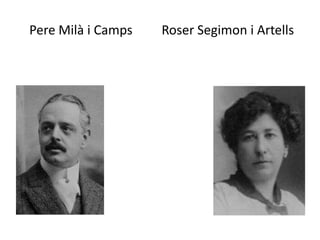
• It was commissioned by businessman Pere Milà i Camps
and his wife Roser Segimon i Artells, from Reus and widow
of the wealthy Indian Josep Guardiola i Grau
• Architecturally it is considered an innovative work by
having a structure of columns and floors free of load
bearing walls. Similarly, the front – which is made of stone
– is also self-supporting, i.e., not loads of floors. Another
innovative element was the construction of the
underground garage.
• In 1984, it was declared a World Heritage Site by UNESCO.
It is currently the headquarters of the Fundació-Catalunya
La Pedrera, which manages the various exhibitions and
activities done there and the public visits.
Pere Milà i Camps Roser Segimon i Artells
• There were no right
• http://architecture.about.com/cs/historicperi
ods/a/timeline.htm
• http://www.lapedrera.com/en/what-is-casa-
mila

Antoni gaudi presentation

  • 2.
    • Antoni Gaudíi Cornet (Riudoms or Reus, 25 June 1852 – Barcelona, 10 June 1926) was a Spanish Catalan architect • the best-known representative of Catalan Modernism • His works are marked by a highly individual style • the vast majority of them are situated in the Catalan capital of Barcelona,
  • 3.
    • Much ofGaudí's work was marked by the four passions of his life: architecture, nature, religion and his love for Catalonia • he himself was skilled, such as ceramics, stained glass, wrought ironwork forging and carpentry • introduced new techniques in the treatment of the materials • trencadis, made of waste ceramic pieces. • Rarely did Gaudí draw detailed plans of his works
  • 4.
    • instead preferredto create them as three- dimensional scale • Gaudí’s work has widespread international appeal • admired by both professionals and the general public • Between 1984 and 2005 seven of his works were declared World Heritage Sites by UNESCO.
  • 5.
    • Antoni Gaudíwas born in 1852, to the industrial Francesc Gaudí i Serra (1813–1906) and Antònia Cornet i Bertran (1819–1876).
  • 7.
    • family originsgo back to the Auvergne region in southern France • Gaudí’s exact birthplace is unknown because no documents stating it were kept • it was Reus or Riudoms • he was baptized in the church of Sant Pere Apòstol in Reus the day after his birth • name that appears on his baptismal certificate is "Antoni Plàcid Guillem Gaudí i Cornet
  • 8.
    • felt adeep appreciation for his native land • ”We own the image. Fantasy comes from the ghosts. Fantasy is what people in the North own. We are concrete. The image comes from the Mediterranean. Orestes knows his way, where Hamlet is torn apart by his doubts”.
  • 9.
    • time spentin his native land helped Gaudí to get to know and study nature profoundly • he later on became a member of the Centre Excursionista de Catalunya (1879) • Sometimes, he used to horse-ride, or walked around ten kilometres a day.
  • 10.
    • Young Gaudíwas of a sickly nature; • he suffered from rheumatism from childhood, • led to his rather reticent and reserved character • This may also have been the reason for his becoming a vegetarian along with Dr. Kneipp’s hygienist theories.
  • 11.
    • Gaudí’s firststudies were at the nursery school run by Francesc Berenguer, whose son, also called Francesc, would later become one of Gaudí’s main assistants • he attended the Piarists school in Reus • his talent for drawing stood out during his • participation in the seminar El Arlequin (the Harlequin) • He also worked as an apprentice in the “Vapor Nou” textile mill in Reus for some time.
  • 12.
    • In 1868he moved to Barcelona to study teaching in the Convent del Carme. • During his adolescence he was interested in utopian socialism • with his fellow students Eduard Toda i Güell and Josep Ribera i Sans he planned a restoration of the Poblet monastery that would have transformed it into a Utopian phalanstère.
  • 13.
    • Between 1875and 1878, Gaudí completed his compulsory military service in the Infantry regiment in Barcelona as a Military Administrator. • In 1876 his mother died at the age of 57, and so did his brother Francesc, 25
  • 14.
    • Gaudí studiedarchitecture at the Llotja School • the Barcelona Higher School of Architecture, from which he graduated in 1878. • He also attended French lectures and studied history, economics, philosophy and aesthetics. • His grades were average, some of them were fails • Gaudí cared more about his own interests than those of the official courses
  • 15.
    • When handinghim his degree, Elies Rogent, director of Barcelona Architecture School, said: ”We have given this academic title either to a fool or a genius. Time will show.” • To finance his studies, Gaudí worked as a draughtsman for various architects and constructors such as Leandre Serrallach, Joan Martorell, Emili Sala Cortés, Francisco de Paula del Villar y Lozano and Josep Fontserè.
  • 16.
    • that waswhy Gaudí, when receiving his degree, said to his friend the sculptor Llorenç Matamala, with his ironical sense of humour: ”Llorenç, they’re saying I’m an architect now” :P
  • 17.
    • Gaudí’s firstprojects were the lampposts he designed for the Plaça Reial in Barcelona, the unfinished Girossi news stands and the Cooperativa Obrera Mataronense (Workers' Cooperative of Mataró). • He became well known through his first important commission, the Casa Vicens, and subsequently received increasingly more significant requests.
  • 18.
    • At theParis World Fair in 1878 Gaudí displayed a showcase he had produced for the glove manufacturer Comella. • Its modernista design, which was at the same time functional and aesthetic, impressed the Catalan industrialist Eusebi Güell • who later on contacted the architect to request him to carry out various projects he had in mind.
  • 19.
    • In 1883Gaudí accepted responsibility for the recently-initiated works of the Basílica i Temple Expiatori de la Sagrada Família (Basilica and Expiatory Church of the Holy Family, more commonly referred to in English as the Sagrada Família).
  • 20.
    • Given thenumber of commissions he began receiving, he had to rely on a professional team to be able to work on various projects simultaneously. • His team consisted of professionals from all fields of construction. • As a result of Gaudi’s increasing fame, in 1902 the painter Joan Llimona chose Gaudí’s features to represent Saint Philip Neri in the paintings in the aisle of the Sant Felip Neri church in Barcelona
  • 21.
    • Gaudí frequentlychanged his address • Finally, in 1906, he settled in a house in the Güell Park that he owned and which had been constructed by his assistant Francesc Berenguer as a showcase property for the estate.
  • 22.
    • Gaudí livedhis life devoted entirely to his profession, remaining single all his life. • It seems that it was only on one occasion that he felt attracted to a woman, Josefa Moreu, teacher at the Mataró Cooperative, in 1884, but this was not reciprocated.
  • 23.
    • From thenon, Gaudí took refuge in his deep religiousness, which gave him profound spiritual peace. • From then on, Gaudí took refuge in his deep religiousness, which gave him profound spiritual peace. • From then on, Gaudí took refuge in his deep religiousness, which gave him profound spiritual peace.
  • 24.
    • Gaudí lefthardly any written documents, apart from technical reports of his works required by official authorities, some letters sent to friends (above all to Joan Maragall) and a few journal articles.
  • 25.
    Movements or stylesin architectural history • Ancient Egypt 3,050 BC to 900 BC • Classical 850 BC to 476 AD • Byzantine 527 to 565 AD. • Romanesque 800 to 1200 AD • Gothic Architecture 1100 to 1450 AD • Renaissance Architecture 1400 to 1600 AD • Baroque Architecture 1600 to 1830 AD • Rococo Architecture 1650 to 1790 AD • Neoclassicism in Architecture 1730 to 1925 AD • Art Nouveau Architecture 1890 to 1914 AD • Beaux Arts Architecture 1895 to 1925 AD • Neo-Gothic Architecture 1905 to 1930 AD • Art Deco Architecture 1925 to 1937 AD
  • 26.
    • Sezession TheVienna Secession was founded on 3 April 1897 by artists Gustav Klimt, Koloman Moser, Josef Hoffmann, Joseph Maria Olbrich, Max Kurzweil, and others. • Liberty It is simply a man’s name: Arthur Lasenby Liberty (1843- 1917), a London merchant whose shop specialized in ornaments, fabrics and miscellaneous art objects associated with the then (the late 1800s) emerging aesthetic movement known in French (and in English) as Art Nouveau and in German as Jugendstil. • Jugendstil art nouveau in Germany • Art nouveau international philosophy and style of decorative art • Modernisme : it was the expression of a desire for the modernisation and cultural resurgence of Catalonia, fed by the dynamism of its capital, Barcelona
  • 27.
    • three ofwhom are particularly well known for their outstanding buildings: Antoni Gaudí, Lluís Domènech i Montaner andJosep Puig i Cadafalch.
  • 31.
    • Parque Güell •Palacio Güell • Casa Mila • Casa Vicens • Casa Batlló • Crypt at the Colònia Güell • Sagrada Familia
  • 32.
    Parque guell • ParkGüell is a garden complex with architectural elements situated on the hill of El Carmel in the Gràcia district of Barcelona Catalonia Spain. It was designed by the Catalan architect Antoni Gaudíand built in the years 1900 to 1914. It has an extension of 17.18 ha (0.1718 km²), which makes it one of the largest architectural works in south Europe. It is part of the UNESCO World Heritage Site "Works of Antoni Gaudí".
  • 33.
  • 34.
    • Eusebi Güellgave Gaudí the assignment of drawing up plans for developing an estate for well-off families on a large property he had acquired in the zone known popularly as the Muntanya Pelada (bare mountain). • Its location was unbeatable, in a healthy setting and with splendid views over the sea and the Plain of Barcelona. • Allowance was made for some 60 triangular-shaped plots on the estate, with a complex network of paths, viaducts and steps to cope with the lie of the land. • The building conditions were highly restrictive, as only one-sixth of the plot could be built upon and the height and placement of the houses was ordained so that they could not block the view of the sea nor deprive neighbours of sunlight.
  • 35.
  • 40.
    • Güell wantedto recreate the British residential parks, which is why he named it Park Güell, in English. • Gaudí respected the vegetation that was already growing on the property, such as the carob and olive trees, and when new species were introduced, he opted for Mediterranean plants that did not require much water. • He also designed various systems for collecting and storing water, based on the irrigation systems he had learned about in the rural setting of his childhood. • Both the vegetation and the management of the water resources thus helped to prevent the erosion of the land caused by the heavy Mediterranean downpours, while at the same time helping to provide the water needed by the estate’s inhabitants.
  • 43.
    • October 1900saw the start of work on dividing the site into levels, with building work proceeding at a good pace. • On 4 January 1903, a description published in the Anuari de l’Associació d’Arquitectes (Association of Architects Year Book) noted that the two entrance pavilions had been constructed, as well as the main flight of steps, the shelter for horse-drawn carriages, the outer enclosure, the viaducts and part of the great esplanade, together with the water evacuation system. • By 1907 events were already being held in the great square, from which we know that the hypostyle room was entirely covered by then, while the tiled bench running around it was completed in 1914.
  • 45.
    • The firstperson to buy a plot in the Park, in 1902, was a friend of Güell, lawyer Martí Trias i Domènech, who commissioned architect Juli Batllevell with building his villa. • At the same time, the works contractor, Josep Pardo i Casanovas, built a show house, designed by Gaudí’s assistant Francesc Berenguer, to encourage sales. • Gaudí himself moved there in 1906 to live with his father and niece. • Shortly afterwards, in 1907, Eusebi Güell converted the old mansion (Casa Larrard), that was already there when he bought the site for development, into his usual residence. Over those years, a large number of civic events were held in the great square, with the owner’s approval.
  • 46.
    • The entranceand the porter's lodge pavilions • The main entrance to Park Güell is on the south side, on Carrer d’Olot, from which visitors can enjoy the spectacular view of the stairway with the hypostyle room. • The wall of the park is made of rustic stone topped with ceramic tiling and medallions bearing the name of Park Güell. The iron gates, designed in the shape of palm leaves, do not form part of the original plan, but came from Casa Vicens • To either side are the two pavilions that form the porter’s lodge. The one to the left was the one actually used as a porter’s lodge, with a waiting room and telephone booth, while the one to the right was the porter’s residence, whence the name Casa del Guarda, though it is today part of the Barcelona History Museum. Both have very beautiful roofs, built with the traditional Catalan clay tiles covered with “trencadís”, a mosaic made of tile shards.
  • 50.
    • The DragonStairway • From the entrance esplanade a twin flight of steps soars up, flanked by two walls with merlons that form terraces under which there are two grottos. • The one to the right was used for keeping the horses and is supported by a magnificent conical central column. • The stairway is divided into three sections, along which the water from a fountain runs, once supplied from the tank under the hypostyle room. • On the first landing are some capricious shapes like goblins, while halfway up the steps is the emblem of Catalonia and further up the dragon, or salamander, covered with decorative tile-shard mosaic which has become the most popular image of the park. • On the last flight of steps, sheltered under the hypostyle room, is a Greek-theatre shaped bench.
  • 54.
    • The HypostyleRoom • The great entrance stairway leads to the Hypostyle Room, which was designed to be the market for the estate. • It is made up of 84 striated columns inspired in the Doric order. • The outermost ones slope in an undulating movement clearly contrary to the rules of classical composition, while reinforcing a perception of their structural role. The colonnade is crowned by an architrave on which the undulating bench is placed. • A conduit running inside it collects the rainwater that filters down from the square, sending it on to an underground tank, which has as the stairway dragon’s mouth as its overflow. • Inside the room the absence of columns in some sections creates spaces that simulate three naves, like a great church. • The ceiling is formed of small domes constructed using the traditional technique of clay bricks decorated with original tile- shard mosaics made by Josep M. Jujol, one of Gaudí’s assistants.
  • 56.
    • The GreekTheatre or Nature Square • Right at the centre of the monumental zone of Park Güell is the large esplanade which the original plans called the Greek Theatre and which has more recently been rechristened as Plaça de la Natura (Nature Square). • Its original name was due to the fact that it was planned for staging large open-air shows that could be watched from the surrounding terraces. Although Gaudí always respected the lie of the land, this large square is artificial. • Part of it is dug into the rock, while the other part is held up on top of the hypostyle room. On the stairway side it is bounded by the undulating bench covered with tile-shard mosaic planned by Josep M. Jujol, acting as a balustrade, and on the mountain side by a retaining wall finished with large capitals made to look like palm trees.
  • 60.
    • The LaundryRoom Portico • On the eastern side of the Greek Theatre square there is an original iron door which leads to where there used to be the gardens of Casa Larrard, the former mansion that Güell adopted as his own house, but which has since 1931 been a school. • The route, which runs at a level higher than that of the house, passes through a pine grove with the portico backing onto a retaining wall made from unworked stone. • The portico adopts the shape of a great wave atop slanting columns, with a double colonnade that acts as a buttress. It is one of the finest examples of the organic architecture upheld by Gaudí. • The same meaning, at once structural and aesthetic, can be appreciated in the spiral ramp which takes visitors down to the house, at the end of the path columns, with a double colonnade that acts as a buttress. It is one of the finest examples of the organic architecture upheld by Gaudí. • The same meaning, at once structural and aesthetic, can be appreciated in the spiral ramp which takes visitors down to the house, at the end of the path.
  • 62.
    • The AustriaGardens • What we now know as the Austria Gardens was one of the zones to be used as plots in the estate. When the Park Güell was turned into a public park, however, the zone was used as a municipal plant nursery. • This part of the precinct has a completely different look to the rest of the park, and it got its name through a donation of trees from Austria in 1977. • The garden has good views, and from its centre the two houses that were built in Eusebi Güell's time can be seen: the one belonging to lawyer Martí Trias i Domènech, planned by architect Juli Batllevell, and the estate show home, by Francesc Berenguer, which was finally acquired by the Gaudí family for their home, and which is now the Gaudí House Museum.
  • 63.
  • 64.
    • Casa Milàalso known as La Pedrera meaning the 'The Quarry', is a modernist building located at 92, Passeig de Gràcia (passeig is Catalan for promenade) in Barcelona, Catalonia, Spain, at the corner of Carrer de Provença, in the Eixample. • It was one of the last civil works designed by Catalan architect Antoni Gaudi and it was built between the years 1906 and 1910. In 1912, Gaudí and the Milà i Segimon signed the contract of completion of the work of the Casa Milà.
  • 65.
    • It wascommissioned by businessman Pere Milà i Camps and his wife Roser Segimon i Artells, from Reus and widow of the wealthy Indian Josep Guardiola i Grau • Architecturally it is considered an innovative work by having a structure of columns and floors free of load bearing walls. Similarly, the front – which is made of stone – is also self-supporting, i.e., not loads of floors. Another innovative element was the construction of the underground garage. • In 1984, it was declared a World Heritage Site by UNESCO. It is currently the headquarters of the Fundació-Catalunya La Pedrera, which manages the various exhibitions and activities done there and the public visits.
  • 66.
    Pere Milà iCamps Roser Segimon i Artells
  • 67.
  • 68.