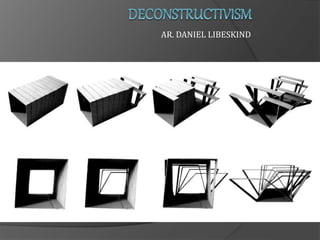
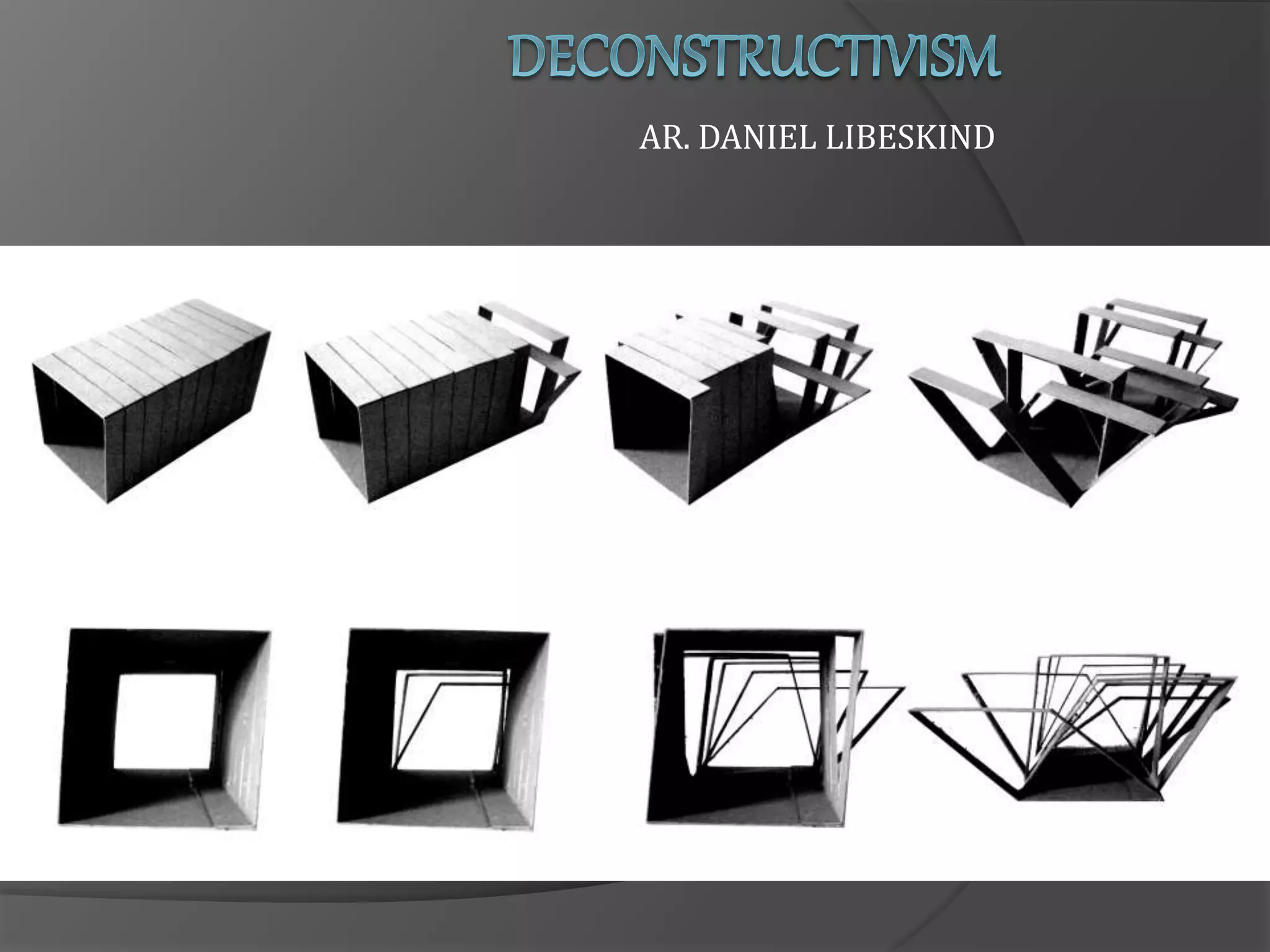
AR. DANIEL LIBESKIND
Deconstructionism Movement
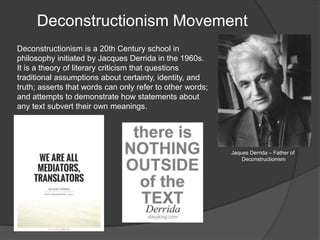
Deconstructionism is a 20th Century school in
philosophy initiated by Jacques Derrida in the 1960s.
It is a theory of literary criticism that questions
traditional assumptions about certainty, identity, and
truth; asserts that words can only refer to other words;
and attempts to demonstrate how statements about
any text subvert their own meanings.
Jaques Derrida – Father of
Deconstructionism
Deconstructivism in Architecture
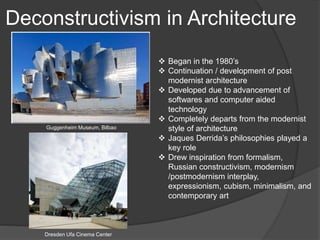
 Began in the 1980’s
 Continuation / development of post
modernist architecture
 Developed due to advancement of
softwares and computer aided
technology
 Completely departs from the modernist
style of architecture
 Jaques Derrida’s philosophies played a
key role
 Drew inspiration from formalism,
Russian constructivism, modernism
/postmodernism interplay,
expressionism, cubism, minimalism, and
contemporary art
Guggenheim Museum, Bilbao
Dresden Ufa Cinema Center
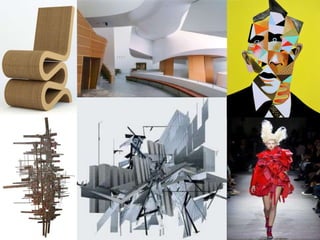
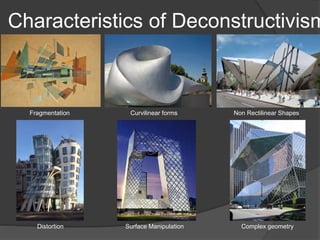
Characteristics of Deconstructivism
Fragmentation Curvilinear forms Non Rectilinear Shapes
Distortion Surface Manipulation Complex geometry
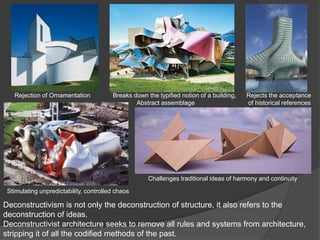
Rejection of Ornamentation Breaks down the typified notion of a building,
Abstract assemblage
Stimulating unpredictability, controlled chaos
Challenges traditional ideas of harmony and continuity
Rejects the acceptance
of historical references
Deconstructivism is not only the deconstruction of structure, it also refers to the
deconstruction of ideas.
Deconstructivist architecture seeks to remove all rules and systems from architecture,
stripping it of all the codified methods of the past.
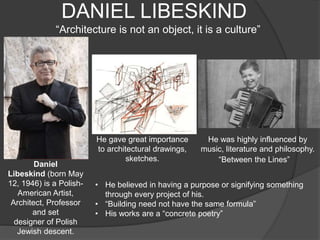
DANIEL LIBESKIND
“Architecture is not an object, it is a culture”
Daniel
Libeskind (born May
12, 1946) is a Polish-
American Artist,
Architect, Professor
and set
designer of Polish
Jewish descent.
He gave great importance
to architectural drawings,
sketches.
He was highly influenced by
music, literature and philosophy.
• He believed in having a purpose or signifying something
through every project of his.
• “Building need not have the same formula”
• His works are a “concrete poetry”
“Between the Lines”
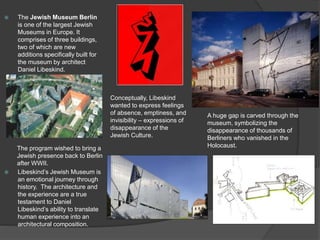
 The Jewish Museum Berlin
is one of the largest Jewish
Museums in Europe. It
comprises of three buildings,
two of which are new
additions specifically built for
the museum by architect
Daniel Libeskind.
 Libeskind’s Jewish Museum is
an emotional journey through
history. The architecture and
the experience are a true
testament to Daniel
Libeskind’s ability to translate
human experience into an
architectural composition.
The program wished to bring a
Jewish presence back to Berlin
after WWII.
Conceptually, Libeskind
wanted to express feelings
of absence, emptiness, and
invisibility – expressions of
disappearance of the
Jewish Culture.
A huge gap is carved through the
museum, symbolizing the
disappearance of thousands of
Berliners who vanished in the
Holocaust.
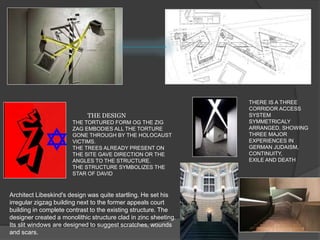
THE DESIGN
THE TORTURED FORM OG THE ZIG
ZAG EMBODIES ALL THE TORTURE
GONE THROUGH BY THE HOLOCAUST
VICTIMS.
THE TREES ALREADY PRESENT ON
THE SITE GAVE DIRECTION OR THE
ANGLES TO THE STRUCTURE.
THE STRUCTURE SYMBOLIZES THE
STAR OF DAVID
THERE IS A THREE
CORRIDOR ACCESS
SYSTEM
SYMMETRICALY
ARRANGED, SHOWING
THREE MAJOR
EXPERIENCES IN
GERMAN JUDAISM,
CONTINUITY,
EXILE AND DEATH
Architect Libeskind's design was quite startling. He set his
irregular zigzag building next to the former appeals court
building in complete contrast to the existing structure. The
designer created a monolithic structure clad in zinc sheeting.
Its slit windows are designed to suggest scratches, wounds
and scars.
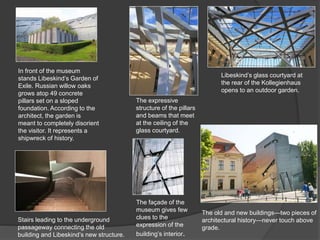
In front of the museum
stands Libeskind’s Garden of
Exile. Russian willow oaks
grows atop 49 concrete
pillars set on a sloped
foundation. According to the
architect, the garden is
meant to completely disorient
the visitor. It represents a
shipwreck of history.
The old and new buildings—two pieces of
architectural history—never touch above
grade.
Libeskind’s glass courtyard at
the rear of the Kollegienhaus
opens to an outdoor garden.
The expressive
structure of the pillars
and beams that meet
at the ceiling of the
glass courtyard.
Stairs leading to the underground
passageway connecting the old
building and Libeskind’s new structure.
The façade of the
museum gives few
clues to the
expression of the
building’s interior.
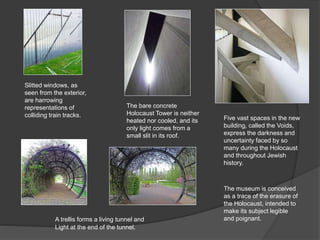
Slitted windows, as
seen from the exterior,
are harrowing
representations of
colliding train tracks. Five vast spaces in the new
building, called the Voids,
express the darkness and
uncertainty faced by so
many during the Holocaust
and throughout Jewish
history.
The bare concrete
Holocaust Tower is neither
heated nor cooled, and its
only light comes from a
small slit in its roof.
A trellis forms a living tunnel and
Light at the end of the tunnel.
The museum is conceived
as a trace of the erasure of
the Holocaust, intended to
make its subject legible
and poignant.
Deconstructivism

Deconstructivism

  • 1.
  • 2.
    Deconstructionism Movement Deconstructionism isa 20th Century school in philosophy initiated by Jacques Derrida in the 1960s. It is a theory of literary criticism that questions traditional assumptions about certainty, identity, and truth; asserts that words can only refer to other words; and attempts to demonstrate how statements about any text subvert their own meanings. Jaques Derrida – Father of Deconstructionism
  • 4.
    Deconstructivism in Architecture Began in the 1980’s  Continuation / development of post modernist architecture  Developed due to advancement of softwares and computer aided technology  Completely departs from the modernist style of architecture  Jaques Derrida’s philosophies played a key role  Drew inspiration from formalism, Russian constructivism, modernism /postmodernism interplay, expressionism, cubism, minimalism, and contemporary art Guggenheim Museum, Bilbao Dresden Ufa Cinema Center
  • 5.
    Characteristics of Deconstructivism FragmentationCurvilinear forms Non Rectilinear Shapes Distortion Surface Manipulation Complex geometry
  • 6.
    Rejection of OrnamentationBreaks down the typified notion of a building, Abstract assemblage Stimulating unpredictability, controlled chaos Challenges traditional ideas of harmony and continuity Rejects the acceptance of historical references Deconstructivism is not only the deconstruction of structure, it also refers to the deconstruction of ideas. Deconstructivist architecture seeks to remove all rules and systems from architecture, stripping it of all the codified methods of the past.
  • 7.
    DANIEL LIBESKIND “Architecture isnot an object, it is a culture” Daniel Libeskind (born May 12, 1946) is a Polish- American Artist, Architect, Professor and set designer of Polish Jewish descent. He gave great importance to architectural drawings, sketches. He was highly influenced by music, literature and philosophy. • He believed in having a purpose or signifying something through every project of his. • “Building need not have the same formula” • His works are a “concrete poetry” “Between the Lines”
  • 8.
     The JewishMuseum Berlin is one of the largest Jewish Museums in Europe. It comprises of three buildings, two of which are new additions specifically built for the museum by architect Daniel Libeskind.  Libeskind’s Jewish Museum is an emotional journey through history. The architecture and the experience are a true testament to Daniel Libeskind’s ability to translate human experience into an architectural composition. The program wished to bring a Jewish presence back to Berlin after WWII. Conceptually, Libeskind wanted to express feelings of absence, emptiness, and invisibility – expressions of disappearance of the Jewish Culture. A huge gap is carved through the museum, symbolizing the disappearance of thousands of Berliners who vanished in the Holocaust.
  • 9.
    THE DESIGN THE TORTUREDFORM OG THE ZIG ZAG EMBODIES ALL THE TORTURE GONE THROUGH BY THE HOLOCAUST VICTIMS. THE TREES ALREADY PRESENT ON THE SITE GAVE DIRECTION OR THE ANGLES TO THE STRUCTURE. THE STRUCTURE SYMBOLIZES THE STAR OF DAVID THERE IS A THREE CORRIDOR ACCESS SYSTEM SYMMETRICALY ARRANGED, SHOWING THREE MAJOR EXPERIENCES IN GERMAN JUDAISM, CONTINUITY, EXILE AND DEATH Architect Libeskind's design was quite startling. He set his irregular zigzag building next to the former appeals court building in complete contrast to the existing structure. The designer created a monolithic structure clad in zinc sheeting. Its slit windows are designed to suggest scratches, wounds and scars.
  • 10.
    In front ofthe museum stands Libeskind’s Garden of Exile. Russian willow oaks grows atop 49 concrete pillars set on a sloped foundation. According to the architect, the garden is meant to completely disorient the visitor. It represents a shipwreck of history. The old and new buildings—two pieces of architectural history—never touch above grade. Libeskind’s glass courtyard at the rear of the Kollegienhaus opens to an outdoor garden. The expressive structure of the pillars and beams that meet at the ceiling of the glass courtyard. Stairs leading to the underground passageway connecting the old building and Libeskind’s new structure. The façade of the museum gives few clues to the expression of the building’s interior.
  • 11.
    Slitted windows, as seenfrom the exterior, are harrowing representations of colliding train tracks. Five vast spaces in the new building, called the Voids, express the darkness and uncertainty faced by so many during the Holocaust and throughout Jewish history. The bare concrete Holocaust Tower is neither heated nor cooled, and its only light comes from a small slit in its roof. A trellis forms a living tunnel and Light at the end of the tunnel. The museum is conceived as a trace of the erasure of the Holocaust, intended to make its subject legible and poignant.