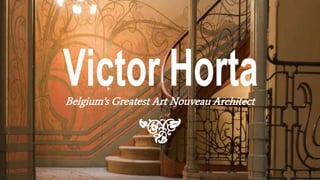
Belgium's Greatest Art Nouveau Architect
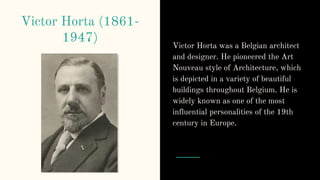
Victor Horta (1861-
1947) Victor Horta was a Belgian architect
and designer. He pioneered the Art
Nouveau style of Architecture, which
is depicted in a variety of beautiful
buildings throughout Belgium. He is
widely known as one of the most
influential personalities of the 19th
century in Europe.
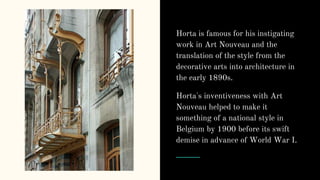
Horta is famous for his instigating
work in Art Nouveau and the
translation of the style from the
decorative arts into architecture in
the early 1890s.
Horta's inventiveness with Art
Nouveau helped to make it
something of a national style in
Belgium by 1900 before its swift
demise in advance of World War I.
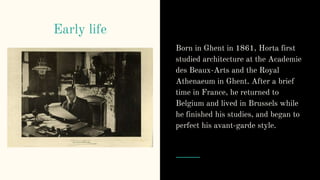
Early life
Born in Ghent in 1861, Horta first
studied architecture at the Academie
des Beaux-Arts and the Royal
Athenaeum in Ghent. After a brief
time in France, he returned to
Belgium and lived in Brussels while
he finished his studies, and began to
perfect his avant-garde style.
Horta left for Paris in 1878 where
he was inspired by the emerging of
impressionist and pointillist artists
and the possibility to work with iron
and glass.
He drew decorative motifs from
nature,seen in his works, the Hotel
Tassel, the Hotel Solvay, and the
Horta Museum, which are now
regarded as iconic examples of Art
Nouveau architecture.
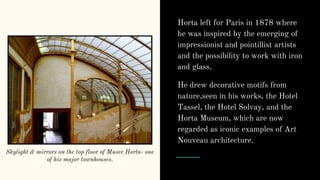
Skylight & mirrors on the top floor of Musee Horta- one
of his major townhouses.
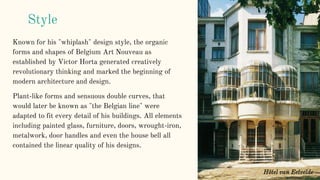
Known for his "whiplash" design style, the organic
forms and shapes of Belgium Art Nouveau as
established by Victor Horta generated creatively
revolutionary thinking and marked the beginning of
modern architecture and design.
Plant-like forms and sensuous double curves, that
would later be known as "the Belgian line" were
adapted to fit every detail of his buildings. All elements
including painted glass, furniture, doors, wrought-iron,
metalwork, door handles and even the house bell all
contained the linear quality of his designs.
Style
Hôtel van Eetvelde
Art Nouveau in Brussels
Art Nouveau represented a major change in
European and Western art, architecture, and
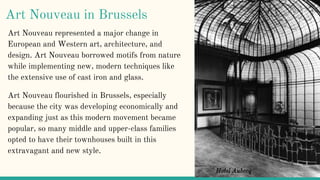
design. Art Nouveau borrowed motifs from nature
while implementing new, modern techniques like
the extensive use of cast iron and glass.
Art Nouveau flourished in Brussels, especially
because the city was developing economically and
expanding just as this modern movement became
popular, so many middle and upper-class families
opted to have their townhouses built in this
extravagant and new style.
Hotel Aubecq
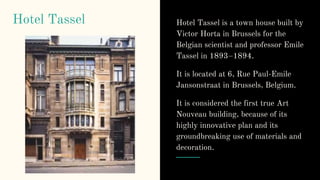
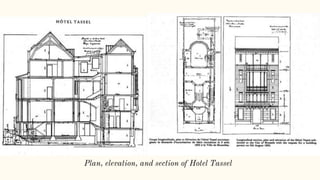
Hotel Tassel Hotel Tassel is a town house built by
Victor Horta in Brussels for the
Belgian scientist and professor Emile
Tassel in 1893–1894.
It is located at 6, Rue Paul-Emile
Jansonstraat in Brussels, Belgium.
It is considered the first true Art
Nouveau building, because of its
highly innovative plan and its
groundbreaking use of materials and
decoration.
Plan, elevation, and section of Hotel Tassel
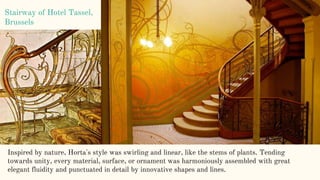
Stairway of Hotel Tassel,
Brussels
Inspired by nature, Horta's style was swirling and linear, like the stems of plants. Tending
towards unity, every material, surface, or ornament was harmoniously assembled with great
elegant fluidity and punctuated in detail by innovative shapes and lines.
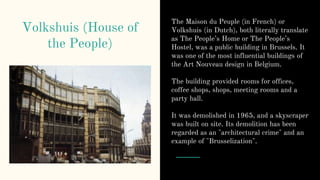
Volkshuis (House of
the People)
The Maison du Peuple (in French) or
Volkshuis (in Dutch), both literally translate
as The People’s Home or The People’s
Hostel, was a public building in Brussels. It
was one of the most influential buildings of
the Art Nouveau design in Belgium.
The building provided rooms for offices,
coffee shops, shops, meeting rooms and a
party hall.
It was demolished in 1965, and a skyscraper
was built on site. Its demolition has been
regarded as an "architectural crime" and an
example of "Brusselization".
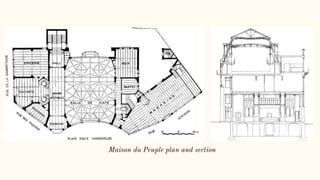
Maison du Peuple plan and section
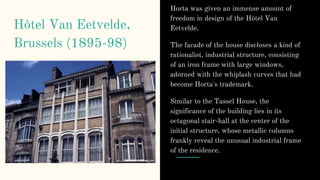
Hôtel Van Eetvelde,
Brussels (1895-98)
Horta was given an immense amount of
freedom in design of the Hôtel Van
Eetvelde.
The facade of the house discloses a kind of
rationalist, industrial structure, consisting
of an iron frame with large windows,
adorned with the whiplash curves that had
become Horta's trademark.
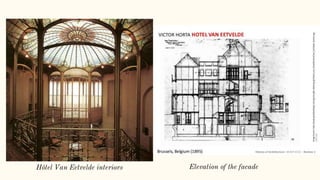
Similar to the Tassel House, the
significance of the building lies in its
octagonal stair-hall at the center of the
initial structure, whose metallic columns
frankly reveal the unusual industrial frame
of the residence.
Hôtel Van Eetvelde interiors Elevation of the facade
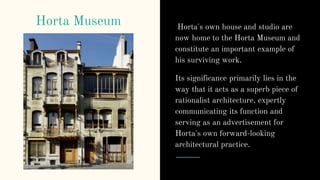
Horta Museum Horta's own house and studio are
now home to the Horta Museum and
constitute an important example of
his surviving work.
Its significance primarily lies in the
way that it acts as a superb piece of
rationalist architecture, expertly
communicating its function and
serving as an advertisement for
Horta's own forward-looking
architectural practice.
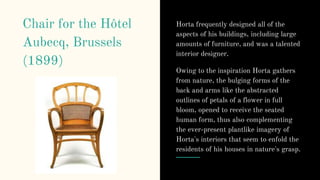
Chair for the Hôtel
Aubecq, Brussels
(1899)
Horta frequently designed all of the
aspects of his buildings, including large
amounts of furniture, and was a talented
interior designer.
Owing to the inspiration Horta gathers
from nature, the bulging forms of the
back and arms like the abstracted
outlines of petals of a flower in full
bloom, opened to receive the seated
human form, thus also complementing
the ever-present plantlike imagery of
Horta's interiors that seem to enfold the
residents of his houses in nature's grasp.
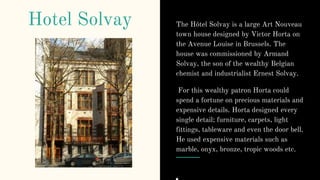
Hotel Solvay The Hôtel Solvay is a large Art Nouveau
town house designed by Victor Horta on
the Avenue Louise in Brussels. The
house was commissioned by Armand
Solvay, the son of the wealthy Belgian
chemist and industrialist Ernest Solvay.
For this wealthy patron Horta could
spend a fortune on precious materials and
expensive details. Horta designed every
single detail; furniture, carpets, light
fittings, tableware and even the door bell.
He used expensive materials such as
marble, onyx, bronze, tropic woods etc.
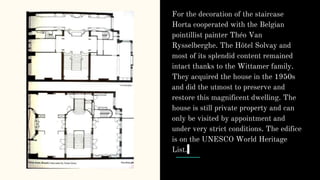
For the decoration of the staircase
Horta cooperated with the Belgian
pointillist painter Théo Van
Rysselberghe. The Hôtel Solvay and
most of its splendid content remained
intact thanks to the Wittamer family.
They acquired the house in the 1950s
and did the utmost to preserve and
restore this magnificent dwelling. The
house is still private property and can
only be visited by appointment and
under very strict conditions. The edifice
is on the UNESCO World Heritage
List.
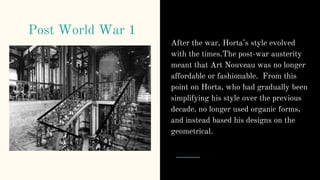
Post World War 1
After the war, Horta’s style evolved
with the times.The post-war austerity
meant that Art Nouveau was no longer
affordable or fashionable. From this
point on Horta, who had gradually been
simplifying his style over the previous
decade, no longer used organic forms,
and instead based his designs on the
geometrical.
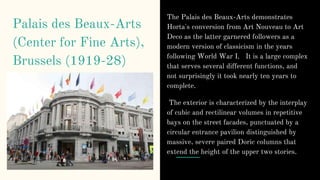
Palais des Beaux-Arts
(Center for Fine Arts),
Brussels (1919-28)
The Palais des Beaux-Arts demonstrates
Horta's conversion from Art Nouveau to Art
Deco as the latter garnered followers as a
modern version of classicism in the years
following World War I. It is a large complex
that serves several different functions, and
not surprisingly it took nearly ten years to
complete.
The exterior is characterized by the interplay
of cubic and rectilinear volumes in repetitive
bays on the street facades, punctuated by a
circular entrance pavilion distinguished by
massive, severe paired Doric columns that
extend the height of the upper two stories.
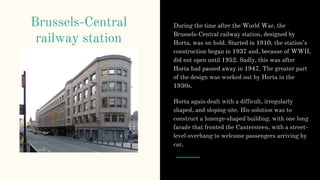
Brussels-Central
railway station
During the time after the World War, the
Brussels-Central railway station, designed by
Horta, was on hold. Started in 1910, the station’s
construction began in 1937 and, because of WWII,
did not open until 1952. Sadly, this was after
Horta had passed away in 1947. The greater part
of the design was worked out by Horta in the
1930s.
Horta again dealt with a difficult, irregularly
shaped, and sloping site. His solution was to
construct a lozenge-shaped building, with one long
facade that fronted the Cantersteen, with a street-
level overhang to welcome passengers arriving by
car.
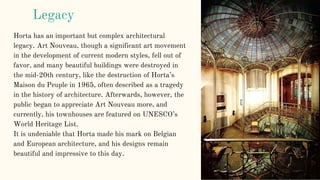
Legacy
Horta has an important but complex architectural
legacy. Art Nouveau, though a significant art movement
in the development of current modern styles, fell out of
favor, and many beautiful buildings were destroyed in
the mid-20th century, like the destruction of Horta’s
Maison du Peuple in 1965, often described as a tragedy
in the history of architecture. Afterwards, however, the
public began to appreciate Art Nouveau more, and
currently, his townhouses are featured on UNESCO’s
World Heritage List.
It is undeniable that Horta made his mark on Belgian
and European architecture, and his designs remain
beautiful and impressive to this day.
By:
Anushka Anand (01)
Shinjini Bhattacharjee (05)
Rinika Datta (09)
Tanay Parulekar(35)
Diya Shetty(43)
Sahil Sitlaney (50)
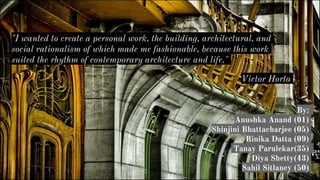
"I wanted to create a personal work, the building, architectural, and
social rationalism of which made me fashionable, because this work
suited the rhythm of contemporary architecture and life."
Victor Horta

Victor Horta

  • 1.
    Belgium's Greatest ArtNouveau Architect
  • 2.
    Victor Horta (1861- 1947)Victor Horta was a Belgian architect and designer. He pioneered the Art Nouveau style of Architecture, which is depicted in a variety of beautiful buildings throughout Belgium. He is widely known as one of the most influential personalities of the 19th century in Europe.
  • 3.
    Horta is famousfor his instigating work in Art Nouveau and the translation of the style from the decorative arts into architecture in the early 1890s. Horta's inventiveness with Art Nouveau helped to make it something of a national style in Belgium by 1900 before its swift demise in advance of World War I.
  • 4.
    Early life Born inGhent in 1861, Horta first studied architecture at the Academie des Beaux-Arts and the Royal Athenaeum in Ghent. After a brief time in France, he returned to Belgium and lived in Brussels while he finished his studies, and began to perfect his avant-garde style.
  • 5.
    Horta left forParis in 1878 where he was inspired by the emerging of impressionist and pointillist artists and the possibility to work with iron and glass. He drew decorative motifs from nature,seen in his works, the Hotel Tassel, the Hotel Solvay, and the Horta Museum, which are now regarded as iconic examples of Art Nouveau architecture. Skylight & mirrors on the top floor of Musee Horta- one of his major townhouses.
  • 6.
    Known for his"whiplash" design style, the organic forms and shapes of Belgium Art Nouveau as established by Victor Horta generated creatively revolutionary thinking and marked the beginning of modern architecture and design. Plant-like forms and sensuous double curves, that would later be known as "the Belgian line" were adapted to fit every detail of his buildings. All elements including painted glass, furniture, doors, wrought-iron, metalwork, door handles and even the house bell all contained the linear quality of his designs. Style Hôtel van Eetvelde
  • 7.
    Art Nouveau inBrussels Art Nouveau represented a major change in European and Western art, architecture, and design. Art Nouveau borrowed motifs from nature while implementing new, modern techniques like the extensive use of cast iron and glass. Art Nouveau flourished in Brussels, especially because the city was developing economically and expanding just as this modern movement became popular, so many middle and upper-class families opted to have their townhouses built in this extravagant and new style. Hotel Aubecq
  • 8.
    Hotel Tassel HotelTassel is a town house built by Victor Horta in Brussels for the Belgian scientist and professor Emile Tassel in 1893–1894. It is located at 6, Rue Paul-Emile Jansonstraat in Brussels, Belgium. It is considered the first true Art Nouveau building, because of its highly innovative plan and its groundbreaking use of materials and decoration.
  • 9.
    Plan, elevation, andsection of Hotel Tassel
  • 10.
    Stairway of HotelTassel, Brussels Inspired by nature, Horta's style was swirling and linear, like the stems of plants. Tending towards unity, every material, surface, or ornament was harmoniously assembled with great elegant fluidity and punctuated in detail by innovative shapes and lines.
  • 11.
    Volkshuis (House of thePeople) The Maison du Peuple (in French) or Volkshuis (in Dutch), both literally translate as The People’s Home or The People’s Hostel, was a public building in Brussels. It was one of the most influential buildings of the Art Nouveau design in Belgium. The building provided rooms for offices, coffee shops, shops, meeting rooms and a party hall. It was demolished in 1965, and a skyscraper was built on site. Its demolition has been regarded as an "architectural crime" and an example of "Brusselization".
  • 12.
    Maison du Peupleplan and section
  • 13.
    Hôtel Van Eetvelde, Brussels(1895-98) Horta was given an immense amount of freedom in design of the Hôtel Van Eetvelde. The facade of the house discloses a kind of rationalist, industrial structure, consisting of an iron frame with large windows, adorned with the whiplash curves that had become Horta's trademark. Similar to the Tassel House, the significance of the building lies in its octagonal stair-hall at the center of the initial structure, whose metallic columns frankly reveal the unusual industrial frame of the residence.
  • 14.
    Hôtel Van Eetveldeinteriors Elevation of the facade
  • 15.
    Horta Museum Horta'sown house and studio are now home to the Horta Museum and constitute an important example of his surviving work. Its significance primarily lies in the way that it acts as a superb piece of rationalist architecture, expertly communicating its function and serving as an advertisement for Horta's own forward-looking architectural practice.
  • 16.
    Chair for theHôtel Aubecq, Brussels (1899) Horta frequently designed all of the aspects of his buildings, including large amounts of furniture, and was a talented interior designer. Owing to the inspiration Horta gathers from nature, the bulging forms of the back and arms like the abstracted outlines of petals of a flower in full bloom, opened to receive the seated human form, thus also complementing the ever-present plantlike imagery of Horta's interiors that seem to enfold the residents of his houses in nature's grasp.
  • 17.
    Hotel Solvay TheHôtel Solvay is a large Art Nouveau town house designed by Victor Horta on the Avenue Louise in Brussels. The house was commissioned by Armand Solvay, the son of the wealthy Belgian chemist and industrialist Ernest Solvay. For this wealthy patron Horta could spend a fortune on precious materials and expensive details. Horta designed every single detail; furniture, carpets, light fittings, tableware and even the door bell. He used expensive materials such as marble, onyx, bronze, tropic woods etc.
  • 18.
    For the decorationof the staircase Horta cooperated with the Belgian pointillist painter Théo Van Rysselberghe. The Hôtel Solvay and most of its splendid content remained intact thanks to the Wittamer family. They acquired the house in the 1950s and did the utmost to preserve and restore this magnificent dwelling. The house is still private property and can only be visited by appointment and under very strict conditions. The edifice is on the UNESCO World Heritage List.
  • 19.
    Post World War1 After the war, Horta’s style evolved with the times.The post-war austerity meant that Art Nouveau was no longer affordable or fashionable. From this point on Horta, who had gradually been simplifying his style over the previous decade, no longer used organic forms, and instead based his designs on the geometrical.
  • 20.
    Palais des Beaux-Arts (Centerfor Fine Arts), Brussels (1919-28) The Palais des Beaux-Arts demonstrates Horta's conversion from Art Nouveau to Art Deco as the latter garnered followers as a modern version of classicism in the years following World War I. It is a large complex that serves several different functions, and not surprisingly it took nearly ten years to complete. The exterior is characterized by the interplay of cubic and rectilinear volumes in repetitive bays on the street facades, punctuated by a circular entrance pavilion distinguished by massive, severe paired Doric columns that extend the height of the upper two stories.
  • 21.
    Brussels-Central railway station During thetime after the World War, the Brussels-Central railway station, designed by Horta, was on hold. Started in 1910, the station’s construction began in 1937 and, because of WWII, did not open until 1952. Sadly, this was after Horta had passed away in 1947. The greater part of the design was worked out by Horta in the 1930s. Horta again dealt with a difficult, irregularly shaped, and sloping site. His solution was to construct a lozenge-shaped building, with one long facade that fronted the Cantersteen, with a street- level overhang to welcome passengers arriving by car.
  • 22.
    Legacy Horta has animportant but complex architectural legacy. Art Nouveau, though a significant art movement in the development of current modern styles, fell out of favor, and many beautiful buildings were destroyed in the mid-20th century, like the destruction of Horta’s Maison du Peuple in 1965, often described as a tragedy in the history of architecture. Afterwards, however, the public began to appreciate Art Nouveau more, and currently, his townhouses are featured on UNESCO’s World Heritage List. It is undeniable that Horta made his mark on Belgian and European architecture, and his designs remain beautiful and impressive to this day.
  • 23.
    By: Anushka Anand (01) ShinjiniBhattacharjee (05) Rinika Datta (09) Tanay Parulekar(35) Diya Shetty(43) Sahil Sitlaney (50) "I wanted to create a personal work, the building, architectural, and social rationalism of which made me fashionable, because this work suited the rhythm of contemporary architecture and life." Victor Horta