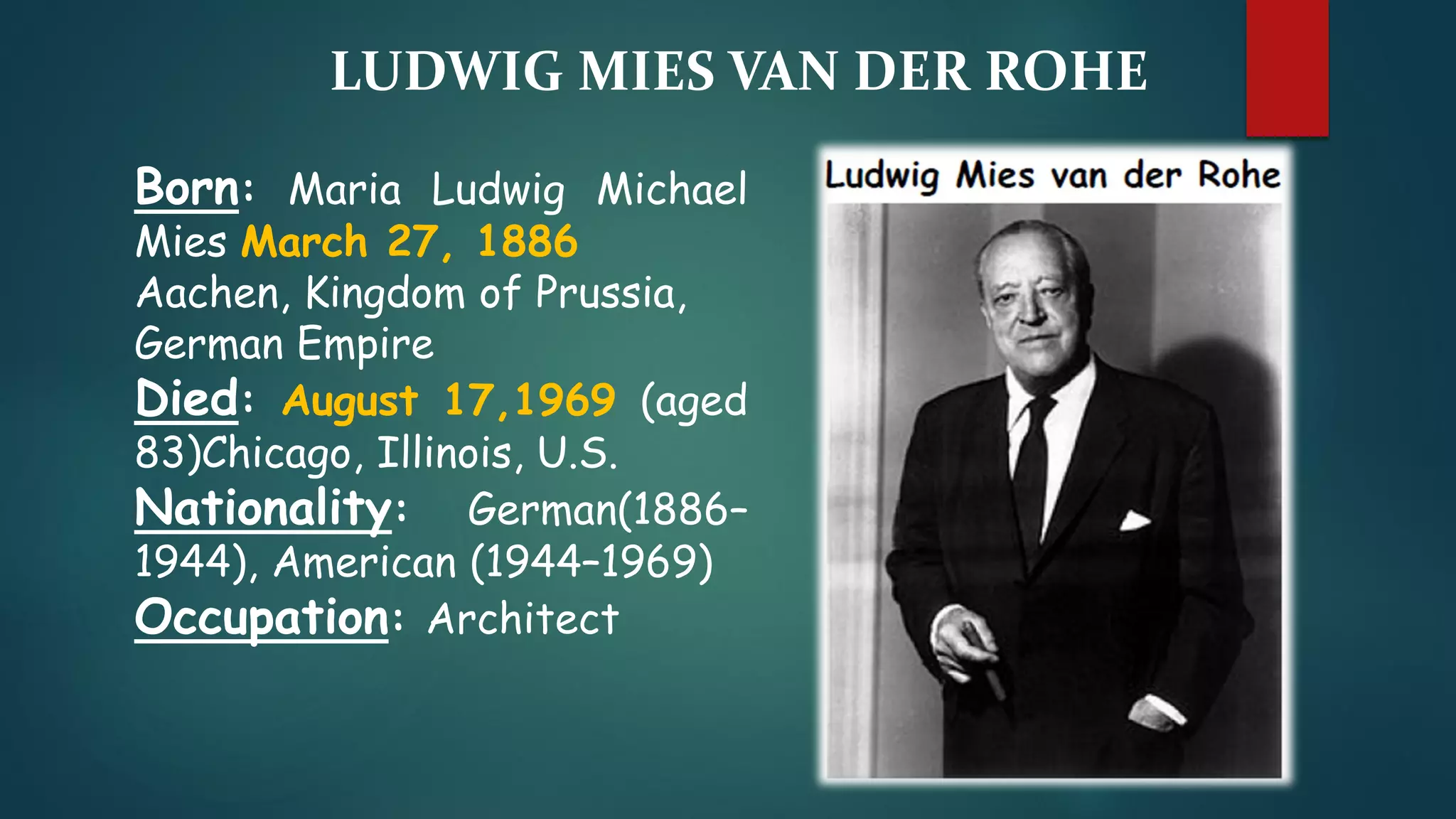
LUDWIG MIES VAN DER ROHE
Born: Maria Ludwig Michael
Mies March 27, 1886
Aachen, Kingdom of Prussia,
German Empire
Died: August 17,1969 (aged
83)Chicago, Illinois, U.S.
Nationality: German(1886–
1944), American (1944–1969)
Occupation: Architect
ABOUT THE LEGEND….
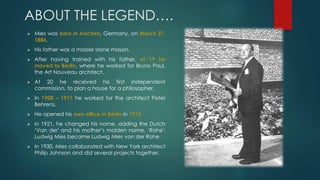
 Mies was born in Aachen, Germany, on March 27,
1886.
 His father was a master stone mason.
 After having trained with his father, at 19 he
moved to Berlin, where he worked for Bruno Paul,
the Art Nouveau architect.
 At 20 he received his first independent
commission, to plan a house for a philosopher.
 In 1908 – 1911 he worked for the architect Peter
Behrens.
 He opened his own office in Berlin in 1912.
 In 1921, he changed his name, adding the Dutch
‘Van der' and his mother’s maiden name, ‘Rohe':
Ludwig Mies became Ludwig Mies van der Rohe.
 In 1930, Mies collaborated with New York architect
Philip Johnson and did several projects together.
ABOUT THE LEGEND….
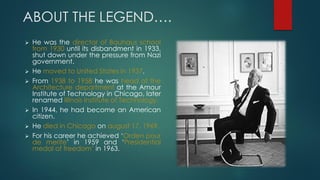
 He was the director of Bauhaus school
from 1930 until its disbandment in 1933,
shut down under the pressure from Nazi
government.
 He moved to United States in 1937.
 From 1938 to 1958 he was head of the
Architecture department at the Amour
Institute of Technology in Chicago, later
renamed Illinois Institute of Technology.
 In 1944, he had become an American
citizen.
 He died in Chicago on august 17, 1969.
 For his career he achieved ‘Orden pour
de merite’ in 1959 and ‘Presidential
medal of freedom’ in 1963.
HIS NOTABLE WORKS…….
Can be divided into categories as shown below:
 Approach to structure
 Court houses with steel columns
 Steel framed office buildings with glass curtained wall
 Hall construction with a wide span roof
 Truss construction with suspended roof
 Glass houses with steel frame
 Steel framed apartment towers with glass curtained wall
 Urban planning
DESIGN PHILOSOPHIES………
 Evolved his ideas from basic principles of construction; hence
the form of his buildings is the expression of their structure.
 No complication rather aimed at clear and simple structure.
 The concept of fluid space with a seamless flow between
indoors and outdoors.
 Distinction between structural and non structural elements.
 Flexible arrangement of floor plan.
 Emphasized on the usage of steel and glass as a building
material in the structures.
 Togetherness of the interior space and the landscape served
the ideology.
DESIGN PHILOSOPHIES………
 Emphasized on the better selection of the modest usage of the
building material.
 He created an influential 20th century architectural style. His
mature buildings made use of modern materials such as
industrial steel and plate glass to define interior spaces. He
called his buildings "skin and bones" architecture.
 He is known for the use of the aphorisms "less is more" and
Gustave Flaubert's "God is in the details”.
 LESS IS MORE
He does not build palaces or heavy, massive fortresses. For a
minimum of mass, his buildings yield a maximum in cultivated
living……
 GOD IS IN THE DETAILS
perfection lies in giving consideration to every minute
detail……..as GOD is perfect………
LIST OF WORKS
Early career in Berlin (1907-1938)
 1907 Riehl House – Residential Home,
Potsdam, Germany
 1911 Perl House – Residential Home,
Zehlendorf
 1913 Werner House – Residential
Home, Zehlendorf
 1917 Urbig House – Residential Home,
Potsdam
 1922 Kempner House – Residential
Home, Charlottenburg
 1922 Eichstaedt House – Residential
Home, Wannsee
 1922 Feldmann House – Residential
Home,Wilmersdorf
 1923 Ryder House - Residential Home,
Wiesbaden
 1926 Mosler House – Residential
Home, Babelsberg
 1926 Liebknecht-Luxemburg-Monument
'Revolutionsdenkmal' - Monument, Berlin
 1927 Afrikanische Straße Apartments –
Multi-Family Residential, Berlin, Germany
 1927 Weissenhof Estate – Housing Exhibition
coordinated by Mies and with a contribution
by him, Stuttgart
 1928 Haus Lange and Haus Esters –
Residential Home and an art museum, Krefeld
 1929 Barcelona Pavilion – World's Fair
Pavilion, Barcelona, Spain
 1930 Villa Tugendhat – Residential Home,
Brno, Czech Republic, designated a World
Heritage Site by UNESCO in 2001
 1930 Verseidag Factory –Dyeing and HE Silk
Mill Building Krefeld, Germany[17]
 1932 Lemke House – Residential Home,
Weissensee
 1939-1958 – Illinois Institute of Technology
Campus Master Plan, Academic Campus& Buildings,
Chicago, Illinois
 1949 The Promontory Apartments – Residential
Apartment Complex, Chicago, Illinois
 1951 Sheridan-Oakdale Apartments (2933 N
Sheridan Rd ) – Residential Apartment Complex,
Chicago, Illinois
 1951 Lake Shore Drive Apartments – Residential
Apartment Towers, Chicago
 1951 Algonquin Apartments – Residential
Apartments, Chicago, Illinois
 1951 Farnsworth House – Vacation Home, Plano,
Illinois
 1952 Arts Club of Chicago Interior Renovation –
Art Gallery, demolished in 1997,Chicago, Illinois
 1952 Robert H. McCormick House - Residential
Home, relocated to the Elmhurst Art Museum,
Elmhurst, Illinois
BUILDINGS AFTER EMIGRATION TO THE UNITED
STATES (1939-1960)
 1954 Cullinan Hall – Museum of Fine Arts, Houston
 1956 Crown Hall, Illinois Institute of Technology College
of Architecture– Academic Building, Chicago, Illinois[18]
 1956 Esplanade Apartment Buildings (900-910 Lake
Shore Dr) – Residential Apartment Complex, Chicago,
Illinois
 1957 Commonwealth Promenade Apartments (330- 330
W Diversey Parkway) – Residential Apartment Complex,
Chicago (1957)[19]
 1958 Seagram Building – Office Tower, New York City,
New York
 1958 Caroline Weiss Law Building, Museum of Fine Art,
Houston
 1959 Home Federal Savings and Loan Association
Building– Office Building, Des Moines, Iowa
 1959 Lafayette Park – Residential Development, Detroit,
Michigan.
 1960 Pavilion and Colonnade Apartments– Residential
complex, Newark, New JerseyLate career Worldwide
(1961–69)
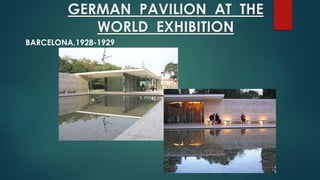
GERMAN PAVILION AT THE
WORLD EXHIBITION
BARCELONA,1928-1929
SIGNIFICANT FEATURES
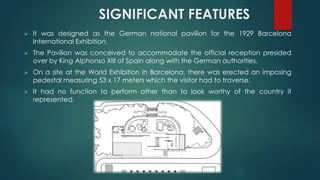
 It was designed as the German national pavilion for the 1929 Barcelona
International Exhibition.
 The Pavilion was conceived to accommodate the official reception presided
over by King Alphonso XIII of Spain along with the German authorities.
 On a site at the World Exhibition in Barcelona, there was erected an imposing
pedestal measuring 53 x 17 meters which the visitor had to traverse.
 It had no function to perform other than to look worthy of the country it
represented.
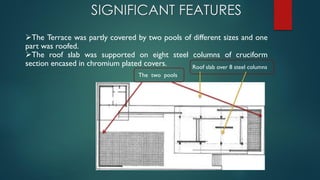
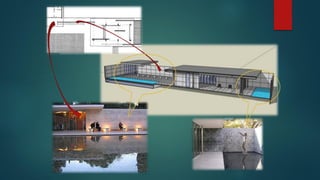
The two pools
Roof slab over 8 steel columns
The Terrace was partly covered by two pools of different sizes and one
part was roofed.
The roof slab was supported on eight steel columns of cruciform
section encased in chromium plated covers.
SIGNIFICANT FEATURES
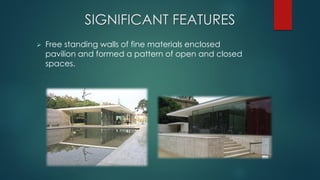
 Free standing walls of fine materials enclosed
pavilion and formed a pattern of open and closed
spaces.
SIGNIFICANT FEATURES
 THE MATERIALS : Glass, steel and four different kinds of marble (Roman travertine,
green Alpine marble, ancient green marble from Greece and golden onyx from
the Atlas Mountains) were used for the construction
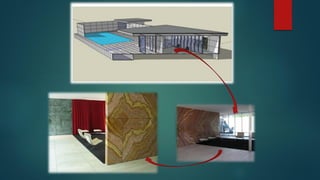
 Interior walls were covered with Honey colored golden onyx, antique green
Tinian Marble and tinted and frosted glass.
 The only transverse wall to join two other was made of frosted glass and
contained lighting which provide diffuse illumination inside and outside the
pavilion.
 The terrace was paved with slabs of Travertine marble about 1 meter square.
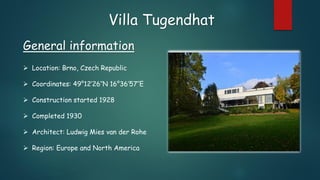
Villa Tugendhat
General information
 Location: Brno, Czech Republic
 Coordinates: 49°12′26″N 16°36′57″E
 Construction started 1928
 Completed 1930
 Architect: Ludwig Mies van der Rohe
 Region: Europe and North America
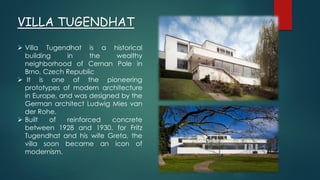
VILLA TUGENDHAT
 Villa Tugendhat is a historical
building in the wealthy
neighborhood of Cernan Pole in
Brno, Czech Republic
 It is one of the pioneering
prototypes of modern architecture
in Europe, and was designed by the
German architect Ludwig Mies van
der Rohe.
 Built of reinforced concrete
between 1928 and 1930. for Fritz
Tugendhat and his wife Greta, the
villa soon became an icon of
modernism.
The villa was commissioned by the Jewish German
Fritz and Greta Tugendhat.
The construction company of Arturo and Mořic Eisler
began construction in the summer of 1929 and
completed it in 14 months.
 Fritz and Greta Tugendhat enjoyed just eight years
in the villa before fleeing Czechoslovakia
It suffered considerable damage during combat at
the end of World War II and later, when it served as
quarters and stables for the Soviet military.
It was partially repaired and used for various
purposes for several decades after World War II.
CONT...
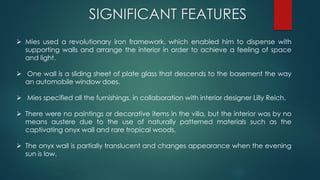
SIGNIFICANT FEATURES
 Mies used a revolutionary iron framework, which enabled him to dispense with
supporting walls and arrange the interior in order to achieve a feeling of space
and light.
 One wall is a sliding sheet of plate glass that descends to the basement the way
an automobile window does.
 Mies specified all the furnishings, in collaboration with interior designer Lilly Reich.
 There were no paintings or decorative items in the villa, but the interior was by no
means austere due to the use of naturally patterned materials such as the
captivating onyx wall and rare tropical woods.
 The onyx wall is partially translucent and changes appearance when the evening
sun is low.
SIGNIFICANT FEATURES
 luxurious materials, and the use of modern technology for heating
and ventilation.
 The lower-ground level was used as a service area.
 An ultra-modern air-conditioning system was here and a glass
façade that opens completely assisted by a mechanism built into the
wall.
 The floor area was unusually large and open compared to the
average family home of the period.
 In addition to the various storage rooms, made the structure unique if
not confusing to visitors not used to such minimalism.
SIGNIFICANT FEATURES
GEORG KOLBE’S SCULPTURE :
 In the water court, stood a figure of a dancer by Georg
Kolbe.
 The sculpture is a bronze reproduction of the piece entitled
Alba (Dawn) by Georg Kolbe, a contemporary of Mies van
der Rohe's.
 Masterfully placed at one end of the small pond, the
sculpture is reflected not only in the water but also in the
marble and glass, thereby creating the sensation that it is
multiplied in space, while its curves contrast with the
geometrical purity of the building.
Reflection of the sculpture
in glass walls……….
THE FURNITURES
SIGNIFICANT FEATURES
 designed a chair, especially for the Pavilion, consisting of
a leather upholstered metallic profile The chairs and
stools in the interior were of flat Chromium plated steel
bars.
 The table were topped with slabs of black opal glass.

Mies van der rohe

  • 1.
    LUDWIG MIES VANDER ROHE Born: Maria Ludwig Michael Mies March 27, 1886 Aachen, Kingdom of Prussia, German Empire Died: August 17,1969 (aged 83)Chicago, Illinois, U.S. Nationality: German(1886– 1944), American (1944–1969) Occupation: Architect
  • 2.
    ABOUT THE LEGEND…. Mies was born in Aachen, Germany, on March 27, 1886.  His father was a master stone mason.  After having trained with his father, at 19 he moved to Berlin, where he worked for Bruno Paul, the Art Nouveau architect.  At 20 he received his first independent commission, to plan a house for a philosopher.  In 1908 – 1911 he worked for the architect Peter Behrens.  He opened his own office in Berlin in 1912.  In 1921, he changed his name, adding the Dutch ‘Van der' and his mother’s maiden name, ‘Rohe': Ludwig Mies became Ludwig Mies van der Rohe.  In 1930, Mies collaborated with New York architect Philip Johnson and did several projects together.
  • 3.
    ABOUT THE LEGEND…. He was the director of Bauhaus school from 1930 until its disbandment in 1933, shut down under the pressure from Nazi government.  He moved to United States in 1937.  From 1938 to 1958 he was head of the Architecture department at the Amour Institute of Technology in Chicago, later renamed Illinois Institute of Technology.  In 1944, he had become an American citizen.  He died in Chicago on august 17, 1969.  For his career he achieved ‘Orden pour de merite’ in 1959 and ‘Presidential medal of freedom’ in 1963.
  • 4.
    HIS NOTABLE WORKS……. Canbe divided into categories as shown below:  Approach to structure  Court houses with steel columns  Steel framed office buildings with glass curtained wall  Hall construction with a wide span roof  Truss construction with suspended roof  Glass houses with steel frame  Steel framed apartment towers with glass curtained wall  Urban planning
  • 5.
    DESIGN PHILOSOPHIES………  Evolvedhis ideas from basic principles of construction; hence the form of his buildings is the expression of their structure.  No complication rather aimed at clear and simple structure.  The concept of fluid space with a seamless flow between indoors and outdoors.  Distinction between structural and non structural elements.  Flexible arrangement of floor plan.  Emphasized on the usage of steel and glass as a building material in the structures.  Togetherness of the interior space and the landscape served the ideology.
  • 6.
    DESIGN PHILOSOPHIES………  Emphasizedon the better selection of the modest usage of the building material.  He created an influential 20th century architectural style. His mature buildings made use of modern materials such as industrial steel and plate glass to define interior spaces. He called his buildings "skin and bones" architecture.  He is known for the use of the aphorisms "less is more" and Gustave Flaubert's "God is in the details”.  LESS IS MORE He does not build palaces or heavy, massive fortresses. For a minimum of mass, his buildings yield a maximum in cultivated living……  GOD IS IN THE DETAILS perfection lies in giving consideration to every minute detail……..as GOD is perfect………
  • 7.
    LIST OF WORKS Earlycareer in Berlin (1907-1938)  1907 Riehl House – Residential Home, Potsdam, Germany  1911 Perl House – Residential Home, Zehlendorf  1913 Werner House – Residential Home, Zehlendorf  1917 Urbig House – Residential Home, Potsdam  1922 Kempner House – Residential Home, Charlottenburg  1922 Eichstaedt House – Residential Home, Wannsee  1922 Feldmann House – Residential Home,Wilmersdorf  1923 Ryder House - Residential Home, Wiesbaden  1926 Mosler House – Residential Home, Babelsberg  1926 Liebknecht-Luxemburg-Monument 'Revolutionsdenkmal' - Monument, Berlin  1927 Afrikanische Straße Apartments – Multi-Family Residential, Berlin, Germany  1927 Weissenhof Estate – Housing Exhibition coordinated by Mies and with a contribution by him, Stuttgart  1928 Haus Lange and Haus Esters – Residential Home and an art museum, Krefeld  1929 Barcelona Pavilion – World's Fair Pavilion, Barcelona, Spain  1930 Villa Tugendhat – Residential Home, Brno, Czech Republic, designated a World Heritage Site by UNESCO in 2001  1930 Verseidag Factory –Dyeing and HE Silk Mill Building Krefeld, Germany[17]  1932 Lemke House – Residential Home, Weissensee
  • 8.
     1939-1958 –Illinois Institute of Technology Campus Master Plan, Academic Campus& Buildings, Chicago, Illinois  1949 The Promontory Apartments – Residential Apartment Complex, Chicago, Illinois  1951 Sheridan-Oakdale Apartments (2933 N Sheridan Rd ) – Residential Apartment Complex, Chicago, Illinois  1951 Lake Shore Drive Apartments – Residential Apartment Towers, Chicago  1951 Algonquin Apartments – Residential Apartments, Chicago, Illinois  1951 Farnsworth House – Vacation Home, Plano, Illinois  1952 Arts Club of Chicago Interior Renovation – Art Gallery, demolished in 1997,Chicago, Illinois  1952 Robert H. McCormick House - Residential Home, relocated to the Elmhurst Art Museum, Elmhurst, Illinois BUILDINGS AFTER EMIGRATION TO THE UNITED STATES (1939-1960)  1954 Cullinan Hall – Museum of Fine Arts, Houston  1956 Crown Hall, Illinois Institute of Technology College of Architecture– Academic Building, Chicago, Illinois[18]  1956 Esplanade Apartment Buildings (900-910 Lake Shore Dr) – Residential Apartment Complex, Chicago, Illinois  1957 Commonwealth Promenade Apartments (330- 330 W Diversey Parkway) – Residential Apartment Complex, Chicago (1957)[19]  1958 Seagram Building – Office Tower, New York City, New York  1958 Caroline Weiss Law Building, Museum of Fine Art, Houston  1959 Home Federal Savings and Loan Association Building– Office Building, Des Moines, Iowa  1959 Lafayette Park – Residential Development, Detroit, Michigan.  1960 Pavilion and Colonnade Apartments– Residential complex, Newark, New JerseyLate career Worldwide (1961–69)
  • 9.
    GERMAN PAVILION ATTHE WORLD EXHIBITION BARCELONA,1928-1929
  • 10.
    SIGNIFICANT FEATURES  Itwas designed as the German national pavilion for the 1929 Barcelona International Exhibition.  The Pavilion was conceived to accommodate the official reception presided over by King Alphonso XIII of Spain along with the German authorities.  On a site at the World Exhibition in Barcelona, there was erected an imposing pedestal measuring 53 x 17 meters which the visitor had to traverse.  It had no function to perform other than to look worthy of the country it represented.
  • 11.
    The two pools Roofslab over 8 steel columns The Terrace was partly covered by two pools of different sizes and one part was roofed. The roof slab was supported on eight steel columns of cruciform section encased in chromium plated covers. SIGNIFICANT FEATURES
  • 12.
    SIGNIFICANT FEATURES  Freestanding walls of fine materials enclosed pavilion and formed a pattern of open and closed spaces.
  • 15.
    SIGNIFICANT FEATURES  THEMATERIALS : Glass, steel and four different kinds of marble (Roman travertine, green Alpine marble, ancient green marble from Greece and golden onyx from the Atlas Mountains) were used for the construction  Interior walls were covered with Honey colored golden onyx, antique green Tinian Marble and tinted and frosted glass.  The only transverse wall to join two other was made of frosted glass and contained lighting which provide diffuse illumination inside and outside the pavilion.  The terrace was paved with slabs of Travertine marble about 1 meter square.
  • 16.
    Villa Tugendhat General information Location: Brno, Czech Republic  Coordinates: 49°12′26″N 16°36′57″E  Construction started 1928  Completed 1930  Architect: Ludwig Mies van der Rohe  Region: Europe and North America
  • 17.
    VILLA TUGENDHAT  VillaTugendhat is a historical building in the wealthy neighborhood of Cernan Pole in Brno, Czech Republic  It is one of the pioneering prototypes of modern architecture in Europe, and was designed by the German architect Ludwig Mies van der Rohe.  Built of reinforced concrete between 1928 and 1930. for Fritz Tugendhat and his wife Greta, the villa soon became an icon of modernism.
  • 18.
    The villa wascommissioned by the Jewish German Fritz and Greta Tugendhat. The construction company of Arturo and Mořic Eisler began construction in the summer of 1929 and completed it in 14 months.  Fritz and Greta Tugendhat enjoyed just eight years in the villa before fleeing Czechoslovakia It suffered considerable damage during combat at the end of World War II and later, when it served as quarters and stables for the Soviet military. It was partially repaired and used for various purposes for several decades after World War II. CONT...
  • 19.
    SIGNIFICANT FEATURES  Miesused a revolutionary iron framework, which enabled him to dispense with supporting walls and arrange the interior in order to achieve a feeling of space and light.  One wall is a sliding sheet of plate glass that descends to the basement the way an automobile window does.  Mies specified all the furnishings, in collaboration with interior designer Lilly Reich.  There were no paintings or decorative items in the villa, but the interior was by no means austere due to the use of naturally patterned materials such as the captivating onyx wall and rare tropical woods.  The onyx wall is partially translucent and changes appearance when the evening sun is low.
  • 20.
    SIGNIFICANT FEATURES  luxuriousmaterials, and the use of modern technology for heating and ventilation.  The lower-ground level was used as a service area.  An ultra-modern air-conditioning system was here and a glass façade that opens completely assisted by a mechanism built into the wall.  The floor area was unusually large and open compared to the average family home of the period.  In addition to the various storage rooms, made the structure unique if not confusing to visitors not used to such minimalism.
  • 21.
    SIGNIFICANT FEATURES GEORG KOLBE’SSCULPTURE :  In the water court, stood a figure of a dancer by Georg Kolbe.  The sculpture is a bronze reproduction of the piece entitled Alba (Dawn) by Georg Kolbe, a contemporary of Mies van der Rohe's.  Masterfully placed at one end of the small pond, the sculpture is reflected not only in the water but also in the marble and glass, thereby creating the sensation that it is multiplied in space, while its curves contrast with the geometrical purity of the building. Reflection of the sculpture in glass walls……….
  • 22.
    THE FURNITURES SIGNIFICANT FEATURES designed a chair, especially for the Pavilion, consisting of a leather upholstered metallic profile The chairs and stools in the interior were of flat Chromium plated steel bars.  The table were topped with slabs of black opal glass.