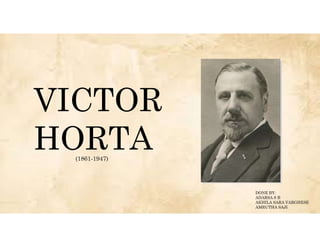
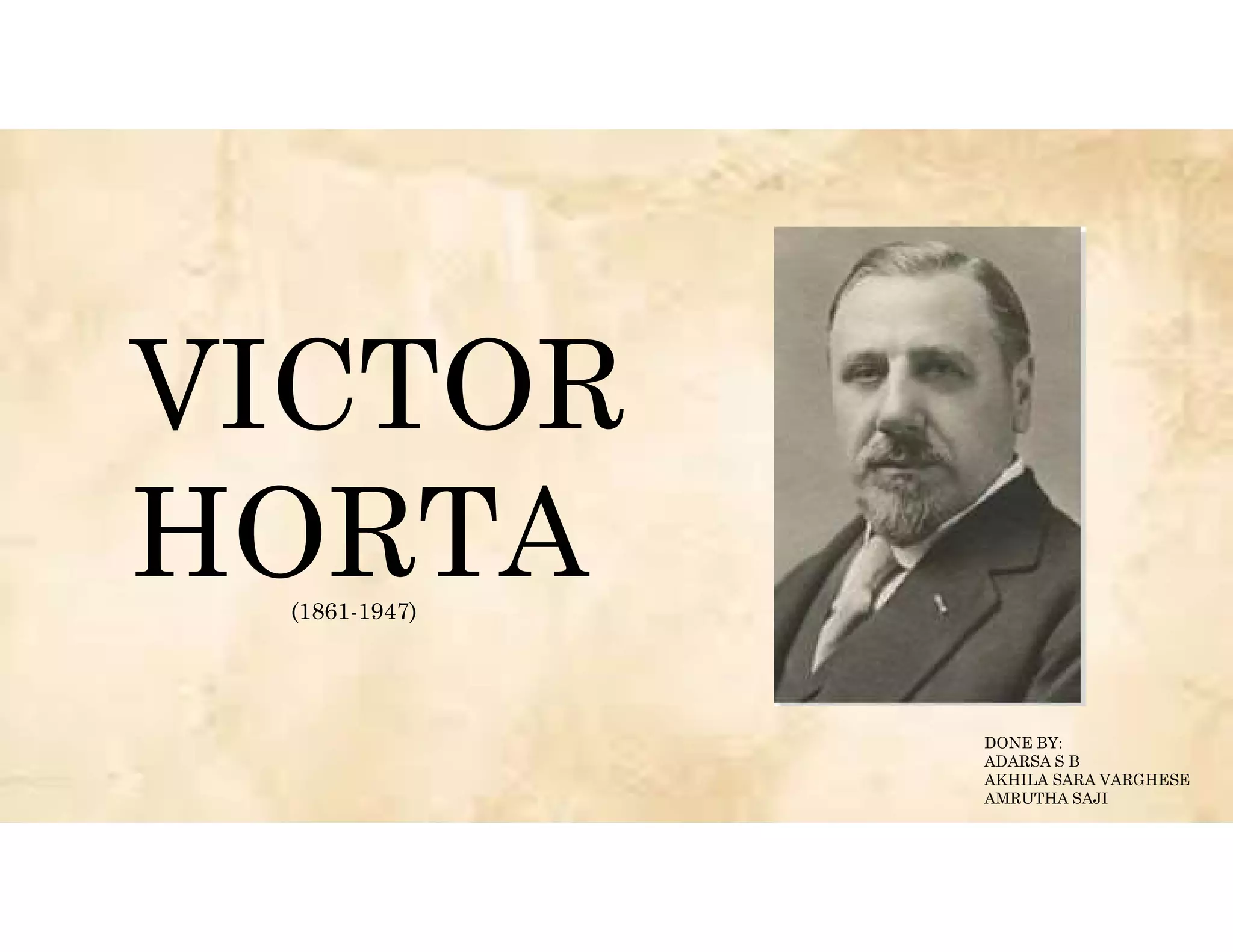
VICTOR
HORTA
(1861-1947)
DONE BY:
ADARSA S B
AKHILA SARA VARGHESE
AMRUTHA SAJI
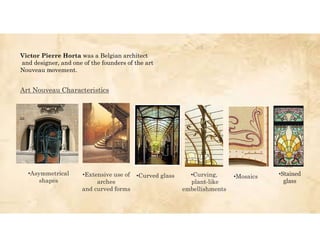
Victor Pierre Horta was a Belgian architect
and designer, and one of the founders of the art
Nouveau movement.
•Asymmetrical
shapes
Art Nouveau Characteristics
•Extensive use of
arches
and curved forms
•Curved glass •Curving,
plant-like
embellishments
•Mosaics •Stained
glass
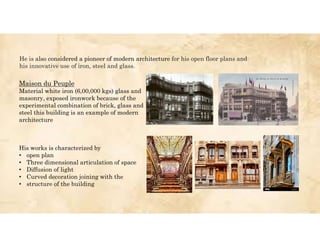
His works is characterized by
• open plan
• Three dimensional articulation of space
• Diffusion of light
• Curved decoration joining with the
• structure of the building
Maison du Peuple
Material white iron (6,00,000 kgs) glass and
masonry, exposed ironwork because of the
experimental combination of brick, glass and
steel this building is an example of modern
architecture
He is also considered a pioneer of modern architecture for his open floor plans and
his innovative use of iron, steel and glass.
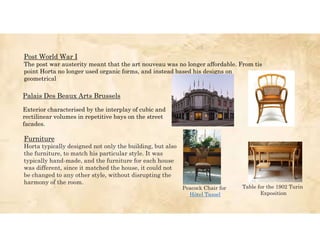
Post World War I
The post war austerity meant that the art nouveau was no longer affordable. From tis
point Horta no longer used organic forms, and instead based his designs on
geometrical
Exterior characterised by the interplay of cubic and
rectilinear volumes in repetitive bays on the street
facades.
Palais Des Beaux Arts Brussels
Furniture
Horta typically designed not only the building, but also
the furniture, to match his particular style. It was
typically hand-made, and the furniture for each house
was different, since it matched the house, it could not
be changed to any other style, without disrupting the
harmony of the room.
Peacock Chair for
Hôtel Tassel
Table for the 1902 Turin
Exposition
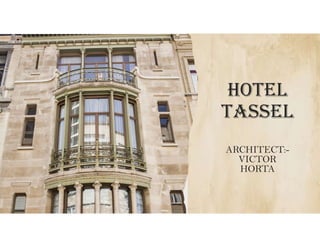
HOTEL
TASSEL
ARCHITECT:-
VICTOR
HORTA
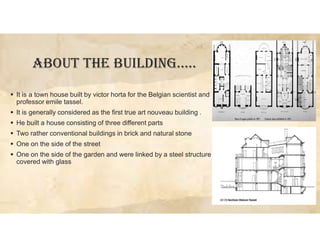
ABOUT THE BUILDING…..
 It is a town house built by victor horta for the Belgian scientist and
professor emile tassel.
 It is generally considered as the first true art nouveau building .
 He built a house consisting of three different parts
 Two rather conventional buildings in brick and natural stone
 One on the side of the street
 One on the side of the garden and were linked by a steel structure
covered with glass
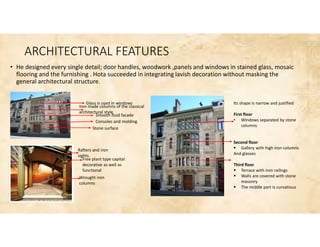
ARCHITECTURAL FEATURES
• He designed every single detail; door handles, woodwork ,panels and windows in stained glass, mosaic
flooring and the furnishing . Hota succeeded in integrating lavish decoration without masking the
general architectural structure.
Glass is used in windows
Iron made columns of the classical
architectural style
Smooth fluid facade
Consoles and molding
Stone surface
Rafters and iron
sights.
Free plant type capital
decorative as well as
functional
Wrought iron
columns
Its shape is narrow and justified
First floor
• Windows separated by stone
columns
Second floor
 Gallery with high iron columns
And glasses
Third floor
 Terrace with iron railings
 Walls are covered with stone
masonry
 The middle part is curvatious
ARCHITECTURAL FEATURES
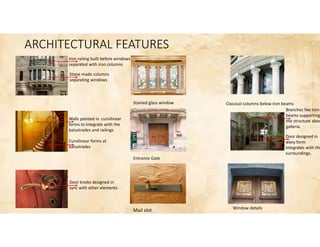
Iron railing built before windows
separated with iron columns
Stone made columns
separating windows
Walls painted in curvilinear
forms to integrate with the
balustrades and railings
Curvilinear forms at
balustrades
Door knobs designed in
sync with other elements
Stained glass window
Entrance Gate
Mail slot
Classical columns below iron beams
Window details
Branches like iron
beams supporting
the structure abov
galleria.
Door designed in
wavy form
integrates with the
surroundings.
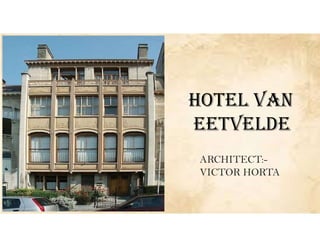
HOTEL vAN
EETvELDE
ARCHITECT:-
VICTOR HORTA
ABOUT
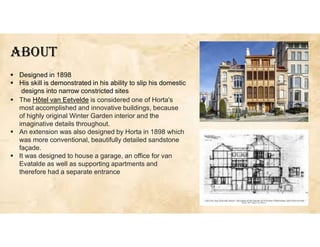
 Designed in 1898
 His skill is demonstrated in his ability to slip his domestic
designs into narrow constricted sites
 The Hôtel van Eetvelde is considered one of Horta's
most accomplished and innovative buildings, because
of highly original Winter Garden interior and the
imaginative details throughout.
 An extension was also designed by Horta in 1898 which
was more conventional, beautifully detailed sandstone
façade.
 It was designed to house a garage, an office for van
Evatalde as well as supporting apartments and
therefore had a separate entrance
ArcHITEcTUrAL fEATUrES
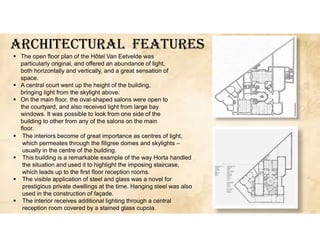
 The interiors become of great importance as centres of light,
which permeates through the filigree domes and skylights –
usually in the centre of the building.
 This building is a remarkable example of the way Horta handled
the situation and used it to highlight the imposing staircase,
which leads up to the first floor reception rooms.
 The visible application of steel and glass was a novel for
prestigious private dwellings at the time. Hanging steel was also
used in the construction of façade.
 The interior receives additional lighting through a central
reception room covered by a stained glass cupola.
 The open floor plan of the Hôtel Van Eetvelde was
particularly original, and offered an abundance of light,
both horizontally and vertically, and a great sensation of
space.
 A central court went up the height of the building,
bringing light from the skylight above.
 On the main floor, the oval-shaped salons were open to
the courtyard, and also received light from large bay
windows. It was possible to look from one side of the
building to other from any of the salons on the main
floor.
ArcHITEcTUrAL fEATUrES
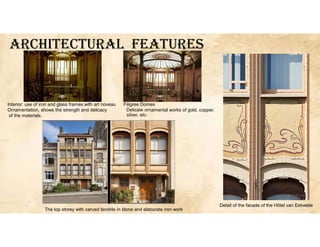
Detail of the facade of the Hôtel van Eetvelde
Interior: use of iron and glass frames with art noveau Filigree Domes
Ornamentation, shows the strength and delicacy Delicate ornamental works of gold, copper,
of the materials.
The top storey with carved tendrils in stone and elaborate iron work
ArcHITEcTUrAL fEATUrES
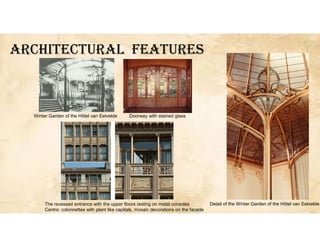
The recessed entrance with the upper floors resting on metal consoles
Centre: colonnettes with plant like capitals, mosaic decorations on the facade
Detail of the Winter Garden of the Hôtel van Eetvelde
Winter Garden of the Hôtel van Eetvelde Doorway with stained glass
THANK YOU

victor horta

  • 1.
    VICTOR HORTA (1861-1947) DONE BY: ADARSA SB AKHILA SARA VARGHESE AMRUTHA SAJI
  • 2.
    Victor Pierre Hortawas a Belgian architect and designer, and one of the founders of the art Nouveau movement. •Asymmetrical shapes Art Nouveau Characteristics •Extensive use of arches and curved forms •Curved glass •Curving, plant-like embellishments •Mosaics •Stained glass
  • 3.
    His works ischaracterized by • open plan • Three dimensional articulation of space • Diffusion of light • Curved decoration joining with the • structure of the building Maison du Peuple Material white iron (6,00,000 kgs) glass and masonry, exposed ironwork because of the experimental combination of brick, glass and steel this building is an example of modern architecture He is also considered a pioneer of modern architecture for his open floor plans and his innovative use of iron, steel and glass.
  • 4.
    Post World WarI The post war austerity meant that the art nouveau was no longer affordable. From tis point Horta no longer used organic forms, and instead based his designs on geometrical Exterior characterised by the interplay of cubic and rectilinear volumes in repetitive bays on the street facades. Palais Des Beaux Arts Brussels Furniture Horta typically designed not only the building, but also the furniture, to match his particular style. It was typically hand-made, and the furniture for each house was different, since it matched the house, it could not be changed to any other style, without disrupting the harmony of the room. Peacock Chair for Hôtel Tassel Table for the 1902 Turin Exposition
  • 5.
  • 6.
    ABOUT THE BUILDING….. It is a town house built by victor horta for the Belgian scientist and professor emile tassel.  It is generally considered as the first true art nouveau building .  He built a house consisting of three different parts  Two rather conventional buildings in brick and natural stone  One on the side of the street  One on the side of the garden and were linked by a steel structure covered with glass
  • 7.
    ARCHITECTURAL FEATURES • Hedesigned every single detail; door handles, woodwork ,panels and windows in stained glass, mosaic flooring and the furnishing . Hota succeeded in integrating lavish decoration without masking the general architectural structure. Glass is used in windows Iron made columns of the classical architectural style Smooth fluid facade Consoles and molding Stone surface Rafters and iron sights. Free plant type capital decorative as well as functional Wrought iron columns Its shape is narrow and justified First floor • Windows separated by stone columns Second floor  Gallery with high iron columns And glasses Third floor  Terrace with iron railings  Walls are covered with stone masonry  The middle part is curvatious
  • 8.
    ARCHITECTURAL FEATURES Iron railingbuilt before windows separated with iron columns Stone made columns separating windows Walls painted in curvilinear forms to integrate with the balustrades and railings Curvilinear forms at balustrades Door knobs designed in sync with other elements Stained glass window Entrance Gate Mail slot Classical columns below iron beams Window details Branches like iron beams supporting the structure abov galleria. Door designed in wavy form integrates with the surroundings.
  • 9.
  • 10.
    ABOUT  Designed in1898  His skill is demonstrated in his ability to slip his domestic designs into narrow constricted sites  The Hôtel van Eetvelde is considered one of Horta's most accomplished and innovative buildings, because of highly original Winter Garden interior and the imaginative details throughout.  An extension was also designed by Horta in 1898 which was more conventional, beautifully detailed sandstone façade.  It was designed to house a garage, an office for van Evatalde as well as supporting apartments and therefore had a separate entrance
  • 11.
    ArcHITEcTUrAL fEATUrES  Theinteriors become of great importance as centres of light, which permeates through the filigree domes and skylights – usually in the centre of the building.  This building is a remarkable example of the way Horta handled the situation and used it to highlight the imposing staircase, which leads up to the first floor reception rooms.  The visible application of steel and glass was a novel for prestigious private dwellings at the time. Hanging steel was also used in the construction of façade.  The interior receives additional lighting through a central reception room covered by a stained glass cupola.  The open floor plan of the Hôtel Van Eetvelde was particularly original, and offered an abundance of light, both horizontally and vertically, and a great sensation of space.  A central court went up the height of the building, bringing light from the skylight above.  On the main floor, the oval-shaped salons were open to the courtyard, and also received light from large bay windows. It was possible to look from one side of the building to other from any of the salons on the main floor.
  • 12.
    ArcHITEcTUrAL fEATUrES Detail ofthe facade of the Hôtel van Eetvelde Interior: use of iron and glass frames with art noveau Filigree Domes Ornamentation, shows the strength and delicacy Delicate ornamental works of gold, copper, of the materials. The top storey with carved tendrils in stone and elaborate iron work
  • 13.
    ArcHITEcTUrAL fEATUrES The recessedentrance with the upper floors resting on metal consoles Centre: colonnettes with plant like capitals, mosaic decorations on the facade Detail of the Winter Garden of the Hôtel van Eetvelde Winter Garden of the Hôtel van Eetvelde Doorway with stained glass
  • 14.