POLITEKNIK UNGKU OMAR
RAMS
C 2329 HISTORY OF MODERN ARCHITECTURE ( SEJARAH SENIBINA MODEN) 2009
Art Nouveau
Art Nouveau is an elegant decorative art style
characterized by intricate patterns of curving lines. Its origins
somewhat rooted in the British Arts and Crafts Movement of
William Morris, Art Nouveau was popular across Europe and
in the United States as well. Leading practitioners included
Alphonse Mucha, Aubrey Beardsley, Gustav Klimt and the
American glassmaker Louis Comfort Tiffany. Art Nouveau
remained popular until around the time of World War I, and
was ultimately replaced by the Art Deco style.
Is a decorative-art movement centered in Western Europe. It
began in the 1880s as a reaction against the historical emphasis
of mid-19th-century art, but did not survive World War I. Art
nouveau originated in London and was variously called
Jugendstil in Germany, Sezessionstil in Austria, and
Modernismo in Spain. In general it was most successfully
practiced in the decorative arts: furniture, jewelry, and book
design and illustration. The style was richly ornamental and
asymmetrical, characterized by a whiplash linearity
reminiscent of twining plant tendrils. Its exponents chose
themes fraught with symbolism, frequently of an erotic nature.
They imbued their designs with dreamlike and exotic forms.
The outstanding designers of art nouveau in England include
the graphic artist Aubrey Beardsley, A. H. Mackmurdo,
Charles Ricketts, Walter Crane, and the Scottish architect
Charles R. Mackintosh; in Belgium the architects Henry Van
de Velde and Victor Horta; in France the architect and designer
of the Paris mtro entrances, Hector Guimard, and the jewelry
designer Ren Lalique; in Austria the painter Gustav Klimt; in
Spain the architect Antonio Gaud; in Germany the illustrator
Otto Eckmann and the architect Peter Behrens; in Italy the
originator of the ornamental Floral style, Giuseppe
Sommaruga; and in the United States Louis Sullivan, whose
architecture was dressed with art nouveau detail, and the
designer of elegant glassware Louis C. Tiffany. The aesthetics
of the movement were disseminated through various illustrated
periodicals including The Century Guild Hobby Horse (1894),
The Dial (1889), The Studio (begun, 1893), The Yellow Book
(1894,95), and The Savoy (1896,98). The works of Beardsley
and Tiffany were especially popular.
art nouveau
POLITEKNIK UNGKU OMAR
RAMS
C 2329 HISTORY OF MODERN ARCHITECTURE ( SEJARAH SENIBINA MODEN) 2009
The Hôtel Tassel is a
town house built by
Victor Horta in
Brussels for the
Belgian scientist and
professor Emile Tassel
in 1893-1894. It is
located at 6, Rue Paul-
Emile Jansonstraat in
Brussels. It is
generally considered
as the first true 'Art
Nouveau' building,
because of its highly innovative plan and its ground breaking
use of materials and decoration. Together with three other town
houses of Victor Horta, including Horta's own house and
atelier it was put on the 'UNESCO World Heritage List' in
2000. From the report of the UNESCO commission:
"The four major town houses - Hôtel Tassel, Hôtel Solvay,
Hôtel van Eetvelde, and Maison & Atelier Horta - located in
Brussels and designed by the architect Victor Horta, one of the
earliest initiators of Art Nouveau, are some of the most
remarkable pioneering works of architecture of the end of the
19th century. The stylistic revolution represented by these
works is characterized by their open plan, the diffusion of light,
and the brilliant joining of the curved lines of decoration with
the structure of the building."
The first town house built by Victor Horta was the Maison
Autrique. This dwelling was already innovative for its
application of a novel 'Art Nouveau' decorative scheme that
didn't include references to other historical styles. However the
floor plan and spatial composition of the Madison Antique
remained rather traditional. On the deep and narrow building
plot the rooms were organized according to a traditional
scheme used in most Belgian town houses at that time. It
consisted of a suite of rooms on the left side of the building
plot flanked by a rather narrow entrance hall with stairs and a
corridor that led to a small garden at the back. From the three
room suite only the first and the last had windows so that the
middle room (mostly used as a dining room) was rather
gloomy.
At the Hôtel Tassel Horta definitively broke with this
traditional scheme. In fact he built a house consisting of three
different parts. Two rather conventional buildings in brick and
natural stone - one on the side of the street and one on the side
of the garden - were linked by a steel structure covered
with glass. It functions as the connective part in the
spatial composition of the house and contains staircases
and landings that connect the different rooms and floors.
Trough the glass roof it functions as a light shaft that
POLITEKNIK UNGKU OMAR
RAMS
C 2329 HISTORY OF MODERN ARCHITECTURE ( SEJARAH SENIBINA MODEN) 2009
brings natural light into the centre of the building. In this part
of the house that could also be used for receiving guests, Horta
made the maximum of his skills as an interior designer. He
designed every single detail; door handles, woodwork, panels
and windows in stained glass, mosaic floorings, stair railings,
electric fittings and even the decorative wall paintings and the
furnishing. Horta succeeded in integrating the lavish decoration
without masking the general architectural structures.
The innovations made in the Hôtel Tassel would mark the style
and approach for most of Horta's later town houses, including
the Hôtel van Eetvelde, the Hôtel Solvay and the architects
own house and 'atelier'. It might be superfluous to mention that
these houses were very expensive and only affordable for the
rich 'bourgeoisie' with an 'Avant-Garde' taste. For this reason
the pure architectural innovations were not largely followed by
other architects. Most other Art Nouveau dwellings in Belgium
and other European countries were inspired by Horta's
'whiplash' decorative style which is mostly applied to a more
traditional building. The Hôtel Tassel had a decisive influence
on the French Art Nouveau architect Hector Guimard who
later developed a personal interpretation of Horta's
example
. Hôtel
Tassel
Horta
POLITEKNIK UNGKU OMAR
RAMS
C 2329 HISTORY OF MODERN ARCHITECTURE ( SEJARAH SENIBINA MODEN) 2009
Karl Ernst Osthaus-Museum
The Karl Ernst Osthaus-Museum is an art museum in
Hagen, North Rhine-Westphalia, Germany. The center of the
museum is a building whose interior was designed by Henry
van de Velde to house Karl Ernst Osthaus' art collection, open
to the public as the Folkwang Museum. When Osthaus' heirs
sold his art collection to the city of Essen, the city of Hagen
gained possession of the empty museum building. For a time it
served as offices for the local electric company.
After World War II, the new director of Hagen's city art
museum, Herta Hesse, oversaw the restoration of the old
Folkwang building into a new home for Hagen's art museum.
Although the original interior design was lost due to
reconstruction and World War II bombings, the interior has
been restored several times and gives a reasonable
approximation of Osthaus' original museum, if not its
collection. Under her direction, the museum focused on
recapturing what the city had lost when the Folkwang
collection was sold to Essen. The museum became a focus for
exhibits of art nouveau and expressionist art, particularly the
artists associated with Osthaus or his art colony.
Under Michael Fehr, the Karl Ernst Osthaus-Museum adopted
a more playful attitude toward local history. Large installations
created sensations in the city, and numerous works poke fun at
Hagen's inability to transcend the Osthaus past.
The painting collection stems from private donations and
gradual purchases. It houses one of the main collections of
paintings by Christian Rohlfs and the most important collection
of paintings by Emil Schumacher. Both are considered Hagen
artists. Other notable works on exhibit include environmental
art by Herman de Vries, and the German branch of the
Museum of Jurassic Technology.
The Karl Ernst Osthaus-Museum also houses the Karl Ernst
Osthaus-Archive, a major depository of documents relating to
the Folkwang Museum and early 20th century avant garde art
and architecture.
POLITEKNIK UNGKU OMAR
RAMS
C 2329 HISTORY OF MODERN ARCHITECTURE ( SEJARAH SENIBINA MODEN) 2009
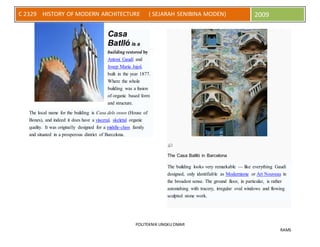
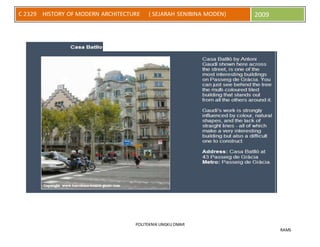
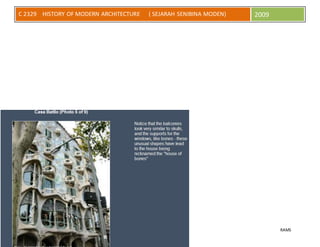
Casa
Batlló is a
building restored by
Antoni Gaudí and
Josep Maria Jujol,
built in the year 1877.
Where the whole
building was a fusion
of organic based form
and structure.
The local name for the building is Casa dels ossos (House of
Bones), and indeed it does have a visceral, skeletal organic
quality. It was originally designed for a middle-class family
and situated in a prosperous district of Barcelona.
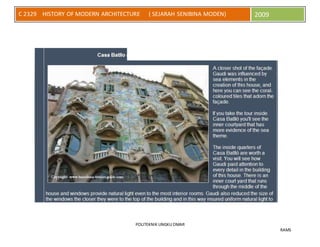
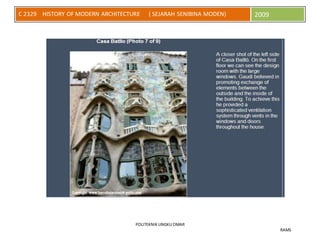
The Casa Batlló in Barcelona
The building looks very remarkable — like everything Gaudí
designed, only identifiable as Modernisme or Art Nouveau in
the broadest sense. The ground floor, in particular, is rather
astonishing with tracery, irregular oval windows and flowing
sculpted stone work.
POLITEKNIK UNGKU OMAR
RAMS
C 2329 HISTORY OF MODERN ARCHITECTURE ( SEJARAH SENIBINA MODEN) 2009
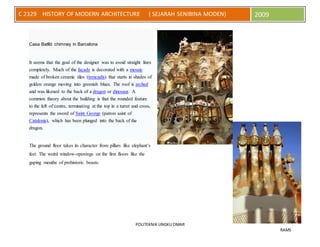
Casa Batlló chimney in Barcelona
It seems that the goal of the designer was to avoid straight lines
completely. Much of the façade is decorated with a mosaic
made of broken ceramic tiles (trencadís) that starts in shades of
golden orange moving into greenish blues. The roof is arched
and was likened to the back of a dragon or dinosaur. A
common theory about the building is that the rounded feature
to the left of centre, terminating at the top in a turret and cross,
represents the sword of Saint George (patron saint of
Catalonia), which has been plunged into the back of the
dragon.
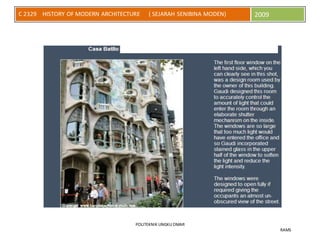
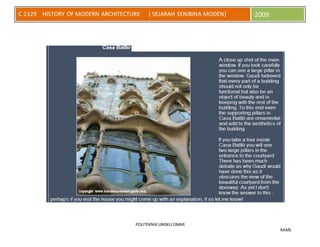
The ground floor takes its character from pillars like elephant’s
feet. The weird window-openings on the first floors like the
gaping mouths of prehistoric beasts.
POLITEKNIK UNGKU OMAR
RAMS
C 2329 HISTORY OF MODERN ARCHITECTURE ( SEJARAH SENIBINA MODEN) 2009
POLITEKNIK UNGKU OMAR
RAMS
C 2329 HISTORY OF MODERN ARCHITECTURE ( SEJARAH SENIBINA MODEN) 2009
POLITEKNIK UNGKU OMAR
RAMS
C 2329 HISTORY OF MODERN ARCHITECTURE ( SEJARAH SENIBINA MODEN) 2009
POLITEKNIK UNGKU OMAR
RAMS
C 2329 HISTORY OF MODERN ARCHITECTURE ( SEJARAH SENIBINA MODEN) 2009
POLITEKNIK UNGKU OMAR
RAMS
C 2329 HISTORY OF MODERN ARCHITECTURE ( SEJARAH SENIBINA MODEN) 2009
POLITEKNIK UNGKU OMAR
RAMS
C 2329 HISTORY OF MODERN ARCHITECTURE ( SEJARAH SENIBINA MODEN) 2009
POLITEKNIK UNGKU OMAR
RAMS
C 2329 HISTORY OF MODERN ARCHITECTURE ( SEJARAH SENIBINA MODEN) 2009

Art nouveau

  • 1.
    POLITEKNIK UNGKU OMAR RAMS C2329 HISTORY OF MODERN ARCHITECTURE ( SEJARAH SENIBINA MODEN) 2009 Art Nouveau Art Nouveau is an elegant decorative art style characterized by intricate patterns of curving lines. Its origins somewhat rooted in the British Arts and Crafts Movement of William Morris, Art Nouveau was popular across Europe and in the United States as well. Leading practitioners included Alphonse Mucha, Aubrey Beardsley, Gustav Klimt and the American glassmaker Louis Comfort Tiffany. Art Nouveau remained popular until around the time of World War I, and was ultimately replaced by the Art Deco style. Is a decorative-art movement centered in Western Europe. It began in the 1880s as a reaction against the historical emphasis of mid-19th-century art, but did not survive World War I. Art nouveau originated in London and was variously called Jugendstil in Germany, Sezessionstil in Austria, and Modernismo in Spain. In general it was most successfully practiced in the decorative arts: furniture, jewelry, and book design and illustration. The style was richly ornamental and asymmetrical, characterized by a whiplash linearity reminiscent of twining plant tendrils. Its exponents chose themes fraught with symbolism, frequently of an erotic nature. They imbued their designs with dreamlike and exotic forms. The outstanding designers of art nouveau in England include the graphic artist Aubrey Beardsley, A. H. Mackmurdo, Charles Ricketts, Walter Crane, and the Scottish architect Charles R. Mackintosh; in Belgium the architects Henry Van de Velde and Victor Horta; in France the architect and designer of the Paris mtro entrances, Hector Guimard, and the jewelry designer Ren Lalique; in Austria the painter Gustav Klimt; in Spain the architect Antonio Gaud; in Germany the illustrator Otto Eckmann and the architect Peter Behrens; in Italy the originator of the ornamental Floral style, Giuseppe Sommaruga; and in the United States Louis Sullivan, whose architecture was dressed with art nouveau detail, and the designer of elegant glassware Louis C. Tiffany. The aesthetics of the movement were disseminated through various illustrated periodicals including The Century Guild Hobby Horse (1894), The Dial (1889), The Studio (begun, 1893), The Yellow Book (1894,95), and The Savoy (1896,98). The works of Beardsley and Tiffany were especially popular. art nouveau
  • 2.
    POLITEKNIK UNGKU OMAR RAMS C2329 HISTORY OF MODERN ARCHITECTURE ( SEJARAH SENIBINA MODEN) 2009 The Hôtel Tassel is a town house built by Victor Horta in Brussels for the Belgian scientist and professor Emile Tassel in 1893-1894. It is located at 6, Rue Paul- Emile Jansonstraat in Brussels. It is generally considered as the first true 'Art Nouveau' building, because of its highly innovative plan and its ground breaking use of materials and decoration. Together with three other town houses of Victor Horta, including Horta's own house and atelier it was put on the 'UNESCO World Heritage List' in 2000. From the report of the UNESCO commission: "The four major town houses - Hôtel Tassel, Hôtel Solvay, Hôtel van Eetvelde, and Maison & Atelier Horta - located in Brussels and designed by the architect Victor Horta, one of the earliest initiators of Art Nouveau, are some of the most remarkable pioneering works of architecture of the end of the 19th century. The stylistic revolution represented by these works is characterized by their open plan, the diffusion of light, and the brilliant joining of the curved lines of decoration with the structure of the building." The first town house built by Victor Horta was the Maison Autrique. This dwelling was already innovative for its application of a novel 'Art Nouveau' decorative scheme that didn't include references to other historical styles. However the floor plan and spatial composition of the Madison Antique remained rather traditional. On the deep and narrow building plot the rooms were organized according to a traditional scheme used in most Belgian town houses at that time. It consisted of a suite of rooms on the left side of the building plot flanked by a rather narrow entrance hall with stairs and a corridor that led to a small garden at the back. From the three room suite only the first and the last had windows so that the middle room (mostly used as a dining room) was rather gloomy. At the Hôtel Tassel Horta definitively broke with this traditional scheme. In fact he built a house consisting of three different parts. Two rather conventional buildings in brick and natural stone - one on the side of the street and one on the side of the garden - were linked by a steel structure covered with glass. It functions as the connective part in the spatial composition of the house and contains staircases and landings that connect the different rooms and floors. Trough the glass roof it functions as a light shaft that
  • 3.
    POLITEKNIK UNGKU OMAR RAMS C2329 HISTORY OF MODERN ARCHITECTURE ( SEJARAH SENIBINA MODEN) 2009 brings natural light into the centre of the building. In this part of the house that could also be used for receiving guests, Horta made the maximum of his skills as an interior designer. He designed every single detail; door handles, woodwork, panels and windows in stained glass, mosaic floorings, stair railings, electric fittings and even the decorative wall paintings and the furnishing. Horta succeeded in integrating the lavish decoration without masking the general architectural structures. The innovations made in the Hôtel Tassel would mark the style and approach for most of Horta's later town houses, including the Hôtel van Eetvelde, the Hôtel Solvay and the architects own house and 'atelier'. It might be superfluous to mention that these houses were very expensive and only affordable for the rich 'bourgeoisie' with an 'Avant-Garde' taste. For this reason the pure architectural innovations were not largely followed by other architects. Most other Art Nouveau dwellings in Belgium and other European countries were inspired by Horta's 'whiplash' decorative style which is mostly applied to a more traditional building. The Hôtel Tassel had a decisive influence on the French Art Nouveau architect Hector Guimard who later developed a personal interpretation of Horta's example . Hôtel Tassel Horta
  • 4.
    POLITEKNIK UNGKU OMAR RAMS C2329 HISTORY OF MODERN ARCHITECTURE ( SEJARAH SENIBINA MODEN) 2009 Karl Ernst Osthaus-Museum The Karl Ernst Osthaus-Museum is an art museum in Hagen, North Rhine-Westphalia, Germany. The center of the museum is a building whose interior was designed by Henry van de Velde to house Karl Ernst Osthaus' art collection, open to the public as the Folkwang Museum. When Osthaus' heirs sold his art collection to the city of Essen, the city of Hagen gained possession of the empty museum building. For a time it served as offices for the local electric company. After World War II, the new director of Hagen's city art museum, Herta Hesse, oversaw the restoration of the old Folkwang building into a new home for Hagen's art museum. Although the original interior design was lost due to reconstruction and World War II bombings, the interior has been restored several times and gives a reasonable approximation of Osthaus' original museum, if not its collection. Under her direction, the museum focused on recapturing what the city had lost when the Folkwang collection was sold to Essen. The museum became a focus for exhibits of art nouveau and expressionist art, particularly the artists associated with Osthaus or his art colony. Under Michael Fehr, the Karl Ernst Osthaus-Museum adopted a more playful attitude toward local history. Large installations created sensations in the city, and numerous works poke fun at Hagen's inability to transcend the Osthaus past. The painting collection stems from private donations and gradual purchases. It houses one of the main collections of paintings by Christian Rohlfs and the most important collection of paintings by Emil Schumacher. Both are considered Hagen artists. Other notable works on exhibit include environmental art by Herman de Vries, and the German branch of the Museum of Jurassic Technology. The Karl Ernst Osthaus-Museum also houses the Karl Ernst Osthaus-Archive, a major depository of documents relating to the Folkwang Museum and early 20th century avant garde art and architecture.
  • 5.
    POLITEKNIK UNGKU OMAR RAMS C2329 HISTORY OF MODERN ARCHITECTURE ( SEJARAH SENIBINA MODEN) 2009 Casa Batlló is a building restored by Antoni Gaudí and Josep Maria Jujol, built in the year 1877. Where the whole building was a fusion of organic based form and structure. The local name for the building is Casa dels ossos (House of Bones), and indeed it does have a visceral, skeletal organic quality. It was originally designed for a middle-class family and situated in a prosperous district of Barcelona. The Casa Batlló in Barcelona The building looks very remarkable — like everything Gaudí designed, only identifiable as Modernisme or Art Nouveau in the broadest sense. The ground floor, in particular, is rather astonishing with tracery, irregular oval windows and flowing sculpted stone work.
  • 6.
    POLITEKNIK UNGKU OMAR RAMS C2329 HISTORY OF MODERN ARCHITECTURE ( SEJARAH SENIBINA MODEN) 2009 Casa Batlló chimney in Barcelona It seems that the goal of the designer was to avoid straight lines completely. Much of the façade is decorated with a mosaic made of broken ceramic tiles (trencadís) that starts in shades of golden orange moving into greenish blues. The roof is arched and was likened to the back of a dragon or dinosaur. A common theory about the building is that the rounded feature to the left of centre, terminating at the top in a turret and cross, represents the sword of Saint George (patron saint of Catalonia), which has been plunged into the back of the dragon. The ground floor takes its character from pillars like elephant’s feet. The weird window-openings on the first floors like the gaping mouths of prehistoric beasts.
  • 7.
    POLITEKNIK UNGKU OMAR RAMS C2329 HISTORY OF MODERN ARCHITECTURE ( SEJARAH SENIBINA MODEN) 2009
  • 8.
    POLITEKNIK UNGKU OMAR RAMS C2329 HISTORY OF MODERN ARCHITECTURE ( SEJARAH SENIBINA MODEN) 2009
  • 9.
    POLITEKNIK UNGKU OMAR RAMS C2329 HISTORY OF MODERN ARCHITECTURE ( SEJARAH SENIBINA MODEN) 2009
  • 10.
    POLITEKNIK UNGKU OMAR RAMS C2329 HISTORY OF MODERN ARCHITECTURE ( SEJARAH SENIBINA MODEN) 2009
  • 11.
    POLITEKNIK UNGKU OMAR RAMS C2329 HISTORY OF MODERN ARCHITECTURE ( SEJARAH SENIBINA MODEN) 2009
  • 12.
    POLITEKNIK UNGKU OMAR RAMS C2329 HISTORY OF MODERN ARCHITECTURE ( SEJARAH SENIBINA MODEN) 2009
  • 13.
    POLITEKNIK UNGKU OMAR RAMS C2329 HISTORY OF MODERN ARCHITECTURE ( SEJARAH SENIBINA MODEN) 2009