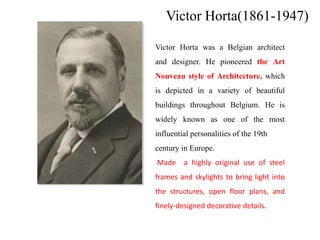
Victor Horta was a Belgian architect
and designer. He pioneered the Art
Nouveau style of Architecture, which
is depicted in a variety of beautiful
buildings throughout Belgium. He is
widely known as one of the most
influential personalities of the 19th
century in Europe.
Made a highly original use of steel
frames and skylights to bring light into
the structures, open floor plans, and
finely-designed decorative details.
Victor Horta(1861-1947)
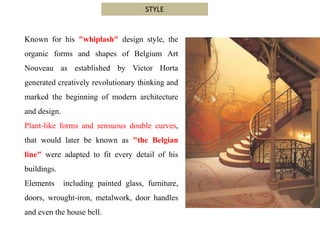
Known for his "whiplash" design style, the
organic forms and shapes of Belgium Art
Nouveau as established by Victor Horta
generated creatively revolutionary thinking and
marked the beginning of modern architecture
and design.
Plant-like forms and sensuous double curves,
that would later be known as "the Belgian
line" were adapted to fit every detail of his
buildings.
Elements including painted glass, furniture,
doors, wrought-iron, metalwork, door handles
and even the house bell.
STYLE
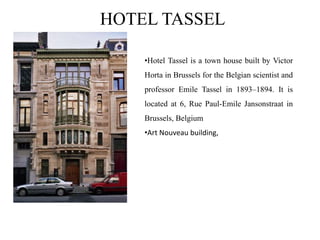
HOTEL TASSEL
•Hotel Tassel is a town house built by Victor
Horta in Brussels for the Belgian scientist and
professor Emile Tassel in 1893–1894. It is
located at 6, Rue Paul-Emile Jansonstraat in
Brussels, Belgium
•Art Nouveau building,
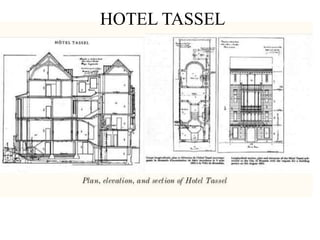
HOTEL TASSEL
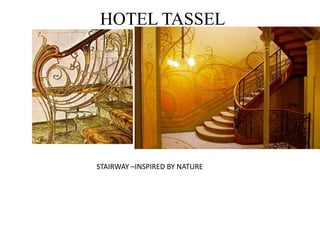
STAIRWAY –INSPIRED BY NATURE
HOTEL TASSEL
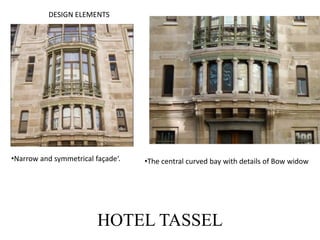
DESIGN ELEMENTS
•Narrow and symmetrical façade‘. •The central curved bay with details of Bow widow
HOTEL TASSEL
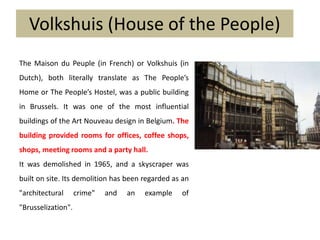
Volkshuis (House of the People)
The Maison du Peuple (in French) or Volkshuis (in
Dutch), both literally translate as The People’s
Home or The People’s Hostel, was a public building
in Brussels. It was one of the most influential
buildings of the Art Nouveau design in Belgium. The
building provided rooms for offices, coffee shops,
shops, meeting rooms and a party hall.
It was demolished in 1965, and a skyscraper was
built on site. Its demolition has been regarded as an
"architectural crime" and an example of
"Brusselization".
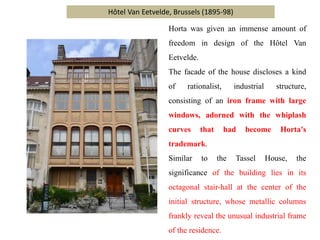
Hôtel Van Eetvelde, Brussels (1895-98)
Horta was given an immense amount of
freedom in design of the Hôtel Van
Eetvelde.
The facade of the house discloses a kind
of rationalist, industrial structure,
consisting of an iron frame with large
windows, adorned with the whiplash
curves that had become Horta's
trademark.
Similar to the Tassel House, the
significance of the building lies in its
octagonal stair-hall at the center of the
initial structure, whose metallic columns
frankly reveal the unusual industrial frame
of the residence.
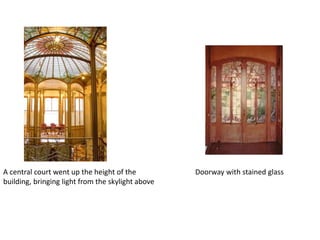
A central court went up the height of the
building, bringing light from the skylight above
Doorway with stained glass

Victor horta

  • 1.
    Victor Horta wasa Belgian architect and designer. He pioneered the Art Nouveau style of Architecture, which is depicted in a variety of beautiful buildings throughout Belgium. He is widely known as one of the most influential personalities of the 19th century in Europe. Made a highly original use of steel frames and skylights to bring light into the structures, open floor plans, and finely-designed decorative details. Victor Horta(1861-1947)
  • 2.
    Known for his"whiplash" design style, the organic forms and shapes of Belgium Art Nouveau as established by Victor Horta generated creatively revolutionary thinking and marked the beginning of modern architecture and design. Plant-like forms and sensuous double curves, that would later be known as "the Belgian line" were adapted to fit every detail of his buildings. Elements including painted glass, furniture, doors, wrought-iron, metalwork, door handles and even the house bell. STYLE
  • 3.
    HOTEL TASSEL •Hotel Tasselis a town house built by Victor Horta in Brussels for the Belgian scientist and professor Emile Tassel in 1893–1894. It is located at 6, Rue Paul-Emile Jansonstraat in Brussels, Belgium •Art Nouveau building,
  • 4.
  • 5.
    STAIRWAY –INSPIRED BYNATURE HOTEL TASSEL
  • 6.
    DESIGN ELEMENTS •Narrow andsymmetrical façade‘. •The central curved bay with details of Bow widow HOTEL TASSEL
  • 7.
    Volkshuis (House ofthe People) The Maison du Peuple (in French) or Volkshuis (in Dutch), both literally translate as The People’s Home or The People’s Hostel, was a public building in Brussels. It was one of the most influential buildings of the Art Nouveau design in Belgium. The building provided rooms for offices, coffee shops, shops, meeting rooms and a party hall. It was demolished in 1965, and a skyscraper was built on site. Its demolition has been regarded as an "architectural crime" and an example of "Brusselization".
  • 9.
    Hôtel Van Eetvelde,Brussels (1895-98) Horta was given an immense amount of freedom in design of the Hôtel Van Eetvelde. The facade of the house discloses a kind of rationalist, industrial structure, consisting of an iron frame with large windows, adorned with the whiplash curves that had become Horta's trademark. Similar to the Tassel House, the significance of the building lies in its octagonal stair-hall at the center of the initial structure, whose metallic columns frankly reveal the unusual industrial frame of the residence.
  • 10.
    A central courtwent up the height of the building, bringing light from the skylight above Doorway with stained glass