T.Y.B.Sc.(Etx)
Advanced Digital System Design:
Unit 2.Verilog Hardware
Description Language
-Prof.Vandana Pagar
Assistant professor,
MIT ACSC
Topics to be Covered
 strings,
 Identifiers& keywords,
❑DataTypes inVerilog HDL
Net
reg
 Vectors
 Integers
 Real
 Time
 Arrays
 Memories
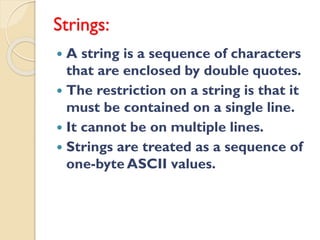
Strings:
 A string is a sequence of characters
that are enclosed by double quotes.
 The restriction on a string is that it
must be contained on a single line.
 It cannot be on multiple lines.
 Strings are treated as a sequence of
one-byte ASCII values.
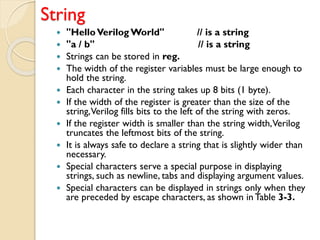
String
 "HelloVerilog World" // is a string
 "a / b" // is a string
 Strings can be stored in reg.
 The width of the register variables must be large enough to
hold the string.
 Each character in the string takes up 8 bits (1 byte).
 If the width of the register is greater than the size of the
string,Verilog fills bits to the left of the string with zeros.
 If the register width is smaller than the string width,Verilog
truncates the leftmost bits of the string.
 It is always safe to declare a string that is slightly wider than
necessary.
 Special characters serve a special purpose in displaying
strings, such as newline, tabs and displaying argument values.
 Special characters can be displayed in strings only when they
are preceded by escape characters, as shown in Table 3-3.
 reg [8*18:1] string-value;
//Declare a variable that is l8 bytes wide
Initial string-value = "HelloVerilogWorld";
// String can be stored
// in variable
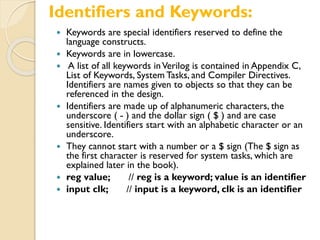
Identifiers and Keywords:
 Keywords are special identifiers reserved to define the
language constructs.
 Keywords are in lowercase.
 A list of all keywords inVerilog is contained in Appendix C,
List of Keywords, System Tasks, and Compiler Directives.
Identifiers are names given to objects so that they can be
referenced in the design.
 Identifiers are made up of alphanumeric characters, the
underscore ( - ) and the dollar sign ( $ ) and are case
sensitive. Identifiers start with an alphabetic character or an
underscore.
 They cannot start with a number or a $ sign (The $ sign as
the first character is reserved for system tasks, which are
explained later in the book).
 reg value; // reg is a keyword; value is an identifier
 input clk; // input is a keyword, clk is an identifier
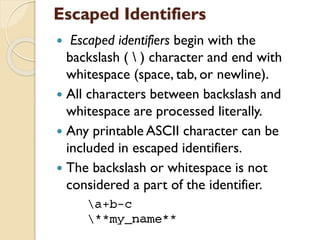
Escaped Identifiers
 Escaped identifiers begin with the
backslash (  ) character and end with
whitespace (space, tab, or newline).
 All characters between backslash and
whitespace are processed literally.
 Any printable ASCII character can be
included in escaped identifiers.
 The backslash or whitespace is not
considered a part of the identifier.
DataTypes
 This section discusses the data types used
inVerilog.
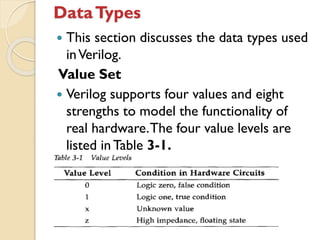
Value Set
 Verilog supports four values and eight
strengths to model the functionality of
real hardware.The four value levels are
listed inTable 3-1.
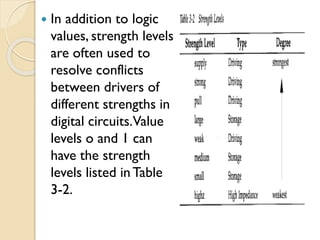
 In addition to logic
values, strength levels
are often used to
resolve conflicts
between drivers of
different strengths in
digital circuits.Value
levels o and 1 can
have the strength
levels listed inTable
3-2.
Nets
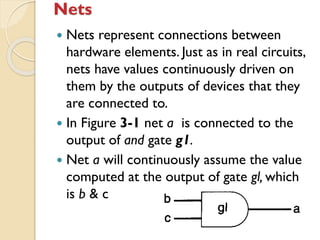
 Nets represent connections between
hardware elements. Just as in real circuits,
nets have values continuously driven on
them by the outputs of devices that they
are connected to.
 In Figure 3-1 net a is connected to the
output of and gate g1.
 Net a will continuously assume the value
computed at the output of gate gl, which
is b & c
Nets
 Nets are declared primarily with the keyword
wire. Nets are one-bit values by default unless
they are declared explicitly as vectors.The terms
w i r e and net are often used interchangeably.
The default value of a net is z (except the trireg
net, which defaults to X ). Nets get the output
value of their drivers. If a net has no driver, it gets
the value z.
 wire a; / / Declare net a for the above
circuit
 wire b,c; / / Declare two wires b,c for the
above circuit
 wire d = l'bO; / / Net d is fixed to logic
value 0 at declaration.
Registers
 Registers represent data storage elements.
 Registers retain value until another value is placed onto
them.
 Do not confuse the term registers inVerilog with hardware
registers built from edge-triggered flip-flops in real circuits.
 InVerilog, the term register merely means a variable that can
hold a value.
 Unlike a net, a register does not need a driver.
 Verilog registers do not need a clock as hardware registers
do.
 Values of registers can be changed anytime in a simulation by
assigning a new value to the register.
 Register data types are commonly declared by the keyword
reg.
 The default value for a reg data type is X.
Example of Register
reg reset; // declare a variable reset
that can hold its value
initial // this construct will be
discussed later
begin
reset = l'bl; //initialize reset to 1 to
reset the digital circuit.
#l00 reset = l'bO; // after 100 time
units reset is deasserted.
End
Vectors
 Nets or reg data types can be declared as vectors (multiple
bit widths).
 If bit width is not specified, the default is scalar (l-bit).
 Vectors can be declared at [high# : low#] or [low# : high#],
but the left number in the squared brackets is always the
most significant bit of the vector. In the example shown
above, bit 0 is the most significant bit of vector virtual-addr.
 For the vector declarations shown above, it is possible to
address bits or parts of vectors.

wire a; / / scalar net variable, default
wire [7:0] bus; / / 8-bit bus
wire [31:0] busA,busB,busC; / / 3 buses of 32-bit
width.
reg clock; / / scalar register, default
reg [O : 40] virtual-addr; // vector register, virtual
address 41 bits wide
Vectors: Accessing elements
 Wire [7:0] busA /8 bit vector busA
 busA[2] // 2nd bit of vector busA
 busA[2:0] //Three least significant
bits of vector bus,
/* using bus[0:2] is illegal because the
significant bit should always be on the
left of a range specification*/
Integer
 An integer is a general purpose register data type used for
manipulating quantities.
 Integers are declared by the keyword integer.
 Although it is possible to use reg as a general-purpose
variable, it is more convenient to declare an integer variable
for purposes such as counting.
 The default width for an integer is the host-machine word
size, which is implementation specific but is at least 32 bits.
 Registers declared as data type reg store values as unsigned
quantities, whereas integers store values as signed quantities.
integer counter; / / general purpose variable used
as a counter.
initial
counter = -1; / / A negative one is stored in the counter
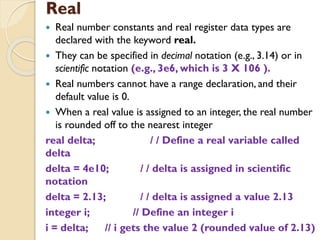
Real
 Real number constants and real register data types are
declared with the keyword real.
 They can be specified in decimal notation (e.g., 3.14) or in
scientific notation (e.g., 3e6, which is 3 X 10⁶ ).
 Real numbers cannot have a range declaration, and their
default value is 0.
 When a real value is assigned to an integer, the real number
is rounded off to the nearest integer
real delta; / / Define a real variable called
delta
delta = 4e10; / / delta is assigned in scientific
notation
delta = 2.13; / / delta is assigned a value 2.13
integer i; // Define an integer i
i = delta; // i gets the value 2 (rounded value of 2.13)
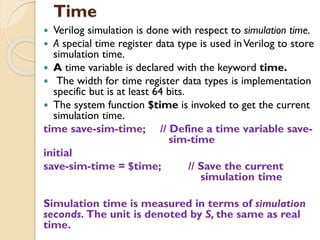
Time
 Verilog simulation is done with respect to simulation time.
 A special time register data type is used inVerilog to store
simulation time.
 A time variable is declared with the keyword time.
 The width for time register data types is implementation
specific but is at least 64 bits.
 The system function $time is invoked to get the current
simulation time.
time save-sim-time; // Define a time variable save-
sim-time
initial
save-sim-time = $time; // Save the current
simulation time
Simulation time is measured in terms of simulation
seconds. The unit is denoted by S, the same as real
time.
Arrays
 Arrays are allowed inVerilog for reg, integer, time, and vector register data
types. Arrays are not allowed for real variables.Arrays are accessed by <array-
name> [<subscript>l.
integer count[0:7]; / / an array of 8 count variables
reg bool[31:0 1] ; //Array of 32 one-bit boolean register variables
time chkqpoint[l:lOO]; //Array of 100 time checkpoint variables
reg [4 : 01 port-id[O : 71 ; //Array of 8port-ids; each port-id is 5 bits wide
integer matrix[4:0][4:0]; // 11legaldeclaration.Multidimensional
array
count[5] // 5th element of array of count variables
chk_point[100] //100th time check point value
port_id[3] //3rd element of port-id array.This is a 5-bit value.
A vector is a single element that is n-bits wide. On the other hand, arrays are
multiple elements that are l-bit or n-bits wide.
Memories
 In digital simulation, one often needs to model
register files, RAMS, and ROMs.
 Memories are modeled inVerilog simply as an array of
registers.
 Each element of the array is known as a word. Each
word can be one or more bits.
 It is important to differentiate between n l-bit
registers and one n-bit register.A particular word in
memory is obtained by using the address as a
memory array subscript.
reg memlbit[0:1023]; //~emory memlbit with 1K
l-bit words
reg [7 : 01 membyte [O : 10231]]; // memory
membyte with 1K 8-bit words (bytes)
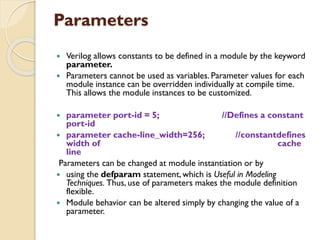
Parameters
 Verilog allows constants to be defined in a module by the keyword
parameter.
 Parameters cannot be used as variables. Parameter values for each
module instance can be overridden individually at compile time.
This allows the module instances to be customized.
 parameter port-id = 5; //Defines a constant
port-id
 parameter cache-line_width=256; //constantdefines
width of cache
line
Parameters can be changed at module instantiation or by
 using the defparam statement, which is Useful in Modeling
Techniques. Thus, use of parameters makes the module definition
flexible.
 Module behavior can be altered simply by changing the value of a
parameter.
References
 Verilog HDL A guide to digital design &
synthesis By Samir Palnitkar, Pearson
Second Edition
 Fundamental of digital logic with Verilog
By Stephen Brown, Zvonko Vranesic,
Tata McGraw Hill

VHDL- data types

  • 1.
    T.Y.B.Sc.(Etx) Advanced Digital SystemDesign: Unit 2.Verilog Hardware Description Language -Prof.Vandana Pagar Assistant professor, MIT ACSC
  • 2.
    Topics to beCovered  strings,  Identifiers& keywords, ❑DataTypes inVerilog HDL Net reg  Vectors  Integers  Real  Time  Arrays  Memories
  • 3.
    Strings:  A stringis a sequence of characters that are enclosed by double quotes.  The restriction on a string is that it must be contained on a single line.  It cannot be on multiple lines.  Strings are treated as a sequence of one-byte ASCII values.
  • 4.
    String  "HelloVerilog World"// is a string  "a / b" // is a string  Strings can be stored in reg.  The width of the register variables must be large enough to hold the string.  Each character in the string takes up 8 bits (1 byte).  If the width of the register is greater than the size of the string,Verilog fills bits to the left of the string with zeros.  If the register width is smaller than the string width,Verilog truncates the leftmost bits of the string.  It is always safe to declare a string that is slightly wider than necessary.  Special characters serve a special purpose in displaying strings, such as newline, tabs and displaying argument values.  Special characters can be displayed in strings only when they are preceded by escape characters, as shown in Table 3-3.
  • 5.
     reg [8*18:1]string-value; //Declare a variable that is l8 bytes wide Initial string-value = "HelloVerilogWorld"; // String can be stored // in variable
  • 6.
    Identifiers and Keywords: Keywords are special identifiers reserved to define the language constructs.  Keywords are in lowercase.  A list of all keywords inVerilog is contained in Appendix C, List of Keywords, System Tasks, and Compiler Directives. Identifiers are names given to objects so that they can be referenced in the design.  Identifiers are made up of alphanumeric characters, the underscore ( - ) and the dollar sign ( $ ) and are case sensitive. Identifiers start with an alphabetic character or an underscore.  They cannot start with a number or a $ sign (The $ sign as the first character is reserved for system tasks, which are explained later in the book).  reg value; // reg is a keyword; value is an identifier  input clk; // input is a keyword, clk is an identifier
  • 7.
    Escaped Identifiers  Escapedidentifiers begin with the backslash ( ) character and end with whitespace (space, tab, or newline).  All characters between backslash and whitespace are processed literally.  Any printable ASCII character can be included in escaped identifiers.  The backslash or whitespace is not considered a part of the identifier.
  • 8.
    DataTypes  This sectiondiscusses the data types used inVerilog. Value Set  Verilog supports four values and eight strengths to model the functionality of real hardware.The four value levels are listed inTable 3-1.
  • 9.
     In additionto logic values, strength levels are often used to resolve conflicts between drivers of different strengths in digital circuits.Value levels o and 1 can have the strength levels listed inTable 3-2.
  • 10.
    Nets  Nets representconnections between hardware elements. Just as in real circuits, nets have values continuously driven on them by the outputs of devices that they are connected to.  In Figure 3-1 net a is connected to the output of and gate g1.  Net a will continuously assume the value computed at the output of gate gl, which is b & c
  • 11.
    Nets  Nets aredeclared primarily with the keyword wire. Nets are one-bit values by default unless they are declared explicitly as vectors.The terms w i r e and net are often used interchangeably. The default value of a net is z (except the trireg net, which defaults to X ). Nets get the output value of their drivers. If a net has no driver, it gets the value z.  wire a; / / Declare net a for the above circuit  wire b,c; / / Declare two wires b,c for the above circuit  wire d = l'bO; / / Net d is fixed to logic value 0 at declaration.
  • 12.
    Registers  Registers representdata storage elements.  Registers retain value until another value is placed onto them.  Do not confuse the term registers inVerilog with hardware registers built from edge-triggered flip-flops in real circuits.  InVerilog, the term register merely means a variable that can hold a value.  Unlike a net, a register does not need a driver.  Verilog registers do not need a clock as hardware registers do.  Values of registers can be changed anytime in a simulation by assigning a new value to the register.  Register data types are commonly declared by the keyword reg.  The default value for a reg data type is X.
  • 13.
    Example of Register regreset; // declare a variable reset that can hold its value initial // this construct will be discussed later begin reset = l'bl; //initialize reset to 1 to reset the digital circuit. #l00 reset = l'bO; // after 100 time units reset is deasserted. End
  • 14.
    Vectors  Nets orreg data types can be declared as vectors (multiple bit widths).  If bit width is not specified, the default is scalar (l-bit).  Vectors can be declared at [high# : low#] or [low# : high#], but the left number in the squared brackets is always the most significant bit of the vector. In the example shown above, bit 0 is the most significant bit of vector virtual-addr.  For the vector declarations shown above, it is possible to address bits or parts of vectors.  wire a; / / scalar net variable, default wire [7:0] bus; / / 8-bit bus wire [31:0] busA,busB,busC; / / 3 buses of 32-bit width. reg clock; / / scalar register, default reg [O : 40] virtual-addr; // vector register, virtual address 41 bits wide
  • 15.
    Vectors: Accessing elements Wire [7:0] busA /8 bit vector busA  busA[2] // 2nd bit of vector busA  busA[2:0] //Three least significant bits of vector bus, /* using bus[0:2] is illegal because the significant bit should always be on the left of a range specification*/
  • 16.
    Integer  An integeris a general purpose register data type used for manipulating quantities.  Integers are declared by the keyword integer.  Although it is possible to use reg as a general-purpose variable, it is more convenient to declare an integer variable for purposes such as counting.  The default width for an integer is the host-machine word size, which is implementation specific but is at least 32 bits.  Registers declared as data type reg store values as unsigned quantities, whereas integers store values as signed quantities. integer counter; / / general purpose variable used as a counter. initial counter = -1; / / A negative one is stored in the counter
  • 17.
    Real  Real numberconstants and real register data types are declared with the keyword real.  They can be specified in decimal notation (e.g., 3.14) or in scientific notation (e.g., 3e6, which is 3 X 10⁶ ).  Real numbers cannot have a range declaration, and their default value is 0.  When a real value is assigned to an integer, the real number is rounded off to the nearest integer real delta; / / Define a real variable called delta delta = 4e10; / / delta is assigned in scientific notation delta = 2.13; / / delta is assigned a value 2.13 integer i; // Define an integer i i = delta; // i gets the value 2 (rounded value of 2.13)
  • 18.
    Time  Verilog simulationis done with respect to simulation time.  A special time register data type is used inVerilog to store simulation time.  A time variable is declared with the keyword time.  The width for time register data types is implementation specific but is at least 64 bits.  The system function $time is invoked to get the current simulation time. time save-sim-time; // Define a time variable save- sim-time initial save-sim-time = $time; // Save the current simulation time Simulation time is measured in terms of simulation seconds. The unit is denoted by S, the same as real time.
  • 19.
    Arrays  Arrays areallowed inVerilog for reg, integer, time, and vector register data types. Arrays are not allowed for real variables.Arrays are accessed by <array- name> [<subscript>l. integer count[0:7]; / / an array of 8 count variables reg bool[31:0 1] ; //Array of 32 one-bit boolean register variables time chkqpoint[l:lOO]; //Array of 100 time checkpoint variables reg [4 : 01 port-id[O : 71 ; //Array of 8port-ids; each port-id is 5 bits wide integer matrix[4:0][4:0]; // 11legaldeclaration.Multidimensional array count[5] // 5th element of array of count variables chk_point[100] //100th time check point value port_id[3] //3rd element of port-id array.This is a 5-bit value. A vector is a single element that is n-bits wide. On the other hand, arrays are multiple elements that are l-bit or n-bits wide.
  • 20.
    Memories  In digitalsimulation, one often needs to model register files, RAMS, and ROMs.  Memories are modeled inVerilog simply as an array of registers.  Each element of the array is known as a word. Each word can be one or more bits.  It is important to differentiate between n l-bit registers and one n-bit register.A particular word in memory is obtained by using the address as a memory array subscript. reg memlbit[0:1023]; //~emory memlbit with 1K l-bit words reg [7 : 01 membyte [O : 10231]]; // memory membyte with 1K 8-bit words (bytes)
  • 21.
    Parameters  Verilog allowsconstants to be defined in a module by the keyword parameter.  Parameters cannot be used as variables. Parameter values for each module instance can be overridden individually at compile time. This allows the module instances to be customized.  parameter port-id = 5; //Defines a constant port-id  parameter cache-line_width=256; //constantdefines width of cache line Parameters can be changed at module instantiation or by  using the defparam statement, which is Useful in Modeling Techniques. Thus, use of parameters makes the module definition flexible.  Module behavior can be altered simply by changing the value of a parameter.
  • 22.
    References  Verilog HDLA guide to digital design & synthesis By Samir Palnitkar, Pearson Second Edition  Fundamental of digital logic with Verilog By Stephen Brown, Zvonko Vranesic, Tata McGraw Hill