Electronics paper 2
Wireless Communication and Internet of Things
Unit 4: Applications of IOT
-Mrs. Vandana Pagar,
Assistant Professor,
Dept. of Electronics,
MIT ACSC Alandi
Application Domains of IOT
 The number of IoT devices and systems has been increasing all over
the world.
Major Application areas are categorized as follows:
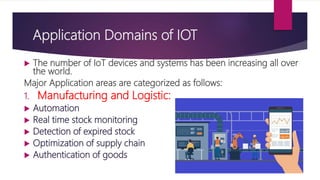
1. Manufacturing and Logistic:
 Automation
 Real time stock monitoring
 Detection of expired stock
 Optimization of supply chain
 Authentication of goods
Application Areas of IOT
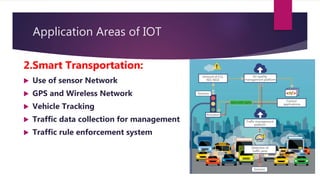
2.Smart Transportation:
 Use of sensor Network
 GPS and Wireless Network
 Vehicle Tracking
 Traffic data collection for management
 Traffic rule enforcement system
Application Areas of IOT
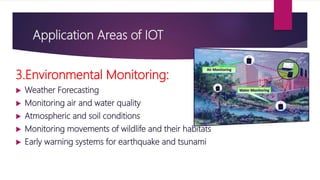
3.Environmental Monitoring:
 Weather Forecasting
 Monitoring air and water quality
 Atmospheric and soil conditions
 Monitoring movements of wildlife and their habitats
 Early warning systems for earthquake and tsunami
Application Areas of IOT
4.Energy and Utilities:
 Smart Electricity Grid
 Water Transmission Grid
 Real Time monitoring of water supply and
electricity usage
Application Areas of IOT
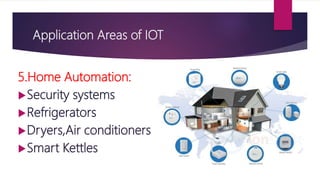
5.Home Automation:
Security systems
Refrigerators
Dryers,Air conditioners
Smart Kettles
Application Areas of IOT
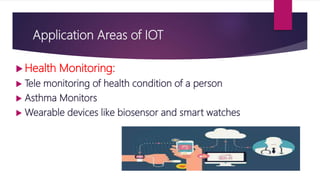
 Health Monitoring:
 Tele monitoring of health condition of a person
 Asthma Monitors
 Wearable devices like biosensor and smart watches
Challenges in IOT
1. Power Consumption
2. Physical security
3. Durability
4. Secure Connectivity
5. Secure data Storage
6. Data Volume
7. Scalability
Case Studies
1. Smart Irrigation System for Agricultural Field
Objectives
 Design a smart irrigation system using IOT devices and soil
moisture sensors.
 To determine moisture level of soil.
 If level goes below a threshold , release the flow of water through
irrigation pipes
 To collect data of moisture levels in the clouds and analyze it to
plan watering schedules
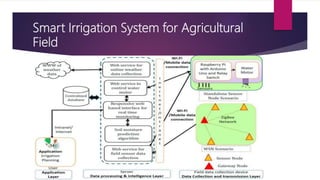
1. Smart Irrigation System for Agricultural
Field
System Architecture
i. Data collection of soil/ environment parameters
ii. Data transmission
iii. Data Processing and Intelligence
iv. Enabling of water pumps
Smart Irrigation System for Agricultural
Field
Smart Irrigation System for Agricultural
Field
Advantages
Avoids excessive use of water in irrigation
Avoids under irrigation
Automated control of irrigation system increases
crop yeild
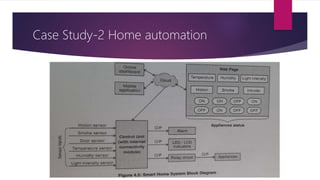
Case Study-2 Home automation
 Smart Lighting
 Smart Appliances
 Intrusion Detection
 Smoke/Gas detectors
Case Study-2 Home automation
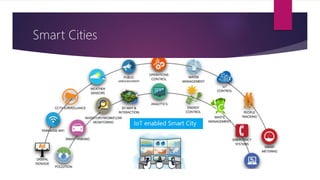
Case study 3: Smart Cities
 Improved Energy Distribution
 Streamlined Trash Collection
 Decreased Traffic Congestion
 Improved air quality
 Conserved Energy
Smart Cities
Smart Cities
• Smart Lighting
Dynamically controlled and adaptive to ambient
conditions.
Set according to foggy, cloudy, festival days
Smart Cities
• Smart Roads:
Roads equipped with sensors can provide
information on driving conditions
Travel time estimates and help in avoiding traffic
congestions
Smart Cities
• Structural health Monitoring:
Monitor the vibration levels in structures such as
bridges, dams, building, towers etc
Can detect cracks, mechanical breakdowns ,
damages to a structure and estimate life span of
structure
Smart Cities
Smart Parking
 Finding Parking spaces during rush hours
 IoT based smart parking system detects the number
and location of empty parking space.
Smart Cities
Smart Energy optimization:
 One of the strengths of IoT is its direct application for measures of sustainability
and energy efficiency.
 Sensor infrastructure deployed in a city allows knowing how, where and when the
energy is being consumed.
 All this information allows generating different consumption profiles for the city
objects (lighting, transport and buildings) and through this knowledge, to optimize
consumption avoiding waste.
Smart Cities
Surveillance
Emergency Response
Water and waste management
THANK YOU

IoT_application.pptx

  • 1.
    Electronics paper 2 WirelessCommunication and Internet of Things Unit 4: Applications of IOT -Mrs. Vandana Pagar, Assistant Professor, Dept. of Electronics, MIT ACSC Alandi
  • 2.
    Application Domains ofIOT  The number of IoT devices and systems has been increasing all over the world. Major Application areas are categorized as follows: 1. Manufacturing and Logistic:  Automation  Real time stock monitoring  Detection of expired stock  Optimization of supply chain  Authentication of goods
  • 3.
    Application Areas ofIOT 2.Smart Transportation:  Use of sensor Network  GPS and Wireless Network  Vehicle Tracking  Traffic data collection for management  Traffic rule enforcement system
  • 4.
    Application Areas ofIOT 3.Environmental Monitoring:  Weather Forecasting  Monitoring air and water quality  Atmospheric and soil conditions  Monitoring movements of wildlife and their habitats  Early warning systems for earthquake and tsunami
  • 5.
    Application Areas ofIOT 4.Energy and Utilities:  Smart Electricity Grid  Water Transmission Grid  Real Time monitoring of water supply and electricity usage
  • 6.
    Application Areas ofIOT 5.Home Automation: Security systems Refrigerators Dryers,Air conditioners Smart Kettles
  • 7.
    Application Areas ofIOT  Health Monitoring:  Tele monitoring of health condition of a person  Asthma Monitors  Wearable devices like biosensor and smart watches
  • 8.
    Challenges in IOT 1.Power Consumption 2. Physical security 3. Durability 4. Secure Connectivity 5. Secure data Storage 6. Data Volume 7. Scalability
  • 9.
    Case Studies 1. SmartIrrigation System for Agricultural Field Objectives  Design a smart irrigation system using IOT devices and soil moisture sensors.  To determine moisture level of soil.  If level goes below a threshold , release the flow of water through irrigation pipes  To collect data of moisture levels in the clouds and analyze it to plan watering schedules
  • 10.
    1. Smart IrrigationSystem for Agricultural Field System Architecture i. Data collection of soil/ environment parameters ii. Data transmission iii. Data Processing and Intelligence iv. Enabling of water pumps
  • 11.
    Smart Irrigation Systemfor Agricultural Field
  • 12.
    Smart Irrigation Systemfor Agricultural Field Advantages Avoids excessive use of water in irrigation Avoids under irrigation Automated control of irrigation system increases crop yeild
  • 13.
    Case Study-2 Homeautomation  Smart Lighting  Smart Appliances  Intrusion Detection  Smoke/Gas detectors
  • 14.
  • 15.
    Case study 3:Smart Cities  Improved Energy Distribution  Streamlined Trash Collection  Decreased Traffic Congestion  Improved air quality  Conserved Energy
  • 16.
  • 17.
    Smart Cities • SmartLighting Dynamically controlled and adaptive to ambient conditions. Set according to foggy, cloudy, festival days
  • 18.
    Smart Cities • SmartRoads: Roads equipped with sensors can provide information on driving conditions Travel time estimates and help in avoiding traffic congestions
  • 19.
    Smart Cities • Structuralhealth Monitoring: Monitor the vibration levels in structures such as bridges, dams, building, towers etc Can detect cracks, mechanical breakdowns , damages to a structure and estimate life span of structure
  • 20.
    Smart Cities Smart Parking Finding Parking spaces during rush hours  IoT based smart parking system detects the number and location of empty parking space.
  • 21.
    Smart Cities Smart Energyoptimization:  One of the strengths of IoT is its direct application for measures of sustainability and energy efficiency.  Sensor infrastructure deployed in a city allows knowing how, where and when the energy is being consumed.  All this information allows generating different consumption profiles for the city objects (lighting, transport and buildings) and through this knowledge, to optimize consumption avoiding waste.
  • 22.
  • 23.