This document discusses variation analysis, which examines patterns in alternative ways of saying the same thing in a language. Variationists assume that social context influences language use. They study how speech varies based on social and linguistic factors by observing language use in different social settings. The document contrasts the vernacular, which is language used with little attention to style, with more prestigious forms that may be used when speech is being observed or judged. It provides examples of linguistic variation in words, pronunciations, and syntax. The end discusses narrative and list as different text types that have distinct information structures related to temporal sequencing, descriptions, and evaluations.
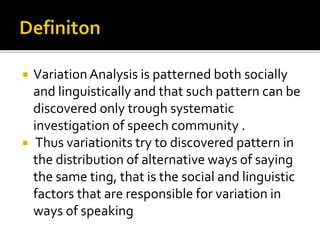
VariationAnalysis ispatterned both socially
and linguistically and that such pattern can be
discovered only trough systematic
investigation of speech community .
Thus variationits try to discovered pattern in
the distribution of alternative ways of saying
the same ting, that is the social and linguistic
factors that are responsible for variation in
ways of speaking
3.
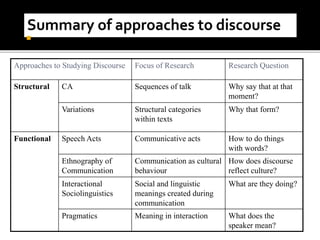
Approaches to StudyingDiscourse Focus of Research Research Question
Structural CA Sequences of talk Why say that at that
moment?
Variations Structural categories
within texts
Why that form?
Functional Speech Acts Communicative acts How to do things
with words?
Ethnography of
Communication
Communication as cultural
behaviour
How does discourse
reflect culture?
Interactional
Sociolinguistics
Social and linguistic
meanings created during
communication
What are they doing?
Pragmatics Meaning in interaction What does the
speaker mean?
4.
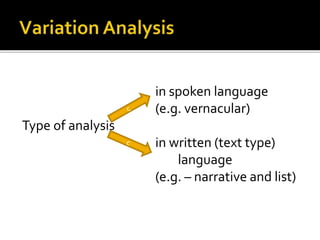
in spoken language
(e.g.vernacular)
Type of analysis
in written (text type)
language
(e.g. – narrative and list)
5.
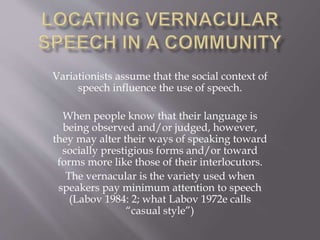
Variationists assume thatthe social context of
speech influence the use of speech.
When people know that their language is
being observed and/or judged, however,
they may alter their ways of speaking toward
socially prestigious forms and/or toward
forms more like those of their interlocutors.
The vernacular is the variety used when
speakers pay minimum attention to speech
(Labov 1984: 2; what Labov 1972e calls
“casual style”)
6.
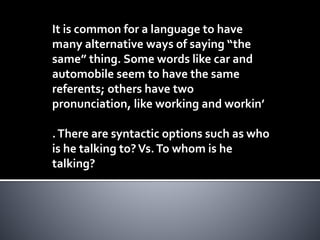
It is commonfor a language to have
many alternative ways of saying “the
same” thing. Some words like car and
automobile seem to have the same
referents; others have two
pronunciation, like working and workin’
.There are syntactic options such as who
is he talking to?Vs.To whom is he
talking?
8.
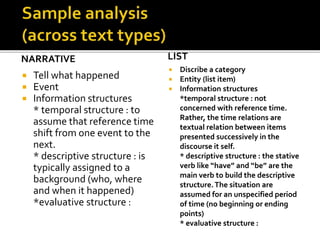
NARRATIVE
Tell whathappened
Event
Information structures
* temporal structure : to
assume that reference time
shift from one event to the
next.
* descriptive structure : is
typically assigned to a
background (who, where
and when it happened)
*evaluative structure :
LIST
Discribe a category
Entity (list item)
Information structures
*temporal structure : not
concerned with reference time.
Rather, the time relations are
textual relation between items
presented successively in the
discourse it self.
* descriptive structure : the stative
verb like “have” and “be” are the
main verb to build the descriptive
structure.The situation are
assumed for an unspecified period
of time (no beginning or ending
points)
* evaluative structure :
9.
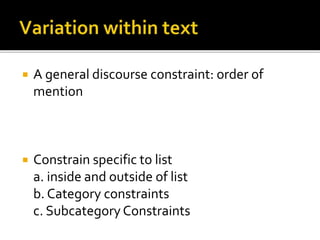
A generaldiscourse constraint: order of
mention
Constrain specific to list
a. inside and outside of list
b. Category constraints
c. Subcategory Constraints