Interactional Sociolinguistics:
Tools for Analyzing Language and
Communication in Cross-Cultural Training


  Dr. Anna Marie Trester & Sonia Checchia
  Linguistics Department, Georgetown University
  M.A. Program in Language and Communication
Sociolinguistics

 The study of language in its social context.

 Sociolinguists are interested in how language
 impacts society, and conversely in how
 society may have an impact on language.

 We look for patterns!
Anna’s background
 Dissertation research with Washington Improv
 Theater.

 Interactional Style of Improvisational Theater
 performers
 – Ethnography to uncover aspects of conversational style

 – Their way of using language says something about what
   they value (careful listening, wordplay, storytelling, creation
   of characters) contributes to a sense of belonging for group
   members.
“Language of Diversity” panel
 Discussion for diversity practitioners (AARP,
 CIL, NY Times Company, Defense Equal
 Opportunity Management Institute)

 Began by asking participants to address the
 following questions:
    a) What is a new emerging term dealing with
   diversity in the workplace?
    b) What is a term you no longer hear or shouldn't
   hear in today's workplace?
Referring Expressions

 referring expressions vs. address terms
 (“those people,” “old guys”)
 Issues of power and solidarity
 (“the girls” “kids”)
 finding terms that “put the person first”
 (“wheelchair”) – (Castania 2003)
 Presupposition / Deixis (“reverse
 discrimination” “disabled”)
What a Linguist Brings to the table

 Expose underlying assumptions
 Insight into how power and worldview
 are produced and reproduced through
 language
 Raise awareness of the ways that
 language can embed our own
 perspective
What we hope to accomplish today

 Add some critical and analytical tools for analyzing
 language to your toolkit

 Introduce some interactional sociolinguistic concepts
  –   Reference
  –   Contextualization Cues
  –   Speech acts
  –   Discourse Markers

 Demonstrate how these concepts can enhance our
 understanding of language and social interaction
Introductions

 But before we get too far into today’s
 workshop, we want to know a little bit
 about you all

 Could we go around the room and have
 you each briefly introduce yourselves?
What we “saw” as we were “listening”

 Intonation
 Transition Relevance Place
 Topic
 Discourse Markers
 Awareness of Frame – “what is going on
 here” (Erving Goffman)
 Speed
 Volume
 Aka “Contextualization Cues”
Contextualization Cues
 When we speak, we provide cues for the context
 in which our utterances should be taken.

 They signal how talk is meant to be received by
 the listener.

 Contextualization cues signal things ranging from
 interpersonal contexts (I am being friendly) to
 aspects of speech events (this is a joke).
Intonation

 Lists (Schiffrin 2006)

 “positive politeness marker to
 emphasize speaker-hearer solidarity &
 to assist in the cooperative
 management of talk” (Britain 1998).
Interactional Sociolinguistics

 John Gumperz Discourse Strategies
  – pioneered analyses of sources of
    misunderstanding in cross-cultural encounters
 Focus on forms of language that are not
 often explicitly studied (e.g. intonation,
 assumptions about context)
Clip @ Bank from Crosstalk
 Intonation as a Contextualization Cue

 For Gumperz, we are NOT just following pre-existing
 rules for situations, we use language to actively signal our
 relationship to our talk and our interlocutors (even if it is
 unconscious)

 Gumperz used this paradigm to show how cultural
 misunderstandings occur and suggests that if more people
 understand these differences in contextualization cues, then
 discrimination will be lessened (social justice issue)
Takeaway

 Every communication must simultaneously
 communicate two messages, the message
 and the “metamessage” (Bateson 1972)

 Metamessage: a second message, encoded
 and superimposed upon the basic, which
 indicates how someone is supposed to
 interpret the basic message
Tannen (1995)
 “Communication isn’t as simple as saying
 what you mean. How you say what you
 mean is crucial, and differs from one person
 to the next, because using language is
 learned social behavior: How we talk and
 listen are deeply influenced by cultural
 experience” (pg. 243).

 The danger is that we often assume that our
 way of making requests, etc. is the “natural
 way,” the “best way,” or the “right way.”
Speech Acts

 How we accomplish things through language.

 Performative Speech Acts
 Declarative Speech Acts
 Commands
 Compliments
 Requests
Declarative Speech Acts
 For example, saying "I now pronounce you
 husband and wife," is called a declarative
 speech act because it is the act of uttering
 these words that actually accomplishes the
 act of marrying two people.

 Anna attended a wedding this past summer
 where the minister had not yet actually
 finished her ordination, so she had to say "I
 now ANNOUNCE you husband and wife"
 because she did not yet have the power to
 PRONOUNCE them.
Compliments
 Another type of speech act is a compliment.
 Interestingly, the meaning of compliments
 can vary culture by culture. For example, in
 India, politeness requires that if someone
 compliments one of your possessions, you
 should offer to give the item as a gift, so
 complimenting can be a way of asking for
 things. An Indian woman who had just met
 her son's American wife was shocked to hear
 her new daughter-in-law praise her beautiful
 saris. She commented, "What kind of girl did
 he marry? She wants everything!" (Source: LSA
 website - Tannen: What is Discourse Analysis?
 http://www.lsadc.org/info/ling-fields-discourse.cfm )
Requests
Think about some of the many ways that
requests get accomplished around you (and that
you accomplish them yourself). Typically you will
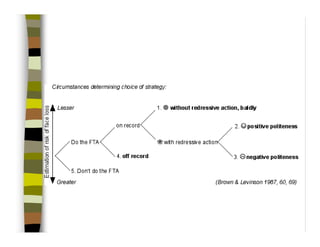
find that requests can be made directly or
indirectly (or “on-record” vs. “off-record”).
Sifianu Greek example, an indirect way of
requesting the remote control for the TV might
be to say “have you seen the remote?” Note
that the requestor did not say directly “please
bring me the remote” but depending on your
expectations (and those of your listener) about
requests, this more indirect “have you seen the
remote?” might be heard as such.
Scenario

 You live in an apartment building in DC
 and you are rushing off to work one
 morning. You realize that you have no
 cash and have no time to go to the ATM
 for your bus fare. You knock on your
 neighbor’s door to ask for a dollar.

 What do you say?
Takeaway
 Misunderstandings can often arise out of
 different cultures’ expectations about
 directness vs. indirectness.

 While neither style (direct or indirect) is
 BETTER, you will find that people tend to
 have a strong preference (of which, they are
 likely unaware).
Discourse Markers

 Little words like oh, well, so, but, then, and,
 or, you know, I mean.

 These “little words” break our speech up into
 parts and show the relation between parts.
 They help organize the sequence and
 relationship between utterances, give
 information as to the speaker’s attitude to the
 hearer, to the information, and to the world.
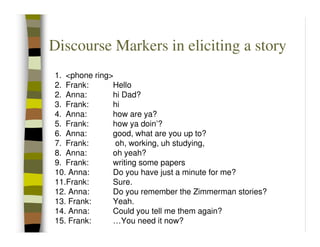
Discourse Markers in eliciting a story
1. <phone ring>
2. Frank:      Hello
2. Anna:       hi Dad?
3. Frank:      hi
4. Anna:       how are ya?
5. Frank:      how ya doin’?
6. Anna:       good, what are you up to?
7. Frank:       oh, working, uh studying,
8. Anna:       oh yeah?
9. Frank:      writing some papers
10. Anna:      Do you have just a minute for me?
11.Frank:      Sure.
12. Anna:      Do you remember the Zimmerman stories?
13. Frank:     Yeah.
14. Anna:      Could you tell me them again?
15. Frank:     …You need it now?
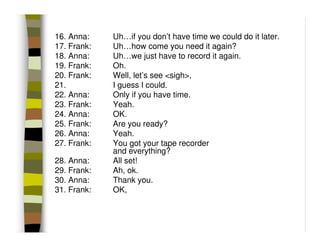
16. Anna:    Uh…if you don’t have time we could do it later.
17. Frank:   Uh…how come you need it again?
18. Anna:    Uh…we just have to record it again.
19. Frank:   Oh.
20. Frank:   Well, let’s see <sigh>,
21.          I guess I could.
22. Anna:    Only if you have time.
23. Frank:   Yeah.
24. Anna:    OK.
25. Frank:   Are you ready?
26. Anna:    Yeah.
27. Frank:   You got your tape recorder
             and everything?
28. Anna:    All set!
29. Frank:   Ah, ok.
30. Anna:    Thank you.
31. Frank:   OK,
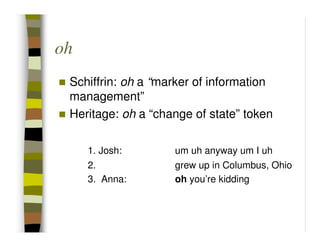
oh
 Schiffrin: oh a “marker of information
 management”
 Heritage: oh a “change of state” token

     1. Josh:       um uh anyway um I uh
     2.             grew up in Columbus, Ohio
     3. Anna:       oh you’re kidding
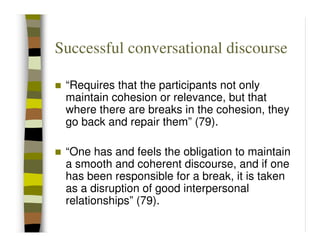
Successful conversational discourse

 “Requires that the participants not only
 maintain cohesion or relevance, but that
 where there are breaks in the cohesion, they
 go back and repair them” (79).

 “One has and feels the obligation to maintain
 a smooth and coherent discourse, and if one
 has been responsible for a break, it is taken
 as a disruption of good interpersonal
 relationships” (79).
Smooth Discourse
 “depends so strongly on shared knowledge
 that when there is a break or disruption, the
 most immediate reaction is that the culprit
 must be a member of a different group” (79).

 Most of us are quite conscious of different
 pronunciations or of different words used by
 members of other groups, but in day-to-day
 practice it is cohesion in discourse which
 provides the strongest and most emblematic
 forces for group identity” (79).
Promoting smooth discourse

 Using interactional sociolinguistics to
 coach a speaker on:
 – Turn - taking
 – Pause length
 – Transition relevance places


 <please refer to back of handout>

Interactional socio & training

  • 1.
    Interactional Sociolinguistics: Tools forAnalyzing Language and Communication in Cross-Cultural Training Dr. Anna Marie Trester & Sonia Checchia Linguistics Department, Georgetown University M.A. Program in Language and Communication
  • 2.
    Sociolinguistics The studyof language in its social context. Sociolinguists are interested in how language impacts society, and conversely in how society may have an impact on language. We look for patterns!
  • 3.
    Anna’s background Dissertationresearch with Washington Improv Theater. Interactional Style of Improvisational Theater performers – Ethnography to uncover aspects of conversational style – Their way of using language says something about what they value (careful listening, wordplay, storytelling, creation of characters) contributes to a sense of belonging for group members.
  • 4.
    “Language of Diversity”panel Discussion for diversity practitioners (AARP, CIL, NY Times Company, Defense Equal Opportunity Management Institute) Began by asking participants to address the following questions: a) What is a new emerging term dealing with diversity in the workplace? b) What is a term you no longer hear or shouldn't hear in today's workplace?
  • 5.
    Referring Expressions referringexpressions vs. address terms (“those people,” “old guys”) Issues of power and solidarity (“the girls” “kids”) finding terms that “put the person first” (“wheelchair”) – (Castania 2003) Presupposition / Deixis (“reverse discrimination” “disabled”)
  • 6.
    What a LinguistBrings to the table Expose underlying assumptions Insight into how power and worldview are produced and reproduced through language Raise awareness of the ways that language can embed our own perspective
  • 7.
    What we hopeto accomplish today Add some critical and analytical tools for analyzing language to your toolkit Introduce some interactional sociolinguistic concepts – Reference – Contextualization Cues – Speech acts – Discourse Markers Demonstrate how these concepts can enhance our understanding of language and social interaction
  • 8.
    Introductions But beforewe get too far into today’s workshop, we want to know a little bit about you all Could we go around the room and have you each briefly introduce yourselves?
  • 9.
    What we “saw”as we were “listening” Intonation Transition Relevance Place Topic Discourse Markers Awareness of Frame – “what is going on here” (Erving Goffman) Speed Volume Aka “Contextualization Cues”
  • 10.
    Contextualization Cues Whenwe speak, we provide cues for the context in which our utterances should be taken. They signal how talk is meant to be received by the listener. Contextualization cues signal things ranging from interpersonal contexts (I am being friendly) to aspects of speech events (this is a joke).
  • 11.
    Intonation Lists (Schiffrin2006) “positive politeness marker to emphasize speaker-hearer solidarity & to assist in the cooperative management of talk” (Britain 1998).
  • 12.
    Interactional Sociolinguistics JohnGumperz Discourse Strategies – pioneered analyses of sources of misunderstanding in cross-cultural encounters Focus on forms of language that are not often explicitly studied (e.g. intonation, assumptions about context)
  • 13.
    Clip @ Bankfrom Crosstalk Intonation as a Contextualization Cue For Gumperz, we are NOT just following pre-existing rules for situations, we use language to actively signal our relationship to our talk and our interlocutors (even if it is unconscious) Gumperz used this paradigm to show how cultural misunderstandings occur and suggests that if more people understand these differences in contextualization cues, then discrimination will be lessened (social justice issue)
  • 14.
    Takeaway Every communicationmust simultaneously communicate two messages, the message and the “metamessage” (Bateson 1972) Metamessage: a second message, encoded and superimposed upon the basic, which indicates how someone is supposed to interpret the basic message
  • 15.
    Tannen (1995) “Communicationisn’t as simple as saying what you mean. How you say what you mean is crucial, and differs from one person to the next, because using language is learned social behavior: How we talk and listen are deeply influenced by cultural experience” (pg. 243). The danger is that we often assume that our way of making requests, etc. is the “natural way,” the “best way,” or the “right way.”
  • 16.
    Speech Acts Howwe accomplish things through language. Performative Speech Acts Declarative Speech Acts Commands Compliments Requests
  • 17.
    Declarative Speech Acts For example, saying "I now pronounce you husband and wife," is called a declarative speech act because it is the act of uttering these words that actually accomplishes the act of marrying two people. Anna attended a wedding this past summer where the minister had not yet actually finished her ordination, so she had to say "I now ANNOUNCE you husband and wife" because she did not yet have the power to PRONOUNCE them.
  • 18.
    Compliments Another typeof speech act is a compliment. Interestingly, the meaning of compliments can vary culture by culture. For example, in India, politeness requires that if someone compliments one of your possessions, you should offer to give the item as a gift, so complimenting can be a way of asking for things. An Indian woman who had just met her son's American wife was shocked to hear her new daughter-in-law praise her beautiful saris. She commented, "What kind of girl did he marry? She wants everything!" (Source: LSA website - Tannen: What is Discourse Analysis? http://www.lsadc.org/info/ling-fields-discourse.cfm )
  • 19.
    Requests Think about someof the many ways that requests get accomplished around you (and that you accomplish them yourself). Typically you will find that requests can be made directly or indirectly (or “on-record” vs. “off-record”). Sifianu Greek example, an indirect way of requesting the remote control for the TV might be to say “have you seen the remote?” Note that the requestor did not say directly “please bring me the remote” but depending on your expectations (and those of your listener) about requests, this more indirect “have you seen the remote?” might be heard as such.
  • 20.
    Scenario You livein an apartment building in DC and you are rushing off to work one morning. You realize that you have no cash and have no time to go to the ATM for your bus fare. You knock on your neighbor’s door to ask for a dollar. What do you say?
  • 22.
    Takeaway Misunderstandings canoften arise out of different cultures’ expectations about directness vs. indirectness. While neither style (direct or indirect) is BETTER, you will find that people tend to have a strong preference (of which, they are likely unaware).
  • 23.
    Discourse Markers Littlewords like oh, well, so, but, then, and, or, you know, I mean. These “little words” break our speech up into parts and show the relation between parts. They help organize the sequence and relationship between utterances, give information as to the speaker’s attitude to the hearer, to the information, and to the world.
  • 24.
    Discourse Markers ineliciting a story 1. <phone ring> 2. Frank: Hello 2. Anna: hi Dad? 3. Frank: hi 4. Anna: how are ya? 5. Frank: how ya doin’? 6. Anna: good, what are you up to? 7. Frank: oh, working, uh studying, 8. Anna: oh yeah? 9. Frank: writing some papers 10. Anna: Do you have just a minute for me? 11.Frank: Sure. 12. Anna: Do you remember the Zimmerman stories? 13. Frank: Yeah. 14. Anna: Could you tell me them again? 15. Frank: …You need it now?
  • 25.
    16. Anna: Uh…if you don’t have time we could do it later. 17. Frank: Uh…how come you need it again? 18. Anna: Uh…we just have to record it again. 19. Frank: Oh. 20. Frank: Well, let’s see <sigh>, 21. I guess I could. 22. Anna: Only if you have time. 23. Frank: Yeah. 24. Anna: OK. 25. Frank: Are you ready? 26. Anna: Yeah. 27. Frank: You got your tape recorder and everything? 28. Anna: All set! 29. Frank: Ah, ok. 30. Anna: Thank you. 31. Frank: OK,
  • 26.
    oh Schiffrin: oha “marker of information management” Heritage: oh a “change of state” token 1. Josh: um uh anyway um I uh 2. grew up in Columbus, Ohio 3. Anna: oh you’re kidding
  • 27.
    Successful conversational discourse “Requires that the participants not only maintain cohesion or relevance, but that where there are breaks in the cohesion, they go back and repair them” (79). “One has and feels the obligation to maintain a smooth and coherent discourse, and if one has been responsible for a break, it is taken as a disruption of good interpersonal relationships” (79).
  • 28.
    Smooth Discourse “dependsso strongly on shared knowledge that when there is a break or disruption, the most immediate reaction is that the culprit must be a member of a different group” (79). Most of us are quite conscious of different pronunciations or of different words used by members of other groups, but in day-to-day practice it is cohesion in discourse which provides the strongest and most emblematic forces for group identity” (79).
  • 29.
    Promoting smooth discourse Using interactional sociolinguistics to coach a speaker on: – Turn - taking – Pause length – Transition relevance places <please refer to back of handout>