Delete Misbehavior
101
There are no bad kids, just bad behavior.
There are no bad parents, just bad habits.
There are no bad teachers, just bad
strategies
After you delete the bad, there’s only 1 thing
left…….
Human Beings
Just people
With
Hearts and Minds
Thoughts and Deeds
Course Description
● This four-hour course is designed to meet the
requirements towards the “happy chi” degree.
● This is a new Master degree that I made up.
● It allows you to be a better person all day everyday in
all settings including in the mall and grocery store
● It allows you to create a peaceful environment in your
classroom from August to June, no joke, no lie!
Hand-outs:
● “People Bingo” (Ice Breakers)
● “Who’s in the Room?”
● “Scenario” Role Play
Materials:
● 3 different colored highlighters
● 1 Large Envelope
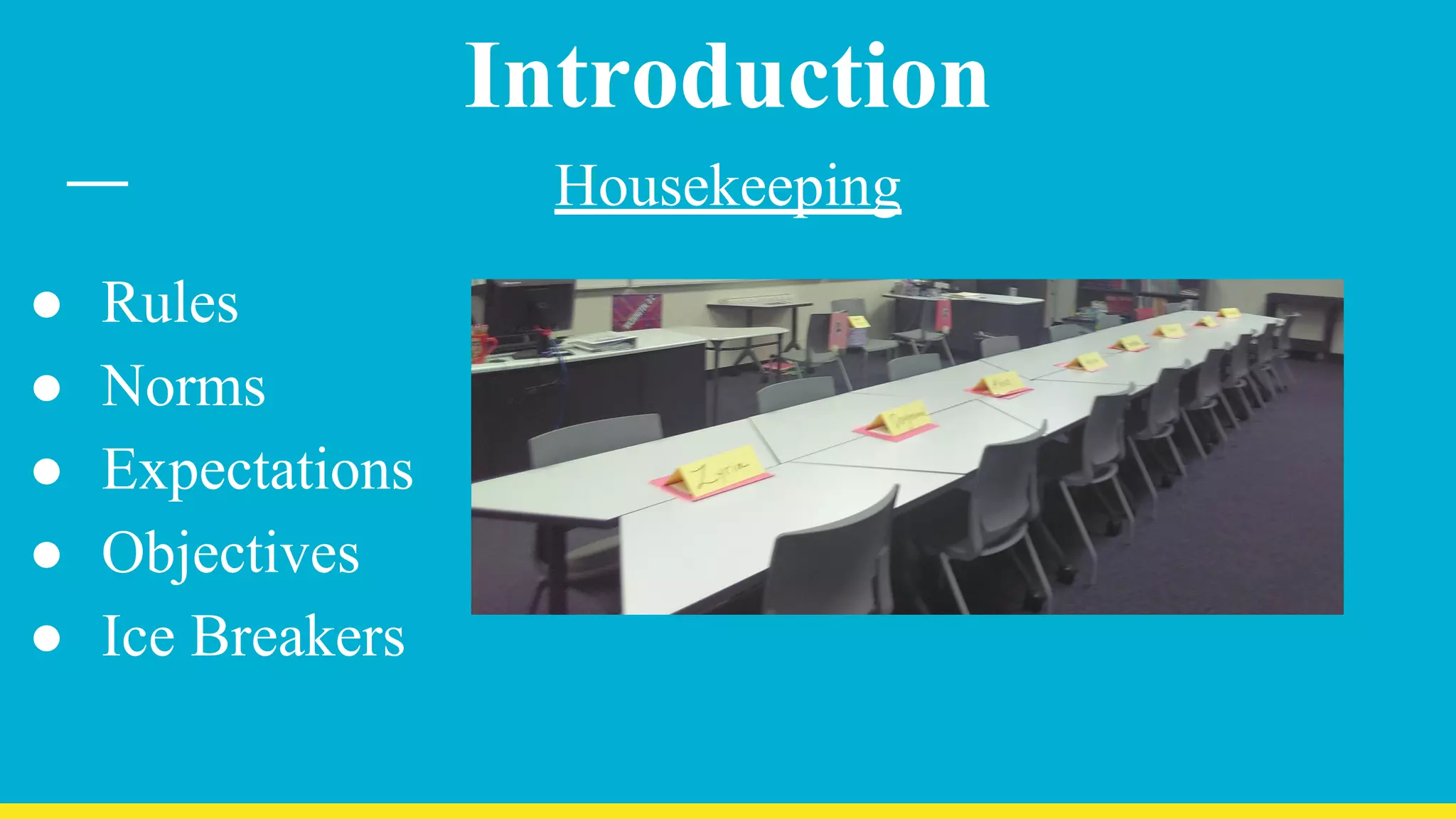
Introduction
Housekeeping
● Rules
● Norms
● Expectations
● Objectives
● Ice Breakers
Objectives
1. Explain how to build rapport.
2. List Erikson’s 8 stages of behavior.
3. Describe Maslow’s hierarchy of needs and how it
influences human behavior.
4. Explain the process of De-Escalation of disruptive
behavior.
Key
Terms
1. Rapport
2. Behavior
3. Management
4. Self-control
5. Disruptive
6. De-escalate
7. Re-direct
8. Reward
Who said this and when?
“The children now love luxury. They have
bad manners, contempt for authority; they
show disrespect for elders and love chatter
in place of exercise.”
Socrates
Athens, Greece
399 BC
Behavior
● Observable activity in a human, aggregate the
aggregate of responses to internal and external
stimuli.
● In the scientific world, Isaac Newton’s third law of
motion says for every action,
● “there is an equal and opposite reaction (Newton,
1750).”
● This law is sometimes called the action-reaction law.
Behavior
● Humans react to external stimuli.
● If a person make a rude comment to another
person, the victim will eventually say
something back
● to defend themselves or inflict pain on the
aggressor.
Disruptive Behavior● Behavior that is designed to break up or put into a state of disorder.
Research has shown that when misbehavior occurs it is often a cry for
help.
● Therefore, the professional who observes the misbehavior could
help the situation by trying to find out what caused the behavior.
● Educational experts Tom and Marsha Savage have written
extensively on the topic of misbehavior.
● In their research, they observed that when a person is experiencing
serious “social or emotional problems, they may be unable to
change their behavior until the underlying issues are addressed”
(2010).
De-escalate
● Reduce the level or intensity or size or scope of.
● Professionals will learn to help client/residents calm
down, think, correct their behavior and save face.
● Staff will learn to redirect client/resident behavior.
● Depending upon the setting, clients may also be
referred to as persons served, residents, or resident
consumer.
Video
“Nine De-escalation Skills.”
https://www.youtube.com/watch?v=MOeuoNP-fyQ.
Running time: 4:16. Release Date: January 25, 2016.
Produced by Training JPCL.
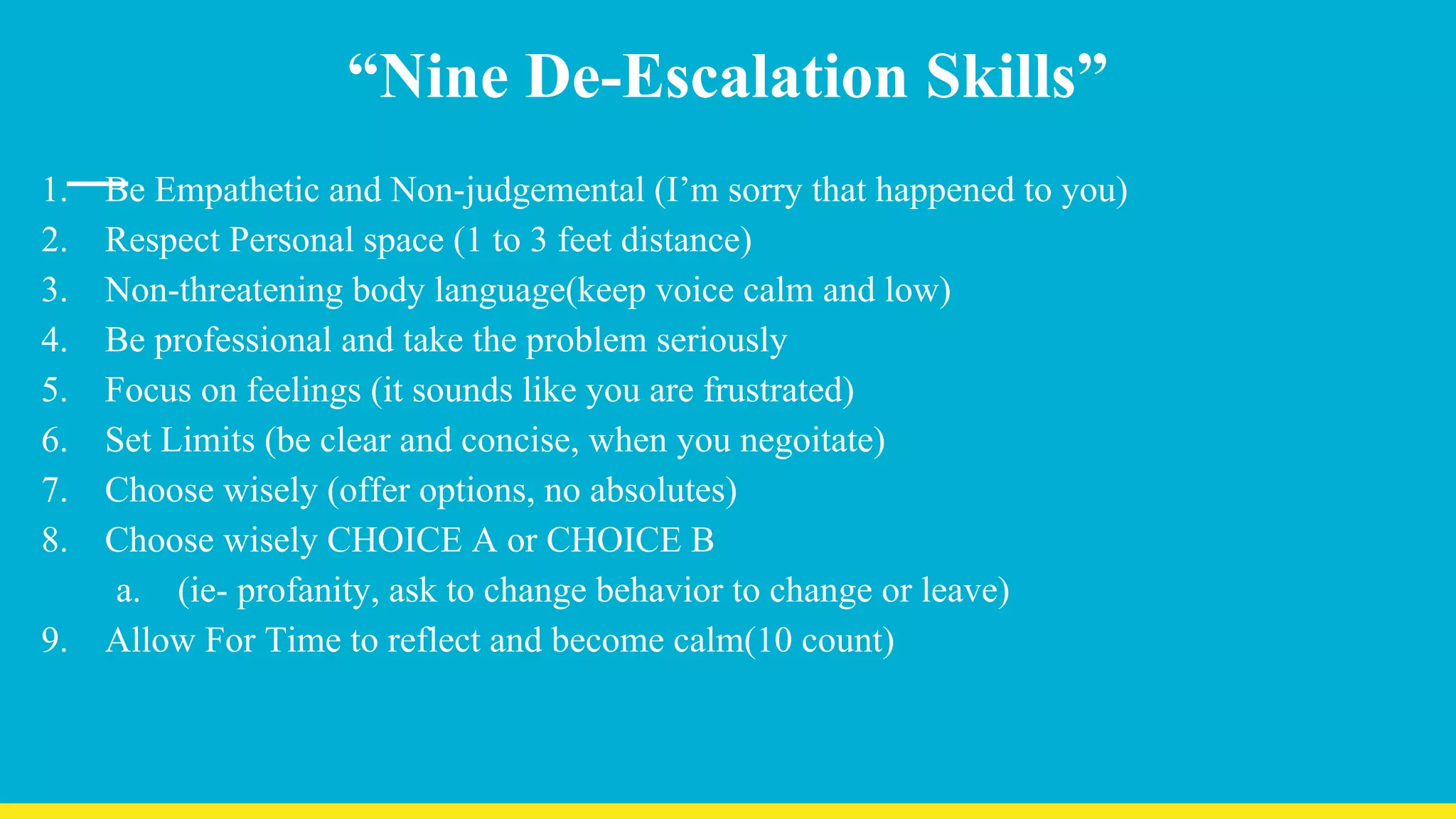
“Nine De-Escalation Skills”
1. Be Empathetic and Non-judgemental (I’m sorry that happened to you)
2. Respect Personal space (1 to 3 feet distance)
3. Non-threatening body language(keep voice calm and low)
4. Be professional and take the problem seriously
5. Focus on feelings (it sounds like you are frustrated)
6. Set Limits (be clear and concise, when you negoitate)
7. Choose wisely (offer options, no absolutes)
8. Choose wisely CHOICE A or CHOICE B
a. (ie- profanity, ask to change behavior to change or leave)
9. Allow For Time to reflect and become calm(10 count)
Manage
● the technique, practice, or science of managing, controlling or
dealing.
● With regards to adults dealing with children, the adults proactive
behavior impacts the child’s learning.
● In the workplace, the manager has six basic functions that they are
responsible for doing on behalf of the organization.
●
The 6 functions of a manager
1. forecasting- the needs that will come up in the future
planning
2. writing out a plan of action organizing
3. putting together financial and human resources
commanding
4. getting workers focused coordinating
5. bringing all people together to work on a project
controlling
6. explaining to people what needs to be done
Rapport
According to researchers Linda Tickle-Degnen and Robert Rosenthal,
when you have a rapport with someone, you share:
● Mutual attentiveness: you're both focused on, and interested in,
what the other person is saying or doing.
● Positivity: you're both friendly and happy, and you show care
and concern for one another.
● Coordination: you feel "in sync" with one another, so that you
share a common understanding. Your energy levels, tone and
body language are also similar.
Redirect
● to cause to move in a different
direction or go to a different
direction.
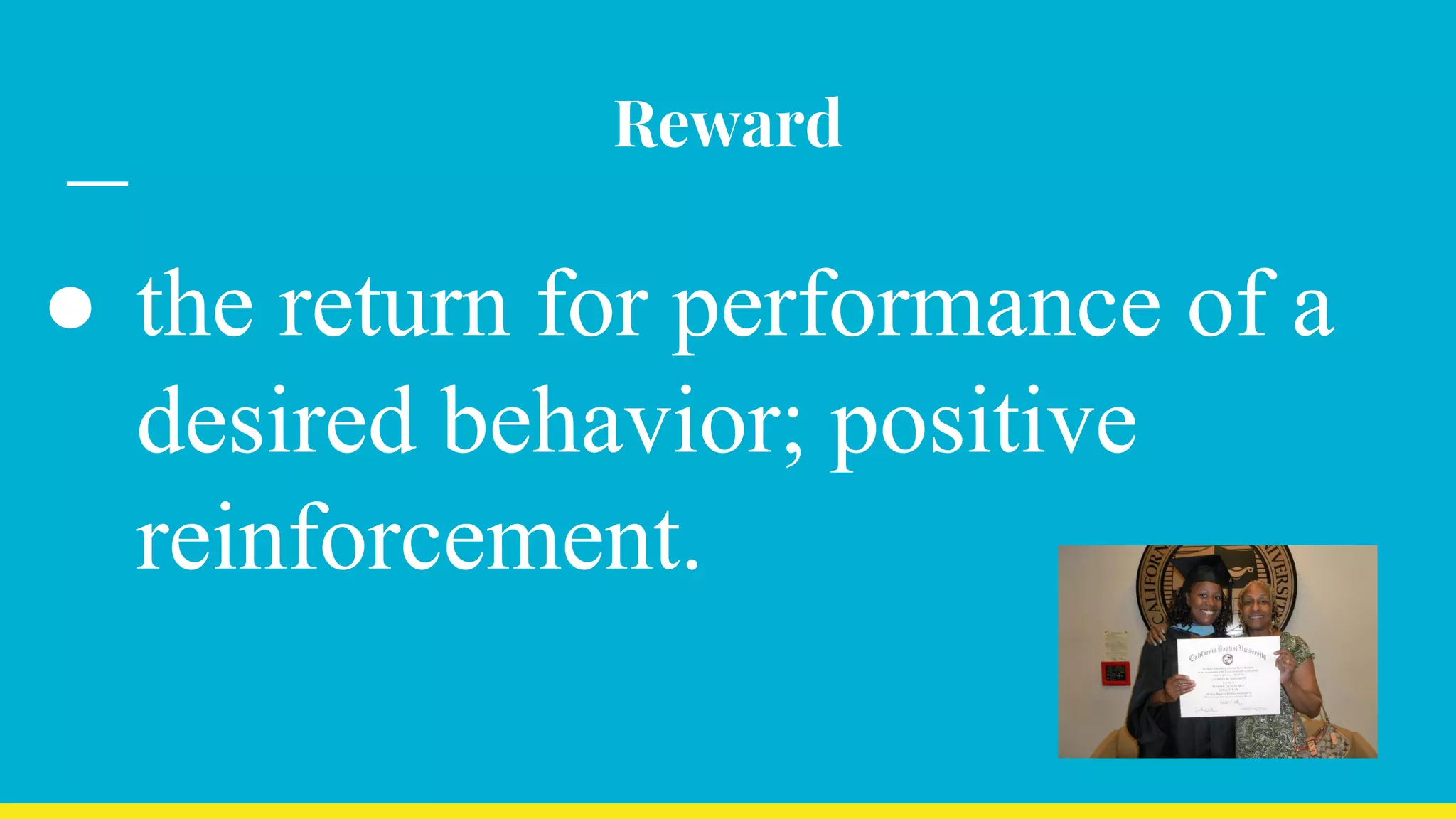
Reward
● the return for performance of a
desired behavior; positive
reinforcement.
Time to Apply!
● Choose 1 partner
● Pick 2 of the key terms
● Write 1 complete sentence using the two
words you picked
● Prepare to share with the class.
Break Time
10 Minutes
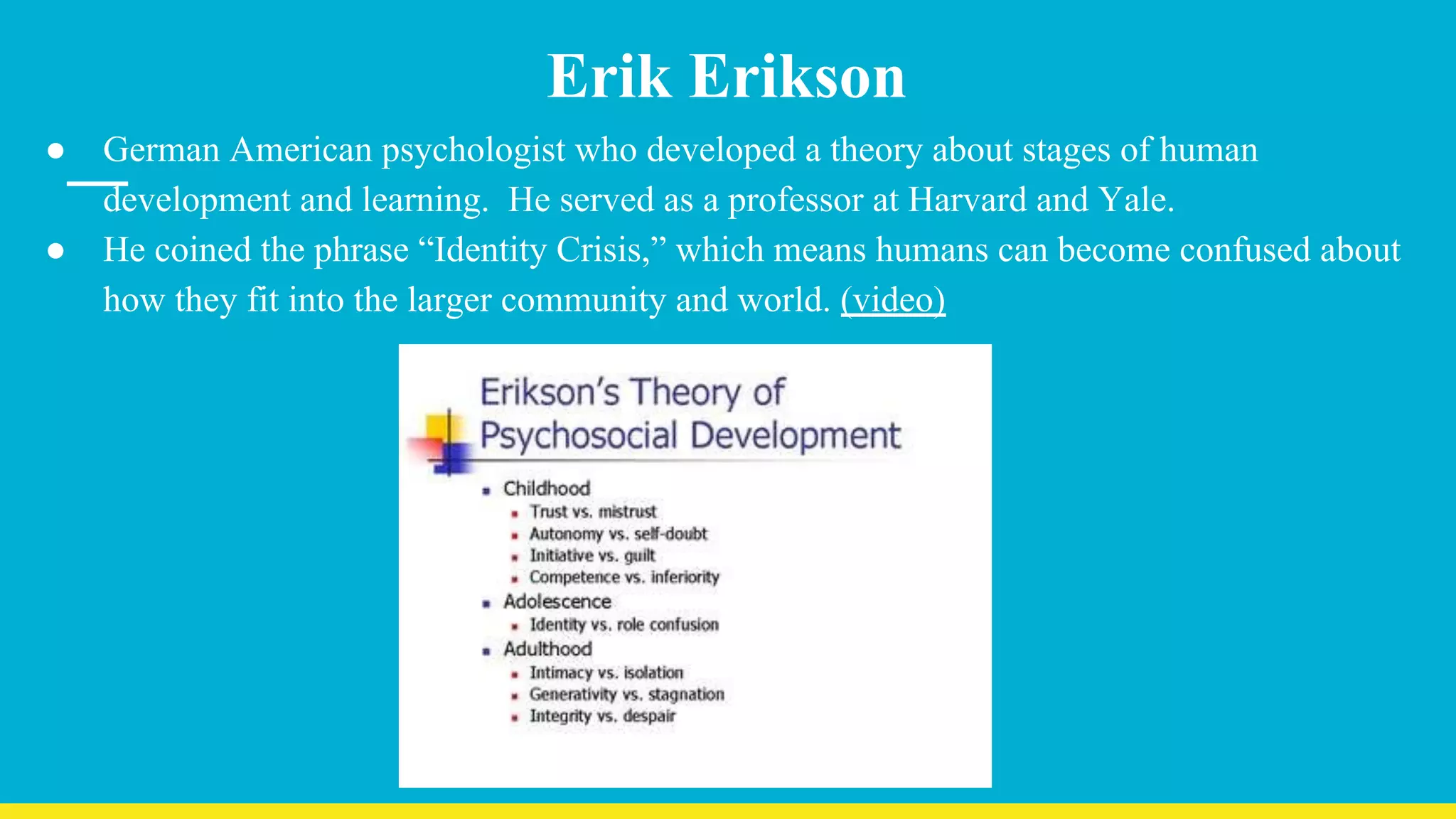
Erik Erikson
● German American psychologist who developed a theory about stages of human
development and learning. He served as a professor at Harvard and Yale.
● He coined the phrase “Identity Crisis,” which means humans can become confused about
how they fit into the larger community and world. (video)
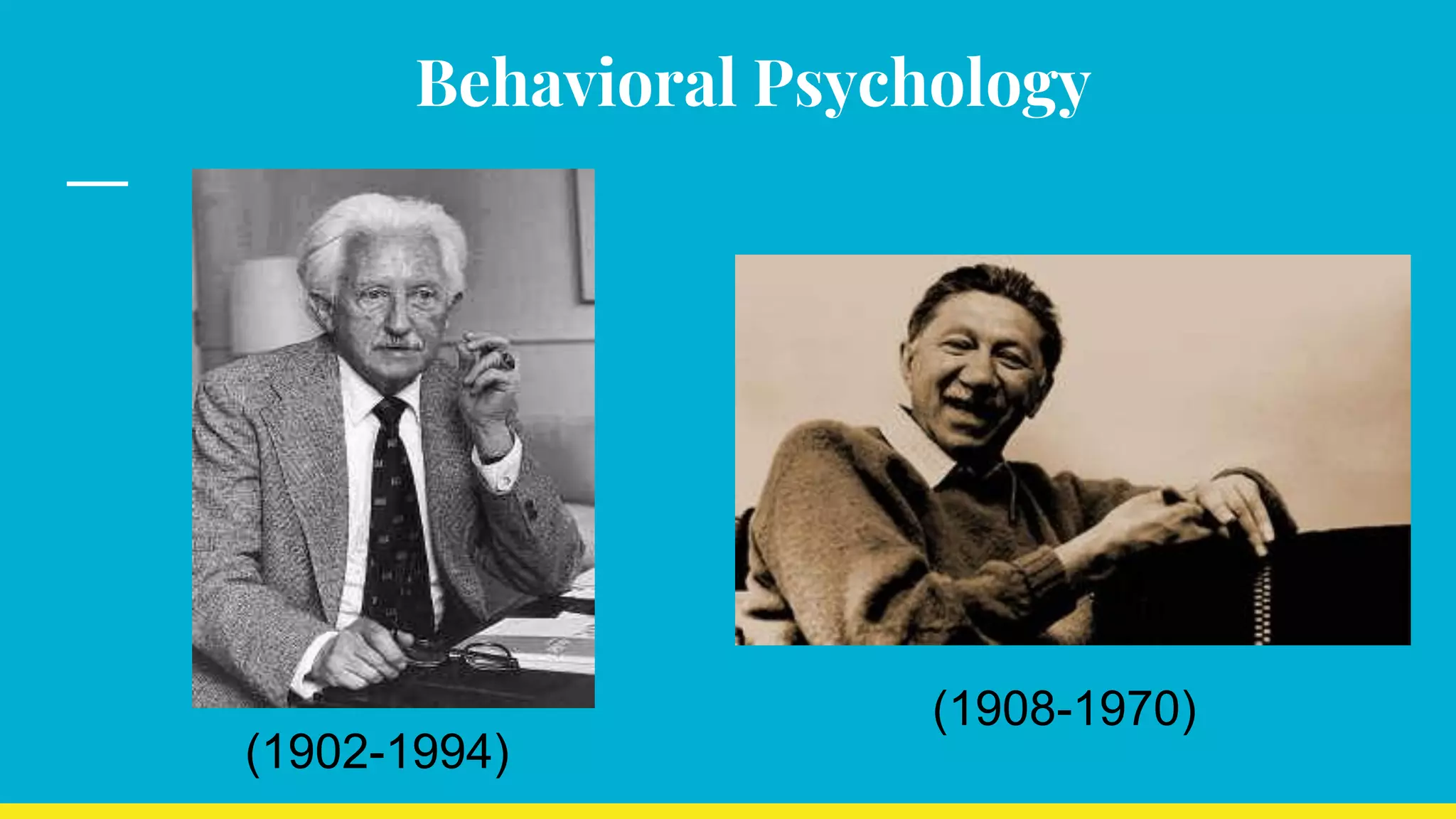
Behavioral Psychology
(1908-1970)
(1902-1994)
Erikson’s Theory of Psychosocial Needs
https://www.youtube.com/watch?v=aYCBdZLCDBQ
Running time: 5:19. Release Date: April 23, 2017.
Produced by Sprouts.
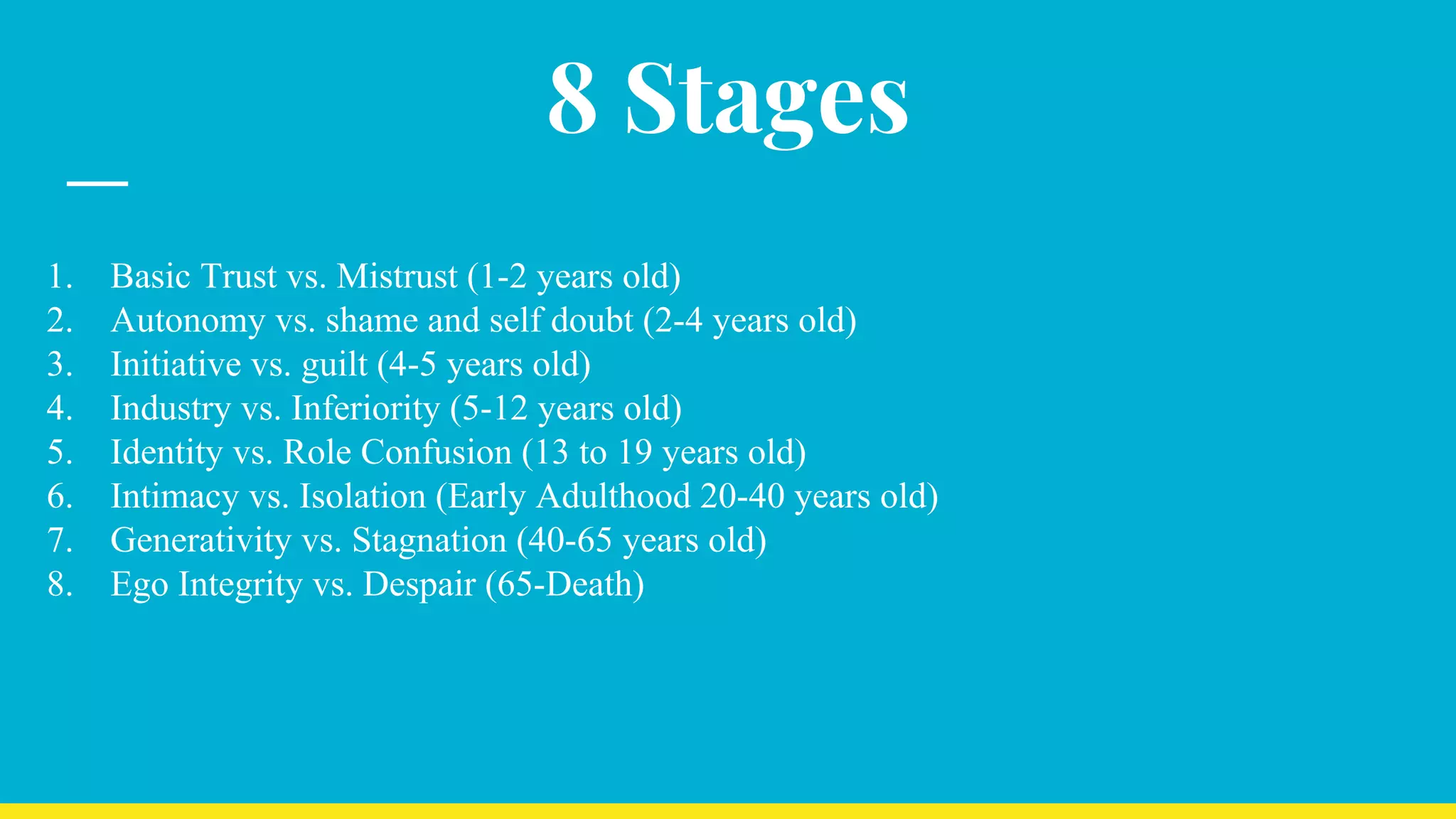
8 Stages
1. Basic Trust vs. Mistrust (1-2 years old)
2. Autonomy vs. shame and self doubt (2-4 years old)
3. Initiative vs. guilt (4-5 years old)
4. Industry vs. Inferiority (5-12 years old)
5. Identity vs. Role Confusion (13 to 19 years old)
6. Intimacy vs. Isolation (Early Adulthood 20-40 years old)
7. Generativity vs. Stagnation (40-65 years old)
8. Ego Integrity vs. Despair (65-Death)
Pair Share
Based on Erikson’s theory of the 8
stages of development, explain
which stage was the most difficult
one for you?
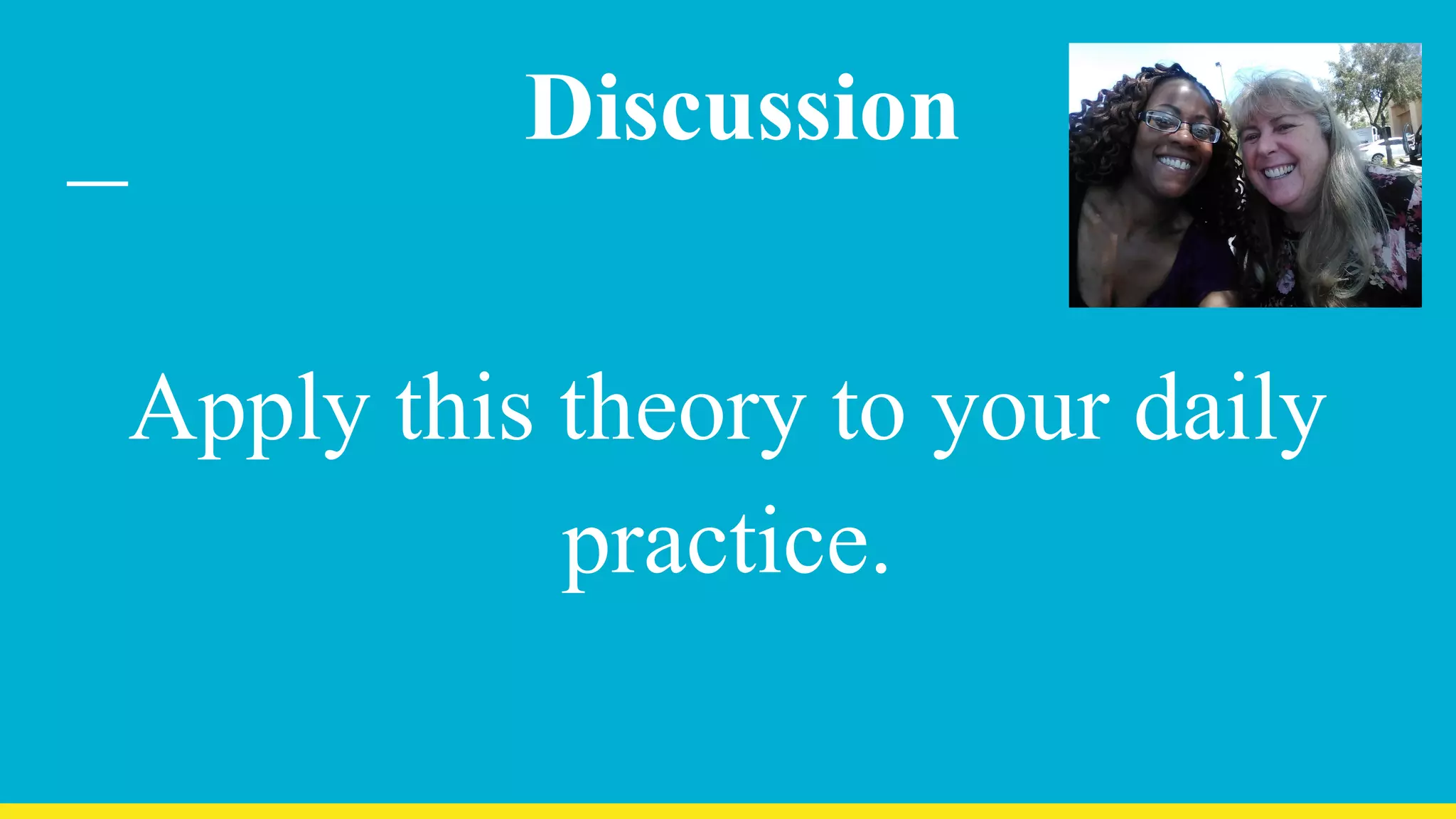
Discussion
Apply this theory to your daily
practice.
Maslow’s Theory of Needs
“Maslow’s Hierarchy of Needs”
https://www.youtube.com/watch?v=O-4ithG_07Q. Running Time:
2:47. Release Date: January 5, 2017. Produced by Sprouts.
Maslow’s Hierarchy of Needs
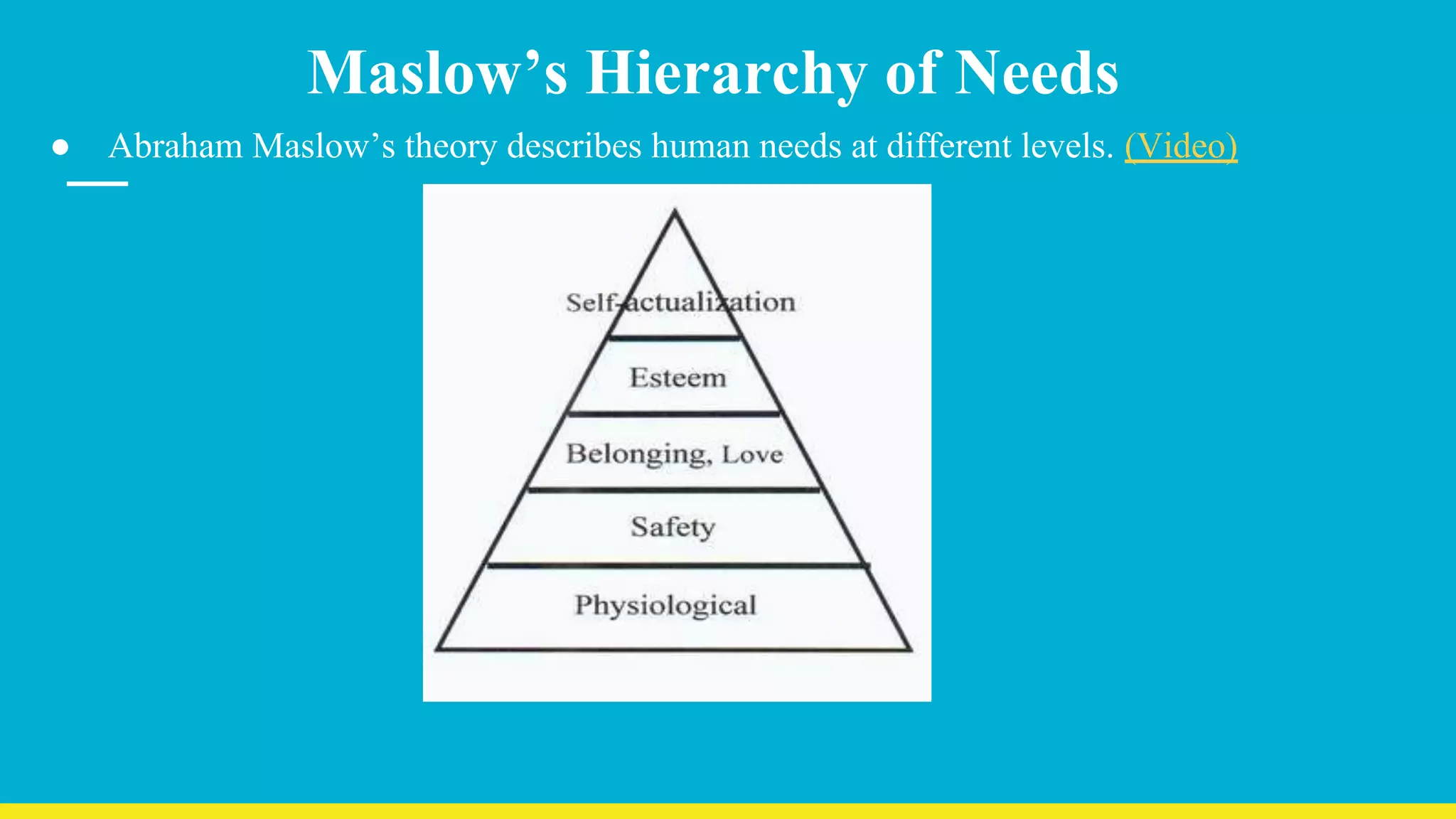
● Abraham Maslow’s theory describes human needs at different levels. (Video)
Maslow’s Hierarchy of Needs
1. Physiological needs- which include the need to breathe, eat, drink, and sleep. When
those needs are met, humans get motivated to do the next thing.
2. Physical needs for shelter. Humans are motivated to earn money to provide shelter
for themselves.
3. Emotional needs. Humans seek love and belonging. This motivates humans to join
groups such as a club, organization, or gang.
4. Need for recognition- self esteem, confidence, and respect from peers. Motivation to
compete and excel are natural. Motivation to perform well happens here.
5. Need for self-actualization- less pressure because basic needs are met. High level
thinking and problem solving take place in this stage.
Lesson’s Learned From Maslow’s
Have I (we) provided adequate food and water to all clients? (Stage 1)
Have I (we) provided a clean and safe place for each client to live?
(Stage 2 needs)
Have I (we) personally invited all clients to participate in all major
activities? (Stage 3 needs)
Have I (we) given recognizing to clients who stand out on a daily basis?
(Stage 4 needs)
Have I (we) offered each client a variety of activities which allow
resident to pursue their own interests. (Stage 5 needs)
How do you handle
verbal insults, attacks
and/or outbursts?
Four Magic Phrases
Diffusers
Break
10
Minutes
Video
“4 Magic Phrases You Can Use to Respond to ANYTHING.”
https://www.youtube.com/watch?v=g5RknemM8Hw. Running
Time: 5:13. Release Date: July 27, 2009. Produced by Dan
O'Connor.
“Four Magic Phrases”
Video
That’s interesting……..Tell Me More.
That’s Interesting …….Why Would You Say that to Me?
That’s Interesting …….Why Would You Do That?
That’s Interesting …….Why Would You Ask That?
When someone insults you, that’s about THEM. You are a person of
integrity.
Diffusers from “Time To
Teach”I understand
Probably so
Nevertheless
I’m Sorry
Role Play
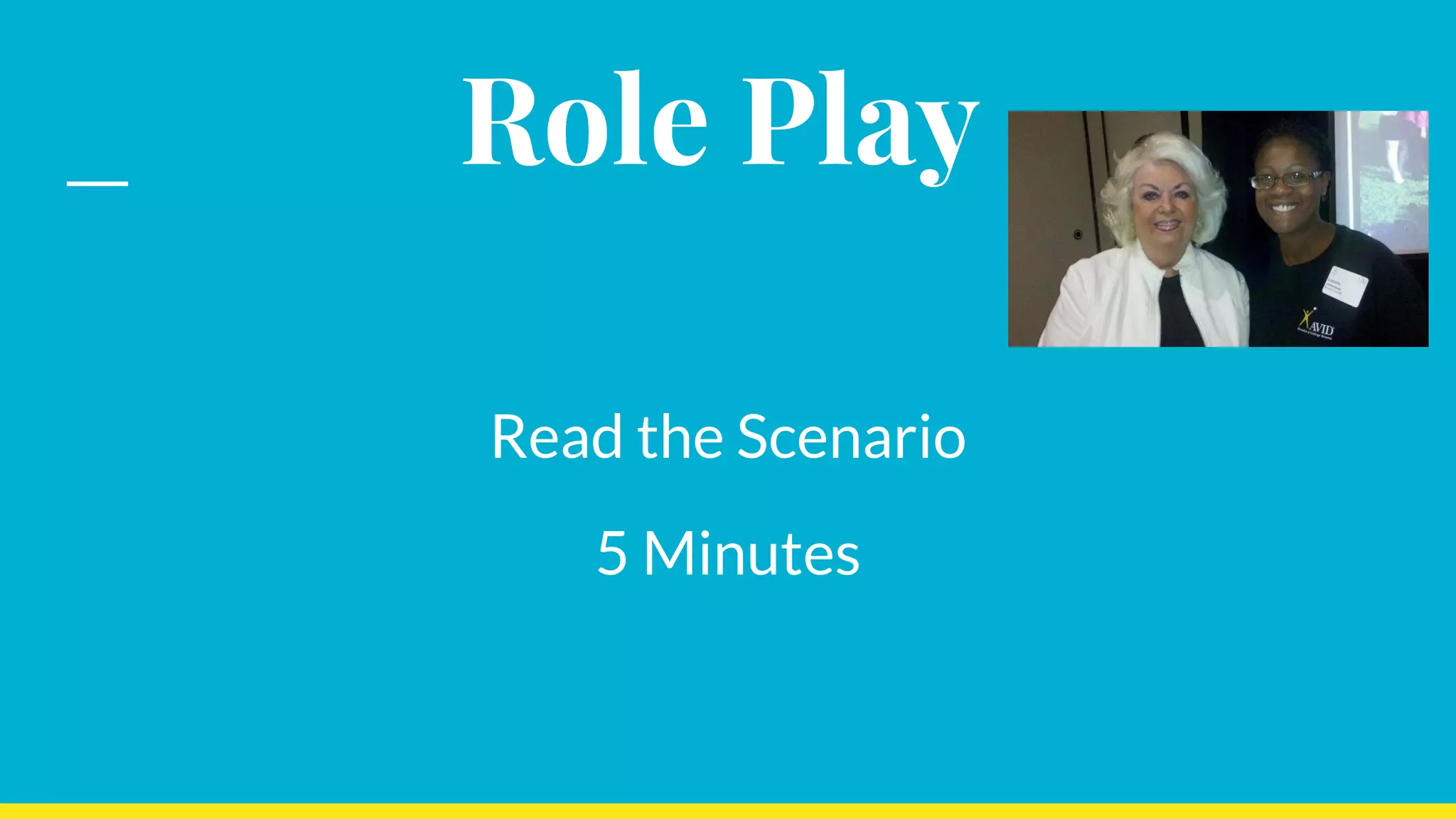
Read the Scenario
5 Minutes
Role Play
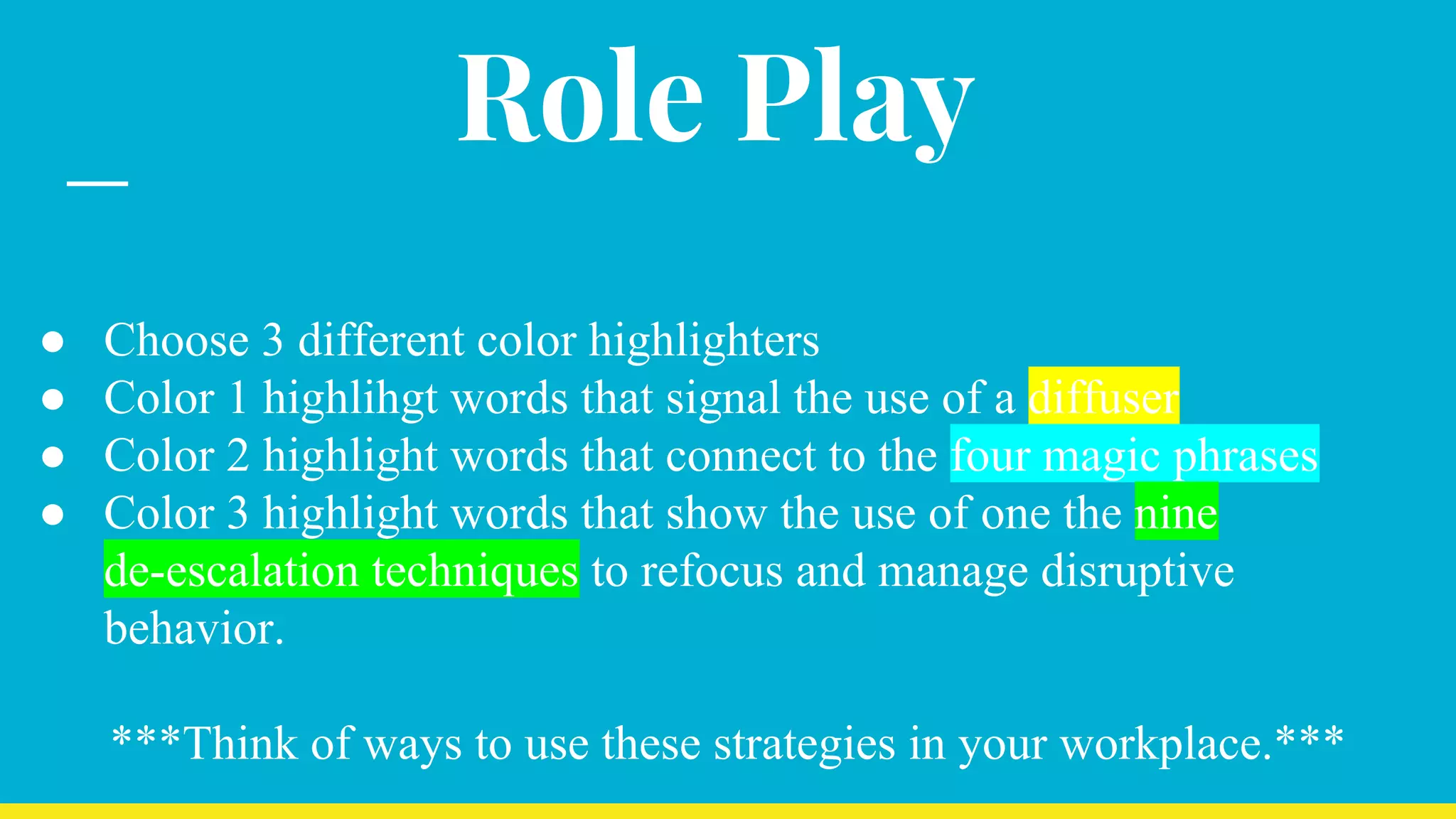
● Choose 3 different color highlighters
● Color 1 highlihgt words that signal the use of a diffuser
● Color 2 highlight words that connect to the four magic phrases
● Color 3 highlight words that show the use of one the nine
de-escalation techniques to refocus and manage disruptive
behavior.
***Think of ways to use these strategies in your workplace.***
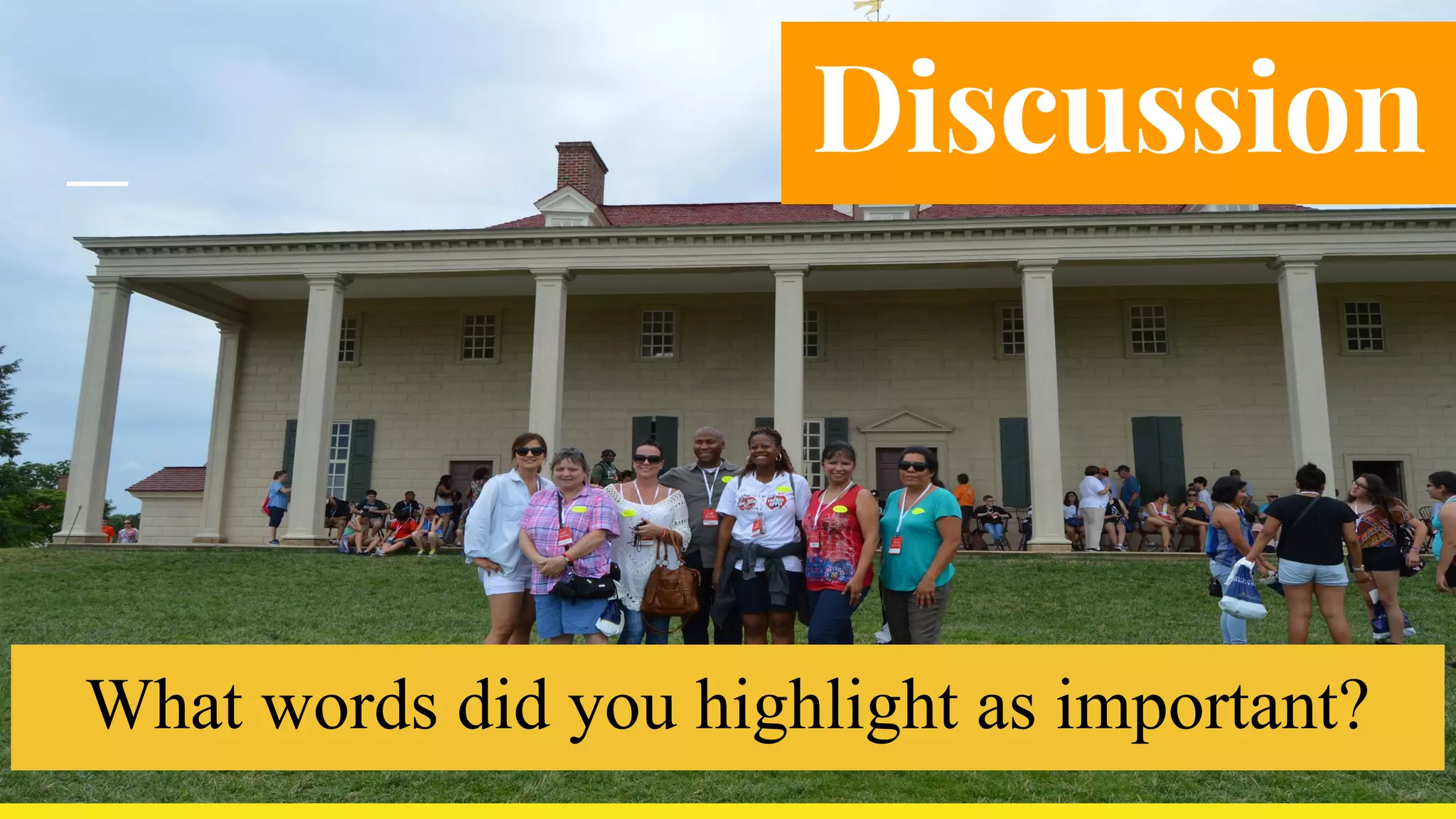
Discussion
What words did you highlight as important?
Discussion
What techniques were used to de-escalate the
situation?
Real Life
Describe a real life situation where you observed
disruptive behavior that was de-escalated by a
professional.
What If Game
○ Write down a what if question on a slip of
paper
○ Drop the question into a large envelope.
What If
○ Take someone else’s “what if” question
out of the envelope.
○ Response to the question with a verbal
answer.
Wrap Up
1. Distribute Course Evaluations
2. Collect course evaluations
3. Certificates of Completion - distribute or how and
when to collect
Sources
Dahlgren, Rick, Faulk, Joanna, Lattimer, Melanie, and Malas Brett. (2008).
Time To Teach! The Source for Classroom Management. Hayden Lake, Idaho, Center For Teacher Effectiveness.
Savage, Tomas V and Savage, Marsha K. (2010). Successful Classroom
Management and Discipline: Teaching Self Control and Responsibility. Thousand Oaks, California, Sage
Publications Inc.
Sprouts (April 23, 2017). 8 Stages of Development by Erik Erikson.
https://www.youtube.com/watch?v=aYCBdZLCDBQ
Sprouts (January 5, 2017) Maslow’s Hierarchy of Needs. https://www.youtube.com/watch?v=O-4ithG_07Q
Training by Jefferson County Public Library (January 25, 2016). Nine De-escalation skills.
https://www.youtube.com/watch?v=MOeuoNP-fyQ
Need additional resources?
E-mail me at
ljimerson35@gmail.com

Deleting behavior-101

  • 1.
    Delete Misbehavior 101 There areno bad kids, just bad behavior. There are no bad parents, just bad habits. There are no bad teachers, just bad strategies After you delete the bad, there’s only 1 thing left…….
  • 2.
    Human Beings Just people With Heartsand Minds Thoughts and Deeds
  • 3.
    Course Description ● Thisfour-hour course is designed to meet the requirements towards the “happy chi” degree. ● This is a new Master degree that I made up. ● It allows you to be a better person all day everyday in all settings including in the mall and grocery store ● It allows you to create a peaceful environment in your classroom from August to June, no joke, no lie!
  • 4.
    Hand-outs: ● “People Bingo”(Ice Breakers) ● “Who’s in the Room?” ● “Scenario” Role Play Materials: ● 3 different colored highlighters ● 1 Large Envelope
  • 5.
    Introduction Housekeeping ● Rules ● Norms ●Expectations ● Objectives ● Ice Breakers
  • 6.
    Objectives 1. Explain howto build rapport. 2. List Erikson’s 8 stages of behavior. 3. Describe Maslow’s hierarchy of needs and how it influences human behavior. 4. Explain the process of De-Escalation of disruptive behavior.
  • 7.
    Key Terms 1. Rapport 2. Behavior 3.Management 4. Self-control 5. Disruptive 6. De-escalate 7. Re-direct 8. Reward
  • 8.
    Who said thisand when? “The children now love luxury. They have bad manners, contempt for authority; they show disrespect for elders and love chatter in place of exercise.”
  • 9.
  • 10.
    Behavior ● Observable activityin a human, aggregate the aggregate of responses to internal and external stimuli. ● In the scientific world, Isaac Newton’s third law of motion says for every action, ● “there is an equal and opposite reaction (Newton, 1750).” ● This law is sometimes called the action-reaction law.
  • 11.
    Behavior ● Humans reactto external stimuli. ● If a person make a rude comment to another person, the victim will eventually say something back ● to defend themselves or inflict pain on the aggressor.
  • 12.
    Disruptive Behavior● Behaviorthat is designed to break up or put into a state of disorder. Research has shown that when misbehavior occurs it is often a cry for help. ● Therefore, the professional who observes the misbehavior could help the situation by trying to find out what caused the behavior. ● Educational experts Tom and Marsha Savage have written extensively on the topic of misbehavior. ● In their research, they observed that when a person is experiencing serious “social or emotional problems, they may be unable to change their behavior until the underlying issues are addressed” (2010).
  • 13.
    De-escalate ● Reduce thelevel or intensity or size or scope of. ● Professionals will learn to help client/residents calm down, think, correct their behavior and save face. ● Staff will learn to redirect client/resident behavior. ● Depending upon the setting, clients may also be referred to as persons served, residents, or resident consumer.
  • 14.
    Video “Nine De-escalation Skills.” https://www.youtube.com/watch?v=MOeuoNP-fyQ. Runningtime: 4:16. Release Date: January 25, 2016. Produced by Training JPCL.
  • 15.
    “Nine De-Escalation Skills” 1.Be Empathetic and Non-judgemental (I’m sorry that happened to you) 2. Respect Personal space (1 to 3 feet distance) 3. Non-threatening body language(keep voice calm and low) 4. Be professional and take the problem seriously 5. Focus on feelings (it sounds like you are frustrated) 6. Set Limits (be clear and concise, when you negoitate) 7. Choose wisely (offer options, no absolutes) 8. Choose wisely CHOICE A or CHOICE B a. (ie- profanity, ask to change behavior to change or leave) 9. Allow For Time to reflect and become calm(10 count)
  • 16.
    Manage ● the technique,practice, or science of managing, controlling or dealing. ● With regards to adults dealing with children, the adults proactive behavior impacts the child’s learning. ● In the workplace, the manager has six basic functions that they are responsible for doing on behalf of the organization. ●
  • 17.
    The 6 functionsof a manager 1. forecasting- the needs that will come up in the future planning 2. writing out a plan of action organizing 3. putting together financial and human resources commanding 4. getting workers focused coordinating 5. bringing all people together to work on a project controlling 6. explaining to people what needs to be done
  • 18.
    Rapport According to researchersLinda Tickle-Degnen and Robert Rosenthal, when you have a rapport with someone, you share: ● Mutual attentiveness: you're both focused on, and interested in, what the other person is saying or doing. ● Positivity: you're both friendly and happy, and you show care and concern for one another. ● Coordination: you feel "in sync" with one another, so that you share a common understanding. Your energy levels, tone and body language are also similar.
  • 19.
    Redirect ● to causeto move in a different direction or go to a different direction.
  • 20.
    Reward ● the returnfor performance of a desired behavior; positive reinforcement.
  • 21.
    Time to Apply! ●Choose 1 partner ● Pick 2 of the key terms ● Write 1 complete sentence using the two words you picked ● Prepare to share with the class.
  • 22.
  • 23.
    Erik Erikson ● GermanAmerican psychologist who developed a theory about stages of human development and learning. He served as a professor at Harvard and Yale. ● He coined the phrase “Identity Crisis,” which means humans can become confused about how they fit into the larger community and world. (video)
  • 24.
  • 25.
    Erikson’s Theory ofPsychosocial Needs https://www.youtube.com/watch?v=aYCBdZLCDBQ Running time: 5:19. Release Date: April 23, 2017. Produced by Sprouts.
  • 26.
    8 Stages 1. BasicTrust vs. Mistrust (1-2 years old) 2. Autonomy vs. shame and self doubt (2-4 years old) 3. Initiative vs. guilt (4-5 years old) 4. Industry vs. Inferiority (5-12 years old) 5. Identity vs. Role Confusion (13 to 19 years old) 6. Intimacy vs. Isolation (Early Adulthood 20-40 years old) 7. Generativity vs. Stagnation (40-65 years old) 8. Ego Integrity vs. Despair (65-Death)
  • 27.
    Pair Share Based onErikson’s theory of the 8 stages of development, explain which stage was the most difficult one for you?
  • 28.
    Discussion Apply this theoryto your daily practice.
  • 29.
    Maslow’s Theory ofNeeds “Maslow’s Hierarchy of Needs” https://www.youtube.com/watch?v=O-4ithG_07Q. Running Time: 2:47. Release Date: January 5, 2017. Produced by Sprouts.
  • 30.
    Maslow’s Hierarchy ofNeeds ● Abraham Maslow’s theory describes human needs at different levels. (Video)
  • 31.
    Maslow’s Hierarchy ofNeeds 1. Physiological needs- which include the need to breathe, eat, drink, and sleep. When those needs are met, humans get motivated to do the next thing. 2. Physical needs for shelter. Humans are motivated to earn money to provide shelter for themselves. 3. Emotional needs. Humans seek love and belonging. This motivates humans to join groups such as a club, organization, or gang. 4. Need for recognition- self esteem, confidence, and respect from peers. Motivation to compete and excel are natural. Motivation to perform well happens here. 5. Need for self-actualization- less pressure because basic needs are met. High level thinking and problem solving take place in this stage.
  • 32.
    Lesson’s Learned FromMaslow’s Have I (we) provided adequate food and water to all clients? (Stage 1) Have I (we) provided a clean and safe place for each client to live? (Stage 2 needs) Have I (we) personally invited all clients to participate in all major activities? (Stage 3 needs) Have I (we) given recognizing to clients who stand out on a daily basis? (Stage 4 needs) Have I (we) offered each client a variety of activities which allow resident to pursue their own interests. (Stage 5 needs)
  • 33.
    How do youhandle verbal insults, attacks and/or outbursts? Four Magic Phrases Diffusers
  • 34.
  • 35.
    Video “4 Magic PhrasesYou Can Use to Respond to ANYTHING.” https://www.youtube.com/watch?v=g5RknemM8Hw. Running Time: 5:13. Release Date: July 27, 2009. Produced by Dan O'Connor.
  • 36.
    “Four Magic Phrases” Video That’sinteresting……..Tell Me More. That’s Interesting …….Why Would You Say that to Me? That’s Interesting …….Why Would You Do That? That’s Interesting …….Why Would You Ask That? When someone insults you, that’s about THEM. You are a person of integrity.
  • 37.
    Diffusers from “TimeTo Teach”I understand Probably so Nevertheless I’m Sorry
  • 38.
    Role Play Read theScenario 5 Minutes
  • 39.
    Role Play ● Choose3 different color highlighters ● Color 1 highlihgt words that signal the use of a diffuser ● Color 2 highlight words that connect to the four magic phrases ● Color 3 highlight words that show the use of one the nine de-escalation techniques to refocus and manage disruptive behavior. ***Think of ways to use these strategies in your workplace.***
  • 40.
    Discussion What words didyou highlight as important?
  • 41.
    Discussion What techniques wereused to de-escalate the situation?
  • 42.
    Real Life Describe areal life situation where you observed disruptive behavior that was de-escalated by a professional.
  • 43.
    What If Game ○Write down a what if question on a slip of paper ○ Drop the question into a large envelope.
  • 44.
    What If ○ Takesomeone else’s “what if” question out of the envelope. ○ Response to the question with a verbal answer.
  • 45.
    Wrap Up 1. DistributeCourse Evaluations 2. Collect course evaluations 3. Certificates of Completion - distribute or how and when to collect
  • 46.
    Sources Dahlgren, Rick, Faulk,Joanna, Lattimer, Melanie, and Malas Brett. (2008). Time To Teach! The Source for Classroom Management. Hayden Lake, Idaho, Center For Teacher Effectiveness. Savage, Tomas V and Savage, Marsha K. (2010). Successful Classroom Management and Discipline: Teaching Self Control and Responsibility. Thousand Oaks, California, Sage Publications Inc. Sprouts (April 23, 2017). 8 Stages of Development by Erik Erikson. https://www.youtube.com/watch?v=aYCBdZLCDBQ Sprouts (January 5, 2017) Maslow’s Hierarchy of Needs. https://www.youtube.com/watch?v=O-4ithG_07Q Training by Jefferson County Public Library (January 25, 2016). Nine De-escalation skills. https://www.youtube.com/watch?v=MOeuoNP-fyQ
  • 47.
    Need additional resources? E-mailme at ljimerson35@gmail.com