Kangkan sharma
NRS MEDICAL COLLEGE
• A VSD is a defect in the ventricular septum
• Most common congenital cardiac anomalies.
• 3-3.8 per 1000 live births
• 30-60% of all newborns with a CHD
• Prospective studies give a prevalence of 2-5
per 100 births of trabecular VSDs that closes
shortly after birth in 80-90% of the cases
• “Adevelopmental defect of the heart occurs from
which cyanosis does not ensue inspite of the fact
that a communication exists between the cavities
of the two ventricles and inspite of the fact that
admixture of venous blood and arterial blood
occurs. This congenital defect , which is even
compatible with a long life, is a simple one. It
comprises a defect in the interventricular
septum.”
Henri Roger, 1879
 Complex non – planar structure; 4
components
 Inlet septum – lightly
trabeculated; extends from
tricuspid annulus to attachments
of tricuspid valve
 Trabecular septum – heavily
trabeculated; trabecular septum
extends from inlet out to apex and
up to smooth-walled outlet
 Outlet septum – non trabeculated;
extends up to pulmonary valve&
diverge from small membranous
septum
 Membranous septum only fibrous
component of IVS, wedged btwn
AV,MV, TV.
1.Membranous
2.Outlet
3.Trabecular septum
4.Inflow
5.Subarterial or
supracristal
• Most common congenital heart lesion
• Occurs in 50% of children with heart lesions
• 15-20% in isolation
• 5-50 per 1000 live births
• 56% female
• CLASSICAL
• SOTO
• VAN PRAAGH
• ANDERSON
• MORPHOLOGICAL (congenital heart surgery
nomenclature & database project)
CONAL
PARAMEMBRA
NOUS
ATRIOVENTRIC
ULAR CANAL
MUSCULAR
CONAL
CONOVENTRIC
ULAR
AV CANAL
MUSCULAR
PERIMEMBR
ANOUS
DOUBLY
COMMTTTE
D
MUSCULAR
 Classification
1. Perimembranous
Extension
inlet
outlet
anterior
2. Muscular outlet/conal
trabecular
inlet
anterior
apical
3. Doubly committed subarterial
4. Inlet septal
5. Malalinged
AV septal type
Ant (TOF)
Post(INTERRUPTED AORTIC ARCH)
Rotational (Taussig bing)
• Restrictive
• Moderately restrictive
• Non restrictive
– Restrictive- resistance that limits the shunt at the
site of vsd
– < 0.5 cm2 (Smaller than Ao valve orifice area)
– Small L to R shunt
– Normal RV output
– 75% spontaneously close < 2yrs
LVSP > RVSP
pulm /aortic systolic pressure ratio < 0.3
Qp / Qs<1.4--1
• Moderately restrictive - RVSP high, but
less than LVSP
• Qp/Qs 1.4--2.2
 Non restrictive -Shunt not limited at the site of
defect
– > 1.0 cm2 (Equal to or greater than to Ao valve
orifice area)
– Large hemodynamically significant L to R shunt
– Rarely close spontaneously
-RVSP , LVSP,PA , Aortic systolic
pressures equal
- Qp/Qs >2.2
- Flow determined by PVR
Small Size Medium Size Large Size
Diameter (mm)
Size (cm2)
<5
<0.5
5~15
0.5~1.5
>15
>1.0
Shunt small medium large
Symptom Non or little some Obvious
Pul. Vessel No affection affected Pul. Arterial
Hypertension
Eisenmenger’s
syndrome
• Defect size is often compared to aortic
annulus
– Large: > 75% of annulus size
– Medium: 75-33% of annulus size
– Small: <33% of annulus size
• Atrioventricular canal type VSD
• Muscular VSDs: midventricular
(1), apical (2), anterior (3), and
posterior (4)
• Conoventricular septal defect,
which includes
perimembranous and
malalignment conoventricular
septal defects
• Conal septal defects.
• Conoventricular defects are located between the conal
septum and the ventricular septum.
• They are centered in or around the membranous
 septum and comprise 80% of all VSDs.
• Located exclusively within the membranous
septum, or can extend beyond the boundaries
of the membranous
septum toward inferior, posterior, or
directions, and are then sometimes
anterior
called
“perimembranous” or “paramembranous” VSDs.
• The prefix “peri-,” appearing in loan words from the Greek,
means “surrounding” (i.e., perimeter). As such, a truly
perimembranous ventricular septal defect would surround
the membranous septum.
• In contrast, the prefix “para-,” also from the Greek, means
“adjacent to” or “beside” and more accurately reflects the
notion of a defect adjacent to the membranous septum.
• Neither perimembranous nor paramembranous correctly
describes the typical defect involving the membranous
septum and extending into the adjacent septum.
• The current recommendation is to call these defects either
membranous VSDs or conoventricular defects.
• Malalignment of
ventricular septal
the conal septal plane
plane results in
vis-à-vis the
the typical
conoventricular defect.
• The malalignment can be anterior, as seen in tetralogy of
Fallot, or posterior, as seen in interrupted aortic arch.
• Anterior conal septal malalignment also results in RVOT
• Posterior malalignment of the conal septum results in LVOT.
• Important landmarks in conoventricular septal defects are
the anteroseptal commissure of the tricuspid valve
inferiorly and the noncoronary cusp of the aortic valve.
• When the ventricular portion of the membranous septum
is entirely absent, the VSD extends to the base of the aortic
valve (sometimes called “subaortic” VSD).
• The medial papillary muscle (muscle of Lancisi) located at
the inferior–posterior border of the defect is also an
important landmark.
• Both the septal and anterior tricuspid valve leaflets are
attached to it.
• Approximately 8% of VSDs are located in the
conal (infundibulum or outlet) septum.
• They also are called supracristal VSDs.
• They are either entirely surrounded by muscle
(muscular conal VSDs) or limited upstream by
the aortic or pulmonary annuli (sometimes
called subarterial VSDs).
• This defect is characterized by the absence of
part or all of the inlet septum.
• The VSD is located immediately underneath
the septal leaflet of the tricuspid valve with no
tissue in between.
• Approximately 6% of all VSDs are inlet-type
VSDs.
• Muscular VSDs (10% of all VSDs) are entirely surrounded by
muscle.
• They can occur anywhere in the trabecular portion of the
septum and can be isolated or multiple.
• They are described by their location, that is, anterior,
midventricular, posterior, or apical.
• When inspected through the left side of the septum, what
appeared to be multiple muscular defects often converge
into either a single hole or two separate holes.
• Blood flow dependent on multiple factors
–Small and restrictive
• Lesion sizesize
–Large and non-restrictive
• BalanP
cu
elm
bo
en
ta
wry
eev
nasc
pu
ula
lr
monaryandresistance
systemic vascular resistance
systemic vascular
resistance
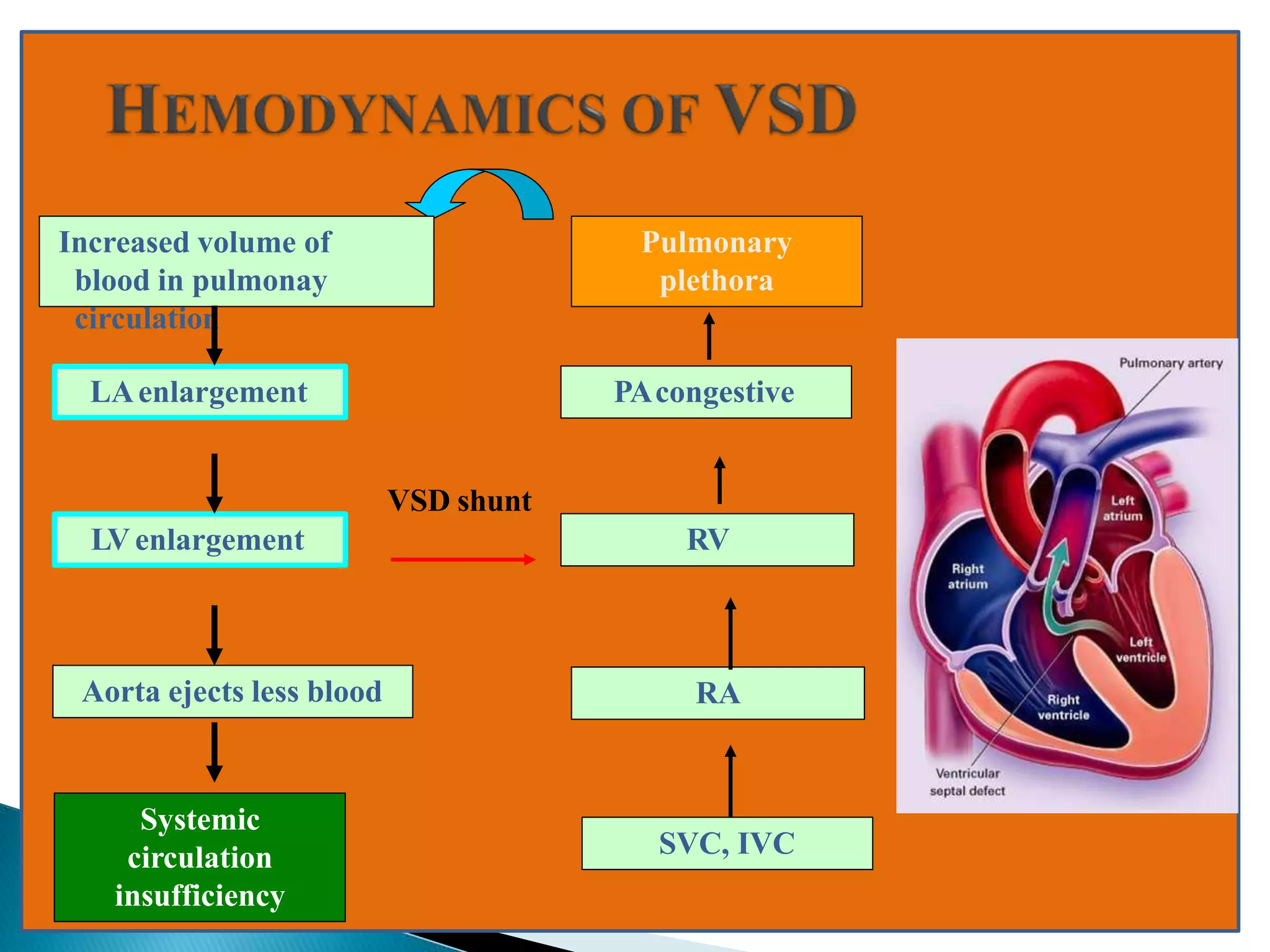
VSD shunt
Pulmonary
plethora
PAcongestive
RV
RA
SVC, IVC
Increased volume of
blood in pulmonay
circulation
LAenlargement
LV enlargement
Aorta ejects less blood
Systemic
circulation
insufficiency
SMALL VSD -
MODERATE / LARGE VSD - r :
Surgical
correction
has to be
done before
irreversible
damage to
pulmonary
vasculature
occurs.
Surgical correction
has to be done
before irreversible
changes in
pulmonary
vasculature occurs
5 operative approaches - RIGHT ATRIAL
TRANSPULMONARY
TRANSAORTIC
RIGHT VENTRICULAR
LEFT VENTRICULAR
1.Preoperative vsd location
2.Surgical technique to avoid injury to conduction
pathways
3.Operative technique needed to secure the closure
5 operative approaches
Right atrial
Transpulmonary
Left ventricular
Right ventricular
transaortic
Thank you

Ventricular septal defect

  • 1.
  • 2.
    • A VSDis a defect in the ventricular septum • Most common congenital cardiac anomalies. • 3-3.8 per 1000 live births • 30-60% of all newborns with a CHD • Prospective studies give a prevalence of 2-5 per 100 births of trabecular VSDs that closes shortly after birth in 80-90% of the cases
  • 3.
    • “Adevelopmental defectof the heart occurs from which cyanosis does not ensue inspite of the fact that a communication exists between the cavities of the two ventricles and inspite of the fact that admixture of venous blood and arterial blood occurs. This congenital defect , which is even compatible with a long life, is a simple one. It comprises a defect in the interventricular septum.” Henri Roger, 1879
  • 4.
     Complex non– planar structure; 4 components  Inlet septum – lightly trabeculated; extends from tricuspid annulus to attachments of tricuspid valve  Trabecular septum – heavily trabeculated; trabecular septum extends from inlet out to apex and up to smooth-walled outlet  Outlet septum – non trabeculated; extends up to pulmonary valve& diverge from small membranous septum  Membranous septum only fibrous component of IVS, wedged btwn AV,MV, TV.
  • 5.
  • 6.
    • Most commoncongenital heart lesion • Occurs in 50% of children with heart lesions • 15-20% in isolation • 5-50 per 1000 live births • 56% female
  • 7.
    • CLASSICAL • SOTO •VAN PRAAGH • ANDERSON • MORPHOLOGICAL (congenital heart surgery nomenclature & database project)
  • 8.
  • 9.
  • 10.
  • 11.
     Classification 1. Perimembranous Extension inlet outlet anterior 2.Muscular outlet/conal trabecular inlet anterior apical 3. Doubly committed subarterial 4. Inlet septal 5. Malalinged AV septal type Ant (TOF) Post(INTERRUPTED AORTIC ARCH) Rotational (Taussig bing)
  • 12.
    • Restrictive • Moderatelyrestrictive • Non restrictive
  • 13.
    – Restrictive- resistancethat limits the shunt at the site of vsd – < 0.5 cm2 (Smaller than Ao valve orifice area) – Small L to R shunt – Normal RV output – 75% spontaneously close < 2yrs LVSP > RVSP pulm /aortic systolic pressure ratio < 0.3 Qp / Qs<1.4--1
  • 14.
    • Moderately restrictive- RVSP high, but less than LVSP • Qp/Qs 1.4--2.2
  • 15.
     Non restrictive-Shunt not limited at the site of defect – > 1.0 cm2 (Equal to or greater than to Ao valve orifice area) – Large hemodynamically significant L to R shunt – Rarely close spontaneously -RVSP , LVSP,PA , Aortic systolic pressures equal - Qp/Qs >2.2 - Flow determined by PVR
  • 16.
    Small Size MediumSize Large Size Diameter (mm) Size (cm2) <5 <0.5 5~15 0.5~1.5 >15 >1.0 Shunt small medium large Symptom Non or little some Obvious Pul. Vessel No affection affected Pul. Arterial Hypertension Eisenmenger’s syndrome
  • 18.
    • Defect sizeis often compared to aortic annulus – Large: > 75% of annulus size – Medium: 75-33% of annulus size – Small: <33% of annulus size
  • 19.
    • Atrioventricular canaltype VSD • Muscular VSDs: midventricular (1), apical (2), anterior (3), and posterior (4) • Conoventricular septal defect, which includes perimembranous and malalignment conoventricular septal defects • Conal septal defects.
  • 20.
    • Conoventricular defectsare located between the conal septum and the ventricular septum. • They are centered in or around the membranous  septum and comprise 80% of all VSDs. • Located exclusively within the membranous septum, or can extend beyond the boundaries of the membranous septum toward inferior, posterior, or directions, and are then sometimes anterior called “perimembranous” or “paramembranous” VSDs.
  • 21.
    • The prefix“peri-,” appearing in loan words from the Greek, means “surrounding” (i.e., perimeter). As such, a truly perimembranous ventricular septal defect would surround the membranous septum. • In contrast, the prefix “para-,” also from the Greek, means “adjacent to” or “beside” and more accurately reflects the notion of a defect adjacent to the membranous septum. • Neither perimembranous nor paramembranous correctly describes the typical defect involving the membranous septum and extending into the adjacent septum.
  • 22.
    • The currentrecommendation is to call these defects either membranous VSDs or conoventricular defects. • Malalignment of ventricular septal the conal septal plane plane results in vis-à-vis the the typical conoventricular defect. • The malalignment can be anterior, as seen in tetralogy of Fallot, or posterior, as seen in interrupted aortic arch. • Anterior conal septal malalignment also results in RVOT • Posterior malalignment of the conal septum results in LVOT.
  • 23.
    • Important landmarksin conoventricular septal defects are the anteroseptal commissure of the tricuspid valve inferiorly and the noncoronary cusp of the aortic valve. • When the ventricular portion of the membranous septum is entirely absent, the VSD extends to the base of the aortic valve (sometimes called “subaortic” VSD). • The medial papillary muscle (muscle of Lancisi) located at the inferior–posterior border of the defect is also an important landmark. • Both the septal and anterior tricuspid valve leaflets are attached to it.
  • 24.
    • Approximately 8%of VSDs are located in the conal (infundibulum or outlet) septum. • They also are called supracristal VSDs. • They are either entirely surrounded by muscle (muscular conal VSDs) or limited upstream by the aortic or pulmonary annuli (sometimes called subarterial VSDs).
  • 25.
    • This defectis characterized by the absence of part or all of the inlet septum. • The VSD is located immediately underneath the septal leaflet of the tricuspid valve with no tissue in between. • Approximately 6% of all VSDs are inlet-type VSDs.
  • 26.
    • Muscular VSDs(10% of all VSDs) are entirely surrounded by muscle. • They can occur anywhere in the trabecular portion of the septum and can be isolated or multiple. • They are described by their location, that is, anterior, midventricular, posterior, or apical. • When inspected through the left side of the septum, what appeared to be multiple muscular defects often converge into either a single hole or two separate holes.
  • 27.
    • Blood flowdependent on multiple factors –Small and restrictive • Lesion sizesize –Large and non-restrictive • BalanP cu elm bo en ta wry eev nasc pu ula lr monaryandresistance systemic vascular resistance systemic vascular resistance
  • 28.
    VSD shunt Pulmonary plethora PAcongestive RV RA SVC, IVC Increasedvolume of blood in pulmonay circulation LAenlargement LV enlargement Aorta ejects less blood Systemic circulation insufficiency
  • 29.
    SMALL VSD - MODERATE/ LARGE VSD - r :
  • 30.
    Surgical correction has to be donebefore irreversible damage to pulmonary vasculature occurs. Surgical correction has to be done before irreversible changes in pulmonary vasculature occurs
  • 32.
    5 operative approaches- RIGHT ATRIAL TRANSPULMONARY TRANSAORTIC RIGHT VENTRICULAR LEFT VENTRICULAR 1.Preoperative vsd location 2.Surgical technique to avoid injury to conduction pathways 3.Operative technique needed to secure the closure 5 operative approaches Right atrial Transpulmonary Left ventricular Right ventricular transaortic
  • 37.